
Critical Realism as a Framework Steve Vincent
Description: Critical Realism as a Framework Steve Vincent Newcastle University Business School Overview This topic is about using Critical Realism CR as a framework I asked myself the question: how do the conceptual parts of CR combine to help us to
Related Topics
Download Presentation
"Critical Realism as a Framework Steve Vincent" is the property of its rightful owner. Permission is granted to download and print the materials on this website for personal, non-commercial use only, and to display it on your personal computer provided you do not modify the materials and that you retain all copyright notices contained in the materials. By downloading content from our website, you accept the terms of this agreement.
Presentation Transcript
slide1. Critical Realism as a Framework Steve Vincent
Newcastle University Business School<br>
slide2. Overview This topic is about using Critical Realism [CR] as a framework
I asked myself the question: how do the conceptual parts of CR combine to help us to develop and assimilate knowledge about the [social] world?
Leveraging the lexicon: using CR and RST to bringing other theory together in explanations [my examples]…
CR and the political economy of HRM
Bourdieu and the social structure of HRM consultant’s networks<br>
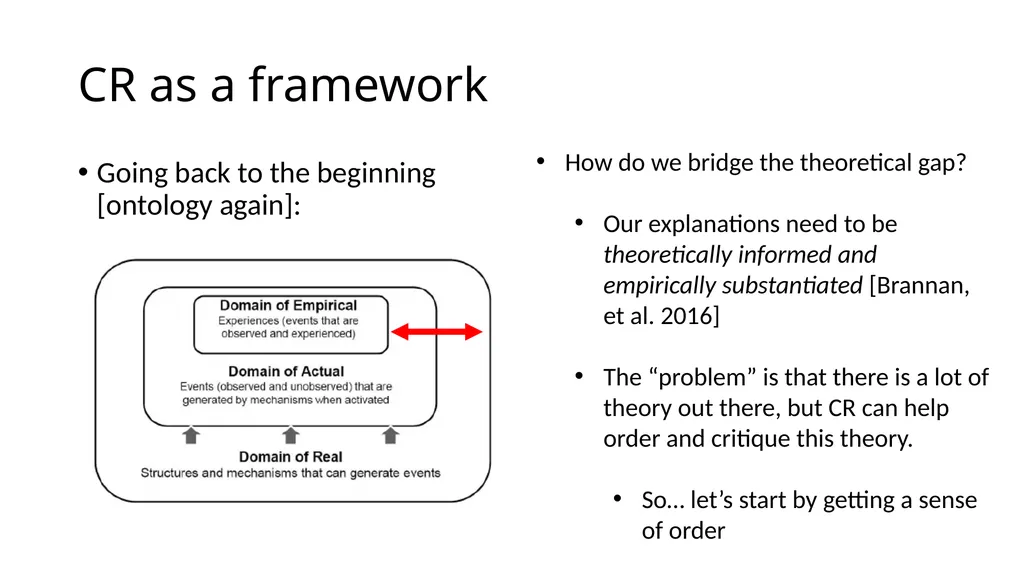
slide3. CR as a framework Going back to the beginning [ontology again]: How do we bridge the theoretical gap?
Our explanations need to be theoretically informed and empirically substantiated [Brannan, et al. 2016]
The “problem” is that there is a lot of theory out there, but CR can help order and critique this theory.
So… let’s start by getting a sense of order<br>
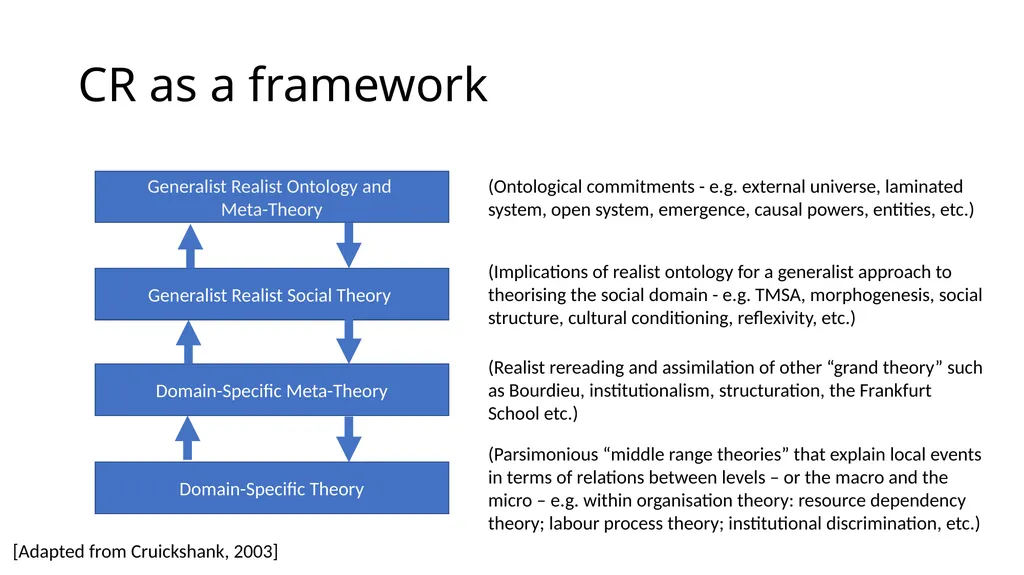
slide4. Generalist Realist Ontology and
Meta-Theory Generalist Realist Social Theory Domain-Specific Theory (Realist rereading and assimilation of other “grand theory” such as Bourdieu, institutionalism, structuration, the Frankfurt School etc.) [Adapted from Cruickshank, 2003] (Parsimonious “middle range theories” that explain local events in terms of relations between levels – or the macro and the micro – e.g. within organisation theory: resource dependency theory; labour process theory; institutional discrimination, etc.) CR as a framework (Ontological commitments - e.g. external universe, laminated system, open system, emergence, causal powers, entities, etc.) Domain-Specific Meta-Theory (Implications of realist ontology for a generalist approach to theorising the social domain - e.g. TMSA, morphogenesis, social structure, cultural conditioning, reflexivity, etc.)<br>
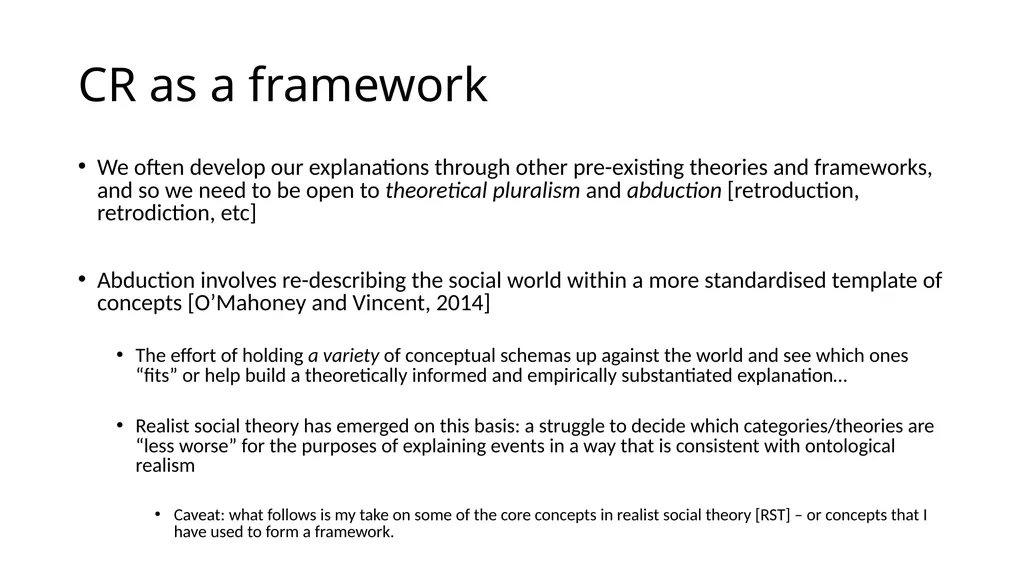
slide5. CR as a framework We often develop our explanations through other pre-existing theories and frameworks, and so we need to be open to theoretical pluralism and abduction [retroduction, retrodiction, etc]
Abduction involves re-describing the social world within a more standardised template of concepts [O’Mahoney and Vincent, 2014]
The effort of holding a variety of conceptual schemas up against the world and see which ones “fits” or help build a theoretically informed and empirically substantiated explanation…
Realist social theory has emerged on this basis: a struggle to decide which categories/theories are “less worse” for the purposes of explaining events in a way that is consistent with ontological realism
Caveat: what follows is my take on some of the core concepts in realist social theory [RST] – or concepts that I have used to form a framework.<br>
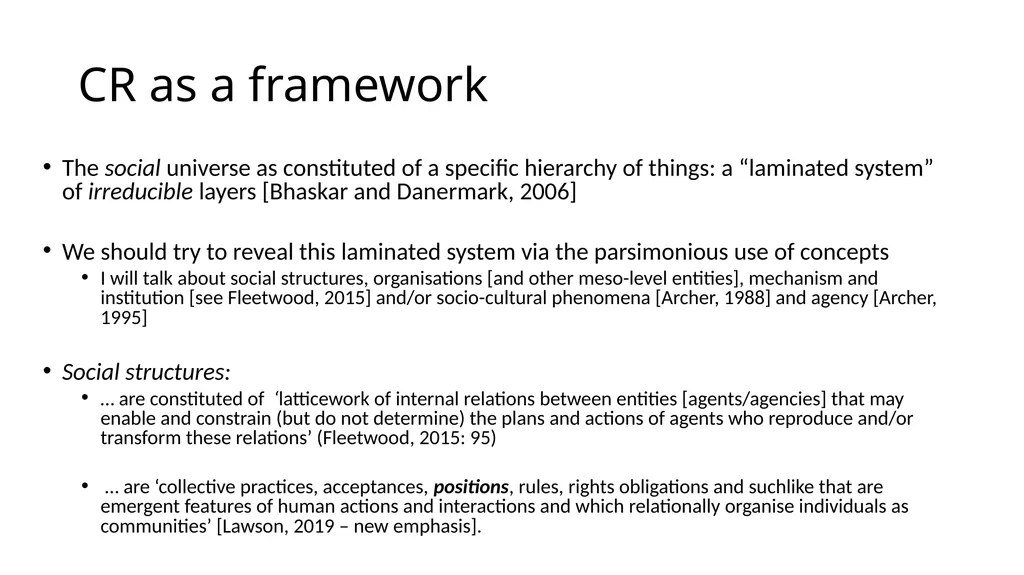
slide6. CR as a framework The social universe as constituted of a specific hierarchy of things: a “laminated system” of irreducible layers [Bhaskar and Danermark, 2006]
We should try to reveal this laminated system via the parsimonious use of concepts
I will talk about social structures, organisations [and other meso-level entities], mechanism and institution [see Fleetwood, 2015] and/or socio-cultural phenomena [Archer, 1988] and agency [Archer, 1995]
Social structures:
… are constituted of ‘latticework of internal relations between entities [agents/agencies] that may enable and constrain (but do not determine) the plans and actions of agents who reproduce and/or transform these relations’ (Fleetwood, 2015: 95)
… are ‘collective practices, acceptances, positions, rules, rights obligations and suchlike that are emergent features of human actions and interactions and which relationally organise individuals as communities’ [Lawson, 2019 – new emphasis].<br>
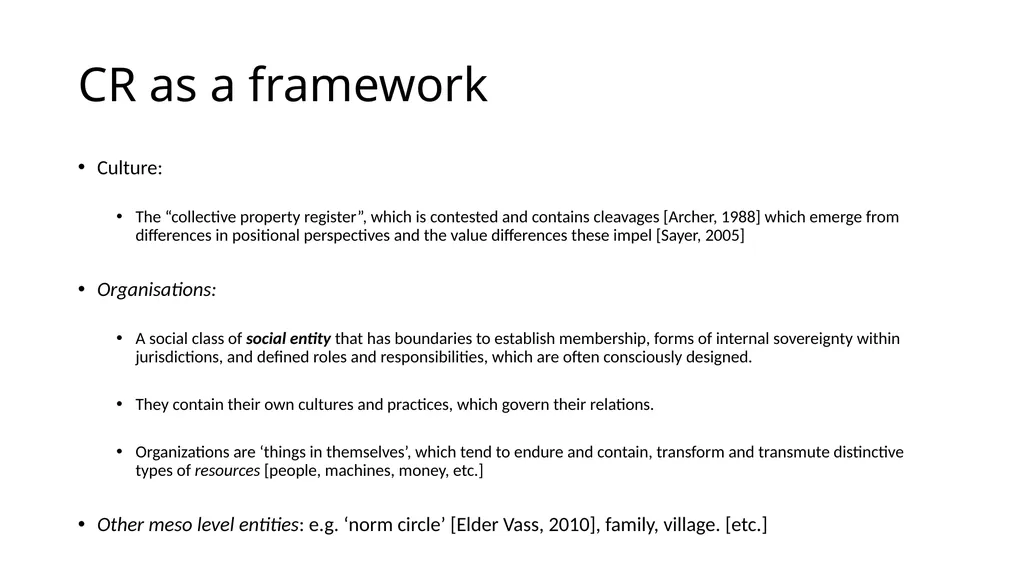
slide7. CR as a framework Culture:
The “collective property register”, which is contested and contains cleavages [Archer, 1988] which emerge from differences in positional perspectives and the value differences these impel [Sayer, 2005]
Organisations:
A social class of social entity that has boundaries to establish membership, forms of internal sovereignty within jurisdictions, and defined roles and responsibilities, which are often consciously designed.
They contain their own cultures and practices, which govern their relations.
Organizations are ‘things in themselves’, which tend to endure and contain, transform and transmute distinctive types of resources [people, machines, money, etc.]
Other meso level entities: e.g. ‘norm circle’ [Elder Vass, 2010], family, village. [etc.]<br>
slide8. CR as a framework Mechanisms:
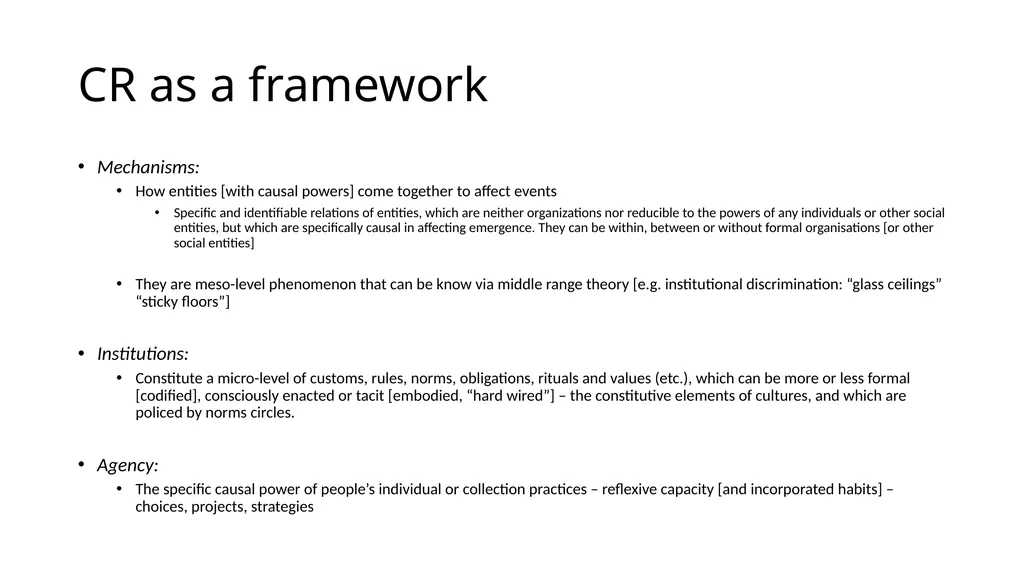
How entities [with causal powers] come together to affect events
Specific and identifiable relations of entities, which are neither organizations nor reducible to the powers of any individuals or other social entities, but which are specifically causal in affecting emergence. They can be within, between or without formal organisations [or other social entities]
They are meso-level phenomenon that can be know via middle range theory [e.g. institutional discrimination: “glass ceilings” “sticky floors”]
Institutions:
Constitute a micro-level of customs, rules, norms, obligations, rituals and values (etc.), which can be more or less formal [codified], consciously enacted or tacit [embodied, “hard wired”] – the constitutive elements of cultures, and which are policed by norms circles.
Agency:
The specific causal power of people’s individual or collection practices – reflexive capacity [and incorporated habits] – choices, projects, strategies<br>
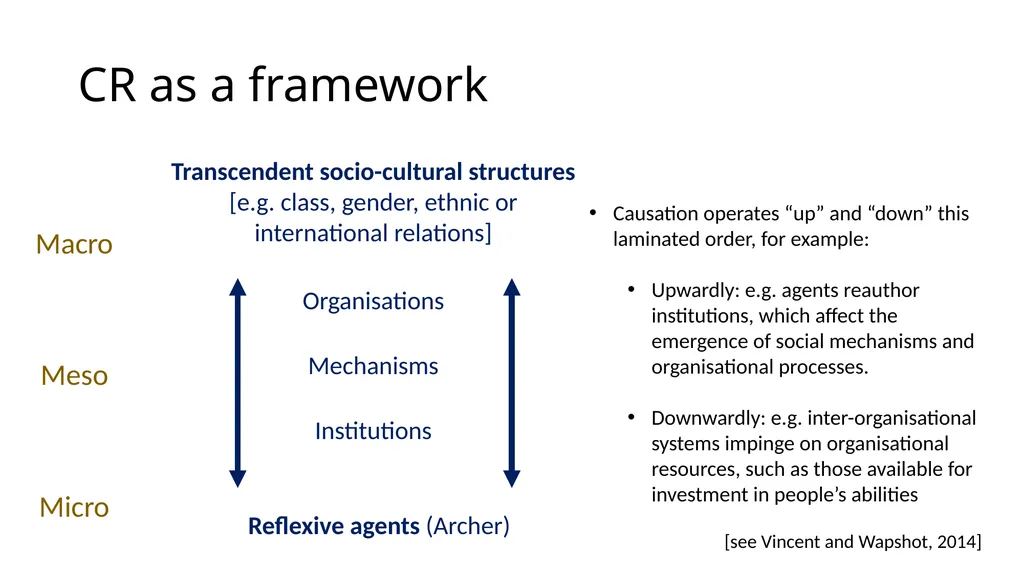
slide9. CR as a framework Macro Meso Micro Transcendent socio-cultural structures
[e.g. class, gender, ethnic or international relations] Organisations Mechanisms Reflexive agents (Archer) Institutions Causation operates “up” and “down” this laminated order, for example:
Upwardly: e.g. agents reauthor institutions, which affect the emergence of social mechanisms and organisational processes.
Downwardly: e.g. inter-organisational systems impinge on organisational resources, such as those available for investment in people’s abilities
[see Vincent and Wapshot, 2014]<br>
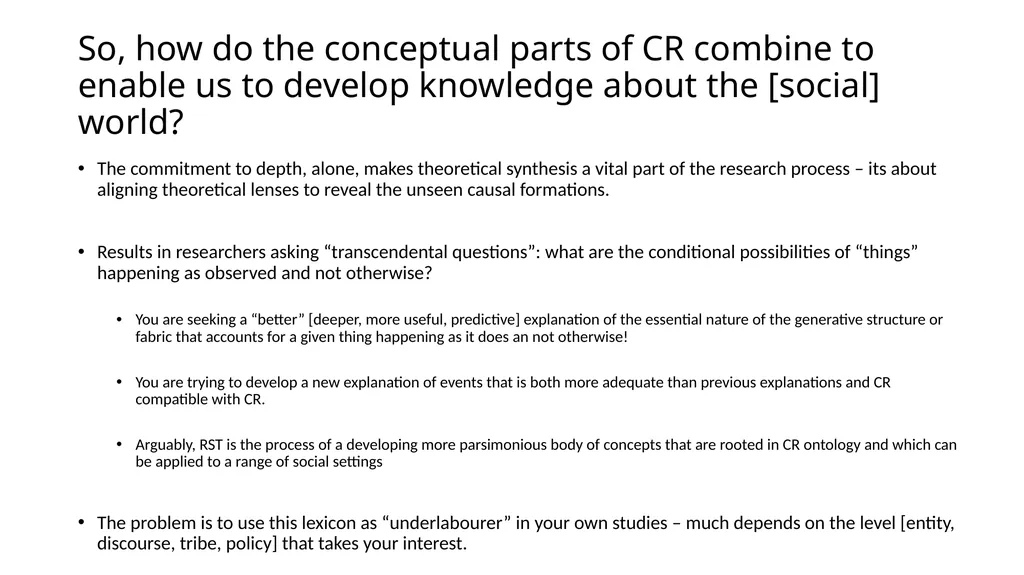
slide10. So, how do the conceptual parts of CR combine to enable us to develop knowledge about the [social] world? The commitment to depth, alone, makes theoretical synthesis a vital part of the research process – its about aligning theoretical lenses to reveal the unseen causal formations.
Results in researchers asking “transcendental questions”: what are the conditional possibilities of “things” happening as observed and not otherwise?
You are seeking a “better” [deeper, more useful, predictive] explanation of the essential nature of the generative structure or fabric that accounts for a given thing happening as it does an not otherwise!
You are trying to develop a new explanation of events that is both more adequate than previous explanations and CR compatible with CR.
Arguably, RST is the process of a developing more parsimonious body of concepts that are rooted in CR ontology and which can be applied to a range of social settings
The problem is to use this lexicon as “underlabourer” in your own studies – much depends on the level [entity, discourse, tribe, policy] that takes your interest.<br>
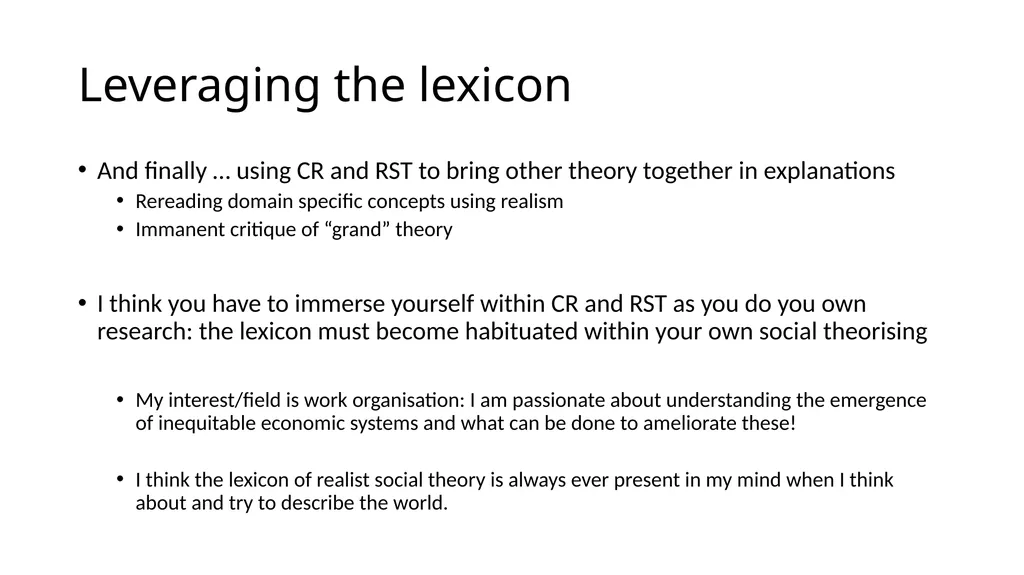
slide11. Leveraging the lexicon And finally … using CR and RST to bring other theory together in explanations
Rereading domain specific concepts using realism
Immanent critique of “grand” theory
I think you have to immerse yourself within CR and RST as you do you own research: the lexicon must become habituated within your own social theorising
My interest/field is work organisation: I am passionate about understanding the emergence of inequitable economic systems and what can be done to ameliorate these!
I think the lexicon of realist social theory is always ever present in my mind when I think about and try to describe the world.<br>
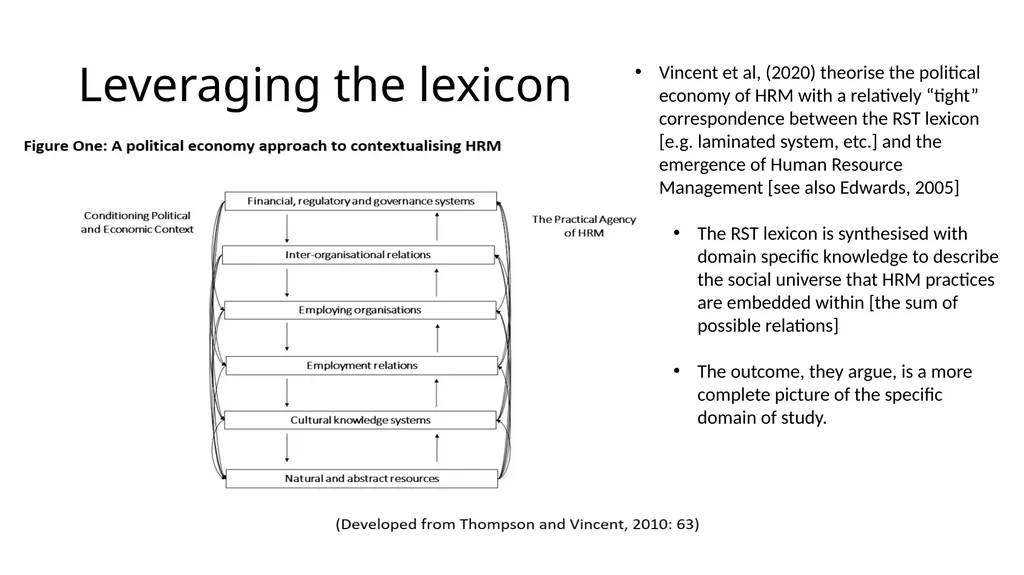
slide12. Leveraging the lexicon Vincent et al, (2020) theorise the political economy of HRM with a relatively “tight” correspondence between the RST lexicon [e.g. laminated system, etc.] and the emergence of Human Resource Management [see also Edwards, 2005]
The RST lexicon is synthesised with domain specific knowledge to describe the social universe that HRM practices are embedded within [the sum of possible relations]
The outcome, they argue, is a more complete picture of the specific domain of study.<br>
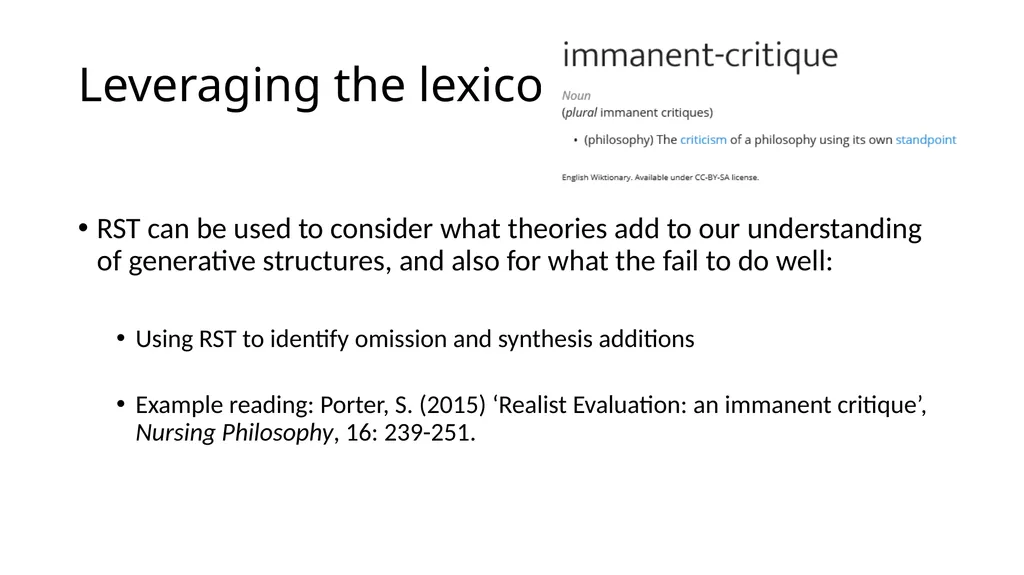
slide13. Leveraging the lexicon RST can be used to consider what theories add to our understanding of generative structures, and also for what the fail to do well:
Using RST to identify omission and synthesis additions
Example reading: Porter, S. (2015) ‘Realist Evaluation: an immanent critique’, Nursing Philosophy, 16: 239-251.<br>
slide14. Leveraging the lexicon Vincent and Pagan (2019) offer an immanent critique of Bourdieu using the RST lexicon
Bourdieu is GREAT! He explain just about everything in the social world in terms of a handful of parsimonious concepts, and this is why he is so well cited!!
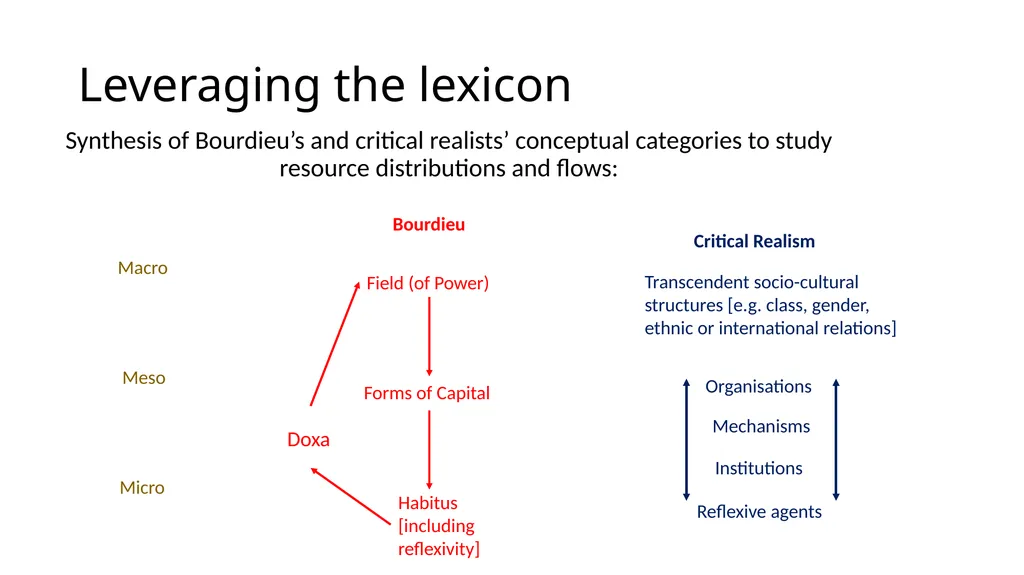
Field (of power and resources) [macro-level] and position [micro-level 1]
Forms of capital (economic, social, cultural, symbolic) as making fields “distinct” [meso-level 1]
Doxa – the “rules of the game” [viz. institution] which can be contested locally [meso-level 2]
Habitus – “structuring structures” or “feel for the game” - often tacit, but also strategic; deportments, manners, accents, styles, (etc.) - includes reflexive struggle for what is at stake in the game [i.e. to contest doxa] and illusio – one’s sense of investment in the game [micro-level 2]
The Bourdieusian hierarchy of concepts has a built in “layered” affinity with RST!<br>
slide15. Leveraging the lexicon In Bourdieusian scholarship, the meso-level (local social rules [doxa] and forms of capital, which impel the “field of power”) is left as a matter for local determination – as distinct to your setting
And yet, cultural capital and social capital are heterogeneous and emergent from ontologically various things (as embodied, signified, collective recognised, instituted and organised).
How, then, do you unpack, explore and explain all this “social stuff”?
Unfortunately, this is where Bourdieu provides less help than one might expect ….<br>
slide16. Leveraging the lexicon Arguably, as a consequence of this issue, Bourdieusian scholars rather gloss over the field as an independent analytical category
Vincent and Pagan [2019] looked at the entrepreneurship research and failed to find one paper that used more than a paragraph to reflect on the causal properties of fields
Bourdieusian scholars often prioritise agency [habitus/strategy] as “structuring structures” over real structures [the field], often asserting things like: ‘identities and external environment get jointly and simultaneously co-created’ [De Clercq and Voronov, 2009].
In Archer’s [2003] terms, such analyses are guilty of central conflation – the failure to separate the causal properties of the parts from the causal properties of the people.
We argue that central conflation is not necessary when using Bourdieusian concepts – it can be corrected using CR concepts!<br>
slide17. Leveraging the lexicon Synthesis of Bourdieu’s and critical realists’ conceptual categories to study resource distributions and flows: Field (of Power) Forms of Capital Macro Meso Micro Habitus [including reflexivity] Transcendent socio-cultural structures [e.g. class, gender, ethnic or international relations] Organisations Mechanisms Reflexive agents Critical Realism Bourdieu Doxa Institutions<br>
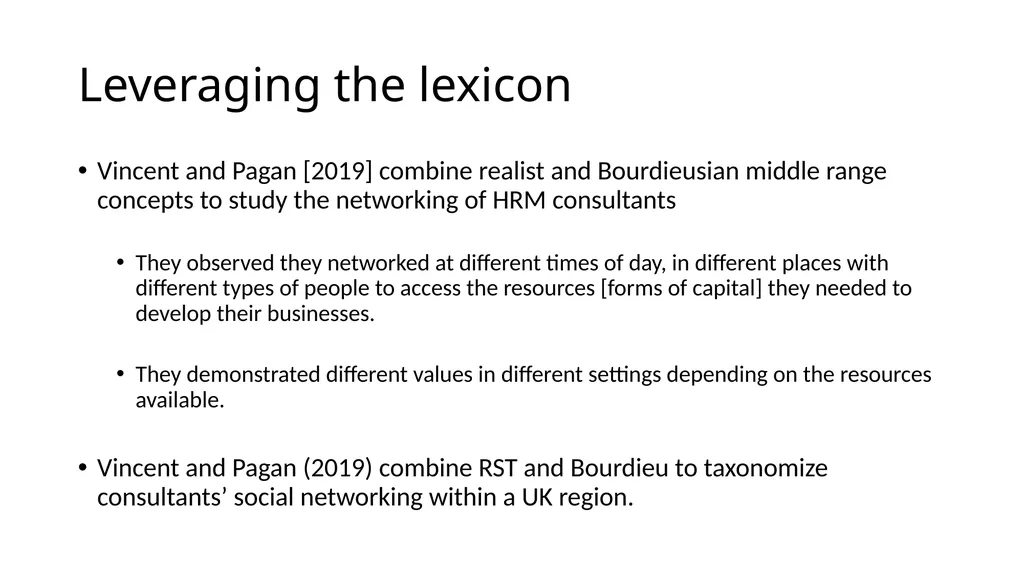
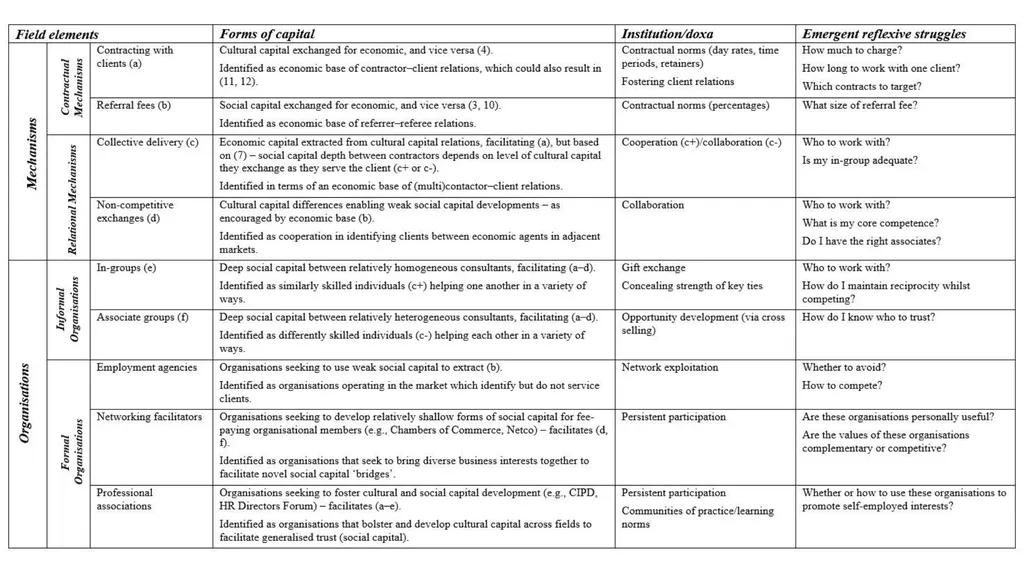
slide18. Leveraging the lexicon Vincent and Pagan [2019] combine realist and Bourdieusian middle range concepts to study the networking of HRM consultants
They observed they networked at different times of day, in different places with different types of people to access the resources [forms of capital] they needed to develop their businesses.
They demonstrated different values in different settings depending on the resources available.
Vincent and Pagan (2019) combine RST and Bourdieu to taxonomize consultants’ social networking within a UK region.<br>
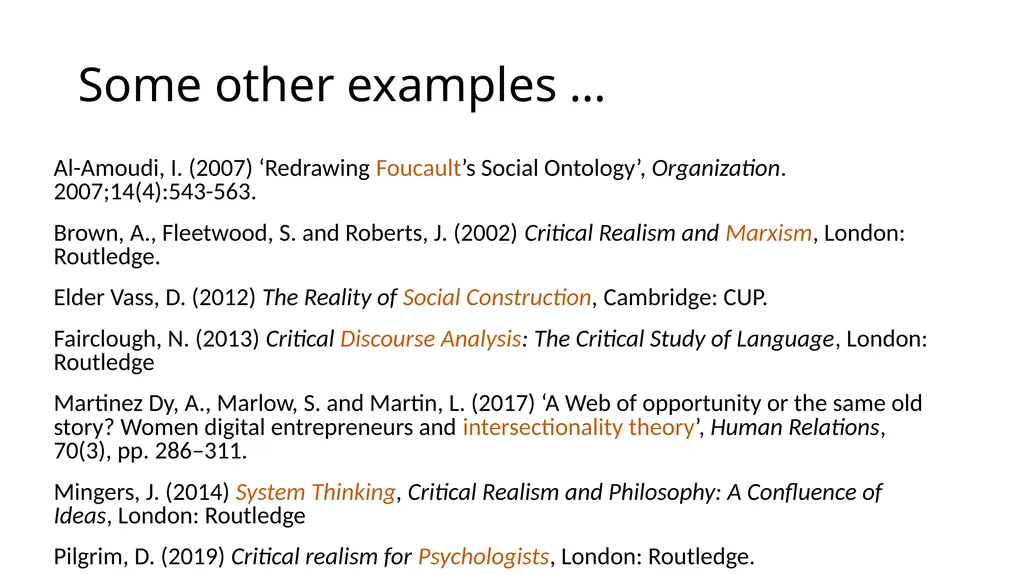
slide20. Some other examples … Al-Amoudi, I. (2007) ‘Redrawing Foucault’s Social Ontology’, Organization. 2007;14(4):543-563.
Brown, A., Fleetwood, S. and Roberts, J. (2002) Critical Realism and Marxism, London: Routledge.
Elder Vass, D. (2012) The Reality of Social Construction, Cambridge: CUP.
Fairclough, N. (2013) Critical Discourse Analysis: The Critical Study of Language, London: Routledge
Martinez Dy, A., Marlow, S. and Martin, L. (2017) ‘A Web of opportunity or the same old story? Women digital entrepreneurs and intersectionality theory’, Human Relations, 70(3), pp. 286–311.
Mingers, J. (2014) System Thinking, Critical Realism and Philosophy: A Confluence of Ideas, London: Routledge
Pilgrim, D. (2019) Critical realism for Psychologists, London: Routledge.<br>
slide21. Final thoughts … We found combining RST with Bourdieu allowed a sophisticated resource informed perspective on the causal properties of social structure.
Clearly, others use CR ontology and RST in different ways depending on their point of interest – what they are trying to explain.
Do you have any questions?
To stimulate discussion, perhaps you can tell us how incorporating domain specific ideas into a realist informed study, as well as to take any questions!<br>
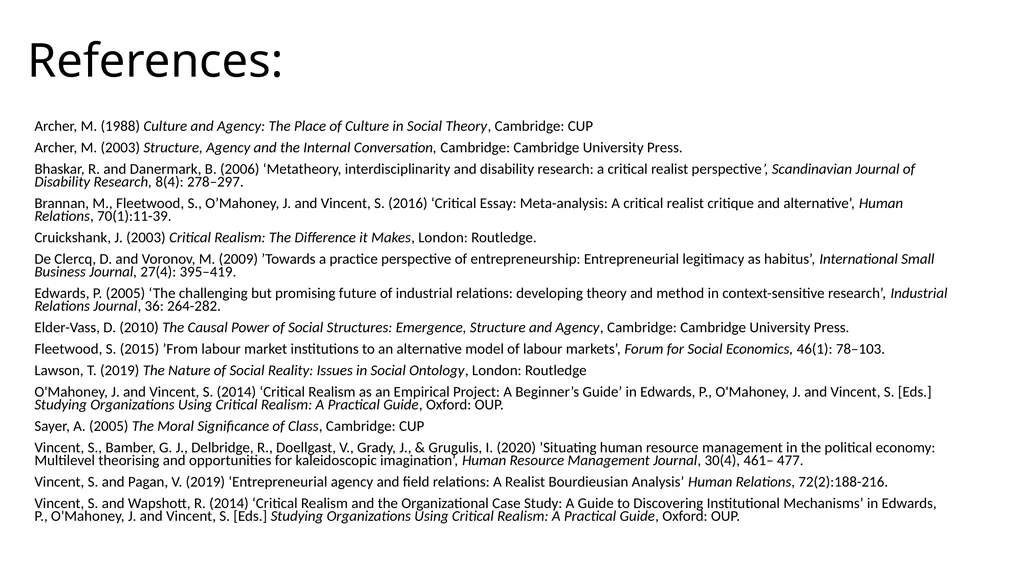
slide22. References: Archer, M. (1988) Culture and Agency: The Place of Culture in Social Theory, Cambridge: CUP
Archer, M. (2003) Structure, Agency and the Internal Conversation, Cambridge: Cambridge University Press.
Bhaskar, R. and Danermark, B. (2006) ‘Metatheory, interdisciplinarity and disability research: a critical realist perspective’, Scandinavian Journal of Disability Research, 8(4): 278–297.
Brannan, M., Fleetwood, S., O’Mahoney, J. and Vincent, S. (2016) ‘Critical Essay: Meta-analysis: A critical realist critique and alternative’, Human Relations, 70(1):11-39.
Cruickshank, J. (2003) Critical Realism: The Difference it Makes, London: Routledge.
De Clercq, D. and Voronov, M. (2009) ’Towards a practice perspective of entrepreneurship: Entrepreneurial legitimacy as habitus’, International Small Business Journal, 27(4): 395–419.
Edwards, P. (2005) ‘The challenging but promising future of industrial relations: developing theory and method in context-sensitive research’, Industrial Relations Journal, 36: 264-282.
Elder-Vass, D. (2010) The Causal Power of Social Structures: Emergence, Structure and Agency, Cambridge: Cambridge University Press.
Fleetwood, S. (2015) ’From labour market institutions to an alternative model of labour markets’, Forum for Social Economics, 46(1): 78–103.
Lawson, T. (2019) The Nature of Social Reality: Issues in Social Ontology, London: Routledge
O'Mahoney, J. and Vincent, S. (2014) ‘Critical Realism as an Empirical Project: A Beginner’s Guide’ in Edwards, P., O'Mahoney, J. and Vincent, S. [Eds.] Studying Organizations Using Critical Realism: A Practical Guide, Oxford: OUP.
Sayer, A. (2005) The Moral Significance of Class, Cambridge: CUP
Vincent, S., Bamber, G. J., Delbridge, R., Doellgast, V., Grady, J., & Grugulis, I. (2020) ’Situating human resource management in the political economy: Multilevel theorising and opportunities for kaleidoscopic imagination’, Human Resource Management Journal, 30(4), 461– 477.
Vincent, S. and Pagan, V. (2019) ‘Entrepreneurial agency and field relations: A Realist Bourdieusian Analysis’ Human Relations, 72(2):188-216.
Vincent, S. and Wapshott, R. (2014) ‘Critical Realism and the Organizational Case Study: A Guide to Discovering Institutional Mechanisms’ in Edwards, P., O'Mahoney, J. and Vincent, S. [Eds.] Studying Organizations Using Critical Realism: A Practical Guide, Oxford: OUP.<br>
Newcastle University Business School<br>
slide2. Overview This topic is about using Critical Realism [CR] as a framework
I asked myself the question: how do the conceptual parts of CR combine to help us to develop and assimilate knowledge about the [social] world?
Leveraging the lexicon: using CR and RST to bringing other theory together in explanations [my examples]…
CR and the political economy of HRM
Bourdieu and the social structure of HRM consultant’s networks<br>
slide3. CR as a framework Going back to the beginning [ontology again]: How do we bridge the theoretical gap?
Our explanations need to be theoretically informed and empirically substantiated [Brannan, et al. 2016]
The “problem” is that there is a lot of theory out there, but CR can help order and critique this theory.
So… let’s start by getting a sense of order<br>
slide4. Generalist Realist Ontology and
Meta-Theory Generalist Realist Social Theory Domain-Specific Theory (Realist rereading and assimilation of other “grand theory” such as Bourdieu, institutionalism, structuration, the Frankfurt School etc.) [Adapted from Cruickshank, 2003] (Parsimonious “middle range theories” that explain local events in terms of relations between levels – or the macro and the micro – e.g. within organisation theory: resource dependency theory; labour process theory; institutional discrimination, etc.) CR as a framework (Ontological commitments - e.g. external universe, laminated system, open system, emergence, causal powers, entities, etc.) Domain-Specific Meta-Theory (Implications of realist ontology for a generalist approach to theorising the social domain - e.g. TMSA, morphogenesis, social structure, cultural conditioning, reflexivity, etc.)<br>
slide5. CR as a framework We often develop our explanations through other pre-existing theories and frameworks, and so we need to be open to theoretical pluralism and abduction [retroduction, retrodiction, etc]
Abduction involves re-describing the social world within a more standardised template of concepts [O’Mahoney and Vincent, 2014]
The effort of holding a variety of conceptual schemas up against the world and see which ones “fits” or help build a theoretically informed and empirically substantiated explanation…
Realist social theory has emerged on this basis: a struggle to decide which categories/theories are “less worse” for the purposes of explaining events in a way that is consistent with ontological realism
Caveat: what follows is my take on some of the core concepts in realist social theory [RST] – or concepts that I have used to form a framework.<br>
slide6. CR as a framework The social universe as constituted of a specific hierarchy of things: a “laminated system” of irreducible layers [Bhaskar and Danermark, 2006]
We should try to reveal this laminated system via the parsimonious use of concepts
I will talk about social structures, organisations [and other meso-level entities], mechanism and institution [see Fleetwood, 2015] and/or socio-cultural phenomena [Archer, 1988] and agency [Archer, 1995]
Social structures:
… are constituted of ‘latticework of internal relations between entities [agents/agencies] that may enable and constrain (but do not determine) the plans and actions of agents who reproduce and/or transform these relations’ (Fleetwood, 2015: 95)
… are ‘collective practices, acceptances, positions, rules, rights obligations and suchlike that are emergent features of human actions and interactions and which relationally organise individuals as communities’ [Lawson, 2019 – new emphasis].<br>
slide7. CR as a framework Culture:
The “collective property register”, which is contested and contains cleavages [Archer, 1988] which emerge from differences in positional perspectives and the value differences these impel [Sayer, 2005]
Organisations:
A social class of social entity that has boundaries to establish membership, forms of internal sovereignty within jurisdictions, and defined roles and responsibilities, which are often consciously designed.
They contain their own cultures and practices, which govern their relations.
Organizations are ‘things in themselves’, which tend to endure and contain, transform and transmute distinctive types of resources [people, machines, money, etc.]
Other meso level entities: e.g. ‘norm circle’ [Elder Vass, 2010], family, village. [etc.]<br>
slide8. CR as a framework Mechanisms:
How entities [with causal powers] come together to affect events
Specific and identifiable relations of entities, which are neither organizations nor reducible to the powers of any individuals or other social entities, but which are specifically causal in affecting emergence. They can be within, between or without formal organisations [or other social entities]
They are meso-level phenomenon that can be know via middle range theory [e.g. institutional discrimination: “glass ceilings” “sticky floors”]
Institutions:
Constitute a micro-level of customs, rules, norms, obligations, rituals and values (etc.), which can be more or less formal [codified], consciously enacted or tacit [embodied, “hard wired”] – the constitutive elements of cultures, and which are policed by norms circles.
Agency:
The specific causal power of people’s individual or collection practices – reflexive capacity [and incorporated habits] – choices, projects, strategies<br>
slide9. CR as a framework Macro Meso Micro Transcendent socio-cultural structures
[e.g. class, gender, ethnic or international relations] Organisations Mechanisms Reflexive agents (Archer) Institutions Causation operates “up” and “down” this laminated order, for example:
Upwardly: e.g. agents reauthor institutions, which affect the emergence of social mechanisms and organisational processes.
Downwardly: e.g. inter-organisational systems impinge on organisational resources, such as those available for investment in people’s abilities
[see Vincent and Wapshot, 2014]<br>
slide10. So, how do the conceptual parts of CR combine to enable us to develop knowledge about the [social] world? The commitment to depth, alone, makes theoretical synthesis a vital part of the research process – its about aligning theoretical lenses to reveal the unseen causal formations.
Results in researchers asking “transcendental questions”: what are the conditional possibilities of “things” happening as observed and not otherwise?
You are seeking a “better” [deeper, more useful, predictive] explanation of the essential nature of the generative structure or fabric that accounts for a given thing happening as it does an not otherwise!
You are trying to develop a new explanation of events that is both more adequate than previous explanations and CR compatible with CR.
Arguably, RST is the process of a developing more parsimonious body of concepts that are rooted in CR ontology and which can be applied to a range of social settings
The problem is to use this lexicon as “underlabourer” in your own studies – much depends on the level [entity, discourse, tribe, policy] that takes your interest.<br>
slide11. Leveraging the lexicon And finally … using CR and RST to bring other theory together in explanations
Rereading domain specific concepts using realism
Immanent critique of “grand” theory
I think you have to immerse yourself within CR and RST as you do you own research: the lexicon must become habituated within your own social theorising
My interest/field is work organisation: I am passionate about understanding the emergence of inequitable economic systems and what can be done to ameliorate these!
I think the lexicon of realist social theory is always ever present in my mind when I think about and try to describe the world.<br>
slide12. Leveraging the lexicon Vincent et al, (2020) theorise the political economy of HRM with a relatively “tight” correspondence between the RST lexicon [e.g. laminated system, etc.] and the emergence of Human Resource Management [see also Edwards, 2005]
The RST lexicon is synthesised with domain specific knowledge to describe the social universe that HRM practices are embedded within [the sum of possible relations]
The outcome, they argue, is a more complete picture of the specific domain of study.<br>
slide13. Leveraging the lexicon RST can be used to consider what theories add to our understanding of generative structures, and also for what the fail to do well:
Using RST to identify omission and synthesis additions
Example reading: Porter, S. (2015) ‘Realist Evaluation: an immanent critique’, Nursing Philosophy, 16: 239-251.<br>
slide14. Leveraging the lexicon Vincent and Pagan (2019) offer an immanent critique of Bourdieu using the RST lexicon
Bourdieu is GREAT! He explain just about everything in the social world in terms of a handful of parsimonious concepts, and this is why he is so well cited!!
Field (of power and resources) [macro-level] and position [micro-level 1]
Forms of capital (economic, social, cultural, symbolic) as making fields “distinct” [meso-level 1]
Doxa – the “rules of the game” [viz. institution] which can be contested locally [meso-level 2]
Habitus – “structuring structures” or “feel for the game” - often tacit, but also strategic; deportments, manners, accents, styles, (etc.) - includes reflexive struggle for what is at stake in the game [i.e. to contest doxa] and illusio – one’s sense of investment in the game [micro-level 2]
The Bourdieusian hierarchy of concepts has a built in “layered” affinity with RST!<br>
slide15. Leveraging the lexicon In Bourdieusian scholarship, the meso-level (local social rules [doxa] and forms of capital, which impel the “field of power”) is left as a matter for local determination – as distinct to your setting
And yet, cultural capital and social capital are heterogeneous and emergent from ontologically various things (as embodied, signified, collective recognised, instituted and organised).
How, then, do you unpack, explore and explain all this “social stuff”?
Unfortunately, this is where Bourdieu provides less help than one might expect ….<br>
slide16. Leveraging the lexicon Arguably, as a consequence of this issue, Bourdieusian scholars rather gloss over the field as an independent analytical category
Vincent and Pagan [2019] looked at the entrepreneurship research and failed to find one paper that used more than a paragraph to reflect on the causal properties of fields
Bourdieusian scholars often prioritise agency [habitus/strategy] as “structuring structures” over real structures [the field], often asserting things like: ‘identities and external environment get jointly and simultaneously co-created’ [De Clercq and Voronov, 2009].
In Archer’s [2003] terms, such analyses are guilty of central conflation – the failure to separate the causal properties of the parts from the causal properties of the people.
We argue that central conflation is not necessary when using Bourdieusian concepts – it can be corrected using CR concepts!<br>
slide17. Leveraging the lexicon Synthesis of Bourdieu’s and critical realists’ conceptual categories to study resource distributions and flows: Field (of Power) Forms of Capital Macro Meso Micro Habitus [including reflexivity] Transcendent socio-cultural structures [e.g. class, gender, ethnic or international relations] Organisations Mechanisms Reflexive agents Critical Realism Bourdieu Doxa Institutions<br>
slide18. Leveraging the lexicon Vincent and Pagan [2019] combine realist and Bourdieusian middle range concepts to study the networking of HRM consultants
They observed they networked at different times of day, in different places with different types of people to access the resources [forms of capital] they needed to develop their businesses.
They demonstrated different values in different settings depending on the resources available.
Vincent and Pagan (2019) combine RST and Bourdieu to taxonomize consultants’ social networking within a UK region.<br>
slide20. Some other examples … Al-Amoudi, I. (2007) ‘Redrawing Foucault’s Social Ontology’, Organization. 2007;14(4):543-563.
Brown, A., Fleetwood, S. and Roberts, J. (2002) Critical Realism and Marxism, London: Routledge.
Elder Vass, D. (2012) The Reality of Social Construction, Cambridge: CUP.
Fairclough, N. (2013) Critical Discourse Analysis: The Critical Study of Language, London: Routledge
Martinez Dy, A., Marlow, S. and Martin, L. (2017) ‘A Web of opportunity or the same old story? Women digital entrepreneurs and intersectionality theory’, Human Relations, 70(3), pp. 286–311.
Mingers, J. (2014) System Thinking, Critical Realism and Philosophy: A Confluence of Ideas, London: Routledge
Pilgrim, D. (2019) Critical realism for Psychologists, London: Routledge.<br>
slide21. Final thoughts … We found combining RST with Bourdieu allowed a sophisticated resource informed perspective on the causal properties of social structure.
Clearly, others use CR ontology and RST in different ways depending on their point of interest – what they are trying to explain.
Do you have any questions?
To stimulate discussion, perhaps you can tell us how incorporating domain specific ideas into a realist informed study, as well as to take any questions!<br>
slide22. References: Archer, M. (1988) Culture and Agency: The Place of Culture in Social Theory, Cambridge: CUP
Archer, M. (2003) Structure, Agency and the Internal Conversation, Cambridge: Cambridge University Press.
Bhaskar, R. and Danermark, B. (2006) ‘Metatheory, interdisciplinarity and disability research: a critical realist perspective’, Scandinavian Journal of Disability Research, 8(4): 278–297.
Brannan, M., Fleetwood, S., O’Mahoney, J. and Vincent, S. (2016) ‘Critical Essay: Meta-analysis: A critical realist critique and alternative’, Human Relations, 70(1):11-39.
Cruickshank, J. (2003) Critical Realism: The Difference it Makes, London: Routledge.
De Clercq, D. and Voronov, M. (2009) ’Towards a practice perspective of entrepreneurship: Entrepreneurial legitimacy as habitus’, International Small Business Journal, 27(4): 395–419.
Edwards, P. (2005) ‘The challenging but promising future of industrial relations: developing theory and method in context-sensitive research’, Industrial Relations Journal, 36: 264-282.
Elder-Vass, D. (2010) The Causal Power of Social Structures: Emergence, Structure and Agency, Cambridge: Cambridge University Press.
Fleetwood, S. (2015) ’From labour market institutions to an alternative model of labour markets’, Forum for Social Economics, 46(1): 78–103.
Lawson, T. (2019) The Nature of Social Reality: Issues in Social Ontology, London: Routledge
O'Mahoney, J. and Vincent, S. (2014) ‘Critical Realism as an Empirical Project: A Beginner’s Guide’ in Edwards, P., O'Mahoney, J. and Vincent, S. [Eds.] Studying Organizations Using Critical Realism: A Practical Guide, Oxford: OUP.
Sayer, A. (2005) The Moral Significance of Class, Cambridge: CUP
Vincent, S., Bamber, G. J., Delbridge, R., Doellgast, V., Grady, J., & Grugulis, I. (2020) ’Situating human resource management in the political economy: Multilevel theorising and opportunities for kaleidoscopic imagination’, Human Resource Management Journal, 30(4), 461– 477.
Vincent, S. and Pagan, V. (2019) ‘Entrepreneurial agency and field relations: A Realist Bourdieusian Analysis’ Human Relations, 72(2):188-216.
Vincent, S. and Wapshott, R. (2014) ‘Critical Realism and the Organizational Case Study: A Guide to Discovering Institutional Mechanisms’ in Edwards, P., O'Mahoney, J. and Vincent, S. [Eds.] Studying Organizations Using Critical Realism: A Practical Guide, Oxford: OUP.<br>