
CS 352 Network Security: Introduction CS 352,
OM
Published · 45 slides · 0 views
1 / 1





Description
CS 352 Network Security: Introduction CS 352, Lecture 25.1 http:www.cs.rutgers.edusn624352 Srinivas Narayana 1 Security and the Network Stack Application Transport Network Link HTTPS Security: cuts across all parts of the network
Related Topics
Share
Embed code
Download this presentation From Below
"CS 352 Network Security: Introduction CS 352," is the property of its rightful owner. Permission is granted to download and print the materials on this website for personal, non-commercial use only, and to display it on your personal computer provided you do not modify the materials and that you retain all copyright notices contained in the materials. By downloading content from our website, you accept the terms of this agreement.
Presentation Transcript
01
CS 352
Network Security: Introduction CS 352, Lecture 25.1
http://www.cs.rutgers.edu/~sn624/352
Srinivas Narayana 1<br>
http://www.cs.rutgers.edu/~sn624/352
Srinivas Narayana 1<br>
02
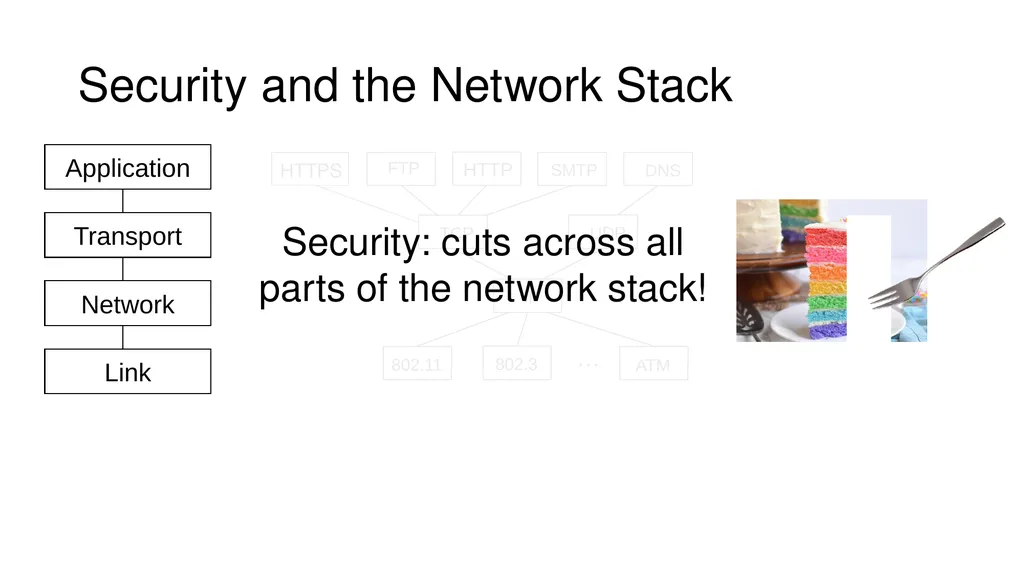
Security and the Network Stack Application Transport Network Link HTTPS Security: cuts across all parts of the network stack!<br>
03
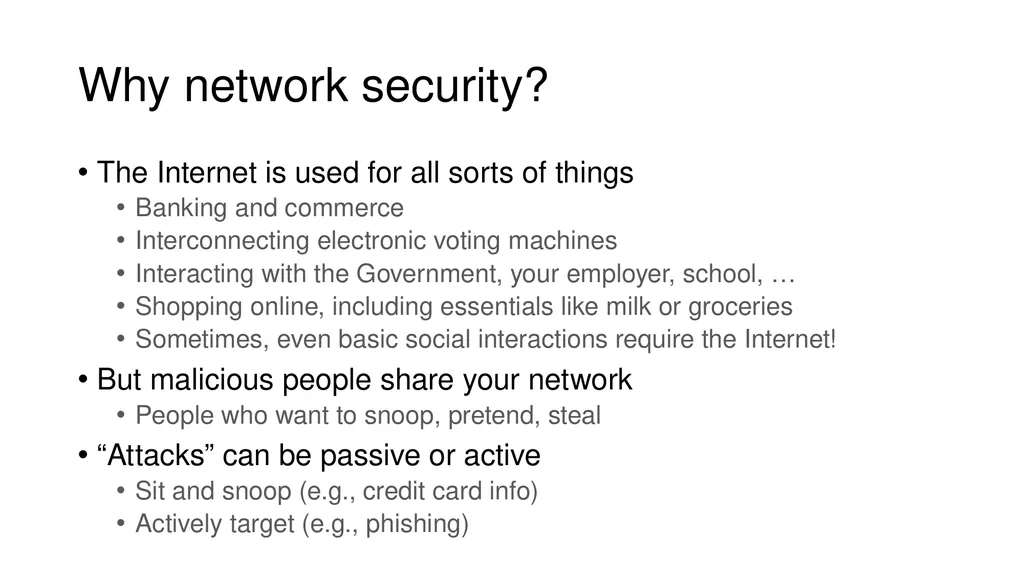
Why network security? The Internet is used for all sorts of things
Banking and commerce
Interconnecting electronic voting machines
Interacting with the Government, your employer, school, …
Shopping online, including essentials like milk or groceries
Sometimes, even basic social interactions require the Internet!
But malicious people share your network
People who want to snoop, pretend, steal
“Attacks” can be passive or active
Sit and snoop (e.g., credit card info)
Actively target (e.g., phishing)<br>
Banking and commerce
Interconnecting electronic voting machines
Interacting with the Government, your employer, school, …
Shopping online, including essentials like milk or groceries
Sometimes, even basic social interactions require the Internet!
But malicious people share your network
People who want to snoop, pretend, steal
“Attacks” can be passive or active
Sit and snoop (e.g., credit card info)
Actively target (e.g., phishing)<br>
04
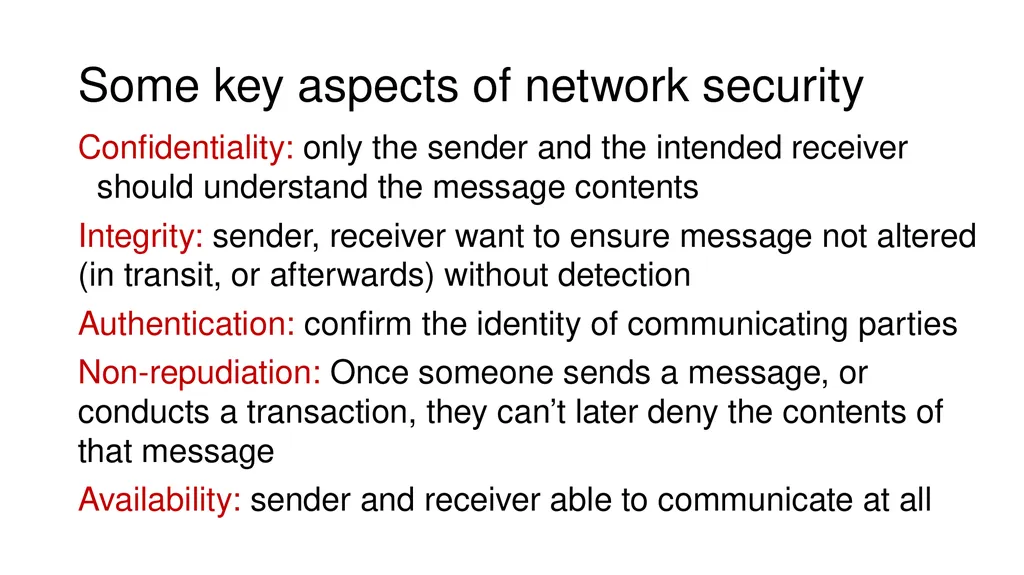
Some key aspects of network security Confidentiality: only the sender and the intended receiver should understand the message contents
Integrity: sender, receiver want to ensure message not altered (in transit, or afterwards) without detection
Authentication: confirm the identity of communicating parties
Non-repudiation: Once someone sends a message, or conducts a transaction, they can’t later deny the contents of that message
Availability: sender and receiver able to communicate at all<br>
Integrity: sender, receiver want to ensure message not altered (in transit, or afterwards) without detection
Authentication: confirm the identity of communicating parties
Non-repudiation: Once someone sends a message, or conducts a transaction, they can’t later deny the contents of that message
Availability: sender and receiver able to communicate at all<br>
05
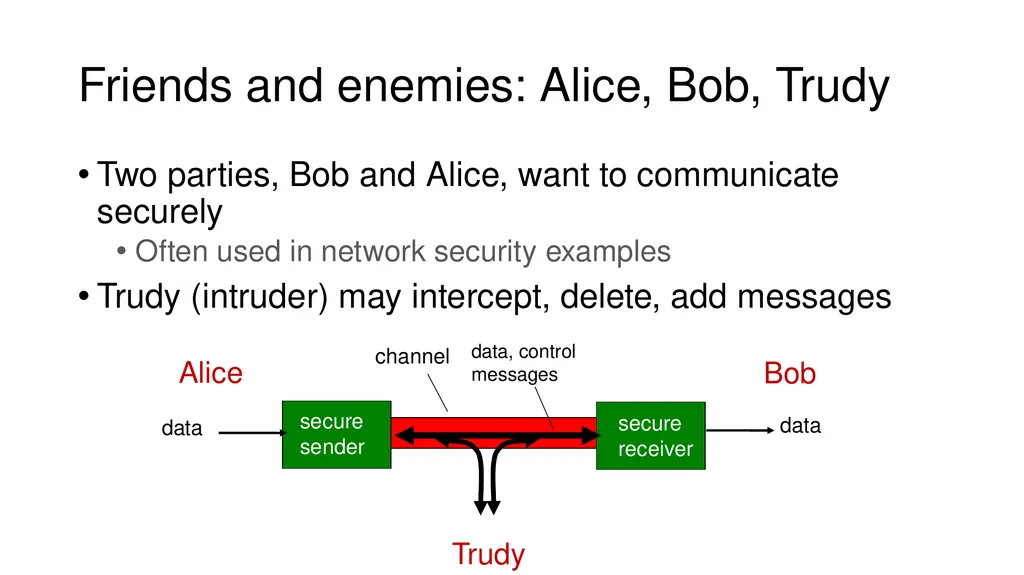
Friends and enemies: Alice, Bob, Trudy Two parties, Bob and Alice, want to communicate securely
Often used in network security examples
Trudy (intruder) may intercept, delete, add messages secure
sender secure
receiver channel data, control messages data data Alice Bob Trudy<br>
Often used in network security examples
Trudy (intruder) may intercept, delete, add messages secure
sender secure
receiver channel data, control messages data data Alice Bob Trudy<br>
06
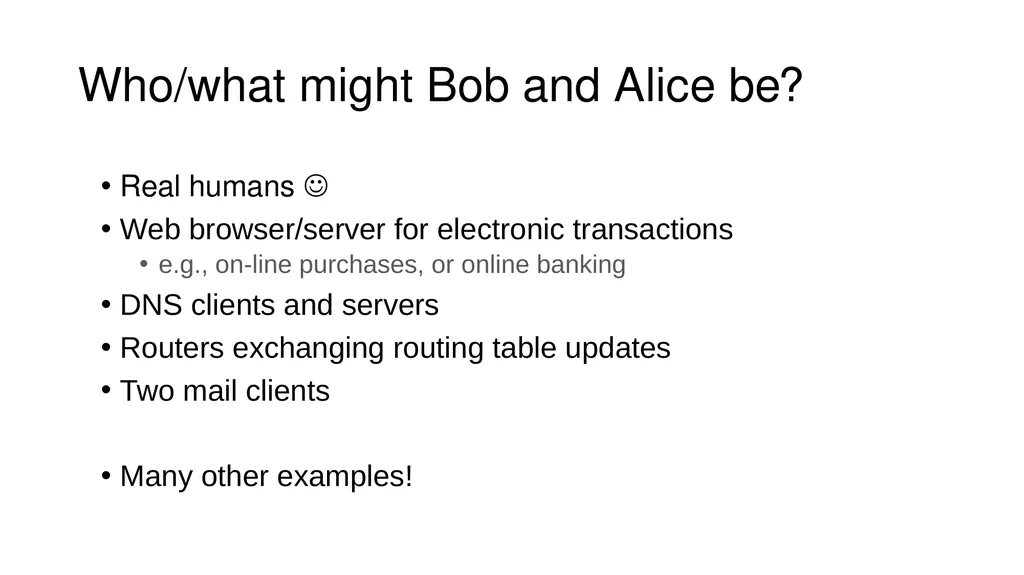
Who/what might Bob and Alice be? Real humans
Web browser/server for electronic transactions
e.g., on-line purchases, or online banking
DNS clients and servers
Routers exchanging routing table updates
Two mail clients
Many other examples!<br>
Web browser/server for electronic transactions
e.g., on-line purchases, or online banking
DNS clients and servers
Routers exchanging routing table updates
Two mail clients
Many other examples!<br>
07
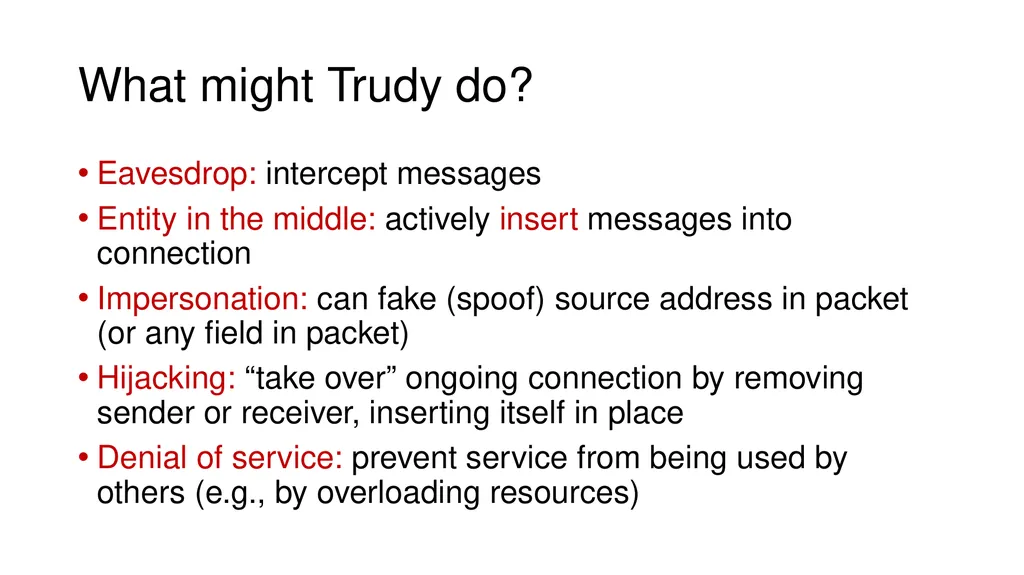
What might Trudy do? Eavesdrop: intercept messages
Entity in the middle: actively insert messages into connection
Impersonation: can fake (spoof) source address in packet (or any field in packet)
Hijacking: “take over” ongoing connection by removing sender or receiver, inserting itself in place
Denial of service: prevent service from being used by others (e.g., by overloading resources)<br>
Entity in the middle: actively insert messages into connection
Impersonation: can fake (spoof) source address in packet (or any field in packet)
Hijacking: “take over” ongoing connection by removing sender or receiver, inserting itself in place
Denial of service: prevent service from being used by others (e.g., by overloading resources)<br>
08
What we will learn in the next lectures Principles of network security
Primitives for confidentiality, authentication, integrity, non-repudiation
How to apply these principles to secure:
An application: e-mail
Transport: TLS (Transport Layer Security for TCP)<br>
Primitives for confidentiality, authentication, integrity, non-repudiation
How to apply these principles to secure:
An application: e-mail
Transport: TLS (Transport Layer Security for TCP)<br>
09
Network security is a broad area Many exciting topics!
Security for apps and transport protocols: e.g., QUIC
Security at all layers: Network layer (e.g., IPSec, VPNs); Link layer (e.g., WPA)
Security for protocols, e.g., DNSSEC, BGPSEC
Operational security: how to secure a network
Firewalls, intrusion detection/prevention, data breach security, …
Covering these and other topics in network & system security would require its own set of courses <br>
Security for apps and transport protocols: e.g., QUIC
Security at all layers: Network layer (e.g., IPSec, VPNs); Link layer (e.g., WPA)
Security for protocols, e.g., DNSSEC, BGPSEC
Operational security: how to secure a network
Firewalls, intrusion detection/prevention, data breach security, …
Covering these and other topics in network & system security would require its own set of courses <br>
10
CS 352
Cryptography: Introduction CS 352, Lecture 25.2
http://www.cs.rutgers.edu/~sn624/352
Srinivas Narayana 11<br>
http://www.cs.rutgers.edu/~sn624/352
Srinivas Narayana 11<br>
11
Confidentiality Confidentiality: only the sender and the intended receiver should understand the message contents
How to achieve this goal?
Cryptography
Sender encrypts a message, receiver decrypts it.
An intermediate observer should just see random bytes!<br>
How to achieve this goal?
Cryptography
Sender encrypts a message, receiver decrypts it.
An intermediate observer should just see random bytes!<br>
12
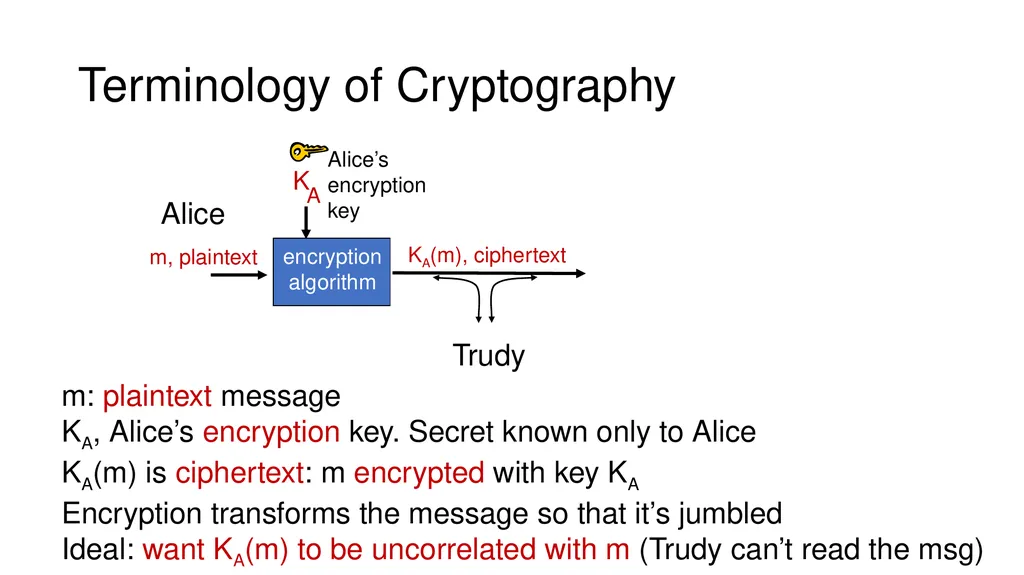
Terminology of Cryptography m, plaintext KA(m), ciphertext encryption
algorithm Alice’s
encryption
key Alice Trudy m: plaintext message
KA, Alice’s encryption key. Secret known only to Alice
KA(m) is ciphertext: m encrypted with key KA
Encryption transforms the message so that it’s jumbled
Ideal: want KA(m) to be uncorrelated with m (Trudy can’t read the msg)<br>
algorithm Alice’s
encryption
key Alice Trudy m: plaintext message
KA, Alice’s encryption key. Secret known only to Alice
KA(m) is ciphertext: m encrypted with key KA
Encryption transforms the message so that it’s jumbled
Ideal: want KA(m) to be uncorrelated with m (Trudy can’t read the msg)<br>
13
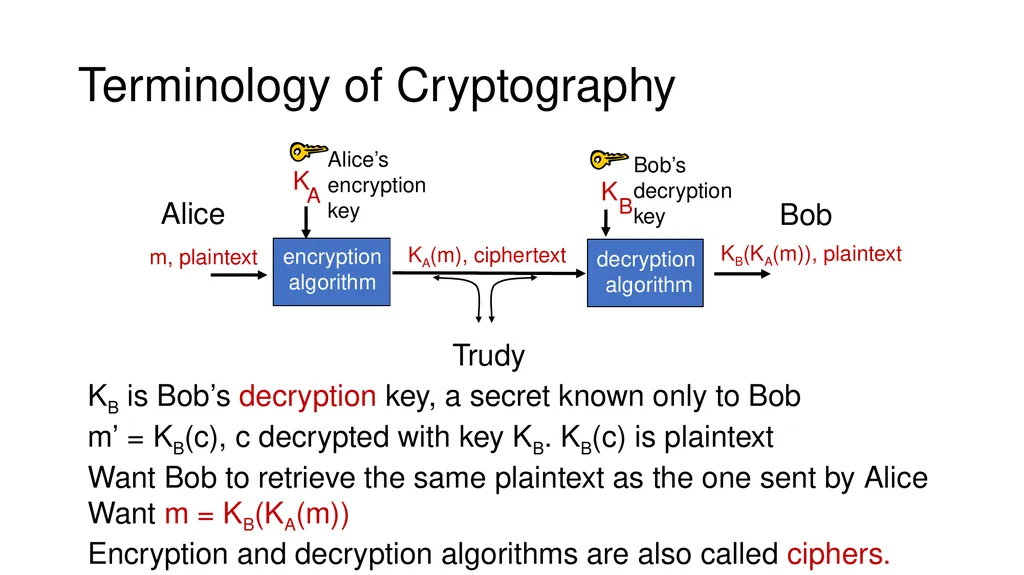
Terminology of Cryptography m, plaintext KB(KA(m)), plaintext KA(m), ciphertext encryption
algorithm decryption
algorithm Alice’s
encryption
key Bob’s
decryption
key Alice Bob Trudy KB is Bob’s decryption key, a secret known only to Bob
m’ = KB(c), c decrypted with key KB. KB(c) is plaintext
Want Bob to retrieve the same plaintext as the one sent by Alice
Want m = KB(KA(m))
Encryption and decryption algorithms are also called ciphers.<br>
algorithm decryption
algorithm Alice’s
encryption
key Bob’s
decryption
key Alice Bob Trudy KB is Bob’s decryption key, a secret known only to Bob
m’ = KB(c), c decrypted with key KB. KB(c) is plaintext
Want Bob to retrieve the same plaintext as the one sent by Alice
Want m = KB(KA(m))
Encryption and decryption algorithms are also called ciphers.<br>
14
Algorithms and Keys Cryptography requires algorithms (for encryption and decryption) and keys (parameters fed to the algorithms)
Cryptography practice: algorithms must be publicly known
Inspires trust that it works: obvious flaws found sooner
Openness fosters innovation: techniques can be improved by everyone
On the other hand, keys are secret
Keys must be hard to guess, e.g., 128-bit, 256-bit, 1024-bit
Analogy: everyone knows how your house lock works, and they use a similar design for their house lock
“Everyone uses the same lock, so it must be a reliable lock”
But only you know the combination for your lock<br>
Cryptography practice: algorithms must be publicly known
Inspires trust that it works: obvious flaws found sooner
Openness fosters innovation: techniques can be improved by everyone
On the other hand, keys are secret
Keys must be hard to guess, e.g., 128-bit, 256-bit, 1024-bit
Analogy: everyone knows how your house lock works, and they use a similar design for their house lock
“Everyone uses the same lock, so it must be a reliable lock”
But only you know the combination for your lock<br>
15
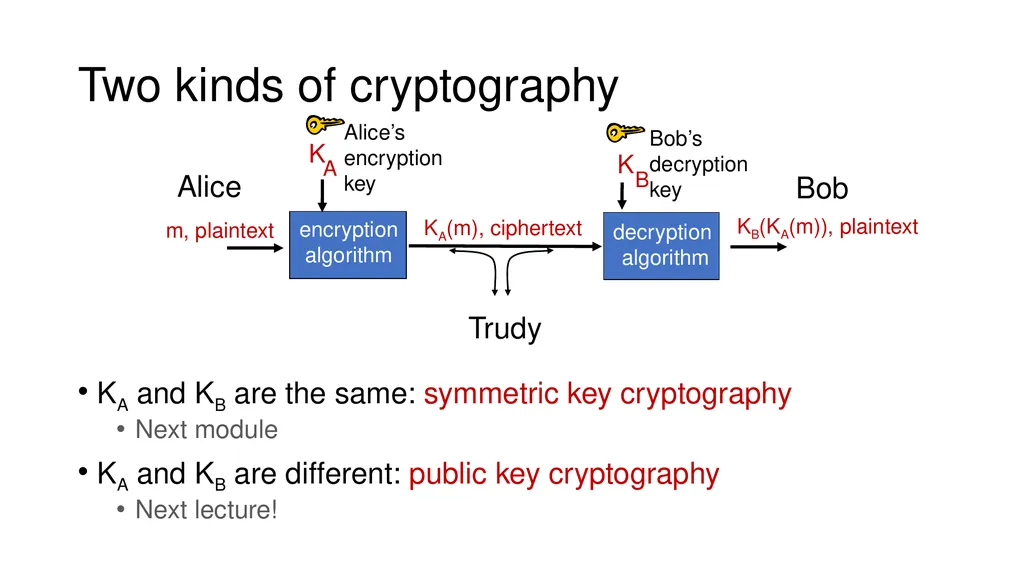
Two kinds of cryptography KA and KB are the same: symmetric key cryptography
Next module
KA and KB are different: public key cryptography
Next lecture! m, plaintext KB(KA(m)), plaintext KA(m), ciphertext encryption
algorithm decryption
algorithm Alice’s
encryption
key Bob’s
decryption
key Alice Bob Trudy<br>
Next module
KA and KB are different: public key cryptography
Next lecture! m, plaintext KB(KA(m)), plaintext KA(m), ciphertext encryption
algorithm decryption
algorithm Alice’s
encryption
key Bob’s
decryption
key Alice Bob Trudy<br>
16
CS 352
Symmetric Key Cryptography CS 352, Lecture 25.3
http://www.cs.rutgers.edu/~sn624/352
Srinivas Narayana 18<br>
http://www.cs.rutgers.edu/~sn624/352
Srinivas Narayana 18<br>
17
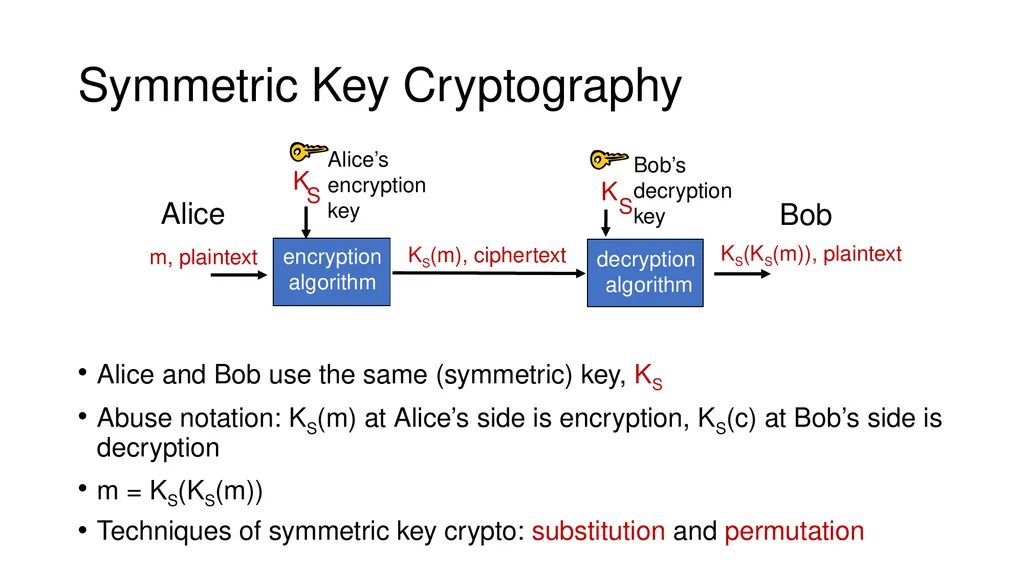
Symmetric Key Cryptography Alice and Bob use the same (symmetric) key, KS
Abuse notation: KS(m) at Alice’s side is encryption, KS(c) at Bob’s side is decryption
m = KS(KS(m))
Techniques of symmetric key crypto: substitution and permutation m, plaintext KS(KS(m)), plaintext KS(m), ciphertext encryption
algorithm decryption
algorithm Alice’s
encryption
key Bob’s
decryption
key Alice Bob<br>
Abuse notation: KS(m) at Alice’s side is encryption, KS(c) at Bob’s side is decryption
m = KS(KS(m))
Techniques of symmetric key crypto: substitution and permutation m, plaintext KS(KS(m)), plaintext KS(m), ciphertext encryption
algorithm decryption
algorithm Alice’s
encryption
key Bob’s
decryption
key Alice Bob<br>
18
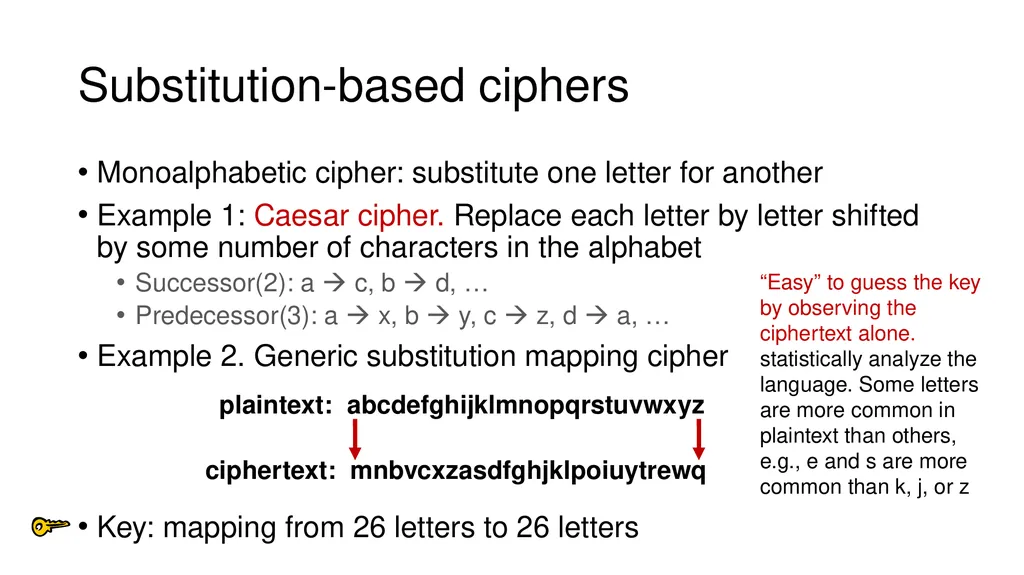
Substitution-based ciphers Monoalphabetic cipher: substitute one letter for another
Example 1: Caesar cipher. Replace each letter by letter shifted by some number of characters in the alphabet
Successor(2): a c, b d, …
Predecessor(3): a x, b y, c z, d a, …
Example 2. Generic substitution mapping cipher
Key: mapping from 26 letters to 26 letters plaintext: abcdefghijklmnopqrstuvwxyz ciphertext: mnbvcxzasdfghjklpoiuytrewq “Easy” to guess the key by observing the ciphertext alone. statistically analyze the language. Some letters are more common in plaintext than others, e.g., e and s are more common than k, j, or z<br>
Example 1: Caesar cipher. Replace each letter by letter shifted by some number of characters in the alphabet
Successor(2): a c, b d, …
Predecessor(3): a x, b y, c z, d a, …
Example 2. Generic substitution mapping cipher
Key: mapping from 26 letters to 26 letters plaintext: abcdefghijklmnopqrstuvwxyz ciphertext: mnbvcxzasdfghjklpoiuytrewq “Easy” to guess the key by observing the ciphertext alone. statistically analyze the language. Some letters are more common in plaintext than others, e.g., e and s are more common than k, j, or z<br>
19
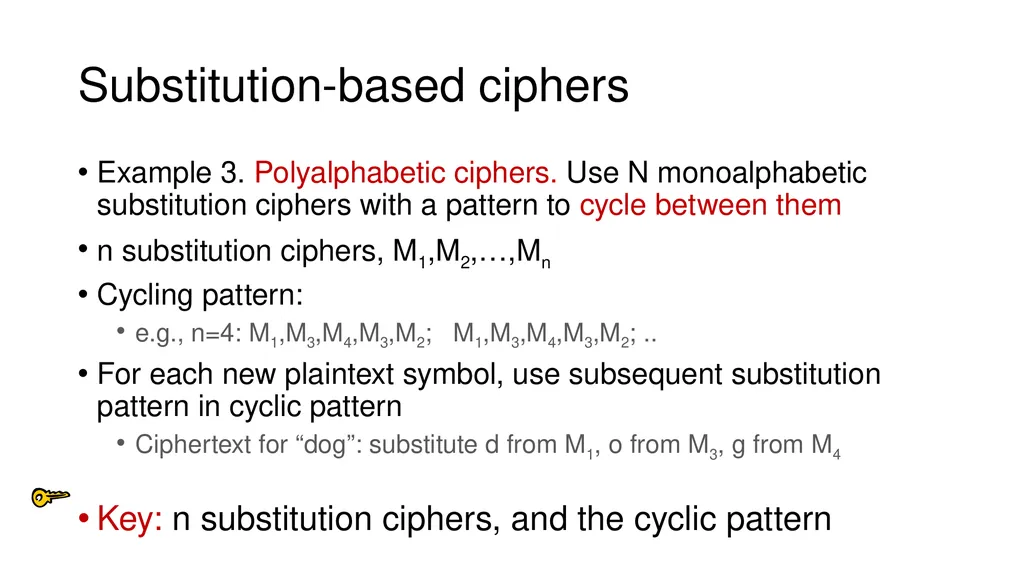
Substitution-based ciphers Example 3. Polyalphabetic ciphers. Use N monoalphabetic substitution ciphers with a pattern to cycle between them
n substitution ciphers, M1,M2,…,Mn
Cycling pattern:
e.g., n=4: M1,M3,M4,M3,M2; M1,M3,M4,M3,M2; ..
For each new plaintext symbol, use subsequent substitution pattern in cyclic pattern
Ciphertext for “dog”: substitute d from M1, o from M3, g from M4
Key: n substitution ciphers, and the cyclic pattern<br>
n substitution ciphers, M1,M2,…,Mn
Cycling pattern:
e.g., n=4: M1,M3,M4,M3,M2; M1,M3,M4,M3,M2; ..
For each new plaintext symbol, use subsequent substitution pattern in cyclic pattern
Ciphertext for “dog”: substitute d from M1, o from M3, g from M4
Key: n substitution ciphers, and the cyclic pattern<br>
20
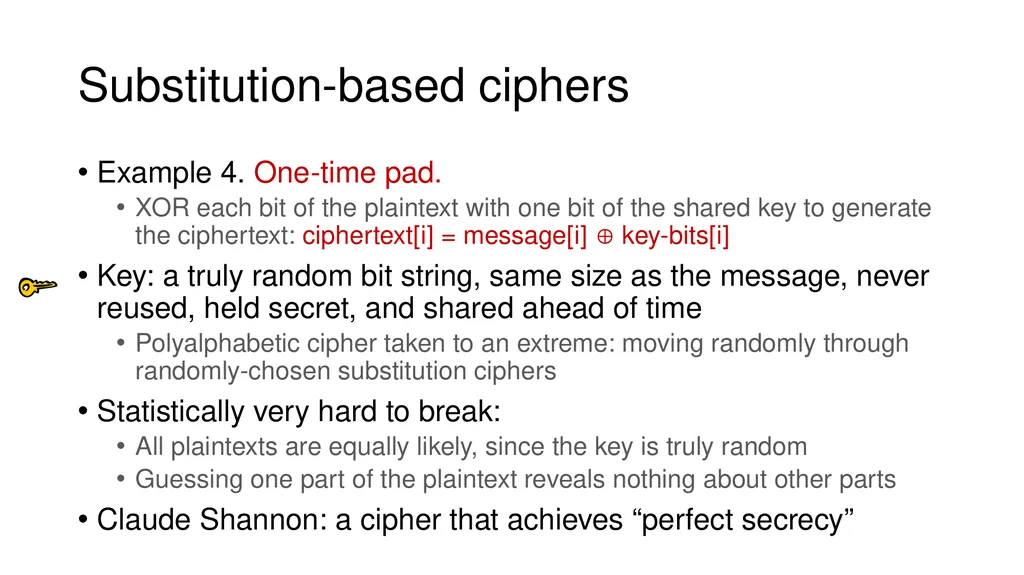
Substitution-based ciphers Example 4. One-time pad.
XOR each bit of the plaintext with one bit of the shared key to generate the ciphertext: ciphertext[i] = message[i] key-bits[i]
Key: a truly random bit string, same size as the message, never reused, held secret, and shared ahead of time
Polyalphabetic cipher taken to an extreme: moving randomly through randomly-chosen substitution ciphers
Statistically very hard to break:
All plaintexts are equally likely, since the key is truly random
Guessing one part of the plaintext reveals nothing about other parts
Claude Shannon: a cipher that achieves “perfect secrecy”<br>
XOR each bit of the plaintext with one bit of the shared key to generate the ciphertext: ciphertext[i] = message[i] key-bits[i]
Key: a truly random bit string, same size as the message, never reused, held secret, and shared ahead of time
Polyalphabetic cipher taken to an extreme: moving randomly through randomly-chosen substitution ciphers
Statistically very hard to break:
All plaintexts are equally likely, since the key is truly random
Guessing one part of the plaintext reveals nothing about other parts
Claude Shannon: a cipher that achieves “perfect secrecy”<br>
21
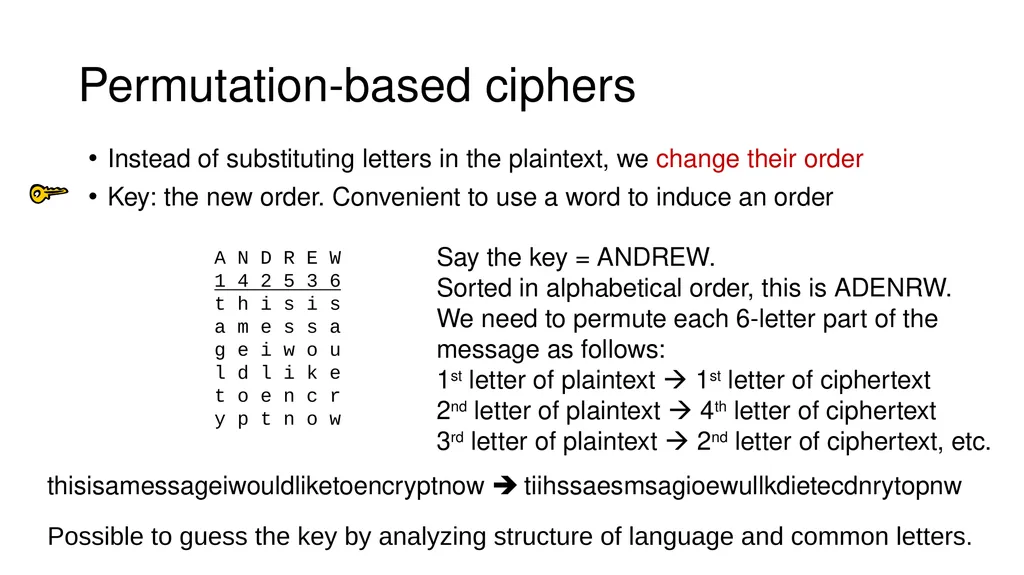
Permutation-based ciphers Instead of substituting letters in the plaintext, we change their order
Key: the new order. Convenient to use a word to induce an order A N D R E W
1 4 2 5 3 6
t h i s i s
a m e s s a
g e i w o u
l d l i k e
t o e n c r
y p t n o w Say the key = ANDREW.
Sorted in alphabetical order, this is ADENRW.
We need to permute each 6-letter part of the message as follows:
1st letter of plaintext 1st letter of ciphertext
2nd letter of plaintext 4th letter of ciphertext
3rd letter of plaintext 2nd letter of ciphertext, etc. Possible to guess the key by analyzing structure of language and common letters. thisisamessageiwouldliketoencryptnow tiihssaesmsagioewullkdietecdnrytopnw<br>
Key: the new order. Convenient to use a word to induce an order A N D R E W
1 4 2 5 3 6
t h i s i s
a m e s s a
g e i w o u
l d l i k e
t o e n c r
y p t n o w Say the key = ANDREW.
Sorted in alphabetical order, this is ADENRW.
We need to permute each 6-letter part of the message as follows:
1st letter of plaintext 1st letter of ciphertext
2nd letter of plaintext 4th letter of ciphertext
3rd letter of plaintext 2nd letter of ciphertext, etc. Possible to guess the key by analyzing structure of language and common letters. thisisamessageiwouldliketoencryptnow tiihssaesmsagioewullkdietecdnrytopnw<br>
22
Stream and Block Ciphers<br>
23
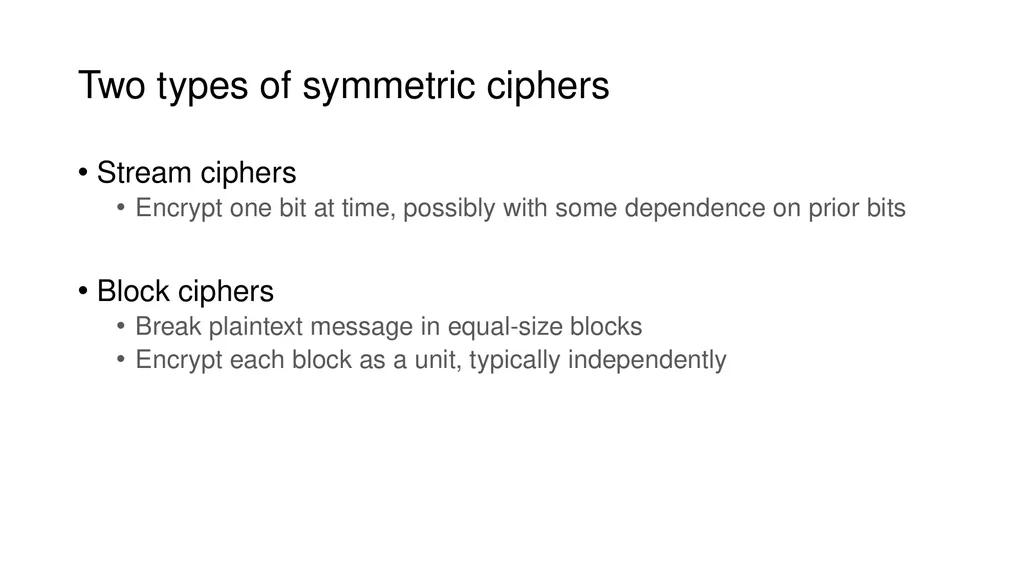
Two types of symmetric ciphers Stream ciphers
Encrypt one bit at time, possibly with some dependence on prior bits
Block ciphers
Break plaintext message in equal-size blocks
Encrypt each block as a unit, typically independently<br>
Encrypt one bit at time, possibly with some dependence on prior bits
Block ciphers
Break plaintext message in equal-size blocks
Encrypt each block as a unit, typically independently<br>
24
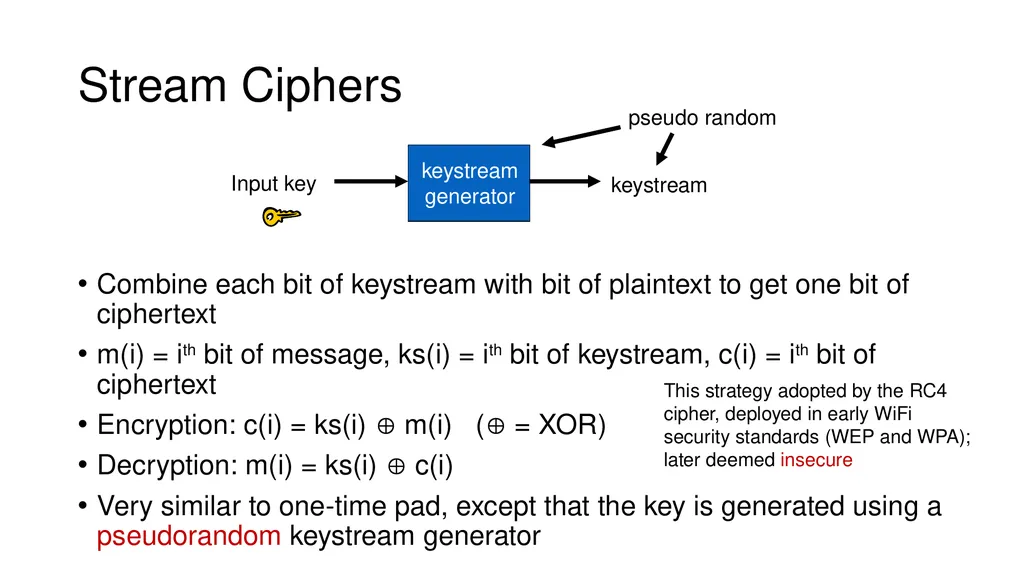
Stream Ciphers Combine each bit of keystream with bit of plaintext to get one bit of ciphertext
m(i) = ith bit of message, ks(i) = ith bit of keystream, c(i) = ith bit of ciphertext
Encryption: c(i) = ks(i) m(i) ( = XOR)
Decryption: m(i) = ks(i) c(i)
Very similar to one-time pad, except that the key is generated using a pseudorandom keystream generator keystream
generator Input key keystream pseudo random This strategy adopted by the RC4 cipher, deployed in early WiFi security standards (WEP and WPA); later deemed insecure<br>
m(i) = ith bit of message, ks(i) = ith bit of keystream, c(i) = ith bit of ciphertext
Encryption: c(i) = ks(i) m(i) ( = XOR)
Decryption: m(i) = ks(i) c(i)
Very similar to one-time pad, except that the key is generated using a pseudorandom keystream generator keystream
generator Input key keystream pseudo random This strategy adopted by the RC4 cipher, deployed in early WiFi security standards (WEP and WPA); later deemed insecure<br>
25
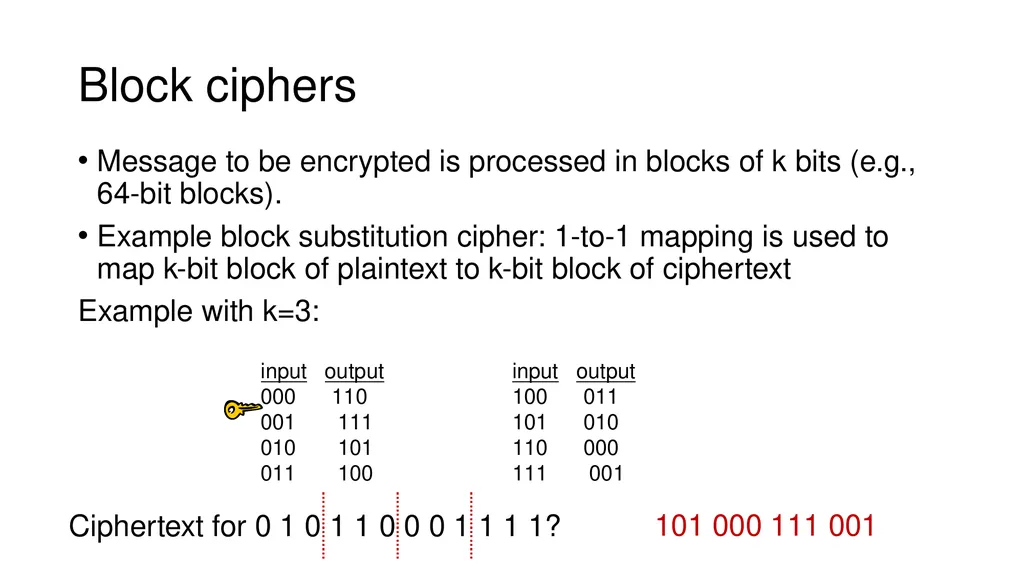
Block ciphers Message to be encrypted is processed in blocks of k bits (e.g., 64-bit blocks).
Example block substitution cipher: 1-to-1 mapping is used to map k-bit block of plaintext to k-bit block of ciphertext
Example with k=3: input output
000 110
001 111
010 101
011 100 input output
100 011
101 010
110 000
111 001 Ciphertext for 0 1 0 1 1 0 0 0 1 1 1 1? 101 000 111 001<br>
Example block substitution cipher: 1-to-1 mapping is used to map k-bit block of plaintext to k-bit block of ciphertext
Example with k=3: input output
000 110
001 111
010 101
011 100 input output
100 011
101 010
110 000
111 001 Ciphertext for 0 1 0 1 1 0 0 0 1 1 1 1? 101 000 111 001<br>
26
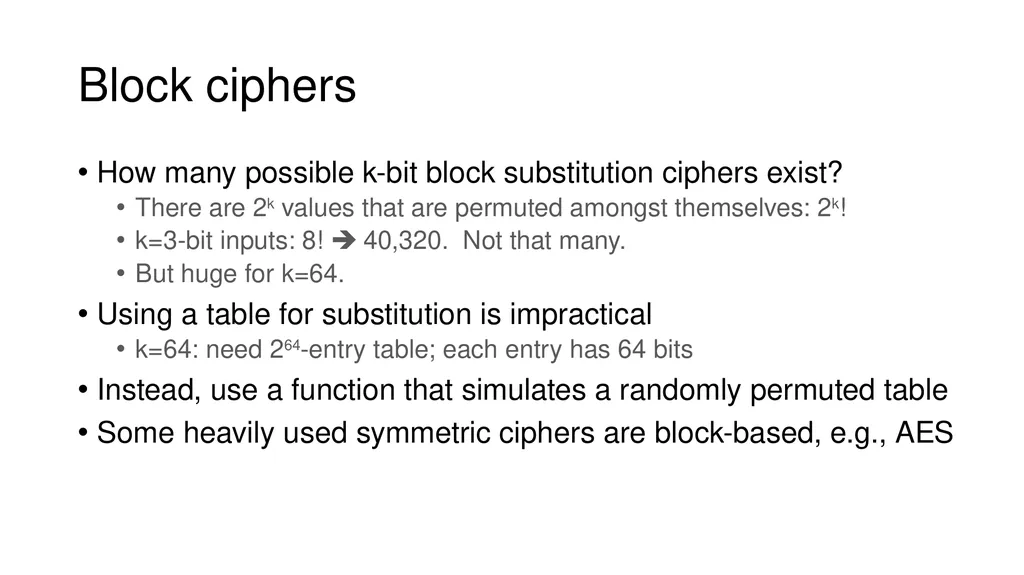
Block ciphers How many possible k-bit block substitution ciphers exist?
There are 2k values that are permuted amongst themselves: 2k!
k=3-bit inputs: 8! 40,320. Not that many.
But huge for k=64.
Using a table for substitution is impractical
k=64: need 264-entry table; each entry has 64 bits
Instead, use a function that simulates a randomly permuted table
Some heavily used symmetric ciphers are block-based, e.g., AES<br>
There are 2k values that are permuted amongst themselves: 2k!
k=3-bit inputs: 8! 40,320. Not that many.
But huge for k=64.
Using a table for substitution is impractical
k=64: need 264-entry table; each entry has 64 bits
Instead, use a function that simulates a randomly permuted table
Some heavily used symmetric ciphers are block-based, e.g., AES<br>
27
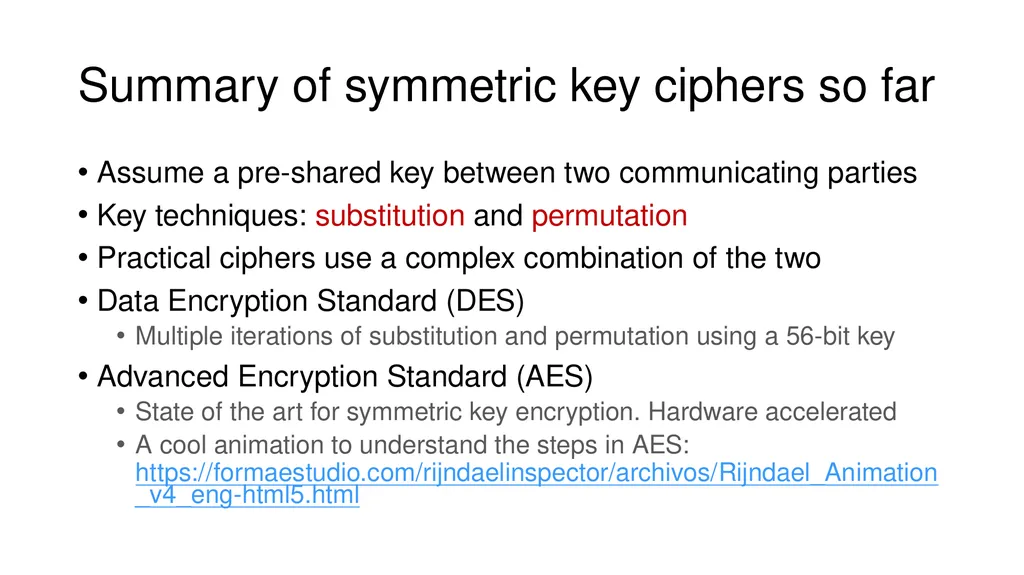
Summary of symmetric key ciphers so far Assume a pre-shared key between two communicating parties
Key techniques: substitution and permutation
Practical ciphers use a complex combination of the two
Data Encryption Standard (DES)
Multiple iterations of substitution and permutation using a 56-bit key
Advanced Encryption Standard (AES)
State of the art for symmetric key encryption. Hardware accelerated
A cool animation to understand the steps in AES: https://formaestudio.com/rijndaelinspector/archivos/Rijndael_Animation_v4_eng-html5.html<br>
Key techniques: substitution and permutation
Practical ciphers use a complex combination of the two
Data Encryption Standard (DES)
Multiple iterations of substitution and permutation using a 56-bit key
Advanced Encryption Standard (AES)
State of the art for symmetric key encryption. Hardware accelerated
A cool animation to understand the steps in AES: https://formaestudio.com/rijndaelinspector/archivos/Rijndael_Animation_v4_eng-html5.html<br>
28
CS 352
Improving Symmetric Key Crypto CS 352, Lecture 25.4
http://www.cs.rutgers.edu/~sn624/352
Srinivas Narayana 31<br>
http://www.cs.rutgers.edu/~sn624/352
Srinivas Narayana 31<br>
29
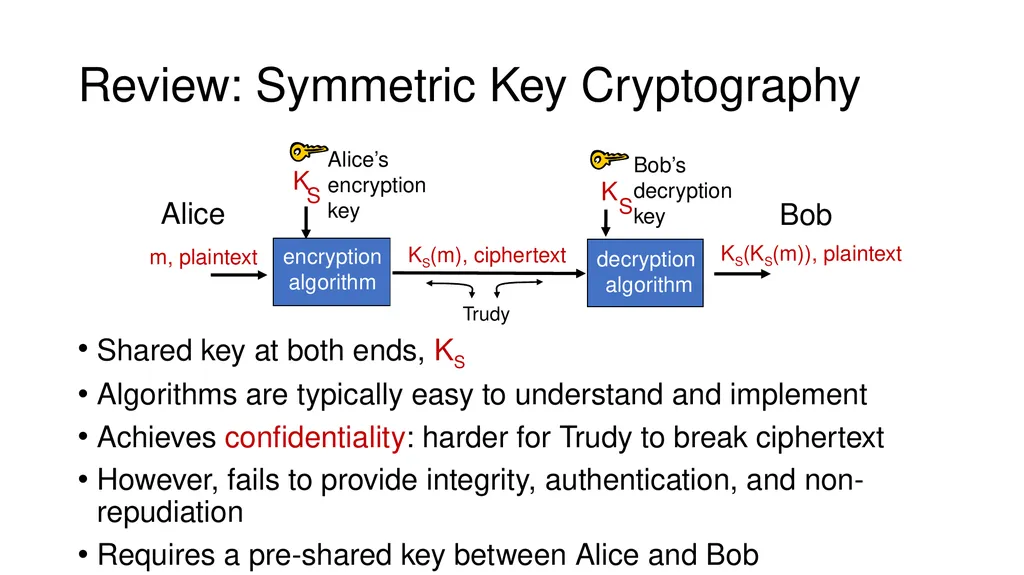
Review: Symmetric Key Cryptography Shared key at both ends, KS
Algorithms are typically easy to understand and implement
Achieves confidentiality: harder for Trudy to break ciphertext
However, fails to provide integrity, authentication, and non-repudiation
Requires a pre-shared key between Alice and Bob m, plaintext KS(KS(m)), plaintext KS(m), ciphertext encryption
algorithm decryption
algorithm Alice’s
encryption
key Bob’s
decryption
key Alice Bob Trudy<br>
Algorithms are typically easy to understand and implement
Achieves confidentiality: harder for Trudy to break ciphertext
However, fails to provide integrity, authentication, and non-repudiation
Requires a pre-shared key between Alice and Bob m, plaintext KS(KS(m)), plaintext KS(m), ciphertext encryption
algorithm decryption
algorithm Alice’s
encryption
key Bob’s
decryption
key Alice Bob Trudy<br>
30
Attempting authentication with symmetric key crypto<br>
31
An example: Login system Bob runs a login server to provide access to protected resources
Alice must present a password to login
Exchange of password implemented using symmetric key cryptography on top of block ciphers<br>
Alice must present a password to login
Exchange of password implemented using symmetric key cryptography on top of block ciphers<br>
32
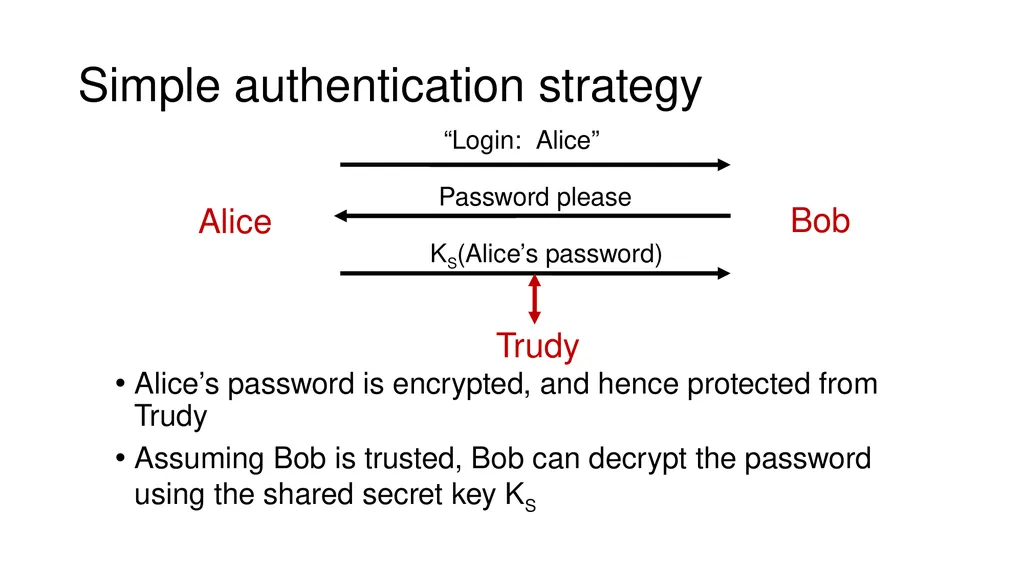
Simple authentication strategy Alice Bob “Login: Alice” Password please KS(Alice’s password) Alice’s password is encrypted, and hence protected from Trudy
Assuming Bob is trusted, Bob can decrypt the password using the shared secret key KS Trudy<br>
Assuming Bob is trusted, Bob can decrypt the password using the shared secret key KS Trudy<br>
33
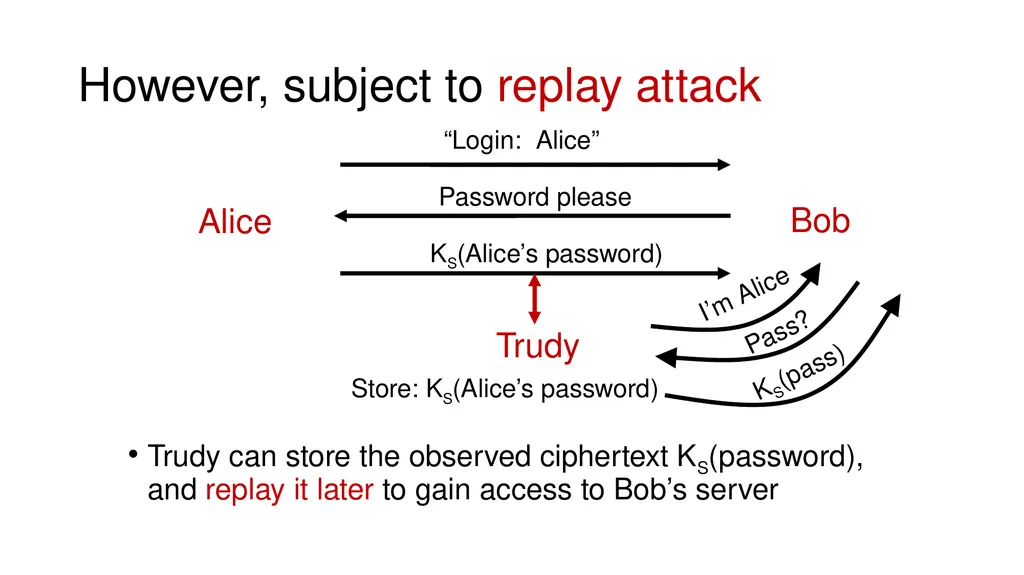
However, subject to replay attack Alice Bob “Login: Alice” Password please KS(Alice’s password) Trudy can store the observed ciphertext KS(password), and replay it later to gain access to Bob’s server Trudy Store: KS(Alice’s password) I’m Alice Pass? KS(pass)<br>
34
Preventing replay attacks Key idea: Vary the ciphertext for the same plaintext sent at different times.
Make the ciphertext depend on a one-time value, randomly chosen by Bob.
e.g., a random number generated by Bob
Nonce: a “number used once only”
Alice must combine the password with the nonce before encryption<br>
Make the ciphertext depend on a one-time value, randomly chosen by Bob.
e.g., a random number generated by Bob
Nonce: a “number used once only”
Alice must combine the password with the nonce before encryption<br>
35
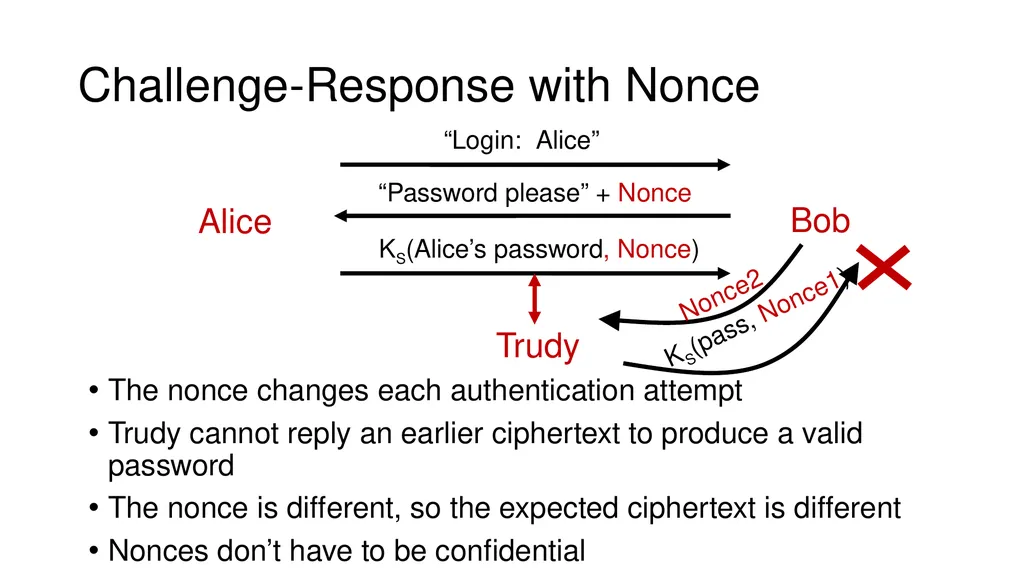
Challenge-Response with Nonce Alice Bob “Login: Alice” “Password please” + Nonce KS(Alice’s password, Nonce) The nonce changes each authentication attempt
Trudy cannot reply an earlier ciphertext to produce a valid password
The nonce is different, so the expected ciphertext is different
Nonces don’t have to be confidential Trudy Nonce2 KS(pass, Nonce1)<br>
Trudy cannot reply an earlier ciphertext to produce a valid password
The nonce is different, so the expected ciphertext is different
Nonces don’t have to be confidential Trudy Nonce2 KS(pass, Nonce1)<br>
36
Protecting against general replay attacks<br>
37
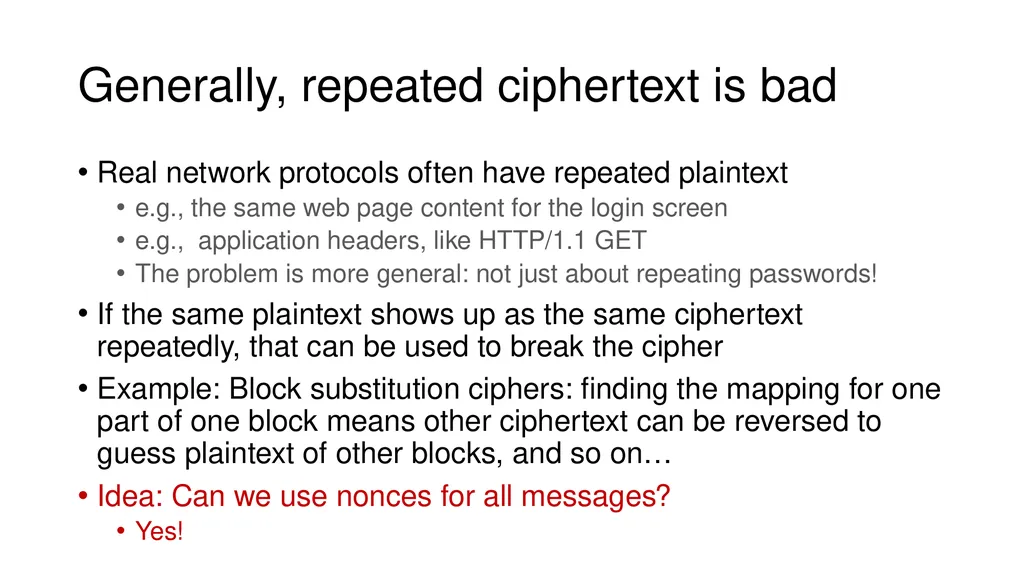
Generally, repeated ciphertext is bad Real network protocols often have repeated plaintext
e.g., the same web page content for the login screen
e.g., application headers, like HTTP/1.1 GET
The problem is more general: not just about repeating passwords!
If the same plaintext shows up as the same ciphertext repeatedly, that can be used to break the cipher
Example: Block substitution ciphers: finding the mapping for one part of one block means other ciphertext can be reversed to guess plaintext of other blocks, and so on…
Idea: Can we use nonces for all messages?
Yes!<br>
e.g., the same web page content for the login screen
e.g., application headers, like HTTP/1.1 GET
The problem is more general: not just about repeating passwords!
If the same plaintext shows up as the same ciphertext repeatedly, that can be used to break the cipher
Example: Block substitution ciphers: finding the mapping for one part of one block means other ciphertext can be reversed to guess plaintext of other blocks, and so on…
Idea: Can we use nonces for all messages?
Yes!<br>
38
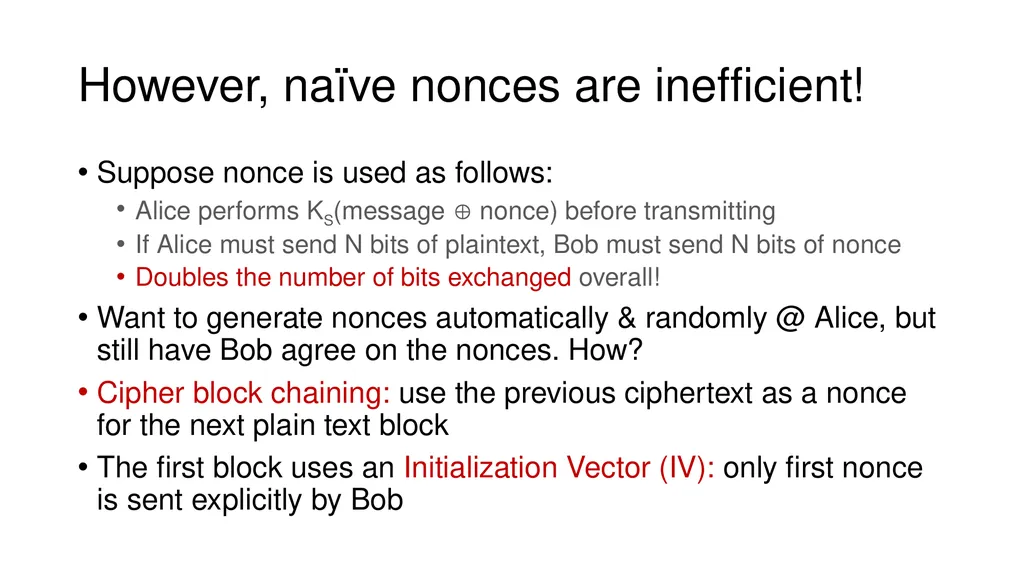
However, naïve nonces are inefficient! Suppose nonce is used as follows:
Alice performs KS(message nonce) before transmitting
If Alice must send N bits of plaintext, Bob must send N bits of nonce
Doubles the number of bits exchanged overall!
Want to generate nonces automatically & randomly @ Alice, but still have Bob agree on the nonces. How?
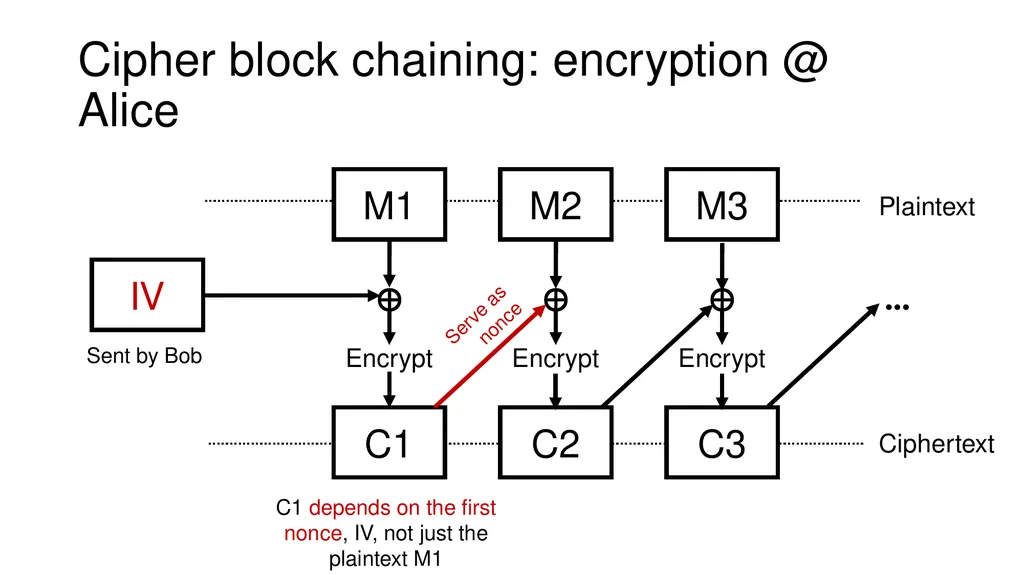
Cipher block chaining: use the previous ciphertext as a nonce for the next plain text block
The first block uses an Initialization Vector (IV): only first nonce is sent explicitly by Bob<br>
Alice performs KS(message nonce) before transmitting
If Alice must send N bits of plaintext, Bob must send N bits of nonce
Doubles the number of bits exchanged overall!
Want to generate nonces automatically & randomly @ Alice, but still have Bob agree on the nonces. How?
Cipher block chaining: use the previous ciphertext as a nonce for the next plain text block
The first block uses an Initialization Vector (IV): only first nonce is sent explicitly by Bob<br>
39
Cipher block chaining: encryption @ Alice IV M1 C1 M2 M3 C2 C3 Encrypt Encrypt Encrypt Sent by Bob Plaintext Ciphertext Serve as nonce C1 depends on the first nonce, IV, not just the plaintext M1 …<br>
40
Agreeing on a shared key<br>
41
How to agree on a shared secret key? In reality: two parties may meet in person or communicate “out of band” to exchange shared key
Often, communicating parties may never meet in person
It’s very common not to meet someone you talk to over the Internet
Amazon? Your bank?
And what if the shared secret is stolen?
Must exchange keys securely again!
Q: how to exchange keys securely over an insecure network? Next lecture: Public key cryptography<br>
Often, communicating parties may never meet in person
It’s very common not to meet someone you talk to over the Internet
Amazon? Your bank?
And what if the shared secret is stolen?
Must exchange keys securely again!
Q: how to exchange keys securely over an insecure network? Next lecture: Public key cryptography<br>