
CS 446: Machine Learning Dan Roth University of
KL
Published · 71 slides · 0 views
1 / 1


Description
CS 446: Machine Learning Dan Roth University of Illinois, Urbana-Champaign danrillinois.edu http:L2R.cs.uiuc.edudanr 3322 SC CS446: Machine Learning What do you need to know: Theory of Computation Probability Theory Linear Algebra
Related Topics
Share
Embed code
Download this presentation From Below
"CS 446: Machine Learning Dan Roth University of" is the property of its rightful owner. Permission is granted to download and print the materials on this website for personal, non-commercial use only, and to display it on your personal computer provided you do not modify the materials and that you retain all copyright notices contained in the materials. By downloading content from our website, you accept the terms of this agreement.
Presentation Transcript
01
CS 446: Machine Learning Dan Roth
University of Illinois, Urbana-Champaign
danr@illinois.edu
http://L2R.cs.uiuc.edu/~danr
3322 SC<br>
University of Illinois, Urbana-Champaign
danr@illinois.edu
http://L2R.cs.uiuc.edu/~danr
3322 SC<br>
02
CS446: Machine Learning What do you need to know:
Theory of Computation
Probability Theory
Linear Algebra
Programming (Java; your favorite language; some Matlab)
Homework 0 – on the web
No need to submit
Who is the class for?
Future Machine Learning researchers/Advanced users 2 Participate, Ask Questions<br>
Theory of Computation
Probability Theory
Linear Algebra
Programming (Java; your favorite language; some Matlab)
Homework 0 – on the web
No need to submit
Who is the class for?
Future Machine Learning researchers/Advanced users 2 Participate, Ask Questions<br>
03
CS446: Policies Cheating
No.
We take it very seriously.
Homework:
Collaboration is encouraged
But, you have to write your own solution/program.
(Please don’t use old solutions)
Late Policy:
You have a credit of 4 days (4*24hours); That’s it.
Grading:
Possibly separate for grads/undergrads.
5% Quizzes; 25% - homework; 30%-midterm; 40%-final;
Projects: 25% (4 hours)
Questions? 3 Info page
Note also the Schedule Page and our Notes<br>
No.
We take it very seriously.
Homework:
Collaboration is encouraged
But, you have to write your own solution/program.
(Please don’t use old solutions)
Late Policy:
You have a credit of 4 days (4*24hours); That’s it.
Grading:
Possibly separate for grads/undergrads.
5% Quizzes; 25% - homework; 30%-midterm; 40%-final;
Projects: 25% (4 hours)
Questions? 3 Info page
Note also the Schedule Page and our Notes<br>
04
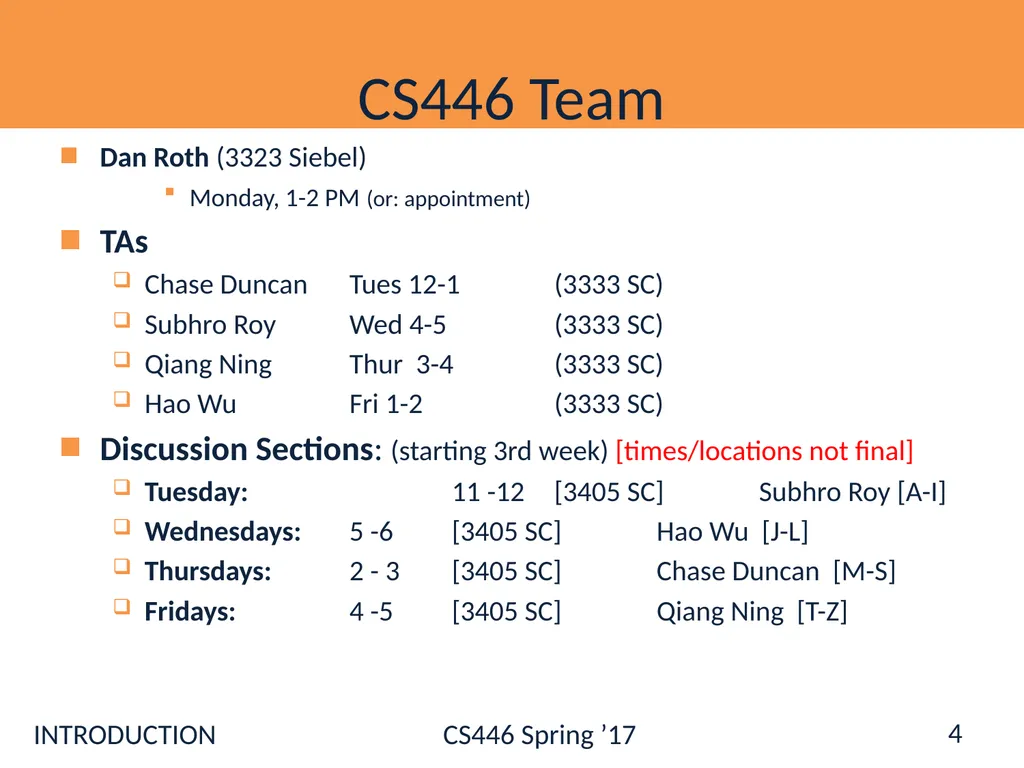
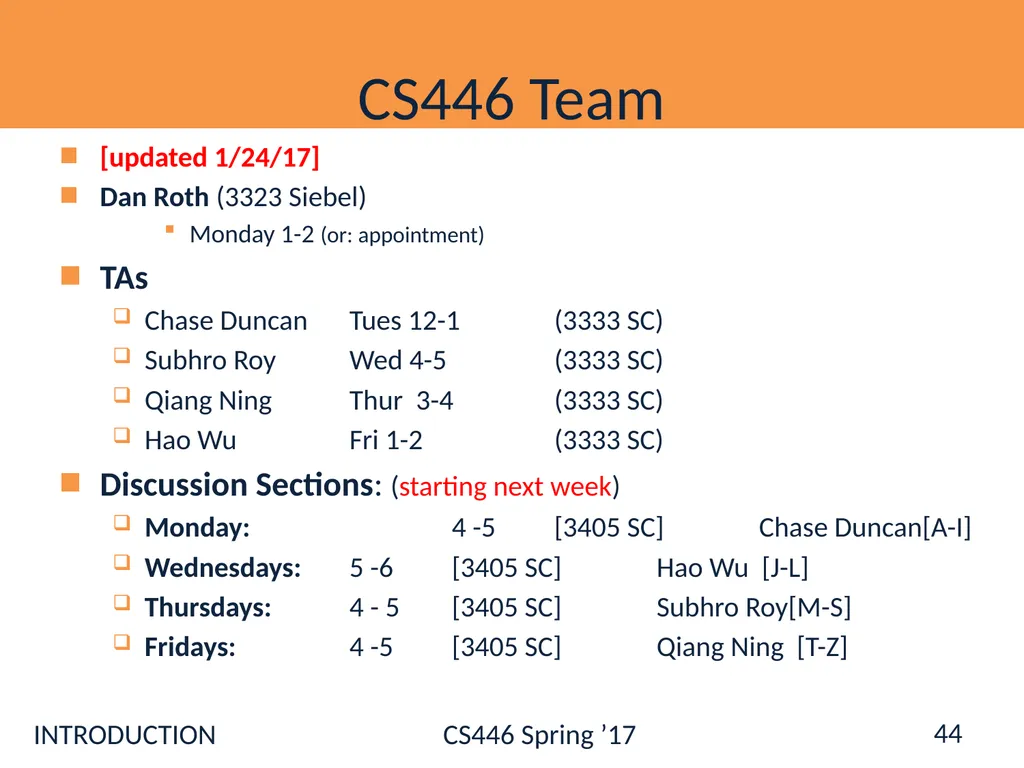
CS446 Team Dan Roth (3323 Siebel)
Monday, 1-2 PM (or: appointment)
TAs
Chase Duncan Tues 12-1 (3333 SC)
Subhro Roy Wed 4-5 (3333 SC)
Qiang Ning Thur 3-4 (3333 SC)
Hao Wu Fri 1-2 (3333 SC)
Discussion Sections: (starting 3rd week) [times/locations not final]
Tuesday: 11 -12 [3405 SC] Subhro Roy [A-I]
Wednesdays: 5 -6 [3405 SC] Hao Wu [J-L]
Thursdays: 2 - 3 [3405 SC] Chase Duncan [M-S]
Fridays: 4 -5 [3405 SC] Qiang Ning [T-Z] 4<br>
Monday, 1-2 PM (or: appointment)
TAs
Chase Duncan Tues 12-1 (3333 SC)
Subhro Roy Wed 4-5 (3333 SC)
Qiang Ning Thur 3-4 (3333 SC)
Hao Wu Fri 1-2 (3333 SC)
Discussion Sections: (starting 3rd week) [times/locations not final]
Tuesday: 11 -12 [3405 SC] Subhro Roy [A-I]
Wednesdays: 5 -6 [3405 SC] Hao Wu [J-L]
Thursdays: 2 - 3 [3405 SC] Chase Duncan [M-S]
Fridays: 4 -5 [3405 SC] Qiang Ning [T-Z] 4<br>
05
CS446 on the web Check our class website:
Schedule, slides, videos, policies
http://l2r.cs.uiuc.edu/~danr/Teaching/CS446-17/index.html
Sign up, participate in our Piazza forum:
Announcements and discussions
https://piazza.com/class#fall2017/cs446
Log on to Compass:
Submit assignments, get your grades
https://compass2g.illinois.edu
Scribing the Class [Good writers; Latex; Paid Hourly] 5<br>
Schedule, slides, videos, policies
http://l2r.cs.uiuc.edu/~danr/Teaching/CS446-17/index.html
Sign up, participate in our Piazza forum:
Announcements and discussions
https://piazza.com/class#fall2017/cs446
Log on to Compass:
Submit assignments, get your grades
https://compass2g.illinois.edu
Scribing the Class [Good writers; Latex; Paid Hourly] 5<br>
06
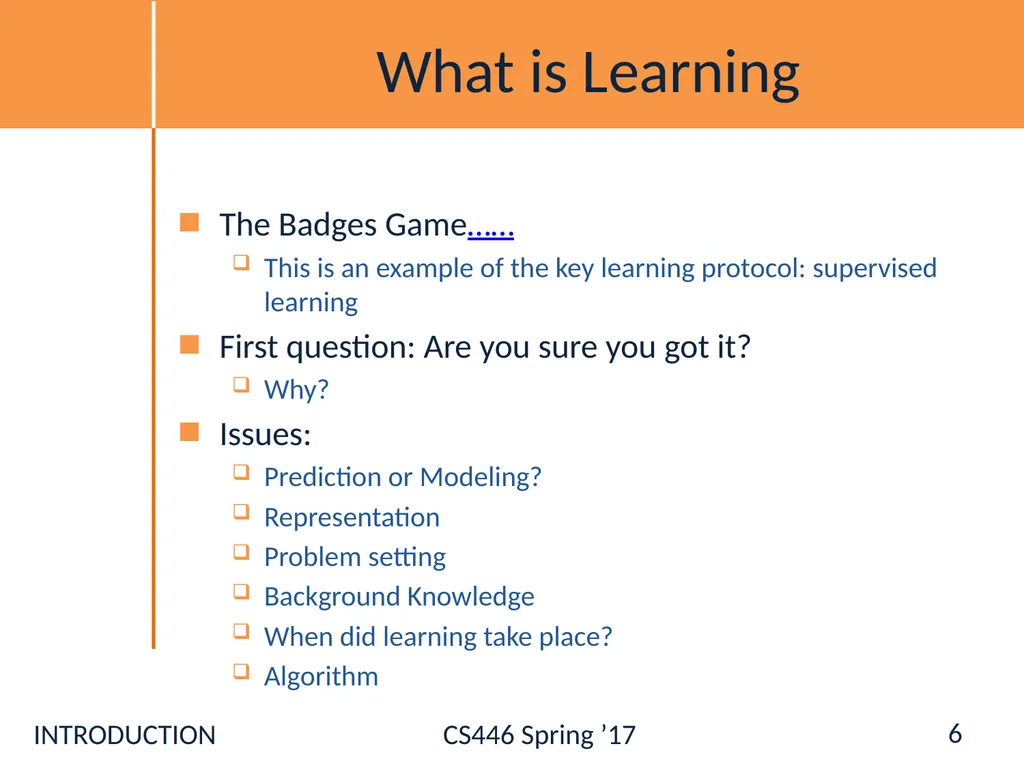
What is Learning The Badges Game……
This is an example of the key learning protocol: supervised learning
First question: Are you sure you got it?
Why?
Issues:
Prediction or Modeling?
Representation
Problem setting
Background Knowledge
When did learning take place?
Algorithm 6<br>
This is an example of the key learning protocol: supervised learning
First question: Are you sure you got it?
Why?
Issues:
Prediction or Modeling?
Representation
Problem setting
Background Knowledge
When did learning take place?
Algorithm 6<br>
07
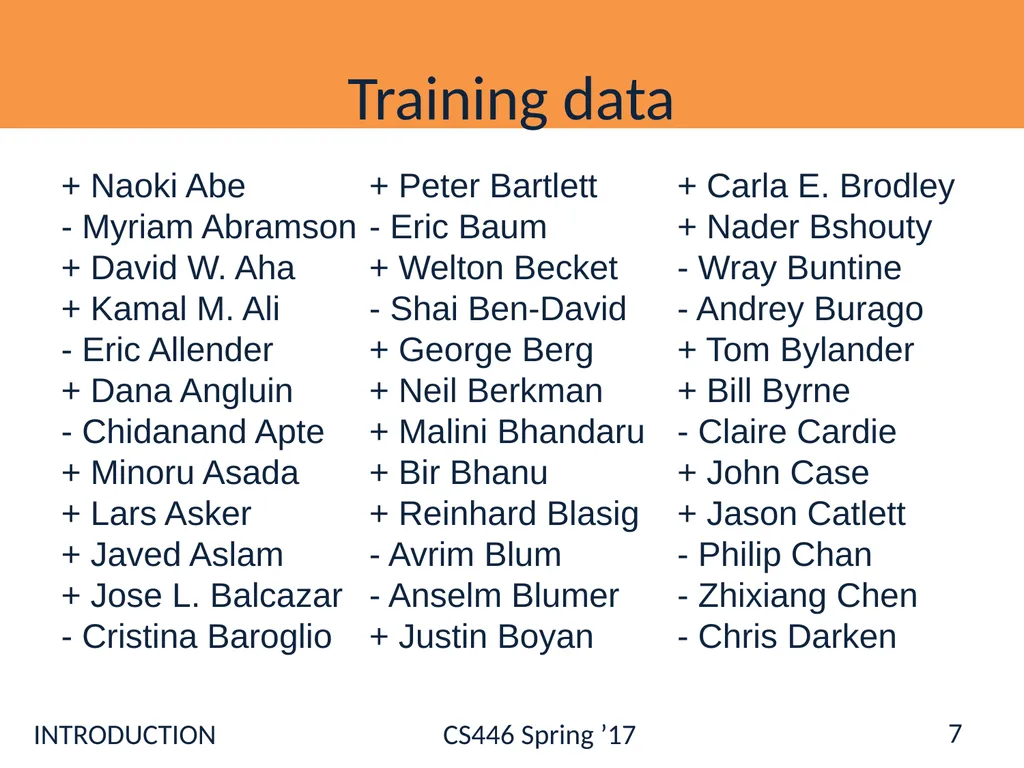
Training data + Naoki Abe
- Myriam Abramson
+ David W. Aha
+ Kamal M. Ali
- Eric Allender
+ Dana Angluin
- Chidanand Apte
+ Minoru Asada
+ Lars Asker
+ Javed Aslam
+ Jose L. Balcazar
- Cristina Baroglio
+ Peter Bartlett
- Eric Baum
+ Welton Becket
- Shai Ben-David
+ George Berg
+ Neil Berkman
+ Malini Bhandaru
+ Bir Bhanu
+ Reinhard Blasig
- Avrim Blum
- Anselm Blumer
+ Justin Boyan
+ Carla E. Brodley
+ Nader Bshouty
- Wray Buntine
- Andrey Burago
+ Tom Bylander
+ Bill Byrne
- Claire Cardie
+ John Case
+ Jason Catlett
- Philip Chan
- Zhixiang Chen
- Chris Darken 7<br>
- Myriam Abramson
+ David W. Aha
+ Kamal M. Ali
- Eric Allender
+ Dana Angluin
- Chidanand Apte
+ Minoru Asada
+ Lars Asker
+ Javed Aslam
+ Jose L. Balcazar
- Cristina Baroglio
+ Peter Bartlett
- Eric Baum
+ Welton Becket
- Shai Ben-David
+ George Berg
+ Neil Berkman
+ Malini Bhandaru
+ Bir Bhanu
+ Reinhard Blasig
- Avrim Blum
- Anselm Blumer
+ Justin Boyan
+ Carla E. Brodley
+ Nader Bshouty
- Wray Buntine
- Andrey Burago
+ Tom Bylander
+ Bill Byrne
- Claire Cardie
+ John Case
+ Jason Catlett
- Philip Chan
- Zhixiang Chen
- Chris Darken 7<br>
08
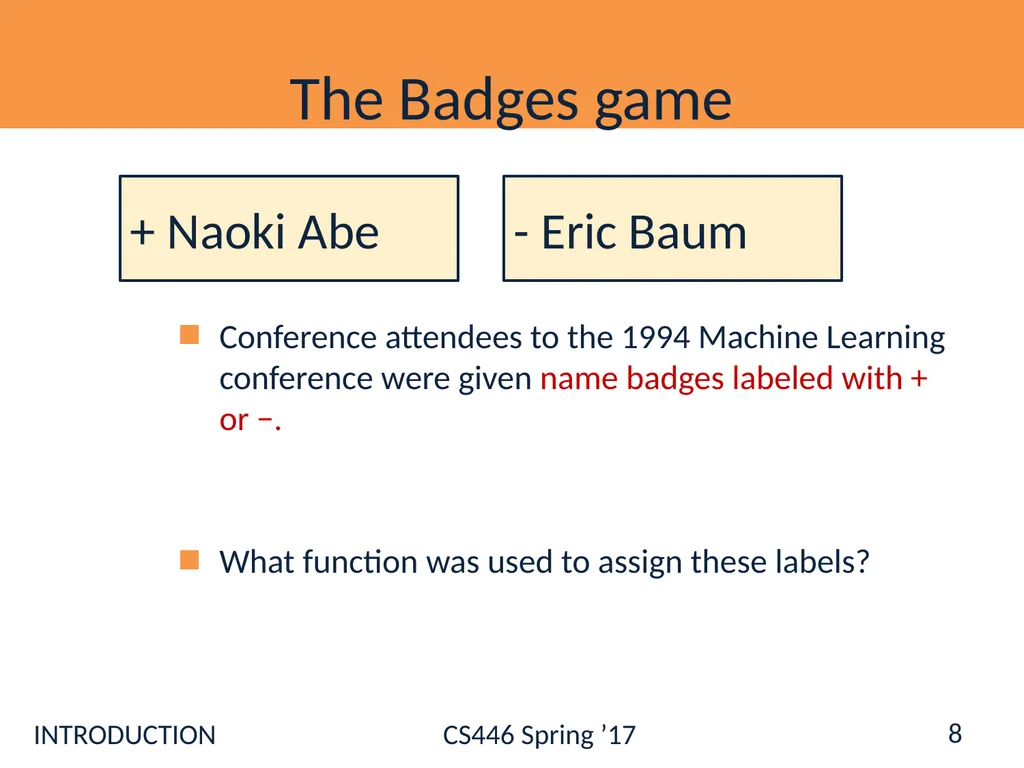
The Badges game Conference attendees to the 1994 Machine Learning conference were given name badges labeled with + or −.
What function was used to assign these labels? + Naoki Abe - Eric Baum 8<br>
What function was used to assign these labels? + Naoki Abe - Eric Baum 8<br>
09
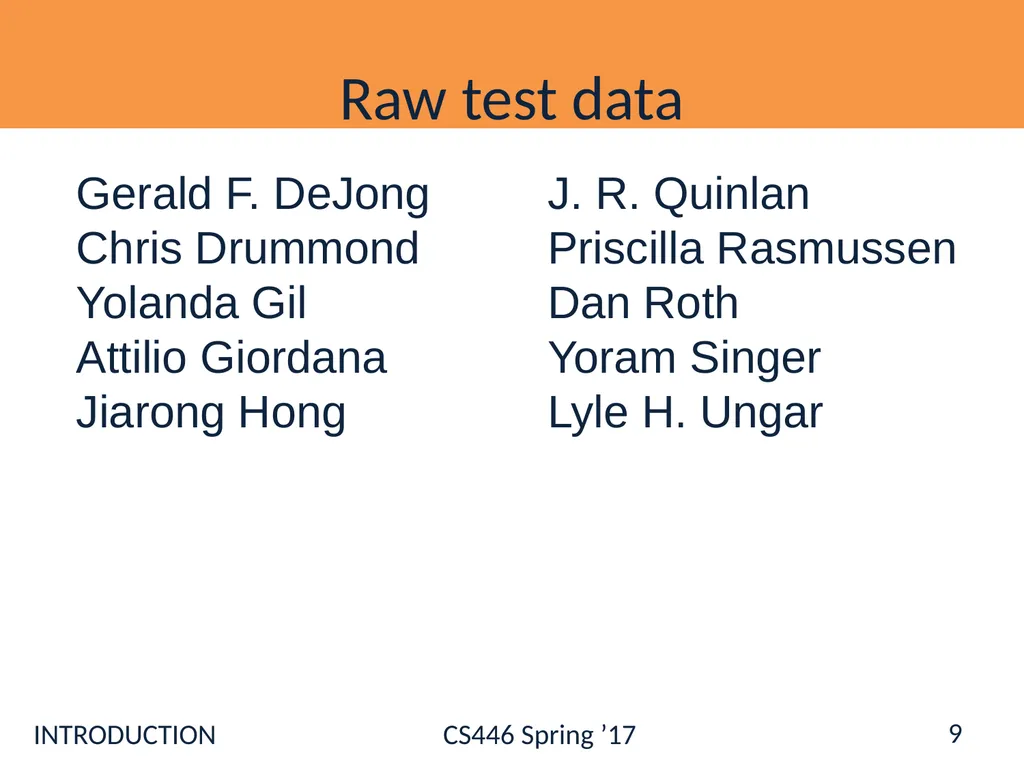
Raw test data Gerald F. DeJong
Chris Drummond
Yolanda Gil
Attilio Giordana
Jiarong Hong
J. R. Quinlan
Priscilla Rasmussen
Dan Roth
Yoram Singer
Lyle H. Ungar 9<br>
Chris Drummond
Yolanda Gil
Attilio Giordana
Jiarong Hong
J. R. Quinlan
Priscilla Rasmussen
Dan Roth
Yoram Singer
Lyle H. Ungar 9<br>
10
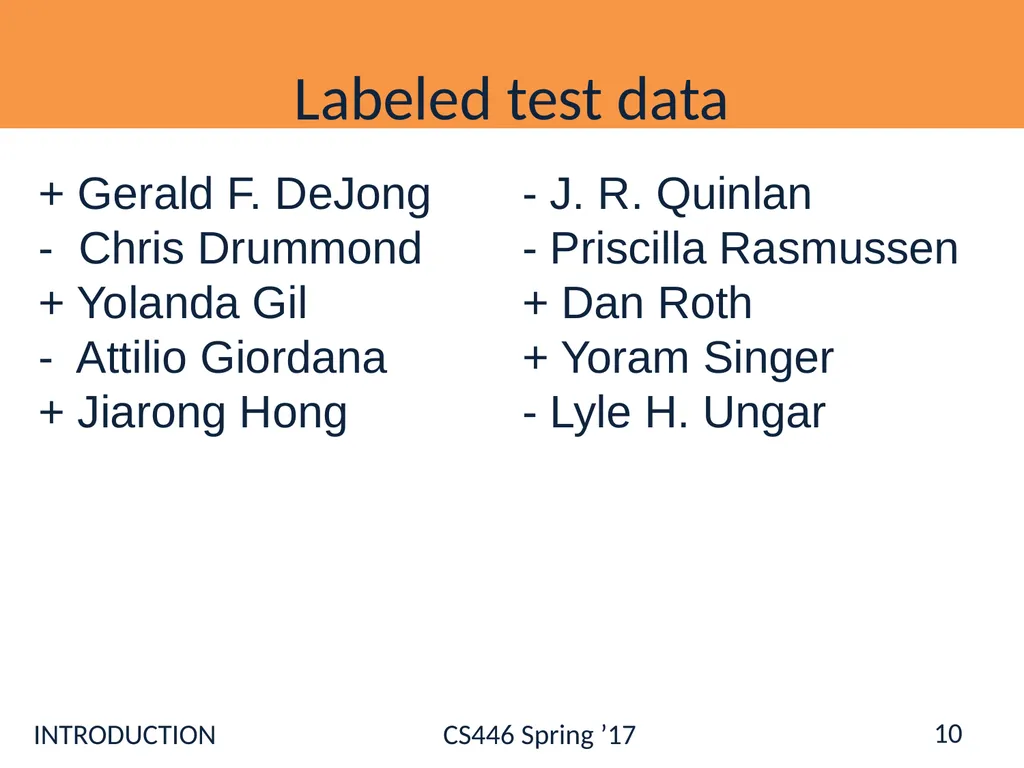
Labeled test data + Gerald F. DeJong
- Chris Drummond
+ Yolanda Gil
- Attilio Giordana
+ Jiarong Hong
- J. R. Quinlan
- Priscilla Rasmussen
+ Dan Roth
+ Yoram Singer
- Lyle H. Ungar 10<br>
- Chris Drummond
+ Yolanda Gil
- Attilio Giordana
+ Jiarong Hong
- J. R. Quinlan
- Priscilla Rasmussen
+ Dan Roth
+ Yoram Singer
- Lyle H. Ungar 10<br>
11
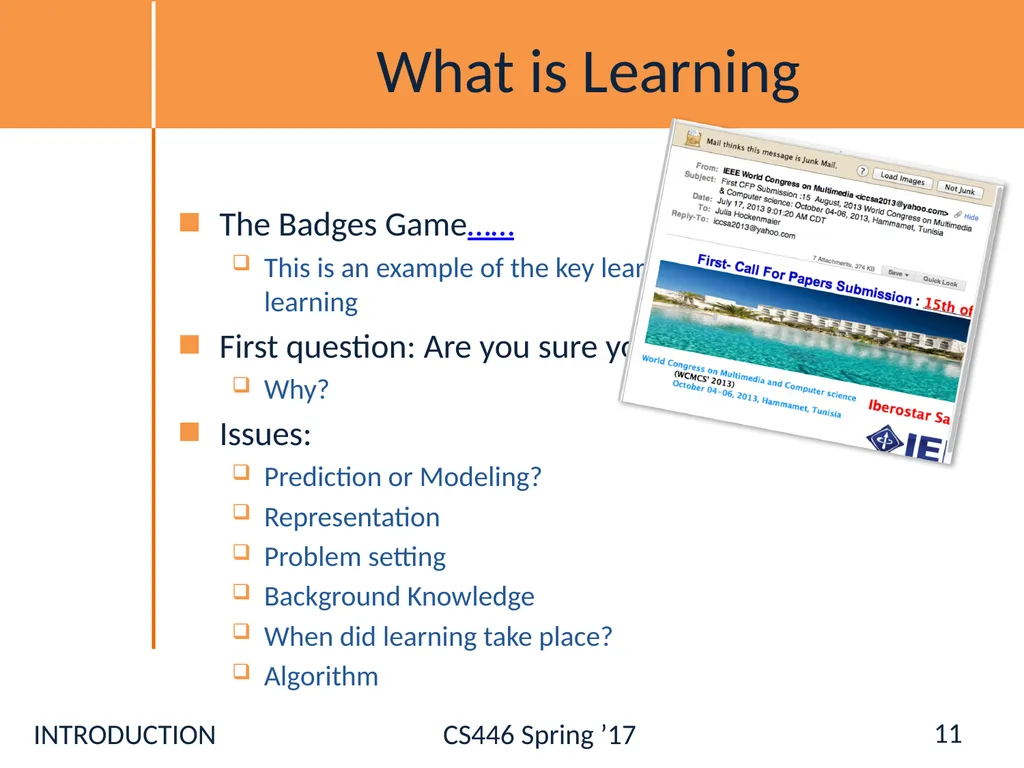
What is Learning The Badges Game……
This is an example of the key learning protocol: supervised learning
First question: Are you sure you got it right?
Why?
Issues:
Prediction or Modeling?
Representation
Problem setting
Background Knowledge
When did learning take place?
Algorithm 11<br>
This is an example of the key learning protocol: supervised learning
First question: Are you sure you got it right?
Why?
Issues:
Prediction or Modeling?
Representation
Problem setting
Background Knowledge
When did learning take place?
Algorithm 11<br>
12
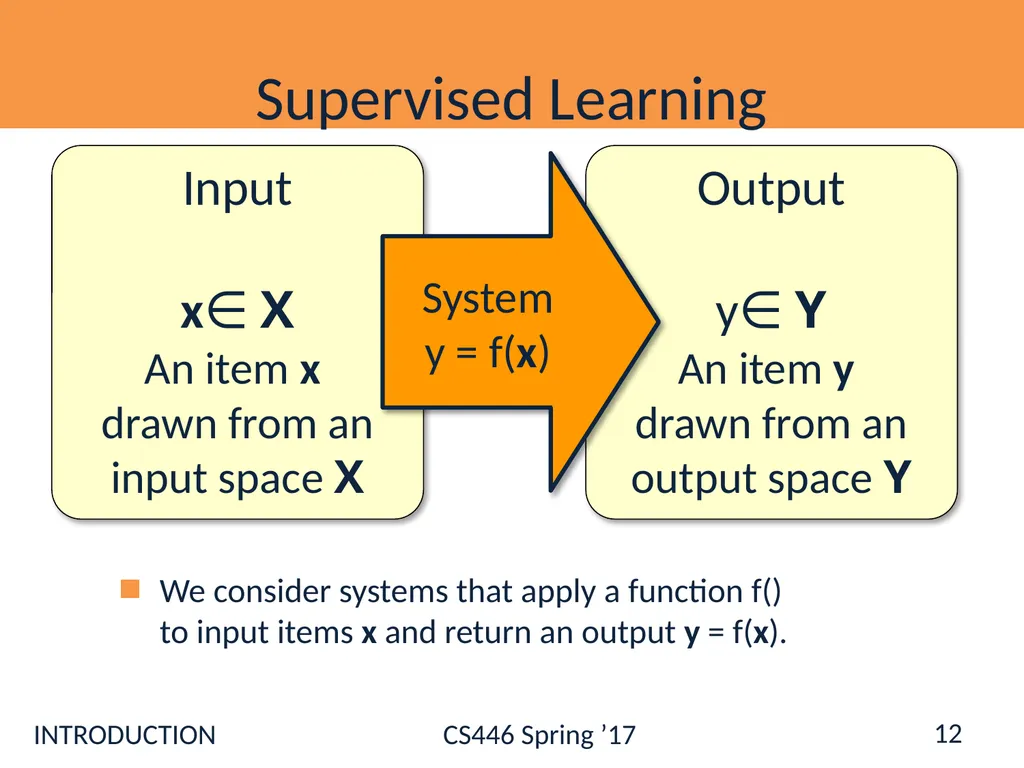
Output
y∈ Y
An item y drawn from an output space Y Input
x∈ X
An item x drawn from an input space X System
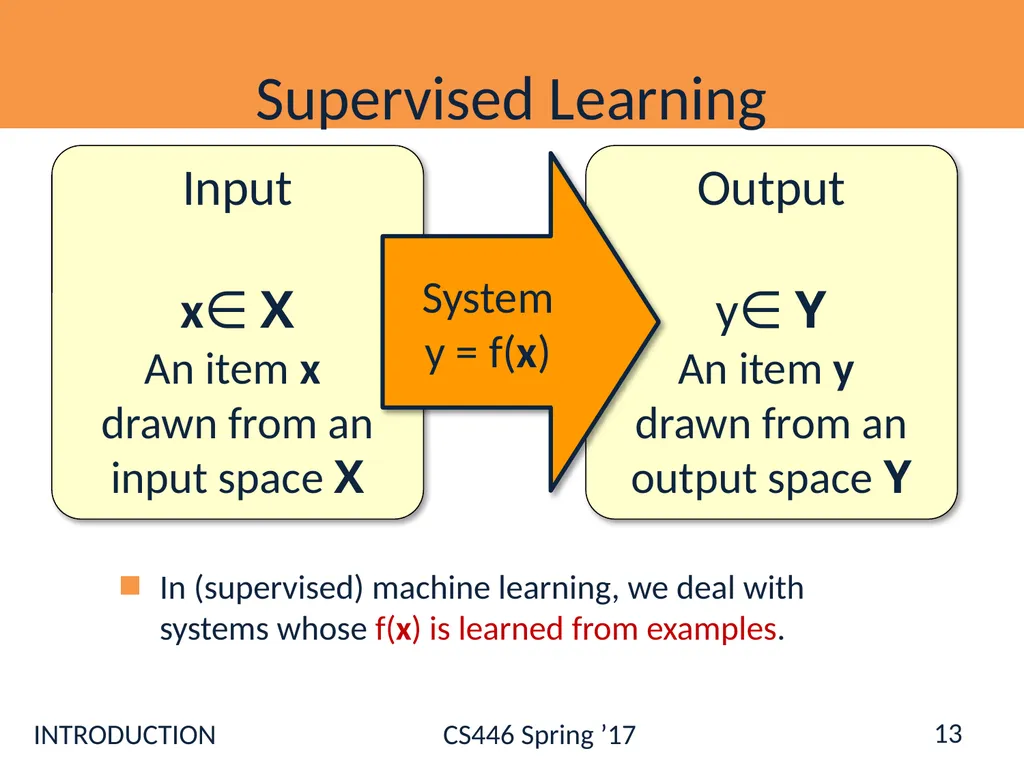
y = f(x) Supervised Learning We consider systems that apply a function f() to input items x and return an output y = f(x). 12<br>
y∈ Y
An item y drawn from an output space Y Input
x∈ X
An item x drawn from an input space X System
y = f(x) Supervised Learning We consider systems that apply a function f() to input items x and return an output y = f(x). 12<br>
13
Output
y∈ Y
An item y drawn from an output space Y Input
x∈ X
An item x drawn from an input space X System
y = f(x) Supervised Learning In (supervised) machine learning, we deal with systems whose f(x) is learned from examples. 13<br>
y∈ Y
An item y drawn from an output space Y Input
x∈ X
An item x drawn from an input space X System
y = f(x) Supervised Learning In (supervised) machine learning, we deal with systems whose f(x) is learned from examples. 13<br>
14
Why use learning? We typically use machine learning when
the function f(x) we want the system to apply is unknown to us, and we cannot “think” about it. The function could actually be simple. 14<br>
15
Output
y∈ Y
An item y drawn from a label space Y Input
x∈ X
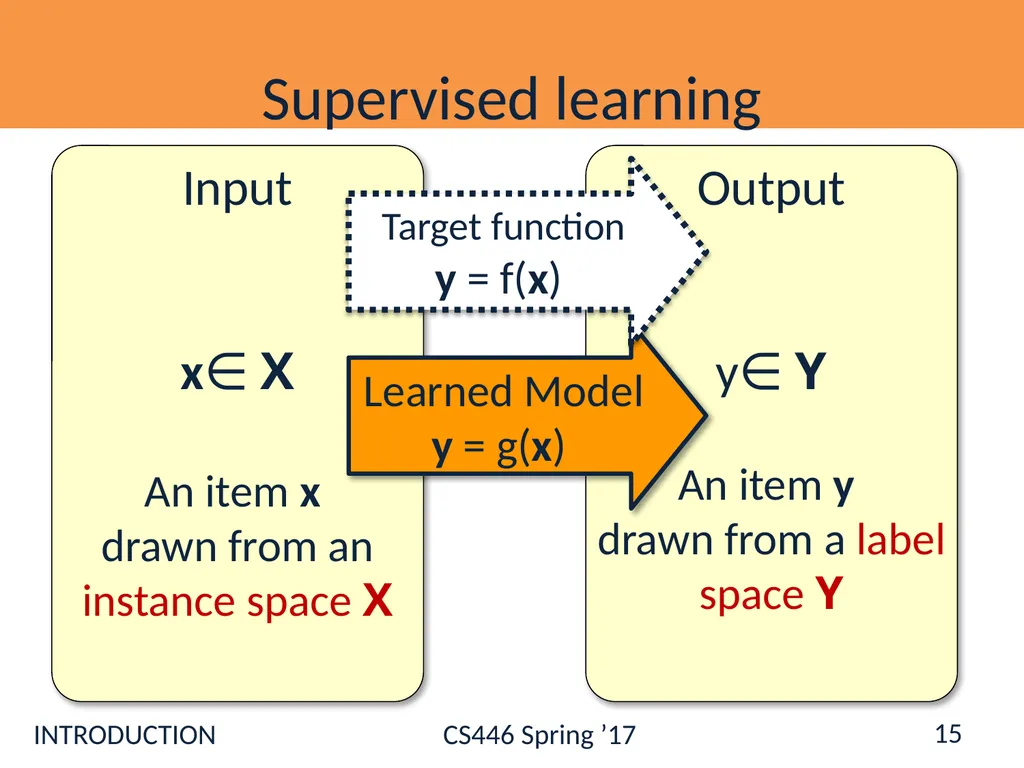
An item x drawn from an instance space X Learned Model y = g(x) Supervised learning Target function
y = f(x) 15<br>
y∈ Y
An item y drawn from a label space Y Input
x∈ X
An item x drawn from an instance space X Learned Model y = g(x) Supervised learning Target function
y = f(x) 15<br>
16
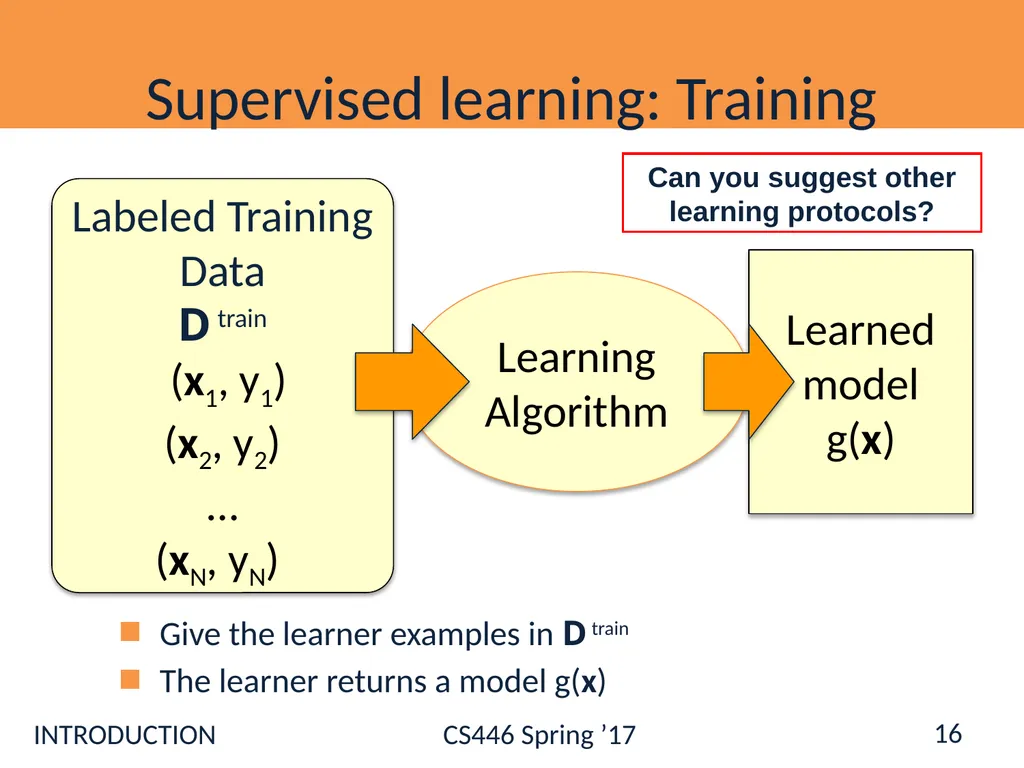
Supervised learning: Training Give the learner examples in D train
The learner returns a model g(x) 16 Labeled Training Data D train (x1, y1)
(x2, y2)
…
(xN, yN) Learned model
g(x) Learning Algorithm Can you suggest other learning protocols?<br>
The learner returns a model g(x) 16 Labeled Training Data D train (x1, y1)
(x2, y2)
…
(xN, yN) Learned model
g(x) Learning Algorithm Can you suggest other learning protocols?<br>
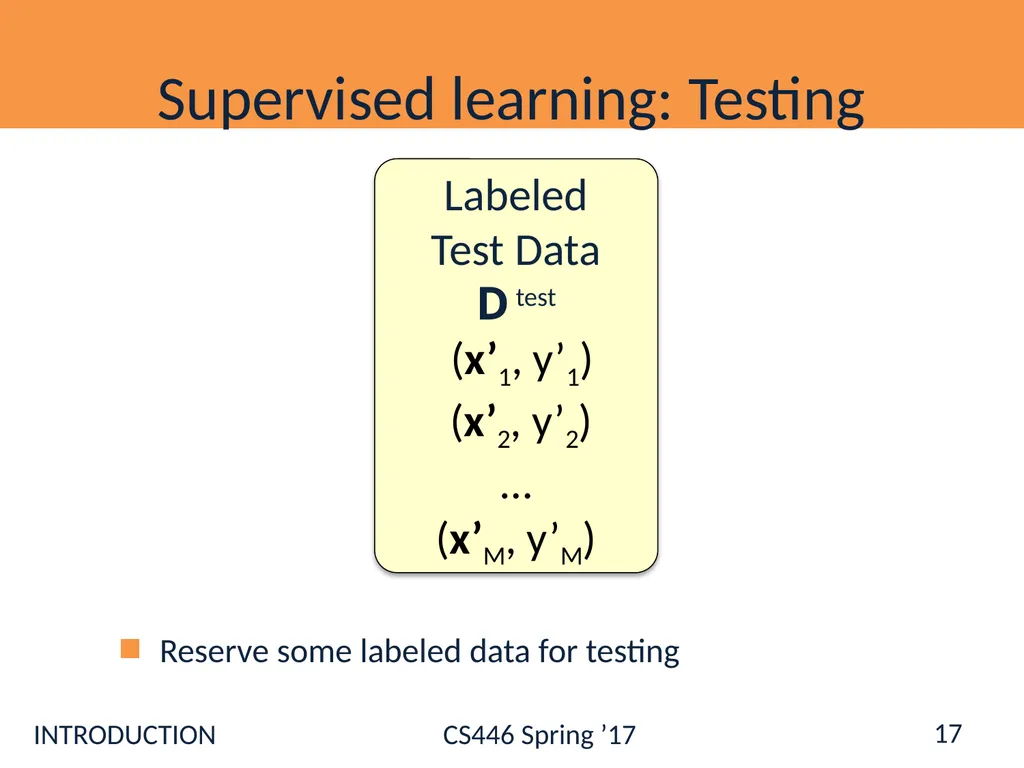
17
Supervised learning: Testing Reserve some labeled data for testing 17 Labeled
Test Data D test (x’1, y’1)
(x’2, y’2)
…
(x’M, y’M)<br>
Test Data D test (x’1, y’1)
(x’2, y’2)
…
(x’M, y’M)<br>
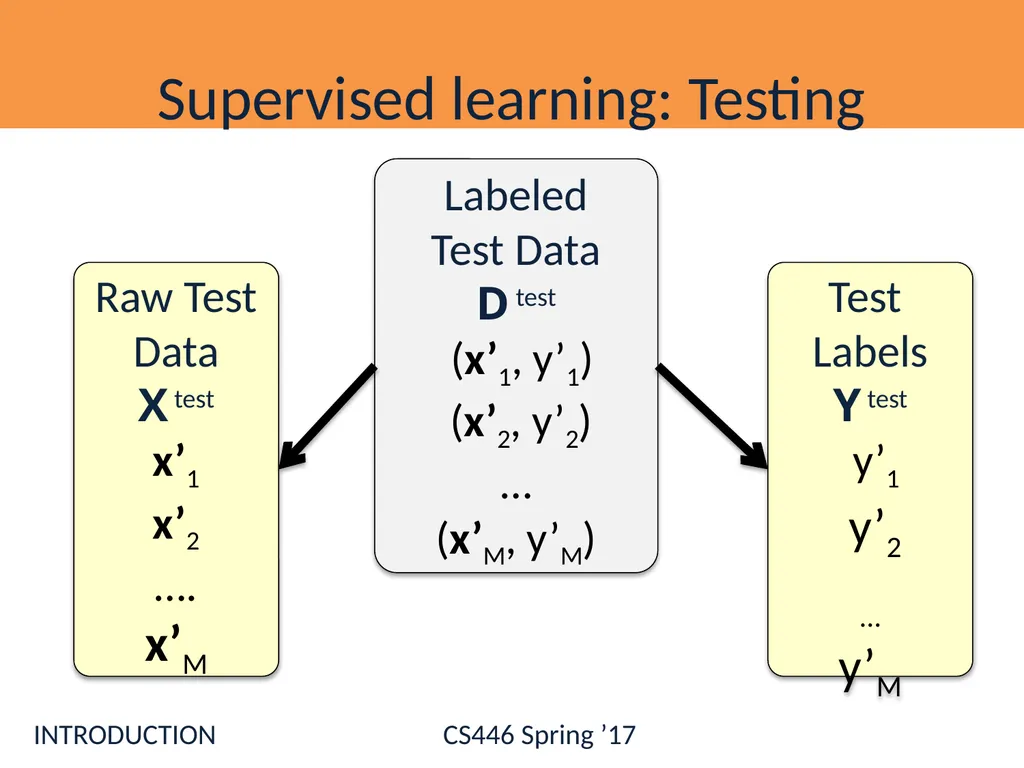
18
Supervised learning: Testing Labeled
Test Data D test (x’1, y’1)
(x’2, y’2)
…
(x’M, y’M)<br>
Test Data D test (x’1, y’1)
(x’2, y’2)
…
(x’M, y’M)<br>
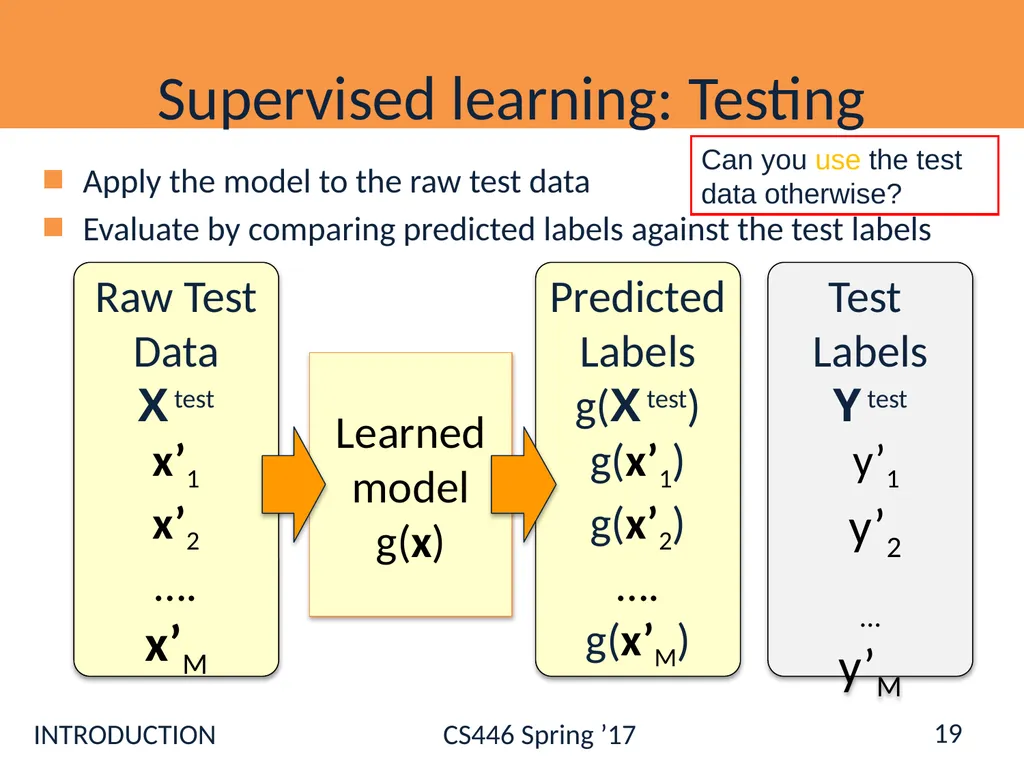
19
Test
Labels
Y test
y’1
y’2
...
y’M Raw Test Data X test x’1 x’2
….
x’M Supervised learning: Testing Apply the model to the raw test data
Evaluate by comparing predicted labels against the test labels 19 Learned model
g(x) Can you use the test data otherwise?<br>
y’2
...
y’M Raw Test Data X test x’1 x’2
….
x’M Supervised learning: Testing Apply the model to the raw test data
Evaluate by comparing predicted labels against the test labels 19 Learned model
g(x) Can you use the test data otherwise?<br>
20
What is Learning The Badges Game……
This is an example of the key learning protocol: supervised learning
First question: Are you sure you got it?
Why?
Issues:
Prediction or Modeling?
Representation
Problem setting
Background Knowledge
When did learning take place?
Algorithm 20<br>
This is an example of the key learning protocol: supervised learning
First question: Are you sure you got it?
Why?
Issues:
Prediction or Modeling?
Representation
Problem setting
Background Knowledge
When did learning take place?
Algorithm 20<br>
21
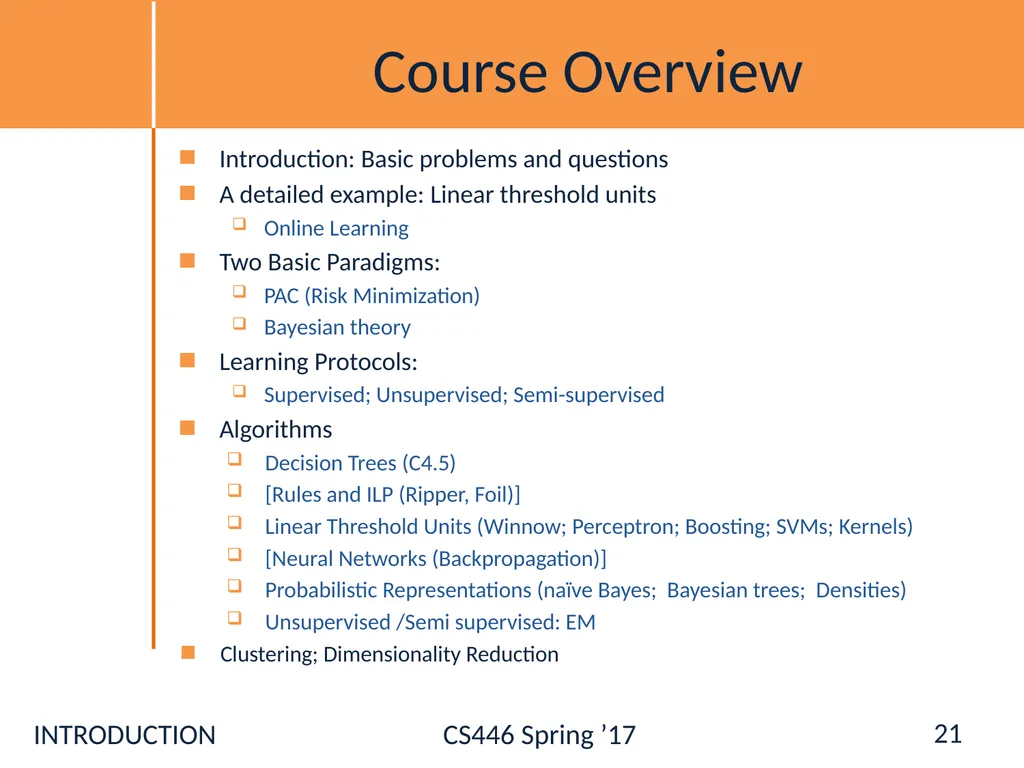
Course Overview Introduction: Basic problems and questions
A detailed example: Linear threshold units
Online Learning
Two Basic Paradigms:
PAC (Risk Minimization)
Bayesian theory
Learning Protocols:
Supervised; Unsupervised; Semi-supervised
Algorithms
Decision Trees (C4.5)
[Rules and ILP (Ripper, Foil)]
Linear Threshold Units (Winnow; Perceptron; Boosting; SVMs; Kernels)
[Neural Networks (Backpropagation)]
Probabilistic Representations (naïve Bayes; Bayesian trees; Densities)
Unsupervised /Semi supervised: EM
Clustering; Dimensionality Reduction 21<br>
A detailed example: Linear threshold units
Online Learning
Two Basic Paradigms:
PAC (Risk Minimization)
Bayesian theory
Learning Protocols:
Supervised; Unsupervised; Semi-supervised
Algorithms
Decision Trees (C4.5)
[Rules and ILP (Ripper, Foil)]
Linear Threshold Units (Winnow; Perceptron; Boosting; SVMs; Kernels)
[Neural Networks (Backpropagation)]
Probabilistic Representations (naïve Bayes; Bayesian trees; Densities)
Unsupervised /Semi supervised: EM
Clustering; Dimensionality Reduction 21<br>
22
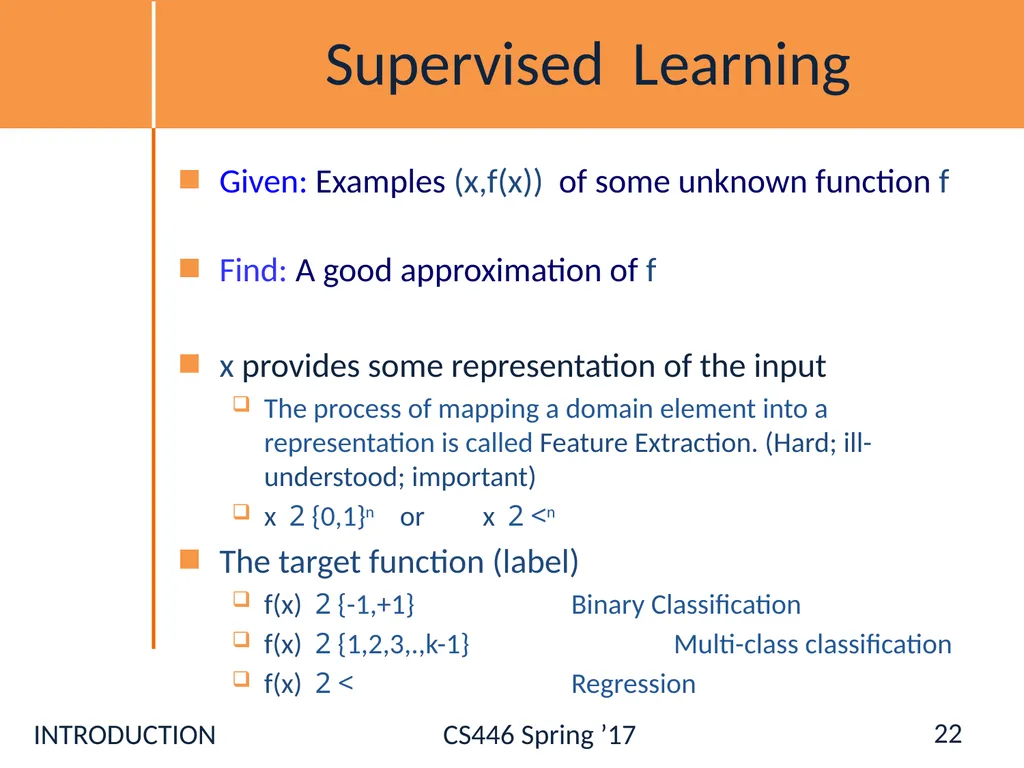
Supervised Learning Given: Examples (x,f(x)) of some unknown function f
Find: A good approximation of f
x provides some representation of the input
The process of mapping a domain element into a representation is called Feature Extraction. (Hard; ill-understood; important)
x 2 {0,1}n or x 2 <n
The target function (label)
f(x) 2 {-1,+1} Binary Classification
f(x) 2 {1,2,3,.,k-1} Multi-class classification
f(x) 2 < Regression 22<br>
Find: A good approximation of f
x provides some representation of the input
The process of mapping a domain element into a representation is called Feature Extraction. (Hard; ill-understood; important)
x 2 {0,1}n or x 2 <n
The target function (label)
f(x) 2 {-1,+1} Binary Classification
f(x) 2 {1,2,3,.,k-1} Multi-class classification
f(x) 2 < Regression 22<br>
23
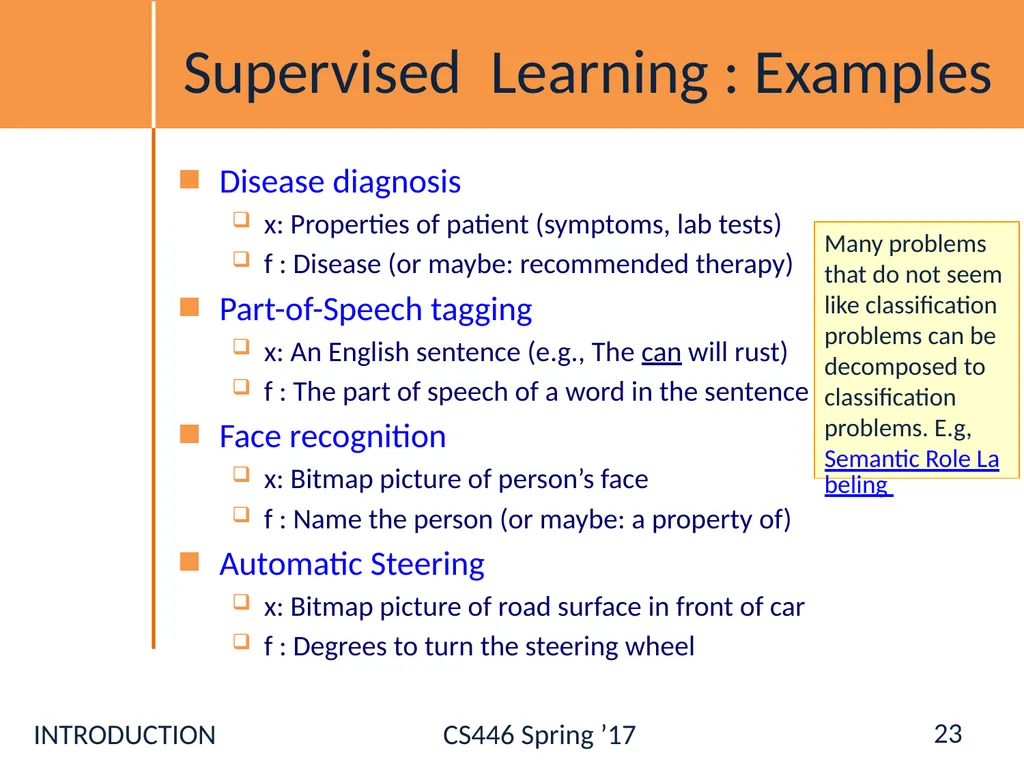
Supervised Learning : Examples Disease diagnosis
x: Properties of patient (symptoms, lab tests)
f : Disease (or maybe: recommended therapy)
Part-of-Speech tagging
x: An English sentence (e.g., The can will rust)
f : The part of speech of a word in the sentence
Face recognition
x: Bitmap picture of person’s face
f : Name the person (or maybe: a property of)
Automatic Steering
x: Bitmap picture of road surface in front of car
f : Degrees to turn the steering wheel Many problems that do not seem like classification problems can be decomposed to classification problems. E.g, Semantic Role Labeling 23<br>
x: Properties of patient (symptoms, lab tests)
f : Disease (or maybe: recommended therapy)
Part-of-Speech tagging
x: An English sentence (e.g., The can will rust)
f : The part of speech of a word in the sentence
Face recognition
x: Bitmap picture of person’s face
f : Name the person (or maybe: a property of)
Automatic Steering
x: Bitmap picture of road surface in front of car
f : Degrees to turn the steering wheel Many problems that do not seem like classification problems can be decomposed to classification problems. E.g, Semantic Role Labeling 23<br>
24
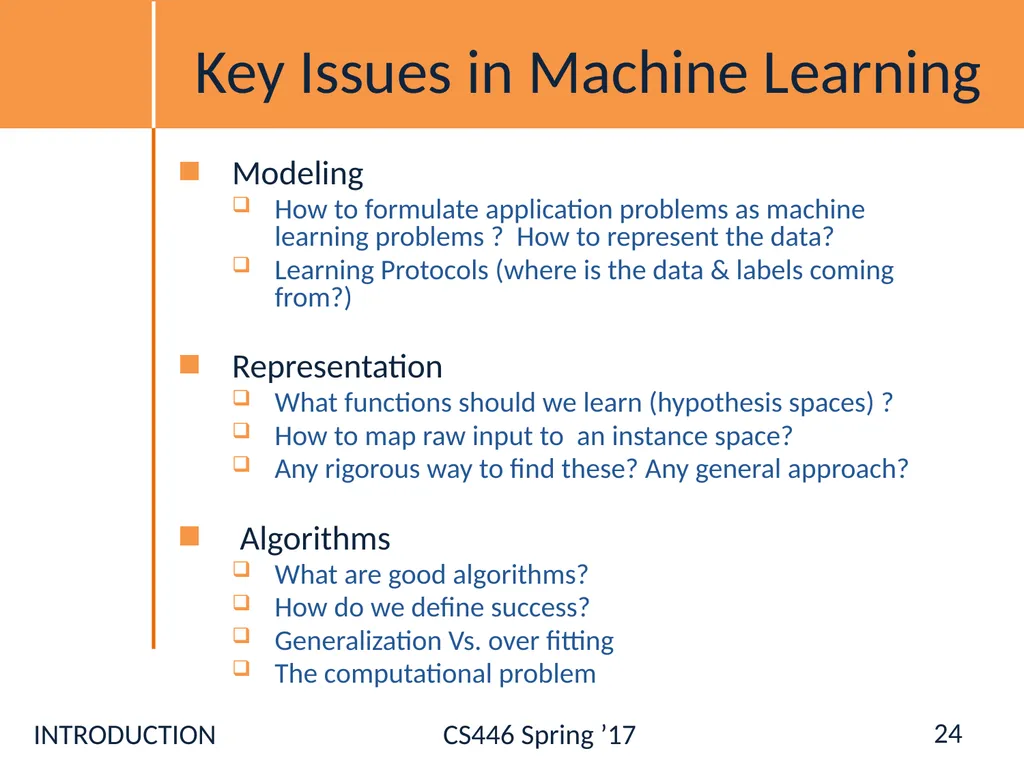
Key Issues in Machine Learning Modeling
How to formulate application problems as machine learning problems ? How to represent the data?
Learning Protocols (where is the data & labels coming from?)
Representation
What functions should we learn (hypothesis spaces) ?
How to map raw input to an instance space?
Any rigorous way to find these? Any general approach?
Algorithms
What are good algorithms?
How do we define success?
Generalization Vs. over fitting
The computational problem 24<br>
How to formulate application problems as machine learning problems ? How to represent the data?
Learning Protocols (where is the data & labels coming from?)
Representation
What functions should we learn (hypothesis spaces) ?
How to map raw input to an instance space?
Any rigorous way to find these? Any general approach?
Algorithms
What are good algorithms?
How do we define success?
Generalization Vs. over fitting
The computational problem 24<br>
25
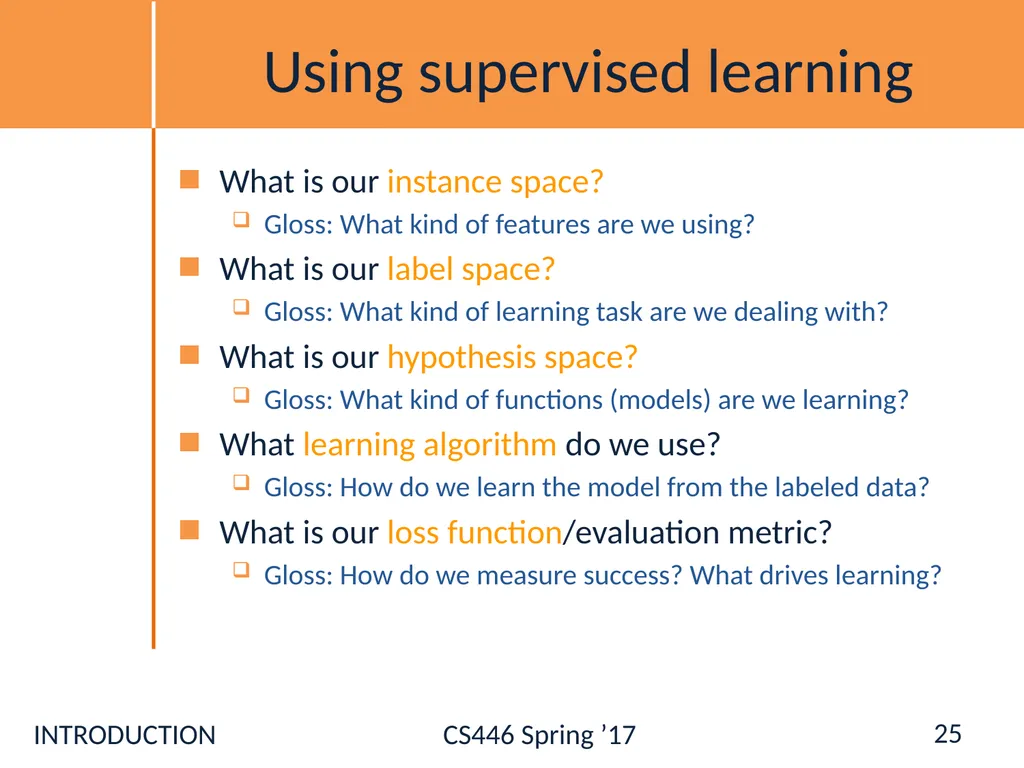
Using supervised learning What is our instance space?
Gloss: What kind of features are we using?
What is our label space?
Gloss: What kind of learning task are we dealing with?
What is our hypothesis space?
Gloss: What kind of functions (models) are we learning?
What learning algorithm do we use?
Gloss: How do we learn the model from the labeled data?
What is our loss function/evaluation metric?
Gloss: How do we measure success? What drives learning? 25<br>
Gloss: What kind of features are we using?
What is our label space?
Gloss: What kind of learning task are we dealing with?
What is our hypothesis space?
Gloss: What kind of functions (models) are we learning?
What learning algorithm do we use?
Gloss: How do we learn the model from the labeled data?
What is our loss function/evaluation metric?
Gloss: How do we measure success? What drives learning? 25<br>
26
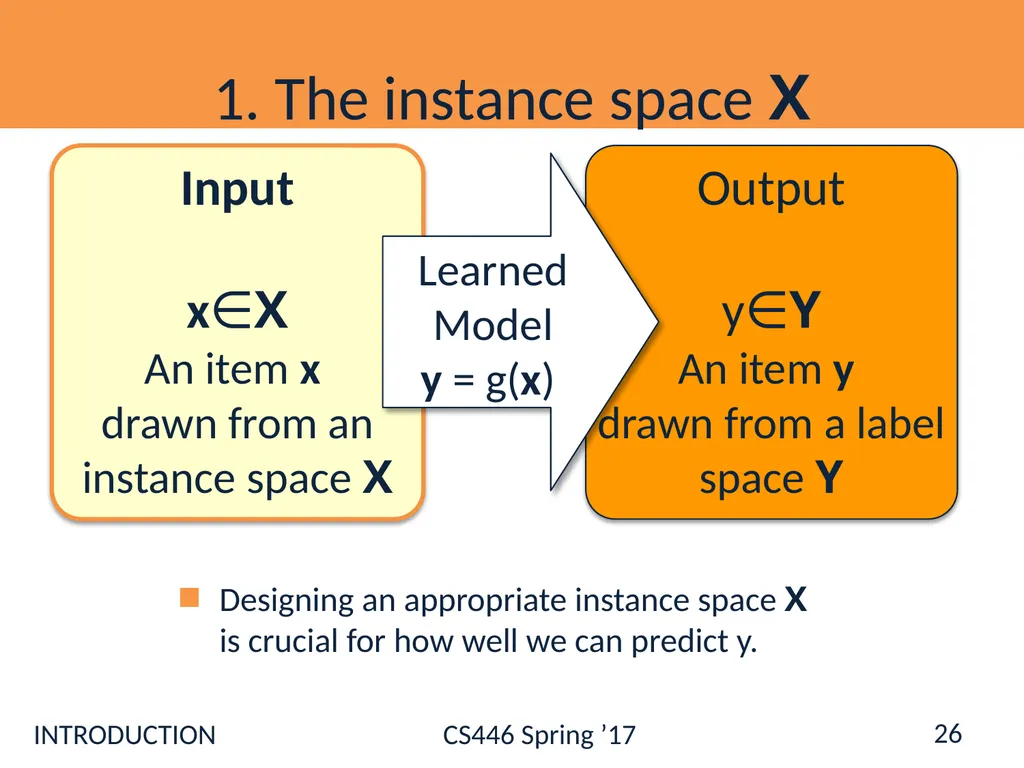
Output
y∈Y
An item y drawn from a label space Y Input
x∈X
An item x drawn from an instance space X Learned
Model
y = g(x) 1. The instance space X Designing an appropriate instance space X is crucial for how well we can predict y. 26<br>
y∈Y
An item y drawn from a label space Y Input
x∈X
An item x drawn from an instance space X Learned
Model
y = g(x) 1. The instance space X Designing an appropriate instance space X is crucial for how well we can predict y. 26<br>
27
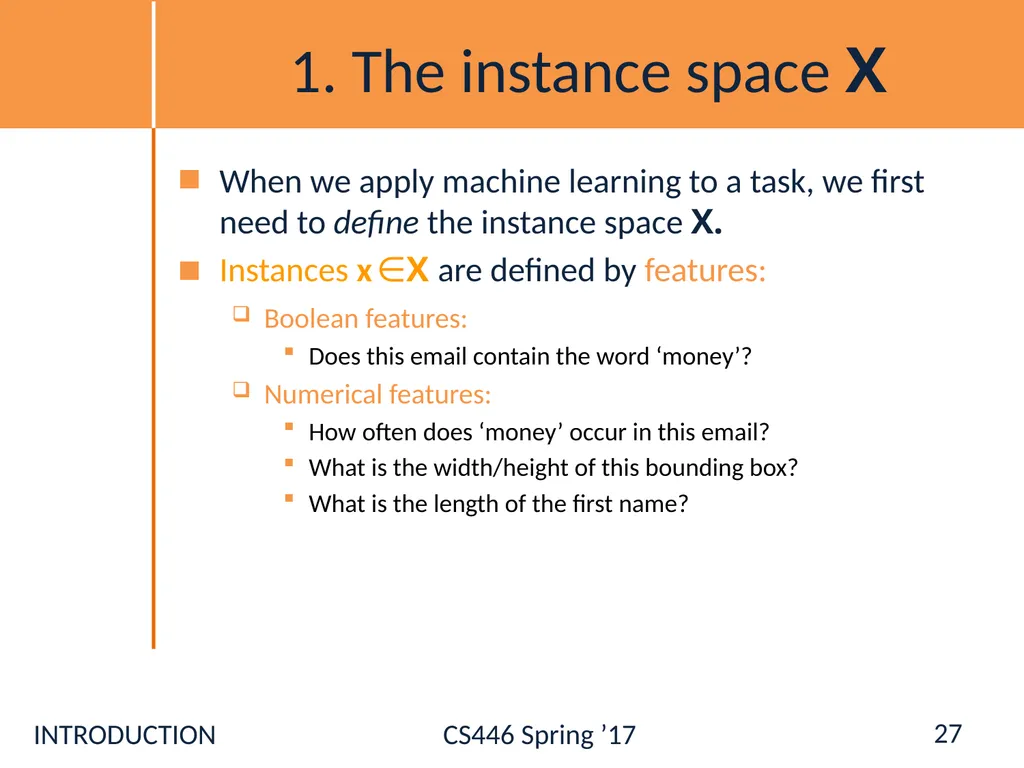
1. The instance space X When we apply machine learning to a task, we first need to define the instance space X.
Instances x ∈X are defined by features:
Boolean features:
Does this email contain the word ‘money’?
Numerical features:
How often does ‘money’ occur in this email?
What is the width/height of this bounding box?
What is the length of the first name? 27<br>
Instances x ∈X are defined by features:
Boolean features:
Does this email contain the word ‘money’?
Numerical features:
How often does ‘money’ occur in this email?
What is the width/height of this bounding box?
What is the length of the first name? 27<br>
28
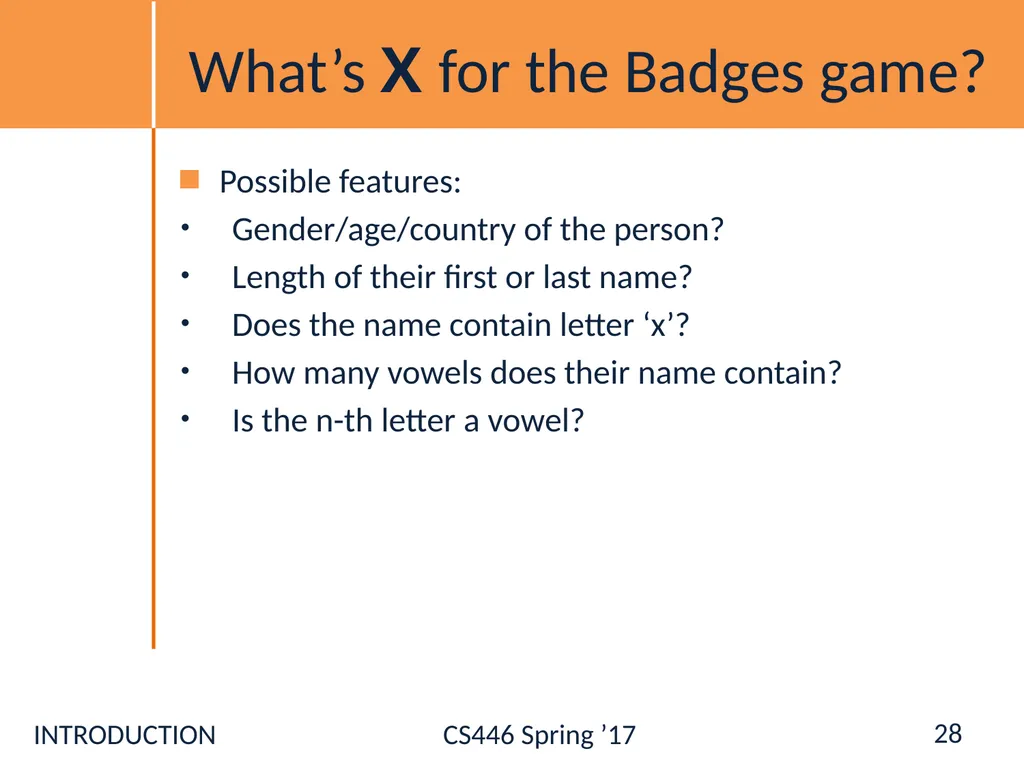
What’s X for the Badges game? Possible features:
Gender/age/country of the person?
Length of their first or last name?
Does the name contain letter ‘x’?
How many vowels does their name contain?
Is the n-th letter a vowel? 28<br>
Gender/age/country of the person?
Length of their first or last name?
Does the name contain letter ‘x’?
How many vowels does their name contain?
Is the n-th letter a vowel? 28<br>
29
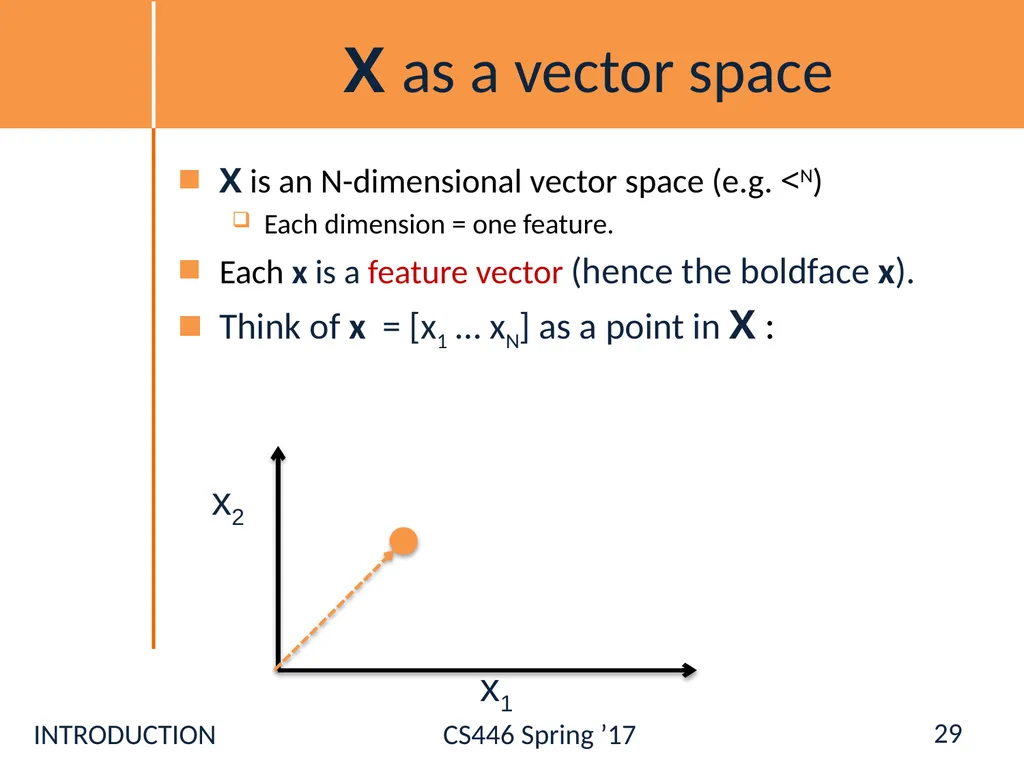
X as a vector space X is an N-dimensional vector space (e.g. <N)
Each dimension = one feature.
Each x is a feature vector (hence the boldface x).
Think of x = [x1 … xN] as a point in X : 29<br>
Each dimension = one feature.
Each x is a feature vector (hence the boldface x).
Think of x = [x1 … xN] as a point in X : 29<br>
30
From feature templates to vectors When designing features, we often think in terms of templates, not individual features:
Encoding a name by encoding it characters:
What is the i-th letter?
Abe → [1 0 0 0 0… 0 1 0 0 0 0… 0 0 0 0 1 …]
26*2 + 1 positions in each group;
# of groups == upper bounds on length of names 30<br>
Encoding a name by encoding it characters:
What is the i-th letter?
Abe → [1 0 0 0 0… 0 1 0 0 0 0… 0 0 0 0 1 …]
26*2 + 1 positions in each group;
# of groups == upper bounds on length of names 30<br>
31
Good features are essential The choice of features is crucial for how well a task can be learned.
In many application areas (language, vision, etc.), a lot of work goes into designing suitable features.
This requires domain expertise.
CS446 can’t teach you what specific features to use for your task.
But we will touch on some general principles 31<br>
In many application areas (language, vision, etc.), a lot of work goes into designing suitable features.
This requires domain expertise.
CS446 can’t teach you what specific features to use for your task.
But we will touch on some general principles 31<br>
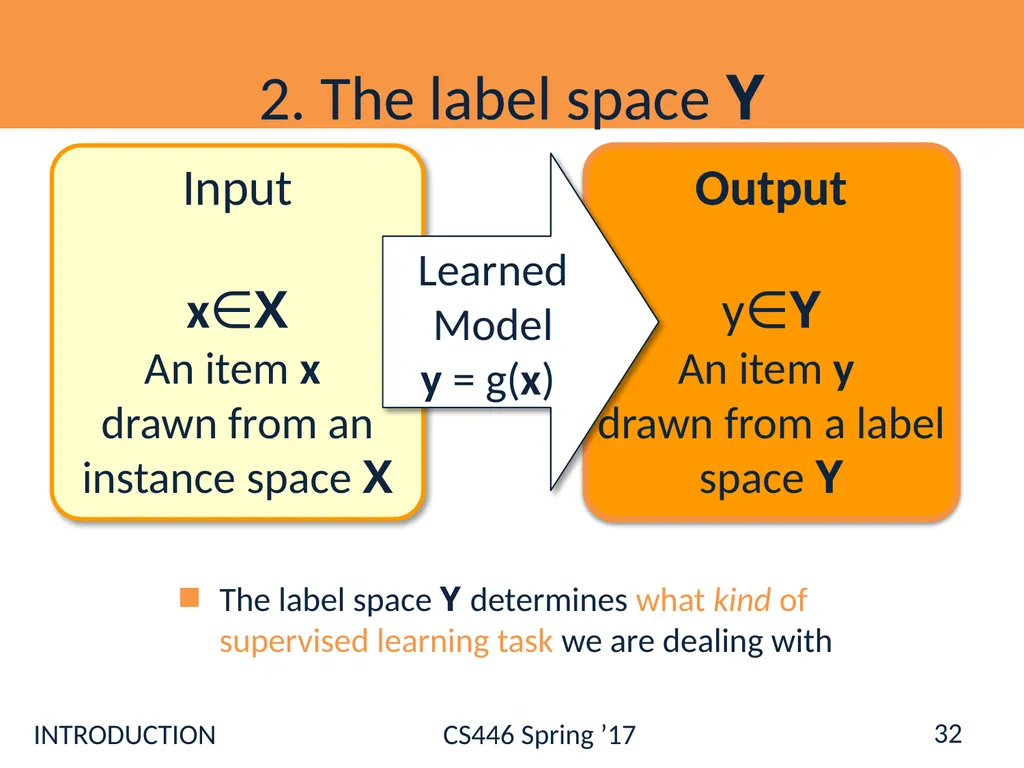
32
Output
y∈Y
An item y drawn from a label space Y Input
x∈X
An item x drawn from an instance space X Learned Model
y = g(x) 2. The label space Y The label space Y determines what kind of supervised learning task we are dealing with 32<br>
y∈Y
An item y drawn from a label space Y Input
x∈X
An item x drawn from an instance space X Learned Model
y = g(x) 2. The label space Y The label space Y determines what kind of supervised learning task we are dealing with 32<br>
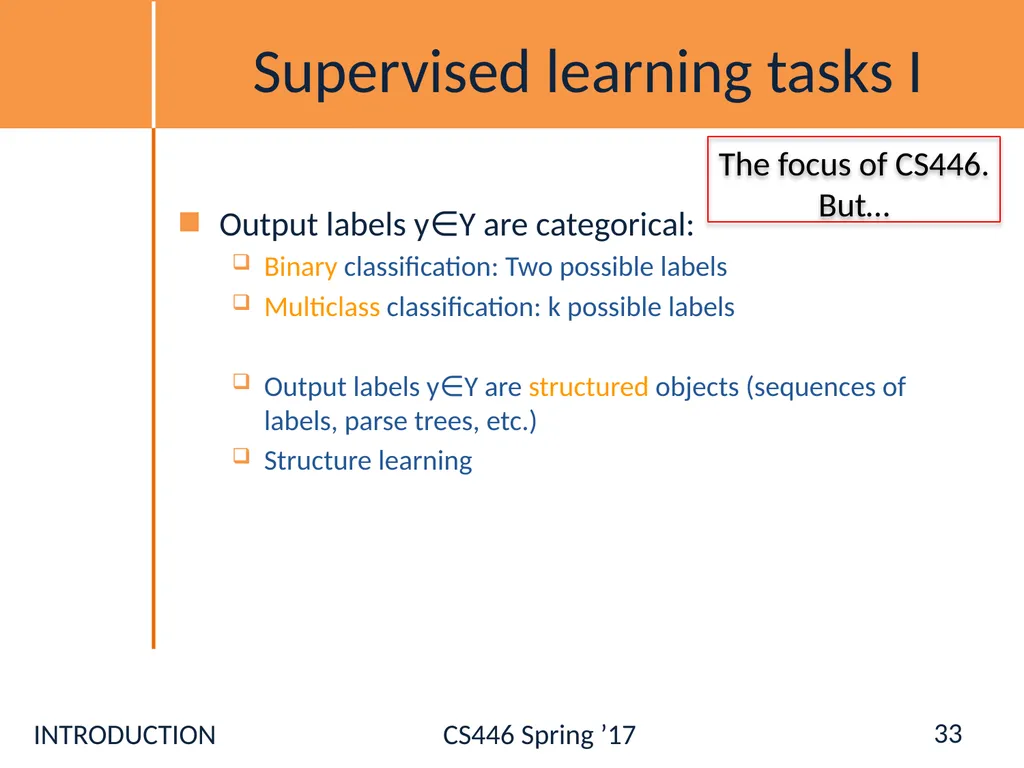
33
The focus of CS446. But… Supervised learning tasks I Output labels y∈Y are categorical:
Binary classification: Two possible labels
Multiclass classification: k possible labels
Output labels y∈Y are structured objects (sequences of labels, parse trees, etc.)
Structure learning 33<br>
Binary classification: Two possible labels
Multiclass classification: k possible labels
Output labels y∈Y are structured objects (sequences of labels, parse trees, etc.)
Structure learning 33<br>
34
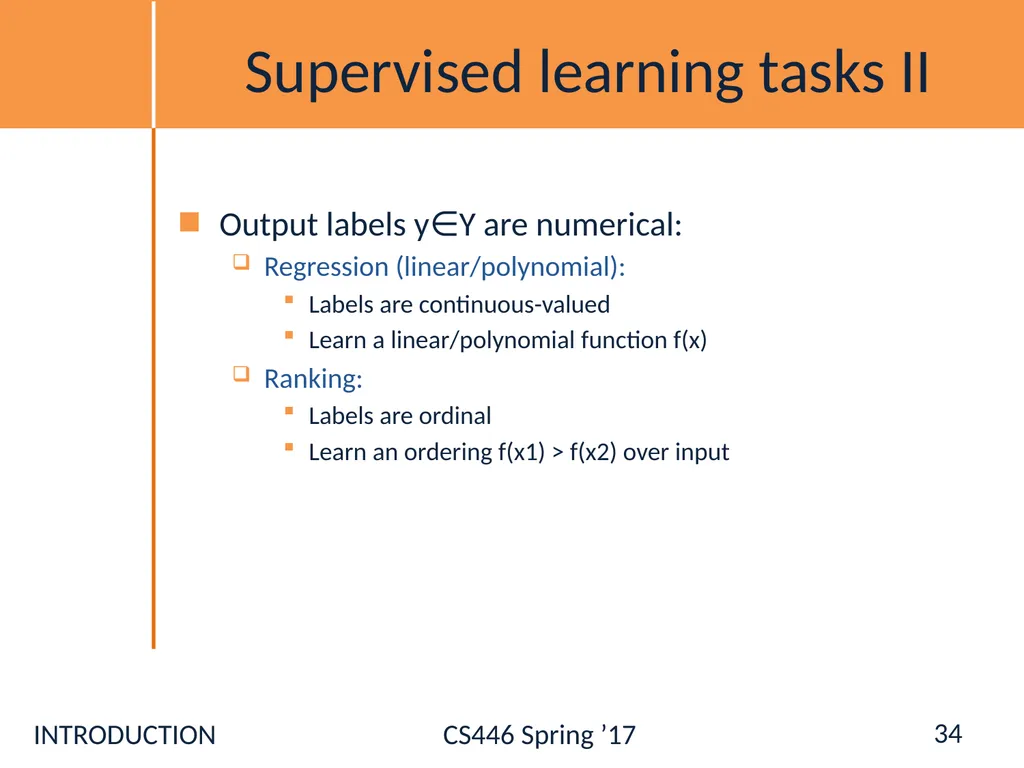
Supervised learning tasks II Output labels y∈Y are numerical:
Regression (linear/polynomial):
Labels are continuous-valued
Learn a linear/polynomial function f(x)
Ranking:
Labels are ordinal
Learn an ordering f(x1) > f(x2) over input 34<br>
Regression (linear/polynomial):
Labels are continuous-valued
Learn a linear/polynomial function f(x)
Ranking:
Labels are ordinal
Learn an ordering f(x1) > f(x2) over input 34<br>
35
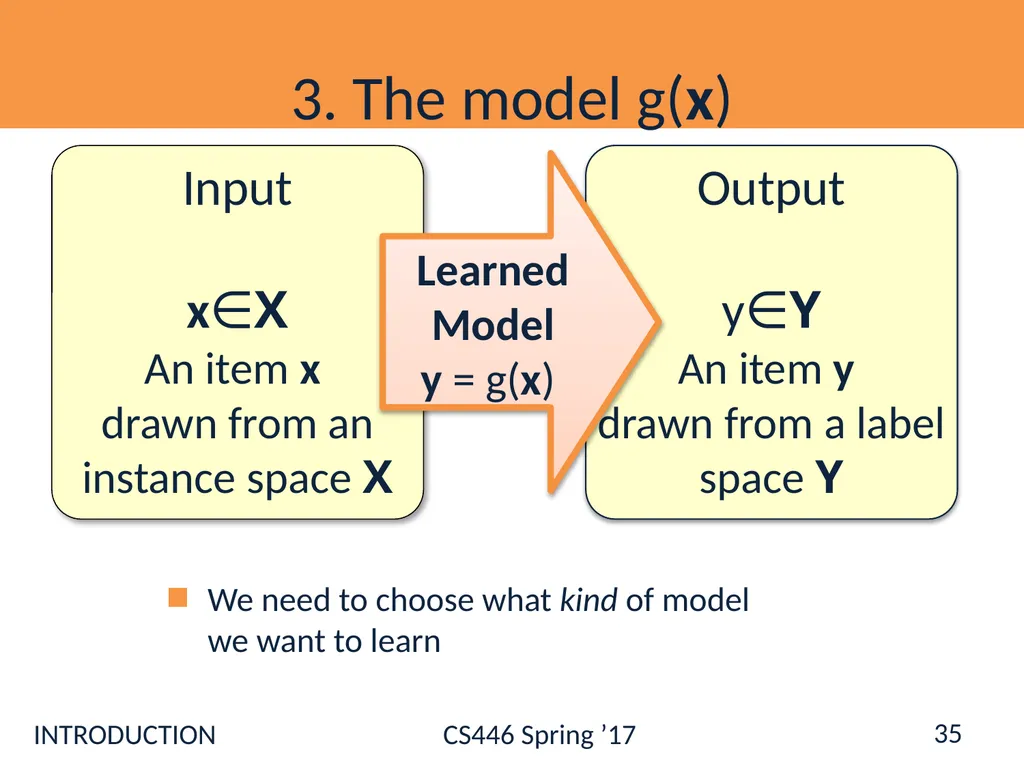
Output
y∈Y
An item y drawn from a label space Y Input
x∈X
An item x drawn from an instance space X Learned Model
y = g(x) 3. The model g(x) We need to choose what kind of model we want to learn 35<br>
y∈Y
An item y drawn from a label space Y Input
x∈X
An item x drawn from an instance space X Learned Model
y = g(x) 3. The model g(x) We need to choose what kind of model we want to learn 35<br>
36
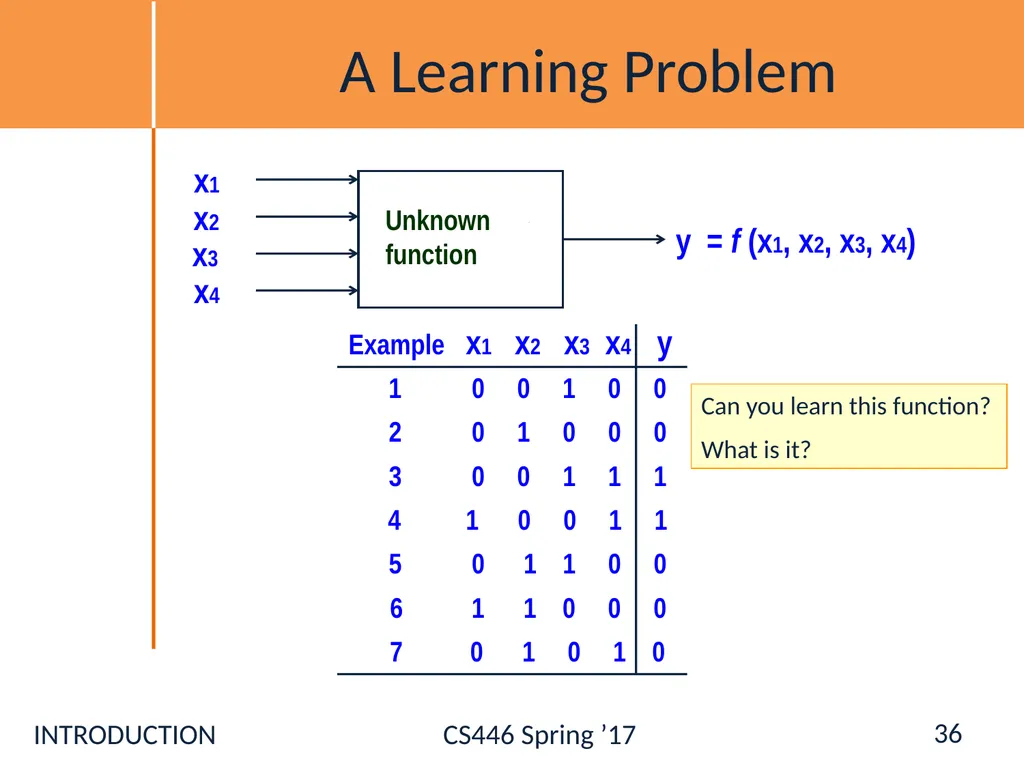
A Learning Problem y = f (x1, x2, x3, x4) Unknown
function x1 x2 x3 x4 Can you learn this function?
What is it? 36<br>
function x1 x2 x3 x4 Can you learn this function?
What is it? 36<br>
37
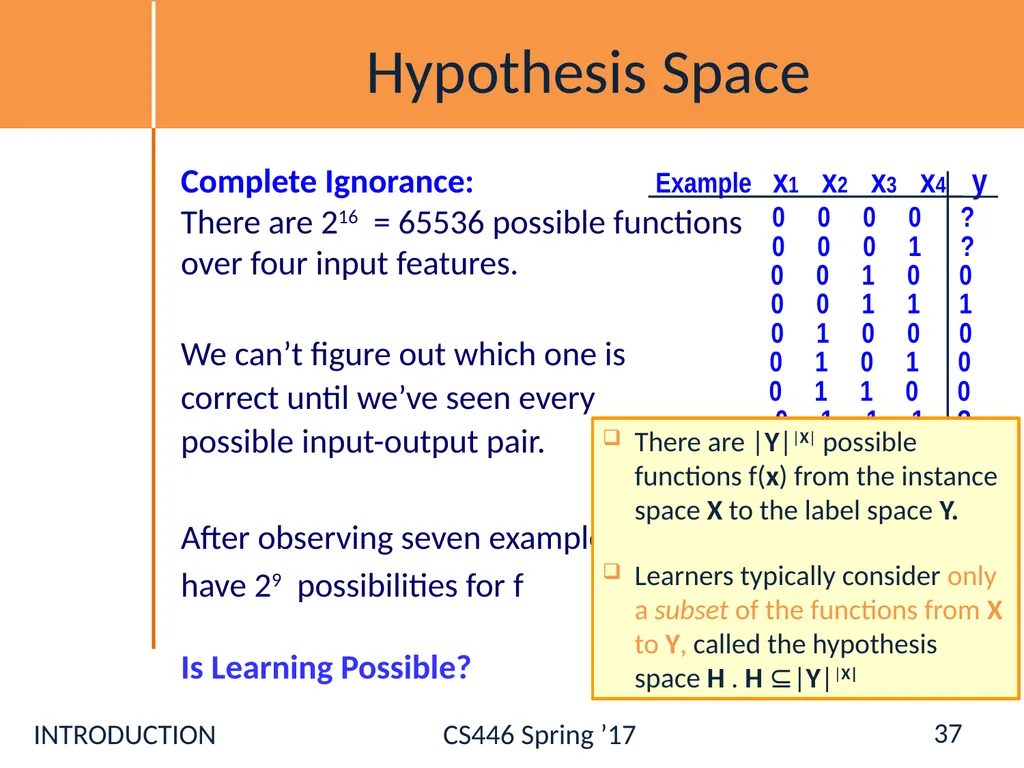
Hypothesis Space Complete Ignorance:
There are 216 = 65536 possible functions
over four input features.
We can’t figure out which one is
correct until we’ve seen every
possible input-output pair.
After observing seven examples we still
have 29 possibilities for f
Is Learning Possible? 37 There are |Y||X| possible functions f(x) from the instance space X to the label space Y.
Learners typically consider only a subset of the functions from X to Y, called the hypothesis space H . H ⊆|Y||X|<br>
There are 216 = 65536 possible functions
over four input features.
We can’t figure out which one is
correct until we’ve seen every
possible input-output pair.
After observing seven examples we still
have 29 possibilities for f
Is Learning Possible? 37 There are |Y||X| possible functions f(x) from the instance space X to the label space Y.
Learners typically consider only a subset of the functions from X to Y, called the hypothesis space H . H ⊆|Y||X|<br>
38
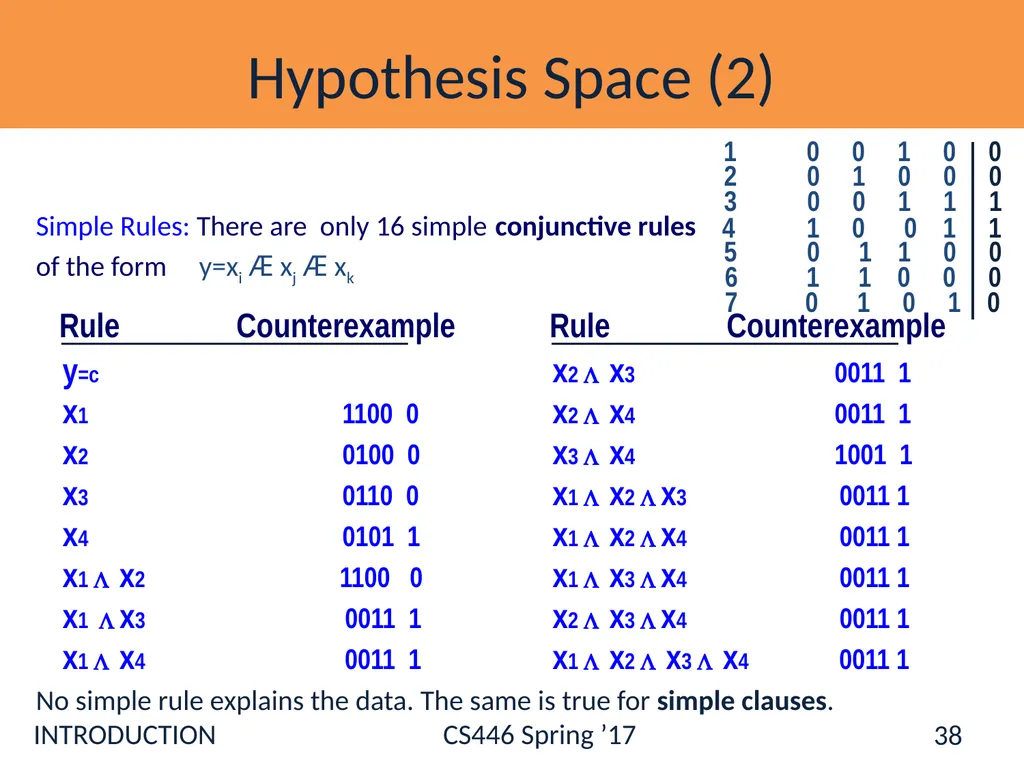
Hypothesis Space (2) Simple Rules: There are only 16 simple conjunctive rules
of the form y=xi Æ xj Æ xk
No simple rule explains the data. The same is true for simple clauses. 38<br>
of the form y=xi Æ xj Æ xk
No simple rule explains the data. The same is true for simple clauses. 38<br>
39
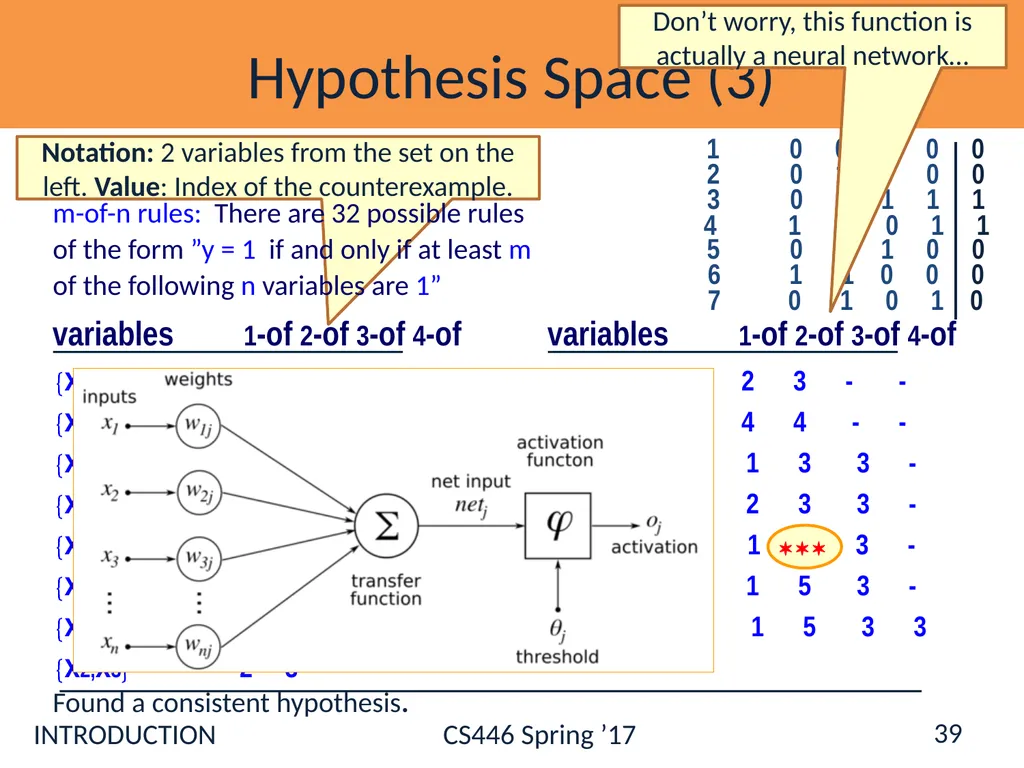
Notation: 2 variables from the set on the left. Value: Index of the counterexample. Hypothesis Space (3) m-of-n rules: There are 32 possible rules
of the form ”y = 1 if and only if at least m
of the following n variables are 1”
Found a consistent hypothesis. 39 Don’t worry, this function is actually a neural network…<br>
of the form ”y = 1 if and only if at least m
of the following n variables are 1”
Found a consistent hypothesis. 39 Don’t worry, this function is actually a neural network…<br>
40
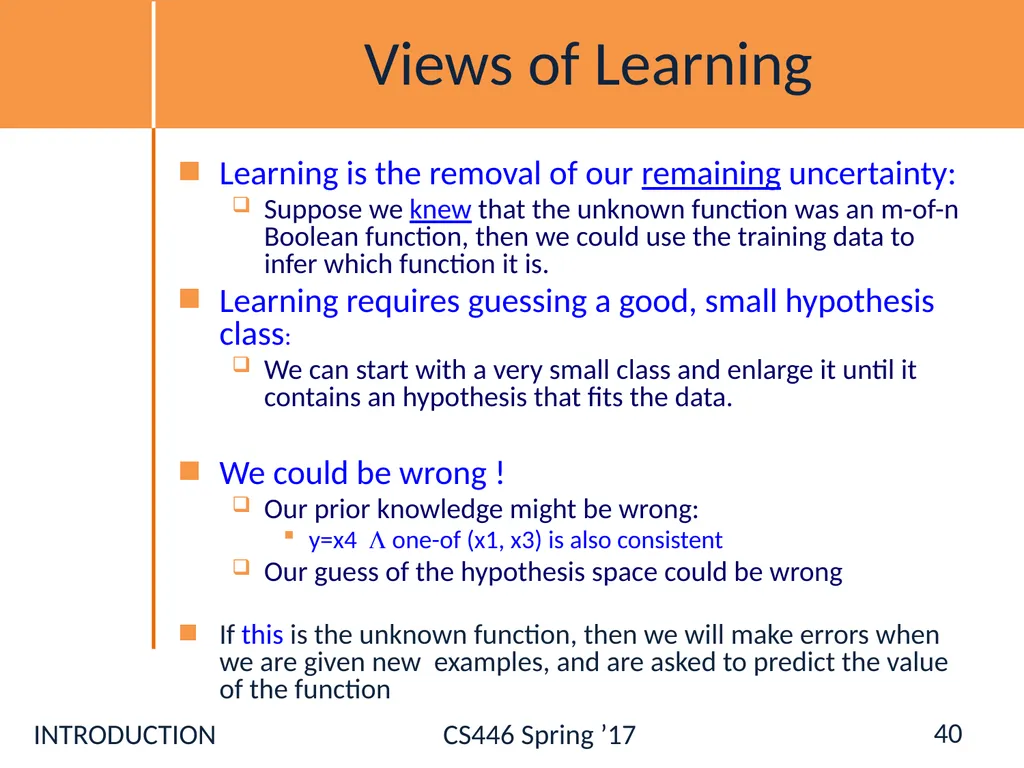
Views of Learning Learning is the removal of our remaining uncertainty:
Suppose we knew that the unknown function was an m-of-n Boolean function, then we could use the training data to infer which function it is.
Learning requires guessing a good, small hypothesis class:
We can start with a very small class and enlarge it until it contains an hypothesis that fits the data.
We could be wrong !
Our prior knowledge might be wrong:
y=x4 one-of (x1, x3) is also consistent
Our guess of the hypothesis space could be wrong
If this is the unknown function, then we will make errors when we are given new examples, and are asked to predict the value of the function 40<br>
Suppose we knew that the unknown function was an m-of-n Boolean function, then we could use the training data to infer which function it is.
Learning requires guessing a good, small hypothesis class:
We can start with a very small class and enlarge it until it contains an hypothesis that fits the data.
We could be wrong !
Our prior knowledge might be wrong:
y=x4 one-of (x1, x3) is also consistent
Our guess of the hypothesis space could be wrong
If this is the unknown function, then we will make errors when we are given new examples, and are asked to predict the value of the function 40<br>
41
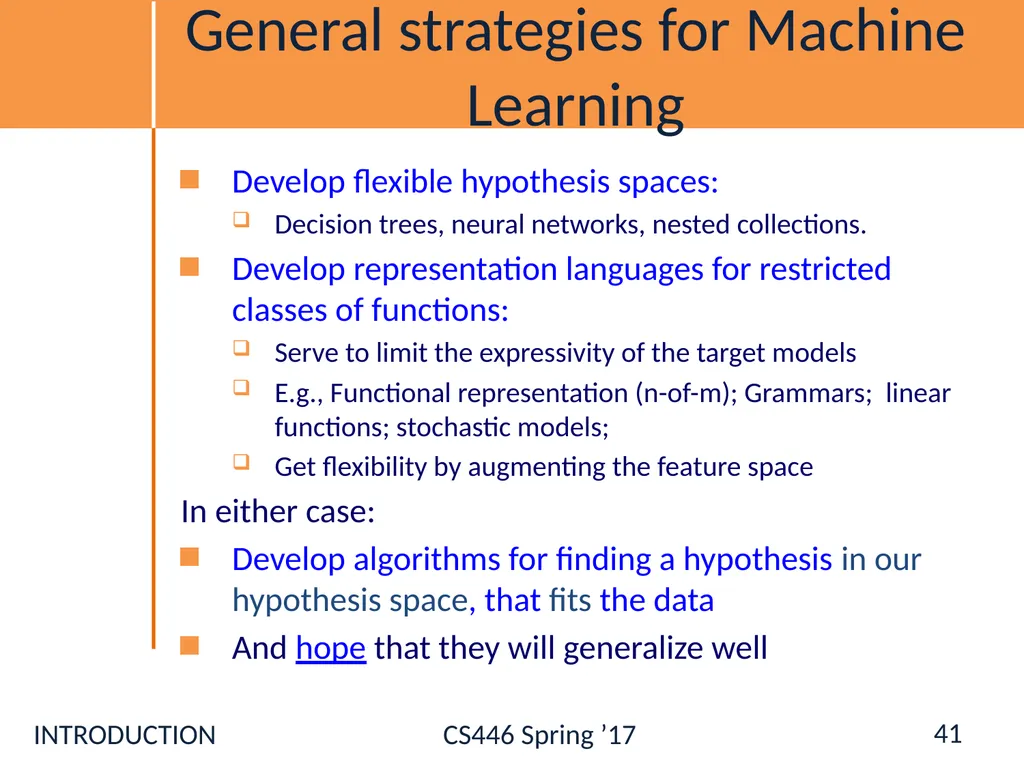
General strategies for Machine Learning Develop flexible hypothesis spaces:
Decision trees, neural networks, nested collections.
Develop representation languages for restricted classes of functions:
Serve to limit the expressivity of the target models
E.g., Functional representation (n-of-m); Grammars; linear functions; stochastic models;
Get flexibility by augmenting the feature space
In either case:
Develop algorithms for finding a hypothesis in our hypothesis space, that fits the data
And hope that they will generalize well 41<br>
Decision trees, neural networks, nested collections.
Develop representation languages for restricted classes of functions:
Serve to limit the expressivity of the target models
E.g., Functional representation (n-of-m); Grammars; linear functions; stochastic models;
Get flexibility by augmenting the feature space
In either case:
Develop algorithms for finding a hypothesis in our hypothesis space, that fits the data
And hope that they will generalize well 41<br>
42
Terminology Target function (concept): The true function f :X {…Labels…}
Concept: Boolean function. Example for which f (x)= 1 are positive examples; those for which f (x)= 0 are negative examples (instances)
Hypothesis: A proposed function h, believed to be similar to f. The output of our learning algorithm.
Hypothesis space: The space of all hypotheses that can, in principle, be the output of the learning algorithm.
Classifier: A discrete valued function produced by the learning algorithm. The possible value of f: {1,2,…K} are the classes or class labels. (In most algorithms the classifier will actually return a real valued function that we’ll have to interpret).
Training examples: A set of examples of the form {(x, f (x))} 42<br>
Concept: Boolean function. Example for which f (x)= 1 are positive examples; those for which f (x)= 0 are negative examples (instances)
Hypothesis: A proposed function h, believed to be similar to f. The output of our learning algorithm.
Hypothesis space: The space of all hypotheses that can, in principle, be the output of the learning algorithm.
Classifier: A discrete valued function produced by the learning algorithm. The possible value of f: {1,2,…K} are the classes or class labels. (In most algorithms the classifier will actually return a real valued function that we’ll have to interpret).
Training examples: A set of examples of the form {(x, f (x))} 42<br>
43
Example: Generalization vs Overfitting What is a Tree ?
A botanist Her brother
A tree is something with A tree is a green thing
leaves I’ve seen before
Neither will generalize well 43<br>
A botanist Her brother
A tree is something with A tree is a green thing
leaves I’ve seen before
Neither will generalize well 43<br>
44
CS446 Team [updated 1/24/17]
Dan Roth (3323 Siebel)
Monday 1-2 (or: appointment)
TAs
Chase Duncan Tues 12-1 (3333 SC)
Subhro Roy Wed 4-5 (3333 SC)
Qiang Ning Thur 3-4 (3333 SC)
Hao Wu Fri 1-2 (3333 SC)
Discussion Sections: (starting next week)
Monday: 4 -5 [3405 SC] Chase Duncan[A-I]
Wednesdays: 5 -6 [3405 SC] Hao Wu [J-L]
Thursdays: 4 - 5 [3405 SC] Subhro Roy[M-S]
Fridays: 4 -5 [3405 SC] Qiang Ning [T-Z] 44<br>
Dan Roth (3323 Siebel)
Monday 1-2 (or: appointment)
TAs
Chase Duncan Tues 12-1 (3333 SC)
Subhro Roy Wed 4-5 (3333 SC)
Qiang Ning Thur 3-4 (3333 SC)
Hao Wu Fri 1-2 (3333 SC)
Discussion Sections: (starting next week)
Monday: 4 -5 [3405 SC] Chase Duncan[A-I]
Wednesdays: 5 -6 [3405 SC] Hao Wu [J-L]
Thursdays: 4 - 5 [3405 SC] Subhro Roy[M-S]
Fridays: 4 -5 [3405 SC] Qiang Ning [T-Z] 44<br>
45
CS446 on the web Check our class website:
Schedule, slides, videos, policies
http://l2r.cs.uiuc.edu/~danr/Teaching/CS446-17/index.html
Sign up, participate in our Piazza forum:
Announcements and discussions
https://piazza.com/class#fall2017/cs446
Log on to Compass:
Submit assignments, get your grades
https://compass2g.illinois.edu
Scribing the Class [Good writers; Latex; Paid Hourly] 45<br>
Schedule, slides, videos, policies
http://l2r.cs.uiuc.edu/~danr/Teaching/CS446-17/index.html
Sign up, participate in our Piazza forum:
Announcements and discussions
https://piazza.com/class#fall2017/cs446
Log on to Compass:
Submit assignments, get your grades
https://compass2g.illinois.edu
Scribing the Class [Good writers; Latex; Paid Hourly] 45<br>
46
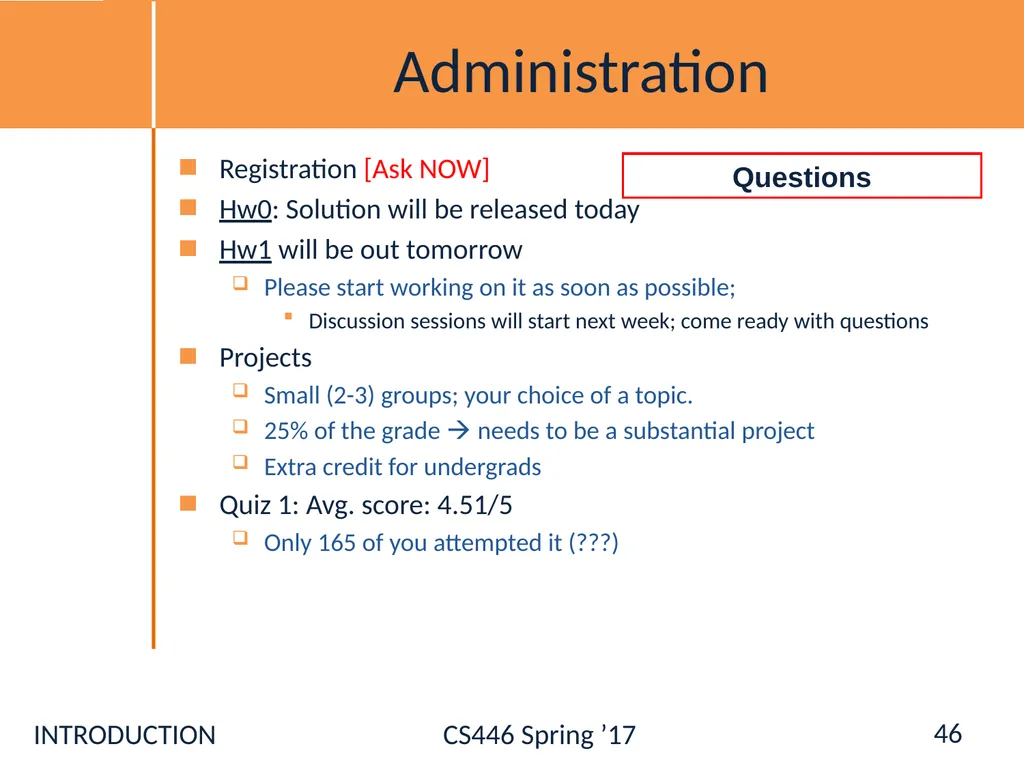
Administration Registration [Ask NOW]
Hw0: Solution will be released today
Hw1 will be out tomorrow
Please start working on it as soon as possible;
Discussion sessions will start next week; come ready with questions
Projects
Small (2-3) groups; your choice of a topic.
25% of the grade needs to be a substantial project
Extra credit for undergrads
Quiz 1: Avg. score: 4.51/5
Only 165 of you attempted it (???) 46 Questions<br>
Hw0: Solution will be released today
Hw1 will be out tomorrow
Please start working on it as soon as possible;
Discussion sessions will start next week; come ready with questions
Projects
Small (2-3) groups; your choice of a topic.
25% of the grade needs to be a substantial project
Extra credit for undergrads
Quiz 1: Avg. score: 4.51/5
Only 165 of you attempted it (???) 46 Questions<br>
47
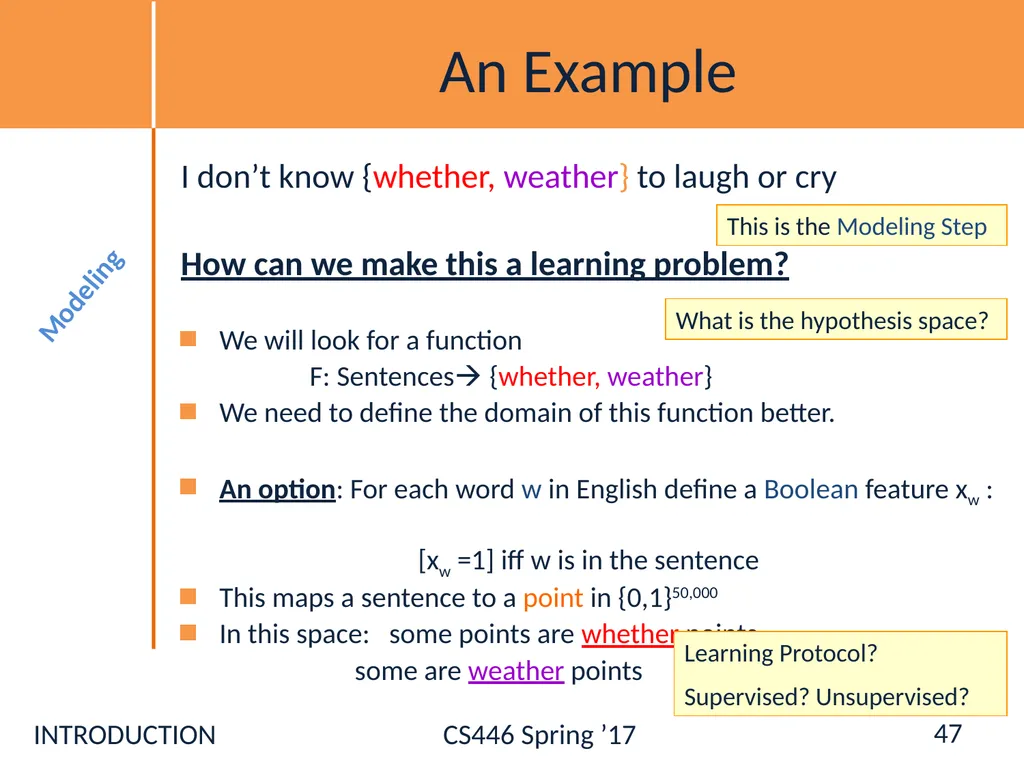
An Example I don’t know {whether, weather} to laugh or cry
How can we make this a learning problem?
We will look for a function
F: Sentences {whether, weather}
We need to define the domain of this function better.
An option: For each word w in English define a Boolean feature xw :
[xw =1] iff w is in the sentence
This maps a sentence to a point in {0,1}50,000
In this space: some points are whether points
some are weather points Modeling Learning Protocol?
Supervised? Unsupervised? This is the Modeling Step 47 What is the hypothesis space?<br>
How can we make this a learning problem?
We will look for a function
F: Sentences {whether, weather}
We need to define the domain of this function better.
An option: For each word w in English define a Boolean feature xw :
[xw =1] iff w is in the sentence
This maps a sentence to a point in {0,1}50,000
In this space: some points are whether points
some are weather points Modeling Learning Protocol?
Supervised? Unsupervised? This is the Modeling Step 47 What is the hypothesis space?<br>
48
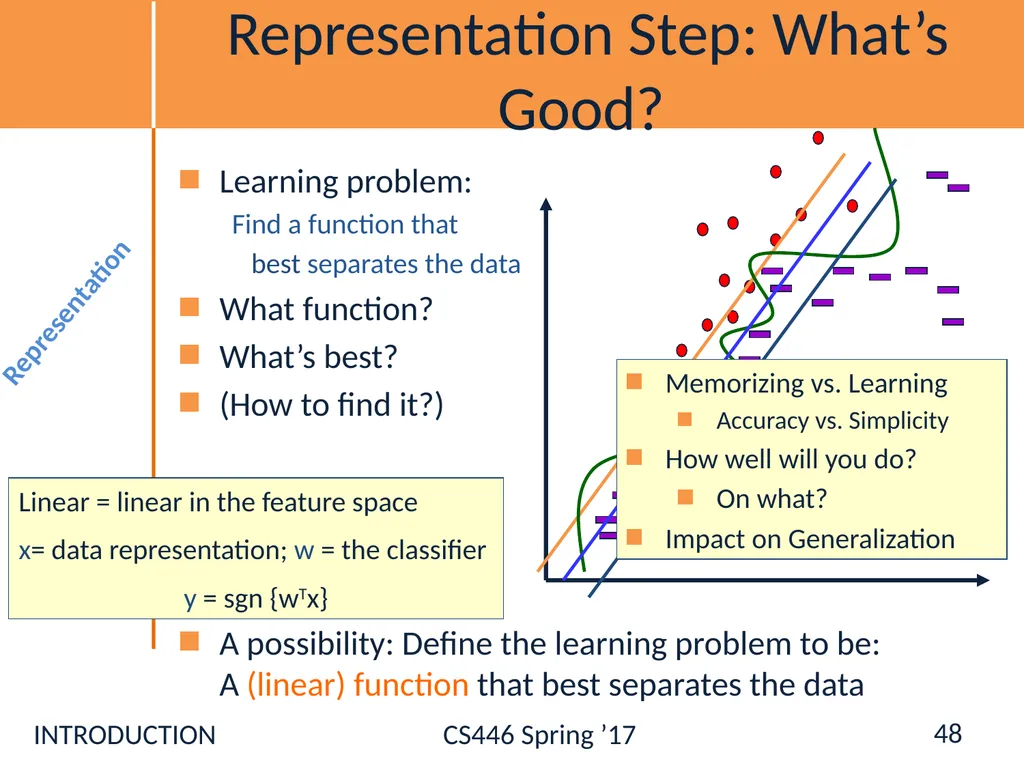
Representation Step: What’s Good? Learning problem:
Find a function that
best separates the data
What function?
What’s best?
(How to find it?)
A possibility: Define the learning problem to be: A (linear) function that best separates the data Representation Linear = linear in the feature space
x= data representation; w = the classifier
y = sgn {wTx} 48 Memorizing vs. Learning
Accuracy vs. Simplicity
How well will you do?
On what?
Impact on Generalization<br>
Find a function that
best separates the data
What function?
What’s best?
(How to find it?)
A possibility: Define the learning problem to be: A (linear) function that best separates the data Representation Linear = linear in the feature space
x= data representation; w = the classifier
y = sgn {wTx} 48 Memorizing vs. Learning
Accuracy vs. Simplicity
How well will you do?
On what?
Impact on Generalization<br>
49
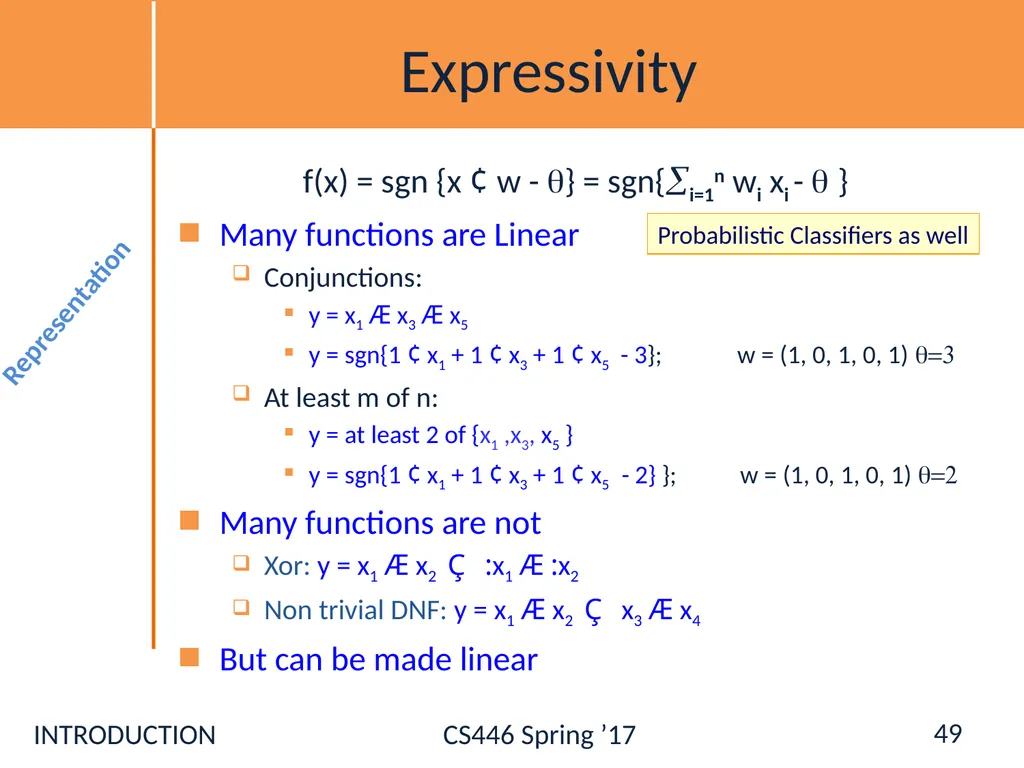
Expressivity f(x) = sgn {x ¢ w - } = sgn{i=1n wi xi - }
Many functions are Linear
Conjunctions:
y = x1 Æ x3 Æ x5
y = sgn{1 ¢ x1 + 1 ¢ x3 + 1 ¢ x5 - 3}; w = (1, 0, 1, 0, 1) =3
At least m of n:
y = at least 2 of {x1 ,x3, x5 }
y = sgn{1 ¢ x1 + 1 ¢ x3 + 1 ¢ x5 - 2} }; w = (1, 0, 1, 0, 1) =2
Many functions are not
Xor: y = x1 Æ x2 Ç :x1 Æ :x2
Non trivial DNF: y = x1 Æ x2 Ç x3 Æ x4
But can be made linear Representation Probabilistic Classifiers as well 49<br>
Many functions are Linear
Conjunctions:
y = x1 Æ x3 Æ x5
y = sgn{1 ¢ x1 + 1 ¢ x3 + 1 ¢ x5 - 3}; w = (1, 0, 1, 0, 1) =3
At least m of n:
y = at least 2 of {x1 ,x3, x5 }
y = sgn{1 ¢ x1 + 1 ¢ x3 + 1 ¢ x5 - 2} }; w = (1, 0, 1, 0, 1) =2
Many functions are not
Xor: y = x1 Æ x2 Ç :x1 Æ :x2
Non trivial DNF: y = x1 Æ x2 Ç x3 Æ x4
But can be made linear Representation Probabilistic Classifiers as well 49<br>
50
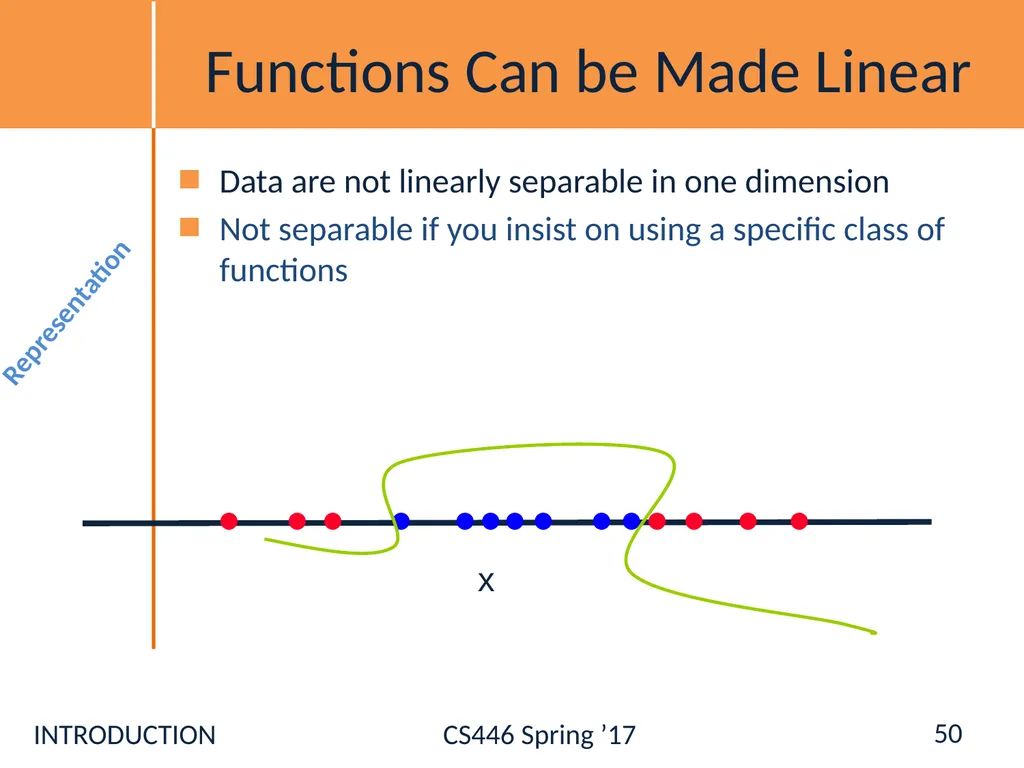
Functions Can be Made Linear Data are not linearly separable in one dimension
Not separable if you insist on using a specific class of functions Representation x 50<br>
Not separable if you insist on using a specific class of functions Representation x 50<br>
51
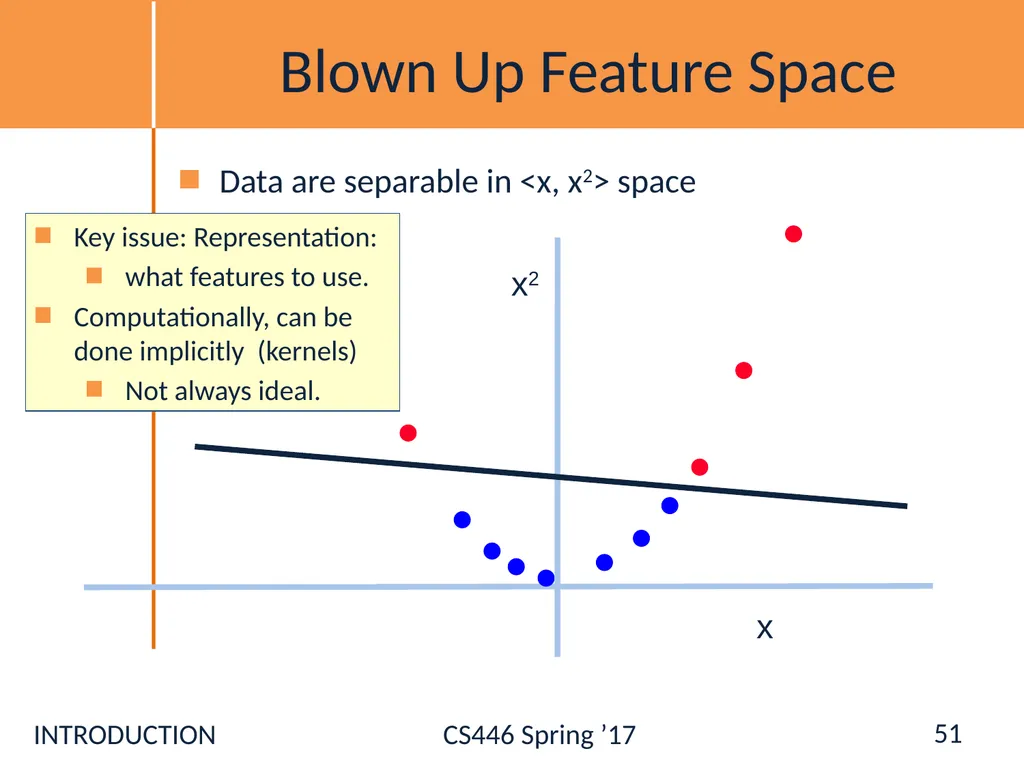
Blown Up Feature Space Data are separable in <x, x2> space x x2 Key issue: Representation:
what features to use.
Computationally, can be done implicitly (kernels)
Not always ideal. 51<br>
what features to use.
Computationally, can be done implicitly (kernels)
Not always ideal. 51<br>
52
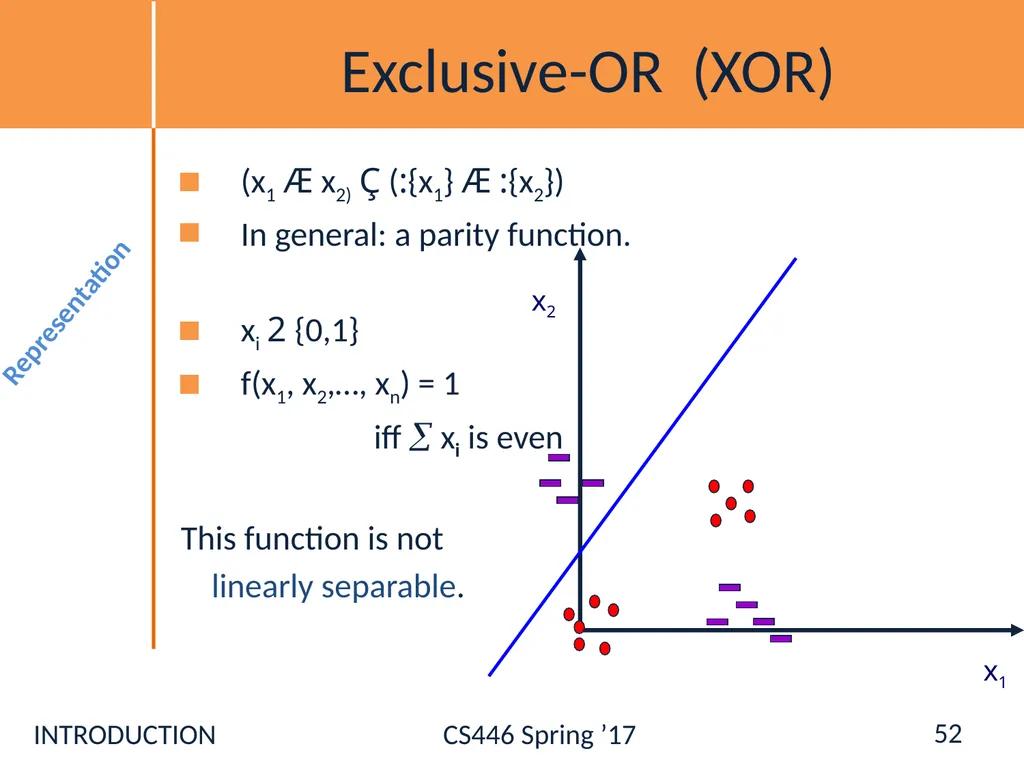
Exclusive-OR (XOR) (x1 Æ x2) Ç (:{x1} Æ :{x2})
In general: a parity function.
xi 2 {0,1}
f(x1, x2,…, xn) = 1
iff xi is even
This function is not
linearly separable. Representation 52<br>
In general: a parity function.
xi 2 {0,1}
f(x1, x2,…, xn) = 1
iff xi is even
This function is not
linearly separable. Representation 52<br>
53
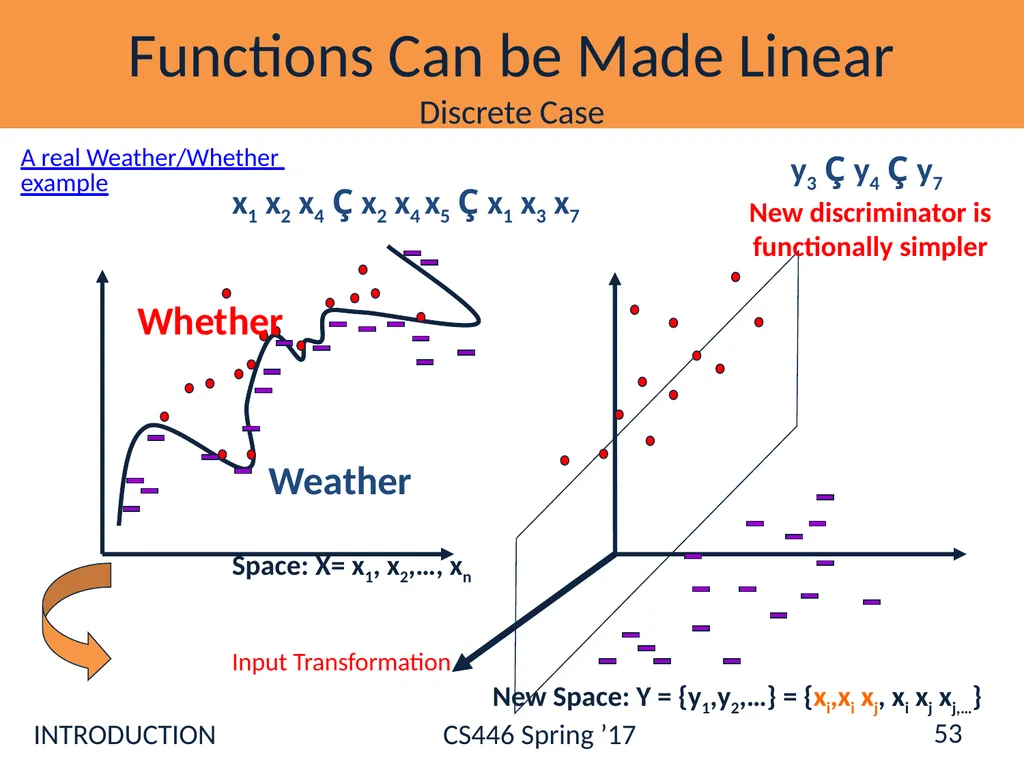
Functions Can be Made Linear
Discrete Case y3 Ç y4 Ç y7
New discriminator is functionally simpler A real Weather/Whether example 53 x1 x2 x4 Ç x2 x4 x5 Ç x1 x3 x7
Space: X= x1, x2,…, xn
Input Transformation
New Space: Y = {y1,y2,…} = {xi,xi xj, xi xj xj,…}<br>
New discriminator is functionally simpler A real Weather/Whether example 53 x1 x2 x4 Ç x2 x4 x5 Ç x1 x3 x7
Space: X= x1, x2,…, xn
Input Transformation
New Space: Y = {y1,y2,…} = {xi,xi xj, xi xj xj,…}<br>
54
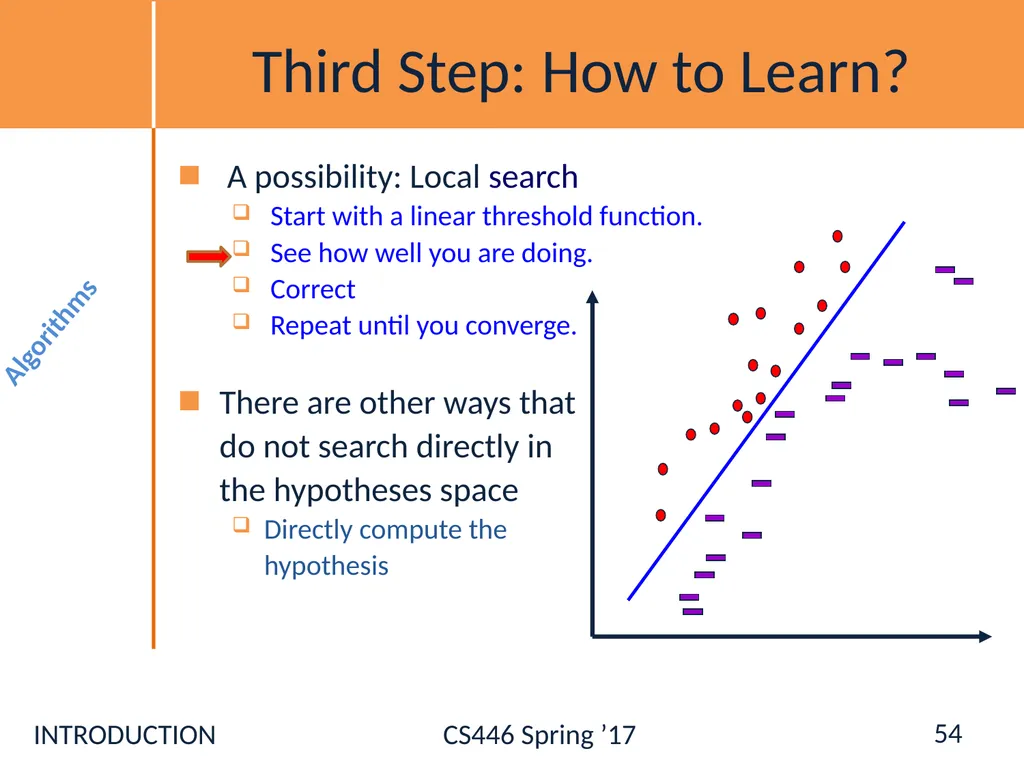
Third Step: How to Learn? A possibility: Local search
Start with a linear threshold function.
See how well you are doing.
Correct
Repeat until you converge.
There are other ways that
do not search directly in
the hypotheses space
Directly compute the
hypothesis Algorithms 54<br>
Start with a linear threshold function.
See how well you are doing.
Correct
Repeat until you converge.
There are other ways that
do not search directly in
the hypotheses space
Directly compute the
hypothesis Algorithms 54<br>
55
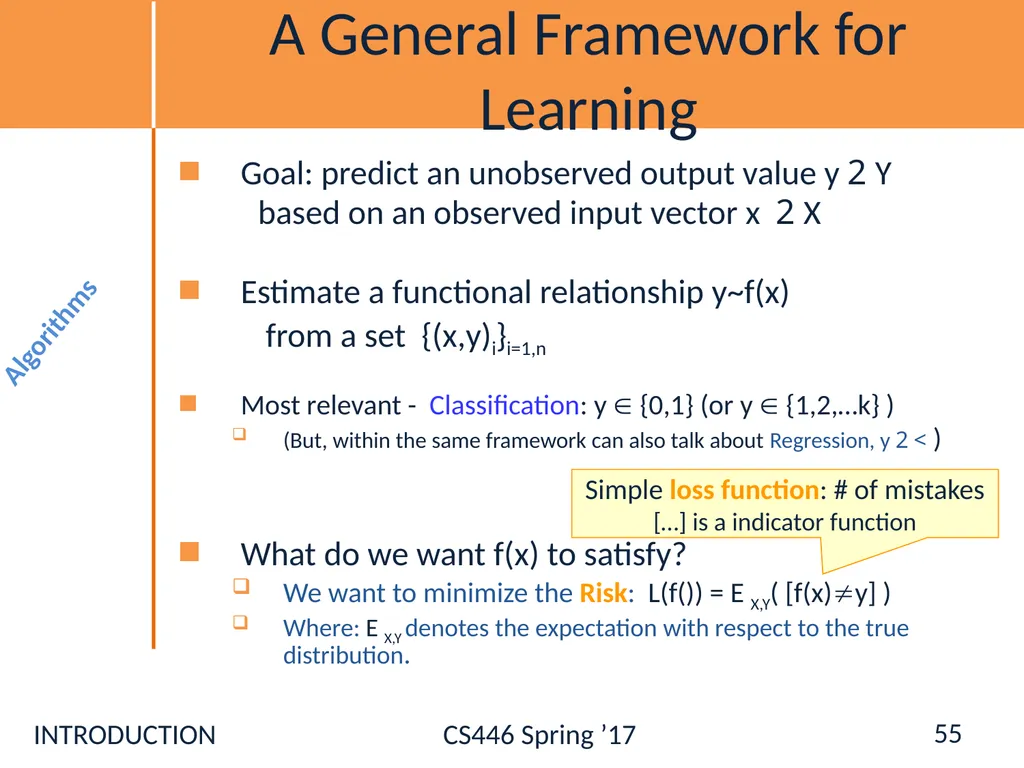
A General Framework for Learning Goal: predict an unobserved output value y 2 Y
based on an observed input vector x 2 X
Estimate a functional relationship y~f(x)
from a set {(x,y)i}i=1,n
Most relevant - Classification: y {0,1} (or y {1,2,…k} )
(But, within the same framework can also talk about Regression, y 2 < )
What do we want f(x) to satisfy?
We want to minimize the Risk: L(f()) = E X,Y( [f(x)y] )
Where: E X,Y denotes the expectation with respect to the true distribution. Algorithms Simple loss function: # of mistakes
[…] is a indicator function 55<br>
based on an observed input vector x 2 X
Estimate a functional relationship y~f(x)
from a set {(x,y)i}i=1,n
Most relevant - Classification: y {0,1} (or y {1,2,…k} )
(But, within the same framework can also talk about Regression, y 2 < )
What do we want f(x) to satisfy?
We want to minimize the Risk: L(f()) = E X,Y( [f(x)y] )
Where: E X,Y denotes the expectation with respect to the true distribution. Algorithms Simple loss function: # of mistakes
[…] is a indicator function 55<br>
56
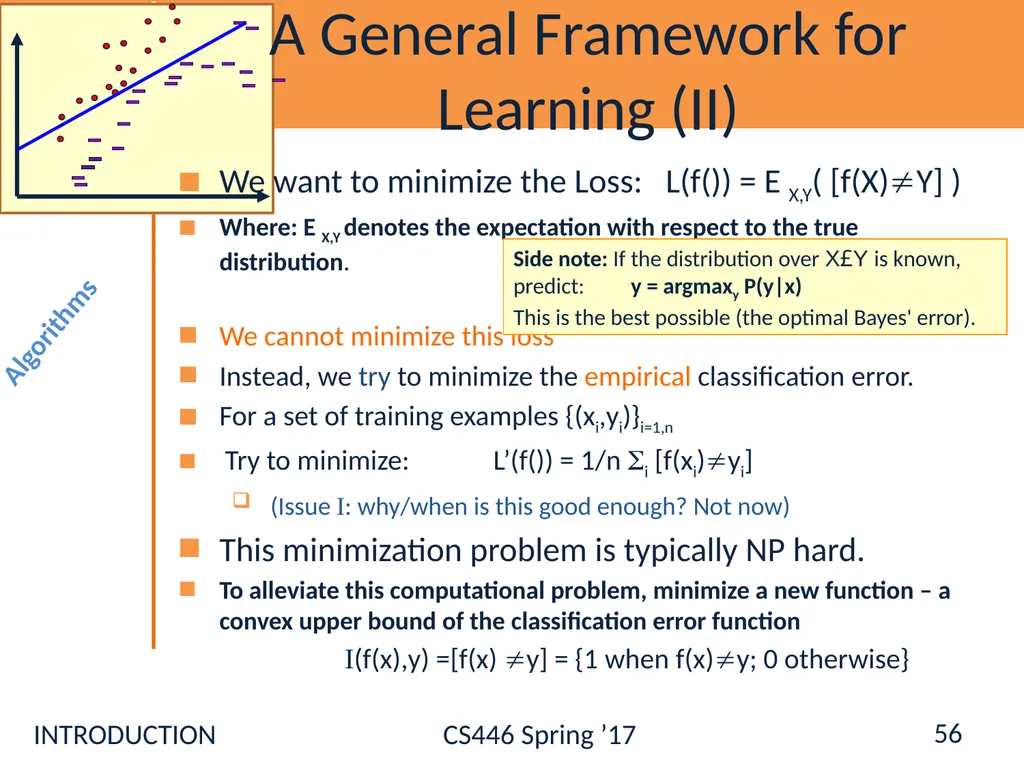
A General Framework for Learning (II) We want to minimize the Loss: L(f()) = E X,Y( [f(X)Y] )
Where: E X,Y denotes the expectation with respect to the true distribution.
We cannot minimize this loss
Instead, we try to minimize the empirical classification error.
For a set of training examples {(xi,yi)}i=1,n
Try to minimize: L’(f()) = 1/n i [f(xi)yi]
(Issue I: why/when is this good enough? Not now)
This minimization problem is typically NP hard.
To alleviate this computational problem, minimize a new function – a convex upper bound of the classification error function
I(f(x),y) =[f(x) y] = {1 when f(x)y; 0 otherwise} Algorithms Side note: If the distribution over X£Y is known, predict: y = argmaxy P(y|x)
This is the best possible (the optimal Bayes' error). 56<br>
Where: E X,Y denotes the expectation with respect to the true distribution.
We cannot minimize this loss
Instead, we try to minimize the empirical classification error.
For a set of training examples {(xi,yi)}i=1,n
Try to minimize: L’(f()) = 1/n i [f(xi)yi]
(Issue I: why/when is this good enough? Not now)
This minimization problem is typically NP hard.
To alleviate this computational problem, minimize a new function – a convex upper bound of the classification error function
I(f(x),y) =[f(x) y] = {1 when f(x)y; 0 otherwise} Algorithms Side note: If the distribution over X£Y is known, predict: y = argmaxy P(y|x)
This is the best possible (the optimal Bayes' error). 56<br>
57
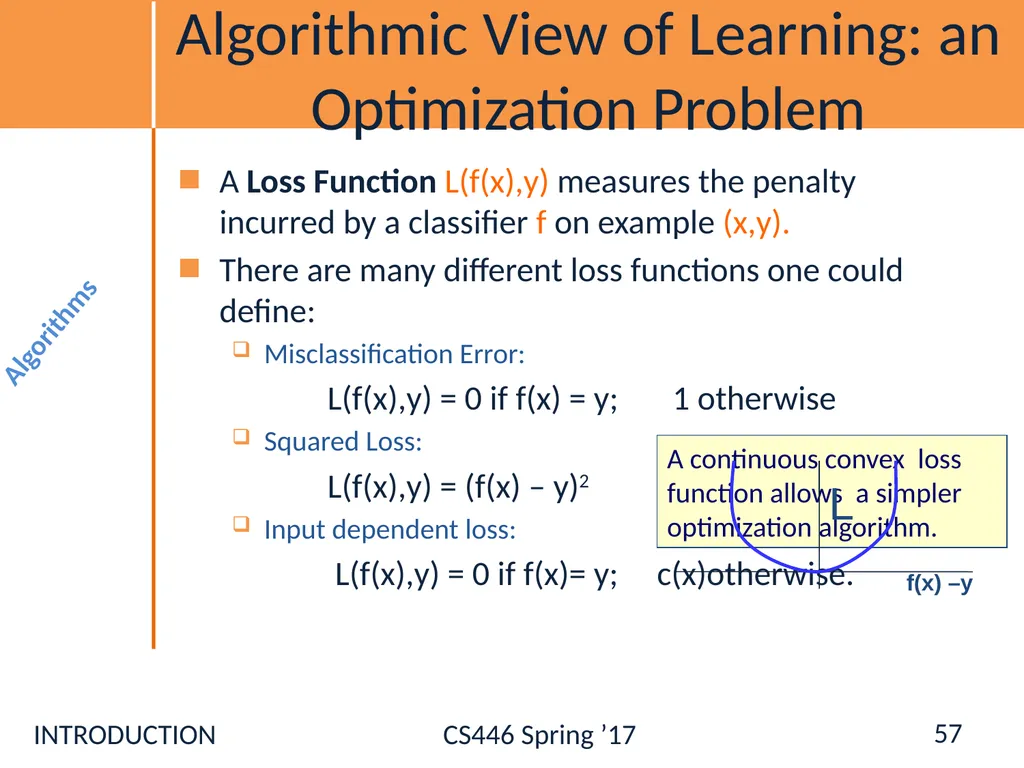
Algorithmic View of Learning: an Optimization Problem A Loss Function L(f(x),y) measures the penalty incurred by a classifier f on example (x,y).
There are many different loss functions one could define:
Misclassification Error:
L(f(x),y) = 0 if f(x) = y; 1 otherwise
Squared Loss:
L(f(x),y) = (f(x) – y)2
Input dependent loss:
L(f(x),y) = 0 if f(x)= y; c(x)otherwise. Algorithms A continuous convex loss function allows a simpler optimization algorithm. L 57<br>
There are many different loss functions one could define:
Misclassification Error:
L(f(x),y) = 0 if f(x) = y; 1 otherwise
Squared Loss:
L(f(x),y) = (f(x) – y)2
Input dependent loss:
L(f(x),y) = 0 if f(x)= y; c(x)otherwise. Algorithms A continuous convex loss function allows a simpler optimization algorithm. L 57<br>
58
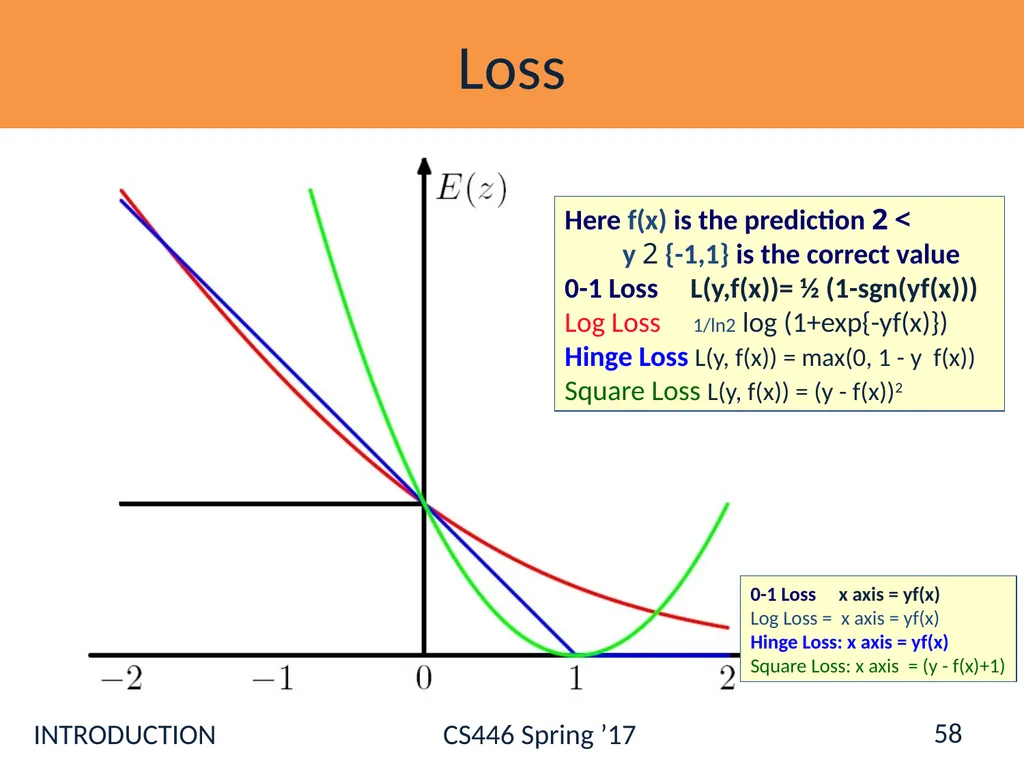
Loss Here f(x) is the prediction 2 <
y 2 {-1,1} is the correct value
0-1 Loss L(y,f(x))= ½ (1-sgn(yf(x)))
Log Loss 1/ln2 log (1+exp{-yf(x)})
Hinge Loss L(y, f(x)) = max(0, 1 - y f(x))
Square Loss L(y, f(x)) = (y - f(x))2 0-1 Loss x axis = yf(x)
Log Loss = x axis = yf(x)
Hinge Loss: x axis = yf(x)
Square Loss: x axis = (y - f(x)+1) 58<br>
y 2 {-1,1} is the correct value
0-1 Loss L(y,f(x))= ½ (1-sgn(yf(x)))
Log Loss 1/ln2 log (1+exp{-yf(x)})
Hinge Loss L(y, f(x)) = max(0, 1 - y f(x))
Square Loss L(y, f(x)) = (y - f(x))2 0-1 Loss x axis = yf(x)
Log Loss = x axis = yf(x)
Hinge Loss: x axis = yf(x)
Square Loss: x axis = (y - f(x)+1) 58<br>
59
Example Putting it all together:
A Learning Algorithm<br>
A Learning Algorithm<br>
60
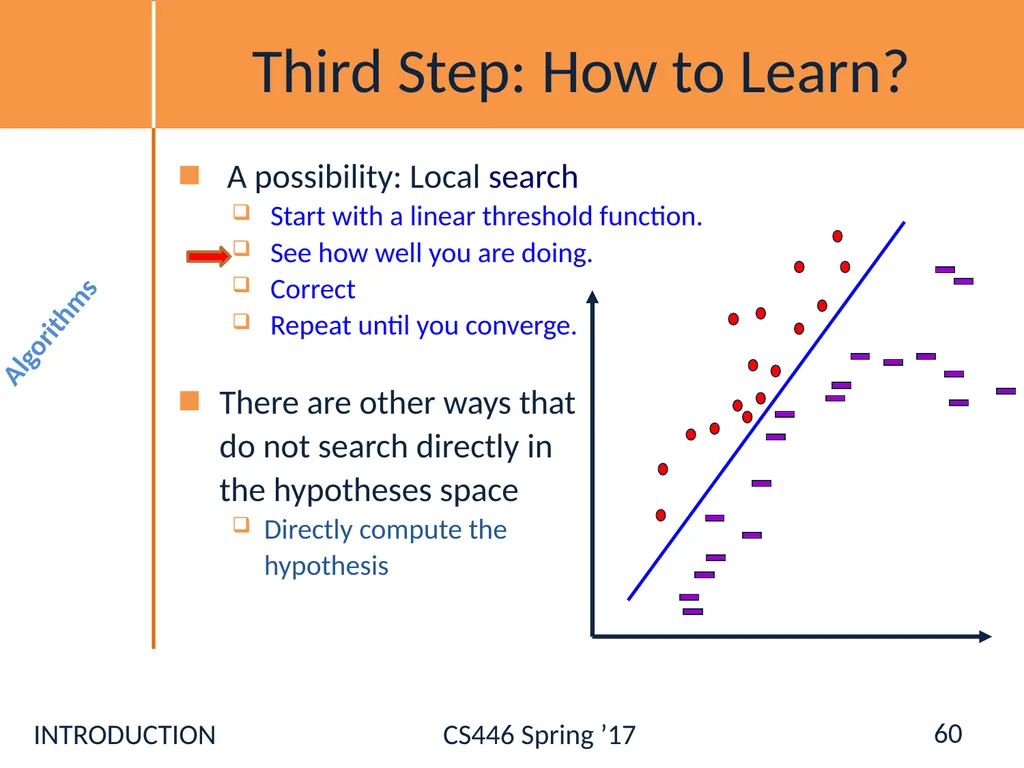
Third Step: How to Learn? A possibility: Local search
Start with a linear threshold function.
See how well you are doing.
Correct
Repeat until you converge.
There are other ways that
do not search directly in
the hypotheses space
Directly compute the
hypothesis Algorithms 60<br>
Start with a linear threshold function.
See how well you are doing.
Correct
Repeat until you converge.
There are other ways that
do not search directly in
the hypotheses space
Directly compute the
hypothesis Algorithms 60<br>
61
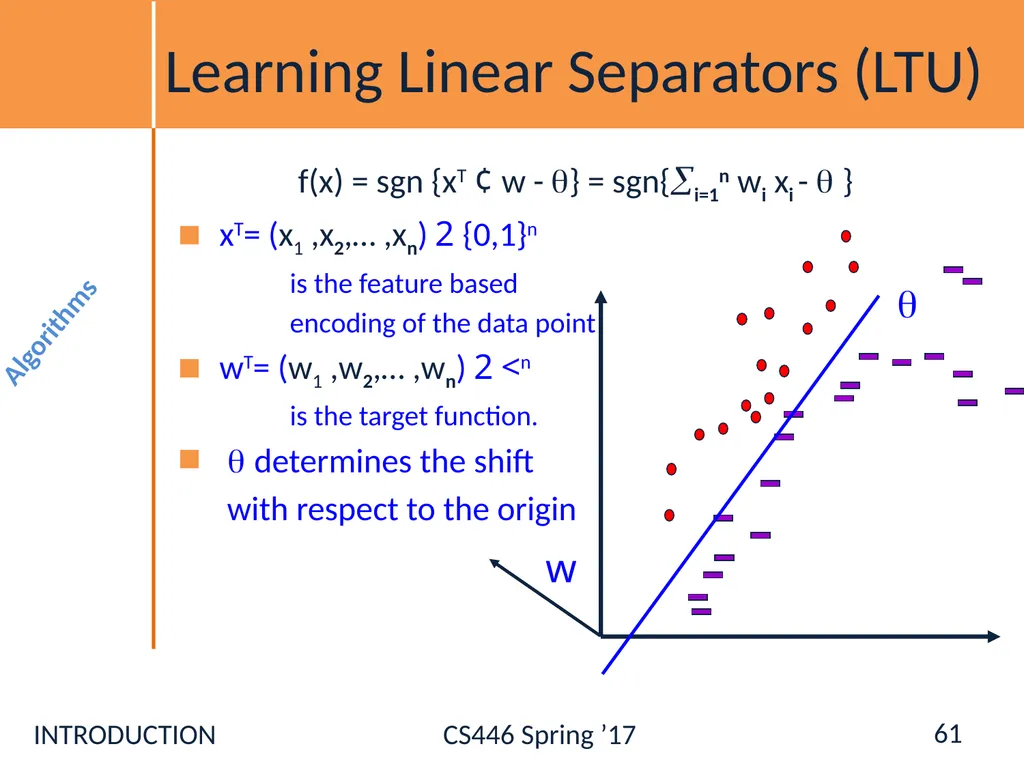
Learning Linear Separators (LTU) f(x) = sgn {xT ¢ w - } = sgn{i=1n wi xi - }
xT= (x1 ,x2,… ,xn) 2 {0,1}n
is the feature based
encoding of the data point
wT= (w1 ,w2,… ,wn) 2 <n
is the target function.
determines the shift
with respect to the origin Algorithms 61<br>
xT= (x1 ,x2,… ,xn) 2 {0,1}n
is the feature based
encoding of the data point
wT= (w1 ,w2,… ,wn) 2 <n
is the target function.
determines the shift
with respect to the origin Algorithms 61<br>
62
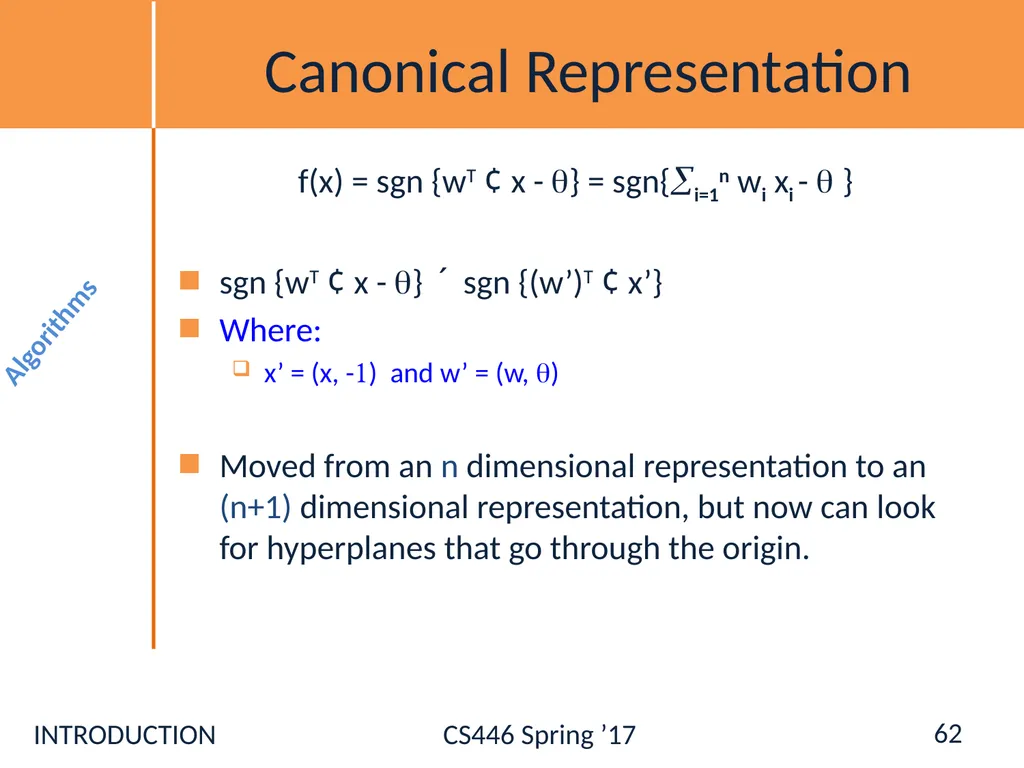
Canonical Representation f(x) = sgn {wT ¢ x - } = sgn{i=1n wi xi - }
sgn {wT ¢ x - } ´ sgn {(w’)T ¢ x’}
Where:
x’ = (x, -1) and w’ = (w, )
Moved from an n dimensional representation to an (n+1) dimensional representation, but now can look for hyperplanes that go through the origin. Algorithms 62<br>
sgn {wT ¢ x - } ´ sgn {(w’)T ¢ x’}
Where:
x’ = (x, -1) and w’ = (w, )
Moved from an n dimensional representation to an (n+1) dimensional representation, but now can look for hyperplanes that go through the origin. Algorithms 62<br>
63
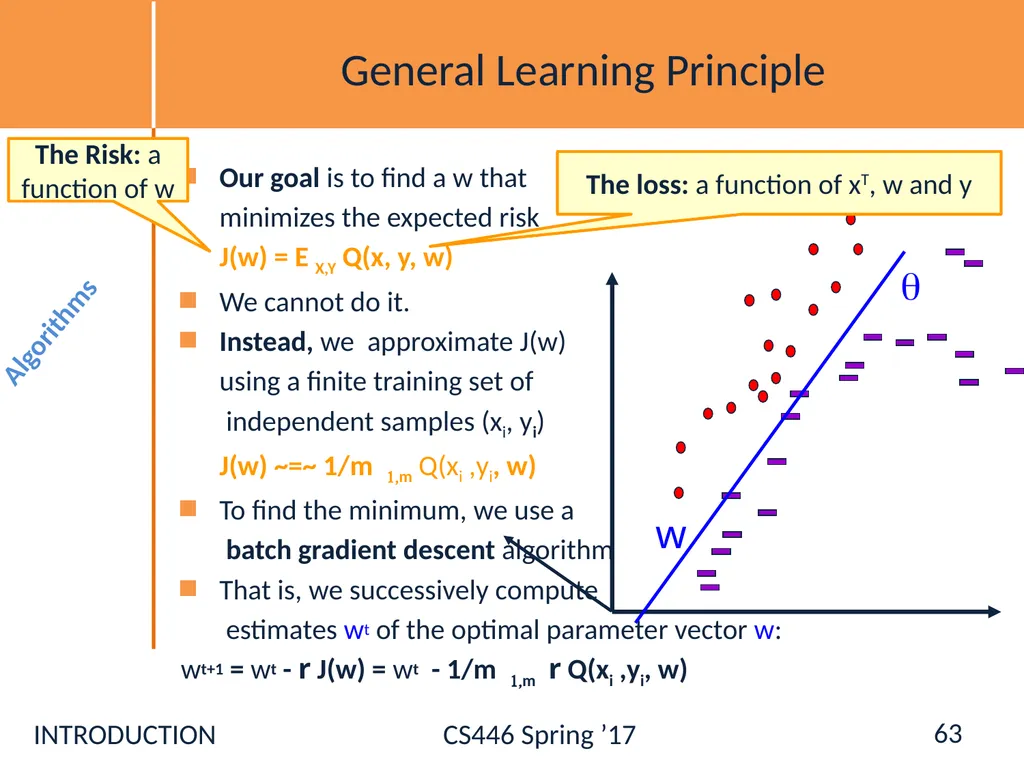
General Learning Principle Our goal is to find a w that
minimizes the expected risk
J(w) = E X,Y Q(x, y, w)
We cannot do it.
Instead, we approximate J(w)
using a finite training set of
independent samples (xi, yi)
J(w) ~=~ 1/m 1,m Q(xi ,yi, w)
To find the minimum, we use a
batch gradient descent algorithm
That is, we successively compute
estimates wt of the optimal parameter vector w:
wt+1 = wt - r J(w) = wt - 1/m 1,m r Q(xi ,yi, w) Algorithms 63 The loss: a function of xT, w and y The Risk: a function of w<br>
minimizes the expected risk
J(w) = E X,Y Q(x, y, w)
We cannot do it.
Instead, we approximate J(w)
using a finite training set of
independent samples (xi, yi)
J(w) ~=~ 1/m 1,m Q(xi ,yi, w)
To find the minimum, we use a
batch gradient descent algorithm
That is, we successively compute
estimates wt of the optimal parameter vector w:
wt+1 = wt - r J(w) = wt - 1/m 1,m r Q(xi ,yi, w) Algorithms 63 The loss: a function of xT, w and y The Risk: a function of w<br>
64
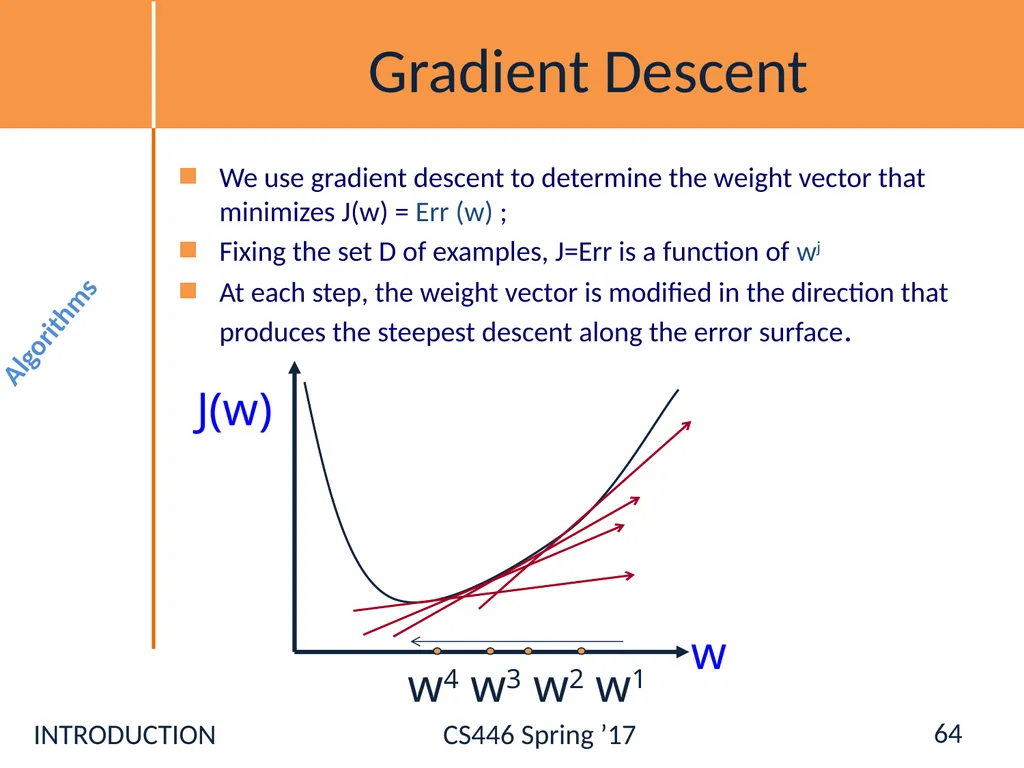
Gradient Descent We use gradient descent to determine the weight vector that minimizes J(w) = Err (w) ;
Fixing the set D of examples, J=Err is a function of wj
At each step, the weight vector is modified in the direction that produces the steepest descent along the error surface. Algorithms J(w) w 64<br>
Fixing the set D of examples, J=Err is a function of wj
At each step, the weight vector is modified in the direction that produces the steepest descent along the error surface. Algorithms J(w) w 64<br>
65
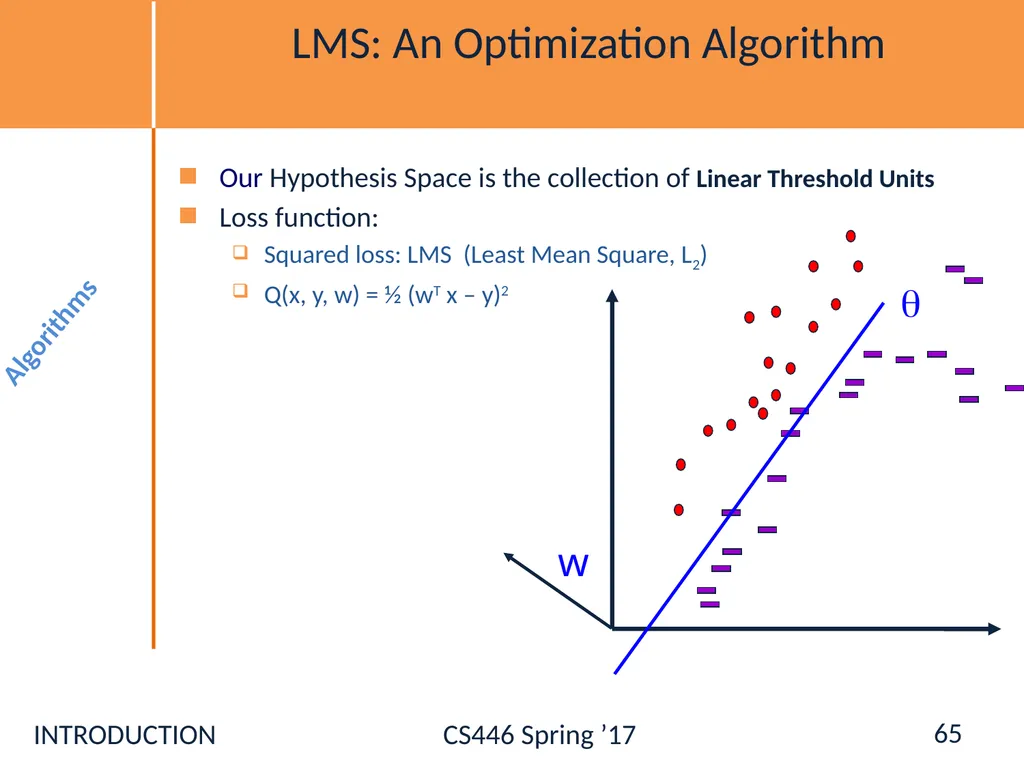
Our Hypothesis Space is the collection of Linear Threshold Units
Loss function:
Squared loss: LMS (Least Mean Square, L2)
Q(x, y, w) = ½ (wT x – y)2 LMS: An Optimization Algorithm Algorithms 65<br>
Loss function:
Squared loss: LMS (Least Mean Square, L2)
Q(x, y, w) = ½ (wT x – y)2 LMS: An Optimization Algorithm Algorithms 65<br>
66
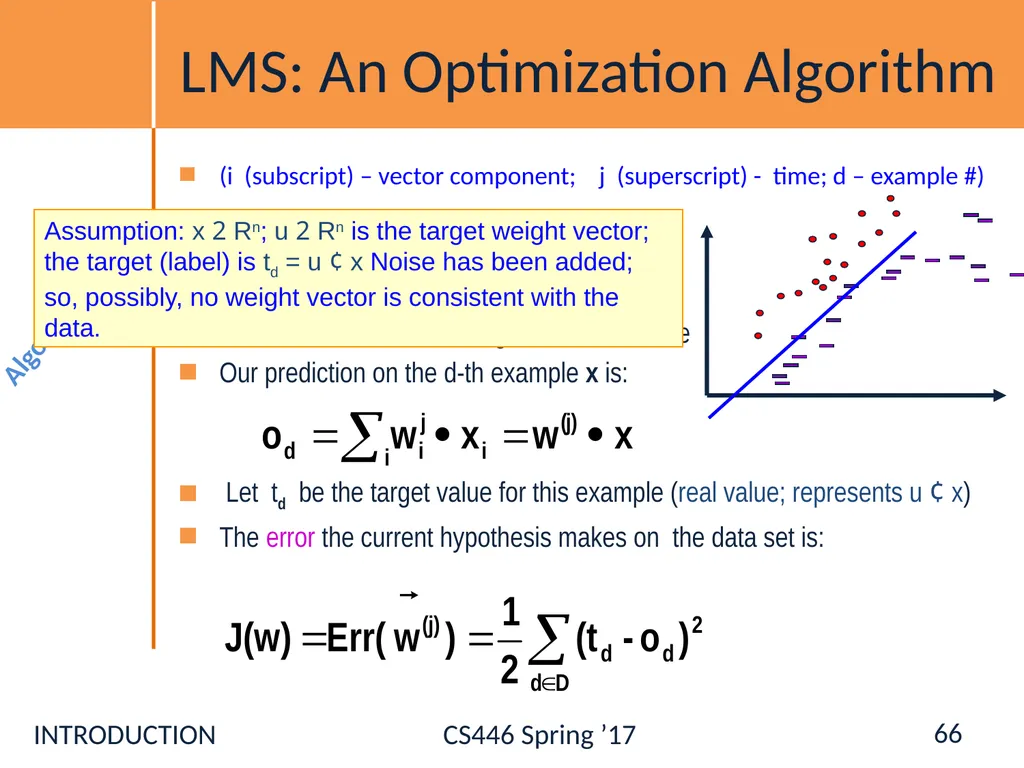
LMS: An Optimization Algorithm (i (subscript) – vector component; j (superscript) - time; d – example #)
Let w(j) be the current weight vector we have
Our prediction on the d-th example x is:
Let td be the target value for this example (real value; represents u ¢ x)
The error the current hypothesis makes on the data set is: Algorithms Assumption: x 2 Rn; u 2 Rn is the target weight vector; the target (label) is td = u ¢ x Noise has been added; so, possibly, no weight vector is consistent with the data. 66<br>
Let w(j) be the current weight vector we have
Our prediction on the d-th example x is:
Let td be the target value for this example (real value; represents u ¢ x)
The error the current hypothesis makes on the data set is: Algorithms Assumption: x 2 Rn; u 2 Rn is the target weight vector; the target (label) is td = u ¢ x Noise has been added; so, possibly, no weight vector is consistent with the data. 66<br>
67
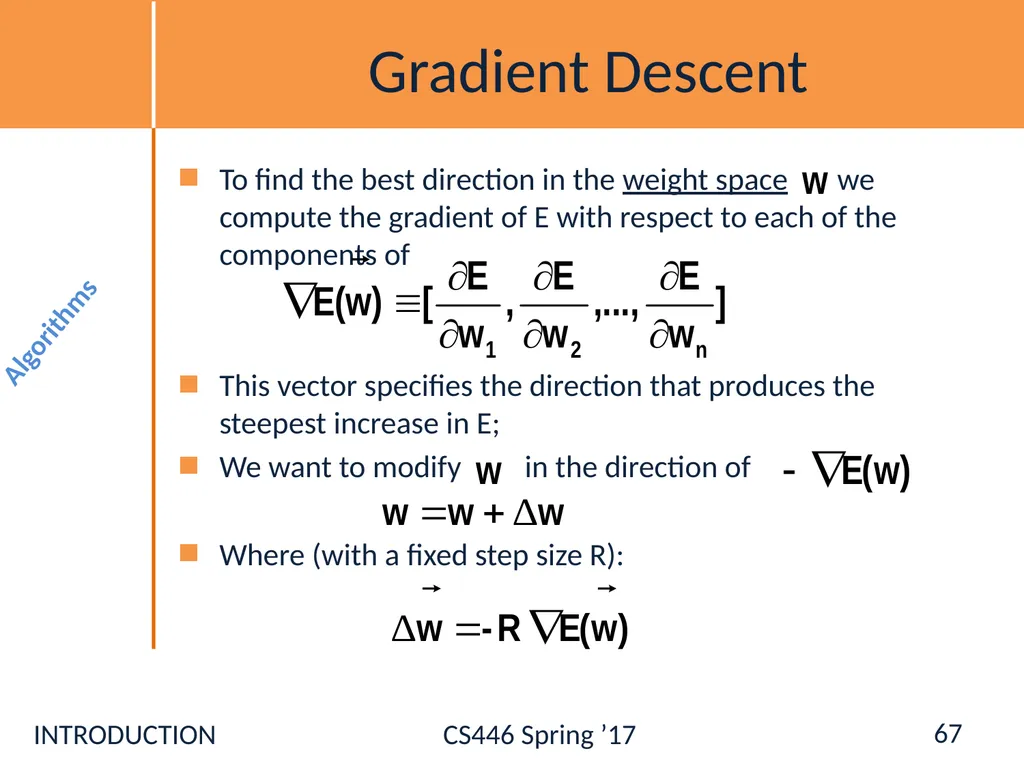
Gradient Descent To find the best direction in the weight space we compute the gradient of E with respect to each of the components of
This vector specifies the direction that produces the steepest increase in E;
We want to modify in the direction of
Where (with a fixed step size R): Algorithms 67<br>
This vector specifies the direction that produces the steepest increase in E;
We want to modify in the direction of
Where (with a fixed step size R): Algorithms 67<br>
68
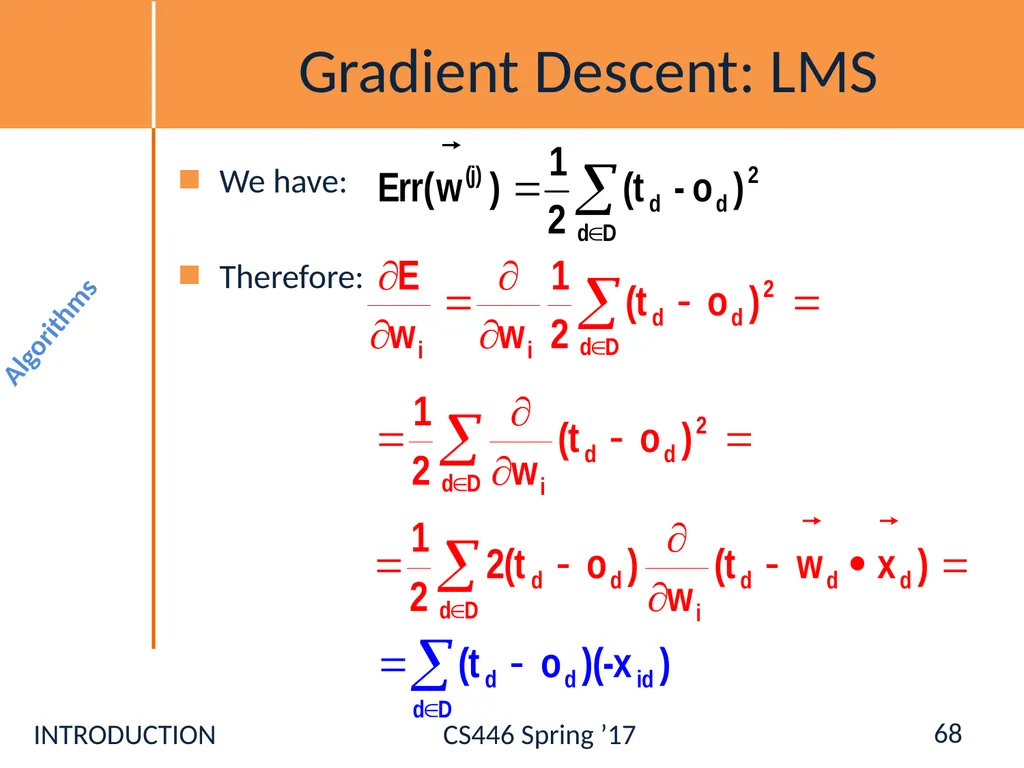
Gradient Descent: LMS We have:
Therefore: Algorithms 68<br>
Therefore: Algorithms 68<br>
69
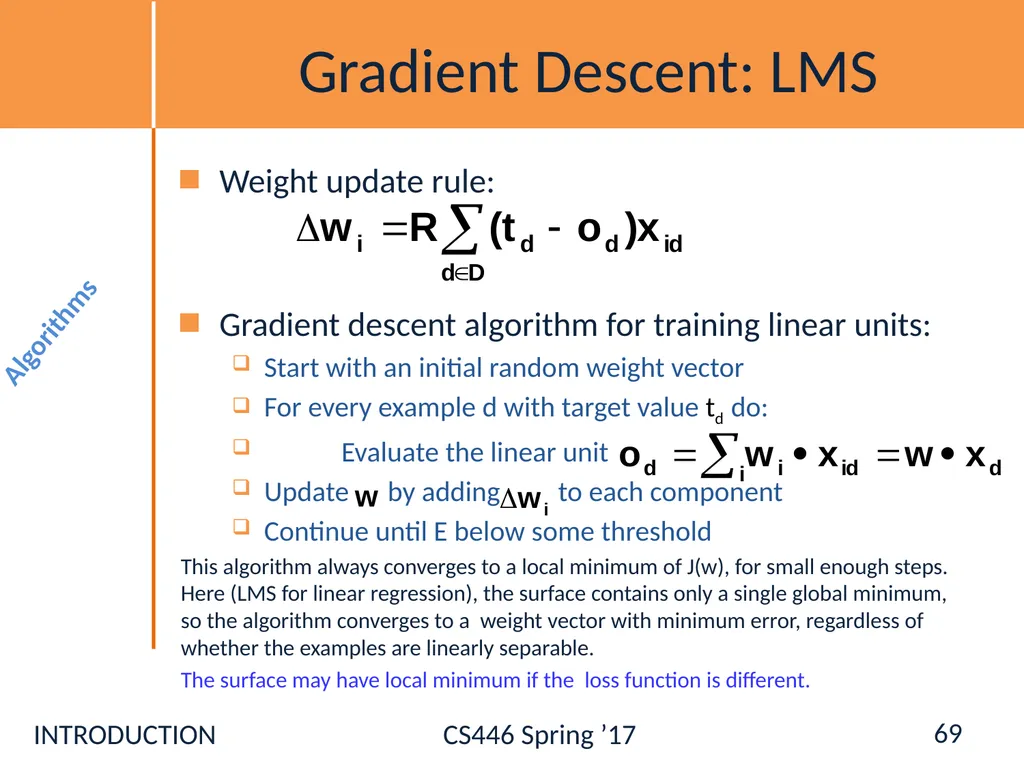
Gradient Descent: LMS Weight update rule:
Gradient descent algorithm for training linear units:
Start with an initial random weight vector
For every example d with target value td do:
Evaluate the linear unit
Update by adding to each component
Continue until E below some threshold
This algorithm always converges to a local minimum of J(w), for small enough steps. Here (LMS for linear regression), the surface contains only a single global minimum, so the algorithm converges to a weight vector with minimum error, regardless of whether the examples are linearly separable.
The surface may have local minimum if the loss function is different. Algorithms 69<br>
Gradient descent algorithm for training linear units:
Start with an initial random weight vector
For every example d with target value td do:
Evaluate the linear unit
Update by adding to each component
Continue until E below some threshold
This algorithm always converges to a local minimum of J(w), for small enough steps. Here (LMS for linear regression), the surface contains only a single global minimum, so the algorithm converges to a weight vector with minimum error, regardless of whether the examples are linearly separable.
The surface may have local minimum if the loss function is different. Algorithms 69<br>
70
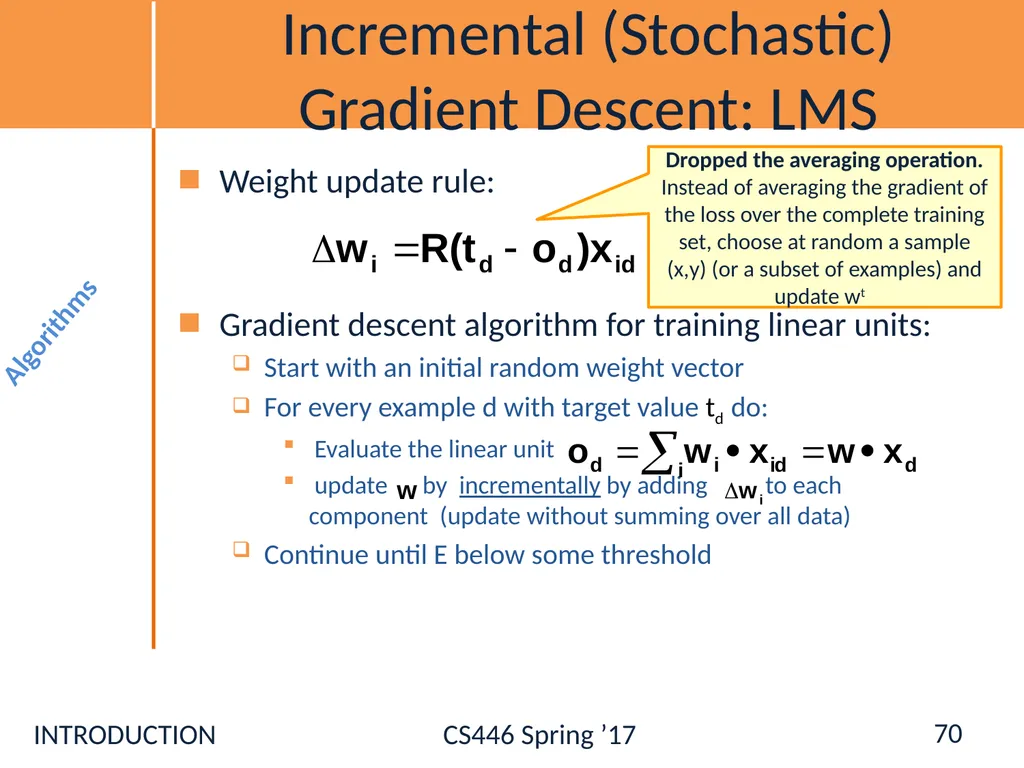
Weight update rule:
Gradient descent algorithm for training linear units:
Start with an initial random weight vector
For every example d with target value td do:
Evaluate the linear unit
update by incrementally by adding to each component (update without summing over all data)
Continue until E below some threshold Incremental (Stochastic) Gradient Descent: LMS Algorithms 70 Dropped the averaging operation.
Instead of averaging the gradient of the loss over the complete training set, choose at random a sample (x,y) (or a subset of examples) and update wt<br>
Gradient descent algorithm for training linear units:
Start with an initial random weight vector
For every example d with target value td do:
Evaluate the linear unit
update by incrementally by adding to each component (update without summing over all data)
Continue until E below some threshold Incremental (Stochastic) Gradient Descent: LMS Algorithms 70 Dropped the averaging operation.
Instead of averaging the gradient of the loss over the complete training set, choose at random a sample (x,y) (or a subset of examples) and update wt<br>
71
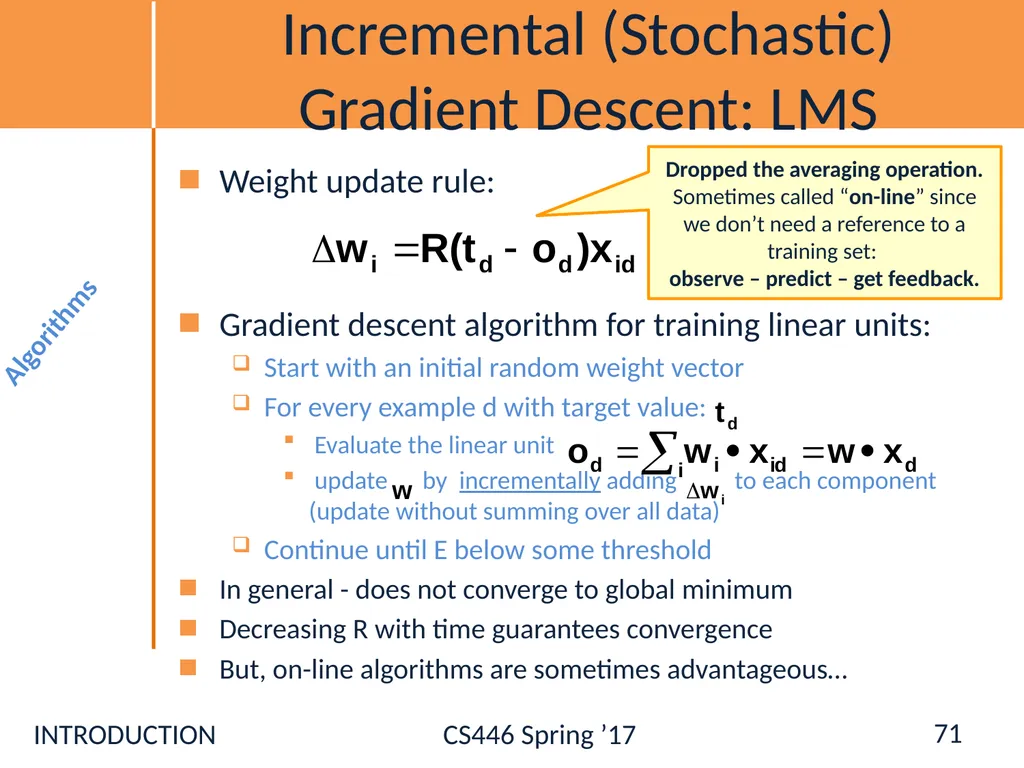
Incremental (Stochastic) Gradient Descent: LMS Algorithms 71 Weight update rule:
Gradient descent algorithm for training linear units:
Start with an initial random weight vector
For every example d with target value:
Evaluate the linear unit
update by incrementally adding to each component (update without summing over all data)
Continue until E below some threshold
In general - does not converge to global minimum
Decreasing R with time guarantees convergence
But, on-line algorithms are sometimes advantageous… Dropped the averaging operation.
Sometimes called “on-line” since we don’t need a reference to a training set:
observe – predict – get feedback.<br>
Gradient descent algorithm for training linear units:
Start with an initial random weight vector
For every example d with target value:
Evaluate the linear unit
update by incrementally adding to each component (update without summing over all data)
Continue until E below some threshold
In general - does not converge to global minimum
Decreasing R with time guarantees convergence
But, on-line algorithms are sometimes advantageous… Dropped the averaging operation.
Sometimes called “on-line” since we don’t need a reference to a training set:
observe – predict – get feedback.<br>
72
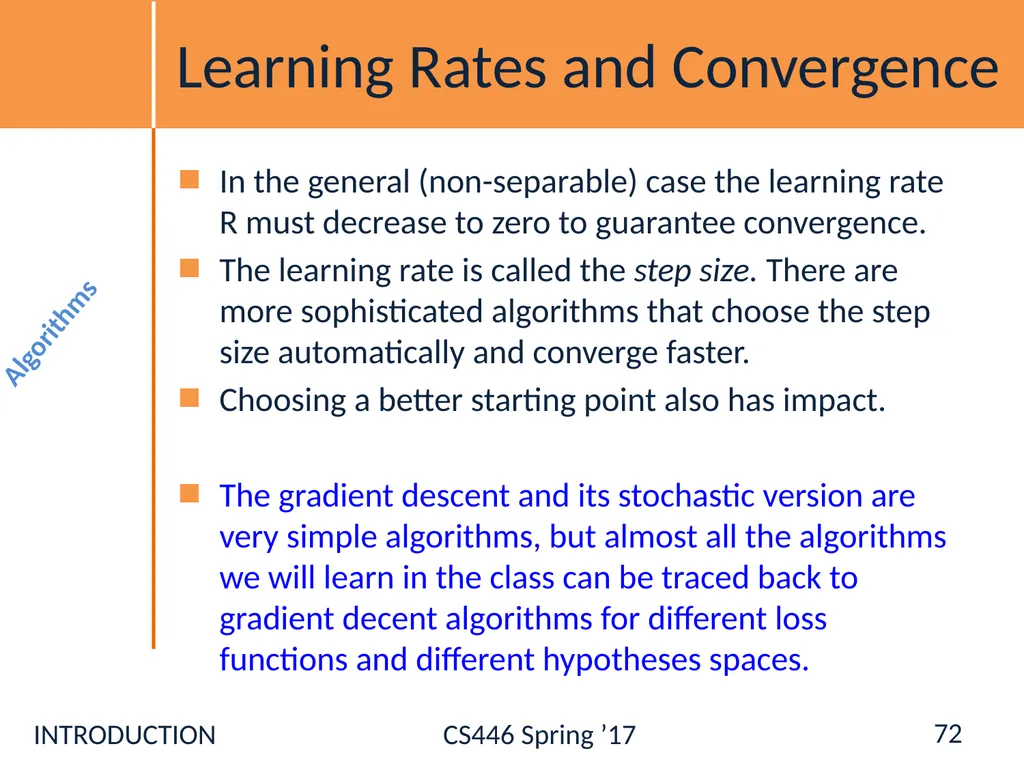
In the general (non-separable) case the learning rate R must decrease to zero to guarantee convergence.
The learning rate is called the step size. There are more sophisticated algorithms that choose the step size automatically and converge faster.
Choosing a better starting point also has impact.
The gradient descent and its stochastic version are very simple algorithms, but almost all the algorithms we will learn in the class can be traced back to gradient decent algorithms for different loss functions and different hypotheses spaces. Algorithms Learning Rates and Convergence 72<br>
The learning rate is called the step size. There are more sophisticated algorithms that choose the step size automatically and converge faster.
Choosing a better starting point also has impact.
The gradient descent and its stochastic version are very simple algorithms, but almost all the algorithms we will learn in the class can be traced back to gradient decent algorithms for different loss functions and different hypotheses spaces. Algorithms Learning Rates and Convergence 72<br>
73
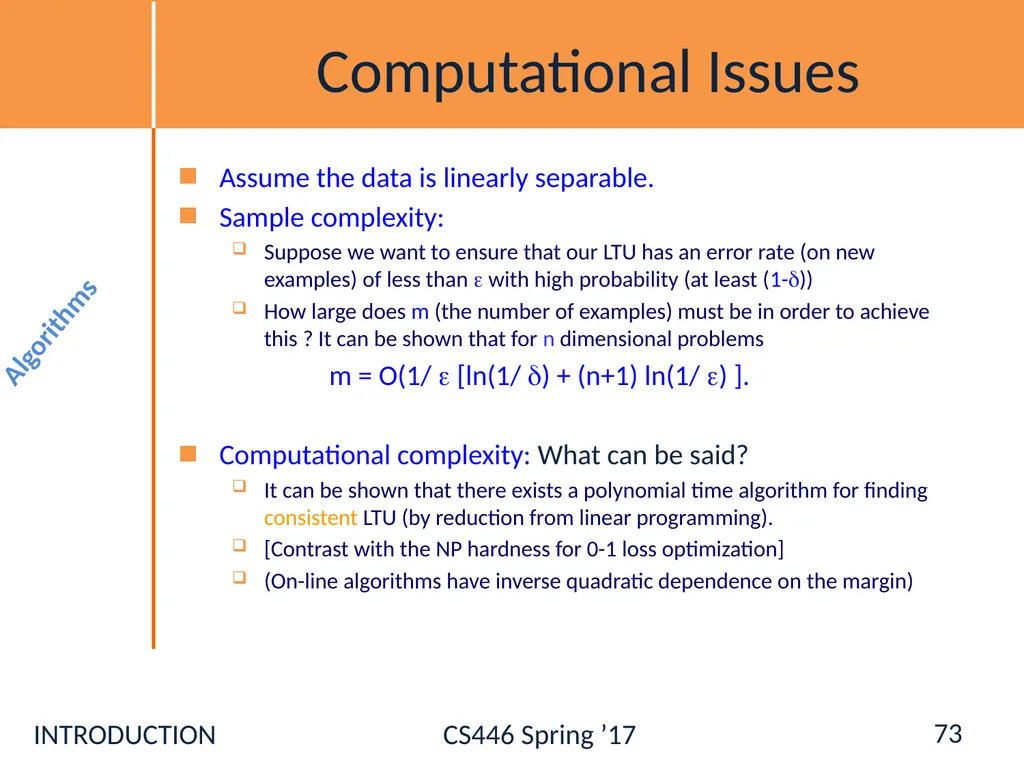
Computational Issues Assume the data is linearly separable.
Sample complexity:
Suppose we want to ensure that our LTU has an error rate (on new examples) of less than with high probability (at least (1-))
How large does m (the number of examples) must be in order to achieve this ? It can be shown that for n dimensional problems
m = O(1/ [ln(1/ ) + (n+1) ln(1/ ) ].
Computational complexity: What can be said?
It can be shown that there exists a polynomial time algorithm for finding consistent LTU (by reduction from linear programming).
[Contrast with the NP hardness for 0-1 loss optimization]
(On-line algorithms have inverse quadratic dependence on the margin) Algorithms 73<br>
Sample complexity:
Suppose we want to ensure that our LTU has an error rate (on new examples) of less than with high probability (at least (1-))
How large does m (the number of examples) must be in order to achieve this ? It can be shown that for n dimensional problems
m = O(1/ [ln(1/ ) + (n+1) ln(1/ ) ].
Computational complexity: What can be said?
It can be shown that there exists a polynomial time algorithm for finding consistent LTU (by reduction from linear programming).
[Contrast with the NP hardness for 0-1 loss optimization]
(On-line algorithms have inverse quadratic dependence on the margin) Algorithms 73<br>
74
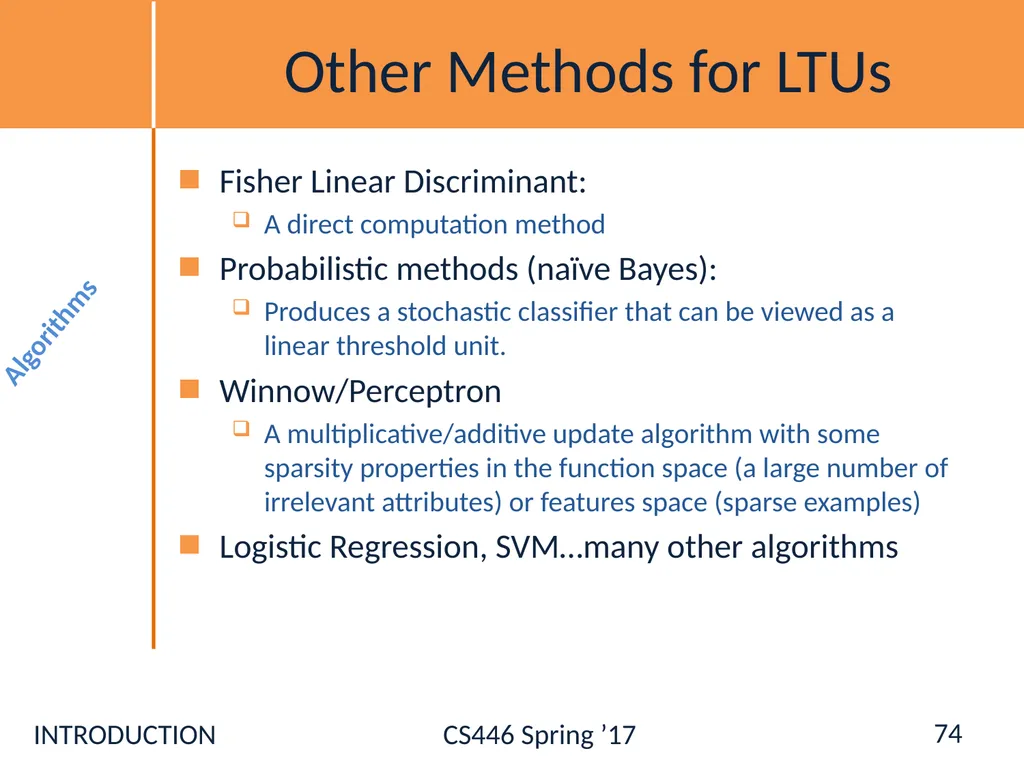
Other Methods for LTUs Fisher Linear Discriminant:
A direct computation method
Probabilistic methods (naïve Bayes):
Produces a stochastic classifier that can be viewed as a linear threshold unit.
Winnow/Perceptron
A multiplicative/additive update algorithm with some sparsity properties in the function space (a large number of irrelevant attributes) or features space (sparse examples)
Logistic Regression, SVM…many other algorithms Algorithms 74<br>
A direct computation method
Probabilistic methods (naïve Bayes):
Produces a stochastic classifier that can be viewed as a linear threshold unit.
Winnow/Perceptron
A multiplicative/additive update algorithm with some sparsity properties in the function space (a large number of irrelevant attributes) or features space (sparse examples)
Logistic Regression, SVM…many other algorithms Algorithms 74<br>