
CS 581 Constructing rooted trees Tandy Warnow
LO
Published · 42 slides · 0 views
1 / 1

Description
CS 581 Constructing rooted trees Tandy Warnow Todays material Newick strings Representing rooted trees using clades and rooted triplet trees Constructing a rooted tree from its set of clades using Hasse Diagrams Constructing a rooted tree
Related Topics
Share
Embed code
Download this presentation From Below
"CS 581 Constructing rooted trees Tandy Warnow" is the property of its rightful owner. Permission is granted to download and print the materials on this website for personal, non-commercial use only, and to display it on your personal computer provided you do not modify the materials and that you retain all copyright notices contained in the materials. By downloading content from our website, you accept the terms of this agreement.
Presentation Transcript
01
CS 581
Constructing rooted trees Tandy Warnow<br>
02
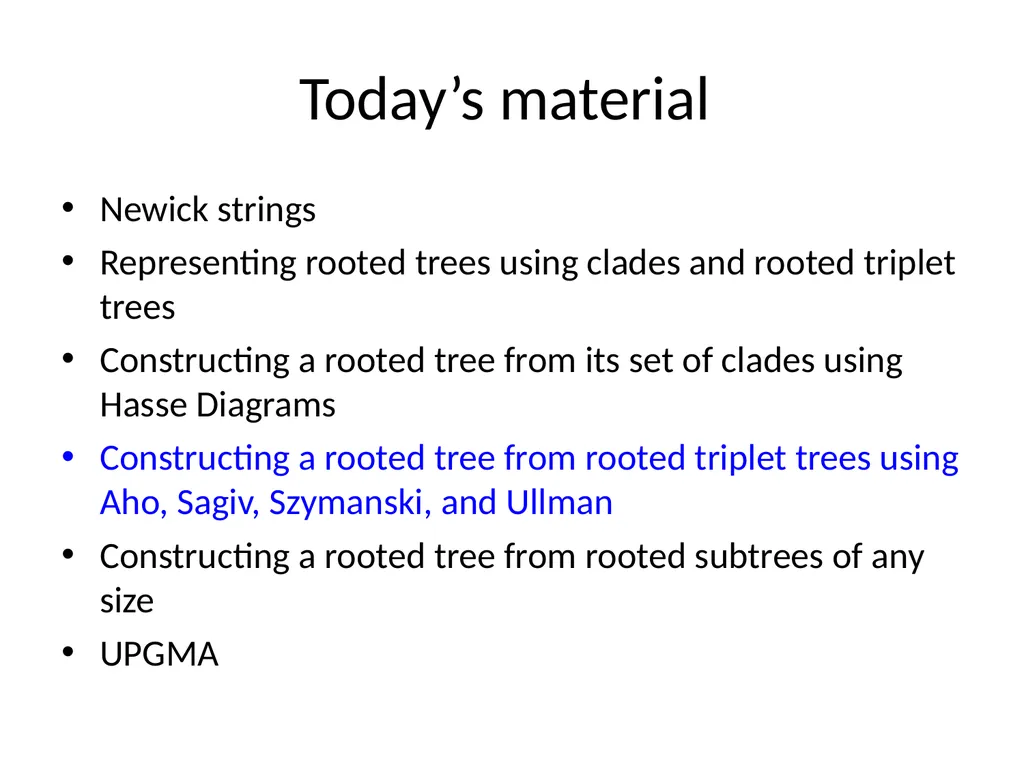
Today’s material Newick strings
Representing rooted trees using clades and rooted triplet trees
Constructing a rooted tree from its set of clades using Hasse Diagrams
Constructing a rooted tree from rooted triplet trees using Aho, Sagiv, Szymanski, and Ullman
Constructing a rooted tree from rooted subtrees of any size
UPGMA<br>
Representing rooted trees using clades and rooted triplet trees
Constructing a rooted tree from its set of clades using Hasse Diagrams
Constructing a rooted tree from rooted triplet trees using Aho, Sagiv, Szymanski, and Ullman
Constructing a rooted tree from rooted subtrees of any size
UPGMA<br>
03
Today’s material Newick strings
Representing rooted trees using clades and rooted triplet trees
Constructing a rooted tree from its set of clades using Hasse Diagrams
Constructing a rooted tree from rooted triplet trees using Aho, Sagiv, Szymanski, and Ullman
Constructing a rooted tree from rooted subtrees of any size
UPGMA<br>
Representing rooted trees using clades and rooted triplet trees
Constructing a rooted tree from its set of clades using Hasse Diagrams
Constructing a rooted tree from rooted triplet trees using Aho, Sagiv, Szymanski, and Ullman
Constructing a rooted tree from rooted subtrees of any size
UPGMA<br>
04
Newick representations For a rooted tree, we represent it with a string with the taxa, commas, and nested parentheses.
For example, what rooted tree is represented by (a,(b,(c,((d,e),(f,g))))))?
How do we represent an unrooted tree? (Easy - root it somewhere, and write down the Newick representation of the rooted version.)<br>
For example, what rooted tree is represented by (a,(b,(c,((d,e),(f,g))))))?
How do we represent an unrooted tree? (Easy - root it somewhere, and write down the Newick representation of the rooted version.)<br>
05
Today’s material Newick strings
Representing rooted trees using clades and rooted triplet trees
Constructing a rooted tree from its set of clades using Hasse Diagrams
Constructing a rooted tree from rooted triplet trees using Aho, Sagiv, Szymanski, and Ullman
Constructing a rooted tree from rooted subtrees of any size<br>
Representing rooted trees using clades and rooted triplet trees
Constructing a rooted tree from its set of clades using Hasse Diagrams
Constructing a rooted tree from rooted triplet trees using Aho, Sagiv, Szymanski, and Ullman
Constructing a rooted tree from rooted subtrees of any size<br>
06
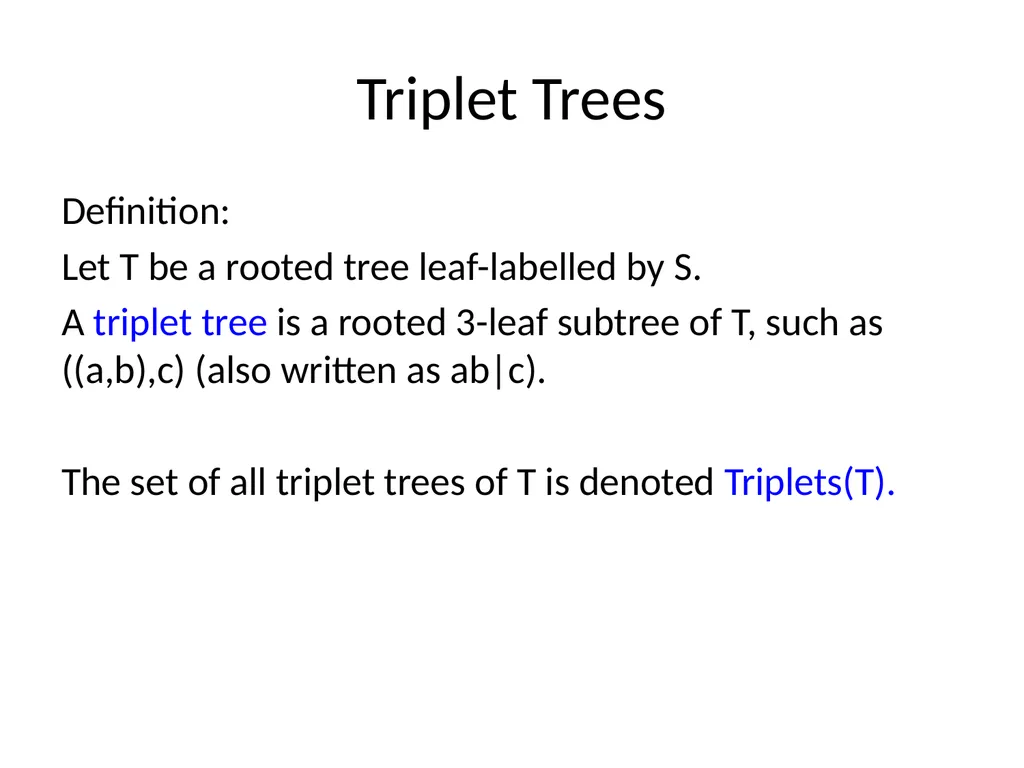
Triplet Trees Definition:
Let T be a rooted tree leaf-labelled by S.
A triplet tree is a rooted 3-leaf subtree of T, such as ((a,b),c) (also written as ab|c).
The set of all triplet trees of T is denoted Triplets(T).<br>
Let T be a rooted tree leaf-labelled by S.
A triplet tree is a rooted 3-leaf subtree of T, such as ((a,b),c) (also written as ab|c).
The set of all triplet trees of T is denoted Triplets(T).<br>
07
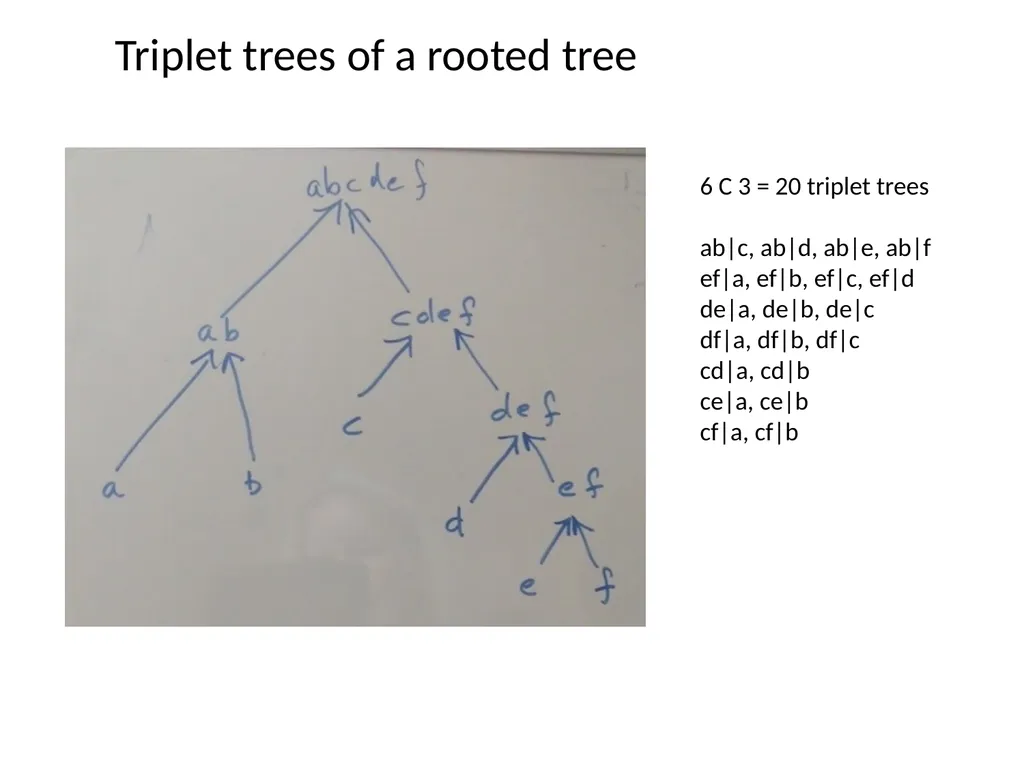
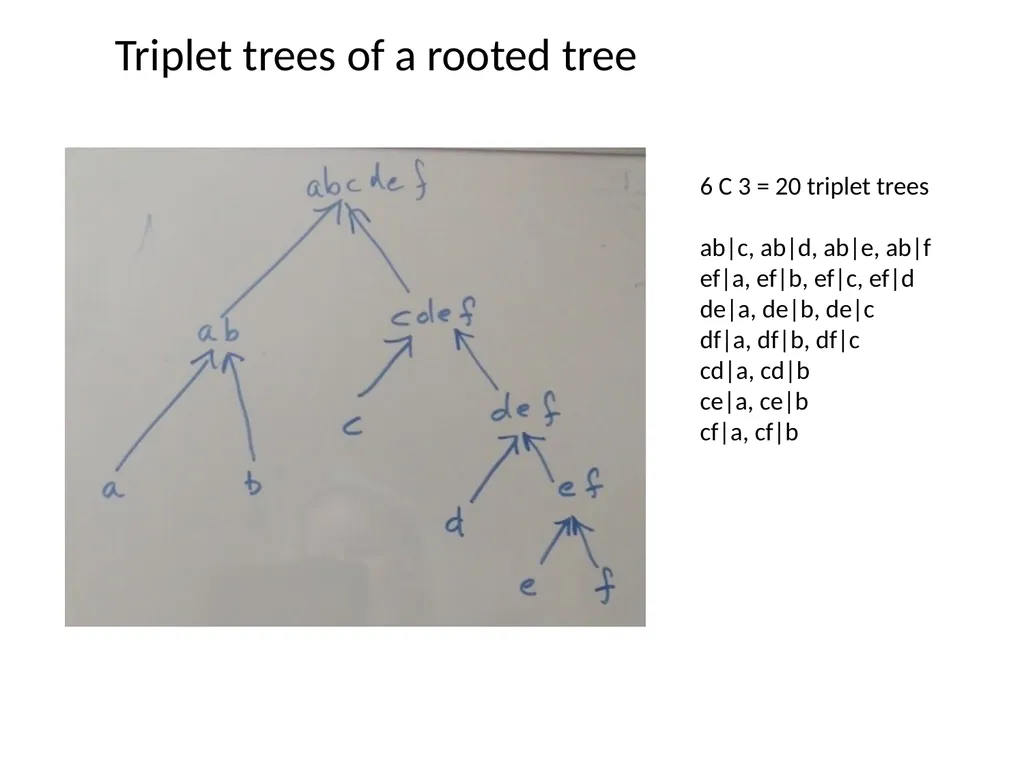
Triplet trees of a rooted tree 6 C 3 = 20 triplet trees
ab|c, ab|d, ab|e, ab|f
ef|a, ef|b, ef|c, ef|d
de|a, de|b, de|c
df|a, df|b, df|c
cd|a, cd|b
ce|a, ce|b
cf|a, cf|b<br>
ab|c, ab|d, ab|e, ab|f
ef|a, ef|b, ef|c, ef|d
de|a, de|b, de|c
df|a, df|b, df|c
cd|a, cd|b
ce|a, ce|b
cf|a, cf|b<br>
08
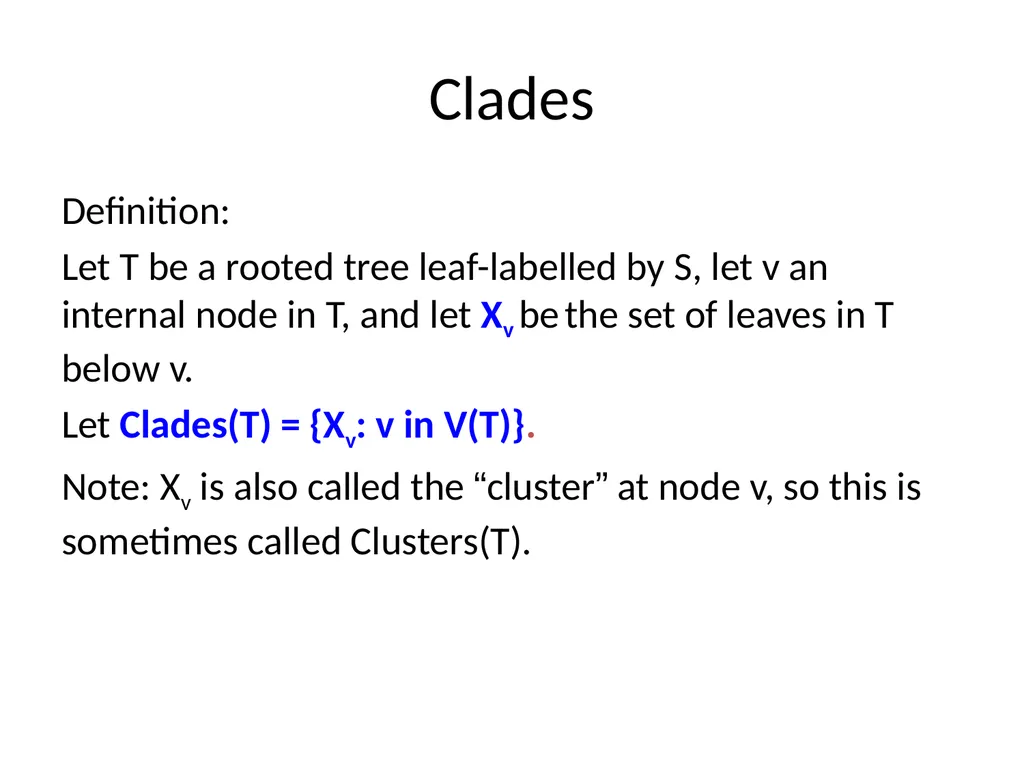
Clades Definition:
Let T be a rooted tree leaf-labelled by S, let v an internal node in T, and let Xv be the set of leaves in T below v.
Let Clades(T) = {Xv: v in V(T)}.
Note: Xv is also called the “cluster” at node v, so this is sometimes called Clusters(T).<br>
Let T be a rooted tree leaf-labelled by S, let v an internal node in T, and let Xv be the set of leaves in T below v.
Let Clades(T) = {Xv: v in V(T)}.
Note: Xv is also called the “cluster” at node v, so this is sometimes called Clusters(T).<br>
09
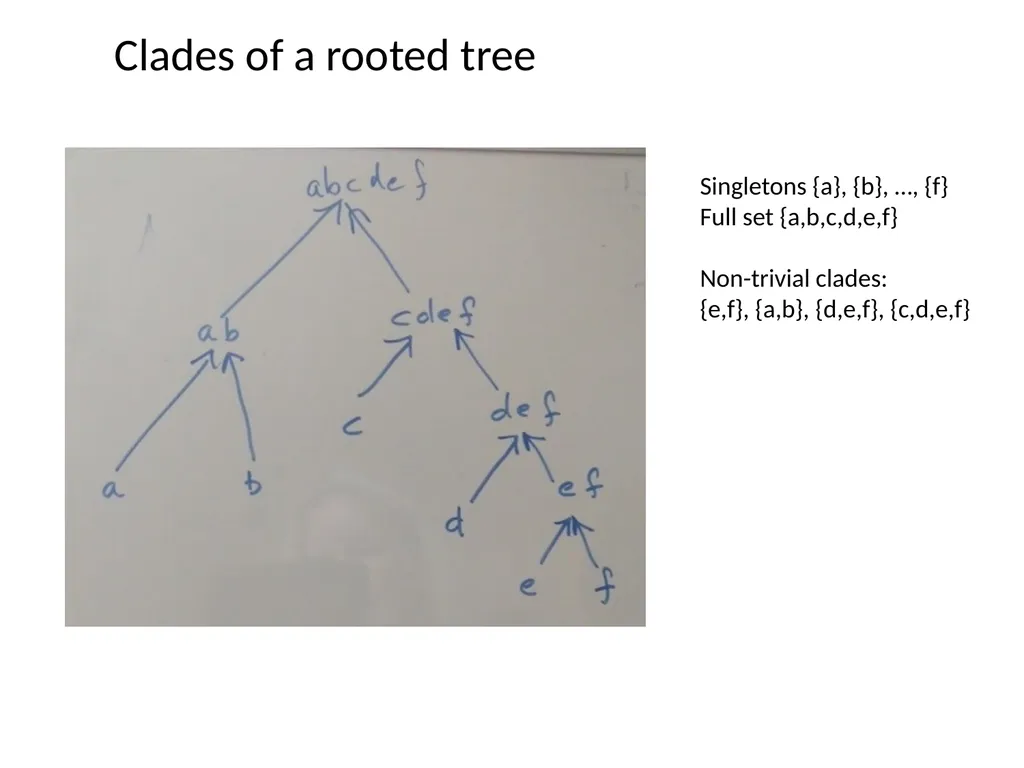
Clades of a rooted tree Singletons {a}, {b}, …, {f}
Full set {a,b,c,d,e,f}
Non-trivial clades: {e,f}, {a,b}, {d,e,f}, {c,d,e,f}<br>
Full set {a,b,c,d,e,f}
Non-trivial clades: {e,f}, {a,b}, {d,e,f}, {c,d,e,f}<br>
10
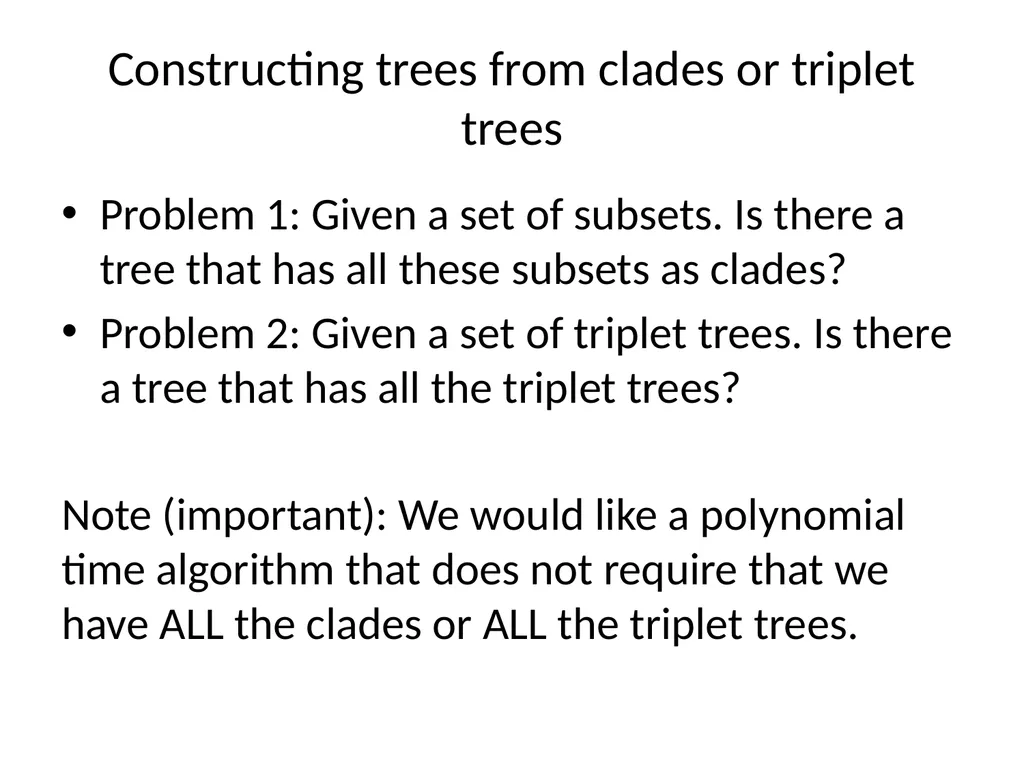
Constructing trees from clades or triplet trees Problem 1: Given a set of subsets. Is there a tree that has all these subsets as clades?
Problem 2: Given a set of triplet trees. Is there a tree that has all the triplet trees?
Note (important): We would like a polynomial time algorithm that does not require that we have ALL the clades or ALL the triplet trees.<br>
Problem 2: Given a set of triplet trees. Is there a tree that has all the triplet trees?
Note (important): We would like a polynomial time algorithm that does not require that we have ALL the clades or ALL the triplet trees.<br>
11
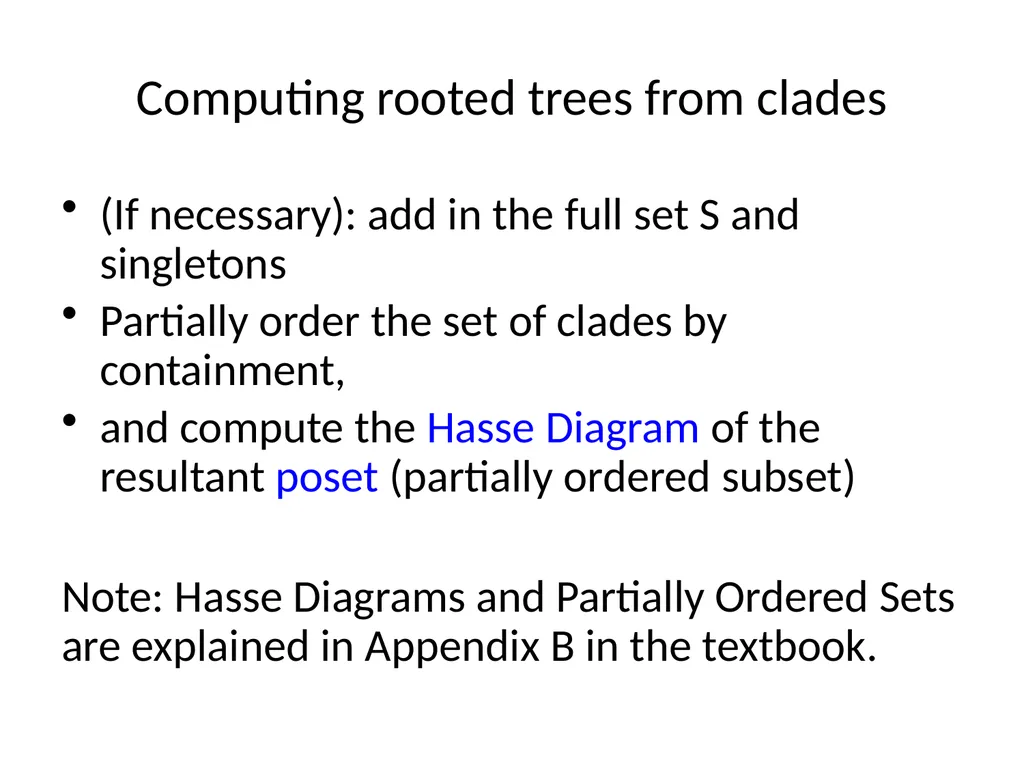
Computing rooted trees from clades (If necessary): add in the full set S and singletons
Partially order the set of clades by containment,
and compute the Hasse Diagram of the resultant poset (partially ordered subset)
Note: Hasse Diagrams and Partially Ordered Sets are explained in Appendix B in the textbook.<br>
Partially order the set of clades by containment,
and compute the Hasse Diagram of the resultant poset (partially ordered subset)
Note: Hasse Diagrams and Partially Ordered Sets are explained in Appendix B in the textbook.<br>
12
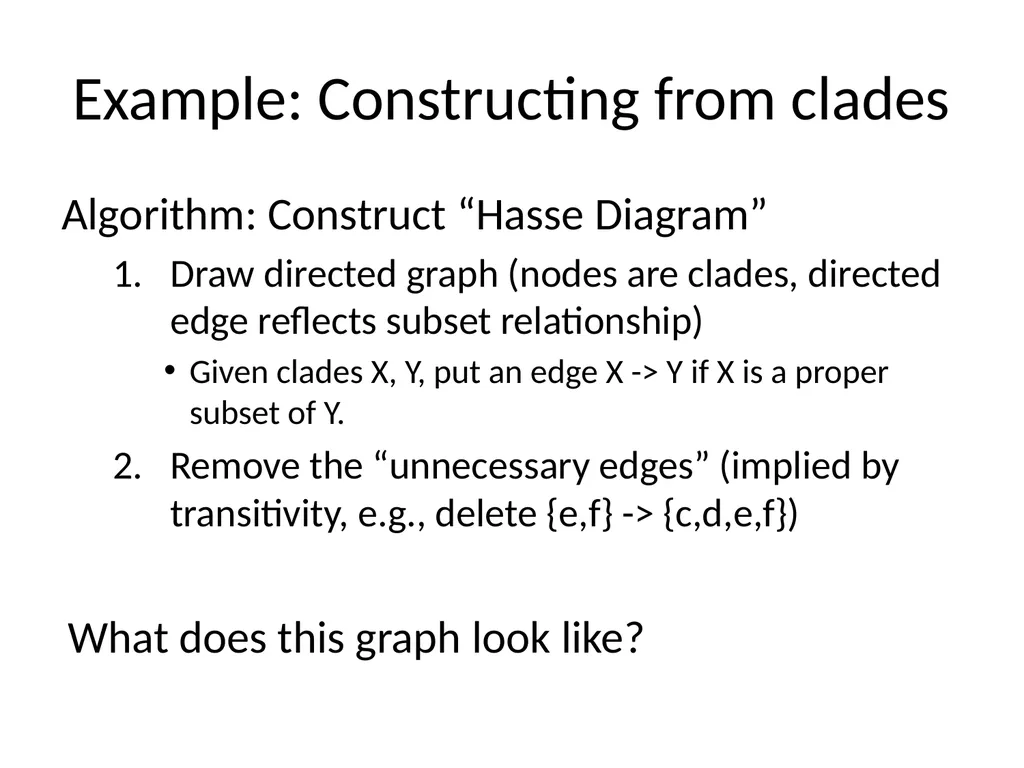
Example: Constructing from clades Algorithm: Construct “Hasse Diagram”
Draw directed graph (nodes are clades, directed edge reflects subset relationship)
Given clades X, Y, put an edge X -> Y if X is a proper subset of Y.
Remove the “unnecessary edges” (implied by transitivity, e.g., delete {e,f} -> {c,d,e,f})
What does this graph look like?<br>
Draw directed graph (nodes are clades, directed edge reflects subset relationship)
Given clades X, Y, put an edge X -> Y if X is a proper subset of Y.
Remove the “unnecessary edges” (implied by transitivity, e.g., delete {e,f} -> {c,d,e,f})
What does this graph look like?<br>
13
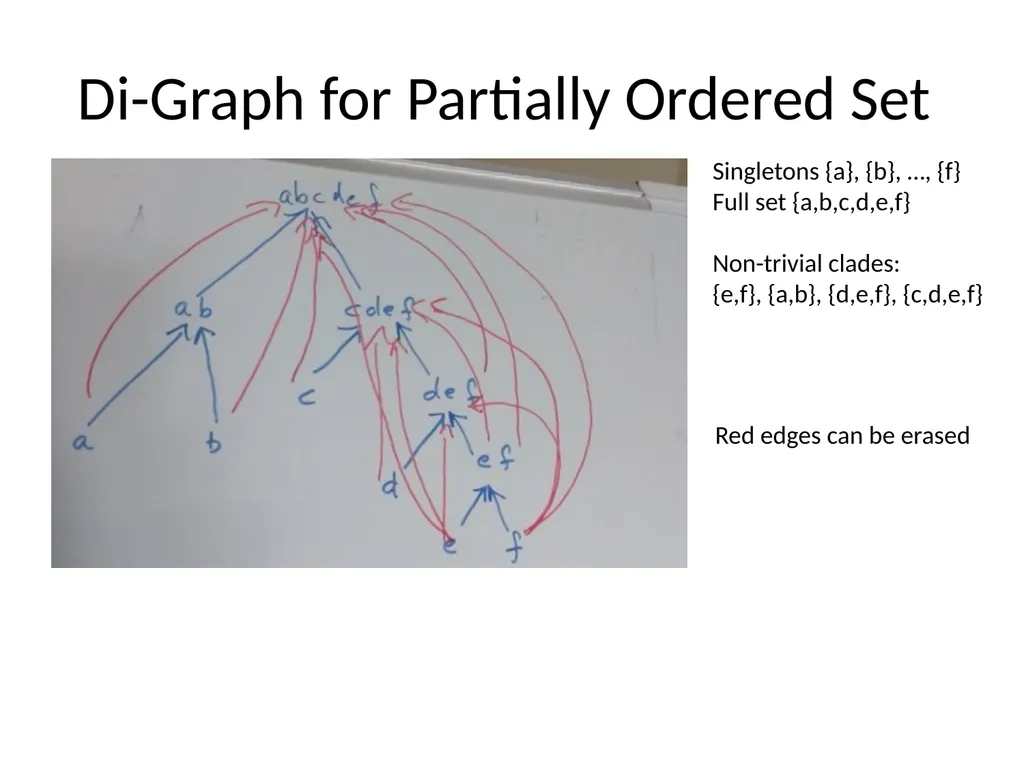
Di-Graph for Partially Ordered Set Singletons {a}, {b}, …, {f}
Full set {a,b,c,d,e,f}
Non-trivial clades:
{e,f}, {a,b}, {d,e,f}, {c,d,e,f} Red edges can be erased<br>
Full set {a,b,c,d,e,f}
Non-trivial clades:
{e,f}, {a,b}, {d,e,f}, {c,d,e,f} Red edges can be erased<br>
14
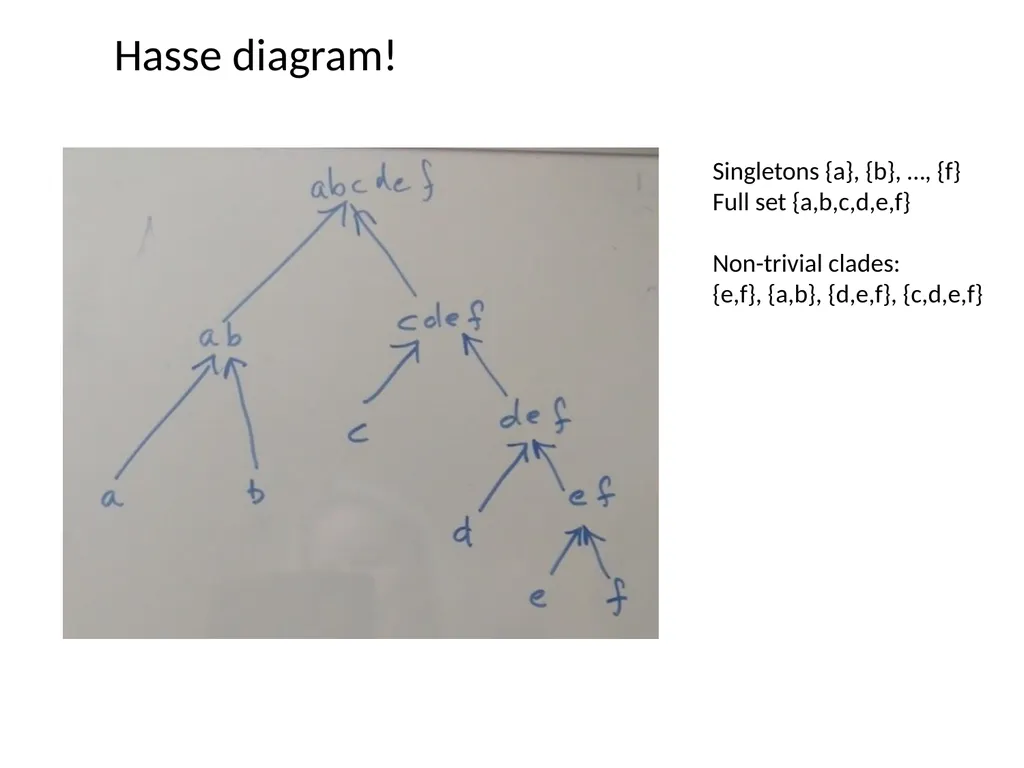
Hasse diagram! Singletons {a}, {b}, …, {f}
Full set {a,b,c,d,e,f}
Non-trivial clades:
{e,f}, {a,b}, {d,e,f}, {c,d,e,f}<br>
Full set {a,b,c,d,e,f}
Non-trivial clades:
{e,f}, {a,b}, {d,e,f}, {c,d,e,f}<br>
15
Clades of T -> Hasse Diagram -> T Singletons {a}, {b}, …, {f}
Full set {a,b,c,d,e,f}
Non-trivial clades: {e,f}, {a,b}, {d,e,f}, {c,d,e,f}<br>
Full set {a,b,c,d,e,f}
Non-trivial clades: {e,f}, {a,b}, {d,e,f}, {c,d,e,f}<br>
16
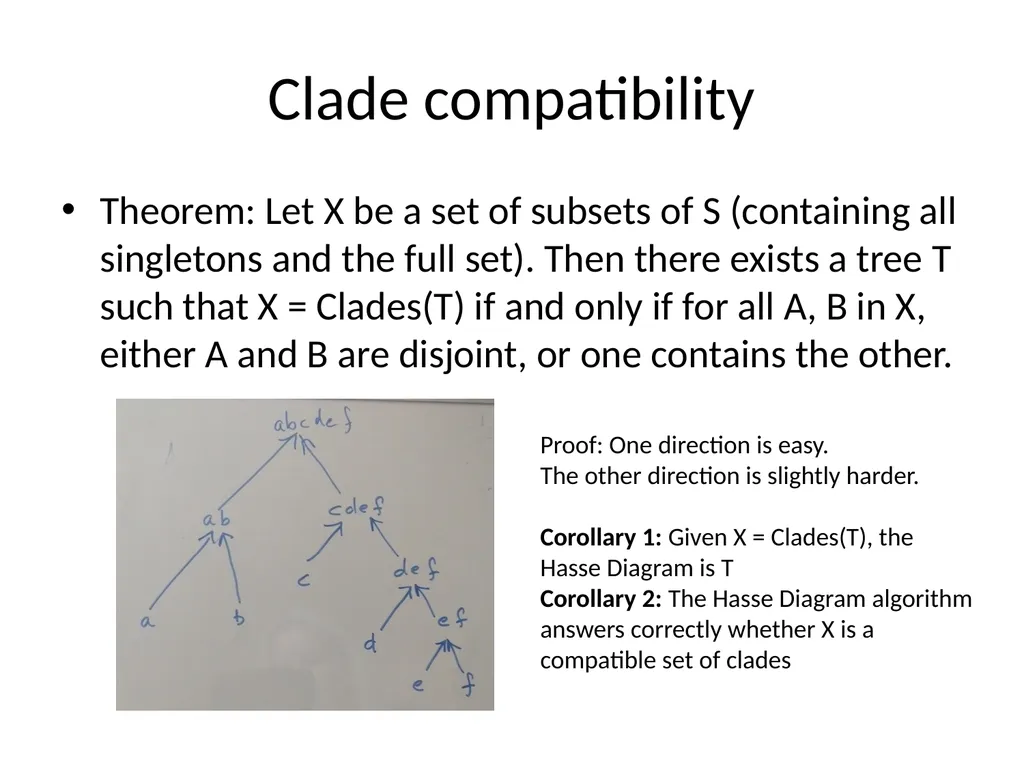
Clade compatibility Theorem: Let X be a set of subsets of S (containing all singletons and the full set). Then there exists a tree T such that X = Clades(T) if and only if for all A, B in X, either A and B are disjoint, or one contains the other. Proof: One direction is easy.
The other direction is slightly harder.
Corollary 1: Given X = Clades(T), the Hasse Diagram is T
Corollary 2: The Hasse Diagram algorithm answers correctly whether X is a compatible set of clades<br>
The other direction is slightly harder.
Corollary 1: Given X = Clades(T), the Hasse Diagram is T
Corollary 2: The Hasse Diagram algorithm answers correctly whether X is a compatible set of clades<br>
17
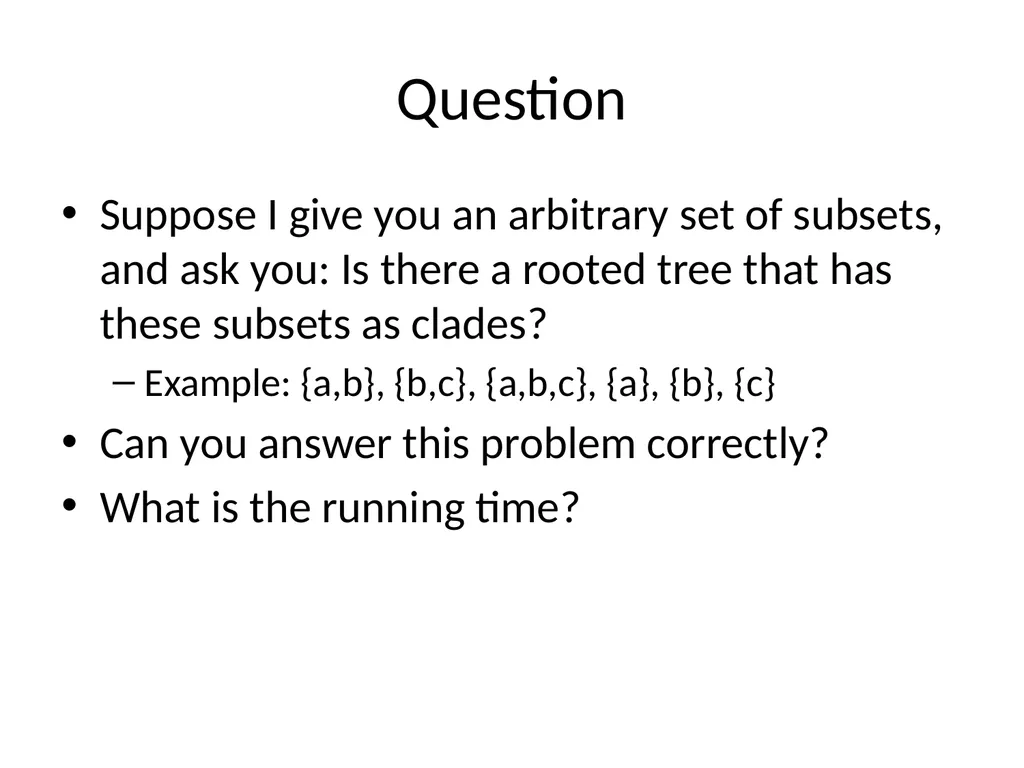
Question Suppose I give you an arbitrary set of subsets, and ask you: Is there a rooted tree that has these subsets as clades?
Example: {a,b}, {b,c}, {a,b,c}, {a}, {b}, {c}
Can you answer this problem correctly?
What is the running time?<br>
Example: {a,b}, {b,c}, {a,b,c}, {a}, {b}, {c}
Can you answer this problem correctly?
What is the running time?<br>
18
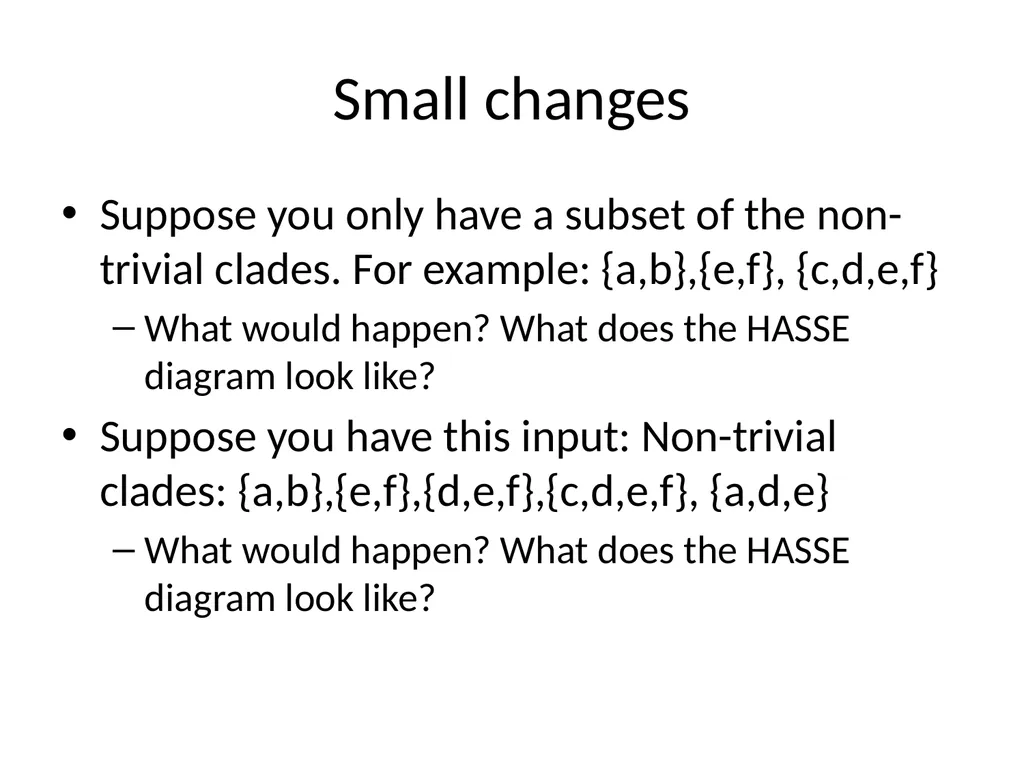
Small changes Suppose you only have a subset of the non-trivial clades. For example: {a,b},{e,f}, {c,d,e,f}
What would happen? What does the HASSE diagram look like?
Suppose you have this input: Non-trivial clades: {a,b},{e,f},{d,e,f},{c,d,e,f}, {a,d,e}
What would happen? What does the HASSE diagram look like?<br>
What would happen? What does the HASSE diagram look like?
Suppose you have this input: Non-trivial clades: {a,b},{e,f},{d,e,f},{c,d,e,f}, {a,d,e}
What would happen? What does the HASSE diagram look like?<br>
19
Tree construction from clades We presented an algorithm (Hasse Diagram)
Questions:
Accuracy if given all the clades?
Does it always produce binary trees?
What if you are missing some clades? (for example, singletons?)
What is the running time?<br>
Questions:
Accuracy if given all the clades?
Does it always produce binary trees?
What if you are missing some clades? (for example, singletons?)
What is the running time?<br>
20
Today’s material Newick strings
Representing rooted trees using clades and rooted triplet trees
Constructing a rooted tree from its set of clades using Hasse Diagrams
Constructing a rooted tree from rooted triplet trees using Aho, Sagiv, Szymanski, and Ullman
Constructing a rooted tree from rooted subtrees of any size
UPGMA<br>
Representing rooted trees using clades and rooted triplet trees
Constructing a rooted tree from its set of clades using Hasse Diagrams
Constructing a rooted tree from rooted triplet trees using Aho, Sagiv, Szymanski, and Ullman
Constructing a rooted tree from rooted subtrees of any size
UPGMA<br>
21
Today’s material Newick strings
Representing rooted trees using clades and rooted triplet trees
Constructing a rooted tree from its set of clades using Hasse Diagrams
Constructing a rooted tree from rooted triplet trees using Aho, Sagiv, Szymanski, and Ullman
Constructing a rooted tree from rooted subtrees of any size
UPGMA<br>
Representing rooted trees using clades and rooted triplet trees
Constructing a rooted tree from its set of clades using Hasse Diagrams
Constructing a rooted tree from rooted triplet trees using Aho, Sagiv, Szymanski, and Ullman
Constructing a rooted tree from rooted subtrees of any size
UPGMA<br>
22
Triplet trees of a rooted tree 6 C 3 = 20 triplet trees
ab|c, ab|d, ab|e, ab|f
ef|a, ef|b, ef|c, ef|d
de|a, de|b, de|c
df|a, df|b, df|c
cd|a, cd|b
ce|a, ce|b
cf|a, cf|b<br>
ab|c, ab|d, ab|e, ab|f
ef|a, ef|b, ef|c, ef|d
de|a, de|b, de|c
df|a, df|b, df|c
cd|a, cd|b
ce|a, ce|b
cf|a, cf|b<br>
23
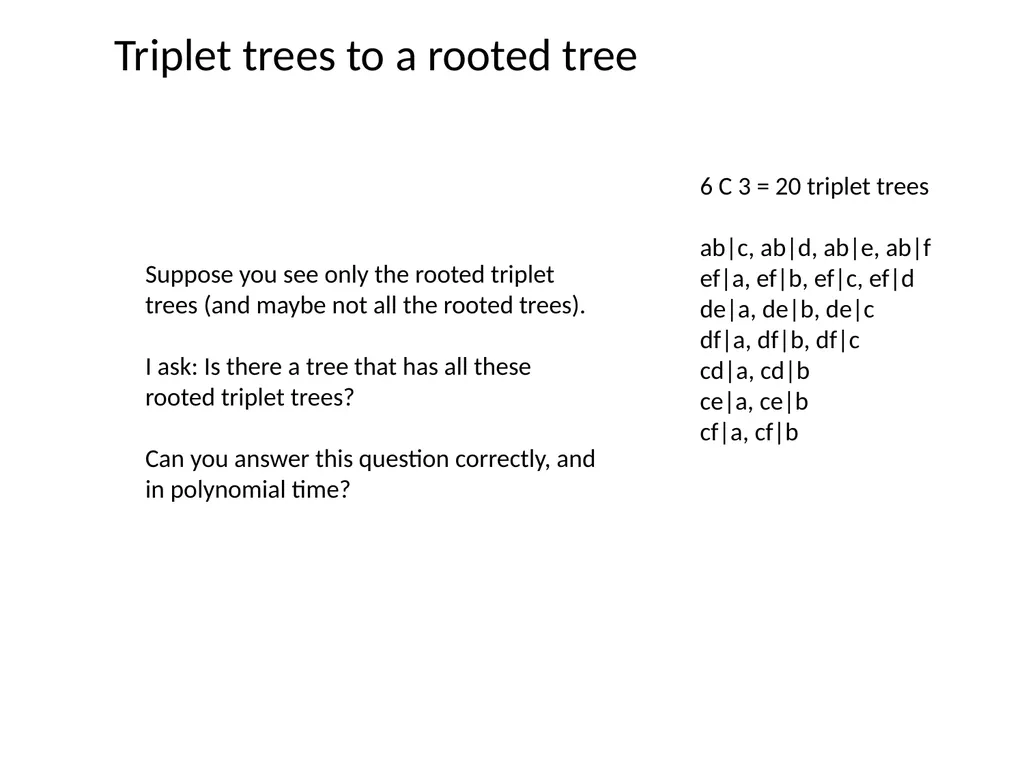
Triplet trees to a rooted tree 6 C 3 = 20 triplet trees
ab|c, ab|d, ab|e, ab|f
ef|a, ef|b, ef|c, ef|d
de|a, de|b, de|c
df|a, df|b, df|c
cd|a, cd|b
ce|a, ce|b
cf|a, cf|b Suppose you see only the rooted triplet trees (and maybe not all the rooted trees).
I ask: Is there a tree that has all these rooted triplet trees?
Can you answer this question correctly, and in polynomial time?<br>
ab|c, ab|d, ab|e, ab|f
ef|a, ef|b, ef|c, ef|d
de|a, de|b, de|c
df|a, df|b, df|c
cd|a, cd|b
ce|a, ce|b
cf|a, cf|b Suppose you see only the rooted triplet trees (and maybe not all the rooted trees).
I ask: Is there a tree that has all these rooted triplet trees?
Can you answer this question correctly, and in polynomial time?<br>
24
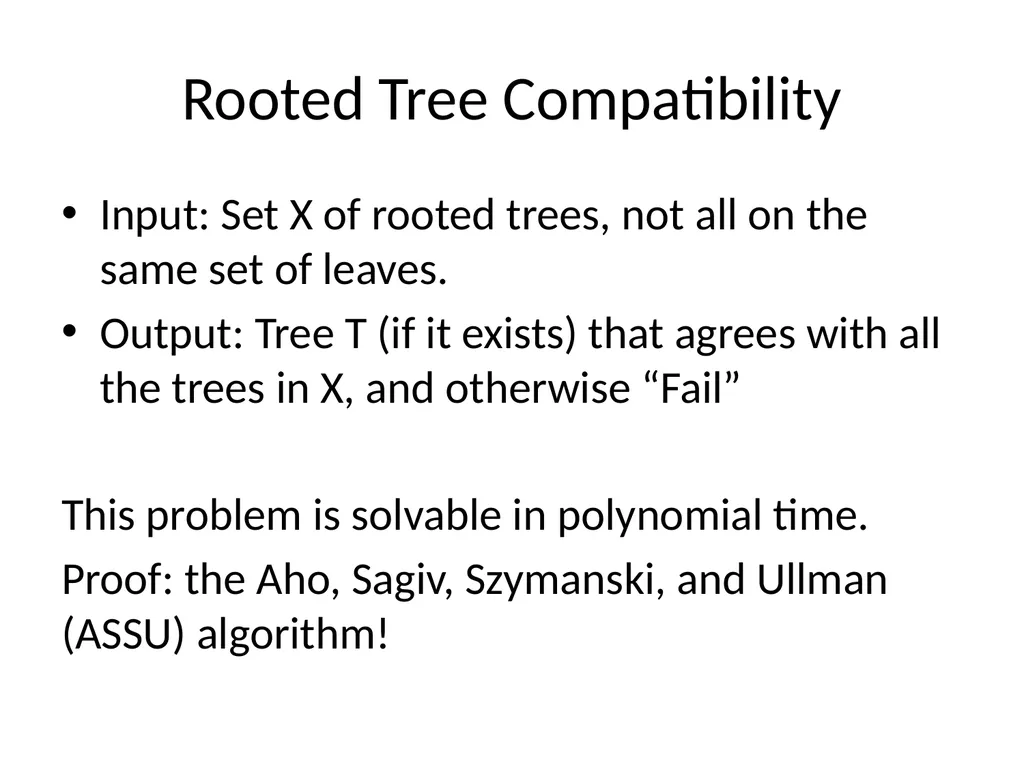
Rooted Tree Compatibility Input: Set X of rooted trees, not all on the same set of leaves.
Output: Tree T (if it exists) that agrees with all the trees in X, and otherwise “Fail”
This problem is solvable in polynomial time.
Proof: the Aho, Sagiv, Szymanski, and Ullman (ASSU) algorithm!<br>
Output: Tree T (if it exists) that agrees with all the trees in X, and otherwise “Fail”
This problem is solvable in polynomial time.
Proof: the Aho, Sagiv, Szymanski, and Ullman (ASSU) algorithm!<br>
25
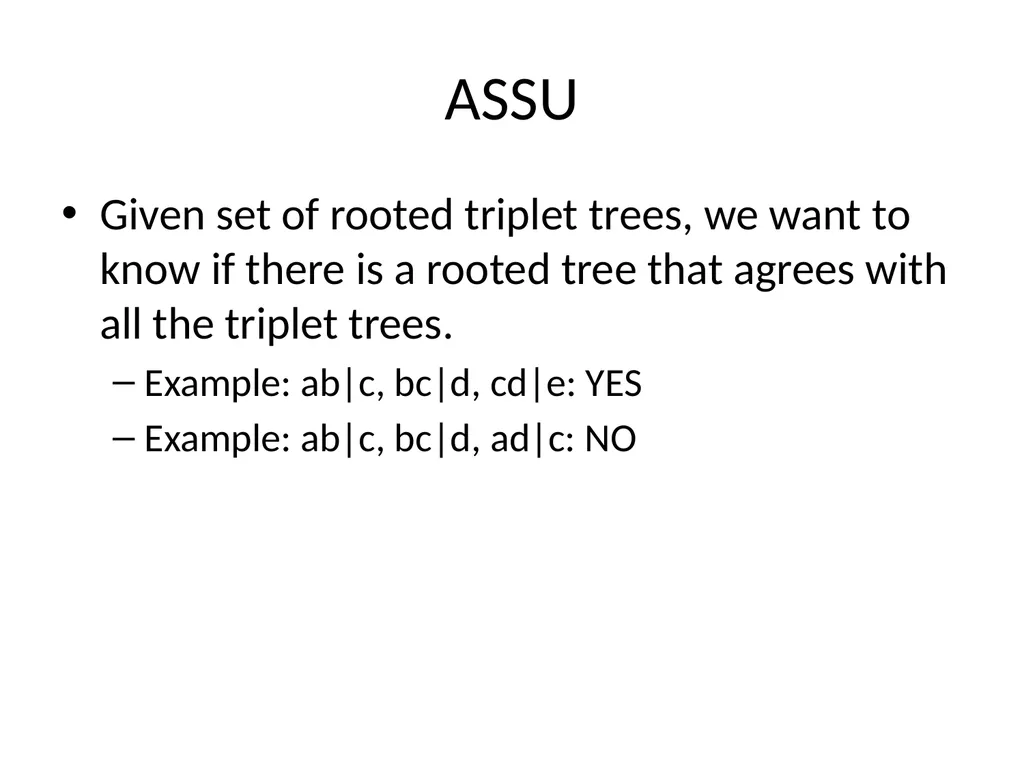
ASSU Given set of rooted triplet trees, we want to know if there is a rooted tree that agrees with all the triplet trees.
Example: ab|c, bc|d, cd|e: YES
Example: ab|c, bc|d, ad|c: NO<br>
Example: ab|c, bc|d, cd|e: YES
Example: ab|c, bc|d, ad|c: NO<br>
26
ASSU Given set of rooted triplet trees, we want to know if there is a rooted tree that agrees with all the triplet trees.
Approach: Assume there is a binary tree that agrees with the triplet trees, and try to construct it. Then check.<br>
Approach: Assume there is a binary tree that agrees with the triplet trees, and try to construct it. Then check.<br>
27
ASSU Given set of rooted triplet trees, we want to know if there is a rooted tree that agrees with all the triplet trees.
Key insight: If xy|z is a triplet tree, then x and y must be on the same side of the root of the binary tree that agrees with xy|z.
Why?<br>
Key insight: If xy|z is a triplet tree, then x and y must be on the same side of the root of the binary tree that agrees with xy|z.
Why?<br>
28
ASSU Given set of rooted triplet trees, we want to know if there is a rooted tree that agrees with all the triplet trees.
Key insight: Make a graph G=(V,E) with every ”species” a vertex in V and include edge (x,y) if some triplet tree xy|z is in the input. This graph must have at least two components.
Why?<br>
Key insight: Make a graph G=(V,E) with every ”species” a vertex in V and include edge (x,y) if some triplet tree xy|z is in the input. This graph must have at least two components.
Why?<br>
29
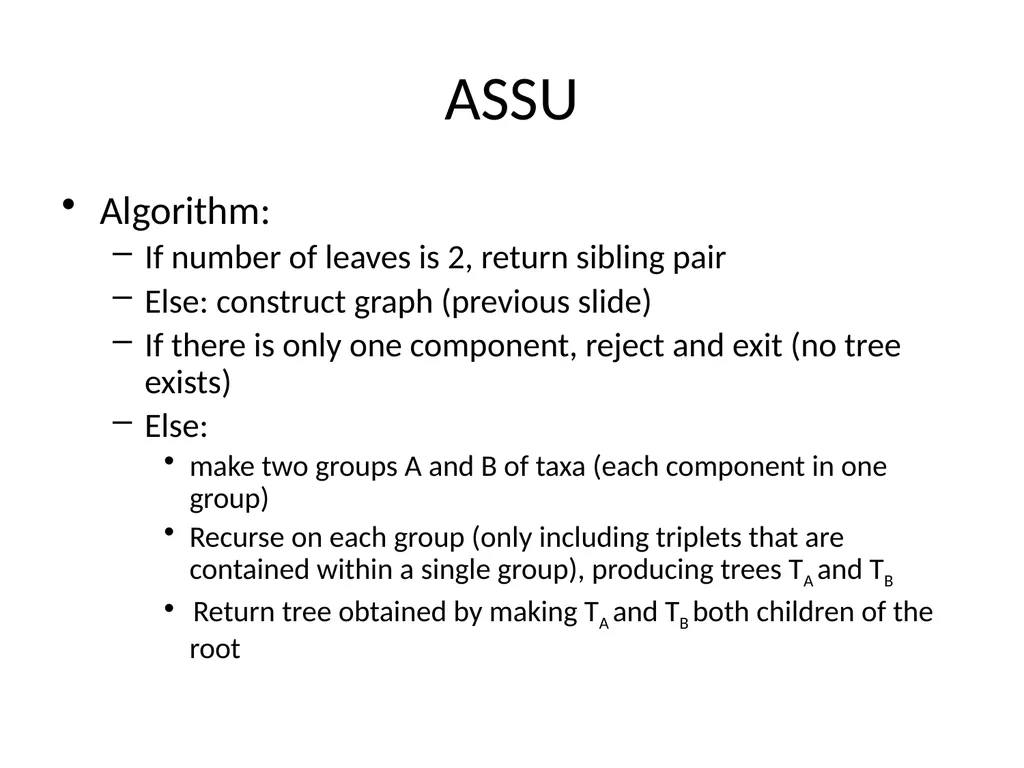
ASSU Algorithm:
If number of leaves is 2, return sibling pair
Else: construct graph (previous slide)
If there is only one component, reject and exit (no tree exists)
Else:
make two groups A and B of taxa (each component in one group)
Recurse on each group (only including triplets that are contained within a single group), producing trees TA and TB
Return tree obtained by making TA and TB both children of the root<br>
If number of leaves is 2, return sibling pair
Else: construct graph (previous slide)
If there is only one component, reject and exit (no tree exists)
Else:
make two groups A and B of taxa (each component in one group)
Recurse on each group (only including triplets that are contained within a single group), producing trees TA and TB
Return tree obtained by making TA and TB both children of the root<br>
30
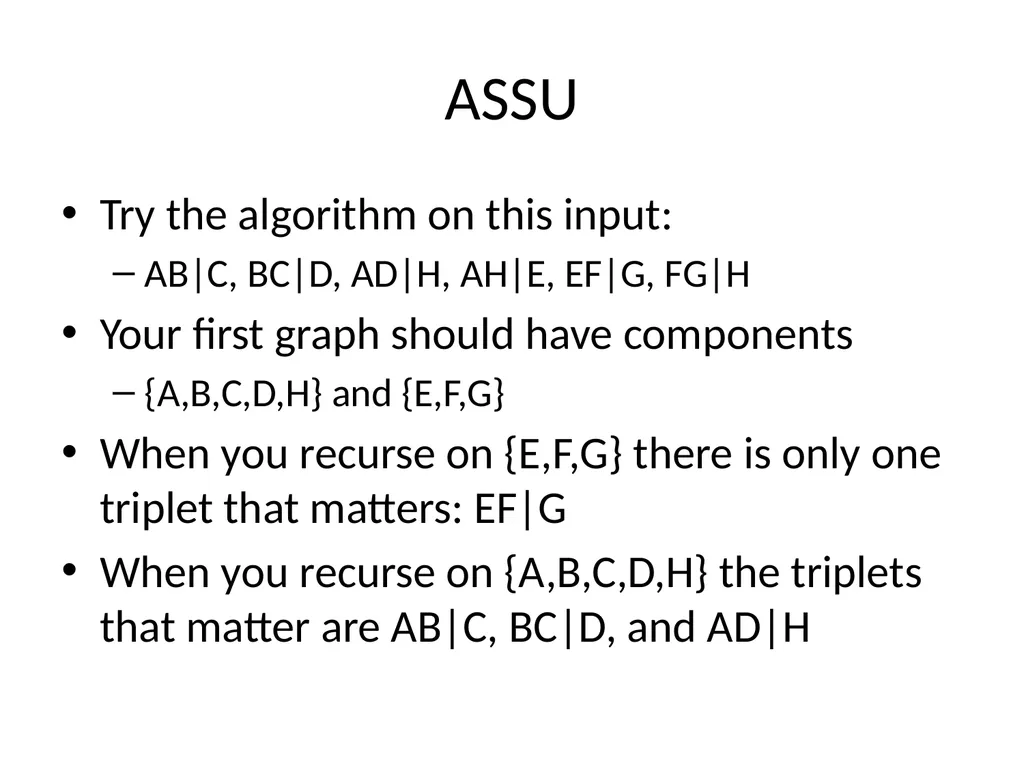
ASSU Try the algorithm on this input:
AB|C, BC|D, AD|H, AH|E, EF|G, FG|H
Your first graph should have components
{A,B,C,D,H} and {E,F,G}
When you recurse on {E,F,G} there is only one triplet that matters: EF|G
When you recurse on {A,B,C,D,H} the triplets that matter are AB|C, BC|D, and AD|H<br>
AB|C, BC|D, AD|H, AH|E, EF|G, FG|H
Your first graph should have components
{A,B,C,D,H} and {E,F,G}
When you recurse on {E,F,G} there is only one triplet that matters: EF|G
When you recurse on {A,B,C,D,H} the triplets that matter are AB|C, BC|D, and AD|H<br>
31
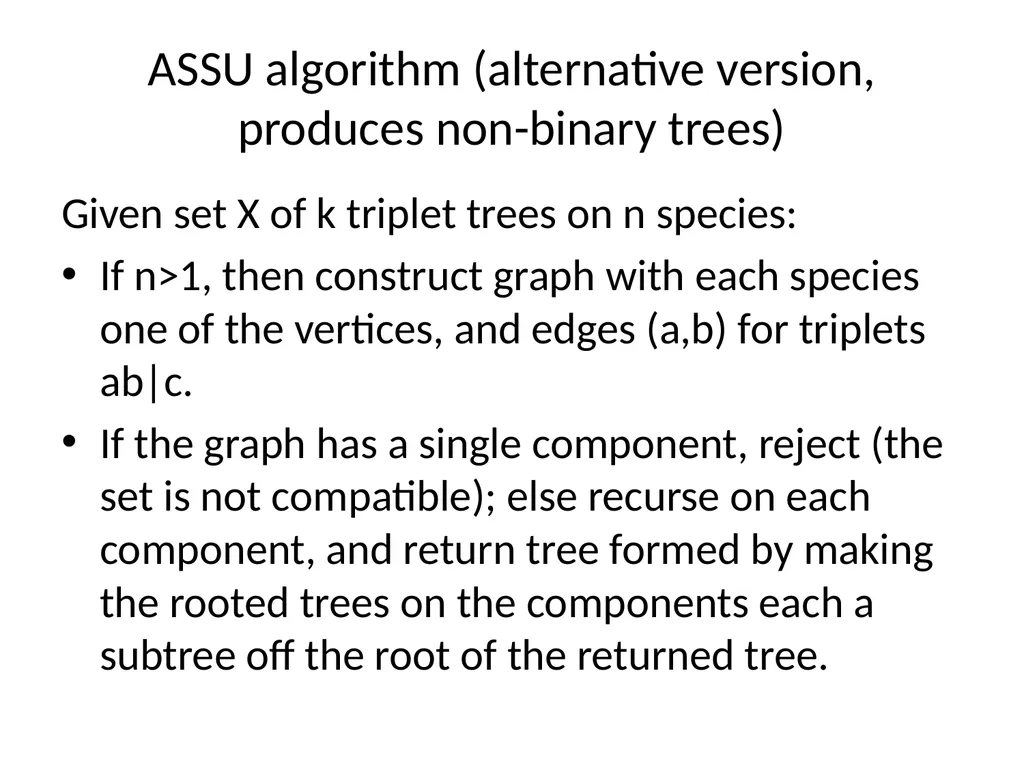
ASSU algorithm (alternative version, produces non-binary trees) Given set X of k triplet trees on n species:
If n>1, then construct graph with each species one of the vertices, and edges (a,b) for triplets ab|c.
If the graph has a single component, reject (the set is not compatible); else recurse on each component, and return tree formed by making the rooted trees on the components each a subtree off the root of the returned tree.<br>
If n>1, then construct graph with each species one of the vertices, and edges (a,b) for triplets ab|c.
If the graph has a single component, reject (the set is not compatible); else recurse on each component, and return tree formed by making the rooted trees on the components each a subtree off the root of the returned tree.<br>
32
Today’s material (from Chapters 1-3) Newick strings
Representing rooted trees using clades and rooted triplet trees
Constructing a rooted tree from its set of clades using Hasse Diagrams
Constructing a rooted tree from rooted triplet trees using Aho, Sagiv, Szymanski, and Ullman
Constructing a rooted tree from rooted subtrees of any size
UPGMA<br>
Representing rooted trees using clades and rooted triplet trees
Constructing a rooted tree from its set of clades using Hasse Diagrams
Constructing a rooted tree from rooted triplet trees using Aho, Sagiv, Szymanski, and Ullman
Constructing a rooted tree from rooted subtrees of any size
UPGMA<br>
33
Today’s material (from Chapters 1-3) Newick strings
Representing rooted trees using clades and rooted triplet trees
Constructing a rooted tree from its set of clades using Hasse Diagrams
Constructing a rooted tree from rooted triplet trees using Aho, Sagiv, Szymanski, and Ullman
Constructing a rooted tree from rooted subtrees of any size
UPGMA<br>
Representing rooted trees using clades and rooted triplet trees
Constructing a rooted tree from its set of clades using Hasse Diagrams
Constructing a rooted tree from rooted triplet trees using Aho, Sagiv, Szymanski, and Ullman
Constructing a rooted tree from rooted subtrees of any size
UPGMA<br>
34
Compatibility of rooted trees Suppose the input is a set X of rooted trees (not necessarily triplet trees).
Can we use ASSU to determine if X is compatible, and to compute a compatibility supertree for X?
Solution: YES, just encode each rooted tree in X by its set of rooted triplet trees (or some subset of these that suffices to define each tree in X), and then run ASSU.<br>
Can we use ASSU to determine if X is compatible, and to compute a compatibility supertree for X?
Solution: YES, just encode each rooted tree in X by its set of rooted triplet trees (or some subset of these that suffices to define each tree in X), and then run ASSU.<br>
35
Compatibility of rooted trees Suppose the input is a set X of rooted trees (not necessarily triplet trees).
Can we use ASSU to determine if X is compatible, and to compute a compatibility supertree for X?
Solution: YES, just encode each rooted tree in X by its set of rooted triplet trees (or some subset of these that suffices to define each tree in X), and then run ASSU.<br>
Can we use ASSU to determine if X is compatible, and to compute a compatibility supertree for X?
Solution: YES, just encode each rooted tree in X by its set of rooted triplet trees (or some subset of these that suffices to define each tree in X), and then run ASSU.<br>
36
Compatibility of rooted trees Suppose the input is a set X of rooted trees (not necessarily triplet trees).
Can we use ASSU to determine if X is compatible, and to compute a compatibility supertree for X?
Solution: YES, just encode each rooted tree in X by its set of rooted triplet trees (or some subset of these that suffices to define each tree in X), and then run ASSU.<br>
Can we use ASSU to determine if X is compatible, and to compute a compatibility supertree for X?
Solution: YES, just encode each rooted tree in X by its set of rooted triplet trees (or some subset of these that suffices to define each tree in X), and then run ASSU.<br>
37
Today’s material (from Chapters 1-3) Newick strings
Representing rooted trees using clades and rooted triplet trees
Constructing a rooted tree from its set of clades using Hasse Diagrams
Constructing a rooted tree from rooted triplet trees using Aho, Sagiv, Szymanski, and Ullman
Constructing a rooted tree from rooted subtrees of any size
UPGMA<br>
Representing rooted trees using clades and rooted triplet trees
Constructing a rooted tree from its set of clades using Hasse Diagrams
Constructing a rooted tree from rooted triplet trees using Aho, Sagiv, Szymanski, and Ullman
Constructing a rooted tree from rooted subtrees of any size
UPGMA<br>
38
UPGMA The input is a dissimilarity matrix. UPGMA builds a rooted tree from the bottom-up: finds the pair that has the smallest distance, makes them siblings, and “recurses”.
You can turn the tree UPGMA computes into an unrooted tree.
Think about what UPGMA does on additive matrices for four leaves.<br>
You can turn the tree UPGMA computes into an unrooted tree.
Think about what UPGMA does on additive matrices for four leaves.<br>
39
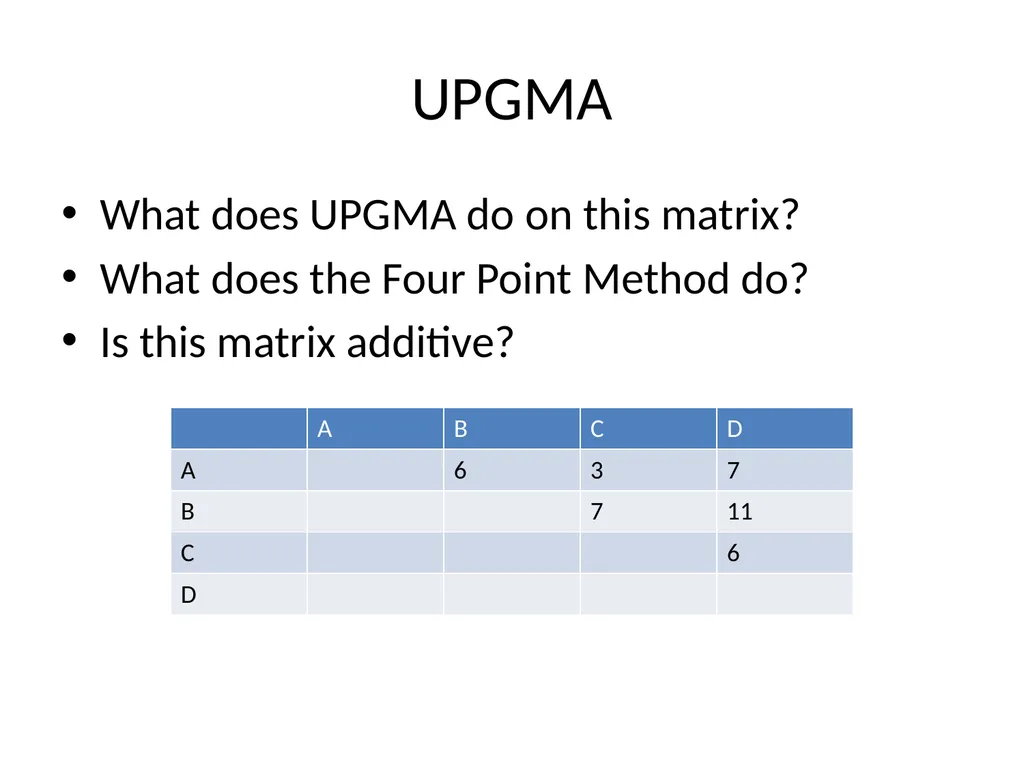
UPGMA What does UPGMA do on this matrix?
What does the Four Point Method do?
Is this matrix additive?<br>
What does the Four Point Method do?
Is this matrix additive?<br>
40
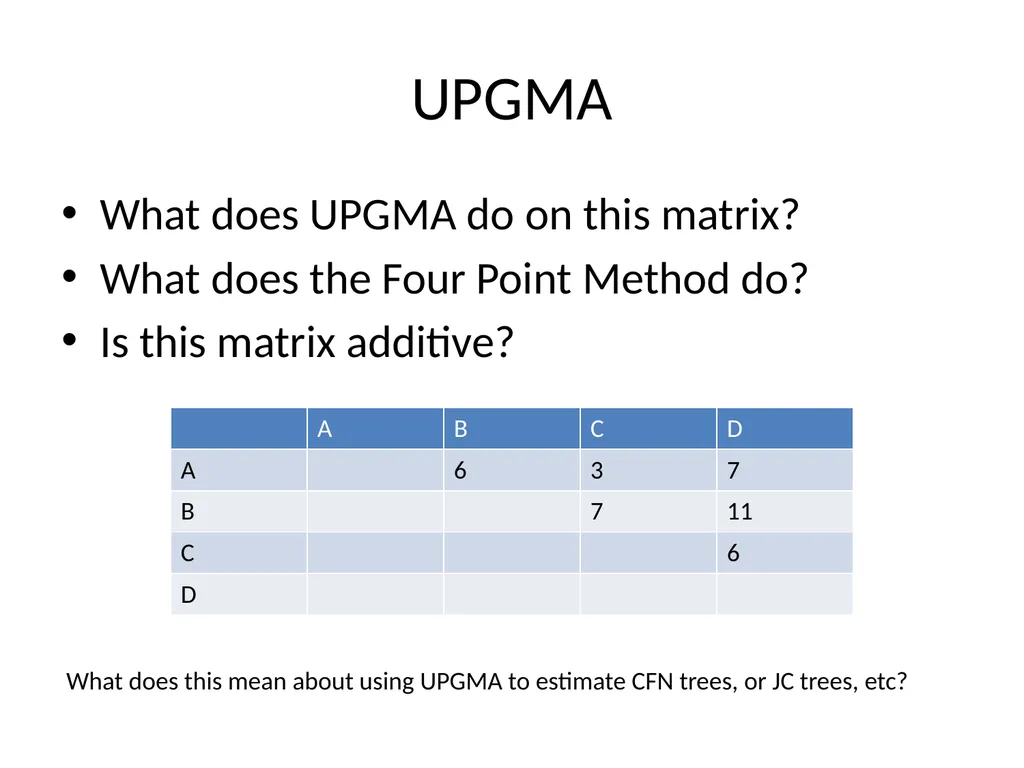
UPGMA What does UPGMA do on this matrix?
What does the Four Point Method do?
Is this matrix additive? What does this mean about using UPGMA to estimate CFN trees, or JC trees, etc?<br>
What does the Four Point Method do?
Is this matrix additive? What does this mean about using UPGMA to estimate CFN trees, or JC trees, etc?<br>
41
Summary of today’s lecture We have seen how to construct a rooted tree from its set of clades or triplet trees.
We have seen how to test compatibility of a set of clades or rooted trees.
We have seen that UPGMA, a method that is designed for rooted tree calculation, can do strange things.<br>
We have seen how to test compatibility of a set of clades or rooted trees.
We have seen that UPGMA, a method that is designed for rooted tree calculation, can do strange things.<br>
42
Parting thoughts: Rooted != Unrooted ALSO: Please think about corresponding approaches for unrooted trees.
Remember the All Quartets algorithm.
What if we only had a subset of the quartet trees?
Would it still work?<br>
Remember the All Quartets algorithm.
What if we only had a subset of the quartet trees?
Would it still work?<br>