
CSCI-1680 Web Performance and Content Distribution


Description: CSCI-1680 Web Performance and Content Distribution Based partly on lecture notes by Scott Shenker and John Jannotti Rodrigo Fonseca Last time HTTP and the WWW Some performance issues Persistent Connections, Pipeline, Multiple Connections
Related Topics
Download Presentation
"CSCI-1680 Web Performance and Content Distribution" is the property of its rightful owner. Permission is granted to download and print the materials on this website for personal, non-commercial use only, and to display it on your personal computer provided you do not modify the materials and that you retain all copyright notices contained in the materials. By downloading content from our website, you accept the terms of this agreement.
Presentation Transcript
slide1. CSCI-1680
Web Performance and Content Distribution Based partly on lecture notes by Scott Shenker and John Jannotti Rodrigo Fonseca<br>
slide2. Last time HTTP and the WWW
Some performance issues
Persistent Connections, Pipeline, Multiple Connections
Caching
Today
More on Caching
Content Distribution Networks<br>
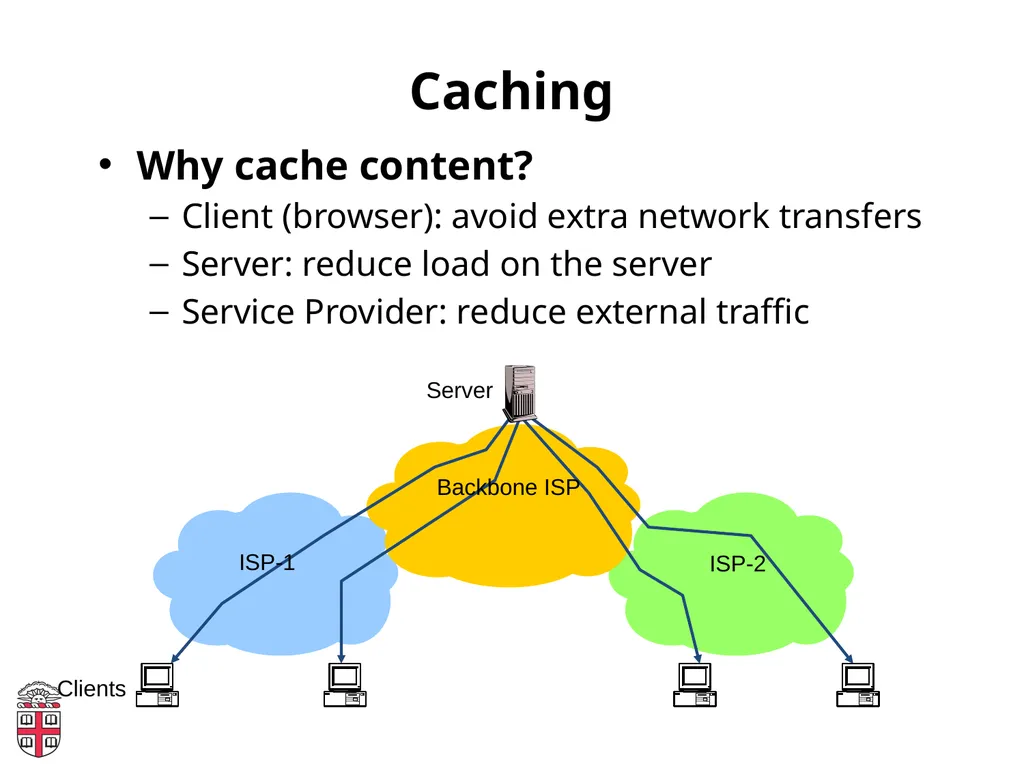
slide3. Caching Why cache content?
Client (browser): avoid extra network transfers
Server: reduce load on the server
Service Provider: reduce external traffic Server Clients Backbone ISP ISP-1 ISP-2<br>
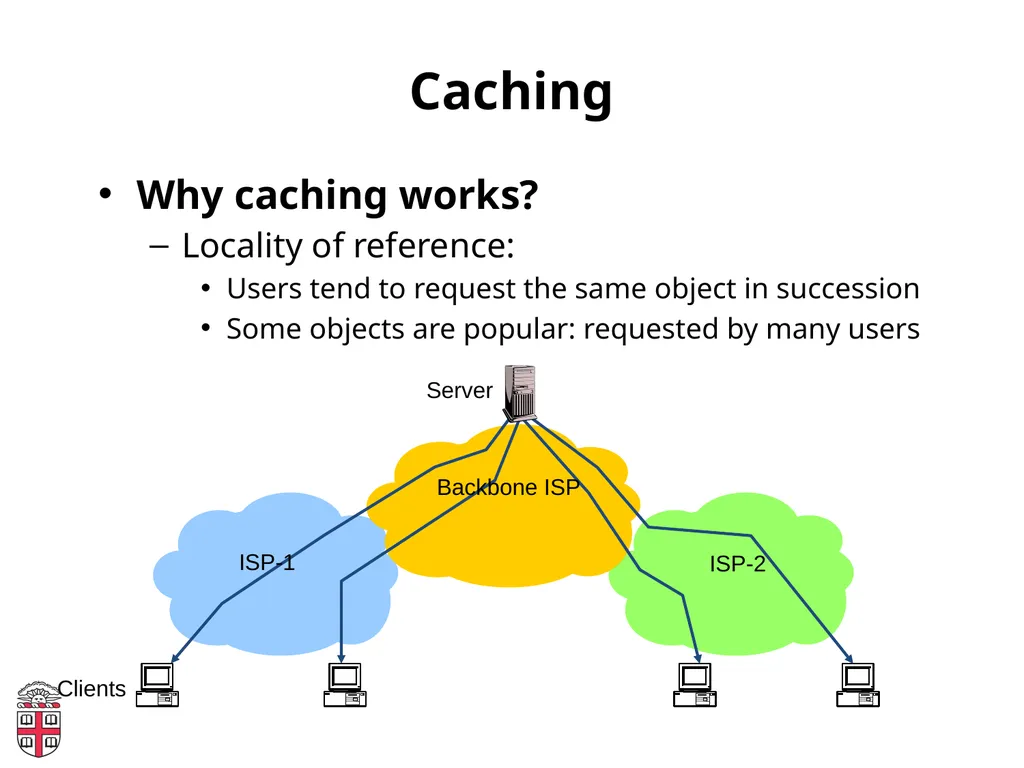
slide4. Caching Why caching works?
Locality of reference:
Users tend to request the same object in succession
Some objects are popular: requested by many users Server Clients Backbone ISP ISP-1 ISP-2<br>
slide5. How well does caching work? Very well, up to a point
Large overlap in requested objects
Objects with one access place upper bound on hit ratio
Example: Wikipedia
About 400 servers, 100 are HTTP Caches (Squid)
85% Hit ratio for text, 98% for media<br>
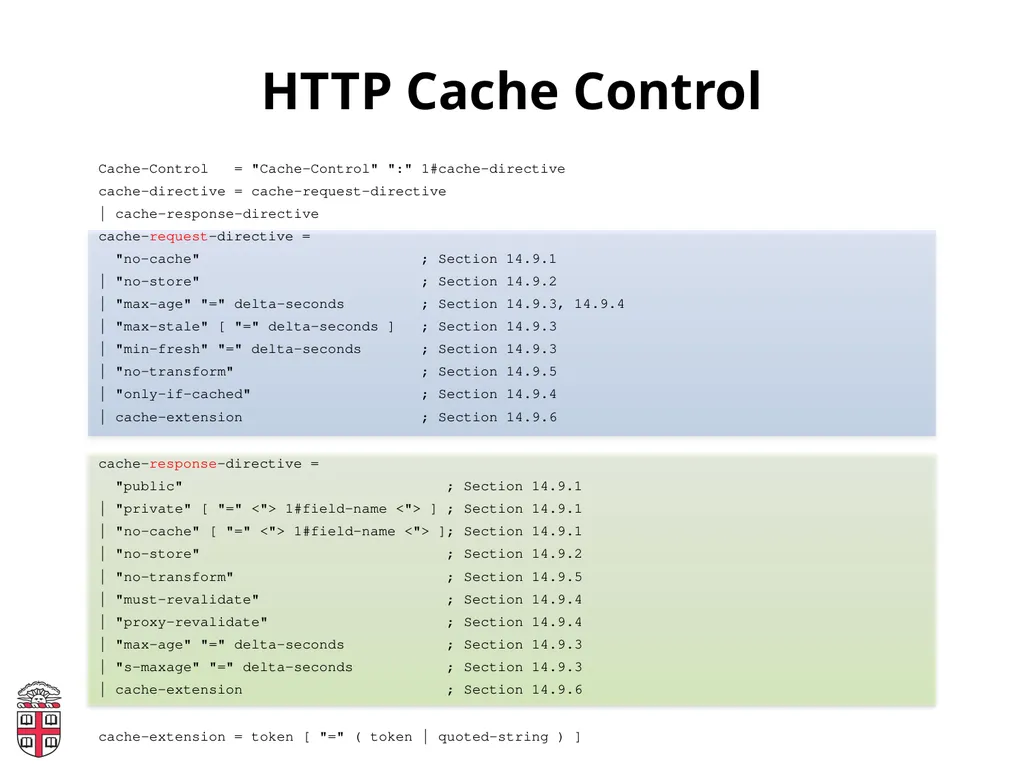
slide6. HTTP Cache Control Cache-Control = "Cache-Control" ":" 1#cache-directive
cache-directive = cache-request-directive
| cache-response-directive
cache-request-directive =
"no-cache" ; Section 14.9.1
| "no-store" ; Section 14.9.2
| "max-age" "=" delta-seconds ; Section 14.9.3, 14.9.4
| "max-stale" [ "=" delta-seconds ] ; Section 14.9.3
| "min-fresh" "=" delta-seconds ; Section 14.9.3
| "no-transform" ; Section 14.9.5
| "only-if-cached" ; Section 14.9.4
| cache-extension ; Section 14.9.6
cache-response-directive =
"public" ; Section 14.9.1
| "private" [ "=" <"> 1#field-name <"> ] ; Section 14.9.1
| "no-cache" [ "=" <"> 1#field-name <"> ]; Section 14.9.1
| "no-store" ; Section 14.9.2
| "no-transform" ; Section 14.9.5
| "must-revalidate" ; Section 14.9.4
| "proxy-revalidate" ; Section 14.9.4
| "max-age" "=" delta-seconds ; Section 14.9.3
| "s-maxage" "=" delta-seconds ; Section 14.9.3
| cache-extension ; Section 14.9.6
cache-extension = token [ "=" ( token | quoted-string ) ]<br>
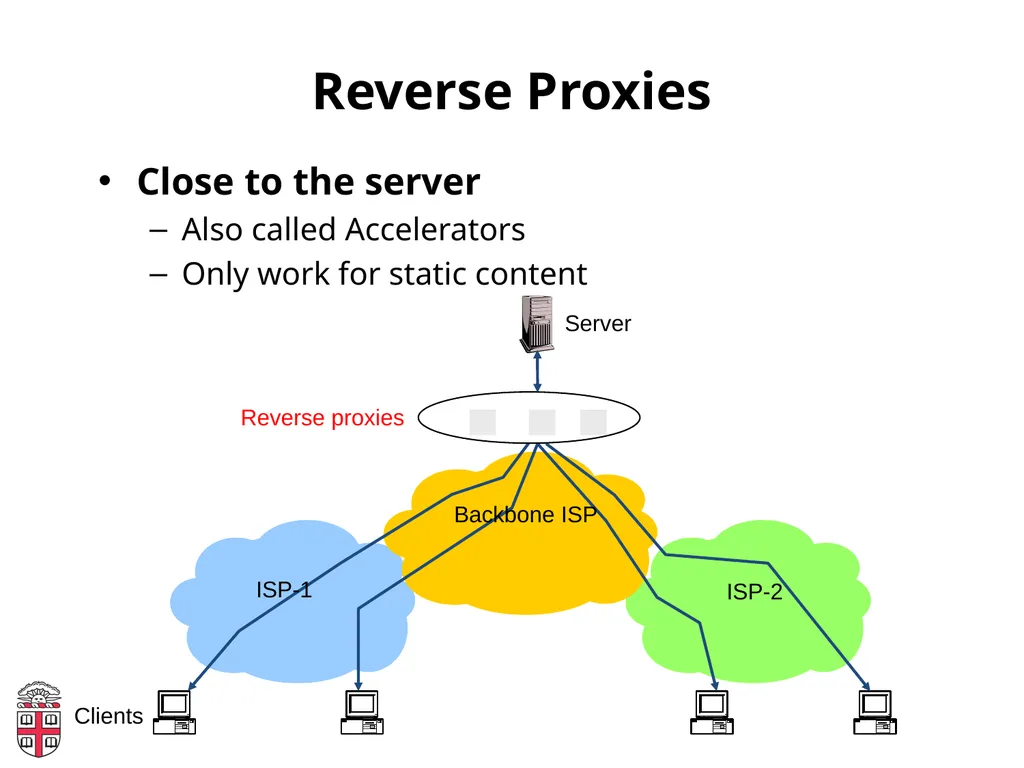
slide7. Reverse Proxies Close to the server
Also called Accelerators
Only work for static content Clients Backbone ISP ISP-1 ISP-2 Server Reverse proxies<br>
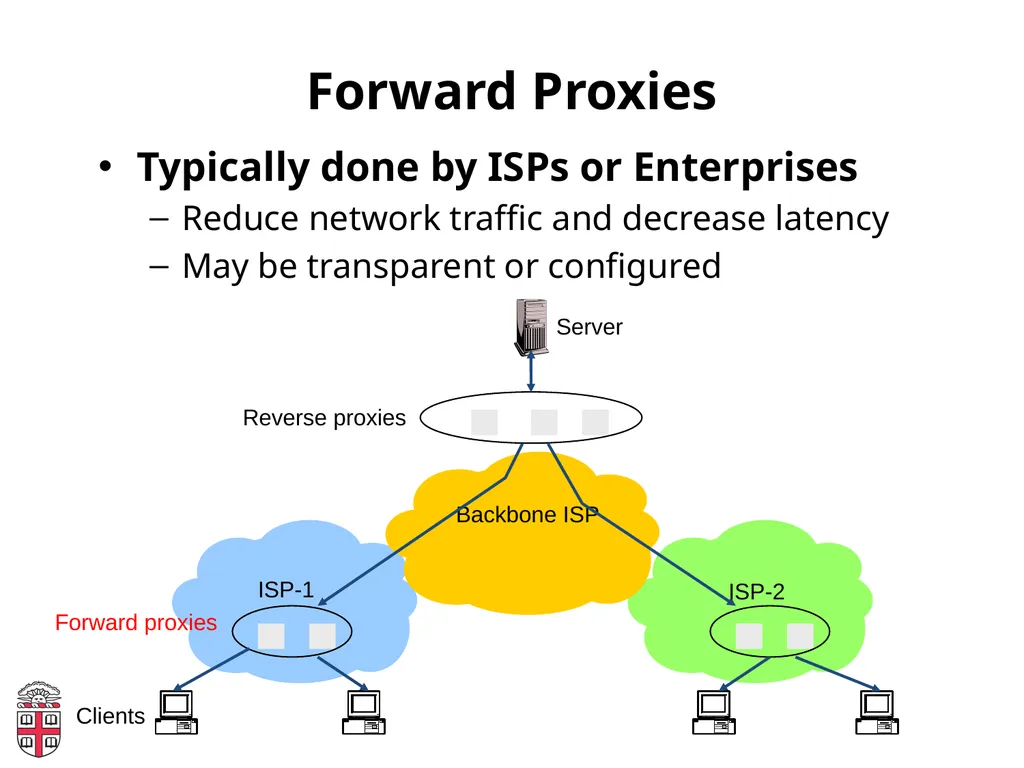
slide8. Forward Proxies Typically done by ISPs or Enterprises
Reduce network traffic and decrease latency
May be transparent or configured Clients Backbone ISP ISP-1 ISP-2 Server Reverse proxies Forward proxies<br>
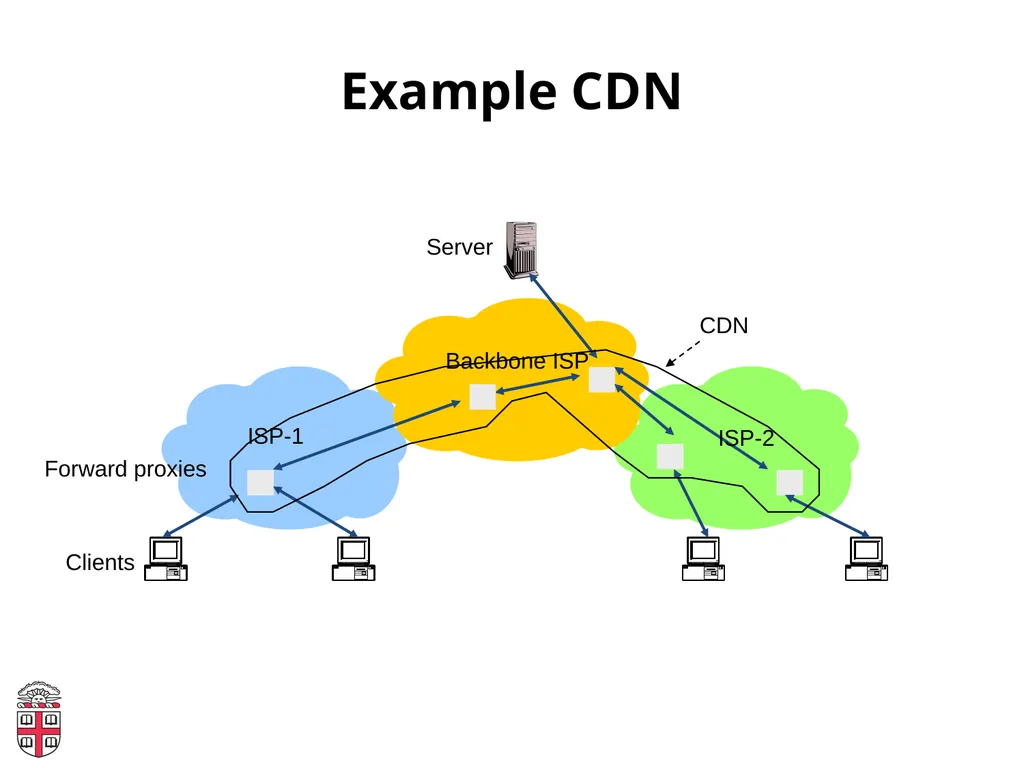
slide9. Content Distribution Networks Integrate forward and reverse caching
One network generally administered by one entity
E.g. Akamai
Provide document caching
Pull: result from client requests
Push: expectation of high access rates to some objects
Can also do some processing
Deploy code to handle some dynamic requests
Can do other things, such as transcoding<br>
slide10. Example CDN Clients ISP-1 Server Forward proxies Backbone ISP ISP-2 CDN<br>
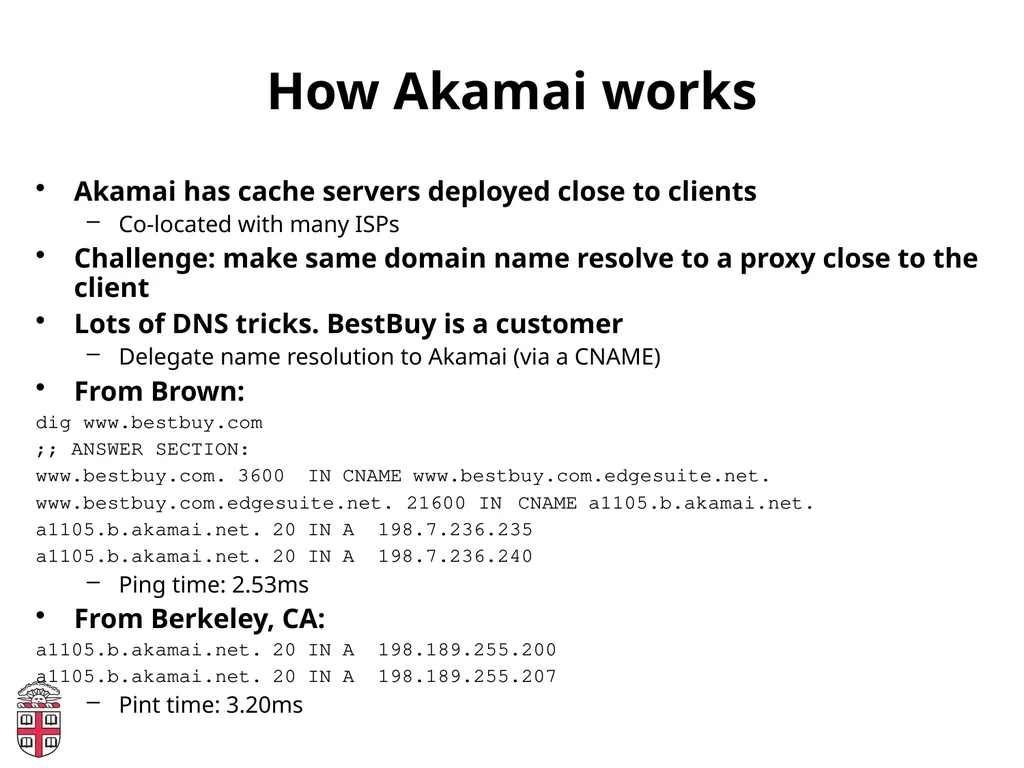
slide11. How Akamai works Akamai has cache servers deployed close to clients
Co-located with many ISPs
Challenge: make same domain name resolve to a proxy close to the client
Lots of DNS tricks. BestBuy is a customer
Delegate name resolution to Akamai (via a CNAME)
From Brown:
dig www.bestbuy.com
;; ANSWER SECTION:
www.bestbuy.com. 3600 IN CNAME www.bestbuy.com.edgesuite.net.
www.bestbuy.com.edgesuite.net. 21600 IN CNAME a1105.b.akamai.net.
a1105.b.akamai.net. 20 IN A 198.7.236.235
a1105.b.akamai.net. 20 IN A 198.7.236.240
Ping time: 2.53ms
From Berkeley, CA:
a1105.b.akamai.net. 20 IN A 198.189.255.200
a1105.b.akamai.net. 20 IN A 198.189.255.207
Pint time: 3.20ms<br>
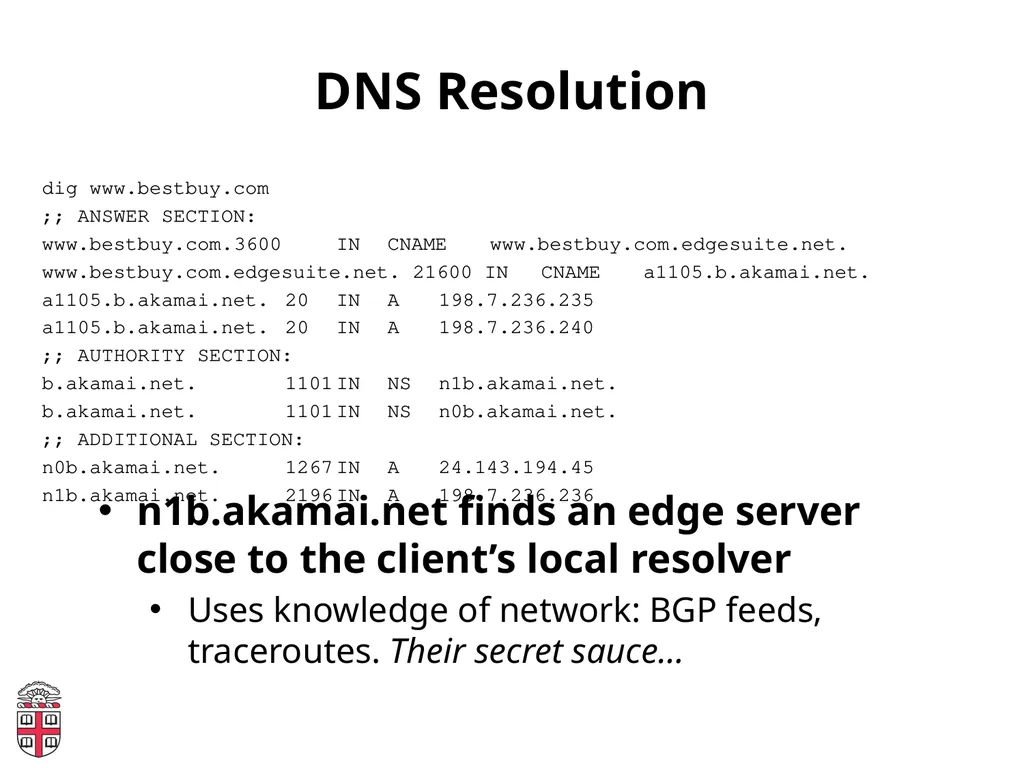
slide12. DNS Resolution dig www.bestbuy.com
;; ANSWER SECTION:
www.bestbuy.com. 3600 IN CNAME www.bestbuy.com.edgesuite.net.
www.bestbuy.com.edgesuite.net. 21600 IN CNAME a1105.b.akamai.net.
a1105.b.akamai.net. 20 IN A 198.7.236.235
a1105.b.akamai.net. 20 IN A 198.7.236.240
;; AUTHORITY SECTION:
b.akamai.net. 1101 IN NS n1b.akamai.net.
b.akamai.net. 1101 IN NS n0b.akamai.net.
;; ADDITIONAL SECTION:
n0b.akamai.net. 1267 IN A 24.143.194.45
n1b.akamai.net. 2196 IN A 198.7.236.236 n1b.akamai.net finds an edge server close to the client’s local resolver
Uses knowledge of network: BGP feeds, traceroutes. Their secret sauce…<br>
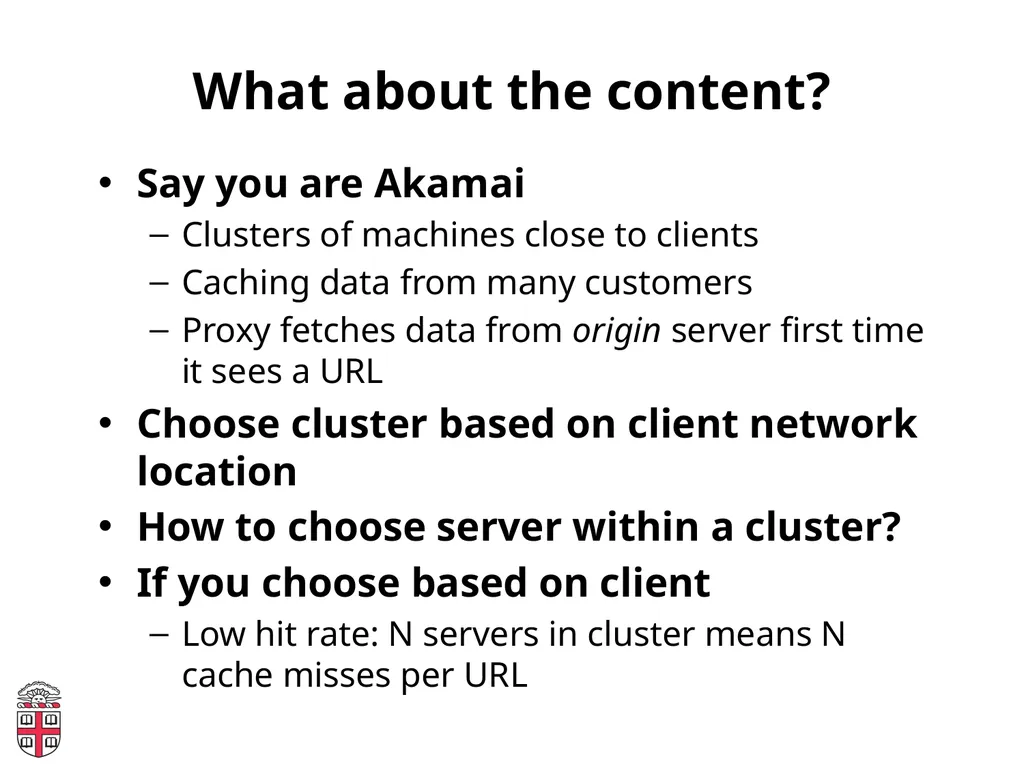
slide13. What about the content? Say you are Akamai
Clusters of machines close to clients
Caching data from many customers
Proxy fetches data from origin server first time it sees a URL
Choose cluster based on client network location
How to choose server within a cluster?
If you choose based on client
Low hit rate: N servers in cluster means N cache misses per URL<br>
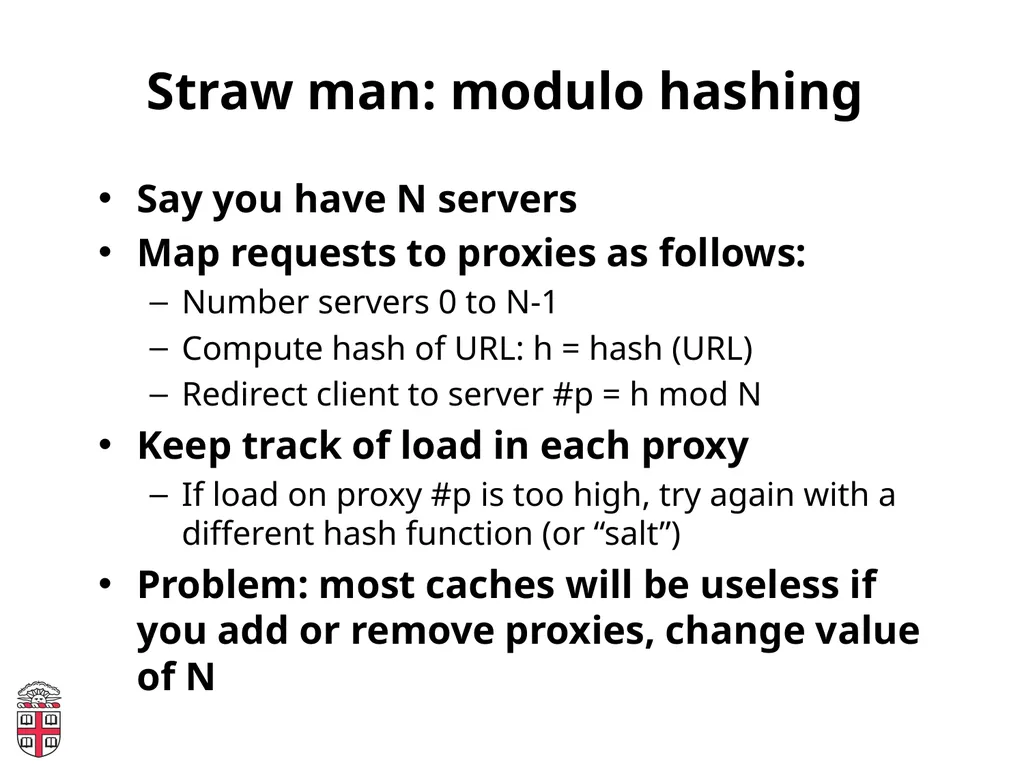
slide14. Straw man: modulo hashing Say you have N servers
Map requests to proxies as follows:
Number servers 0 to N-1
Compute hash of URL: h = hash (URL)
Redirect client to server #p = h mod N
Keep track of load in each proxy
If load on proxy #p is too high, try again with a different hash function (or “salt”)
Problem: most caches will be useless if you add or remove proxies, change value of N<br>
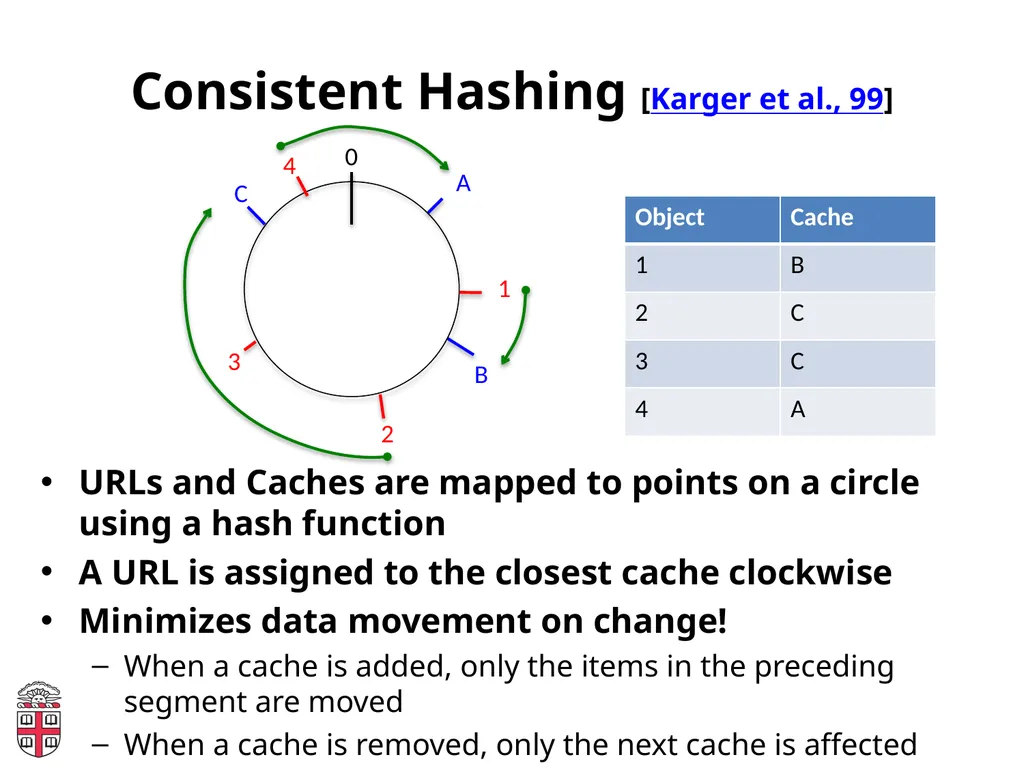
slide15. Consistent Hashing [Karger et al., 99] URLs and Caches are mapped to points on a circle using a hash function
A URL is assigned to the closest cache clockwise
Minimizes data movement on change!
When a cache is added, only the items in the preceding segment are moved
When a cache is removed, only the next cache is affected<br>
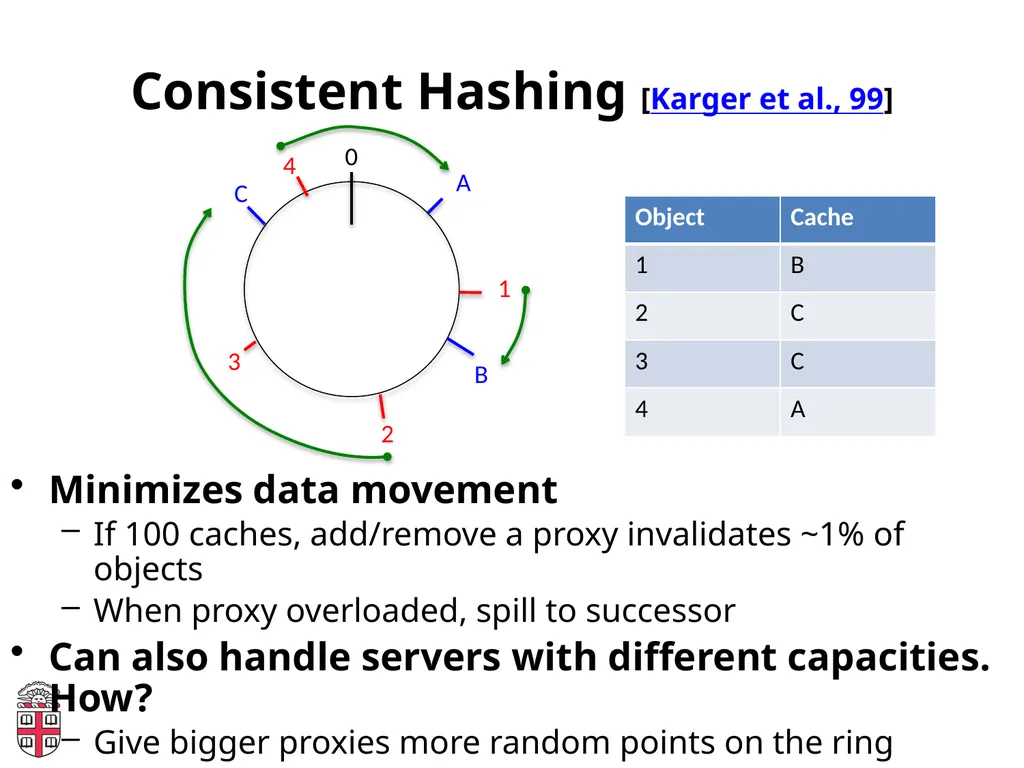
slide16. Consistent Hashing [Karger et al., 99] Minimizes data movement
If 100 caches, add/remove a proxy invalidates ~1% of objects
When proxy overloaded, spill to successor
Can also handle servers with different capacities. How?
Give bigger proxies more random points on the ring A B C 0<br>
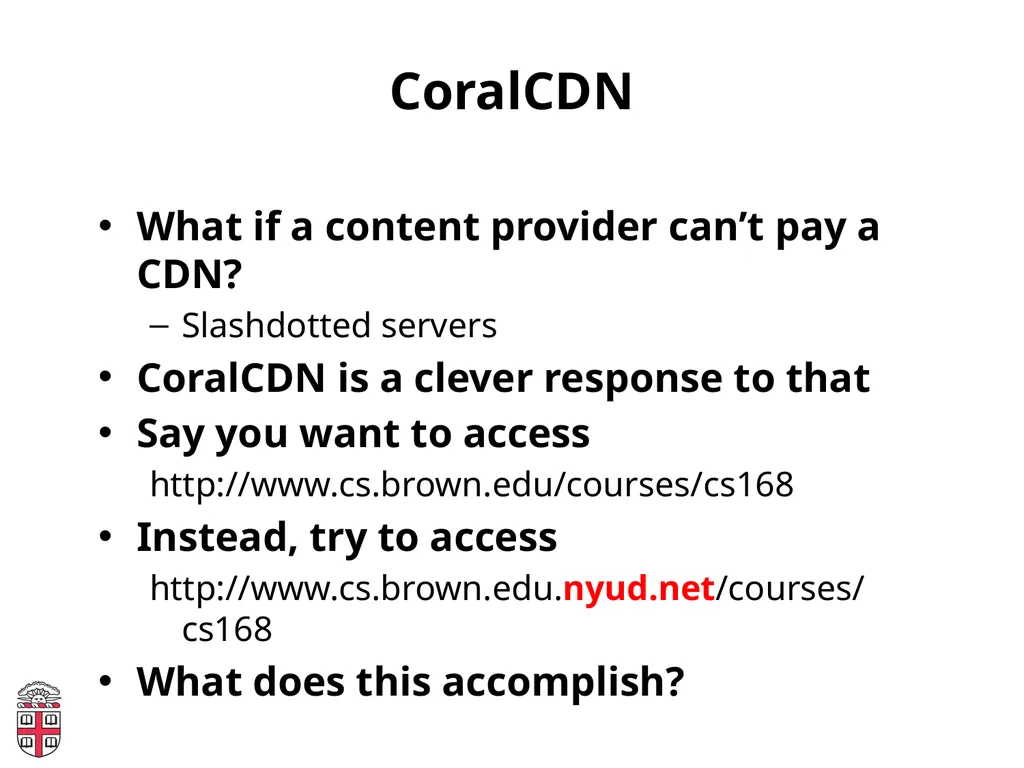
slide17. CoralCDN What if a content provider can’t pay a CDN?
Slashdotted servers
CoralCDN is a clever response to that
Say you want to access
http://www.cs.brown.edu/courses/cs168
Instead, try to access
http://www.cs.brown.edu.nyud.net/courses/cs168
What does this accomplish?<br>
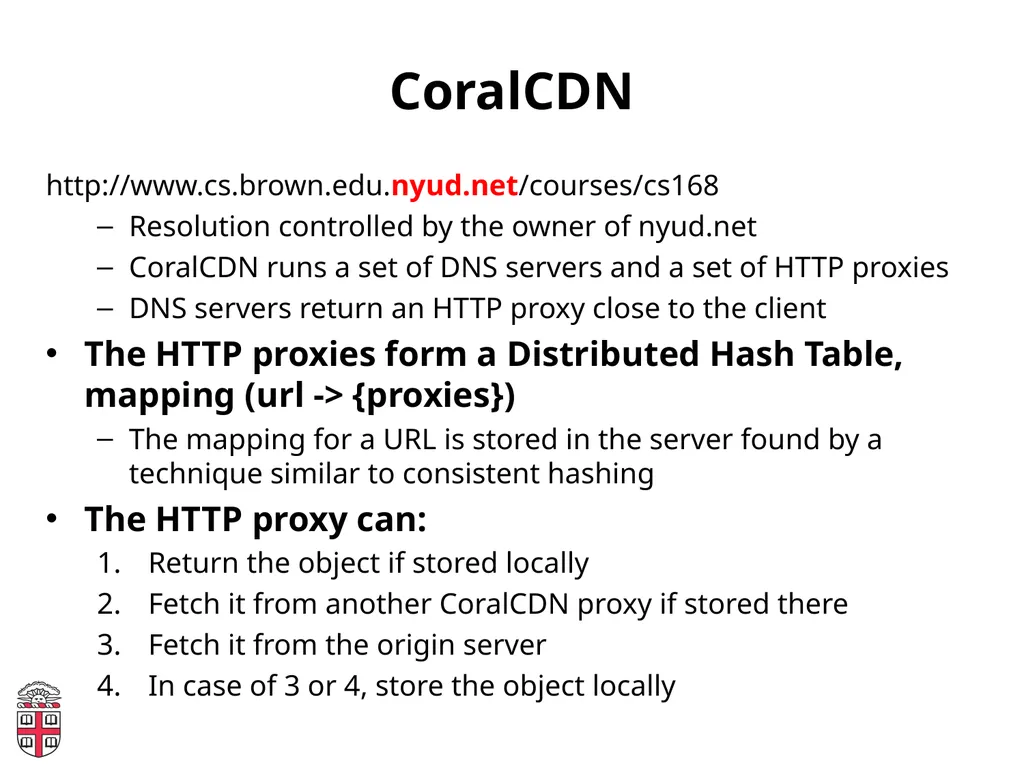
slide18. CoralCDN http://www.cs.brown.edu.nyud.net/courses/cs168
Resolution controlled by the owner of nyud.net
CoralCDN runs a set of DNS servers and a set of HTTP proxies
DNS servers return an HTTP proxy close to the client
The HTTP proxies form a Distributed Hash Table, mapping (url -> {proxies})
The mapping for a URL is stored in the server found by a technique similar to consistent hashing
The HTTP proxy can:
Return the object if stored locally
Fetch it from another CoralCDN proxy if stored there
Fetch it from the origin server
In case of 3 or 4, store the object locally<br>
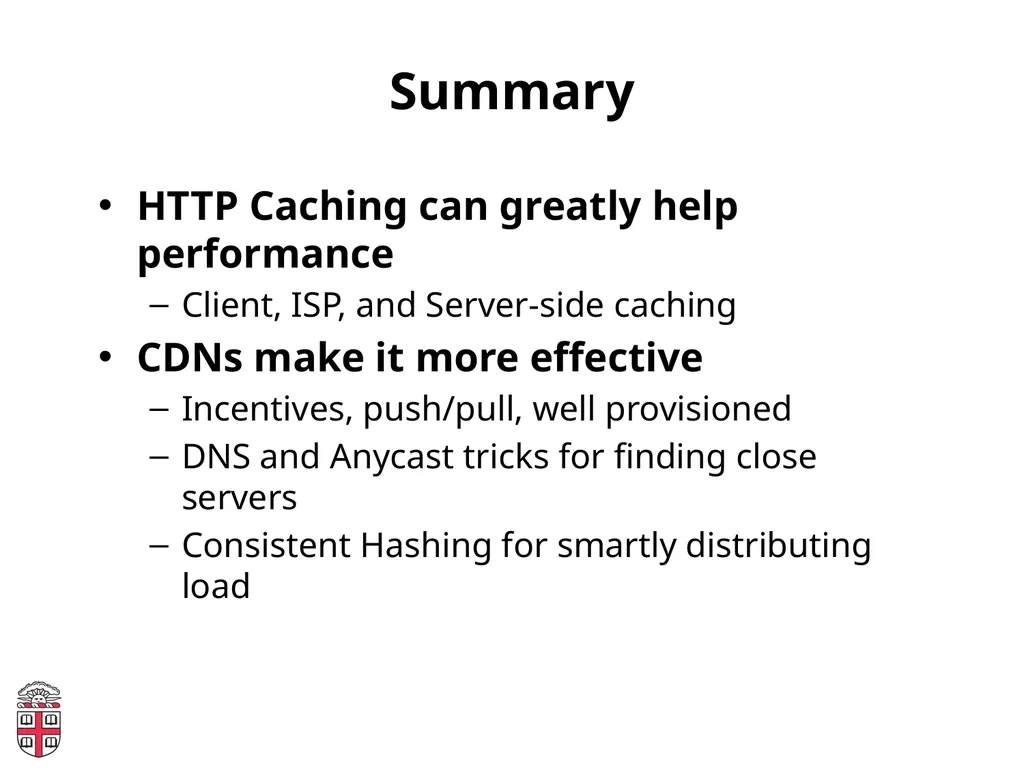
slide19. Summary HTTP Caching can greatly help performance
Client, ISP, and Server-side caching
CDNs make it more effective
Incentives, push/pull, well provisioned
DNS and Anycast tricks for finding close servers
Consistent Hashing for smartly distributing load<br>
slide20. Next time Justin DeBrabant will talk about Application Layer Data, or how to write your own application layer protocol…<br>
slide2. Last time HTTP and the WWW
Some performance issues
Persistent Connections, Pipeline, Multiple Connections
Caching
Today
More on Caching
Content Distribution Networks<br>
slide3. Caching Why cache content?
Client (browser): avoid extra network transfers
Server: reduce load on the server
Service Provider: reduce external traffic Server Clients Backbone ISP ISP-1 ISP-2<br>
slide4. Caching Why caching works?
Locality of reference:
Users tend to request the same object in succession
Some objects are popular: requested by many users Server Clients Backbone ISP ISP-1 ISP-2<br>
slide5. How well does caching work? Very well, up to a point
Large overlap in requested objects
Objects with one access place upper bound on hit ratio
Example: Wikipedia
About 400 servers, 100 are HTTP Caches (Squid)
85% Hit ratio for text, 98% for media<br>
slide6. HTTP Cache Control Cache-Control = "Cache-Control" ":" 1#cache-directive
cache-directive = cache-request-directive
| cache-response-directive
cache-request-directive =
"no-cache" ; Section 14.9.1
| "no-store" ; Section 14.9.2
| "max-age" "=" delta-seconds ; Section 14.9.3, 14.9.4
| "max-stale" [ "=" delta-seconds ] ; Section 14.9.3
| "min-fresh" "=" delta-seconds ; Section 14.9.3
| "no-transform" ; Section 14.9.5
| "only-if-cached" ; Section 14.9.4
| cache-extension ; Section 14.9.6
cache-response-directive =
"public" ; Section 14.9.1
| "private" [ "=" <"> 1#field-name <"> ] ; Section 14.9.1
| "no-cache" [ "=" <"> 1#field-name <"> ]; Section 14.9.1
| "no-store" ; Section 14.9.2
| "no-transform" ; Section 14.9.5
| "must-revalidate" ; Section 14.9.4
| "proxy-revalidate" ; Section 14.9.4
| "max-age" "=" delta-seconds ; Section 14.9.3
| "s-maxage" "=" delta-seconds ; Section 14.9.3
| cache-extension ; Section 14.9.6
cache-extension = token [ "=" ( token | quoted-string ) ]<br>
slide7. Reverse Proxies Close to the server
Also called Accelerators
Only work for static content Clients Backbone ISP ISP-1 ISP-2 Server Reverse proxies<br>
slide8. Forward Proxies Typically done by ISPs or Enterprises
Reduce network traffic and decrease latency
May be transparent or configured Clients Backbone ISP ISP-1 ISP-2 Server Reverse proxies Forward proxies<br>
slide9. Content Distribution Networks Integrate forward and reverse caching
One network generally administered by one entity
E.g. Akamai
Provide document caching
Pull: result from client requests
Push: expectation of high access rates to some objects
Can also do some processing
Deploy code to handle some dynamic requests
Can do other things, such as transcoding<br>
slide10. Example CDN Clients ISP-1 Server Forward proxies Backbone ISP ISP-2 CDN<br>
slide11. How Akamai works Akamai has cache servers deployed close to clients
Co-located with many ISPs
Challenge: make same domain name resolve to a proxy close to the client
Lots of DNS tricks. BestBuy is a customer
Delegate name resolution to Akamai (via a CNAME)
From Brown:
dig www.bestbuy.com
;; ANSWER SECTION:
www.bestbuy.com. 3600 IN CNAME www.bestbuy.com.edgesuite.net.
www.bestbuy.com.edgesuite.net. 21600 IN CNAME a1105.b.akamai.net.
a1105.b.akamai.net. 20 IN A 198.7.236.235
a1105.b.akamai.net. 20 IN A 198.7.236.240
Ping time: 2.53ms
From Berkeley, CA:
a1105.b.akamai.net. 20 IN A 198.189.255.200
a1105.b.akamai.net. 20 IN A 198.189.255.207
Pint time: 3.20ms<br>
slide12. DNS Resolution dig www.bestbuy.com
;; ANSWER SECTION:
www.bestbuy.com. 3600 IN CNAME www.bestbuy.com.edgesuite.net.
www.bestbuy.com.edgesuite.net. 21600 IN CNAME a1105.b.akamai.net.
a1105.b.akamai.net. 20 IN A 198.7.236.235
a1105.b.akamai.net. 20 IN A 198.7.236.240
;; AUTHORITY SECTION:
b.akamai.net. 1101 IN NS n1b.akamai.net.
b.akamai.net. 1101 IN NS n0b.akamai.net.
;; ADDITIONAL SECTION:
n0b.akamai.net. 1267 IN A 24.143.194.45
n1b.akamai.net. 2196 IN A 198.7.236.236 n1b.akamai.net finds an edge server close to the client’s local resolver
Uses knowledge of network: BGP feeds, traceroutes. Their secret sauce…<br>
slide13. What about the content? Say you are Akamai
Clusters of machines close to clients
Caching data from many customers
Proxy fetches data from origin server first time it sees a URL
Choose cluster based on client network location
How to choose server within a cluster?
If you choose based on client
Low hit rate: N servers in cluster means N cache misses per URL<br>
slide14. Straw man: modulo hashing Say you have N servers
Map requests to proxies as follows:
Number servers 0 to N-1
Compute hash of URL: h = hash (URL)
Redirect client to server #p = h mod N
Keep track of load in each proxy
If load on proxy #p is too high, try again with a different hash function (or “salt”)
Problem: most caches will be useless if you add or remove proxies, change value of N<br>
slide15. Consistent Hashing [Karger et al., 99] URLs and Caches are mapped to points on a circle using a hash function
A URL is assigned to the closest cache clockwise
Minimizes data movement on change!
When a cache is added, only the items in the preceding segment are moved
When a cache is removed, only the next cache is affected<br>
slide16. Consistent Hashing [Karger et al., 99] Minimizes data movement
If 100 caches, add/remove a proxy invalidates ~1% of objects
When proxy overloaded, spill to successor
Can also handle servers with different capacities. How?
Give bigger proxies more random points on the ring A B C 0<br>
slide17. CoralCDN What if a content provider can’t pay a CDN?
Slashdotted servers
CoralCDN is a clever response to that
Say you want to access
http://www.cs.brown.edu/courses/cs168
Instead, try to access
http://www.cs.brown.edu.nyud.net/courses/cs168
What does this accomplish?<br>
slide18. CoralCDN http://www.cs.brown.edu.nyud.net/courses/cs168
Resolution controlled by the owner of nyud.net
CoralCDN runs a set of DNS servers and a set of HTTP proxies
DNS servers return an HTTP proxy close to the client
The HTTP proxies form a Distributed Hash Table, mapping (url -> {proxies})
The mapping for a URL is stored in the server found by a technique similar to consistent hashing
The HTTP proxy can:
Return the object if stored locally
Fetch it from another CoralCDN proxy if stored there
Fetch it from the origin server
In case of 3 or 4, store the object locally<br>
slide19. Summary HTTP Caching can greatly help performance
Client, ISP, and Server-side caching
CDNs make it more effective
Incentives, push/pull, well provisioned
DNS and Anycast tricks for finding close servers
Consistent Hashing for smartly distributing load<br>
slide20. Next time Justin DeBrabant will talk about Application Layer Data, or how to write your own application layer protocol…<br>