CSE 105 theory of computation Spring 2019 https:cseweb.ucsd.educlassessp19cse105-a Todays learning goals Sipser Ch 5.1, 7 (highlights) Construct reductions from one problem to another. Distinguish between computability and complexity
"CSE 105 theory of computation Spring 2019" is the property of its rightful owner. Permission is granted to
download and print the materials on this website for personal, non-commercial use only, and to display it
on your personal computer provided you do not modify the materials and that you retain all copyright
notices contained in the materials. By downloading content from our website, you accept the terms of this
agreement.
Today's learning goals Sipser Ch 5.1, 7 (highlights) Construct reductions from one problem to another.
Distinguish between computability and complexity
Section 7.1: time complexity, asymptotic upper bounds.
Section 7.2: polynomial time, P
Section 7.3: NP, polynomial verifiers, nondeterministic machines.<br>
03
Today's learning goals Sipser Ch 5.1, 7 (highlights) Specifically for complexity theory:
Define the time complexity class P and name some problems in P
Distinguish between polynomial and exponential DTIME
Define the class NP and name some problems in NP
State and explain P=NP?
Define NP-completeness and connect it to P=NP
Describe how reductions are used both for questions of decidability and of complexity.<br>
04
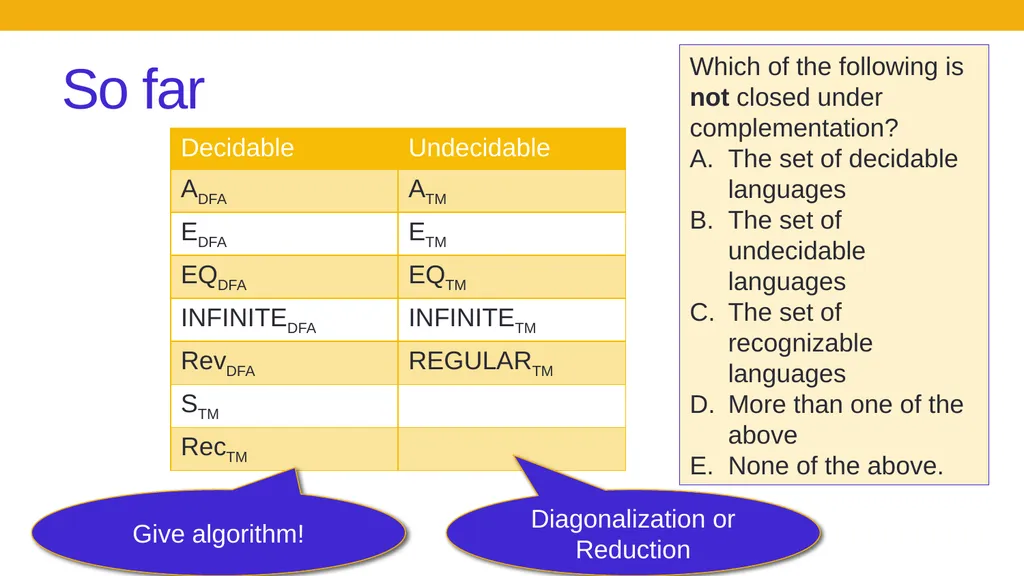
So far Give algorithm! Diagonalization or Reduction Which of the following is
not closed under complementation?
The set of decidable languages
The set of undecidable languages
The set of recognizable languages
More than one of the above
None of the above.<br>
05
Reducing sets to one another We saw ATM reduces to HALTTM
Given genie G deciding HALTTM, construct solution for ATM:
"On input <M,w>:
Run G on <M,w>. If rejects, reject.
If accepts, run M on w. If accepts, accept; if rejects; reject."
What about in the other direction?<br>
06
Reducing sets to one another Given genie GATM deciding ATM, construct solution for HALTTM:
"On input <M,w>:<br>
07
Not just decidable … For a given algorithm working on a given input, how long do we need to wait for an answer? How does the running time depend on the input in the worst-case? average-case? Expect to have to spend more time on larger inputs.
What's in common among all problems that are efficiently solvable?<br>
08
Measuring time For a given algorithm working on a given input, how long do we need to wait for an answer? Count steps! How does the running time depend on the input in the worst-case? average-case? Big-O
What's in common among all problems that are efficiently solvable? Time(n)<br>
09
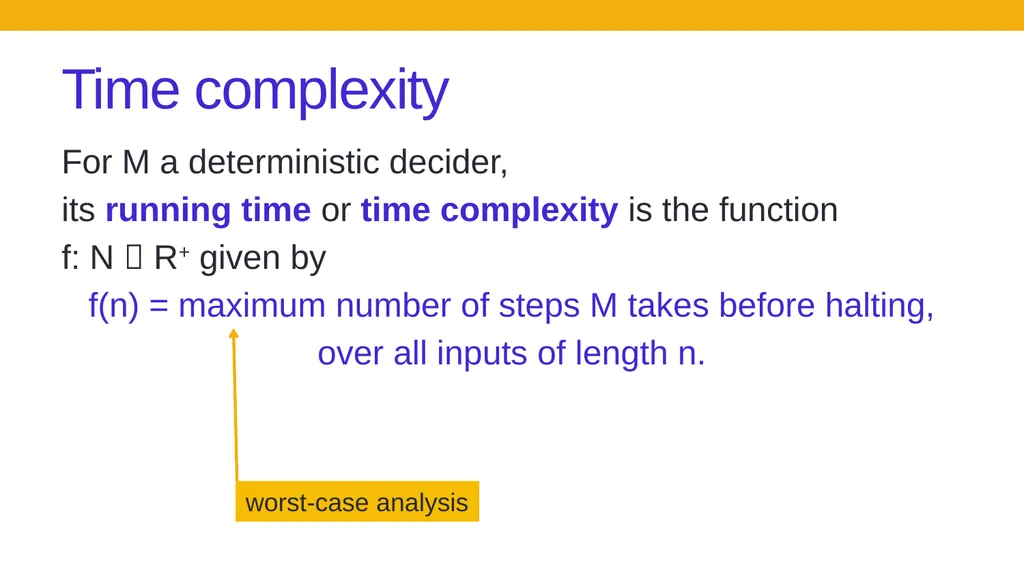
Time complexity For M a deterministic decider,
its running time or time complexity is the function
f: N R+ given by
f(n) = maximum number of steps M takes before halting,
over all inputs of length n. worst-case analysis<br>
10
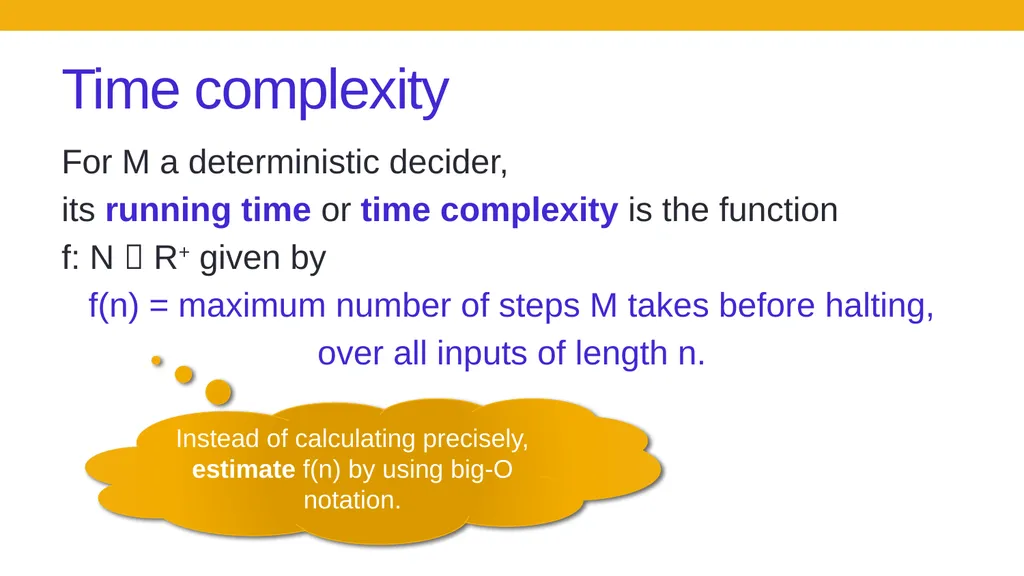
Time complexity For M a deterministic decider,
its running time or time complexity is the function
f: N R+ given by
f(n) = maximum number of steps M takes before halting,
over all inputs of length n. Instead of calculating precisely, estimate f(n) by using big-O notation.<br>
11
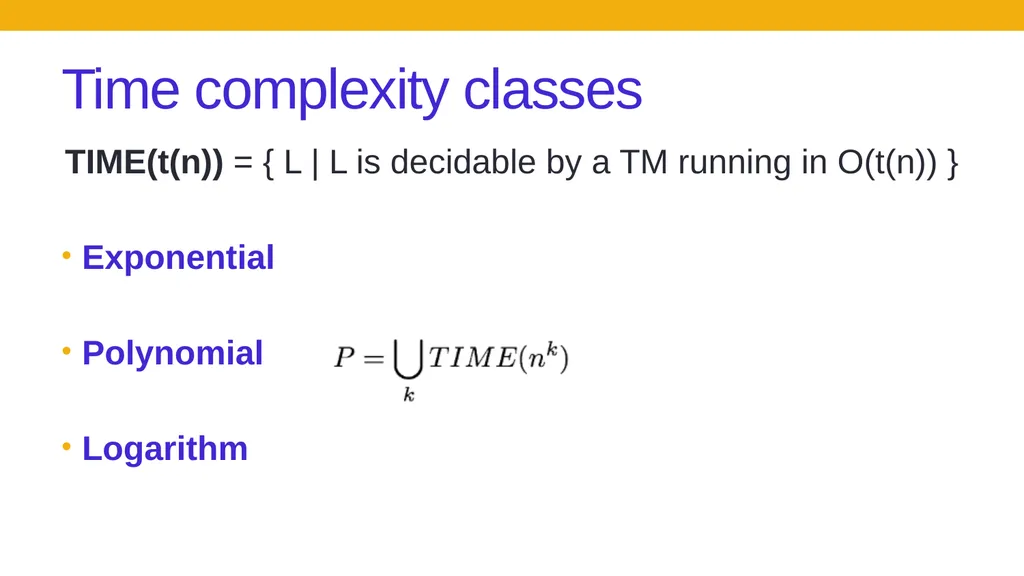
Time complexity classes TIME(t(n)) = { L | L is decidable by a TM running in O(t(n)) }
Exponential
Polynomial
Logarithm<br>
12
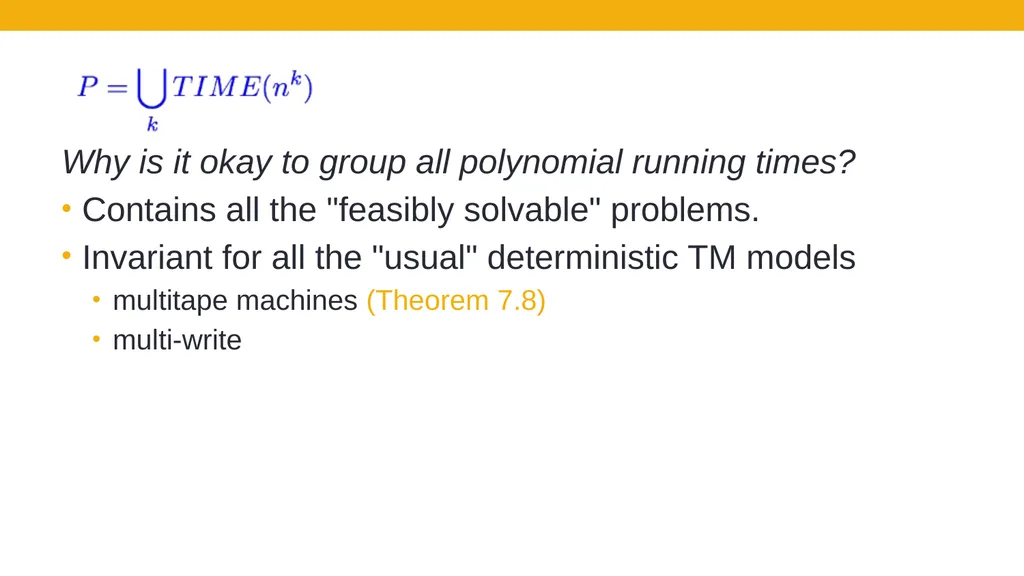
Why is it okay to group all polynomial running times?
Contains all the "feasibly solvable" problems.
Invariant for all the "usual" deterministic TM models
multitape machines (Theorem 7.8)
multi-write<br>
13
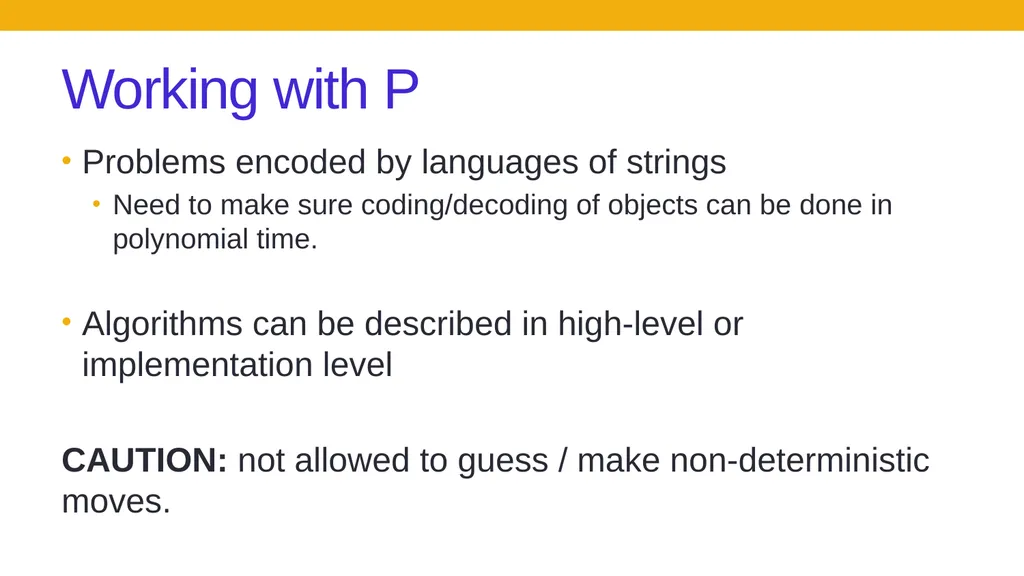
Working with P Problems encoded by languages of strings
Need to make sure coding/decoding of objects can be done in polynomial time.
Algorithms can be described in high-level or implementation level
CAUTION: not allowed to guess / make non-deterministic moves.<br>
14
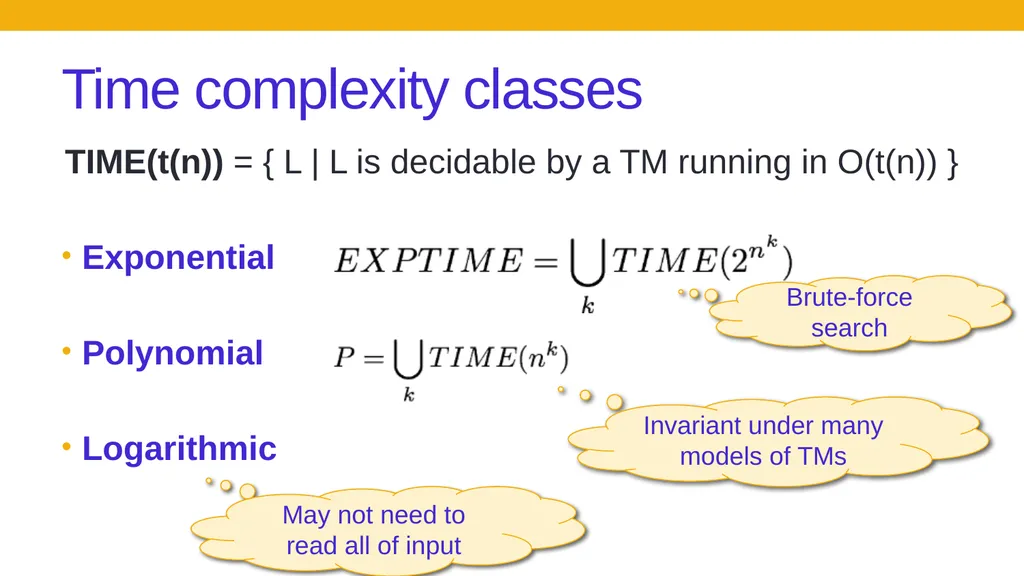
Time complexity classes TIME(t(n)) = { L | L is decidable by a TM running in O(t(n)) }
Exponential
Polynomial
Logarithmic May not need to read all of input Invariant under many models of TMs Brute-force search<br>
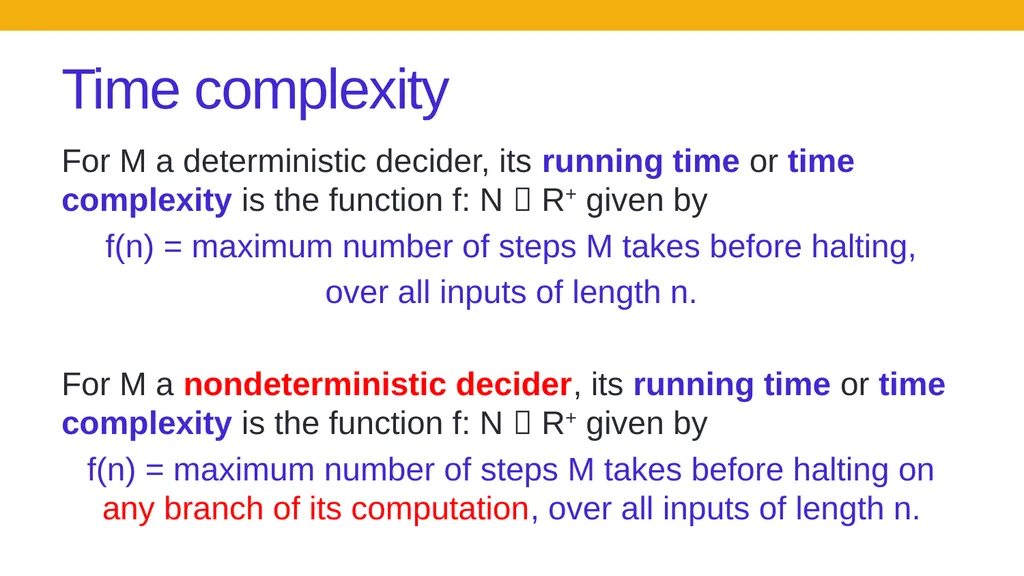
Time complexity For M a deterministic decider, its running time or time complexity is the function f: N R+ given by
f(n) = maximum number of steps M takes before halting,
over all inputs of length n.
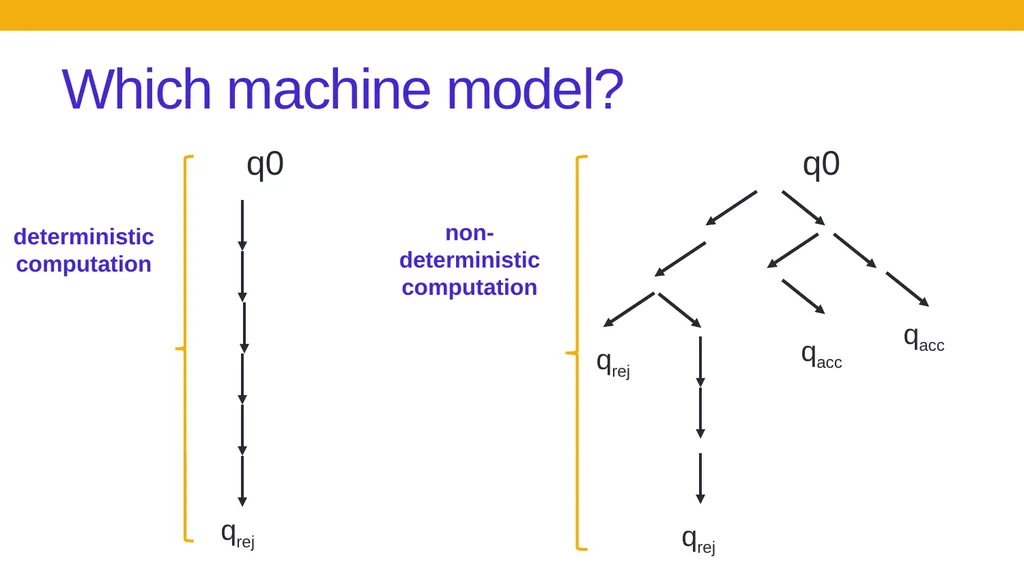
For M a nondeterministic decider, its running time or time complexity is the function f: N R+ given by
f(n) = maximum number of steps M takes before halting on any branch of its computation, over all inputs of length n.<br>
17
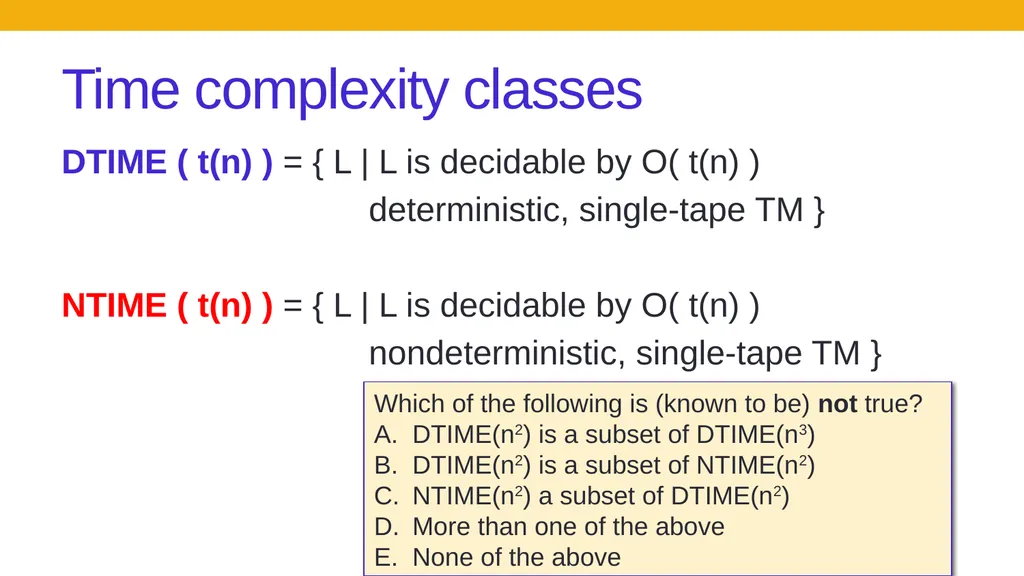
Time complexity classes DTIME ( t(n) ) = { L | L is decidable by O( t(n) )
deterministic, single-tape TM }
NTIME ( t(n) ) = { L | L is decidable by O( t(n) )
nondeterministic, single-tape TM } Which of the following is (known to be) not true?
DTIME(n2) is a subset of DTIME(n3)
DTIME(n2) is a subset of NTIME(n2)
NTIME(n2) a subset of DTIME(n2)
More than one of the above
None of the above<br>
18
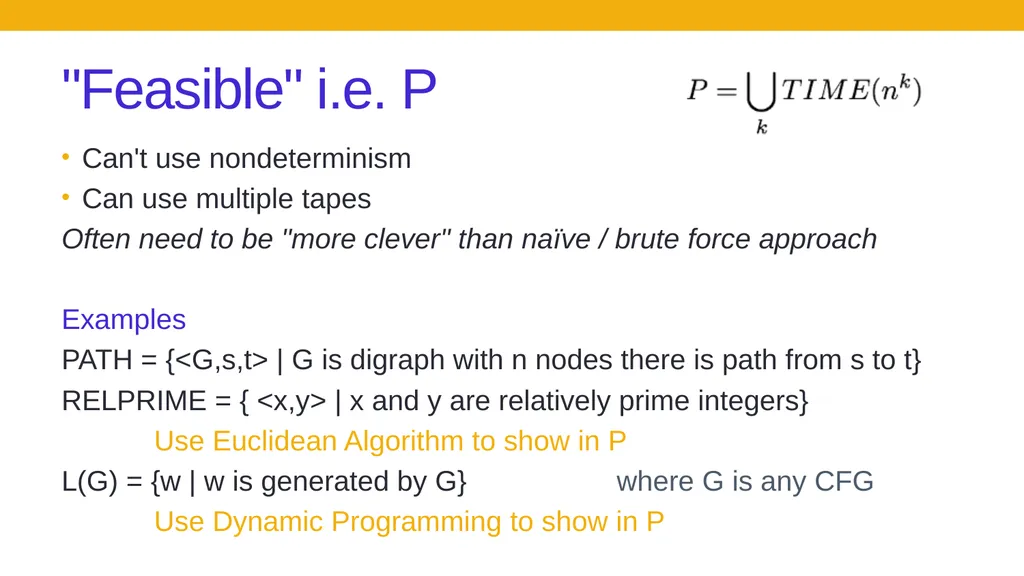
"Feasible" i.e. P Can't use nondeterminism
Can use multiple tapes
Often need to be "more clever" than naïve / brute force approach
Examples
PATH = {<G,s,t> | G is digraph with n nodes there is path from s to t}
RELPRIME = { <x,y> | x and y are relatively prime integers}
Use Euclidean Algorithm to show in P
L(G) = {w | w is generated by G} where G is any CFG
Use Dynamic Programming to show in P<br>
19
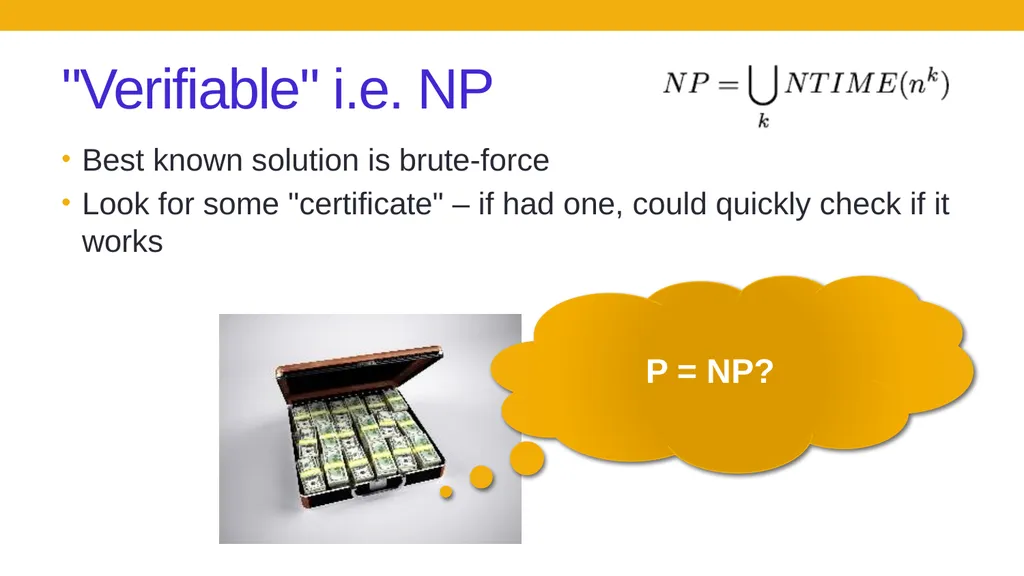
"Verifiable" i.e. NP Best known solution is brute-force
Look for some "certificate" – if had one, could quickly check if it works P = NP?<br>
20
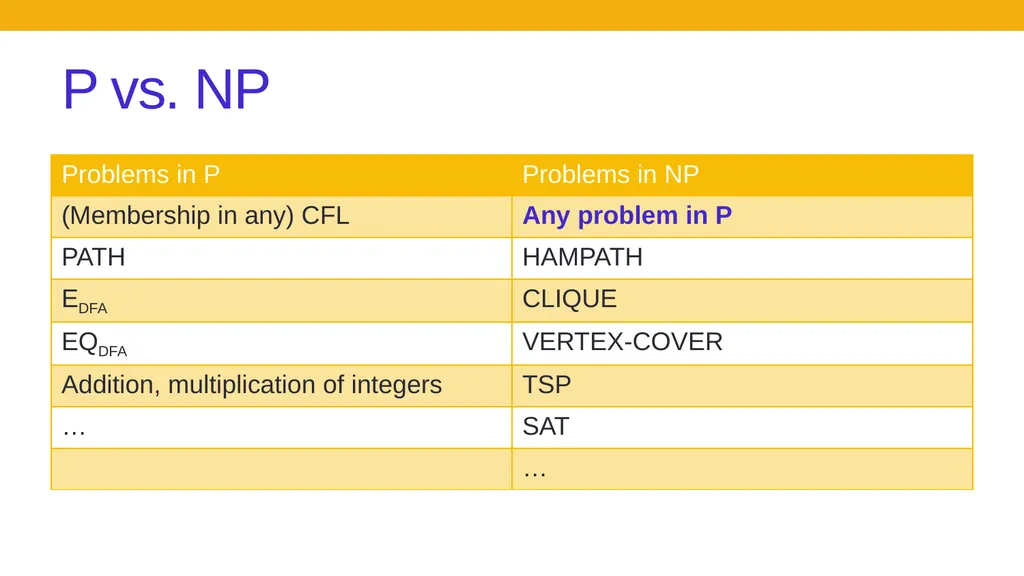
P vs. NP<br>
21
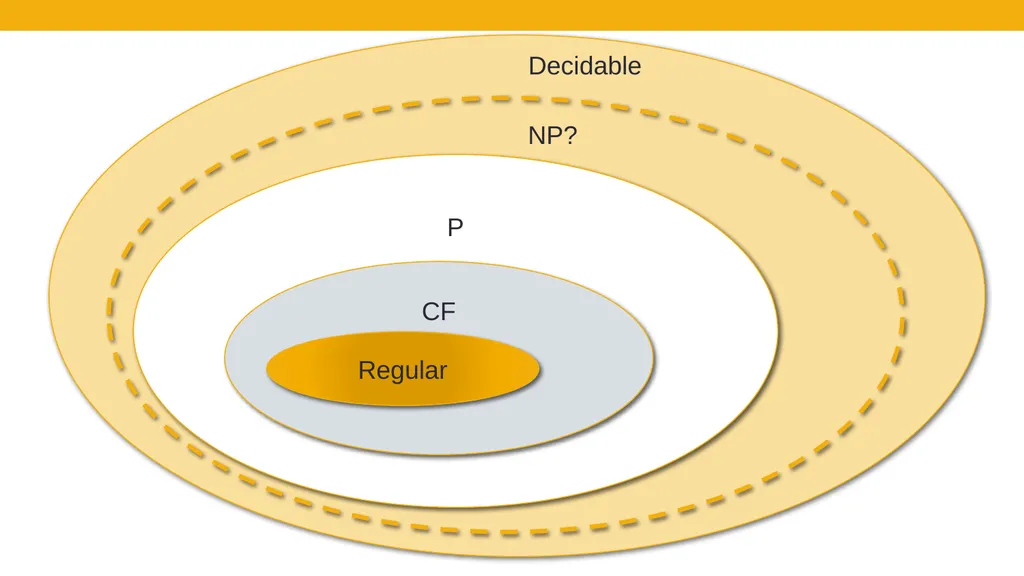
P CF Regular Decidable NP?<br>
22
Reductions to the rescue Sipser p. 271,276 1970s Stephen Cook and Leonid Levin indepdendently and in parallel lay foundations of NP-completeness
Intuitively: if an NP-complete problem has a polynomial algorithm, then all NP problems are polynomail time solvable.
A language B is NP-complete if it is in NP and every A in NP is polynomial-time reducible to it.
Cook-Levin Theorem: SAT is NP-complete.<br>
23
Reductions to the rescue Sipser p. 271,276 1970s Stephen Cook and Leonid Levin indepdendently and in parallel lay foundations of NP-completeness
Intuitively: if an NP-complete problem has a polynomial algorithm, then all NP problems are polynomail time solvable.
A language B is NP-complete if it is in NP and every A in NP is polynomial-time reducible to it.
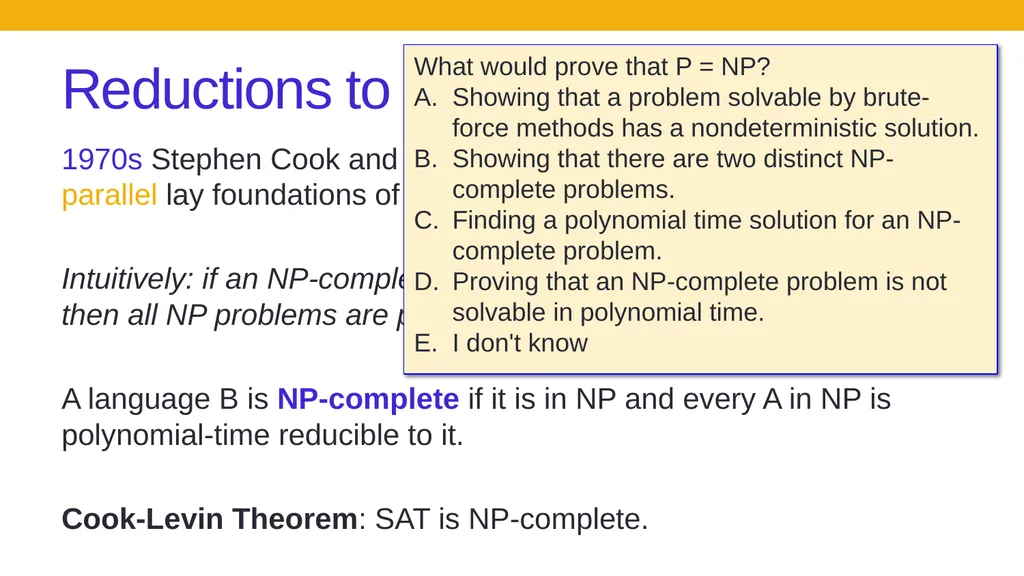
Cook-Levin Theorem: SAT is NP-complete. What would prove that P = NP?
Showing that a problem solvable by brute-force methods has a nondeterministic solution.
Showing that there are two distinct NP-complete problems.
Finding a polynomial time solution for an NP-complete problem.
Proving that an NP-complete problem is not solvable in polynomial time.
I don't know<br>