04
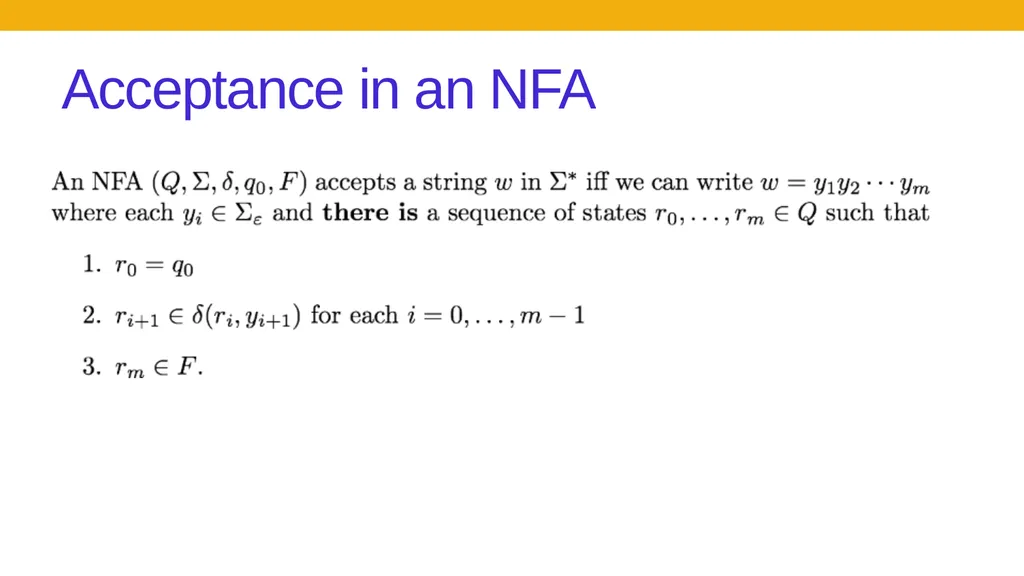
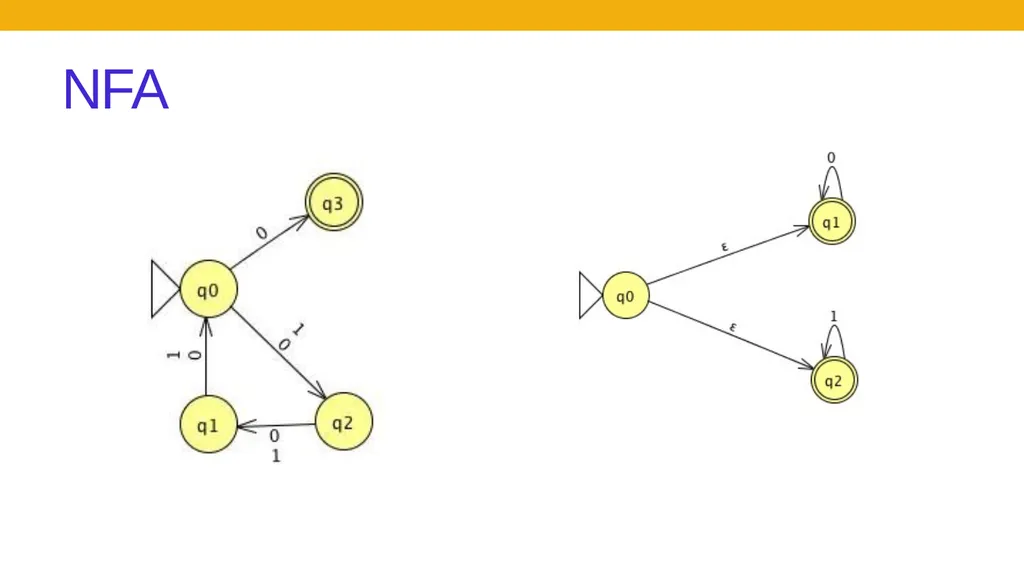
Acceptance in an NFA<br>
06
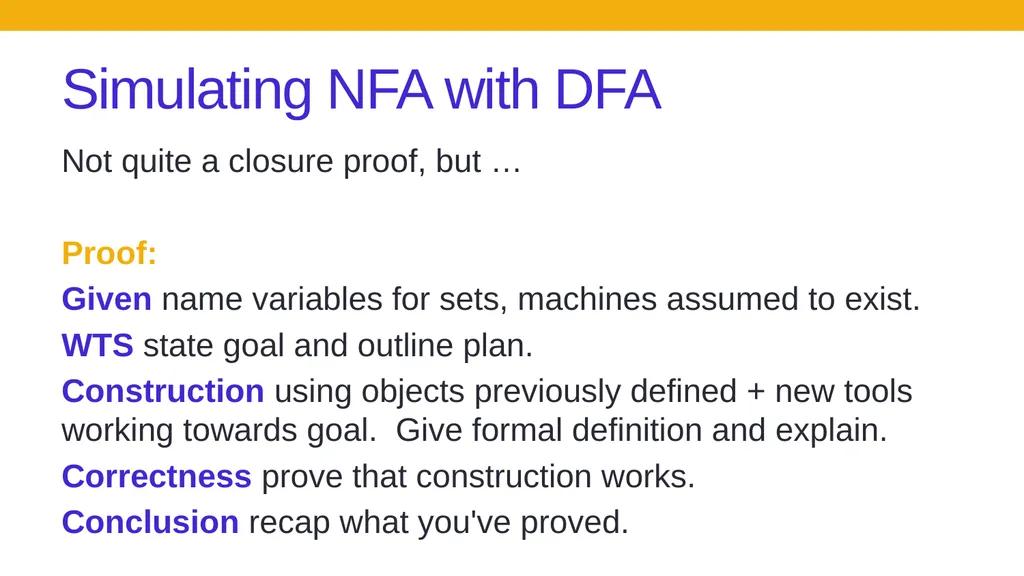
Simulating NFA with DFA Not quite a closure proof, but …
Proof:
Given name variables for sets, machines assumed to exist.
WTS state goal and outline plan.
Construction using objects previously defined + new tools working towards goal. Give formal definition and explain.
Correctness prove that construction works.
Conclusion recap what you've proved.<br>
07
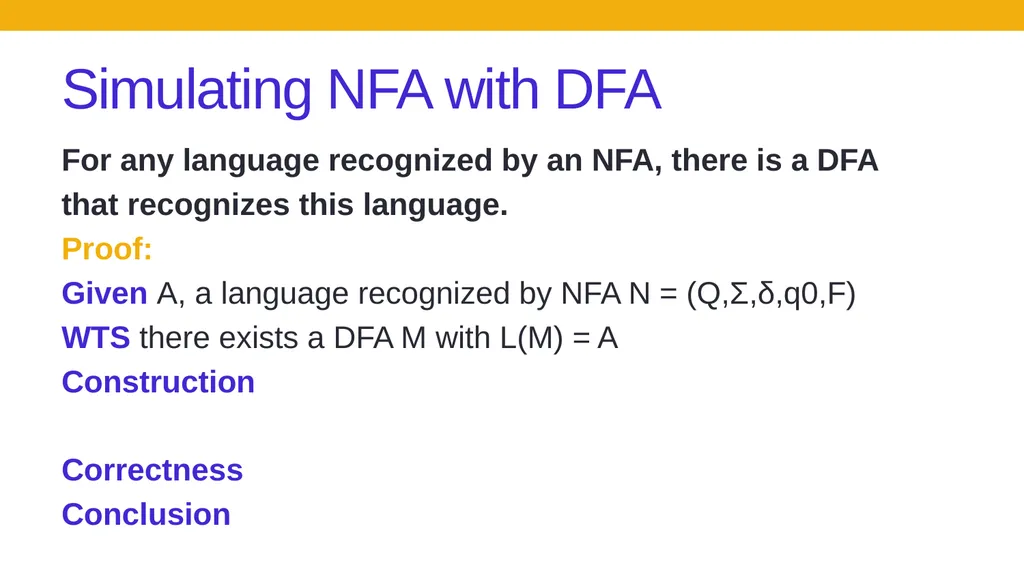
Simulating NFA with DFA For any language recognized by an NFA, there is a DFA
that recognizes this language.
Proof:
Given A, a language recognized by NFA N = (Q,Σ,δ,q0,F)
WTS there exists a DFA M with L(M) = A
Construction
Correctness
Conclusion<br>
08
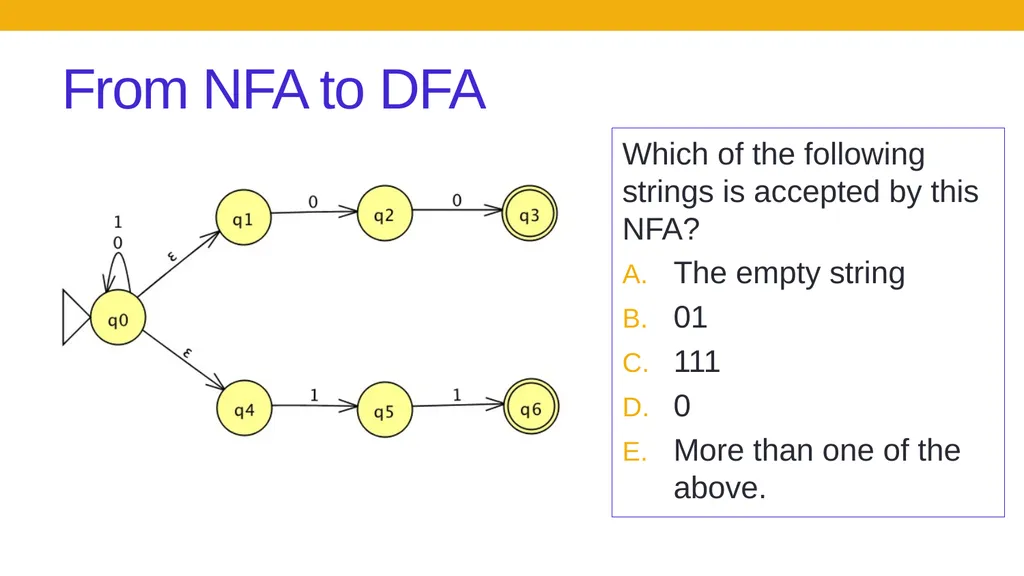
Which of the following strings is accepted by this NFA?
The empty string
01
111
0
More than one of the above. From NFA to DFA<br>
09
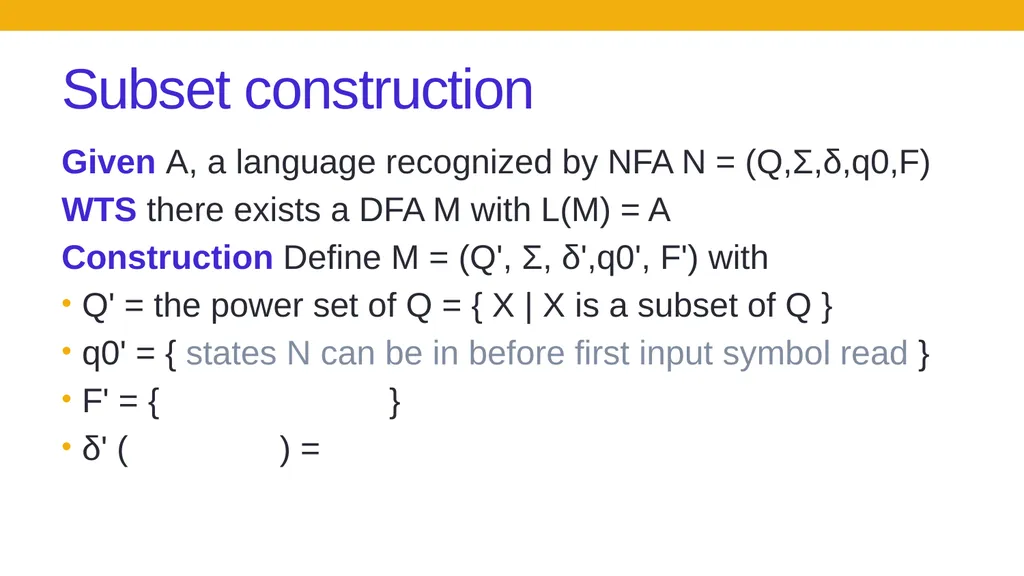
Subset construction Given A, a language recognized by NFA N = (Q,Σ,δ,q0,F)
WTS there exists a DFA M with L(M) = A
Construction Define M = (Q', Σ, δ',q0', F') with
Q' = the power set of Q = { X | X is a subset of Q }
q0' = { states N can be in before first input symbol read }
F' = { }
δ' ( ) =<br>
10
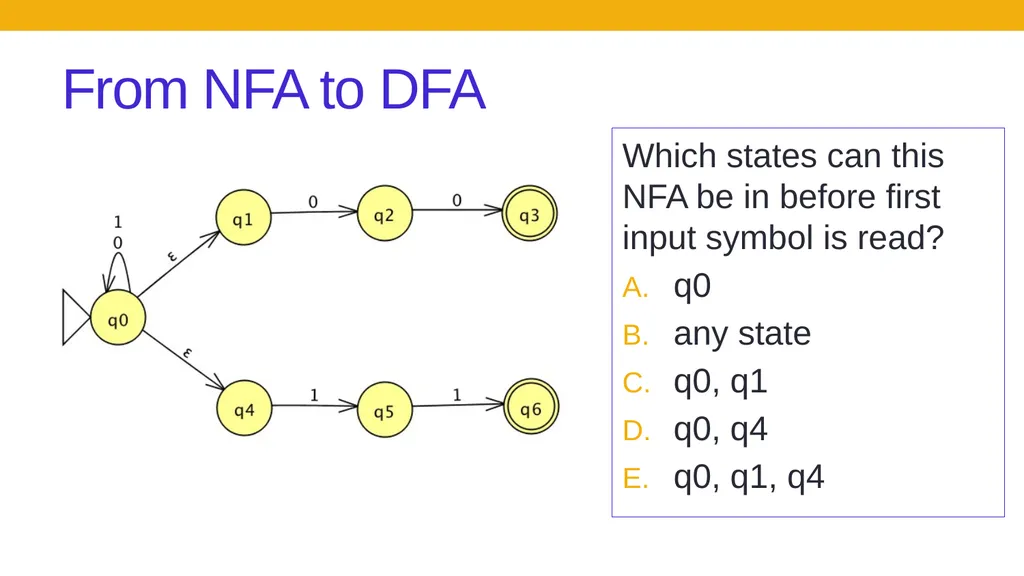
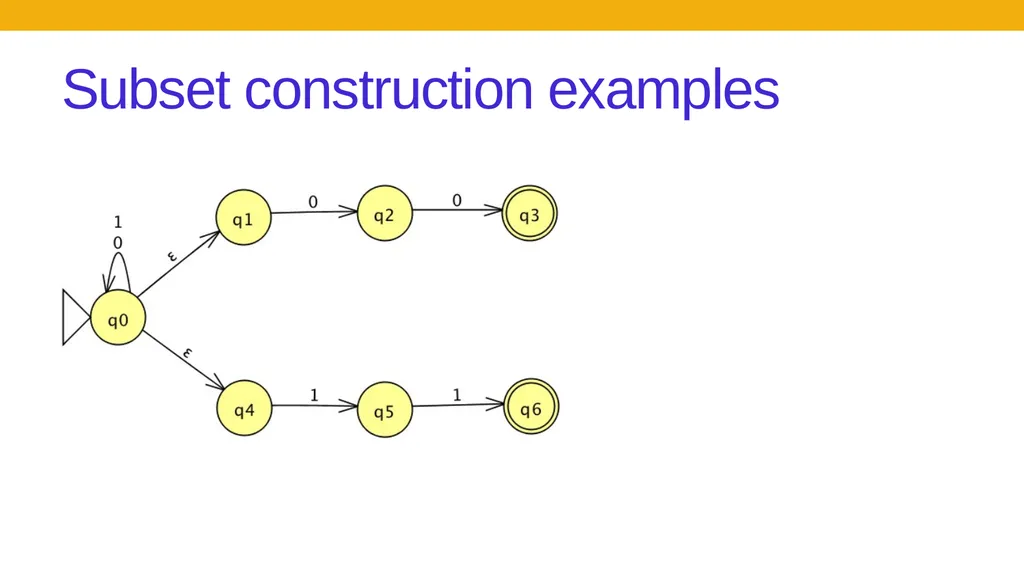
Which states can this NFA be in before first input symbol is read?
q0
any state
q0, q1
q0, q4
q0, q1, q4 From NFA to DFA<br>
11
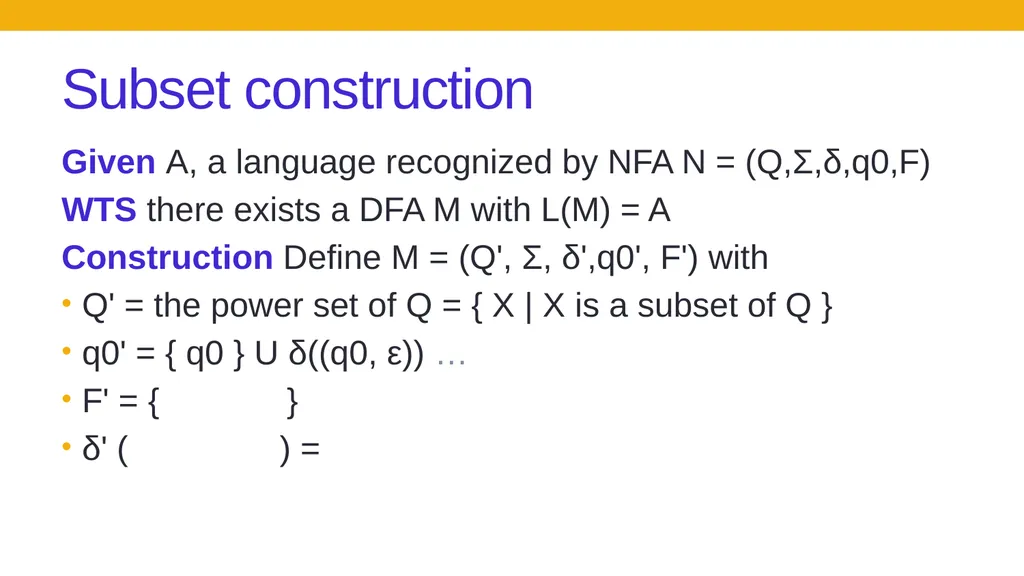
Subset construction Given A, a language recognized by NFA N = (Q,Σ,δ,q0,F)
WTS there exists a DFA M with L(M) = A
Construction Define M = (Q', Σ, δ',q0', F') with
Q' = the power set of Q = { X | X is a subset of Q }
q0' = { q0 } U δ((q0, ε)) …
F' = { }
δ' ( ) =<br>
12
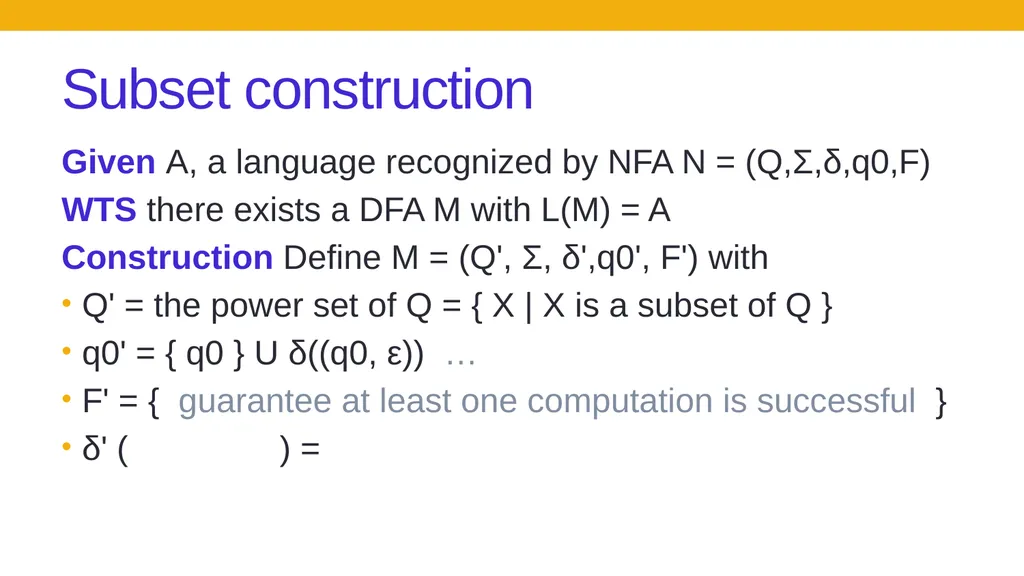
Subset construction Given A, a language recognized by NFA N = (Q,Σ,δ,q0,F)
WTS there exists a DFA M with L(M) = A
Construction Define M = (Q', Σ, δ',q0', F') with
Q' = the power set of Q = { X | X is a subset of Q }
q0' = { q0 } U δ((q0, ε)) …
F' = { guarantee at least one computation is successful }
δ' ( ) =<br>
13
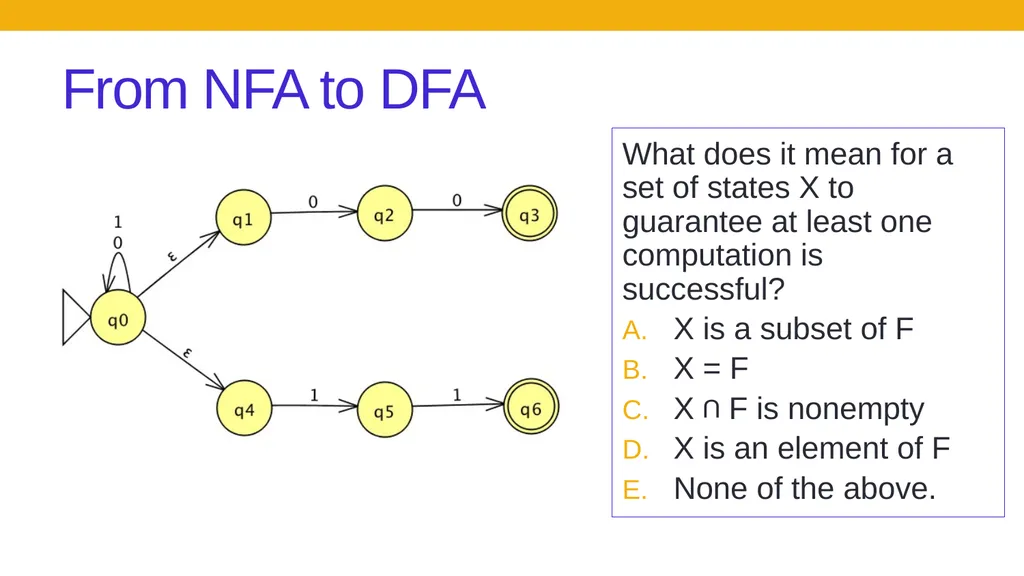
What does it mean for a set of states X to guarantee at least one computation is successful?
X is a subset of F
X = F
X F is nonempty
X is an element of F
None of the above. From NFA to DFA U<br>
14
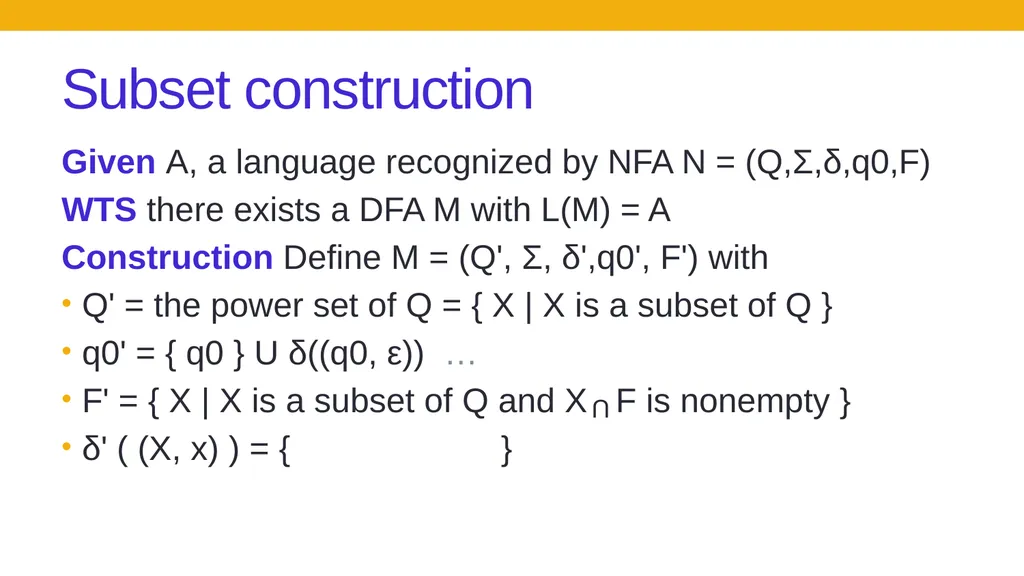
Subset construction Given A, a language recognized by NFA N = (Q,Σ,δ,q0,F)
WTS there exists a DFA M with L(M) = A
Construction Define M = (Q', Σ, δ',q0', F') with
Q' = the power set of Q = { X | X is a subset of Q }
q0' = { q0 } U δ((q0, ε)) …
F' = { X | X is a subset of Q and X F is nonempty }
δ' ( (X, x) ) = { } U<br>
15
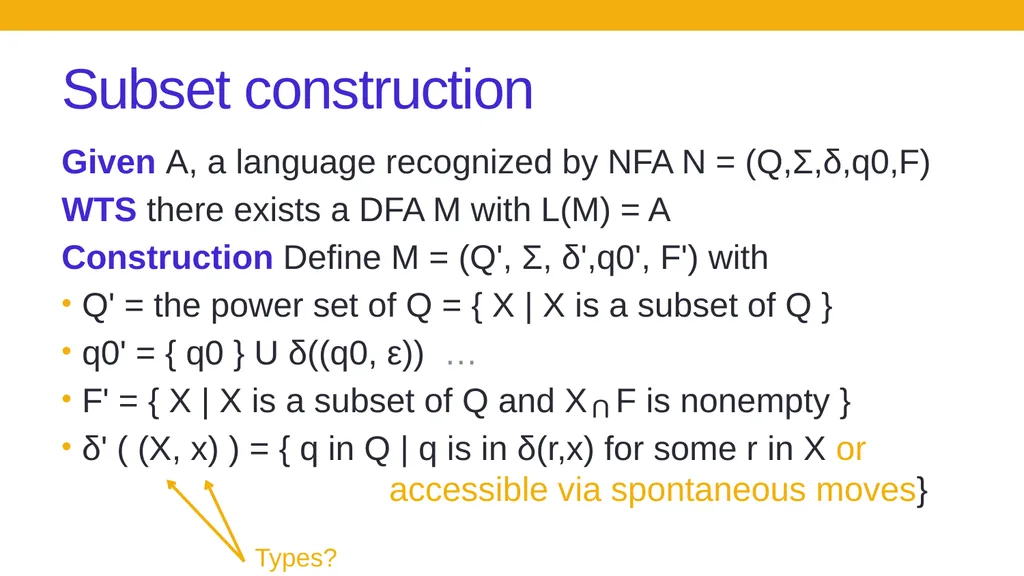
Subset construction Given A, a language recognized by NFA N = (Q,Σ,δ,q0,F)
WTS there exists a DFA M with L(M) = A
Construction Define M = (Q', Σ, δ',q0', F') with
Q' = the power set of Q = { X | X is a subset of Q }
q0' = { q0 } U δ((q0, ε)) …
F' = { X | X is a subset of Q and X F is nonempty }
δ' ( (X, x) ) = { q in Q | q is in δ(r,x) for some r in X or accessible via spontaneous moves} U Types?<br>
16
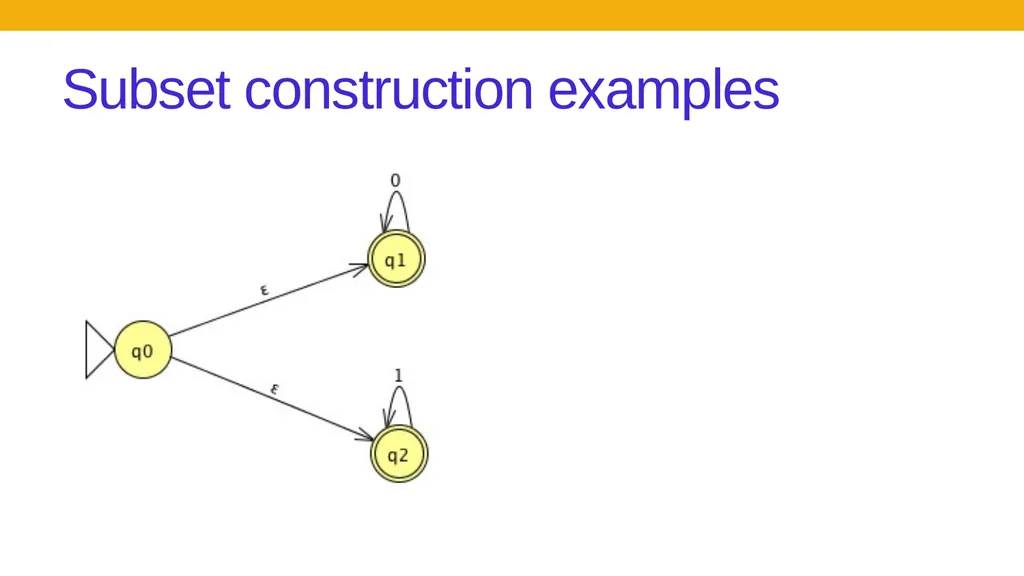
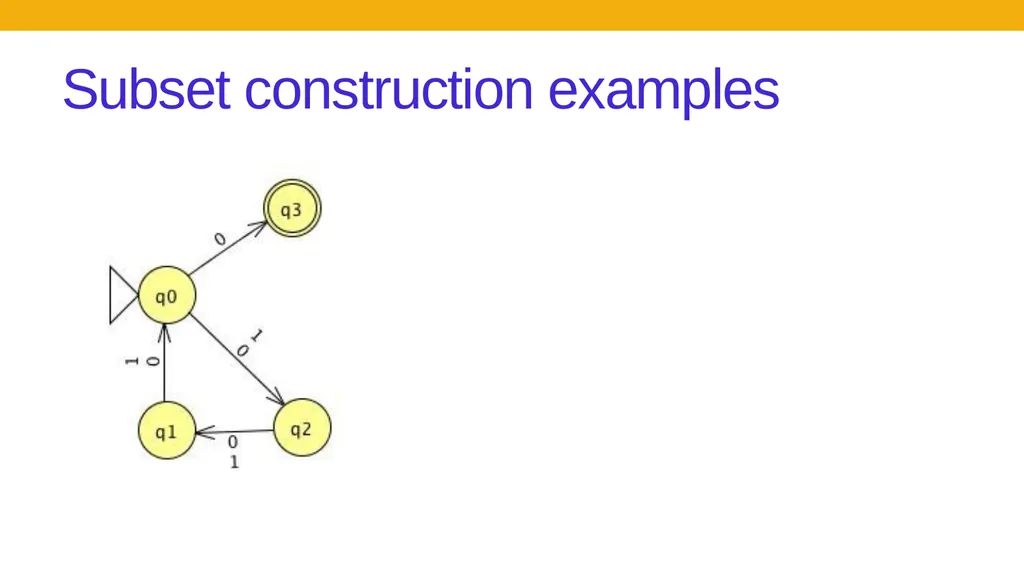
Subset construction examples<br>
17
Subset construction examples<br>
18
Subset construction examples<br>
19
Recap Regular sets of strings i.e., those that aren't too complicated are those that are
the language of some DFA, or equivalently,
the language of some NFA.
If a set of strings can be expressed as the result of complement, union, intersection, concatenation, Kleene star of regular languages, then it itself is regular.<br>
20
Regular expressions Can all regular languages be expressed as those that are built up from very simple languages using the regular operations?<br>
21
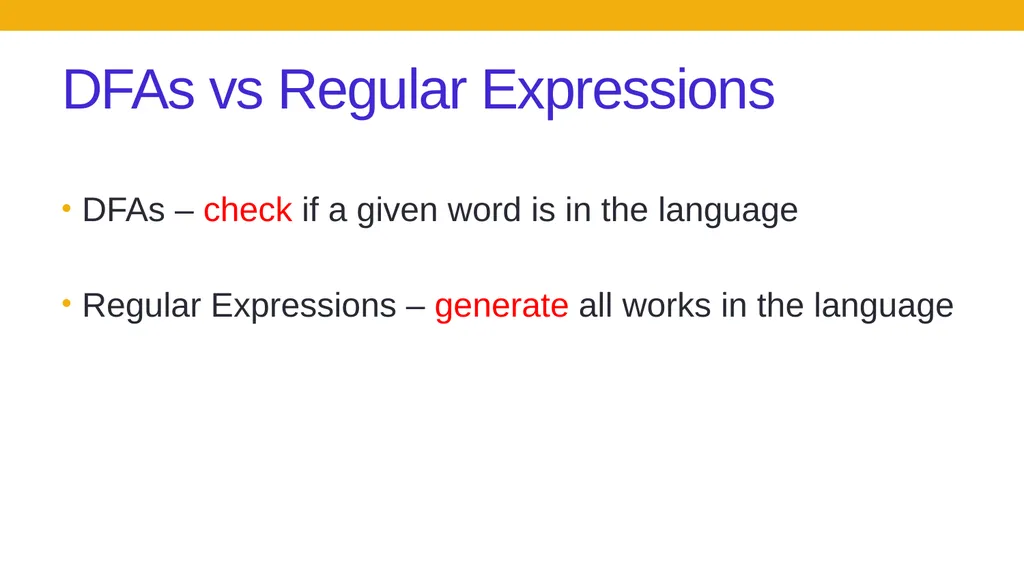
DFAs vs Regular Expressions DFAs – check if a given word is in the language
Regular Expressions – generate all works in the language<br>
22
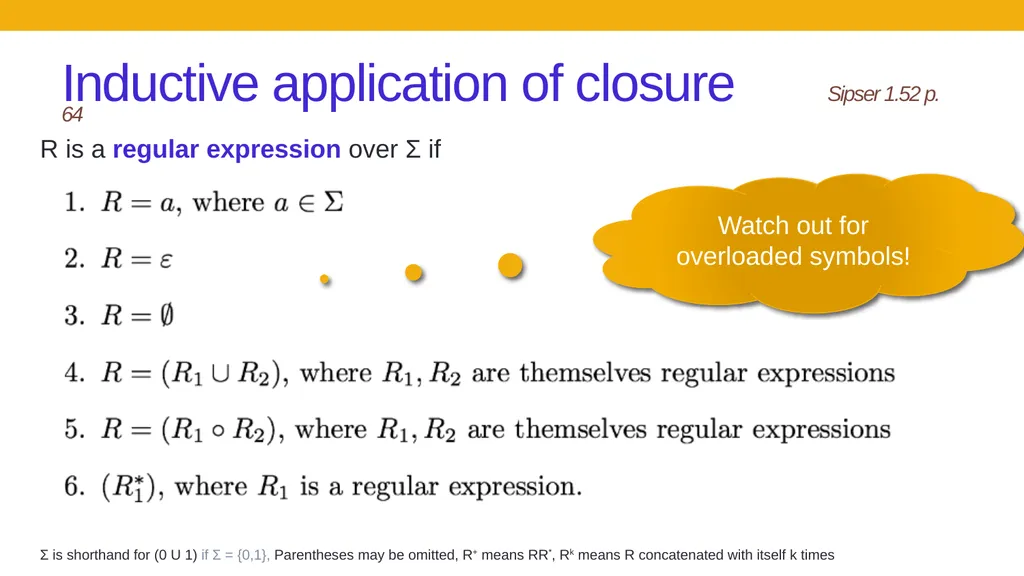
Inductive application of closure Sipser 1.52 p. 64 R is a regular expression over Σ if
Σ is shorthand for (0 U 1) if Σ = {0,1}, Parentheses may be omitted, R+ means RR*, Rk means R concatenated with itself k times Watch out for overloaded symbols!<br>
23
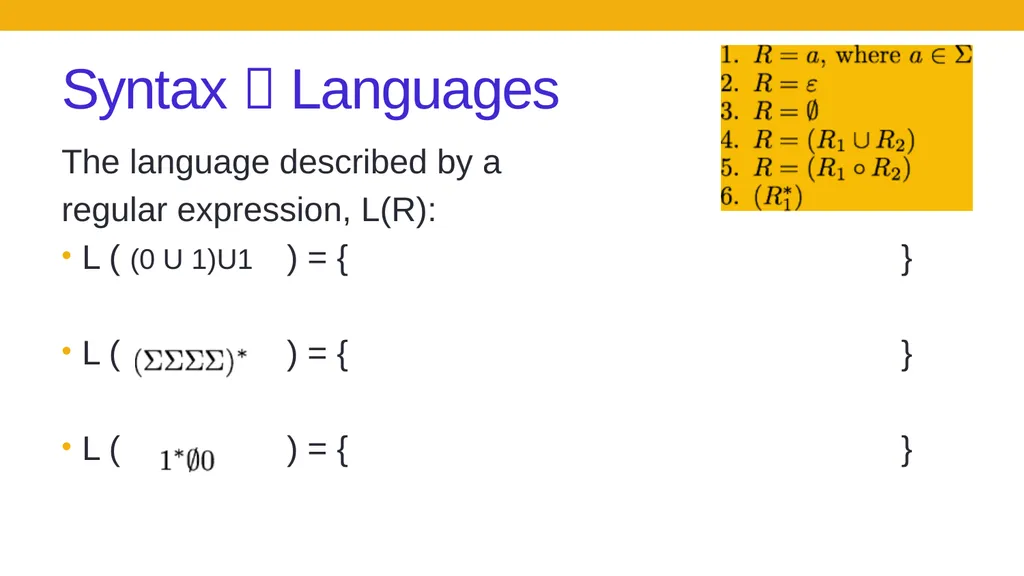
Syntax Languages The language described by a
regular expression, L(R):
L ( (0 U 1)U1 ) = { }
L ( ) = { }
L ( ) = { }<br>
24
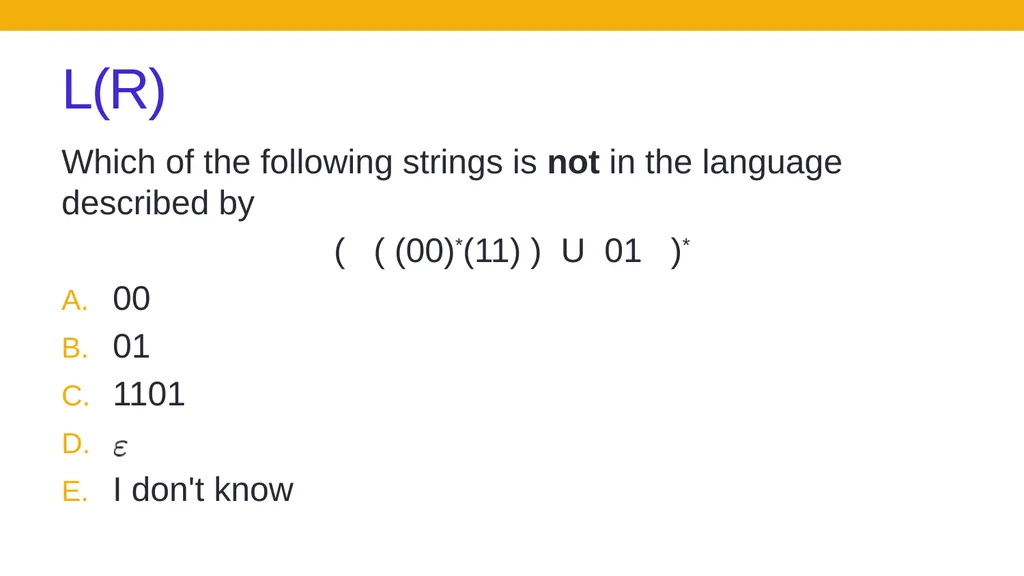
L(R) Which of the following strings is not in the language described by
( ( (00)*(11) ) U 01 )*
00
01
1101
I don't know<br>
25
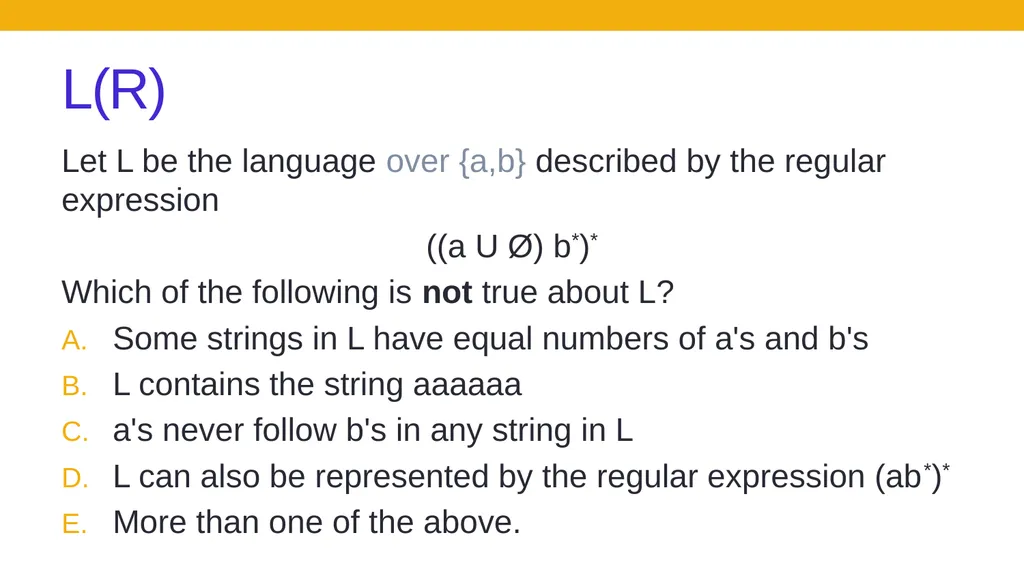
L(R) Let L be the language over {a,b} described by the regular expression
((a U Ø) b*)*
Which of the following is not true about L?
Some strings in L have equal numbers of a's and b's
L contains the string aaaaaa
a's never follow b's in any string in L
L can also be represented by the regular expression (ab*)*
More than one of the above.<br>
26
Regular expressions in practice Compilers: first phase of compiling transforms Strings to Tokens keywords, operators, identifiers, literals
One regular expression for each token type
Other software tools: grep, Perl, Python, Java, Ruby, …<br>
27
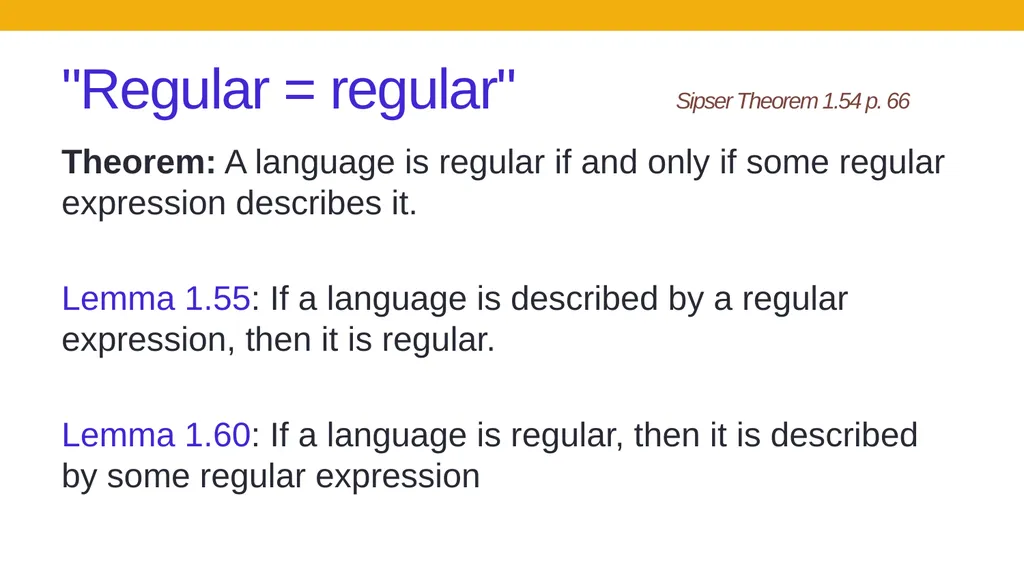
"Regular = regular" Sipser Theorem 1.54 p. 66 Theorem: A language is regular if and only if some regular expression describes it.
Lemma 1.55: If a language is described by a regular expression, then it is regular.
Lemma 1.60: If a language is regular, then it is described by some regular expression<br>