"CSE 531: Performance Analysis of Systems Lecture" is the property of its rightful owner. Permission is granted to
download and print the materials on this website for personal, non-commercial use only, and to display it
on your personal computer provided you do not modify the materials and that you retain all copyright
notices contained in the materials. By downloading content from our website, you accept the terms of this
agreement.
Presentation Transcript
01
CSE 531: Performance Analysis of Systems Lecture 1: Intro and Logistics Anshul Gandhi
1307, CS building
anshul@cs.stonybrook.edu
anshul.gandhi@stonybrook.edu 1<br>
02
Outline Logistics
Course info
Lectures
Course webpage
Office hours
Grading
Resources
Syllabus 2<br>
03
Course Info New course, almost
Analysis of computer systems
Design options
Optimizations
Performance (response time, throughput); cost; energy
Data centers, cloud systems, databases, Hadoop
Analytical tools
Markov chains
Operational Laws
Queueing theory
Predictive models, control theory, simulations, etc. 3<br>
04
Course Info Prerequisites:
Basic CS background
Distributed systems, Databases, Networking
Probability and Statistics
This is NOT a systems course
This is NOT a theory course 4<br>
05
Example 1 1-server queue
Deterministic service times
Deterministic inter-arrival times 5<br>
06
Example 1 (continued) 1-server queue
Deterministic service times
Exponential inter-arrival times 6<br>
07
Example 1 (continued) 1-server queue
Exponential service times
Exponential inter-arrival times
M/M/1 queue 7<br>
08
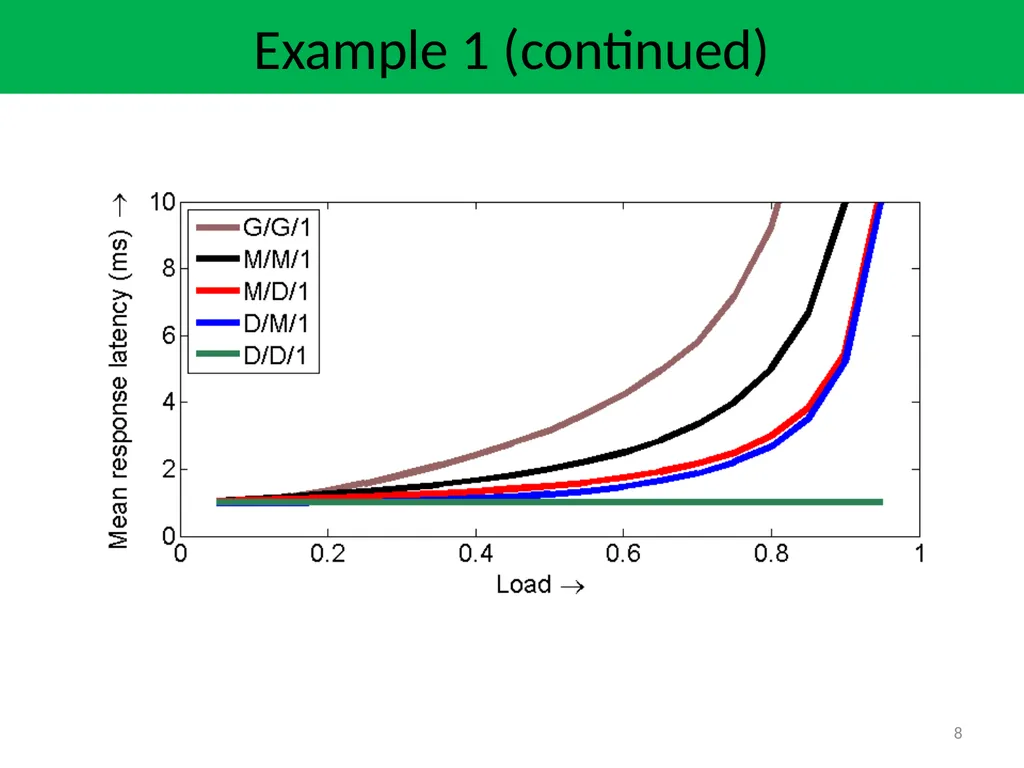
Example 1 (continued) 8<br>
09
Lectures Tu, Th: 11:30am – 12:50pm
5-min break at the halfway point
Slides + whiteboard
Interactive (please)
Carry a book, a real one! 9<br>
10
Course webpage www.cs.stonybrook.edu/~cse531
Regularly updated
Please check periodically!
Slides will be posted
Contains all course info and logistics 10<br>
Office hours Tuesday 2pm-4pm
Any time with prior appointment (email me)
CS 1307
Tentative
Will re-visit after add/drop date 12<br>
13
Example 2 Queueing policies 13<br>
14
Example 2 (continued) Service policies 14<br>
15
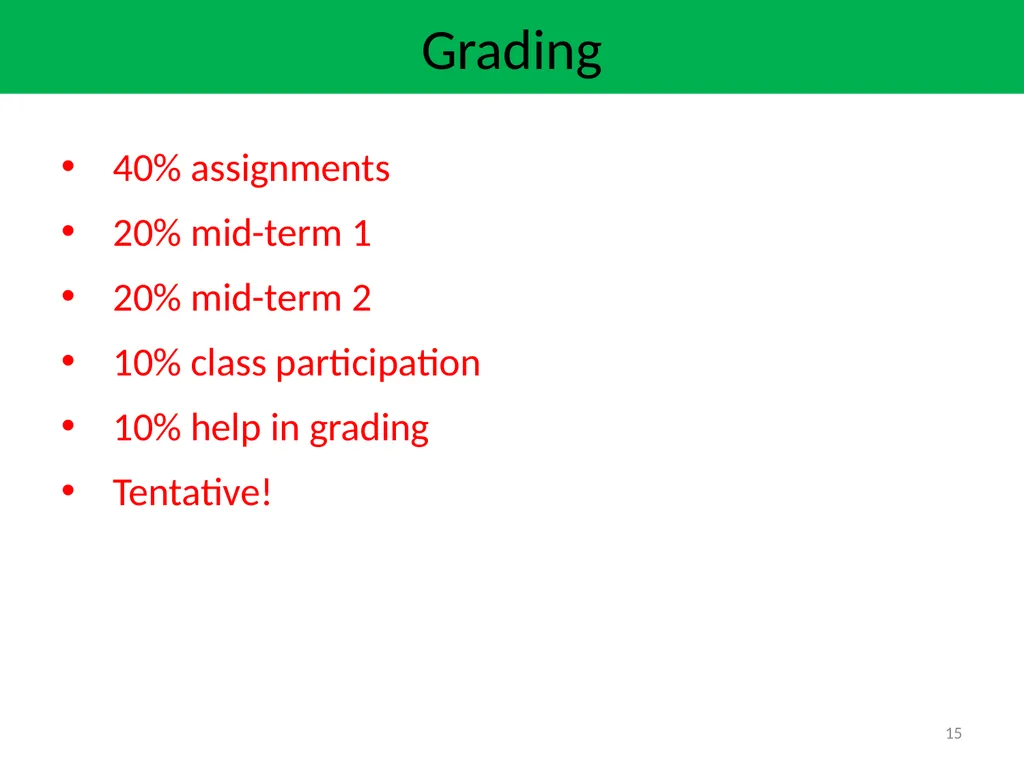
Grading 40% assignments
20% mid-term 1
20% mid-term 2
10% class participation
10% help in grading
Tentative! 15<br>
16
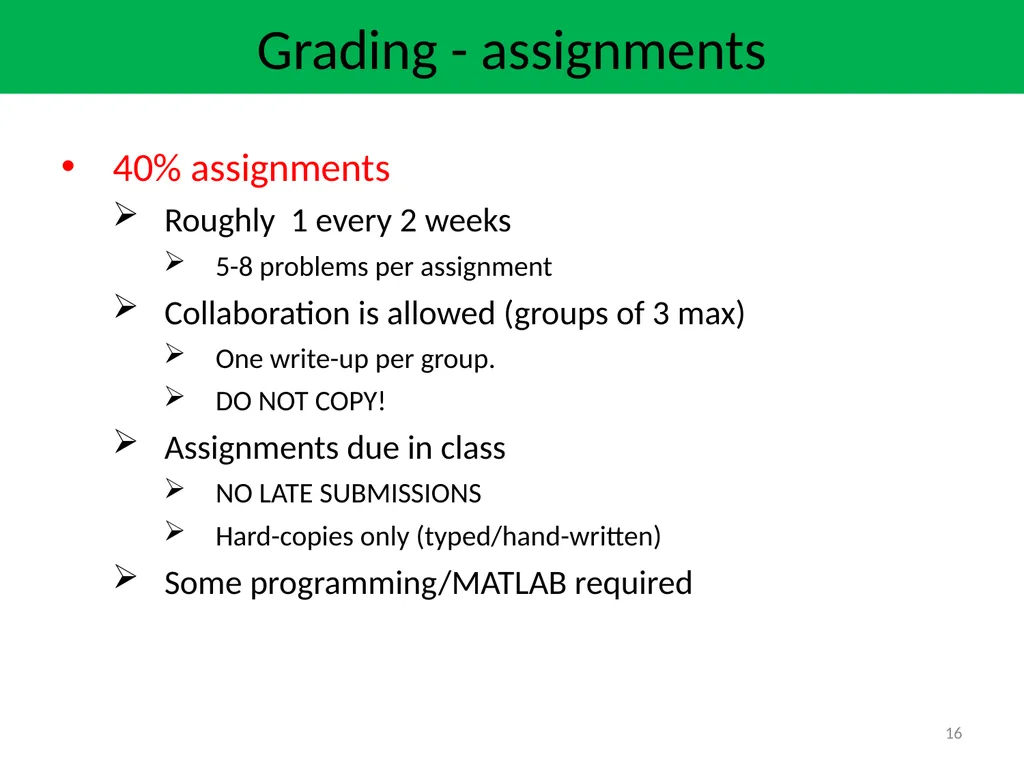
Grading - assignments 40% assignments
Roughly 1 every 2 weeks
5-8 problems per assignment
Collaboration is allowed (groups of 3 max)
One write-up per group.
DO NOT COPY!
Assignments due in class
NO LATE SUBMISSIONS
Hard-copies only (typed/hand-written)
Some programming/MATLAB required 16<br>
17
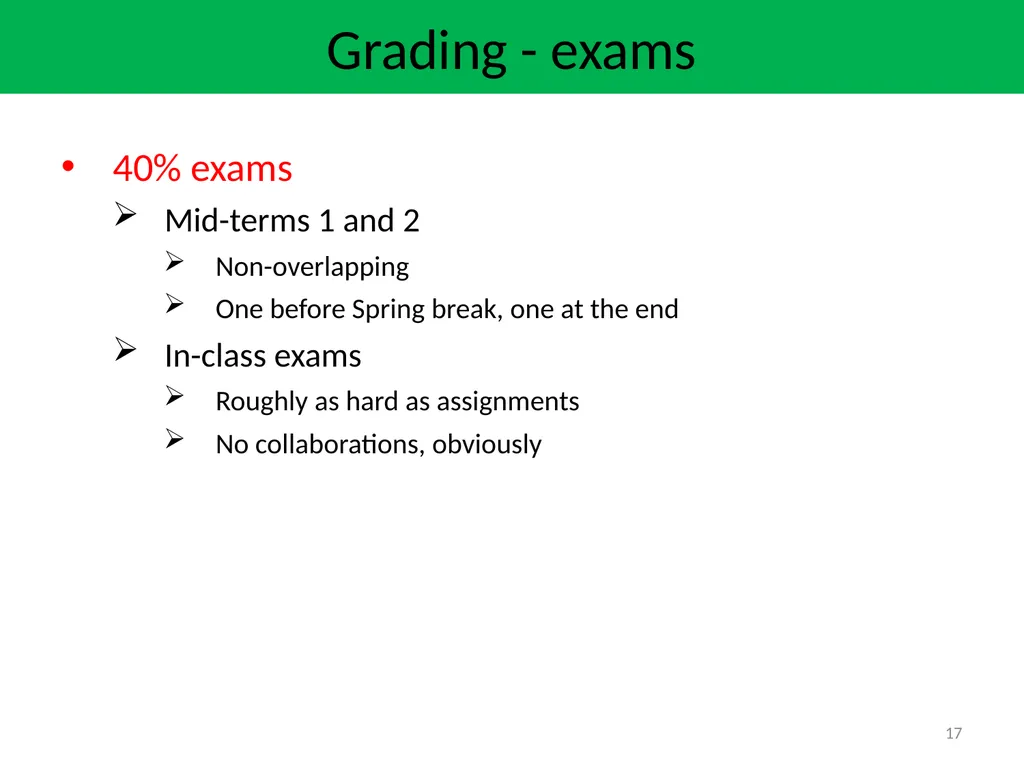
Grading - exams 40% exams
Mid-terms 1 and 2
Non-overlapping
One before Spring break, one at the end
In-class exams
Roughly as hard as assignments
No collaborations, obviously 17<br>
18
Grading – class participation 10% class participation
Contribute to class discussions
Interactive
Very helpful for bumping your grade if you are on the border 18<br>
19
Grading – help with grading 10% class participation
Help grade one assignment as part of a group of graders
2-3 hour commitment for one evening
Tentative 19<br>
20
Resources Lectures
Slides posted online
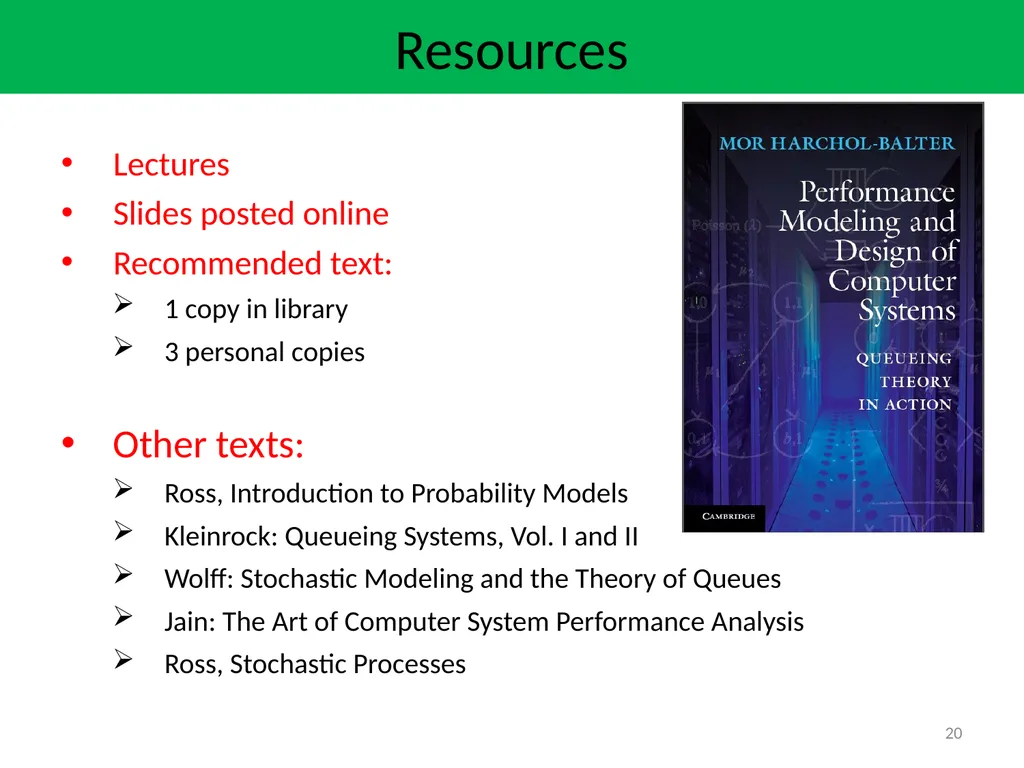
Recommended text:
1 copy in library
3 personal copies
Other texts:
Ross, Introduction to Probability Models
Kleinrock: Queueing Systems, Vol. I and II
Wolff: Stochastic Modeling and the Theory of Queues
Jain: The Art of Computer System Performance Analysis
Ross, Stochastic Processes 20<br>
21
Example 3 RightScaling for M/M/k 21<br>
22
Example 3 (continued) AutoScaling for M(t)/M/k 22<br>
23
Example 4 Performance modeling for Databases 23<br>
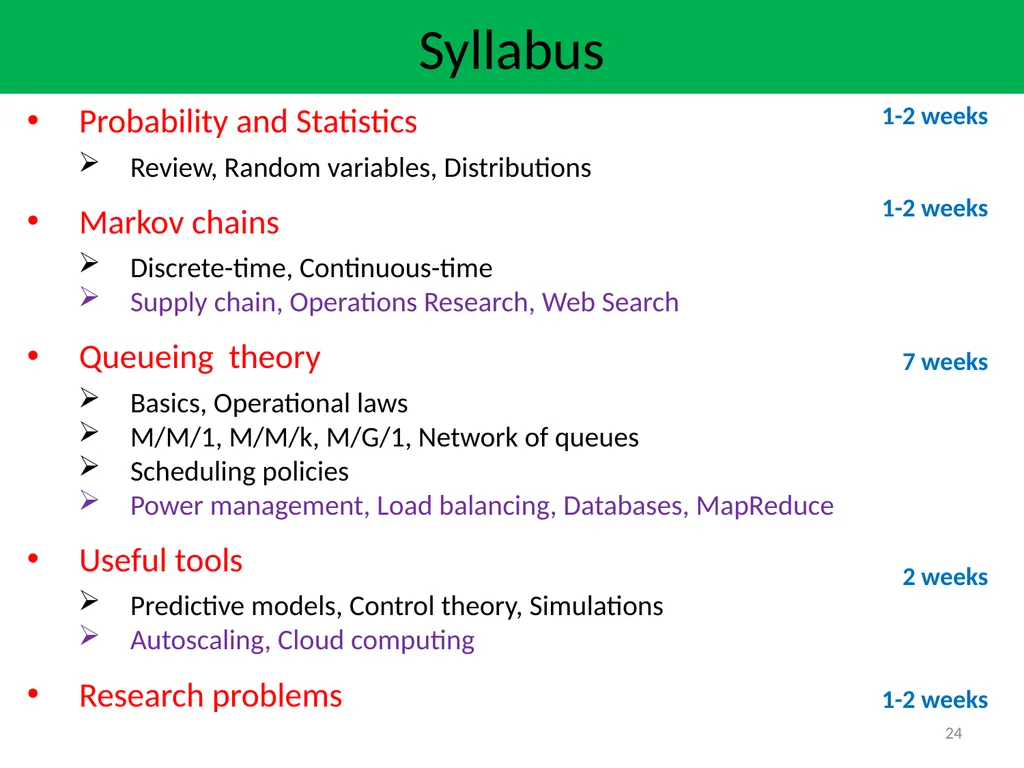
24
Syllabus Probability and Statistics
Review, Random variables, Distributions
Markov chains
Discrete-time, Continuous-time
Supply chain, Operations Research, Web Search
Queueing theory
Basics, Operational laws
M/M/1, M/M/k, M/G/1, Network of queues
Scheduling policies
Power management, Load balancing, Databases, MapReduce
Useful tools
Predictive models, Control theory, Simulations
Autoscaling, Cloud computing
Research problems 24 1-2 weeks