CSR CSR “CSR is a concept which suggests that
Description: CSR CSR CSR is a concept which suggests that commercial corporations must fulfill their duty of providing care to the society Ethical behavior of a company (or business) towards society. Promoting activities like engaging directly with
Related Topics
Download Presentation
"CSR CSR “CSR is a concept which suggests that" is the property of its rightful owner. Permission is granted to download and print the materials on this website for personal, non-commercial use only, and to display it on your personal computer provided you do not modify the materials and that you retain all copyright notices contained in the materials. By downloading content from our website, you accept the terms of this agreement.
Presentation Transcript
slide1. CSR<br>
slide2. CSR “CSR is a concept which suggests that commercial corporations must fulfill their duty of providing care to the society”<br>
slide3. Ethical behavior of a company (or business) towards society. Promoting activities like engaging directly with local communities, identifying their basic needs, and integrating their needs with business goals and strategic intent.
The government perceives CSR as the business contribution to the nation’s sustainable development goals.
Essentially, it is about how business takes into account the economic, social and environmental impact of the way in which it operates.<br>
slide4. International organizations on CSR EU Definition of CSR: "A concept whereby companies integrate social and environmental concerns in their business operations and in their interaction with their stakeholders on a voluntary basis.“
Mallenbaker Definition: "CSR is about how companies manage the business processes to produce an overall positive impact on society“
The World Business Council for Sustainable Development (WBCSD): "Corporate Social Responsibility is the continuing commitment by business to behave ethically and contribute to economic development while improving the quality of life of the workforce and their families as well as of the local community and society at large"<br>
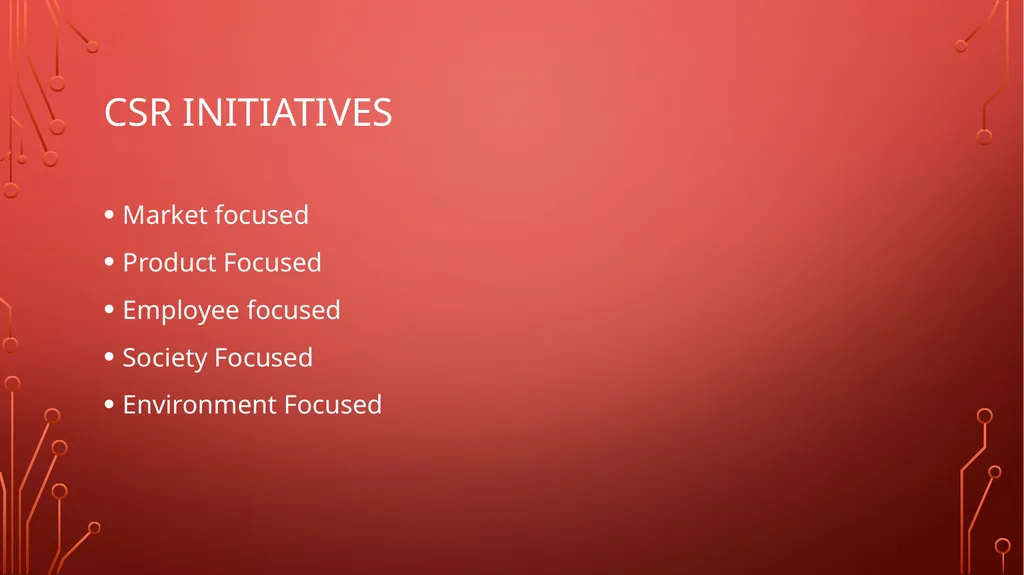
slide6. Csr initiatives Market focused
Product Focused
Employee focused
Society Focused
Environment Focused<br>
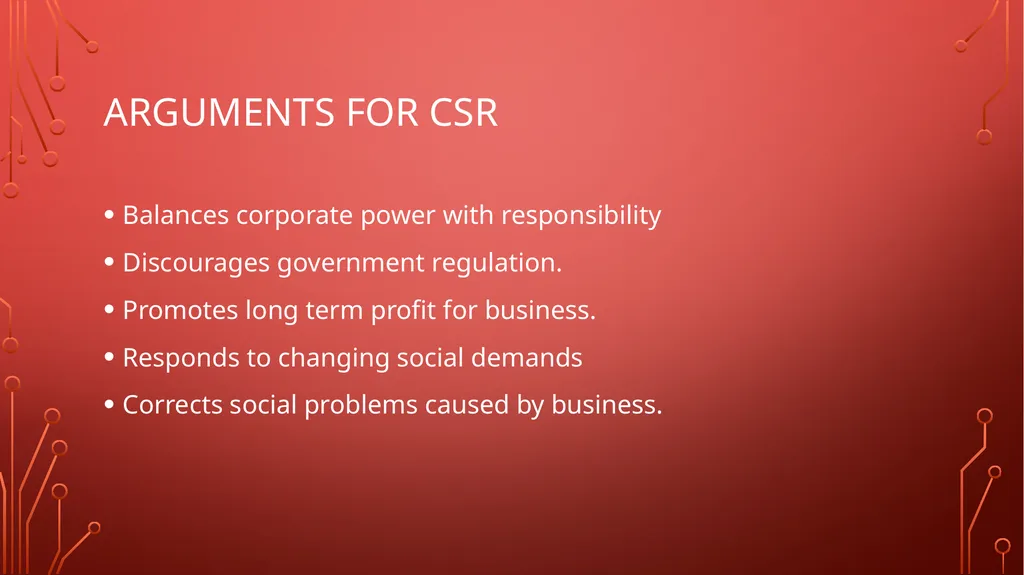
slide7. Arguments for csr Balances corporate power with responsibility
Discourages government regulation.
Promotes long term profit for business.
Responds to changing social demands
Corrects social problems caused by business.<br>
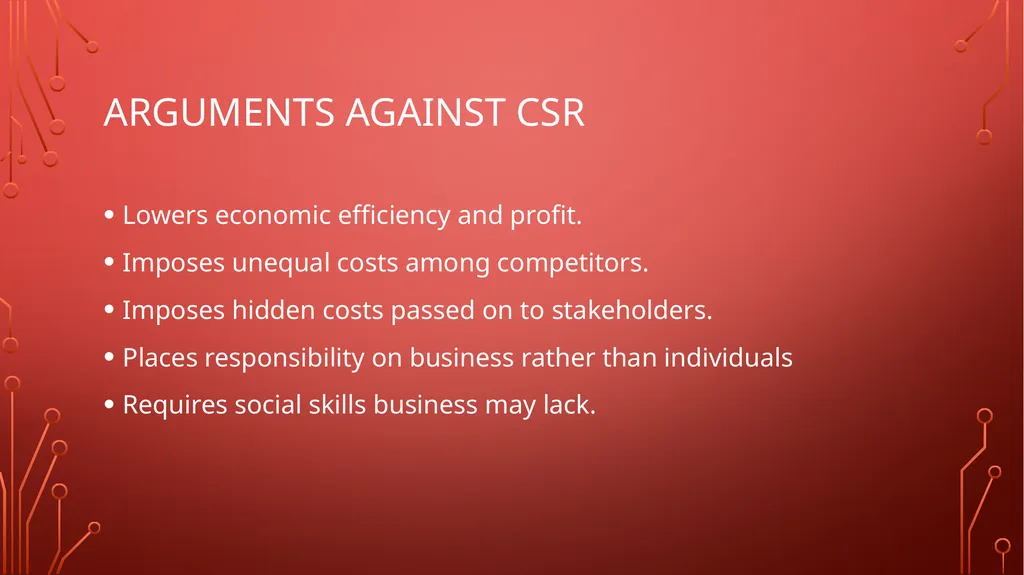
slide8. Arguments against csr Lowers economic efficiency and profit.
Imposes unequal costs among competitors.
Imposes hidden costs passed on to stakeholders.
Places responsibility on business rather than individuals
Requires social skills business may lack.<br>
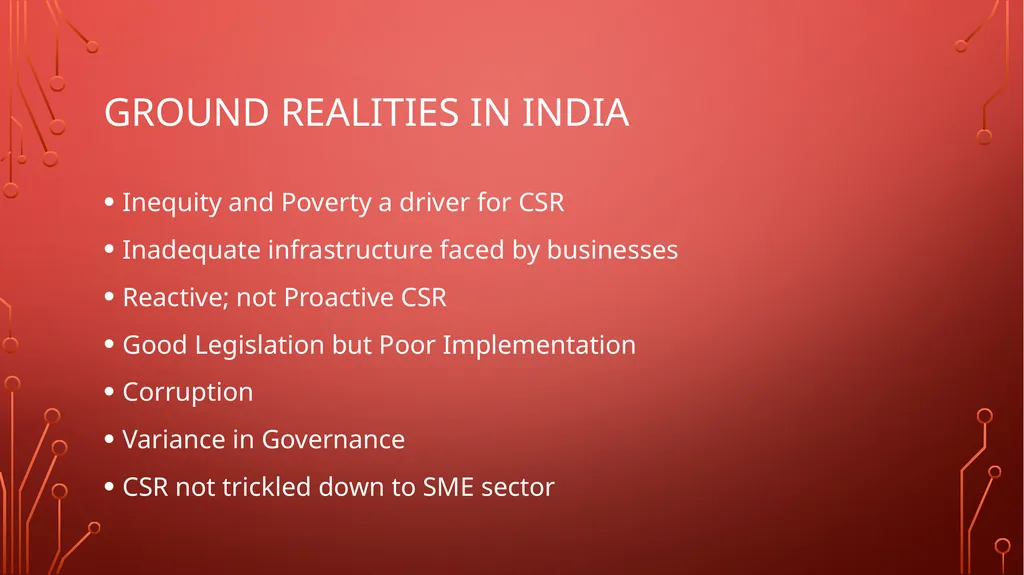
slide9. Ground realities in india Inequity and Poverty a driver for CSR
Inadequate infrastructure faced by businesses
Reactive; not Proactive CSR
Good Legislation but Poor Implementation
Corruption
Variance in Governance
CSR not trickled down to SME sector<br>
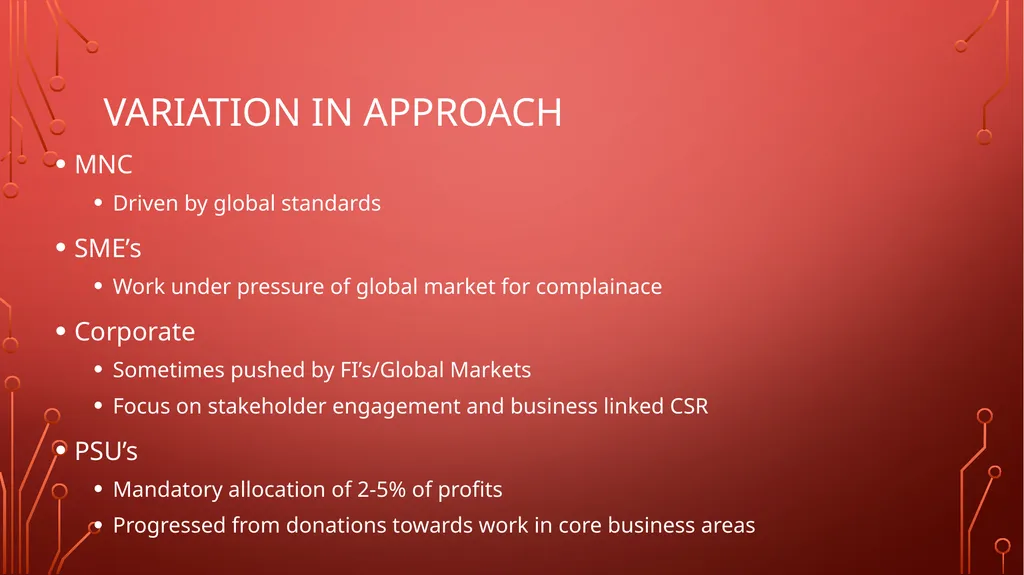
slide11. Variation in approach MNC
Driven by global standards
SME’s
Work under pressure of global market for complainace
Corporate
Sometimes pushed by FI’s/Global Markets
Focus on stakeholder engagement and business linked CSR
PSU’s
Mandatory allocation of 2-5% of profits
Progressed from donations towards work in core business areas<br>
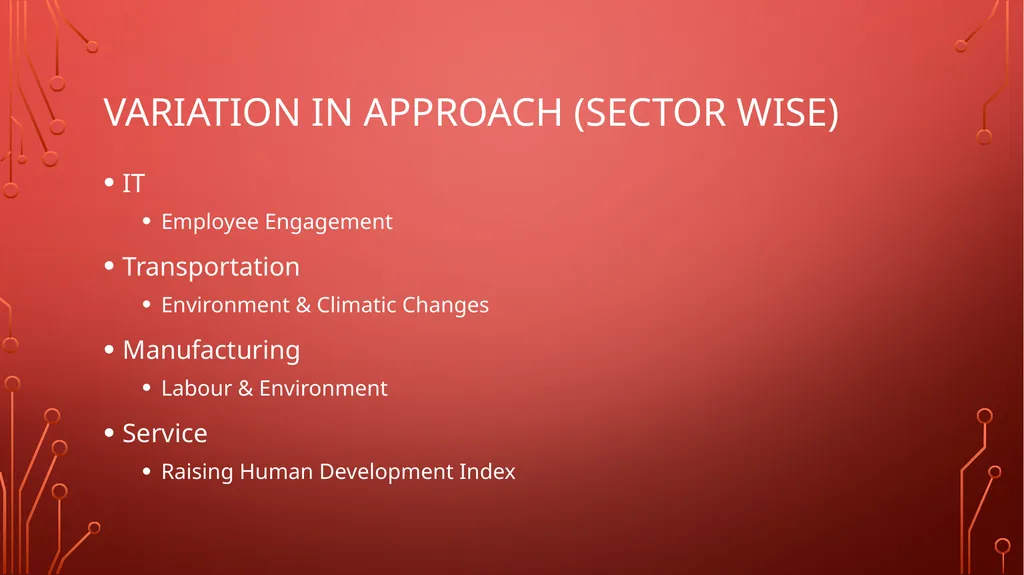
slide12. Variation in approach (sector wise) IT
Employee Engagement
Transportation
Environment & Climatic Changes
Manufacturing
Labour & Environment
Service
Raising Human Development Index<br>
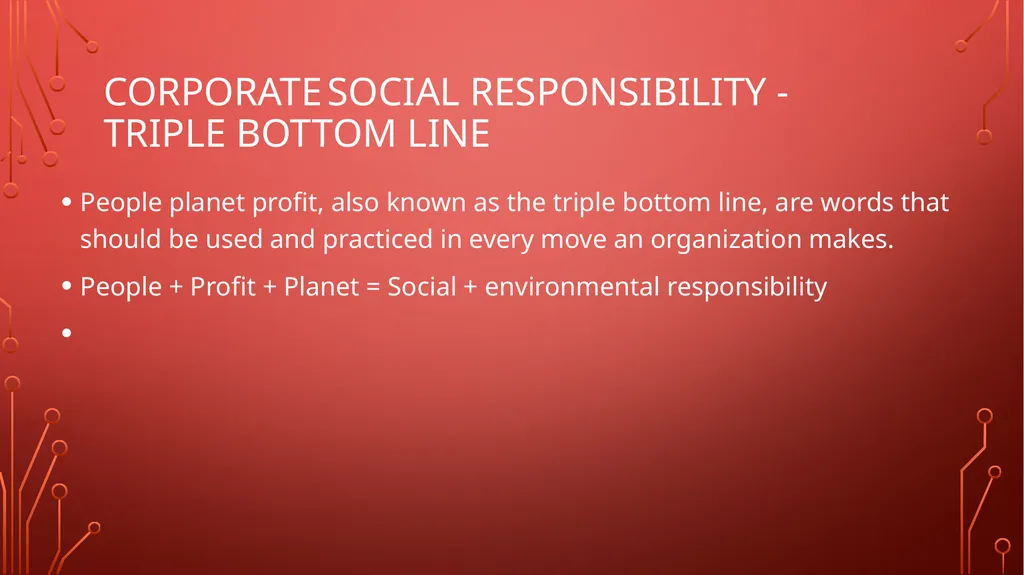
slide13. Corporate social responsibility - Triple bottom line People planet profit, also known as the triple bottom line, are words that should be used and practiced in every move an organization makes.
People + Profit + Planet = Social + environmental responsibility
<br>
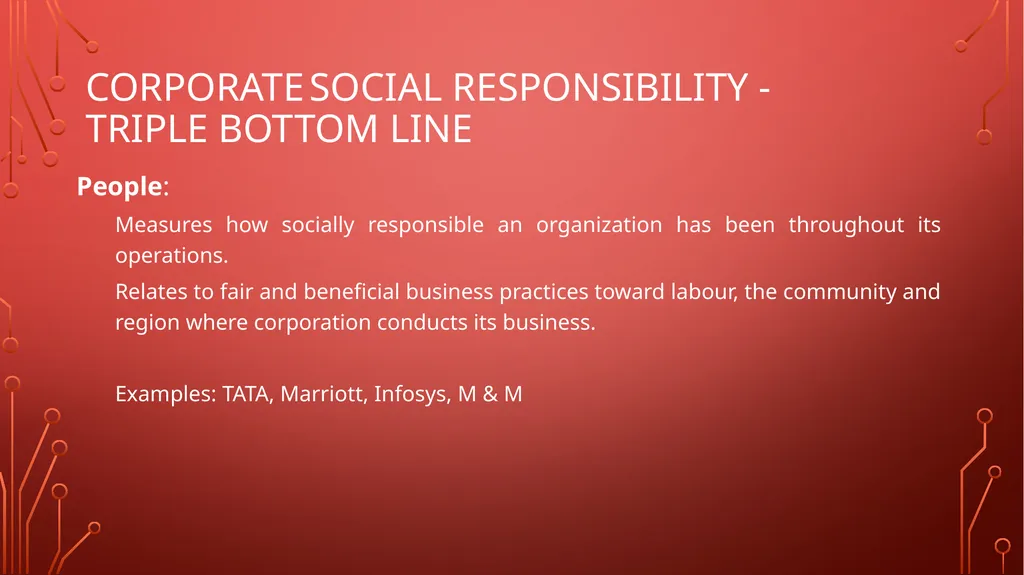
slide14. Corporate social responsibility - Triple bottom line People:
Measures how socially responsible an organization has been throughout its operations.
Relates to fair and beneficial business practices toward labour, the community and region where corporation conducts its business.
Examples: TATA, Marriott, Infosys, M & M<br>
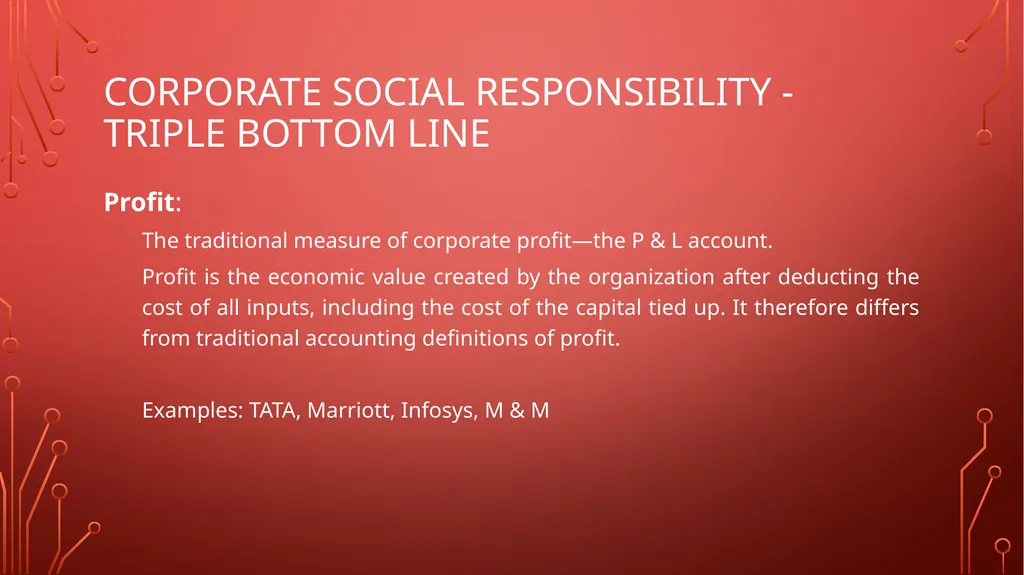
slide15. Corporate social responsibility - Triple bottom line Profit:
The traditional measure of corporate profit—the P & L account.
Profit is the economic value created by the organization after deducting the cost of all inputs, including the cost of the capital tied up. It therefore differs from traditional accounting definitions of profit.
Examples: TATA, Marriott, Infosys, M & M<br>
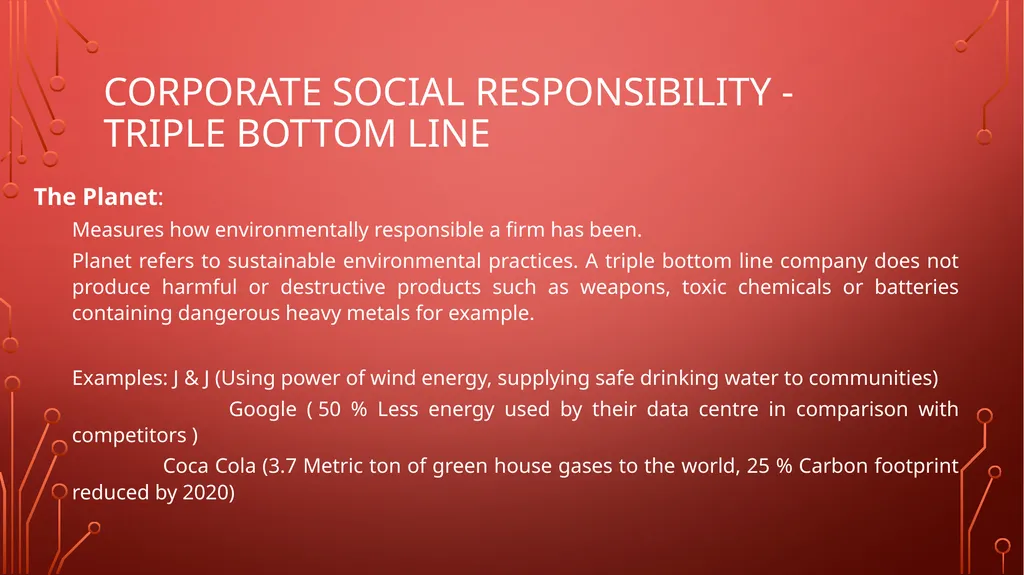
slide16. Corporate social responsibility - Triple bottom line The Planet:
Measures how environmentally responsible a firm has been.
Planet refers to sustainable environmental practices. A triple bottom line company does not produce harmful or destructive products such as weapons, toxic chemicals or batteries containing dangerous heavy metals for example.
Examples: J & J (Using power of wind energy, supplying safe drinking water to communities)
Google ( 50 % Less energy used by their data centre in comparison with competitors )
Coca Cola (3.7 Metric ton of green house gases to the world, 25 % Carbon footprint reduced by 2020)<br>
slide17. Corporate social responsibility - Triple bottom line challenges A key challenge of the TBL, according to Elkington, is the difficulty of measuring the social and environmental bottom lines.
Profitability is inherently quantitative, so it is easy to measure.
What constitutes social and environmental responsibility, however, is somewhat subjective.
How do you put a dollar value on an oil spill—or on preventing one.<br>
slide18. Corporate social responsibility - Triple bottom line challenges Consider a clothing manufacturer whose best way to maximize profits might be to hire the least expensive labor possible and to dispose of manufacturing waste in the cheapest way possible.
These practices might well result in the highest possible profits for the company, but at the expense of miserable working and living conditions for laborers, and damage to the natural environment and the people who live in that environment
Profits do matter in the triple bottom line—just not at the expense of social and environmental concerns.<br>
slide19. Corporate social responsibility - Triple bottom line examples Axion Structural Innovations LLC (privately held; Zanesville, Ohio) is known for its commitment to sustainability. Axion builds railroad ties and pilings using recycled plastic bottles and industrial waste instead of standard materials such as wood, steel, and cement.<br>
slide20. Corporate social responsibility - Triple bottom line examples Ben & Jerry's (NYSE: UL) is the ice cream company that made conscious capitalism central to its strategy. As stated on its website, "Ben & Jerry's is founded on and dedicated to a sustainable corporate concept of linked prosperity." The company supports opposing the use of recombinant bovine growth hormone (rBGH) and genetically modified organisms (GMOs) and fosters myriad values such as fair trade and climate justice.
Interestingly, in 2000 Ben & Jerry's became a wholly-owned subsidiary of Unilever PLC, the British-Dutch Multinational Corporation (MNC). Was Unilever's acquisition emblematic of corporations' renewed interest? Part of the deal was that Unilever agreed to encourage, and fund, Ben & Jerry's social missions; and in turn, Ben & Jerry's would help to strengthen Unilever's social practices worldwide.<br>
slide21. Corporate social responsibility - Triple bottom line examples The LEGO Group (privately held; Billund, Denmark) has formed partnerships with organizations like the non-governmental organization (NGO), World Wildlife Fund. In addition, LEGO has made a commitment to reduce its carbon footprint and is working towards 100% renewable energy capacity by 2030.<br>
slide22. Corporate social responsibility - Triple bottom line examples Starbucks Corporation which has been socially and environmentally focused since its inception in 1971, promises to hire 25,000 veterans before 2025.<br>

slide2. CSR “CSR is a concept which suggests that commercial corporations must fulfill their duty of providing care to the society”<br>
slide3. Ethical behavior of a company (or business) towards society. Promoting activities like engaging directly with local communities, identifying their basic needs, and integrating their needs with business goals and strategic intent.
The government perceives CSR as the business contribution to the nation’s sustainable development goals.
Essentially, it is about how business takes into account the economic, social and environmental impact of the way in which it operates.<br>
slide4. International organizations on CSR EU Definition of CSR: "A concept whereby companies integrate social and environmental concerns in their business operations and in their interaction with their stakeholders on a voluntary basis.“
Mallenbaker Definition: "CSR is about how companies manage the business processes to produce an overall positive impact on society“
The World Business Council for Sustainable Development (WBCSD): "Corporate Social Responsibility is the continuing commitment by business to behave ethically and contribute to economic development while improving the quality of life of the workforce and their families as well as of the local community and society at large"<br>
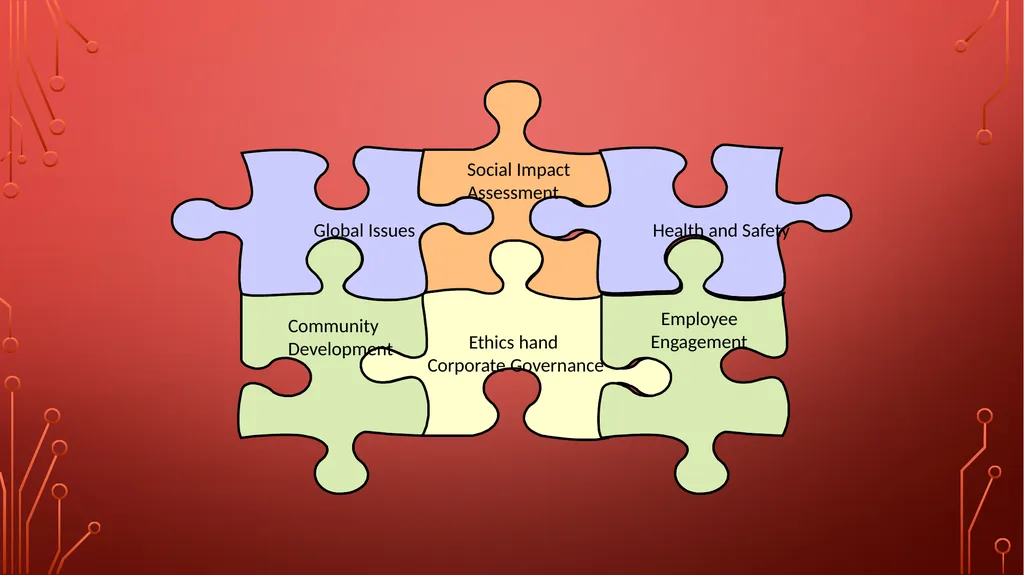
slide6. Csr initiatives Market focused
Product Focused
Employee focused
Society Focused
Environment Focused<br>
slide7. Arguments for csr Balances corporate power with responsibility
Discourages government regulation.
Promotes long term profit for business.
Responds to changing social demands
Corrects social problems caused by business.<br>
slide8. Arguments against csr Lowers economic efficiency and profit.
Imposes unequal costs among competitors.
Imposes hidden costs passed on to stakeholders.
Places responsibility on business rather than individuals
Requires social skills business may lack.<br>
slide9. Ground realities in india Inequity and Poverty a driver for CSR
Inadequate infrastructure faced by businesses
Reactive; not Proactive CSR
Good Legislation but Poor Implementation
Corruption
Variance in Governance
CSR not trickled down to SME sector<br>
slide11. Variation in approach MNC
Driven by global standards
SME’s
Work under pressure of global market for complainace
Corporate
Sometimes pushed by FI’s/Global Markets
Focus on stakeholder engagement and business linked CSR
PSU’s
Mandatory allocation of 2-5% of profits
Progressed from donations towards work in core business areas<br>
slide12. Variation in approach (sector wise) IT
Employee Engagement
Transportation
Environment & Climatic Changes
Manufacturing
Labour & Environment
Service
Raising Human Development Index<br>
slide13. Corporate social responsibility - Triple bottom line People planet profit, also known as the triple bottom line, are words that should be used and practiced in every move an organization makes.
People + Profit + Planet = Social + environmental responsibility
<br>
slide14. Corporate social responsibility - Triple bottom line People:
Measures how socially responsible an organization has been throughout its operations.
Relates to fair and beneficial business practices toward labour, the community and region where corporation conducts its business.
Examples: TATA, Marriott, Infosys, M & M<br>
slide15. Corporate social responsibility - Triple bottom line Profit:
The traditional measure of corporate profit—the P & L account.
Profit is the economic value created by the organization after deducting the cost of all inputs, including the cost of the capital tied up. It therefore differs from traditional accounting definitions of profit.
Examples: TATA, Marriott, Infosys, M & M<br>
slide16. Corporate social responsibility - Triple bottom line The Planet:
Measures how environmentally responsible a firm has been.
Planet refers to sustainable environmental practices. A triple bottom line company does not produce harmful or destructive products such as weapons, toxic chemicals or batteries containing dangerous heavy metals for example.
Examples: J & J (Using power of wind energy, supplying safe drinking water to communities)
Google ( 50 % Less energy used by their data centre in comparison with competitors )
Coca Cola (3.7 Metric ton of green house gases to the world, 25 % Carbon footprint reduced by 2020)<br>
slide17. Corporate social responsibility - Triple bottom line challenges A key challenge of the TBL, according to Elkington, is the difficulty of measuring the social and environmental bottom lines.
Profitability is inherently quantitative, so it is easy to measure.
What constitutes social and environmental responsibility, however, is somewhat subjective.
How do you put a dollar value on an oil spill—or on preventing one.<br>
slide18. Corporate social responsibility - Triple bottom line challenges Consider a clothing manufacturer whose best way to maximize profits might be to hire the least expensive labor possible and to dispose of manufacturing waste in the cheapest way possible.
These practices might well result in the highest possible profits for the company, but at the expense of miserable working and living conditions for laborers, and damage to the natural environment and the people who live in that environment
Profits do matter in the triple bottom line—just not at the expense of social and environmental concerns.<br>
slide19. Corporate social responsibility - Triple bottom line examples Axion Structural Innovations LLC (privately held; Zanesville, Ohio) is known for its commitment to sustainability. Axion builds railroad ties and pilings using recycled plastic bottles and industrial waste instead of standard materials such as wood, steel, and cement.<br>
slide20. Corporate social responsibility - Triple bottom line examples Ben & Jerry's (NYSE: UL) is the ice cream company that made conscious capitalism central to its strategy. As stated on its website, "Ben & Jerry's is founded on and dedicated to a sustainable corporate concept of linked prosperity." The company supports opposing the use of recombinant bovine growth hormone (rBGH) and genetically modified organisms (GMOs) and fosters myriad values such as fair trade and climate justice.
Interestingly, in 2000 Ben & Jerry's became a wholly-owned subsidiary of Unilever PLC, the British-Dutch Multinational Corporation (MNC). Was Unilever's acquisition emblematic of corporations' renewed interest? Part of the deal was that Unilever agreed to encourage, and fund, Ben & Jerry's social missions; and in turn, Ben & Jerry's would help to strengthen Unilever's social practices worldwide.<br>
slide21. Corporate social responsibility - Triple bottom line examples The LEGO Group (privately held; Billund, Denmark) has formed partnerships with organizations like the non-governmental organization (NGO), World Wildlife Fund. In addition, LEGO has made a commitment to reduce its carbon footprint and is working towards 100% renewable energy capacity by 2030.<br>
slide22. Corporate social responsibility - Triple bottom line examples Starbucks Corporation which has been socially and environmentally focused since its inception in 1971, promises to hire 25,000 veterans before 2025.<br>