
CUMIN GODI SUSMITHA CUMIN Scientific Name :
T
Published · 11 slides · 0 views

1 / 1


Description
CUMIN GODI SUSMITHA CUMIN Scientific Name : Cuminum cyminum L. Family : Apiaceae Umbelliferae English name : Cumin Indian name: Jiro, Jeera, Zira or Safoid Jeero or Zeera (Hindi), Sofaid Jiro or Zeera (Bengali and Punjabi), Jiru or Jeeru
Related Topics
Share
Embed code
Download this presentation From Below
"CUMIN GODI SUSMITHA CUMIN Scientific Name :" is the property of its rightful owner. Permission is granted to download and print the materials on this website for personal, non-commercial use only, and to display it on your personal computer provided you do not modify the materials and that you retain all copyright notices contained in the materials. By downloading content from our website, you accept the terms of this agreement.
Presentation Transcript
01
CUMIN GODI SUSMITHA<br>
02
CUMIN
Scientific Name : Cuminum cyminum L.
Family : Apiaceae/ Umbelliferae
English name : Cumin
Indian name: Jiro, Jeera, Zira or Safoid Jeero or Zeera (Hindi), Sofaid Jiro or Zeera (Bengali and Punjabi), Jiru or Jeeru (Gujarati), Jeerige (Kannada), Zyur (Kashmiri), Jeerakam (Malayalam), Jeregire ( Marathi), Jira, Jeera (Oriya), Jiraka, Jiro (Sanskrit), Zero(Sindhi), Ziragam or Jeeragom (Tamil), Jidakara, Jikaka (Telugu<br>
03
IMPORTANCE AND USES:
Cumin or Safaid jeera (Cuminurn cyminum L.) is one of the oldest spices known to mankind.
It is the ripe fruit of a slender herb.
Cumin seeds are yellowish to greyish-brown and have an aromatic odour due to the presence of an aromatic alcohol, cuminol, and a spicy somewhat bitter taste, and are extensively used as a condiment.
Cumin is used as an essential ingredient in all mixed spices and curry powder for flavouring soups, pastries, stews, sausages, pickles, cheese and for seasoning bakery products such as bread and cakes
. Cumin oil is used in soaps, perfumery and for flavouring liquors and cordials.
The absolute is superior to the oil for flavouring. Cumin aldehyde is also used in perfumery.
Cumin seeds yield a volatile oil (2.5 to 4.5 %), the chief constituent of which is cuminaldehyde (20-40%) which is used in perfumery.
In addition to this, seeds also contain a fixed oil (10%) with a strong aromatic flavour. It is also used as a ingredient in many Ayuruedic medicines.
It is prescribed as a stimulant and carminative in indigenous medicines.
It is an astringent and is useful in flatulence and griping, and in conditions of diarrhoea and dyspepsia.
Cumin seeds are now chiefly used in many veterinary drugs.
The distillation-residue water of the oil is given to children as carminative and is useful in flatulence and griping.
The residue left over after the extraction of volatile oil contains 17.2% protein and 30% fat.
It can be used as a cattle feed. The fixed oil could also find use in the oil, fat and soap industries<br>
04
Origin and distribution
Cumin is a native of Egypt, Syria, Turkey and the Eastern Mediterranean region.
It is an important cash crop of India, Argentina, Cyprus, Denmark, Mexico, USSR, Pakistan, Syria, Iran, Morocco, Turkey, China, Southern Russia, Indonesia and Japan.
Iran is the major world exporter of the cumin seed known as 'green cumin'. In India, it is cultivated on a commercial scale in Rajasthan, Gujarat, Tamil Nadu and to some extent in Uttar Pradesh, Punjab and Madhya Pradesh.
Gujarat is the leading cumin seed producing state in India accounting for about 52% of the production.
The area under cumin in India was about 2,96,990 hectares and production about 1,38,220 tonnes during 2001-02.
There are several types of cumin well-known in the international trade. These are Iranian cumin, Indian cumin, Egyptian cumin, Turkish cumin and cumin from other regions.
Area and Production:
In India the cumin is cultivated with an area of 3.77 lakh hectares with an annual production of 1.56 lakh tonnes. The productivity is 400 kg/ha. (2009-10).
About 32,500 tonnes of cumin is exported earning a foreign exchange of Rs.39.59 crores (2010-11)<br>
05
Botany:
It is a small, slender, annual herb of about 30-45 cm height, with a much-branched angular or striated stem bearing 2 or 3 linear leaves, bluish green in colour and having a sheathing base.
The flowers are white or rose coloured, borne in compound umbels.
Calyx, five-toothed gamosepalous; corolla consists of five pink-coloured but sometimes whitecoloured petals united at base; androecium consists of five stameans; anthers mature earlier than the stigma becomes receptive; gynoecium, two carpels with syncarpous inferior ovary, stigma persisting as distinct stylopodium.
The commonly known cumin seed is size of schizocarpic fruit contains single seed.
Climate
Cumin thrives well in tropical and sub-tropical climates. It can be grown from sea level upto an elevation of 1800 to 3000 MSL.
It flourishes well in a mild cool climate rather than the hot plains.
It is grown as a rabi crop during October-November. In areas where the atmospheric humidity is low during the months of February and March, which coincides with the flowering and fruiting periods, it induces the development of diseases like powdery mildew and blight and insect pests to which the crop is highly susceptible<br>
06
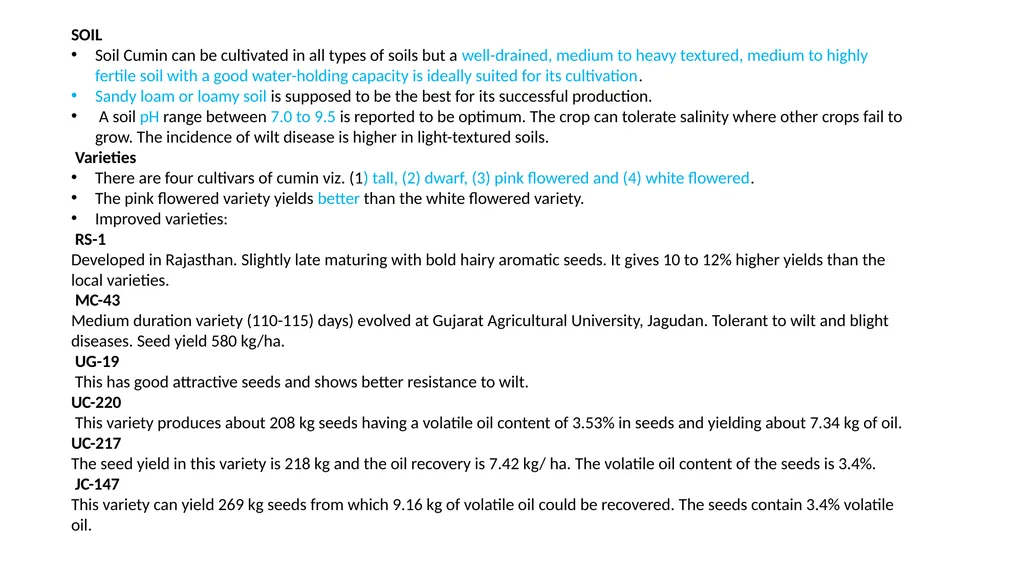
SOIL
Soil Cumin can be cultivated in all types of soils but a well-drained, medium to heavy textured, medium to highly fertile soil with a good water-holding capacity is ideally suited for its cultivation.
Sandy loam or loamy soil is supposed to be the best for its successful production.
A soil pH range between 7.0 to 9.5 is reported to be optimum. The crop can tolerate salinity where other crops fail to grow. The incidence of wilt disease is higher in light-textured soils.
Varieties
There are four cultivars of cumin viz. (1) tall, (2) dwarf, (3) pink flowered and (4) white flowered.
The pink flowered variety yields better than the white flowered variety.
Improved varieties:
RS-1
Developed in Rajasthan. Slightly late maturing with bold hairy aromatic seeds. It gives 10 to 12% higher yields than the local varieties.
MC-43
Medium duration variety (110-115) days) evolved at Gujarat Agricultural University, Jagudan. Tolerant to wilt and blight diseases. Seed yield 580 kg/ha.
UG-19
This has good attractive seeds and shows better resistance to wilt.
UC-220
This variety produces about 208 kg seeds having a volatile oil content of 3.53% in seeds and yielding about 7.34 kg of oil.
UC-217
The seed yield in this variety is 218 kg and the oil recovery is 7.42 kg/ ha. The volatile oil content of the seeds is 3.4%.
JC-147
This variety can yield 269 kg seeds from which 9.16 kg of volatile oil could be recovered. The seeds contain 3.4% volatile oil.<br>
07
RZ-19 (Rajasthan zeera-19)
This is a recurrent selection from UC-19 made at the SNJ College of Agriculture, Jobener, Rajasthan. This is a late variety, maturing in 125 days and is well adopted to late sown conditions. The variety can yield 500 kg/ha and is tolerant to Fusarium wilt and Alternaria blight diseases.
UG-198
This is highly tolerant to wilt and is very rich in volatile oil (5-6% compared to 3% in other varieties), but its grains are some what fragile and are not suitable for marketing.
UG-223
This variety can yield 301 kg of seeds and the oil recovery is 10.23 kg/ha. The seeds contain 3.40% of essential oil.<br>
08
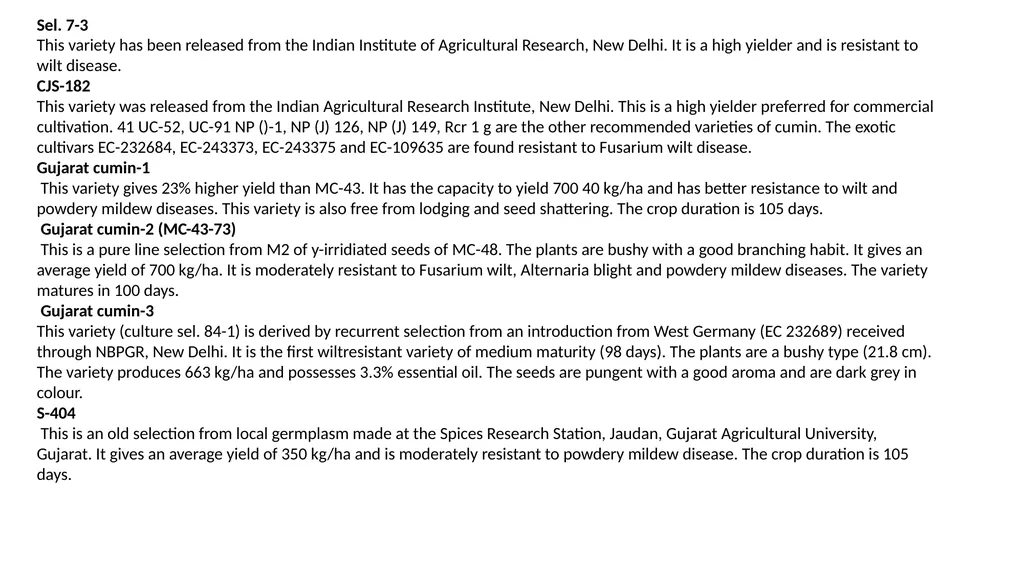
Sel. 7-3
This variety has been released from the Indian Institute of Agricultural Research, New Delhi. It is a high yielder and is resistant to wilt disease.
CJS-182
This variety was released from the Indian Agricultural Research Institute, New Delhi. This is a high yielder preferred for commercial cultivation. 41 UC-52, UC-91 NP ()-1, NP (J) 126, NP (J) 149, Rcr 1 g are the other recommended varieties of cumin. The exotic cultivars EC-232684, EC-243373, EC-243375 and EC-109635 are found resistant to Fusarium wilt disease.
Gujarat cumin-1
This variety gives 23% higher yield than MC-43. It has the capacity to yield 700 40 kg/ha and has better resistance to wilt and powdery mildew diseases. This variety is also free from lodging and seed shattering. The crop duration is 105 days.
Gujarat cumin-2 (MC-43-73)
This is a pure line selection from M2 of y-irridiated seeds of MC-48. The plants are bushy with a good branching habit. It gives an average yield of 700 kg/ha. It is moderately resistant to Fusarium wilt, Alternaria blight and powdery mildew diseases. The variety matures in 100 days.
Gujarat cumin-3
This variety (culture sel. 84-1) is derived by recurrent selection from an introduction from West Germany (EC 232689) received through NBPGR, New Delhi. It is the first wiltresistant variety of medium maturity (98 days). The plants are a bushy type (21.8 cm). The variety produces 663 kg/ha and possesses 3.3% essential oil. The seeds are pungent with a good aroma and are dark grey in colour.
S-404
This is an old selection from local germplasm made at the Spices Research Station, Jaudan, Gujarat Agricultural University, Gujarat. It gives an average yield of 350 kg/ha and is moderately resistant to powdery mildew disease. The crop duration is 105 days.<br>
09
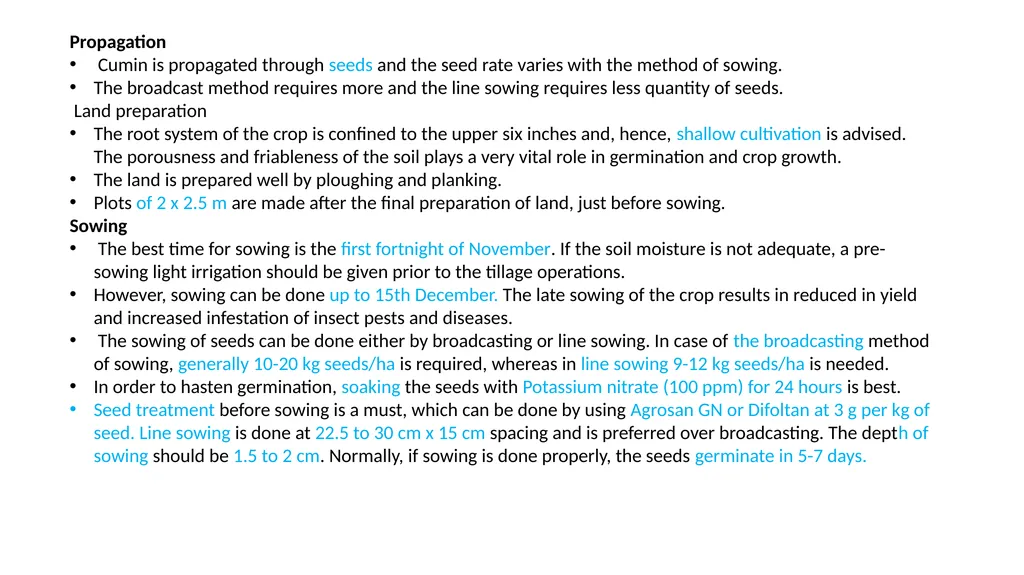
Propagation
Cumin is propagated through seeds and the seed rate varies with the method of sowing.
The broadcast method requires more and the line sowing requires less quantity of seeds.
Land preparation
The root system of the crop is confined to the upper six inches and, hence, shallow cultivation is advised. The porousness and friableness of the soil plays a very vital role in germination and crop growth.
The land is prepared well by ploughing and planking.
Plots of 2 x 2.5 m are made after the final preparation of land, just before sowing.
Sowing
The best time for sowing is the first fortnight of November. If the soil moisture is not adequate, a pre-sowing light irrigation should be given prior to the tillage operations.
However, sowing can be done up to 15th December. The late sowing of the crop results in reduced in yield and increased infestation of insect pests and diseases.
The sowing of seeds can be done either by broadcasting or line sowing. In case of the broadcasting method of sowing, generally 10-20 kg seeds/ha is required, whereas in line sowing 9-12 kg seeds/ha is needed.
In order to hasten germination, soaking the seeds with Potassium nitrate (100 ppm) for 24 hours is best.
Seed treatment before sowing is a must, which can be done by using Agrosan GN or Difoltan at 3 g per kg of seed. Line sowing is done at 22.5 to 30 cm x 15 cm spacing and is preferred over broadcasting. The depth of sowing should be 1.5 to 2 cm. Normally, if sowing is done properly, the seeds germinate in 5-7 days.<br>
10
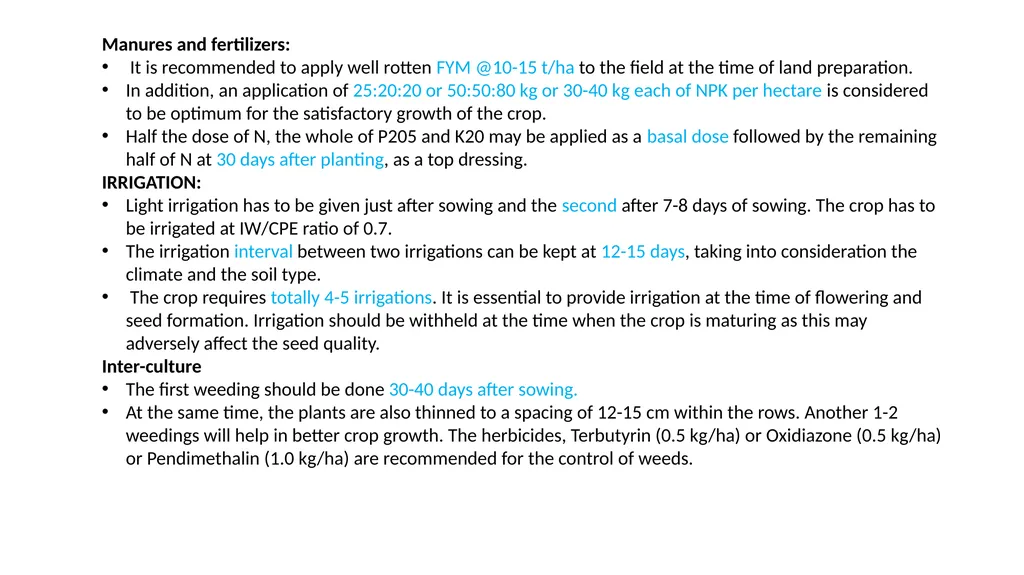
Manures and fertilizers:
It is recommended to apply well rotten FYM @10-15 t/ha to the field at the time of land preparation.
In addition, an application of 25:20:20 or 50:50:80 kg or 30-40 kg each of NPK per hectare is considered to be optimum for the satisfactory growth of the crop.
Half the dose of N, the whole of P205 and K20 may be applied as a basal dose followed by the remaining half of N at 30 days after planting, as a top dressing.
IRRIGATION:
Light irrigation has to be given just after sowing and the second after 7-8 days of sowing. The crop has to be irrigated at IW/CPE ratio of 0.7.
The irrigation interval between two irrigations can be kept at 12-15 days, taking into consideration the climate and the soil type.
The crop requires totally 4-5 irrigations. It is essential to provide irrigation at the time of flowering and seed formation. Irrigation should be withheld at the time when the crop is maturing as this may adversely affect the seed quality.
Inter-culture
The first weeding should be done 30-40 days after sowing.
At the same time, the plants are also thinned to a spacing of 12-15 cm within the rows. Another 1-2 weedings will help in better crop growth. The herbicides, Terbutyrin (0.5 kg/ha) or Oxidiazone (0.5 kg/ha) or Pendimethalin (1.0 kg/ha) are recommended for the control of weeds.<br>
11
Harvesting and yield
The crop will be ready for harvest in about 80 to 120 days after sowing.
At this stage, the leaves of the plant become yellow. The crop is harvested before the fruits shatter, by uprooting the whole plant in the morning.
The uprooted plants are stacked for 2-3 days in the sun for drying.
The seeds are separated by rubbing the plants manually or beating them with bamboo sticks. The clean and dried seeds are filled in gunny bags lined internally with a polyethylene sheet and stored in a cool dry place till they are marketed.
A disease-free field receiving the above package of practice would easily produce 8 to 15 quintals of cumin seeds per hectare.
Processing
The dried fruit or seed is crushed and distilled immediately to obtain the essential oil; steam distillation is usually carried out.
The oil recovery ranges from 2.5 to 4.5%; older seeds yield lesser oil.
On an average, an oil yield of 25-30 kg/ha is obtained. The volatile oil is colourless or pale yellow, turning dark on storage.
The oil could also be extracted by the Super-Critical Fluid Extraction (SCFE) process.
Cumin oil is often adulterated with synthetic cumin aldehyde, the presence of which in small quantities cannot be detected by routine analysis, and higher percentages affect the optical rotation.
In addition to volatile oil, the seed also contains about 10% of fixed greenish brown oil with a strong aromatic flavour. It is a semi-drying oil with an iodine value of 92. Cumin oleoresin is also obtained from the seeds.
Value Added Products:
The value added products are cuminpowder, cuminoil and cumin oleoresin.<br>