
Current procurement environment from a

Description: Current procurement environment from a consultants perspective Cape Town 15 March 2012 IMESA Seminar 1 - consulting engineers south africa (cesa) 2 - presentation outline 3 - set context construction sector decline 4 - set context -
Related Topics
Download Presentation
"Current procurement environment from a" is the property of its rightful owner. Permission is granted to download and print the materials on this website for personal, non-commercial use only, and to display it on your personal computer provided you do not modify the materials and that you retain all copyright notices contained in the materials. By downloading content from our website, you accept the terms of this agreement.
Presentation Transcript
slide1. Current procurement environment from a consultant’s perspective
Cape Town
15 March 2012 IMESA Seminar<br>
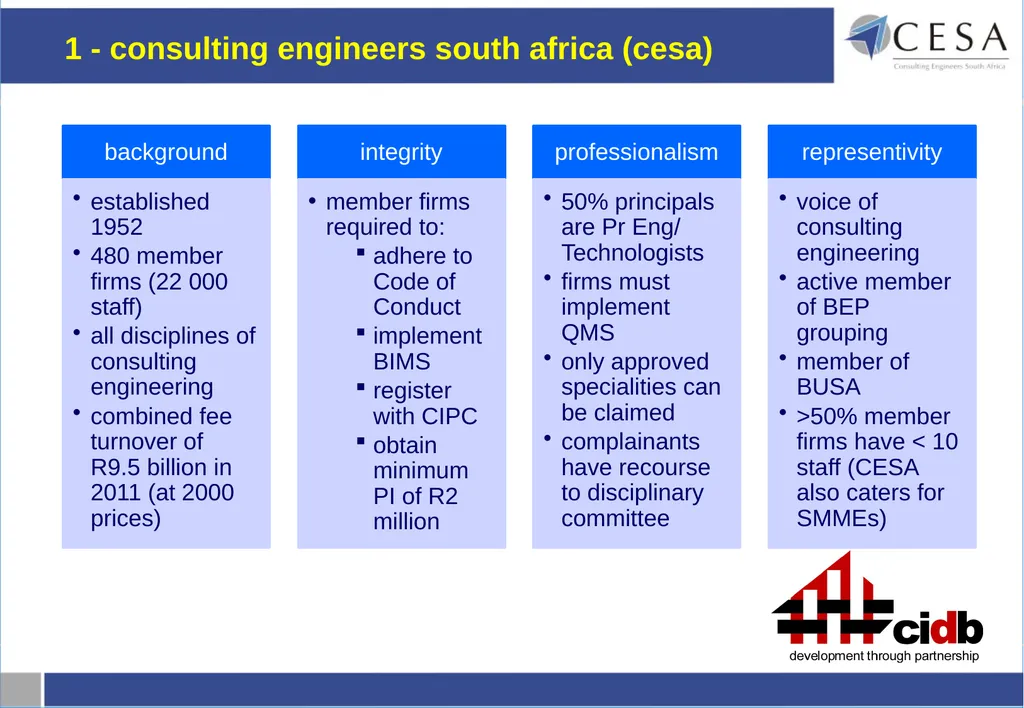
slide2. 1 - consulting engineers south africa (cesa)<br>
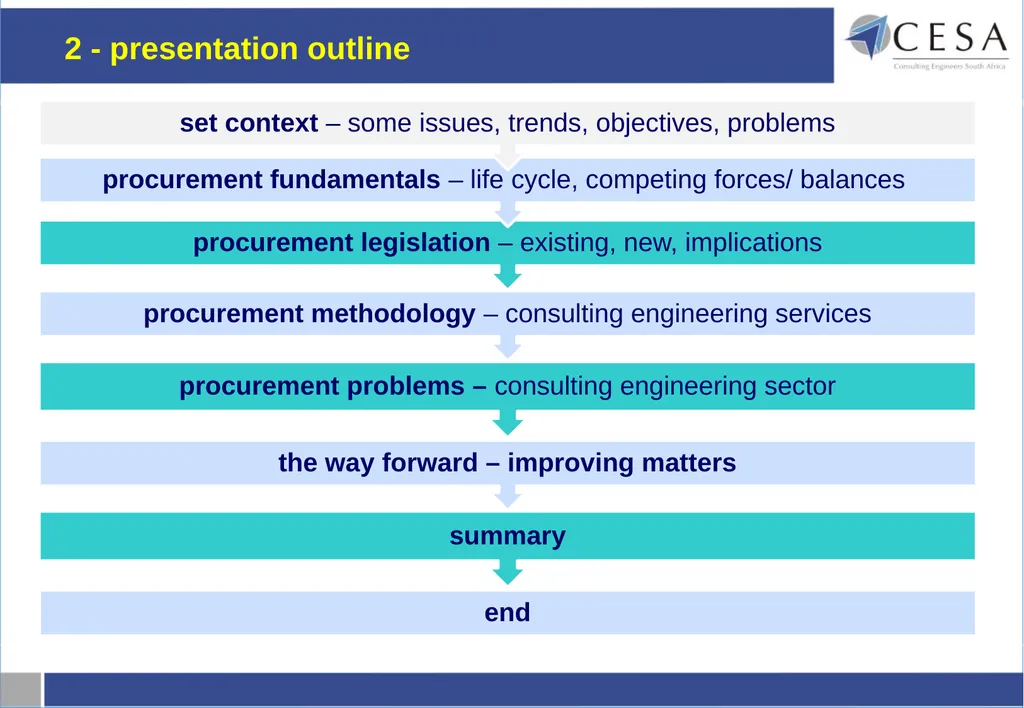
slide3. 2 - presentation outline<br>
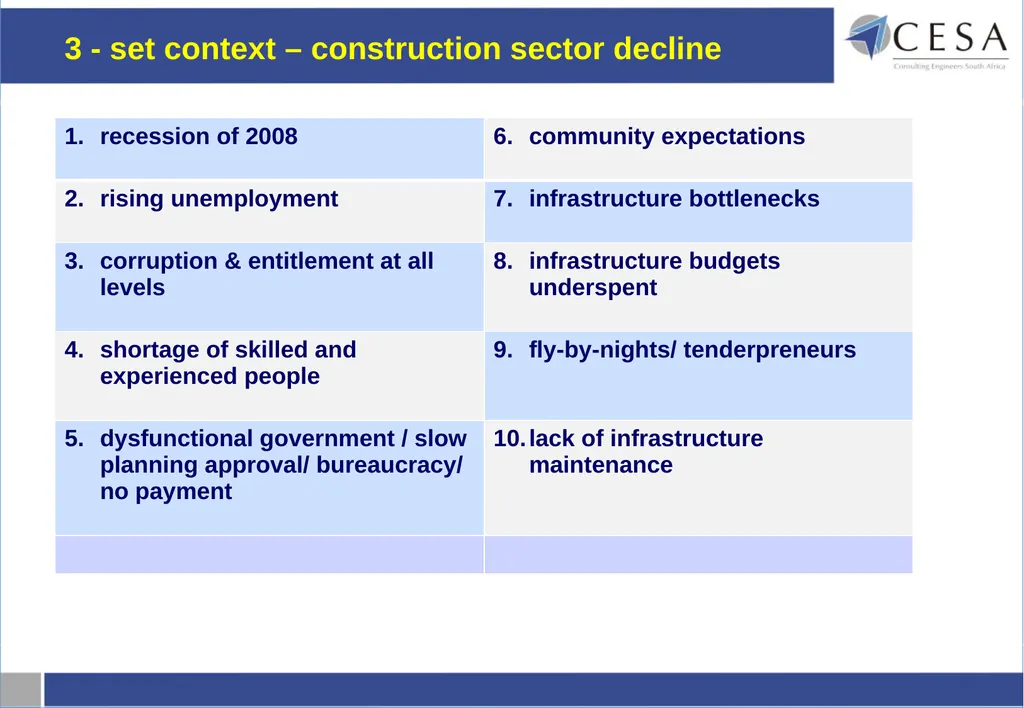
slide4. 3 - set context – construction sector decline<br>
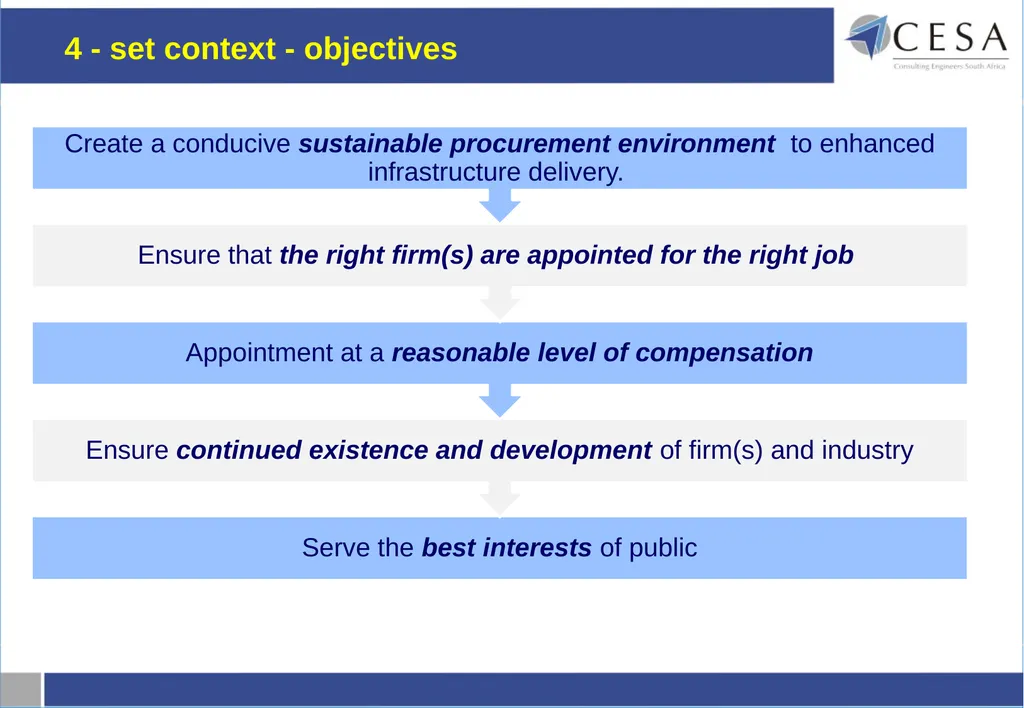
slide5. 4 - set context - objectives<br>
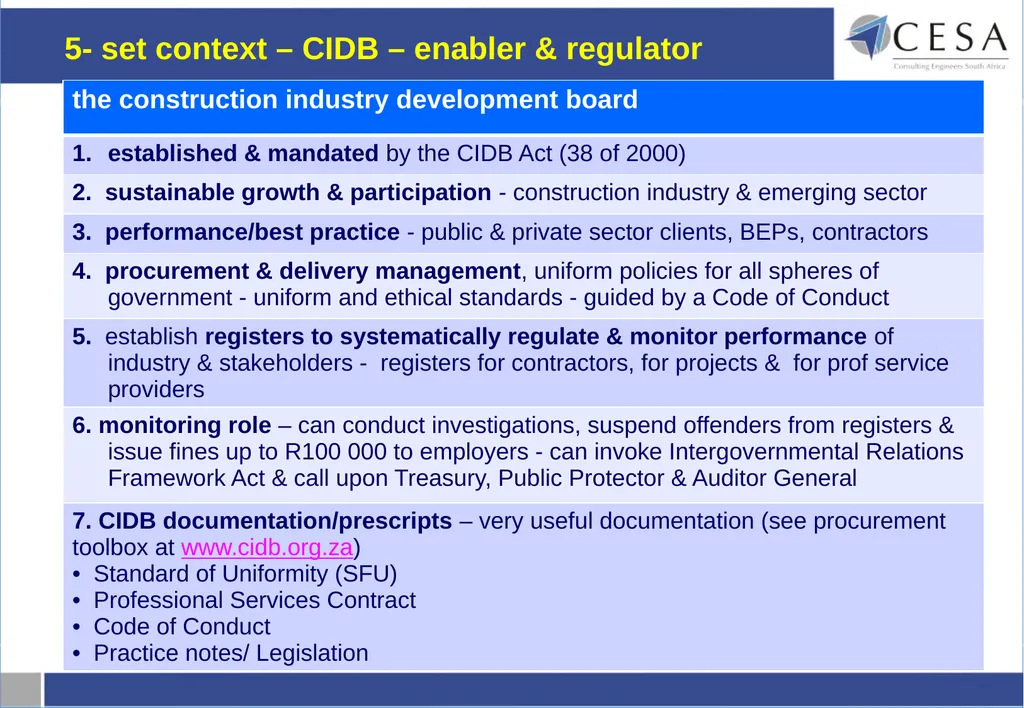
slide6. 5- set context – CIDB – enabler & regulator<br>
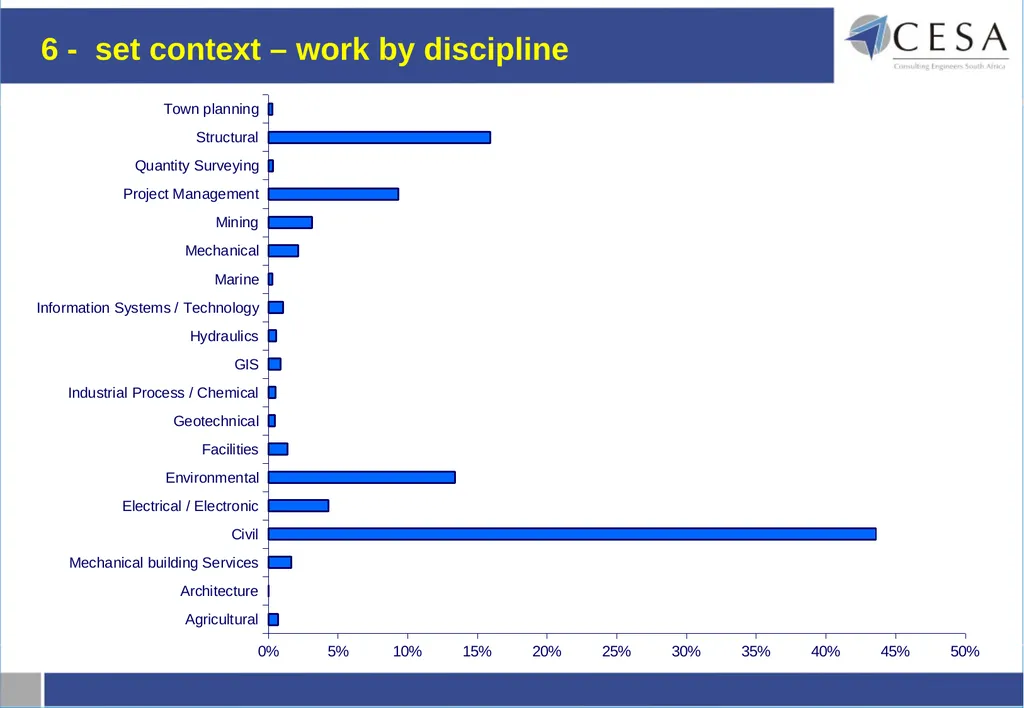
slide7. 6 - set context – work by discipline<br>
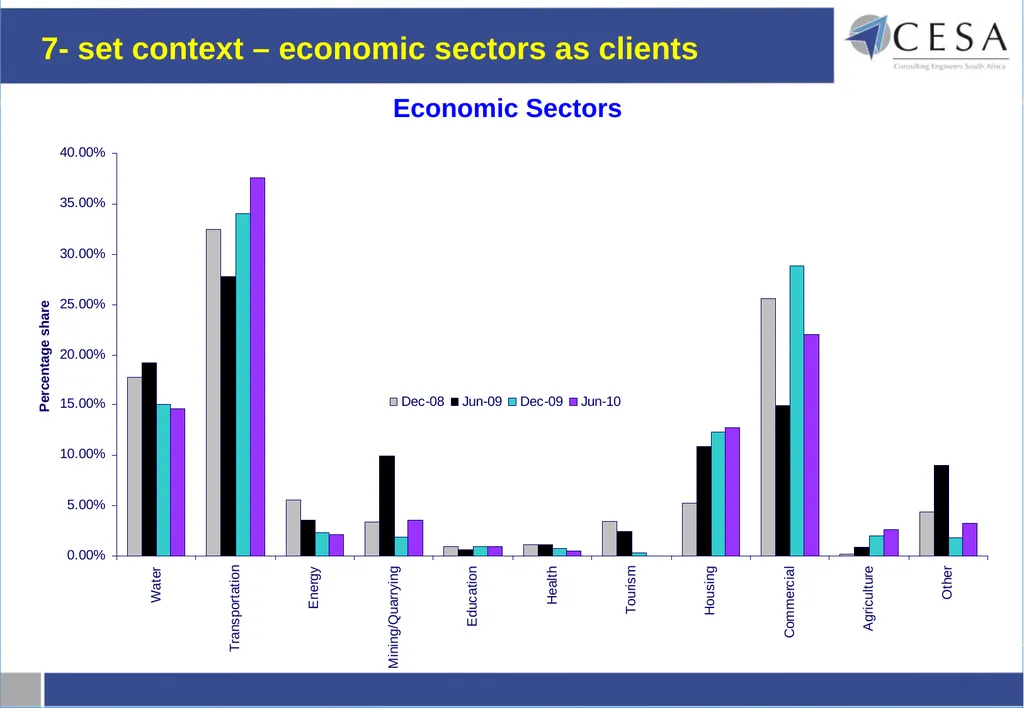
slide8. Economic Sectors 7- set context – economic sectors as clients<br>
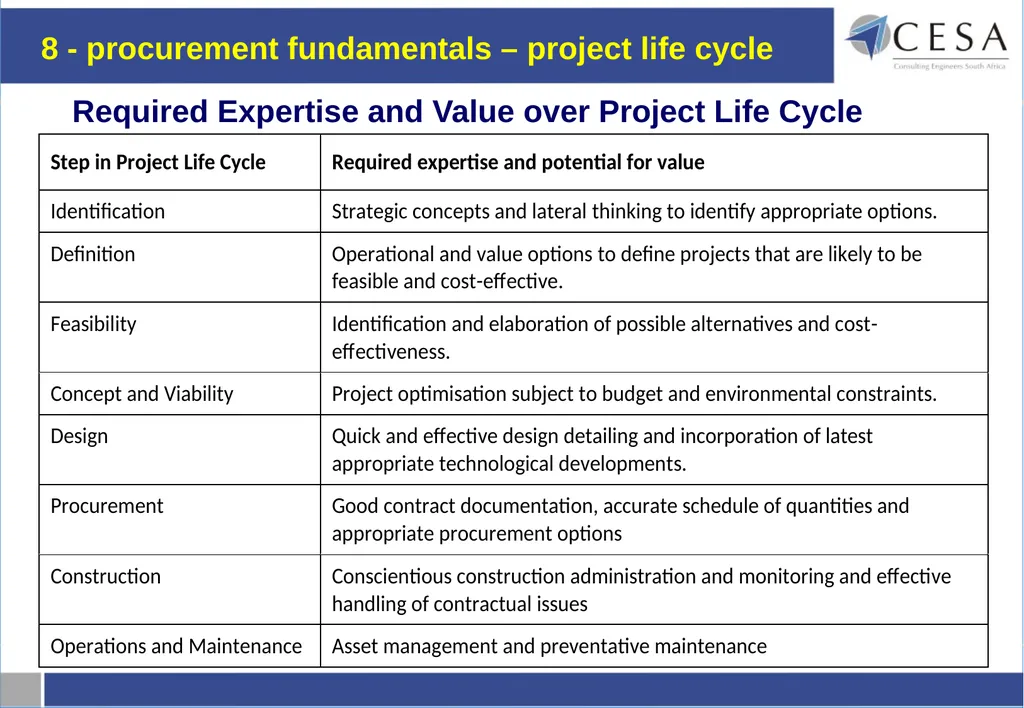
slide9. Required Expertise and Value over Project Life Cycle 8 - procurement fundamentals – project life cycle<br>
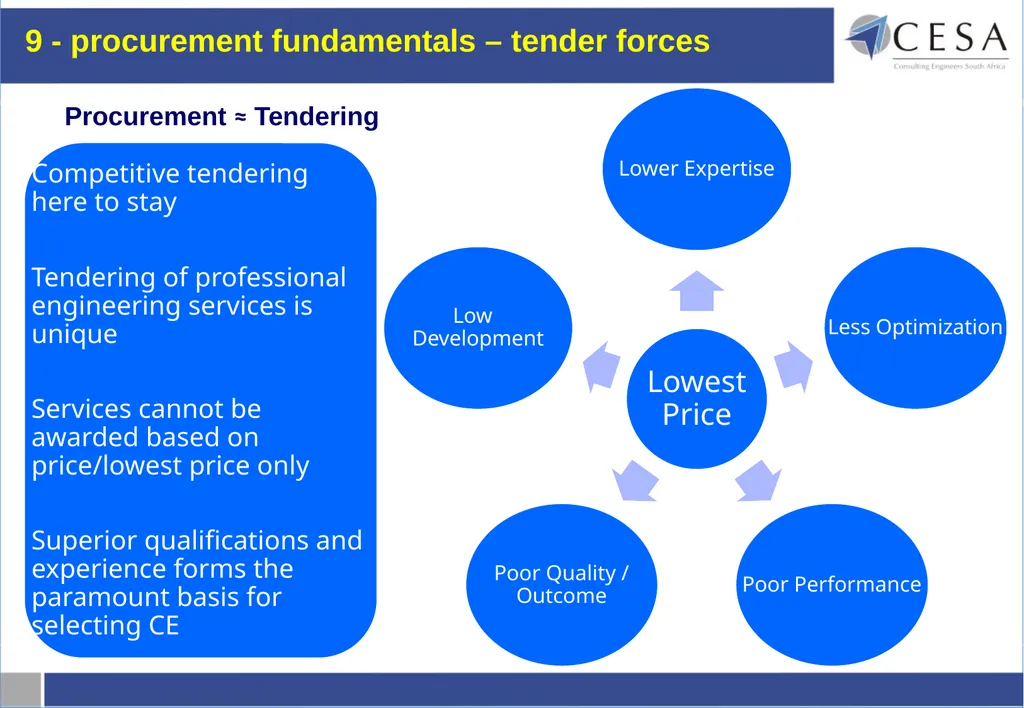
slide10. 9 - procurement fundamentals – tender forces Procurement ≈ Tendering<br>
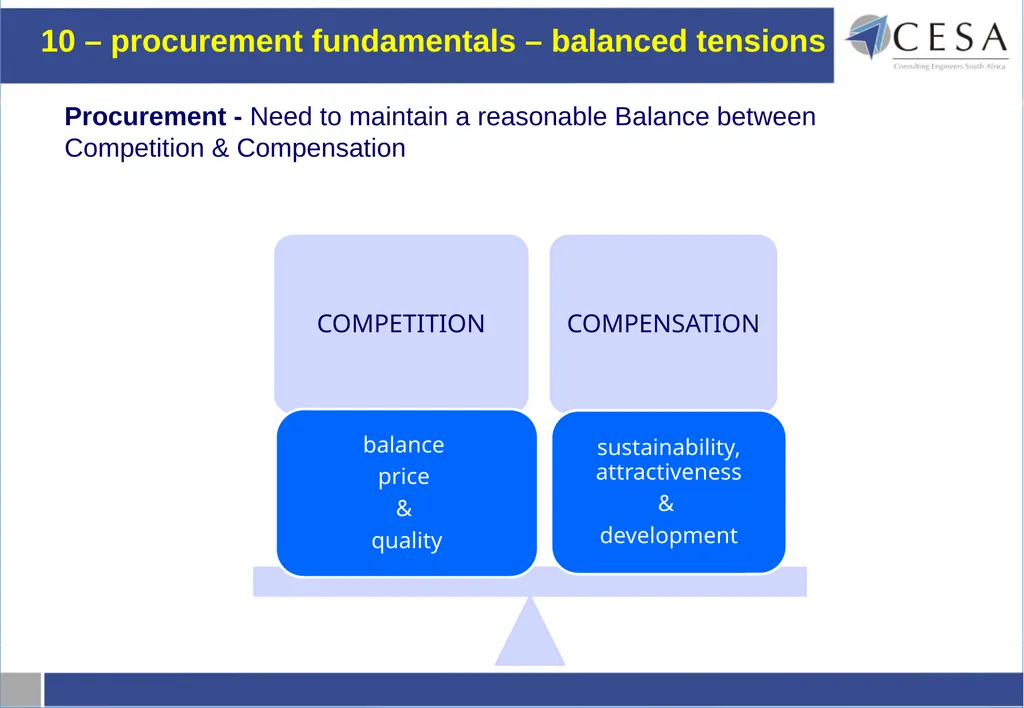
slide11. Procurement - Need to maintain a reasonable Balance between Competition & Compensation 10 – procurement fundamentals – balanced tensions<br>
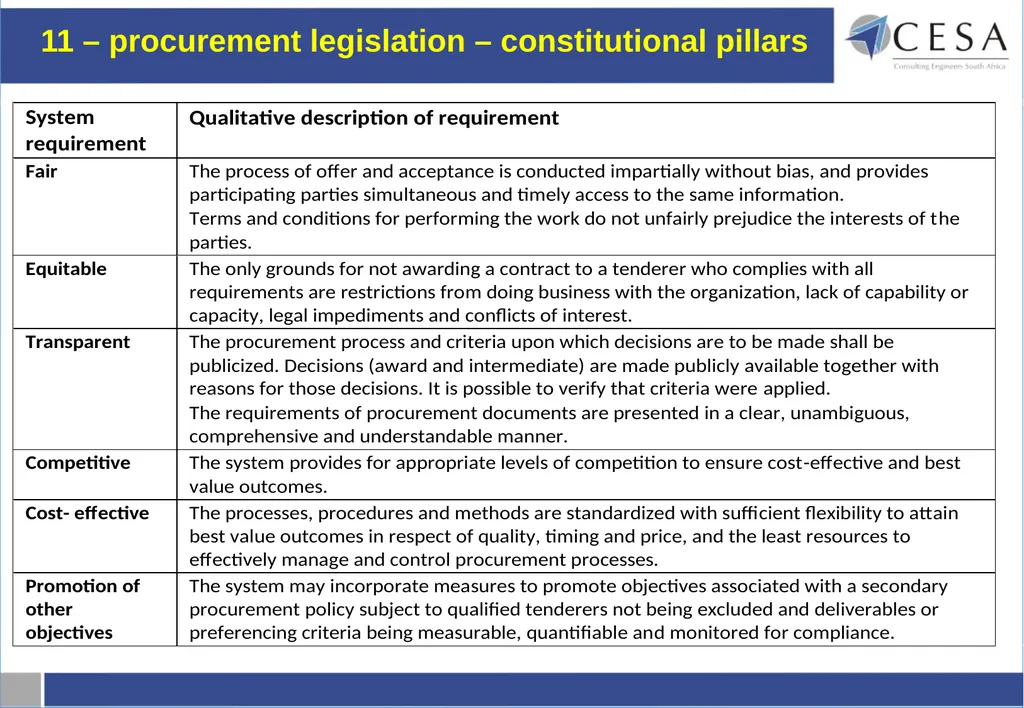
slide12. 11 – procurement legislation – constitutional pillars<br>
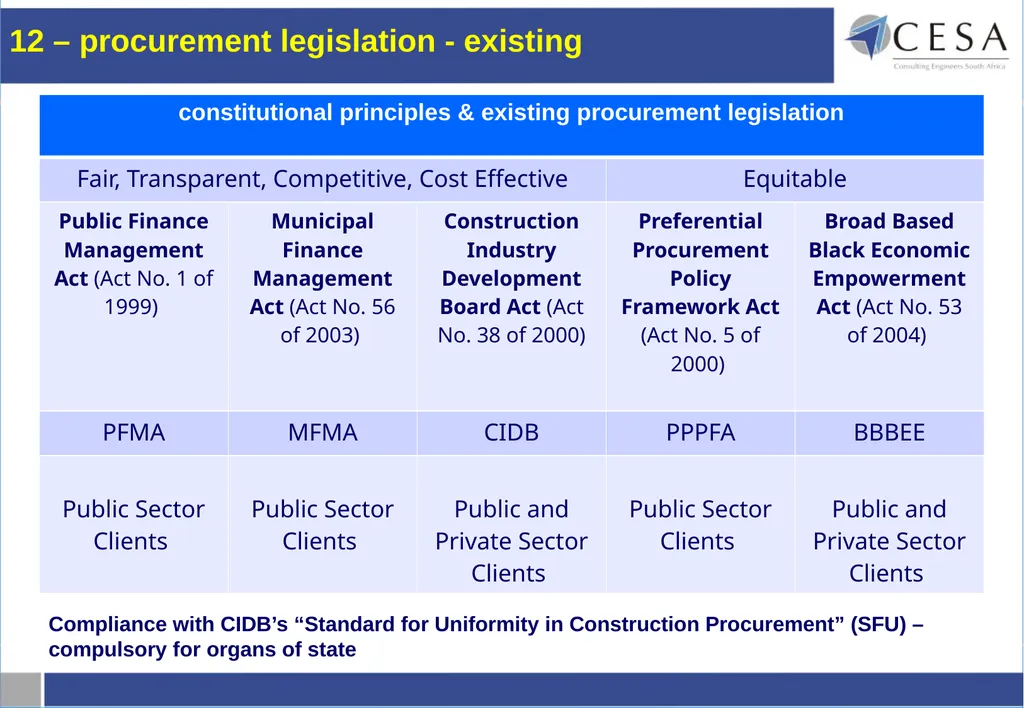
slide13. Compliance with CIDB’s “Standard for Uniformity in Construction Procurement” (SFU) – compulsory for organs of state 12 – procurement legislation - existing<br>
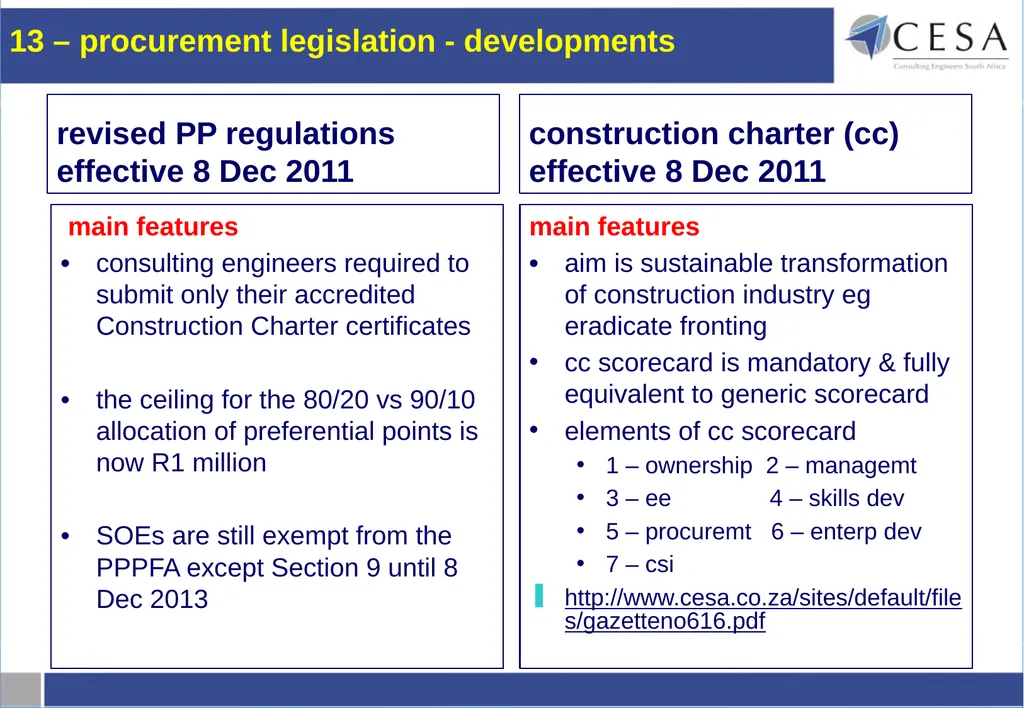
slide14. revised PP regulations effective 8 Dec 2011 main features
• consulting engineers required to submit only their accredited Construction Charter certificates
• the ceiling for the 80/20 vs 90/10 allocation of preferential points is now R1 million
• SOEs are still exempt from the PPPFA except Section 9 until 8 Dec 2013 construction charter (cc) effective 8 Dec 2011 main features
• aim is sustainable transformation of construction industry eg eradicate fronting
cc scorecard is mandatory & fully equivalent to generic scorecard
elements of cc scorecard
1 – ownership 2 – managemt
3 – ee 4 – skills dev
5 – procuremt 6 – enterp dev
7 – csi
http://www.cesa.co.za/sites/default/files/gazetteno616.pdf 13 – procurement legislation - developments<br>
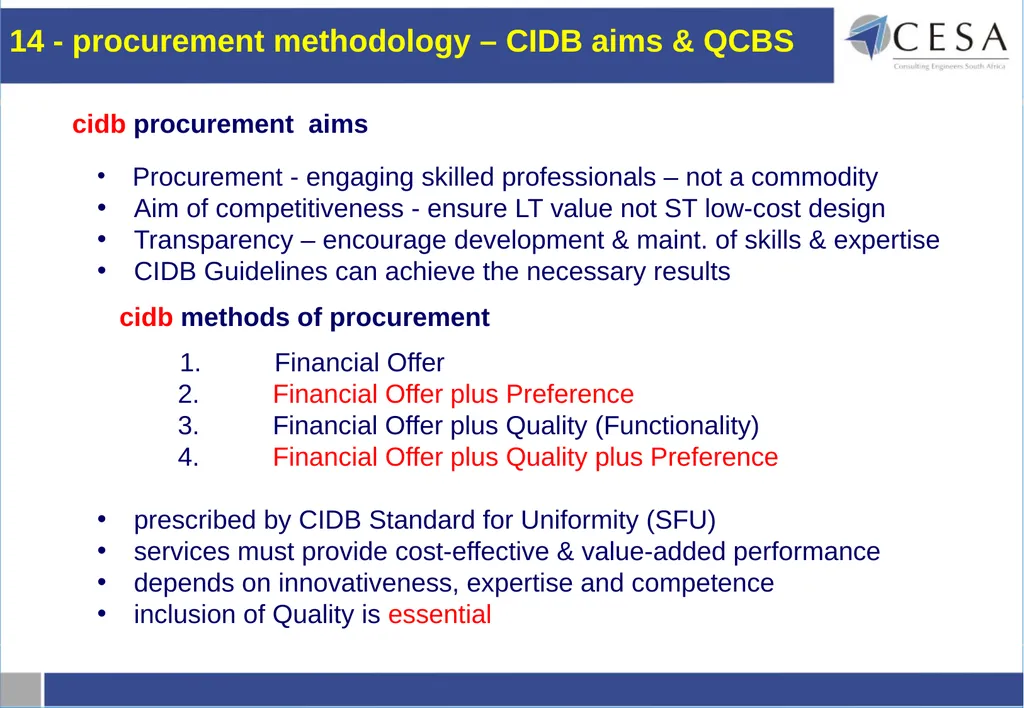
slide15. cidb procurement aims
Procurement - engaging skilled professionals – not a commodity
Aim of competitiveness - ensure LT value not ST low-cost design
Transparency – encourage development & maint. of skills & expertise
CIDB Guidelines can achieve the necessary results
cidb methods of procurement
1. Financial Offer
2. Financial Offer plus Preference
3. Financial Offer plus Quality (Functionality)
4. Financial Offer plus Quality plus Preference
prescribed by CIDB Standard for Uniformity (SFU)
services must provide cost-effective & value-added performance
depends on innovativeness, expertise and competence
inclusion of Quality is essential 14 - procurement methodology – CIDB aims & QCBS<br>
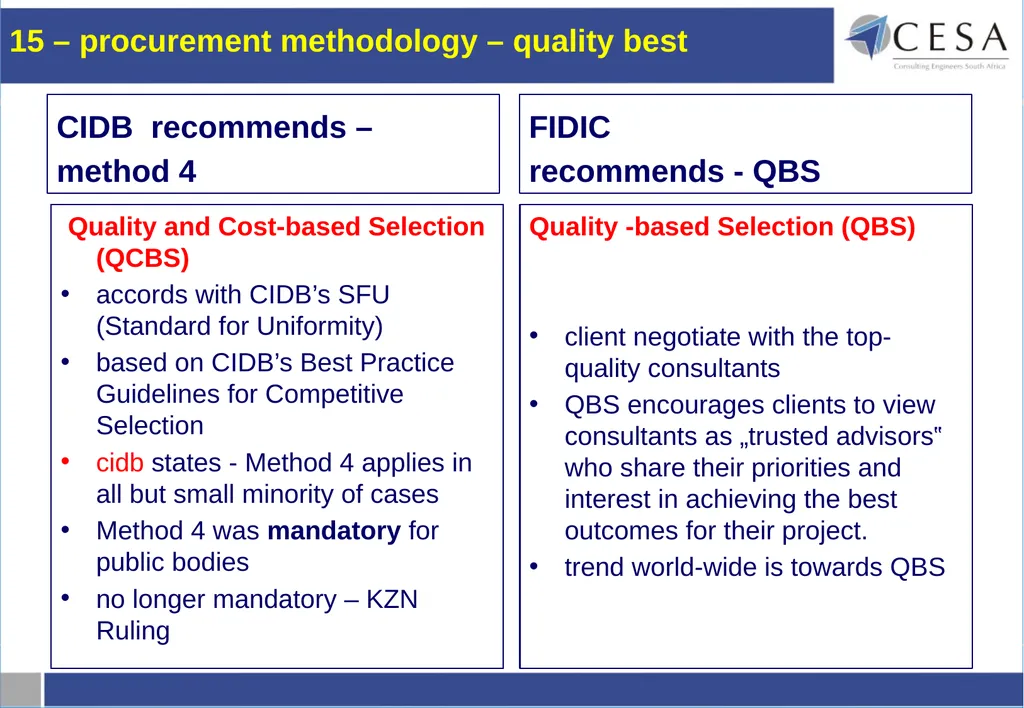
slide16. CIDB recommends –
method 4 Quality and Cost-based Selection (QCBS)
accords with CIDB’s SFU (Standard for Uniformity)
based on CIDB’s Best Practice Guidelines for Competitive Selection
cidb states - Method 4 applies in all but small minority of cases
Method 4 was mandatory for public bodies
no longer mandatory – KZN Ruling FIDIC
recommends - QBS Quality -based Selection (QBS)
client negotiate with the top-quality consultants
QBS encourages clients to view consultants as „trusted advisors‟ who share their priorities and interest in achieving the best outcomes for their project.
trend world-wide is towards QBS 15 – procurement methodology – quality best<br>
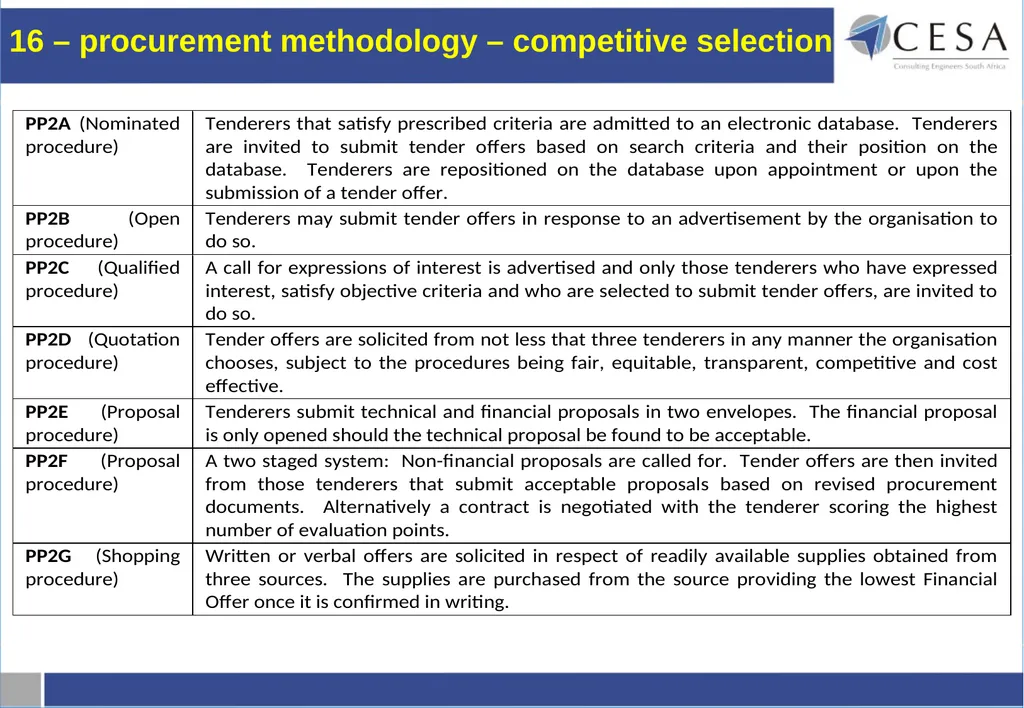
slide17. 16 – procurement methodology – competitive selection<br>
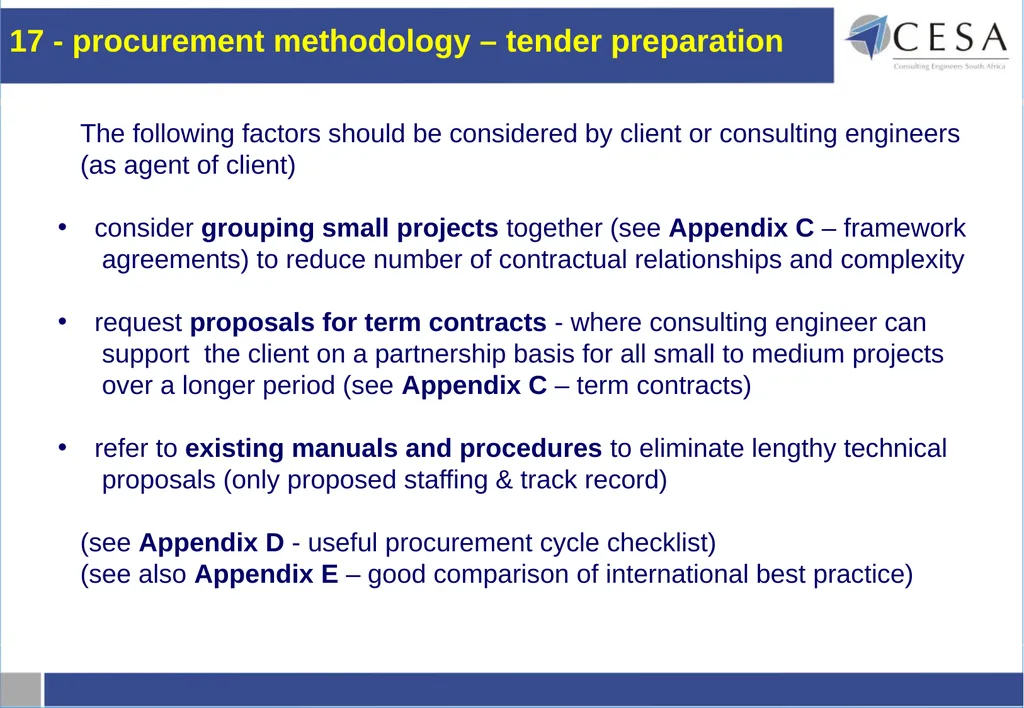
slide18. The following factors should be considered by client or consulting engineers (as agent of client)
consider grouping small projects together (see Appendix C – framework
agreements) to reduce number of contractual relationships and complexity
request proposals for term contracts - where consulting engineer can
support the client on a partnership basis for all small to medium projects
over a longer period (see Appendix C – term contracts)
refer to existing manuals and procedures to eliminate lengthy technical
proposals (only proposed staffing & track record)
(see Appendix D - useful procurement cycle checklist)
(see also Appendix E – good comparison of international best practice) 17 - procurement methodology – tender preparation<br>
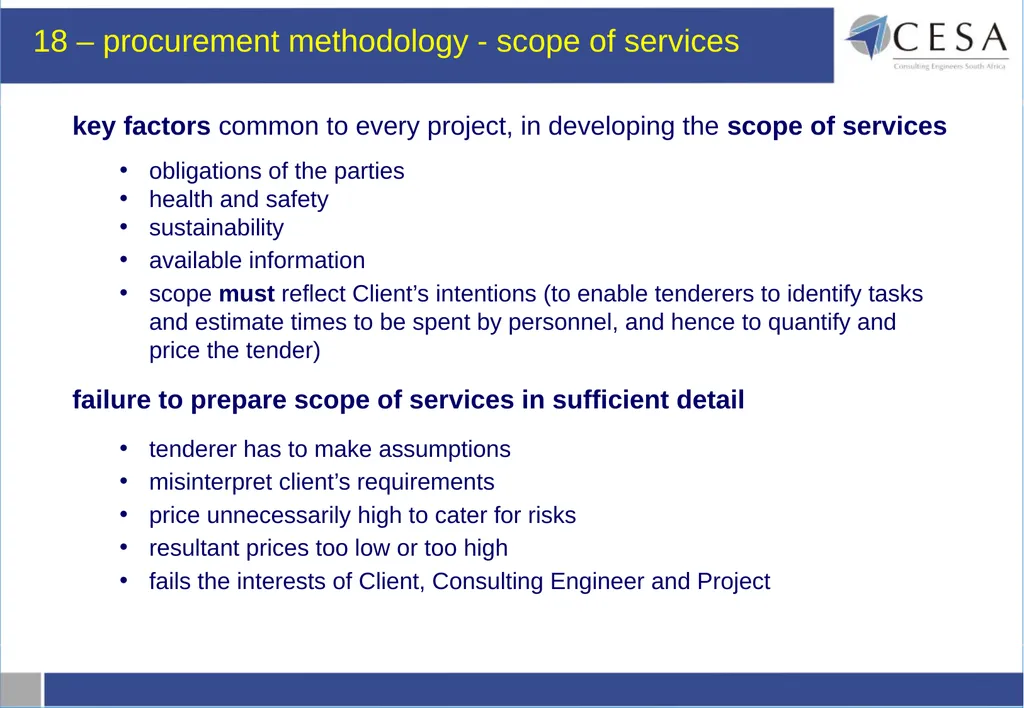
slide19. key factors common to every project, in developing the scope of services
obligations of the parties
health and safety
sustainability
available information
scope must reflect Client’s intentions (to enable tenderers to identify tasks and estimate times to be spent by personnel, and hence to quantify and price the tender)
failure to prepare scope of services in sufficient detail
tenderer has to make assumptions
misinterpret client’s requirements
price unnecessarily high to cater for risks
resultant prices too low or too high
fails the interests of Client, Consulting Engineer and Project 18 – procurement methodology - scope of services<br>
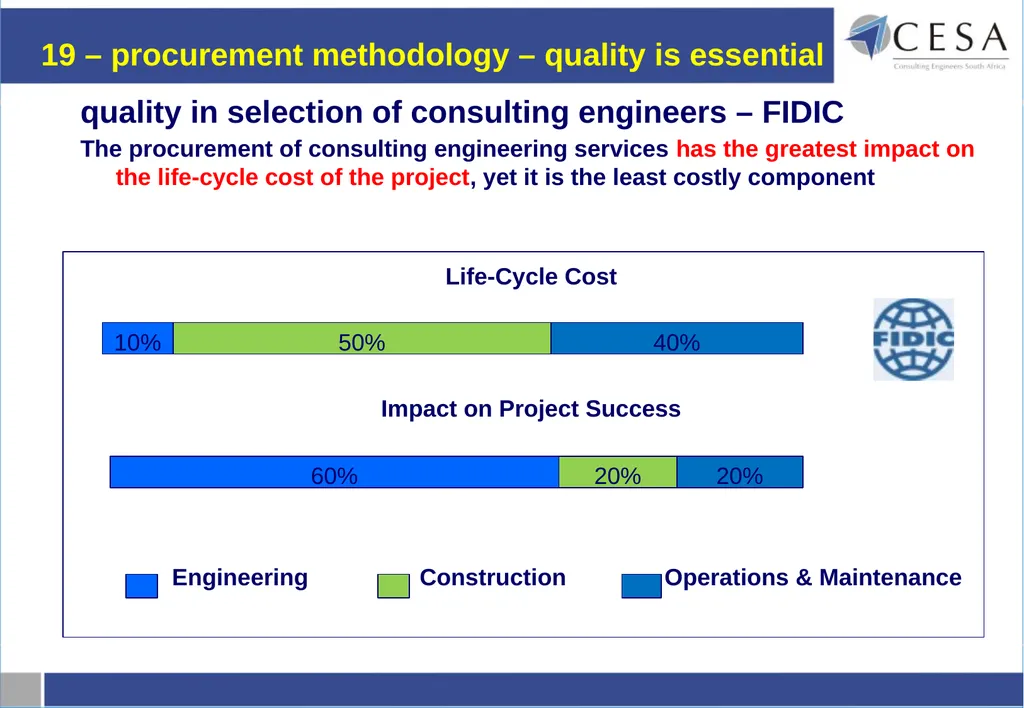
slide20. 19 – procurement methodology – quality is essential quality in selection of consulting engineers – FIDIC
The procurement of consulting engineering services has the greatest impact on the life-cycle cost of the project, yet it is the least costly component
Life-Cycle Cost
Impact on Project Success
Engineering Construction Operations & Maintenance 10% 50% 40% 60% 20% 20%<br>
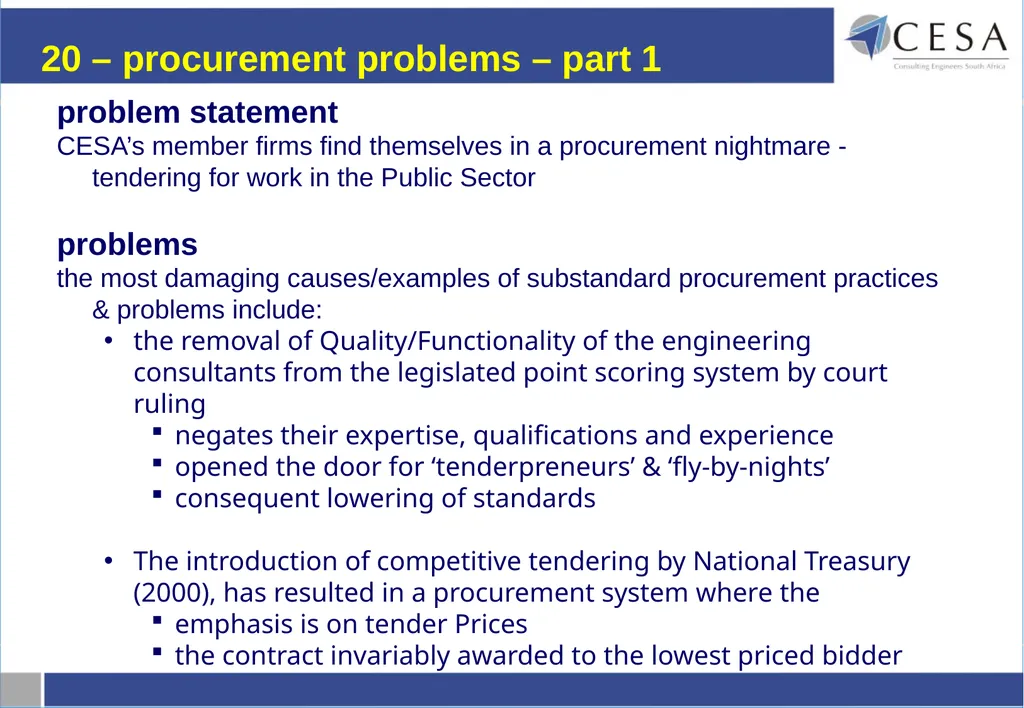
slide21. problem statement
CESA’s member firms find themselves in a procurement nightmare - tendering for work in the Public Sector
problems
the most damaging causes/examples of substandard procurement practices & problems include:
the removal of Quality/Functionality of the engineering consultants from the legislated point scoring system by court ruling
negates their expertise, qualifications and experience
opened the door for ‘tenderpreneurs’ & ‘fly-by-nights’
consequent lowering of standards
The introduction of competitive tendering by National Treasury (2000), has resulted in a procurement system where the
emphasis is on tender Prices
the contract invariably awarded to the lowest priced bidder
. 20 – procurement problems – part 1<br>
slide22. The treatment of consulting engineering services not as unique professional services but as ‘Goods’ as defined in the NT General Conditions of Contract, has resulted in the widespread practice whereby municipalities and government departments call for consulting engineers to substantially ‘discount their fees’ in order to win tenders.
The confusion of procurement functions in government structures eg NT, NDPW, CIDB, and DTI have their own procurement requirements, and allowing SOEs to differ from the PPPFA and to implement their own BBBEE criteria, eg Eskom, ACSA and DBSA, have greatly complicated the procurement of consulting engineers in the public sector.
The complexity has served to provide hidden opportunities for wide scale corruption as well as to challenge the capacity of the SCM officials at these organisations
The lack of technical staff in government departments & municipalities to assist with the technical planning and tender process has severely hampered service delivery and the provision of engineering infrastructure.
For for non-technical staff, it is difficult to evaluate and adjudicate tenders for consulting engineering appointments ito Quality/Functionality
. 21 – procurement problems – part 2<br>
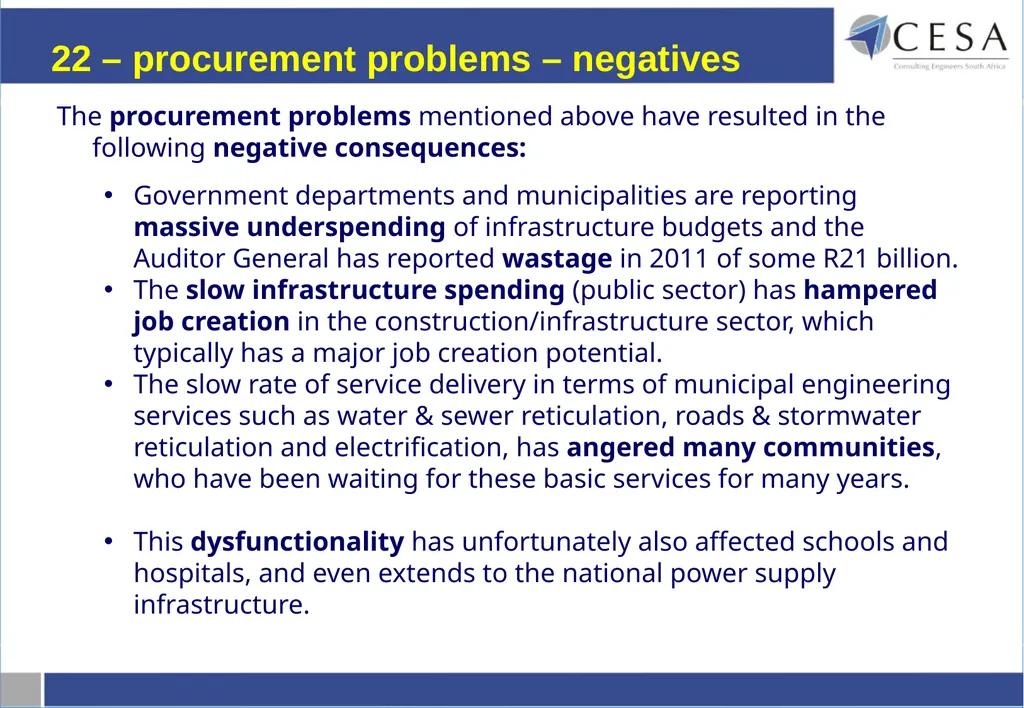
slide23. The procurement problems mentioned above have resulted in the following negative consequences:
Government departments and municipalities are reporting massive underspending of infrastructure budgets and the Auditor General has reported wastage in 2011 of some R21 billion.
The slow infrastructure spending (public sector) has hampered job creation in the construction/infrastructure sector, which typically has a major job creation potential.
The slow rate of service delivery in terms of municipal engineering services such as water & sewer reticulation, roads & stormwater reticulation and electrification, has angered many communities, who have been waiting for these basic services for many years.
This dysfunctionality has unfortunately also affected schools and hospitals, and even extends to the national power supply infrastructure. 22 – procurement problems – negatives<br>
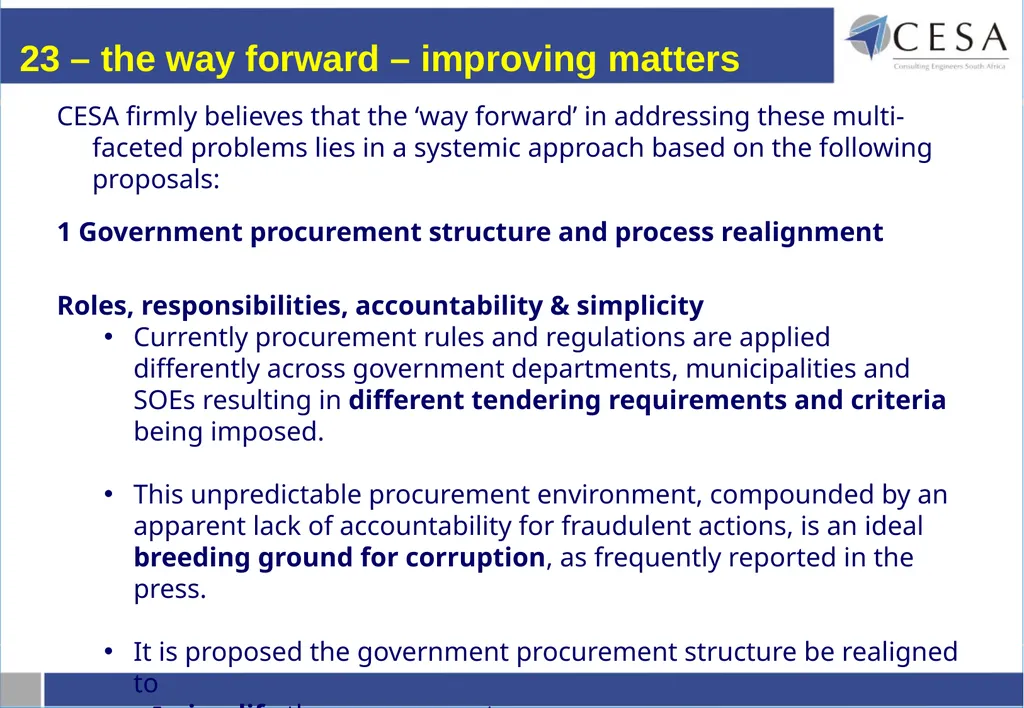
slide24. CESA firmly believes that the ‘way forward’ in addressing these multi-faceted problems lies in a systemic approach based on the following proposals:
1 Government procurement structure and process realignment
Roles, responsibilities, accountability & simplicity
Currently procurement rules and regulations are applied differently across government departments, municipalities and SOEs resulting in different tendering requirements and criteria being imposed.
This unpredictable procurement environment, compounded by an apparent lack of accountability for fraudulent actions, is an ideal breeding ground for corruption, as frequently reported in the press.
It is proposed the government procurement structure be realigned to
simplify the procurement process
establish responsibilities & allocate accountability 23 – the way forward – improving matters<br>
slide25. Separation of procurement processes
Feedback from consulting engineering firms is that invariably “Supply Chain Management” officials who are faced with a mountain of legislation, practice notes and challenged by a complex procurement procedure, treat the procurement of consulting engineering services not as the procurement of “unique professional services” but as the procurement of “goods”.
Typically the SCM officials have no technical training or skills and are unable to evaluate tenderers according to their expertise, qualifications and experience.
This is compounded by failure of existing legislation to enable the best-value procurement of expert consulting engineering services
It is proposed that the PCES be separated from the Supply Chain Management procurement process - technical staff can be in-sourced for tender evaluation and adjudication purposes 24 – the way forward – improving matters<br>
slide26. Technical staff to administer PCES procurement process
The slow The failure of government departments and municipalities to effectively evaluate and adjudicate tenders for consulting engineering services, can to a large extent be attributed to the paucity of engineering staff employed at the organisations. It is critical that engineering staff who understand the intricacies of procuring professional engineering services, are employed or in-sourced.
2 Reintroduction of Quality/Functionality criteria
the trend internationally is to award consulting engineering tenders based primarily on Quality/Functionality criteria
locally consulting engineering sector has been well served by Method IV (QCBS) required by the cidb in its ‘Standard for Uniformity’ regulations, which requires the inclusion of Quality/Functionality criteria in the PPPFA point-scoring system (80/20 or 90/10). 25 – the way forward – improving matters<br>
slide27. the KZN Court ruling in 2010 disallowed Method IV thus excluding Quality/Functionality from the point-scoring criteria.
reducing the importance of Quality/Functionality in the tender award process
“opening up” the tender process to “fly-by-nights”, “tenderpreneurs”,
unsustainable “discounting of fees”.
To ensure the sustainability of the consulting engineering sector and the provision of sound infrastructure, it is imperative that this situation is rectified through the reintroduction of Quality/Functionality to the point-scoring system (Method IV).
3 revision of ECSA fees guideline
In addition the Scope of Services and Tariff of Fees Guideline produced annually by the Engineering Council of South Africa, needs investigation and revision in order to eliminate unsustainable fee discounting and to continue to provide government departments and municipalities with a benchmark of fair and reasonable fees. 26 – the way forward – improving matters<br>
slide28. The current spate of service delivery protests, infrastructure bottlenecks and the like cannot be allowed to continue. It is clear that South Africa needs to accelerate service and infrastructure delivery to improve the quality of life for all its citizens. As outlined above, three of the recommended ways to achieve this scenario are to:
simplify the procurement of consulting engineering services through the separation of PCES and SCM processes,
ensure the appointment of competent and qualified consulting engineering firms through the inclusion of technical staff in the procurement process
re-introduce Quality/Functionality criteria into the point-scoring system for PCES
In conclusion the consulting engineering sector is willing and able to assist Government in meeting the service and infrastructure delivery challenges facing South Africa. 27 – summary<br>
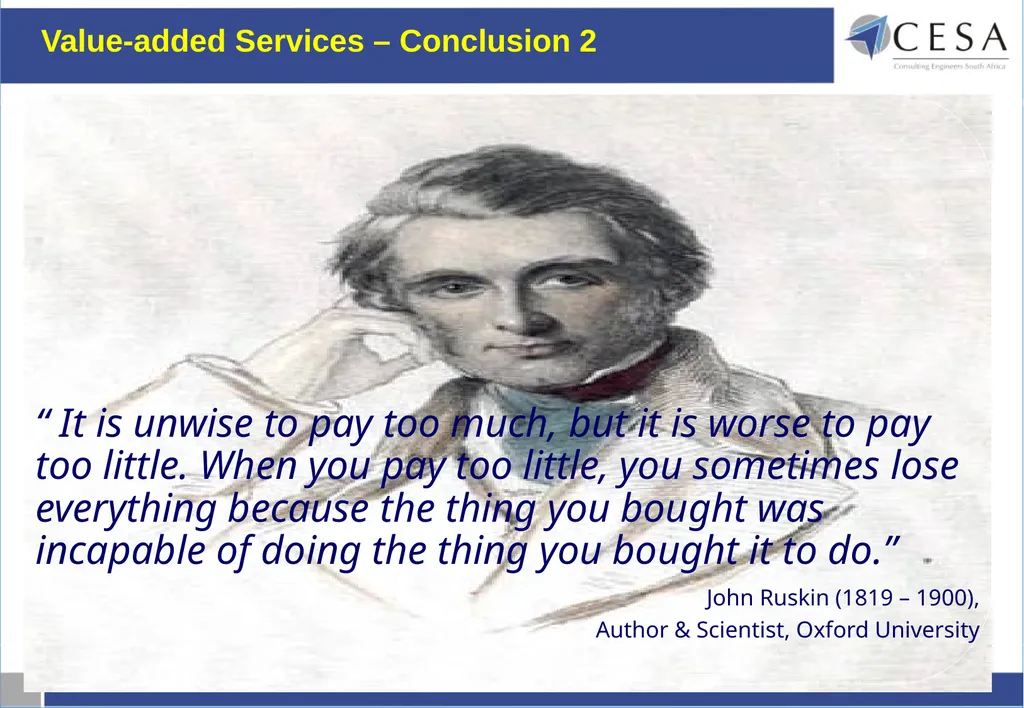
slide29. Value-added Services – Conclusion 2<br>
Cape Town
15 March 2012 IMESA Seminar<br>
slide2. 1 - consulting engineers south africa (cesa)<br>
slide3. 2 - presentation outline<br>
slide4. 3 - set context – construction sector decline<br>
slide5. 4 - set context - objectives<br>
slide6. 5- set context – CIDB – enabler & regulator<br>
slide7. 6 - set context – work by discipline<br>
slide8. Economic Sectors 7- set context – economic sectors as clients<br>
slide9. Required Expertise and Value over Project Life Cycle 8 - procurement fundamentals – project life cycle<br>
slide10. 9 - procurement fundamentals – tender forces Procurement ≈ Tendering<br>
slide11. Procurement - Need to maintain a reasonable Balance between Competition & Compensation 10 – procurement fundamentals – balanced tensions<br>
slide12. 11 – procurement legislation – constitutional pillars<br>
slide13. Compliance with CIDB’s “Standard for Uniformity in Construction Procurement” (SFU) – compulsory for organs of state 12 – procurement legislation - existing<br>
slide14. revised PP regulations effective 8 Dec 2011 main features
• consulting engineers required to submit only their accredited Construction Charter certificates
• the ceiling for the 80/20 vs 90/10 allocation of preferential points is now R1 million
• SOEs are still exempt from the PPPFA except Section 9 until 8 Dec 2013 construction charter (cc) effective 8 Dec 2011 main features
• aim is sustainable transformation of construction industry eg eradicate fronting
cc scorecard is mandatory & fully equivalent to generic scorecard
elements of cc scorecard
1 – ownership 2 – managemt
3 – ee 4 – skills dev
5 – procuremt 6 – enterp dev
7 – csi
http://www.cesa.co.za/sites/default/files/gazetteno616.pdf 13 – procurement legislation - developments<br>
slide15. cidb procurement aims
Procurement - engaging skilled professionals – not a commodity
Aim of competitiveness - ensure LT value not ST low-cost design
Transparency – encourage development & maint. of skills & expertise
CIDB Guidelines can achieve the necessary results
cidb methods of procurement
1. Financial Offer
2. Financial Offer plus Preference
3. Financial Offer plus Quality (Functionality)
4. Financial Offer plus Quality plus Preference
prescribed by CIDB Standard for Uniformity (SFU)
services must provide cost-effective & value-added performance
depends on innovativeness, expertise and competence
inclusion of Quality is essential 14 - procurement methodology – CIDB aims & QCBS<br>
slide16. CIDB recommends –
method 4 Quality and Cost-based Selection (QCBS)
accords with CIDB’s SFU (Standard for Uniformity)
based on CIDB’s Best Practice Guidelines for Competitive Selection
cidb states - Method 4 applies in all but small minority of cases
Method 4 was mandatory for public bodies
no longer mandatory – KZN Ruling FIDIC
recommends - QBS Quality -based Selection (QBS)
client negotiate with the top-quality consultants
QBS encourages clients to view consultants as „trusted advisors‟ who share their priorities and interest in achieving the best outcomes for their project.
trend world-wide is towards QBS 15 – procurement methodology – quality best<br>
slide17. 16 – procurement methodology – competitive selection<br>
slide18. The following factors should be considered by client or consulting engineers (as agent of client)
consider grouping small projects together (see Appendix C – framework
agreements) to reduce number of contractual relationships and complexity
request proposals for term contracts - where consulting engineer can
support the client on a partnership basis for all small to medium projects
over a longer period (see Appendix C – term contracts)
refer to existing manuals and procedures to eliminate lengthy technical
proposals (only proposed staffing & track record)
(see Appendix D - useful procurement cycle checklist)
(see also Appendix E – good comparison of international best practice) 17 - procurement methodology – tender preparation<br>
slide19. key factors common to every project, in developing the scope of services
obligations of the parties
health and safety
sustainability
available information
scope must reflect Client’s intentions (to enable tenderers to identify tasks and estimate times to be spent by personnel, and hence to quantify and price the tender)
failure to prepare scope of services in sufficient detail
tenderer has to make assumptions
misinterpret client’s requirements
price unnecessarily high to cater for risks
resultant prices too low or too high
fails the interests of Client, Consulting Engineer and Project 18 – procurement methodology - scope of services<br>
slide20. 19 – procurement methodology – quality is essential quality in selection of consulting engineers – FIDIC
The procurement of consulting engineering services has the greatest impact on the life-cycle cost of the project, yet it is the least costly component
Life-Cycle Cost
Impact on Project Success
Engineering Construction Operations & Maintenance 10% 50% 40% 60% 20% 20%<br>
slide21. problem statement
CESA’s member firms find themselves in a procurement nightmare - tendering for work in the Public Sector
problems
the most damaging causes/examples of substandard procurement practices & problems include:
the removal of Quality/Functionality of the engineering consultants from the legislated point scoring system by court ruling
negates their expertise, qualifications and experience
opened the door for ‘tenderpreneurs’ & ‘fly-by-nights’
consequent lowering of standards
The introduction of competitive tendering by National Treasury (2000), has resulted in a procurement system where the
emphasis is on tender Prices
the contract invariably awarded to the lowest priced bidder
. 20 – procurement problems – part 1<br>
slide22. The treatment of consulting engineering services not as unique professional services but as ‘Goods’ as defined in the NT General Conditions of Contract, has resulted in the widespread practice whereby municipalities and government departments call for consulting engineers to substantially ‘discount their fees’ in order to win tenders.
The confusion of procurement functions in government structures eg NT, NDPW, CIDB, and DTI have their own procurement requirements, and allowing SOEs to differ from the PPPFA and to implement their own BBBEE criteria, eg Eskom, ACSA and DBSA, have greatly complicated the procurement of consulting engineers in the public sector.
The complexity has served to provide hidden opportunities for wide scale corruption as well as to challenge the capacity of the SCM officials at these organisations
The lack of technical staff in government departments & municipalities to assist with the technical planning and tender process has severely hampered service delivery and the provision of engineering infrastructure.
For for non-technical staff, it is difficult to evaluate and adjudicate tenders for consulting engineering appointments ito Quality/Functionality
. 21 – procurement problems – part 2<br>
slide23. The procurement problems mentioned above have resulted in the following negative consequences:
Government departments and municipalities are reporting massive underspending of infrastructure budgets and the Auditor General has reported wastage in 2011 of some R21 billion.
The slow infrastructure spending (public sector) has hampered job creation in the construction/infrastructure sector, which typically has a major job creation potential.
The slow rate of service delivery in terms of municipal engineering services such as water & sewer reticulation, roads & stormwater reticulation and electrification, has angered many communities, who have been waiting for these basic services for many years.
This dysfunctionality has unfortunately also affected schools and hospitals, and even extends to the national power supply infrastructure. 22 – procurement problems – negatives<br>
slide24. CESA firmly believes that the ‘way forward’ in addressing these multi-faceted problems lies in a systemic approach based on the following proposals:
1 Government procurement structure and process realignment
Roles, responsibilities, accountability & simplicity
Currently procurement rules and regulations are applied differently across government departments, municipalities and SOEs resulting in different tendering requirements and criteria being imposed.
This unpredictable procurement environment, compounded by an apparent lack of accountability for fraudulent actions, is an ideal breeding ground for corruption, as frequently reported in the press.
It is proposed the government procurement structure be realigned to
simplify the procurement process
establish responsibilities & allocate accountability 23 – the way forward – improving matters<br>
slide25. Separation of procurement processes
Feedback from consulting engineering firms is that invariably “Supply Chain Management” officials who are faced with a mountain of legislation, practice notes and challenged by a complex procurement procedure, treat the procurement of consulting engineering services not as the procurement of “unique professional services” but as the procurement of “goods”.
Typically the SCM officials have no technical training or skills and are unable to evaluate tenderers according to their expertise, qualifications and experience.
This is compounded by failure of existing legislation to enable the best-value procurement of expert consulting engineering services
It is proposed that the PCES be separated from the Supply Chain Management procurement process - technical staff can be in-sourced for tender evaluation and adjudication purposes 24 – the way forward – improving matters<br>
slide26. Technical staff to administer PCES procurement process
The slow The failure of government departments and municipalities to effectively evaluate and adjudicate tenders for consulting engineering services, can to a large extent be attributed to the paucity of engineering staff employed at the organisations. It is critical that engineering staff who understand the intricacies of procuring professional engineering services, are employed or in-sourced.
2 Reintroduction of Quality/Functionality criteria
the trend internationally is to award consulting engineering tenders based primarily on Quality/Functionality criteria
locally consulting engineering sector has been well served by Method IV (QCBS) required by the cidb in its ‘Standard for Uniformity’ regulations, which requires the inclusion of Quality/Functionality criteria in the PPPFA point-scoring system (80/20 or 90/10). 25 – the way forward – improving matters<br>
slide27. the KZN Court ruling in 2010 disallowed Method IV thus excluding Quality/Functionality from the point-scoring criteria.
reducing the importance of Quality/Functionality in the tender award process
“opening up” the tender process to “fly-by-nights”, “tenderpreneurs”,
unsustainable “discounting of fees”.
To ensure the sustainability of the consulting engineering sector and the provision of sound infrastructure, it is imperative that this situation is rectified through the reintroduction of Quality/Functionality to the point-scoring system (Method IV).
3 revision of ECSA fees guideline
In addition the Scope of Services and Tariff of Fees Guideline produced annually by the Engineering Council of South Africa, needs investigation and revision in order to eliminate unsustainable fee discounting and to continue to provide government departments and municipalities with a benchmark of fair and reasonable fees. 26 – the way forward – improving matters<br>
slide28. The current spate of service delivery protests, infrastructure bottlenecks and the like cannot be allowed to continue. It is clear that South Africa needs to accelerate service and infrastructure delivery to improve the quality of life for all its citizens. As outlined above, three of the recommended ways to achieve this scenario are to:
simplify the procurement of consulting engineering services through the separation of PCES and SCM processes,
ensure the appointment of competent and qualified consulting engineering firms through the inclusion of technical staff in the procurement process
re-introduce Quality/Functionality criteria into the point-scoring system for PCES
In conclusion the consulting engineering sector is willing and able to assist Government in meeting the service and infrastructure delivery challenges facing South Africa. 27 – summary<br>
slide29. Value-added Services – Conclusion 2<br>