
‘Current Research Information Systems (CRIS): What

Description: Current Research Information Systems (CRIS): What are they and what do they do? James Toon Research Information Systems Manager, University of Edinburgh 17th March 2015 jamestoon This is a reasonable starting point But far too
Related Topics
Download Presentation
"‘Current Research Information Systems (CRIS): What" is the property of its rightful owner. Permission is granted to download and print the materials on this website for personal, non-commercial use only, and to display it on your personal computer provided you do not modify the materials and that you retain all copyright notices contained in the materials. By downloading content from our website, you accept the terms of this agreement.
Presentation Transcript
slide1. ‘Current Research Information Systems (CRIS): What are they and what do they do?’ James Toon
Research Information Systems Manager, University of Edinburgh
17th March 2015 @jamestoon<br>
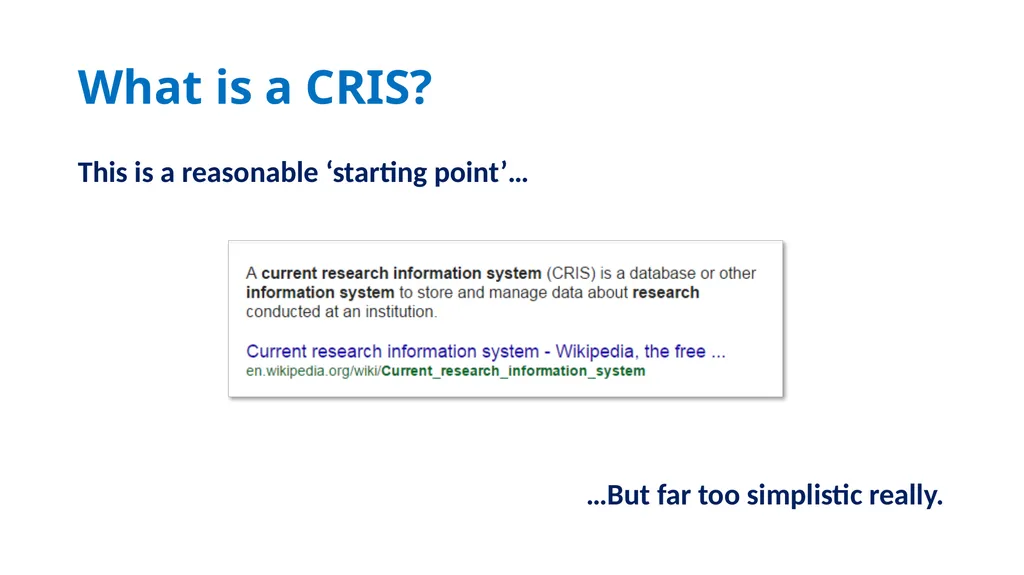
slide2. This is a reasonable ‘starting point’… …But far too simplistic really. What is a CRIS?<br>
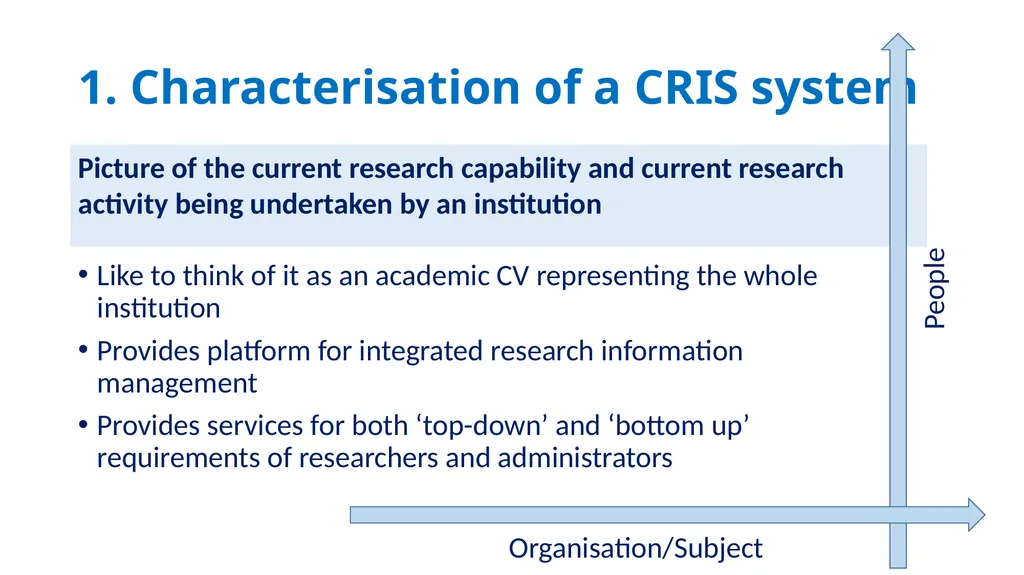
slide3. 1. Characterisation of a CRIS system Like to think of it as an academic CV representing the whole institution
Provides platform for integrated research information management
Provides services for both ‘top-down’ and ‘bottom up’ requirements of researchers and administrators Picture of the current research capability and current research activity being undertaken by an institution People Organisation/Subject<br>
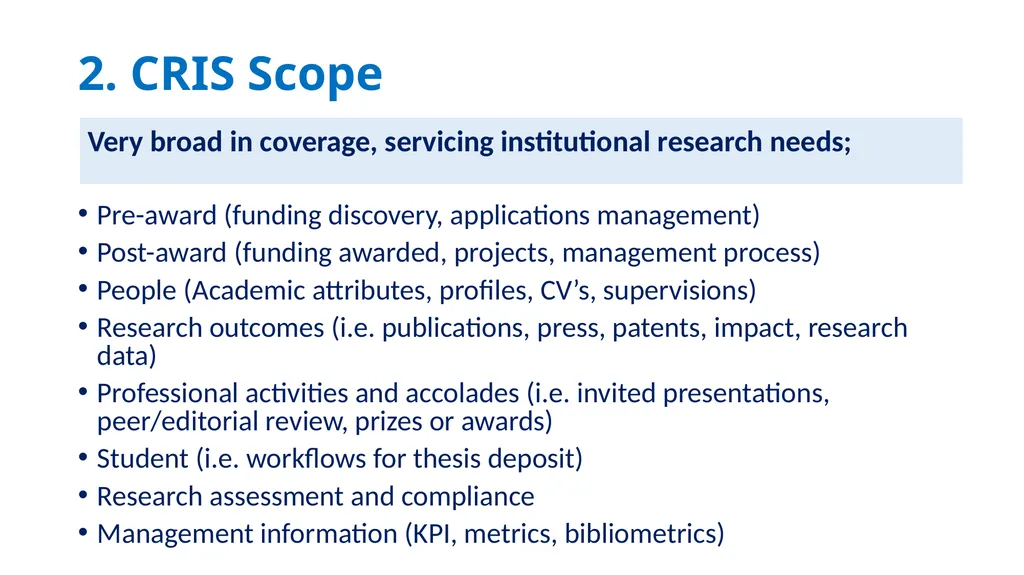
slide4. 2. CRIS Scope Pre-award (funding discovery, applications management)
Post-award (funding awarded, projects, management process)
People (Academic attributes, profiles, CV’s, supervisions)
Research outcomes (i.e. publications, press, patents, impact, research data)
Professional activities and accolades (i.e. invited presentations, peer/editorial review, prizes or awards)
Student (i.e. workflows for thesis deposit)
Research assessment and compliance
Management information (KPI, metrics, bibliometrics) Very broad in coverage, servicing institutional research needs;<br>
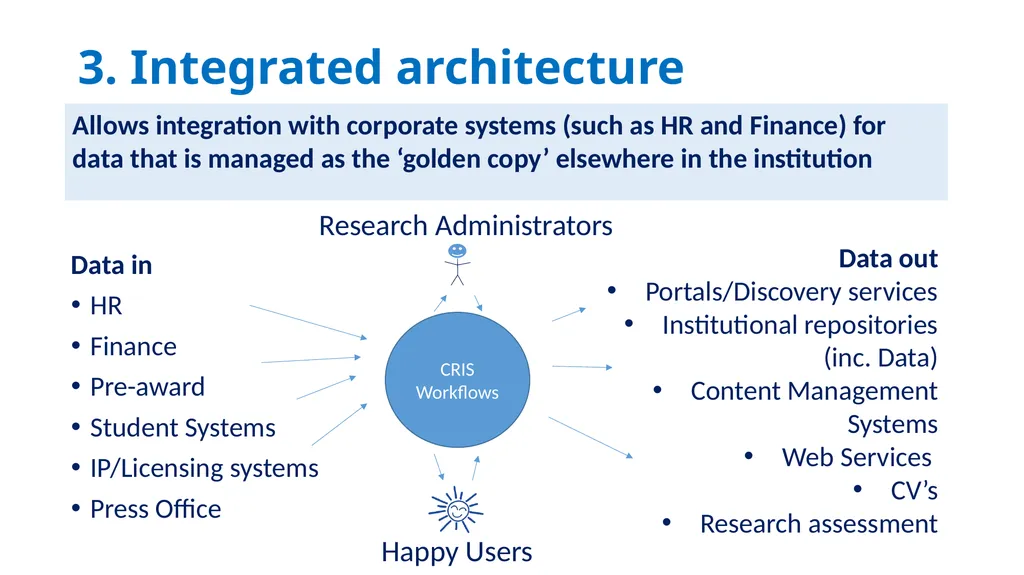
slide5. 3. Integrated architecture Data in
HR
Finance
Pre-award
Student Systems
IP/Licensing systems
Press Office Allows integration with corporate systems (such as HR and Finance) for data that is managed as the ‘golden copy’ elsewhere in the institution Data out
Portals/Discovery services
Institutional repositories (inc. Data)
Content Management Systems
Web Services
CV’s
Research assessment CRIS Workflows Happy Users Research Administrators<br>
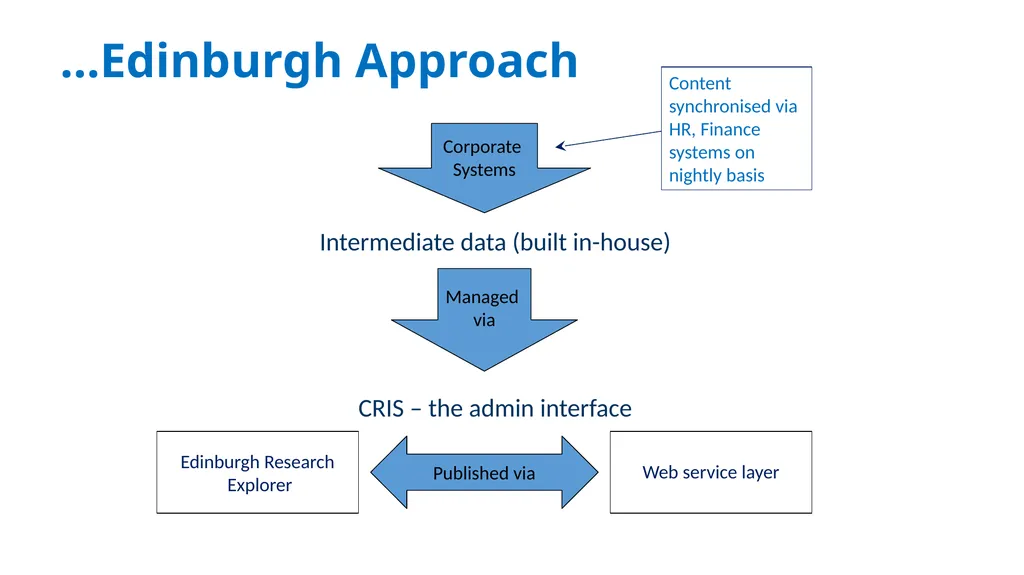
slide6. …Edinburgh Approach Intermediate data (built in-house)
CRIS – the admin interface Managed
via Corporate
Systems Edinburgh Research
Explorer Web service layer Published via Content synchronised via HR, Finance systems on nightly basis<br>
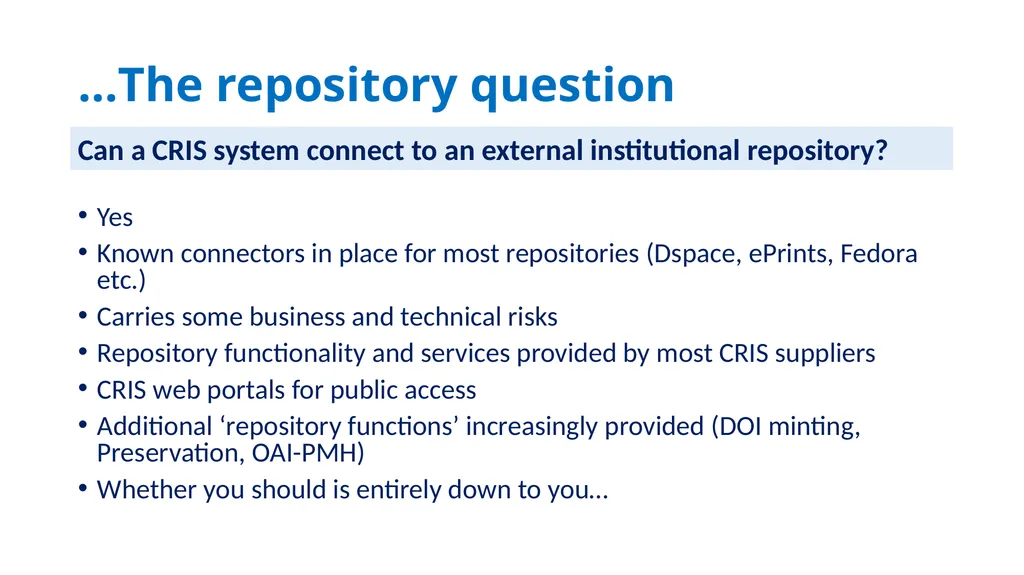
slide7. …The repository question Yes
Known connectors in place for most repositories (Dspace, ePrints, Fedora etc.)
Carries some business and technical risks
Repository functionality and services provided by most CRIS suppliers
CRIS web portals for public access
Additional ‘repository functions’ increasingly provided (DOI minting, Preservation, OAI-PMH)
Whether you should is entirely down to you… Can a CRIS system connect to an external institutional repository?<br>
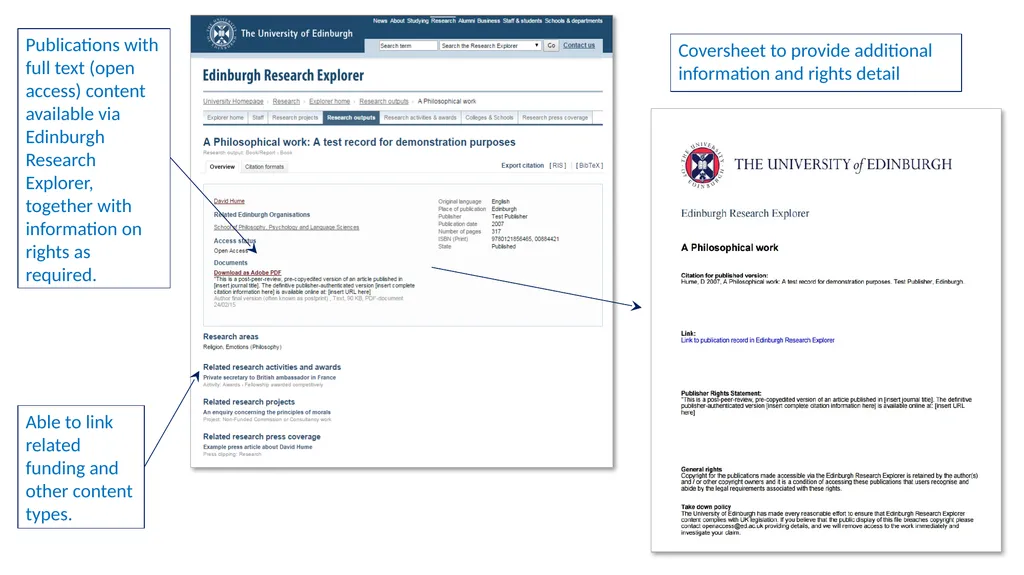
slide8. Publications with full text (open access) content available via Edinburgh Research Explorer, together with information on rights as required. Able to link related funding and other content types. Coversheet to provide additional information and rights detail<br>
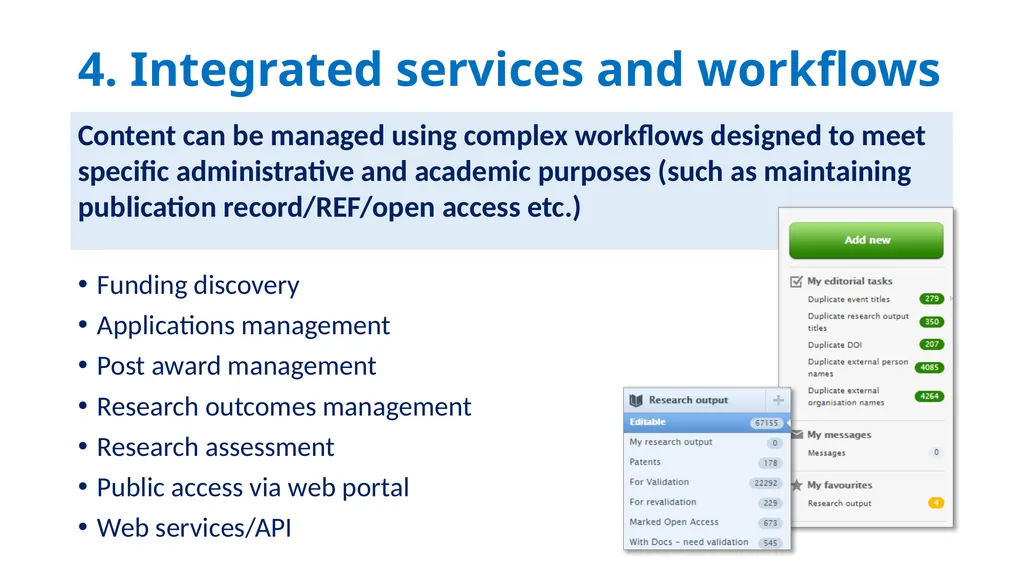
slide9. 4. Integrated services and workflows Funding discovery
Applications management
Post award management
Research outcomes management
Research assessment
Public access via web portal
Web services/API Content can be managed using complex workflows designed to meet specific administrative and academic purposes (such as maintaining publication record/REF/open access etc.)<br>
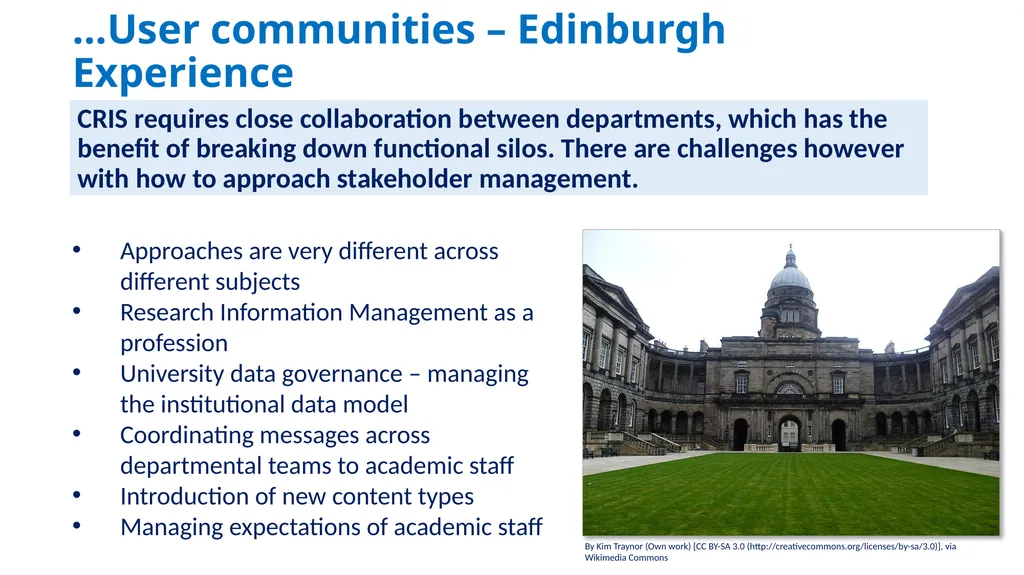
slide10. …User communities – Edinburgh Experience CRIS requires close collaboration between departments, which has the benefit of breaking down functional silos. There are challenges however with how to approach stakeholder management. Approaches are very different across different subjects
Research Information Management as a profession
University data governance – managing the institutional data model
Coordinating messages across departmental teams to academic staff
Introduction of new content types
Managing expectations of academic staff By Kim Traynor (Own work) [CC BY-SA 3.0 (http://creativecommons.org/licenses/by-sa/3.0)], via Wikimedia Commons<br>
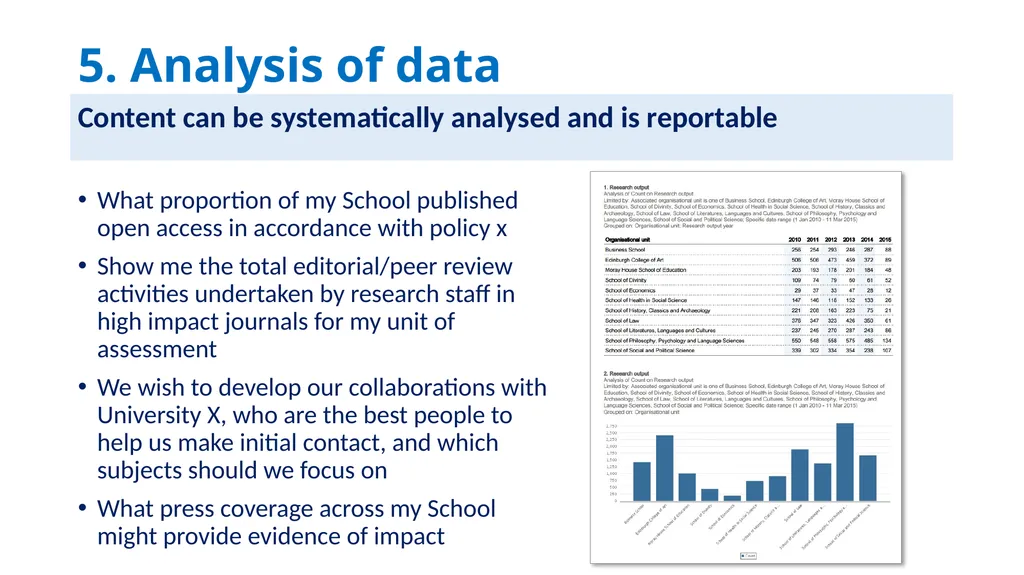
slide11. 5. Analysis of data What proportion of my School published open access in accordance with policy x
Show me the total editorial/peer review activities undertaken by research staff in high impact journals for my unit of assessment
We wish to develop our collaborations with University X, who are the best people to help us make initial contact, and which subjects should we focus on
What press coverage across my School might provide evidence of impact Content can be systematically analysed and is reportable<br>
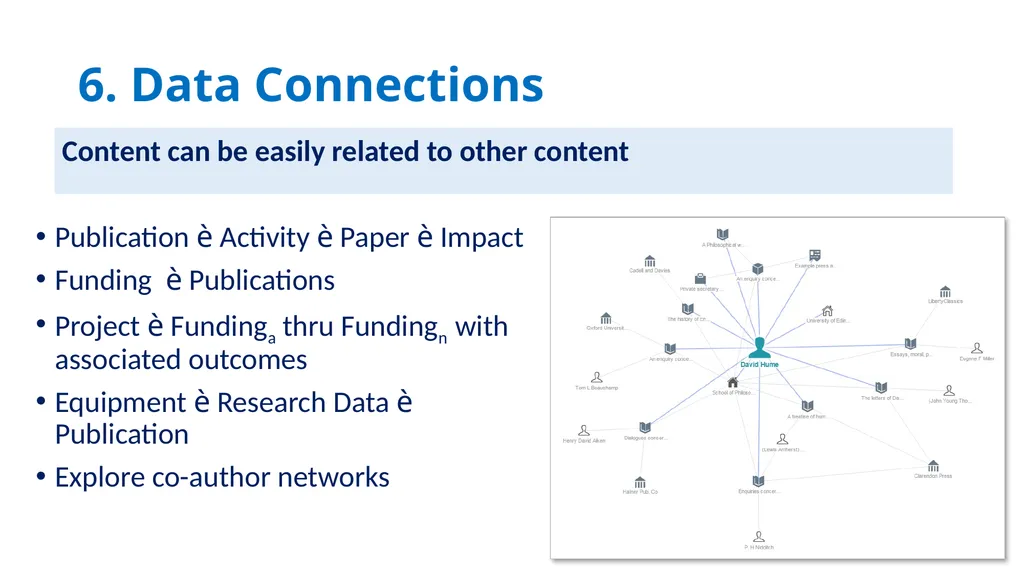
slide12. 6. Data Connections Publication è Activity è Paper è Impact
Funding è Publications
Project è Fundinga thru Fundingn with associated outcomes
Equipment è Research Data è Publication
Explore co-author networks Content can be easily related to other content<br>
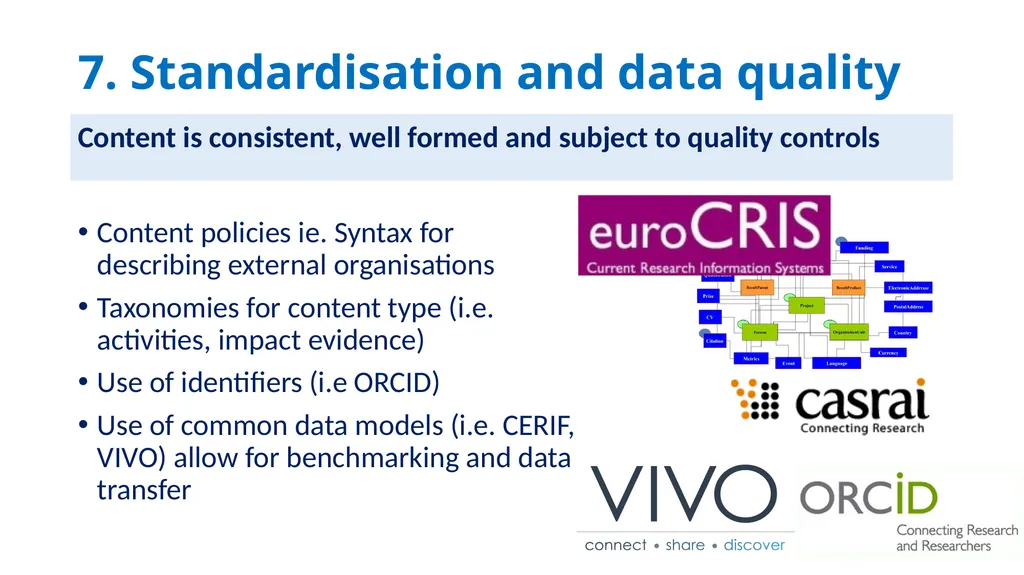
slide13. 7. Standardisation and data quality Content policies ie. Syntax for describing external organisations
Taxonomies for content type (i.e. activities, impact evidence)
Use of identifiers (i.e ORCID)
Use of common data models (i.e. CERIF, VIVO) allow for benchmarking and data transfer Content is consistent, well formed and subject to quality controls<br>
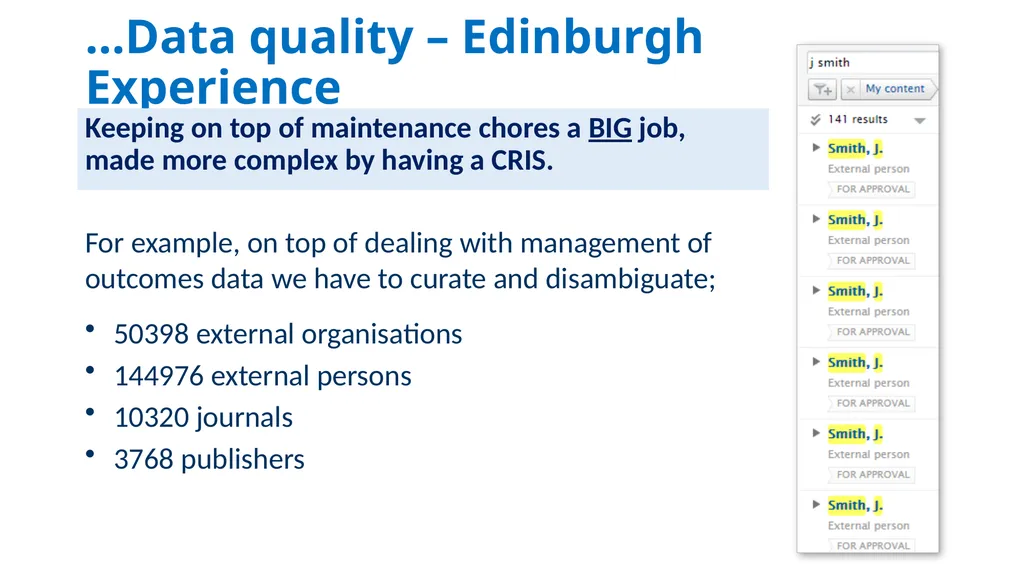
slide14. …Data quality – Edinburgh Experience Keeping on top of maintenance chores a BIG job, made more complex by having a CRIS. For example, on top of dealing with management of outcomes data we have to curate and disambiguate;
50398 external organisations
144976 external persons
10320 journals
3768 publishers<br>
slide15. 8. Content is available for reuse Aim to be ‘one stop shop’ for researchers and research managers
Use in CV’s for promotion, review, proposal
Use in press releases and news items (deep linking)
Re-use in promoting activity and developing impact
Re-use for web applications and school/college websites
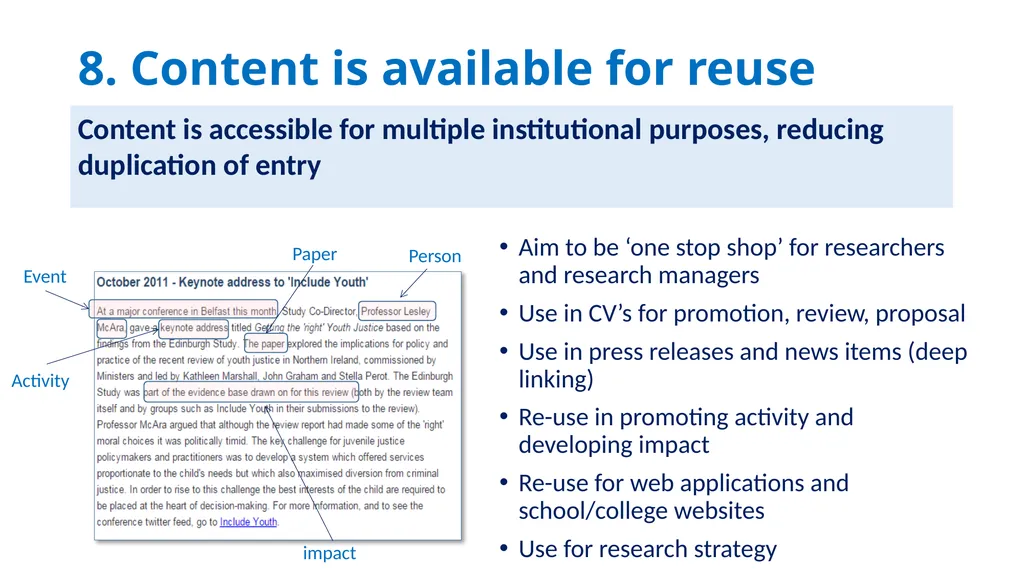
Use for research strategy Content is accessible for multiple institutional purposes, reducing duplication of entry Event Activity Person Paper impact<br>
slide16. 9. Content is marketable Promotion of University research capability via dedicated portals
Aggregate view of research for public, press, potential staff/students
Content can be delivered for specific community purposes
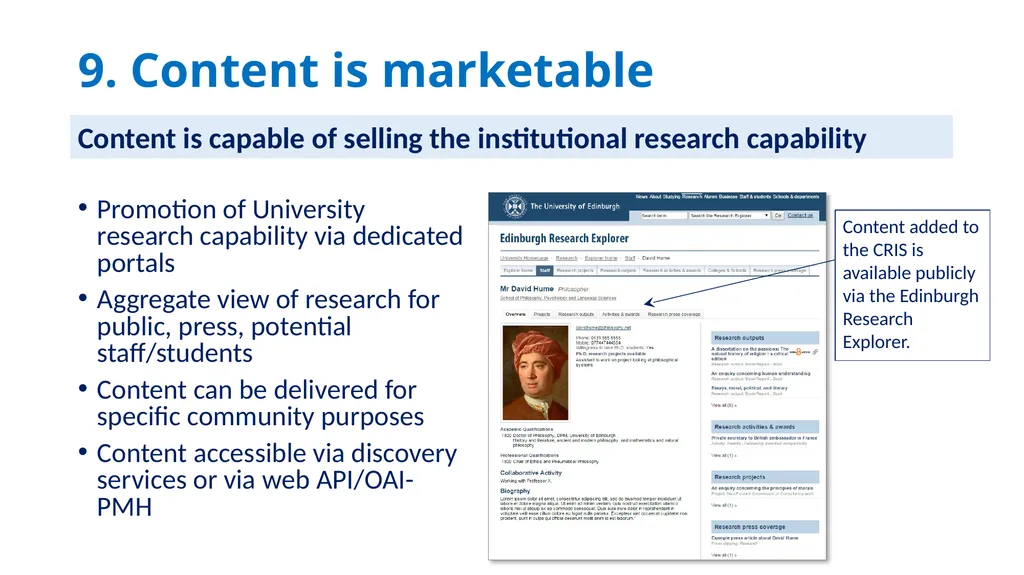
Content accessible via discovery services or via web API/OAI-PMH Content is capable of selling the institutional research capability Content added to the CRIS is available publicly via the Edinburgh Research Explorer.<br>
slide17. 10. Content for external usage Research assessment (REF)
Compliance reporting (i.e. RCUK)
Statistical Reporting (HESA)
Collaboration between institutions
As part of national/international aggregation systems Content is transportable – can be used to submit to external sources in an interoperable format<br>
slide18. Thank You for listening. Any Questions? Please feel free to email me at anytime on james.toon@ed.ac.uk if you need any further information<br>
Research Information Systems Manager, University of Edinburgh
17th March 2015 @jamestoon<br>
slide2. This is a reasonable ‘starting point’… …But far too simplistic really. What is a CRIS?<br>
slide3. 1. Characterisation of a CRIS system Like to think of it as an academic CV representing the whole institution
Provides platform for integrated research information management
Provides services for both ‘top-down’ and ‘bottom up’ requirements of researchers and administrators Picture of the current research capability and current research activity being undertaken by an institution People Organisation/Subject<br>
slide4. 2. CRIS Scope Pre-award (funding discovery, applications management)
Post-award (funding awarded, projects, management process)
People (Academic attributes, profiles, CV’s, supervisions)
Research outcomes (i.e. publications, press, patents, impact, research data)
Professional activities and accolades (i.e. invited presentations, peer/editorial review, prizes or awards)
Student (i.e. workflows for thesis deposit)
Research assessment and compliance
Management information (KPI, metrics, bibliometrics) Very broad in coverage, servicing institutional research needs;<br>
slide5. 3. Integrated architecture Data in
HR
Finance
Pre-award
Student Systems
IP/Licensing systems
Press Office Allows integration with corporate systems (such as HR and Finance) for data that is managed as the ‘golden copy’ elsewhere in the institution Data out
Portals/Discovery services
Institutional repositories (inc. Data)
Content Management Systems
Web Services
CV’s
Research assessment CRIS Workflows Happy Users Research Administrators<br>
slide6. …Edinburgh Approach Intermediate data (built in-house)
CRIS – the admin interface Managed
via Corporate
Systems Edinburgh Research
Explorer Web service layer Published via Content synchronised via HR, Finance systems on nightly basis<br>
slide7. …The repository question Yes
Known connectors in place for most repositories (Dspace, ePrints, Fedora etc.)
Carries some business and technical risks
Repository functionality and services provided by most CRIS suppliers
CRIS web portals for public access
Additional ‘repository functions’ increasingly provided (DOI minting, Preservation, OAI-PMH)
Whether you should is entirely down to you… Can a CRIS system connect to an external institutional repository?<br>
slide8. Publications with full text (open access) content available via Edinburgh Research Explorer, together with information on rights as required. Able to link related funding and other content types. Coversheet to provide additional information and rights detail<br>
slide9. 4. Integrated services and workflows Funding discovery
Applications management
Post award management
Research outcomes management
Research assessment
Public access via web portal
Web services/API Content can be managed using complex workflows designed to meet specific administrative and academic purposes (such as maintaining publication record/REF/open access etc.)<br>
slide10. …User communities – Edinburgh Experience CRIS requires close collaboration between departments, which has the benefit of breaking down functional silos. There are challenges however with how to approach stakeholder management. Approaches are very different across different subjects
Research Information Management as a profession
University data governance – managing the institutional data model
Coordinating messages across departmental teams to academic staff
Introduction of new content types
Managing expectations of academic staff By Kim Traynor (Own work) [CC BY-SA 3.0 (http://creativecommons.org/licenses/by-sa/3.0)], via Wikimedia Commons<br>
slide11. 5. Analysis of data What proportion of my School published open access in accordance with policy x
Show me the total editorial/peer review activities undertaken by research staff in high impact journals for my unit of assessment
We wish to develop our collaborations with University X, who are the best people to help us make initial contact, and which subjects should we focus on
What press coverage across my School might provide evidence of impact Content can be systematically analysed and is reportable<br>
slide12. 6. Data Connections Publication è Activity è Paper è Impact
Funding è Publications
Project è Fundinga thru Fundingn with associated outcomes
Equipment è Research Data è Publication
Explore co-author networks Content can be easily related to other content<br>
slide13. 7. Standardisation and data quality Content policies ie. Syntax for describing external organisations
Taxonomies for content type (i.e. activities, impact evidence)
Use of identifiers (i.e ORCID)
Use of common data models (i.e. CERIF, VIVO) allow for benchmarking and data transfer Content is consistent, well formed and subject to quality controls<br>
slide14. …Data quality – Edinburgh Experience Keeping on top of maintenance chores a BIG job, made more complex by having a CRIS. For example, on top of dealing with management of outcomes data we have to curate and disambiguate;
50398 external organisations
144976 external persons
10320 journals
3768 publishers<br>
slide15. 8. Content is available for reuse Aim to be ‘one stop shop’ for researchers and research managers
Use in CV’s for promotion, review, proposal
Use in press releases and news items (deep linking)
Re-use in promoting activity and developing impact
Re-use for web applications and school/college websites
Use for research strategy Content is accessible for multiple institutional purposes, reducing duplication of entry Event Activity Person Paper impact<br>
slide16. 9. Content is marketable Promotion of University research capability via dedicated portals
Aggregate view of research for public, press, potential staff/students
Content can be delivered for specific community purposes
Content accessible via discovery services or via web API/OAI-PMH Content is capable of selling the institutional research capability Content added to the CRIS is available publicly via the Edinburgh Research Explorer.<br>
slide17. 10. Content for external usage Research assessment (REF)
Compliance reporting (i.e. RCUK)
Statistical Reporting (HESA)
Collaboration between institutions
As part of national/international aggregation systems Content is transportable – can be used to submit to external sources in an interoperable format<br>
slide18. Thank You for listening. Any Questions? Please feel free to email me at anytime on james.toon@ed.ac.uk if you need any further information<br>