
Current situation and market drivers B.





Description: Current situation and market drivers B. Berg-Andersson, M. Kulvik, J. Kunttu, J. Lintunen, T. Orfanidou EFI ETLA Economic Research Koli Forum Round Table September 28, 2022 Current situation Forest industries in the national economy
Related Topics
Download Presentation
"Current situation and market drivers B." is the property of its rightful owner. Permission is granted to download and print the materials on this website for personal, non-commercial use only, and to display it on your personal computer provided you do not modify the materials and that you retain all copyright notices contained in the materials. By downloading content from our website, you accept the terms of this agreement.
Presentation Transcript
slide1. Current situation and
market drivers B. Berg-Andersson, M. Kulvik, J. Kunttu, J. Lintunen, T. Orfanidou
EFI & ETLA Economic Research
Koli Forum Round Table – September 28, 2022<br>
slide2. Current situation<br>
slide3. Forest industries in the national economy Pulp and paper industry is large in Finland, by value the most important exporting branch.
The major part of products are exported
Woodworking industry
Products are mostly used in construction or exported
Both industries use significant amounts of domestic intermediate inputs
Changes in forest industries’ production effects other branches, i.e., forestry, transportation, chemical and machinery industries<br>
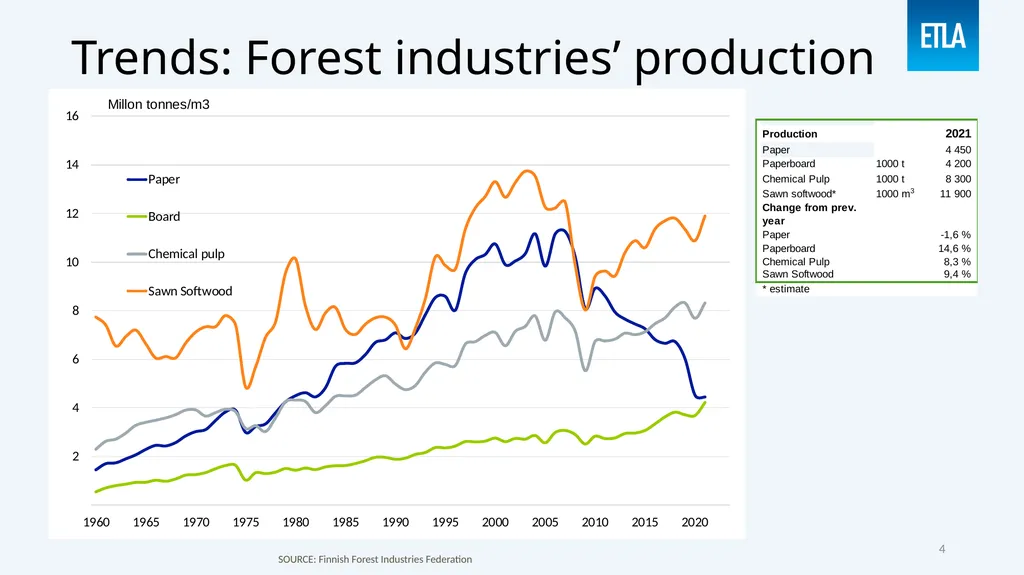
slide4. 4 Trends: Forest industries’ production volumes<br>
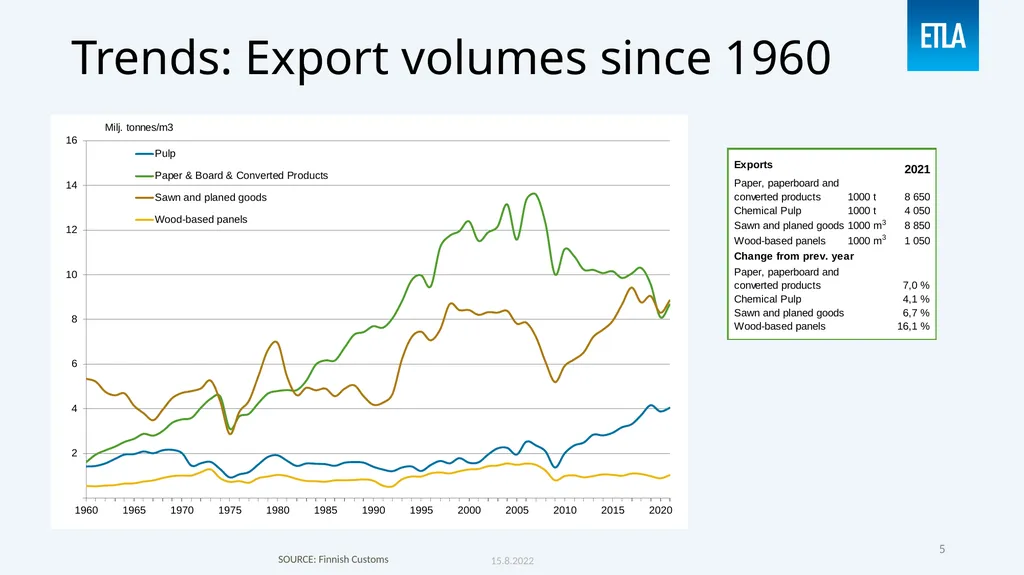
slide5. Trends: Export volumes since 1960 5 15.8.2022<br>
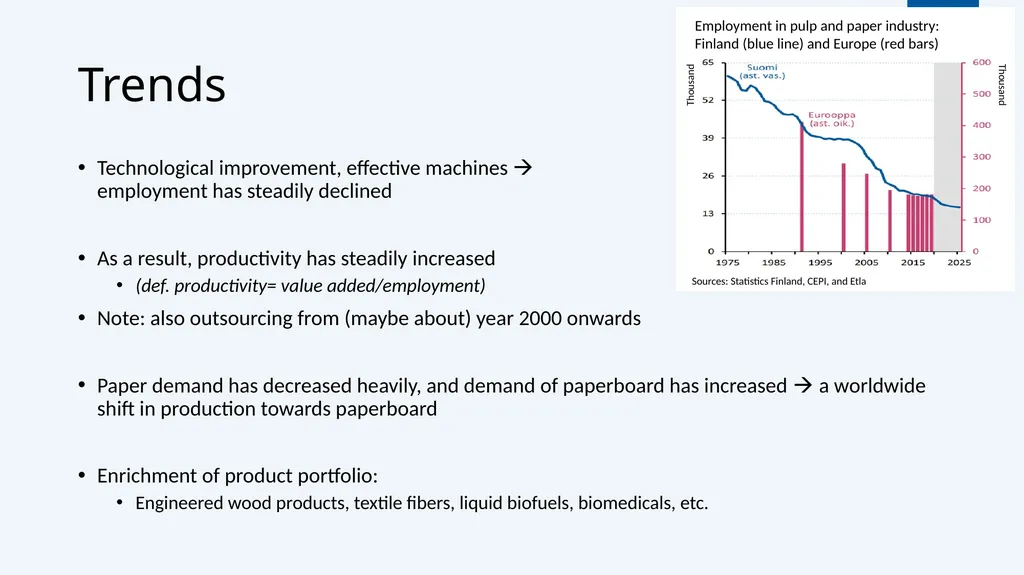
slide6. Trends Technological improvement, effective machines employment has steadily declined
As a result, productivity has steadily increased
(def. productivity= value added/employment)
Note: also outsourcing from (maybe about) year 2000 onwards
Paper demand has decreased heavily, and demand of paperboard has increased a worldwide shift in production towards paperboard
Enrichment of product portfolio:
Engineered wood products, textile fibers, liquid biofuels, biomedicals, etc. Employment in pulp and paper industry: Finland (blue line) and Europe (red bars) Sources: Statistics Finland, CEPI, and Etla Thousand Thousand<br>
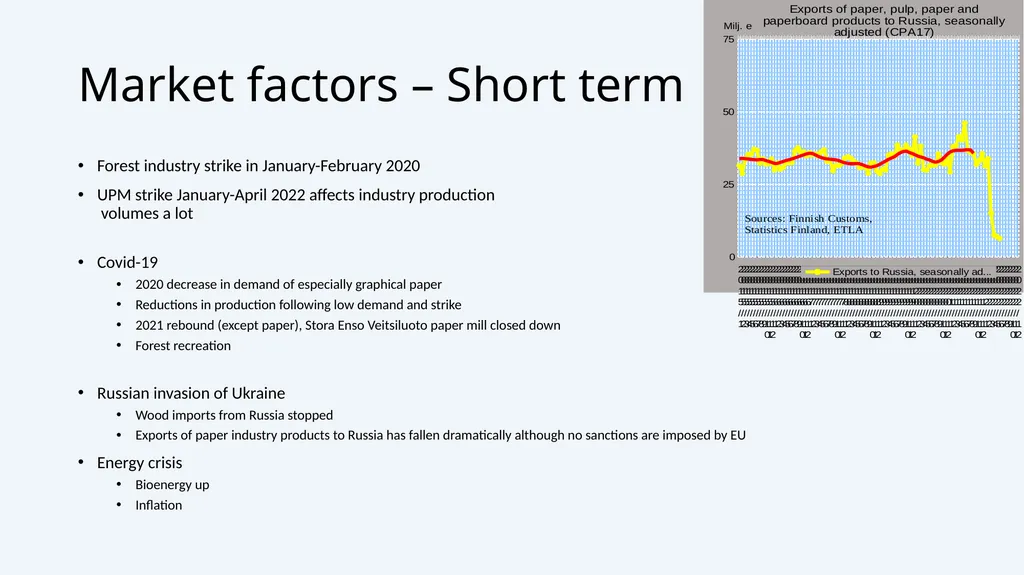
slide7. Market factors – Short term Forest industry strike in January-February 2020
UPM strike January-April 2022 affects industry production volumes a lot
Covid-19
2020 decrease in demand of especially graphical paper
Reductions in production following low demand and strike
2021 rebound (except paper), Stora Enso Veitsiluoto paper mill closed down
Forest recreation
Russian invasion of Ukraine
Wood imports from Russia stopped
Exports of paper industry products to Russia has fallen dramatically although no sanctions are imposed by EU
Energy crisis
Bioenergy up
Inflation<br>
slide8. Increasing environmental regulation LULUCF climate policy
No net emissions
Reference level
EU-wide target of LULUCF/AFOLU sink up to 2035
Biodiversity strategy
Strict protection
Nature restoration<br>
slide9. Increasing environmental regulation Renewable energy directive III
Forest bioenergy
Primary woody biomass (biomass from forests)
Secondary woody biomass (by-product biomass)
Cascading woody biomass use:
Wood products
Extending their service life
Re-use
Recycling
Bioenergy
Disposal<br>
slide10. Forecast up to 2026<br>
slide11. Pulp and paper industries 2022 UPM strike in early 2022 reduced exports of pulp and paper in the first half of the year
No EU sanctions are imposed on forest industry exports to Russia, but Finns have withdrawn voluntarily from Russia
Russian forest industry exports to EU have been stopped by sanctions
Paperboard exports have been increasing (volume +5 % in Jan-May), pulp -25 %, paper -53 % (Source: Finnish Forest Industries)
Export prices are higher than ever before (+30 % Y/Y in Jan-July)
In total, exports of the pulp and paper industry are declining about 13%, in volume terms, in 2022 as a result of the strike (-22 % in Jan-June)
Output declines 7%<br>
slide12. Pulp and paper industries 2023-2026 Export prices are expected to decline from the current high levels
Export volumes will rebound in 2023 from the low level of 2022
After 2023, export volumes and output increase slowly, driven by paperboard and pulp
Value added reduces in 2022 and 2023 but increase slowly from 2024 onwards
In ETLA report no 112 ”The Finnish Forest Industries Up to Year 2025” it was calculated that employment will decrease on average by 3,1% per year during the period 2021-2025 (this part of the forecast not yet updated to 2026)
Productivity was expected to grow by 3% per year in 2023-2025<br>
slide13. Woodworking industries 2022 The value of exports increased remarkably in 2021 (+55%), as export prices rose by 36%.
Also, the volume of exports grew strongly (+15%)
Demand has been higher than market supply, which has put upward pressure on prices
Export prices were all time high in June 2022, but turned downwards both in July and in August – on average export prices are still expected to be 25 % higher in 2022 compared to last year
The export volume is declining around 6 % this year from its high level in 2021, (-10% in Jan-June)
Output does not follow exports one-to-one
Construction keeps growing: 10% increase in wood product output<br>
slide14. Woodworking industries 2023-2026 Export prices are expected to decline from the current high levels
After 2022, export volumes increase slowly
Output is expected to level out by 2025
Value added reduced very strongly in 2021, so it is expected to grow this year. On average in the years 2023-2026 value added will not grow.
Employment and growth in productivity is expected to remain relatively stable (Source: Etla report no. 112, this part of the forecast not yet updated)<br>
slide15. Conclusions Recent years have been full of surprises
Export prices have been all time high
Demand for domestic wood has been increased by the reduction in wood imports
Demand shocks such as the war in Ukraine or Covid-19 affect short term forecasts, which therefore need to be revised
Supply shocks such as strikes also induces a need to revise forecasts
In long term forecasts, temporary shocks do not affect the trends very much
Regulation can insert pressure on domestic wood supply in longer term<br>
slide16. Thank you!<br>
EFI & ETLA Economic Research
Koli Forum Round Table – September 28, 2022<br>
slide2. Current situation<br>
slide3. Forest industries in the national economy Pulp and paper industry is large in Finland, by value the most important exporting branch.
The major part of products are exported
Woodworking industry
Products are mostly used in construction or exported
Both industries use significant amounts of domestic intermediate inputs
Changes in forest industries’ production effects other branches, i.e., forestry, transportation, chemical and machinery industries<br>
slide4. 4 Trends: Forest industries’ production volumes<br>
slide5. Trends: Export volumes since 1960 5 15.8.2022<br>
slide6. Trends Technological improvement, effective machines employment has steadily declined
As a result, productivity has steadily increased
(def. productivity= value added/employment)
Note: also outsourcing from (maybe about) year 2000 onwards
Paper demand has decreased heavily, and demand of paperboard has increased a worldwide shift in production towards paperboard
Enrichment of product portfolio:
Engineered wood products, textile fibers, liquid biofuels, biomedicals, etc. Employment in pulp and paper industry: Finland (blue line) and Europe (red bars) Sources: Statistics Finland, CEPI, and Etla Thousand Thousand<br>
slide7. Market factors – Short term Forest industry strike in January-February 2020
UPM strike January-April 2022 affects industry production volumes a lot
Covid-19
2020 decrease in demand of especially graphical paper
Reductions in production following low demand and strike
2021 rebound (except paper), Stora Enso Veitsiluoto paper mill closed down
Forest recreation
Russian invasion of Ukraine
Wood imports from Russia stopped
Exports of paper industry products to Russia has fallen dramatically although no sanctions are imposed by EU
Energy crisis
Bioenergy up
Inflation<br>
slide8. Increasing environmental regulation LULUCF climate policy
No net emissions
Reference level
EU-wide target of LULUCF/AFOLU sink up to 2035
Biodiversity strategy
Strict protection
Nature restoration<br>
slide9. Increasing environmental regulation Renewable energy directive III
Forest bioenergy
Primary woody biomass (biomass from forests)
Secondary woody biomass (by-product biomass)
Cascading woody biomass use:
Wood products
Extending their service life
Re-use
Recycling
Bioenergy
Disposal<br>
slide10. Forecast up to 2026<br>
slide11. Pulp and paper industries 2022 UPM strike in early 2022 reduced exports of pulp and paper in the first half of the year
No EU sanctions are imposed on forest industry exports to Russia, but Finns have withdrawn voluntarily from Russia
Russian forest industry exports to EU have been stopped by sanctions
Paperboard exports have been increasing (volume +5 % in Jan-May), pulp -25 %, paper -53 % (Source: Finnish Forest Industries)
Export prices are higher than ever before (+30 % Y/Y in Jan-July)
In total, exports of the pulp and paper industry are declining about 13%, in volume terms, in 2022 as a result of the strike (-22 % in Jan-June)
Output declines 7%<br>
slide12. Pulp and paper industries 2023-2026 Export prices are expected to decline from the current high levels
Export volumes will rebound in 2023 from the low level of 2022
After 2023, export volumes and output increase slowly, driven by paperboard and pulp
Value added reduces in 2022 and 2023 but increase slowly from 2024 onwards
In ETLA report no 112 ”The Finnish Forest Industries Up to Year 2025” it was calculated that employment will decrease on average by 3,1% per year during the period 2021-2025 (this part of the forecast not yet updated to 2026)
Productivity was expected to grow by 3% per year in 2023-2025<br>
slide13. Woodworking industries 2022 The value of exports increased remarkably in 2021 (+55%), as export prices rose by 36%.
Also, the volume of exports grew strongly (+15%)
Demand has been higher than market supply, which has put upward pressure on prices
Export prices were all time high in June 2022, but turned downwards both in July and in August – on average export prices are still expected to be 25 % higher in 2022 compared to last year
The export volume is declining around 6 % this year from its high level in 2021, (-10% in Jan-June)
Output does not follow exports one-to-one
Construction keeps growing: 10% increase in wood product output<br>
slide14. Woodworking industries 2023-2026 Export prices are expected to decline from the current high levels
After 2022, export volumes increase slowly
Output is expected to level out by 2025
Value added reduced very strongly in 2021, so it is expected to grow this year. On average in the years 2023-2026 value added will not grow.
Employment and growth in productivity is expected to remain relatively stable (Source: Etla report no. 112, this part of the forecast not yet updated)<br>
slide15. Conclusions Recent years have been full of surprises
Export prices have been all time high
Demand for domestic wood has been increased by the reduction in wood imports
Demand shocks such as the war in Ukraine or Covid-19 affect short term forecasts, which therefore need to be revised
Supply shocks such as strikes also induces a need to revise forecasts
In long term forecasts, temporary shocks do not affect the trends very much
Regulation can insert pressure on domestic wood supply in longer term<br>
slide16. Thank you!<br>