Cyberattacks: How the public thinks about the state of national resilience Richard Wike Director, Global Attitudes 2 Pew Research Center Established 1996 Funded by The Pew Charitable Trusts, foundations Non-profit, non-partisan fact tank in
"Cyberattacks: How the public thinks about the" is the property of its rightful owner. Permission is granted to
download and print the materials on this website for personal, non-commercial use only, and to display it
on your personal computer provided you do not modify the materials and that you retain all copyright
notices contained in the materials. By downloading content from our website, you accept the terms of this
agreement.
Presentation Transcript
01
Cyberattacks: How the public thinks about the state of national resilience Richard Wike Director, Global Attitudes<br>
02
2 Pew Research Center Established 1996
Funded by The Pew Charitable Trusts, foundations
Non-profit, non-partisan fact tank in Washington
Since 2001, we have surveyed in 108 countries
www.pewresearch.org
@pewresearch<br>
03
3 Methodology Survey conducted across 26 countries from May 14 to August 12, 2018, totaling 27,612 respondents
Based on telephone and face-to-face interviews with nationally representative samples of adults 18 and older
The margin of sampling error for the completed set of weighted data is ±2.9% - ±5.1%<br>
04
Global threat perceptions 4<br>
05
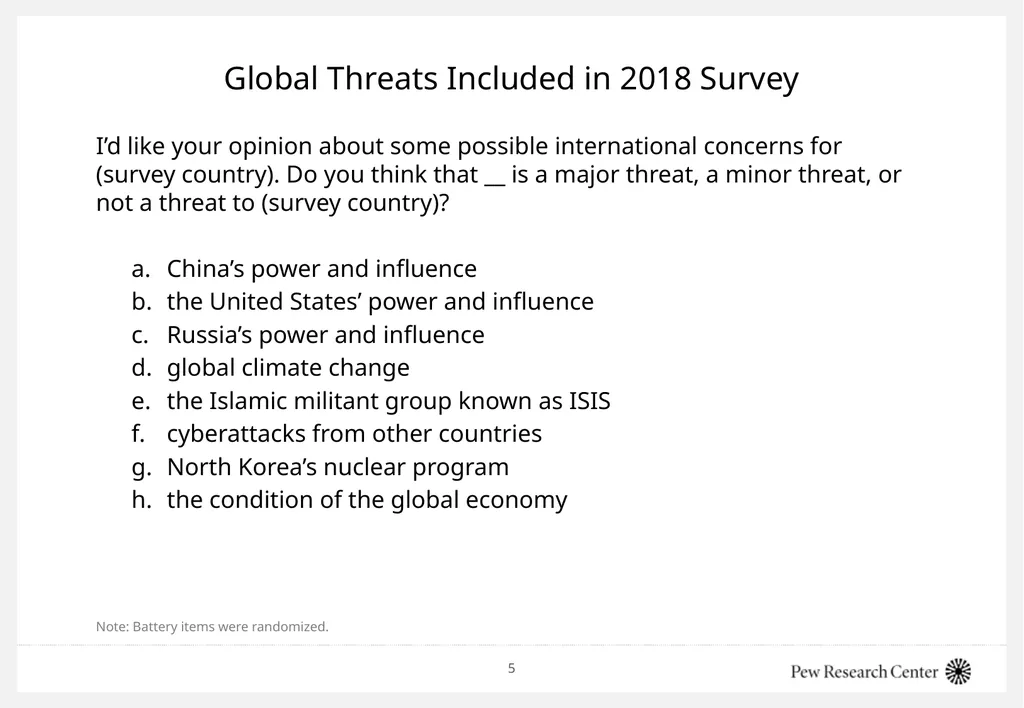
5 Global Threats Included in 2018 Survey I’d like your opinion about some possible international concerns for (survey country). Do you think that __ is a major threat, a minor threat, or not a threat to (survey country)?
China’s power and influence
the United States’ power and influence
Russia’s power and influence
global climate change
the Islamic militant group known as ISIS
cyberattacks from other countries
North Korea’s nuclear program
the condition of the global economy Note: Battery items were randomized.<br>
06
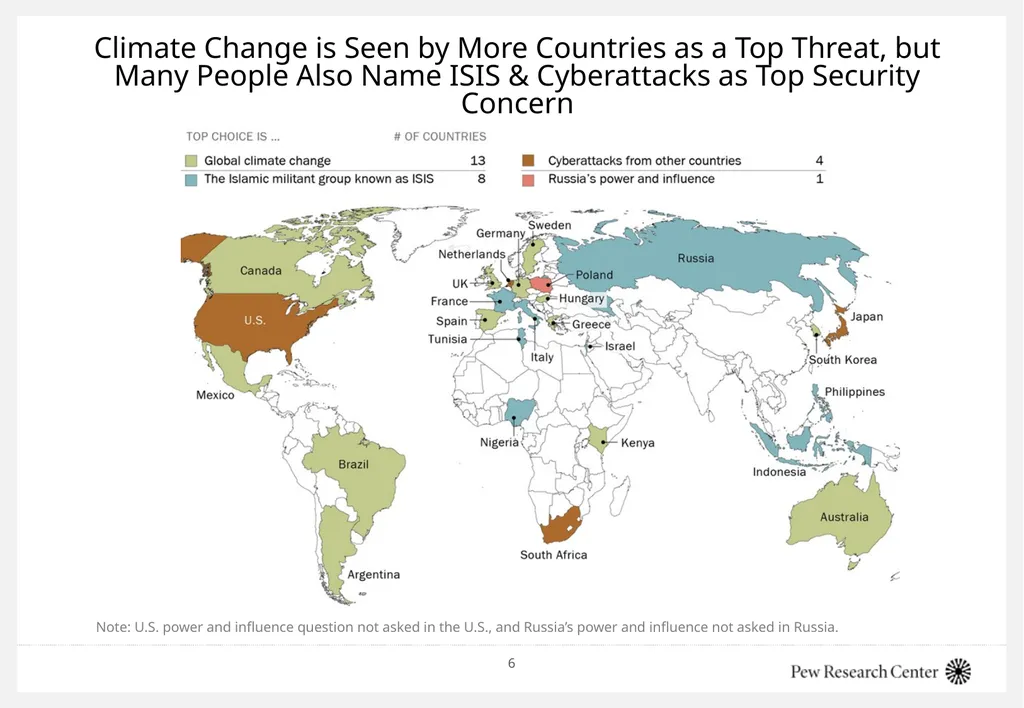
Climate Change is Seen by More Countries as a Top Threat, but Many People Also Name ISIS & Cyberattacks as Top Security Concern 6 Note: U.S. power and influence question not asked in the U.S., and Russia’s power and influence not asked in Russia.<br>
07
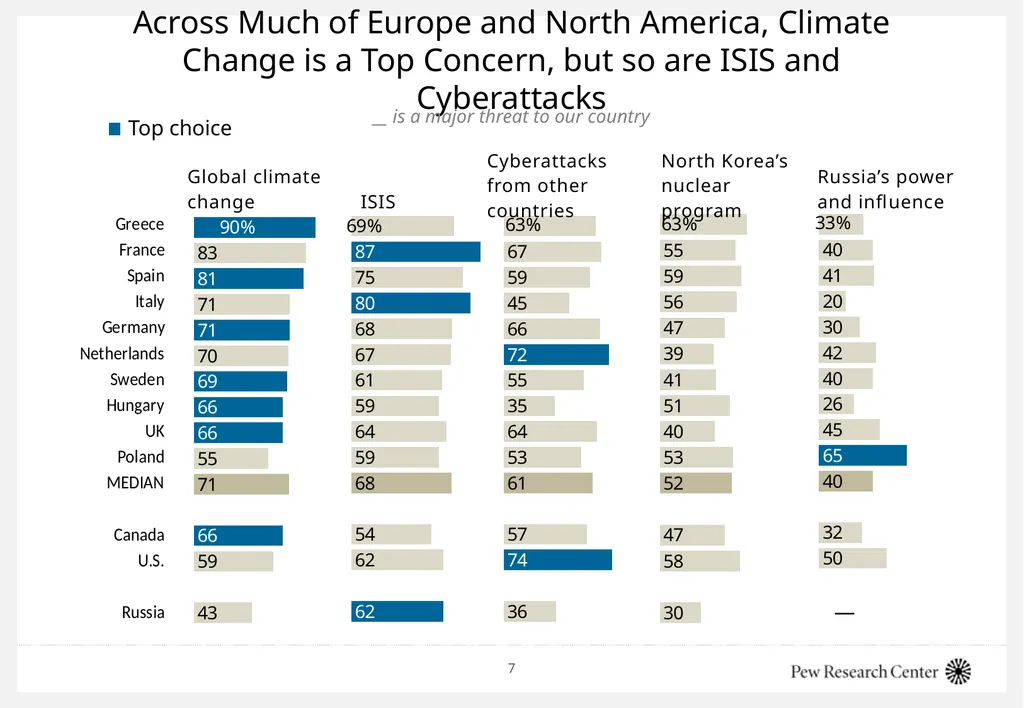
7 Across Much of Europe and North America, Climate Change is a Top Concern, but so are ISIS and Cyberattacks __ is a major threat to our country Top choice —<br>
08
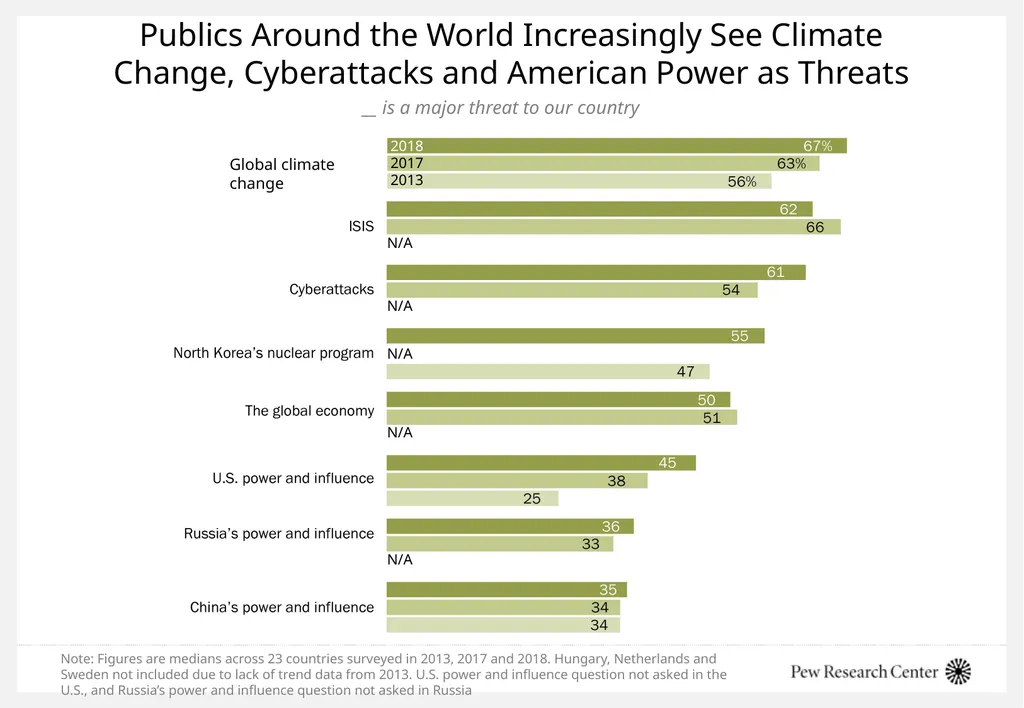
Publics Around the World Increasingly See Climate Change, Cyberattacks and American Power as Threats Note: Figures are medians across 23 countries surveyed in 2013, 2017 and 2018. Hungary, Netherlands and Sweden not included due to lack of trend data from 2013. U.S. power and influence question not asked in the U.S., and Russia’s power and influence question not asked in Russia __ is a major threat to our country Global climate change 2018 2017 2013 N/A N/A N/A N/A N/A<br>
09
The Likelihood of Cyberattacks 9<br>
10
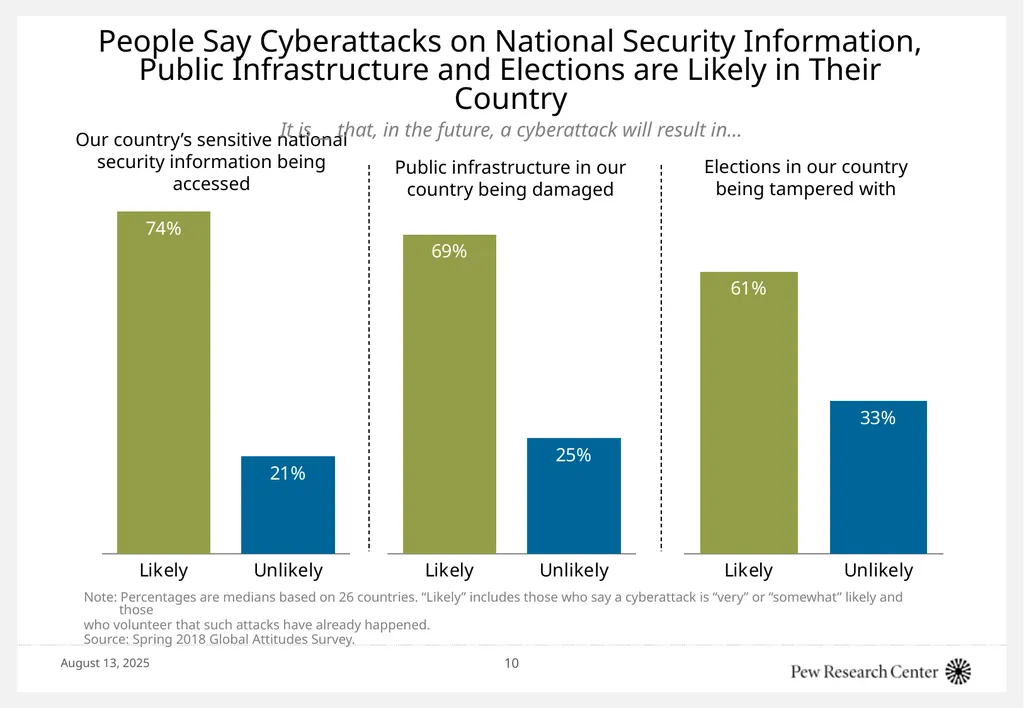
People Say Cyberattacks on National Security Information, Public Infrastructure and Elections are Likely in Their Country February 17, 2019 10 Our country’s sensitive national security information being accessed Public infrastructure in our country being damaged Note: Percentages are medians based on 26 countries. “Likely” includes those who say a cyberattack is “very” or “somewhat” likely and those
who volunteer that such attacks have already happened.
Source: Spring 2018 Global Attitudes Survey. Elections in our country being tampered with It is __ that, in the future, a cyberattack will result in…<br>
11
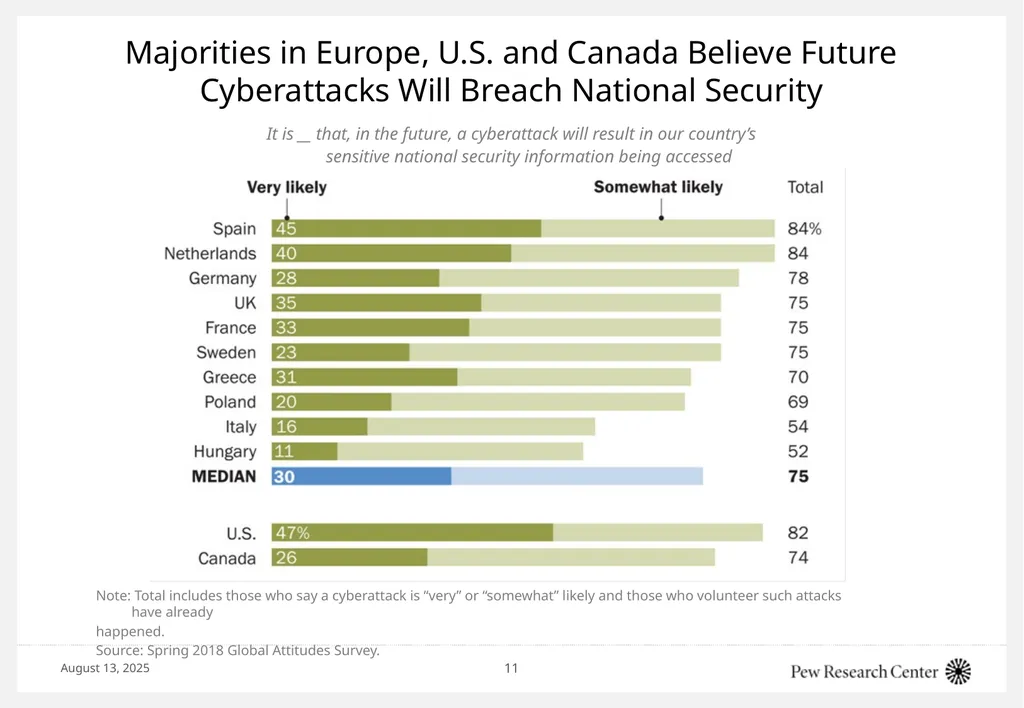
February 17, 2019 11 Majorities in Europe, U.S. and Canada Believe Future Cyberattacks Will Breach National Security It is __ that, in the future, a cyberattack will result in our country’s sensitive national security information being accessed Note: Total includes those who say a cyberattack is “very” or “somewhat” likely and those who volunteer such attacks have already
happened.
Source: Spring 2018 Global Attitudes Survey.<br>
12
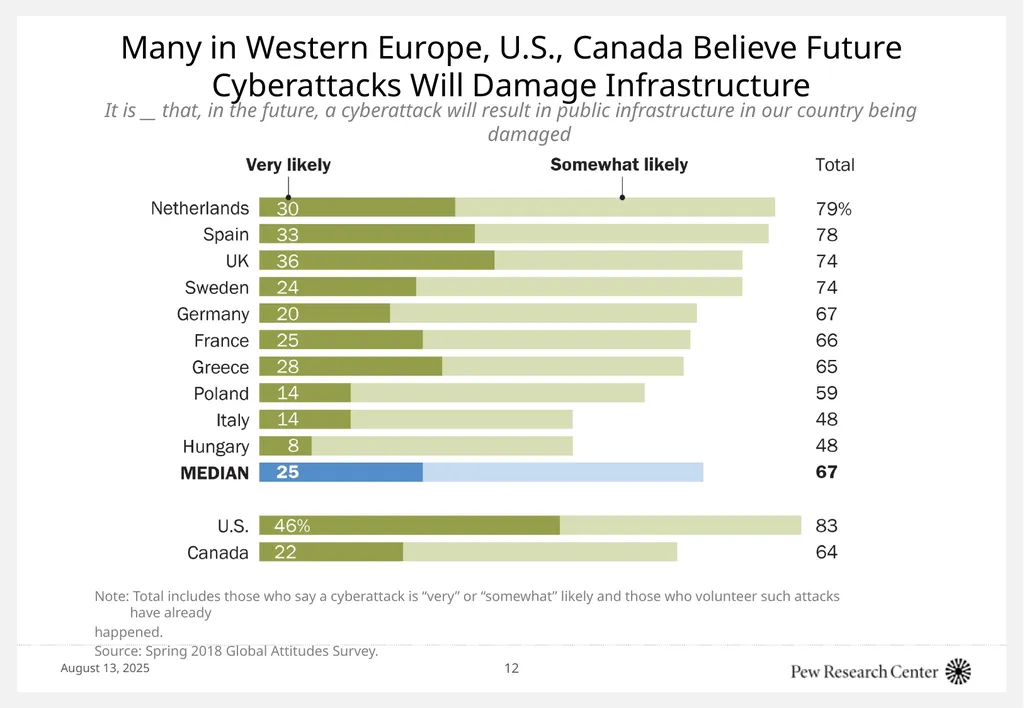
February 17, 2019 12 Many in Western Europe, U.S., Canada Believe Future Cyberattacks Will Damage Infrastructure It is __ that, in the future, a cyberattack will result in public infrastructure in our country being damaged Note: Total includes those who say a cyberattack is “very” or “somewhat” likely and those who volunteer such attacks have already
happened.
Source: Spring 2018 Global Attitudes Survey.<br>
13
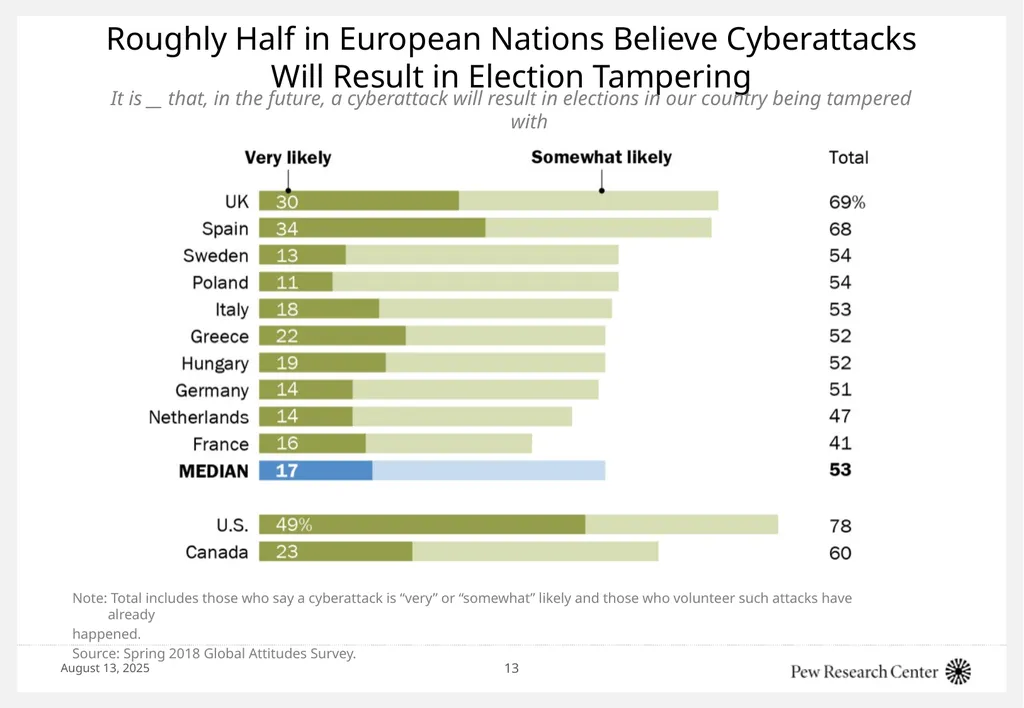
February 17, 2019 13 Roughly Half in European Nations Believe Cyberattacks Will Result in Election Tampering It is __ that, in the future, a cyberattack will result in elections in our country being tampered with Note: Total includes those who say a cyberattack is “very” or “somewhat” likely and those who volunteer such attacks have already
happened.
Source: Spring 2018 Global Attitudes Survey.<br>
14
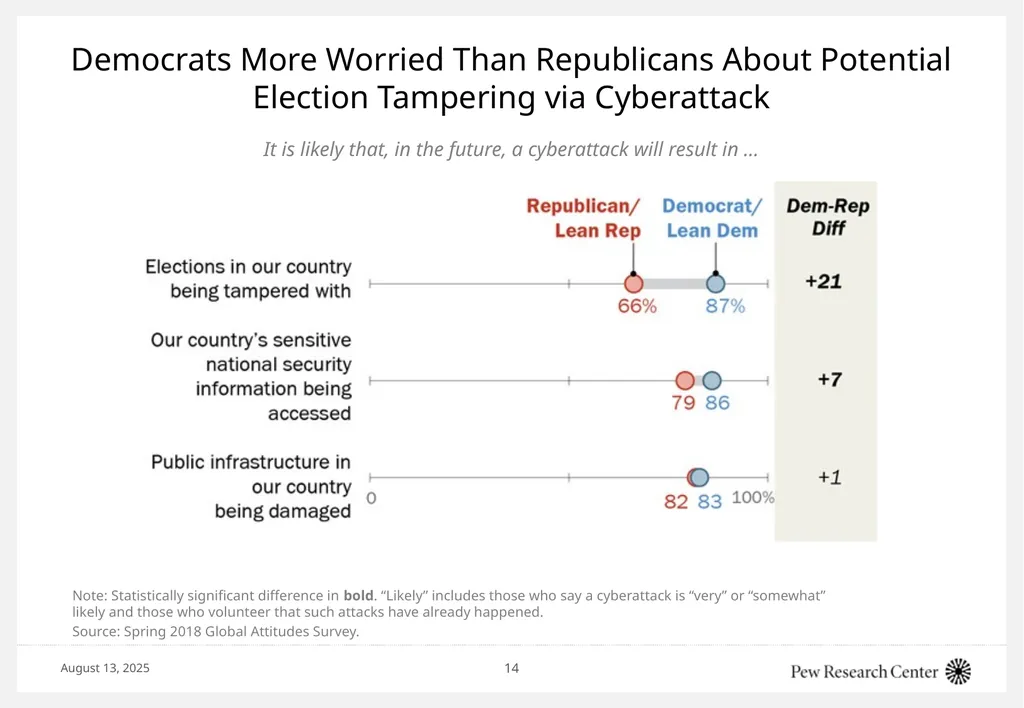
February 17, 2019 14 Democrats More Worried Than Republicans About Potential Election Tampering via Cyberattack It is likely that, in the future, a cyberattack will result in … Note: Statistically significant difference in bold. “Likely” includes those who say a cyberattack is “very” or “somewhat” likely and those who volunteer that such attacks have already happened.
Source: Spring 2018 Global Attitudes Survey.<br>
15
How well prepared is your government? 15<br>
16
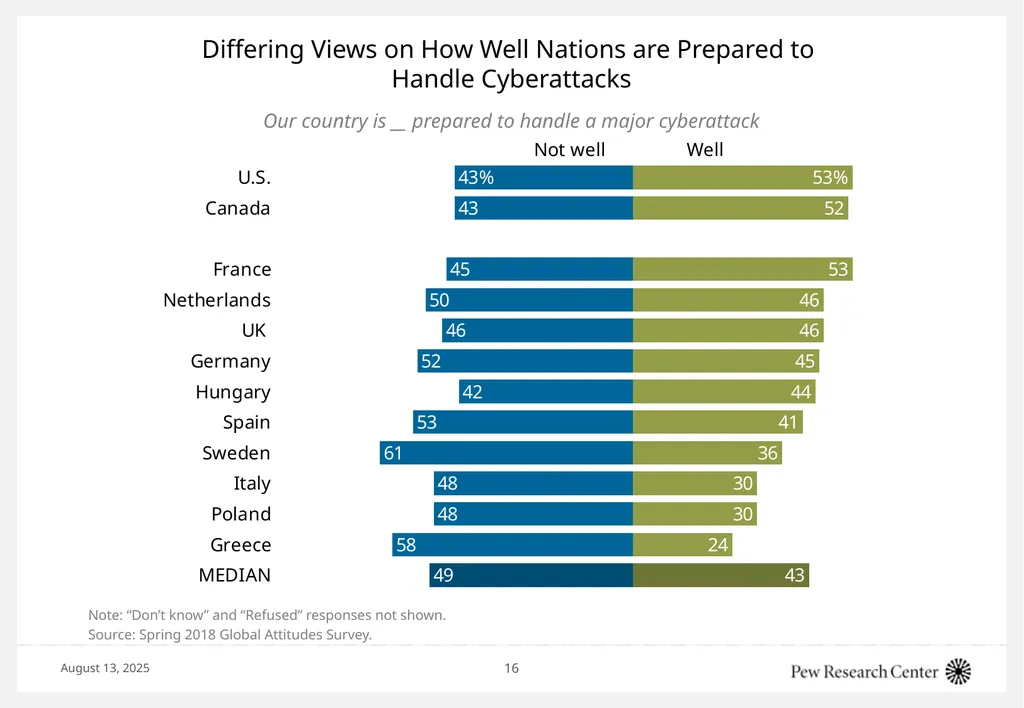
February 17, 2019 16 Differing Views on How Well Nations are Prepared to Handle Cyberattacks Our country is __ prepared to handle a major cyberattack Note: “Don’t know” and “Refused” responses not shown.
Source: Spring 2018 Global Attitudes Survey.<br>
17
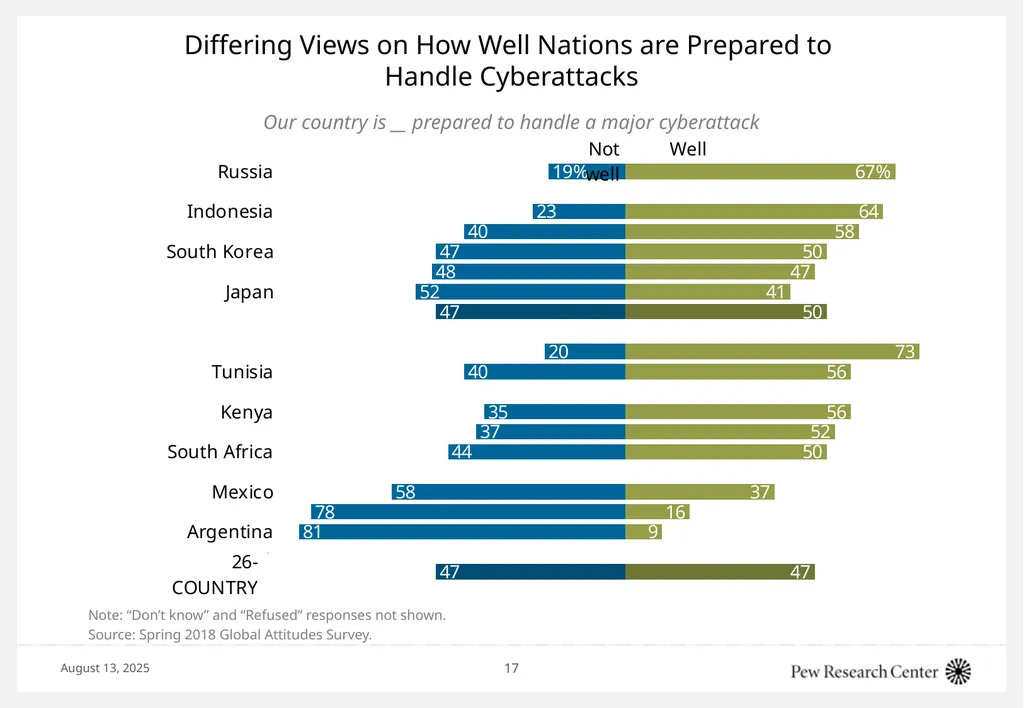
February 17, 2019 17 Differing Views on How Well Nations are Prepared to Handle Cyberattacks Our country is __ prepared to handle a major cyberattack Note: “Don’t know” and “Refused” responses not shown.
Source: Spring 2018 Global Attitudes Survey.<br>
18
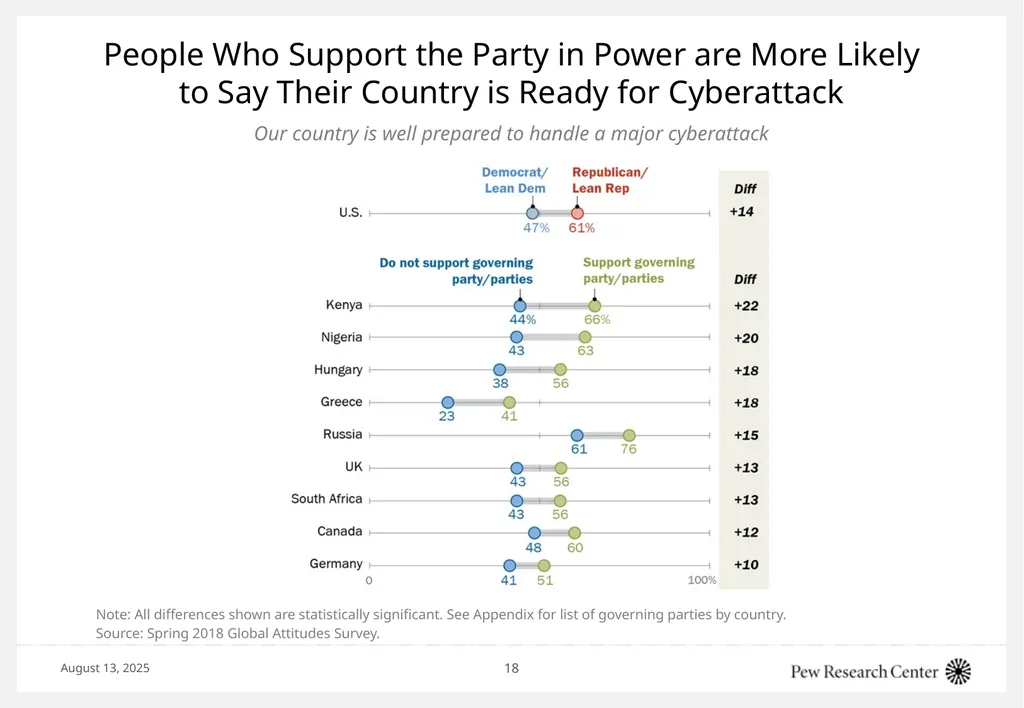
February 17, 2019 18 People Who Support the Party in Power are More Likely to Say Their Country is Ready for Cyberattack Our country is well prepared to handle a major cyberattack Note: All differences shown are statistically significant. See Appendix for list of governing parties by country.
Source: Spring 2018 Global Attitudes Survey.<br>
19
19 All Pew Research Center reports are available online at www.pewresearch.org Richard Wike Director, Global Attitudes Research @RichardWike<br>