
D.C. Office on Aging Ambassador Training 500 K
PT
Published · 39 slides · 0 views

1 / 1




Description
D.C. Office on Aging Ambassador Training 500 K Street N.E. , Washington, D.C. 20002 This is an initiative to train community residents about the programs and services offered by the DC Office on Aging and its Senior Service Network. The
Related Topics
Share
Embed code
Download this presentation From Below
"D.C. Office on Aging Ambassador Training 500 K" is the property of its rightful owner. Permission is granted to download and print the materials on this website for personal, non-commercial use only, and to display it on your personal computer provided you do not modify the materials and that you retain all copyright notices contained in the materials. By downloading content from our website, you accept the terms of this agreement.
Presentation Transcript
01
D.C. Office on Aging
Ambassador Training 500 K Street N.E. , Washington, D.C. 20002<br>
02
This is an initiative to train community residents about the programs and services offered by the DC Office on Aging and its Senior Service Network.
The ambassadors serve as points of contact for distributing information in their wards and communities about the programs and services available to seniors, persons living with disabilities, and caregivers. Ambassador Training Program 2<br>
The ambassadors serve as points of contact for distributing information in their wards and communities about the programs and services available to seniors, persons living with disabilities, and caregivers. Ambassador Training Program 2<br>
03
The D.C. Office on Aging’s mission is to advocate, plan, implement, and monitor programs in health, education, employment, and social services which promote longevity, independence, dignity, and choice for:
District residents age 60 and over;
People with disabilities age 18 and older; and
their caregivers. DCOA’s Mission 3<br>
District residents age 60 and over;
People with disabilities age 18 and older; and
their caregivers. DCOA’s Mission 3<br>
04
DCOA was established by the Mayor in 1975 in order to plan, develop, and implement programs and services for residents age 60 and older. In 2008 DCOA expanded its scope to include services for people ages 18 and over living with disabilities.
DCOA operates the Aging and Disability Resource Center (ADRC) and funds the Senior Service Network, which together consist of more than 20 community-based nonprofit organizations, operating more than 40 programs for older District residents (age 60 and older), people with disabilities (age 18-59), and their caregivers. About DCOA 4<br>
DCOA operates the Aging and Disability Resource Center (ADRC) and funds the Senior Service Network, which together consist of more than 20 community-based nonprofit organizations, operating more than 40 programs for older District residents (age 60 and older), people with disabilities (age 18-59), and their caregivers. About DCOA 4<br>
05
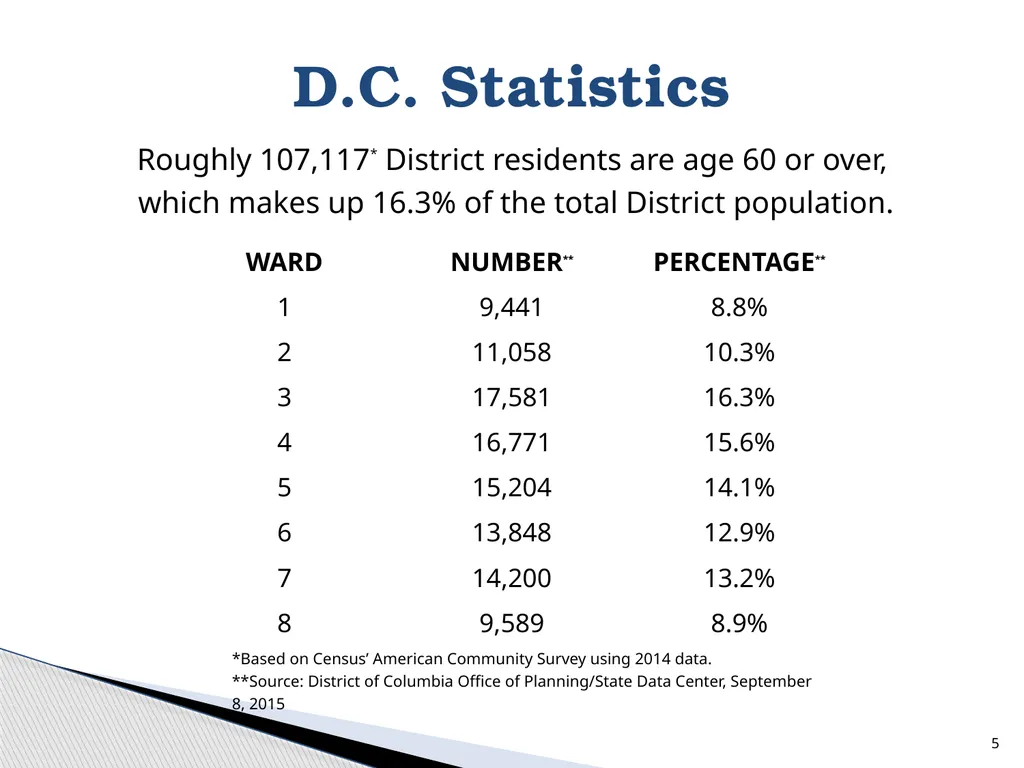
D.C. Statistics 5 Roughly 107,117* District residents are age 60 or over,
which makes up 16.3% of the total District population. *Based on Census’ American Community Survey using 2014 data.
**Source: District of Columbia Office of Planning/State Data Center, September 8, 2015<br>
which makes up 16.3% of the total District population. *Based on Census’ American Community Survey using 2014 data.
**Source: District of Columbia Office of Planning/State Data Center, September 8, 2015<br>
06
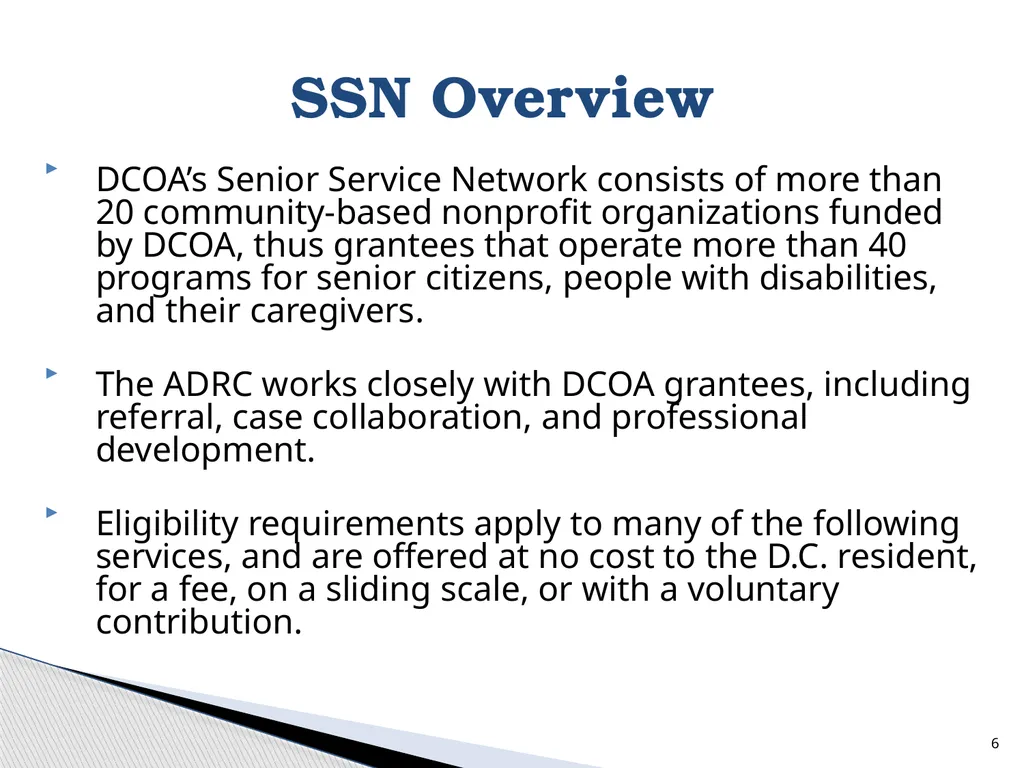
DCOA’s Senior Service Network consists of more than 20 community-based nonprofit organizations funded by DCOA, thus grantees that operate more than 40 programs for senior citizens, people with disabilities, and their caregivers.
The ADRC works closely with DCOA grantees, including referral, case collaboration, and professional development.
Eligibility requirements apply to many of the following services, and are offered at no cost to the D.C. resident, for a fee, on a sliding scale, or with a voluntary contribution. SSN Overview 6<br>
The ADRC works closely with DCOA grantees, including referral, case collaboration, and professional development.
Eligibility requirements apply to many of the following services, and are offered at no cost to the D.C. resident, for a fee, on a sliding scale, or with a voluntary contribution. SSN Overview 6<br>
07
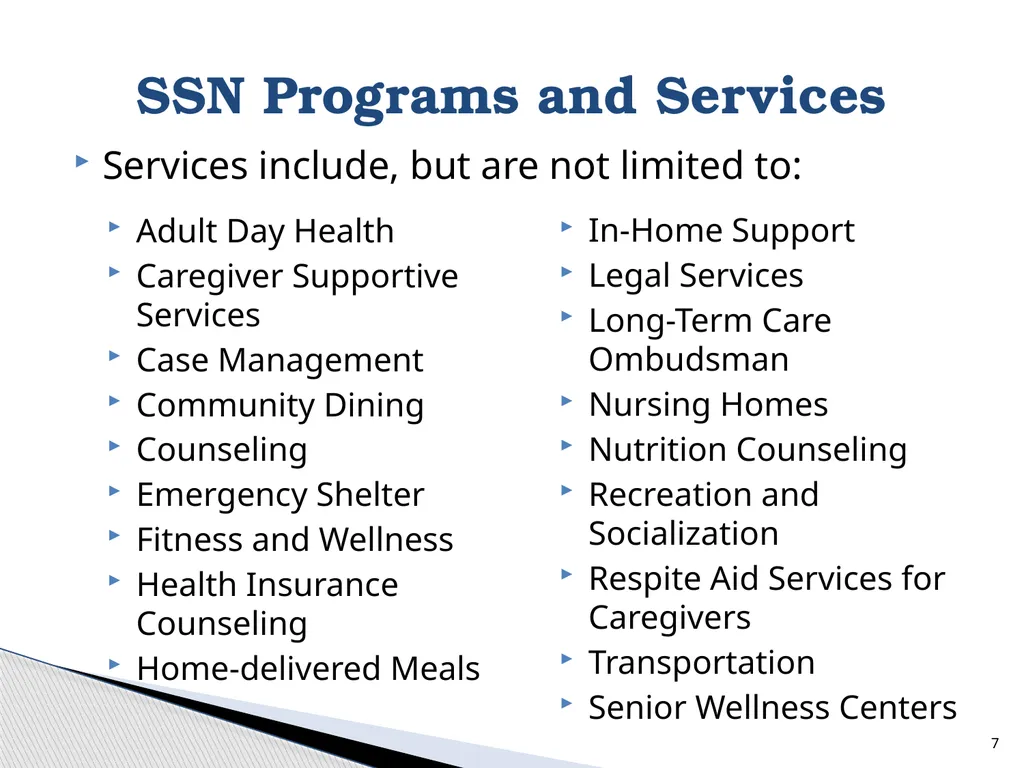
SSN Programs and Services 7 Adult Day Health
Caregiver Supportive Services
Case Management
Community Dining
Counseling
Emergency Shelter
Fitness and Wellness
Health Insurance Counseling
Home-delivered Meals In-Home Support
Legal Services
Long-Term Care Ombudsman
Nursing Homes
Nutrition Counseling
Recreation and Socialization
Respite Aid Services for Caregivers
Transportation
Senior Wellness Centers Services include, but are not limited to:<br>
Caregiver Supportive Services
Case Management
Community Dining
Counseling
Emergency Shelter
Fitness and Wellness
Health Insurance Counseling
Home-delivered Meals In-Home Support
Legal Services
Long-Term Care Ombudsman
Nursing Homes
Nutrition Counseling
Recreation and Socialization
Respite Aid Services for Caregivers
Transportation
Senior Wellness Centers Services include, but are not limited to:<br>
08
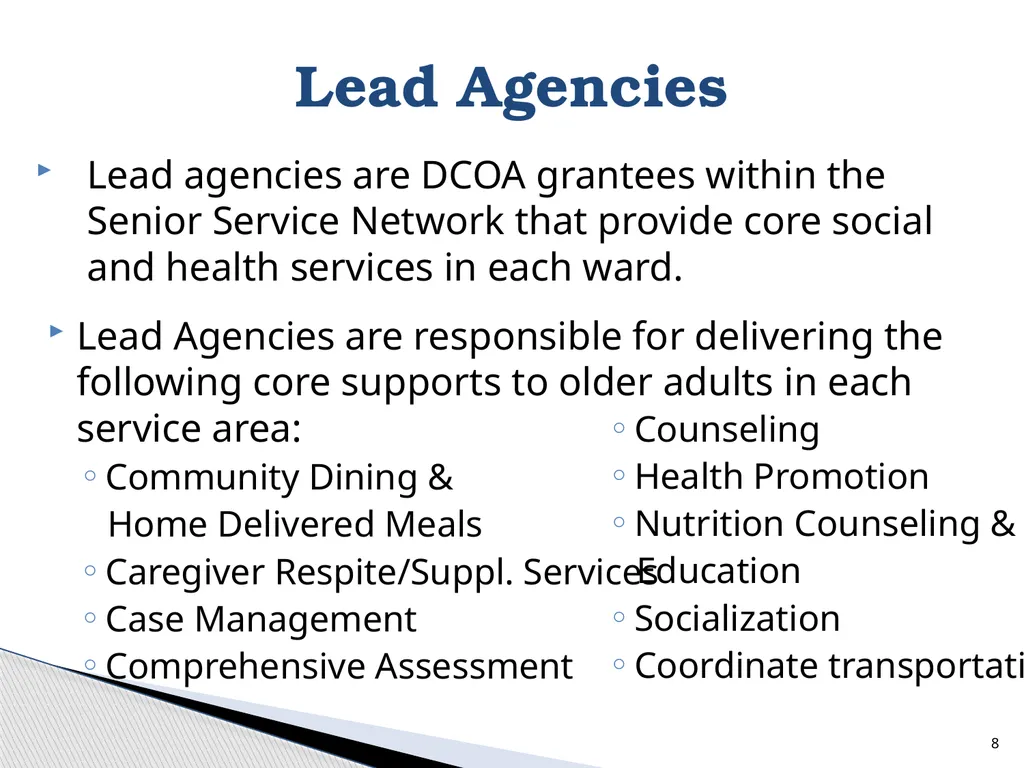
Lead agencies are DCOA grantees within the Senior Service Network that provide core social and health services in each ward.
Lead Agencies are responsible for delivering the following core supports to older adults in each service area:
Community Dining &
Home Delivered Meals
Caregiver Respite/Suppl. Services
Case Management
Comprehensive Assessment Lead Agencies 8 Counseling
Health Promotion
Nutrition Counseling &
Education
Socialization
Coordinate transportation<br>
Lead Agencies are responsible for delivering the following core supports to older adults in each service area:
Community Dining &
Home Delivered Meals
Caregiver Respite/Suppl. Services
Case Management
Comprehensive Assessment Lead Agencies 8 Counseling
Health Promotion
Nutrition Counseling &
Education
Socialization
Coordinate transportation<br>
09
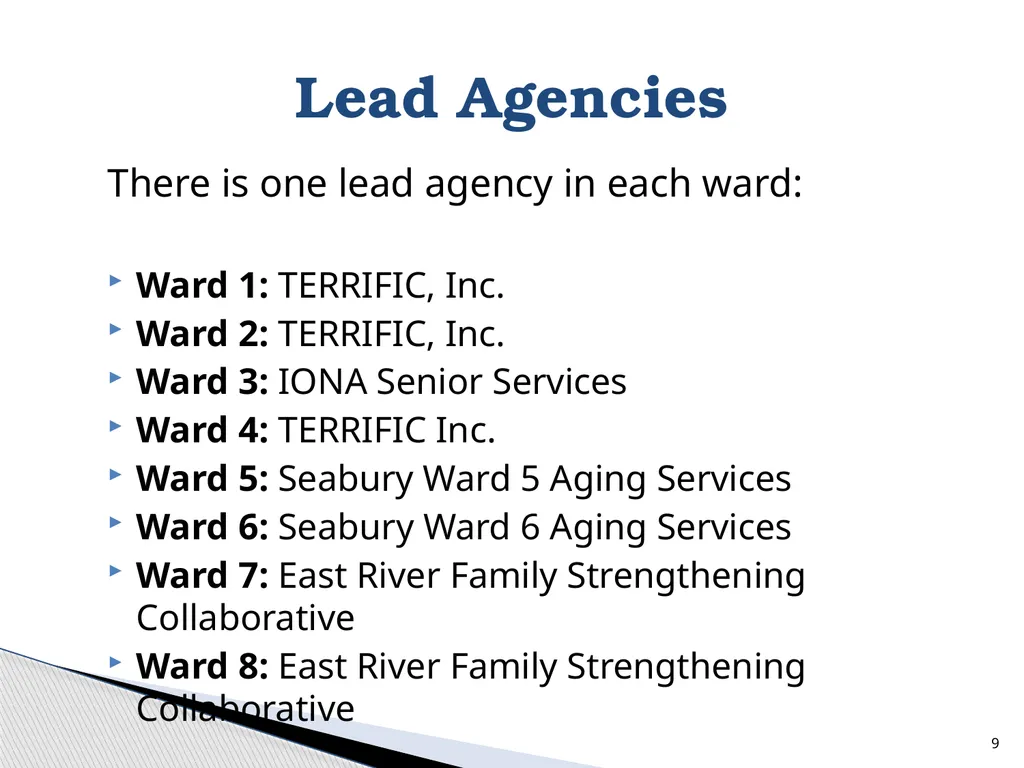
There is one lead agency in each ward:
Ward 1: TERRIFIC, Inc.
Ward 2: TERRIFIC, Inc.
Ward 3: IONA Senior Services
Ward 4: TERRIFIC Inc.
Ward 5: Seabury Ward 5 Aging Services
Ward 6: Seabury Ward 6 Aging Services
Ward 7: East River Family Strengthening Collaborative
Ward 8: East River Family Strengthening Collaborative Lead Agencies 9<br>
Ward 1: TERRIFIC, Inc.
Ward 2: TERRIFIC, Inc.
Ward 3: IONA Senior Services
Ward 4: TERRIFIC Inc.
Ward 5: Seabury Ward 5 Aging Services
Ward 6: Seabury Ward 6 Aging Services
Ward 7: East River Family Strengthening Collaborative
Ward 8: East River Family Strengthening Collaborative Lead Agencies 9<br>
10
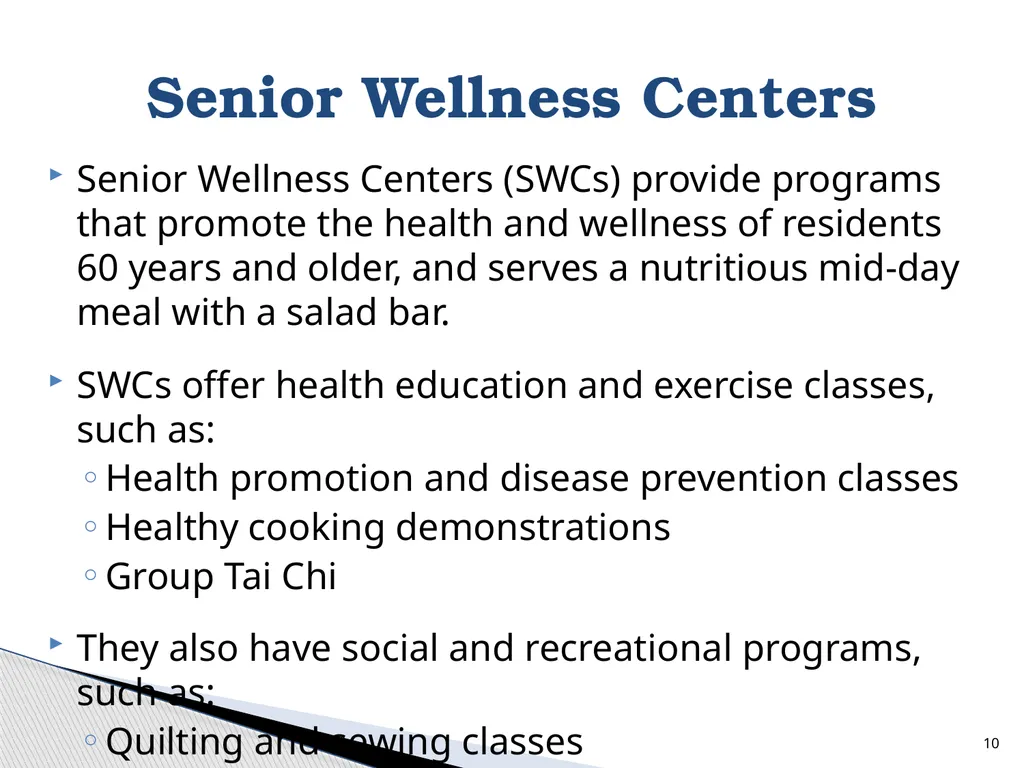
Senior Wellness Centers (SWCs) provide programs that promote the health and wellness of residents 60 years and older, and serves a nutritious mid-day meal with a salad bar.
SWCs offer health education and exercise classes, such as:
Health promotion and disease prevention classes
Healthy cooking demonstrations
Group Tai Chi
They also have social and recreational programs, such as:
Quilting and sewing classes
Group trips Senior Wellness Centers 10<br>
SWCs offer health education and exercise classes, such as:
Health promotion and disease prevention classes
Healthy cooking demonstrations
Group Tai Chi
They also have social and recreational programs, such as:
Quilting and sewing classes
Group trips Senior Wellness Centers 10<br>
11
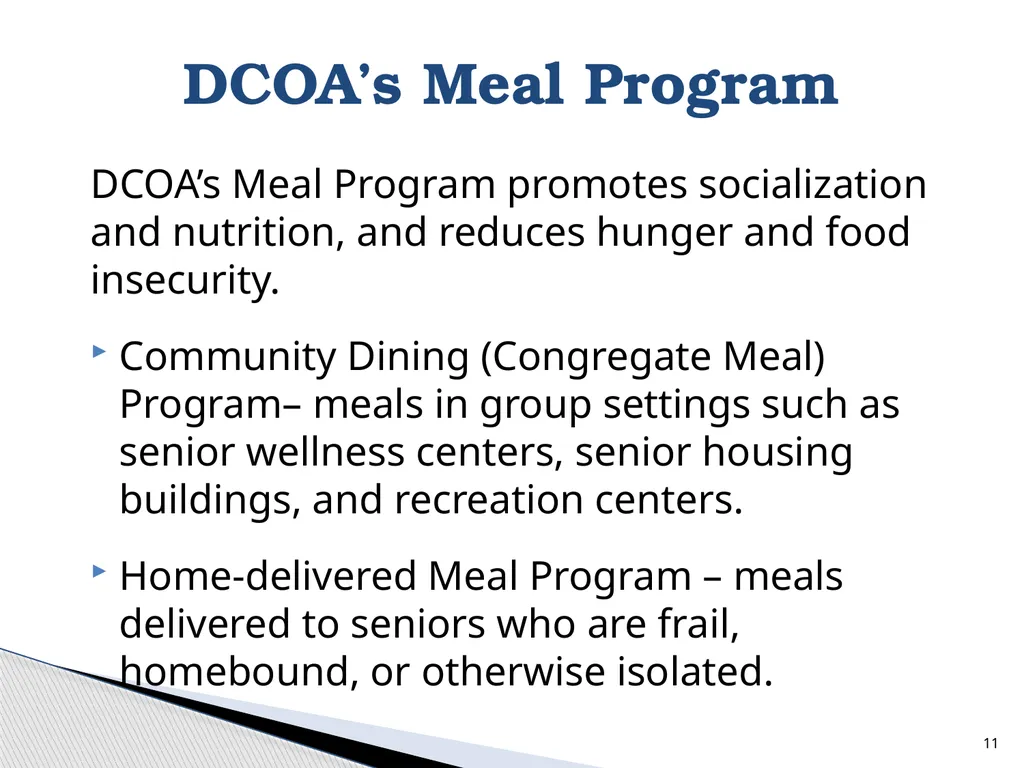
DCOA’s Meal Program promotes socialization and nutrition, and reduces hunger and food insecurity.
Community Dining (Congregate Meal) Program– meals in group settings such as senior wellness centers, senior housing buildings, and recreation centers.
Home-delivered Meal Program – meals delivered to seniors who are frail, homebound, or otherwise isolated. DCOA’s Meal Program 11<br>
Community Dining (Congregate Meal) Program– meals in group settings such as senior wellness centers, senior housing buildings, and recreation centers.
Home-delivered Meal Program – meals delivered to seniors who are frail, homebound, or otherwise isolated. DCOA’s Meal Program 11<br>
12
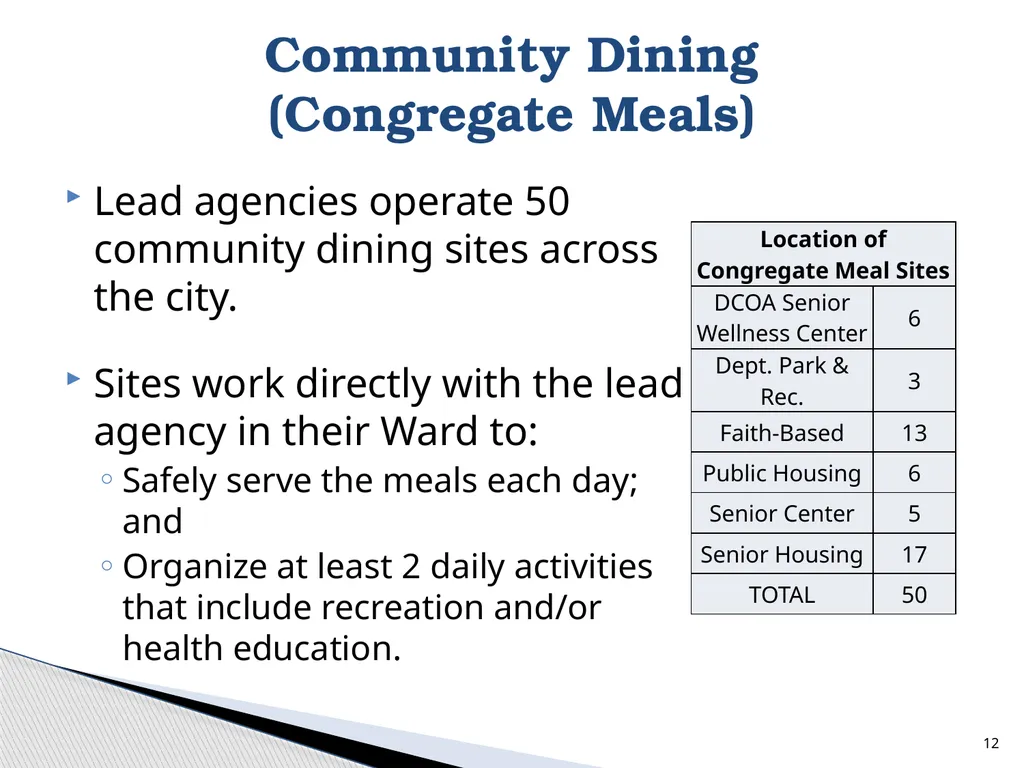
Lead agencies operate 50 community dining sites across the city.
Sites work directly with the lead agency in their Ward to:
Safely serve the meals each day; and
Organize at least 2 daily activities that include recreation and/or health education. Community Dining (Congregate Meals) 12<br>
Sites work directly with the lead agency in their Ward to:
Safely serve the meals each day; and
Organize at least 2 daily activities that include recreation and/or health education. Community Dining (Congregate Meals) 12<br>
13
Home-delivered Meals are offered to seniors who are frail, homebound, or otherwise isolated.
DCOA provides two options for home-delivered meals to all wards in the city.
Option 1: Customer receives up to four deliveries a week and up to seven meals a week. Each delivery consists of fresh meals to be consumed within 48-hours of a delivery.
Option 2: Customers receive one delivery with up to 14 meals every two weeks. Each delivery consists of prepackaged meals to last up to 14-days in the refrigerator and must be reheated in the microwave before eating. Home-delivered Meals 13<br>
DCOA provides two options for home-delivered meals to all wards in the city.
Option 1: Customer receives up to four deliveries a week and up to seven meals a week. Each delivery consists of fresh meals to be consumed within 48-hours of a delivery.
Option 2: Customers receive one delivery with up to 14 meals every two weeks. Each delivery consists of prepackaged meals to last up to 14-days in the refrigerator and must be reheated in the microwave before eating. Home-delivered Meals 13<br>
14
DCOA also connects eligible seniors to additional or alternative food sources:
Grocery Plus (Commodity Supplemental Food Program): free monthly bag of groceries.
Senior Farmers’ Market Program: seniors already enrolled in Grocery Plus receive $30 in vouchers for fresh fruits and vegetables at participating farmers markets.
SNAP (Food Stamps): monthly financial assistance to purchase groceries.
Produce Plus: seniors already enrolled in a government benefit program receive weekly $10 vouchers to purchase fresh fruits and vegetables at participating farmers markets. Meal Program Alternatives 14<br>
Grocery Plus (Commodity Supplemental Food Program): free monthly bag of groceries.
Senior Farmers’ Market Program: seniors already enrolled in Grocery Plus receive $30 in vouchers for fresh fruits and vegetables at participating farmers markets.
SNAP (Food Stamps): monthly financial assistance to purchase groceries.
Produce Plus: seniors already enrolled in a government benefit program receive weekly $10 vouchers to purchase fresh fruits and vegetables at participating farmers markets. Meal Program Alternatives 14<br>
15
Seabury Connector (formally Washington Elderly Handicapped Transportation Service or WEHTS), operated by Seabury Resources for the Aging (Seabury), provides specialized curb-to-curb services to District residents age 60 and older.
Primary objective: provide life-sustaining medical transportation to low-income, functionally impaired persons to achieve and maintain maximum function and independence in the community. Transportation Overview 15<br>
Primary objective: provide life-sustaining medical transportation to low-income, functionally impaired persons to achieve and maintain maximum function and independence in the community. Transportation Overview 15<br>
16
Transportation services are provided for:
Essential medical appointments – chemotherapy, dialysis, adult day health care, etc.
Delivery of home-delivered meals – only for the frail Home-delivered Meal Program
Sites and activities – Senior Wellness Centers, group activities, special events, etc.
Alternative transportation services include:
ConnectorCard – any mode of transportation
Transportation referral and information Transportation Usage 16<br>
Essential medical appointments – chemotherapy, dialysis, adult day health care, etc.
Delivery of home-delivered meals – only for the frail Home-delivered Meal Program
Sites and activities – Senior Wellness Centers, group activities, special events, etc.
Alternative transportation services include:
ConnectorCard – any mode of transportation
Transportation referral and information Transportation Usage 16<br>
17
ConnectorCard is a DCOA subsidized debit card that is loaded with up to $100 per month for each participating senior who shares the burden of costs.
Replaces the “Call-N-Ride” paper coupon system. Up to 150 former paper coupon riders are eligible for this service.
ConnectorCard can be used on any public or private mode of transportation that accepts a card as a form of payment.
Seabury staff monitor daily activity and usage.
Referral and information to other transportation services may include: MetroAcess, TransportDC, and Dept. Parks and Recreation. Alternative Transportation Services 17<br>
Replaces the “Call-N-Ride” paper coupon system. Up to 150 former paper coupon riders are eligible for this service.
ConnectorCard can be used on any public or private mode of transportation that accepts a card as a form of payment.
Seabury staff monitor daily activity and usage.
Referral and information to other transportation services may include: MetroAcess, TransportDC, and Dept. Parks and Recreation. Alternative Transportation Services 17<br>
18
Since 1976, DCOA has contracted with Home Care Partners to administer mandatory homemaker services and caregiver support/respite as defined under two articles of the Older Americans Act (OAA):
Title III B – Support Service and Senior Center Program: funding contributes to home health and homemaker services (e.g. Home Health Aides).
Title III E – National Family Caregiver Support Program: funding contributes to respite services to caregivers (e.g. education, spring cleaning, etc.). In-Home Support Services 18<br>
Title III B – Support Service and Senior Center Program: funding contributes to home health and homemaker services (e.g. Home Health Aides).
Title III E – National Family Caregiver Support Program: funding contributes to respite services to caregivers (e.g. education, spring cleaning, etc.). In-Home Support Services 18<br>
19
Home Health Aides assist with tasks that help customers manage their daily routines. Based on a personalized plan of care, aides are assigned to help with duties that may include:
bathing
dressing
grooming
feeding
toileting
medication reminders
range of motion exercises
Customer Eligibility:
District residents 60 years and over, and
Not eligible for Medicaid. Home Health Aide Services 19 preparing and serving meals
light house cleaning
laundry
shopping and errands
escort to appointments
companionship<br>
bathing
dressing
grooming
feeding
toileting
medication reminders
range of motion exercises
Customer Eligibility:
District residents 60 years and over, and
Not eligible for Medicaid. Home Health Aide Services 19 preparing and serving meals
light house cleaning
laundry
shopping and errands
escort to appointments
companionship<br>
20
Family Caregivers Support 20 Services are designed to ease some of the stresses untrained family caregivers experience while providing continued care at home. Services include:
Case Management to help develop a caregiving plan;
In-home training to manage health problems faced by the senior;
Telephone support groups;
Seminars on practical topics such as therapeutic activities, fall prevention, nutrition and blood pressure management;
Once-a-year “Spring Cleaning” for the senior’s home; and
Reimbursements for eligible caregiving-related supplies or respite care by an agency or other family members.
Customer Eligibility: District residents that are unpaid primary caregivers to District residents 60 years and over.<br>
Case Management to help develop a caregiving plan;
In-home training to manage health problems faced by the senior;
Telephone support groups;
Seminars on practical topics such as therapeutic activities, fall prevention, nutrition and blood pressure management;
Once-a-year “Spring Cleaning” for the senior’s home; and
Reimbursements for eligible caregiving-related supplies or respite care by an agency or other family members.
Customer Eligibility: District residents that are unpaid primary caregivers to District residents 60 years and over.<br>
21
DCOA’s Aging and Disability Resource Center (ADRC), provides a coordinated system of information and access for individuals seeking long-term care services and supports.
This is accomplished through the provision of information, counseling, and service access to older adults, individuals living with disabilities, and caregivers. ADRC Overview 21<br>
This is accomplished through the provision of information, counseling, and service access to older adults, individuals living with disabilities, and caregivers. ADRC Overview 21<br>
22
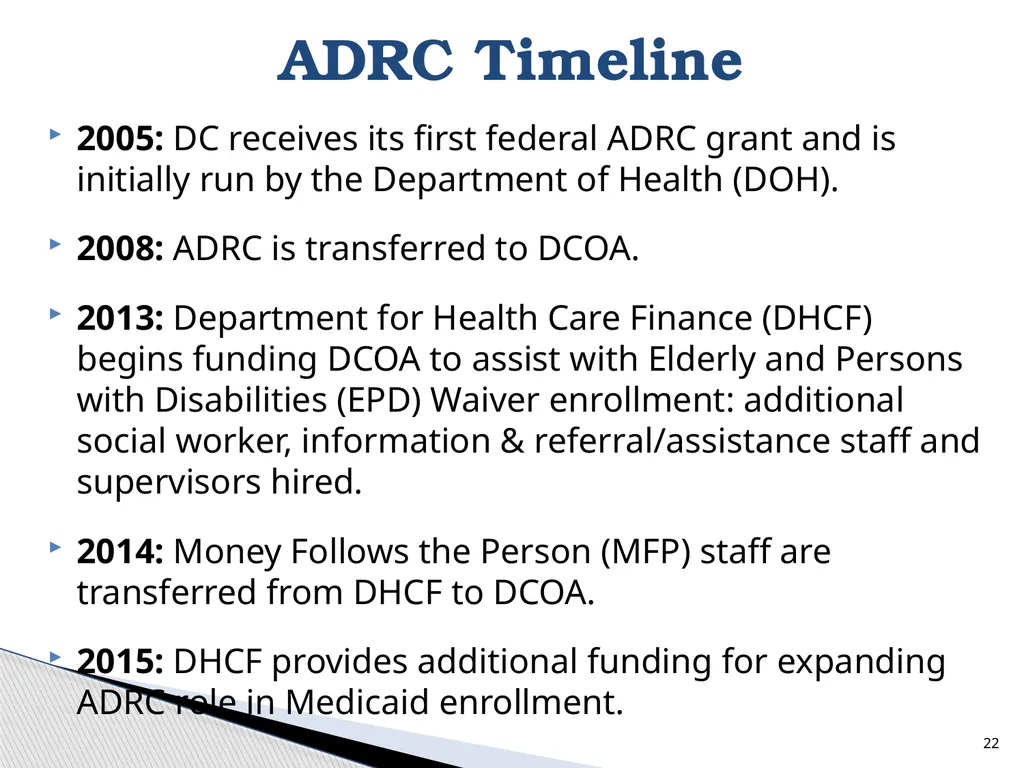
2005: DC receives its first federal ADRC grant and is initially run by the Department of Health (DOH).
2008: ADRC is transferred to DCOA.
2013: Department for Health Care Finance (DHCF) begins funding DCOA to assist with Elderly and Persons with Disabilities (EPD) Waiver enrollment: additional social worker, information & referral/assistance staff and supervisors hired.
2014: Money Follows the Person (MFP) staff are transferred from DHCF to DCOA.
2015: DHCF provides additional funding for expanding ADRC role in Medicaid enrollment. ADRC Timeline 22<br>
2008: ADRC is transferred to DCOA.
2013: Department for Health Care Finance (DHCF) begins funding DCOA to assist with Elderly and Persons with Disabilities (EPD) Waiver enrollment: additional social worker, information & referral/assistance staff and supervisors hired.
2014: Money Follows the Person (MFP) staff are transferred from DHCF to DCOA.
2015: DHCF provides additional funding for expanding ADRC role in Medicaid enrollment. ADRC Timeline 22<br>
23
ADRC provides a variety of direct services including:
Medicaid Waiver Enrollment
Medicaid Adult Day Health Enrollment
Information and Referral/Assistance
Community Social Work
Community Transition ADRC’s Direct Services 23<br>
Medicaid Waiver Enrollment
Medicaid Adult Day Health Enrollment
Information and Referral/Assistance
Community Social Work
Community Transition ADRC’s Direct Services 23<br>
24
D.C.’s Elderly and Persons with Physical Disabilities (EPD)Waiver Program is a person-centered home and community-based waiver funded by Medicaid and administered by the Department of Health Care Finance (DHCF).
As of Spring 2015, the ADRC expanded its role in the EPD Waiver and Medicaid-funded Adult Day Health enrollment processes with the goals of:
Reducing confusion about the enrollment process
Increasing inter-agency communication
Improving customer service
Decreasing enrollment wait times Medicaid Waiver Enrollment 24<br>
As of Spring 2015, the ADRC expanded its role in the EPD Waiver and Medicaid-funded Adult Day Health enrollment processes with the goals of:
Reducing confusion about the enrollment process
Increasing inter-agency communication
Improving customer service
Decreasing enrollment wait times Medicaid Waiver Enrollment 24<br>
25
At the time of conception, the MES team was 80% mobile, providing home visits to all EPD waiver applicants
In April 2017, the ADRC began offering 3 additional pathways to enrollment: self-service, office visits, and phone consultations
To date, the MES team has submitted over 1,900 waiver applications to the Economic Security Administration (ESA)
Since 2015 application processing times have reduced from 200+ days to 60 days or less
DHCF and the ADRC MES team was awarded the 2017 16th Annual Cafritz Award for Team Innovation Medicaid Waiver Enrollment 25<br>
In April 2017, the ADRC began offering 3 additional pathways to enrollment: self-service, office visits, and phone consultations
To date, the MES team has submitted over 1,900 waiver applications to the Economic Security Administration (ESA)
Since 2015 application processing times have reduced from 200+ days to 60 days or less
DHCF and the ADRC MES team was awarded the 2017 16th Annual Cafritz Award for Team Innovation Medicaid Waiver Enrollment 25<br>
26
DCOA has worked collaboratively with DHCF to develop an Adult Day Health Program (ADHP) enrollment process for Medicaid State Plan beneficiaries.
ADRC Community Social Workers:
Conduct Person-Centered Interviews, informing beneficiaries of their service and provider choices.
Complete Person-Centered plans to ensure timely enrollment.
Work collaboratively with DHCF, DDS, and other community partners to educate stakeholders (DC residents, caregivers, ADHP directors and staff) about the new process. Medicaid State Plan Adult Day Health Enrollment 26<br>
ADRC Community Social Workers:
Conduct Person-Centered Interviews, informing beneficiaries of their service and provider choices.
Complete Person-Centered plans to ensure timely enrollment.
Work collaboratively with DHCF, DDS, and other community partners to educate stakeholders (DC residents, caregivers, ADHP directors and staff) about the new process. Medicaid State Plan Adult Day Health Enrollment 26<br>
27
ADRC’s Information and Referral/Assistance (I&R/A) Unit provides a point of entry into the senior service and disability networks.
Clients and caregivers can call and email to obtain assistance on accessing a wide range of home and community-based services, long-term care options, and public benefits.
Contact: 202-724-5626 or ask.adrc@dc.gov Information and Referral/Assistance 27<br>
Clients and caregivers can call and email to obtain assistance on accessing a wide range of home and community-based services, long-term care options, and public benefits.
Contact: 202-724-5626 or ask.adrc@dc.gov Information and Referral/Assistance 27<br>
28
ADRC Social Workers provide:
Long-term care options counseling (person-centered conversations about home and community-based service options);
Case management, counseling, advice and referral-giving for adults 18-59 years old; and
Collaborative assistance on cases with other D.C. agencies, and/or community-based organizations. Community Social Work 28<br>
Long-term care options counseling (person-centered conversations about home and community-based service options);
Case management, counseling, advice and referral-giving for adults 18-59 years old; and
Collaborative assistance on cases with other D.C. agencies, and/or community-based organizations. Community Social Work 28<br>
29
The Community Transition Team assists with transitioning older adults and people with disabilities from long-term care settings back to the community.
It also provides comprehensive post-discharge case management services for up to one year after the date of discharge to ensure sustained independence and quality of life. Community Transition 29<br>
It also provides comprehensive post-discharge case management services for up to one year after the date of discharge to ensure sustained independence and quality of life. Community Transition 29<br>
30
General Intake:
202-724-5626 or ask.adrc@dc.gov
Referrals for Elderly and Persons with Physical Disabilities Waiver Enrollment:
202-724-5626 or epdwaiver.dcoa@dc.gov
Address: 500 K Street NE, DC 20002
ADRC Managers: adrc.managers@dc.gov ADRC Contact Information 30<br>
202-724-5626 or ask.adrc@dc.gov
Referrals for Elderly and Persons with Physical Disabilities Waiver Enrollment:
202-724-5626 or epdwaiver.dcoa@dc.gov
Address: 500 K Street NE, DC 20002
ADRC Managers: adrc.managers@dc.gov ADRC Contact Information 30<br>
31
Age-Friendly DC is a coordinated, comprehensive and collective-action effort with goal of ensuring all DC residents are active, connected, healthy, engaged and happy in their environment.
It is an overarching policy and community engagement framework, one that involves every aspect of life, from transportation, to housing, to health, to finances.
The District completed the Age-Friendly D.C. Strategic Plan in December 2014, which presented two (2) years of engaging nearly 4,000 residents through community forums, focus groups, surveys, and neighborhood walks. Age-Friendly DC 31<br>
It is an overarching policy and community engagement framework, one that involves every aspect of life, from transportation, to housing, to health, to finances.
The District completed the Age-Friendly D.C. Strategic Plan in December 2014, which presented two (2) years of engaging nearly 4,000 residents through community forums, focus groups, surveys, and neighborhood walks. Age-Friendly DC 31<br>
32
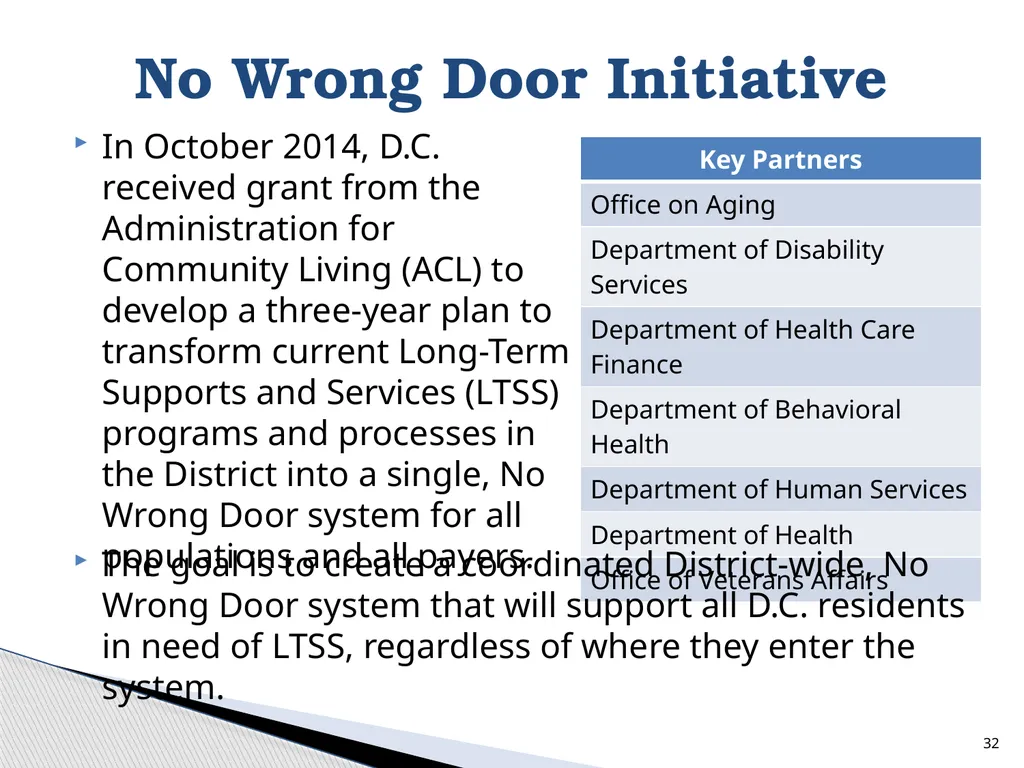
In October 2014, D.C. received grant from the Administration for Community Living (ACL) to develop a three-year plan to transform current Long-Term Supports and Services (LTSS) programs and processes in the District into a single, No Wrong Door system for all populations and all payers. No Wrong Door Initiative 32 The goal is to create a coordinated District-wide, No Wrong Door system that will support all D.C. residents in need of LTSS, regardless of where they enter the system.<br>
33
DCOA works with federal partners to develop strategic objectives and initiatives that serve as a multi-year blue print for serving the older adult population in the District.
The District of Columbia State Plan on Aging has four (4) goals for 2017 through 2018:
Strengthen core program operations and service coordination;
Promote awareness and access to long-term care services and supports offered in the District;
Promote aging in place with dignity and respect; and
Ensure the agency is driven by customer experience. State Plan on Aging 33<br>
The District of Columbia State Plan on Aging has four (4) goals for 2017 through 2018:
Strengthen core program operations and service coordination;
Promote awareness and access to long-term care services and supports offered in the District;
Promote aging in place with dignity and respect; and
Ensure the agency is driven by customer experience. State Plan on Aging 33<br>
34
Currently, DCOA is working on:
Ambassador Training
Intergenerational Programming
Money Smart for Older Adults
Safe at Home
Senior Villages Programs and Initiatives 34<br>
Ambassador Training
Intergenerational Programming
Money Smart for Older Adults
Safe at Home
Senior Villages Programs and Initiatives 34<br>
35
The District of Columbia Office on Aging Safe at Home program provides preventative adaptations to reduce the risk of falls in the homes of qualifying seniors and adults with disabilities. The program has expanded to include safety outside the home through home security cameras at no cost.
In-home preventative adaptations that may be provided through Safe at Home include:
Handrails, Grab bars
Bathtub cuts Shower seat
Furniture risers Chair lift
Call 202-724-5626 for more information on how you can apply for the Safe at Home Program. Safe at Home 35<br>
In-home preventative adaptations that may be provided through Safe at Home include:
Handrails, Grab bars
Bathtub cuts Shower seat
Furniture risers Chair lift
Call 202-724-5626 for more information on how you can apply for the Safe at Home Program. Safe at Home 35<br>
36
DCOA partnered with D.C. Public Schools to bring together older adults and early childhood students to work together on learning experiences in the classroom. Seniors read to students, provide one-on-one tutorials and facilitate special activities.
Genesis, DC’s first intentional intergenerational community,
DCOA developed in partnership with DC Child and Family Services
Comprised of 27 units of affordable housing for residents from three primary groups:
(1) young mothers transitioning from the District of Columbia foster care system and their children,
(2) active, service-minded seniors, and
(3) other families that are not connected with the foster care system. Intergenerational Programing 36<br>
Genesis, DC’s first intentional intergenerational community,
DCOA developed in partnership with DC Child and Family Services
Comprised of 27 units of affordable housing for residents from three primary groups:
(1) young mothers transitioning from the District of Columbia foster care system and their children,
(2) active, service-minded seniors, and
(3) other families that are not connected with the foster care system. Intergenerational Programing 36<br>
37
DCOA and the Elder Abuse Prevention Committee work together to implement the “Money Smart for Older Adults,” a consumer education program in collaboration with the U.S. Consumer Financial Protection Bureau (CFPB).
This interactive consumer education module, designed to prevent the financial exploitation of seniors, has been presented to over a thousand older adults throughout District of Columbia, including seniors at DCOA’s six (6) senior wellness centers. Money Smart for Older Adults 37<br>
This interactive consumer education module, designed to prevent the financial exploitation of seniors, has been presented to over a thousand older adults throughout District of Columbia, including seniors at DCOA’s six (6) senior wellness centers. Money Smart for Older Adults 37<br>
38
During FY15, DCOA worked with leading experts to provide assistance to new and emerging villages, and to research what DCOA’s role should be in supporting villages.
D.C. Villages identified three major areas where DCOA can play an important supporting role:
Increasing Awareness: promote connections between agencies goals and the work of the Villages.
Leverage Partnerships: convene and connect a variety of stakeholders to define mutual goals and efficiently leverage resources.
Build Capacity: build local leadership through assistance, training, and other connections to local funders and community resources. D.C. Villages 38<br>
D.C. Villages identified three major areas where DCOA can play an important supporting role:
Increasing Awareness: promote connections between agencies goals and the work of the Villages.
Leverage Partnerships: convene and connect a variety of stakeholders to define mutual goals and efficiently leverage resources.
Build Capacity: build local leadership through assistance, training, and other connections to local funders and community resources. D.C. Villages 38<br>
39
“Spotlight on Aging” in The Beacon Newspaper
“Spotlight on Community Living” in The Current Newspaper
"Director's Message" Washington Informer
Senior Zone on WYCB, 1340AM
DCOA E*News
Social Media: DCAgingNews on Facebook, Twitter, and Instagram Media Outreach Initiatives 39<br>
“Spotlight on Community Living” in The Current Newspaper
"Director's Message" Washington Informer
Senior Zone on WYCB, 1340AM
DCOA E*News
Social Media: DCAgingNews on Facebook, Twitter, and Instagram Media Outreach Initiatives 39<br>