D-STAR InfoCon 2014 at Dayton Hamvention Part 1 –

Published  . 0 views
↓ Download
D-STAR InfoCon 2014 at Dayton Hamvention Part 1 –
1 / 1
D-STAR InfoCon 2014 at Dayton Hamvention Part 1 – - slide 1 of 19 D-STAR InfoCon 2014 at Dayton Hamvention Part 1 – - slide 2 of 19 D-STAR InfoCon 2014 at Dayton Hamvention Part 1 – - slide 3 of 19 D-STAR InfoCon 2014 at Dayton Hamvention Part 1 – - slide 4 of 19 D-STAR InfoCon 2014 at Dayton Hamvention Part 1 – - slide 5 of 19 D-STAR InfoCon 2014 at Dayton Hamvention Part 1 – - slide 6 of 19 D-STAR InfoCon 2014 at Dayton Hamvention Part 1 – - slide 7 of 19 D-STAR InfoCon 2014 at Dayton Hamvention Part 1 – - slide 8 of 19 D-STAR InfoCon 2014 at Dayton Hamvention Part 1 – - slide 9 of 19 D-STAR InfoCon 2014 at Dayton Hamvention Part 1 – - slide 10 of 19 D-STAR InfoCon 2014 at Dayton Hamvention Part 1 – - slide 11 of 19 D-STAR InfoCon 2014 at Dayton Hamvention Part 1 – - slide 12 of 19 D-STAR InfoCon 2014 at Dayton Hamvention Part 1 – - slide 13 of 19 D-STAR InfoCon 2014 at Dayton Hamvention Part 1 – - slide 14 of 19 D-STAR InfoCon 2014 at Dayton Hamvention Part 1 – - slide 15 of 19 D-STAR InfoCon 2014 at Dayton Hamvention Part 1 – - slide 16 of 19 D-STAR InfoCon 2014 at Dayton Hamvention Part 1 – - slide 17 of 19 D-STAR InfoCon 2014 at Dayton Hamvention Part 1 – - slide 18 of 19 D-STAR InfoCon 2014 at Dayton Hamvention Part 1 – - slide 19 of 19
Description: D-STAR InfoCon 2014 at Dayton Hamvention Part 1 Intro to D-STAR John Davis WB4QDX What is D-STAR? D-STAR is an open standard for digital voice and data on Amateur Radio One of several digital modes in Amateur Radio Developed by Japan

Related Topics

Download Presentation

"D-STAR InfoCon 2014 at Dayton Hamvention Part 1 –" is the property of its rightful owner. Permission is granted to download and print the materials on this website for personal, non-commercial use only, and to display it on your personal computer provided you do not modify the materials and that you retain all copyright notices contained in the materials. By downloading content from our website, you accept the terms of this agreement.

Presentation Transcript

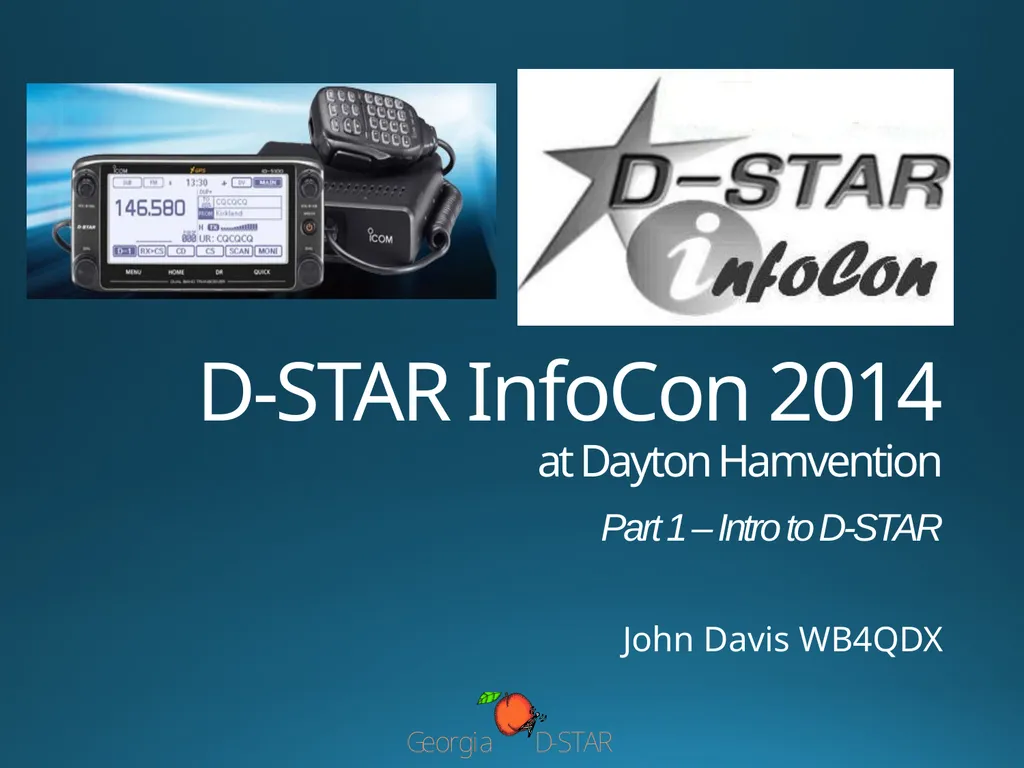
slide1. D-STAR InfoCon 2014 at Dayton Hamvention Part 1 – Intro to D-STAR John Davis WB4QDX<br>
slide2. What is D-STAR? D-STAR is an open standard for digital voice and data on Amateur Radio
One of several digital modes in Amateur Radio
Developed by Japan Amateur Radio League (JARL)
Uses AMBE vocoder chip from DVSI
Icom is first manufacturer with base, mobile, handhelds and repeater equipment
Connect Systems planning D-STAR handheld for 2014
Other vendors offering other products 2 of 19<br>
slide3. How does D-STAR work? Voice is converted to digital modulation and transmitted at 4800 bps
2400 bits for voice
1200 bits for Forward Error Correction on voice
1200 bits for data (error correction usually in applications
True narrowband digital signal
Voice and data occupy one 6.25 KHz signal (versus 12.5 KHz FM voice, P25 and MotoTRBO)
Can operate simplex, repeater or linked to other repeater(s) 3 of 19<br>
slide4. What can D-STAR Do? Transmit or receive voice and 1200 baud data simultaneously on 2m, 440 and 1.2 GHz (no TNC required)

128 Kb data transmission on 1.2 GHz with Internet connectivity (Ethernet bridge to Internet with IP address)

D-PRS (digital APRS) automatic position reporting simultaneous with voice with GPS

Flexible repeater linking with Gateway and Internet connection

Reflectors act as conference bridge for linking multiple repeaters (60+ DPLUS Reflectors now in operation worldwide)

DV Dongle, DV Access Point (DVAP) and DV Node Adapters allow voice and data access to D-STAR via Internet connection (similar to EchoLink) 4 of 19<br>
slide5. As of May 1, 2014 – 1,111 DPLUS Gateways, over 2,575 Voice Repeaters, 218 Data Modules and 34,298 registered users on US Trust Server and 62+ DPLUS reflectors in operation
Other users, repeaters and reflectors on DCS and XREF systems

D-STAR has largest base of users and repeaters of all digital modes D-STAR Growth Continues 5 of 19<br>
slide6. D-STAR Equipment D-STAR radios (mobiles, handhelds, repeaters) commercially produced by ICOM
D-STAR handheld by Connect Systems available in late 2014
DV Dongle is non-radio device allowing access to repeaters and reflectors via Internet (similar to EchoLink)
DV Access Point (DVAP) creates low power hotspot via Internet
Node Adapters converts FM transceiver to D-STAR hotspot via Internet 6 of 19<br>
slide7. Icom Radios Offers line of mobiles, handhelds and repeaters
Most radios are dual band (2m, 70cm)
ID-31A is 70cm only
ID-1 is 23cm only, allows high speed data
All radios operate standard FM and D-STAR digital modes
All Icom radios have built-in serial port for data transmission
All offer GPS as built-in, a part of speaker/mic or connection via serial or USB port 7 of 19<br>
slide8. Icom Mobiles IC-2200 and ID-800 were initial mobiles
D-STAR board can be added to IC-2200
ID-880 updated ID-800 with improved user functions
Dual-band, single receive mobile
IC-2820 is full featured mobile
Dual-band, dual receive
Built-in GPS with external antenna
New ID-5100 mobile offers new features
Dual-Band, dual receive
GPS built into head unit
Touchscreen display
Optional Bluetooth interface
DR Mode with 1200 included memories 8 of 19<br>
slide9. Icom Handhelds IC-91AD was initial D-STAR handheld
Dual-band, dual receive
IC-92AD dual-band, dual receive
Slightly larger frame with more heat sink
Waterproof
GPS spkr/mic optional accessory
IC-80 introduced as lower cost handheld
Dual-band, single receive
GPS spkr/mic accessory available
ID-31A is 70cm handheld
Waterproof
SD card for memory storage, update memory from downloads
Built-in GPS
User friendly DR Mode, locate closest repeater
ID-51A is latest dual band handheld
All features of ID-31A, but dual band, dual receive 9 of 19<br>
slide10. ID-1 for 1.2 GHz Voice and Data Operates FM, Digital Voice (DV), low speed data and high speed data (DV)
High speed data connection is Ethernet compatible
Acts as Ethernet bridge 10 of 19<br>
slide11. DV Dongle Produced by Internet Labs, available at major ham dealers
Provides access to D-STAR repeaters via PC without radio
Small module connects to PC via USB
Uses PC sound card for mic/speaker audio
Windows software runs efficiently on PCs, Netbooks, Windows tablet
Coming to Android tablets, smartphones
Java-based software for Mac, Linux
Connect to repeaters, reflectors, send data, view history. 11 of 19<br>
slide12. DV Access Point Produced by Internet Labs, available at major ham dealers
Creates instant local access point for limited area without D-STAR repeater
Connects to PC via USB
Includes 10mw 2m transceiver and stubby antenna
Use HT, other D-STAR radio nearby for full network access without local repeater
Windows software module for configuration and operation 12 of 19<br>
slide13. DV Node Adapters/GMSK Modems Provides D-STAR interface to FM radio
Can be used to create hotspot or repeater
Can create D-STAR compatible radio with Dongle 13 of 19<br>
slide14. D-STAR Repeater Architecture Linux Gateway PC
Running G2 Gateway software Runs third-party apps, Dongle, DVAP 14 of 19<br>
slide15. The Registration Process Why register?
Registering your callsign allows access to more functions (callsign routing, linking)
Register on your local or the closest system
Register on one and only one system (local registration syncs with all systems throughout world)
Registration is a three-step process (all three steps must be completed) 15 of 19<br>
slide16. Starting Registration Step 1 – Browse to desired system and register as new user (https://callsign.dstargateway.org/Dstar.do) 16 16 of 19<br>
slide17. Fill Out Your Info Fill out the info (callsign, name, email address and desired password)


Step 2 – System administrator must approve your initial registration. You may need to send email to admin. 17 of 19<br>
slide18. Add a Terminal Step 3 – Add at least one terminal with a space in first row under Initial, then type a pc-name (lower case, e.g. wb4qdx-dstar) Note: You only need one terminal, a “space” for use. Adding more terminals can add confusion 18 of 19<br>
slide19. Add Your Callsign to Radio For a radio, program your callsign (caps, no spaces) in MYCALL or MY field
Found in Menu under MY STATION in newer radios
For a DVAP, DV Dongle or Hotspot, program call in callsign field exactly as entered in registration terminal

Get on and talk! 19 of 19<br>