
Darakshan Raja, MA Associate, Safe Nation
LO
Published · 54 slides · 0 views

1 / 1


Description
Darakshan Raja, MA Associate, Safe Nation Collaborative Breaking the silence IMPROVING RESPONSES TO CRIMINAL VICTIMIZATION of MUSLIMS Acknowledgements Development of this training module was supported by funding from Safe Nation
Related Topics
Share
Embed code
Download this presentation From Below
"Darakshan Raja, MA Associate, Safe Nation" is the property of its rightful owner. Permission is granted to download and print the materials on this website for personal, non-commercial use only, and to display it on your personal computer provided you do not modify the materials and that you retain all copyright notices contained in the materials. By downloading content from our website, you accept the terms of this agreement.
Presentation Transcript
01
Darakshan Raja, MA
Associate, Safe Nation Collaborative Breaking the silence IMPROVING RESPONSES TO CRIMINAL VICTIMIZATION of MUSLIMS<br>
Associate, Safe Nation Collaborative Breaking the silence IMPROVING RESPONSES TO CRIMINAL VICTIMIZATION of MUSLIMS<br>
02
Acknowledgements Development of this training module was supported by funding from Safe Nation Collaborative. The opinions, findings, conclusions and recommendations expressed in this training are those of the author and do not necessarily reflect the position of Safe Nation Collaborative or the various organizations and individuals that were interviewed in order to develop this training.
Overall 23 community leaders and professionals who have been working with Muslims who are victims provided feedback for this training. There were a mix of different perspectives from Chaplains, Imams, law enforcement officers, professionals within policy and civil rights organizations, and mental health professionals that have worked with Muslims across a wide range of crimes spanning from domestic violence, hate crimes, sexual assault, forced marriages, workplace violence to torture. Development of this training would not have been possible without the critical feedback from the following individuals:
Sergeant Mike Abdeen, Founder of Muslim Community Affairs Initiative, Los Angeles Sherrif’s Department
Sakeenah Abdulraheem, Counselor and former employee of CAIR
Alejandro Beutal, Former MPAC Government and Policy Analyst
Anas Coburn, Founder and Managing Director, Project Sakinah
Asma Hanif , Founder & Director, Muslimaat al-Nisaa
Shazia Kamal, Associate Editor at AltMuslimah.com and former MPAC Hate Crimes Specialist
Imam Mohamed Magid, President, Islamic Society of North America
Muhammad Malik, Human Rights Advocate, Former Executive Director at CAIR and Board Member of No More Tears
Morlie Patel, Deputy Director of External Affairs, Cook County Sherriff’s Department
Ibrahim Ramey, Executive Director, Muslim Women in Research and Development (MWIRD)
Qudsia Raja, Policy & Advocacy Field Director, YWCA USA
Peaceful Families Project (National Coalition on Muslims against Domestic Violence)<br>
Overall 23 community leaders and professionals who have been working with Muslims who are victims provided feedback for this training. There were a mix of different perspectives from Chaplains, Imams, law enforcement officers, professionals within policy and civil rights organizations, and mental health professionals that have worked with Muslims across a wide range of crimes spanning from domestic violence, hate crimes, sexual assault, forced marriages, workplace violence to torture. Development of this training would not have been possible without the critical feedback from the following individuals:
Sergeant Mike Abdeen, Founder of Muslim Community Affairs Initiative, Los Angeles Sherrif’s Department
Sakeenah Abdulraheem, Counselor and former employee of CAIR
Alejandro Beutal, Former MPAC Government and Policy Analyst
Anas Coburn, Founder and Managing Director, Project Sakinah
Asma Hanif , Founder & Director, Muslimaat al-Nisaa
Shazia Kamal, Associate Editor at AltMuslimah.com and former MPAC Hate Crimes Specialist
Imam Mohamed Magid, President, Islamic Society of North America
Muhammad Malik, Human Rights Advocate, Former Executive Director at CAIR and Board Member of No More Tears
Morlie Patel, Deputy Director of External Affairs, Cook County Sherriff’s Department
Ibrahim Ramey, Executive Director, Muslim Women in Research and Development (MWIRD)
Qudsia Raja, Policy & Advocacy Field Director, YWCA USA
Peaceful Families Project (National Coalition on Muslims against Domestic Violence)<br>
03
“While the trauma and harm experienced by many victims of crime is deep, debilitating, and long-lasting, our treatment of crime victims at every level--individual, community, and governmental is ineffective, fragmented, and dismissive. This woefully inadequate response reinforces victims’ sense of shame and isolation, and a misguided belief that recovery is a private manner (Herman, 2010).”<br>
04
OBJECTIVES Provide an overview of victimization within the Muslim community
What separates the needs of Muslims who are victims of crime from other victims of crime
Identify challenges and barriers for Muslims who are seeking victim services or help from the criminal justice system
Provide recommendations and resources for promising practices<br>
What separates the needs of Muslims who are victims of crime from other victims of crime
Identify challenges and barriers for Muslims who are seeking victim services or help from the criminal justice system
Provide recommendations and resources for promising practices<br>
05
Audience How many of you work with victims of crime?
What types of crimes?
Have you had training on working with victims of crime? What types
Have you worked with Muslims who have been victims of crime?<br>
What types of crimes?
Have you had training on working with victims of crime? What types
Have you worked with Muslims who have been victims of crime?<br>
06
I. Victimization in America<br>
07
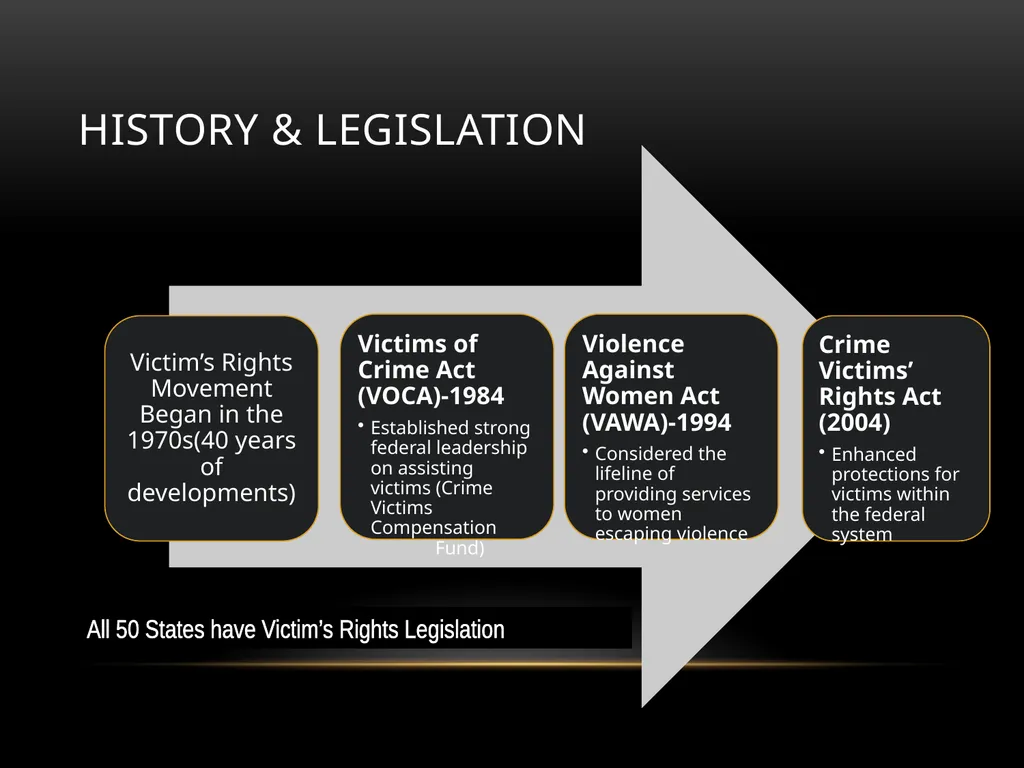
History & legislation All 50 States have Victim’s Rights Legislation<br>
08
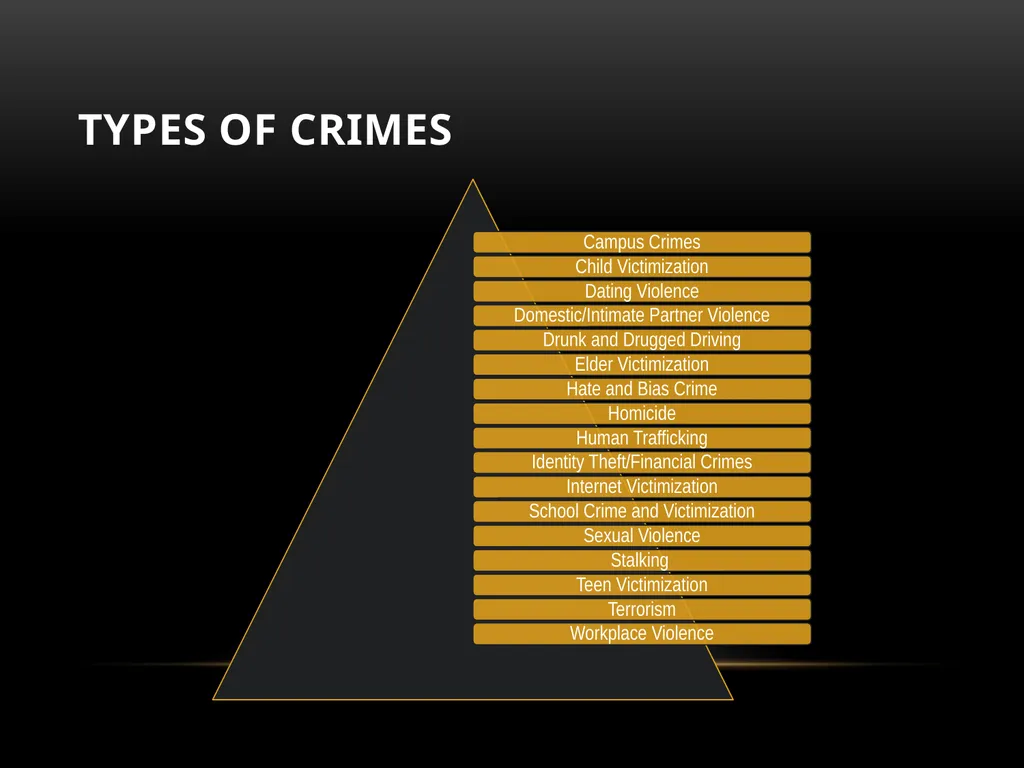
Types of Crimes<br>
09
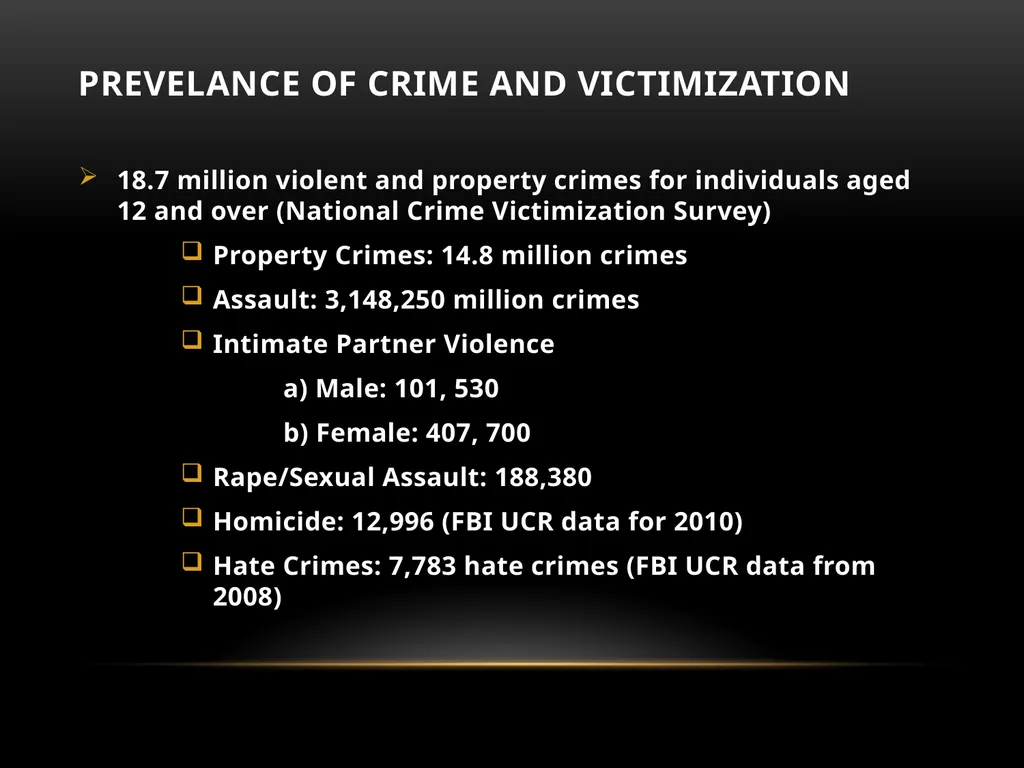
PREVELANCE OF Crime AND VICTIMIZATION 18.7 million violent and property crimes for individuals aged 12 and over (National Crime Victimization Survey)
Property Crimes: 14.8 million crimes
Assault: 3,148,250 million crimes
Intimate Partner Violence
a) Male: 101, 530
b) Female: 407, 700
Rape/Sexual Assault: 188,380
Homicide: 12,996 (FBI UCR data for 2010)
Hate Crimes: 7,783 hate crimes (FBI UCR data from 2008)<br>
Property Crimes: 14.8 million crimes
Assault: 3,148,250 million crimes
Intimate Partner Violence
a) Male: 101, 530
b) Female: 407, 700
Rape/Sexual Assault: 188,380
Homicide: 12,996 (FBI UCR data for 2010)
Hate Crimes: 7,783 hate crimes (FBI UCR data from 2008)<br>
10
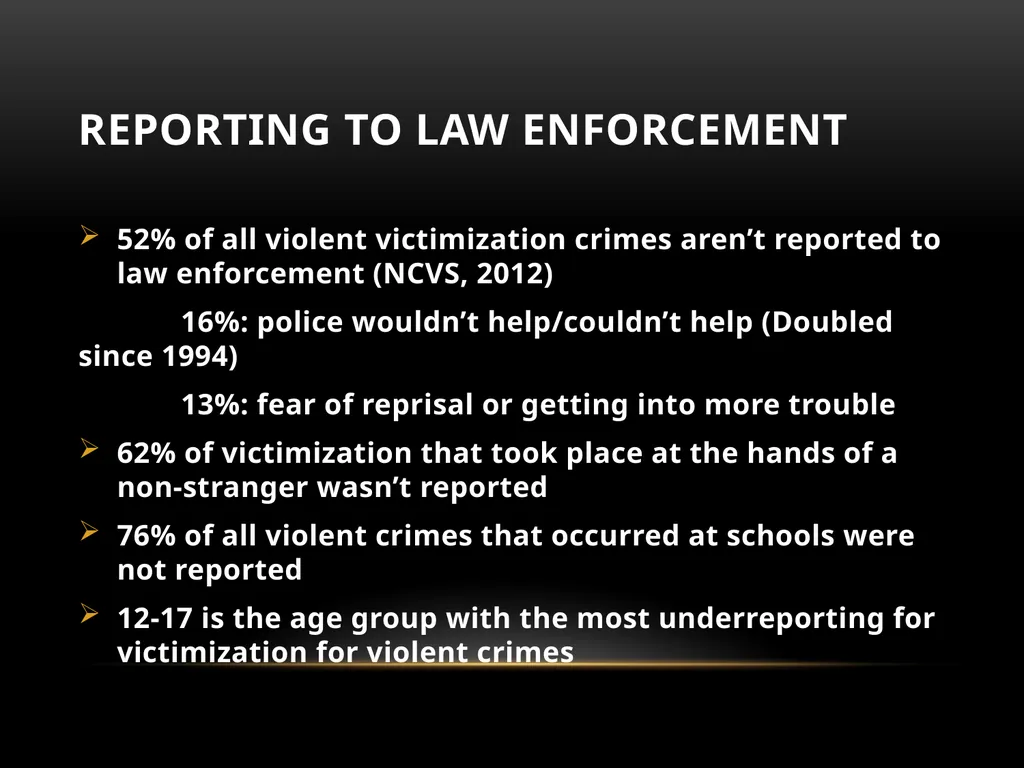
Reporting to Law enforcement 52% of all violent victimization crimes aren’t reported to law enforcement (NCVS, 2012)
16%: police wouldn’t help/couldn’t help (Doubled since 1994)
13%: fear of reprisal or getting into more trouble
62% of victimization that took place at the hands of a non-stranger wasn’t reported
76% of all violent crimes that occurred at schools were not reported
12-17 is the age group with the most underreporting for victimization for violent crimes<br>
16%: police wouldn’t help/couldn’t help (Doubled since 1994)
13%: fear of reprisal or getting into more trouble
62% of victimization that took place at the hands of a non-stranger wasn’t reported
76% of all violent crimes that occurred at schools were not reported
12-17 is the age group with the most underreporting for victimization for violent crimes<br>
11
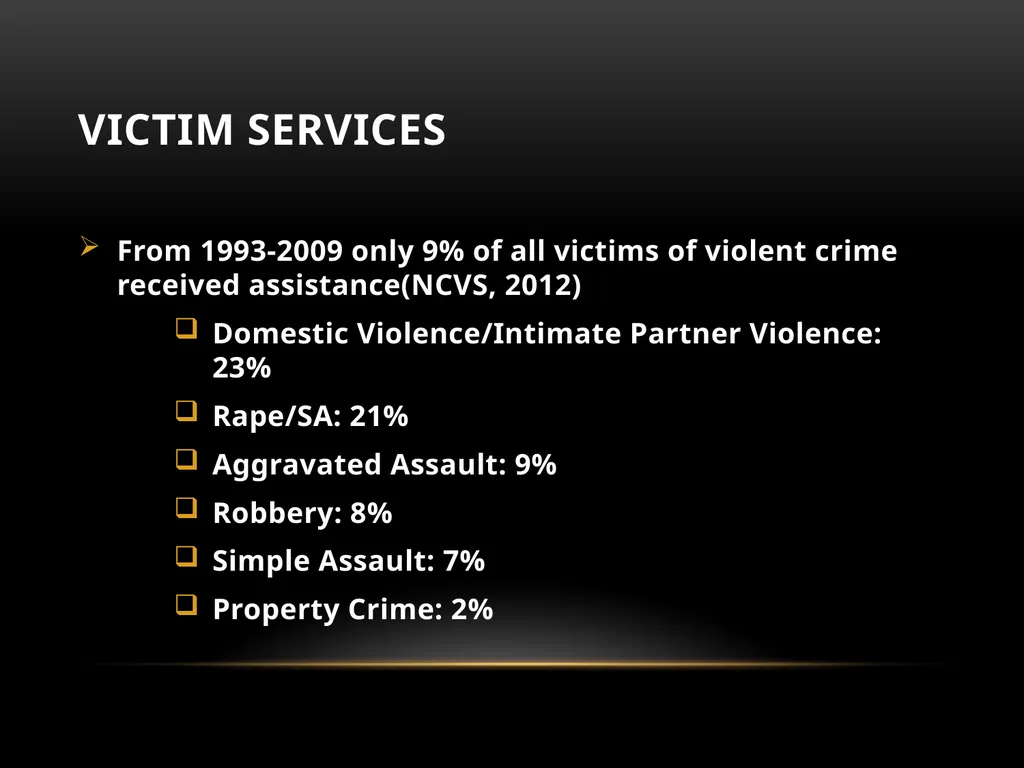
Victim Services From 1993-2009 only 9% of all victims of violent crime received assistance(NCVS, 2012)
Domestic Violence/Intimate Partner Violence: 23%
Rape/SA: 21%
Aggravated Assault: 9%
Robbery: 8%
Simple Assault: 7%
Property Crime: 2%<br>
Domestic Violence/Intimate Partner Violence: 23%
Rape/SA: 21%
Aggravated Assault: 9%
Robbery: 8%
Simple Assault: 7%
Property Crime: 2%<br>
12
II. Underserved Groups: Victimization and Muslims<br>
13
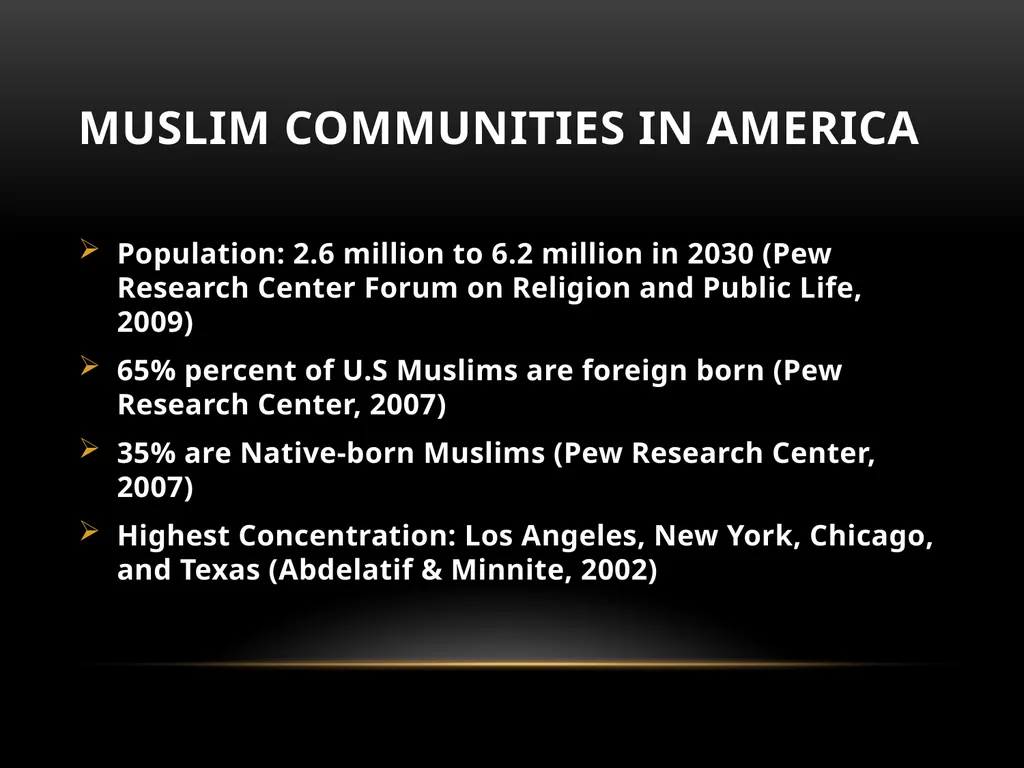
Muslim communities in America Population: 2.6 million to 6.2 million in 2030 (Pew Research Center Forum on Religion and Public Life, 2009)
65% percent of U.S Muslims are foreign born (Pew Research Center, 2007)
35% are Native-born Muslims (Pew Research Center, 2007)
Highest Concentration: Los Angeles, New York, Chicago, and Texas (Abdelatif & Minnite, 2002)<br>
65% percent of U.S Muslims are foreign born (Pew Research Center, 2007)
35% are Native-born Muslims (Pew Research Center, 2007)
Highest Concentration: Los Angeles, New York, Chicago, and Texas (Abdelatif & Minnite, 2002)<br>
14
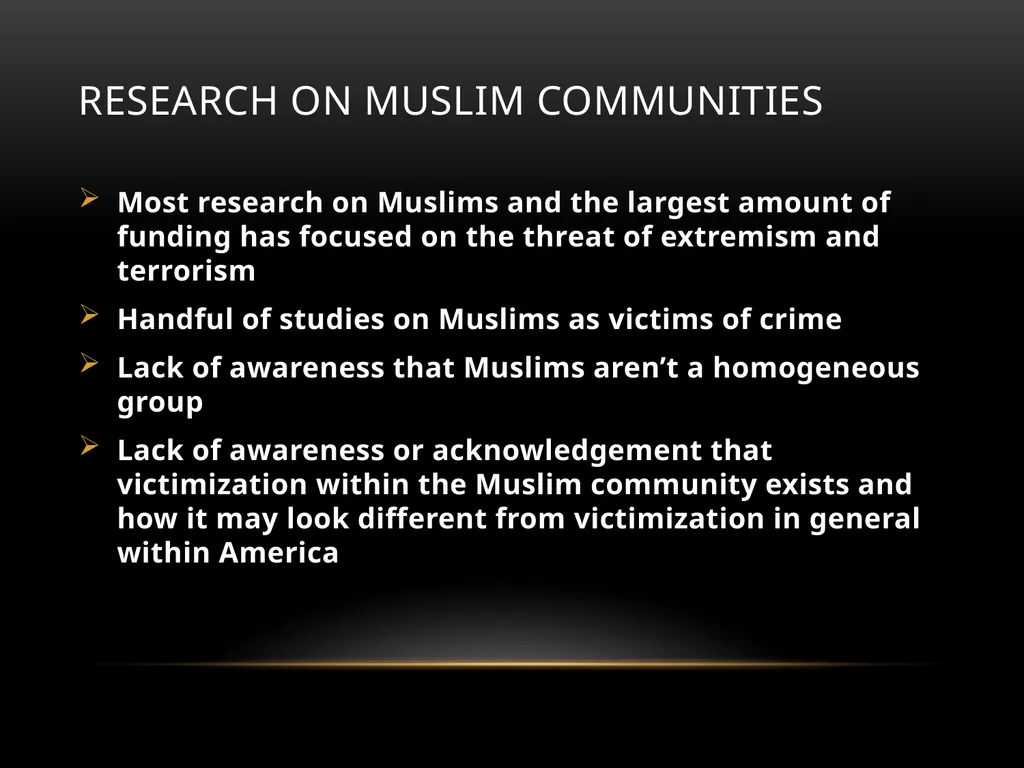
Research on Muslim communities Most research on Muslims and the largest amount of funding has focused on the threat of extremism and terrorism
Handful of studies on Muslims as victims of crime
Lack of awareness that Muslims aren’t a homogeneous group
Lack of awareness or acknowledgement that victimization within the Muslim community exists and how it may look different from victimization in general within America<br>
Handful of studies on Muslims as victims of crime
Lack of awareness that Muslims aren’t a homogeneous group
Lack of awareness or acknowledgement that victimization within the Muslim community exists and how it may look different from victimization in general within America<br>
15
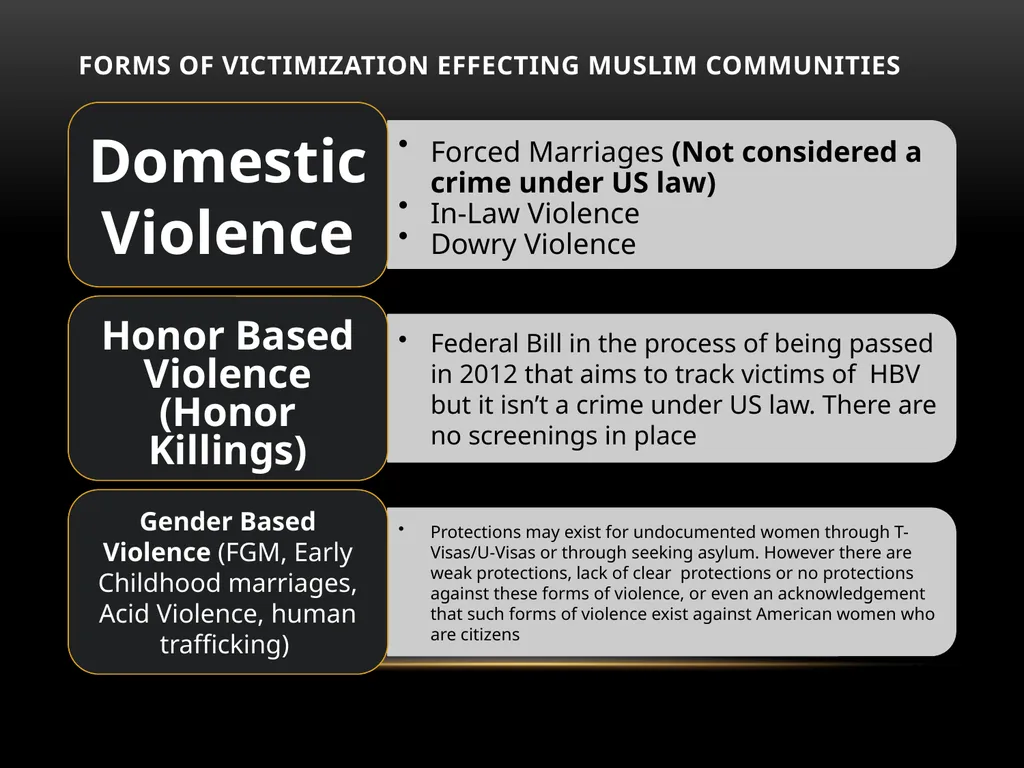
Forms of Victimization effecting muslim communities<br>
16
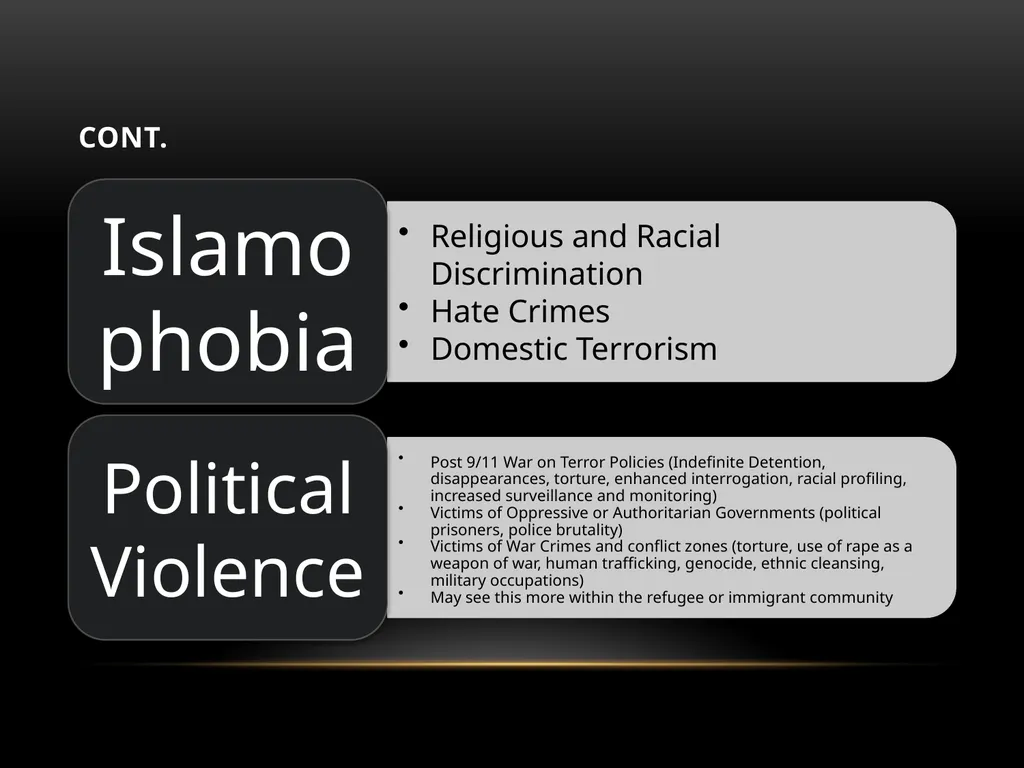
Cont.<br>
17
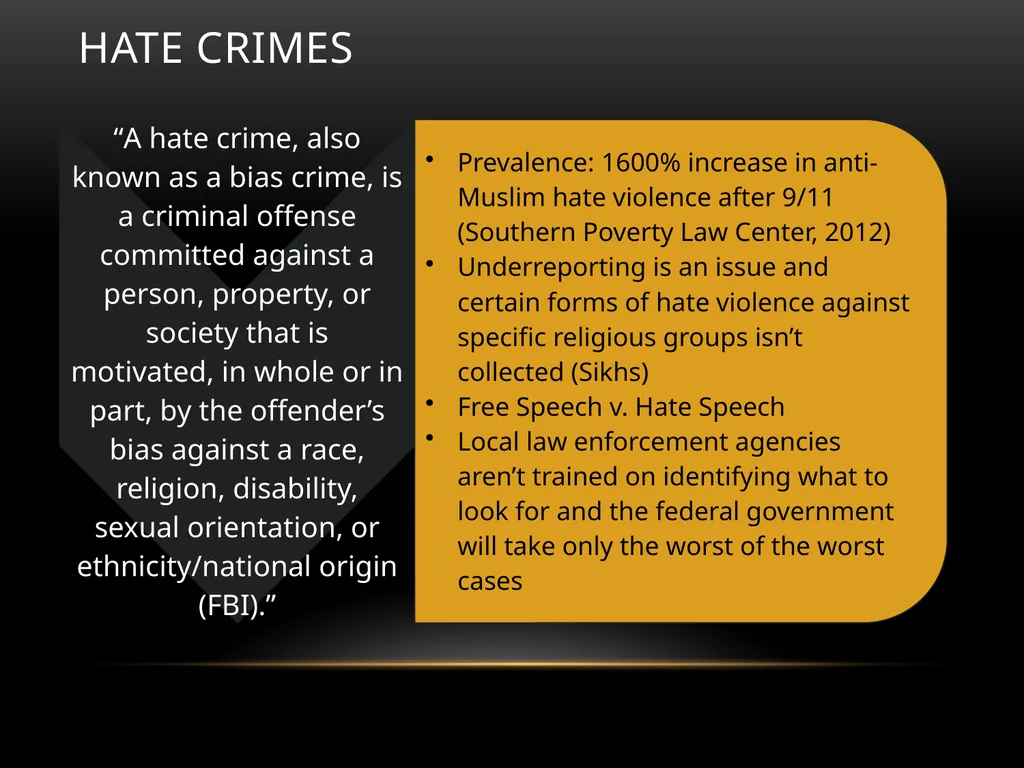
Hate Crimes<br>
18
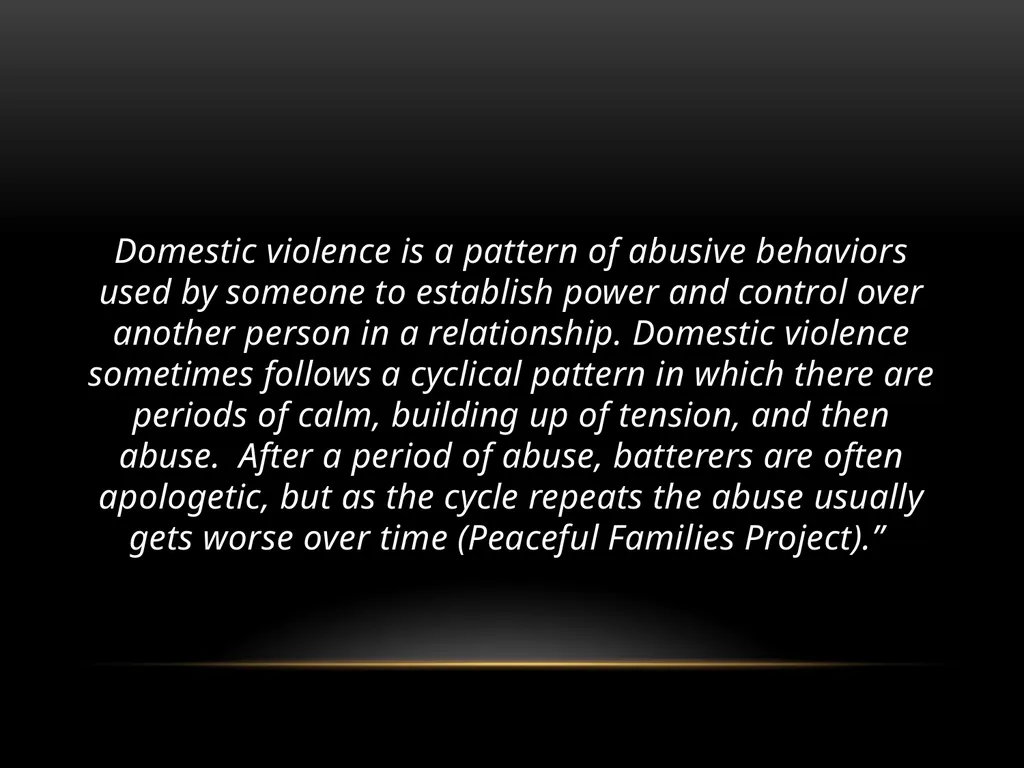
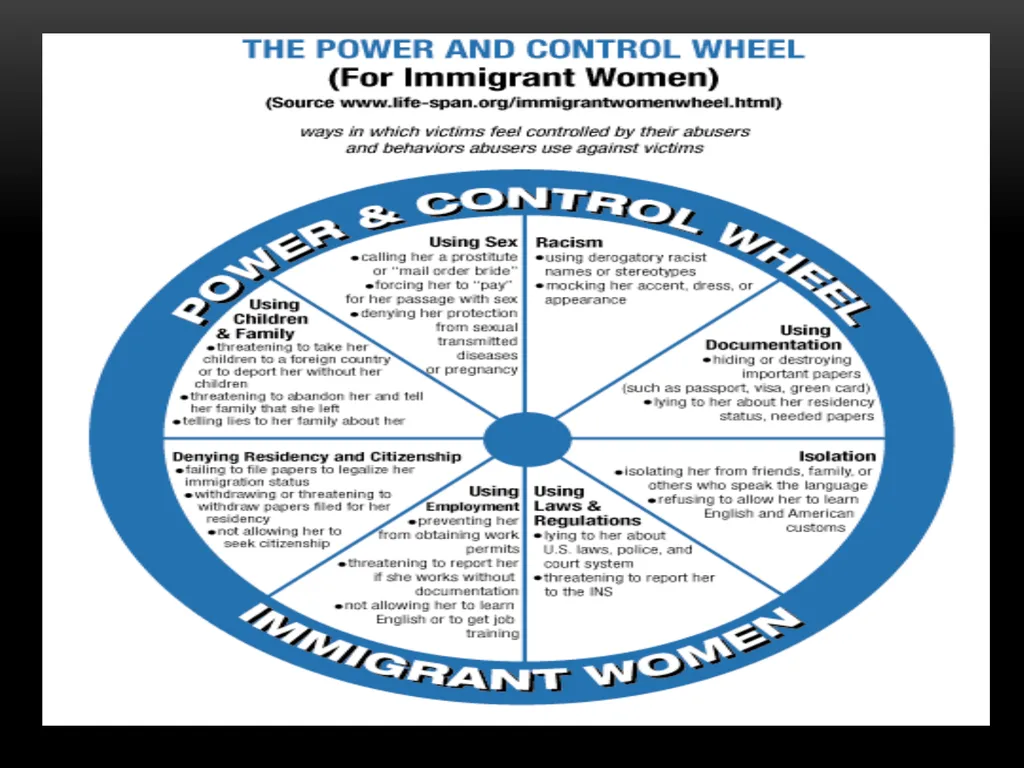
Domestic violence is a pattern of abusive behaviors used by someone to establish power and control over another person in a relationship. Domestic violence sometimes follows a cyclical pattern in which there are periods of calm, building up of tension, and then abuse. After a period of abuse, batterers are often apologetic, but as the cycle repeats the abuse usually gets worse over time (Peaceful Families Project).”<br>
19
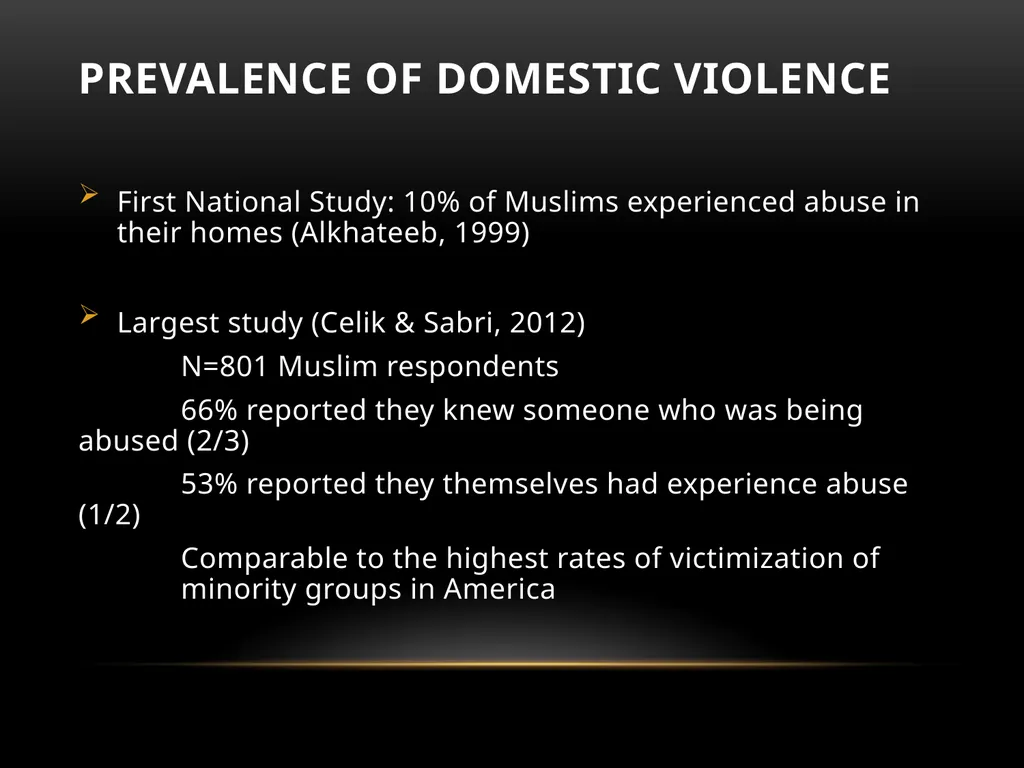
Prevalence OF Domestic violence First National Study: 10% of Muslims experienced abuse in their homes (Alkhateeb, 1999)
Largest study (Celik & Sabri, 2012)
N=801 Muslim respondents
66% reported they knew someone who was being abused (2/3)
53% reported they themselves had experience abuse (1/2)
Comparable to the highest rates of victimization of minority groups in America<br>
Largest study (Celik & Sabri, 2012)
N=801 Muslim respondents
66% reported they knew someone who was being abused (2/3)
53% reported they themselves had experience abuse (1/2)
Comparable to the highest rates of victimization of minority groups in America<br>
20
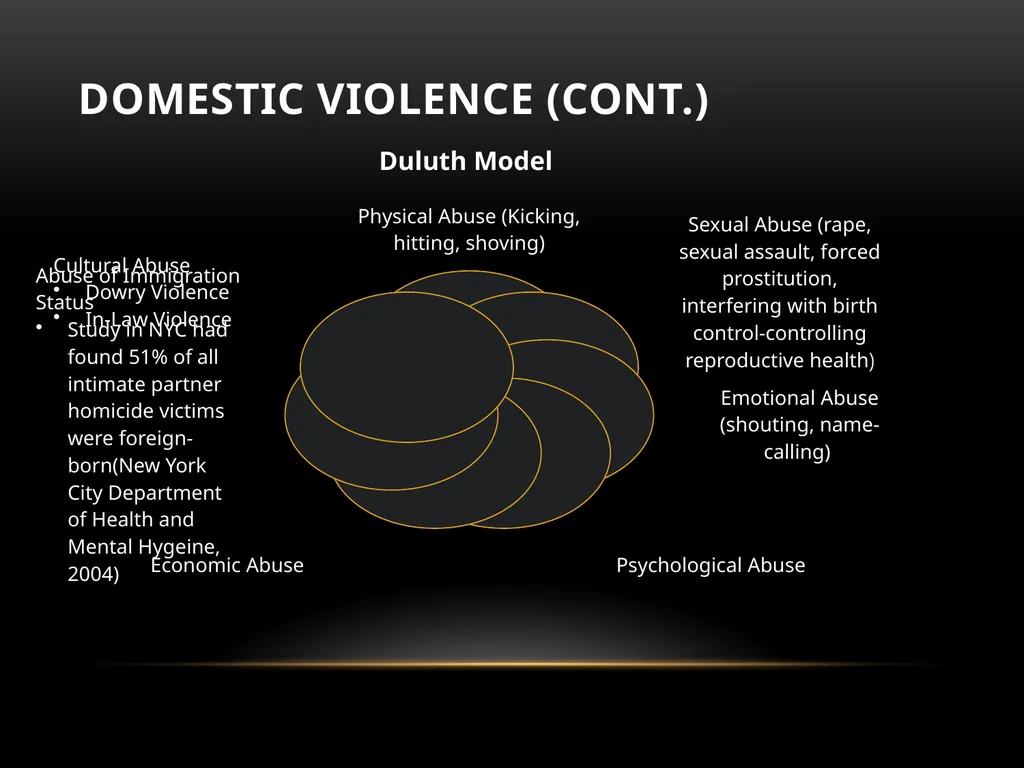
Domestic violence (Cont.)<br>
21
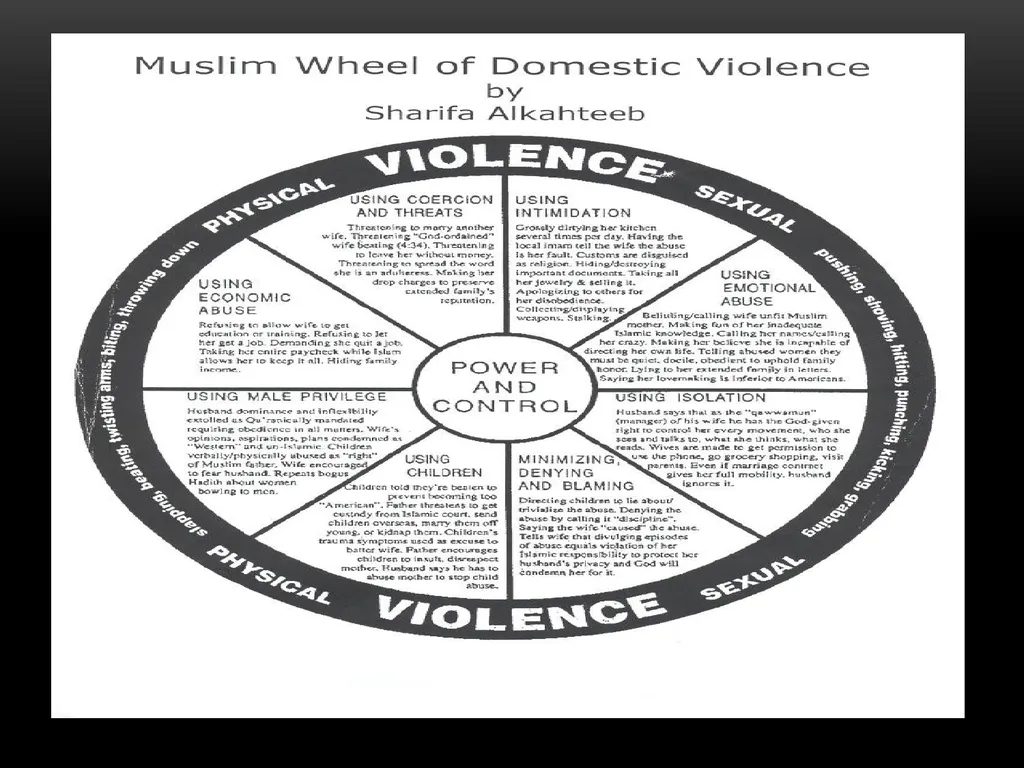
Domestic violence and religious abuse Coercion and Threats
Threatening to marry another wife and “God ordained wife-beating (4:34)”
Threatening to spread the word and dishonor her reputation
Making her drop charges to preserve the extended family’s honor
Intimidation
Having the Imam tell the wife its her fault
Collecting/Displaying weapons
Stalking
Emotional Abuse
Telling the victim she isn’t a good Muslim mother or wife
Stating her knowledge of Islam is weak
Telling women they need to be obedient and uphold the honor of the family<br>
Threatening to marry another wife and “God ordained wife-beating (4:34)”
Threatening to spread the word and dishonor her reputation
Making her drop charges to preserve the extended family’s honor
Intimidation
Having the Imam tell the wife its her fault
Collecting/Displaying weapons
Stalking
Emotional Abuse
Telling the victim she isn’t a good Muslim mother or wife
Stating her knowledge of Islam is weak
Telling women they need to be obedient and uphold the honor of the family<br>
22
Domestic violence and religious abuse Isolation
Restricts movement and access to family
May use religious explanations stating he is the manager of the family and has God-given right to control her movement
Minimizing, Denying and Blaming
Saying the wife caused the abuse
Telling the wife that by telling others of the abuse she is violating the husband’s privacy and God will punish her
Using Children
Child Abuse for the purposes of not having kids become too American or Western
Threats of taking the children back to the native country to marry them off or kidnap them
Father encourages children to abuse and disrespect the mother<br>
Restricts movement and access to family
May use religious explanations stating he is the manager of the family and has God-given right to control her movement
Minimizing, Denying and Blaming
Saying the wife caused the abuse
Telling the wife that by telling others of the abuse she is violating the husband’s privacy and God will punish her
Using Children
Child Abuse for the purposes of not having kids become too American or Western
Threats of taking the children back to the native country to marry them off or kidnap them
Father encourages children to abuse and disrespect the mother<br>
23
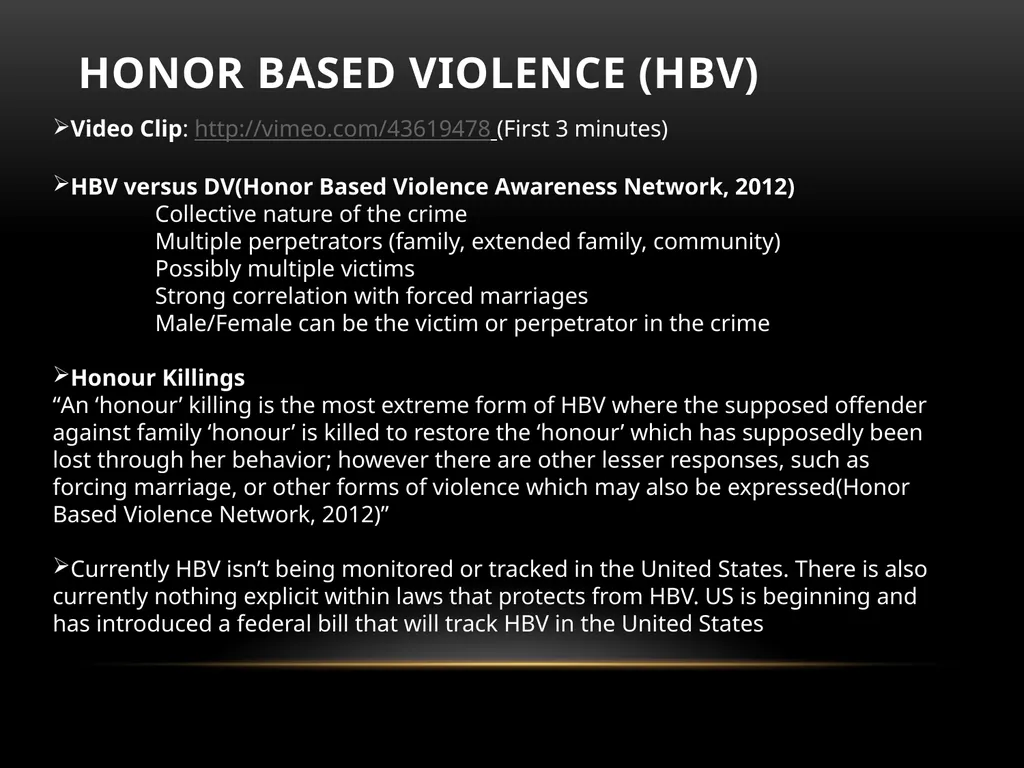
Honor based violence (hbv) Video Clip: http://vimeo.com/43619478 (First 3 minutes)
HBV versus DV(Honor Based Violence Awareness Network, 2012)
Collective nature of the crime
Multiple perpetrators (family, extended family, community)
Possibly multiple victims
Strong correlation with forced marriages
Male/Female can be the victim or perpetrator in the crime
Honour Killings
“An ‘honour’ killing is the most extreme form of HBV where the supposed offender against family ‘honour’ is killed to restore the ‘honour’ which has supposedly been lost through her behavior; however there are other lesser responses, such as forcing marriage, or other forms of violence which may also be expressed(Honor Based Violence Network, 2012)”
Currently HBV isn’t being monitored or tracked in the United States. There is also currently nothing explicit within laws that protects from HBV. US is beginning and has introduced a federal bill that will track HBV in the United States<br>
HBV versus DV(Honor Based Violence Awareness Network, 2012)
Collective nature of the crime
Multiple perpetrators (family, extended family, community)
Possibly multiple victims
Strong correlation with forced marriages
Male/Female can be the victim or perpetrator in the crime
Honour Killings
“An ‘honour’ killing is the most extreme form of HBV where the supposed offender against family ‘honour’ is killed to restore the ‘honour’ which has supposedly been lost through her behavior; however there are other lesser responses, such as forcing marriage, or other forms of violence which may also be expressed(Honor Based Violence Network, 2012)”
Currently HBV isn’t being monitored or tracked in the United States. There is also currently nothing explicit within laws that protects from HBV. US is beginning and has introduced a federal bill that will track HBV in the United States<br>
24
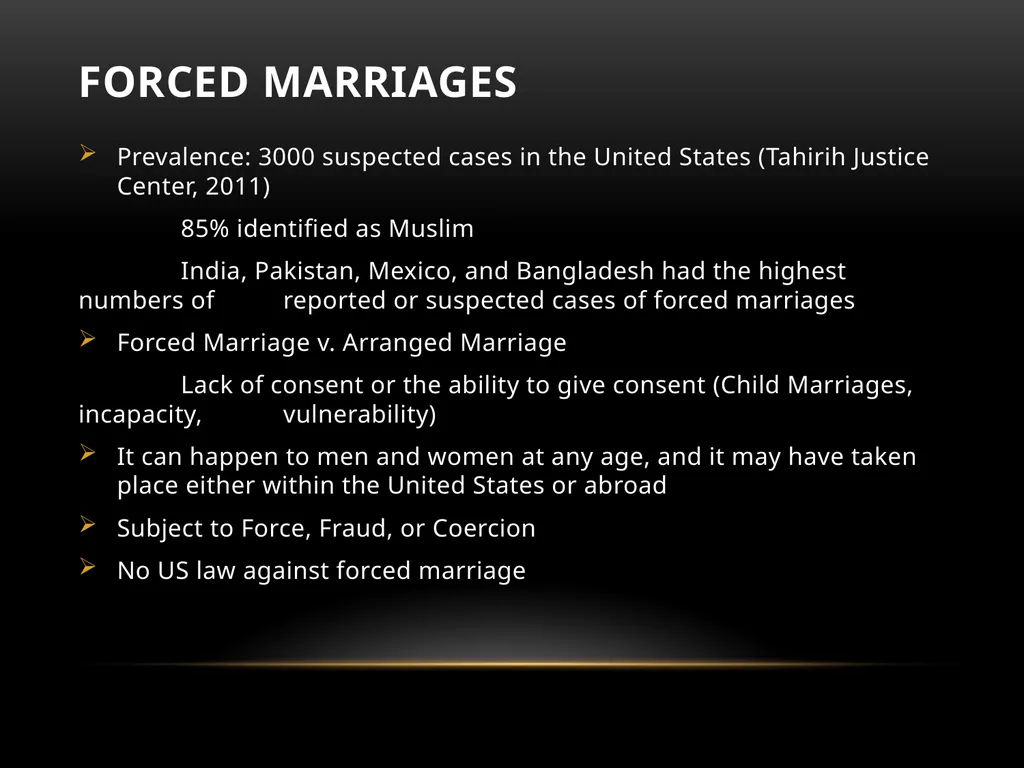
Forced Marriages Prevalence: 3000 suspected cases in the United States (Tahirih Justice Center, 2011)
85% identified as Muslim
India, Pakistan, Mexico, and Bangladesh had the highest numbers of reported or suspected cases of forced marriages
Forced Marriage v. Arranged Marriage
Lack of consent or the ability to give consent (Child Marriages, incapacity, vulnerability)
It can happen to men and women at any age, and it may have taken place either within the United States or abroad
Subject to Force, Fraud, or Coercion
No US law against forced marriage<br>
85% identified as Muslim
India, Pakistan, Mexico, and Bangladesh had the highest numbers of reported or suspected cases of forced marriages
Forced Marriage v. Arranged Marriage
Lack of consent or the ability to give consent (Child Marriages, incapacity, vulnerability)
It can happen to men and women at any age, and it may have taken place either within the United States or abroad
Subject to Force, Fraud, or Coercion
No US law against forced marriage<br>
25
Female genital mutilation (fgm) Collective name for various traditional practices of cutting the female genitals that usually occur from 4-12 in girls, and are considered a rite of passage(Center for Productive Rights, 2006).
Usually carried out by a woman
Cultural not Religious Practice but prevalent in some few subsets of Muslim communities
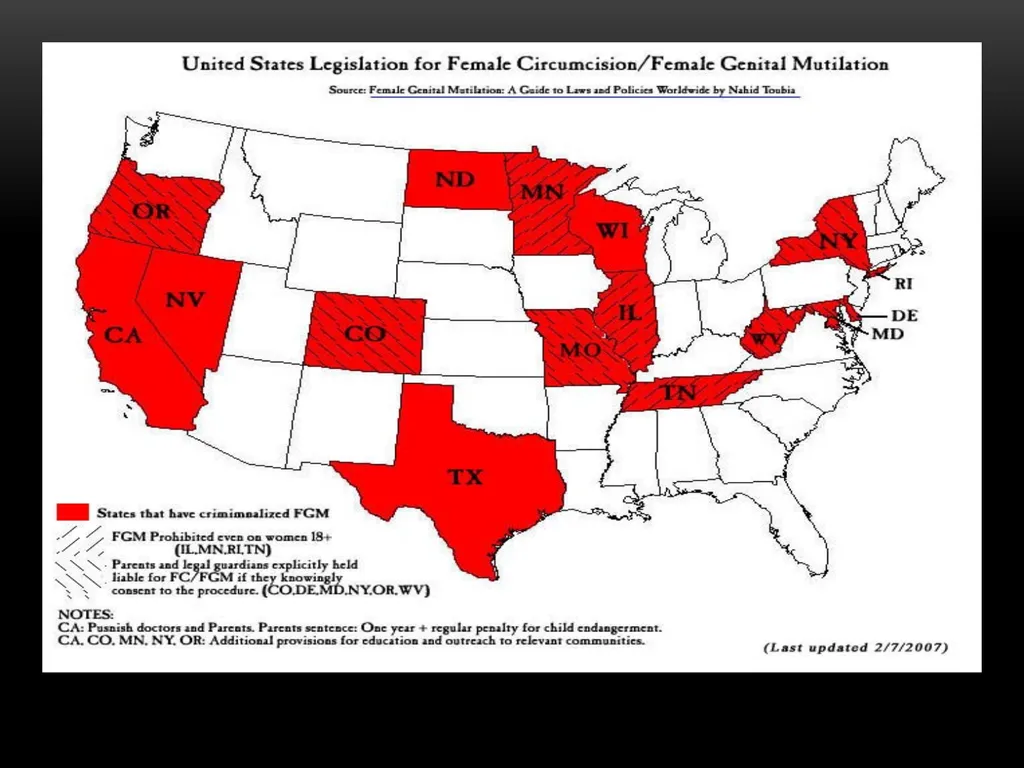
FGM is not illegal in all states in the United States
No prevalence on how many American women face FGM<br>
Usually carried out by a woman
Cultural not Religious Practice but prevalent in some few subsets of Muslim communities
FGM is not illegal in all states in the United States
No prevalence on how many American women face FGM<br>
26
Impact of Crime Victimization Trauma (PTSD)
Secondary Victimization (Societal Response or Lack of)
Victim Blaming and Shaming
Ostracizing the victim due to stigma
Self-Harm/Suicide
Vulnerability to further victimization(Poly
More crime(While most victims of crime do not offend, the majority of offenders have had severe experiences of victimization within their lives)<br>
Secondary Victimization (Societal Response or Lack of)
Victim Blaming and Shaming
Ostracizing the victim due to stigma
Self-Harm/Suicide
Vulnerability to further victimization(Poly
More crime(While most victims of crime do not offend, the majority of offenders have had severe experiences of victimization within their lives)<br>
27
III. Current State of Response to Victimization of Muslims<br>
28
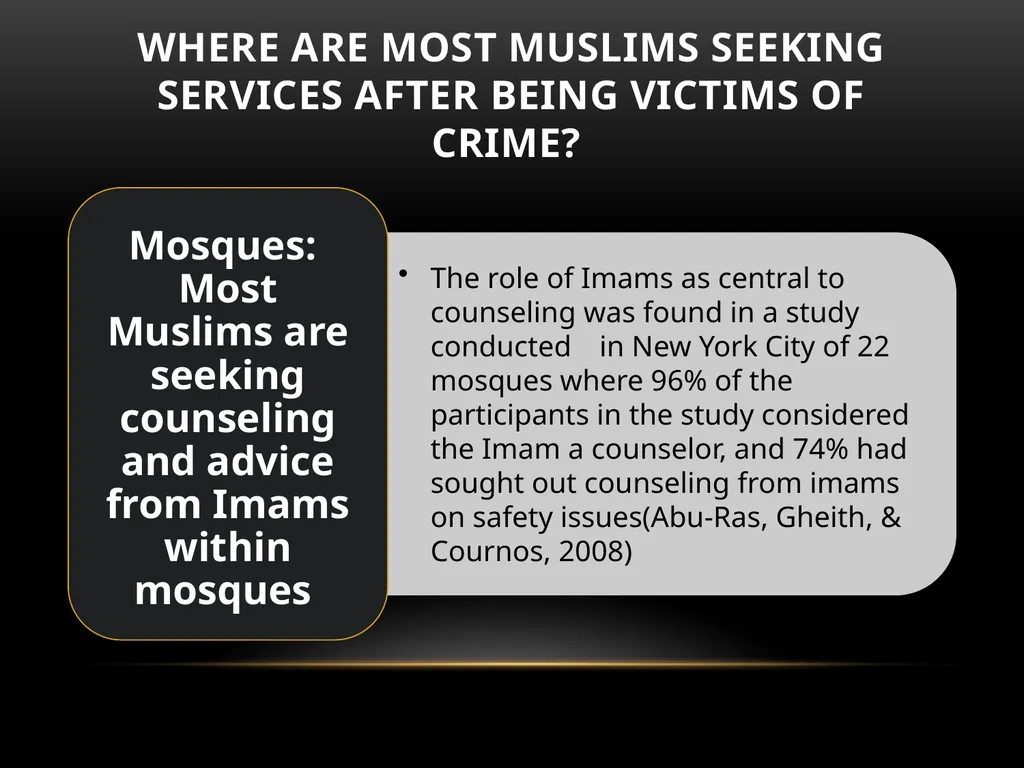
Where are most Muslims seeking services after being victims of crime?<br>
29
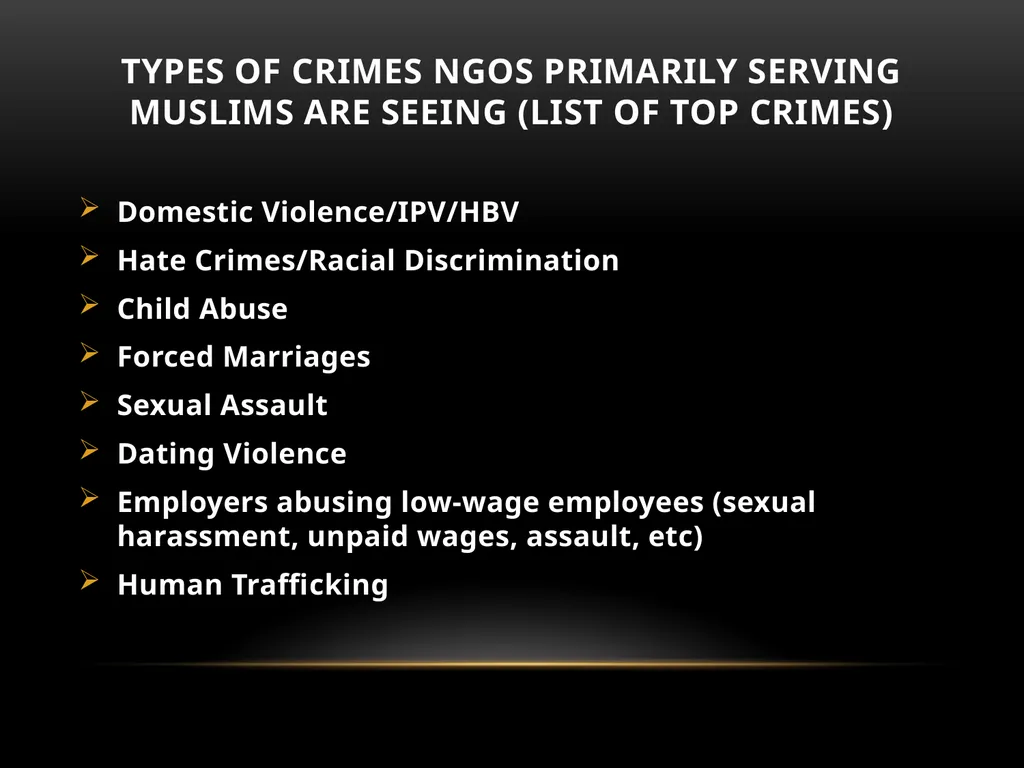
Types of Crimes NGOs primarily serving Muslims are seeing (List of top crimes) Domestic Violence/IPV/HBV
Hate Crimes/Racial Discrimination
Child Abuse
Forced Marriages
Sexual Assault
Dating Violence
Employers abusing low-wage employees (sexual harassment, unpaid wages, assault, etc)
Human Trafficking<br>
Hate Crimes/Racial Discrimination
Child Abuse
Forced Marriages
Sexual Assault
Dating Violence
Employers abusing low-wage employees (sexual harassment, unpaid wages, assault, etc)
Human Trafficking<br>
30
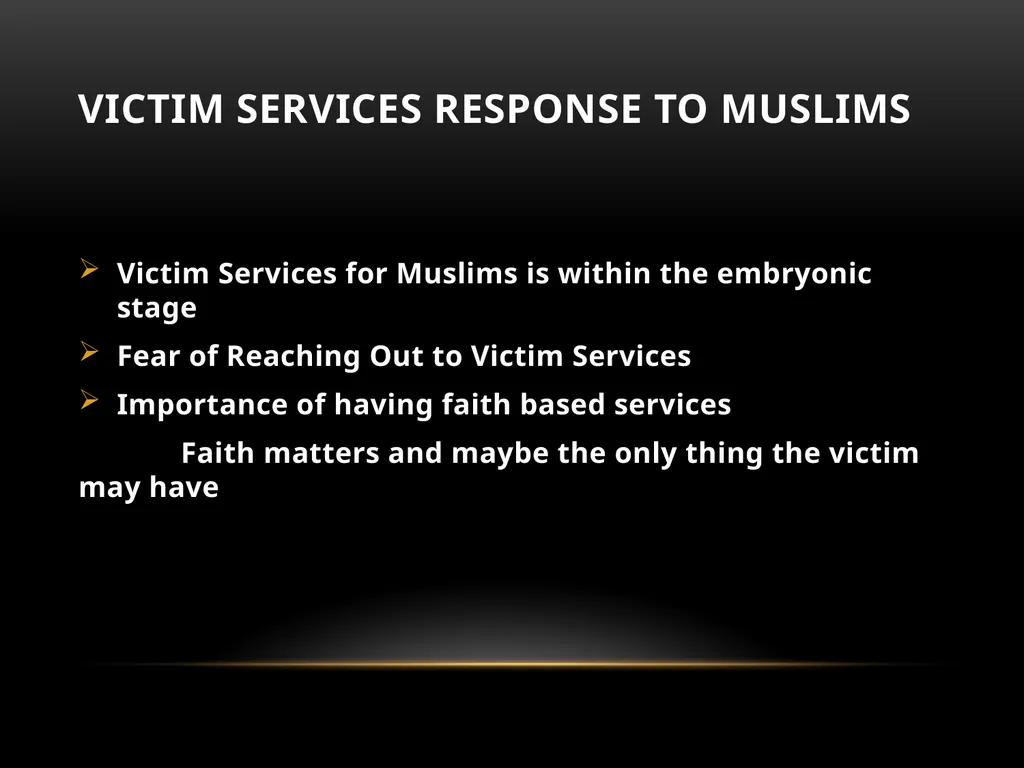
Victim Services Response to Muslims Victim Services for Muslims is within the embryonic stage
Fear of Reaching Out to Victim Services
Importance of having faith based services
Faith matters and maybe the only thing the victim may have<br>
Fear of Reaching Out to Victim Services
Importance of having faith based services
Faith matters and maybe the only thing the victim may have<br>
31
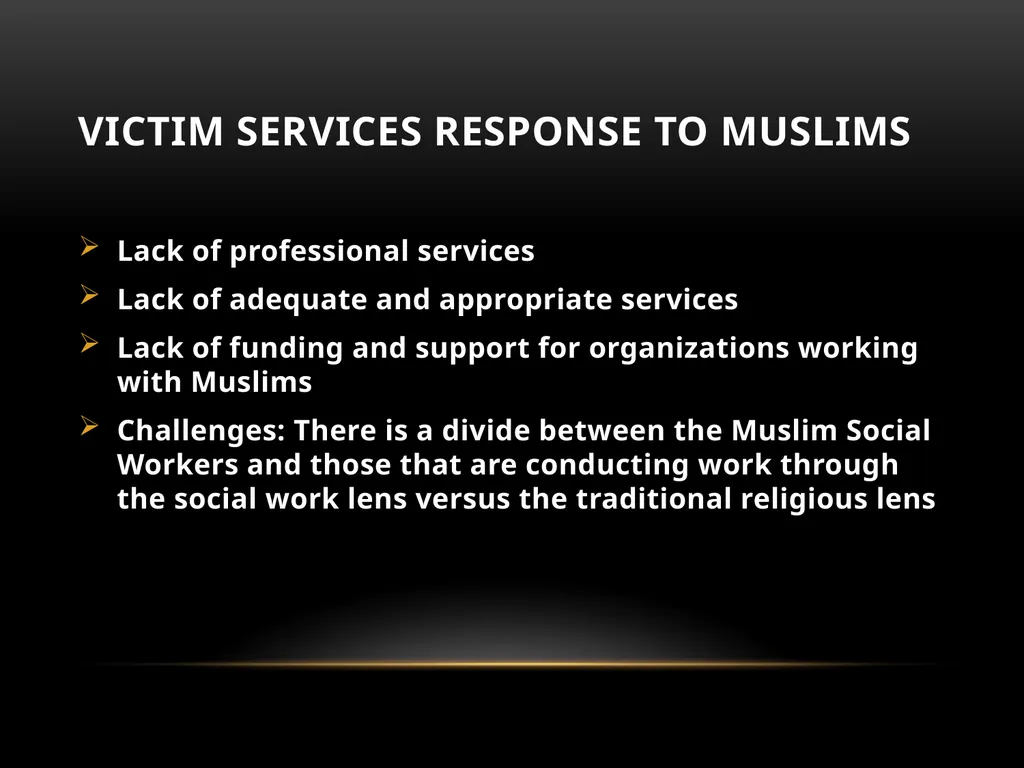
Victim Services Response to Muslims Lack of professional services
Lack of adequate and appropriate services
Lack of funding and support for organizations working with Muslims
Challenges: There is a divide between the Muslim Social Workers and those that are conducting work through the social work lens versus the traditional religious lens<br>
Lack of adequate and appropriate services
Lack of funding and support for organizations working with Muslims
Challenges: There is a divide between the Muslim Social Workers and those that are conducting work through the social work lens versus the traditional religious lens<br>
32
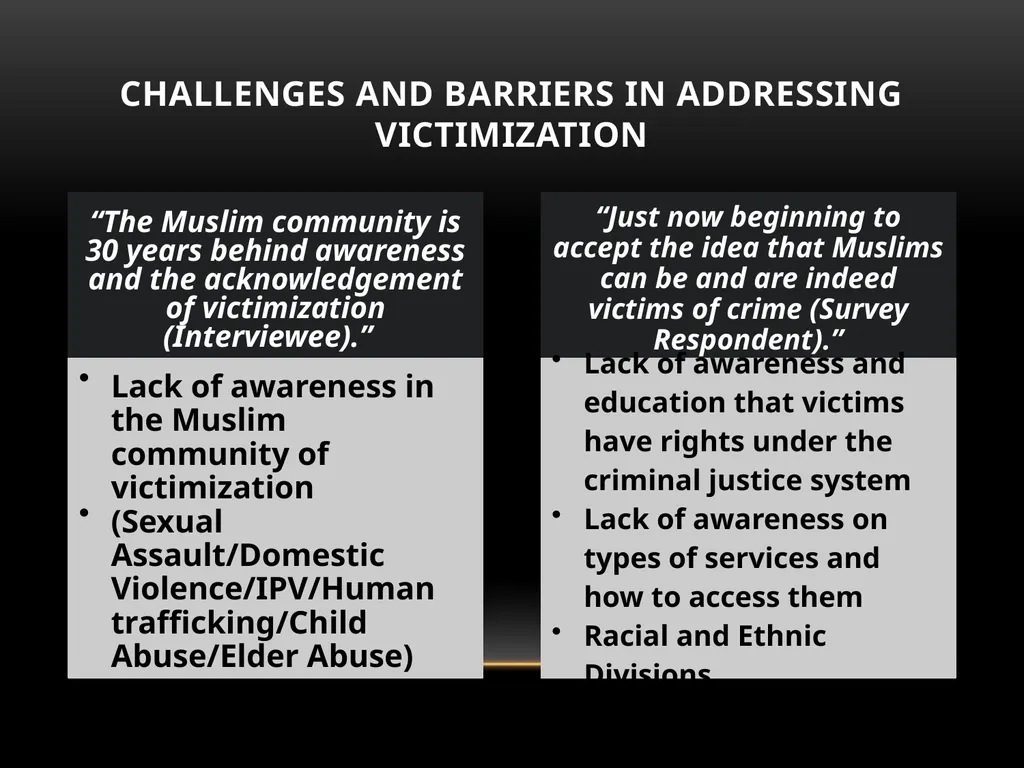
Challenges and Barriers in Addressing Victimization<br>
33
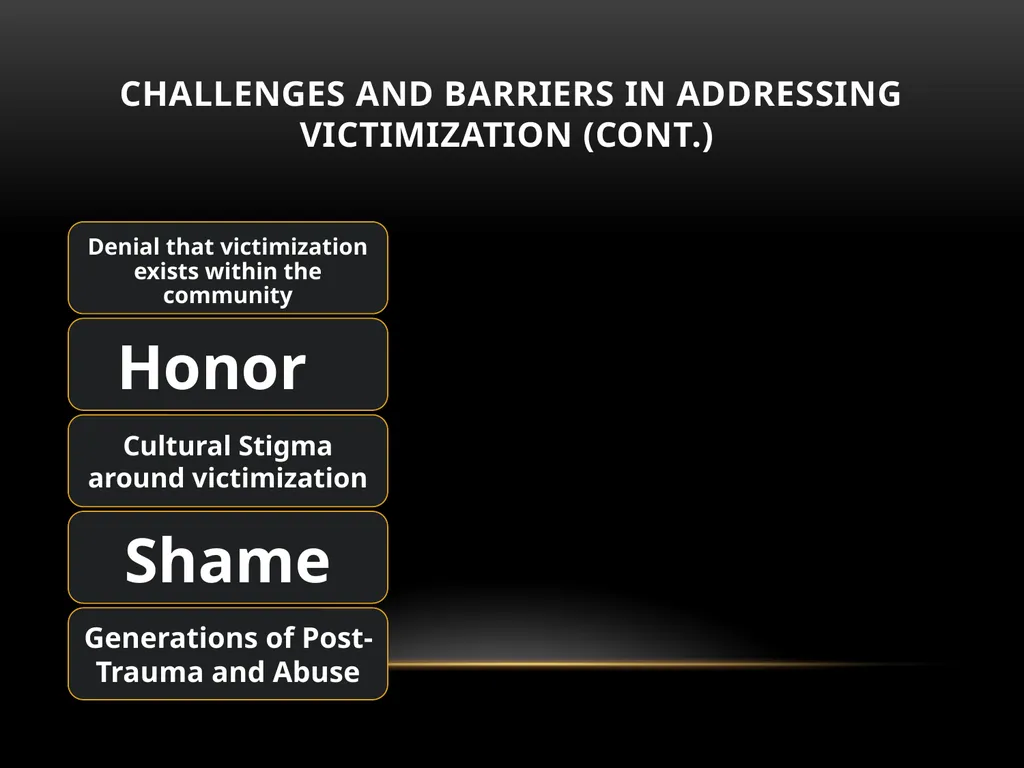
Challenges and Barriers in Addressing Victimization (Cont.)<br>
34
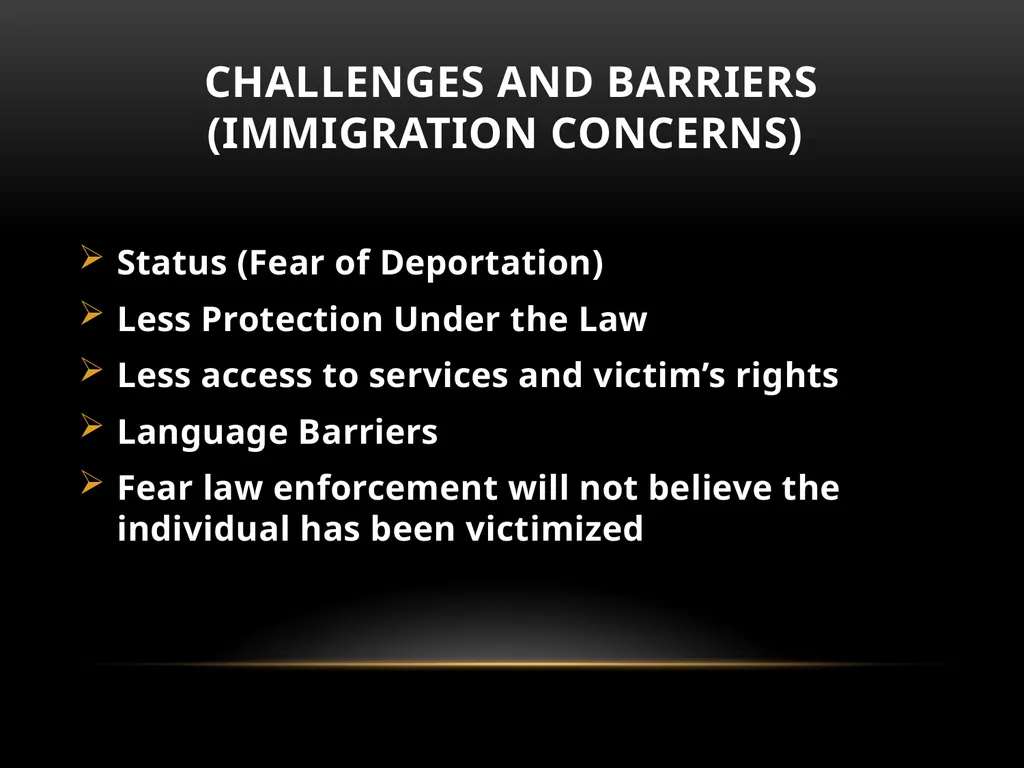
Challenges and Barriers (Immigration Concerns) Status (Fear of Deportation)
Less Protection Under the Law
Less access to services and victim’s rights
Language Barriers
Fear law enforcement will not believe the individual has been victimized<br>
Less Protection Under the Law
Less access to services and victim’s rights
Language Barriers
Fear law enforcement will not believe the individual has been victimized<br>
35
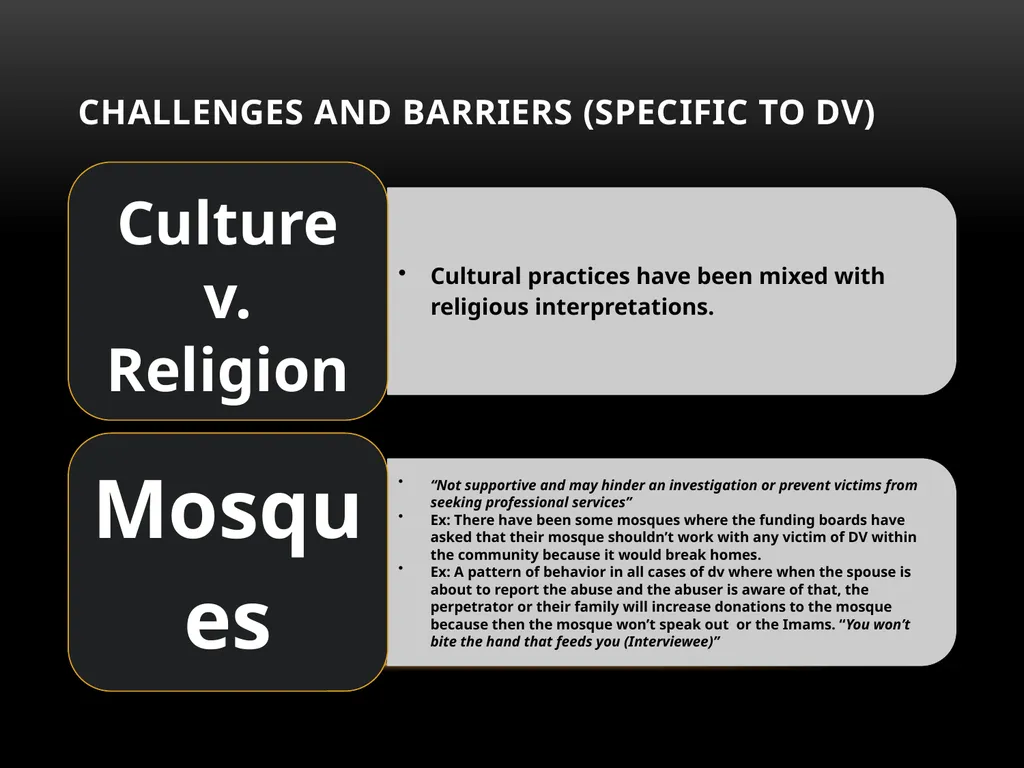
Challenges and Barriers (Specific to DV)<br>
36
Challenges and Barriers
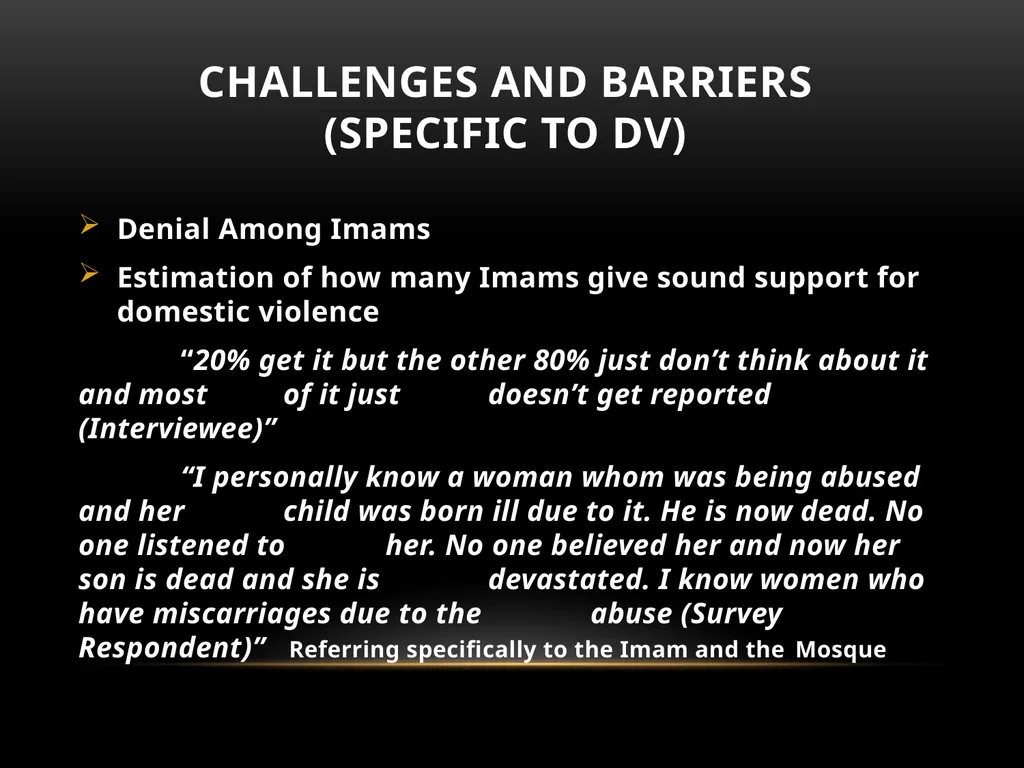
(Specific to DV) Denial Among Imams
Estimation of how many Imams give sound support for domestic violence
“20% get it but the other 80% just don’t think about it and most of it just doesn’t get reported (Interviewee)”
“I personally know a woman whom was being abused and her child was born ill due to it. He is now dead. No one listened to her. No one believed her and now her son is dead and she is devastated. I know women who have miscarriages due to the abuse (Survey Respondent)” Referring specifically to the Imam and the Mosque<br>
Estimation of how many Imams give sound support for domestic violence
“20% get it but the other 80% just don’t think about it and most of it just doesn’t get reported (Interviewee)”
“I personally know a woman whom was being abused and her child was born ill due to it. He is now dead. No one listened to her. No one believed her and now her son is dead and she is devastated. I know women who have miscarriages due to the abuse (Survey Respondent)” Referring specifically to the Imam and the Mosque<br>
37
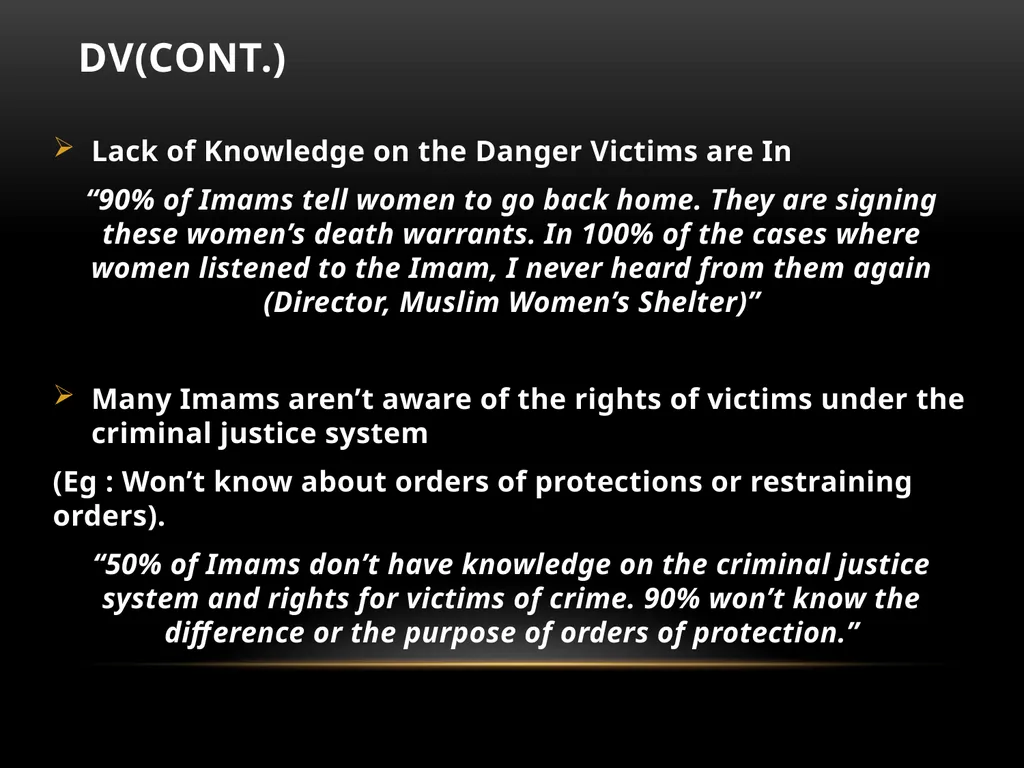
DV(Cont.) Lack of Knowledge on the Danger Victims are In
“90% of Imams tell women to go back home. They are signing these women’s death warrants. In 100% of the cases where women listened to the Imam, I never heard from them again (Director, Muslim Women’s Shelter)”
Many Imams aren’t aware of the rights of victims under the criminal justice system
(Eg : Won’t know about orders of protections or restraining orders).
“50% of Imams don’t have knowledge on the criminal justice system and rights for victims of crime. 90% won’t know the difference or the purpose of orders of protection.”<br>
“90% of Imams tell women to go back home. They are signing these women’s death warrants. In 100% of the cases where women listened to the Imam, I never heard from them again (Director, Muslim Women’s Shelter)”
Many Imams aren’t aware of the rights of victims under the criminal justice system
(Eg : Won’t know about orders of protections or restraining orders).
“50% of Imams don’t have knowledge on the criminal justice system and rights for victims of crime. 90% won’t know the difference or the purpose of orders of protection.”<br>
38
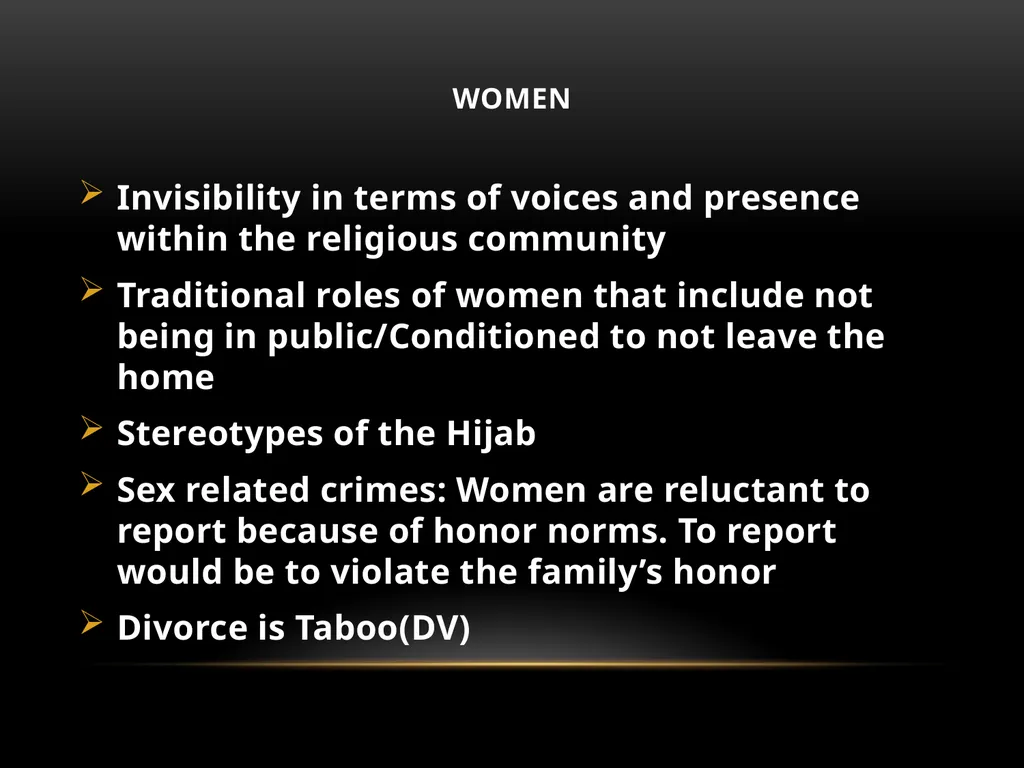
Women Invisibility in terms of voices and presence within the religious community
Traditional roles of women that include not being in public/Conditioned to not leave the home
Stereotypes of the Hijab
Sex related crimes: Women are reluctant to report because of honor norms. To report would be to violate the family’s honor
Divorce is Taboo(DV)<br>
Traditional roles of women that include not being in public/Conditioned to not leave the home
Stereotypes of the Hijab
Sex related crimes: Women are reluctant to report because of honor norms. To report would be to violate the family’s honor
Divorce is Taboo(DV)<br>
39
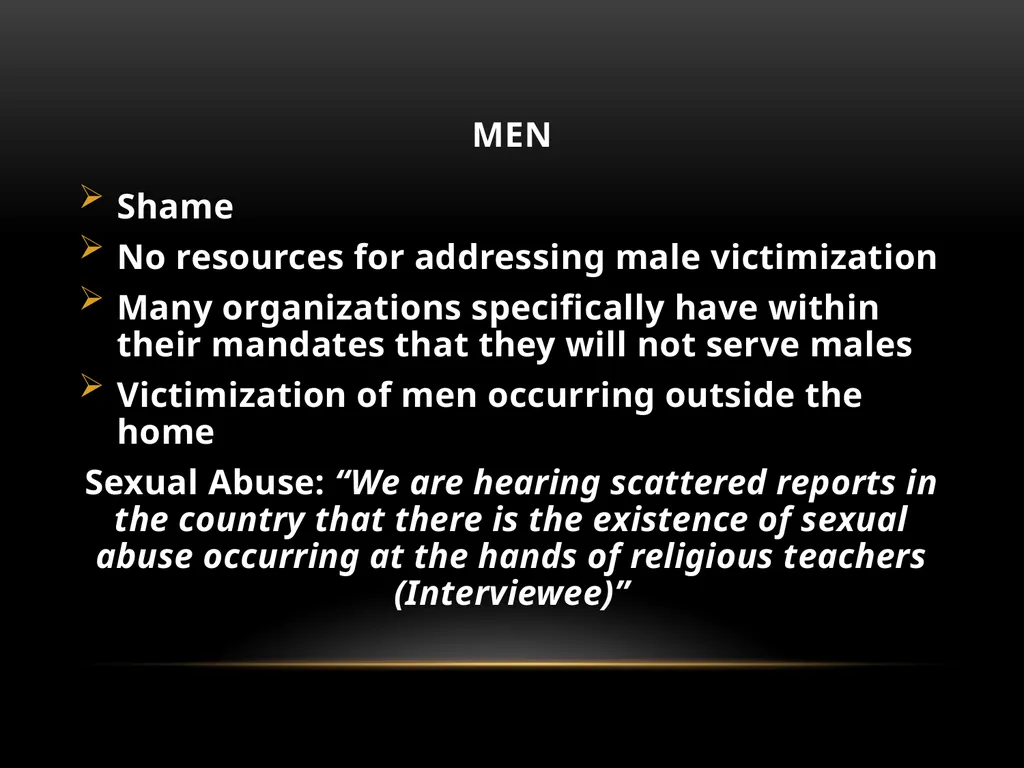
men Shame
No resources for addressing male victimization
Many organizations specifically have within their mandates that they will not serve males
Victimization of men occurring outside the home
Sexual Abuse: “We are hearing scattered reports in the country that there is the existence of sexual abuse occurring at the hands of religious teachers (Interviewee)”<br>
No resources for addressing male victimization
Many organizations specifically have within their mandates that they will not serve males
Victimization of men occurring outside the home
Sexual Abuse: “We are hearing scattered reports in the country that there is the existence of sexual abuse occurring at the hands of religious teachers (Interviewee)”<br>
40
CJ Responses to Muslims (Law Enforcement) Fundamental misunderstanding of the function of the different LE agencies
Mistrust of LE
Fear of LE
Victims won’t be believed (More heightened perception among immigrants)<br>
Mistrust of LE
Fear of LE
Victims won’t be believed (More heightened perception among immigrants)<br>
41
LAW ENFORCEMENT Not aggressive enough in cases where the victims are Muslim
Misconception that the faith allows for the abuse.
Ex: Incidents where officers have responded and stated “Isn’t he allowed to beat you? “Why are you calling us.”
Hate Crimes: “Lukeworm response to hate crimes.” Agencies don’t know what characteristics to look for in terms of indicators of bias
Forced Marriages/Honor Based Violence: Don’t know what to look for in terms of indicators<br>
Misconception that the faith allows for the abuse.
Ex: Incidents where officers have responded and stated “Isn’t he allowed to beat you? “Why are you calling us.”
Hate Crimes: “Lukeworm response to hate crimes.” Agencies don’t know what characteristics to look for in terms of indicators of bias
Forced Marriages/Honor Based Violence: Don’t know what to look for in terms of indicators<br>
42
CJ Responses to Muslims (Prosecution) Low Prosecution Rates
Domestic Violence: Rarely seen cases prosecuted. Some participants mentioned they haven’t heard of a single case that was prosecuted. Even if they are, sentences are low, and the individual will be released back into society and can abuse someone else.
Hate Crimes: Some prosecutions on a federal level but most cases on the state level are being prosecuted as property crimes unless there was an assault
Property Crimes/Financial Crimes: Few prosecutions occurring<br>
Domestic Violence: Rarely seen cases prosecuted. Some participants mentioned they haven’t heard of a single case that was prosecuted. Even if they are, sentences are low, and the individual will be released back into society and can abuse someone else.
Hate Crimes: Some prosecutions on a federal level but most cases on the state level are being prosecuted as property crimes unless there was an assault
Property Crimes/Financial Crimes: Few prosecutions occurring<br>
43
CJ Responses to Muslims (Judges) “There are instances where women’s faith has been used against them. There is a disconnect with courts and victims who are women of faith and victims have been denied orders of protection because the judge felt the victim wasn’t serious enough (Inteviewee).”
Lack of awareness and understanding of religion and culture
Lack of sensitivity
Judges are making decisions based on their own religious interpretations<br>
Lack of awareness and understanding of religion and culture
Lack of sensitivity
Judges are making decisions based on their own religious interpretations<br>
44
IV. Recommendations for Improving Responses to Muslims who are Victims of Crime<br>
45
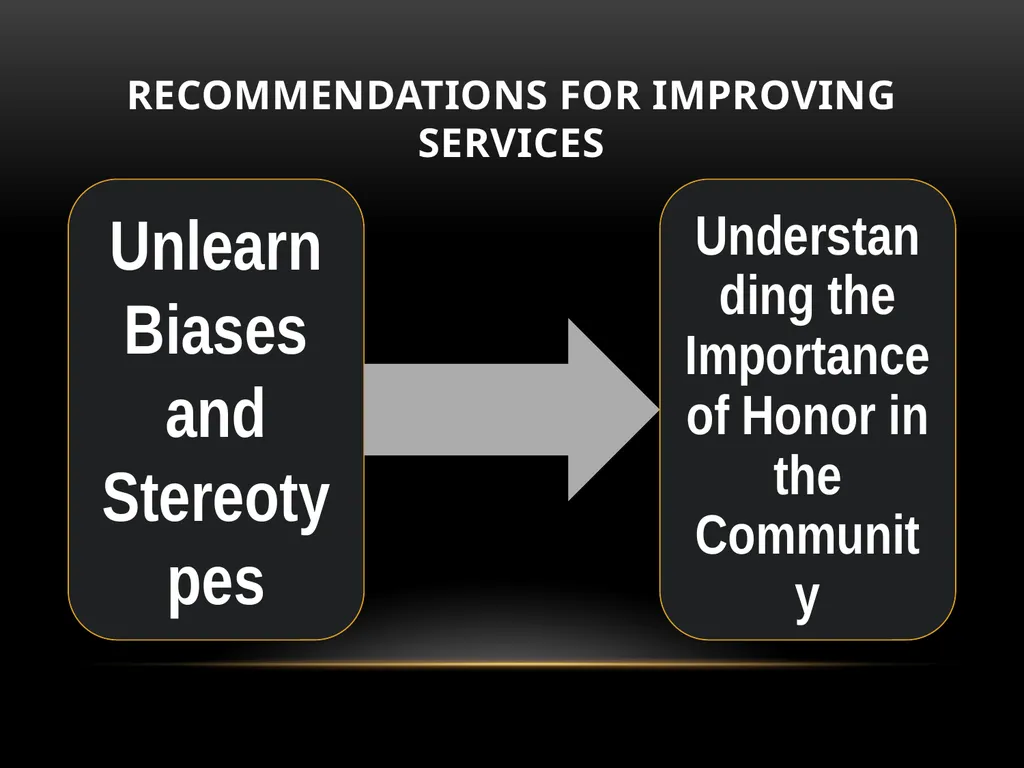
Recommendations for Improving Services<br>
46
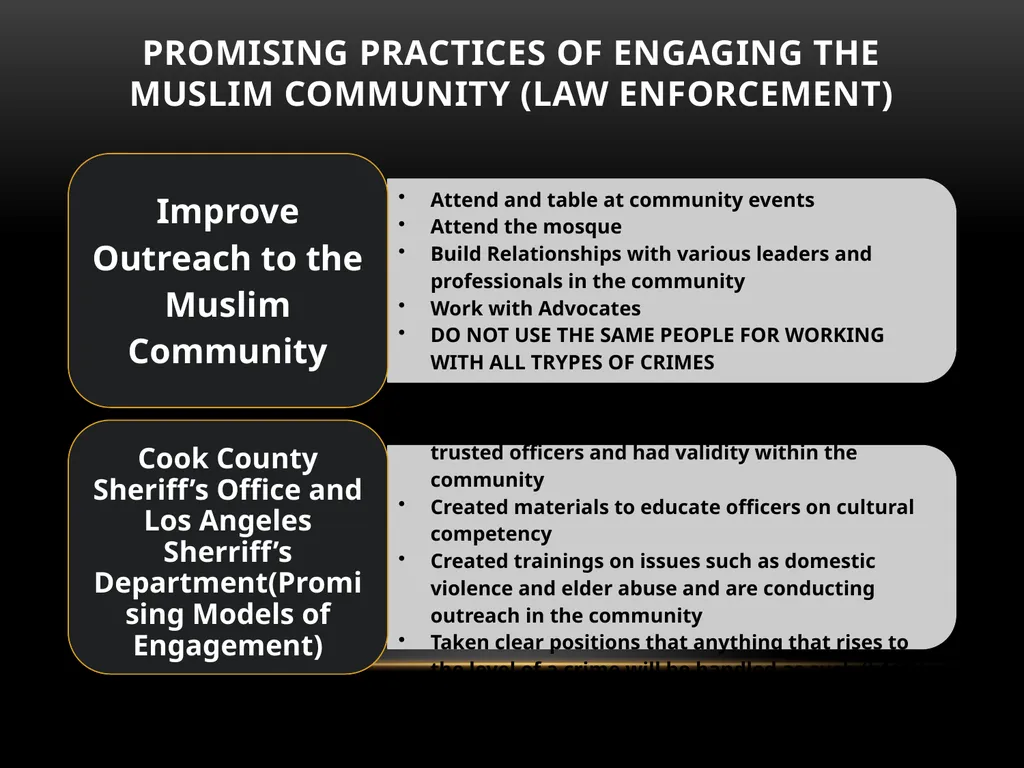
Promising Practices of Engaging the Muslim Community (Law Enforcement)<br>
47
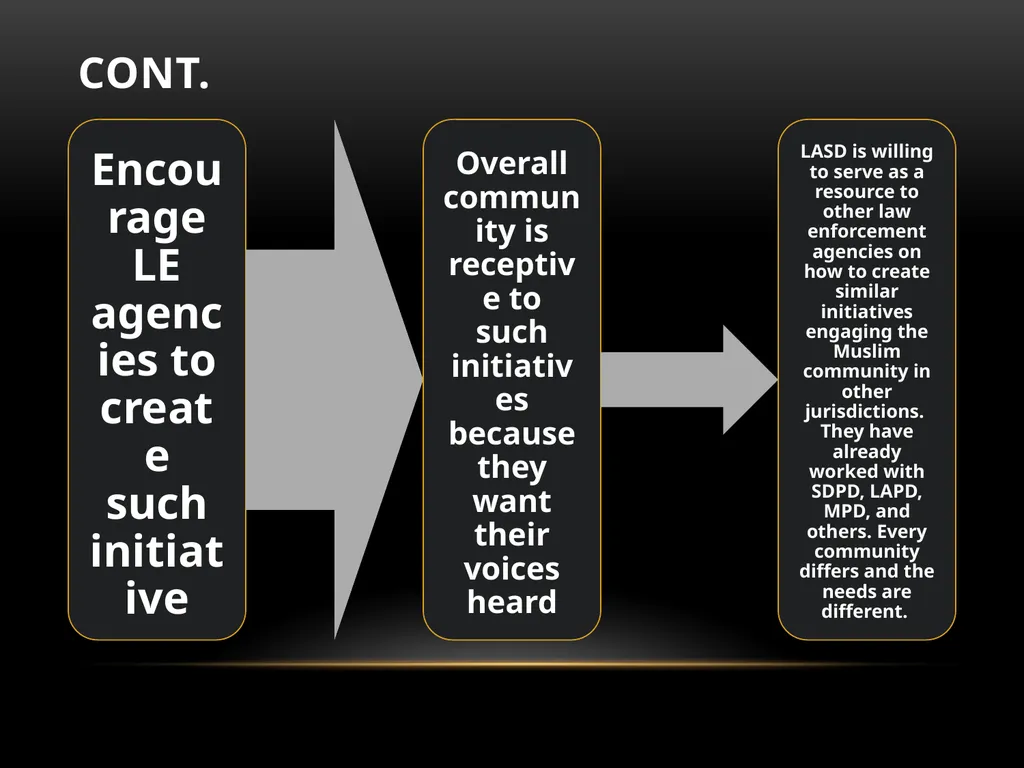
Cont.<br>
48
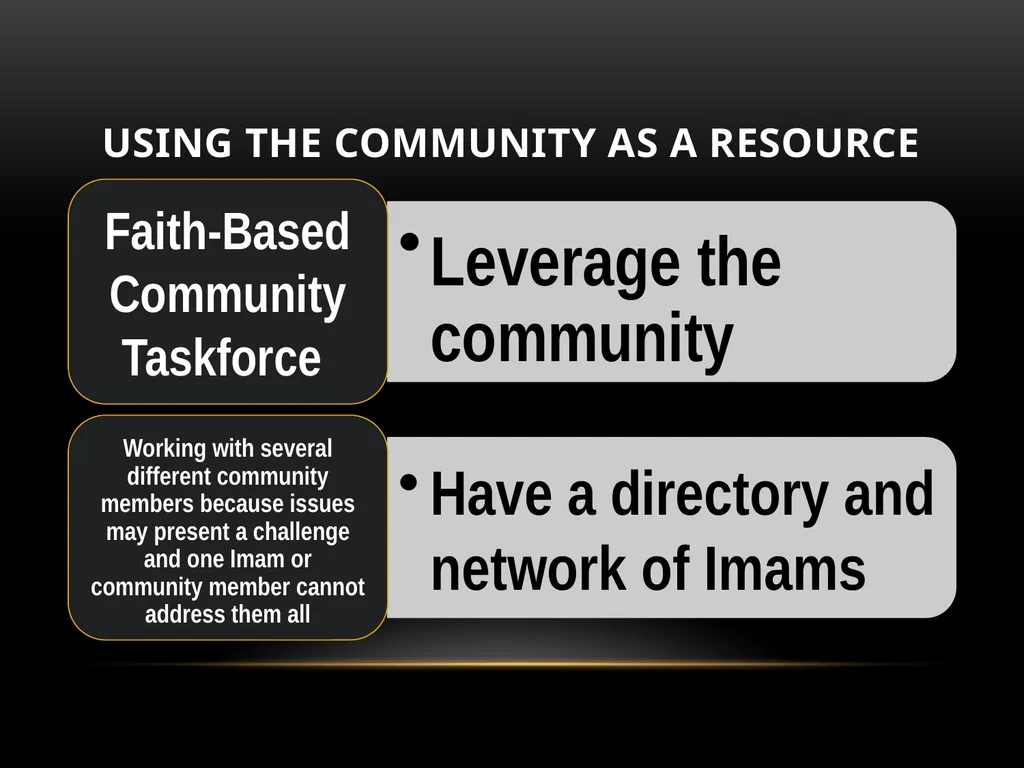
Using the Community as A Resource<br>
49
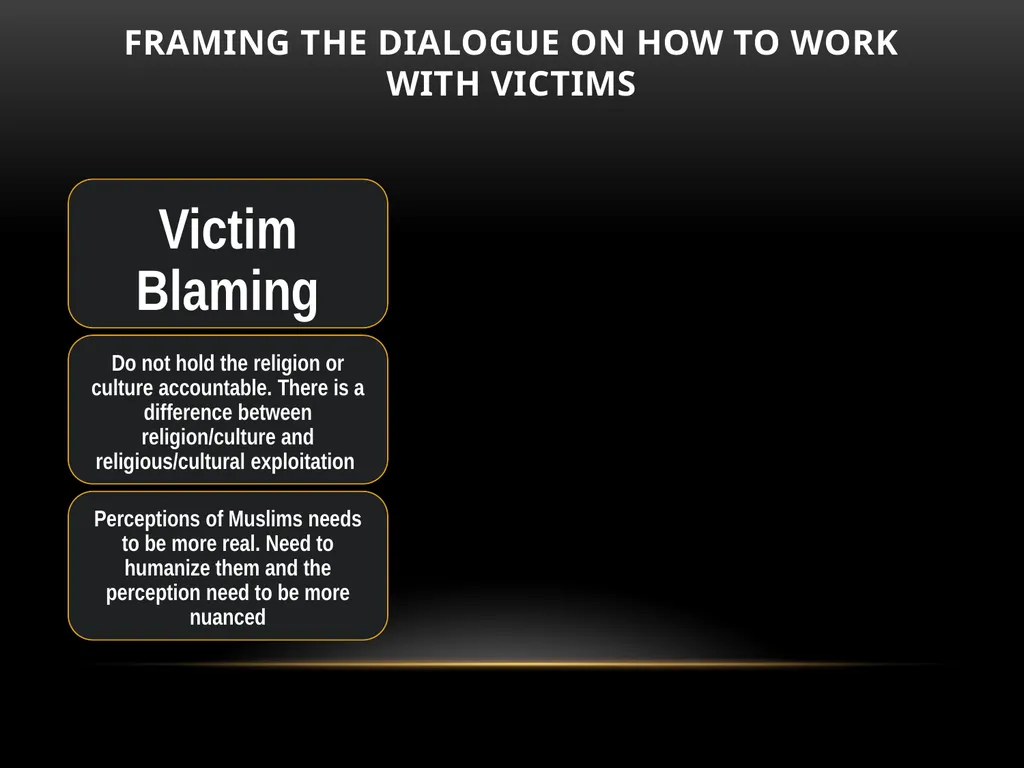
Framing the Dialogue on how to Work with Victims<br>
50
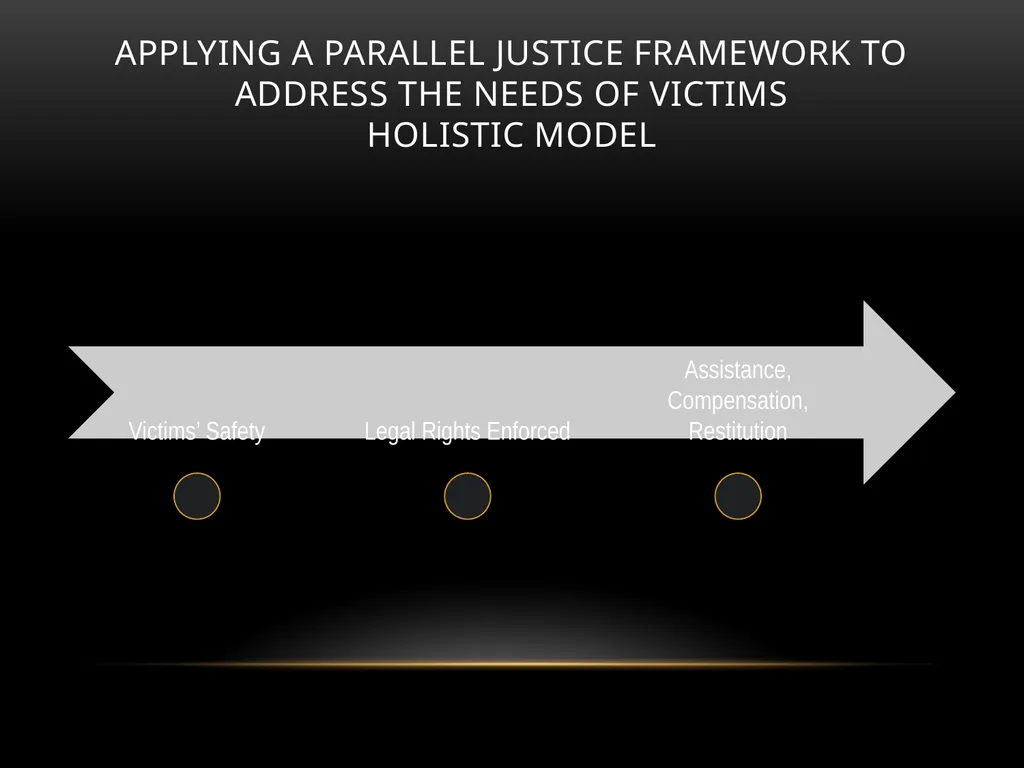
Applying a parallel justice framework TO ADDRESS THE NEEDS OF VICTIMS
holistic model<br>
51
THANK YOU FOR ATTENDING
Contact Draja@urban.org<br>
Contact Draja@urban.org<br>