
Data Link Layer Dr. Husam A. Al-Ameen The data



Description: Data Link Layer Dr. Husam A. Al-Ameen The data link layer is responsible for node-to-node (hop-to-hop) communication. Specific responsibilities of the data link layer include framing, addressing, flow control, error control, and media
Related Topics
Download Presentation
"Data Link Layer Dr. Husam A. Al-Ameen The data" is the property of its rightful owner. Permission is granted to download and print the materials on this website for personal, non-commercial use only, and to display it on your personal computer provided you do not modify the materials and that you retain all copyright notices contained in the materials. By downloading content from our website, you accept the terms of this agreement.
Presentation Transcript
slide1. Data Link Layer Dr. Husam A. Al-Ameen<br>
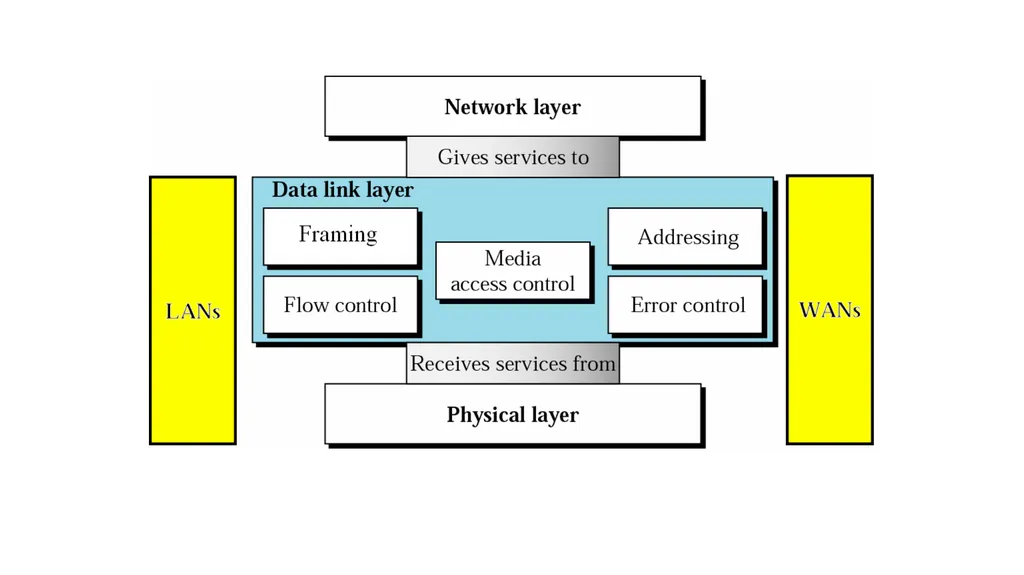
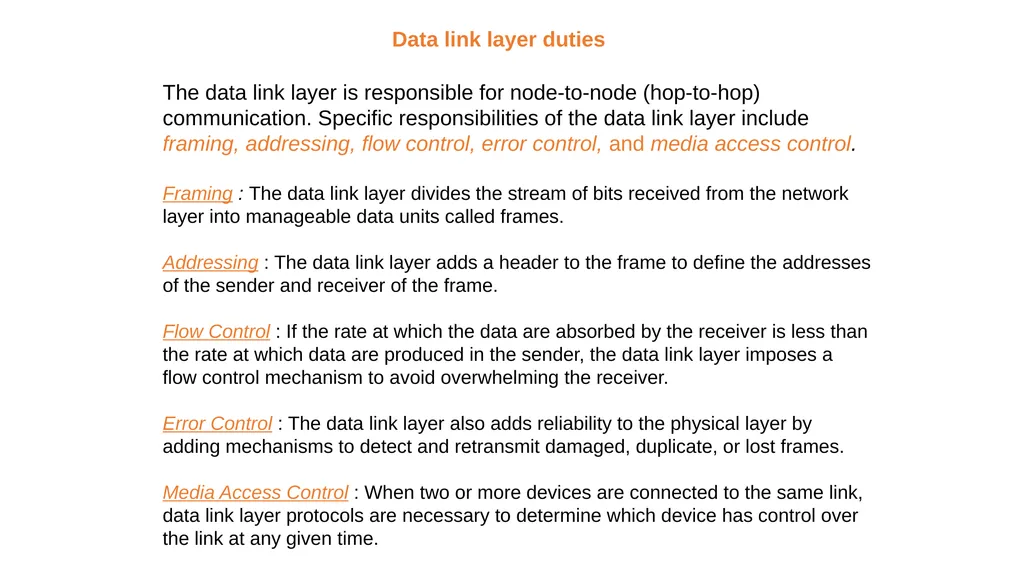
slide3. The data link layer is responsible for node-to-node (hop-to-hop) communication. Specific responsibilities of the data link layer include framing, addressing, flow control, error control, and media access control.
Framing : The data link layer divides the stream of bits received from the network layer into manageable data units called frames.
Addressing : The data link layer adds a header to the frame to define the addresses of the sender and receiver of the frame.
Flow Control : If the rate at which the data are absorbed by the receiver is less than the rate at which data are produced in the sender, the data link layer imposes a flow control mechanism to avoid overwhelming the receiver.
Error Control : The data link layer also adds reliability to the physical layer by adding mechanisms to detect and retransmit damaged, duplicate, or lost frames.
Media Access Control : When two or more devices are connected to the same link, data link layer protocols are necessary to determine which device has control over the link at any given time. Data link layer duties<br>
slide4. Error Detection and Correction<br>
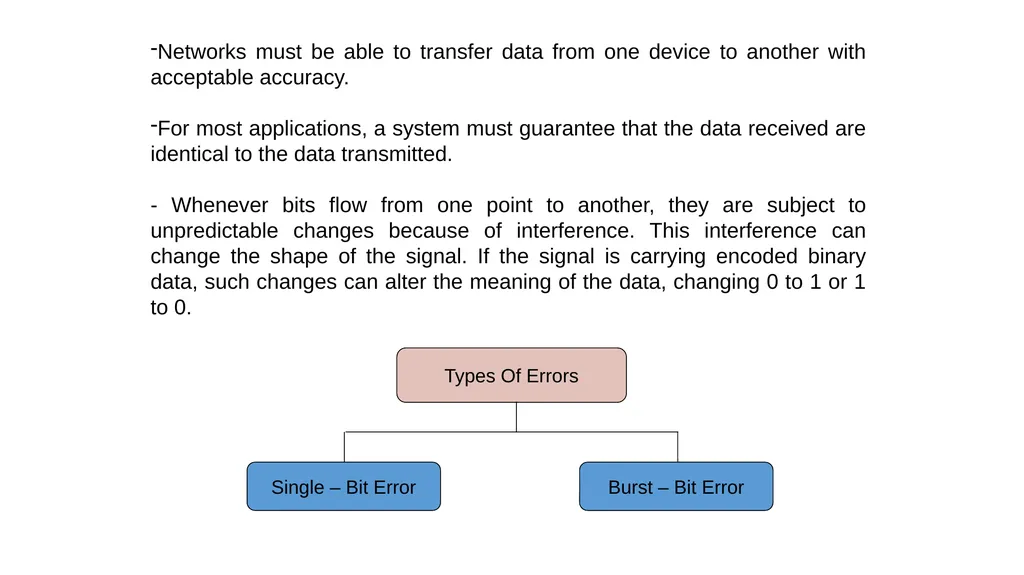
slide5. Networks must be able to transfer data from one device to another with acceptable accuracy.
For most applications, a system must guarantee that the data received are identical to the data transmitted.
- Whenever bits flow from one point to another, they are subject to unpredictable changes because of interference. This interference can change the shape of the signal. If the signal is carrying encoded binary data, such changes can alter the meaning of the data, changing 0 to 1 or 1 to 0.<br>
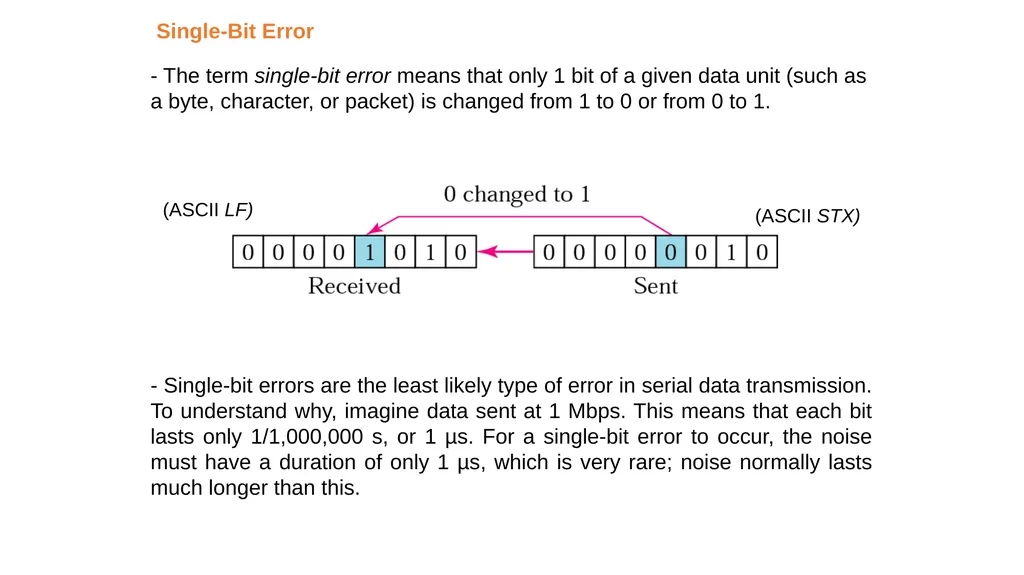
slide6. - The term single-bit error means that only 1 bit of a given data unit (such as a byte, character, or packet) is changed from 1 to 0 or from 0 to 1. Single-Bit Error - Single-bit errors are the least likely type of error in serial data transmission.
To understand why, imagine data sent at 1 Mbps. This means that each bit lasts only 1/1,000,000 s, or 1 µs. For a single-bit error to occur, the noise must have a duration of only 1 µs, which is very rare; noise normally lasts much longer than this.<br>
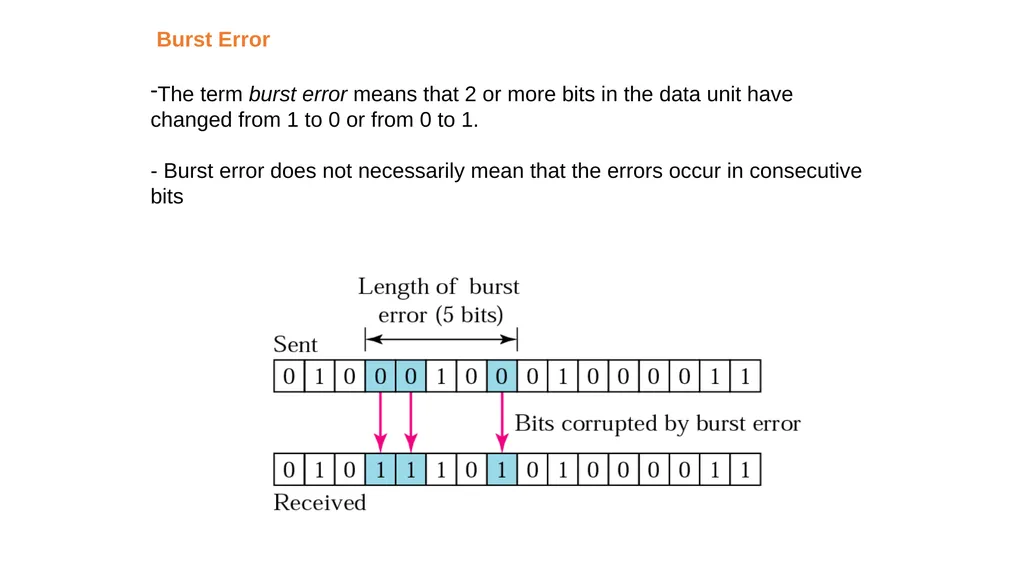
slide7. The term burst error means that 2 or more bits in the data unit have changed from 1 to 0 or from 0 to 1.
- Burst error does not necessarily mean that the errors occur in consecutive bits Burst Error<br>
slide8. A burst error is more likely to occur than a single-bit error. The duration of noise is normally longer than the duration of 1 bit, which means that when noise affects data, it affects a set of bits.
The number of bits affected depends on the data rate and duration of noise. For example, if we are sending data at 1 Kbps, a noise of 1/100 s can affect 10 bits; if we are sending data at 1 Mbps, the same noise can affect 10,000 bits.<br>
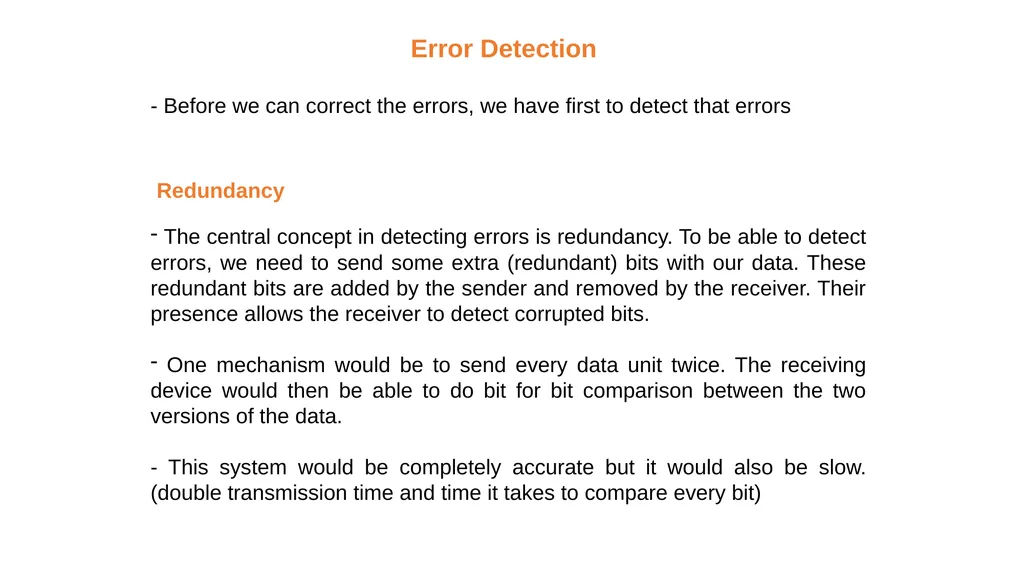
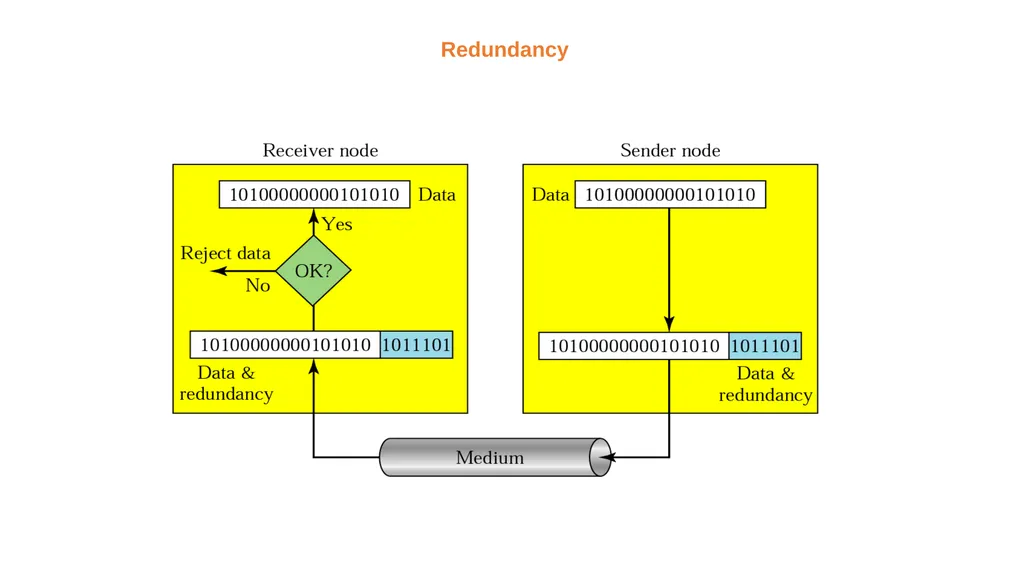
slide9. Error Detection - Before we can correct the errors, we have first to detect that errors The central concept in detecting errors is redundancy. To be able to detect errors, we need to send some extra (redundant) bits with our data. These redundant bits are added by the sender and removed by the receiver. Their presence allows the receiver to detect corrupted bits.
One mechanism would be to send every data unit twice. The receiving device would then be able to do bit for bit comparison between the two versions of the data.
- This system would be completely accurate but it would also be slow. (double transmission time and time it takes to compare every bit) Redundancy<br>
slide10. Redundancy<br>
slide11. The most common and least expensive mechanism for error detection
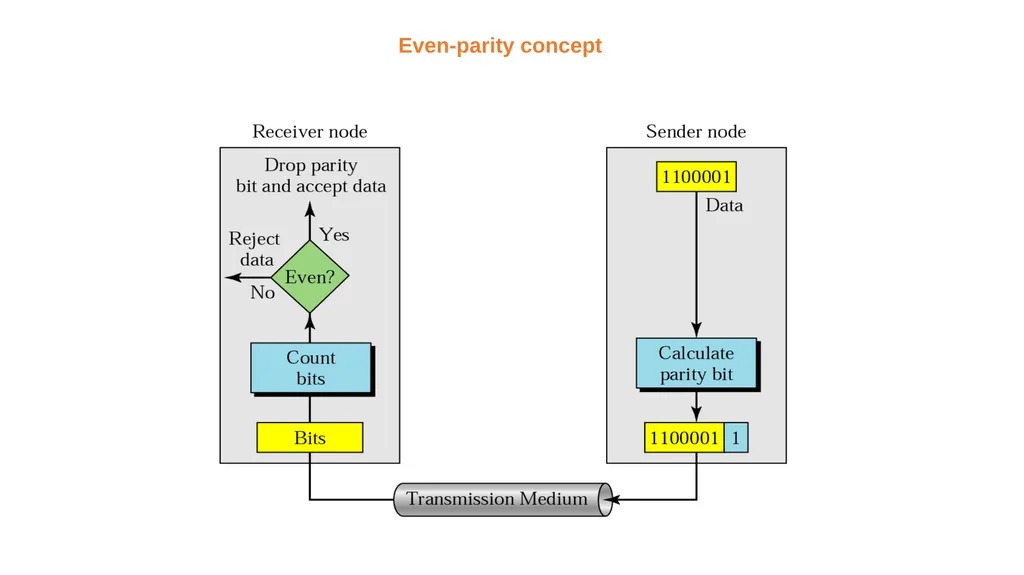
Parity check can be simple or two-dimensional. Parity check In this technique, a parity bit (redundant bit) is added to every data unit so that the total number of 1s in the unit (including the parity bit) is even (or odd for odd-parity). Simple Parity check<br>
slide12. Even-parity concept<br>
slide13. Suppose the sender wants to send the word world. In ASCII the five characters are coded as
1110111 1101111 1110010 1101100 1100100
w o r l d
The following shows the actual bits sent
11101110 11011110 11100100 11011000 11001001 Example 1 Now suppose the word world is received by the receiver without being corrupted in transmission.
11101110 11011110 11100100 11011000 11001001
The receiver counts the 1s in each character and comes up with even numbers (6, 6, 4, 4, 4). The data are accepted.<br>
slide14. Now suppose the word world in Example 1 is corrupted during transmission.
11111110 11011110 11101100 11011000 11001001
The receiver counts the 1s in each character and comes up with even and odd numbers (7, 6, 5, 4, 4). The receiver knows that the data are corrupted, discards them, and asks for retransmission. Simple parity check can detect all single-bit errors.
It can detect burst errors only if the total number of errors in each data unit is odd (1,3,5, … etc.)
- This method cannot detect errors where the total number of bits changed is even (2,4,6, … etc.) Performance<br>
slide3. The data link layer is responsible for node-to-node (hop-to-hop) communication. Specific responsibilities of the data link layer include framing, addressing, flow control, error control, and media access control.
Framing : The data link layer divides the stream of bits received from the network layer into manageable data units called frames.
Addressing : The data link layer adds a header to the frame to define the addresses of the sender and receiver of the frame.
Flow Control : If the rate at which the data are absorbed by the receiver is less than the rate at which data are produced in the sender, the data link layer imposes a flow control mechanism to avoid overwhelming the receiver.
Error Control : The data link layer also adds reliability to the physical layer by adding mechanisms to detect and retransmit damaged, duplicate, or lost frames.
Media Access Control : When two or more devices are connected to the same link, data link layer protocols are necessary to determine which device has control over the link at any given time. Data link layer duties<br>
slide4. Error Detection and Correction<br>
slide5. Networks must be able to transfer data from one device to another with acceptable accuracy.
For most applications, a system must guarantee that the data received are identical to the data transmitted.
- Whenever bits flow from one point to another, they are subject to unpredictable changes because of interference. This interference can change the shape of the signal. If the signal is carrying encoded binary data, such changes can alter the meaning of the data, changing 0 to 1 or 1 to 0.<br>
slide6. - The term single-bit error means that only 1 bit of a given data unit (such as a byte, character, or packet) is changed from 1 to 0 or from 0 to 1. Single-Bit Error - Single-bit errors are the least likely type of error in serial data transmission.
To understand why, imagine data sent at 1 Mbps. This means that each bit lasts only 1/1,000,000 s, or 1 µs. For a single-bit error to occur, the noise must have a duration of only 1 µs, which is very rare; noise normally lasts much longer than this.<br>
slide7. The term burst error means that 2 or more bits in the data unit have changed from 1 to 0 or from 0 to 1.
- Burst error does not necessarily mean that the errors occur in consecutive bits Burst Error<br>
slide8. A burst error is more likely to occur than a single-bit error. The duration of noise is normally longer than the duration of 1 bit, which means that when noise affects data, it affects a set of bits.
The number of bits affected depends on the data rate and duration of noise. For example, if we are sending data at 1 Kbps, a noise of 1/100 s can affect 10 bits; if we are sending data at 1 Mbps, the same noise can affect 10,000 bits.<br>
slide9. Error Detection - Before we can correct the errors, we have first to detect that errors The central concept in detecting errors is redundancy. To be able to detect errors, we need to send some extra (redundant) bits with our data. These redundant bits are added by the sender and removed by the receiver. Their presence allows the receiver to detect corrupted bits.
One mechanism would be to send every data unit twice. The receiving device would then be able to do bit for bit comparison between the two versions of the data.
- This system would be completely accurate but it would also be slow. (double transmission time and time it takes to compare every bit) Redundancy<br>
slide10. Redundancy<br>
slide11. The most common and least expensive mechanism for error detection
Parity check can be simple or two-dimensional. Parity check In this technique, a parity bit (redundant bit) is added to every data unit so that the total number of 1s in the unit (including the parity bit) is even (or odd for odd-parity). Simple Parity check<br>
slide12. Even-parity concept<br>
slide13. Suppose the sender wants to send the word world. In ASCII the five characters are coded as
1110111 1101111 1110010 1101100 1100100
w o r l d
The following shows the actual bits sent
11101110 11011110 11100100 11011000 11001001 Example 1 Now suppose the word world is received by the receiver without being corrupted in transmission.
11101110 11011110 11100100 11011000 11001001
The receiver counts the 1s in each character and comes up with even numbers (6, 6, 4, 4, 4). The data are accepted.<br>
slide14. Now suppose the word world in Example 1 is corrupted during transmission.
11111110 11011110 11101100 11011000 11001001
The receiver counts the 1s in each character and comes up with even and odd numbers (7, 6, 5, 4, 4). The receiver knows that the data are corrupted, discards them, and asks for retransmission. Simple parity check can detect all single-bit errors.
It can detect burst errors only if the total number of errors in each data unit is odd (1,3,5, … etc.)
- This method cannot detect errors where the total number of bits changed is even (2,4,6, … etc.) Performance<br>