Data Management Update Timothy Noble - Rucio Service Owner SWIFT-HEPGridPP 24th March 2022 Work package 1 Set up a UK data-lake prototype. This will build on the DOMA prototype, with the intention that there will be one data lake per
"Data Management Update Timothy Noble - Rucio" is the property of its rightful owner. Permission is granted to
download and print the materials on this website for personal, non-commercial use only, and to display it
on your personal computer provided you do not modify the materials and that you retain all copyright
notices contained in the materials. By downloading content from our website, you accept the terms of this
agreement.
Presentation Transcript
01
Data Management Update Timothy Noble - Rucio Service Owner
SWIFT-HEP/GridPP 24th March 2022<br>
02
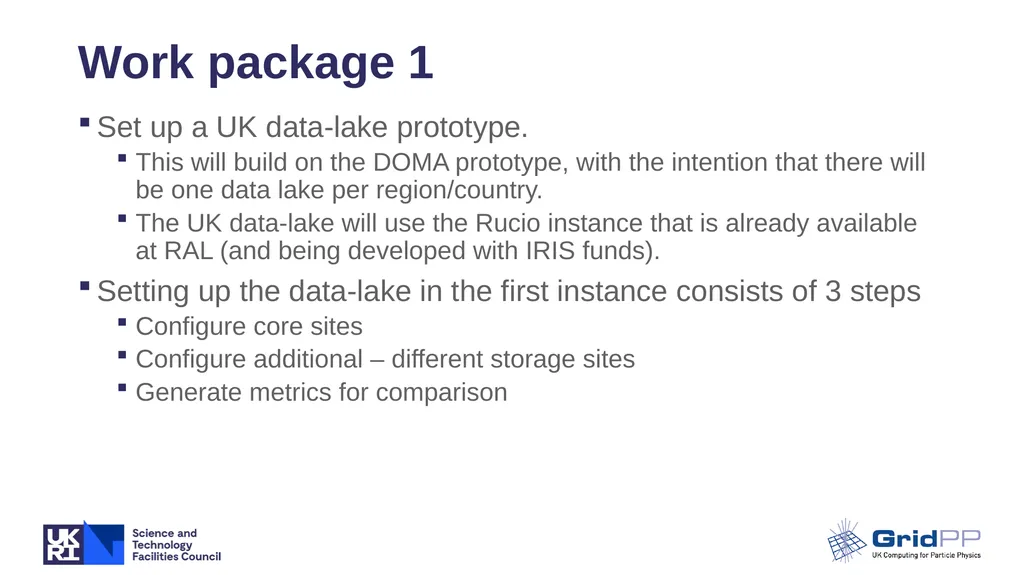
Work package 1 Set up a UK data-lake prototype.
This will build on the DOMA prototype, with the intention that there will be one data lake per region/country.
The UK data-lake will use the Rucio instance that is already available at RAL (and being developed with IRIS funds).
Setting up the data-lake in the first instance consists of 3 steps
Configure core sites
Configure additional – different storage sites
Generate metrics for comparison<br>
03
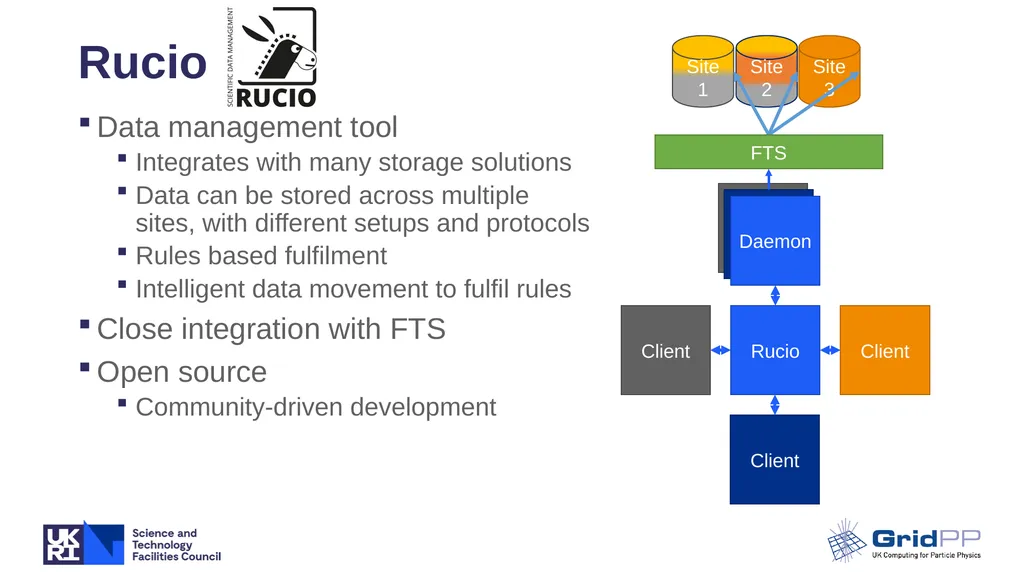
Rucio Data management tool
Integrates with many storage solutions
Data can be stored across multiple sites, with different setups and protocols
Rules based fulfilment
Intelligent data movement to fulfil rules
Close integration with FTS
Open source
Community-driven development Site 1 Site 2 Site 3 Daemons Daemons Daemon Rucio Client Client Client FTS<br>
04
Rucio internal developments Development of Multi-VO features to include conveyor daemons
Running since December with a single transfer daemon running 2 VOs
Move from cloud VMs to containerised deployment of daemons
Looking to move to K8S deployment
Up to date deployment of Rucio
Maintain Multi-VO Rucio to facilitate DiRAC integration compatibility<br>
05
Rucio External Developments Working towards integrating S3 endpoints
Integration with IRIS-IAM
Configured IRIS-IAM client
Internal Rucio configuration issues,
K8S a step towards the answer?
If networking issues resolved
Integration with EGI Check-in<br>
06
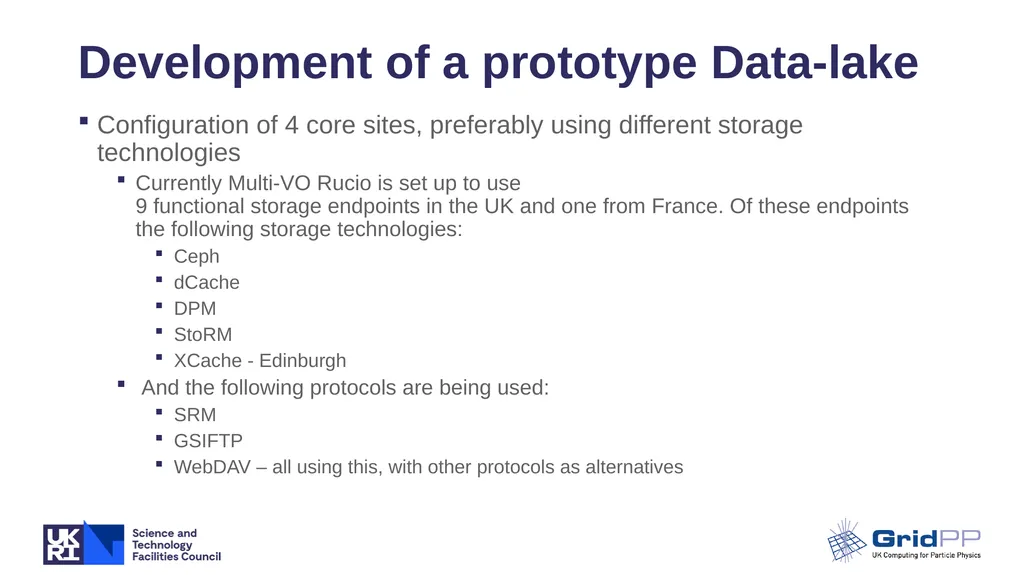
Development of a prototype Data-lake Configuration of 4 core sites, preferably using different storage technologies
Currently Multi-VO Rucio is set up to use 9 functional storage endpoints in the UK and one from France. Of these endpoints the following storage technologies:
Ceph
dCache
DPM
StoRM
XCache - Edinburgh
And the following protocols are being used:
SRM
GSIFTP
WebDAV – all using this, with other protocols as alternatives<br>
07
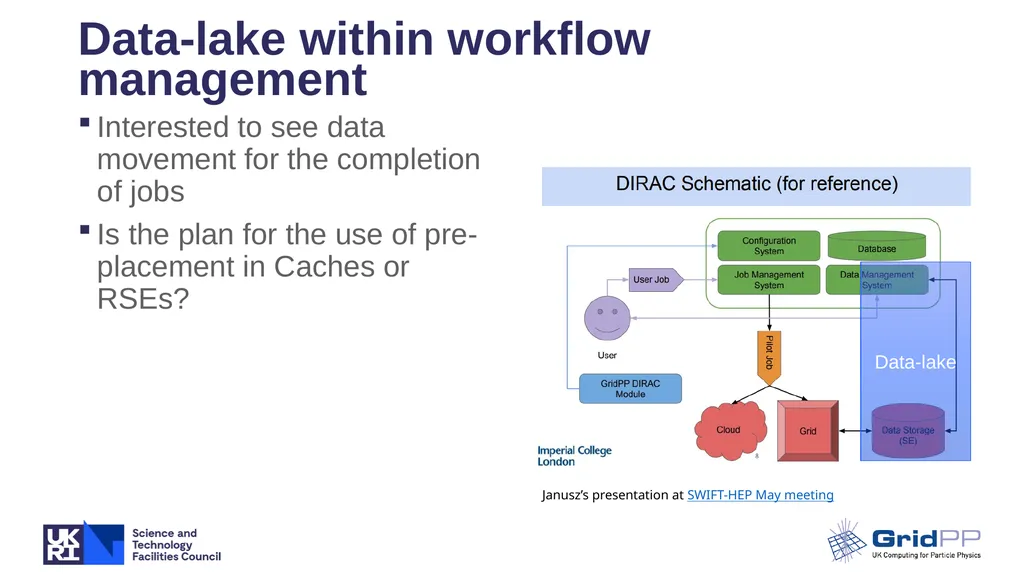
Data-lake within workflow management Interested to see data movement for the completion of jobs
Is the plan for the use of pre-placement in Caches or RSEs? Janusz’s presentation at SWIFT-HEP May meeting Data-lake<br>
08
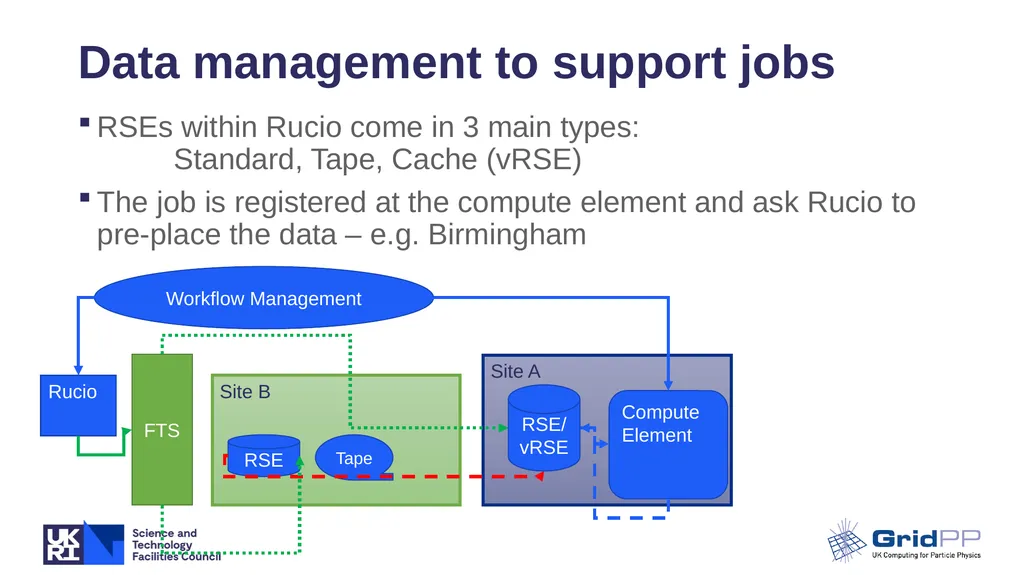
Data management to support jobs RSEs within Rucio come in 3 main types: Standard, Tape, Cache (vRSE)
The job is registered at the compute element and ask Rucio to pre-place the data – e.g. Birmingham Rucio Workflow Management FTS RSE/ vRSE<br>
09
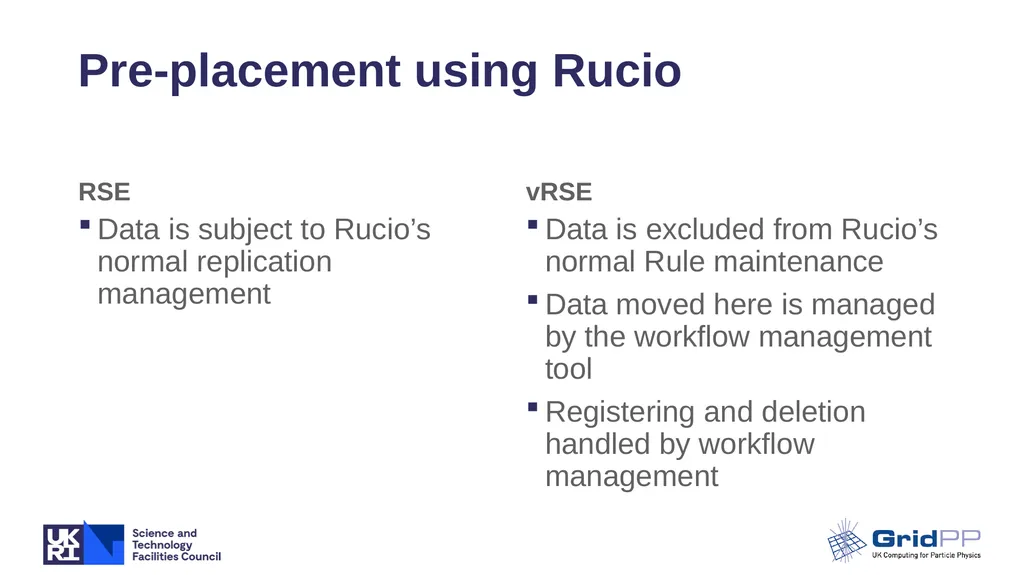
Pre-placement using Rucio RSE Data is subject to Rucio’s normal replication management vRSE Data is excluded from Rucio’s normal Rule maintenance
Data moved here is managed by the workflow management tool
Registering and deletion handled by workflow management<br>
10
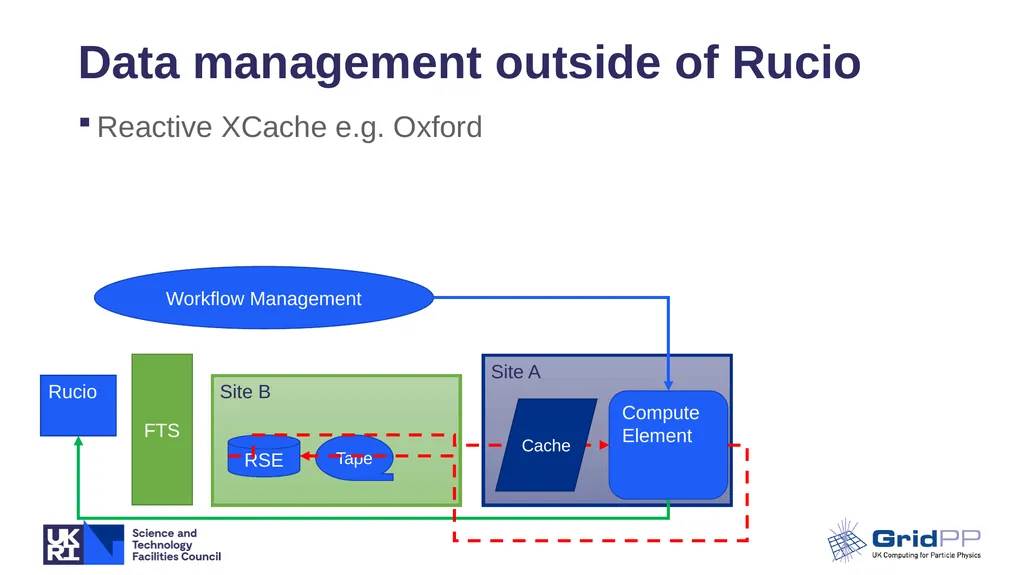
Data management outside of Rucio Reactive XCache e.g. Oxford Rucio Workflow Management FTS Cache<br>
11
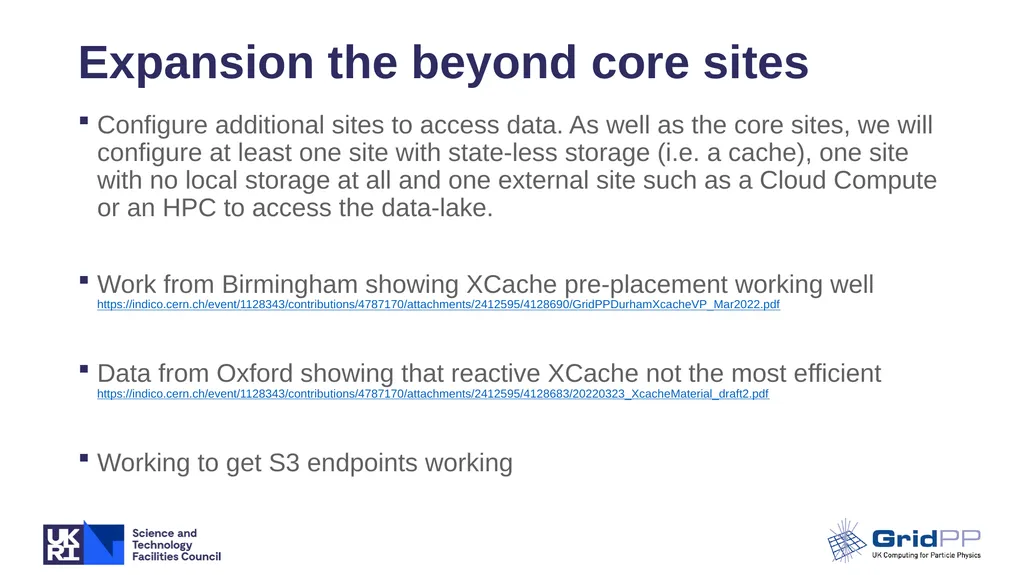
Expansion the beyond core sites Configure additional sites to access data. As well as the core sites, we will configure at least one site with state-less storage (i.e. a cache), one site with no local storage at all and one external site such as a Cloud Compute or an HPC to access the data-lake.
Work from Birmingham showing XCache pre-placement working well https://indico.cern.ch/event/1128343/contributions/4787170/attachments/2412595/4128690/GridPPDurhamXcacheVP_Mar2022.pdf
Data from Oxford showing that reactive XCache not the most efficient https://indico.cern.ch/event/1128343/contributions/4787170/attachments/2412595/4128683/20220323_XcacheMaterial_draft2.pdf
Working to get S3 endpoints working<br>
12
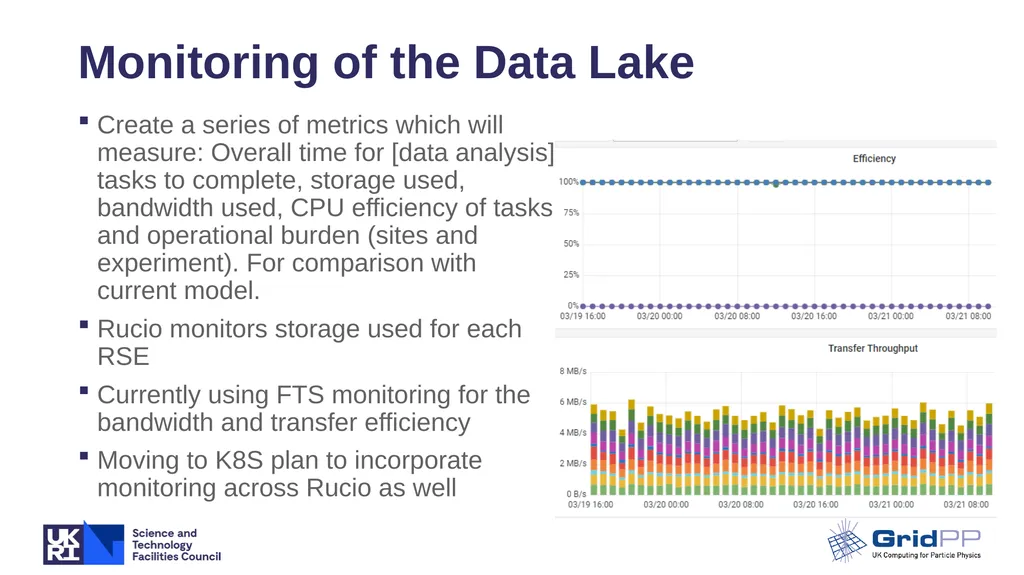
Monitoring of the Data Lake Create a series of metrics which will measure: Overall time for [data analysis] tasks to complete, storage used, bandwidth used, CPU efficiency of tasks and operational burden (sites and experiment). For comparison with current model.
Rucio monitors storage used for each RSE
Currently using FTS monitoring for the bandwidth and transfer efficiency
Moving to K8S plan to incorporate monitoring across Rucio as well<br>
13
Future Developments Move Rucio to a K8S deployment
Improve monitoring for Rucio
Configure of additional sites and technologies:
Cloud storage
cache for onsite analysis
XCache
Implementation of QoS
Some work has been done within Rucio to support this
Still to be looked at and completed<br>
14
Summary & Questions Data-lake setup with a number of sites
Working to expand the data-lake
Looking forward to integration with workflow management
How best to do this? Which VO/s?
XCaches and how to use them to offer the best performance?
Monitoring for Rucio
Using Rucio & FTS to monitor storage and transfers
Expand Rucio monitoring with K8S deployment
Should overall monitoring of data and workflow be unified?
QoS for data placement
QoS still a work in progress?
How would this work with how Endpoints are set up now?
What may need to change?<br>