
Data Mining and its Application in Marketing and

Published  . 0 views
↓ Download
Data Mining and its Application in Marketing and
1 / 1
Data Mining and its Application in Marketing and - slide 1 of 34 Data Mining and its Application in Marketing and - slide 2 of 34 Data Mining and its Application in Marketing and - slide 3 of 34 Data Mining and its Application in Marketing and - slide 4 of 34 Data Mining and its Application in Marketing and - slide 5 of 34 Data Mining and its Application in Marketing and - slide 6 of 34 Data Mining and its Application in Marketing and - slide 7 of 34 Data Mining and its Application in Marketing and - slide 8 of 34 Data Mining and its Application in Marketing and - slide 9 of 34 Data Mining and its Application in Marketing and - slide 10 of 34 Data Mining and its Application in Marketing and - slide 11 of 34 Data Mining and its Application in Marketing and - slide 12 of 34 Data Mining and its Application in Marketing and - slide 13 of 34 Data Mining and its Application in Marketing and - slide 14 of 34 Data Mining and its Application in Marketing and - slide 15 of 34 Data Mining and its Application in Marketing and - slide 16 of 34 Data Mining and its Application in Marketing and - slide 17 of 34 Data Mining and its Application in Marketing and - slide 18 of 34 Data Mining and its Application in Marketing and - slide 19 of 34 Data Mining and its Application in Marketing and - slide 20 of 34 Data Mining and its Application in Marketing and - slide 21 of 34 Data Mining and its Application in Marketing and - slide 22 of 34 Data Mining and its Application in Marketing and - slide 23 of 34 Data Mining and its Application in Marketing and - slide 24 of 34 Data Mining and its Application in Marketing and - slide 25 of 34 Data Mining and its Application in Marketing and - slide 26 of 34 Data Mining and its Application in Marketing and - slide 27 of 34 Data Mining and its Application in Marketing and - slide 28 of 34 Data Mining and its Application in Marketing and - slide 29 of 34 Data Mining and its Application in Marketing and - slide 30 of 34 Data Mining and its Application in Marketing and - slide 31 of 34 Data Mining and its Application in Marketing and - slide 32 of 34 Data Mining and its Application in Marketing and - slide 33 of 34 Data Mining and its Application in Marketing and - slide 34 of 34
Description: Data Mining and its Application in Marketing and Business Credit: Gaby Matalon What is Data Mining? The process of analyzing data from different perspectives and summarizing it into useful information It uncovers patterns in a large set of

Related Topics

Download Presentation

"Data Mining and its Application in Marketing and" is the property of its rightful owner. Permission is granted to download and print the materials on this website for personal, non-commercial use only, and to display it on your personal computer provided you do not modify the materials and that you retain all copyright notices contained in the materials. By downloading content from our website, you accept the terms of this agreement.

Presentation Transcript

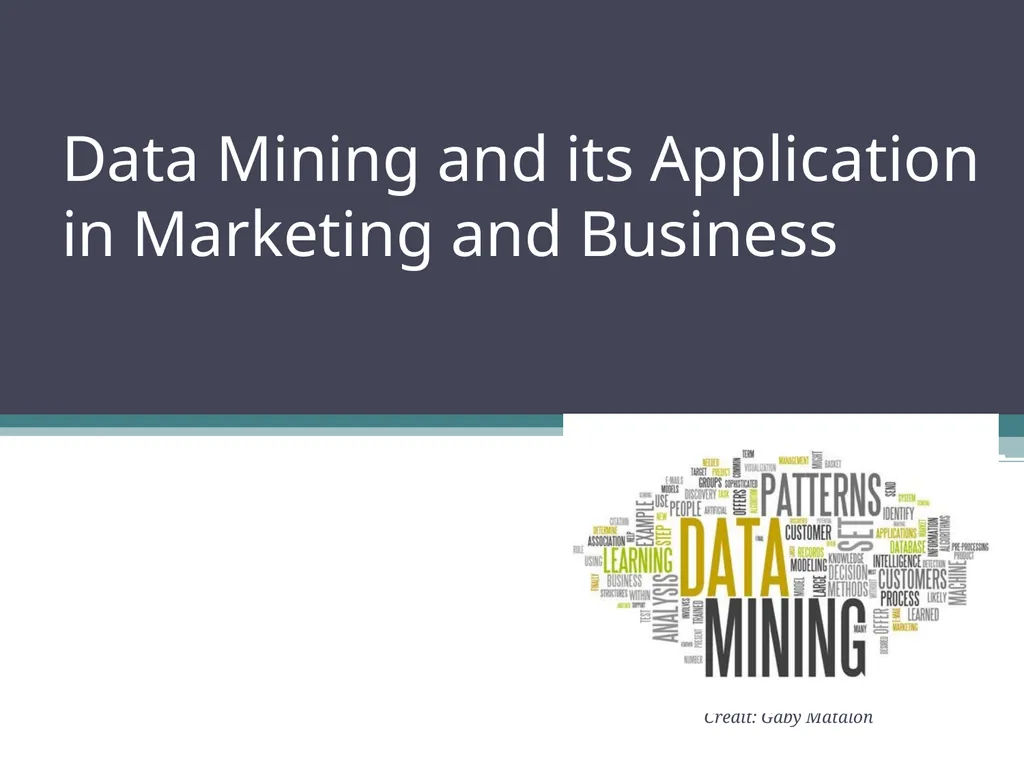
slide1. Data Mining and its Application in Marketing and Business Credit: Gaby Matalon<br>
slide2. What is Data Mining? The process of analyzing data from different perspectives and summarizing it into useful information
It uncovers patterns in a large set of data
Growing industry to target their products and advertisements towards consumers based on data mining<br>
slide3. Why Data Mining? Almost everything we do leaves electronic data behind

Needs to extract useful information from data in order to interpret the data

Data mining helps speed up the process of finding relationships and patterns in raw data<br>
slide4. Uses of Data Mining Healthcare
Finance
Retail & E-Commerce
Learn about consumer preferences
Countless others!<br>
slide5. History of Data Mining The term “data mining” is relatively new but the concepts have been around for many years
Classical statistics, artificial intelligence and machine learning culminated over the years and evolved into data mining<br>
slide6. History of Data Mining (Cont.) Data Collection (1960s)- process of storing information on computers
Technology- computers, tapes and disks

Data Access (1980s)-the introduction of structured query languages and relational databases helped us learn more about data
Data available at record level dynamically<br>
slide7. History of Data Mining (Cont.) Data Warehousing and Decision Report (1990s)-the process of centralized data management and retrieval
Maintaining a central location for all organizational data
Helps you analyze data and concentrate on very specific characteristics
Dynamic data delivery at multiple levels

Data Mining (present)- generalizing patterns, predictive<br>
slide8. Influential People/Events In 1975, John Henry Holland wrote Adaptation in Natural and Artificial Systems, a book on genetic algorithms – start in data mining

1990s, the term “data mining” appeared in the database community for the first time

In 2001, William S. Cleveland introduced data mining as an independent discipline

DJ Patil became the first Chief Data Scientist
in the White House in February 2015<br>
slide9. Terminology Data: facts, numbers or text that can be processed by a computer

Information: the patterns, associations and relationships of data

Knowledge: understanding of a subject, synthesise information to gain knowledge about historical patterns and future trends<br>
slide10. Data, Information, vs. Knowledge<br>
slide11. Data Mining in the Knowledge Discovery Process<br>
slide12. How Data Mining Works Need a clear understanding of data in order to be able to use the information effectively

To do this, classify data into these groups:
Classes
Clusters
Associations
Sequential Patterns<br>
slide13. Classes Classes are groups where the data shares characteristics
Example- A class for a company like Netflix would be the customers who all watched a certain movie<br>
slide14. Clusters Very similar to classes but with additional attributes (ie. logical relationships & consumer preferences)
Example- product recommendations, people who bought this product also bought...

In terms of business this can be the most helpful/effective way to classify data<br>
slide15. Associations Takes clustering even further
Use data to find relationships/patterns that would often go unnoticed
Example: finding a connection between buying two unrelated products
Associations can help businesses identify these patterns and they can tailor deals or promotions to take advantage of their consumers’ buying habits<br>
slide16. Sequential Patterns Sequential patterns uses past data to form a predictive model

Produces projected trends of what the data shows a consumer will buy
Example: Target could predict a consumer will buy diapers if they are/have purchased baby clothes and pacifiers in the past<br>
slide17. Data Mining’s Major Elements Extract, transform, and load transaction data onto the data warehouse system.
Store and manage the data in a multidimensional database system.
Analyze the data by application software.
Present the data in a useful format, such as a graph or table, for display and visualization<br>
slide18. Methods of Analysis Artificial neural networks: Non-linear predictive models that resemble biological neural networks in structure

Genetic algorithms: Optimization techniques that use genetic combination, mutation, and natural selection based on the concepts of natural evolution

Rule induction: The extraction of useful if-then rules from data based on statistical significance<br>
slide19. Methods of Analysis (Cont.) Decision trees: Tree-shaped structures that represent sets of decisions. These decisions generate rules for the classification of a dataset.
Classification and Regression Trees (CART), Chi-Square Automatic Interaction Detection (CHAID)
CART segments a dataset by creating 2-way splits while CHAID segments using chi square tests to create multi-way splits.<br>
slide20. Methods of Analysis (Cont.) Nearest neighbor method: A technique that classifies each record in a dataset based on a combination of the classes of the k-record(s) most similar to it in a historical dataset (where k=1)

Data visualization: The visual interpretation of complex relationships in multidimensional data.
Use graphics tools to illustrate data relationships<br>
slide21. How Data Mining Applied Data mining is accomplished through modeling

Modeling is the act of building a model that applies to one situation and then applying it to another situation where you don’t have a model

Use these new models to predict patterns<br>
slide22. Data Mining and Marketing Advances in the data mining field have had profound effects on the marketing of companies

Companies use this data to tailor their coupons, advertisements and sales to consumers

This marketing tactic is more effective, efficient and can save the company money<br>
slide23. Target Case Study Target uses data mining to tailor the coupons they send in hopes to attract consumers at times in their lives where they are vulnerable to changing their store loyalties
The period where consumers are most vulnerable is when parents are expecting a child
Research has found that when a couple is expecting, they often break their habits and form new ones
This gives stores like Target the opportunity to lure consumers into their stores and get them hooked for life<br>
slide24. Target (Cont.) Target uses data that it collects while you are in the store/on their website along with personal information that they buy from other companies
“For decades, Target has collected vast amounts of data on every person who regularly walks into one of its stores. Whenever possible, Target assigns each shopper a unique code — known internally as the Guest ID number — that keeps tabs on everything they buy” (Duhigg)

This data is then analyzed to better understand consumers’ shopping and personal habits<br>
slide25. Target (Cont.) Analyst, Andrew Pole, started work on a “pregnancy prediction model” by combing through Target’s baby shower registry and taking note of how shopping habits of pregnant women changed throughout their pregnancy

Using this info, he created a list of about 25 items that signal that a woman is pregnant

This model was able to predict not only if someone is pregnant but also estimate due date<br>
slide26. Amazon Case Study Amazon is using the data they have collected to improve the customer-service
This includes, name, address & basic personal info as well as consumer preferences and the specific issue the consumer is trying to fix

Use synchronized data to transfer all the data about an individual collected from various departments to provide the customer service representative with the information they need to have an effective human conversation<br>
slide27. Amazon (Cont.) It makes interactions with consumers more efficient

Customer service employees have access to the info needed when interacting with customers

The employees know enough about you to make your interaction seem personal but not too much that it seems creepy
Good to know name, address and the topic of the call but don’t need to suggest an item that your data has shown they may like<br>
slide28. Starbucks Case Study Starbucks uses data to determine the best locations for their stores

Multiple Starbucks locations are able to do so well in such close proximity due to data mining and modeling

Use location-based data, street traffic analysis and demographic information to determine where their locations will have the most success<br>
slide29. Starbucks (Cont.) Starbucks uses a company called Esri and their data platform, ArcGIS online, to monitor sales, demographics and proximity to potential consumers’ homes, work and other excursions

This company takes Starbucks’ massive amount of data, analyzes it and places it in easy-to understand platform for Starbucks employees<br>
slide30. The Future of Data Mining Predictive analytics: “one-click data mining”, achieved by a easier and more efficient data-mining process
Allow advanced analytics to be applied across subjects
The most revolutionary will be in medicine
Researchers can use predictive analytics to find factors associated with a disease or predict what patient might respond best to an experimental treatment.<br>
slide31. Future Trends Distributed Data Mining: mining data that is located in various different locations
Uses a combination of localized data analysis with a global data model

Hypertext/Hypermedia Data Mining: mining data which includes text, hyperlinks, text mark-ups, and other forms of hypermedia info
Techniques: classification, clustering, semi-structured learning & social network analysis<br>
slide32. Future Trends Multimedia Data Mining: multimedia data (including images, video, audio and animation) need to be represented differently than traditional data
Audio data mining (mining music)

Spatial/Geographical Data Mining: analyzing info about natural resources, images from satellittes, or topographical data
Most of data is image oriented, a lot of it is from different locations<br>
slide33. Concerns about Data Mining Privacy:

As data mining becomes more widely used, more info is collected about every individual

Useful applications of this knowledge vs. potentially dangerous misuse

Possible easy access of data and ill intentions
Potential for identify theft and more!<br>
slide34. Other Concerns User Interface Issues: do visualization tools make the uncovered knowledge interesting & understandable?

Performance Issues: many analysis tools and statistical methods were designed for smaller sets of data. As the data size increases, how do they scale?

Trade-off: Do benefits of data collection and data mining outweigh the potential risk?<br>