
Data Mining for Intrusion Detection Why do we need




Description: Data Mining for Intrusion Detection Why do we need protection? Cyberattacks still on rise Threat of cyber-terrorism, more coordinated Even sensitive installations not well-secured, regular breakins Change in demographic: attacks require
Related Topics
Download Presentation
"Data Mining for Intrusion Detection Why do we need" is the property of its rightful owner. Permission is granted to download and print the materials on this website for personal, non-commercial use only, and to display it on your personal computer provided you do not modify the materials and that you retain all copyright notices contained in the materials. By downloading content from our website, you accept the terms of this agreement.
Presentation Transcript
slide1. Data Mining for Intrusion Detection<br>
slide2. Why do we need protection? Cyberattacks still on rise
Threat of cyber-terrorism, more coordinated
Even sensitive installations not well-secured, regular breakins
Change in demographic: attacks require less sophisticated attackers.<br>
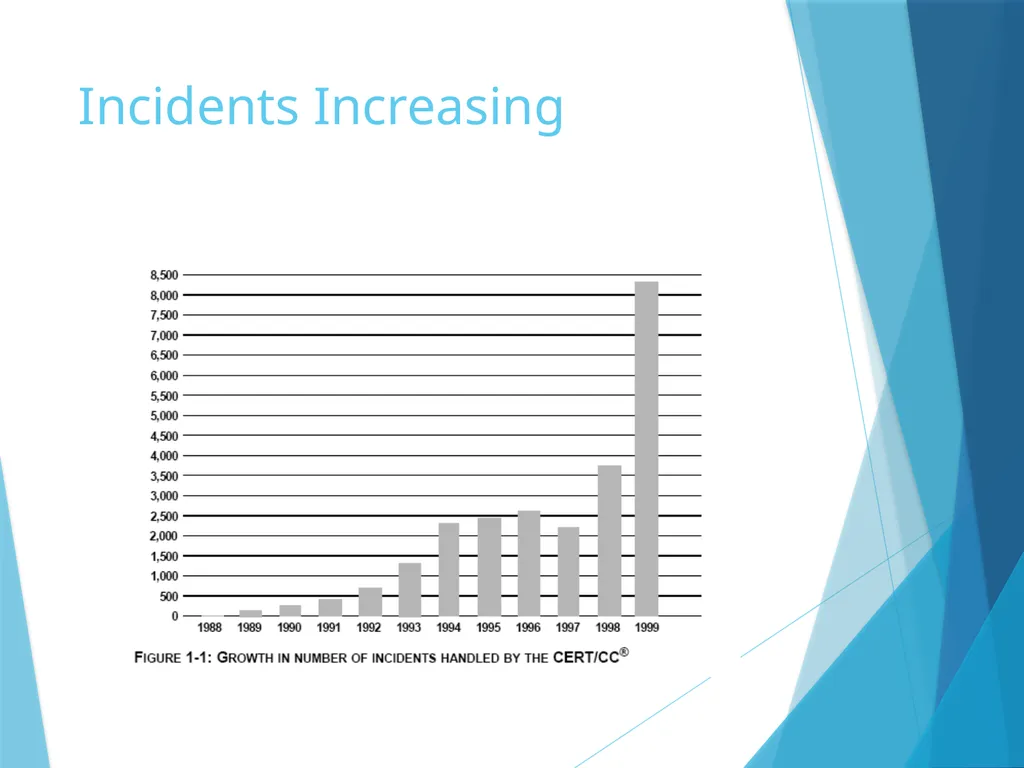
slide3. Incidents Increasing<br>
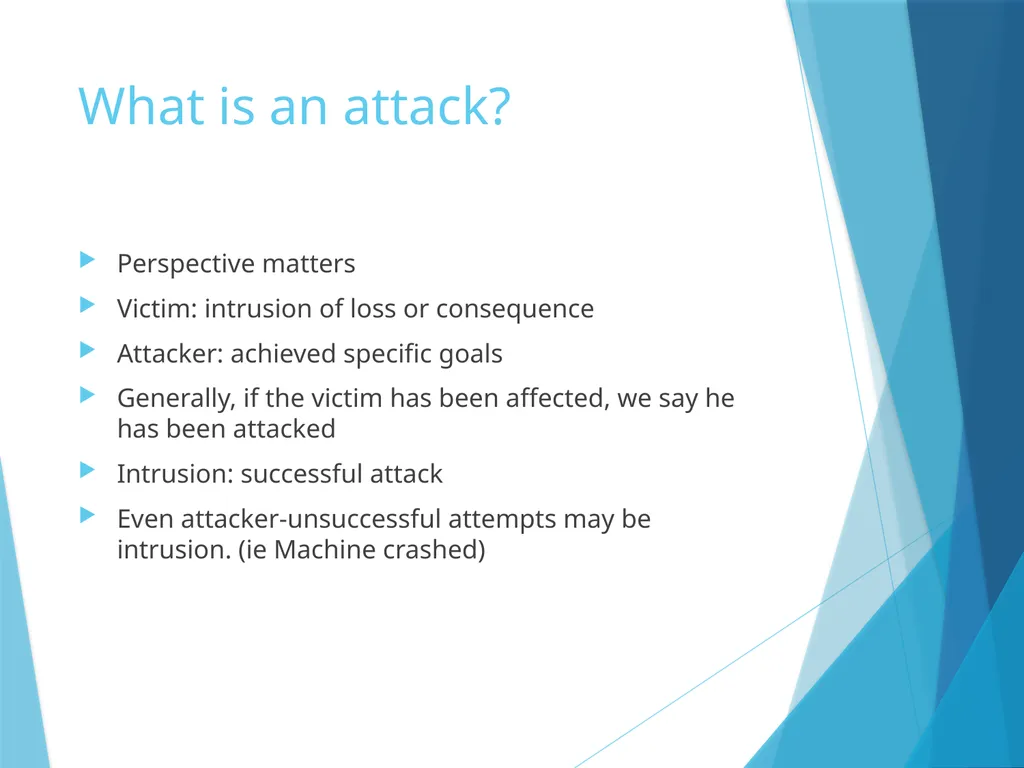
slide4. What is an attack? Perspective matters
Victim: intrusion of loss or consequence
Attacker: achieved specific goals
Generally, if the victim has been affected, we say he has been attacked
Intrusion: successful attack
Even attacker-unsuccessful attempts may be intrusion. (ie Machine crashed)<br>
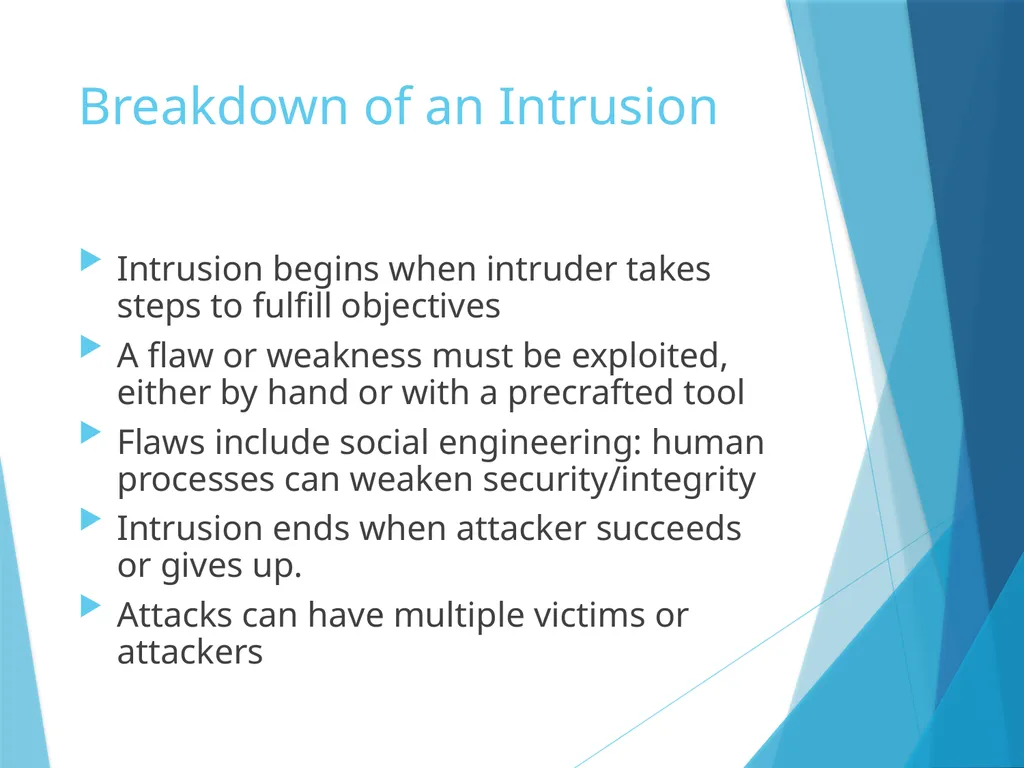
slide5. Breakdown of an Intrusion Intrusion begins when intruder takes steps to fulfill objectives
A flaw or weakness must be exploited, either by hand or with a precrafted tool
Flaws include social engineering: human processes can weaken security/integrity
Intrusion ends when attacker succeeds or gives up.
Attacks can have multiple victims or attackers<br>
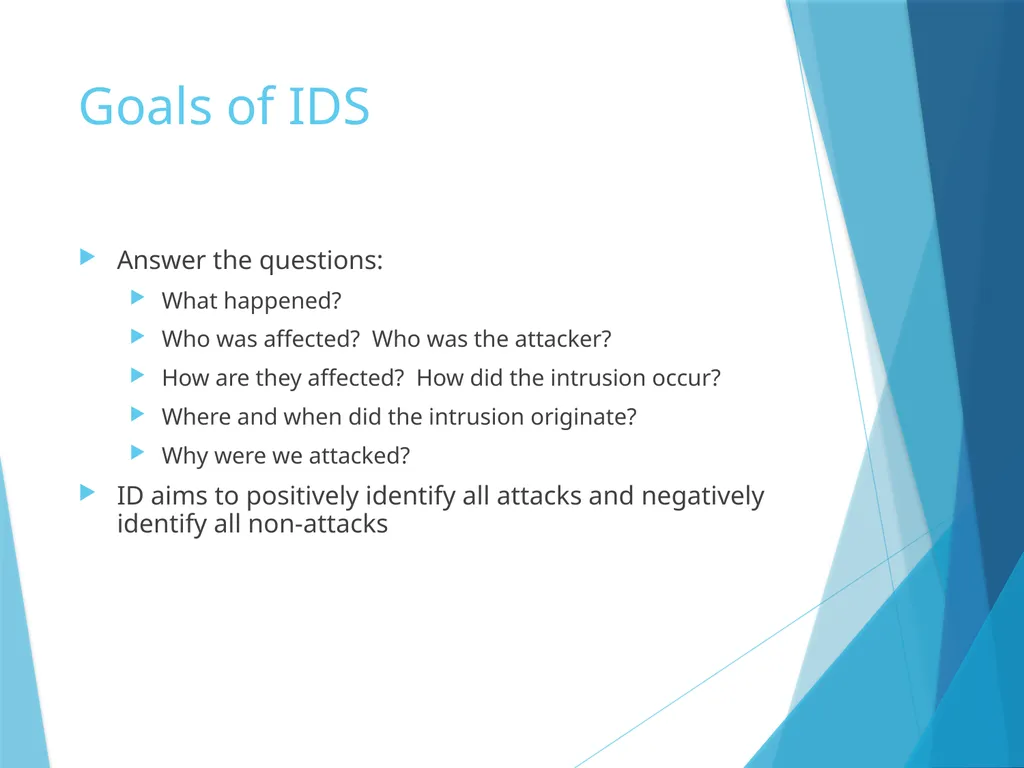
slide6. Goals of IDS Answer the questions:
What happened?
Who was affected? Who was the attacker?
How are they affected? How did the intrusion occur?
Where and when did the intrusion originate?
Why were we attacked?
ID aims to positively identify all attacks and negatively identify all non-attacks<br>
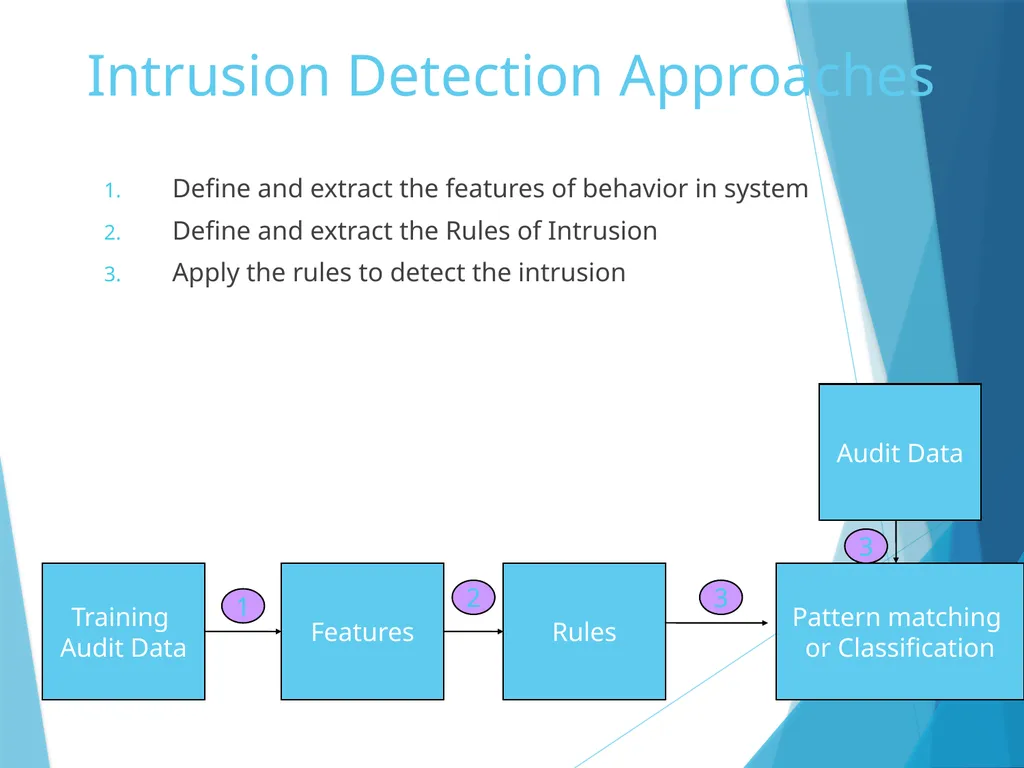
slide7. Intrusion Detection Approaches Define and extract the features of behavior in system
Define and extract the Rules of Intrusion
Apply the rules to detect the intrusion Training
Audit Data Features Rules Audit Data Pattern matching
or Classification 1 3 3 2<br>
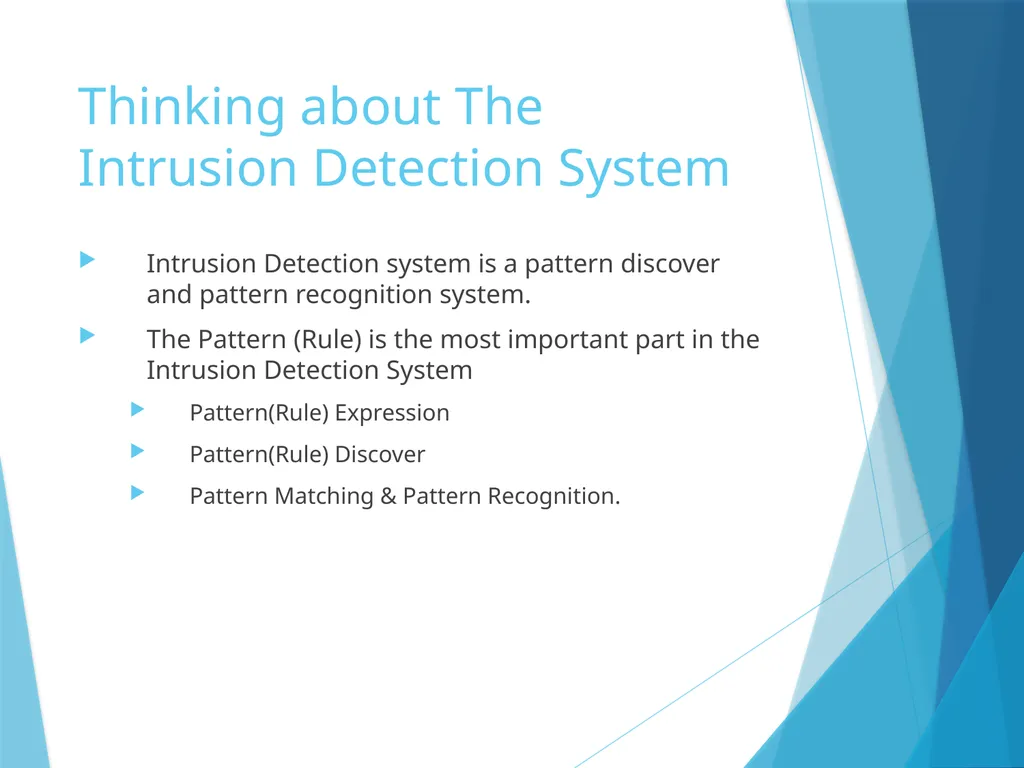
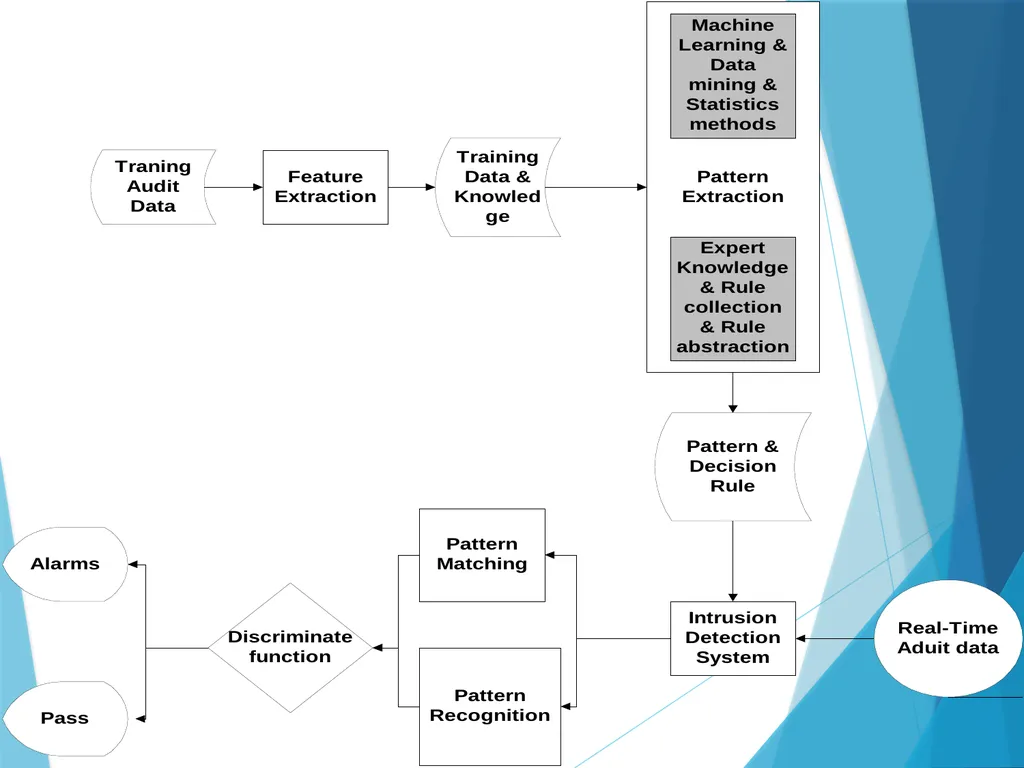
slide8. Thinking about The Intrusion Detection System Intrusion Detection system is a pattern discover and pattern recognition system.
The Pattern (Rule) is the most important part in the Intrusion Detection System
Pattern(Rule) Expression
Pattern(Rule) Discover
Pattern Matching & Pattern Recognition.<br>
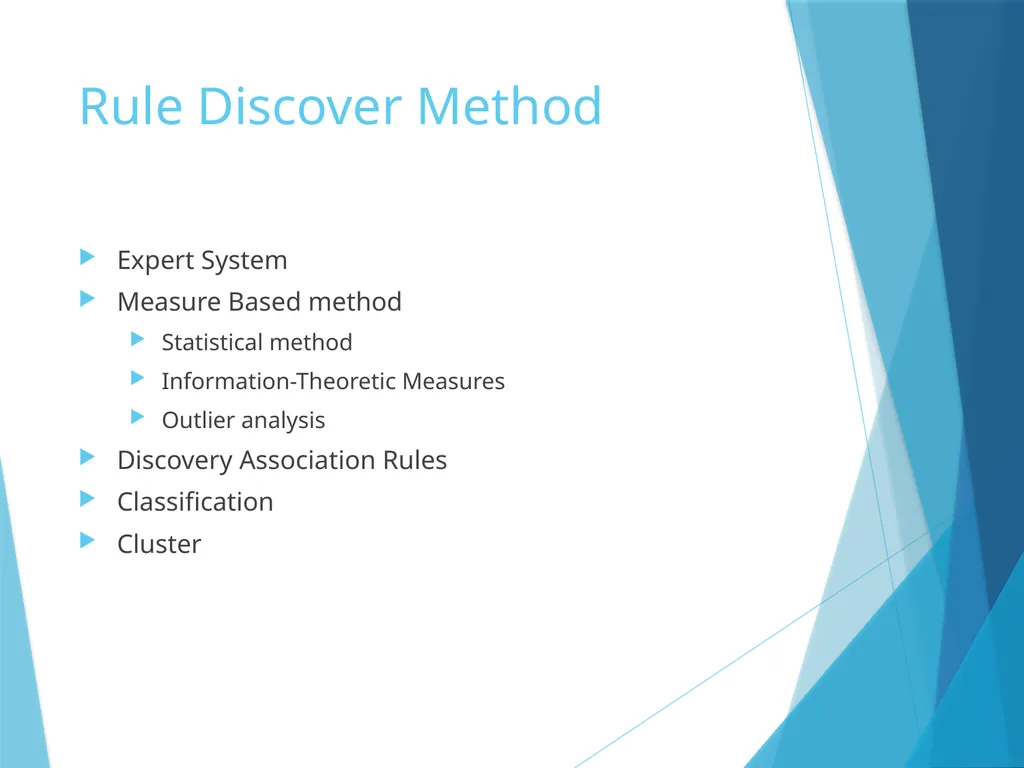
slide10. Rule Discover Method Expert System
Measure Based method
Statistical method
Information-Theoretic Measures
Outlier analysis
Discovery Association Rules
Classification
Cluster<br>
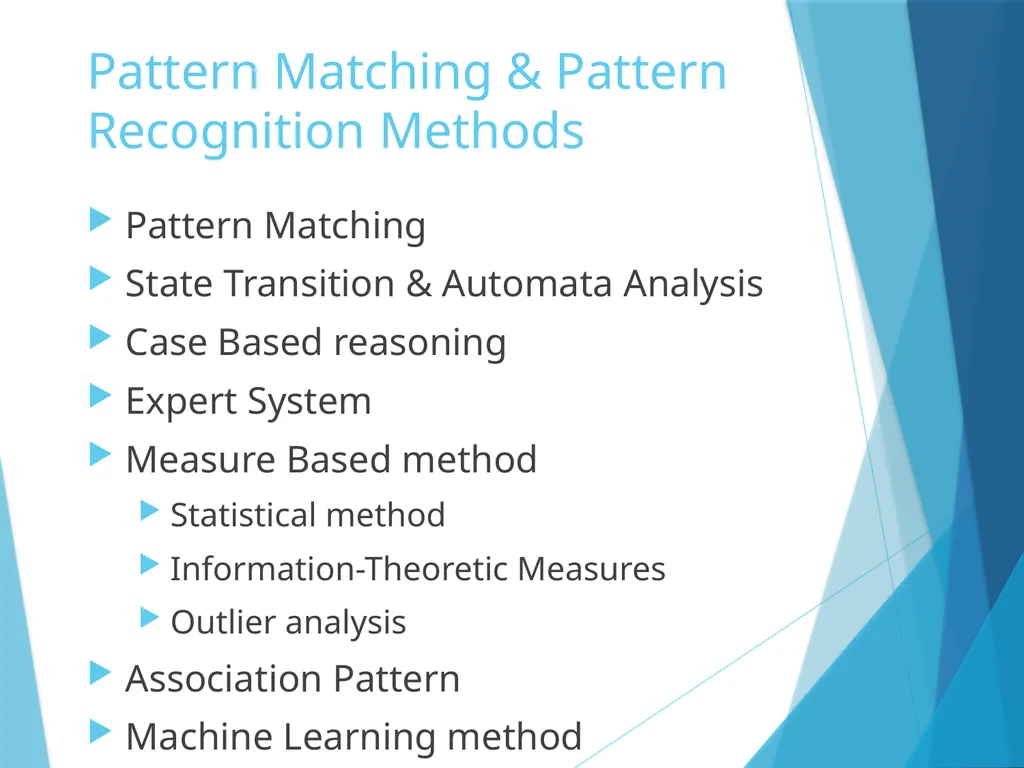
slide11. Pattern Matching & Pattern Recognition Methods Pattern Matching
State Transition & Automata Analysis
Case Based reasoning
Expert System
Measure Based method
Statistical method
Information-Theoretic Measures
Outlier analysis
Association Pattern
Machine Learning method<br>
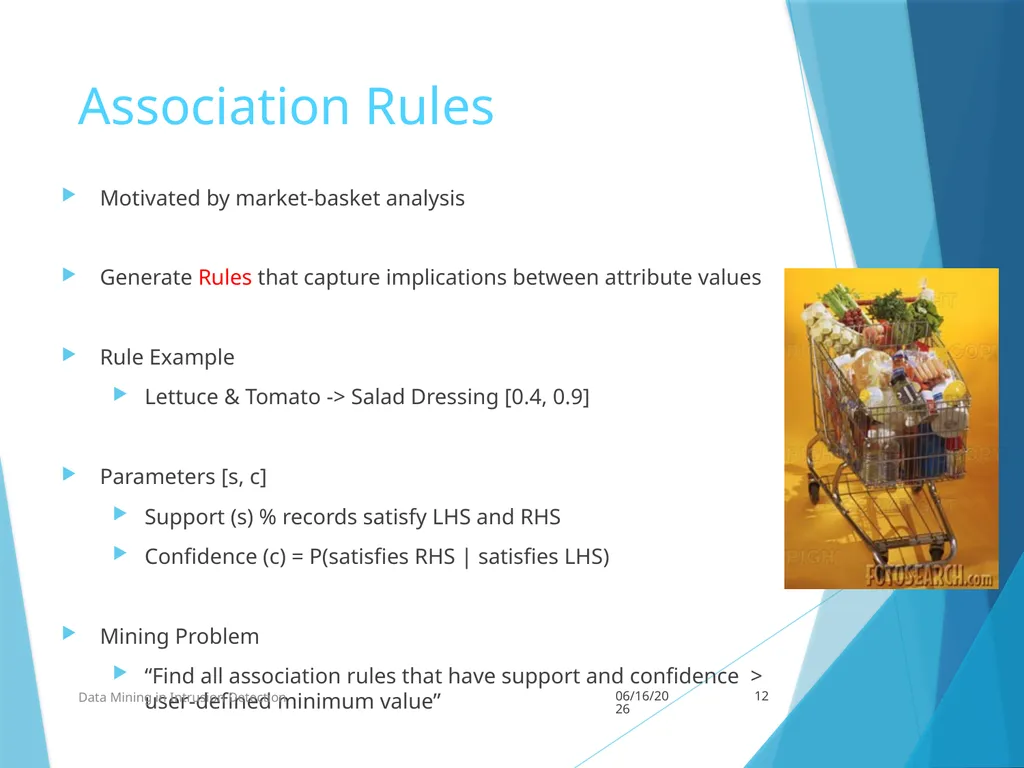
slide12. Association Rules Motivated by market-basket analysis
Generate Rules that capture implications between attribute values
Rule Example
Lettuce & Tomato -> Salad Dressing [0.4, 0.9]
Parameters [s, c]
Support (s) % records satisfy LHS and RHS
Confidence (c) = P(satisfies RHS | satisfies LHS)
Mining Problem
“Find all association rules that have support and confidence > user-defined minimum value” 4/15/2014 Data Mining in Intrusion Detection 12<br>
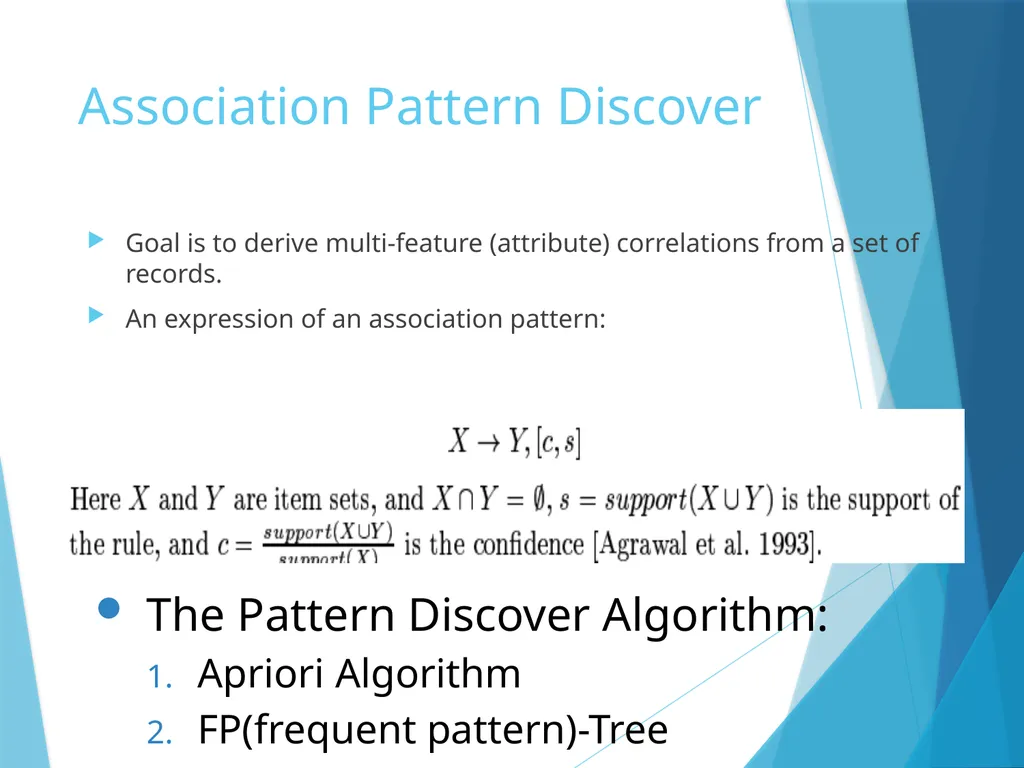
slide13. Association Pattern Discover Goal is to derive multi-feature (attribute) correlations from a set of records.
An expression of an association pattern: The Pattern Discover Algorithm:
Apriori Algorithm
FP(frequent pattern)-Tree<br>
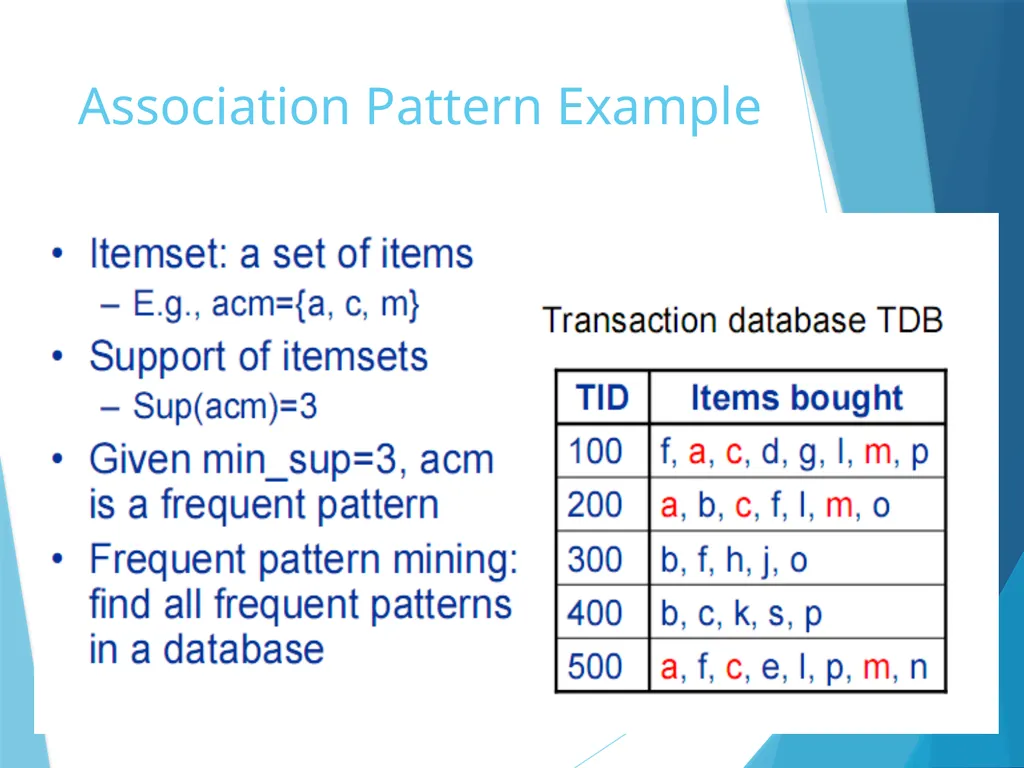
slide14. Association Pattern Example<br>
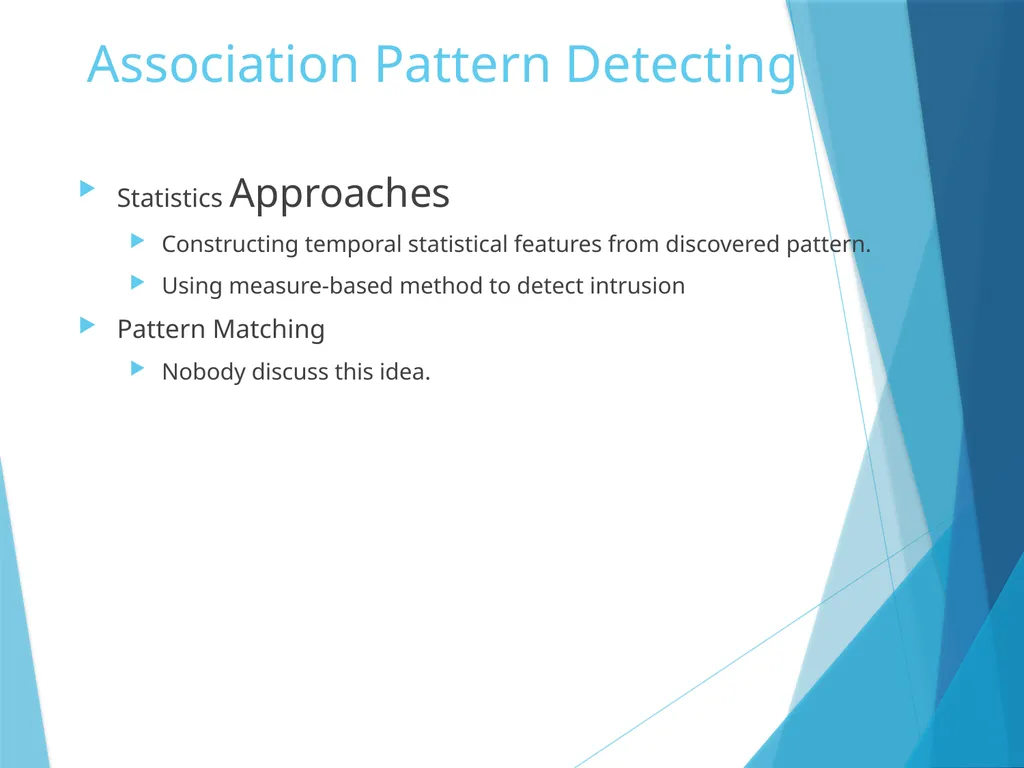
slide15. Association Pattern Detecting Statistics Approaches
Constructing temporal statistical features from discovered pattern.
Using measure-based method to detect intrusion
Pattern Matching
Nobody discuss this idea.<br>
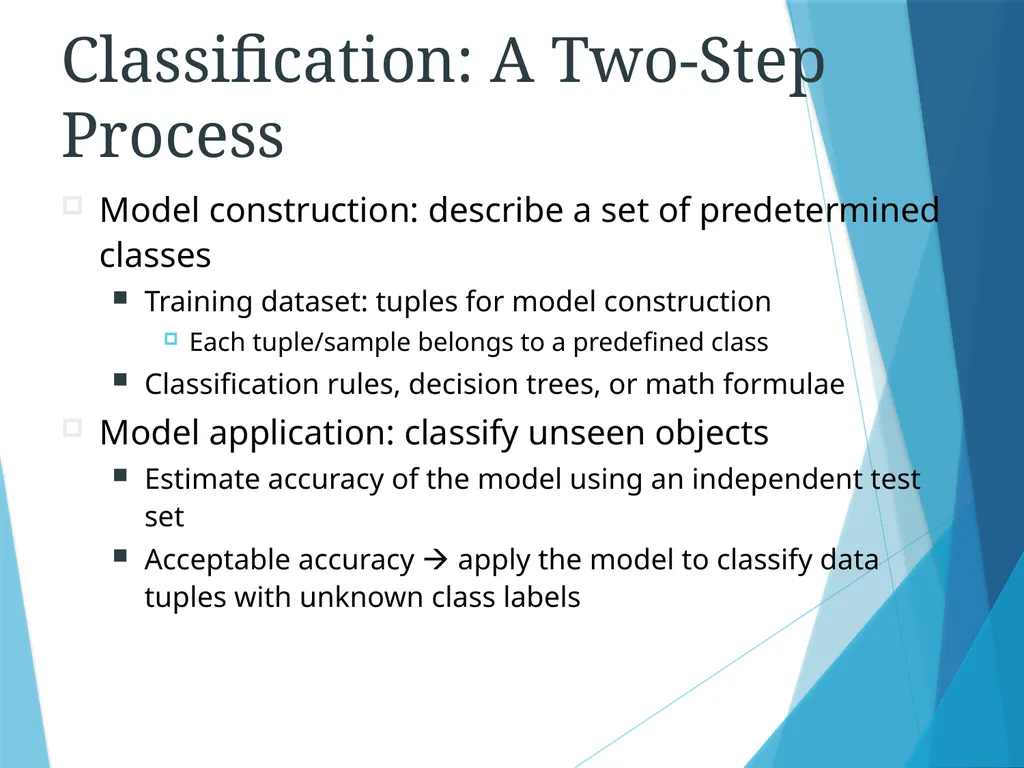
slide16. Classification: A Two-Step Process Model construction: describe a set of predetermined classes
Training dataset: tuples for model construction
Each tuple/sample belongs to a predefined class
Classification rules, decision trees, or math formulae
Model application: classify unseen objects
Estimate accuracy of the model using an independent test set
Acceptable accuracy apply the model to classify data tuples with unknown class labels<br>
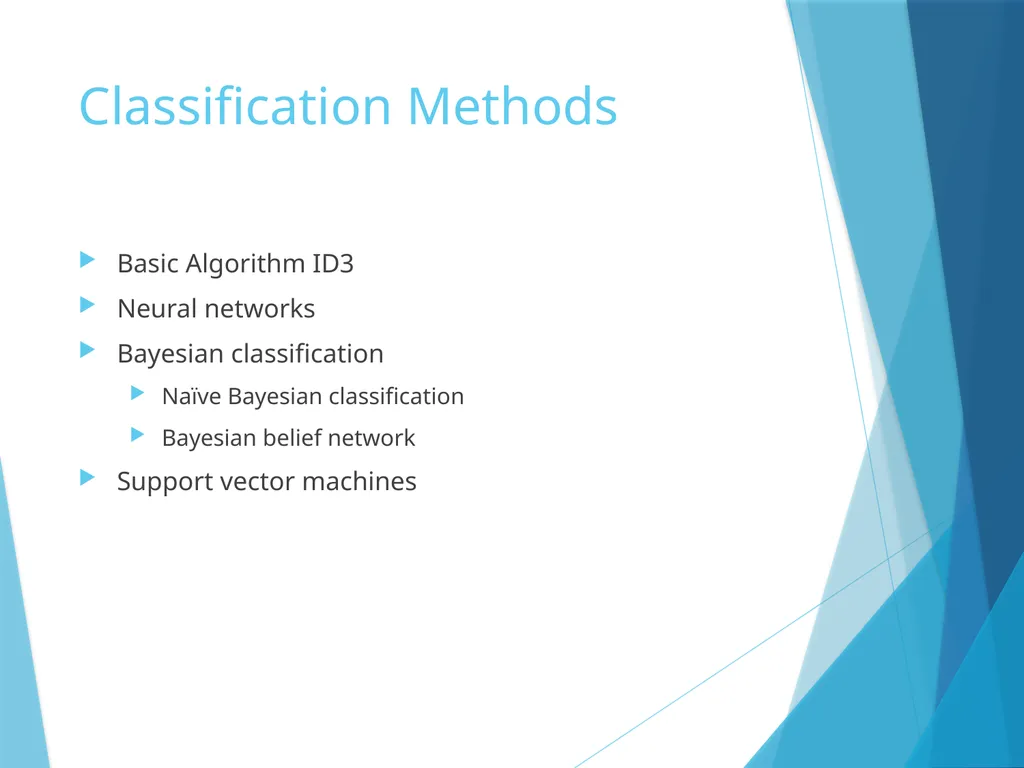
slide17. Classification Methods Basic Algorithm ID3
Neural networks
Bayesian classification
Naïve Bayesian classification
Bayesian belief network
Support vector machines<br>
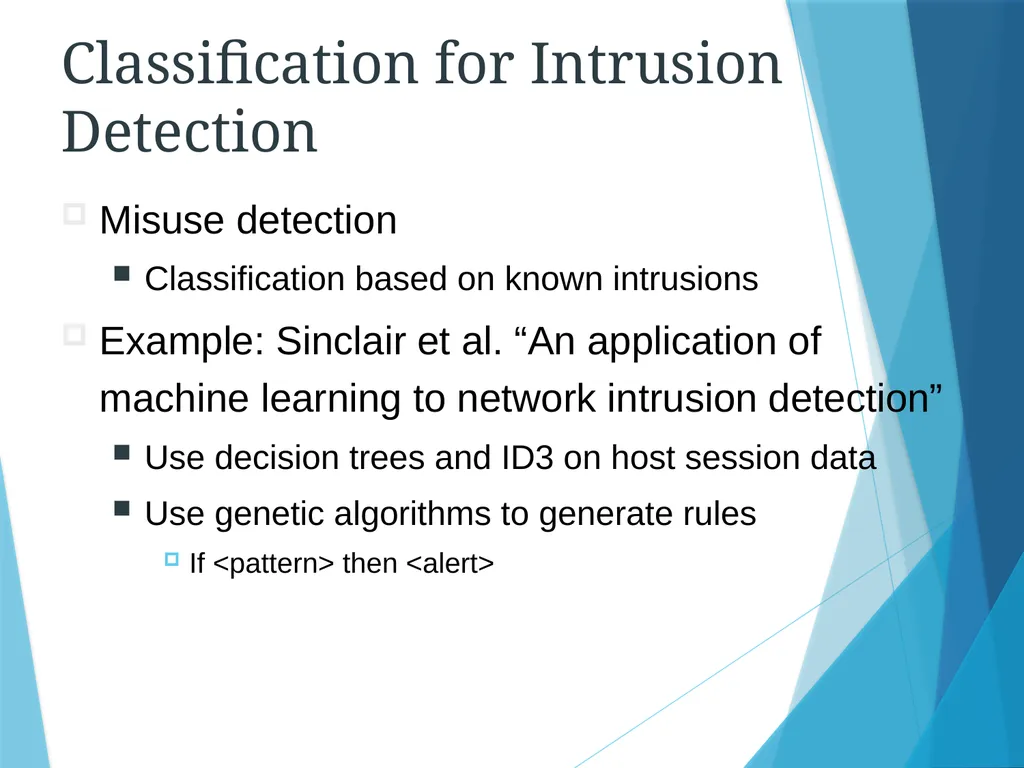
slide18. Classification for Intrusion Detection Misuse detection
Classification based on known intrusions
Example: Sinclair et al. “An application of machine learning to network intrusion detection”
Use decision trees and ID3 on host session data
Use genetic algorithms to generate rules
If <pattern> then <alert><br>
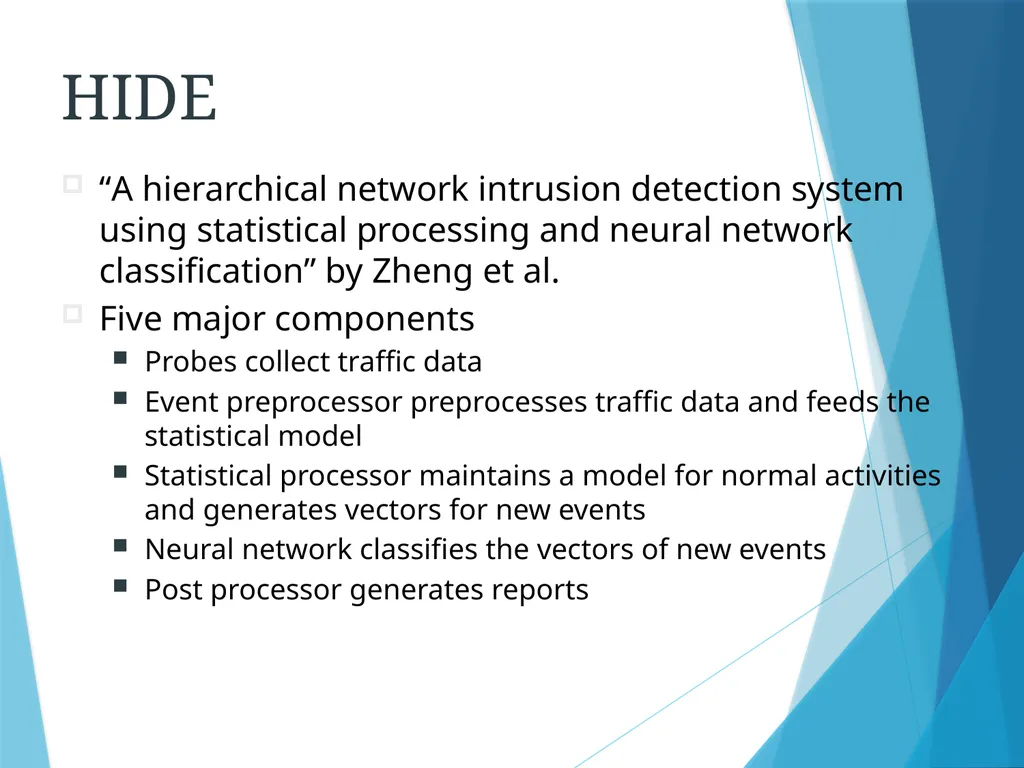
slide19. HIDE “A hierarchical network intrusion detection system using statistical processing and neural network classification” by Zheng et al.
Five major components
Probes collect traffic data
Event preprocessor preprocesses traffic data and feeds the statistical model
Statistical processor maintains a model for normal activities and generates vectors for new events
Neural network classifies the vectors of new events
Post processor generates reports<br>
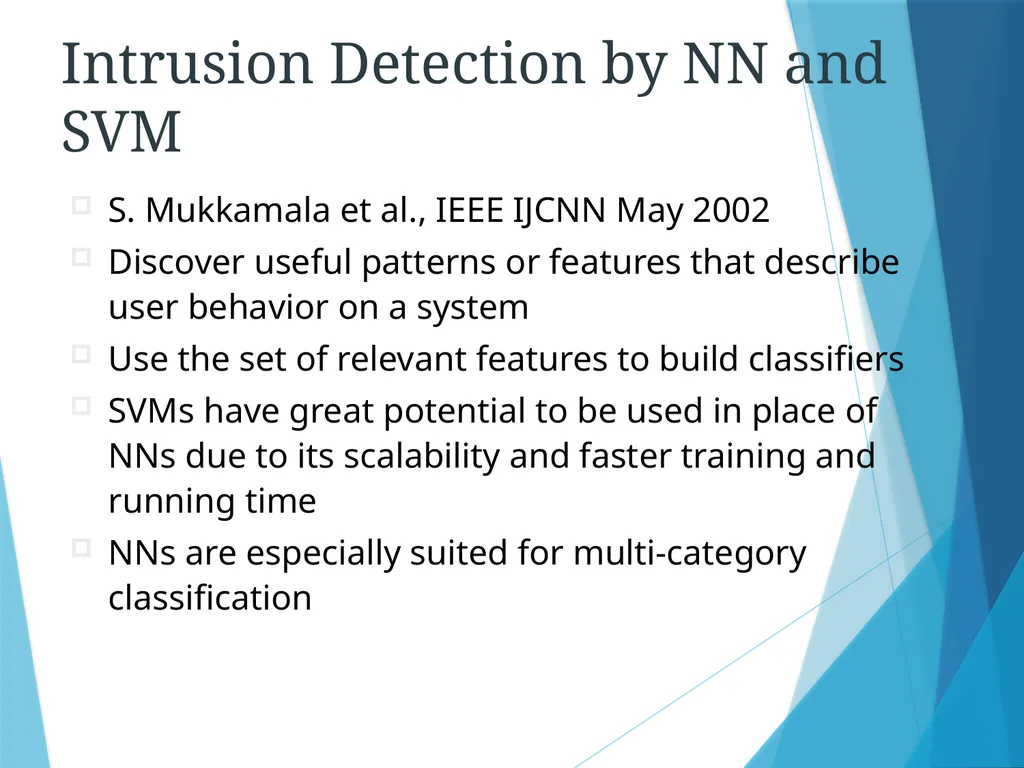
slide20. Intrusion Detection by NN and SVM S. Mukkamala et al., IEEE IJCNN May 2002
Discover useful patterns or features that describe user behavior on a system
Use the set of relevant features to build classifiers
SVMs have great potential to be used in place of NNs due to its scalability and faster training and running time
NNs are especially suited for multi-category classification<br>
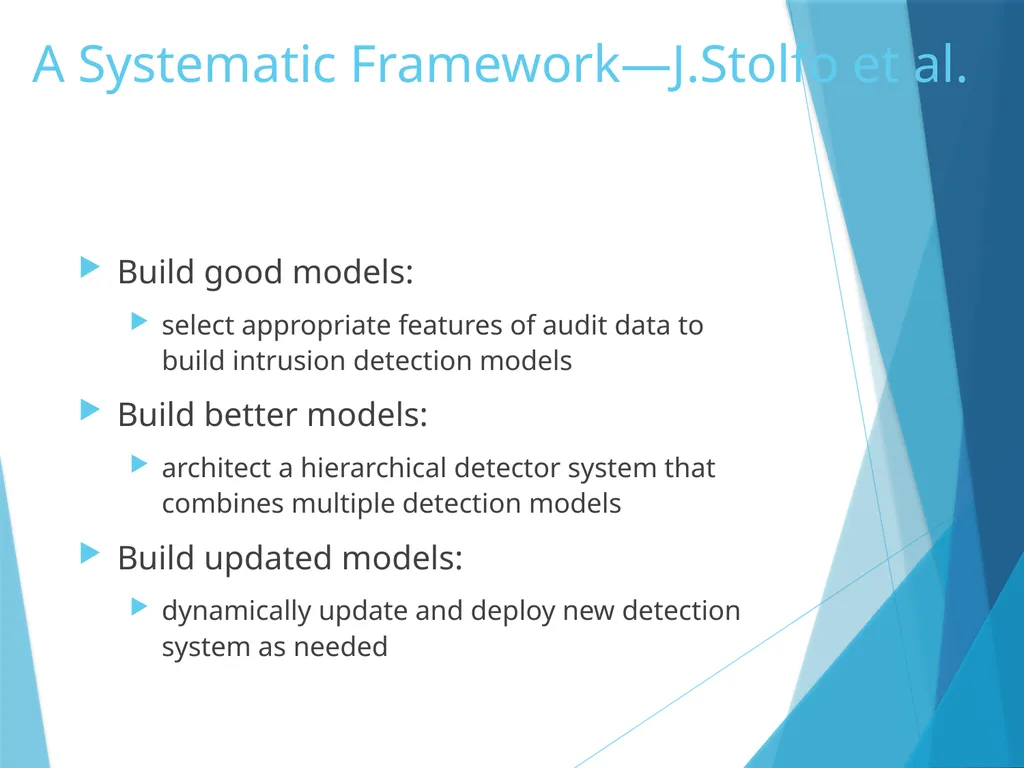
slide21. A Systematic Framework—J.Stolfo et al. Build good models:
select appropriate features of audit data to build intrusion detection models
Build better models:
architect a hierarchical detector system that combines multiple detection models
Build updated models:
dynamically update and deploy new detection system as needed<br>
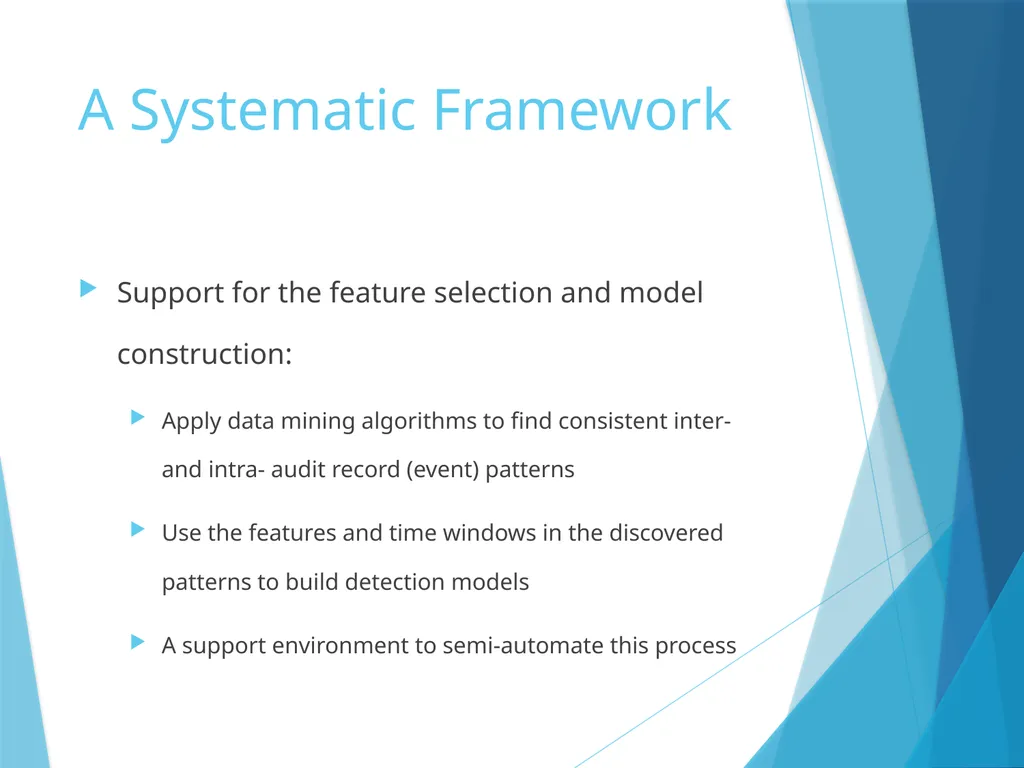
slide22. A Systematic Framework Support for the feature selection and model construction:
Apply data mining algorithms to find consistent inter- and intra- audit record (event) patterns
Use the features and time windows in the discovered patterns to build detection models
A support environment to semi-automate this process<br>
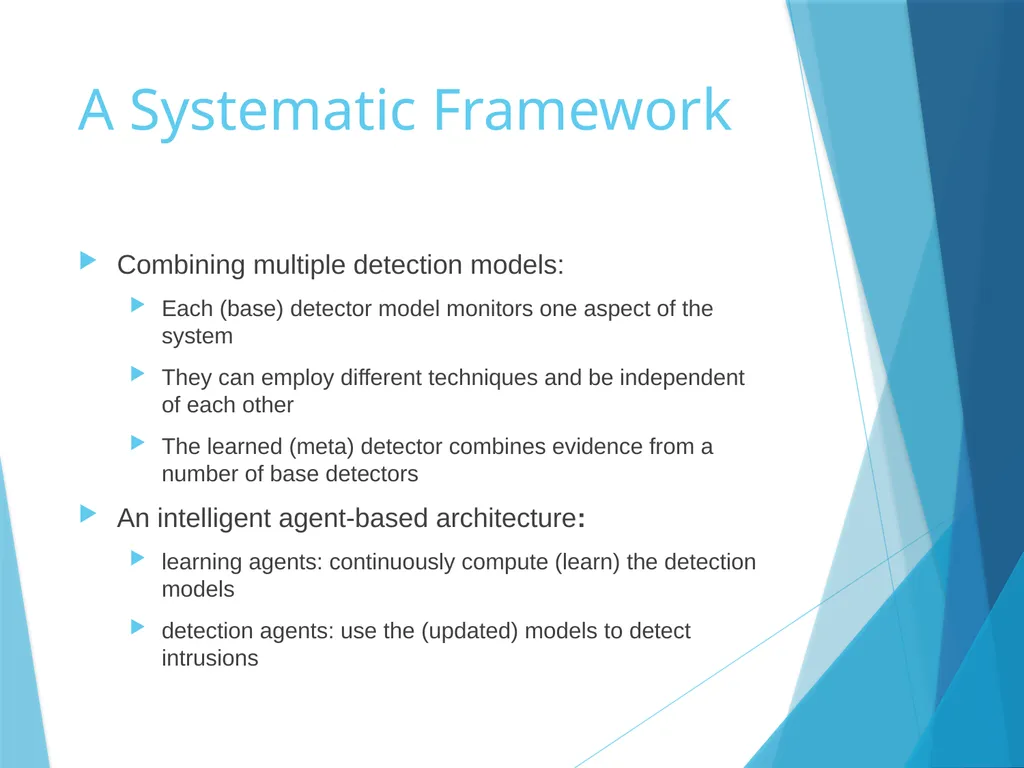
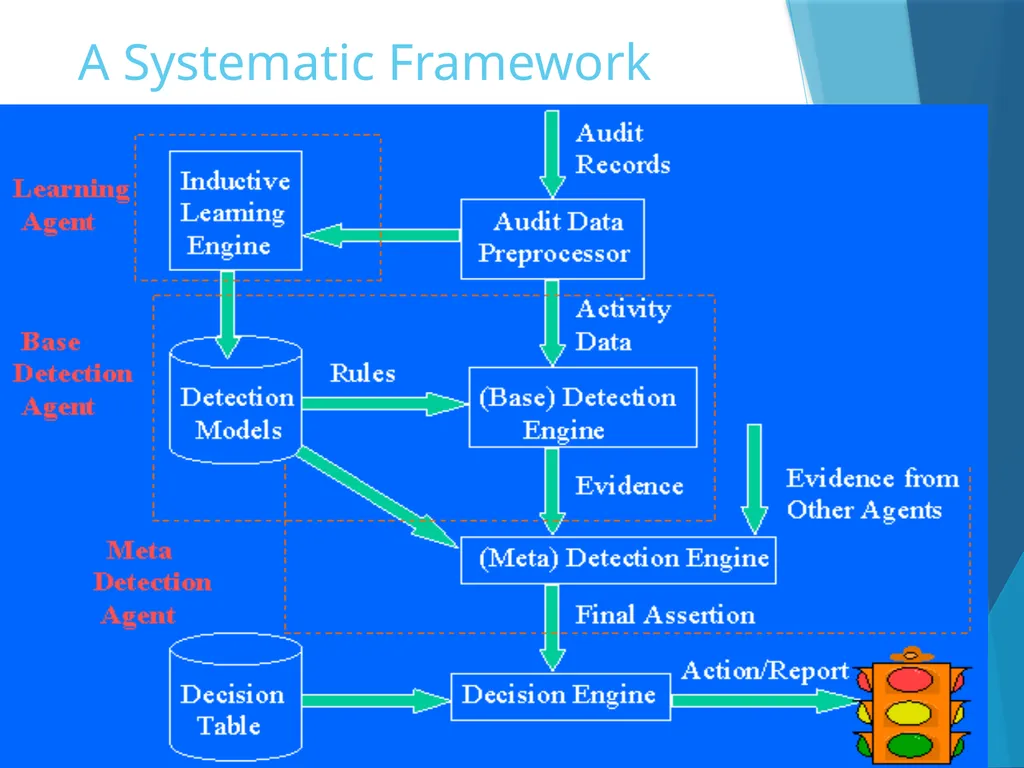
slide23. A Systematic Framework Combining multiple detection models:
Each (base) detector model monitors one aspect of the system
They can employ different techniques and be independent of each other
The learned (meta) detector combines evidence from a number of base detectors
An intelligent agent-based architecture:
learning agents: continuously compute (learn) the detection models
detection agents: use the (updated) models to detect intrusions<br>
slide24. A Systematic Framework<br>
slide25. Building Classifiers for Intrusion Detection—J.Stolfo et al. Experiments in constructing classification models for anomaly detection
Two experiments:
sendmail system call data
network tcpdump data
Use meta classifier to combine multiple classification models<br>
slide26. Classification Models on sendmail The data: sequence of system calls made by sendmail.
Classification models (rules): describe the “normal” patterns of the system call sequences.
The rule set is the normal profile of sendmail
Detection: calculate the deviation from the profile
large number/high scores of “violations” to the rules in a new trace suggests an exploit<br>
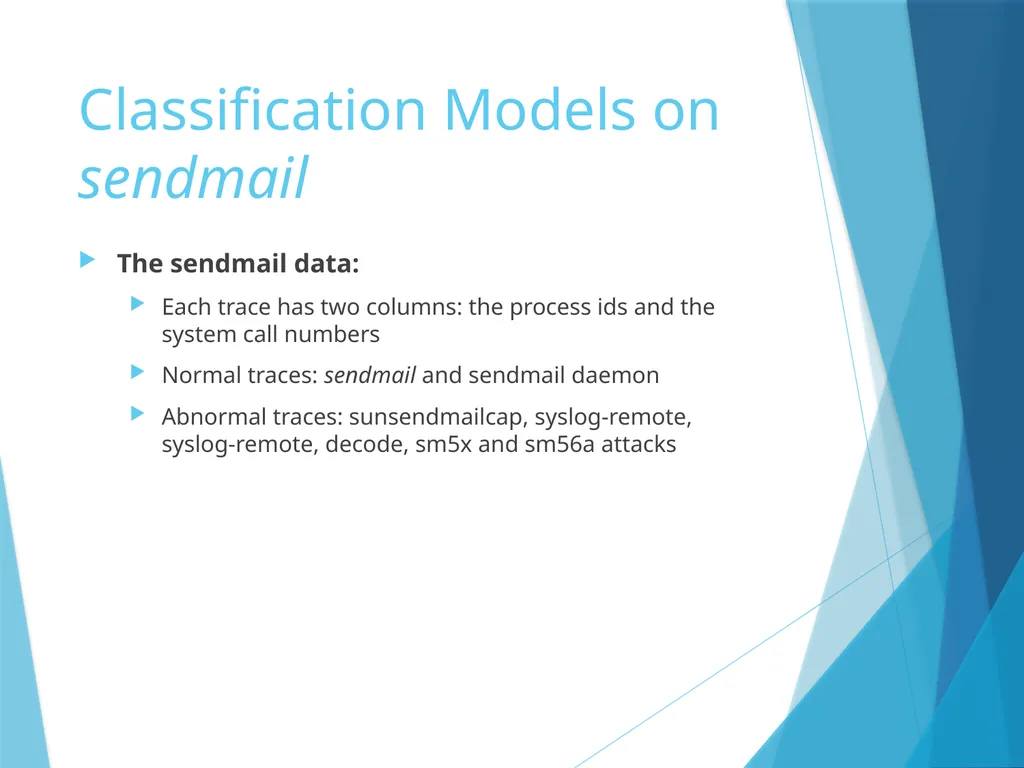
slide27. Classification Models on sendmail The sendmail data:
Each trace has two columns: the process ids and the system call numbers
Normal traces: sendmail and sendmail daemon
Abnormal traces: sunsendmailcap, syslog-remote, syslog-remote, decode, sm5x and sm56a attacks<br>
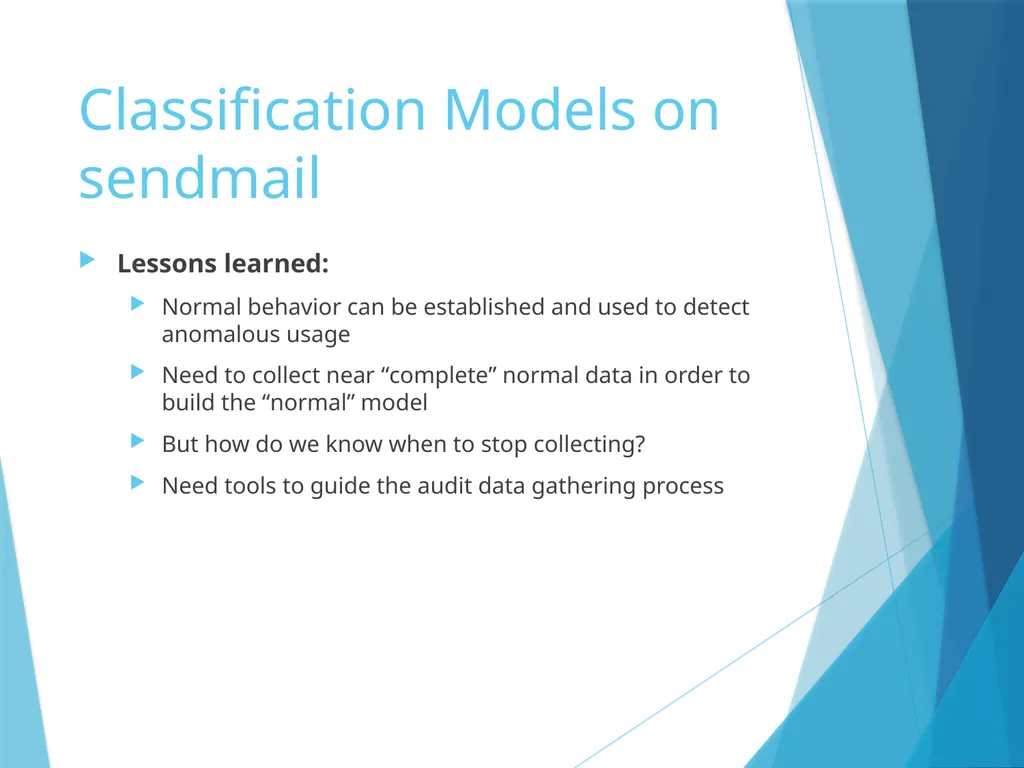
slide28. Classification Models on sendmail Lessons learned:
Normal behavior can be established and used to detect anomalous usage
Need to collect near “complete” normal data in order to build the “normal” model
But how do we know when to stop collecting?
Need tools to guide the audit data gathering process<br>
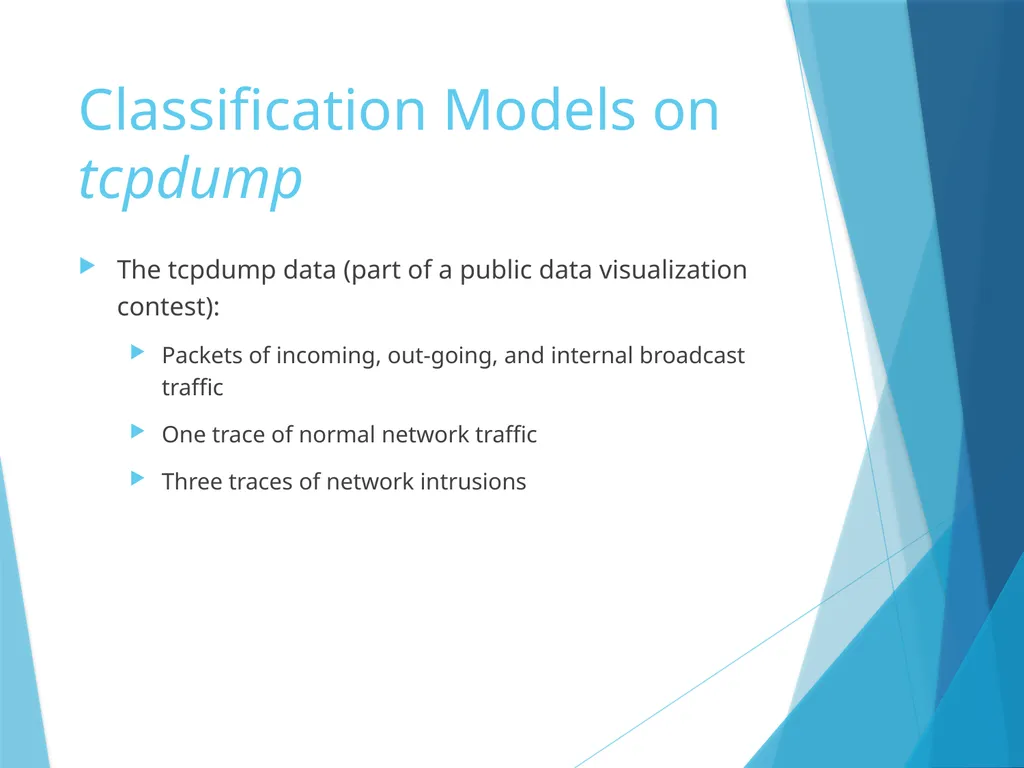
slide29. Classification Models on tcpdump The tcpdump data (part of a public data visualization contest):
Packets of incoming, out-going, and internal broadcast traffic
One trace of normal network traffic
Three traces of network intrusions<br>
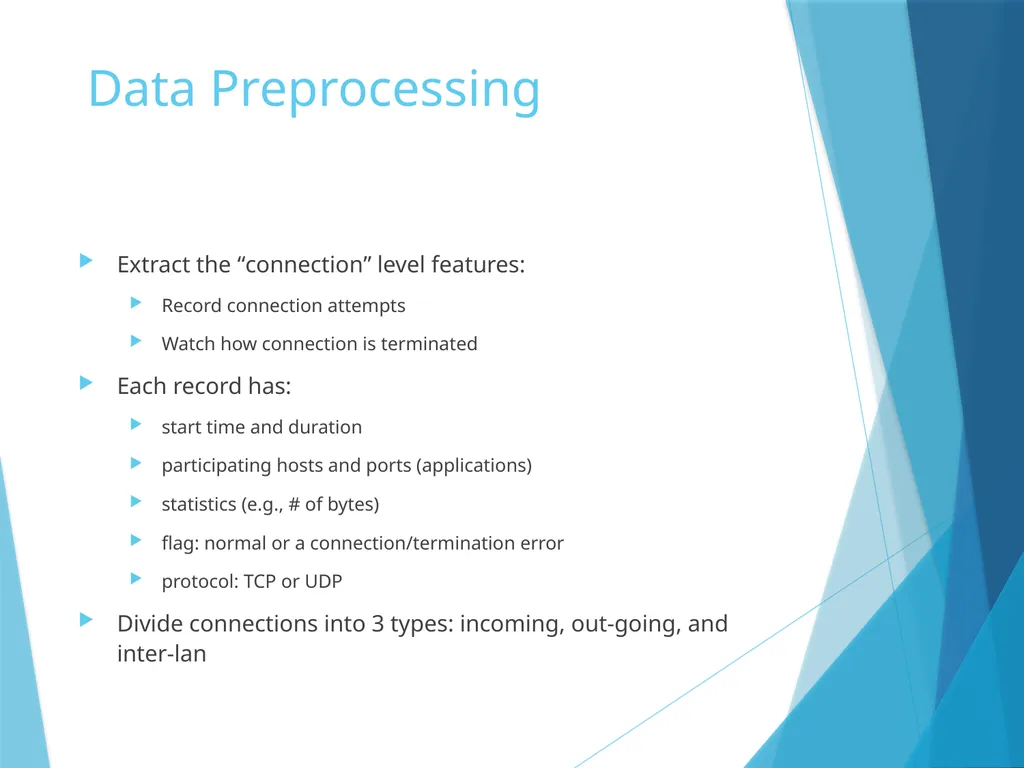
slide30. Data Preprocessing Extract the “connection” level features:
Record connection attempts
Watch how connection is terminated
Each record has:
start time and duration
participating hosts and ports (applications)
statistics (e.g., # of bytes)
flag: normal or a connection/termination error
protocol: TCP or UDP
Divide connections into 3 types: incoming, out-going, and inter-lan<br>
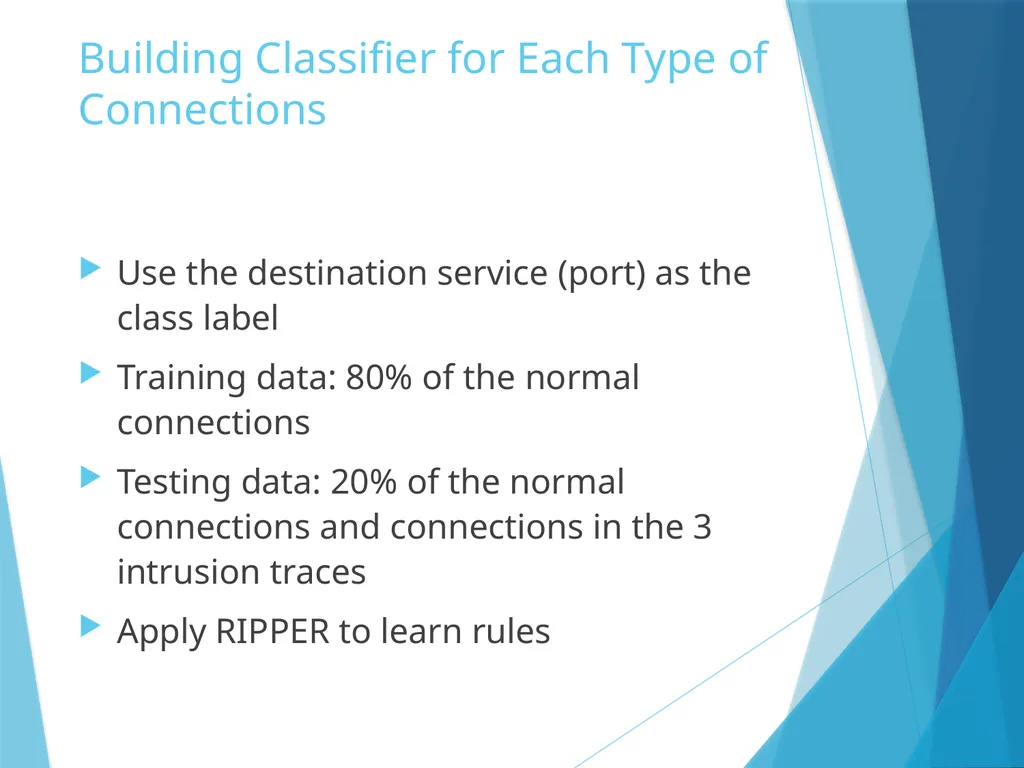
slide31. Building Classifier for Each Type of Connections Use the destination service (port) as the class label
Training data: 80% of the normal connections
Testing data: 20% of the normal connections and connections in the 3 intrusion traces
Apply RIPPER to learn rules<br>
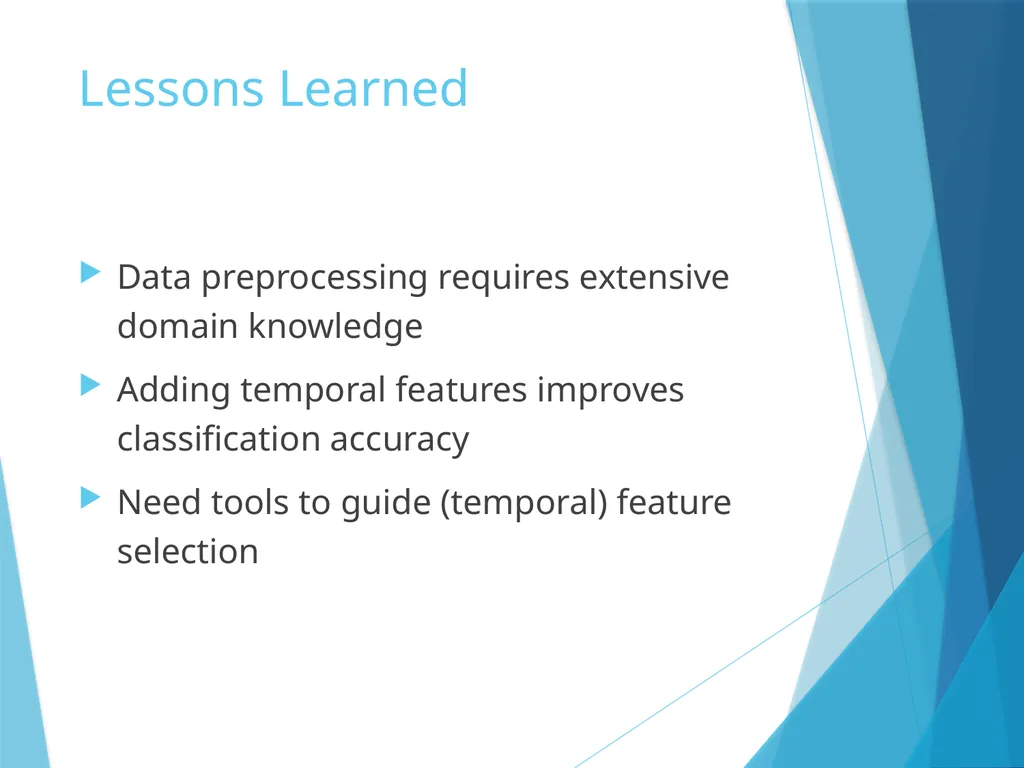
slide32. Lessons Learned Data preprocessing requires extensive domain knowledge
Adding temporal features improves classification accuracy
Need tools to guide (temporal) feature selection<br>
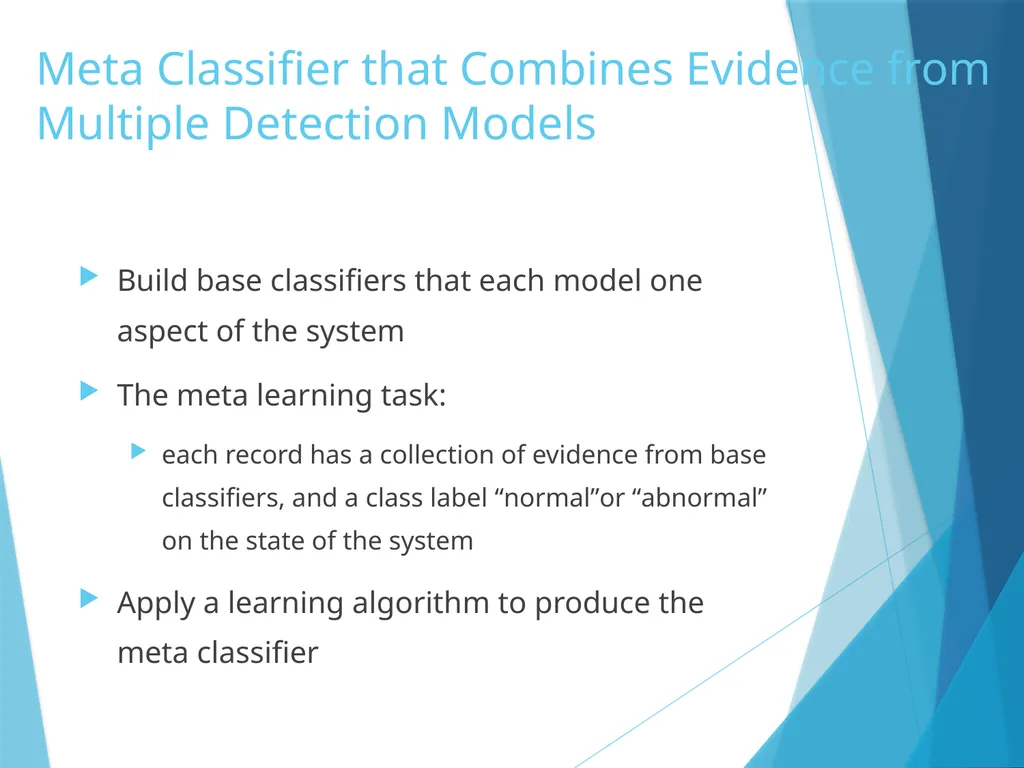
slide33. Meta Classifier that Combines Evidence from Multiple Detection Models Build base classifiers that each model one aspect of the system
The meta learning task:
each record has a collection of evidence from base classifiers, and a class label “normal”or “abnormal” on the state of the system
Apply a learning algorithm to produce the meta classifier<br>
slide34. Reference http://www.cs.kent.edu/~jin/dataminingcourse/intrusiondection.ppt<br>
slide2. Why do we need protection? Cyberattacks still on rise
Threat of cyber-terrorism, more coordinated
Even sensitive installations not well-secured, regular breakins
Change in demographic: attacks require less sophisticated attackers.<br>
slide3. Incidents Increasing<br>
slide4. What is an attack? Perspective matters
Victim: intrusion of loss or consequence
Attacker: achieved specific goals
Generally, if the victim has been affected, we say he has been attacked
Intrusion: successful attack
Even attacker-unsuccessful attempts may be intrusion. (ie Machine crashed)<br>
slide5. Breakdown of an Intrusion Intrusion begins when intruder takes steps to fulfill objectives
A flaw or weakness must be exploited, either by hand or with a precrafted tool
Flaws include social engineering: human processes can weaken security/integrity
Intrusion ends when attacker succeeds or gives up.
Attacks can have multiple victims or attackers<br>
slide6. Goals of IDS Answer the questions:
What happened?
Who was affected? Who was the attacker?
How are they affected? How did the intrusion occur?
Where and when did the intrusion originate?
Why were we attacked?
ID aims to positively identify all attacks and negatively identify all non-attacks<br>
slide7. Intrusion Detection Approaches Define and extract the features of behavior in system
Define and extract the Rules of Intrusion
Apply the rules to detect the intrusion Training
Audit Data Features Rules Audit Data Pattern matching
or Classification 1 3 3 2<br>
slide8. Thinking about The Intrusion Detection System Intrusion Detection system is a pattern discover and pattern recognition system.
The Pattern (Rule) is the most important part in the Intrusion Detection System
Pattern(Rule) Expression
Pattern(Rule) Discover
Pattern Matching & Pattern Recognition.<br>
slide10. Rule Discover Method Expert System
Measure Based method
Statistical method
Information-Theoretic Measures
Outlier analysis
Discovery Association Rules
Classification
Cluster<br>
slide11. Pattern Matching & Pattern Recognition Methods Pattern Matching
State Transition & Automata Analysis
Case Based reasoning
Expert System
Measure Based method
Statistical method
Information-Theoretic Measures
Outlier analysis
Association Pattern
Machine Learning method<br>
slide12. Association Rules Motivated by market-basket analysis
Generate Rules that capture implications between attribute values
Rule Example
Lettuce & Tomato -> Salad Dressing [0.4, 0.9]
Parameters [s, c]
Support (s) % records satisfy LHS and RHS
Confidence (c) = P(satisfies RHS | satisfies LHS)
Mining Problem
“Find all association rules that have support and confidence > user-defined minimum value” 4/15/2014 Data Mining in Intrusion Detection 12<br>
slide13. Association Pattern Discover Goal is to derive multi-feature (attribute) correlations from a set of records.
An expression of an association pattern: The Pattern Discover Algorithm:
Apriori Algorithm
FP(frequent pattern)-Tree<br>
slide14. Association Pattern Example<br>
slide15. Association Pattern Detecting Statistics Approaches
Constructing temporal statistical features from discovered pattern.
Using measure-based method to detect intrusion
Pattern Matching
Nobody discuss this idea.<br>
slide16. Classification: A Two-Step Process Model construction: describe a set of predetermined classes
Training dataset: tuples for model construction
Each tuple/sample belongs to a predefined class
Classification rules, decision trees, or math formulae
Model application: classify unseen objects
Estimate accuracy of the model using an independent test set
Acceptable accuracy apply the model to classify data tuples with unknown class labels<br>
slide17. Classification Methods Basic Algorithm ID3
Neural networks
Bayesian classification
Naïve Bayesian classification
Bayesian belief network
Support vector machines<br>
slide18. Classification for Intrusion Detection Misuse detection
Classification based on known intrusions
Example: Sinclair et al. “An application of machine learning to network intrusion detection”
Use decision trees and ID3 on host session data
Use genetic algorithms to generate rules
If <pattern> then <alert><br>
slide19. HIDE “A hierarchical network intrusion detection system using statistical processing and neural network classification” by Zheng et al.
Five major components
Probes collect traffic data
Event preprocessor preprocesses traffic data and feeds the statistical model
Statistical processor maintains a model for normal activities and generates vectors for new events
Neural network classifies the vectors of new events
Post processor generates reports<br>
slide20. Intrusion Detection by NN and SVM S. Mukkamala et al., IEEE IJCNN May 2002
Discover useful patterns or features that describe user behavior on a system
Use the set of relevant features to build classifiers
SVMs have great potential to be used in place of NNs due to its scalability and faster training and running time
NNs are especially suited for multi-category classification<br>
slide21. A Systematic Framework—J.Stolfo et al. Build good models:
select appropriate features of audit data to build intrusion detection models
Build better models:
architect a hierarchical detector system that combines multiple detection models
Build updated models:
dynamically update and deploy new detection system as needed<br>
slide22. A Systematic Framework Support for the feature selection and model construction:
Apply data mining algorithms to find consistent inter- and intra- audit record (event) patterns
Use the features and time windows in the discovered patterns to build detection models
A support environment to semi-automate this process<br>
slide23. A Systematic Framework Combining multiple detection models:
Each (base) detector model monitors one aspect of the system
They can employ different techniques and be independent of each other
The learned (meta) detector combines evidence from a number of base detectors
An intelligent agent-based architecture:
learning agents: continuously compute (learn) the detection models
detection agents: use the (updated) models to detect intrusions<br>
slide24. A Systematic Framework<br>
slide25. Building Classifiers for Intrusion Detection—J.Stolfo et al. Experiments in constructing classification models for anomaly detection
Two experiments:
sendmail system call data
network tcpdump data
Use meta classifier to combine multiple classification models<br>
slide26. Classification Models on sendmail The data: sequence of system calls made by sendmail.
Classification models (rules): describe the “normal” patterns of the system call sequences.
The rule set is the normal profile of sendmail
Detection: calculate the deviation from the profile
large number/high scores of “violations” to the rules in a new trace suggests an exploit<br>
slide27. Classification Models on sendmail The sendmail data:
Each trace has two columns: the process ids and the system call numbers
Normal traces: sendmail and sendmail daemon
Abnormal traces: sunsendmailcap, syslog-remote, syslog-remote, decode, sm5x and sm56a attacks<br>
slide28. Classification Models on sendmail Lessons learned:
Normal behavior can be established and used to detect anomalous usage
Need to collect near “complete” normal data in order to build the “normal” model
But how do we know when to stop collecting?
Need tools to guide the audit data gathering process<br>
slide29. Classification Models on tcpdump The tcpdump data (part of a public data visualization contest):
Packets of incoming, out-going, and internal broadcast traffic
One trace of normal network traffic
Three traces of network intrusions<br>
slide30. Data Preprocessing Extract the “connection” level features:
Record connection attempts
Watch how connection is terminated
Each record has:
start time and duration
participating hosts and ports (applications)
statistics (e.g., # of bytes)
flag: normal or a connection/termination error
protocol: TCP or UDP
Divide connections into 3 types: incoming, out-going, and inter-lan<br>
slide31. Building Classifier for Each Type of Connections Use the destination service (port) as the class label
Training data: 80% of the normal connections
Testing data: 20% of the normal connections and connections in the 3 intrusion traces
Apply RIPPER to learn rules<br>
slide32. Lessons Learned Data preprocessing requires extensive domain knowledge
Adding temporal features improves classification accuracy
Need tools to guide (temporal) feature selection<br>
slide33. Meta Classifier that Combines Evidence from Multiple Detection Models Build base classifiers that each model one aspect of the system
The meta learning task:
each record has a collection of evidence from base classifiers, and a class label “normal”or “abnormal” on the state of the system
Apply a learning algorithm to produce the meta classifier<br>
slide34. Reference http://www.cs.kent.edu/~jin/dataminingcourse/intrusiondection.ppt<br>