
Data Science Education: The Signal Processing
Description: Data Science Education: The Signal Processing Perspective Panelists: Sharon Gannot, Bar-Ilan University, Israel (moderator) Zheng-Hua Tan, Aalborg University, Denmark (co-moderator) Martin Haardt, Ilmenau University of Technology, Germany
Related Topics
Download Presentation
"Data Science Education: The Signal Processing" is the property of its rightful owner. Permission is granted to download and print the materials on this website for personal, non-commercial use only, and to display it on your personal computer provided you do not modify the materials and that you retain all copyright notices contained in the materials. By downloading content from our website, you accept the terms of this agreement.
Presentation Transcript
slide1. Data Science Education: The Signal Processing Perspective<br>
slide2. Panelists: Sharon Gannot, Bar-Ilan University, Israel (moderator)
Zheng-Hua Tan, Aalborg University, Denmark (co-moderator)
Martin Haardt, Ilmenau University of Technology, Germany
Nancy F. Chen, Agency for Science, Technology, and Research (A*STAR), Singapore
Hoi-To Wai, The Chinese University of Hong Kong, Hong Kong
Ivan Tashev, Microsoft Research, WA, USA ‹#›<br>
slide3. Data Science: An Emerging Research Field In the last decade the signal processing community has witnessed a paradigm shift from model-based to data-driven methods.
Machine-learning, and specifically deep learning, methodologies are nowadays widely-used in all signal processing fields.
Emerged as a research field from several scientific disciplines:
Statistics/Optimization/Algebra (Math)
Computer Science (CS)
Signal Processing (traditionally part of Electrical Engineering (EE) program)
Industrial Engineering and Operations Research (IEOR) ‹#›<br>
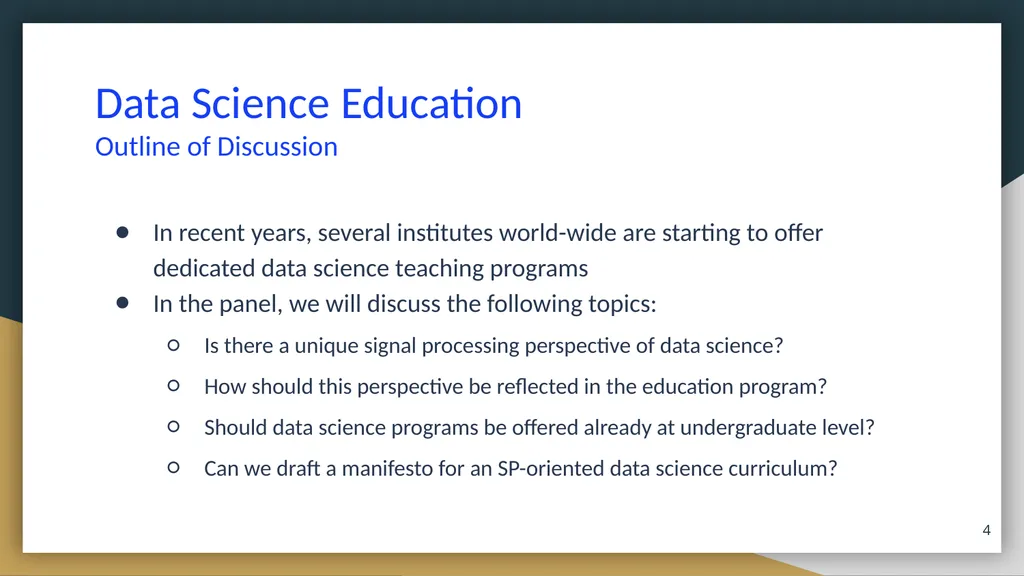
slide4. Data Science Education Outline of Discussion In recent years, several institutes world-wide are starting to offer dedicated data science teaching programs
In the panel, we will discuss the following topics:
Is there a unique signal processing perspective of data science?
How should this perspective be reflected in the education program?
Should data science programs be offered already at undergraduate level?
Can we draft a manifesto for an SP-oriented data science curriculum? ‹#›<br>
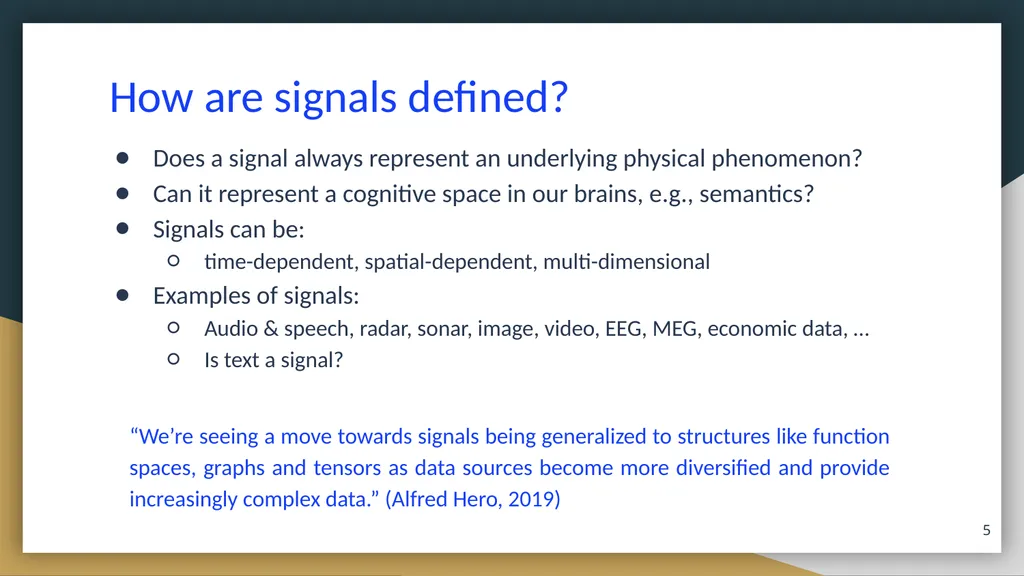
slide5. How are signals defined? Does a signal always represent an underlying physical phenomenon?
Can it represent a cognitive space in our brains, e.g., semantics?
Signals can be:
time-dependent, spatial-dependent, multi-dimensional
Examples of signals:
Audio & speech, radar, sonar, image, video, EEG, MEG, economic data, …
Is text a signal? ‹#› “We’re seeing a move towards signals being generalized to structures like function spaces, graphs and tensors as data sources become more diversified and provide increasingly complex data.” (Alfred Hero, 2019)<br>
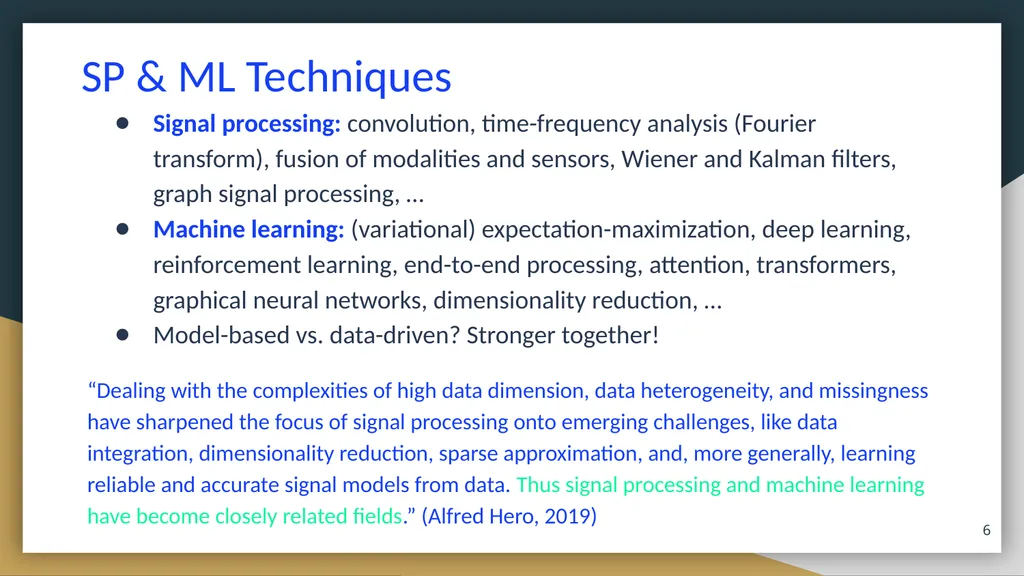
slide6. SP & ML Techniques Signal processing: convolution, time-frequency analysis (Fourier transform), fusion of modalities and sensors, Wiener and Kalman filters, graph signal processing, …
Machine learning: (variational) expectation-maximization, deep learning, reinforcement learning, end-to-end processing, attention, transformers, graphical neural networks, dimensionality reduction, …
Model-based vs. data-driven? Stronger together! ‹#› “Dealing with the complexities of high data dimension, data heterogeneity, and missingness have sharpened the focus of signal processing onto emerging challenges, like data integration, dimensionality reduction, sparse approximation, and, more generally, learning reliable and accurate signal models from data. Thus signal processing and machine learning have become closely related fields.” (Alfred Hero, 2019)<br>
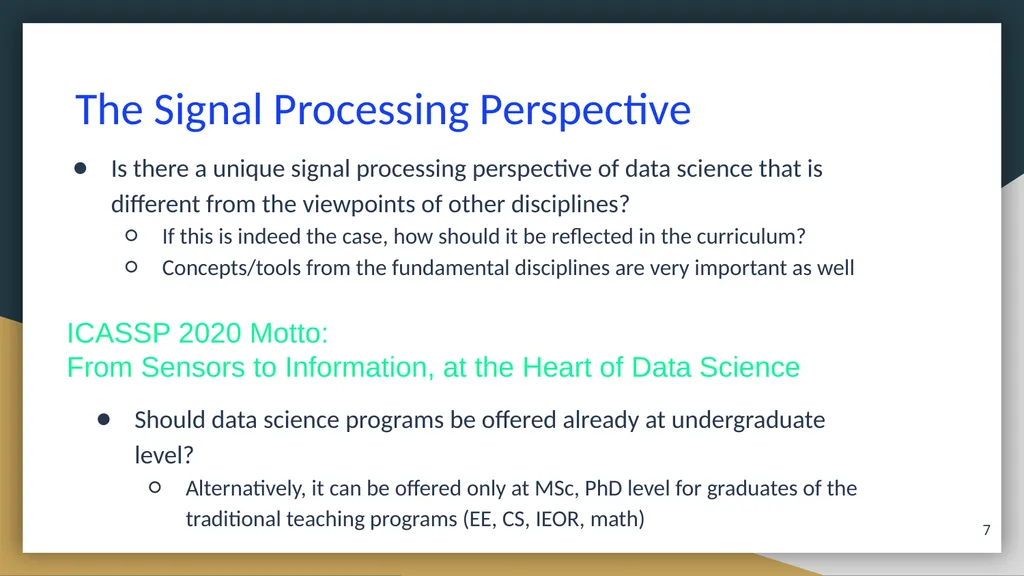
slide7. ICASSP 2020 Motto: From Sensors to Information, at the Heart of Data Science The Signal Processing Perspective Is there a unique signal processing perspective of data science that is different from the viewpoints of other disciplines?
If this is indeed the case, how should it be reflected in the curriculum?
Concepts/tools from the fundamental disciplines are very important as well ‹#› Should data science programs be offered already at undergraduate level?
Alternatively, it can be offered only at MSc, PhD level for graduates of the traditional teaching programs (EE, CS, IEOR, math)<br>
slide8. Audience Discussion ‹#›<br>
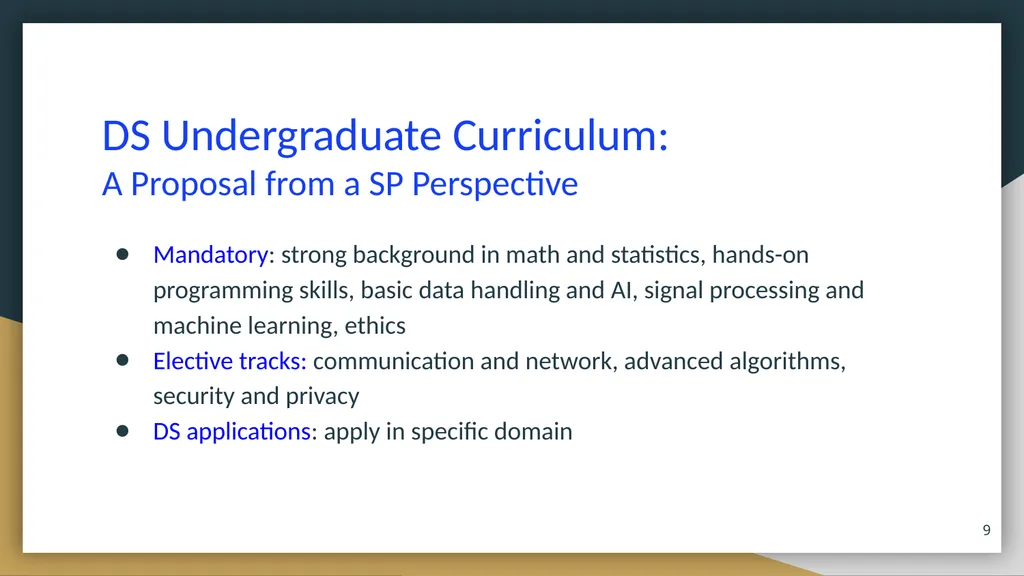
slide9. DS Undergraduate Curriculum: A Proposal from a SP Perspective Mandatory: strong background in math and statistics, hands-on programming skills, basic data handling and AI, signal processing and machine learning, ethics
Elective tracks: communication and network, advanced algorithms, security and privacy
DS applications: apply in specific domain ‹#›<br>
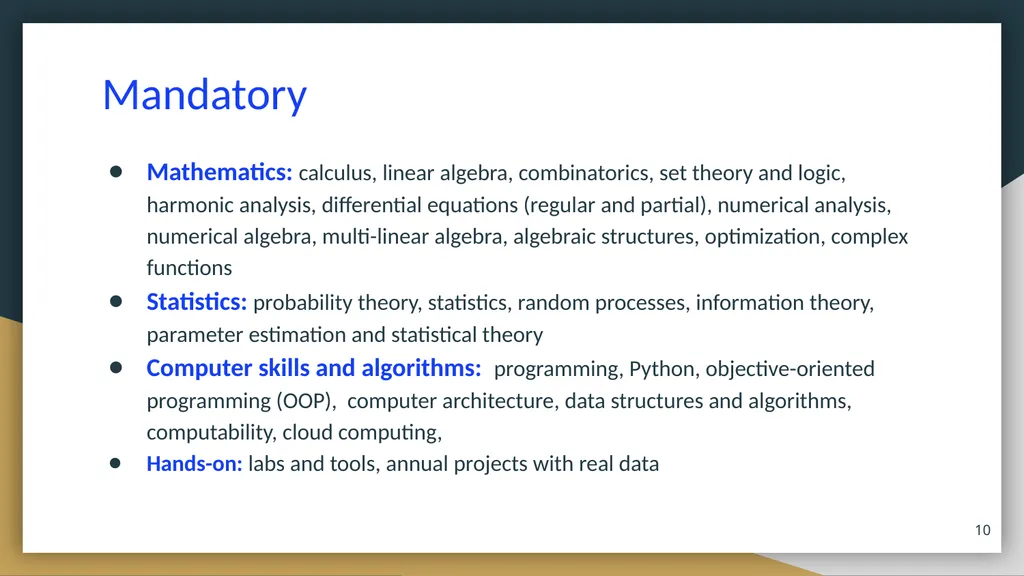
slide10. Mandatory Mathematics: calculus, linear algebra, combinatorics, set theory and logic, harmonic analysis, differential equations (regular and partial), numerical analysis, numerical algebra, multi-linear algebra, algebraic structures, optimization, complex functions
Statistics: probability theory, statistics, random processes, information theory, parameter estimation and statistical theory
Computer skills and algorithms: programming, Python, objective-oriented programming (OOP), computer architecture, data structures and algorithms, computability, cloud computing,
Hands-on: labs and tools, annual projects with real data ‹#›<br>
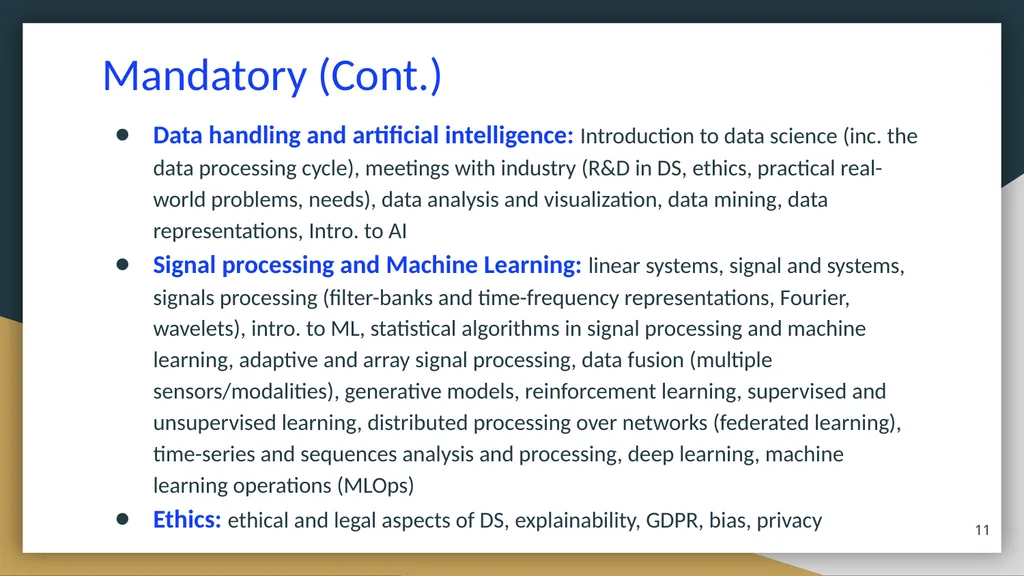
slide11. Mandatory (Cont.) Data handling and artificial intelligence: Introduction to data science (inc. the data processing cycle), meetings with industry (R&D in DS, ethics, practical real-world problems, needs), data analysis and visualization, data mining, data representations, Intro. to AI
Signal processing and Machine Learning: linear systems, signal and systems, signals processing (filter-banks and time-frequency representations, Fourier, wavelets), intro. to ML, statistical algorithms in signal processing and machine learning, adaptive and array signal processing, data fusion (multiple sensors/modalities), generative models, reinforcement learning, supervised and unsupervised learning, distributed processing over networks (federated learning), time-series and sequences analysis and processing, deep learning, machine learning operations (MLOps)
Ethics: ethical and legal aspects of DS, explainability, GDPR, bias, privacy ‹#›<br>
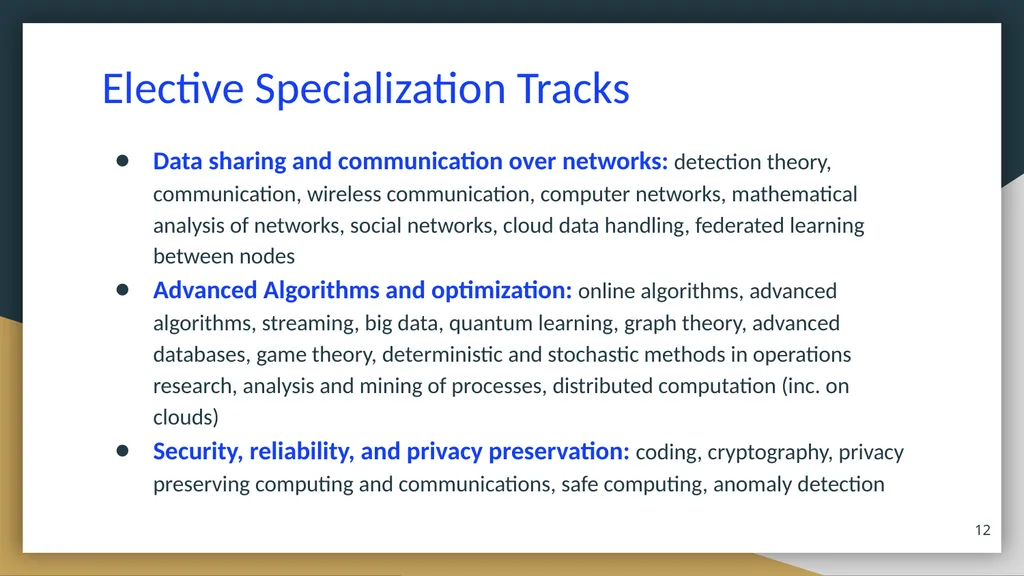
slide12. Elective Specialization Tracks Data sharing and communication over networks: detection theory, communication, wireless communication, computer networks, mathematical analysis of networks, social networks, cloud data handling, federated learning between nodes
Advanced Algorithms and optimization: online algorithms, advanced algorithms, streaming, big data, quantum learning, graph theory, advanced databases, game theory, deterministic and stochastic methods in operations research, analysis and mining of processes, distributed computation (inc. on clouds)
Security, reliability, and privacy preservation: coding, cryptography, privacy preserving computing and communications, safe computing, anomaly detection ‹#›<br>
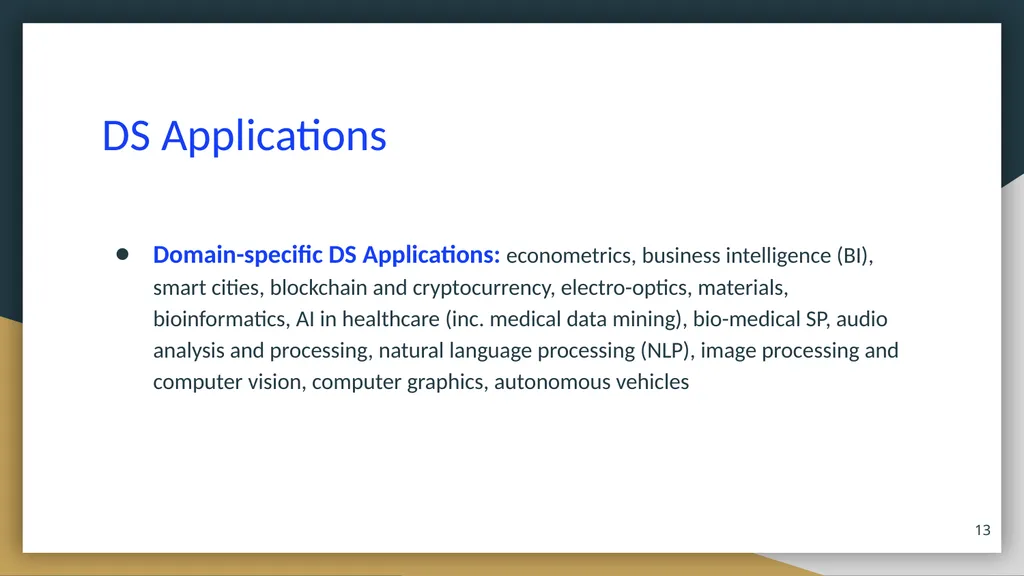
slide13. DS Applications Domain-specific DS Applications: econometrics, business intelligence (BI), smart cities, blockchain and cryptocurrency, electro-optics, materials, bioinformatics, AI in healthcare (inc. medical data mining), bio-medical SP, audio analysis and processing, natural language processing (NLP), image processing and computer vision, computer graphics, autonomous vehicles ‹#›<br>
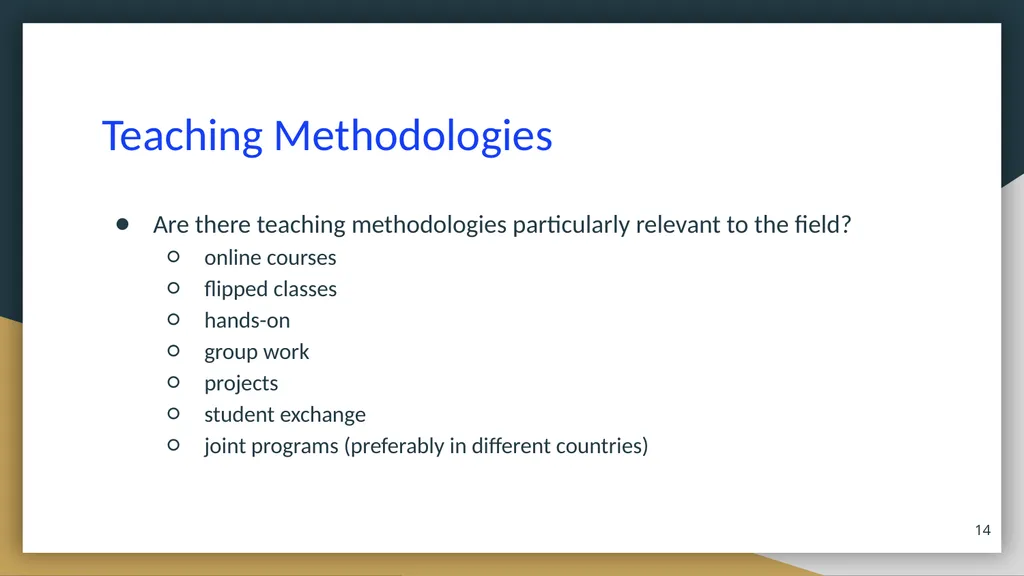
slide14. Teaching Methodologies Are there teaching methodologies particularly relevant to the field?
online courses
flipped classes
hands-on
group work
projects
student exchange
joint programs (preferably in different countries) ‹#›<br>
slide15. Audience Discussion ‹#›<br>
slide16. Contact Us Sharon Gannot, sharon.gannot@biu.ac.il
Zheng-Hua Tan, zt@es.aau.dk
Martin Haardt, martin.haardt@tu-ilmenau.de
Nancy F. Chen, nfychen@i2r.a-star.edu.sg
Hoi-To Wai, htwai@se.cuhk.edu.hk
Ivan Tashev, ivantash@microsoft.com ‹#›<br>
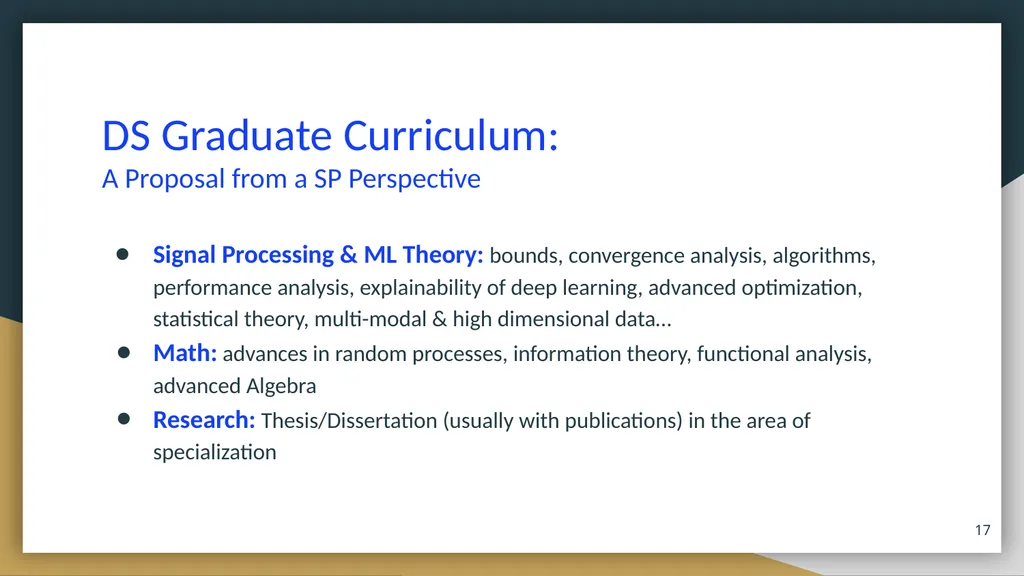
slide17. DS Graduate Curriculum:
A Proposal from a SP Perspective Signal Processing & ML Theory: bounds, convergence analysis, algorithms, performance analysis, explainability of deep learning, advanced optimization, statistical theory, multi-modal & high dimensional data…
Math: advances in random processes, information theory, functional analysis, advanced Algebra
Research: Thesis/Dissertation (usually with publications) in the area of specialization ‹#›<br>
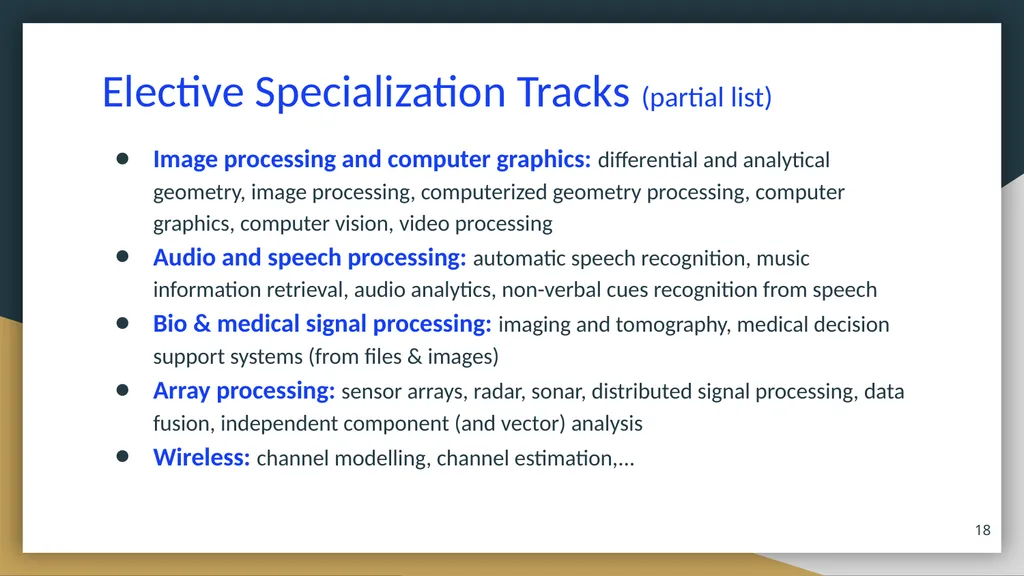
slide18. Elective Specialization Tracks (partial list) Image processing and computer graphics: differential and analytical geometry, image processing, computerized geometry processing, computer graphics, computer vision, video processing
Audio and speech processing: automatic speech recognition, music information retrieval, audio analytics, non-verbal cues recognition from speech
Bio & medical signal processing: imaging and tomography, medical decision support systems (from files & images)
Array processing: sensor arrays, radar, sonar, distributed signal processing, data fusion, independent component (and vector) analysis
Wireless: channel modelling, channel estimation,... ‹#›<br>
slide2. Panelists: Sharon Gannot, Bar-Ilan University, Israel (moderator)
Zheng-Hua Tan, Aalborg University, Denmark (co-moderator)
Martin Haardt, Ilmenau University of Technology, Germany
Nancy F. Chen, Agency for Science, Technology, and Research (A*STAR), Singapore
Hoi-To Wai, The Chinese University of Hong Kong, Hong Kong
Ivan Tashev, Microsoft Research, WA, USA ‹#›<br>
slide3. Data Science: An Emerging Research Field In the last decade the signal processing community has witnessed a paradigm shift from model-based to data-driven methods.
Machine-learning, and specifically deep learning, methodologies are nowadays widely-used in all signal processing fields.
Emerged as a research field from several scientific disciplines:
Statistics/Optimization/Algebra (Math)
Computer Science (CS)
Signal Processing (traditionally part of Electrical Engineering (EE) program)
Industrial Engineering and Operations Research (IEOR) ‹#›<br>
slide4. Data Science Education Outline of Discussion In recent years, several institutes world-wide are starting to offer dedicated data science teaching programs
In the panel, we will discuss the following topics:
Is there a unique signal processing perspective of data science?
How should this perspective be reflected in the education program?
Should data science programs be offered already at undergraduate level?
Can we draft a manifesto for an SP-oriented data science curriculum? ‹#›<br>
slide5. How are signals defined? Does a signal always represent an underlying physical phenomenon?
Can it represent a cognitive space in our brains, e.g., semantics?
Signals can be:
time-dependent, spatial-dependent, multi-dimensional
Examples of signals:
Audio & speech, radar, sonar, image, video, EEG, MEG, economic data, …
Is text a signal? ‹#› “We’re seeing a move towards signals being generalized to structures like function spaces, graphs and tensors as data sources become more diversified and provide increasingly complex data.” (Alfred Hero, 2019)<br>
slide6. SP & ML Techniques Signal processing: convolution, time-frequency analysis (Fourier transform), fusion of modalities and sensors, Wiener and Kalman filters, graph signal processing, …
Machine learning: (variational) expectation-maximization, deep learning, reinforcement learning, end-to-end processing, attention, transformers, graphical neural networks, dimensionality reduction, …
Model-based vs. data-driven? Stronger together! ‹#› “Dealing with the complexities of high data dimension, data heterogeneity, and missingness have sharpened the focus of signal processing onto emerging challenges, like data integration, dimensionality reduction, sparse approximation, and, more generally, learning reliable and accurate signal models from data. Thus signal processing and machine learning have become closely related fields.” (Alfred Hero, 2019)<br>
slide7. ICASSP 2020 Motto: From Sensors to Information, at the Heart of Data Science The Signal Processing Perspective Is there a unique signal processing perspective of data science that is different from the viewpoints of other disciplines?
If this is indeed the case, how should it be reflected in the curriculum?
Concepts/tools from the fundamental disciplines are very important as well ‹#› Should data science programs be offered already at undergraduate level?
Alternatively, it can be offered only at MSc, PhD level for graduates of the traditional teaching programs (EE, CS, IEOR, math)<br>
slide8. Audience Discussion ‹#›<br>
slide9. DS Undergraduate Curriculum: A Proposal from a SP Perspective Mandatory: strong background in math and statistics, hands-on programming skills, basic data handling and AI, signal processing and machine learning, ethics
Elective tracks: communication and network, advanced algorithms, security and privacy
DS applications: apply in specific domain ‹#›<br>
slide10. Mandatory Mathematics: calculus, linear algebra, combinatorics, set theory and logic, harmonic analysis, differential equations (regular and partial), numerical analysis, numerical algebra, multi-linear algebra, algebraic structures, optimization, complex functions
Statistics: probability theory, statistics, random processes, information theory, parameter estimation and statistical theory
Computer skills and algorithms: programming, Python, objective-oriented programming (OOP), computer architecture, data structures and algorithms, computability, cloud computing,
Hands-on: labs and tools, annual projects with real data ‹#›<br>
slide11. Mandatory (Cont.) Data handling and artificial intelligence: Introduction to data science (inc. the data processing cycle), meetings with industry (R&D in DS, ethics, practical real-world problems, needs), data analysis and visualization, data mining, data representations, Intro. to AI
Signal processing and Machine Learning: linear systems, signal and systems, signals processing (filter-banks and time-frequency representations, Fourier, wavelets), intro. to ML, statistical algorithms in signal processing and machine learning, adaptive and array signal processing, data fusion (multiple sensors/modalities), generative models, reinforcement learning, supervised and unsupervised learning, distributed processing over networks (federated learning), time-series and sequences analysis and processing, deep learning, machine learning operations (MLOps)
Ethics: ethical and legal aspects of DS, explainability, GDPR, bias, privacy ‹#›<br>
slide12. Elective Specialization Tracks Data sharing and communication over networks: detection theory, communication, wireless communication, computer networks, mathematical analysis of networks, social networks, cloud data handling, federated learning between nodes
Advanced Algorithms and optimization: online algorithms, advanced algorithms, streaming, big data, quantum learning, graph theory, advanced databases, game theory, deterministic and stochastic methods in operations research, analysis and mining of processes, distributed computation (inc. on clouds)
Security, reliability, and privacy preservation: coding, cryptography, privacy preserving computing and communications, safe computing, anomaly detection ‹#›<br>
slide13. DS Applications Domain-specific DS Applications: econometrics, business intelligence (BI), smart cities, blockchain and cryptocurrency, electro-optics, materials, bioinformatics, AI in healthcare (inc. medical data mining), bio-medical SP, audio analysis and processing, natural language processing (NLP), image processing and computer vision, computer graphics, autonomous vehicles ‹#›<br>
slide14. Teaching Methodologies Are there teaching methodologies particularly relevant to the field?
online courses
flipped classes
hands-on
group work
projects
student exchange
joint programs (preferably in different countries) ‹#›<br>
slide15. Audience Discussion ‹#›<br>
slide16. Contact Us Sharon Gannot, sharon.gannot@biu.ac.il
Zheng-Hua Tan, zt@es.aau.dk
Martin Haardt, martin.haardt@tu-ilmenau.de
Nancy F. Chen, nfychen@i2r.a-star.edu.sg
Hoi-To Wai, htwai@se.cuhk.edu.hk
Ivan Tashev, ivantash@microsoft.com ‹#›<br>
slide17. DS Graduate Curriculum:
A Proposal from a SP Perspective Signal Processing & ML Theory: bounds, convergence analysis, algorithms, performance analysis, explainability of deep learning, advanced optimization, statistical theory, multi-modal & high dimensional data…
Math: advances in random processes, information theory, functional analysis, advanced Algebra
Research: Thesis/Dissertation (usually with publications) in the area of specialization ‹#›<br>
slide18. Elective Specialization Tracks (partial list) Image processing and computer graphics: differential and analytical geometry, image processing, computerized geometry processing, computer graphics, computer vision, video processing
Audio and speech processing: automatic speech recognition, music information retrieval, audio analytics, non-verbal cues recognition from speech
Bio & medical signal processing: imaging and tomography, medical decision support systems (from files & images)
Array processing: sensor arrays, radar, sonar, distributed signal processing, data fusion, independent component (and vector) analysis
Wireless: channel modelling, channel estimation,... ‹#›<br>