
Database Management Systems Unit – VI Introduction
MT
Published · 39 slides · 0 views
1 / 1
Description
Database Management Systems Unit VI Introduction to Big Data, HADOOP: HDFS, MapReduce Prof. Deptii Chaudhari, Assistant Professor Department of Computer Engineering Hope Foundations International Institute of Information Technology, I²IT
Related Topics
Share
Embed code
Download this presentation From Below
"Database Management Systems Unit – VI Introduction" is the property of its rightful owner. Permission is granted to download and print the materials on this website for personal, non-commercial use only, and to display it on your personal computer provided you do not modify the materials and that you retain all copyright notices contained in the materials. By downloading content from our website, you accept the terms of this agreement.
Presentation Transcript
01
Database Management Systems
Unit – VI
Introduction to Big Data, HADOOP: HDFS, MapReduce
Prof. Deptii Chaudhari,
Assistant Professor
Department of Computer Engineering
Hope Foundation’s
International Institute of Information Technology, I²IT<br>
02
What is Big Data? Big data means really a big data, it is a collection of large datasets that cannot be processed using traditional computing techniques.
Big data is not merely a data, rather it has become a complete subject, which involves various tools, techniques and frameworks.
Big data involves the data produced by different devices and applications. Deptii Chaudhari, Dept. of Computer Engineering, Hope Foundation’s International Institute of Information Technology, I²IT P-14,Rajiv Gandhi Infotech Park
MIDC Phase 1, Hinjawadi, Pune – 411057 Tel - +91 20 22933441/2/3 | www.isquareit.edu.in | info@isquareit.edu.in<br>
03
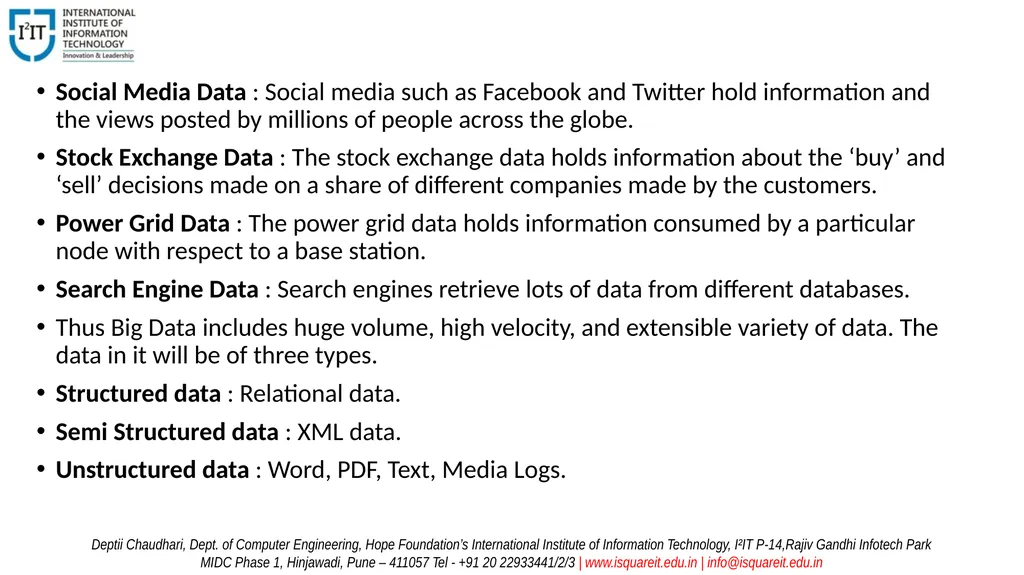
Social Media Data : Social media such as Facebook and Twitter hold information and the views posted by millions of people across the globe.
Stock Exchange Data : The stock exchange data holds information about the ‘buy’ and ‘sell’ decisions made on a share of different companies made by the customers.
Power Grid Data : The power grid data holds information consumed by a particular node with respect to a base station.
Search Engine Data : Search engines retrieve lots of data from different databases.
Thus Big Data includes huge volume, high velocity, and extensible variety of data. The data in it will be of three types.
Structured data : Relational data.
Semi Structured data : XML data.
Unstructured data : Word, PDF, Text, Media Logs. Deptii Chaudhari, Dept. of Computer Engineering, Hope Foundation’s International Institute of Information Technology, I²IT P-14,Rajiv Gandhi Infotech Park
MIDC Phase 1, Hinjawadi, Pune – 411057 Tel - +91 20 22933441/2/3 | www.isquareit.edu.in | info@isquareit.edu.in<br>
04
Benefits of Big Data Big data is really critical to our life and its emerging as one of the most important technologies in modern world.
Using the information kept in the social network like Facebook, the marketing agencies are learning about the response for their campaigns, promotions, and other advertising mediums.
Using the information in the social media like preferences and product perception of their consumers, product companies and retail organizations are planning their production.
Using the data regarding the previous medical history of patients, hospitals are providing better and quick service. Deptii Chaudhari, Dept. of Computer Engineering, Hope Foundation’s International Institute of Information Technology, I²IT P-14,Rajiv Gandhi Infotech Park
MIDC Phase 1, Hinjawadi, Pune – 411057 Tel - +91 20 22933441/2/3 | www.isquareit.edu.in | info@isquareit.edu.in<br>
05
Big Data Technologies Big data technologies are important in providing more accurate analysis, which may lead to more concrete decision-making resulting in greater operational efficiencies, cost reductions, and reduced risks for the business.
To harness the power of big data, you would require an infrastructure that can manage and process huge volumes of structured and unstructured data in real time and can protect data privacy and security.
There are various technologies in the market from different vendors including Amazon, IBM, Microsoft, etc., to handle big data. Deptii Chaudhari, Dept. of Computer Engineering, Hope Foundation’s International Institute of Information Technology, I²IT P-14,Rajiv Gandhi Infotech Park
MIDC Phase 1, Hinjawadi, Pune – 411057 Tel - +91 20 22933441/2/3 | www.isquareit.edu.in | info@isquareit.edu.in<br>
06
Big Data Challenges Capturing data
Curation (Organizing, maintaining)
Storage
Searching
Sharing
Transfer
Analysis
Presentation Deptii Chaudhari, Dept. of Computer Engineering, Hope Foundation’s International Institute of Information Technology, I²IT P-14,Rajiv Gandhi Infotech Park
MIDC Phase 1, Hinjawadi, Pune – 411057 Tel - +91 20 22933441/2/3 | www.isquareit.edu.in | info@isquareit.edu.in<br>
07
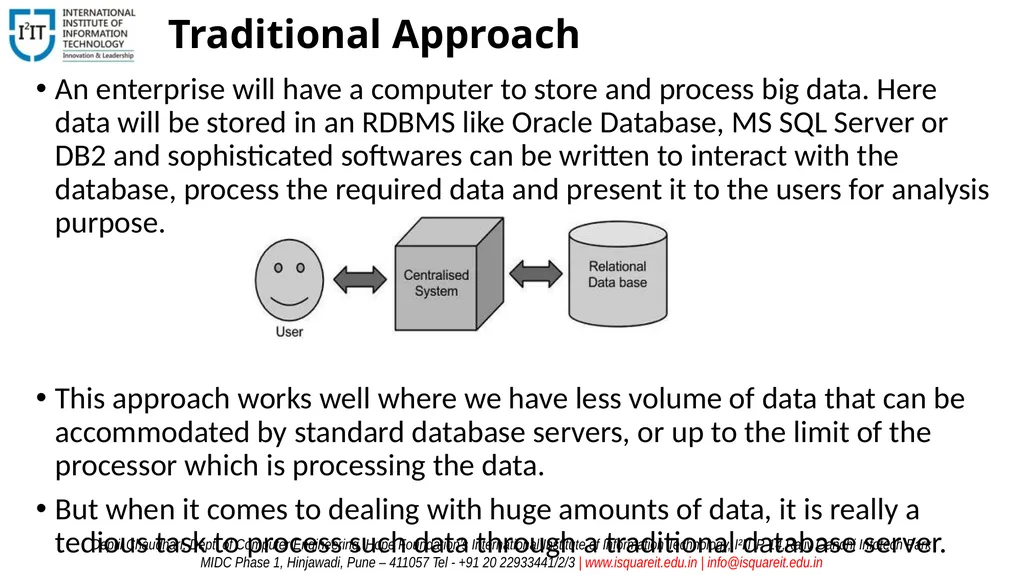
Traditional Approach An enterprise will have a computer to store and process big data. Here data will be stored in an RDBMS like Oracle Database, MS SQL Server or DB2 and sophisticated softwares can be written to interact with the database, process the required data and present it to the users for analysis purpose.
This approach works well where we have less volume of data that can be accommodated by standard database servers, or up to the limit of the processor which is processing the data.
But when it comes to dealing with huge amounts of data, it is really a tedious task to process such data through a traditional database server. Deptii Chaudhari, Dept. of Computer Engineering, Hope Foundation’s International Institute of Information Technology, I²IT P-14,Rajiv Gandhi Infotech Park
MIDC Phase 1, Hinjawadi, Pune – 411057 Tel - +91 20 22933441/2/3 | www.isquareit.edu.in | info@isquareit.edu.in<br>
08
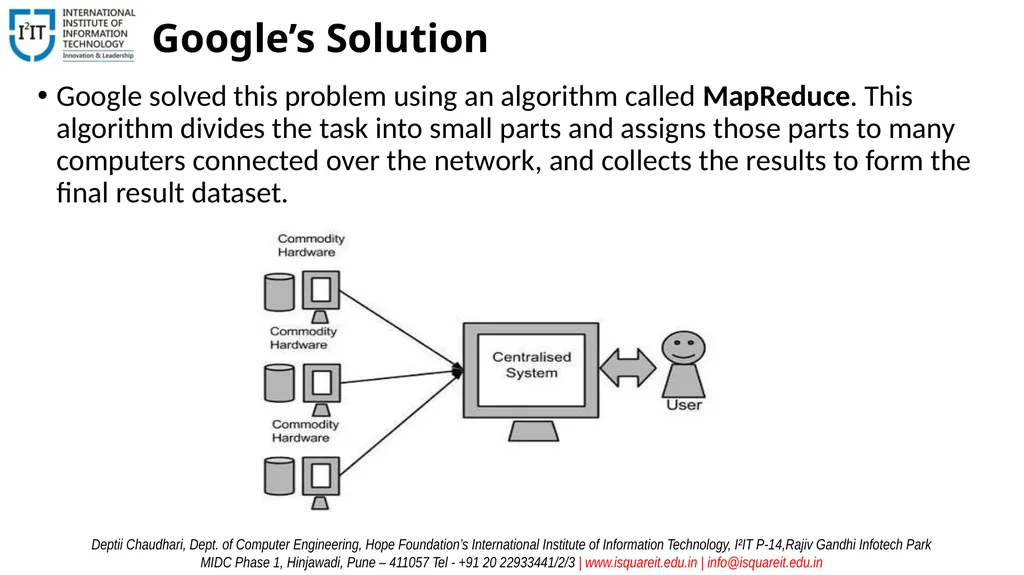
Google’s Solution Google solved this problem using an algorithm called MapReduce. This algorithm divides the task into small parts and assigns those parts to many computers connected over the network, and collects the results to form the final result dataset. Deptii Chaudhari, Dept. of Computer Engineering, Hope Foundation’s International Institute of Information Technology, I²IT P-14,Rajiv Gandhi Infotech Park
MIDC Phase 1, Hinjawadi, Pune – 411057 Tel - +91 20 22933441/2/3 | www.isquareit.edu.in | info@isquareit.edu.in<br>
MIDC Phase 1, Hinjawadi, Pune – 411057 Tel - +91 20 22933441/2/3 | www.isquareit.edu.in | info@isquareit.edu.in<br>
09
Hadoop Doug Cutting, Mike Cafarella and team took the solution provided by Google and started an Open Source Project called HADOOP in 2005 and Doug named it after his son's toy elephant.
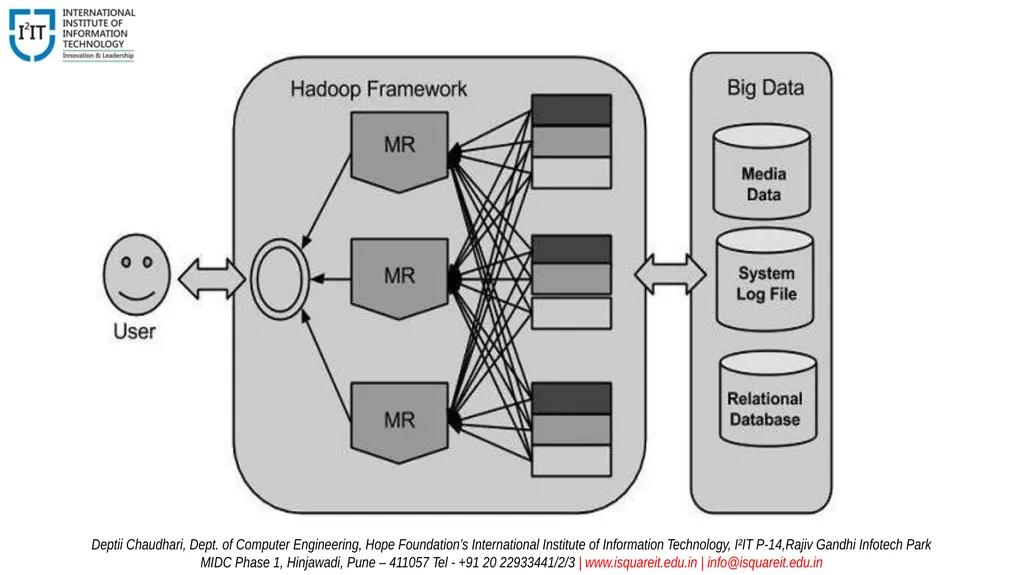
Hadoop runs applications using the MapReduce algorithm, where the data is processed in parallel on different CPU nodes.
In short, Hadoop framework is capable enough to develop applications capable of running on clusters of computers and they could perform complete statistical analysis for a huge amounts of data. Deptii Chaudhari, Dept. of Computer Engineering, Hope Foundation’s International Institute of Information Technology, I²IT P-14,Rajiv Gandhi Infotech Park
MIDC Phase 1, Hinjawadi, Pune – 411057 Tel - +91 20 22933441/2/3 | www.isquareit.edu.in | info@isquareit.edu.in<br>
10
Deptii Chaudhari, Dept. of Computer Engineering, Hope Foundation’s International Institute of Information Technology, I²IT P-14,Rajiv Gandhi Infotech Park
MIDC Phase 1, Hinjawadi, Pune – 411057 Tel - +91 20 22933441/2/3 | www.isquareit.edu.in | info@isquareit.edu.in<br>
MIDC Phase 1, Hinjawadi, Pune – 411057 Tel - +91 20 22933441/2/3 | www.isquareit.edu.in | info@isquareit.edu.in<br>
11
What is Hadoop? Hadoop is an open source framework for writing and running distributed applications that process large amounts of data.
Distributed computing is a wide and varied field, but the key distinctions of Hadoop are that it is
Accessible—Hadoop runs on large clusters of commodity machines or on cloud computing services
Robust—Because it is intended to run on commodity hardware, Hadoop is architected with the assumption of frequent hardware malfunctions. It can gracefully handle most such failures.
Scalable—Hadoop scales linearly to handle larger data by adding more nodes to the cluster.
Simple—Hadoop allows users to quickly write efficient parallel code. Deptii Chaudhari, Dept. of Computer Engineering, Hope Foundation’s International Institute of Information Technology, I²IT P-14,Rajiv Gandhi Infotech Park
MIDC Phase 1, Hinjawadi, Pune – 411057 Tel - +91 20 22933441/2/3 | www.isquareit.edu.in | info@isquareit.edu.in<br>
12
Hadoop is a free, Java-based programming framework that supports the processing of large data sets in a distributed computing environment.
It provides massive storage for any kind of data, enormous processing power and the ability to handle virtually limitless concurrent tasks or jobs. Deptii Chaudhari, Dept. of Computer Engineering, Hope Foundation’s International Institute of Information Technology, I²IT P-14,Rajiv Gandhi Infotech Park
MIDC Phase 1, Hinjawadi, Pune – 411057 Tel - +91 20 22933441/2/3 | www.isquareit.edu.in | info@isquareit.edu.in<br>
13
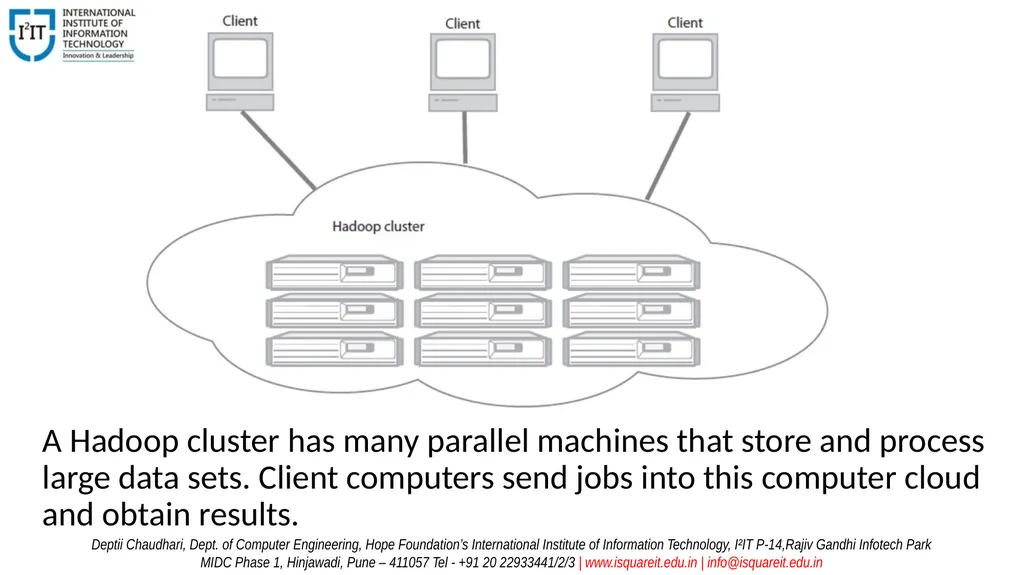
A Hadoop cluster has many parallel machines that store and process large data sets. Client computers send jobs into this computer cloud and obtain results. Deptii Chaudhari, Dept. of Computer Engineering, Hope Foundation’s International Institute of Information Technology, I²IT P-14,Rajiv Gandhi Infotech Park
MIDC Phase 1, Hinjawadi, Pune – 411057 Tel - +91 20 22933441/2/3 | www.isquareit.edu.in | info@isquareit.edu.in<br>
MIDC Phase 1, Hinjawadi, Pune – 411057 Tel - +91 20 22933441/2/3 | www.isquareit.edu.in | info@isquareit.edu.in<br>
14
A Hadoop cluster is a set of commodity machines networked together in one location.
Data storage and processing all occur within this “cloud” of machines .
Different users can submit computing “jobs” to Hadoop from individual clients, which can be their own desktop machines in remote locations from the Hadoop cluster. Deptii Chaudhari, Dept. of Computer Engineering, Hope Foundation’s International Institute of Information Technology, I²IT P-14,Rajiv Gandhi Infotech Park
MIDC Phase 1, Hinjawadi, Pune – 411057 Tel - +91 20 22933441/2/3 | www.isquareit.edu.in | info@isquareit.edu.in<br>
15
Comparing SQL databases and Hadoop SCALE-OUT INSTEAD OF SCALE-UP:
Scaling commercial relational databases is expensive. Their design is more friendly to scaling up. Hadoop is designed to be a scale-out architecture operating on a cluster of commodity PC machines. Adding more resources means adding more machines to the Hadoop cluster.
KEY/VALUE PAIRS INSTEAD OF RELATIONAL TABLES:
Hadoop uses key/value pairs as its basic data unit, which is flexible enough to work with the less-structured data types. In Hadoop, data can originate in any form, but it eventually transforms into (key/value) pairs for the processing functions to work on. Deptii Chaudhari, Dept. of Computer Engineering, Hope Foundation’s International Institute of Information Technology, I²IT P-14,Rajiv Gandhi Infotech Park
MIDC Phase 1, Hinjawadi, Pune – 411057 Tel - +91 20 22933441/2/3 | www.isquareit.edu.in | info@isquareit.edu.in<br>
16
FUNCTIONAL PROGRAMMING (MAPREDUCE) INSTEAD OF DECLARATIVE QUERIES (SQL):
SQL is fundamentally a high-level declarative language. You query data by stating the result you want and let the database engine figure out how to derive it.
Under MapReduce you specify the actual steps in processing the data, which is more analogous to an execution plan for a SQL engine .
Under SQL you have query statements; under MapReduce you have scripts and codes.
OFFLINE BATCH PROCESSING INSTEAD OF ONLINE TRANSACTIONS:
Hadoop is designed for offline processing and analysis of large-scale data. It doesn’t work for random reading and writing of a few records, which is the type of load for online transaction processing. Deptii Chaudhari, Dept. of Computer Engineering, Hope Foundation’s International Institute of Information Technology, I²IT P-14,Rajiv Gandhi Infotech Park
MIDC Phase 1, Hinjawadi, Pune – 411057 Tel - +91 20 22933441/2/3 | www.isquareit.edu.in | info@isquareit.edu.in<br>
17
Components of Hadoop Hadoop framework includes following four modules:
Hadoop Common: These are Java libraries and utilities required by other Hadoop modules. These libraries provide filesystem and OS level abstractions and contains the necessary Java files and scripts required to start Hadoop.
Hadoop YARN: This is a framework for job scheduling and cluster resource management.
Hadoop Distributed File System (HDFS™): A distributed file system that provides high-throughput access to application data.
Hadoop MapReduce: This is YARN-based system for parallel processing of large data sets. Deptii Chaudhari, Dept. of Computer Engineering, Hope Foundation’s International Institute of Information Technology, I²IT P-14,Rajiv Gandhi Infotech Park
MIDC Phase 1, Hinjawadi, Pune – 411057 Tel - +91 20 22933441/2/3 | www.isquareit.edu.in | info@isquareit.edu.in<br>
18
MapReduce Hadoop MapReduce is a software framework for easily writing applications which process big amounts of data in-parallel on large clusters (thousands of nodes) of commodity hardware in a reliable, fault-tolerant manner.
The term MapReduce actually refers to the following two different tasks that Hadoop programs perform:
The Map Task: This is the first task, which takes input data and converts it into a set of data, where individual elements are broken down into tuples (key/value pairs).
The Reduce Task: This task takes the output from a map task as input and combines those data tuples into a smaller set of tuples. The reduce task is always performed after the map task. Deptii Chaudhari, Dept. of Computer Engineering, Hope Foundation’s International Institute of Information Technology, I²IT P-14,Rajiv Gandhi Infotech Park
MIDC Phase 1, Hinjawadi, Pune – 411057 Tel - +91 20 22933441/2/3 | www.isquareit.edu.in | info@isquareit.edu.in<br>
19
Typically both the input and the output are stored in a file-system. The framework takes care of scheduling tasks, monitoring them and re-executes the failed tasks.
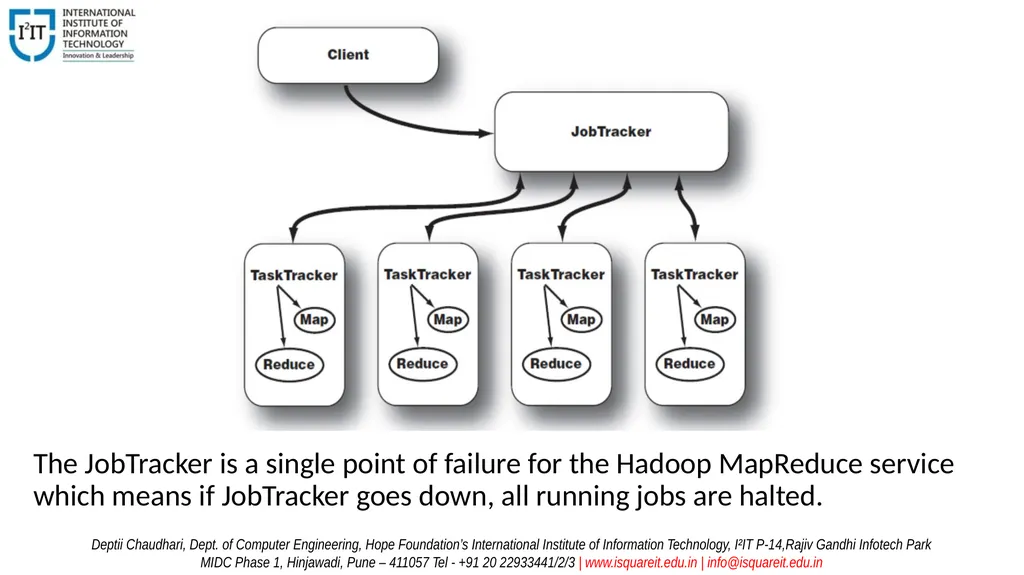
The MapReduce framework consists of a single master JobTracker and one slave TaskTracker per cluster-node.
The master is responsible for resource management, tracking resource consumption/availability and scheduling the jobs component tasks on the slaves, monitoring them and re-executing the failed tasks.
The slaves TaskTracker execute the tasks as directed by the master and provide task-status information to the master periodically. Deptii Chaudhari, Dept. of Computer Engineering, Hope Foundation’s International Institute of Information Technology, I²IT P-14,Rajiv Gandhi Infotech Park
MIDC Phase 1, Hinjawadi, Pune – 411057 Tel - +91 20 22933441/2/3 | www.isquareit.edu.in | info@isquareit.edu.in<br>
20
The JobTracker is a single point of failure for the Hadoop MapReduce service which means if JobTracker goes down, all running jobs are halted. Deptii Chaudhari, Dept. of Computer Engineering, Hope Foundation’s International Institute of Information Technology, I²IT P-14,Rajiv Gandhi Infotech Park
MIDC Phase 1, Hinjawadi, Pune – 411057 Tel - +91 20 22933441/2/3 | www.isquareit.edu.in | info@isquareit.edu.in<br>
MIDC Phase 1, Hinjawadi, Pune – 411057 Tel - +91 20 22933441/2/3 | www.isquareit.edu.in | info@isquareit.edu.in<br>
21
Hadoop Distributed File System The most common file system used by Hadoop is the Hadoop Distributed File System (HDFS).
The Hadoop Distributed File System (HDFS) is based on the Google File System (GFS) and provides a distributed file system that is designed to run on large clusters (thousands of computers) of small computer machines in a reliable, fault-tolerant manner.
HDFS uses a master/slave architecture where master consists of a single NameNode that manages the file system metadata and one or more slave DataNodes that store the actual data. Deptii Chaudhari, Dept. of Computer Engineering, Hope Foundation’s International Institute of Information Technology, I²IT P-14,Rajiv Gandhi Infotech Park
MIDC Phase 1, Hinjawadi, Pune – 411057 Tel - +91 20 22933441/2/3 | www.isquareit.edu.in | info@isquareit.edu.in<br>
22
A file in an HDFS namespace is split into several blocks and those blocks are stored in a set of DataNodes.
The NameNode determines the mapping of blocks to the DataNodes.
The DataNodes takes care of read and write operation with the file system. They also take care of block creation, deletion and replication based on instruction given by NameNode.
HDFS provides a shell like any other file system and a list of commands are available to interact with the file system. Deptii Chaudhari, Dept. of Computer Engineering, Hope Foundation’s International Institute of Information Technology, I²IT P-14,Rajiv Gandhi Infotech Park
MIDC Phase 1, Hinjawadi, Pune – 411057 Tel - +91 20 22933441/2/3 | www.isquareit.edu.in | info@isquareit.edu.in<br>
23
Advantages of Hadoop Hadoop framework allows the user to quickly write and test distributed systems. It is efficient, and it automatic distributes the data and work across the machines and in turn, utilizes the underlying parallelism of the CPU cores.
Hadoop does not rely on hardware to provide fault-tolerance and high availability (FTHA), rather Hadoop library itself has been designed to detect and handle failures at the application layer.
Servers can be added or removed from the cluster dynamically and Hadoop continues to operate without interruption.
Another big advantage of Hadoop is that apart from being open source, it is compatible on all the platforms since it is Java based. Deptii Chaudhari, Dept. of Computer Engineering, Hope Foundation’s International Institute of Information Technology, I²IT P-14,Rajiv Gandhi Infotech Park
MIDC Phase 1, Hinjawadi, Pune – 411057 Tel - +91 20 22933441/2/3 | www.isquareit.edu.in | info@isquareit.edu.in<br>
24
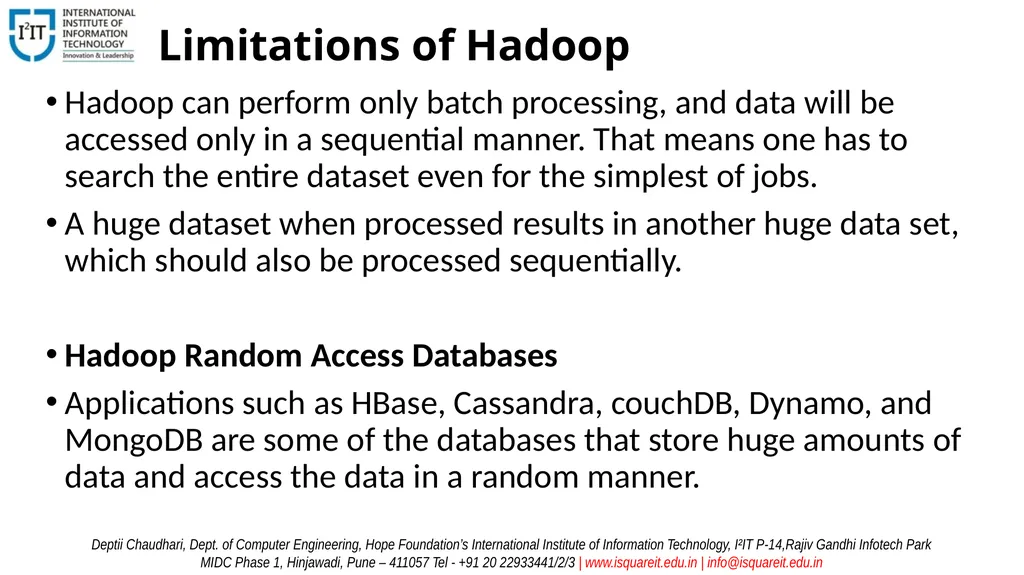
Limitations of Hadoop Hadoop can perform only batch processing, and data will be accessed only in a sequential manner. That means one has to search the entire dataset even for the simplest of jobs.
A huge dataset when processed results in another huge data set, which should also be processed sequentially.
Hadoop Random Access Databases
Applications such as HBase, Cassandra, couchDB, Dynamo, and MongoDB are some of the databases that store huge amounts of data and access the data in a random manner. Deptii Chaudhari, Dept. of Computer Engineering, Hope Foundation’s International Institute of Information Technology, I²IT P-14,Rajiv Gandhi Infotech Park
MIDC Phase 1, Hinjawadi, Pune – 411057 Tel - +91 20 22933441/2/3 | www.isquareit.edu.in | info@isquareit.edu.in<br>
25
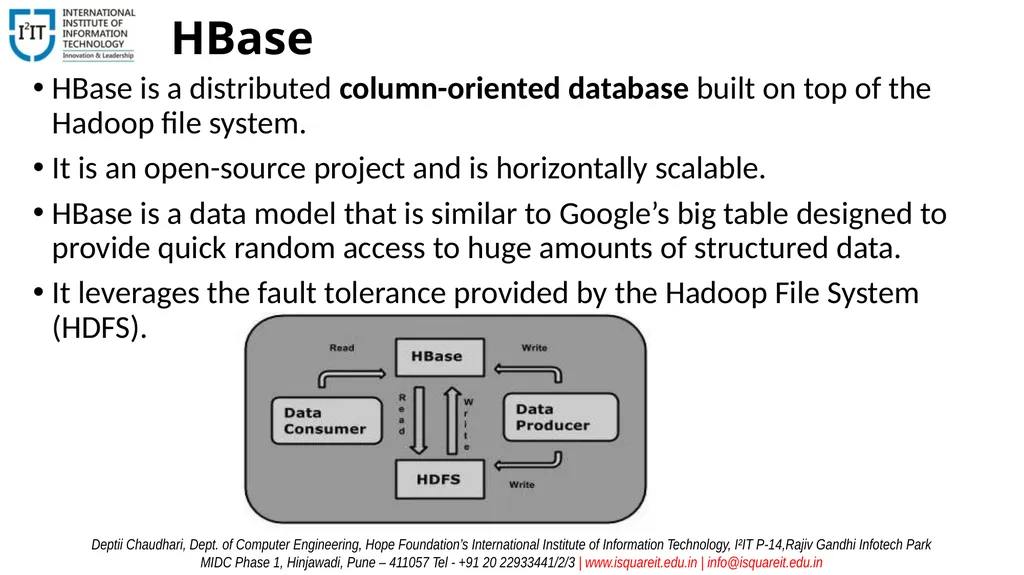
HBase HBase is a distributed column-oriented database built on top of the Hadoop file system.
It is an open-source project and is horizontally scalable.
HBase is a data model that is similar to Google’s big table designed to provide quick random access to huge amounts of structured data.
It leverages the fault tolerance provided by the Hadoop File System (HDFS). Deptii Chaudhari, Dept. of Computer Engineering, Hope Foundation’s International Institute of Information Technology, I²IT P-14,Rajiv Gandhi Infotech Park
MIDC Phase 1, Hinjawadi, Pune – 411057 Tel - +91 20 22933441/2/3 | www.isquareit.edu.in | info@isquareit.edu.in<br>
26
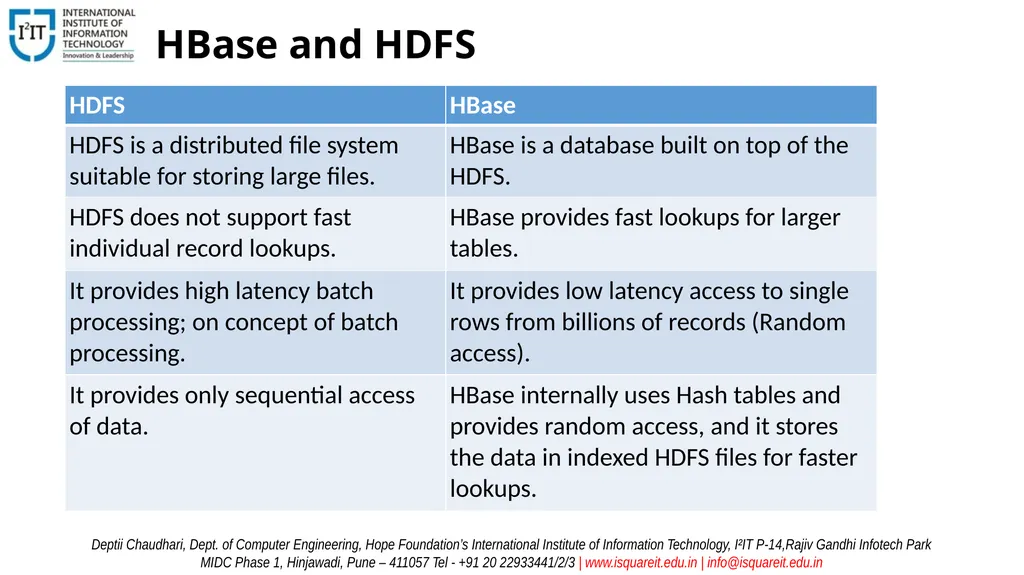
HBase and HDFS Deptii Chaudhari, Dept. of Computer Engineering, Hope Foundation’s International Institute of Information Technology, I²IT P-14,Rajiv Gandhi Infotech Park
MIDC Phase 1, Hinjawadi, Pune – 411057 Tel - +91 20 22933441/2/3 | www.isquareit.edu.in | info@isquareit.edu.in<br>
MIDC Phase 1, Hinjawadi, Pune – 411057 Tel - +91 20 22933441/2/3 | www.isquareit.edu.in | info@isquareit.edu.in<br>
27
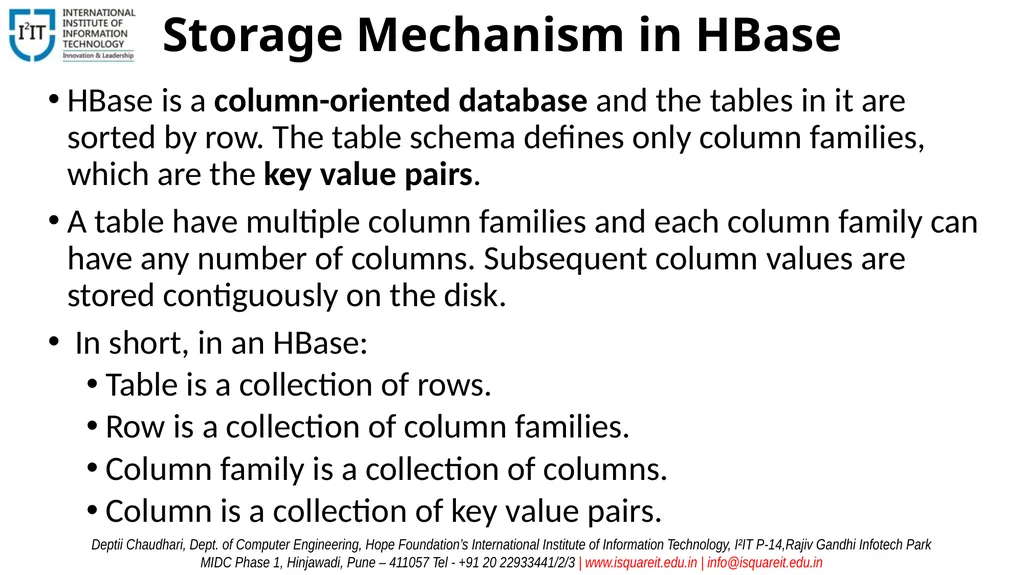
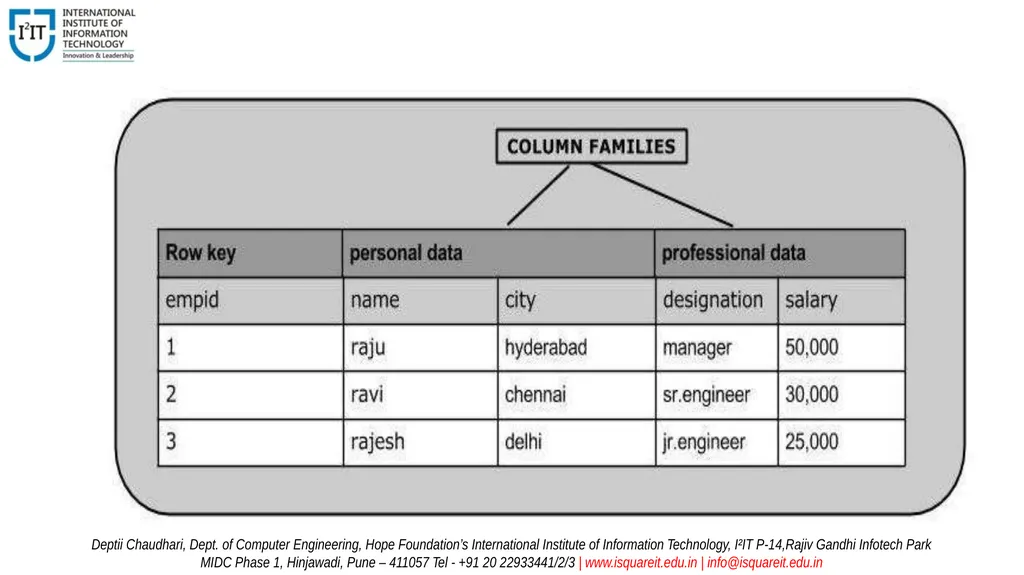
Storage Mechanism in HBase HBase is a column-oriented database and the tables in it are sorted by row. The table schema defines only column families, which are the key value pairs.
A table have multiple column families and each column family can have any number of columns. Subsequent column values are stored contiguously on the disk.
In short, in an HBase:
Table is a collection of rows.
Row is a collection of column families.
Column family is a collection of columns.
Column is a collection of key value pairs. Deptii Chaudhari, Dept. of Computer Engineering, Hope Foundation’s International Institute of Information Technology, I²IT P-14,Rajiv Gandhi Infotech Park
MIDC Phase 1, Hinjawadi, Pune – 411057 Tel - +91 20 22933441/2/3 | www.isquareit.edu.in | info@isquareit.edu.in<br>
28
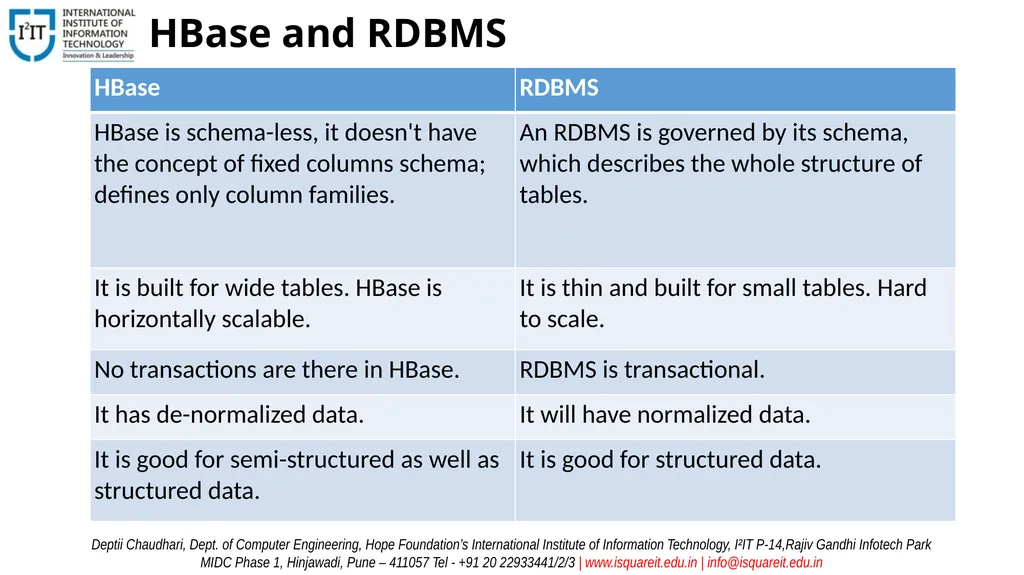
HBase and RDBMS Deptii Chaudhari, Dept. of Computer Engineering, Hope Foundation’s International Institute of Information Technology, I²IT P-14,Rajiv Gandhi Infotech Park
MIDC Phase 1, Hinjawadi, Pune – 411057 Tel - +91 20 22933441/2/3 | www.isquareit.edu.in | info@isquareit.edu.in<br>
MIDC Phase 1, Hinjawadi, Pune – 411057 Tel - +91 20 22933441/2/3 | www.isquareit.edu.in | info@isquareit.edu.in<br>
29
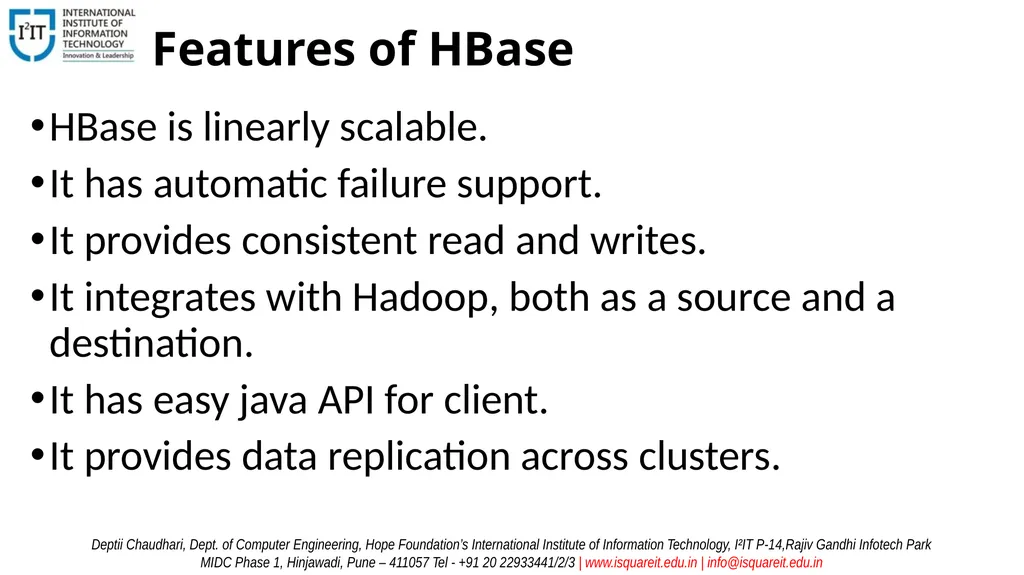
Features of HBase HBase is linearly scalable.
It has automatic failure support.
It provides consistent read and writes.
It integrates with Hadoop, both as a source and a destination.
It has easy java API for client.
It provides data replication across clusters. Deptii Chaudhari, Dept. of Computer Engineering, Hope Foundation’s International Institute of Information Technology, I²IT P-14,Rajiv Gandhi Infotech Park
MIDC Phase 1, Hinjawadi, Pune – 411057 Tel - +91 20 22933441/2/3 | www.isquareit.edu.in | info@isquareit.edu.in<br>
30
Deptii Chaudhari, Dept. of Computer Engineering, Hope Foundation’s International Institute of Information Technology, I²IT P-14,Rajiv Gandhi Infotech Park
MIDC Phase 1, Hinjawadi, Pune – 411057 Tel - +91 20 22933441/2/3 | www.isquareit.edu.in | info@isquareit.edu.in<br>
MIDC Phase 1, Hinjawadi, Pune – 411057 Tel - +91 20 22933441/2/3 | www.isquareit.edu.in | info@isquareit.edu.in<br>
31
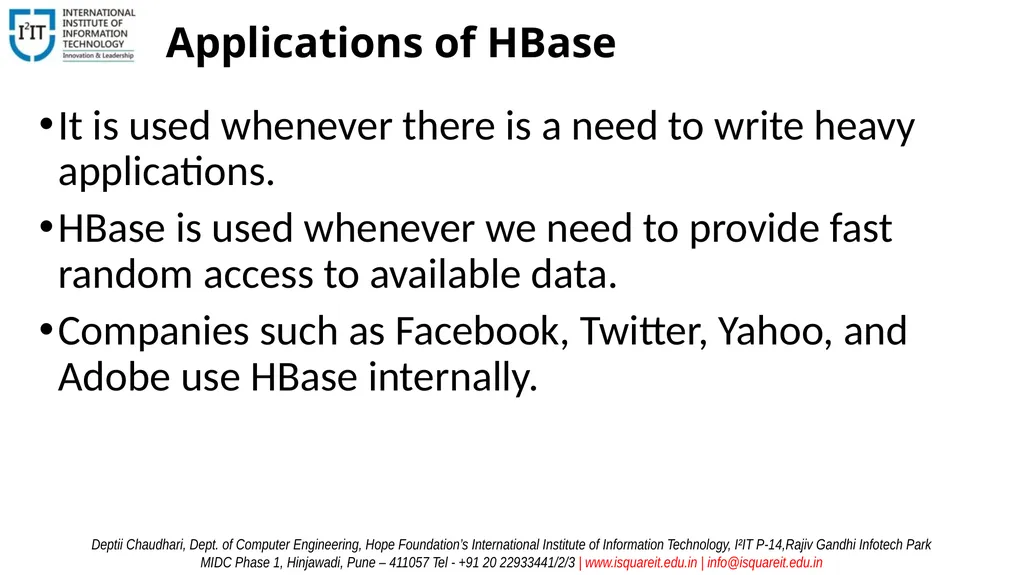
Applications of HBase It is used whenever there is a need to write heavy applications.
HBase is used whenever we need to provide fast random access to available data.
Companies such as Facebook, Twitter, Yahoo, and Adobe use HBase internally. Deptii Chaudhari, Dept. of Computer Engineering, Hope Foundation’s International Institute of Information Technology, I²IT P-14,Rajiv Gandhi Infotech Park
MIDC Phase 1, Hinjawadi, Pune – 411057 Tel - +91 20 22933441/2/3 | www.isquareit.edu.in | info@isquareit.edu.in<br>
32
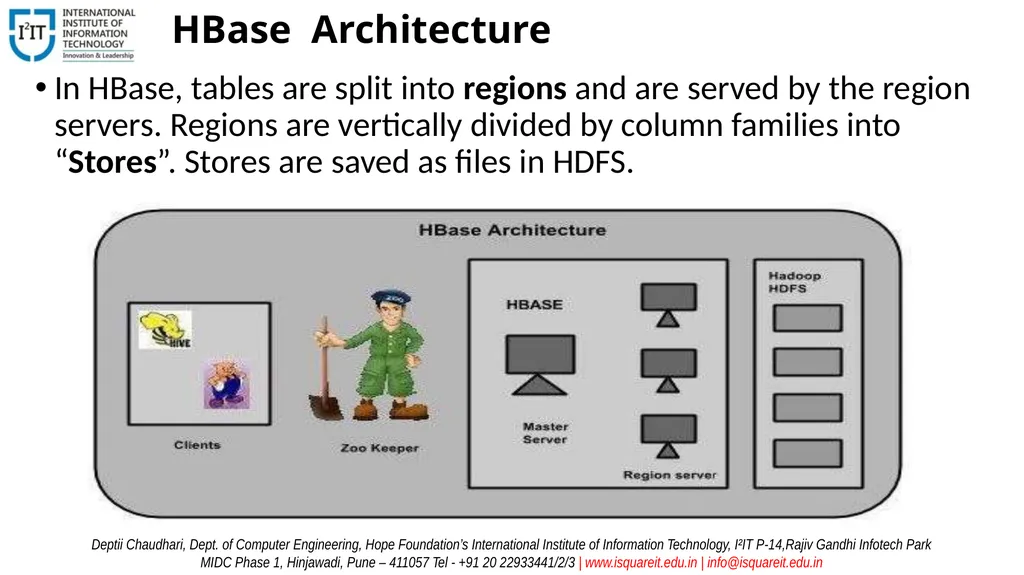
HBase Architecture In HBase, tables are split into regions and are served by the region servers. Regions are vertically divided by column families into “Stores”. Stores are saved as files in HDFS. Deptii Chaudhari, Dept. of Computer Engineering, Hope Foundation’s International Institute of Information Technology, I²IT P-14,Rajiv Gandhi Infotech Park
MIDC Phase 1, Hinjawadi, Pune – 411057 Tel - +91 20 22933441/2/3 | www.isquareit.edu.in | info@isquareit.edu.in<br>
MIDC Phase 1, Hinjawadi, Pune – 411057 Tel - +91 20 22933441/2/3 | www.isquareit.edu.in | info@isquareit.edu.in<br>
33
Components of HBase HBase has three major components: the client library, a master server, and region servers. Region servers can be added or removed as per requirement.
Master Server
Assigns regions to the region servers and takes the help of Apache ZooKeeper for this task.
It Handles load balancing of the regions across region servers. It unloads the busy servers and shifts the regions to less occupied servers.
It Maintains the state of the cluster by negotiating the load balancing.
It Is responsible for schema changes and other metadata operations such as creation of tables and column families. Deptii Chaudhari, Dept. of Computer Engineering, Hope Foundation’s International Institute of Information Technology, I²IT P-14,Rajiv Gandhi Infotech Park
MIDC Phase 1, Hinjawadi, Pune – 411057 Tel - +91 20 22933441/2/3 | www.isquareit.edu.in | info@isquareit.edu.in<br>
34
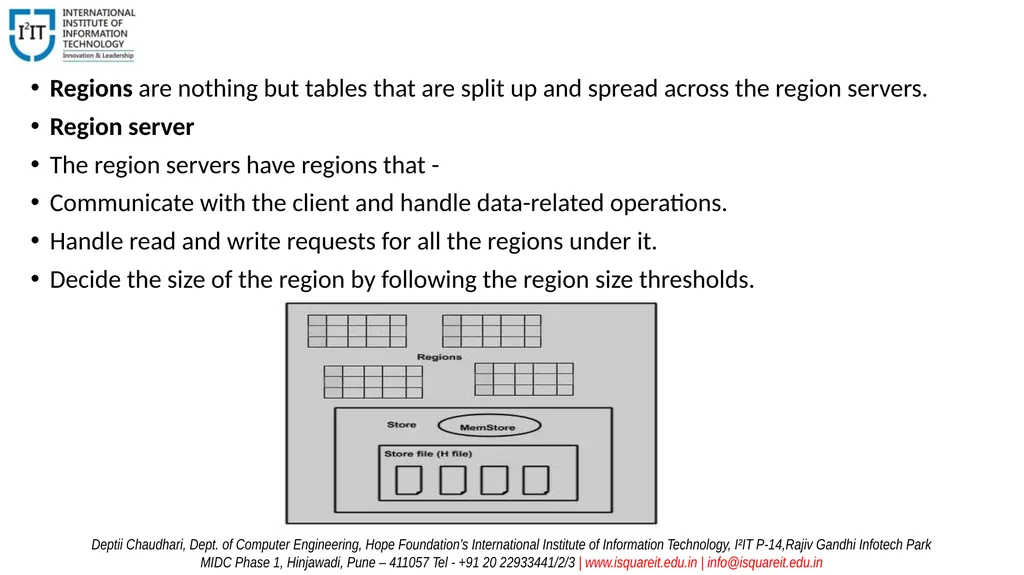
Regions are nothing but tables that are split up and spread across the region servers.
Region server
The region servers have regions that -
Communicate with the client and handle data-related operations.
Handle read and write requests for all the regions under it.
Decide the size of the region by following the region size thresholds. Deptii Chaudhari, Dept. of Computer Engineering, Hope Foundation’s International Institute of Information Technology, I²IT P-14,Rajiv Gandhi Infotech Park
MIDC Phase 1, Hinjawadi, Pune – 411057 Tel - +91 20 22933441/2/3 | www.isquareit.edu.in | info@isquareit.edu.in<br>
35
Zookeeper Zookeeper is an open-source project that provides services like maintaining configuration information, naming, providing distributed synchronization, etc.
Zookeeper has temporary nodes representing different region servers. Master servers use these nodes to discover available servers.
In addition to availability, the nodes are also used to track server failures or network partitions.
Clients communicate with region servers via zookeeper.
In pseudo and standalone modes, HBase itself will take care of zookeeper. Deptii Chaudhari, Dept. of Computer Engineering, Hope Foundation’s International Institute of Information Technology, I²IT P-14,Rajiv Gandhi Infotech Park
MIDC Phase 1, Hinjawadi, Pune – 411057 Tel - +91 20 22933441/2/3 | www.isquareit.edu.in | info@isquareit.edu.in<br>
36
Cloudera Cloudera offers enterprises one place to store, process, and analyze all their data, empowering them to extend the value of existing investments while enabling fundamental new ways to derive value from their data.
Founded in 2008, Cloudera was the first, and is currently, the leading provider and supporter of Apache Hadoop for the enterprise.
Cloudera also offers software for business critical data challenges including storage, access, management, analysis, security, and search. Deptii Chaudhari, Dept. of Computer Engineering, Hope Foundation’s International Institute of Information Technology, I²IT P-14,Rajiv Gandhi Infotech Park
MIDC Phase 1, Hinjawadi, Pune – 411057 Tel - +91 20 22933441/2/3 | www.isquareit.edu.in | info@isquareit.edu.in<br>
37
Cloudera Inc. is an American-based software company that provides Apache Hadoop-based software, support and services, and training to business customers.
Cloudera's open-source Apache Hadoop distribution, CDH (Cloudera Distribution Including Apache Hadoop), targets enterprise-class deployments of that technology. Deptii Chaudhari, Dept. of Computer Engineering, Hope Foundation’s International Institute of Information Technology, I²IT P-14,Rajiv Gandhi Infotech Park
MIDC Phase 1, Hinjawadi, Pune – 411057 Tel - +91 20 22933441/2/3 | www.isquareit.edu.in | info@isquareit.edu.in<br>
38
Reference Hadoop in Action by Chuck Lam, Manning Publications Deptii Chaudhari, Dept. of Computer Engineering, Hope Foundation’s International Institute of Information Technology, I²IT P-14,Rajiv Gandhi Infotech Park
MIDC Phase 1, Hinjawadi, Pune – 411057 Tel - +91 20 22933441/2/3 | www.isquareit.edu.in | info@isquareit.edu.in<br>
MIDC Phase 1, Hinjawadi, Pune – 411057 Tel - +91 20 22933441/2/3 | www.isquareit.edu.in | info@isquareit.edu.in<br>
39
THANK YOU
For further details, please contact
Deptii Chaudhari
deptiic@isquareit.edu.in
Department of Computer Engineering
Hope Foundation’s
International Institute of Information Technology, I²IT
P-14,Rajiv Gandhi Infotech Park
MIDC Phase 1, Hinjawadi, Pune – 411057
Tel - +91 20 22933441/2/3
www.isquareit.edu.in | info@isquareit.edu.in<br>