
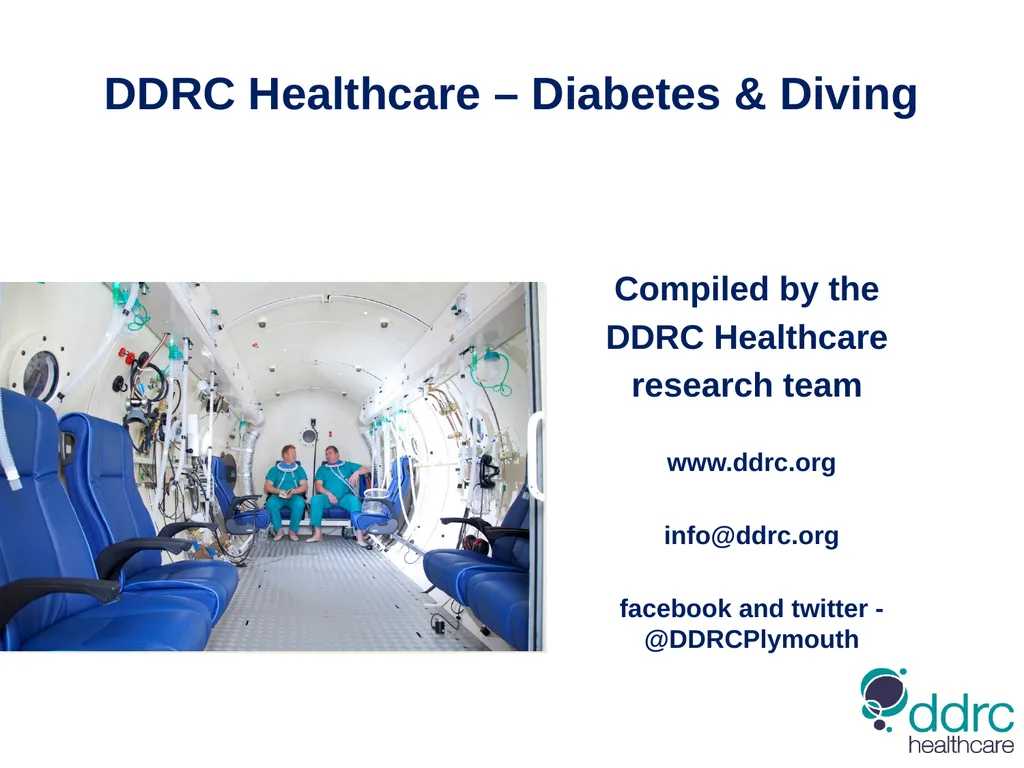
DDRC Healthcare – Diabetes & Diving Compiled by

Description: DDRC Healthcare Diabetes Diving Compiled by the DDRC Healthcare research team www.ddrc.org infoddrc.org facebook and twitter - DDRCPlymouth It is a common health condition 3.9 million diagnosed people in the UK 590,00 estimated
Related Topics
Download Presentation
"DDRC Healthcare – Diabetes & Diving Compiled by" is the property of its rightful owner. Permission is granted to download and print the materials on this website for personal, non-commercial use only, and to display it on your personal computer provided you do not modify the materials and that you retain all copyright notices contained in the materials. By downloading content from our website, you accept the terms of this agreement.
Presentation Transcript
slide1. DDRC Healthcare – Diabetes & Diving Compiled by the
DDRC Healthcare
research team
www.ddrc.org
info@ddrc.org
facebook and twitter - @DDRCPlymouth<br>
slide2. It is a common health condition
3.9 million diagnosed people in the UK
590,00 estimated undiagnosed
>5 million people in 2025 may be diagnosed in UK What is diabetes? What is this talk all about<br>
slide3. Diabetes and diving When the amount of glucose in the blood is too high
This is because the pancreas does not produce sufficient, or any, insulin to help the glucose enter the body’s cells
Or, if insulin is produced the body does not react to it What is diabetes?<br>
slide4. Diabetes and diving Insulin is a hormone produced by the pancreas
It enables glucose to enter the body’s cells
We need glucose for energy to function properly
The liver produces some glucose, but the rest comes from digesting carbohydrates What is diabetes?<br>
slide5. Diabetes and diving There are two types of diabetes, Type 1 & Type 2
Type 1 - approximately 5% to 15% of diabetics
The body is unable to produce any insulin
Treated with insulin injections, & healthy diet
Can develop at any age, but usually before age 40 What is diabetes?<br>
slide6. Diabetes and diving Type 2 - approximately 85% to 95% of diabetics
Your body can still make some insulin, but either not enough, or the body does not react to it normally
Usually develops after the age of 40, there are some ethnic exceptions
Treated with healthy diet, increased exercise, and often with tablet medication and eventually insulin which may be necessary What is diabetes?<br>
slide7. Diabetes and diving Symptoms of undiagnosed diabetes
Feeling tired
Weight loss
Visual disturbance
Increased frequency of infection
Slow healing wounds
Wanting to pass urine more frequently
Increased thirst What is diabetes?<br>
slide8. Diabetes and diving Development of symptoms
Type 1 symptoms are more obvious and develop more quickly, often over weeks
Type 2 symptoms develop less quickly, often over years and so are less obvious
In both types symptoms respond well to treatment What is diabetes?<br>
slide9. Diabetes and diving To put it simply….
Your body does not regulate or utilise glucose in the correct way
As a result it accumulates in the blood and can’t be used as energy
The increased blood glucose also causes damage to the body’s tissues. What is diabetes?<br>
slide10. Diabetes and diving The aim of treatment is to normalise elevated blood sugar
BUT: Some treatments have the potential side effect of decreasing the blood sugar too much
This can cause… confusion, slurred speech, visual problems, seizures, decreased consciousness and ultimately coma. Treating diabetes?<br>
slide11. Diabetes and diving Why is it important for divers to understand the basics of diabetes if there is a diver with diabetes in the club/school?
Someone with diabetes may suffer from a “hypo” (hypoglycemia) and needs this to be recognised and acted upon
What is a hypo?
A hypo is when blood sugar levels fall too low. This may be caused by too much medication, too little food, concurrent illness or diving itself Diving with diabetes?<br>
slide12. Diabetes and diving What are the symptoms of a hypo?
Symptoms vary from one person to another
Diabetics who dive, and their buddy, should be able to recognise these symptoms when they are happening:
Feeling tired, confused, anxious, and/or moody
Heart beating quickly, fuzzy vision, feeling hot & sticky
Tingling lips, feeling weak and shaky
Looking pale
Feeling hungry Diving with diabetes?<br>
slide13. Diabetes and diving Diving with diabetes? There has been much debate and research over the years as to whether divers with diabetes should be allowed to dive
In 2005 a major workshop in the USA with 50 clinicians from 7 countries set guidelines that were agreed by all present
Since then research has continued to study divers with diabetes
The best information can be found at the UK Diving Medical Committee (UKDMC) and DDRC Healthcare websites<br>
slide14. Diabetes and diving The UKDMC has stated these 4 criteria:
The diver should be over 18, and not experienced a hypo in the last 12 months
Has not been hospitalised for any diabetes problem in the last 12 months
The Dr at the diabetic clinic is satisfied with the level of control, and that the potential diabetic diver is mentally and physically fit to dive
There must be no microalbuminuria present (protein in urine). Any degree of retinopathy beyond background retinopathy is not allowed (damage to the retina of the eye). There must be no evidence of neuropathy (nerve cells- sensory, motor or automatic), nor of vascular or microvascular disease beyond the background retinopathy in the eye Diving with diabetes?<br>
slide15. Diabetes and diving Dive planning
What to avoid:
Depths of >30 msw until experience is gained on how diabetic control is affected by diving
Do not dive with a buddy who is also diabetic
Situations that may increase the risk of a hypo
(prolonged , cold, stressful dives)
Dive leader and buddy should be informed of diver’s condition
Both should have instructions in case of a problem Diving with diabetes?<br>
slide16. Diabetes and diving Glucose Management on Day of Diving
The diver should:
Be able to self-assess their own fitness to dive on the day
Have intended blood glucose level stable or rising, before the dive
Check blood glucose levels before and after the dive
Carry readily accessible oral glucose during all dives
Have a medication called glucagon available at the surface
Check their blood sugar frequently for 12-15 hours after diving
Log all their dives including blood glucose levels Diving with diabetes?<br>
slide17. Diabetes and diving If you suspect a hypo in your buddy while underwater:
The diver should ingest glucose
The diver should make a controlled ascent with their buddy
Establish positive buoyancy
Leave the water Diving with diabetes?<br>
slide18. Diabetes and diving I have diabetes and want to dive – what happens next?
Download forms A and B from the UKDMC website (on the next slide)
Liaise with your dive club branch Diving Officer regarding any other leaflets
Form A to be filled in by the diver on an annual basis
Form B completed annually by the physician in charge of the diabetic diver
Make sure both the forms are correctly signed by all concerned
Copy both forms, keeping one copy for you and your dive club/school
Send the originals to Dr C.J. Edge
The Stone Barn, Gravel Lane, Drayton,
Abingdon, Oxon OX14 4HY Diving with diabetes?<br>
slide19. Diabetes and diving The UK Diving Medical Committee
Information about diabetes and the link to down-load the A & B forms and additional information
www.ddrc.org/diving/can-i-dive/can-i-dive-diabetes
DDRC Healthcare
More information about diving with diabetes
www.ddrc.org/diving/can-i-dive/can-i-dive-diabetes
Divers Alert Network (DAN)
Further information and DAN research details
https://alertdiver.eu/en_US/articles/diving-with-diabetes-guidelines-and-latest-research Diving with diabetes – A & B forms & more information<br>
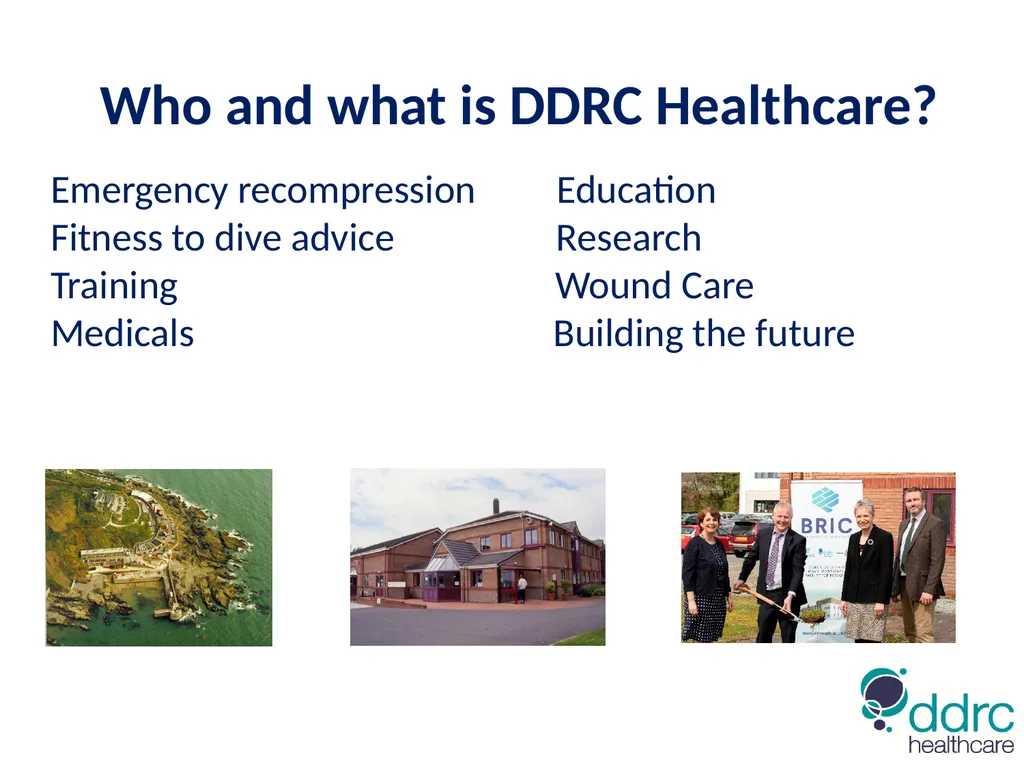
slide20. Emergency recompression Education
Fitness to dive advice Research
Training Wound Care
Medicals Building the future Who and what is DDRC Healthcare?<br>
DDRC Healthcare
research team
www.ddrc.org
info@ddrc.org
facebook and twitter - @DDRCPlymouth<br>
slide2. It is a common health condition
3.9 million diagnosed people in the UK
590,00 estimated undiagnosed
>5 million people in 2025 may be diagnosed in UK What is diabetes? What is this talk all about<br>
slide3. Diabetes and diving When the amount of glucose in the blood is too high
This is because the pancreas does not produce sufficient, or any, insulin to help the glucose enter the body’s cells
Or, if insulin is produced the body does not react to it What is diabetes?<br>
slide4. Diabetes and diving Insulin is a hormone produced by the pancreas
It enables glucose to enter the body’s cells
We need glucose for energy to function properly
The liver produces some glucose, but the rest comes from digesting carbohydrates What is diabetes?<br>
slide5. Diabetes and diving There are two types of diabetes, Type 1 & Type 2
Type 1 - approximately 5% to 15% of diabetics
The body is unable to produce any insulin
Treated with insulin injections, & healthy diet
Can develop at any age, but usually before age 40 What is diabetes?<br>
slide6. Diabetes and diving Type 2 - approximately 85% to 95% of diabetics
Your body can still make some insulin, but either not enough, or the body does not react to it normally
Usually develops after the age of 40, there are some ethnic exceptions
Treated with healthy diet, increased exercise, and often with tablet medication and eventually insulin which may be necessary What is diabetes?<br>
slide7. Diabetes and diving Symptoms of undiagnosed diabetes
Feeling tired
Weight loss
Visual disturbance
Increased frequency of infection
Slow healing wounds
Wanting to pass urine more frequently
Increased thirst What is diabetes?<br>
slide8. Diabetes and diving Development of symptoms
Type 1 symptoms are more obvious and develop more quickly, often over weeks
Type 2 symptoms develop less quickly, often over years and so are less obvious
In both types symptoms respond well to treatment What is diabetes?<br>
slide9. Diabetes and diving To put it simply….
Your body does not regulate or utilise glucose in the correct way
As a result it accumulates in the blood and can’t be used as energy
The increased blood glucose also causes damage to the body’s tissues. What is diabetes?<br>
slide10. Diabetes and diving The aim of treatment is to normalise elevated blood sugar
BUT: Some treatments have the potential side effect of decreasing the blood sugar too much
This can cause… confusion, slurred speech, visual problems, seizures, decreased consciousness and ultimately coma. Treating diabetes?<br>
slide11. Diabetes and diving Why is it important for divers to understand the basics of diabetes if there is a diver with diabetes in the club/school?
Someone with diabetes may suffer from a “hypo” (hypoglycemia) and needs this to be recognised and acted upon
What is a hypo?
A hypo is when blood sugar levels fall too low. This may be caused by too much medication, too little food, concurrent illness or diving itself Diving with diabetes?<br>
slide12. Diabetes and diving What are the symptoms of a hypo?
Symptoms vary from one person to another
Diabetics who dive, and their buddy, should be able to recognise these symptoms when they are happening:
Feeling tired, confused, anxious, and/or moody
Heart beating quickly, fuzzy vision, feeling hot & sticky
Tingling lips, feeling weak and shaky
Looking pale
Feeling hungry Diving with diabetes?<br>
slide13. Diabetes and diving Diving with diabetes? There has been much debate and research over the years as to whether divers with diabetes should be allowed to dive
In 2005 a major workshop in the USA with 50 clinicians from 7 countries set guidelines that were agreed by all present
Since then research has continued to study divers with diabetes
The best information can be found at the UK Diving Medical Committee (UKDMC) and DDRC Healthcare websites<br>
slide14. Diabetes and diving The UKDMC has stated these 4 criteria:
The diver should be over 18, and not experienced a hypo in the last 12 months
Has not been hospitalised for any diabetes problem in the last 12 months
The Dr at the diabetic clinic is satisfied with the level of control, and that the potential diabetic diver is mentally and physically fit to dive
There must be no microalbuminuria present (protein in urine). Any degree of retinopathy beyond background retinopathy is not allowed (damage to the retina of the eye). There must be no evidence of neuropathy (nerve cells- sensory, motor or automatic), nor of vascular or microvascular disease beyond the background retinopathy in the eye Diving with diabetes?<br>
slide15. Diabetes and diving Dive planning
What to avoid:
Depths of >30 msw until experience is gained on how diabetic control is affected by diving
Do not dive with a buddy who is also diabetic
Situations that may increase the risk of a hypo
(prolonged , cold, stressful dives)
Dive leader and buddy should be informed of diver’s condition
Both should have instructions in case of a problem Diving with diabetes?<br>
slide16. Diabetes and diving Glucose Management on Day of Diving
The diver should:
Be able to self-assess their own fitness to dive on the day
Have intended blood glucose level stable or rising, before the dive
Check blood glucose levels before and after the dive
Carry readily accessible oral glucose during all dives
Have a medication called glucagon available at the surface
Check their blood sugar frequently for 12-15 hours after diving
Log all their dives including blood glucose levels Diving with diabetes?<br>
slide17. Diabetes and diving If you suspect a hypo in your buddy while underwater:
The diver should ingest glucose
The diver should make a controlled ascent with their buddy
Establish positive buoyancy
Leave the water Diving with diabetes?<br>
slide18. Diabetes and diving I have diabetes and want to dive – what happens next?
Download forms A and B from the UKDMC website (on the next slide)
Liaise with your dive club branch Diving Officer regarding any other leaflets
Form A to be filled in by the diver on an annual basis
Form B completed annually by the physician in charge of the diabetic diver
Make sure both the forms are correctly signed by all concerned
Copy both forms, keeping one copy for you and your dive club/school
Send the originals to Dr C.J. Edge
The Stone Barn, Gravel Lane, Drayton,
Abingdon, Oxon OX14 4HY Diving with diabetes?<br>
slide19. Diabetes and diving The UK Diving Medical Committee
Information about diabetes and the link to down-load the A & B forms and additional information
www.ddrc.org/diving/can-i-dive/can-i-dive-diabetes
DDRC Healthcare
More information about diving with diabetes
www.ddrc.org/diving/can-i-dive/can-i-dive-diabetes
Divers Alert Network (DAN)
Further information and DAN research details
https://alertdiver.eu/en_US/articles/diving-with-diabetes-guidelines-and-latest-research Diving with diabetes – A & B forms & more information<br>
slide20. Emergency recompression Education
Fitness to dive advice Research
Training Wound Care
Medicals Building the future Who and what is DDRC Healthcare?<br>