De-institutionalization and Family Reunification Initiatives in Odisha, India Rajendra Meher Convener, Taskforce, India Every child has a Right to Family Focus of presentation About Taskforce Institutional care in India About the Children
"De-institutionalization and Family Reunification" is the property of its rightful owner. Permission is granted to
download and print the materials on this website for personal, non-commercial use only, and to display it
on your personal computer provided you do not modify the materials and that you retain all copyright
notices contained in the materials. By downloading content from our website, you accept the terms of this
agreement.
Presentation Transcript
01
De-institutionalization and Family Reunification Initiatives in Odisha, India Rajendra Meher
Convener, Taskforce, India
Every child has a Right to Family<br>
02
Focus of presentation About Taskforce
Institutional care in India
About the Children in Institutional care
Pilot project on De-institutionalisation
Steps & key process
Achievements
Challenges & Opportunities
Way forward plan<br>
03
About Taskforce Taskforce is a body of civil society organizations;
-- aims to contribute to preventing and reducing the phenomenon of institutionalization of children by systematically supporting the children and care givers
--Sensitize and influence the policy makers including government functionaries, elected members and civil society on the subject of Non institutional /family focused child care system<br>
04
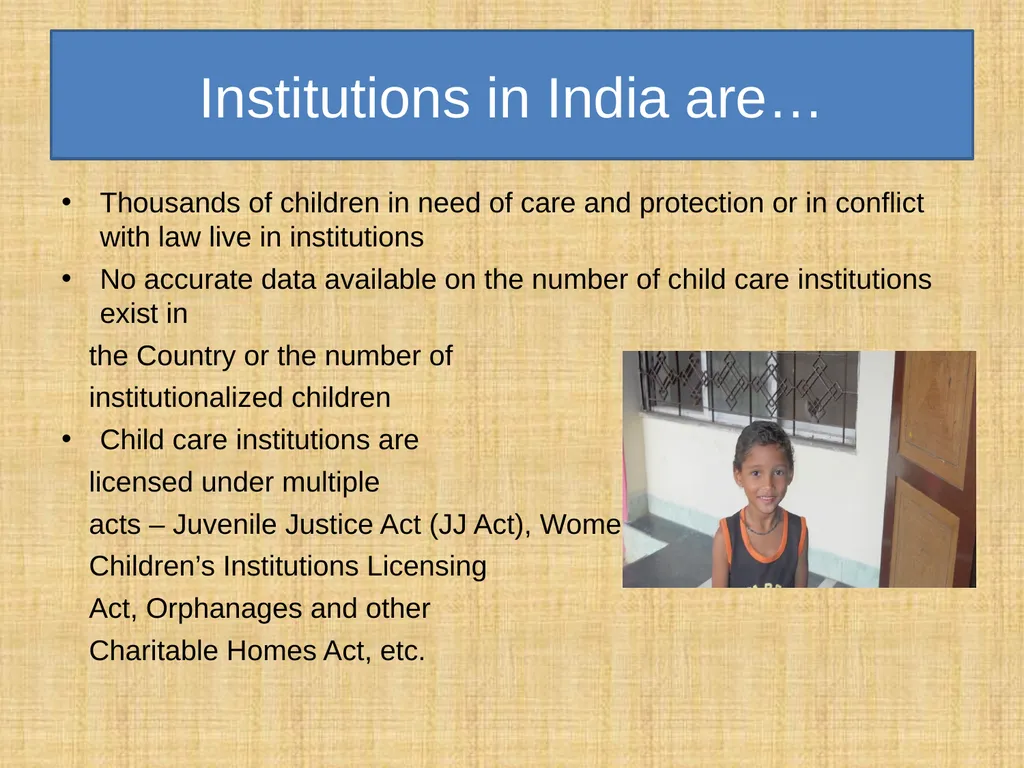
Institutions in India are… Thousands of children in need of care and protection or in conflict with law live in institutions
No accurate data available on the number of child care institutions exist in
the Country or the number of
institutionalized children
Child care institutions are
licensed under multiple
acts – Juvenile Justice Act (JJ Act), Women and
Children’s Institutions Licensing
Act, Orphanages and other
Charitable Homes Act, etc.<br>
05
Institutions in India are… Institutions run by NGOs, Faith based organizations and Governments
Study shows that only around 30% institutions are recognized by Government
Percentage of children having biological parents residing in the institutions is very high (no accurate data available)
Standards of care in institutions is a serious concern and always an issue<br>
06
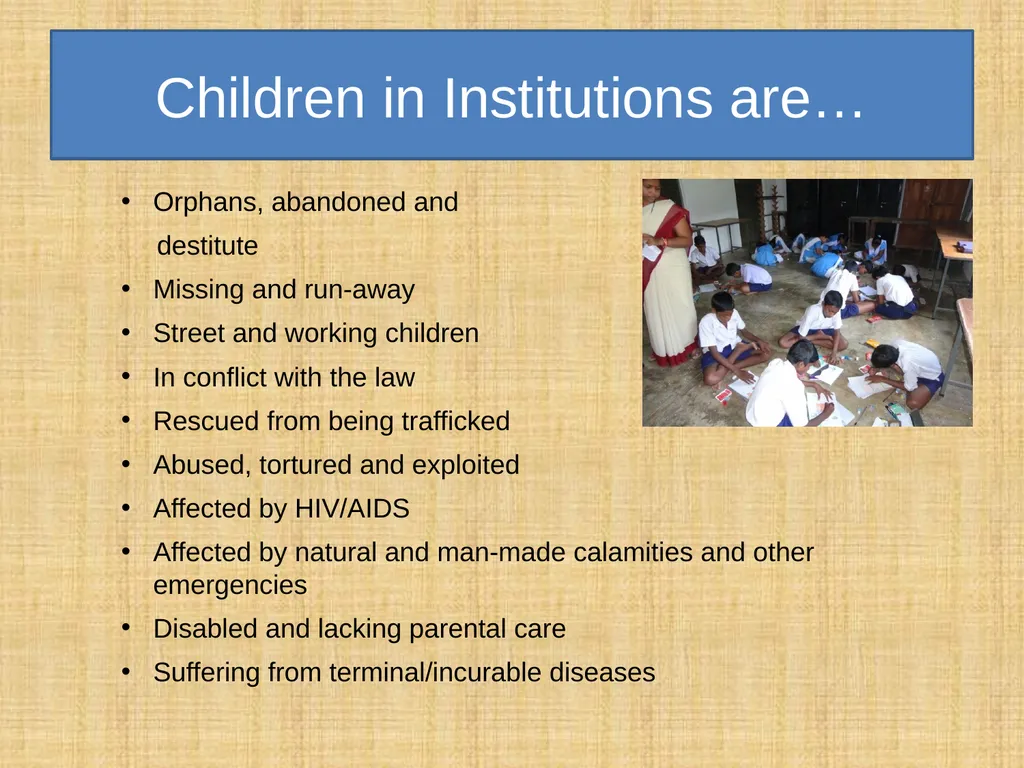
Children in Institutions are… Orphans, abandoned and
destitute
Missing and run-away
Street and working children
In conflict with the law
Rescued from being trafficked
Abused, tortured and exploited
Affected by HIV/AIDS
Affected by natural and man-made calamities and other emergencies
Disabled and lacking parental care
Suffering from terminal/incurable diseases<br>
07
Rational Research evidence demonstrating that child in institutional care has negative effect on the holistic development.
A better understanding of the negative effects of institutions upon children by policy makers and cost to the State and local authorities.
Greater insights into how foster families could be encouraged to provide a better alternative care placement.<br>
08
Big Questions ? Under what conditions do these thousands of children live?
Whose responsibility are they?
What are their rights and entitlements?
Who will safeguard their rights?<br>
09
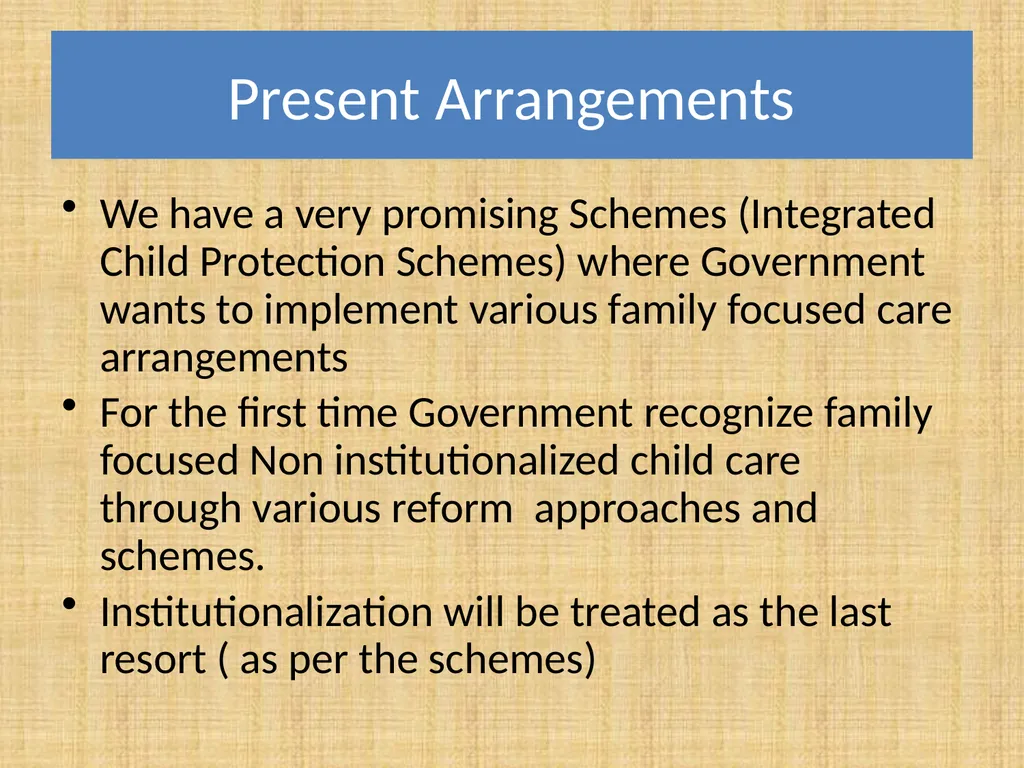
Present Arrangements We have a very promising Schemes (Integrated Child Protection Schemes) where Government wants to implement various family focused care arrangements
For the first time Government recognize family focused Non institutionalized child care through various reform approaches and schemes.
Institutionalization will be treated as the last resort ( as per the schemes)<br>
10
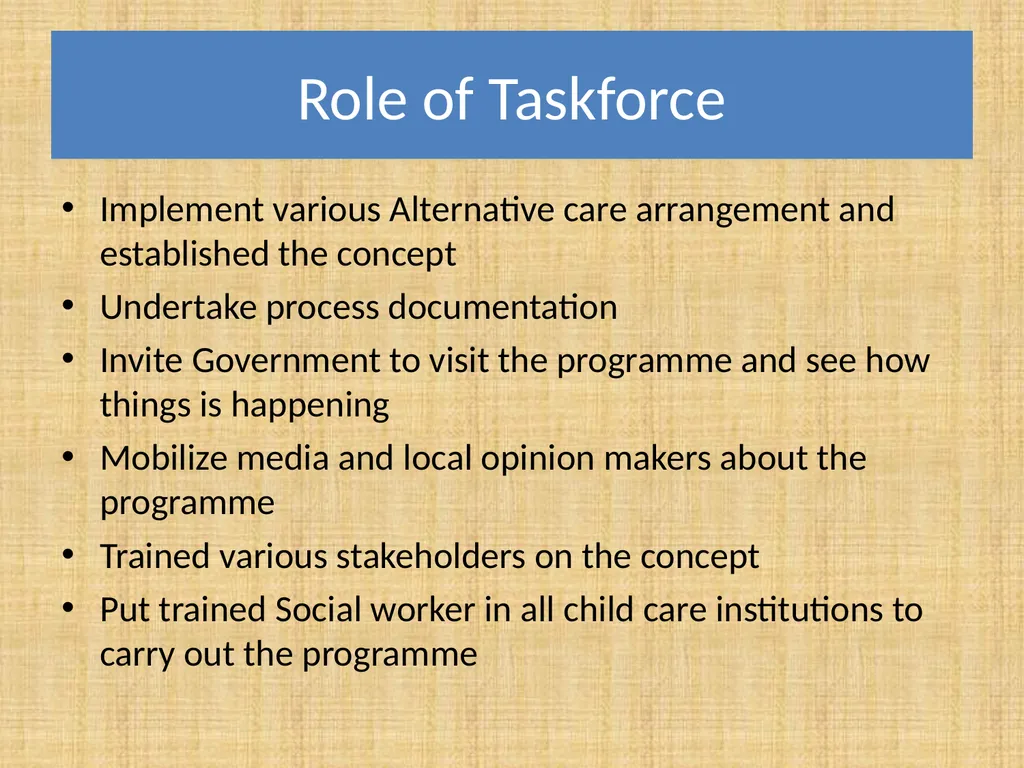
Role of Taskforce Implement various Alternative care arrangement and established the concept
Undertake process documentation
Invite Government to visit the programme and see how things is happening
Mobilize media and local opinion makers about the programme
Trained various stakeholders on the concept
Put trained Social worker in all child care institutions to carry out the programme<br>
11
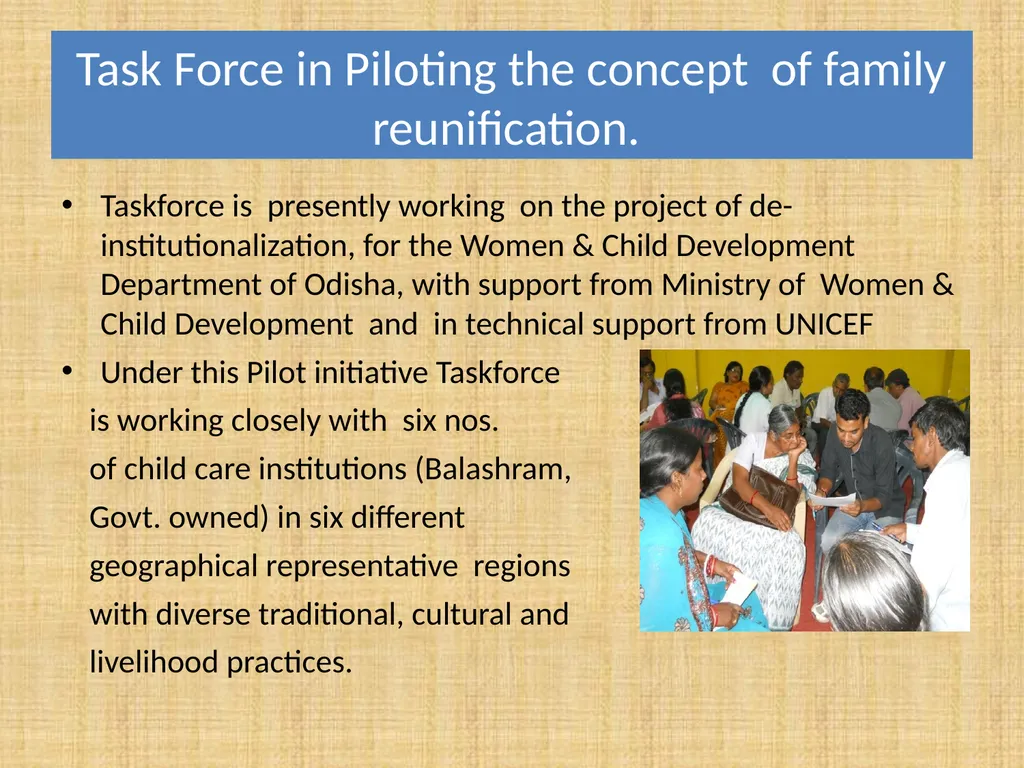
Task Force in Piloting the concept of family reunification. Taskforce is presently working on the project of de-institutionalization, for the Women & Child Development Department of Odisha, with support from Ministry of Women & Child Development and in technical support from UNICEF
Under this Pilot initiative Taskforce
is working closely with six nos.
of child care institutions (Balashram,
Govt. owned) in six different
geographical representative regions
with diverse traditional, cultural and
livelihood practices.<br>
12
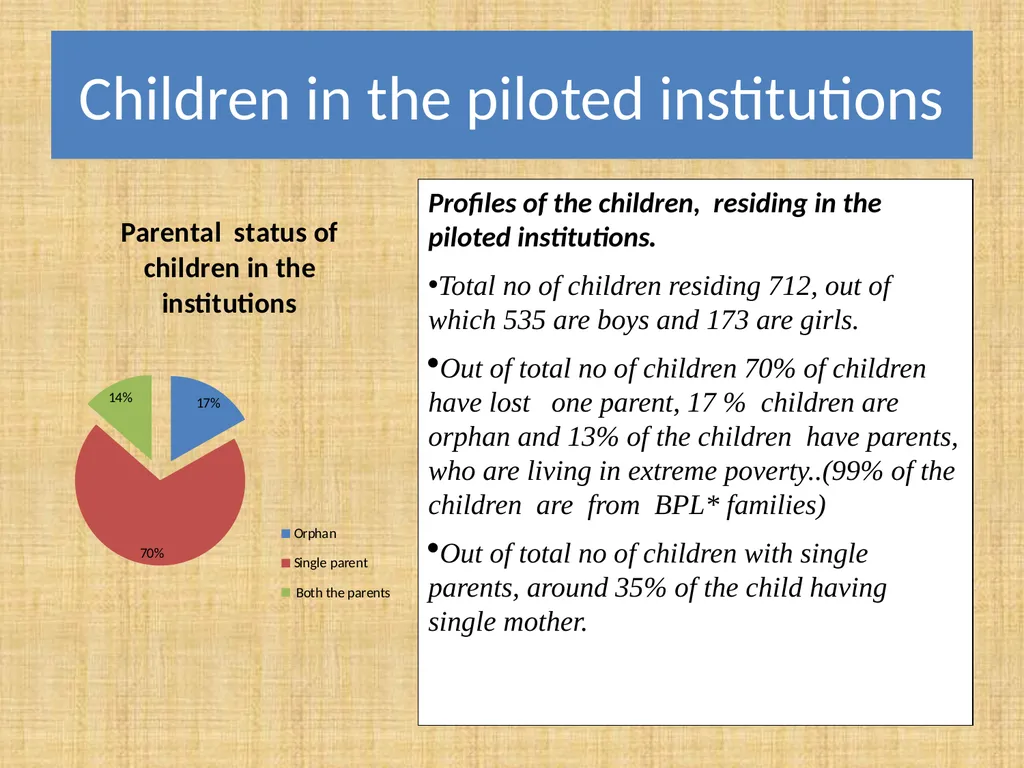
Children in the piloted institutions Profiles of the children, residing in the piloted institutions.
Total no of children residing 712, out of which 535 are boys and 173 are girls.
Out of total no of children 70% of children have lost one parent, 17 % children are orphan and 13% of the children have parents, who are living in extreme poverty..(99% of the children are from BPL* families)
Out of total no of children with single parents, around 35% of the child having single mother.<br>
13
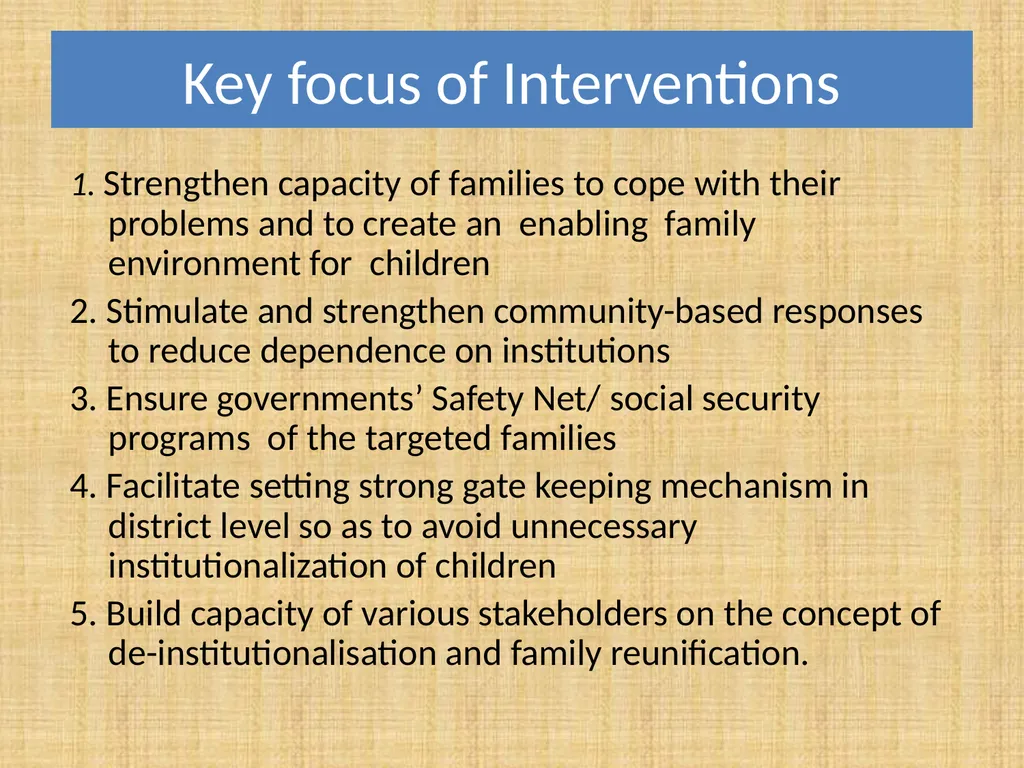
Key focus of Interventions 1. Strengthen capacity of families to cope with their problems and to create an enabling family environment for children
2. Stimulate and strengthen community-based responses to reduce dependence on institutions
3. Ensure governments’ Safety Net/ social security programs of the targeted families
4. Facilitate setting strong gate keeping mechanism in district level so as to avoid unnecessary institutionalization of children
5. Build capacity of various stakeholders on the concept of de-institutionalisation and family reunification.<br>
14
Steps for De-institutionalization<br>
15
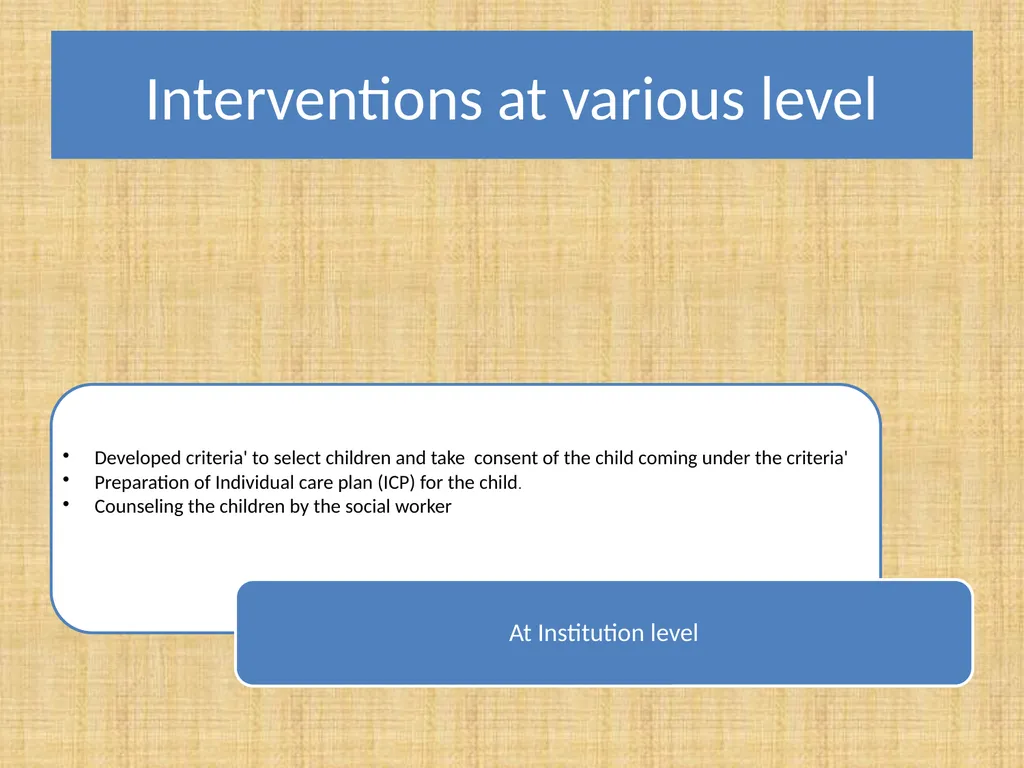
Interventions at various level<br>
16
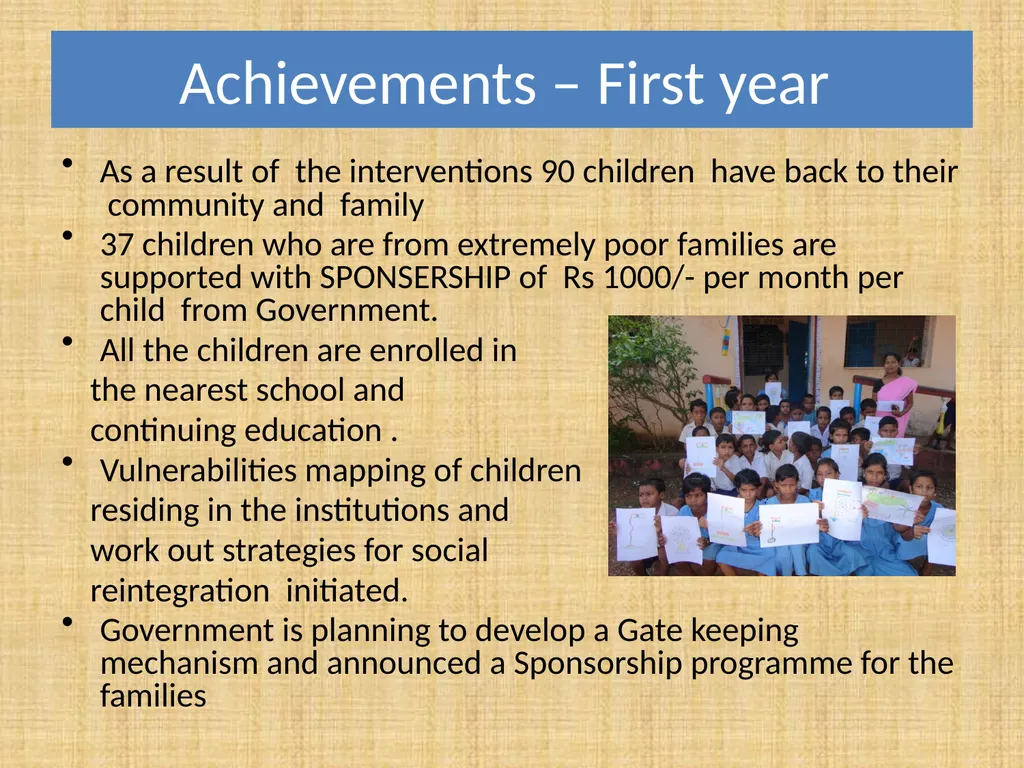
Achievements – First year As a result of the interventions 90 children have back to their community and family
37 children who are from extremely poor families are supported with SPONSERSHIP of Rs 1000/- per month per child from Government.
All the children are enrolled in
the nearest school and
continuing education .
Vulnerabilities mapping of children
residing in the institutions and
work out strategies for social
reintegration initiated.
Government is planning to develop a Gate keeping mechanism and announced a Sponsorship programme for the families<br>
17
Implementation mechanism Work closely with Child Welfare Committee (CWCs) and District Child Protection Society, (DCPS) in the district and Orissa State Child Protection Society (OSCPS) in the state
Establish link with various social protection schemes/programme as a part of family strengthening program.
Identify other orphan and vulnerable children in the society and link them with various schemes to prevent institutionalization.<br>
18
Challenges Everybody is tuned towards institutionalization of children, awareness about family focused care is extremely poor
Inadequate Gate keeping mechanism to prevent unnecessary institutionalization
Peoples‘ perception towards Child care institutions are different. They consider it as a hostel/Education institute/Business
Mostly Parents are resource poor and unable to arrange other facilities for children to stay in the house.<br>
19
Opportunities ICPS Schemes which subscribe the family focused care arrangements are in placed
JJAct focusing on rehabilitation and reintegration of children in need of care and protection is in force
Resource allocation by Government is started under this concept
Slowly alternative/ non-institutional care concept getting recognition by people.<br>
20
Way forward Share the learning with Larger stakeholders and scale up to reach more number of Children/institutions
Undertake study on Status of Institutions offering Institutional care
Develop a strong Gate keeping mechanism and advocate /lobby for De-institutionalization.
Study on Aftercare approach and pilot the concept
Develop a convergence mechanism /synergy with various welfare schemes meant for families and their children<br>
21
Thanks Women and Child Development Departments, Government of Odisha
Unicef, State office for Odisha
Special thanks to
Kinderpostzegels
Cordaid
Bep Van Sloten, BCN<br>