
Decentralization And District Development
Description: Decentralization And District Development Authorities: A Metagovernance Perspective Mr Emmanuel Gorea, UPNG Dr Lawrence Sause, UPNG Dr Lhawang Ugyel, ANUUPNG Introduction A key feature in the PNG governance arrangement is its decentralized
Related Topics
Download Presentation
"Decentralization And District Development" is the property of its rightful owner. Permission is granted to download and print the materials on this website for personal, non-commercial use only, and to display it on your personal computer provided you do not modify the materials and that you retain all copyright notices contained in the materials. By downloading content from our website, you accept the terms of this agreement.
Presentation Transcript
slide1. Decentralization And District Development Authorities: A Metagovernance Perspective Mr Emmanuel Gorea, UPNG
Dr Lawrence Sause, UPNG
Dr Lhawang Ugyel, ANU/UPNG<br>
slide2. Introduction A key feature in the PNG governance arrangement is its decentralized system of government
Changes in the decentralized system in PNG’s unitary framework of government continue to capture our interest
Our ongoing interest is on the additional governance arrangement brought about by the introduction of the DDAs and the effect this will have on the already existing players (actors) in PNG’s decentralization landscape
We move on from our initial study in 2017, and look at the metagovernance issues arising from the establishment and operation of the DDAs using our work with two DDAs in ENBP.
This presentation is part of our ongoing study looking at decentralization in PNG<br>
slide3. Approach New and additional decentralized governance arrangements like the DDAs are designed with intended consequences
Yet the introduction of new additional arrangement to an already existing decentralized arrangement involving a myriad of actors can have unintended consequences and raise issues about how effective the actors will work to realize the goals of decentralization
Among actors within a decentralized arrangement, there will be metagovernance issues of coordination, umpiring, leadership, steering, coherence and unification, and conflict resolution.
Using a metagovernance perspective, we analyze how key issues above are likely to affect the operations of DDAs and hence the decentralized governance arrangement in PNG<br>
slide4. Governance and Metagovernance Governance
Varying perceptions of governance, the two most common are “good governance” and “corporate governance”
In our context, “governance” is taken to mean: a socio-cybernertic system; interdependence among socio-political-administrative actors; governance is result of interactive socio-political-administrative form of governing.
“The totality of interactions and participation by different actors be they government, other public bodies, non-state actors and civil society, aimed at solving public challenges or creating public opportunities”<br>
slide5. Metagovernance
“Government of Governance”
Metagovernance comes about because there is a need to govern governance
In the case of many actors interacting in governance, there will be a need for leadership, strategic direction and oversight, steering, unity and coherence, coordination, resource sharing, umpiring and conflict resolution, etc. These are key tasks of metagovernance.<br>
slide6. Background to the DDAs Institutional Design created by the DDA Act 2014 (certified December 2014)
Created more power and leverage than the OLPLLG provision of the JDPBPC
DDAs are statutory authorities assuming a corporate structure & power
DDAs are legal creatures that can sue and be sued
Can acquire and dispose of property
Would have their own procurement arrangement
DDAs are part of the decentralized framework set within a unitary system of government<br>
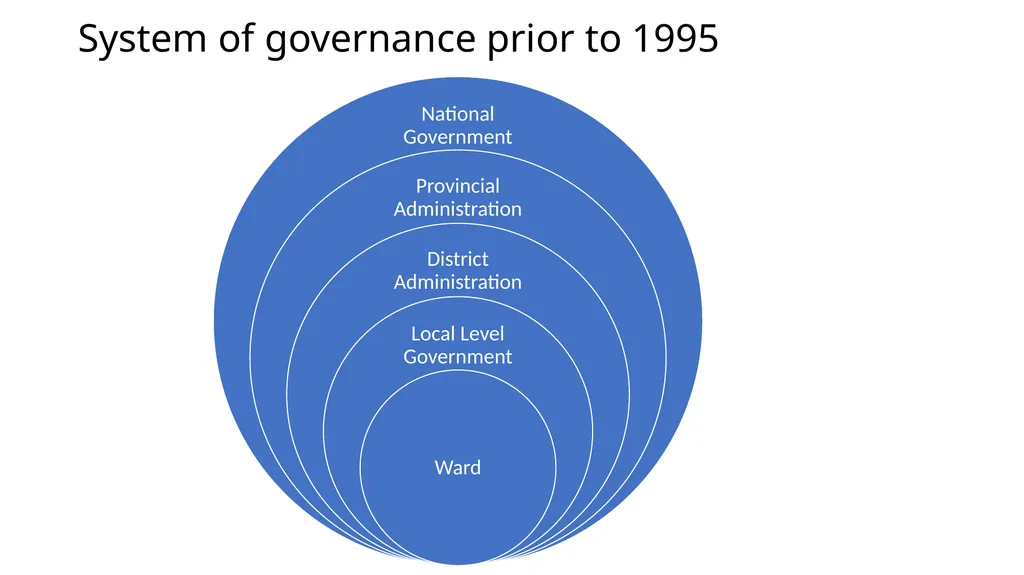
slide7. System of governance prior to 1995<br>
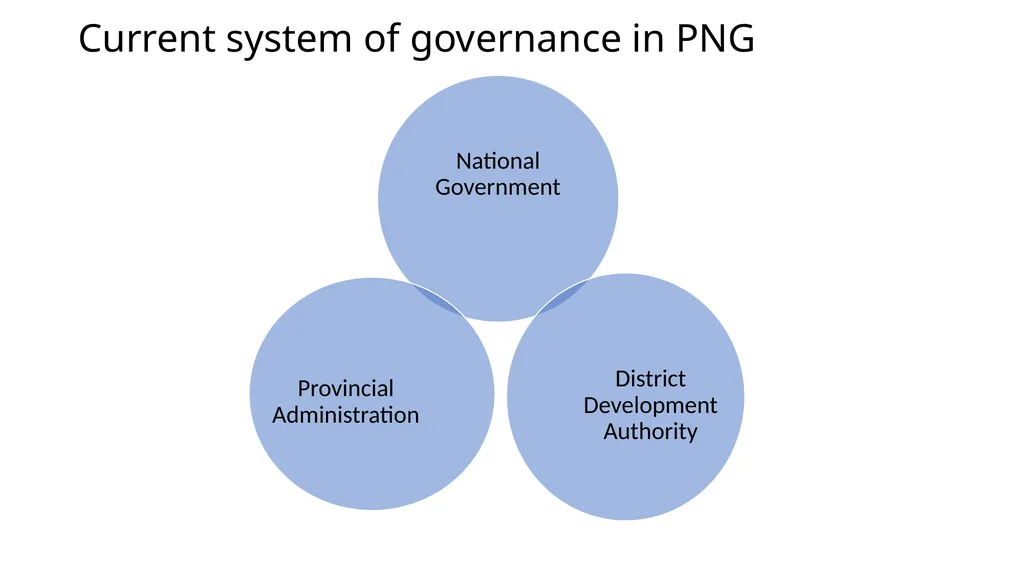
slide8. Current system of governance in PNG<br>
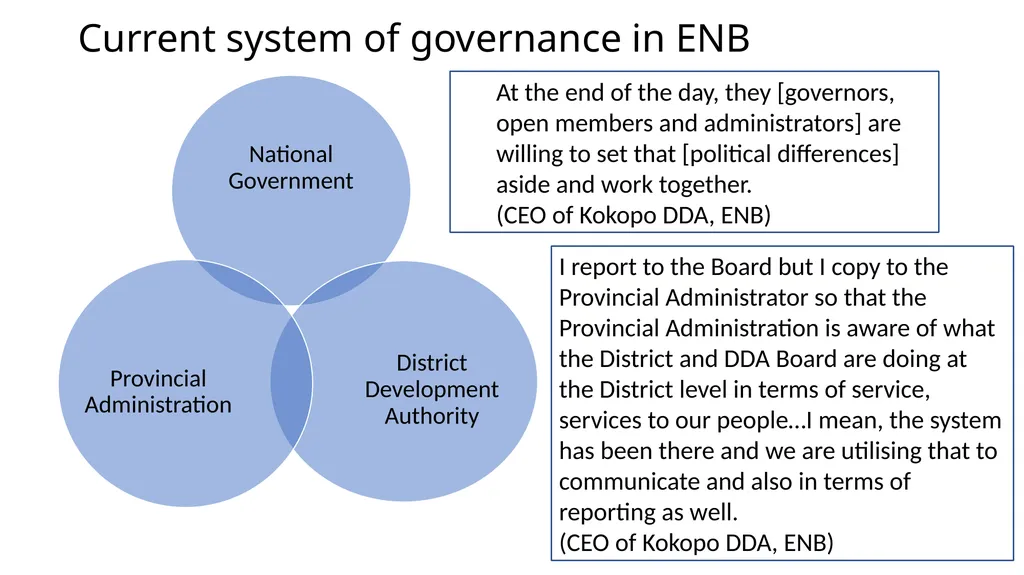
slide9. Current system of governance in ENB I report to the Board but I copy to the Provincial Administrator so that the Provincial Administration is aware of what the District and DDA Board are doing at the District level in terms of service, services to our people…I mean, the system has been there and we are utilising that to communicate and also in terms of reporting as well.
(CEO of Kokopo DDA, ENB) At the end of the day, they [governors, open members and administrators] are willing to set that [political differences] aside and work together.
(CEO of Kokopo DDA, ENB)<br>
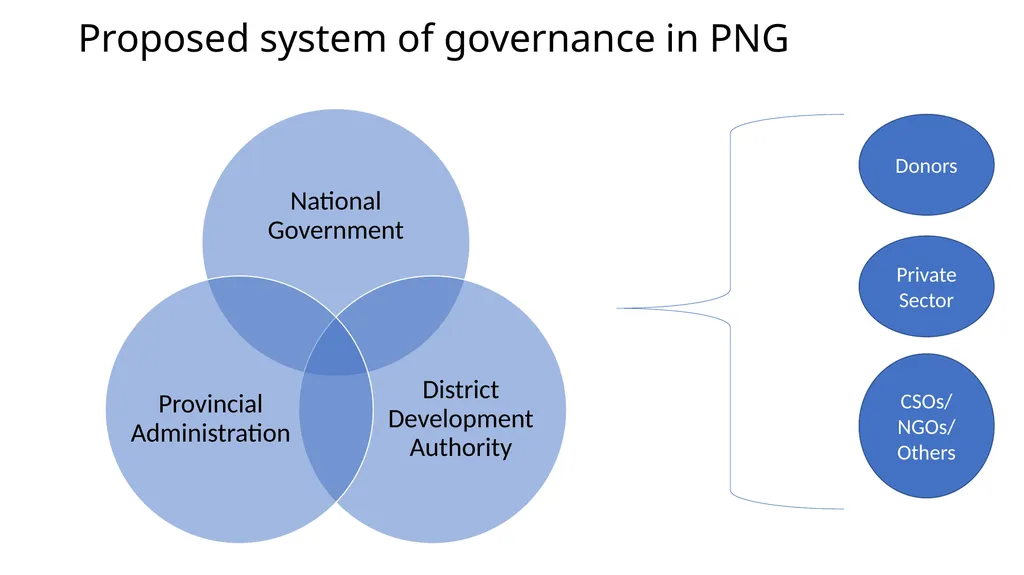
slide10. Proposed system of governance in PNG<br>
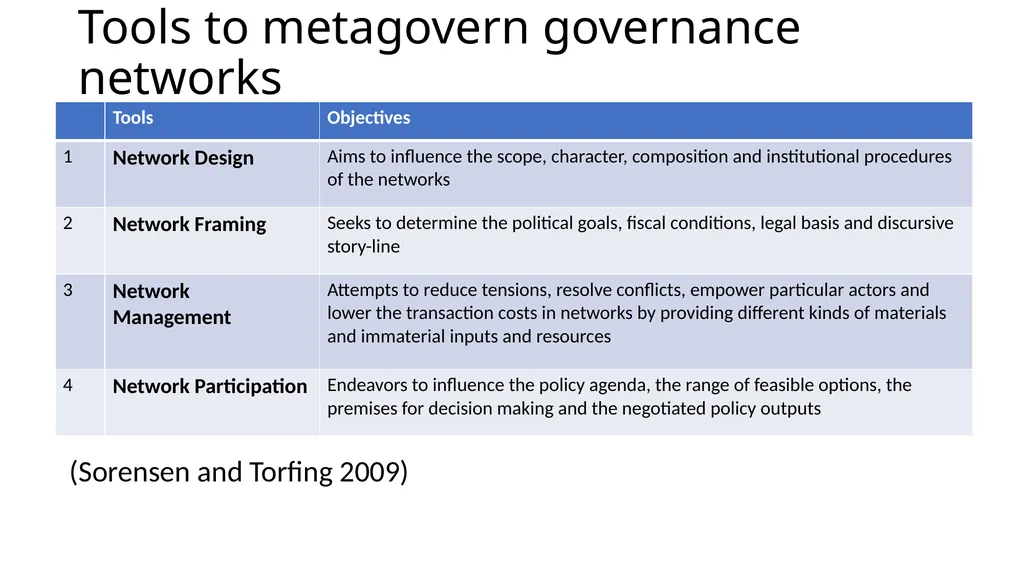
slide11. Tools to metagovern governance networks (Sorensen and Torfing 2009)<br>
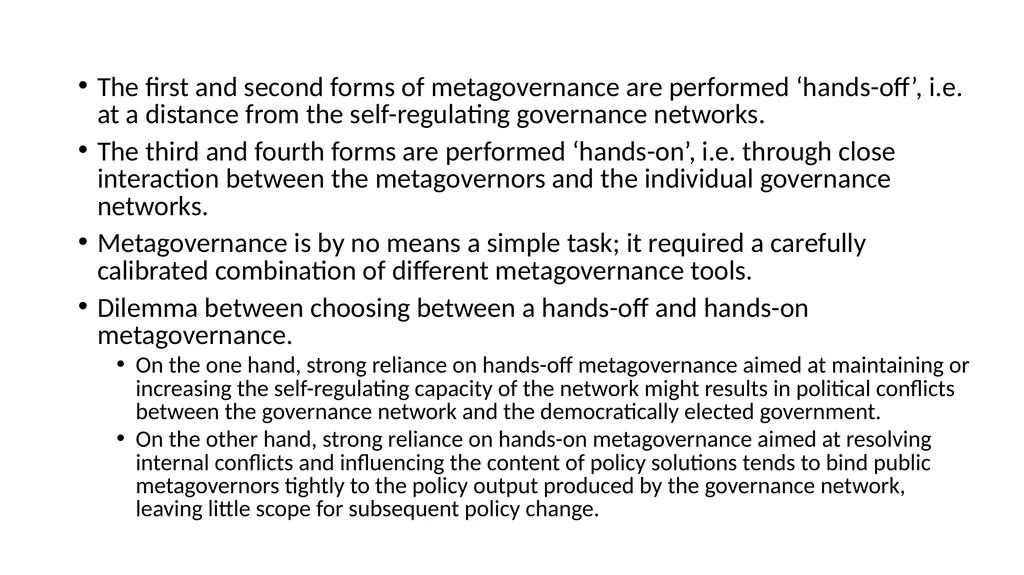
slide12. The first and second forms of metagovernance are performed ‘hands-off’, i.e. at a distance from the self-regulating governance networks.
The third and fourth forms are performed ‘hands-on’, i.e. through close interaction between the metagovernors and the individual governance networks.
Metagovernance is by no means a simple task; it required a carefully calibrated combination of different metagovernance tools.
Dilemma between choosing between a hands-off and hands-on metagovernance.
On the one hand, strong reliance on hands-off metagovernance aimed at maintaining or increasing the self-regulating capacity of the network might results in political conflicts between the governance network and the democratically elected government.
On the other hand, strong reliance on hands-on metagovernance aimed at resolving internal conflicts and influencing the content of policy solutions tends to bind public metagovernors tightly to the policy output produced by the governance network, leaving little scope for subsequent policy change.<br>
slide13. Metagovernance in PNG? Does PNG’s governance system require metagovernance?
What tools to metagovern?—Hands-off/Hands-on?
If hands-off—what design & framing?
If hands-on—who manages (coordinates, umpires and steers) and participates?<br>
slide14. Conclusion Key dilemmas (amongst others):
How to avoid excessive or insufficient metagoverning
The relevant political authorities and public agencies must assign responsibility for the strategic governance of particular networks to the politicians and public managers who are directly or indirectly involved in the networked governance processes and therefore, have the required knowledge of the organizational and political landscape to acts as metagovernors.
Cannot emphasize the importance of meta-governance, particularly in light of PM’s recent announcement on greater decentralization (with more powers to be transferred to the local governments).<br>
Dr Lawrence Sause, UPNG
Dr Lhawang Ugyel, ANU/UPNG<br>
slide2. Introduction A key feature in the PNG governance arrangement is its decentralized system of government
Changes in the decentralized system in PNG’s unitary framework of government continue to capture our interest
Our ongoing interest is on the additional governance arrangement brought about by the introduction of the DDAs and the effect this will have on the already existing players (actors) in PNG’s decentralization landscape
We move on from our initial study in 2017, and look at the metagovernance issues arising from the establishment and operation of the DDAs using our work with two DDAs in ENBP.
This presentation is part of our ongoing study looking at decentralization in PNG<br>
slide3. Approach New and additional decentralized governance arrangements like the DDAs are designed with intended consequences
Yet the introduction of new additional arrangement to an already existing decentralized arrangement involving a myriad of actors can have unintended consequences and raise issues about how effective the actors will work to realize the goals of decentralization
Among actors within a decentralized arrangement, there will be metagovernance issues of coordination, umpiring, leadership, steering, coherence and unification, and conflict resolution.
Using a metagovernance perspective, we analyze how key issues above are likely to affect the operations of DDAs and hence the decentralized governance arrangement in PNG<br>
slide4. Governance and Metagovernance Governance
Varying perceptions of governance, the two most common are “good governance” and “corporate governance”
In our context, “governance” is taken to mean: a socio-cybernertic system; interdependence among socio-political-administrative actors; governance is result of interactive socio-political-administrative form of governing.
“The totality of interactions and participation by different actors be they government, other public bodies, non-state actors and civil society, aimed at solving public challenges or creating public opportunities”<br>
slide5. Metagovernance
“Government of Governance”
Metagovernance comes about because there is a need to govern governance
In the case of many actors interacting in governance, there will be a need for leadership, strategic direction and oversight, steering, unity and coherence, coordination, resource sharing, umpiring and conflict resolution, etc. These are key tasks of metagovernance.<br>
slide6. Background to the DDAs Institutional Design created by the DDA Act 2014 (certified December 2014)
Created more power and leverage than the OLPLLG provision of the JDPBPC
DDAs are statutory authorities assuming a corporate structure & power
DDAs are legal creatures that can sue and be sued
Can acquire and dispose of property
Would have their own procurement arrangement
DDAs are part of the decentralized framework set within a unitary system of government<br>
slide7. System of governance prior to 1995<br>
slide8. Current system of governance in PNG<br>
slide9. Current system of governance in ENB I report to the Board but I copy to the Provincial Administrator so that the Provincial Administration is aware of what the District and DDA Board are doing at the District level in terms of service, services to our people…I mean, the system has been there and we are utilising that to communicate and also in terms of reporting as well.
(CEO of Kokopo DDA, ENB) At the end of the day, they [governors, open members and administrators] are willing to set that [political differences] aside and work together.
(CEO of Kokopo DDA, ENB)<br>
slide10. Proposed system of governance in PNG<br>
slide11. Tools to metagovern governance networks (Sorensen and Torfing 2009)<br>
slide12. The first and second forms of metagovernance are performed ‘hands-off’, i.e. at a distance from the self-regulating governance networks.
The third and fourth forms are performed ‘hands-on’, i.e. through close interaction between the metagovernors and the individual governance networks.
Metagovernance is by no means a simple task; it required a carefully calibrated combination of different metagovernance tools.
Dilemma between choosing between a hands-off and hands-on metagovernance.
On the one hand, strong reliance on hands-off metagovernance aimed at maintaining or increasing the self-regulating capacity of the network might results in political conflicts between the governance network and the democratically elected government.
On the other hand, strong reliance on hands-on metagovernance aimed at resolving internal conflicts and influencing the content of policy solutions tends to bind public metagovernors tightly to the policy output produced by the governance network, leaving little scope for subsequent policy change.<br>
slide13. Metagovernance in PNG? Does PNG’s governance system require metagovernance?
What tools to metagovern?—Hands-off/Hands-on?
If hands-off—what design & framing?
If hands-on—who manages (coordinates, umpires and steers) and participates?<br>
slide14. Conclusion Key dilemmas (amongst others):
How to avoid excessive or insufficient metagoverning
The relevant political authorities and public agencies must assign responsibility for the strategic governance of particular networks to the politicians and public managers who are directly or indirectly involved in the networked governance processes and therefore, have the required knowledge of the organizational and political landscape to acts as metagovernors.
Cannot emphasize the importance of meta-governance, particularly in light of PM’s recent announcement on greater decentralization (with more powers to be transferred to the local governments).<br>