
Defence Technology Challenges and Innovation India




Description: Defence Technology Challenges and Innovation India Defence and Hi-Tech Innovation Forum, July 14 2011, IDSA Manik Mukherjee Director, G-FAST, DRDO DRDO Vision Make India prosperous by establishing world class science and technology base and
Related Topics
Download Presentation
"Defence Technology Challenges and Innovation India" is the property of its rightful owner. Permission is granted to download and print the materials on this website for personal, non-commercial use only, and to display it on your personal computer provided you do not modify the materials and that you retain all copyright notices contained in the materials. By downloading content from our website, you accept the terms of this agreement.
Presentation Transcript
slide1. Defence Technology Challenges and Innovation India Defence and Hi-Tech Innovation Forum, July 14 2011, IDSA Manik Mukherjee
Director, G-FAST, DRDO<br>
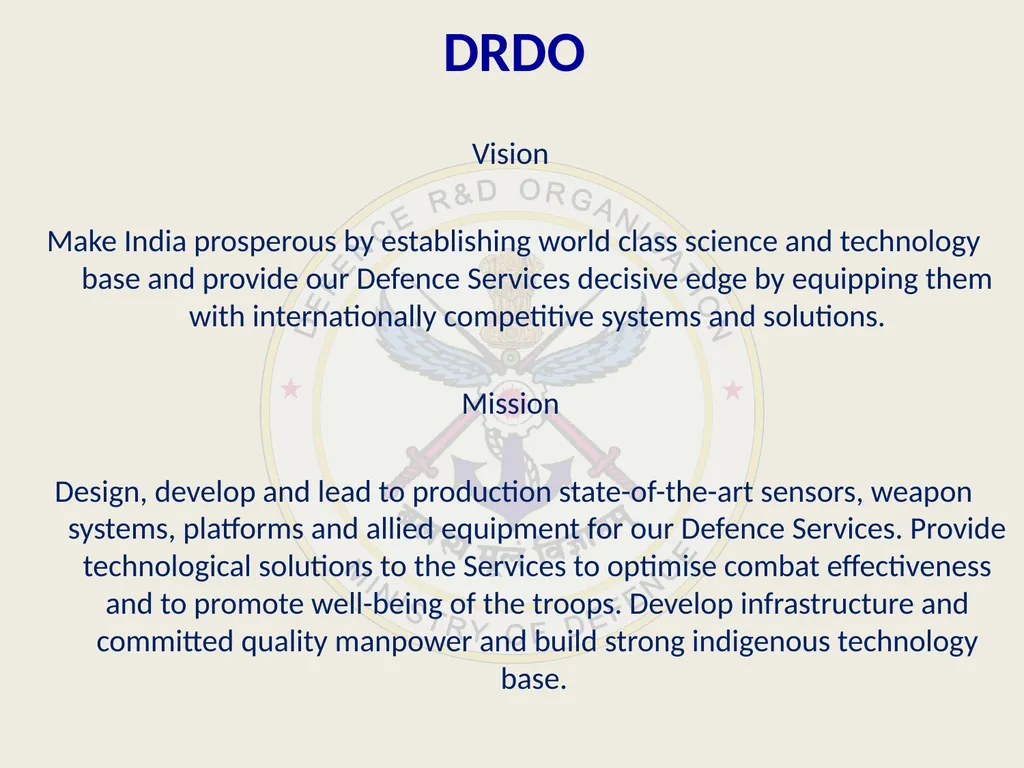
slide2. DRDO Vision
Make India prosperous by establishing world class science and technology base and provide our Defence Services decisive edge by equipping them with internationally competitive systems and solutions.
Mission
Design, develop and lead to production state-of-the-art sensors, weapon systems, platforms and allied equipment for our Defence Services. Provide technological solutions to the Services to optimise combat effectiveness and to promote well-being of the troops. Develop infrastructure and committed quality manpower and build strong indigenous technology base.<br>
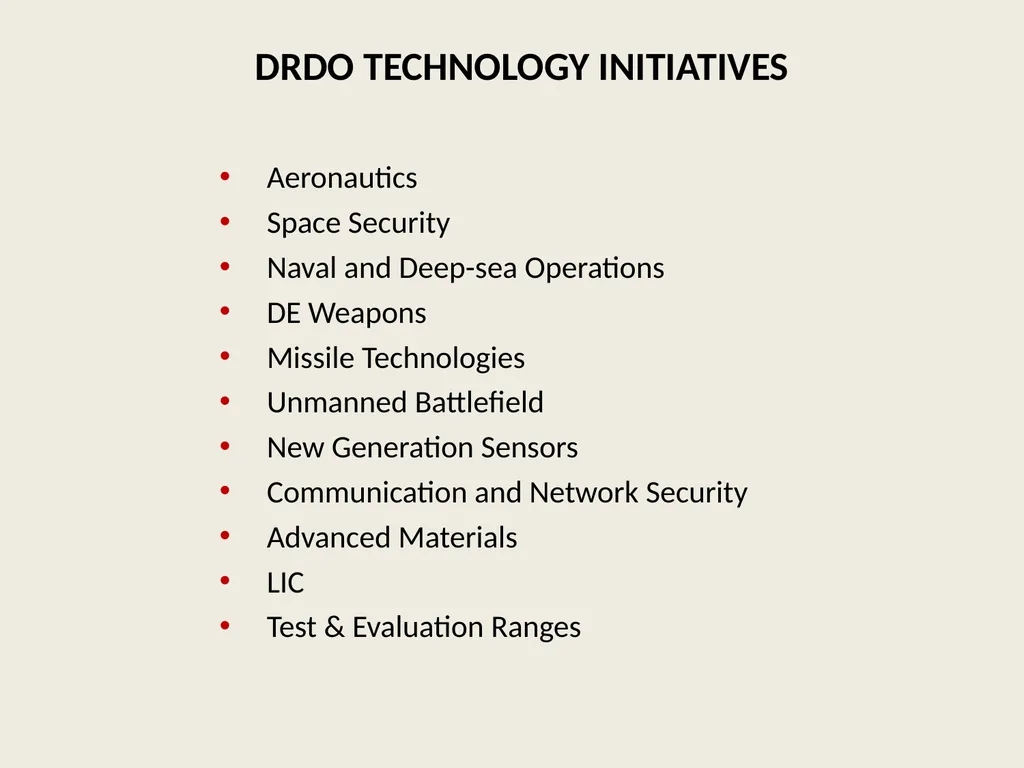
slide3. DRDO TECHNOLOGY INITIATIVES Aeronautics
Space Security
Naval and Deep-sea Operations
DE Weapons
Missile Technologies
Unmanned Battlefield
New Generation Sensors
Communication and Network Security
Advanced Materials
LIC
Test & Evaluation Ranges<br>
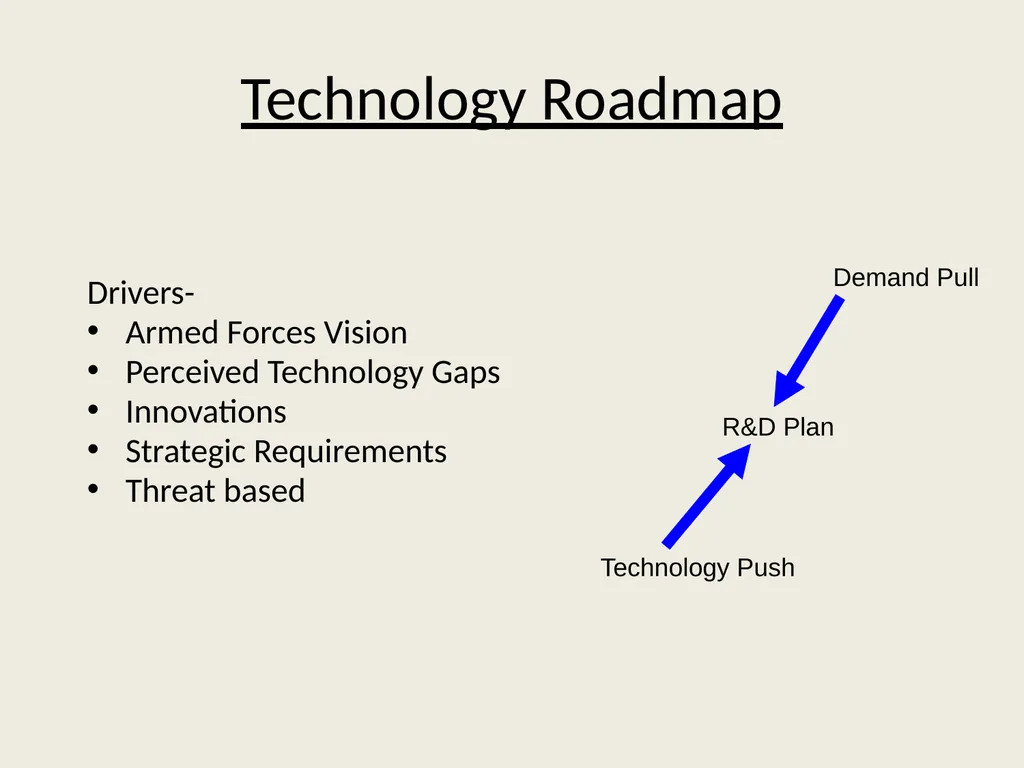
slide4. Technology Roadmap Drivers-
Armed Forces Vision
Perceived Technology Gaps
Innovations
Strategic Requirements
Threat based Technology Push Demand Pull R&D Plan<br>
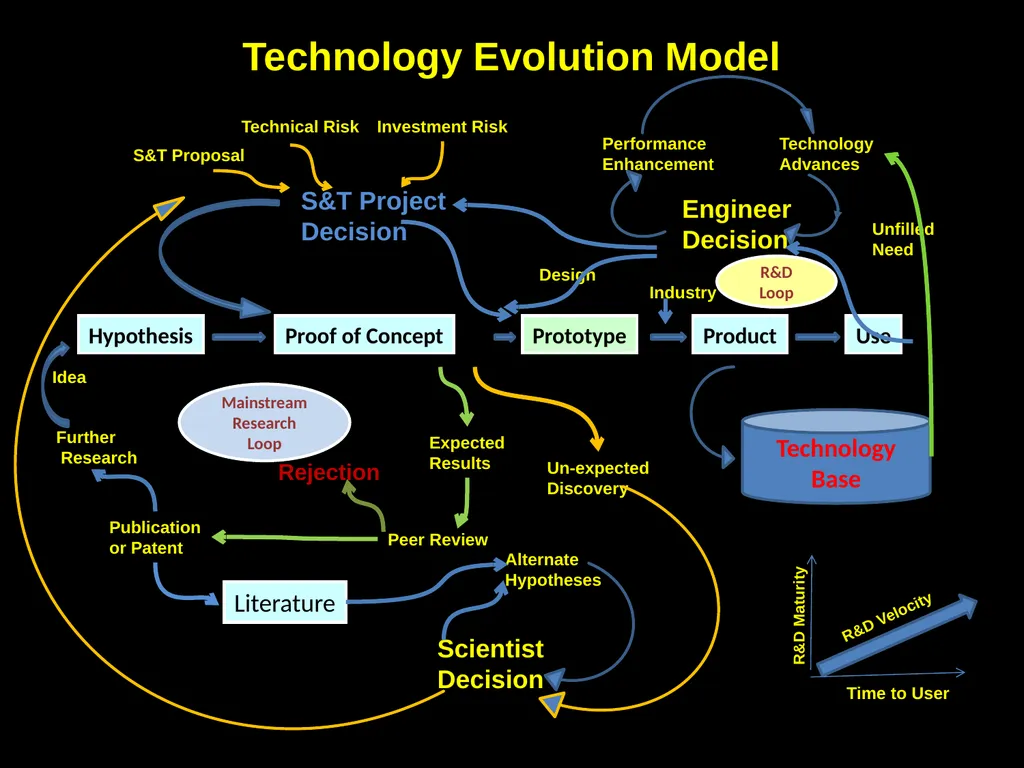
slide5. Technology Evolution Model Hypothesis Proof of Concept Prototype Product Use S&T Project
Decision Technical Risk Investment Risk S&T Proposal Engineer
Decision Performance
Enhancement Technology
Advances Design Industry Unfilled
Need Technology
Base Further
Research Publication
or Patent Literature Expected
Results Peer Review Rejection Scientist
Decision Alternate
Hypotheses Un-expected
Discovery Idea Mainstream
Research Loop R&D
Loop Time to User R&D Maturity R&D Velocity<br>
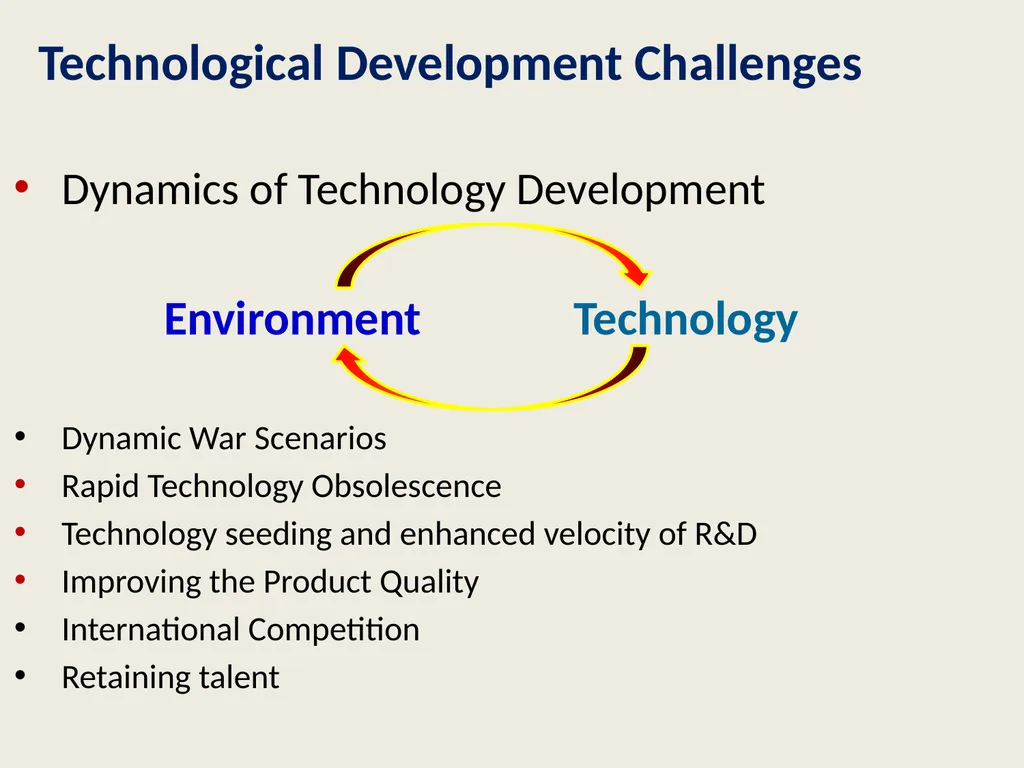
slide6. Technological Development Challenges Dynamics of Technology Development
Environment Technology
Dynamic War Scenarios
Rapid Technology Obsolescence
Technology seeding and enhanced velocity of R&D
Improving the Product Quality
International Competition
Retaining talent<br>
slide7. ‘Takniki Stur’ Metric Technology Maturity thru’ Systems Development TS 1 Basic principles and scientific understanding TS 2 Technology application/ concept formulation TS 3 Proof-of-concept established TS 4 Component level laboratory (bread board) feasibility TS 5 Technology validation in field environment TS 6 Subsystem prototype demonstration in field environment TS 7 System prototype development for field environ. TS 8 TOT & completion of successful field trials TS 9 System fielded with User Technology Maturity Matured Technologies Other Modules/ systems Industry Support Academia User Support<br>
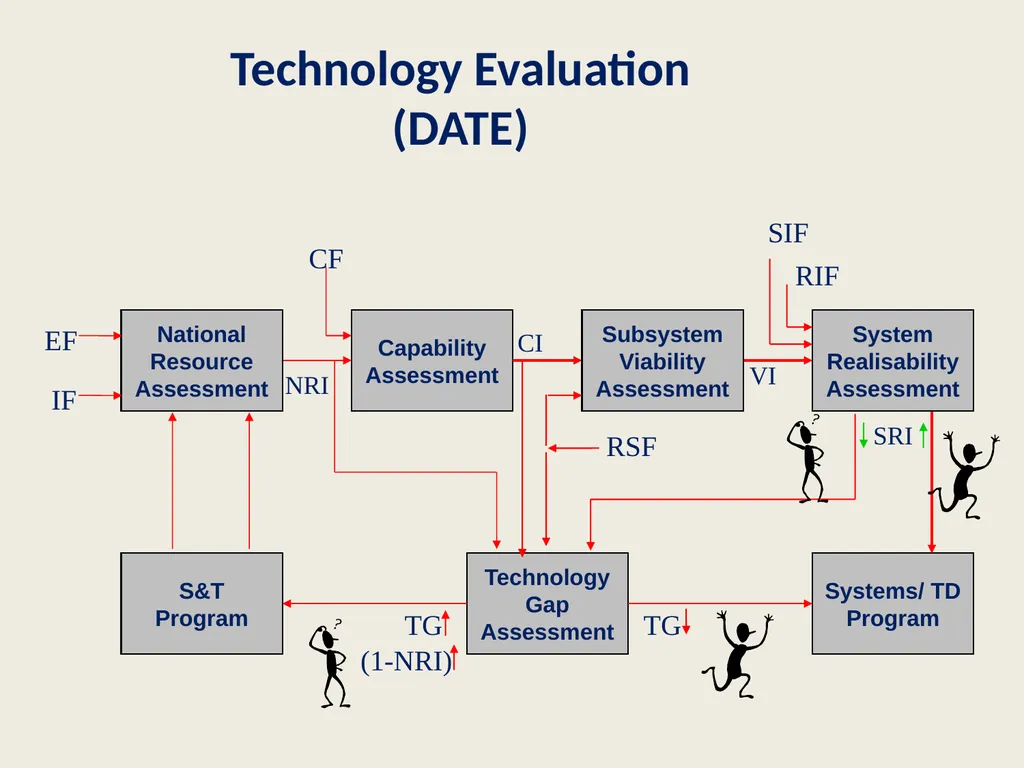
slide8. Technology Evaluation (DATE) Systems/ TD Program S&T Program Technology Gap Assessment Capability Assessment CF CI National Resource Assessment NRI EF IF System Realisability Assessment RIF SIF SRI Subsystem Viability Assessment VI RSF<br>
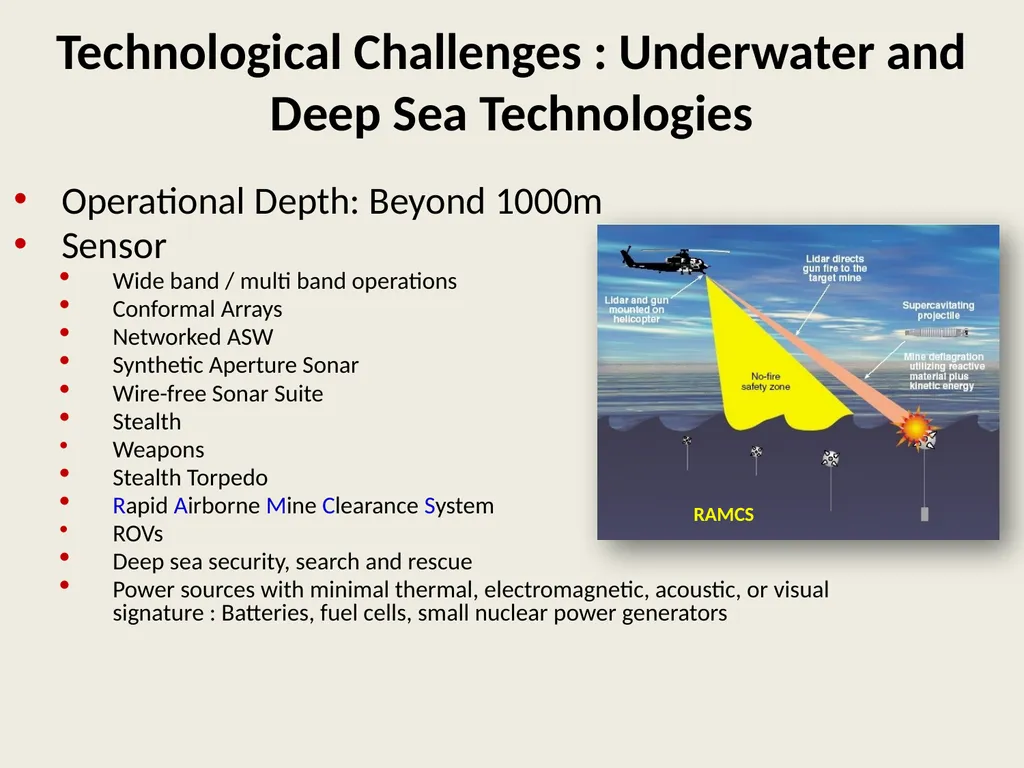
slide9. Technological Challenges : Underwater and Deep Sea Technologies Operational Depth: Beyond 1000m
Sensor
Wide band / multi band operations
Conformal Arrays
Networked ASW
Synthetic Aperture Sonar
Wire-free Sonar Suite
Stealth
Weapons
Stealth Torpedo
Rapid Airborne Mine Clearance System
ROVs
Deep sea security, search and rescue
Power sources with minimal thermal, electromagnetic, acoustic, or visual signature : Batteries, fuel cells, small nuclear power generators<br>
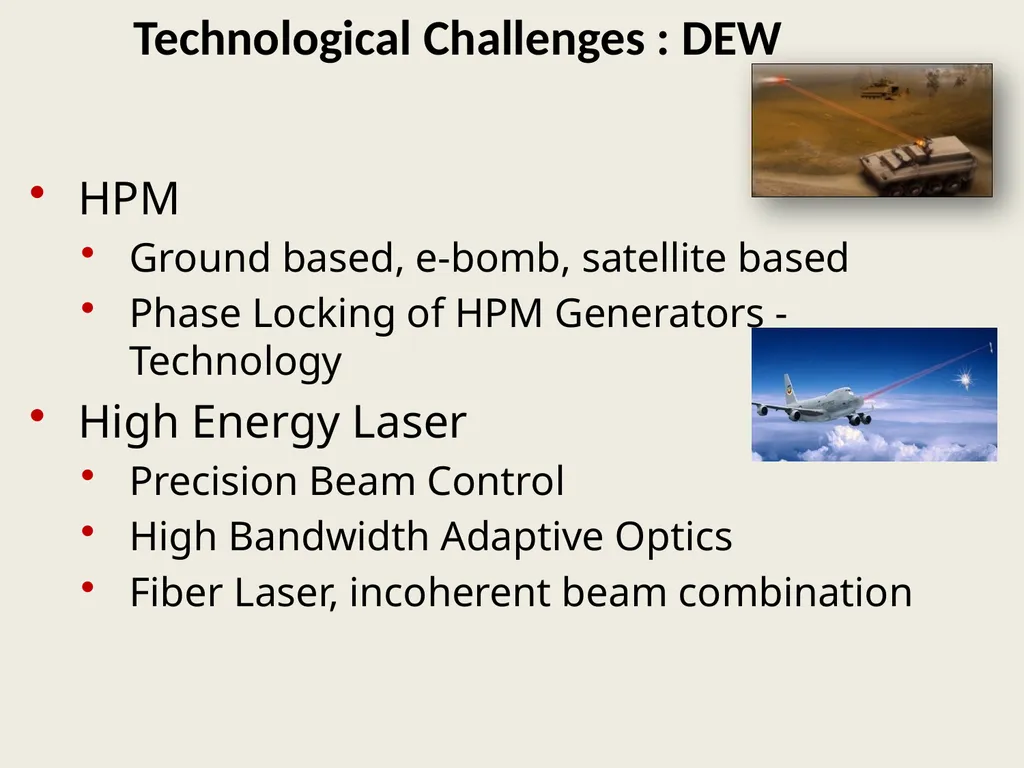
slide10. Technological Challenges : DEW HPM
Ground based, e-bomb, satellite based
Phase Locking of HPM Generators - Technology
High Energy Laser
Precision Beam Control
High Bandwidth Adaptive Optics
Fiber Laser, incoherent beam combination<br>
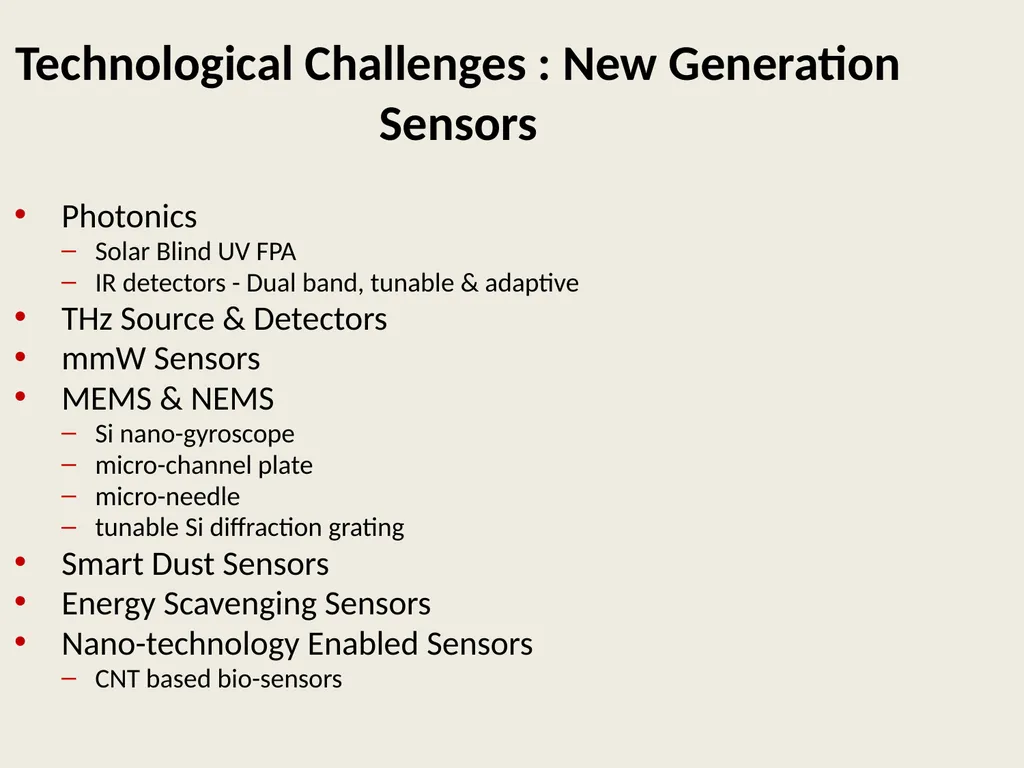
slide11. Technological Challenges : New Generation Sensors Photonics
Solar Blind UV FPA
IR detectors - Dual band, tunable & adaptive
THz Source & Detectors
mmW Sensors
MEMS & NEMS
Si nano-gyroscope
micro-channel plate
micro-needle
tunable Si diffraction grating
Smart Dust Sensors
Energy Scavenging Sensors
Nano-technology Enabled Sensors
CNT based bio-sensors<br>
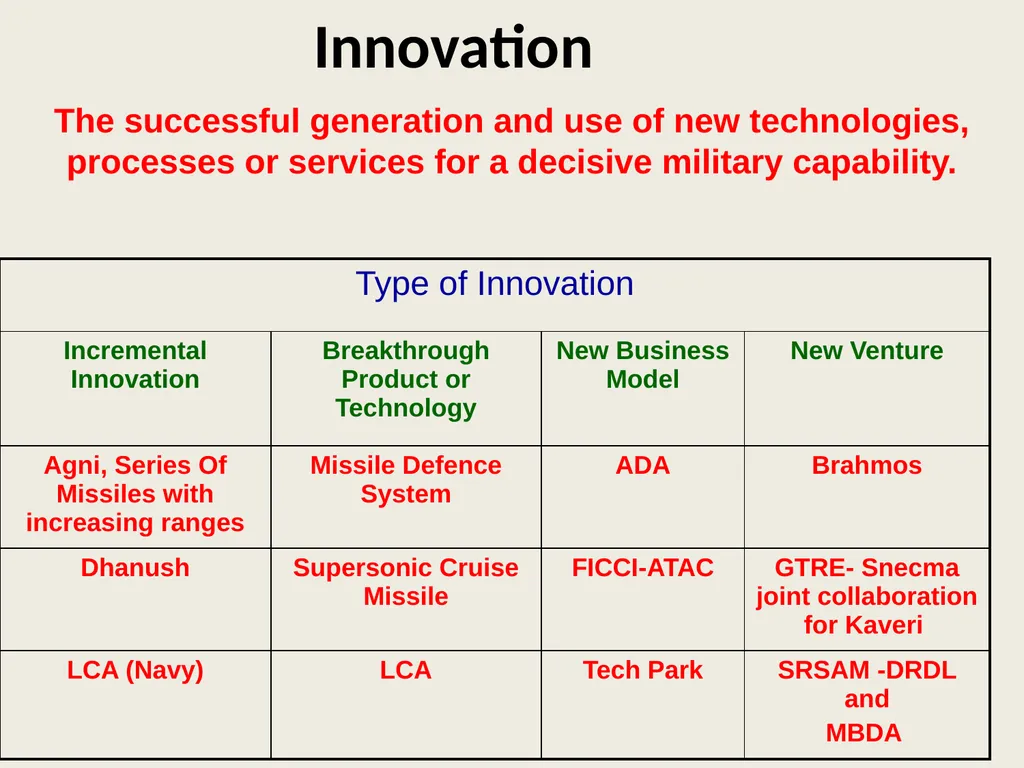
slide12. Innovation The successful generation and use of new technologies, processes or services for a decisive military capability.<br>
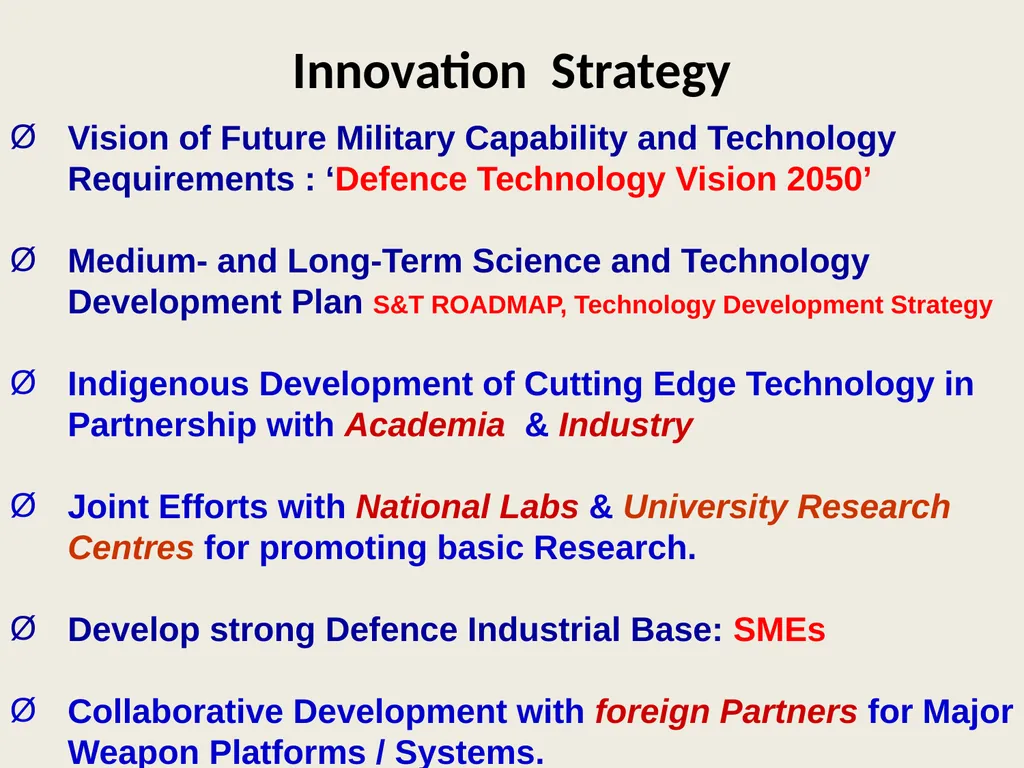
slide13. Innovation Strategy Vision of Future Military Capability and Technology Requirements : ‘Defence Technology Vision 2050’
Medium- and Long-Term Science and Technology Development Plan S&T ROADMAP, Technology Development Strategy
Indigenous Development of Cutting Edge Technology in Partnership with Academia & Industry
Joint Efforts with National Labs & University Research Centres for promoting basic Research.
Develop strong Defence Industrial Base: SMEs
Collaborative Development with foreign Partners for Major Weapon Platforms / Systems.<br>
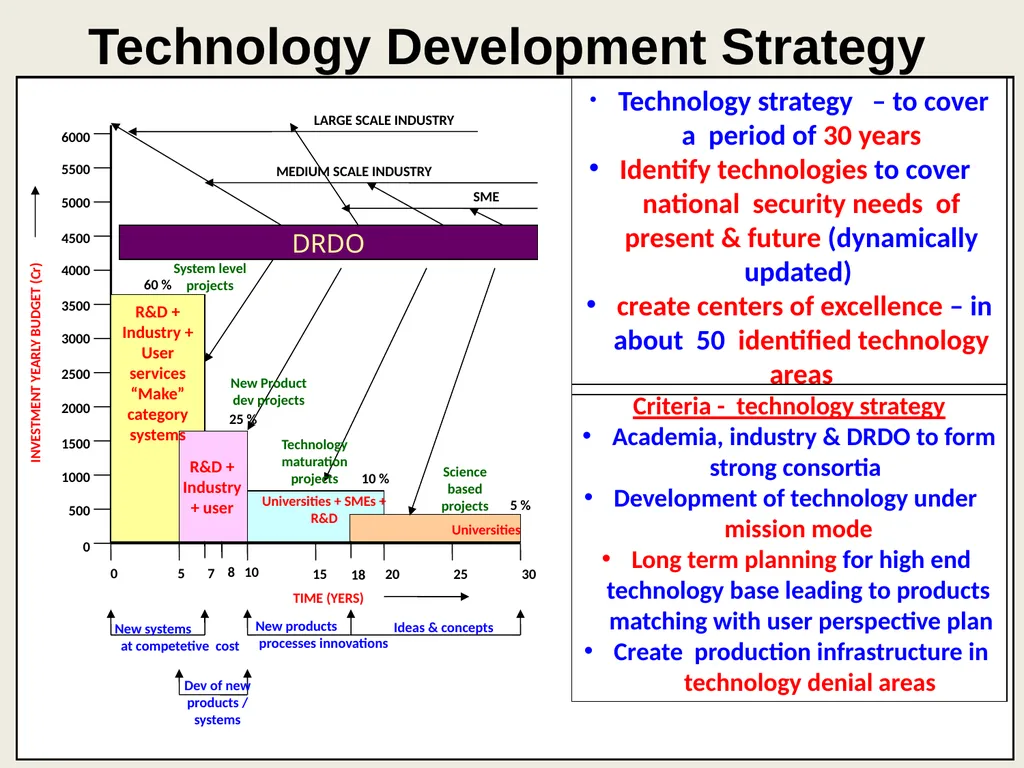
slide14. Technology Development Strategy Technology strategy – to cover a period of 30 years
Identify technologies to cover national security needs of present & future (dynamically updated)
create centers of excellence – in about 50 identified technology areas Criteria - technology strategy
Academia, industry & DRDO to form strong consortia
Development of technology under mission mode
Long term planning for high end technology base leading to products matching with user perspective plan
Create production infrastructure in technology denial areas 0 500 1000 1500 2000 2500 3000 3500 4000 4500 5000 5500 6000 0 5 10 15 20 25 30 60 % 25 % 10 % 5 % TIME (YERS) INVESTMENT YEARLY BUDGET (Cr) LARGE SCALE INDUSTRY MEDIUM SCALE INDUSTRY SME DRDO 8 7 18 New systems at competetive cost New products processes innovations Ideas & concepts Dev of new products / systems Science based projects Technology maturation projects New Product dev projects System level projects Universities Universities + SMEs + R&D R&D + Industry + user R&D + Industry + User services “Make” category systems<br>
slide15. DRDO – Academia Partnership<br>
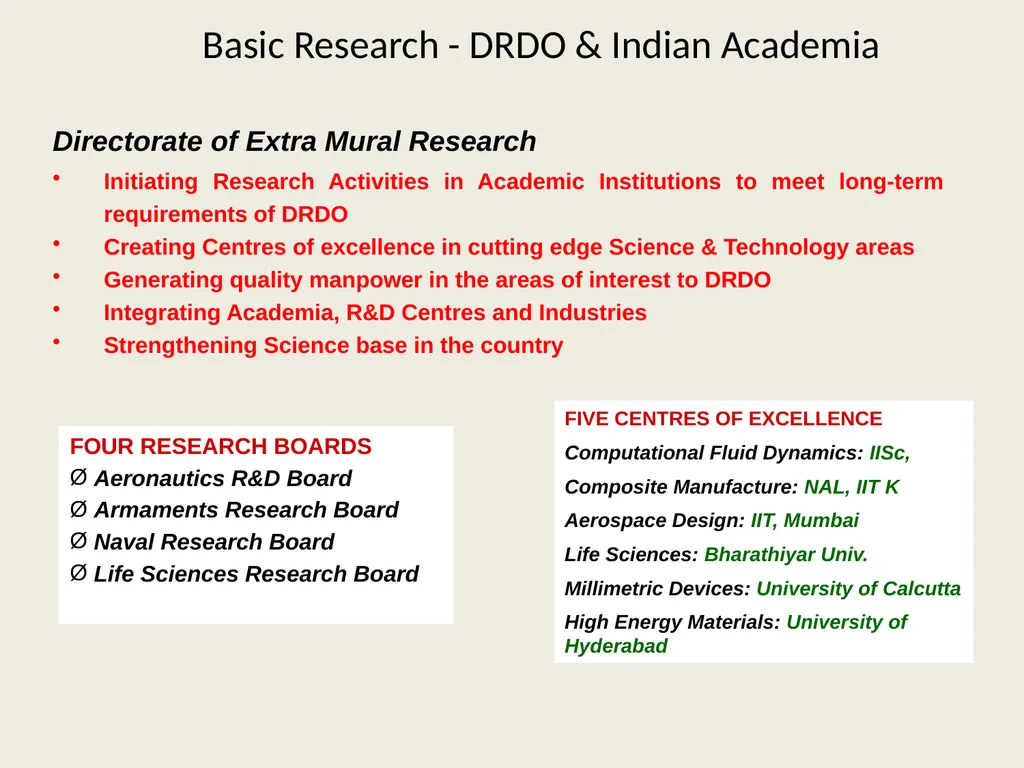
slide16. Basic Research - DRDO & Indian Academia FOUR RESEARCH BOARDS
Aeronautics R&D Board
Armaments Research Board
Naval Research Board
Life Sciences Research Board FIVE CENTRES OF EXCELLENCE
Computational Fluid Dynamics: IISc,
Composite Manufacture: NAL, IIT K
Aerospace Design: IIT, Mumbai
Life Sciences: Bharathiyar Univ.
Millimetric Devices: University of Calcutta
High Energy Materials: University of Hyderabad Directorate of Extra Mural Research
Initiating Research Activities in Academic Institutions to meet long-term requirements of DRDO
Creating Centres of excellence in cutting edge Science & Technology areas
Generating quality manpower in the areas of interest to DRDO
Integrating Academia, R&D Centres and Industries
Strengthening Science base in the country<br>
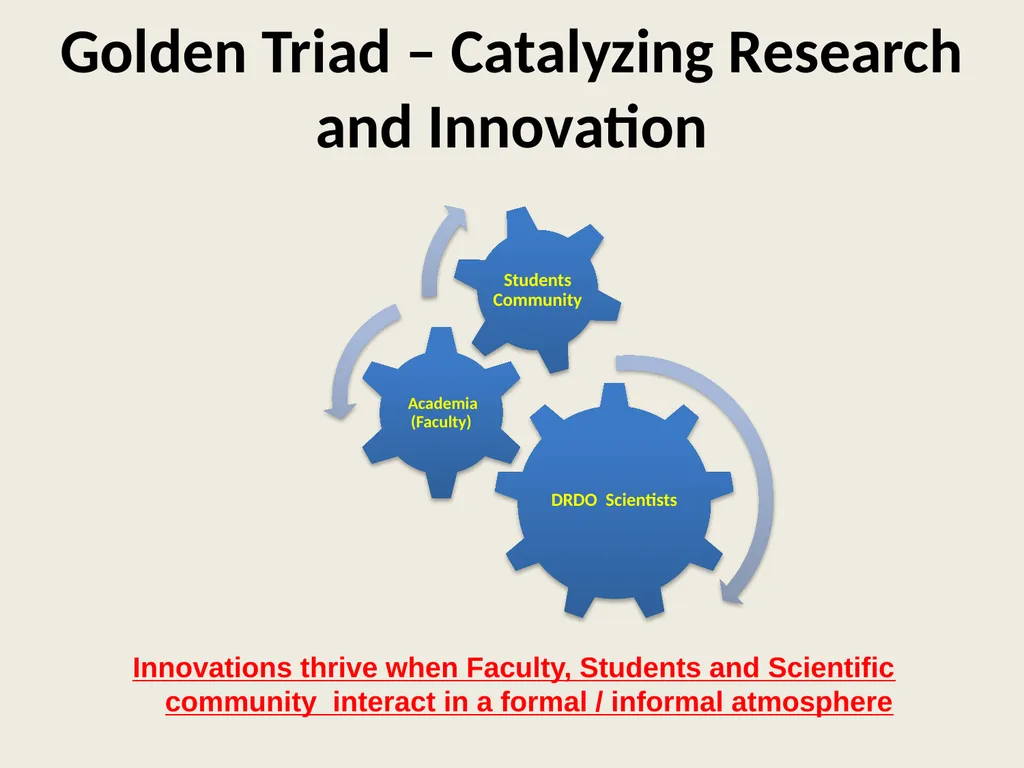
slide17. Golden Triad – Catalyzing Research and Innovation Innovations thrive when Faculty, Students and Scientific community interact in a formal / informal atmosphere<br>
slide18. DRDO Research and Innovation Centre at IIT Madras Research Park It is a ‘New Engagement Model’ to pursue research, both in cutting edge technologies and in the areas of denied technologies.
DRDO to harness the combined strength of Academia, Student community, research fellows, niche technology industries and DRDO scientists to provide impetus to research and innovation.<br>
slide19. DRDO – Industry Partnership<br>
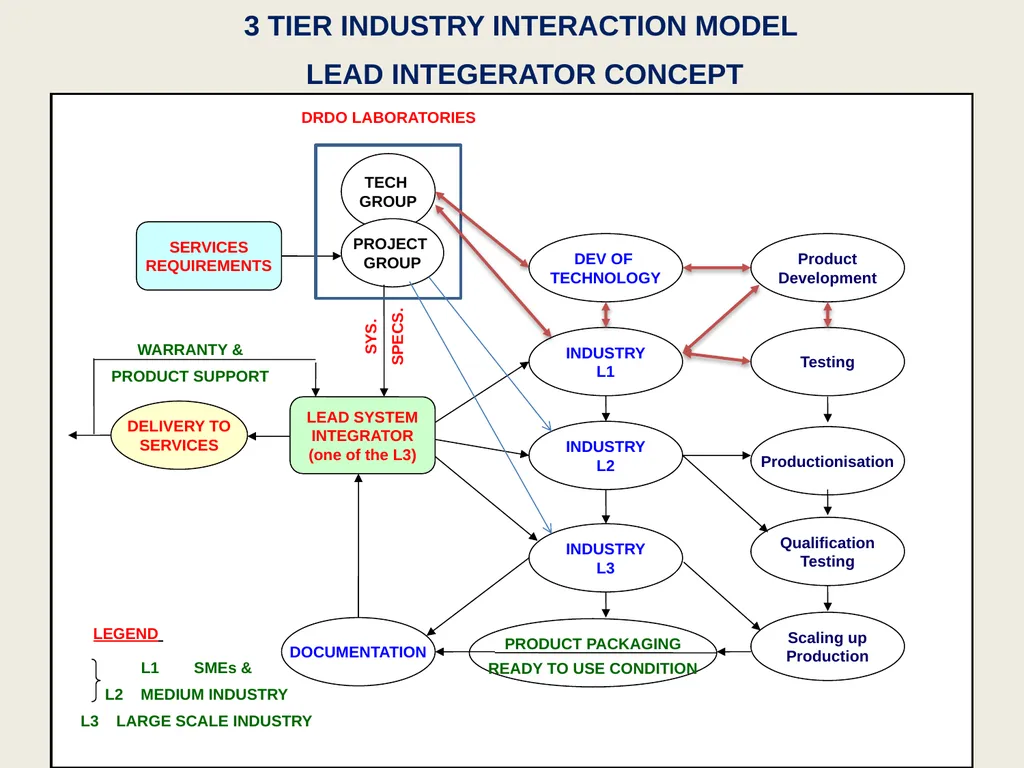
slide20. 3 TIER INDUSTRY INTERACTION MODEL
LEAD INTEGERATOR CONCEPT LEAD SYSTEM
INTEGRATOR
(one of the L3) Product
Development Testing Productionisation Qualification
Testing Scaling up
Production DEV OF
TECHNOLOGY INDUSTRY
L1 INDUSTRY
L2 INDUSTRY
L3 DOCUMENTATION DELIVERY TO
SERVICES TECH
GROUP PROJECT
GROUP DRDO LABORATORIES WARRANTY &
PRODUCT SUPPORT L1 SMEs &
L2 MEDIUM INDUSTRY
L3 LARGE SCALE INDUSTRY LEGEND SERVICES
REQUIREMENTS SYS.
SPECS.<br>
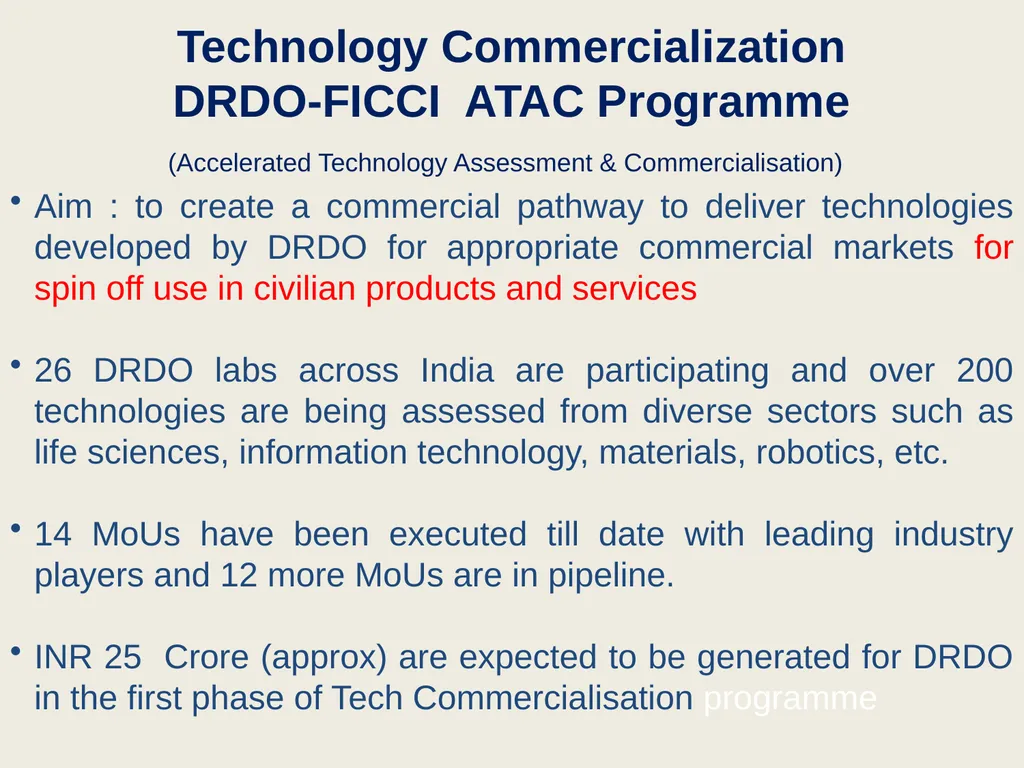
slide21. Technology Commercialization
DRDO-FICCI ATAC Programme
(Accelerated Technology Assessment & Commercialisation) Aim : to create a commercial pathway to deliver technologies developed by DRDO for appropriate commercial markets for spin off use in civilian products and services
26 DRDO labs across India are participating and over 200 technologies are being assessed from diverse sectors such as life sciences, information technology, materials, robotics, etc.
14 MoUs have been executed till date with leading industry players and 12 more MoUs are in pipeline.
INR 25 Crore (approx) are expected to be generated for DRDO in the first phase of Tech Commercialisation programme<br>
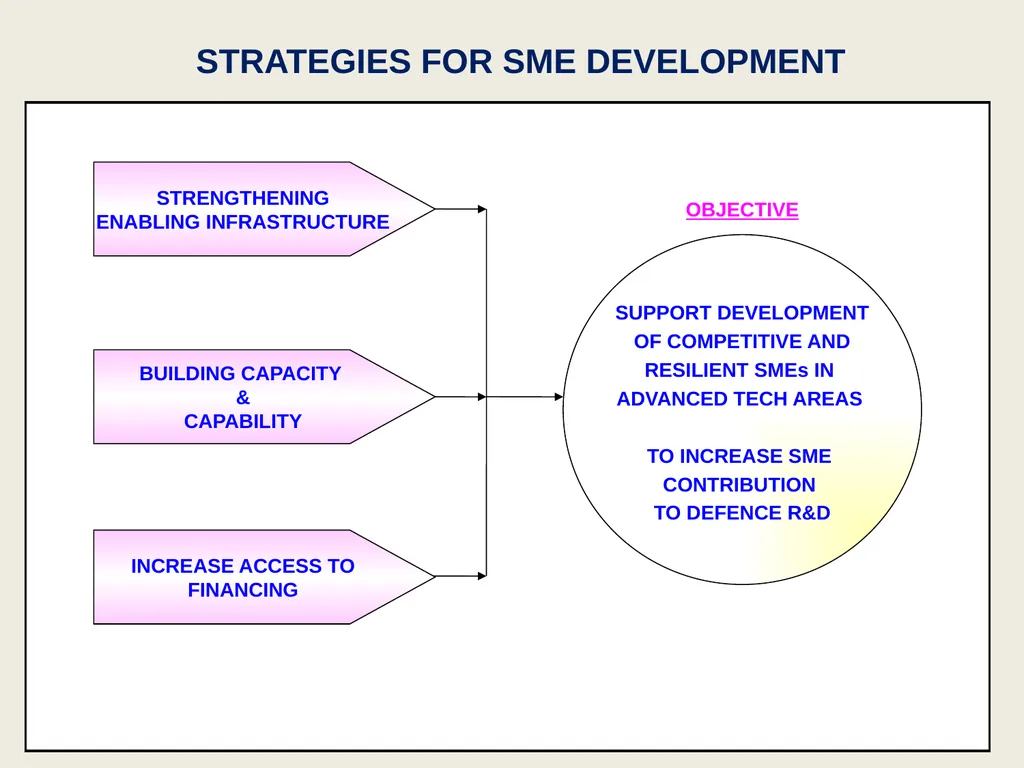
slide22. STRATEGIES FOR SME DEVELOPMENT OBJECTIVE STRENGTHENING
ENABLING INFRASTRUCTURE BUILDING CAPACITY
&
CAPABILITY INCREASE ACCESS TO
FINANCING SUPPORT DEVELOPMENT
OF COMPETITIVE AND
RESILIENT SMEs IN
ADVANCED TECH AREAS
TO INCREASE SME
CONTRIBUTION
TO DEFENCE R&D<br>
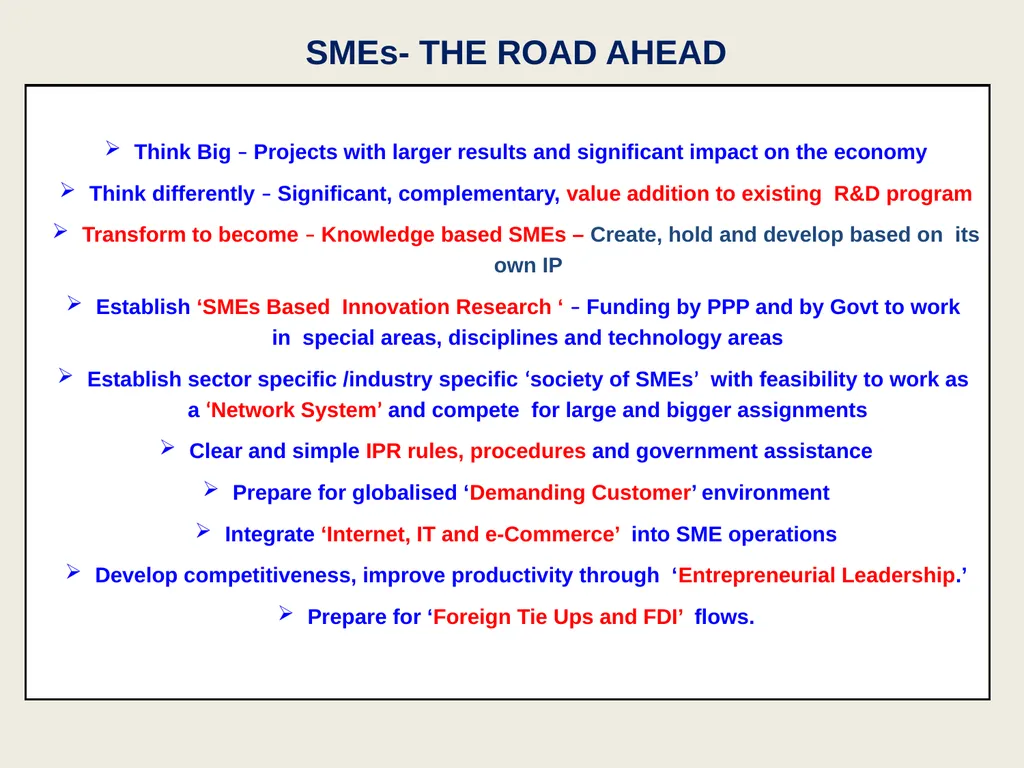
slide23. SMEs- THE ROAD AHEAD Think Big – Projects with larger results and significant impact on the economy
Think differently – Significant, complementary, value addition to existing R&D program
Transform to become – Knowledge based SMEs – Create, hold and develop based on its own IP
Establish ‘SMEs Based Innovation Research ‘ – Funding by PPP and by Govt to work
in special areas, disciplines and technology areas
Establish sector specific /industry specific ‘society of SMEs’ with feasibility to work as
a ‘Network System’ and compete for large and bigger assignments
Clear and simple IPR rules, procedures and government assistance
Prepare for globalised ‘Demanding Customer’ environment
Integrate ‘Internet, IT and e-Commerce’ into SME operations
Develop competitiveness, improve productivity through ‘Entrepreneurial Leadership.’
Prepare for ‘Foreign Tie Ups and FDI’ flows.<br>
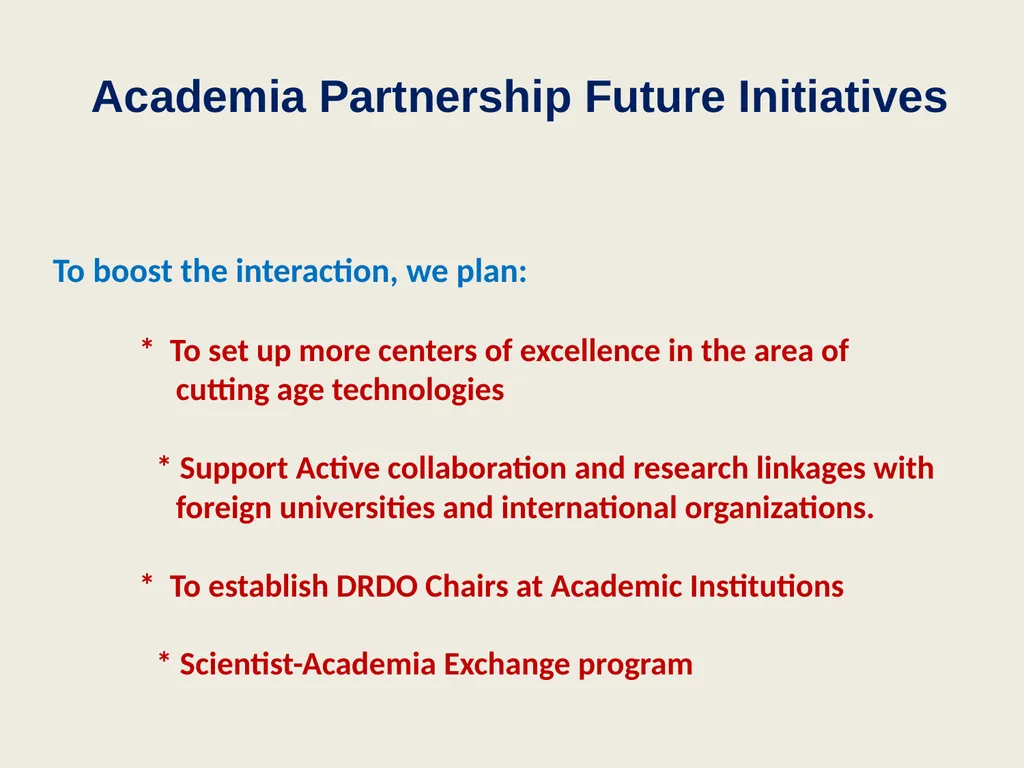
slide24. To boost the interaction, we plan: * To set up more centers of excellence in the area of cutting age technologies * Support Active collaboration and research linkages with foreign universities and international organizations. * To establish DRDO Chairs at Academic Institutions * Scientist-Academia Exchange program Academia Partnership Future Initiatives<br>
slide25. THANK YOU<br>
Director, G-FAST, DRDO<br>
slide2. DRDO Vision
Make India prosperous by establishing world class science and technology base and provide our Defence Services decisive edge by equipping them with internationally competitive systems and solutions.
Mission
Design, develop and lead to production state-of-the-art sensors, weapon systems, platforms and allied equipment for our Defence Services. Provide technological solutions to the Services to optimise combat effectiveness and to promote well-being of the troops. Develop infrastructure and committed quality manpower and build strong indigenous technology base.<br>
slide3. DRDO TECHNOLOGY INITIATIVES Aeronautics
Space Security
Naval and Deep-sea Operations
DE Weapons
Missile Technologies
Unmanned Battlefield
New Generation Sensors
Communication and Network Security
Advanced Materials
LIC
Test & Evaluation Ranges<br>
slide4. Technology Roadmap Drivers-
Armed Forces Vision
Perceived Technology Gaps
Innovations
Strategic Requirements
Threat based Technology Push Demand Pull R&D Plan<br>
slide5. Technology Evolution Model Hypothesis Proof of Concept Prototype Product Use S&T Project
Decision Technical Risk Investment Risk S&T Proposal Engineer
Decision Performance
Enhancement Technology
Advances Design Industry Unfilled
Need Technology
Base Further
Research Publication
or Patent Literature Expected
Results Peer Review Rejection Scientist
Decision Alternate
Hypotheses Un-expected
Discovery Idea Mainstream
Research Loop R&D
Loop Time to User R&D Maturity R&D Velocity<br>
slide6. Technological Development Challenges Dynamics of Technology Development
Environment Technology
Dynamic War Scenarios
Rapid Technology Obsolescence
Technology seeding and enhanced velocity of R&D
Improving the Product Quality
International Competition
Retaining talent<br>
slide7. ‘Takniki Stur’ Metric Technology Maturity thru’ Systems Development TS 1 Basic principles and scientific understanding TS 2 Technology application/ concept formulation TS 3 Proof-of-concept established TS 4 Component level laboratory (bread board) feasibility TS 5 Technology validation in field environment TS 6 Subsystem prototype demonstration in field environment TS 7 System prototype development for field environ. TS 8 TOT & completion of successful field trials TS 9 System fielded with User Technology Maturity Matured Technologies Other Modules/ systems Industry Support Academia User Support<br>
slide8. Technology Evaluation (DATE) Systems/ TD Program S&T Program Technology Gap Assessment Capability Assessment CF CI National Resource Assessment NRI EF IF System Realisability Assessment RIF SIF SRI Subsystem Viability Assessment VI RSF<br>
slide9. Technological Challenges : Underwater and Deep Sea Technologies Operational Depth: Beyond 1000m
Sensor
Wide band / multi band operations
Conformal Arrays
Networked ASW
Synthetic Aperture Sonar
Wire-free Sonar Suite
Stealth
Weapons
Stealth Torpedo
Rapid Airborne Mine Clearance System
ROVs
Deep sea security, search and rescue
Power sources with minimal thermal, electromagnetic, acoustic, or visual signature : Batteries, fuel cells, small nuclear power generators<br>
slide10. Technological Challenges : DEW HPM
Ground based, e-bomb, satellite based
Phase Locking of HPM Generators - Technology
High Energy Laser
Precision Beam Control
High Bandwidth Adaptive Optics
Fiber Laser, incoherent beam combination<br>
slide11. Technological Challenges : New Generation Sensors Photonics
Solar Blind UV FPA
IR detectors - Dual band, tunable & adaptive
THz Source & Detectors
mmW Sensors
MEMS & NEMS
Si nano-gyroscope
micro-channel plate
micro-needle
tunable Si diffraction grating
Smart Dust Sensors
Energy Scavenging Sensors
Nano-technology Enabled Sensors
CNT based bio-sensors<br>
slide12. Innovation The successful generation and use of new technologies, processes or services for a decisive military capability.<br>
slide13. Innovation Strategy Vision of Future Military Capability and Technology Requirements : ‘Defence Technology Vision 2050’
Medium- and Long-Term Science and Technology Development Plan S&T ROADMAP, Technology Development Strategy
Indigenous Development of Cutting Edge Technology in Partnership with Academia & Industry
Joint Efforts with National Labs & University Research Centres for promoting basic Research.
Develop strong Defence Industrial Base: SMEs
Collaborative Development with foreign Partners for Major Weapon Platforms / Systems.<br>
slide14. Technology Development Strategy Technology strategy – to cover a period of 30 years
Identify technologies to cover national security needs of present & future (dynamically updated)
create centers of excellence – in about 50 identified technology areas Criteria - technology strategy
Academia, industry & DRDO to form strong consortia
Development of technology under mission mode
Long term planning for high end technology base leading to products matching with user perspective plan
Create production infrastructure in technology denial areas 0 500 1000 1500 2000 2500 3000 3500 4000 4500 5000 5500 6000 0 5 10 15 20 25 30 60 % 25 % 10 % 5 % TIME (YERS) INVESTMENT YEARLY BUDGET (Cr) LARGE SCALE INDUSTRY MEDIUM SCALE INDUSTRY SME DRDO 8 7 18 New systems at competetive cost New products processes innovations Ideas & concepts Dev of new products / systems Science based projects Technology maturation projects New Product dev projects System level projects Universities Universities + SMEs + R&D R&D + Industry + user R&D + Industry + User services “Make” category systems<br>
slide15. DRDO – Academia Partnership<br>
slide16. Basic Research - DRDO & Indian Academia FOUR RESEARCH BOARDS
Aeronautics R&D Board
Armaments Research Board
Naval Research Board
Life Sciences Research Board FIVE CENTRES OF EXCELLENCE
Computational Fluid Dynamics: IISc,
Composite Manufacture: NAL, IIT K
Aerospace Design: IIT, Mumbai
Life Sciences: Bharathiyar Univ.
Millimetric Devices: University of Calcutta
High Energy Materials: University of Hyderabad Directorate of Extra Mural Research
Initiating Research Activities in Academic Institutions to meet long-term requirements of DRDO
Creating Centres of excellence in cutting edge Science & Technology areas
Generating quality manpower in the areas of interest to DRDO
Integrating Academia, R&D Centres and Industries
Strengthening Science base in the country<br>
slide17. Golden Triad – Catalyzing Research and Innovation Innovations thrive when Faculty, Students and Scientific community interact in a formal / informal atmosphere<br>
slide18. DRDO Research and Innovation Centre at IIT Madras Research Park It is a ‘New Engagement Model’ to pursue research, both in cutting edge technologies and in the areas of denied technologies.
DRDO to harness the combined strength of Academia, Student community, research fellows, niche technology industries and DRDO scientists to provide impetus to research and innovation.<br>
slide19. DRDO – Industry Partnership<br>
slide20. 3 TIER INDUSTRY INTERACTION MODEL
LEAD INTEGERATOR CONCEPT LEAD SYSTEM
INTEGRATOR
(one of the L3) Product
Development Testing Productionisation Qualification
Testing Scaling up
Production DEV OF
TECHNOLOGY INDUSTRY
L1 INDUSTRY
L2 INDUSTRY
L3 DOCUMENTATION DELIVERY TO
SERVICES TECH
GROUP PROJECT
GROUP DRDO LABORATORIES WARRANTY &
PRODUCT SUPPORT L1 SMEs &
L2 MEDIUM INDUSTRY
L3 LARGE SCALE INDUSTRY LEGEND SERVICES
REQUIREMENTS SYS.
SPECS.<br>
slide21. Technology Commercialization
DRDO-FICCI ATAC Programme
(Accelerated Technology Assessment & Commercialisation) Aim : to create a commercial pathway to deliver technologies developed by DRDO for appropriate commercial markets for spin off use in civilian products and services
26 DRDO labs across India are participating and over 200 technologies are being assessed from diverse sectors such as life sciences, information technology, materials, robotics, etc.
14 MoUs have been executed till date with leading industry players and 12 more MoUs are in pipeline.
INR 25 Crore (approx) are expected to be generated for DRDO in the first phase of Tech Commercialisation programme<br>
slide22. STRATEGIES FOR SME DEVELOPMENT OBJECTIVE STRENGTHENING
ENABLING INFRASTRUCTURE BUILDING CAPACITY
&
CAPABILITY INCREASE ACCESS TO
FINANCING SUPPORT DEVELOPMENT
OF COMPETITIVE AND
RESILIENT SMEs IN
ADVANCED TECH AREAS
TO INCREASE SME
CONTRIBUTION
TO DEFENCE R&D<br>
slide23. SMEs- THE ROAD AHEAD Think Big – Projects with larger results and significant impact on the economy
Think differently – Significant, complementary, value addition to existing R&D program
Transform to become – Knowledge based SMEs – Create, hold and develop based on its own IP
Establish ‘SMEs Based Innovation Research ‘ – Funding by PPP and by Govt to work
in special areas, disciplines and technology areas
Establish sector specific /industry specific ‘society of SMEs’ with feasibility to work as
a ‘Network System’ and compete for large and bigger assignments
Clear and simple IPR rules, procedures and government assistance
Prepare for globalised ‘Demanding Customer’ environment
Integrate ‘Internet, IT and e-Commerce’ into SME operations
Develop competitiveness, improve productivity through ‘Entrepreneurial Leadership.’
Prepare for ‘Foreign Tie Ups and FDI’ flows.<br>
slide24. To boost the interaction, we plan: * To set up more centers of excellence in the area of cutting age technologies * Support Active collaboration and research linkages with foreign universities and international organizations. * To establish DRDO Chairs at Academic Institutions * Scientist-Academia Exchange program Academia Partnership Future Initiatives<br>
slide25. THANK YOU<br>