Definitions Radiation is a process in which energetic particles or energetic waves travel through vacuum or media. Radiobiology (also known as radiation biology) is the study of the action of ionizing radiation on living things. The history
"Definitions Radiation is a process in which" is the property of its rightful owner. Permission is granted to
download and print the materials on this website for personal, non-commercial use only, and to display it
on your personal computer provided you do not modify the materials and that you retain all copyright
notices contained in the materials. By downloading content from our website, you accept the terms of this
agreement.
Presentation Transcript
01
Definitions Radiation is a process in which energetic particles or energetic waves travel through vacuum or media.
Radiobiology (also known as radiation biology) is the study of the action of ionizing radiation on living things.<br>
02
The history of discovery of different types of radiation can be summarized as follows:
* Sir Frederick William Herschel (German, 1738-1822) discovered planet Uranus & its major moons (Titania and Oberon). He was the first person who discovers infrared radiation.
* Johann Wilhelm Ritter, 1776 – 1810, Germany, discovered Ultraviolet. * Heinrich Hertz (German 1857 – 1894) detected Radio waves therefore, some prefer to call Hertz the “Father of Radio” and the unit of radio frequency is called the “hertz”. History<br>
03
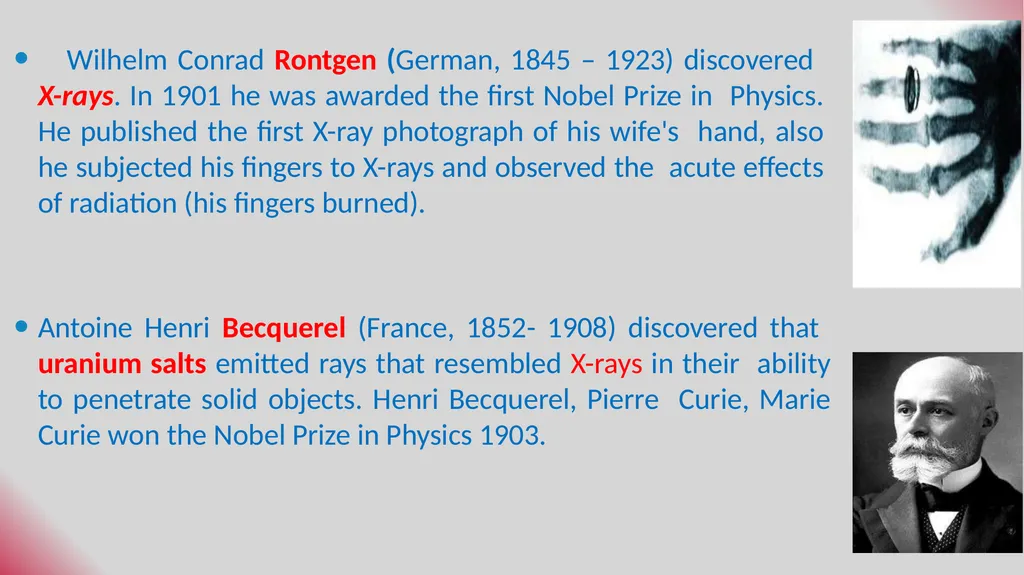
Wilhelm Conrad Rontgen (German, 1845 – 1923) discovered X-rays. In 1901 he was awarded the first Nobel Prize in Physics. He published the first X-ray photograph of his wife's hand, also he subjected his fingers to X-rays and observed the acute effects of radiation (his fingers burned). Antoine Henri Becquerel (France, 1852- 1908) discovered that uranium salts emitted rays that resembled X-rays in their ability to penetrate solid objects. Henri Becquerel, Pierre Curie, Marie Curie won the Nobel Prize in Physics 1903.<br>
04
Ernest Rutherford (1871-1937)
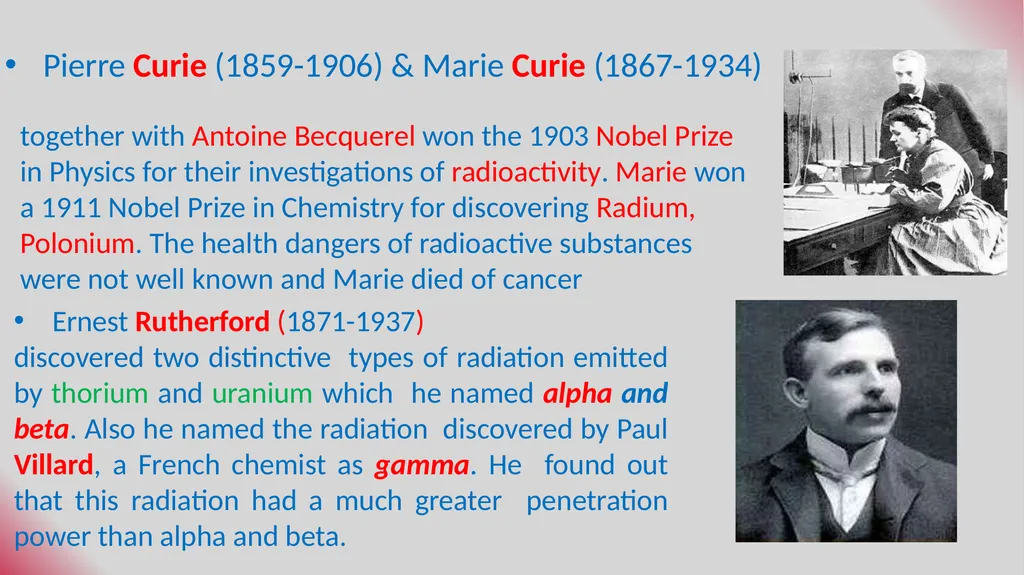
discovered two distinctive types of radiation emitted by thorium and uranium which he named alpha and beta. Also he named the radiation discovered by Paul Villard, a French chemist as gamma. He found out that this radiation had a much greater penetration power than alpha and beta. Pierre Curie (1859-1906) & Marie Curie (1867-1934) together with Antoine Becquerel won the 1903 Nobel Prize in Physics for their investigations of radioactivity. Marie won a 1911 Nobel Prize in Chemistry for discovering Radium, Polonium. The health dangers of radioactive substances were not well known and Marie died of cancer<br>
05
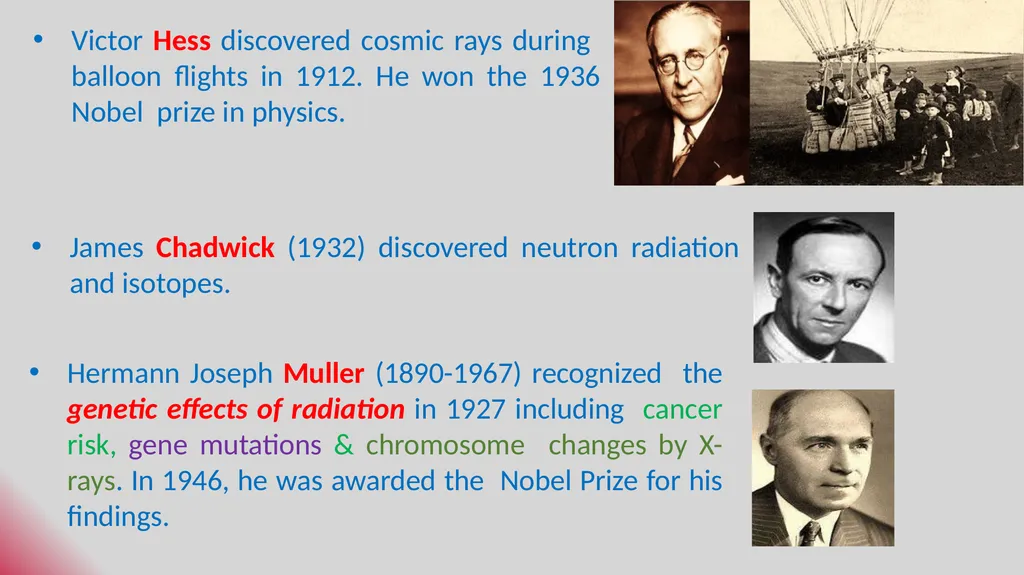
Victor Hess discovered cosmic rays during balloon flights in 1912. He won the 1936 Nobel prize in physics. James Chadwick (1932) discovered neutron radiation and isotopes. Hermann Joseph Muller (1890-1967) recognized the genetic effects of radiation in 1927 including cancer risk, gene mutations & chromosome changes by X-rays. In 1946, he was awarded the Nobel Prize for his findings.<br>
06
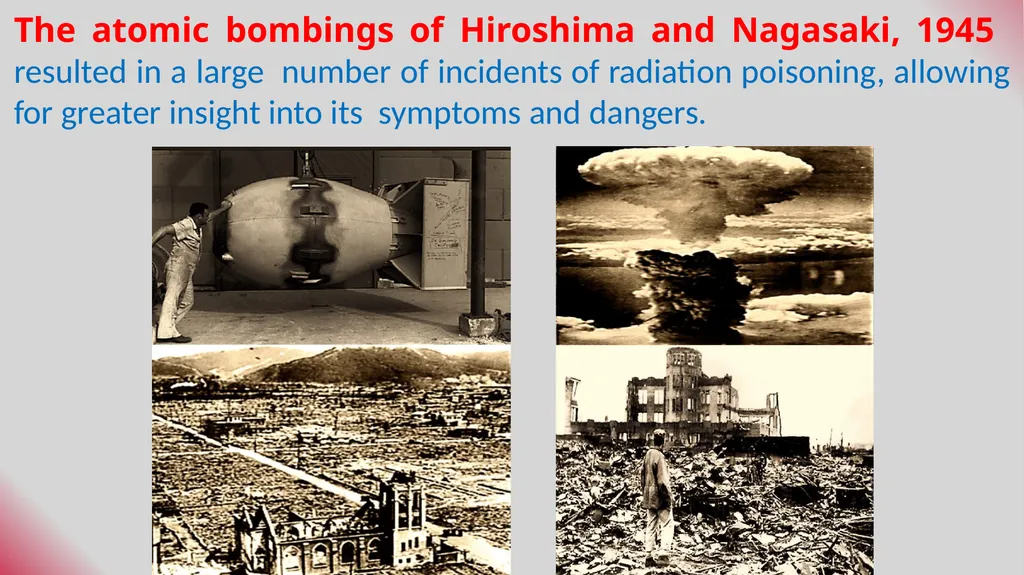
The atomic bombings of Hiroshima and Nagasaki, 1945 resulted in a large number of incidents of radiation poisoning, allowing for greater insight into its symptoms and dangers.<br>
07
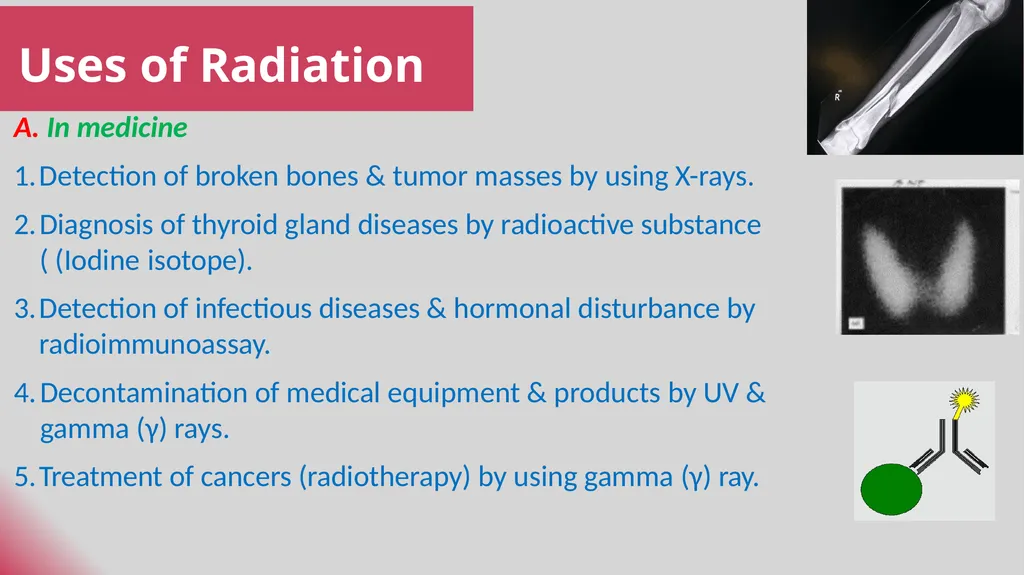
Uses of Radiation A. In medicine
Detection of broken bones & tumor masses by using X-rays.
Diagnosis of thyroid gland diseases by radioactive substance ( (Iodine isotope).
Detection of infectious diseases & hormonal disturbance by radioimmunoassay.
Decontamination of medical equipment & products by UV & gamma (γ) rays.
Treatment of cancers (radiotherapy) by using gamma (γ) ray.<br>
08
B- In communication
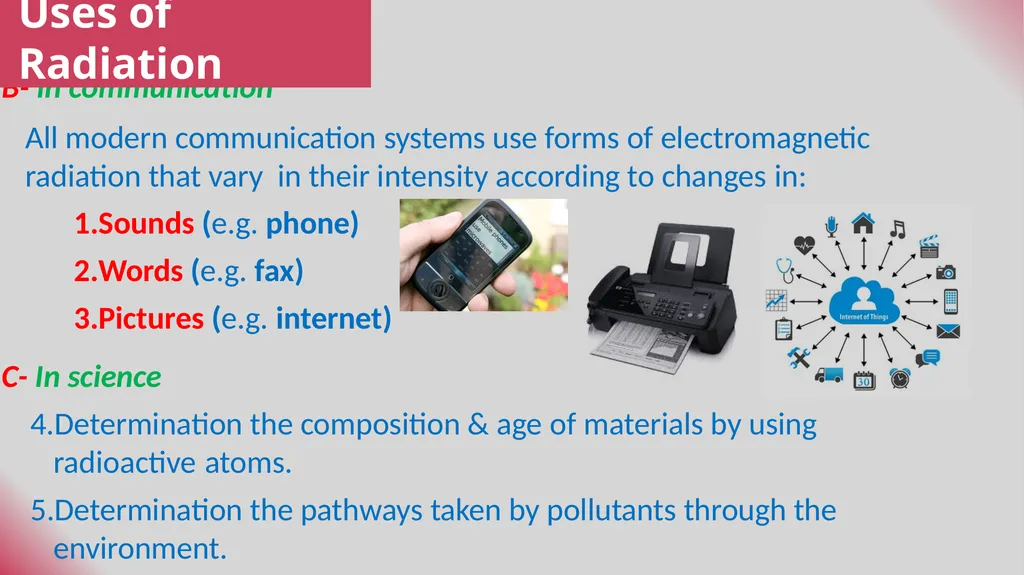
All modern communication systems use forms of electromagnetic radiation that vary in their intensity according to changes in:
Sounds (e.g. phone)
Words (e.g. fax)
Pictures (e.g. internet)
C- In science
Determination the composition & age of materials by using radioactive atoms.
Determination the pathways taken by pollutants through the environment. Uses of Radiation<br>
09
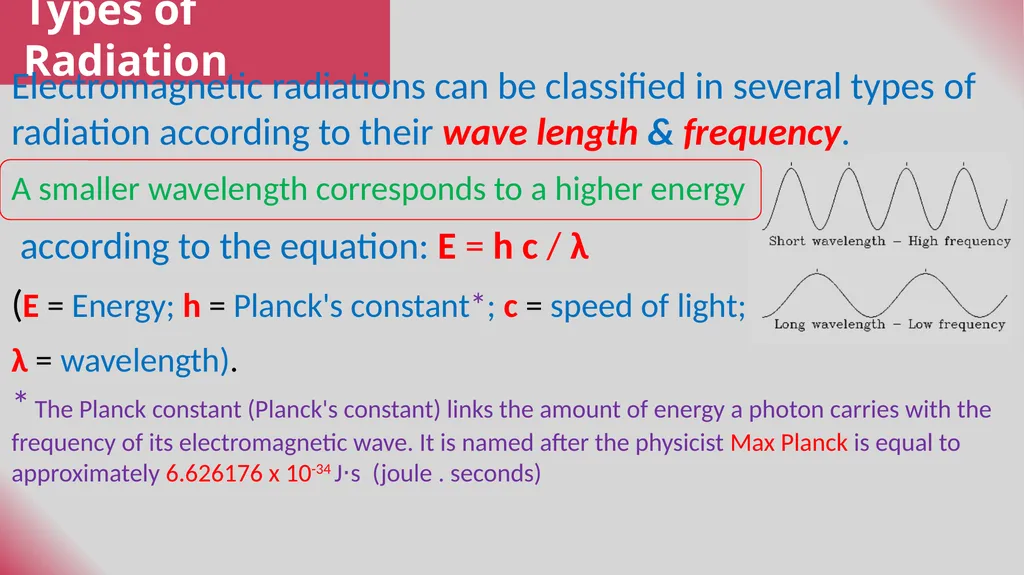
Types of Radiation Electromagnetic radiations can be classified in several types of radiation according to their wave length & frequency.
A smaller wavelength corresponds to a higher energy
according to the equation: E = h c / λ
(E = Energy; h = Planck's constant*; c = speed of light;
λ = wavelength).
* The Planck constant (Planck's constant) links the amount of energy a photon carries with the frequency of its electromagnetic wave. It is named after the physicist Max Planck is equal to approximately 6.626176 x 10⁻³⁴ J⋅s (joule . seconds)<br>
10
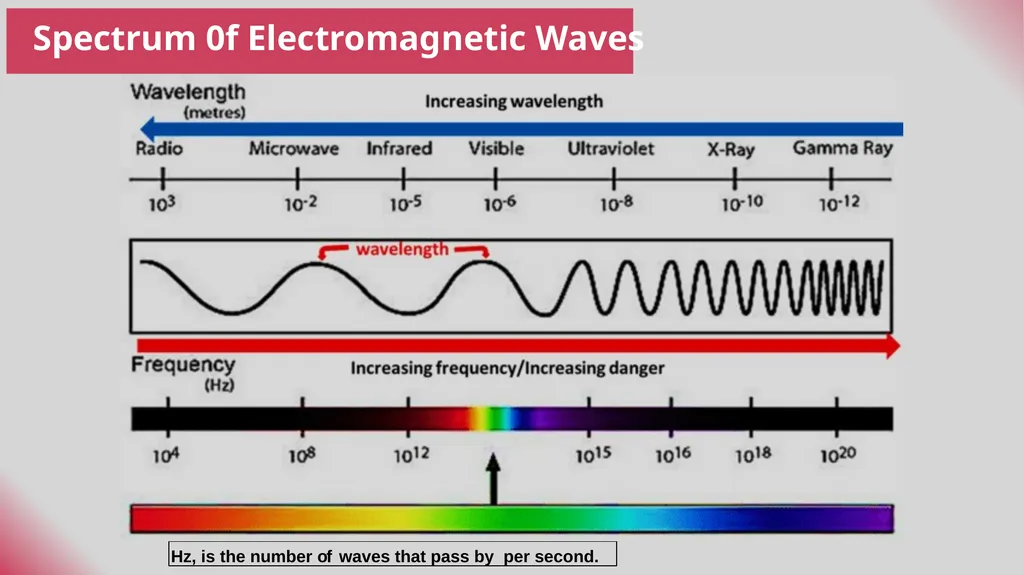
Spectrum 0f Electromagnetic Waves Hz, is the number of waves that pass by per second.<br>
11
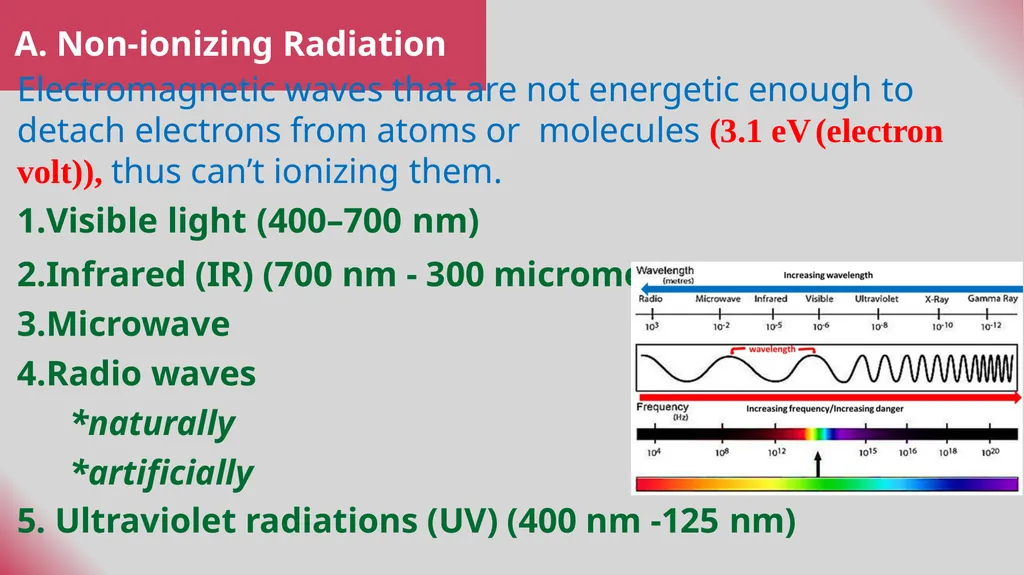
A. Non-ionizing Radiation Electromagnetic waves that are not energetic enough to detach electrons from atoms or molecules (3.1 eV (electron volt)), thus can’t ionizing them.
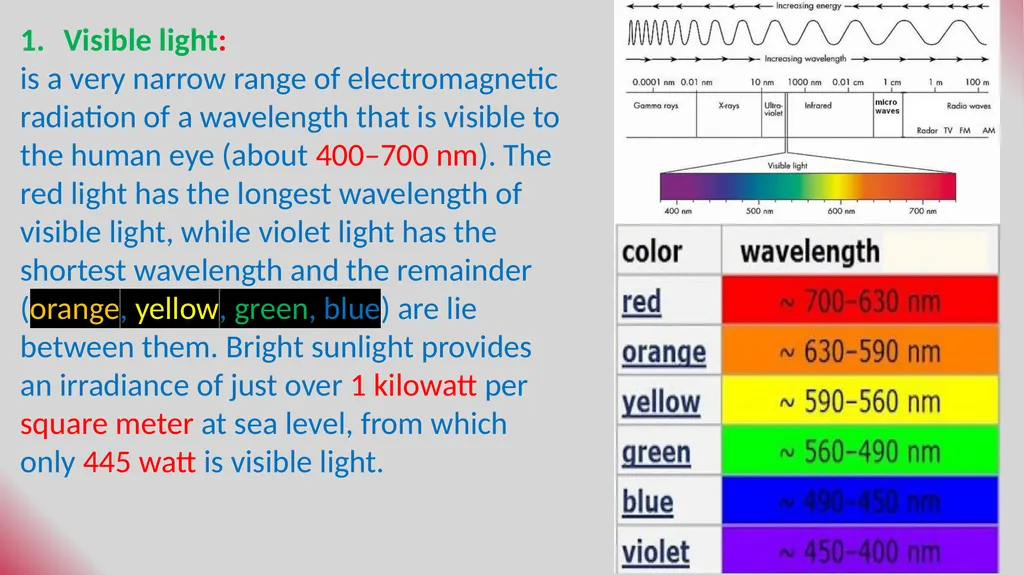
Visible light (400–700 nm)
Infrared (IR) (700 nm - 300 micrometers)
Microwave
Radio waves
*naturally
*artificially
5. Ultraviolet radiations (UV) (400 nm -125 nm)<br>
12
Visible light:
is a very narrow range of electromagnetic radiation of a wavelength that is visible to the human eye (about 400–700 nm). The red light has the longest wavelength of visible light, while violet light has the shortest wavelength and the remainder (orange, yellow, green, blue) are lie between them. Bright sunlight provides an irradiance of just over 1 kilowatt per square meter at sea level, from which only 445 watt is visible light.<br>
13
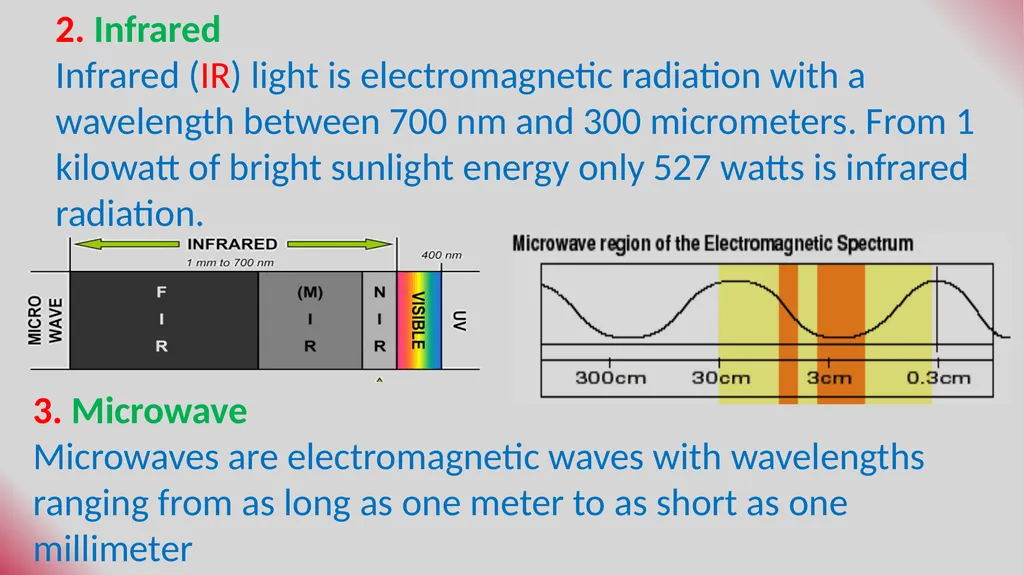
2. Infrared
Infrared (IR) light is electromagnetic radiation with a wavelength between 700 nm and 300 micrometers. From 1 kilowatt of bright sunlight energy only 527 watts is infrared radiation. 3. Microwave
Microwaves are electromagnetic waves with wavelengths ranging from as long as one meter to as short as one millimeter<br>
14
4. Radio waves
Radio waves have the longest wavelength among the non-ionizing radiation waves that reach to thousands meters. They are either
*Naturally occurring radio waves that are resulted from lightning
and astronomical objects,
*Artificially generated to be used for (fixed & mobile communication, broadcasting, radar, satellite communication, and computer networks).
5. Ultraviolet radiations (UV)
Ultraviolet radiation has the shortest wavelength among the non-ionizing radiation waves that lie between 400 nm and 125 nm. From 1 kilowatt of bright sunlight energy, only 32 watt is UV radiation. UV radiation is considered as non-ionizing radiation because its energy is less than binding energy of the outer electron to an atom which is equal to 3.1 electron volt (eV), so it can’t detach electron from its atom but it can cause excitation in biological system and resulting in serious damage.<br>
15
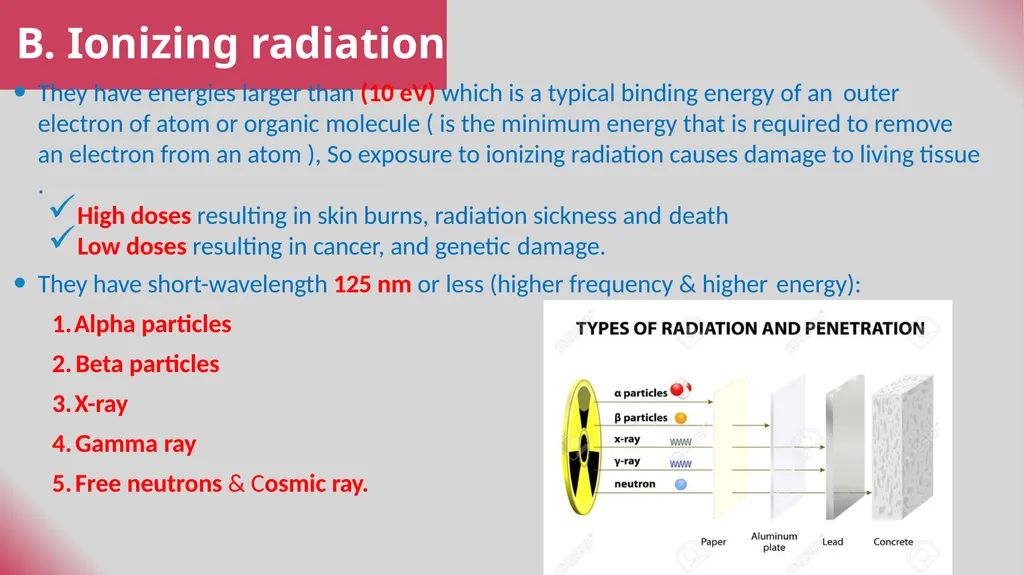
B. Ionizing radiation They have energies larger than (10 eV) which is a typical binding energy of an outer electron of atom or organic molecule ( is the minimum energy that is required to remove an electron from an atom ), So exposure to ionizing radiation causes damage to living tissue .
High doses resulting in skin burns, radiation sickness and death
Low doses resulting in cancer, and genetic damage.
They have short-wavelength 125 nm or less (higher frequency & higher energy):
Alpha particles
Beta particles
X-ray
Gamma ray
Free neutrons & Cosmic ray.<br>