Demystifying Grant BudgetS Dorothy Warner Director, Office of Sponsored and Student Research 2023 - 2024 1 Whats the Big deal about budgets? Bottom line you are asking for money Externally with the funder The budget becomes the financial
"Demystifying Grant BudgetS Dorothy Warner" is the property of its rightful owner. Permission is granted to
download and print the materials on this website for personal, non-commercial use only, and to display it
on your personal computer provided you do not modify the materials and that you retain all copyright
notices contained in the materials. By downloading content from our website, you accept the terms of this
agreement.
Presentation Transcript
01
Demystifying Grant BudgetS Dorothy Warner
Director, Office of Sponsored and Student Research
2023 - 2024 1<br>
02
What’s the Big deal about budgets? Bottom line – you are asking for money
Externally with the funder
The budget becomes the financial basis for your grant agreement
IF you are the PI/project manager, make sure funds are spent appropriately
Internally
Budgets let your chair/Supervisor know – in advance – how you might be spending part of your time. They can start planning.
Finance can make sure that the budget is compliant with various rules and regulations
We pay special attention to match/cost-share requirements and indirect costs 2<br>
03
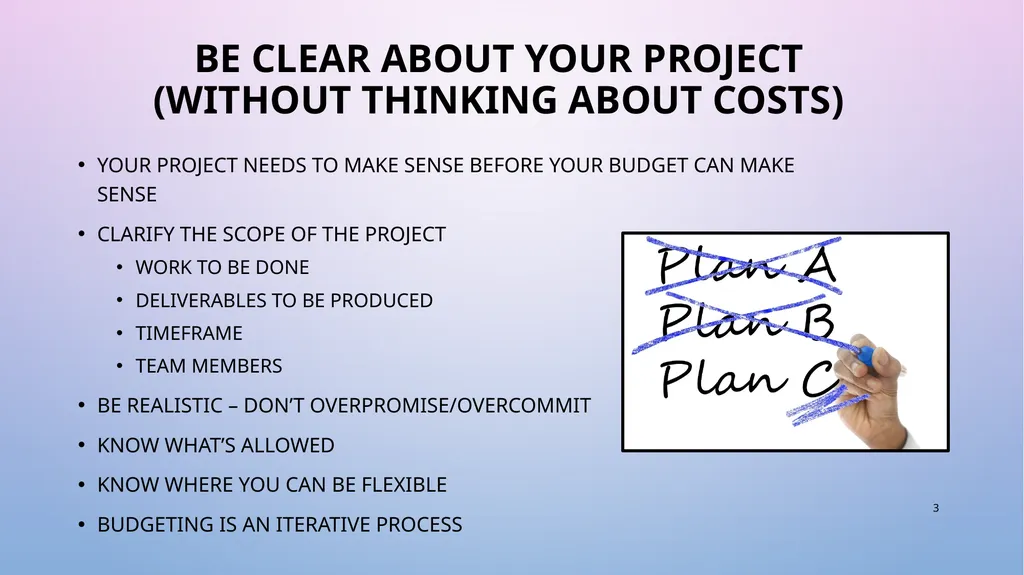
Be Clear About Your Project (Without Thinking about Costs) Your project needs to make sense before your budget can make sense
Clarify the scope of the project
Work to be done
Deliverables to be produced
Timeframe
Team members
Be realistic – don’t overpromise/overcommit
Know what’s allowed
Know where you can be flexible
Budgeting is an iterative process 3<br>
04
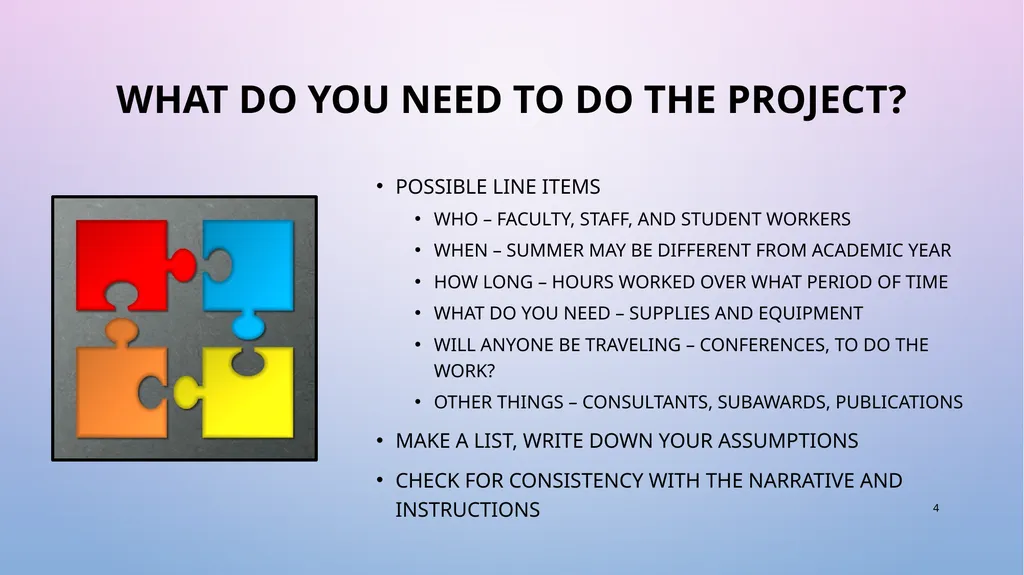
What do You Need to do the Project? Possible Line Items
Who – Faculty, staff, and student workers
When – Summer may be different from academic year
How long – Hours worked over what period of time
What do you need – Supplies and equipment
Will anyone be traveling – Conferences, to do the work?
Other things – Consultants, subawards, publications
Make a list, write down your assumptions
Check for consistency with the narrative and instructions 4<br>
05
Do Your Research Talk with colleagues
Be as realistic as possible – get vendor quotes, look at past grants
If a match/cost-share is required, talk (Early) with Department Chairs, Deans, and others about possible sources of match/cost-share funds
Don’t assume that things are the same as last time
Start early so you can let it sit and come back to it
Budgets are plans based on the best information you have at the time – actual spending will be different (and funders know that) 5<br>
06
Start Using Numbers Write down your assumptions/how the numbers are calculated
Develop a baseline scenario
Make incremental changes to that baseline scenario
Pay attention to funding limits/restrictions
Only include match/cost-share if required, aim to hit the required amount
Direct vs indirect costs - Remember indirect/F&A/Overhead, if allowed!
Keep cross-checking against the narrative and the funder’s requirements 6<br>
07
Common Types of Expenses Salaries/course releases
Fringe benefits
Supplies – consumables
Equipment - $5,000+ and 1+ years of useful life
Meals/travel/lodging
Consultants/vendors
Stipends/honoraria
Publications
Indirect costs – federally-negotiated rate or other as/if allowed by the funder
Matching funds (if required) 7<br>
08
Use Valpo’s Budget Spreadsheet template Organized by types of expense
Add rows to include more people, more supplies, etc.
Add columns for more years and for match/cost-share
WE have standard ways to calculate course releases, fringe benefits, indirect costs, etc.
Has formulas to calculate totals
Excel is your friend! 8<br>
09
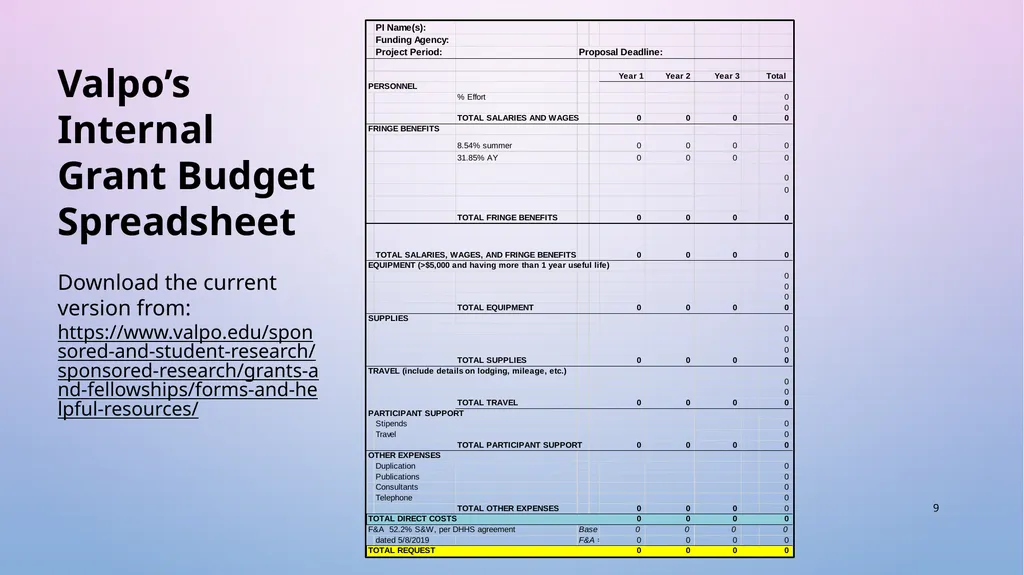
9 Valpo’s Internal Grant Budget Spreadsheet
Download the current version from:
https://www.valpo.edu/sponsored-and-student-research/sponsored-research/grants-and-fellowships/forms-and-helpful-resources/<br>
10
Budget Justification/Narrative Required by all funders, in one way or another
Provides the specifics of how your budget is developed
Explain your assumptions and calculations
must match your budget numbers! And your project narrative!
Find a fresh pair of eyes to review 10<br>
11
Remember Budgets MUST be:
Reasonable and realistic
Justified and justifiable
Consistent with funder, Valpo, and
government guidelines
They need NOT be Perfect 11<br>
12
More Things to Remember Internal review process (GPAF) focuses on budget issues – 5+ business days before deadline
Once awarded, it may be possible to re-budget
Instructions, forms, policies, and helpful resources (including the budget template, a sample budget, and sample budget narrative) are available at: https://www.valpo.edu/sponsored-and-student-research/ 12<br>
13
Budgets – Resources The Office of Sponsored and Student Research is here to help!