Department of Applied Science (Physics) Syllabus of Engineering Physics 1. Wave Optics: Newtons Rings, Michelsons Interferometer, Fraunhofer Diffraction from a Single Slit. Diffraction grating: Construction, theory and spectrum, Resolving
"Department of Applied Science (Physics) Syllabus" is the property of its rightful owner. Permission is granted to
download and print the materials on this website for personal, non-commercial use only, and to display it
on your personal computer provided you do not modify the materials and that you retain all copyright
notices contained in the materials. By downloading content from our website, you accept the terms of this
agreement.
Presentation Transcript
01
Department of Applied Science (Physics)<br>
02
Syllabus of Engineering Physics 1. Wave Optics:
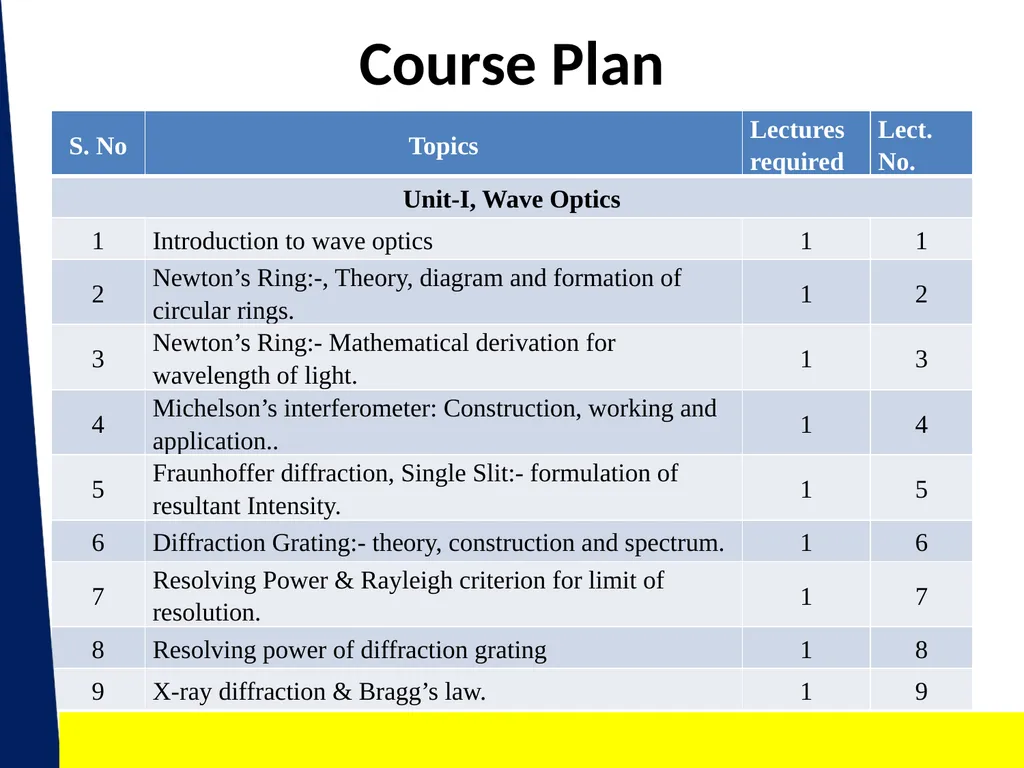
Newton’s Rings, Michelson’s Interferometer, Fraunhofer Diffraction from a Single Slit. Diffraction grating: Construction, theory and spectrum, Resolving power and Rayleigh criterion for limit of resolution, Resolving power of diffraction grating, X-Ray diffraction and Bragg’s Law.
2. Quantum Mechanics:
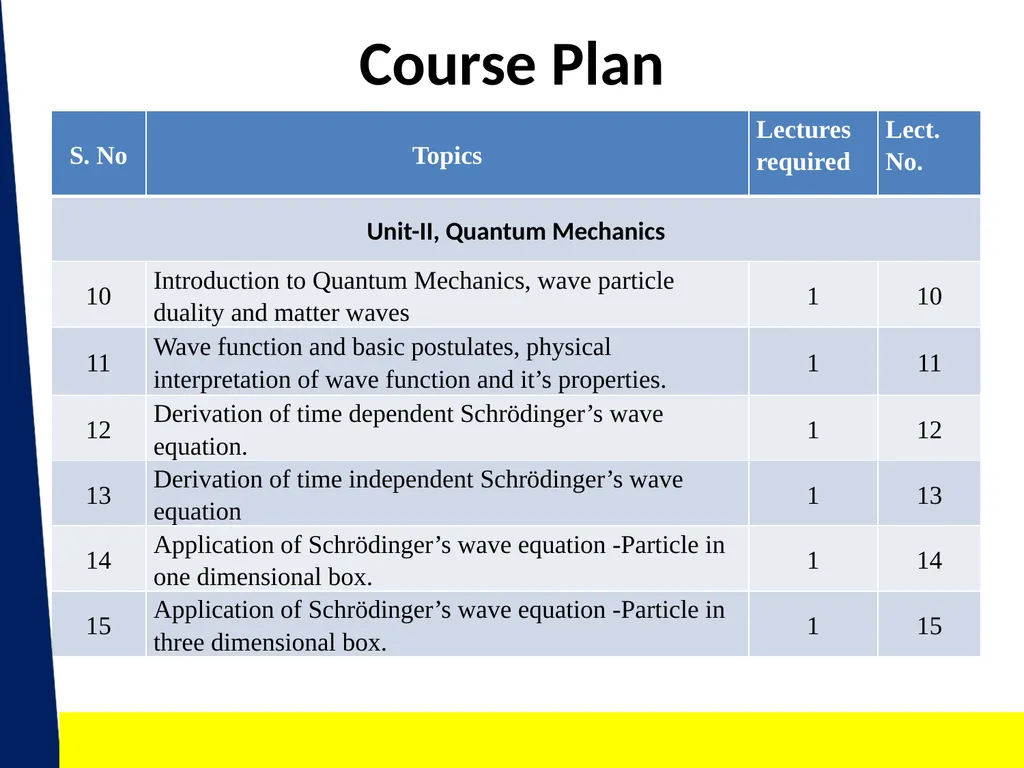
Introduction to quantum Mechanics, Wave-particle duality, Matter waves, Wave function and basic postulates, Time dependent and time independent Schrodinger’s Wave Equation, Physical interpretation of wave function and its properties, Applications of the Schrodinger’s Equation: Particle in one dimensional and three dimensional boxes.<br>
03
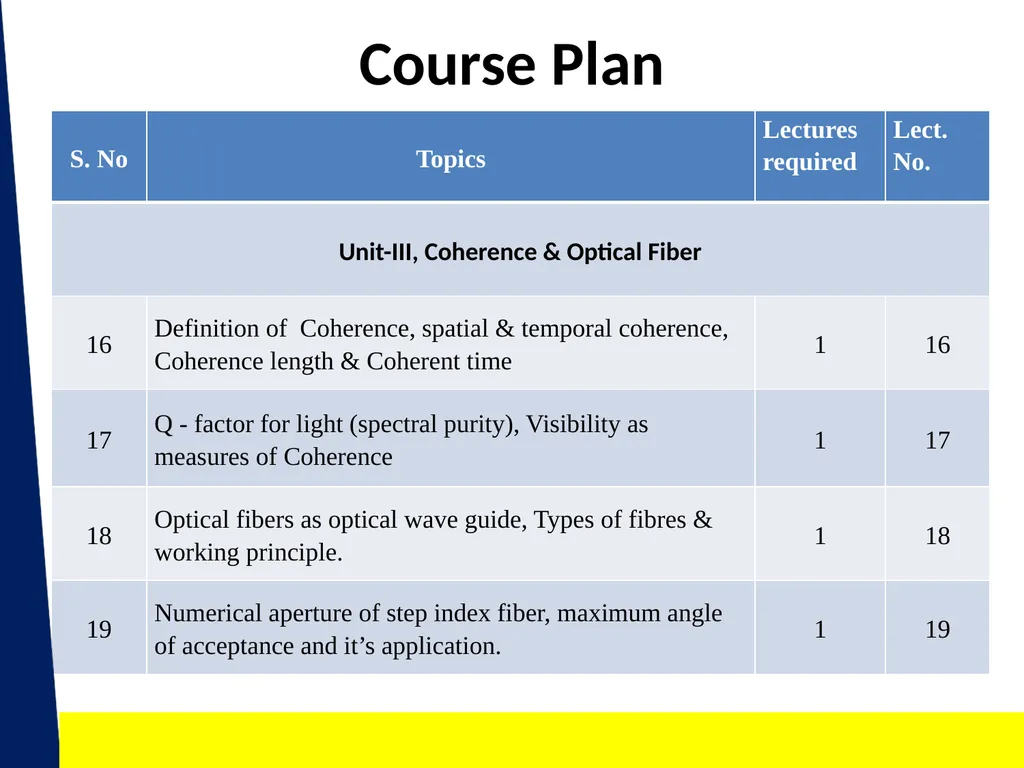
3 Coherence and Optical Fibers:
Spatial and temporal coherence: Coherence length; Coherence
time and ‘Q’ factor for light, Visibility as a measure of
Coherence and spectral purity, Optical fiber as optical wave
guide, Numerical aperture; Maximum angle of acceptance
and applications of optical fiber.
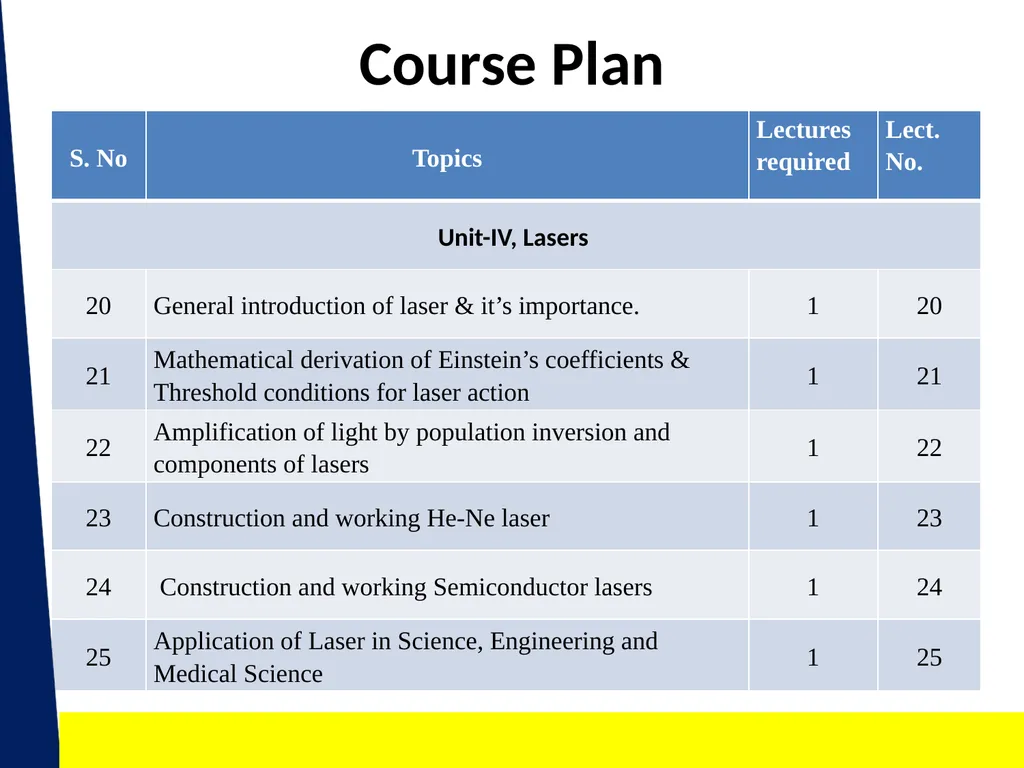
4. Laser:
Einstein’s Theory of laser action; Einstein’s coefficients;
Properties of Laser beam, Amplification of light by
population inversion, Components of laser, Construction
and working of He-Ne and semiconductor lasers,
Applications of Lasers in Science, engineering and medicine.<br>
04
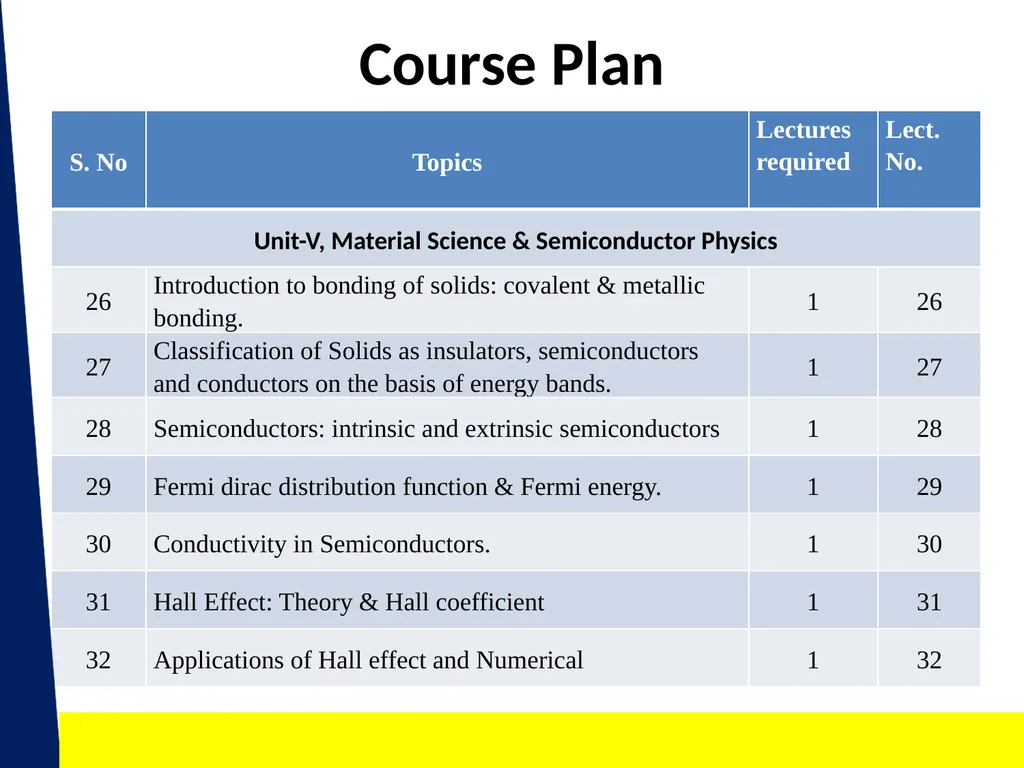
5 Material Science & Semiconductor Physics:
Bonding in solids: covalent and metallic bonding, Energy
bands in solids: Classification of solids as Insulators,
Semiconductors and Conductors, Intrinsic and extrinsic
semiconductors, Fermi dirac distribution function and Fermi
energy, Conductivity in semiconductors, Hall Effect:
Theory, Hall Coefficient and applications.
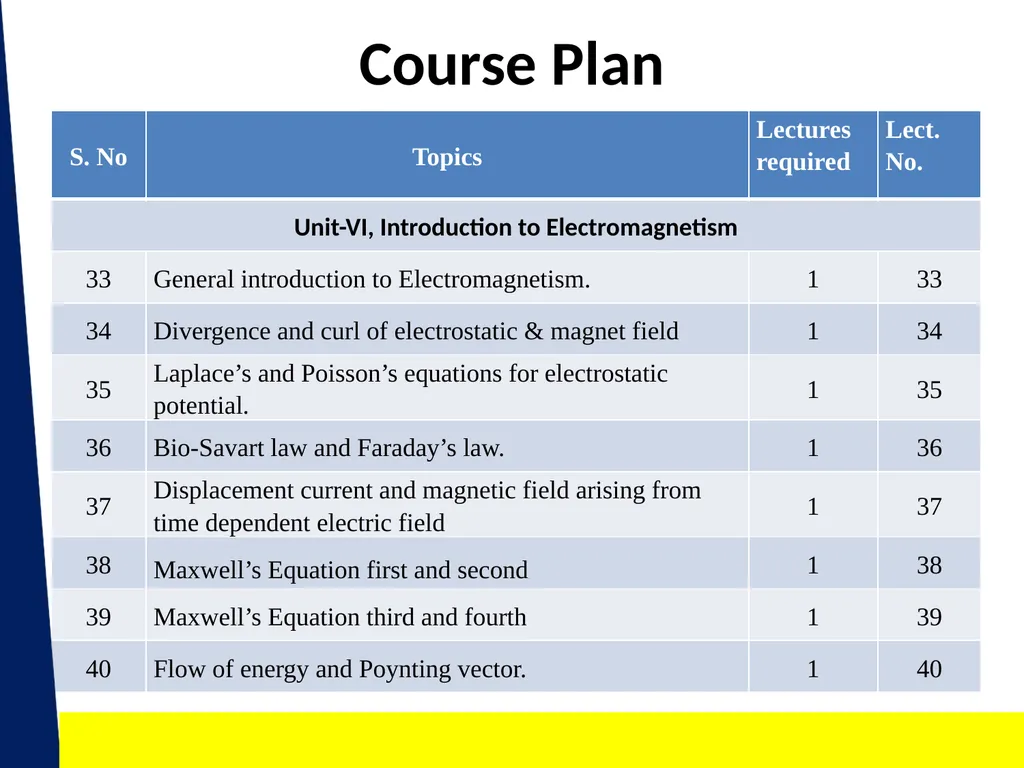
6. Introduction to Electromagnetism:
Divergence and curl of electrostatic field, Laplace’s and
Poisson’s equations for electrostatic potential, Bio-Savart
law, Divergence and curl of static magnetic field, Faraday’s
law, Displacement current and magnetic field arising from
time dependent electric field, Maxwell’ s equations, Flow of
energy and Poynting vector.<br>
05
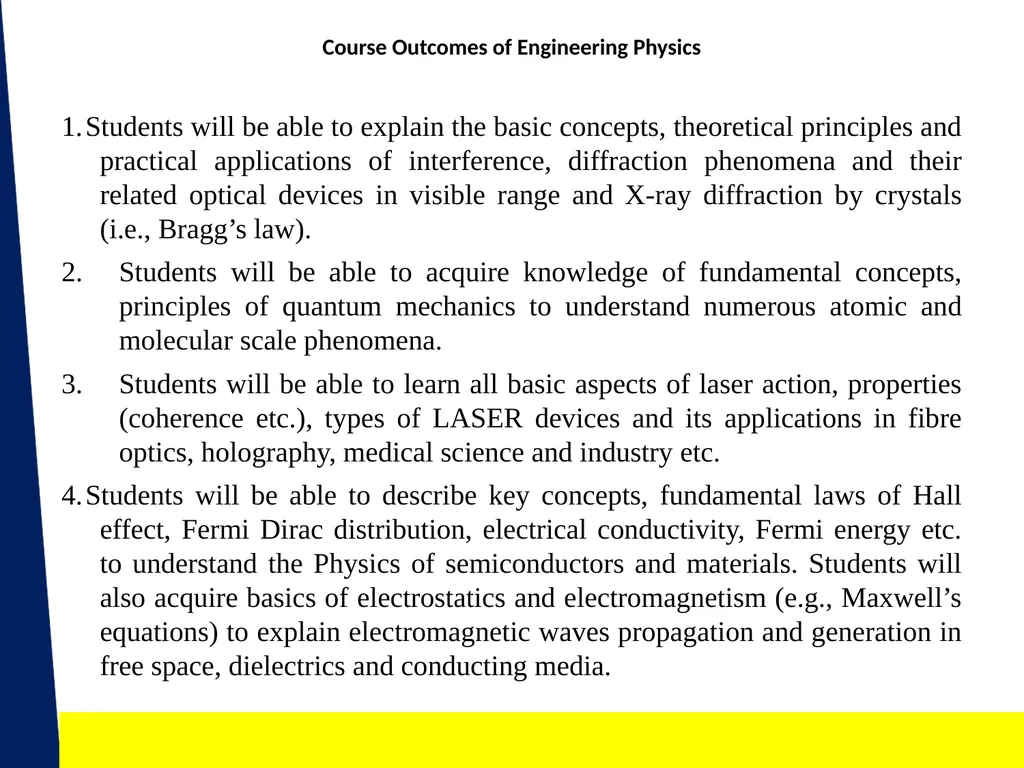
Course Outcomes of Engineering Physics 1. Students will be able to explain the basic concepts, theoretical principles and practical applications of interference, diffraction phenomena and their related optical devices in visible range and X-ray diffraction by crystals (i.e., Bragg’s law).
Students will be able to acquire knowledge of fundamental concepts, principles of quantum mechanics to understand numerous atomic and molecular scale phenomena.
Students will be able to learn all basic aspects of laser action, properties (coherence etc.), types of LASER devices and its applications in fibre optics, holography, medical science and industry etc.
4. Students will be able to describe key concepts, fundamental laws of Hall effect, Fermi Dirac distribution, electrical conductivity, Fermi energy etc. to understand the Physics of semiconductors and materials. Students will also acquire basics of electrostatics and electromagnetism (e.g., Maxwell’s equations) to explain electromagnetic waves propagation and generation in free space, dielectrics and conducting media.<br>
06
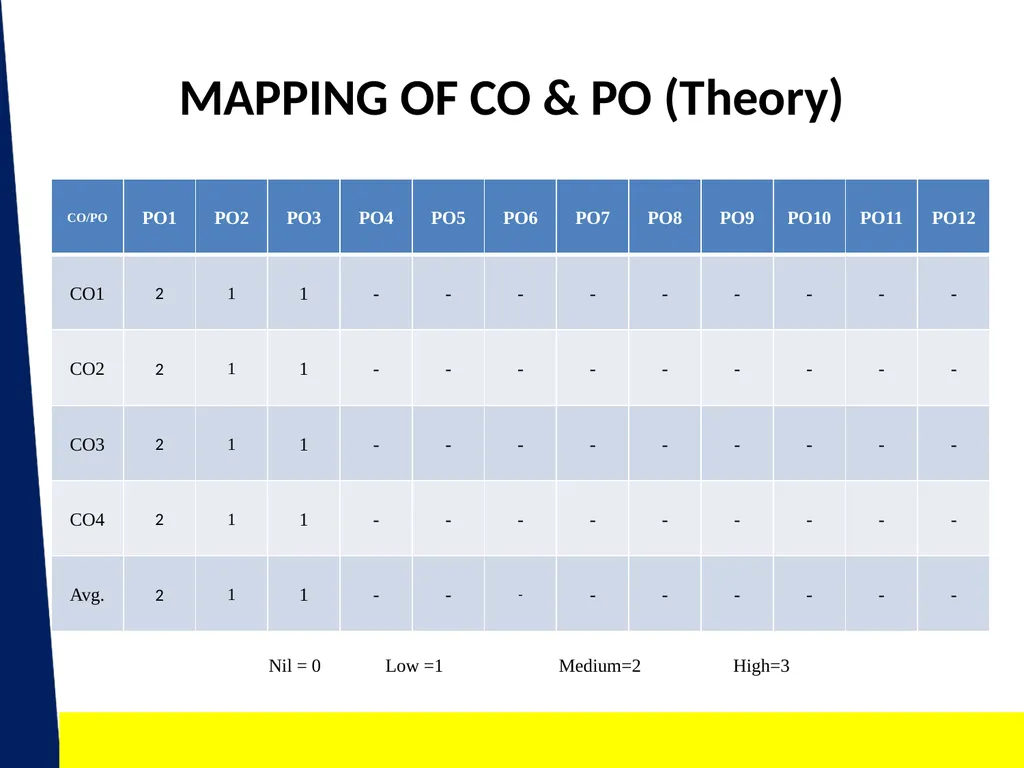
MAPPING OF CO & PO (Theory) Nil = 0 Low =1 Medium=2 High=3<br>