
Descartes’ cosmological argument Michael Lacewing

Description: Descartes cosmological argument Michael Lacewing enquiriesalevelphilosophy.co.uk (c) Michael Lacewing Descartes question Cosmological arguments usually ask why does anything exist? Descartes doubts the existence of everything, and
Related Topics
Download Presentation
"Descartes’ cosmological argument Michael Lacewing" is the property of its rightful owner. Permission is granted to download and print the materials on this website for personal, non-commercial use only, and to display it on your personal computer provided you do not modify the materials and that you retain all copyright notices contained in the materials. By downloading content from our website, you accept the terms of this agreement.
Presentation Transcript
slide1. Descartes’ cosmological argument Michael Lacewing
enquiries@alevelphilosophy.co.uk (c) Michael Lacewing<br>
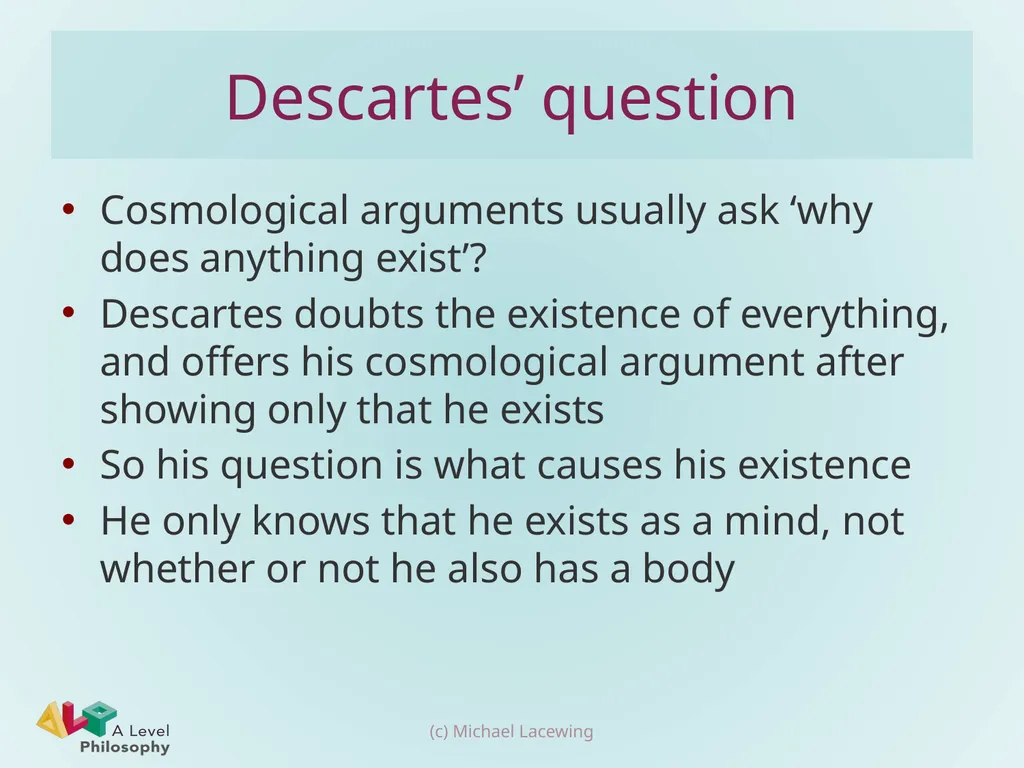
slide2. Descartes’ question Cosmological arguments usually ask ‘why does anything exist’?
Descartes doubts the existence of everything, and offers his cosmological argument after showing only that he exists
So his question is what causes his existence
He only knows that he exists as a mind, not whether or not he also has a body (c) Michael Lacewing<br>
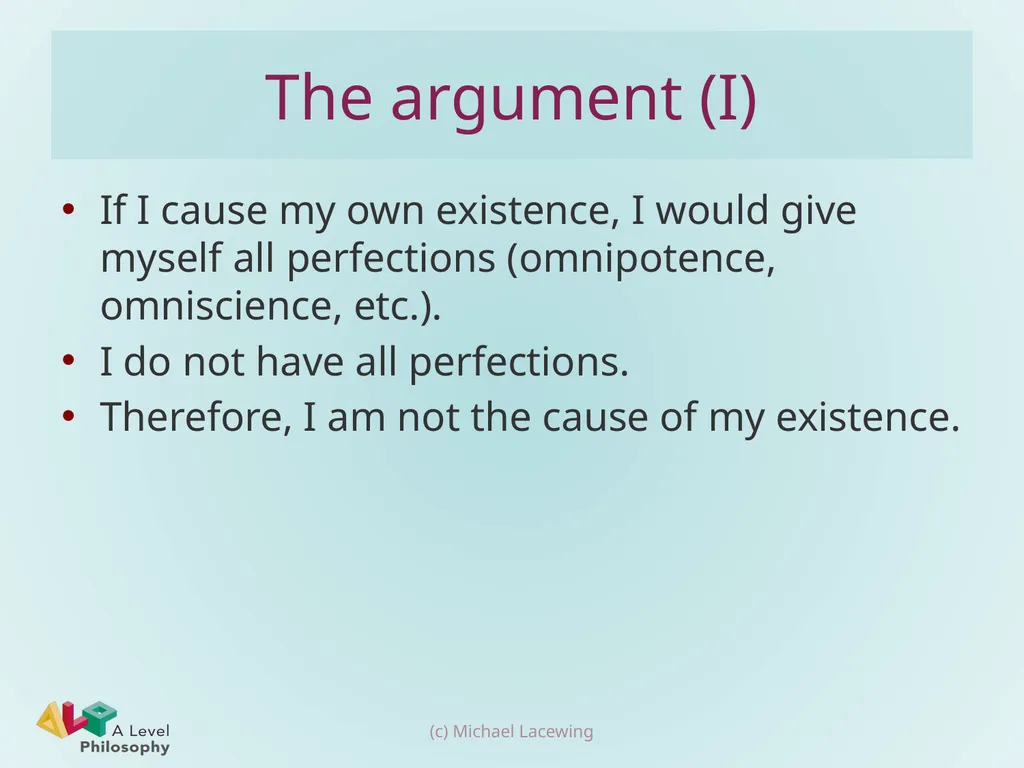
slide3. The argument (I) If I cause my own existence, I would give myself all perfections (omnipotence, omniscience, etc.).
I do not have all perfections.
Therefore, I am not the cause of my existence. (c) Michael Lacewing<br>
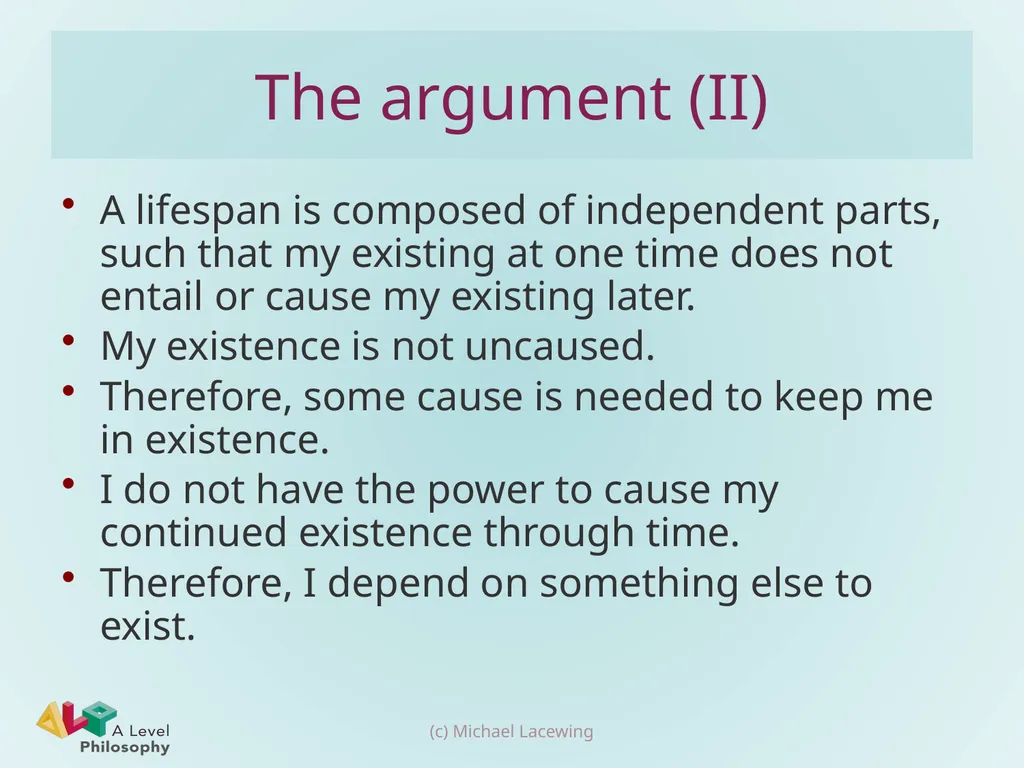
slide4. The argument (II) A lifespan is composed of independent parts, such that my existing at one time does not entail or cause my existing later.
My existence is not uncaused.
Therefore, some cause is needed to keep me in existence.
I do not have the power to cause my continued existence through time.
Therefore, I depend on something else to exist. (c) Michael Lacewing<br>
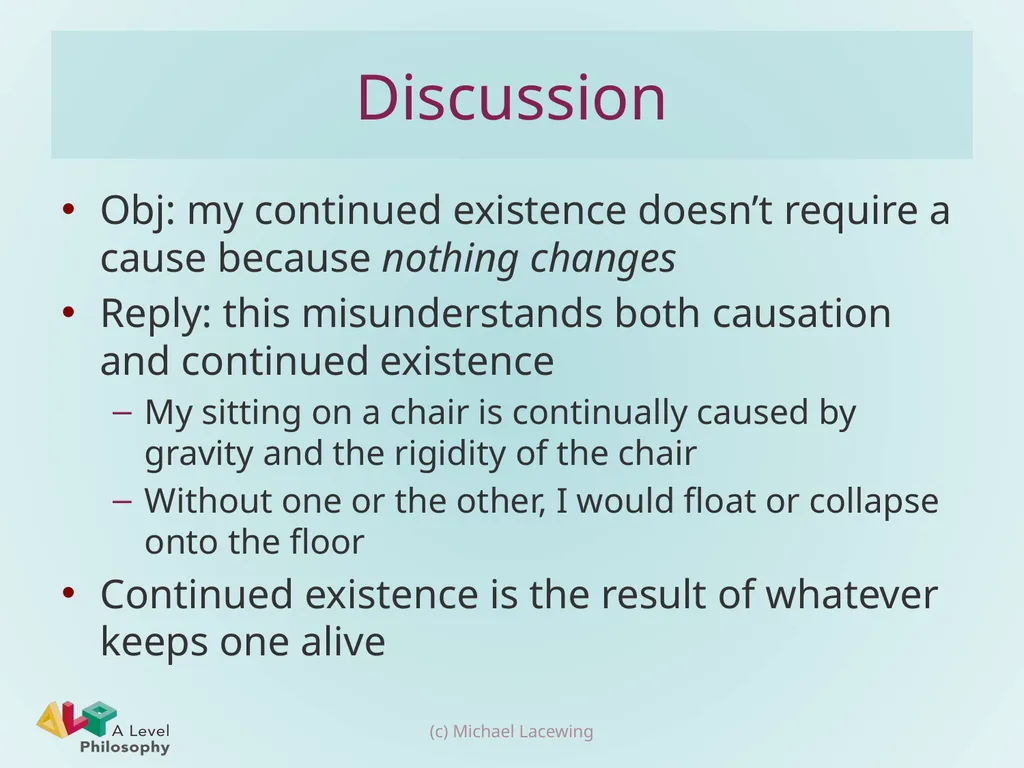
slide5. Discussion Obj: my continued existence doesn’t require a cause because nothing changes
Reply: this misunderstands both causation and continued existence
My sitting on a chair is continually caused by gravity and the rigidity of the chair
Without one or the other, I would float or collapse onto the floor
Continued existence is the result of whatever keeps one alive (c) Michael Lacewing<br>
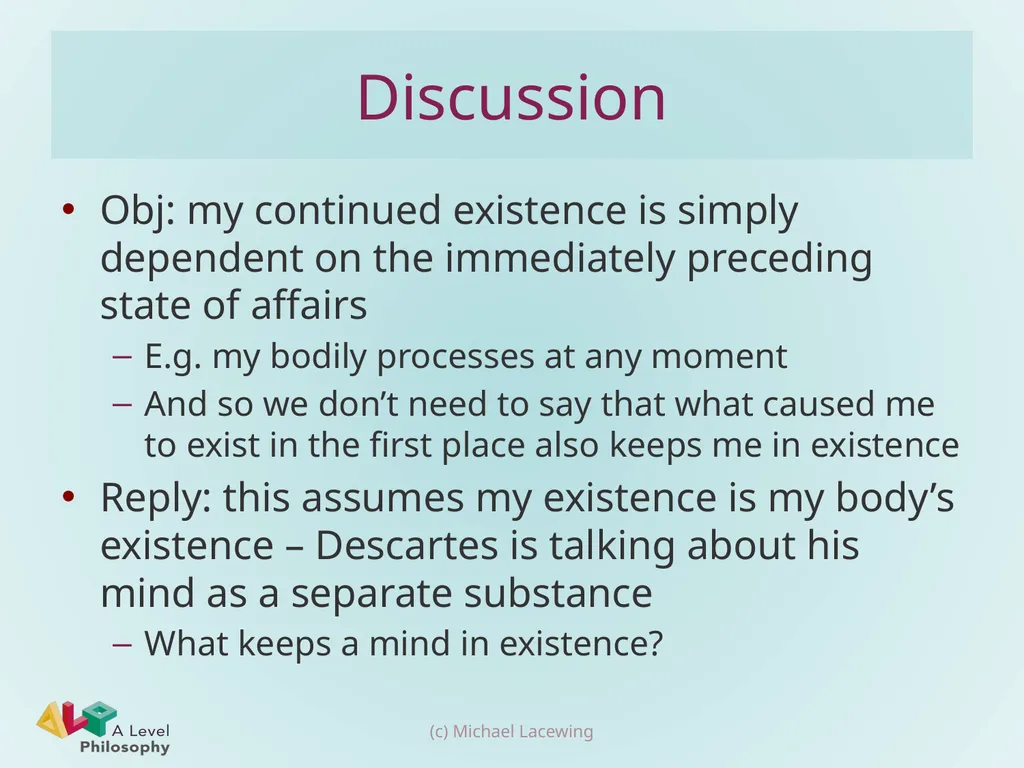
slide6. Discussion Obj: my continued existence is simply dependent on the immediately preceding state of affairs
E.g. my bodily processes at any moment
And so we don’t need to say that what caused me to exist in the first place also keeps me in existence
Reply: this assumes my existence is my body’s existence – Descartes is talking about his mind as a separate substance
What keeps a mind in existence? (c) Michael Lacewing<br>
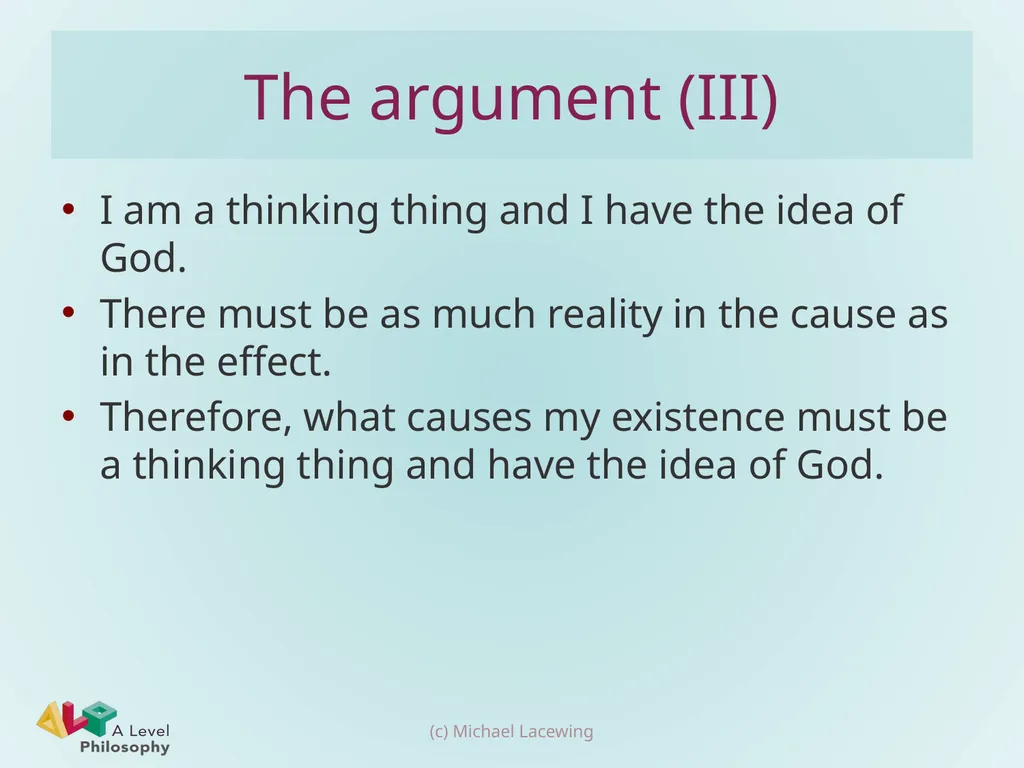
slide7. The argument (III) I am a thinking thing and I have the idea of God.
There must be as much reality in the cause as in the effect.
Therefore, what causes my existence must be a thinking thing and have the idea of God. (c) Michael Lacewing<br>
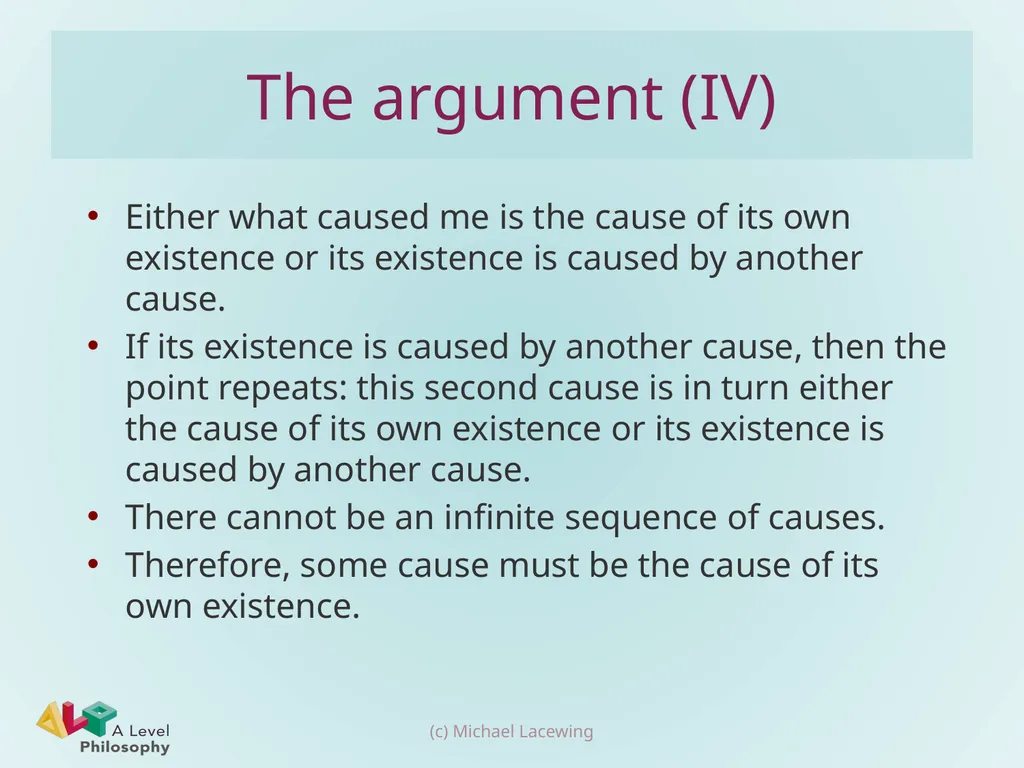
slide8. The argument (IV) Either what caused me is the cause of its own existence or its existence is caused by another cause.
If its existence is caused by another cause, then the point repeats: this second cause is in turn either the cause of its own existence or its existence is caused by another cause.
There cannot be an infinite sequence of causes.
Therefore, some cause must be the cause of its own existence. (c) Michael Lacewing<br>
slide9. The argument (IV) What is the cause of its own existence (and so, directly or indirectly, the cause of my existence) is God.
Therefore, God exists. (c) Michael Lacewing<br>
slide10. An additional argument Some cause is needed to keep me in existence.
There cannot be an infinite chain of causes because what caused my existence also causes my continued existence in the present.
My parents, or any other supposed caused of my existence, do not keep me in existence.
The only cause that could keep me in existence is God.
Therefore, God exists. (c) Michael Lacewing<br>
slide11. Objection: The causal principle Descartes assumes that everything has a cause. Is this true?
Hume:
It is not analytic, so it is not certain.
Experience supports it, but can’t show that it holds universally
Could my existence be uncaused?
‘Something cannot come out of nothing’ is also not analytic. (c) Michael Lacewing<br>
slide12. Objection: God Is Descartes right that the cause of his existence must itself be a mind with the concept of God?
For discussion, see Descartes’ Trademark argument
Hume objects that there is no a priori reason to think that matter cannot produce mind
However, Descartes has cast doubt on the existence of matter at this point in the Meditations (c) Michael Lacewing<br>
slide13. An infinite series of causes Descartes: there cannot be an infinite series of causes
That’s fine. We know this universe began just under 14 billion years ago
This reply assumes Descartes is talking about caused him originally, but he is talking about what keeps him in existence now
That the universe had a beginning shows that it was not always actual. Something actual had to cause the Big Bang.
Perhaps another universe… an infinite series of universes (c) Michael Lacewing<br>
slide14. Actual infinities Infinity is not a very large number
An infinite regress of causes never has a starting point
The concept of infinity makes sense. But does an ‘actual’ infinity?
A hotel with an infinite number of rooms, when full, can take more people (an infinite number more)!
This is nonsense – a hotel can’t be full and have room (c) Michael Lacewing<br>
slide15. Actual infinities If there is an infinite chain of universes, each new universe does not add to the number of universes
If there is an infinite series of causes, we could never have reached the point in the series we are at now
An actual infinity creates paradoxes – so we should reject the claim that actual infinities exist (c) Michael Lacewing<br>
slide16. Objection: infinity again Hume: It is not an analytic truth that an infinite regress is impossible. So we must allow that it is possible.
Does this make sense?
Hume needs to solve the paradoxes regarding an actual infinity. (c) Michael Lacewing<br>
slide17. Infinity again Objection: The problem is with our thought
We need new ways of talking about infinities (c) Michael Lacewing<br>
enquiries@alevelphilosophy.co.uk (c) Michael Lacewing<br>
slide2. Descartes’ question Cosmological arguments usually ask ‘why does anything exist’?
Descartes doubts the existence of everything, and offers his cosmological argument after showing only that he exists
So his question is what causes his existence
He only knows that he exists as a mind, not whether or not he also has a body (c) Michael Lacewing<br>
slide3. The argument (I) If I cause my own existence, I would give myself all perfections (omnipotence, omniscience, etc.).
I do not have all perfections.
Therefore, I am not the cause of my existence. (c) Michael Lacewing<br>
slide4. The argument (II) A lifespan is composed of independent parts, such that my existing at one time does not entail or cause my existing later.
My existence is not uncaused.
Therefore, some cause is needed to keep me in existence.
I do not have the power to cause my continued existence through time.
Therefore, I depend on something else to exist. (c) Michael Lacewing<br>
slide5. Discussion Obj: my continued existence doesn’t require a cause because nothing changes
Reply: this misunderstands both causation and continued existence
My sitting on a chair is continually caused by gravity and the rigidity of the chair
Without one or the other, I would float or collapse onto the floor
Continued existence is the result of whatever keeps one alive (c) Michael Lacewing<br>
slide6. Discussion Obj: my continued existence is simply dependent on the immediately preceding state of affairs
E.g. my bodily processes at any moment
And so we don’t need to say that what caused me to exist in the first place also keeps me in existence
Reply: this assumes my existence is my body’s existence – Descartes is talking about his mind as a separate substance
What keeps a mind in existence? (c) Michael Lacewing<br>
slide7. The argument (III) I am a thinking thing and I have the idea of God.
There must be as much reality in the cause as in the effect.
Therefore, what causes my existence must be a thinking thing and have the idea of God. (c) Michael Lacewing<br>
slide8. The argument (IV) Either what caused me is the cause of its own existence or its existence is caused by another cause.
If its existence is caused by another cause, then the point repeats: this second cause is in turn either the cause of its own existence or its existence is caused by another cause.
There cannot be an infinite sequence of causes.
Therefore, some cause must be the cause of its own existence. (c) Michael Lacewing<br>
slide9. The argument (IV) What is the cause of its own existence (and so, directly or indirectly, the cause of my existence) is God.
Therefore, God exists. (c) Michael Lacewing<br>
slide10. An additional argument Some cause is needed to keep me in existence.
There cannot be an infinite chain of causes because what caused my existence also causes my continued existence in the present.
My parents, or any other supposed caused of my existence, do not keep me in existence.
The only cause that could keep me in existence is God.
Therefore, God exists. (c) Michael Lacewing<br>
slide11. Objection: The causal principle Descartes assumes that everything has a cause. Is this true?
Hume:
It is not analytic, so it is not certain.
Experience supports it, but can’t show that it holds universally
Could my existence be uncaused?
‘Something cannot come out of nothing’ is also not analytic. (c) Michael Lacewing<br>
slide12. Objection: God Is Descartes right that the cause of his existence must itself be a mind with the concept of God?
For discussion, see Descartes’ Trademark argument
Hume objects that there is no a priori reason to think that matter cannot produce mind
However, Descartes has cast doubt on the existence of matter at this point in the Meditations (c) Michael Lacewing<br>
slide13. An infinite series of causes Descartes: there cannot be an infinite series of causes
That’s fine. We know this universe began just under 14 billion years ago
This reply assumes Descartes is talking about caused him originally, but he is talking about what keeps him in existence now
That the universe had a beginning shows that it was not always actual. Something actual had to cause the Big Bang.
Perhaps another universe… an infinite series of universes (c) Michael Lacewing<br>
slide14. Actual infinities Infinity is not a very large number
An infinite regress of causes never has a starting point
The concept of infinity makes sense. But does an ‘actual’ infinity?
A hotel with an infinite number of rooms, when full, can take more people (an infinite number more)!
This is nonsense – a hotel can’t be full and have room (c) Michael Lacewing<br>
slide15. Actual infinities If there is an infinite chain of universes, each new universe does not add to the number of universes
If there is an infinite series of causes, we could never have reached the point in the series we are at now
An actual infinity creates paradoxes – so we should reject the claim that actual infinities exist (c) Michael Lacewing<br>
slide16. Objection: infinity again Hume: It is not an analytic truth that an infinite regress is impossible. So we must allow that it is possible.
Does this make sense?
Hume needs to solve the paradoxes regarding an actual infinity. (c) Michael Lacewing<br>
slide17. Infinity again Objection: The problem is with our thought
We need new ways of talking about infinities (c) Michael Lacewing<br>