
Destination 4: Digital and emerging technologies
AM
Published · 81 slides · 0 views
1 / 1
Description
Destination 4: Digital and emerging technologies for competitiveness and fit for the green deal THE EU RESEARCH AND INNOVATION PROGRAMME (2021-27) Destination 4 Objective European Innovation Leadership in Photonics Work Programme topics
Related Topics
Share
Embed code
Download this presentation From Below
"Destination 4: Digital and emerging technologies" is the property of its rightful owner. Permission is granted to download and print the materials on this website for personal, non-commercial use only, and to display it on your personal computer provided you do not modify the materials and that you retain all copyright notices contained in the materials. By downloading content from our website, you accept the terms of this agreement.
Presentation Transcript
01
Destination 4: Digital and emerging technologies for competitiveness and fit for the green deal<br>
02
THE EU RESEARCH AND INNOVATION PROGRAMME (2021-27) Destination 4 – Objective "European Innovation Leadership in Photonics"<br>
03
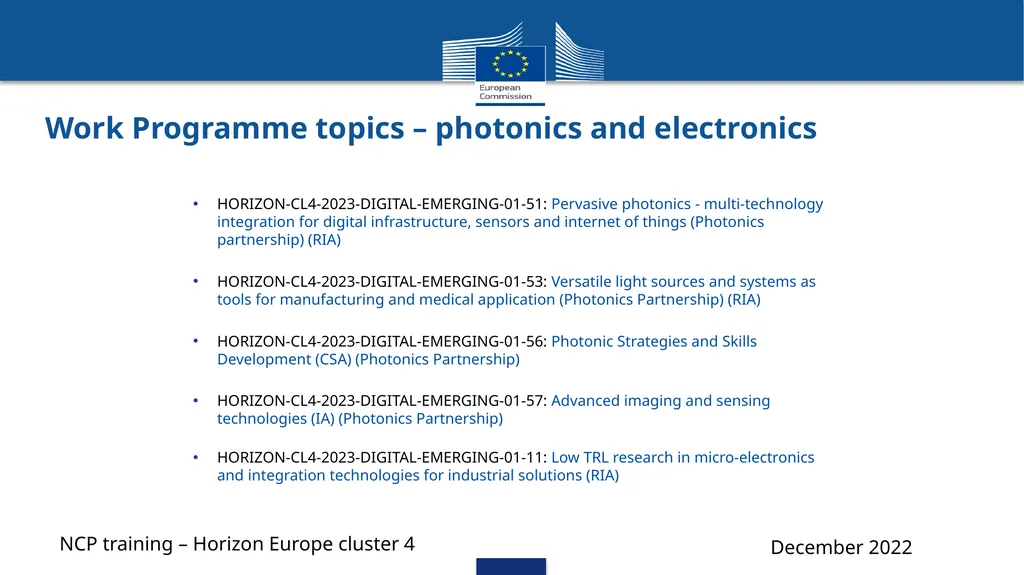
Work Programme topics – photonics and electronics HORIZON-CL4-2023-DIGITAL-EMERGING-01-51: Pervasive photonics - multi-technology integration for digital infrastructure, sensors and internet of things (Photonics partnership) (RIA)
HORIZON-CL4-2023-DIGITAL-EMERGING-01-53: Versatile light sources and systems as tools for manufacturing and medical application (Photonics Partnership) (RIA)
HORIZON-CL4-2023-DIGITAL-EMERGING-01-56: Photonic Strategies and Skills Development (CSA) (Photonics Partnership)
HORIZON-CL4-2023-DIGITAL-EMERGING-01-57: Advanced imaging and sensing technologies (IA) (Photonics Partnership)
HORIZON-CL4-2023-DIGITAL-EMERGING-01-11: Low TRL research in micro-electronics and integration technologies for industrial solutions (RIA) NCP training – Horizon Europe cluster 4 December 2022<br>
HORIZON-CL4-2023-DIGITAL-EMERGING-01-53: Versatile light sources and systems as tools for manufacturing and medical application (Photonics Partnership) (RIA)
HORIZON-CL4-2023-DIGITAL-EMERGING-01-56: Photonic Strategies and Skills Development (CSA) (Photonics Partnership)
HORIZON-CL4-2023-DIGITAL-EMERGING-01-57: Advanced imaging and sensing technologies (IA) (Photonics Partnership)
HORIZON-CL4-2023-DIGITAL-EMERGING-01-11: Low TRL research in micro-electronics and integration technologies for industrial solutions (RIA) NCP training – Horizon Europe cluster 4 December 2022<br>
04
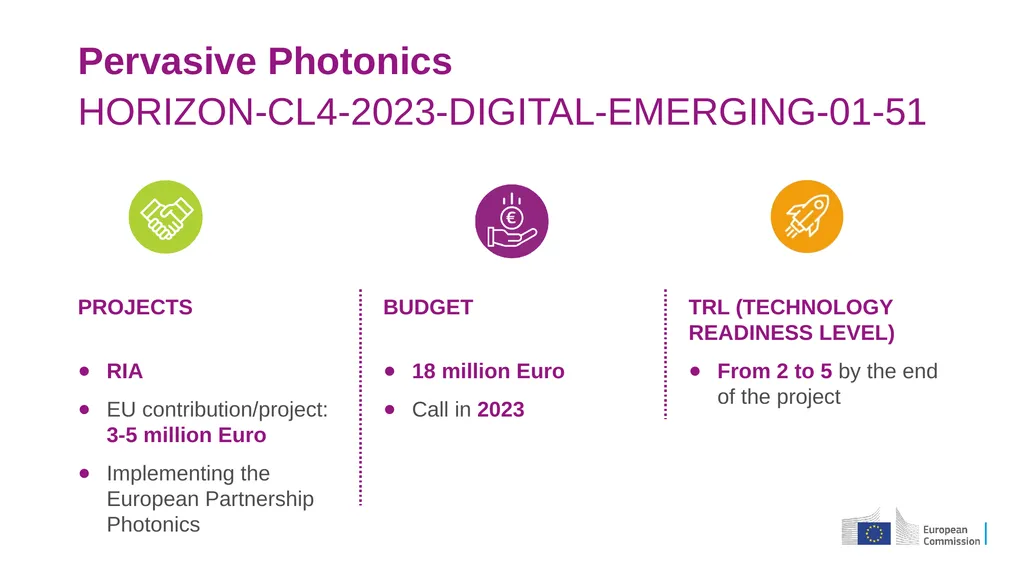
ProjectS
RIA
EU contribution/project: 3-5 million Euro
Implementing the European Partnership Photonics BUDGET
18 million Euro
Call in 2023 TRL (Technology Readiness level)
From 2 to 5 by the end of the project Pervasive Photonics HORIZON-CL4-2023-DIGITAL-EMERGING-01-51<br>
RIA
EU contribution/project: 3-5 million Euro
Implementing the European Partnership Photonics BUDGET
18 million Euro
Call in 2023 TRL (Technology Readiness level)
From 2 to 5 by the end of the project Pervasive Photonics HORIZON-CL4-2023-DIGITAL-EMERGING-01-51<br>
05
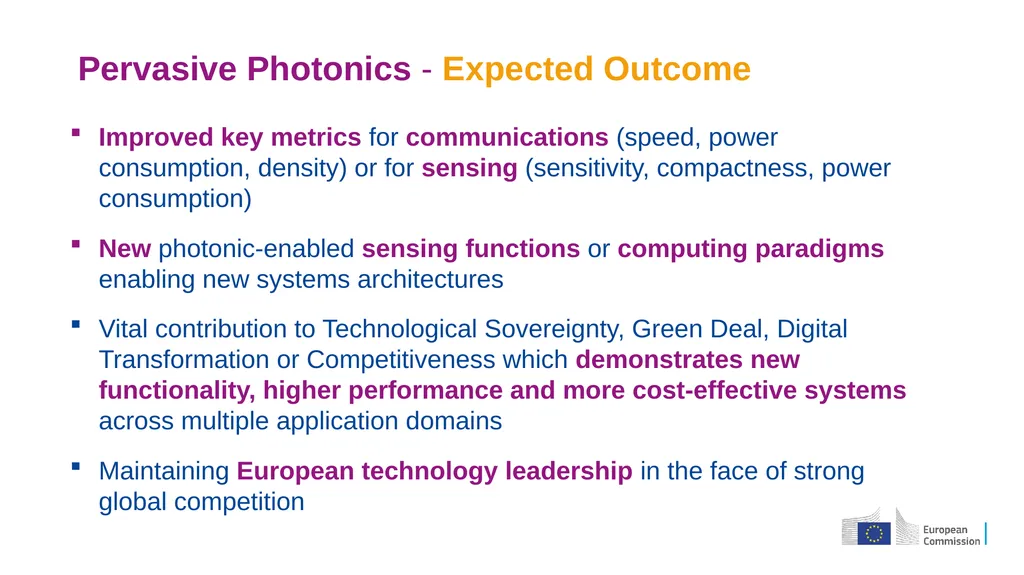
Pervasive Photonics - Expected Outcome Improved key metrics for communications (speed, power consumption, density) or for sensing (sensitivity, compactness, power consumption)
New photonic-enabled sensing functions or computing paradigms enabling new systems architectures
Vital contribution to Technological Sovereignty, Green Deal, Digital Transformation or Competitiveness which demonstrates new functionality, higher performance and more cost-effective systems across multiple application domains
Maintaining European technology leadership in the face of strong global competition<br>
New photonic-enabled sensing functions or computing paradigms enabling new systems architectures
Vital contribution to Technological Sovereignty, Green Deal, Digital Transformation or Competitiveness which demonstrates new functionality, higher performance and more cost-effective systems across multiple application domains
Maintaining European technology leadership in the face of strong global competition<br>
06
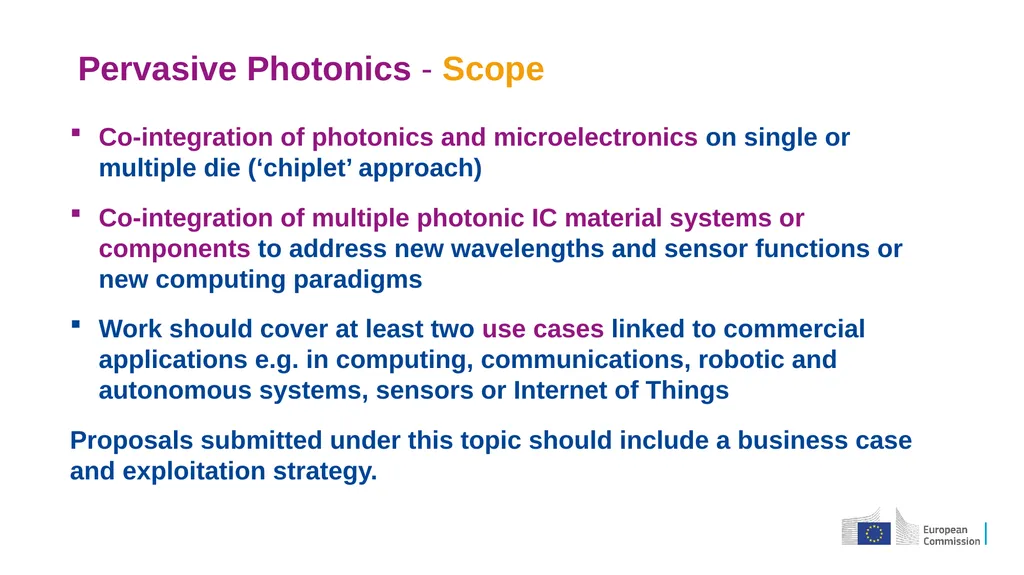
Pervasive Photonics - Scope Co-integration of photonics and microelectronics on single or multiple die (‘chiplet’ approach)
Co-integration of multiple photonic IC material systems or components to address new wavelengths and sensor functions or new computing paradigms
Work should cover at least two use cases linked to commercial applications e.g. in computing, communications, robotic and autonomous systems, sensors or Internet of Things
Proposals submitted under this topic should include a business case and exploitation strategy.<br>
Co-integration of multiple photonic IC material systems or components to address new wavelengths and sensor functions or new computing paradigms
Work should cover at least two use cases linked to commercial applications e.g. in computing, communications, robotic and autonomous systems, sensors or Internet of Things
Proposals submitted under this topic should include a business case and exploitation strategy.<br>
07
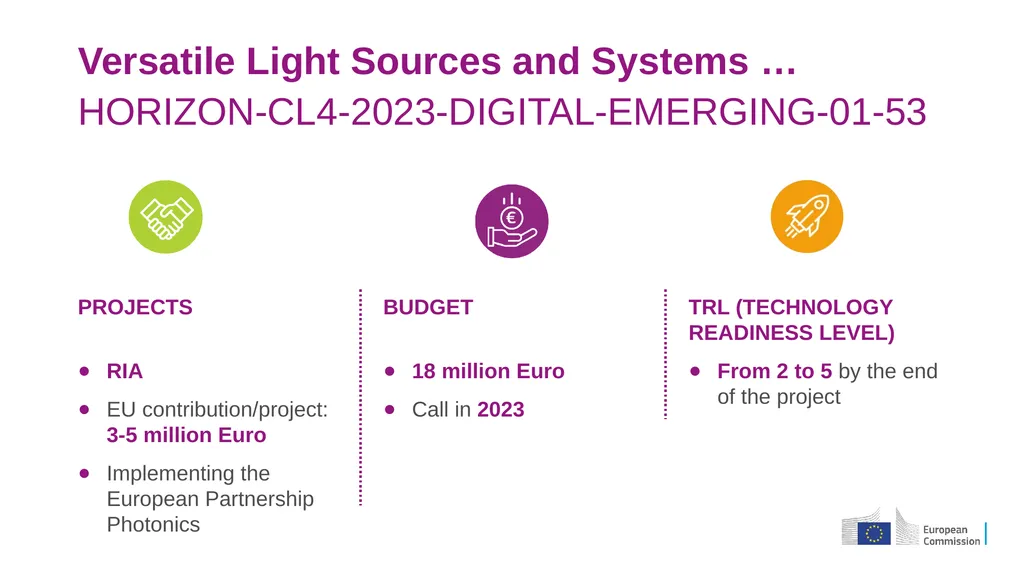
ProjectS
RIA
EU contribution/project: 3-5 million Euro
Implementing the European Partnership Photonics BUDGET
18 million Euro
Call in 2023 TRL (Technology Readiness level)
From 2 to 5 by the end of the project Versatile Light Sources and Systems … HORIZON-CL4-2023-DIGITAL-EMERGING-01-53<br>
RIA
EU contribution/project: 3-5 million Euro
Implementing the European Partnership Photonics BUDGET
18 million Euro
Call in 2023 TRL (Technology Readiness level)
From 2 to 5 by the end of the project Versatile Light Sources and Systems … HORIZON-CL4-2023-DIGITAL-EMERGING-01-53<br>
08
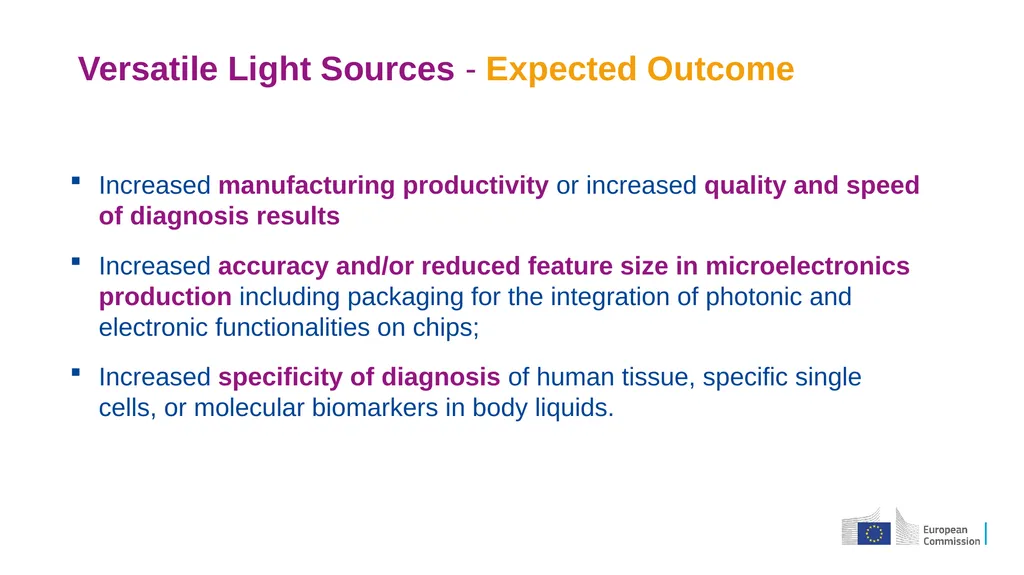
Versatile Light Sources - Expected Outcome Increased manufacturing productivity or increased quality and speed of diagnosis results
Increased accuracy and/or reduced feature size in microelectronics production including packaging for the integration of photonic and electronic functionalities on chips;
Increased specificity of diagnosis of human tissue, specific single cells, or molecular biomarkers in body liquids.<br>
Increased accuracy and/or reduced feature size in microelectronics production including packaging for the integration of photonic and electronic functionalities on chips;
Increased specificity of diagnosis of human tissue, specific single cells, or molecular biomarkers in body liquids.<br>
09
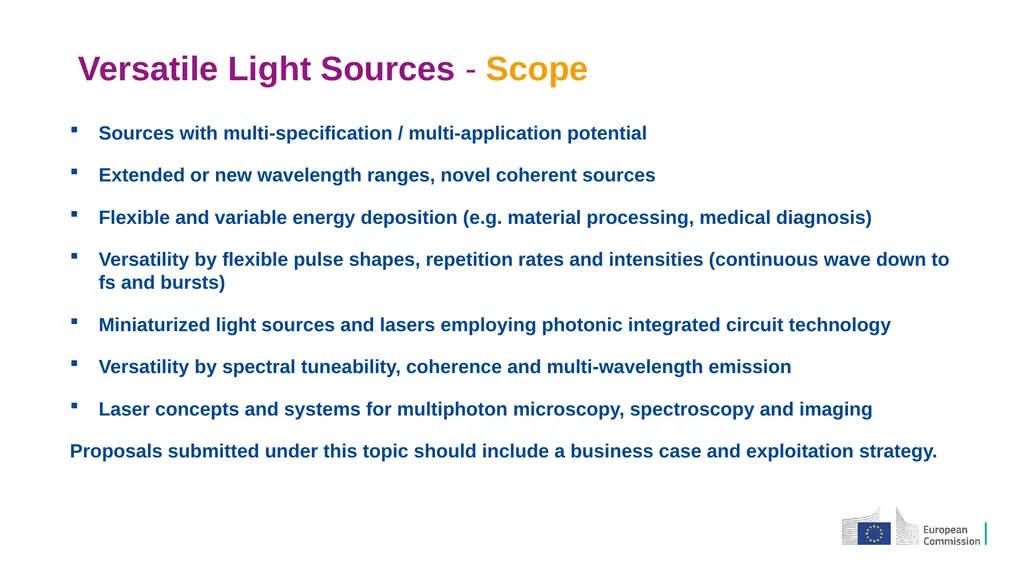
Versatile Light Sources - Scope Sources with multi-specification / multi-application potential
Extended or new wavelength ranges, novel coherent sources
Flexible and variable energy deposition (e.g. material processing, medical diagnosis)
Versatility by flexible pulse shapes, repetition rates and intensities (continuous wave down to fs and bursts)
Miniaturized light sources and lasers employing photonic integrated circuit technology
Versatility by spectral tuneability, coherence and multi-wavelength emission
Laser concepts and systems for multiphoton microscopy, spectroscopy and imaging
Proposals submitted under this topic should include a business case and exploitation strategy.<br>
Extended or new wavelength ranges, novel coherent sources
Flexible and variable energy deposition (e.g. material processing, medical diagnosis)
Versatility by flexible pulse shapes, repetition rates and intensities (continuous wave down to fs and bursts)
Miniaturized light sources and lasers employing photonic integrated circuit technology
Versatility by spectral tuneability, coherence and multi-wavelength emission
Laser concepts and systems for multiphoton microscopy, spectroscopy and imaging
Proposals submitted under this topic should include a business case and exploitation strategy.<br>
10
ProjectS
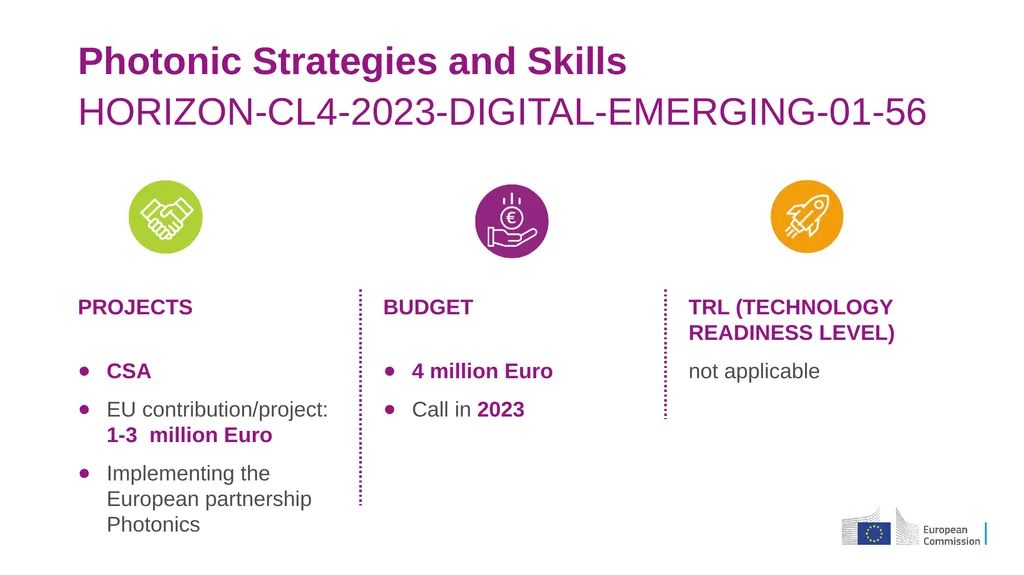
CSA
EU contribution/project: 1-3 million Euro
Implementing the European partnership Photonics BUDGET
4 million Euro
Call in 2023 TRL (Technology Readiness level)
not applicable Photonic Strategies and Skills HORIZON-CL4-2023-DIGITAL-EMERGING-01-56<br>
CSA
EU contribution/project: 1-3 million Euro
Implementing the European partnership Photonics BUDGET
4 million Euro
Call in 2023 TRL (Technology Readiness level)
not applicable Photonic Strategies and Skills HORIZON-CL4-2023-DIGITAL-EMERGING-01-56<br>
11
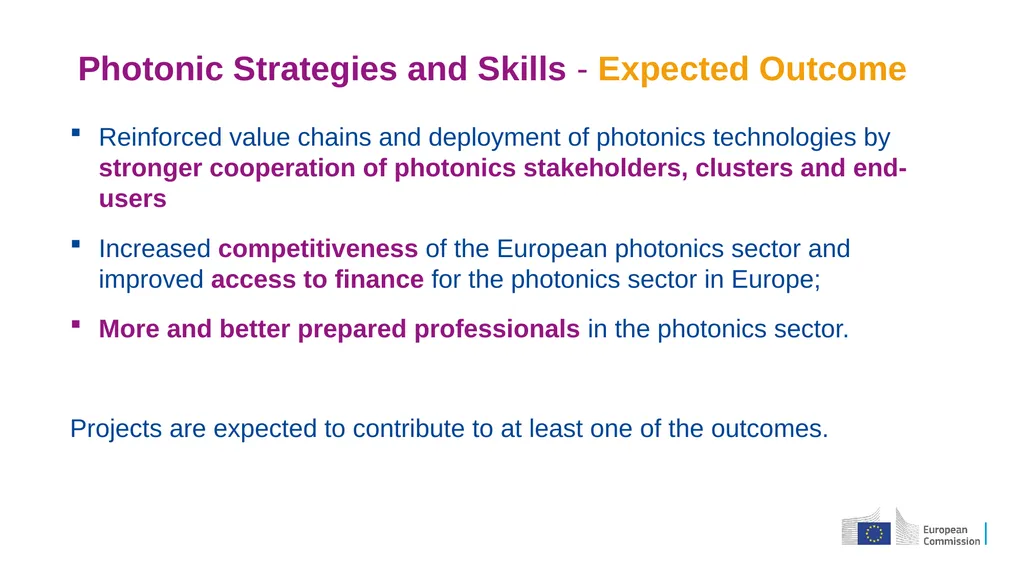
Photonic Strategies and Skills - Expected Outcome Reinforced value chains and deployment of photonics technologies by stronger cooperation of photonics stakeholders, clusters and end-users
Increased competitiveness of the European photonics sector and improved access to finance for the photonics sector in Europe;
More and better prepared professionals in the photonics sector.
Projects are expected to contribute to at least one of the outcomes.<br>
Increased competitiveness of the European photonics sector and improved access to finance for the photonics sector in Europe;
More and better prepared professionals in the photonics sector.
Projects are expected to contribute to at least one of the outcomes.<br>
12
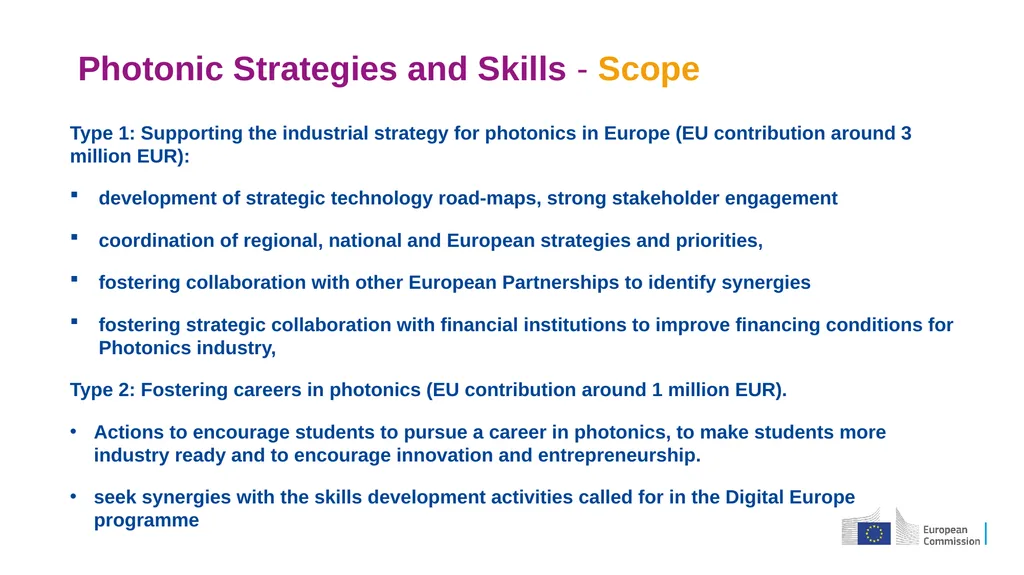
Photonic Strategies and Skills - Scope Type 1: Supporting the industrial strategy for photonics in Europe (EU contribution around 3 million EUR):
development of strategic technology road-maps, strong stakeholder engagement
coordination of regional, national and European strategies and priorities,
fostering collaboration with other European Partnerships to identify synergies
fostering strategic collaboration with financial institutions to improve financing conditions for Photonics industry,
Type 2: Fostering careers in photonics (EU contribution around 1 million EUR).
Actions to encourage students to pursue a career in photonics, to make students more industry ready and to encourage innovation and entrepreneurship.
seek synergies with the skills development activities called for in the Digital Europe programme<br>
development of strategic technology road-maps, strong stakeholder engagement
coordination of regional, national and European strategies and priorities,
fostering collaboration with other European Partnerships to identify synergies
fostering strategic collaboration with financial institutions to improve financing conditions for Photonics industry,
Type 2: Fostering careers in photonics (EU contribution around 1 million EUR).
Actions to encourage students to pursue a career in photonics, to make students more industry ready and to encourage innovation and entrepreneurship.
seek synergies with the skills development activities called for in the Digital Europe programme<br>
13
ProjectS
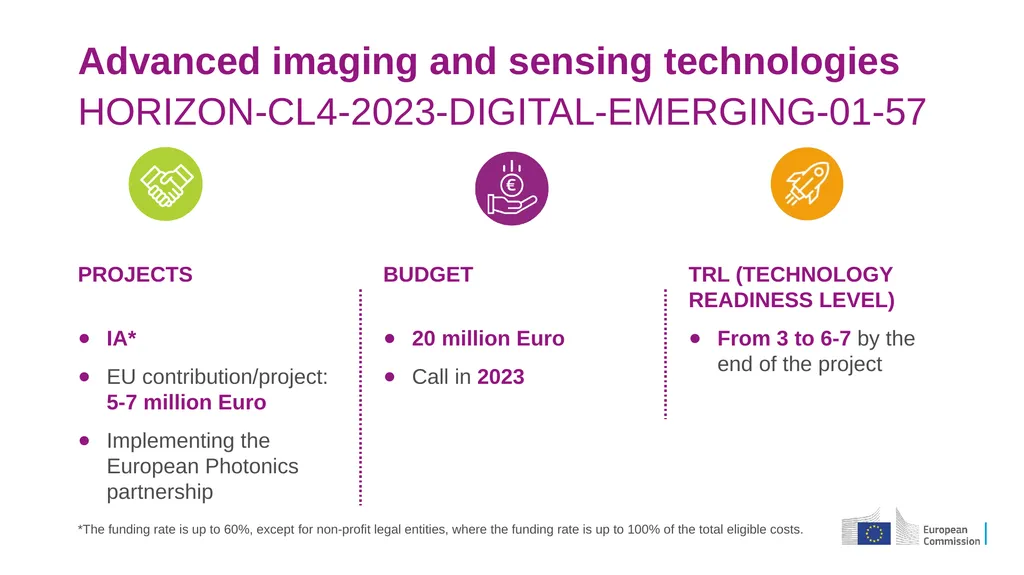
IA*
EU contribution/project: 5-7 million Euro
Implementing the European Photonics partnership BUDGET
20 million Euro
Call in 2023 TRL (Technology Readiness level)
From 3 to 6-7 by the end of the project Advanced imaging and sensing technologies HORIZON-CL4-2023-DIGITAL-EMERGING-01-57 *The funding rate is up to 60%, except for non-profit legal entities, where the funding rate is up to 100% of the total eligible costs.<br>
IA*
EU contribution/project: 5-7 million Euro
Implementing the European Photonics partnership BUDGET
20 million Euro
Call in 2023 TRL (Technology Readiness level)
From 3 to 6-7 by the end of the project Advanced imaging and sensing technologies HORIZON-CL4-2023-DIGITAL-EMERGING-01-57 *The funding rate is up to 60%, except for non-profit legal entities, where the funding rate is up to 100% of the total eligible costs.<br>
14
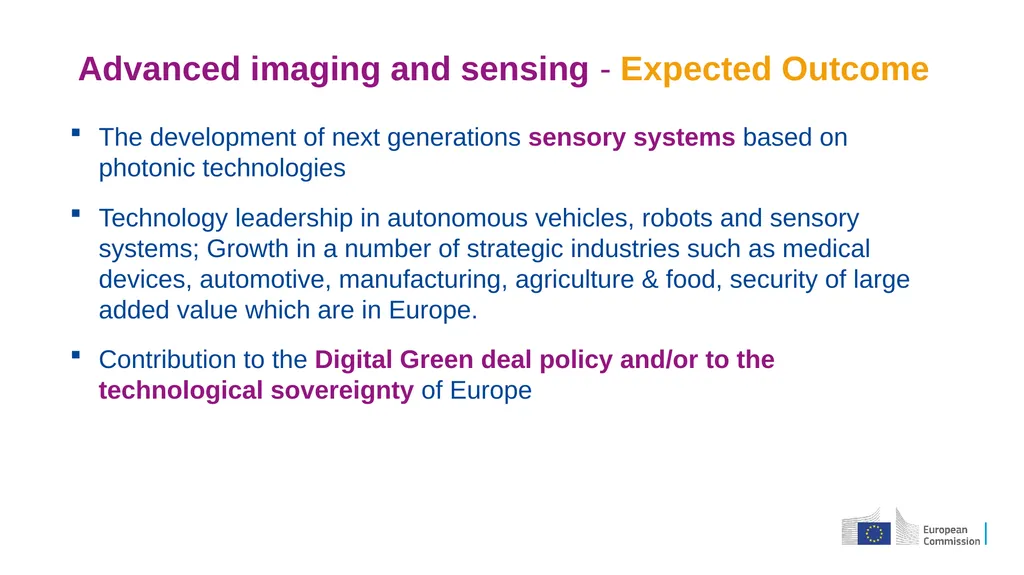
Advanced imaging and sensing - Expected Outcome The development of next generations sensory systems based on photonic technologies
Technology leadership in autonomous vehicles, robots and sensory systems; Growth in a number of strategic industries such as medical devices, automotive, manufacturing, agriculture & food, security of large added value which are in Europe.
Contribution to the Digital Green deal policy and/or to the technological sovereignty of Europe<br>
Technology leadership in autonomous vehicles, robots and sensory systems; Growth in a number of strategic industries such as medical devices, automotive, manufacturing, agriculture & food, security of large added value which are in Europe.
Contribution to the Digital Green deal policy and/or to the technological sovereignty of Europe<br>
15
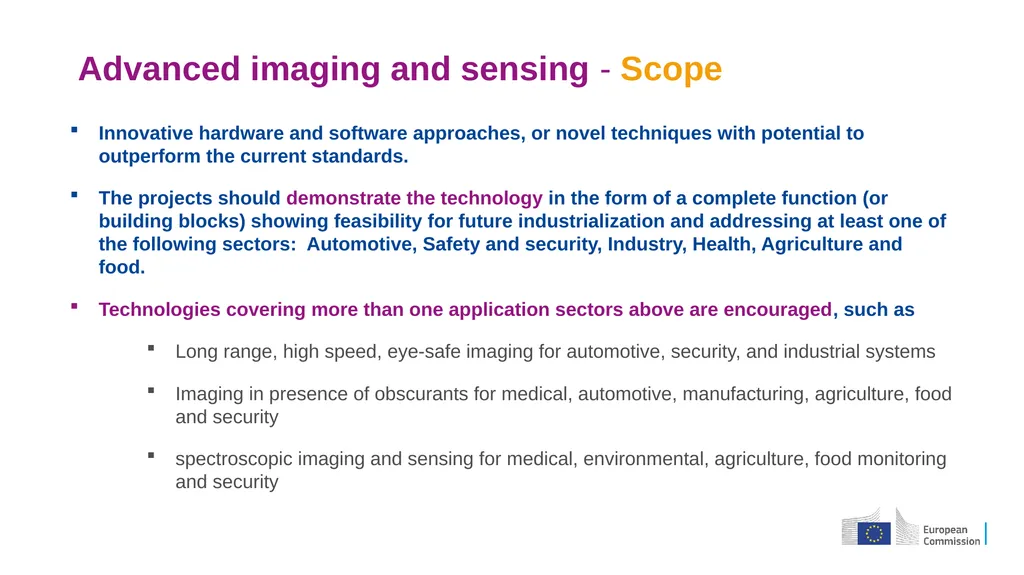
Advanced imaging and sensing - Scope Innovative hardware and software approaches, or novel techniques with potential to outperform the current standards.
The projects should demonstrate the technology in the form of a complete function (or building blocks) showing feasibility for future industrialization and addressing at least one of the following sectors: Automotive, Safety and security, Industry, Health, Agriculture and food.
Technologies covering more than one application sectors above are encouraged, such as
Long range, high speed, eye-safe imaging for automotive, security, and industrial systems
Imaging in presence of obscurants for medical, automotive, manufacturing, agriculture, food and security
spectroscopic imaging and sensing for medical, environmental, agriculture, food monitoring and security<br>
The projects should demonstrate the technology in the form of a complete function (or building blocks) showing feasibility for future industrialization and addressing at least one of the following sectors: Automotive, Safety and security, Industry, Health, Agriculture and food.
Technologies covering more than one application sectors above are encouraged, such as
Long range, high speed, eye-safe imaging for automotive, security, and industrial systems
Imaging in presence of obscurants for medical, automotive, manufacturing, agriculture, food and security
spectroscopic imaging and sensing for medical, environmental, agriculture, food monitoring and security<br>
16
# HorizonEU http://ec.europa.eu/horizon-europe Thank you for your questions<br>
17
THE EU RESEARCH AND INNOVATION PROGRAMME (2021-27) Destination 4 - Objective "AI, Data and Robotics"<br>
18
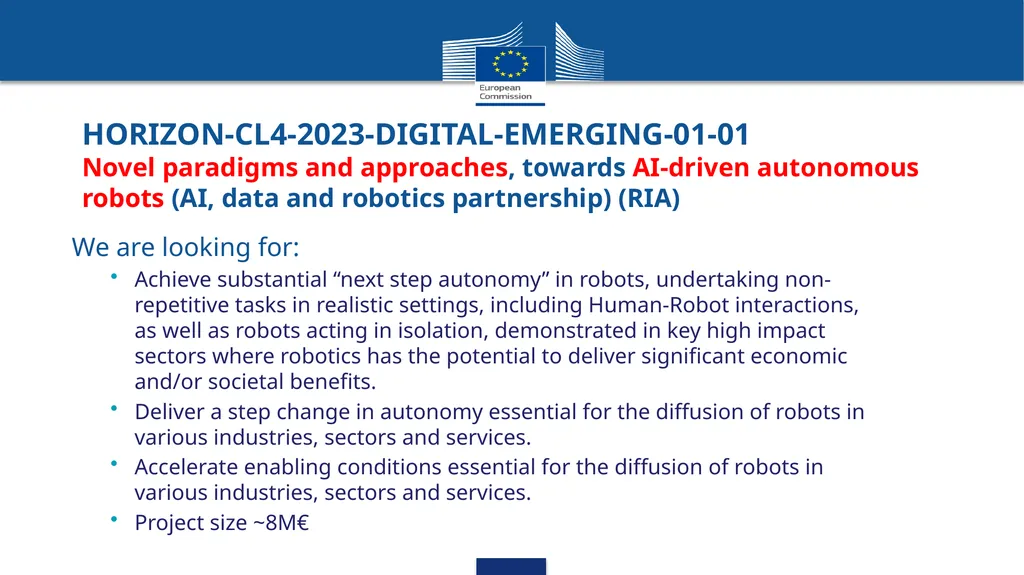
HORIZON-CL4-2023-DIGITAL-EMERGING-01-01
Novel paradigms and approaches, towards AI-driven autonomous robots (AI, data and robotics partnership) (RIA) We are looking for:
Achieve substantial “next step autonomy” in robots, undertaking non-repetitive tasks in realistic settings, including Human-Robot interactions, as well as robots acting in isolation, demonstrated in key high impact sectors where robotics has the potential to deliver significant economic and/or societal benefits.
Deliver a step change in autonomy essential for the diffusion of robots in various industries, sectors and services.
Accelerate enabling conditions essential for the diffusion of robots in various industries, sectors and services.
Project size ~8M€<br>
Achieve substantial “next step autonomy” in robots, undertaking non-repetitive tasks in realistic settings, including Human-Robot interactions, as well as robots acting in isolation, demonstrated in key high impact sectors where robotics has the potential to deliver significant economic and/or societal benefits.
Deliver a step change in autonomy essential for the diffusion of robots in various industries, sectors and services.
Accelerate enabling conditions essential for the diffusion of robots in various industries, sectors and services.
Project size ~8M€<br>
19
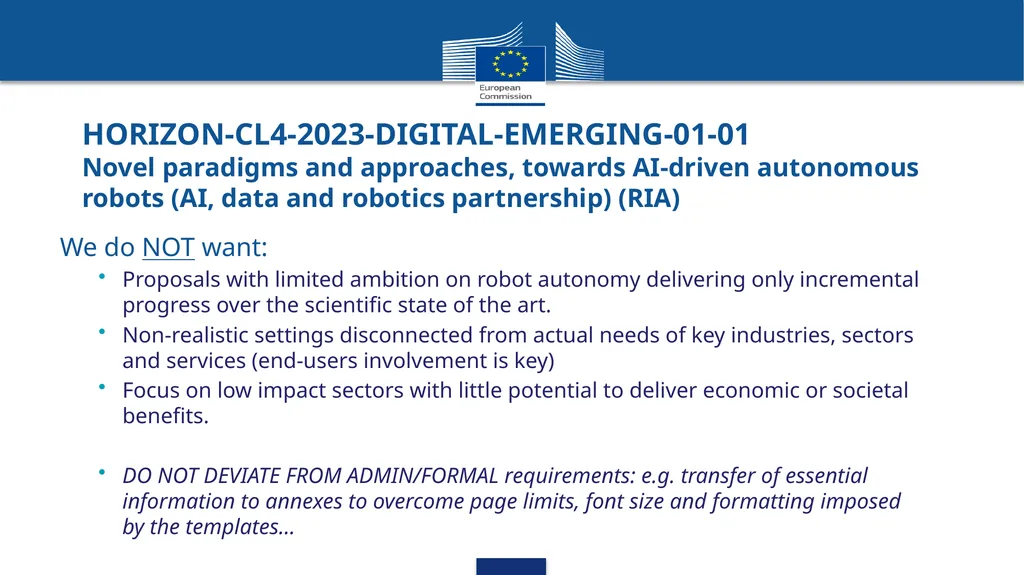
We do NOT want:
Proposals with limited ambition on robot autonomy delivering only incremental progress over the scientific state of the art.
Non-realistic settings disconnected from actual needs of key industries, sectors and services (end-users involvement is key)
Focus on low impact sectors with little potential to deliver economic or societal benefits.
DO NOT DEVIATE FROM ADMIN/FORMAL requirements: e.g. transfer of essential information to annexes to overcome page limits, font size and formatting imposed by the templates… HORIZON-CL4-2023-DIGITAL-EMERGING-01-01 Novel paradigms and approaches, towards AI-driven autonomous robots (AI, data and robotics partnership) (RIA)<br>
Proposals with limited ambition on robot autonomy delivering only incremental progress over the scientific state of the art.
Non-realistic settings disconnected from actual needs of key industries, sectors and services (end-users involvement is key)
Focus on low impact sectors with little potential to deliver economic or societal benefits.
DO NOT DEVIATE FROM ADMIN/FORMAL requirements: e.g. transfer of essential information to annexes to overcome page limits, font size and formatting imposed by the templates… HORIZON-CL4-2023-DIGITAL-EMERGING-01-01 Novel paradigms and approaches, towards AI-driven autonomous robots (AI, data and robotics partnership) (RIA)<br>
20
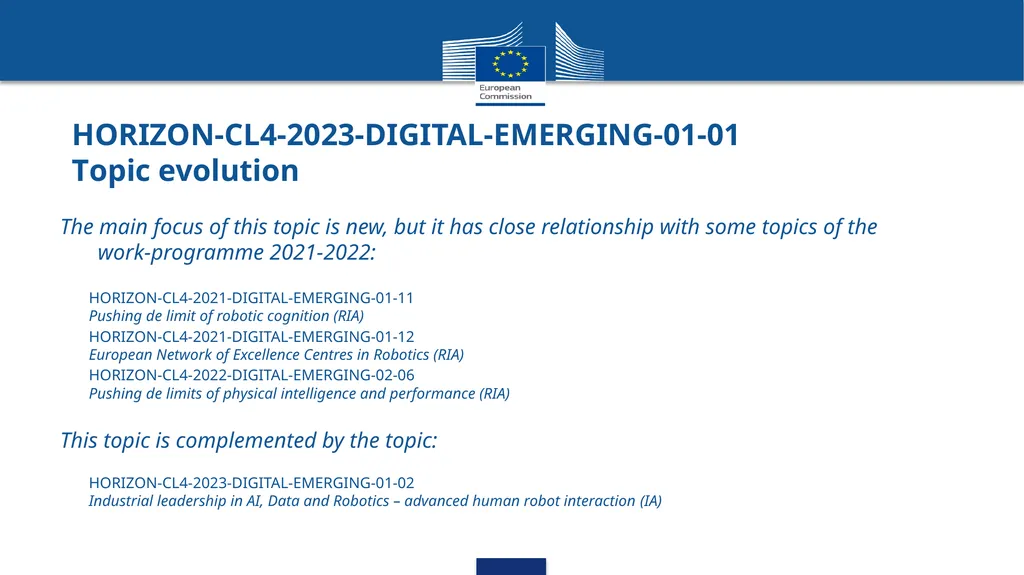
The main focus of this topic is new, but it has close relationship with some topics of the work-programme 2021-2022:
HORIZON-CL4-2021-DIGITAL-EMERGING-01-11 Pushing de limit of robotic cognition (RIA)
HORIZON-CL4-2021-DIGITAL-EMERGING-01-12 European Network of Excellence Centres in Robotics (RIA)
HORIZON-CL4-2022-DIGITAL-EMERGING-02-06 Pushing de limits of physical intelligence and performance (RIA)
This topic is complemented by the topic:
HORIZON-CL4-2023-DIGITAL-EMERGING-01-02 Industrial leadership in AI, Data and Robotics – advanced human robot interaction (IA) HORIZON-CL4-2023-DIGITAL-EMERGING-01-01 Topic evolution<br>
HORIZON-CL4-2021-DIGITAL-EMERGING-01-11 Pushing de limit of robotic cognition (RIA)
HORIZON-CL4-2021-DIGITAL-EMERGING-01-12 European Network of Excellence Centres in Robotics (RIA)
HORIZON-CL4-2022-DIGITAL-EMERGING-02-06 Pushing de limits of physical intelligence and performance (RIA)
This topic is complemented by the topic:
HORIZON-CL4-2023-DIGITAL-EMERGING-01-02 Industrial leadership in AI, Data and Robotics – advanced human robot interaction (IA) HORIZON-CL4-2023-DIGITAL-EMERGING-01-01 Topic evolution<br>
21
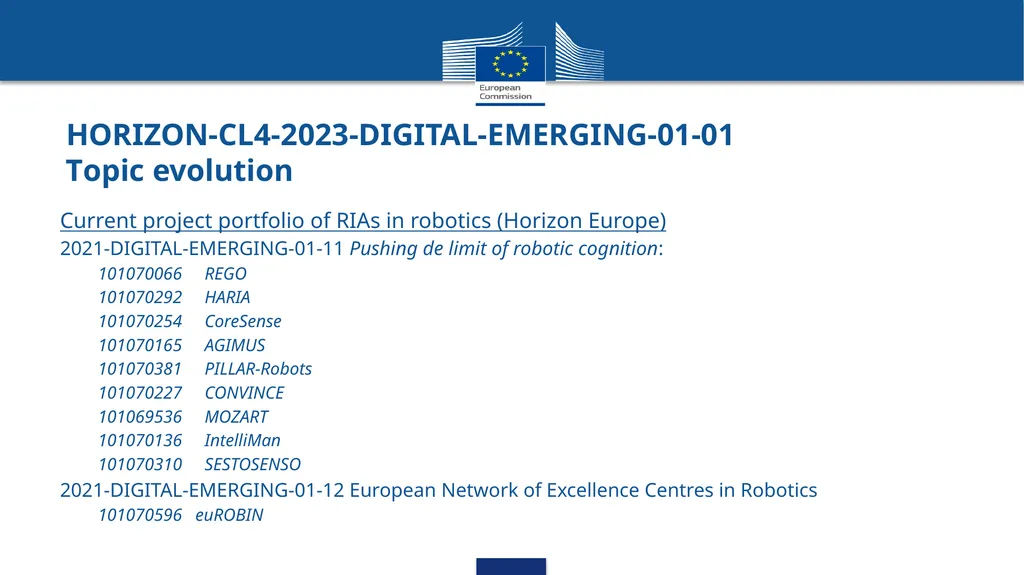
Current project portfolio of RIAs in robotics (Horizon Europe)
2021-DIGITAL-EMERGING-01-11 Pushing de limit of robotic cognition:
101070066 REGO
101070292 HARIA
101070254 CoreSense
101070165 AGIMUS
101070381 PILLAR-Robots
101070227 CONVINCE
101069536 MOZART
101070136 IntelliMan
101070310 SESTOSENSO
2021-DIGITAL-EMERGING-01-12 European Network of Excellence Centres in Robotics
101070596 euROBIN HORIZON-CL4-2023-DIGITAL-EMERGING-01-01 Topic evolution<br>
2021-DIGITAL-EMERGING-01-11 Pushing de limit of robotic cognition:
101070066 REGO
101070292 HARIA
101070254 CoreSense
101070165 AGIMUS
101070381 PILLAR-Robots
101070227 CONVINCE
101069536 MOZART
101070136 IntelliMan
101070310 SESTOSENSO
2021-DIGITAL-EMERGING-01-12 European Network of Excellence Centres in Robotics
101070596 euROBIN HORIZON-CL4-2023-DIGITAL-EMERGING-01-01 Topic evolution<br>
22
HORIZON-CL4-2023-DIGITAL-EMERGING-01-01
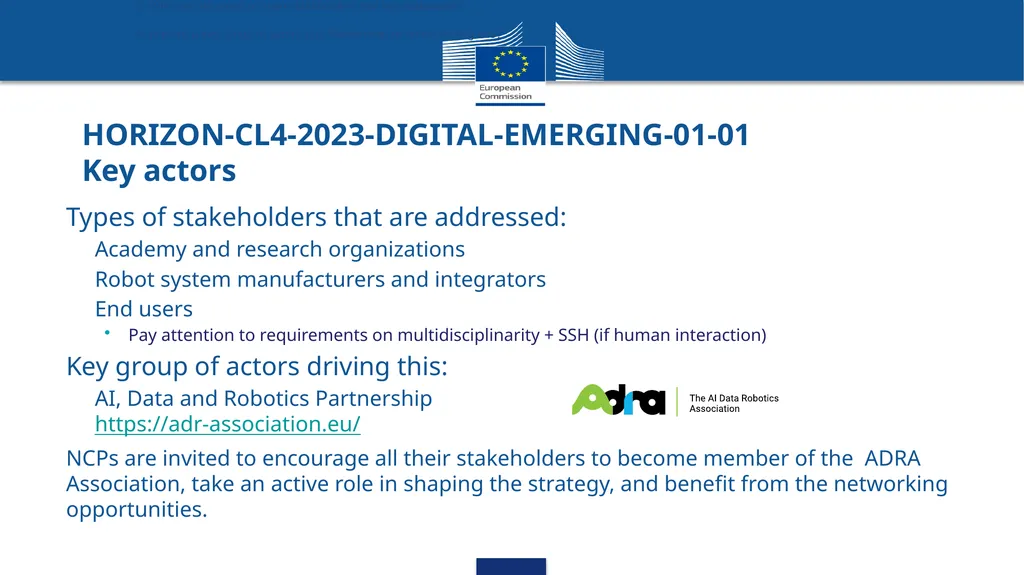
Key actors Types of stakeholders that are addressed:
Academy and research organizations
Robot system manufacturers and integrators
End users
Pay attention to requirements on multidisciplinarity + SSH (if human interaction)
Key group of actors driving this:
AI, Data and Robotics Partnership https://adr-association.eu/
NCPs are invited to encourage all their stakeholders to become member of the ADRA Association, take an active role in shaping the strategy, and benefit from the networking opportunities. 5. Who are the types of main stakeholders that are addressed?
6. Is there a key group of actors (eg. Partnership or other) driving this?<br>
Academy and research organizations
Robot system manufacturers and integrators
End users
Pay attention to requirements on multidisciplinarity + SSH (if human interaction)
Key group of actors driving this:
AI, Data and Robotics Partnership https://adr-association.eu/
NCPs are invited to encourage all their stakeholders to become member of the ADRA Association, take an active role in shaping the strategy, and benefit from the networking opportunities. 5. Who are the types of main stakeholders that are addressed?
6. Is there a key group of actors (eg. Partnership or other) driving this?<br>
23
HORIZON-CL4-2023-DIGITAL-EMERGING-01-01 Additional / background documents
Horizon Europe: New Projects in Robotics and AI - June-November 2022 | Shaping Europe’s digital future (europa.eu)
Launch Event: Paving the way towards the next generation of R&I excellence in AI, Data and Robotics | Adra-e<br>
Horizon Europe: New Projects in Robotics and AI - June-November 2022 | Shaping Europe’s digital future (europa.eu)
Launch Event: Paving the way towards the next generation of R&I excellence in AI, Data and Robotics | Adra-e<br>
24
Future Outlook The AI, Data and Robotics Partnership is driving the future outlook in this area
https://adr-association.eu/<br>
https://adr-association.eu/<br>
25
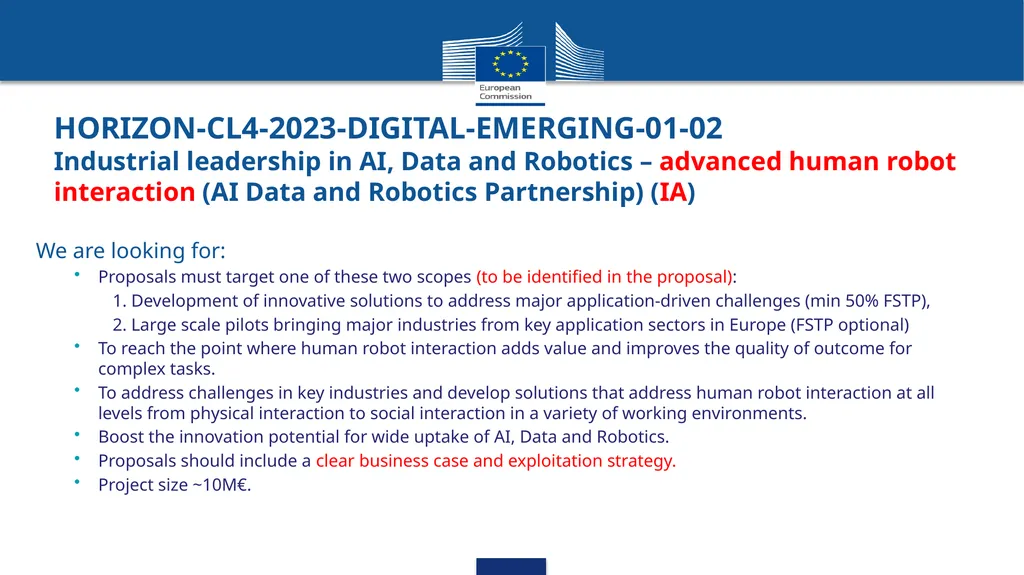
HORIZON-CL4-2023-DIGITAL-EMERGING-01-02
Industrial leadership in AI, Data and Robotics – advanced human robot interaction (AI Data and Robotics Partnership) (IA) We are looking for:
Proposals must target one of these two scopes (to be identified in the proposal):
1. Development of innovative solutions to address major application-driven challenges (min 50% FSTP),
2. Large scale pilots bringing major industries from key application sectors in Europe (FSTP optional)
To reach the point where human robot interaction adds value and improves the quality of outcome for complex tasks.
To address challenges in key industries and develop solutions that address human robot interaction at all levels from physical interaction to social interaction in a variety of working environments.
Boost the innovation potential for wide uptake of AI, Data and Robotics.
Proposals should include a clear business case and exploitation strategy.
Project size ~10M€.<br>
Proposals must target one of these two scopes (to be identified in the proposal):
1. Development of innovative solutions to address major application-driven challenges (min 50% FSTP),
2. Large scale pilots bringing major industries from key application sectors in Europe (FSTP optional)
To reach the point where human robot interaction adds value and improves the quality of outcome for complex tasks.
To address challenges in key industries and develop solutions that address human robot interaction at all levels from physical interaction to social interaction in a variety of working environments.
Boost the innovation potential for wide uptake of AI, Data and Robotics.
Proposals should include a clear business case and exploitation strategy.
Project size ~10M€.<br>
26
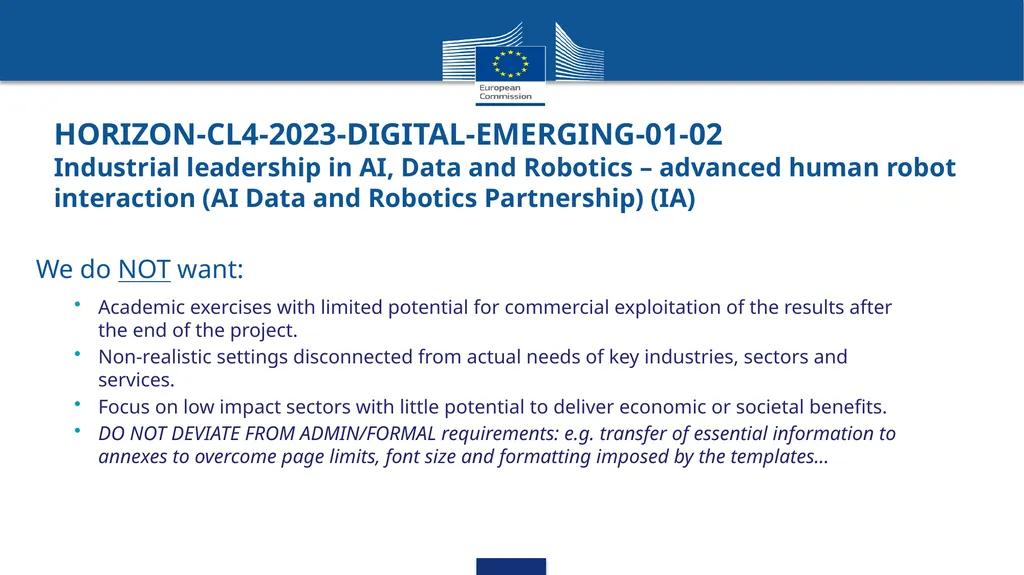
We do NOT want:
Academic exercises with limited potential for commercial exploitation of the results after the end of the project.
Non-realistic settings disconnected from actual needs of key industries, sectors and services.
Focus on low impact sectors with little potential to deliver economic or societal benefits.
DO NOT DEVIATE FROM ADMIN/FORMAL requirements: e.g. transfer of essential information to annexes to overcome page limits, font size and formatting imposed by the templates… HORIZON-CL4-2023-DIGITAL-EMERGING-01-02 Industrial leadership in AI, Data and Robotics – advanced human robot interaction (AI Data and Robotics Partnership) (IA)<br>
Academic exercises with limited potential for commercial exploitation of the results after the end of the project.
Non-realistic settings disconnected from actual needs of key industries, sectors and services.
Focus on low impact sectors with little potential to deliver economic or societal benefits.
DO NOT DEVIATE FROM ADMIN/FORMAL requirements: e.g. transfer of essential information to annexes to overcome page limits, font size and formatting imposed by the templates… HORIZON-CL4-2023-DIGITAL-EMERGING-01-02 Industrial leadership in AI, Data and Robotics – advanced human robot interaction (AI Data and Robotics Partnership) (IA)<br>
27
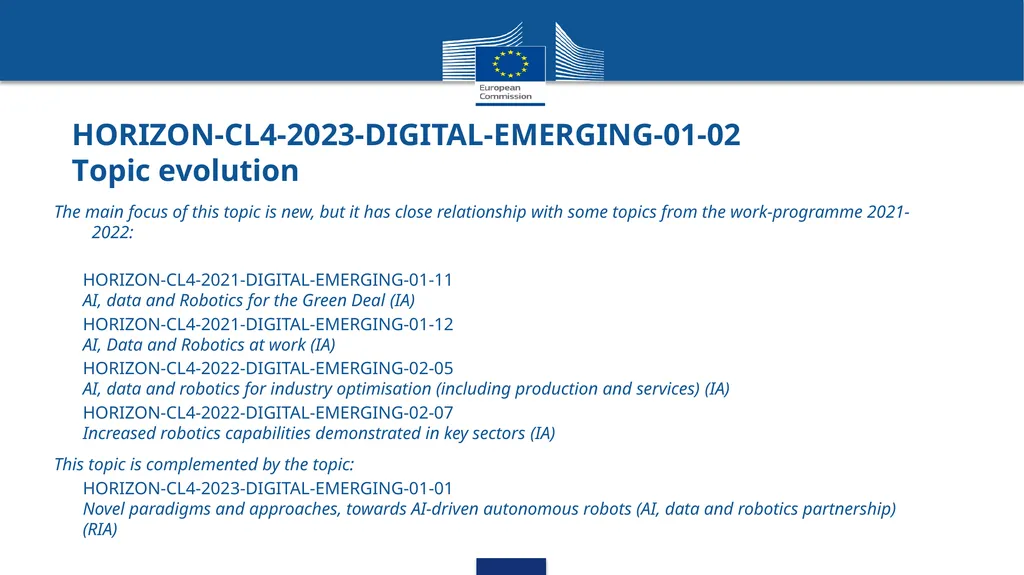
The main focus of this topic is new, but it has close relationship with some topics from the work-programme 2021-2022:
HORIZON-CL4-2021-DIGITAL-EMERGING-01-11 AI, data and Robotics for the Green Deal (IA)
HORIZON-CL4-2021-DIGITAL-EMERGING-01-12 AI, Data and Robotics at work (IA)
HORIZON-CL4-2022-DIGITAL-EMERGING-02-05 AI, data and robotics for industry optimisation (including production and services) (IA)
HORIZON-CL4-2022-DIGITAL-EMERGING-02-07 Increased robotics capabilities demonstrated in key sectors (IA)
This topic is complemented by the topic:
HORIZON-CL4-2023-DIGITAL-EMERGING-01-01 Novel paradigms and approaches, towards AI-driven autonomous robots (AI, data and robotics partnership) (RIA) HORIZON-CL4-2023-DIGITAL-EMERGING-01-02 Topic evolution<br>
HORIZON-CL4-2021-DIGITAL-EMERGING-01-11 AI, data and Robotics for the Green Deal (IA)
HORIZON-CL4-2021-DIGITAL-EMERGING-01-12 AI, Data and Robotics at work (IA)
HORIZON-CL4-2022-DIGITAL-EMERGING-02-05 AI, data and robotics for industry optimisation (including production and services) (IA)
HORIZON-CL4-2022-DIGITAL-EMERGING-02-07 Increased robotics capabilities demonstrated in key sectors (IA)
This topic is complemented by the topic:
HORIZON-CL4-2023-DIGITAL-EMERGING-01-01 Novel paradigms and approaches, towards AI-driven autonomous robots (AI, data and robotics partnership) (RIA) HORIZON-CL4-2023-DIGITAL-EMERGING-01-02 Topic evolution<br>
28
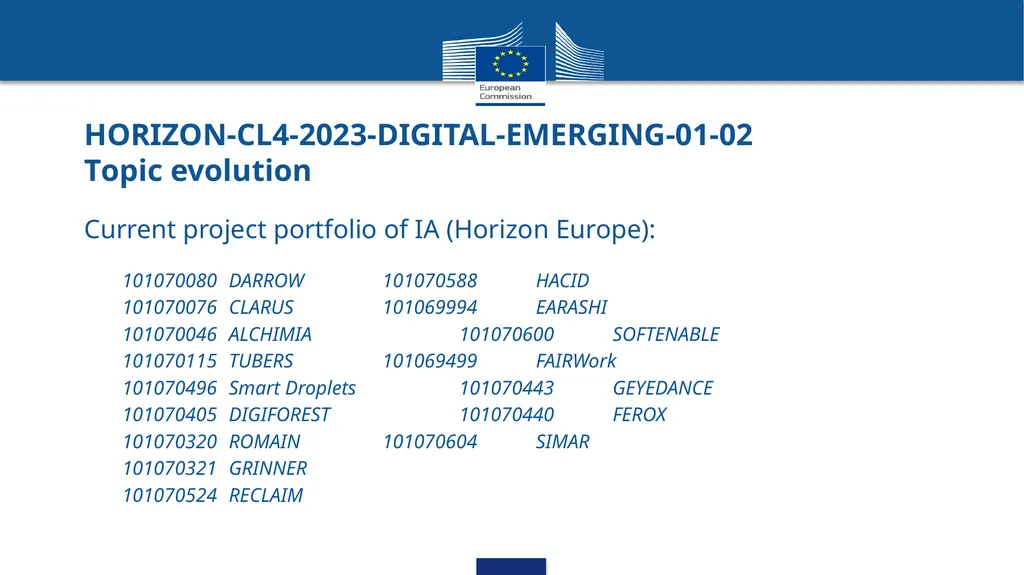
Current project portfolio of IA (Horizon Europe):
101070080 DARROW 101070588 HACID
101070076 CLARUS 101069994 EARASHI
101070046 ALCHIMIA 101070600 SOFTENABLE
101070115 TUBERS 101069499 FAIRWork
101070496 Smart Droplets 101070443 GEYEDANCE
101070405 DIGIFOREST 101070440 FEROX
101070320 ROMAIN 101070604 SIMAR
101070321 GRINNER
101070524 RECLAIM HORIZON-CL4-2023-DIGITAL-EMERGING-01-02 Topic evolution<br>
101070080 DARROW 101070588 HACID
101070076 CLARUS 101069994 EARASHI
101070046 ALCHIMIA 101070600 SOFTENABLE
101070115 TUBERS 101069499 FAIRWork
101070496 Smart Droplets 101070443 GEYEDANCE
101070405 DIGIFOREST 101070440 FEROX
101070320 ROMAIN 101070604 SIMAR
101070321 GRINNER
101070524 RECLAIM HORIZON-CL4-2023-DIGITAL-EMERGING-01-02 Topic evolution<br>
29
HORIZON-CL4-2023-DIGITAL-EMERGING-01-02
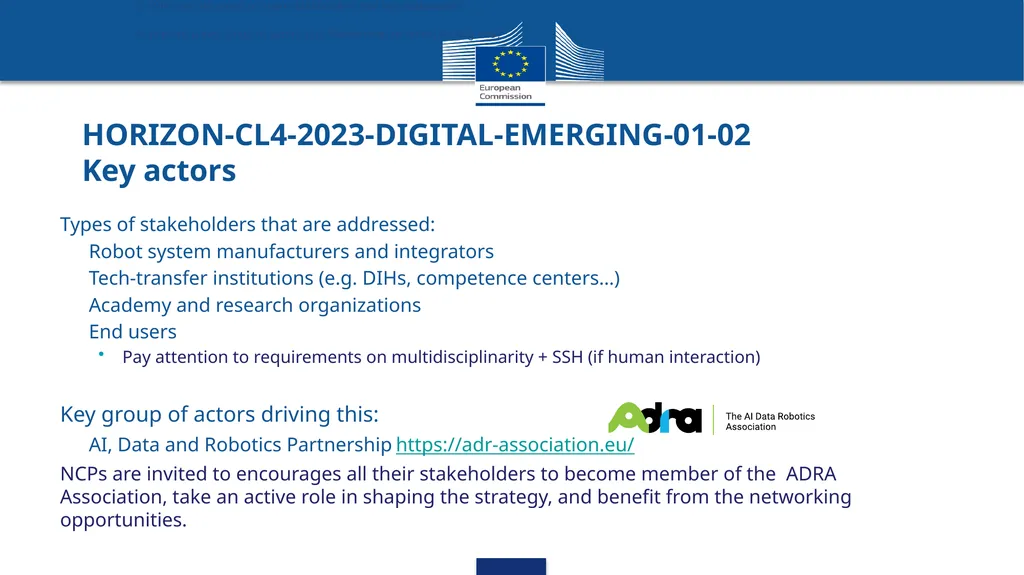
Key actors Types of stakeholders that are addressed:
Robot system manufacturers and integrators
Tech-transfer institutions (e.g. DIHs, competence centers…)
Academy and research organizations
End users
Pay attention to requirements on multidisciplinarity + SSH (if human interaction)
Key group of actors driving this:
AI, Data and Robotics Partnership https://adr-association.eu/
NCPs are invited to encourages all their stakeholders to become member of the ADRA Association, take an active role in shaping the strategy, and benefit from the networking opportunities. 5. Who are the types of main stakeholders that are addressed?
6. Is there a key group of actors (eg. Partnership or other) driving this?<br>
Robot system manufacturers and integrators
Tech-transfer institutions (e.g. DIHs, competence centers…)
Academy and research organizations
End users
Pay attention to requirements on multidisciplinarity + SSH (if human interaction)
Key group of actors driving this:
AI, Data and Robotics Partnership https://adr-association.eu/
NCPs are invited to encourages all their stakeholders to become member of the ADRA Association, take an active role in shaping the strategy, and benefit from the networking opportunities. 5. Who are the types of main stakeholders that are addressed?
6. Is there a key group of actors (eg. Partnership or other) driving this?<br>
30
HORIZON-CL4-2023-DIGITAL-EMERGING-01-02 Additional / background documents
Horizon Europe: New Projects in Robotics and AI - June-November 2022 | Shaping Europe’s digital future (europa.eu)
Launch Event: Paving the way towards the next generation of R&I excellence in AI, Data and Robotics | Adra-e<br>
Horizon Europe: New Projects in Robotics and AI - June-November 2022 | Shaping Europe’s digital future (europa.eu)
Launch Event: Paving the way towards the next generation of R&I excellence in AI, Data and Robotics | Adra-e<br>
31
Future Outlook The AI, Data and Robotics Partnership is driving the future outlook in this area
https://adr-association.eu/<br>
https://adr-association.eu/<br>
32
Upcoming events / information days Horizon Europe Cluster 4 “Digital, Industry and Space” Info Day
12 ~ 14 December 2022
https://research-innovation-community.ec.europa.eu/events/3jM2kV6qwHjteovSf3VOrp/overview<br>
12 ~ 14 December 2022
https://research-innovation-community.ec.europa.eu/events/3jM2kV6qwHjteovSf3VOrp/overview<br>
33
# HorizonEU http://ec.europa.eu/horizon-europe Thank you for your questions<br>
34
THE EU RESEARCH AND INNOVATION PROGRAMME (2021-27) Destination 4 - Objective "European leadership in Emerging and Enabling Technologies"<br>
35
ProjectS
RIA
EU contribution/project: 3-4 million Euro BUDGET
35 million Euro
Call in 2023 TRL (Technology Readiness level)
Start at TRL 1-2
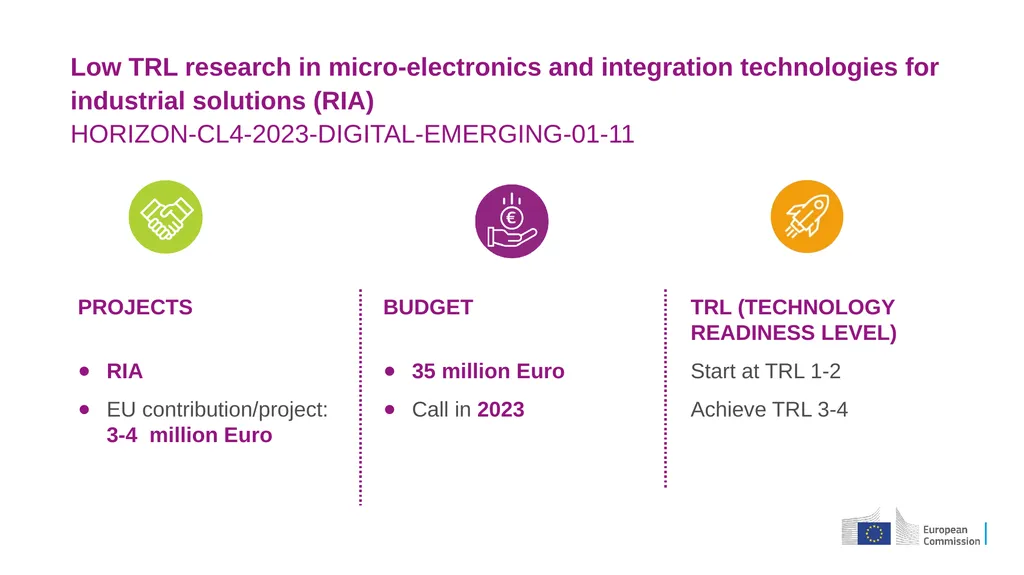
Achieve TRL 3-4 Low TRL research in micro-electronics and integration technologies for industrial solutions (RIA) HORIZON-CL4-2023-DIGITAL-EMERGING-01-11<br>
RIA
EU contribution/project: 3-4 million Euro BUDGET
35 million Euro
Call in 2023 TRL (Technology Readiness level)
Start at TRL 1-2
Achieve TRL 3-4 Low TRL research in micro-electronics and integration technologies for industrial solutions (RIA) HORIZON-CL4-2023-DIGITAL-EMERGING-01-11<br>
36
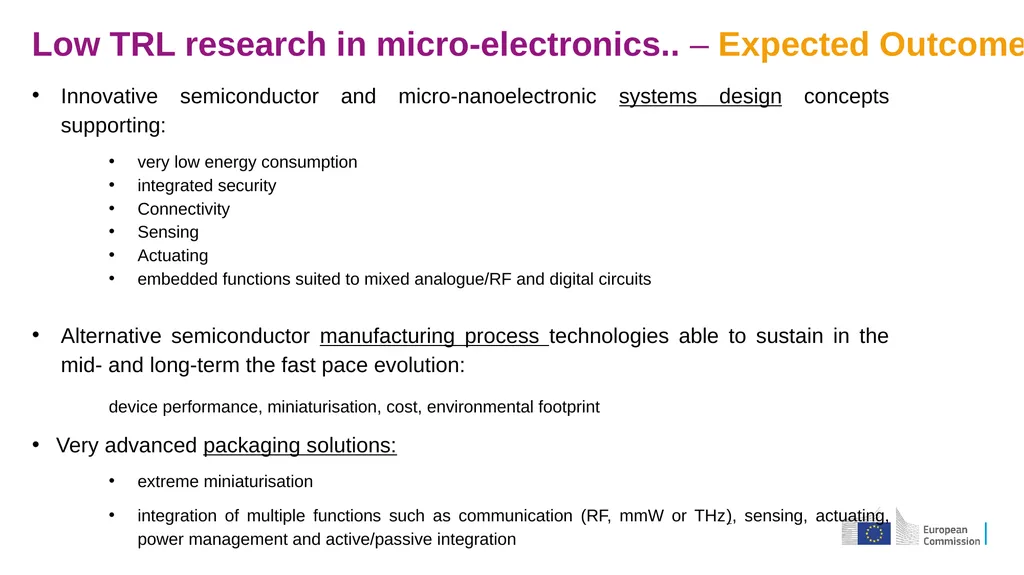
Low TRL research in micro-electronics.. – Expected Outcome Innovative semiconductor and micro-nanoelectronic systems design concepts supporting:
very low energy consumption
integrated security
Connectivity
Sensing
Actuating
embedded functions suited to mixed analogue/RF and digital circuits
Alternative semiconductor manufacturing process technologies able to sustain in the mid- and long-term the fast pace evolution:
device performance, miniaturisation, cost, environmental footprint
Very advanced packaging solutions:
extreme miniaturisation
integration of multiple functions such as communication (RF, mmW or THz), sensing, actuating, power management and active/passive integration<br>
very low energy consumption
integrated security
Connectivity
Sensing
Actuating
embedded functions suited to mixed analogue/RF and digital circuits
Alternative semiconductor manufacturing process technologies able to sustain in the mid- and long-term the fast pace evolution:
device performance, miniaturisation, cost, environmental footprint
Very advanced packaging solutions:
extreme miniaturisation
integration of multiple functions such as communication (RF, mmW or THz), sensing, actuating, power management and active/passive integration<br>
37
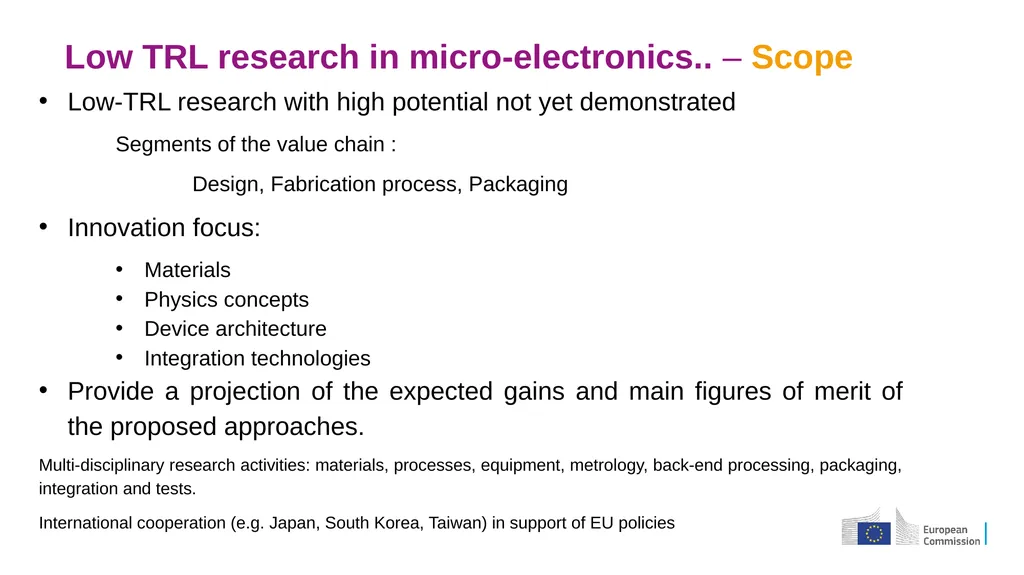
Low TRL research in micro-electronics.. – Scope Low-TRL research with high potential not yet demonstrated
Segments of the value chain :
Design, Fabrication process, Packaging
Innovation focus:
Materials
Physics concepts
Device architecture
Integration technologies
Provide a projection of the expected gains and main figures of merit of the proposed approaches.
Multi-disciplinary research activities: materials, processes, equipment, metrology, back-end processing, packaging, integration and tests.
International cooperation (e.g. Japan, South Korea, Taiwan) in support of EU policies<br>
Segments of the value chain :
Design, Fabrication process, Packaging
Innovation focus:
Materials
Physics concepts
Device architecture
Integration technologies
Provide a projection of the expected gains and main figures of merit of the proposed approaches.
Multi-disciplinary research activities: materials, processes, equipment, metrology, back-end processing, packaging, integration and tests.
International cooperation (e.g. Japan, South Korea, Taiwan) in support of EU policies<br>
38
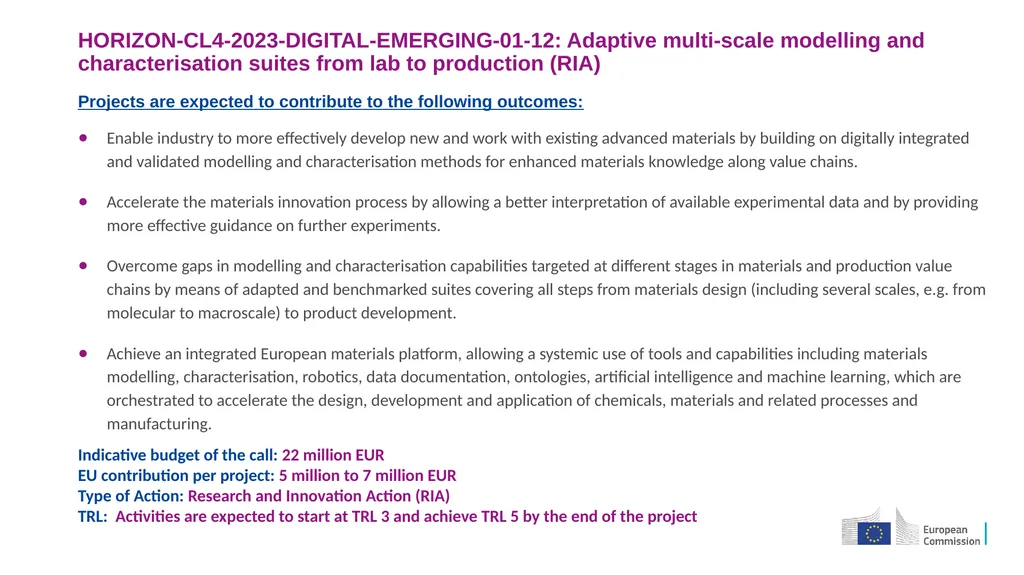
Projects are expected to contribute to the following outcomes:
Enable industry to more effectively develop new and work with existing advanced materials by building on digitally integrated and validated modelling and characterisation methods for enhanced materials knowledge along value chains.
Accelerate the materials innovation process by allowing a better interpretation of available experimental data and by providing more effective guidance on further experiments.
Overcome gaps in modelling and characterisation capabilities targeted at different stages in materials and production value chains by means of adapted and benchmarked suites covering all steps from materials design (including several scales, e.g. from molecular to macroscale) to product development.
Achieve an integrated European materials platform, allowing a systemic use of tools and capabilities including materials modelling, characterisation, robotics, data documentation, ontologies, artificial intelligence and machine learning, which are orchestrated to accelerate the design, development and application of chemicals, materials and related processes and manufacturing.
Indicative budget of the call: 22 million EUR
EU contribution per project: 5 million to 7 million EUR
Type of Action: Research and Innovation Action (RIA)
TRL: Activities are expected to start at TRL 3 and achieve TRL 5 by the end of the project HORIZON-CL4-2023-DIGITAL-EMERGING-01-12: Adaptive multi-scale modelling and characterisation suites from lab to production (RIA)<br>
Enable industry to more effectively develop new and work with existing advanced materials by building on digitally integrated and validated modelling and characterisation methods for enhanced materials knowledge along value chains.
Accelerate the materials innovation process by allowing a better interpretation of available experimental data and by providing more effective guidance on further experiments.
Overcome gaps in modelling and characterisation capabilities targeted at different stages in materials and production value chains by means of adapted and benchmarked suites covering all steps from materials design (including several scales, e.g. from molecular to macroscale) to product development.
Achieve an integrated European materials platform, allowing a systemic use of tools and capabilities including materials modelling, characterisation, robotics, data documentation, ontologies, artificial intelligence and machine learning, which are orchestrated to accelerate the design, development and application of chemicals, materials and related processes and manufacturing.
Indicative budget of the call: 22 million EUR
EU contribution per project: 5 million to 7 million EUR
Type of Action: Research and Innovation Action (RIA)
TRL: Activities are expected to start at TRL 3 and achieve TRL 5 by the end of the project HORIZON-CL4-2023-DIGITAL-EMERGING-01-12: Adaptive multi-scale modelling and characterisation suites from lab to production (RIA)<br>
39
# HorizonEU http://ec.europa.eu/horizon-europe Thank you for your questions<br>
40
THE EU RESEARCH AND INNOVATION PROGRAMME (2021-27) Destination 4 - Objective "Flagship on Quantum Technologies: a Paradigm Shift"<br>
41
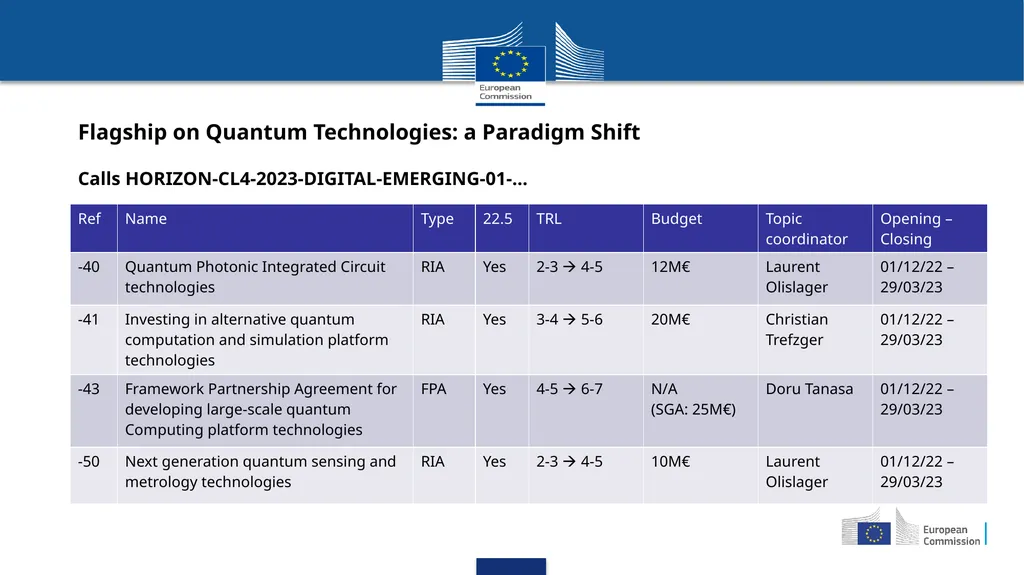
Flagship on Quantum Technologies: a Paradigm Shift
Calls HORIZON-CL4-2023-DIGITAL-EMERGING-01-…<br>
Calls HORIZON-CL4-2023-DIGITAL-EMERGING-01-…<br>
42
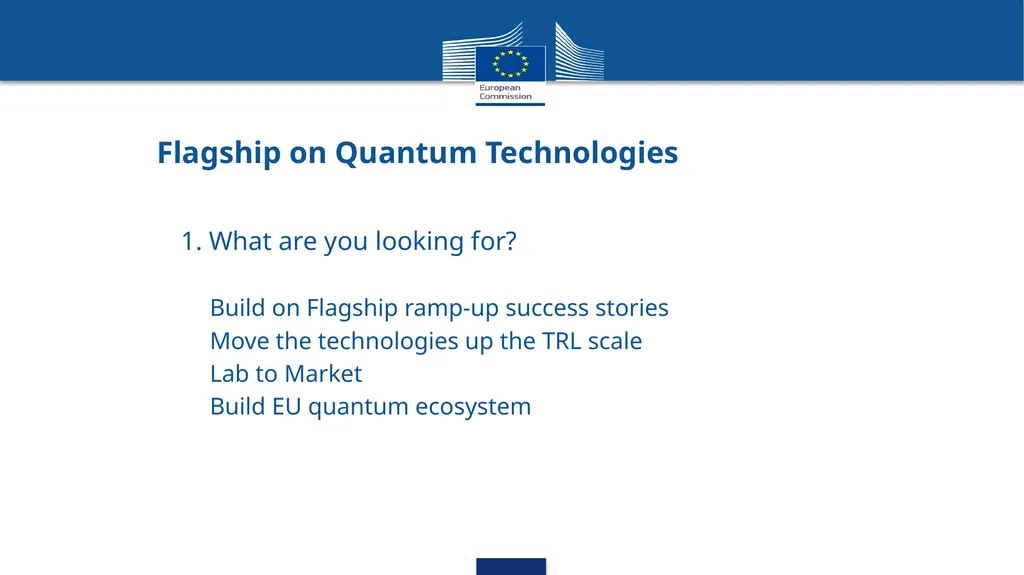
Flagship on Quantum Technologies 1. What are you looking for?
Build on Flagship ramp-up success stories
Move the technologies up the TRL scale
Lab to Market
Build EU quantum ecosystem<br>
Build on Flagship ramp-up success stories
Move the technologies up the TRL scale
Lab to Market
Build EU quantum ecosystem<br>
43
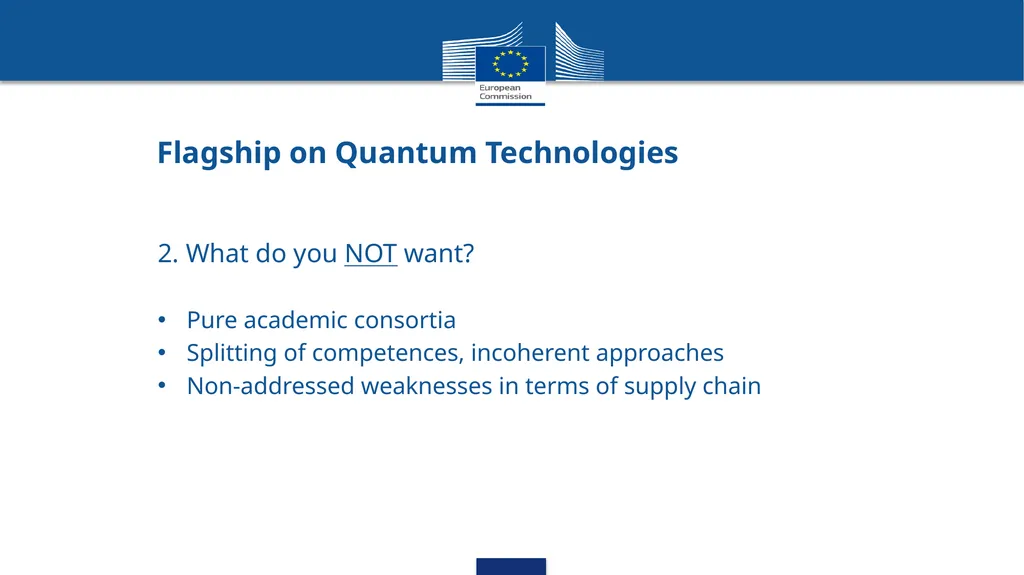
Flagship on Quantum Technologies 2. What do you NOT want?
Pure academic consortia
Splitting of competences, incoherent approaches
Non-addressed weaknesses in terms of supply chain<br>
Pure academic consortia
Splitting of competences, incoherent approaches
Non-addressed weaknesses in terms of supply chain<br>
44
3. Is this new or has it been called before?
Continuation of activities of the Quantum Flagship ramp-up phase & WP21-22
Entering the technology demonstration phase (support deployment activities)
In line with new Strategic Research and Industry Agenda Flagship on Quantum Technologies – Topic evolution<br>
Continuation of activities of the Quantum Flagship ramp-up phase & WP21-22
Entering the technology demonstration phase (support deployment activities)
In line with new Strategic Research and Industry Agenda Flagship on Quantum Technologies – Topic evolution<br>
45
4. Current project portfolio
Quantum Flagship projects under H2020 and HE (RIAs & FPAs/SGAs)
Quantum computing (platforms, software, EuroHPC)
Quantum simulations
Quantum communications (infrastructure: EuroQCI)
Quantum sensing and metrology
Basic science
Pilot lines and testing facilities Flagship on Quantum Technologies – Topic evolution<br>
Quantum Flagship projects under H2020 and HE (RIAs & FPAs/SGAs)
Quantum computing (platforms, software, EuroHPC)
Quantum simulations
Quantum communications (infrastructure: EuroQCI)
Quantum sensing and metrology
Basic science
Pilot lines and testing facilities Flagship on Quantum Technologies – Topic evolution<br>
46
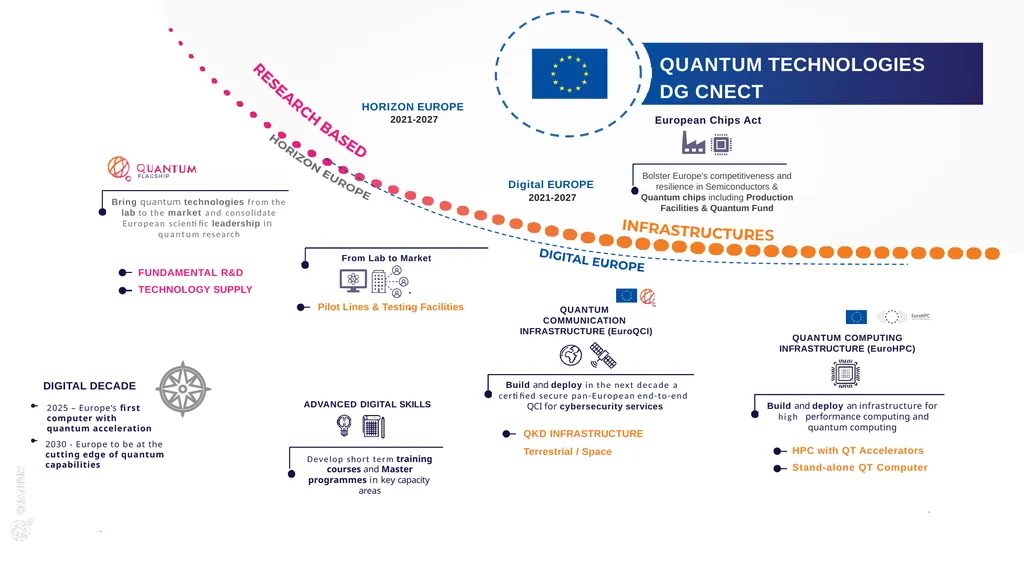
QUANTUM COMMUNICATION INFRASTRUCTURE (EuroQCI) QUANTUM COMPUTING INFRASTRUCTURE (EuroHPC) HORIZON EUROPE
2021-2027 Build and deploy an infrastructure for high performance computing and quantum computing Build and deploy in the next decade a certified secure pan-European end-to-end QCI for cybersecurity services Bring quantum technologies from the lab to the market and consolidate European scientific leadership in quantum research FUNDAMENTAL R&D TECHNOLOGY SUPPLY QUANTUM TECHNOLOGIES
DG CNECT HPC with QT Accelerators
Stand-alone QT Computer QKD INFRASTRUCTURE
Terrestrial / Space Develop short term training courses and Master programmes in key capacity areas ADVANCED DIGITAL SKILLS From Lab to Market Pilot Lines & Testing Facilities Bolster Europe’s competitiveness and resilience in Semiconductors & Quantum chips including Production Facilities & Quantum Fund European Chips Act Digital EUROPE
2021-2027<br>
2021-2027 Build and deploy an infrastructure for high performance computing and quantum computing Build and deploy in the next decade a certified secure pan-European end-to-end QCI for cybersecurity services Bring quantum technologies from the lab to the market and consolidate European scientific leadership in quantum research FUNDAMENTAL R&D TECHNOLOGY SUPPLY QUANTUM TECHNOLOGIES
DG CNECT HPC with QT Accelerators
Stand-alone QT Computer QKD INFRASTRUCTURE
Terrestrial / Space Develop short term training courses and Master programmes in key capacity areas ADVANCED DIGITAL SKILLS From Lab to Market Pilot Lines & Testing Facilities Bolster Europe’s competitiveness and resilience in Semiconductors & Quantum chips including Production Facilities & Quantum Fund European Chips Act Digital EUROPE
2021-2027<br>
47
5. Who are the types of main stakeholders that are addressed?
Research institutes, universities, RTOs, foundations, industry, SMEs & other organizations
Key: academia & industry participation
RTOs: role as facilitators for technology transfer
Importance of SMEs and of potential users Flagship on Quantum Technologies – Key actors<br>
Research institutes, universities, RTOs, foundations, industry, SMEs & other organizations
Key: academia & industry participation
RTOs: role as facilitators for technology transfer
Importance of SMEs and of potential users Flagship on Quantum Technologies – Key actors<br>
48
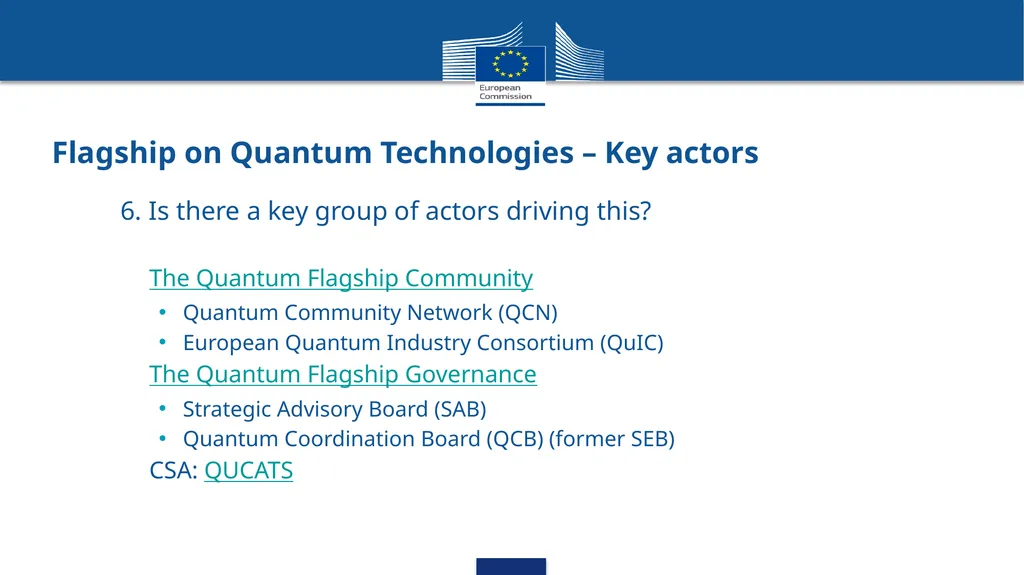
6. Is there a key group of actors driving this?
The Quantum Flagship Community
Quantum Community Network (QCN)
European Quantum Industry Consortium (QuIC)
The Quantum Flagship Governance
Strategic Advisory Board (SAB)
Quantum Coordination Board (QCB) (former SEB)
CSA: QUCATS Flagship on Quantum Technologies – Key actors<br>
The Quantum Flagship Community
Quantum Community Network (QCN)
European Quantum Industry Consortium (QuIC)
The Quantum Flagship Governance
Strategic Advisory Board (SAB)
Quantum Coordination Board (QCB) (former SEB)
CSA: QUCATS Flagship on Quantum Technologies – Key actors<br>
49
7. Are there any additional / background documents?
qt.eu – Resources
Quantum (europa.eu)
CNECT.C2 High Performance Computing & Quantum Technologies cnect-c2@ec.europa.eu cnect-c2-evaluations@ec.europa.eu Flagship on Quantum Technologies<br>
qt.eu – Resources
Quantum (europa.eu)
CNECT.C2 High Performance Computing & Quantum Technologies cnect-c2@ec.europa.eu cnect-c2-evaluations@ec.europa.eu Flagship on Quantum Technologies<br>
50
8. Do you have information about future trends, emerging initiatives, roadmaps, key players in this area?
Reference: Strategic Research and Industry Agenda Flagship on Quantum Technologies – Future outlook<br>
Reference: Strategic Research and Industry Agenda Flagship on Quantum Technologies – Future outlook<br>
51
9. Please list upcoming information days and other events of relevance to this area.
Horizon Europe Information Days – Cluster 4
Destination 4 “Digital and emerging technologies for competitiveness and fit for the Green Deal”
Quantum Technologies on 13 December afternoon Upcoming events / information days<br>
Horizon Europe Information Days – Cluster 4
Destination 4 “Digital and emerging technologies for competitiveness and fit for the Green Deal”
Quantum Technologies on 13 December afternoon Upcoming events / information days<br>
52
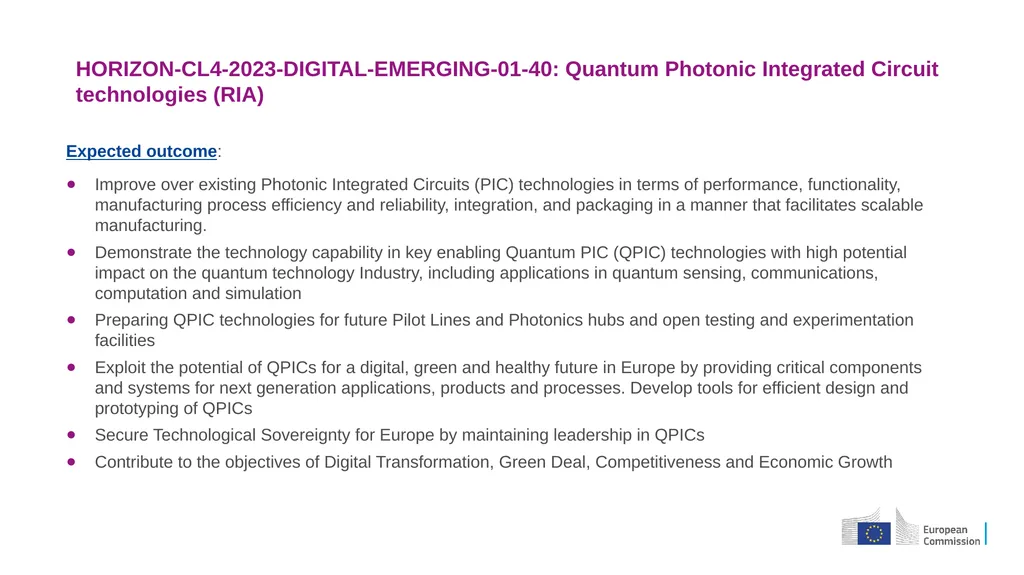
HORIZON-CL4-2023-DIGITAL-EMERGING-01-40: Quantum Photonic Integrated Circuit technologies (RIA) Expected outcome:
Improve over existing Photonic Integrated Circuits (PIC) technologies in terms of performance, functionality, manufacturing process efficiency and reliability, integration, and packaging in a manner that facilitates scalable manufacturing.
Demonstrate the technology capability in key enabling Quantum PIC (QPIC) technologies with high potential impact on the quantum technology Industry, including applications in quantum sensing, communications, computation and simulation
Preparing QPIC technologies for future Pilot Lines and Photonics hubs and open testing and experimentation facilities
Exploit the potential of QPICs for a digital, green and healthy future in Europe by providing critical components and systems for next generation applications, products and processes. Develop tools for efficient design and prototyping of QPICs
Secure Technological Sovereignty for Europe by maintaining leadership in QPICs
Contribute to the objectives of Digital Transformation, Green Deal, Competitiveness and Economic Growth<br>
Improve over existing Photonic Integrated Circuits (PIC) technologies in terms of performance, functionality, manufacturing process efficiency and reliability, integration, and packaging in a manner that facilitates scalable manufacturing.
Demonstrate the technology capability in key enabling Quantum PIC (QPIC) technologies with high potential impact on the quantum technology Industry, including applications in quantum sensing, communications, computation and simulation
Preparing QPIC technologies for future Pilot Lines and Photonics hubs and open testing and experimentation facilities
Exploit the potential of QPICs for a digital, green and healthy future in Europe by providing critical components and systems for next generation applications, products and processes. Develop tools for efficient design and prototyping of QPICs
Secure Technological Sovereignty for Europe by maintaining leadership in QPICs
Contribute to the objectives of Digital Transformation, Green Deal, Competitiveness and Economic Growth<br>
53
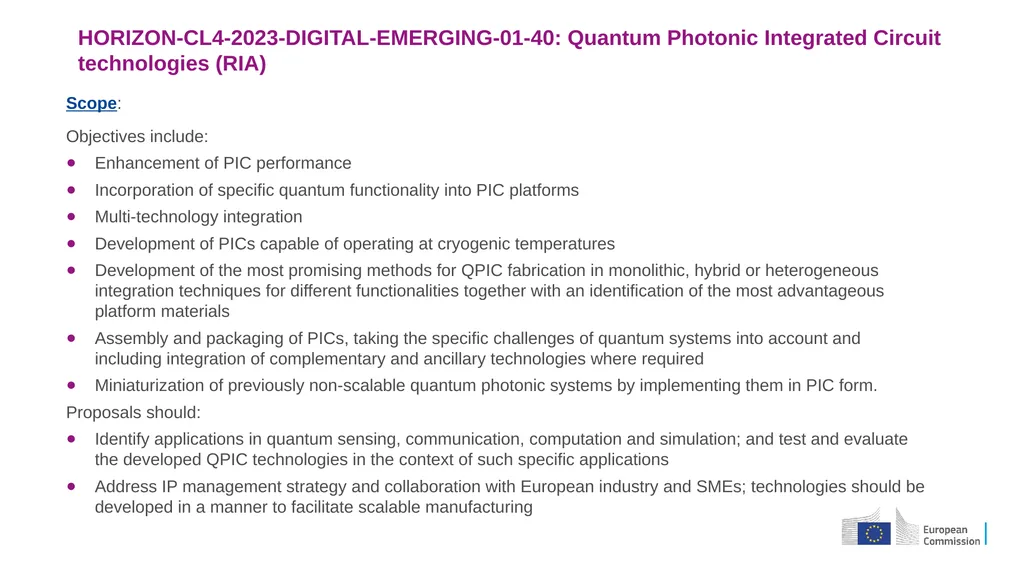
HORIZON-CL4-2023-DIGITAL-EMERGING-01-40: Quantum Photonic Integrated Circuit technologies (RIA) Scope:
Objectives include:
Enhancement of PIC performance
Incorporation of specific quantum functionality into PIC platforms
Multi-technology integration
Development of PICs capable of operating at cryogenic temperatures
Development of the most promising methods for QPIC fabrication in monolithic, hybrid or heterogeneous integration techniques for different functionalities together with an identification of the most advantageous platform materials
Assembly and packaging of PICs, taking the specific challenges of quantum systems into account and including integration of complementary and ancillary technologies where required
Miniaturization of previously non-scalable quantum photonic systems by implementing them in PIC form.
Proposals should:
Identify applications in quantum sensing, communication, computation and simulation; and test and evaluate the developed QPIC technologies in the context of such specific applications
Address IP management strategy and collaboration with European industry and SMEs; technologies should be developed in a manner to facilitate scalable manufacturing<br>
Objectives include:
Enhancement of PIC performance
Incorporation of specific quantum functionality into PIC platforms
Multi-technology integration
Development of PICs capable of operating at cryogenic temperatures
Development of the most promising methods for QPIC fabrication in monolithic, hybrid or heterogeneous integration techniques for different functionalities together with an identification of the most advantageous platform materials
Assembly and packaging of PICs, taking the specific challenges of quantum systems into account and including integration of complementary and ancillary technologies where required
Miniaturization of previously non-scalable quantum photonic systems by implementing them in PIC form.
Proposals should:
Identify applications in quantum sensing, communication, computation and simulation; and test and evaluate the developed QPIC technologies in the context of such specific applications
Address IP management strategy and collaboration with European industry and SMEs; technologies should be developed in a manner to facilitate scalable manufacturing<br>
54
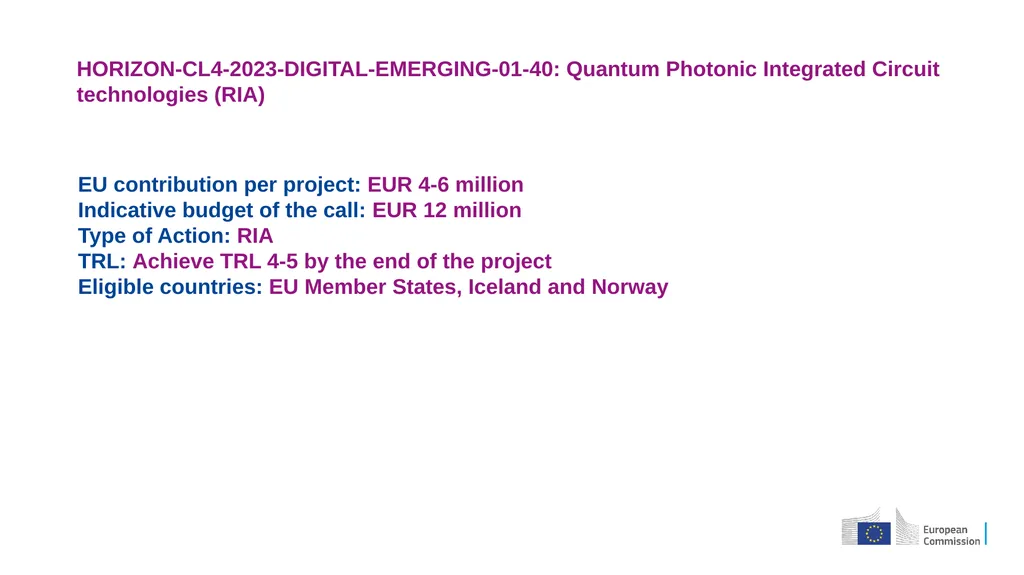
HORIZON-CL4-2023-DIGITAL-EMERGING-01-40: Quantum Photonic Integrated Circuit technologies (RIA) EU contribution per project: EUR 4-6 million
Indicative budget of the call: EUR 12 million
Type of Action: RIA
TRL: Achieve TRL 4-5 by the end of the project
Eligible countries: EU Member States, Iceland and Norway<br>
Indicative budget of the call: EUR 12 million
Type of Action: RIA
TRL: Achieve TRL 4-5 by the end of the project
Eligible countries: EU Member States, Iceland and Norway<br>
55
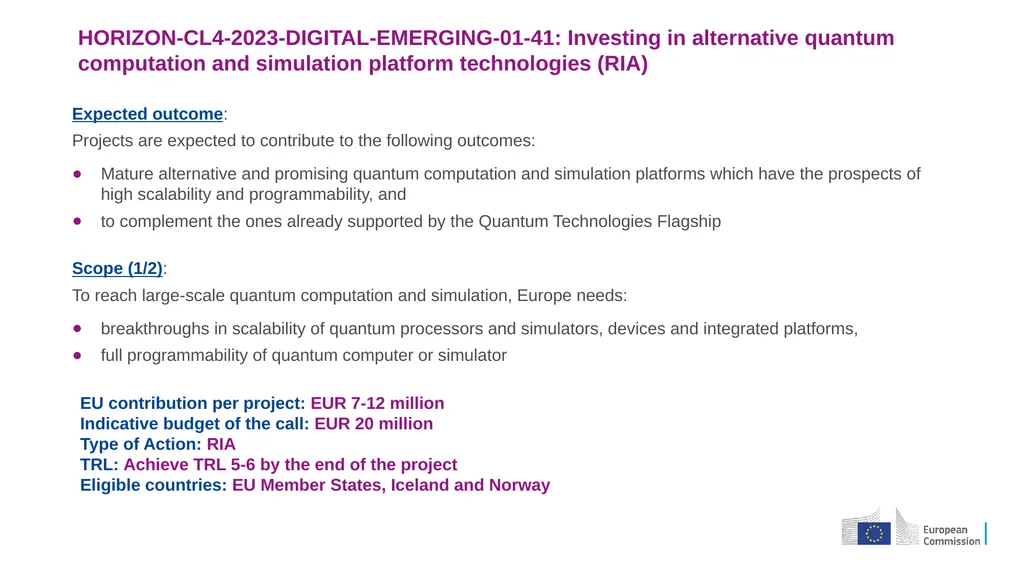
HORIZON-CL4-2023-DIGITAL-EMERGING-01-41: Investing in alternative quantum computation and simulation platform technologies (RIA) Expected outcome:
Projects are expected to contribute to the following outcomes:
Mature alternative and promising quantum computation and simulation platforms which have the prospects of high scalability and programmability, and
to complement the ones already supported by the Quantum Technologies Flagship
Scope (1/2):
To reach large-scale quantum computation and simulation, Europe needs:
breakthroughs in scalability of quantum processors and simulators, devices and integrated platforms,
full programmability of quantum computer or simulator EU contribution per project: EUR 7-12 million
Indicative budget of the call: EUR 20 million
Type of Action: RIA
TRL: Achieve TRL 5-6 by the end of the project
Eligible countries: EU Member States, Iceland and Norway<br>
Projects are expected to contribute to the following outcomes:
Mature alternative and promising quantum computation and simulation platforms which have the prospects of high scalability and programmability, and
to complement the ones already supported by the Quantum Technologies Flagship
Scope (1/2):
To reach large-scale quantum computation and simulation, Europe needs:
breakthroughs in scalability of quantum processors and simulators, devices and integrated platforms,
full programmability of quantum computer or simulator EU contribution per project: EUR 7-12 million
Indicative budget of the call: EUR 20 million
Type of Action: RIA
TRL: Achieve TRL 5-6 by the end of the project
Eligible countries: EU Member States, Iceland and Norway<br>
56
HORIZON-CL4-2023-DIGITAL-EMERGING-01-41: Investing in alternative quantum computation and simulation platform technologies (RIA) Scope (2/2):
Work should address the development of alternative quantum computer and simulator systems and platforms, e.g. photonic or nitrogen vacancy-centre or hybrid systems, and should:
Integrate key building blocks as individual quantum systems (i.e. >10 qubits for a quantum computer and >50 quantum units for a quantum simulator), control electronics, quantum software stack, use case applications, etc.
Address scalability to large systems (>100 qubits for a quantum computer and >1000 quantum units for a quantum simulator), the verification and validation of the quantum computation or simulation, solving a concrete problem to demonstrate the quantum advantage.
Quantum computation platform should explore fault-tolerance. EU contribution per project: EUR 7-12 million
Indicative budget of the call: EUR 20 million
Type of Action: RIA
TRL: Achieve TRL 5-6 by the end of the project
Eligible countries: EU Member States, Iceland and Norway<br>
Work should address the development of alternative quantum computer and simulator systems and platforms, e.g. photonic or nitrogen vacancy-centre or hybrid systems, and should:
Integrate key building blocks as individual quantum systems (i.e. >10 qubits for a quantum computer and >50 quantum units for a quantum simulator), control electronics, quantum software stack, use case applications, etc.
Address scalability to large systems (>100 qubits for a quantum computer and >1000 quantum units for a quantum simulator), the verification and validation of the quantum computation or simulation, solving a concrete problem to demonstrate the quantum advantage.
Quantum computation platform should explore fault-tolerance. EU contribution per project: EUR 7-12 million
Indicative budget of the call: EUR 20 million
Type of Action: RIA
TRL: Achieve TRL 5-6 by the end of the project
Eligible countries: EU Member States, Iceland and Norway<br>
57
HORIZON-CL4-2023-DIGITAL-EMERGING-01-41: Investing in alternative quantum computation and simulation platform technologies (RIA) Proposals should also cover:
Cooperation with complementary projects:
enabling quantum software stack (HORIZON-CL4-2021- DIGITAL-EMERGING-02-10: Strengthening the quantum software ecosystem for quantum computing platforms),
future Digital Europe Programme EuroHPC JU calls for acquisition and operation of quantum computers (integration with the HPC & data infrastructure, establish appropriate IP exploitation agreements).
Cooperation, coordination with the relevant (for the proposed platform) Quantum Flagship initiatives including:
FPAs establishing key EU fabrication processes, technologies and supply chain,
FPAs funded under HORIZON-CL4-2021-DIGITAL-EMERGING-02-17 (simulation) and HORIZON-CL4-2021-DIGITAL-EMERGING-02-15 (computing).
Any additional support they may receive from relevant national, or regional programmes and initiatives
Contribution to the governance and overall coordination of the Quantum Technologies Flagship initiative. Also contribute to spreading excellence across Europe, e.g., through the involvement of EU Widening Countries.<br>
Cooperation with complementary projects:
enabling quantum software stack (HORIZON-CL4-2021- DIGITAL-EMERGING-02-10: Strengthening the quantum software ecosystem for quantum computing platforms),
future Digital Europe Programme EuroHPC JU calls for acquisition and operation of quantum computers (integration with the HPC & data infrastructure, establish appropriate IP exploitation agreements).
Cooperation, coordination with the relevant (for the proposed platform) Quantum Flagship initiatives including:
FPAs establishing key EU fabrication processes, technologies and supply chain,
FPAs funded under HORIZON-CL4-2021-DIGITAL-EMERGING-02-17 (simulation) and HORIZON-CL4-2021-DIGITAL-EMERGING-02-15 (computing).
Any additional support they may receive from relevant national, or regional programmes and initiatives
Contribution to the governance and overall coordination of the Quantum Technologies Flagship initiative. Also contribute to spreading excellence across Europe, e.g., through the involvement of EU Widening Countries.<br>
58
HORIZON-CL4-2023-DIGITAL-EMERGING-01-43: Framework Partnership Agreement for developing large-scale quantum Computing platform technologies (FPA) Expected outcome:
Projects are expected to contribute to the following outcomes:
Demonstrate a universally programmable processor of at least 200 physical qubits (by 2027) operating in the NISQ domain including firmware and having sufficient coherence to perform computations involving all of its qubits; characterised with a hardware-agnostic test suite, including real-world applications, including for hybrid quantum/HPC computing, and the capability of out-performing classical computers on a number of relevant real-world use-cases; control needs to involve a low-level control system, a compiler and a scheduler.
By 2029, build a full stack, highly connected, high fidelity quantum computer of at least one thousand physical qubits, exhibiting scalability and capable of out-performing classical computers on relevant real-world use-cases.
Formulate standards and interface specifications for a complete software and hardware stack including remote, cloud-based access. EU contribution per project: N/A FPA / EUR 25 million SGA
Indicative budget of the call: N/A FPA / EUR 25 million SGA
Type of Action: FPA
TRL: Achieve TRL 6-7 by the end of the project
Eligible countries: EU Member States, Iceland and Norway<br>
Projects are expected to contribute to the following outcomes:
Demonstrate a universally programmable processor of at least 200 physical qubits (by 2027) operating in the NISQ domain including firmware and having sufficient coherence to perform computations involving all of its qubits; characterised with a hardware-agnostic test suite, including real-world applications, including for hybrid quantum/HPC computing, and the capability of out-performing classical computers on a number of relevant real-world use-cases; control needs to involve a low-level control system, a compiler and a scheduler.
By 2029, build a full stack, highly connected, high fidelity quantum computer of at least one thousand physical qubits, exhibiting scalability and capable of out-performing classical computers on relevant real-world use-cases.
Formulate standards and interface specifications for a complete software and hardware stack including remote, cloud-based access. EU contribution per project: N/A FPA / EUR 25 million SGA
Indicative budget of the call: N/A FPA / EUR 25 million SGA
Type of Action: FPA
TRL: Achieve TRL 6-7 by the end of the project
Eligible countries: EU Member States, Iceland and Norway<br>
59
HORIZON-CL4-2023-DIGITAL-EMERGING-01-43: Framework Partnership Agreement for developing large-scale quantum Computing platform technologies (FPA) Scope (1/2):
Proposals for this FPA are expected to build on the quantum computing platforms supported under the Quantum Flagship ramp-up phase and should target:
the development of open quantum computing platforms compatible with the fabrication techniques of the semiconductor industry (e.g. silicon spin qubits)
the integration with the key building blocks such as quantum processors in the NISQ regime with control electronics, low-level software, verification and validation of the quantum computation, etc
practical strategies towards the break-even point of fault tolerance to increase algorithmic depth (number of operations) for quantum computing on existing platforms.
Quantum computation platform should explore fault-tolerance. EU contribution per project: N/A FPA / EUR 25 million SGA
Indicative budget of the call: N/A FPA / EUR 25 million SGA
Type of Action: FPA
TRL: Achieve TRL 6-7 by the end of the project
Eligible countries: EU Member States, Iceland and Norway<br>
Proposals for this FPA are expected to build on the quantum computing platforms supported under the Quantum Flagship ramp-up phase and should target:
the development of open quantum computing platforms compatible with the fabrication techniques of the semiconductor industry (e.g. silicon spin qubits)
the integration with the key building blocks such as quantum processors in the NISQ regime with control electronics, low-level software, verification and validation of the quantum computation, etc
practical strategies towards the break-even point of fault tolerance to increase algorithmic depth (number of operations) for quantum computing on existing platforms.
Quantum computation platform should explore fault-tolerance. EU contribution per project: N/A FPA / EUR 25 million SGA
Indicative budget of the call: N/A FPA / EUR 25 million SGA
Type of Action: FPA
TRL: Achieve TRL 6-7 by the end of the project
Eligible countries: EU Member States, Iceland and Norway<br>
60
HORIZON-CL4-2023-DIGITAL-EMERGING-01-43: Framework Partnership Agreement for developing large-scale quantum Computing platform technologies (FPA) Scope (2/2):
Proposals for this FPA should:
describe how the activities carried out during the ramp-up phase will be continued involving the relevant disciplines ,technologies and stakeholders, how results of the ramp-up phase will be used, and how they will provide efficient coordination under strong scientific and engineering leadership
address the development and integration in this platform of a full software stack, including a compiler and scheduler, programming tools, a suite of algorithms, use cases etc., that would allow them to showcase their capability of solving real and concrete computational problem(s) that demonstrate a quantum advantage and to make progress towards fault tolerance
aim at the development of open quantum computer experimental systems, and work on the reduction of their form factor EU contribution per project: N/A FPA / EUR 25 million SGA
Indicative budget of the call: N/A FPA / EUR 25 million SGA
Type of Action: FPA
TRL: Achieve TRL 6-7 by the end of the project
Eligible countries: EU Member States, Iceland and Norway<br>
Proposals for this FPA should:
describe how the activities carried out during the ramp-up phase will be continued involving the relevant disciplines ,technologies and stakeholders, how results of the ramp-up phase will be used, and how they will provide efficient coordination under strong scientific and engineering leadership
address the development and integration in this platform of a full software stack, including a compiler and scheduler, programming tools, a suite of algorithms, use cases etc., that would allow them to showcase their capability of solving real and concrete computational problem(s) that demonstrate a quantum advantage and to make progress towards fault tolerance
aim at the development of open quantum computer experimental systems, and work on the reduction of their form factor EU contribution per project: N/A FPA / EUR 25 million SGA
Indicative budget of the call: N/A FPA / EUR 25 million SGA
Type of Action: FPA
TRL: Achieve TRL 6-7 by the end of the project
Eligible countries: EU Member States, Iceland and Norway<br>
61
HORIZON-CL4-2023-DIGITAL-EMERGING-01-43: Framework Partnership Agreement for developing large-scale quantum Computing platform technologies (FPA) Proposals should also cover:
Cooperation with complementary projects:
enabling quantum software stack (HORIZON-CL4-2021- DIGITAL-EMERGING-02-10: Strengthening the quantum software ecosystem for quantum computing platforms),
future Digital Europe Programme EuroHPC JU calls for acquisition and operation of quantum computers (integration with the HPC & data infrastructure, establish appropriate IP exploitation agreements).
Any additional support they may receive from relevant national, or regional programmes and initiatives
Contribution to the governance and overall coordination of the Quantum Technologies Flagship initiative. Also contribute to spreading excellence across Europe, e.g., through the involvement of EU Widening Countries.<br>
Cooperation with complementary projects:
enabling quantum software stack (HORIZON-CL4-2021- DIGITAL-EMERGING-02-10: Strengthening the quantum software ecosystem for quantum computing platforms),
future Digital Europe Programme EuroHPC JU calls for acquisition and operation of quantum computers (integration with the HPC & data infrastructure, establish appropriate IP exploitation agreements).
Any additional support they may receive from relevant national, or regional programmes and initiatives
Contribution to the governance and overall coordination of the Quantum Technologies Flagship initiative. Also contribute to spreading excellence across Europe, e.g., through the involvement of EU Widening Countries.<br>
62
HORIZON-CL4-2023-DIGITAL-EMERGING-01-50: Next generation quantum sensing and metrology technologies (RIA) Expected outcome:
Contribute to demonstrate the feasibility of next generation quantum sensing and metrology technologies and devices
By showing disruptive progress in the performance, reliability and efficiency and application of such technologies and devices and by enhancing the TRL of all (essential) components necessary to build them
Scope:
Proposals should focus on next generation quantum sensors and metrology devices such as for example quantum enhanced spectroscopy and imaging, including entangled and/or superposition-based clocks, quantum opto-mechanical sensing devices, squeezed sates of light, point-defects in the solid-state (bulk or 2D materials)
Proposals should address:
the development of new methods and techniques to achieve full control over all relevant quantum degrees of freedom and to protect them from environmental noise;
and/or identify correlated quantum sates that outperform uncorrelated systems in a noisy environment and methods to prepare them reliably.
Proposed work should exploit quantum properties (such as coherence, superposition and entanglement) emerging in quantum systems to improve the performance of the targeted sensors technologies (e.g. in terms of resolution, sensitivity or noise), well beyond the classical limits.<br>
Contribute to demonstrate the feasibility of next generation quantum sensing and metrology technologies and devices
By showing disruptive progress in the performance, reliability and efficiency and application of such technologies and devices and by enhancing the TRL of all (essential) components necessary to build them
Scope:
Proposals should focus on next generation quantum sensors and metrology devices such as for example quantum enhanced spectroscopy and imaging, including entangled and/or superposition-based clocks, quantum opto-mechanical sensing devices, squeezed sates of light, point-defects in the solid-state (bulk or 2D materials)
Proposals should address:
the development of new methods and techniques to achieve full control over all relevant quantum degrees of freedom and to protect them from environmental noise;
and/or identify correlated quantum sates that outperform uncorrelated systems in a noisy environment and methods to prepare them reliably.
Proposed work should exploit quantum properties (such as coherence, superposition and entanglement) emerging in quantum systems to improve the performance of the targeted sensors technologies (e.g. in terms of resolution, sensitivity or noise), well beyond the classical limits.<br>
63
HORIZON-CL4-2023-DIGITAL-EMERGING-01-50: Next generation quantum sensing and metrology technologies (RIA) Scope: (continued)
Proposals should target the development of laboratory prototypes demonstrating the practical usefulness of engineered quantum states of light/matter to improve sensing or imaging and develop and demonstrate optimized quantum software for detection applications in real-world applications.
They should leverage interdisciplinary expertise and join forces with metrology institutes or other relevant technical fields to further advance the limits of sensors sensitivity and resolution and to implement the best control protocols, statistical techniques (e.g. Bayesian, among others) and machine learning algorithms as appropriate.
Projects should build on or seek collaboration with existing projects and develop synergies with other relevant European, national or regional initiatives, funding programmes and platforms and contribute to the governance and overall coordination of the Quantum Technologies Flagship initiative.
EU contribution per project: EUR 2-3 million
Indicative budget of the call: EUR 10 million
Type of Action: RIA
TRL: Achieve TRL 4-5 by the end of the project
Eligible countries: EU Member States, associated countries, OECD countries<br>
Proposals should target the development of laboratory prototypes demonstrating the practical usefulness of engineered quantum states of light/matter to improve sensing or imaging and develop and demonstrate optimized quantum software for detection applications in real-world applications.
They should leverage interdisciplinary expertise and join forces with metrology institutes or other relevant technical fields to further advance the limits of sensors sensitivity and resolution and to implement the best control protocols, statistical techniques (e.g. Bayesian, among others) and machine learning algorithms as appropriate.
Projects should build on or seek collaboration with existing projects and develop synergies with other relevant European, national or regional initiatives, funding programmes and platforms and contribute to the governance and overall coordination of the Quantum Technologies Flagship initiative.
EU contribution per project: EUR 2-3 million
Indicative budget of the call: EUR 10 million
Type of Action: RIA
TRL: Achieve TRL 4-5 by the end of the project
Eligible countries: EU Member States, associated countries, OECD countries<br>
64
# HorizonEU http://ec.europa.eu/horizon-europe Thank you for your questions<br>
65
THE EU RESEARCH AND INNOVATION PROGRAMME (2021-27) Destination 4
Objective "Graphene: Europe in the lead"<br>
Objective "Graphene: Europe in the lead"<br>
66
Graphene: Europe in the lead HE NCP Cluster 4 Training – 6 December 2022
Emilie Klecha, Programme Officer
Disruptive and Emerging Technologies Unit
DG CONNECT, European Commission
Emilie.klecha@ec.europa.eu 66<br>
Emilie Klecha, Programme Officer
Disruptive and Emerging Technologies Unit
DG CONNECT, European Commission
Emilie.klecha@ec.europa.eu 66<br>
67
Graphene: Europe in the lead Starting point is the Graphene Flagship
Build on its achievements, pursued R&I activities and accelerate the technology developments
Concrete innovation opportunities and production capabilities
Strong supply and value chains in graphene and 2D materials in Europe<br>
Build on its achievements, pursued R&I activities and accelerate the technology developments
Concrete innovation opportunities and production capabilities
Strong supply and value chains in graphene and 2D materials in Europe<br>
68
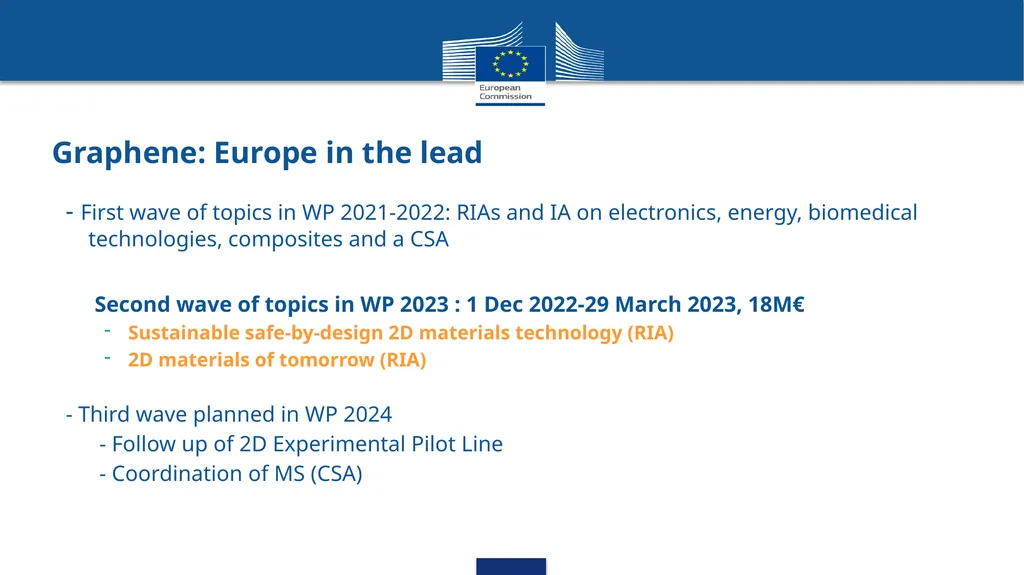
Graphene: Europe in the lead - First wave of topics in WP 2021-2022: RIAs and IA on electronics, energy, biomedical technologies, composites and a CSA
Second wave of topics in WP 2023 : 1 Dec 2022-29 March 2023, 18M€
Sustainable safe-by-design 2D materials technology (RIA)
2D materials of tomorrow (RIA)
- Third wave planned in WP 2024
- Follow up of 2D Experimental Pilot Line
- Coordination of MS (CSA)<br>
Second wave of topics in WP 2023 : 1 Dec 2022-29 March 2023, 18M€
Sustainable safe-by-design 2D materials technology (RIA)
2D materials of tomorrow (RIA)
- Third wave planned in WP 2024
- Follow up of 2D Experimental Pilot Line
- Coordination of MS (CSA)<br>
69
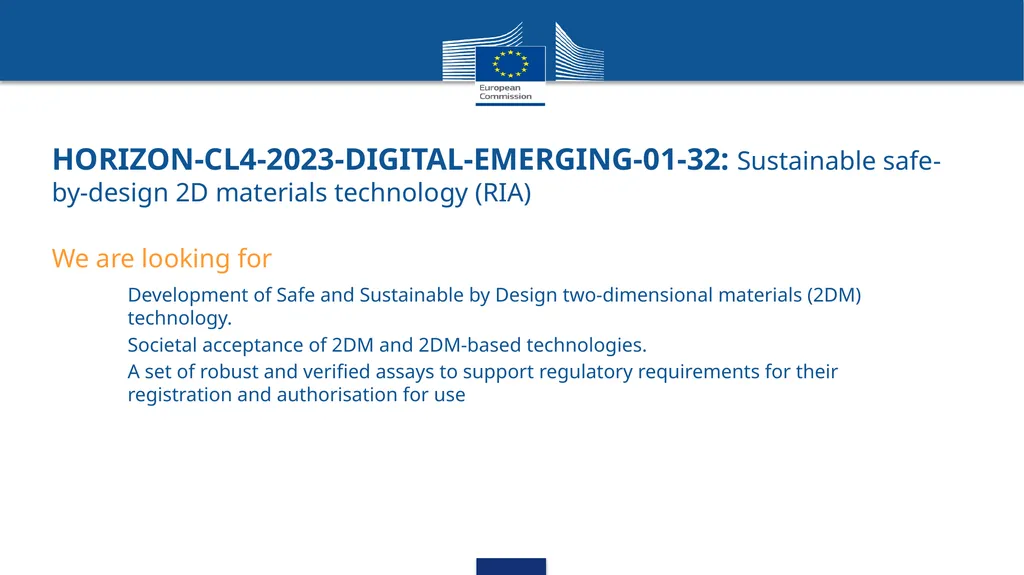
HORIZON-CL4-2023-DIGITAL-EMERGING-01-32: Sustainable safe-by-design 2D materials technology (RIA) We are looking for
Development of Safe and Sustainable by Design two-dimensional materials (2DM) technology.
Societal acceptance of 2DM and 2DM-based technologies.
A set of robust and verified assays to support regulatory requirements for their registration and authorisation for use<br>
Development of Safe and Sustainable by Design two-dimensional materials (2DM) technology.
Societal acceptance of 2DM and 2DM-based technologies.
A set of robust and verified assays to support regulatory requirements for their registration and authorisation for use<br>
70
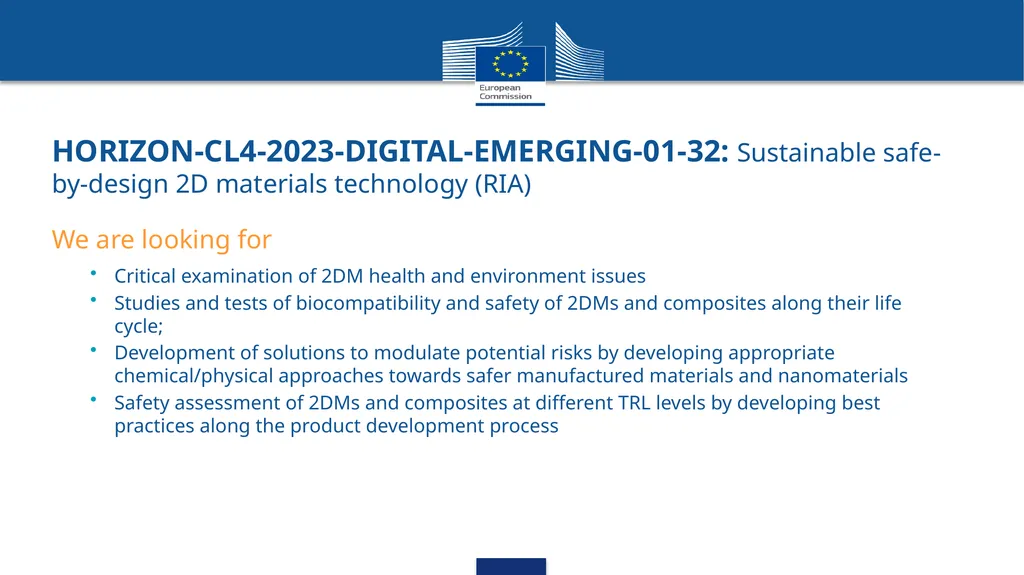
HORIZON-CL4-2023-DIGITAL-EMERGING-01-32: Sustainable safe-by-design 2D materials technology (RIA) We are looking for
Critical examination of 2DM health and environment issues
Studies and tests of biocompatibility and safety of 2DMs and composites along their life cycle;
Development of solutions to modulate potential risks by developing appropriate chemical/physical approaches towards safer manufactured materials and nanomaterials
Safety assessment of 2DMs and composites at different TRL levels by developing best practices along the product development process<br>
Critical examination of 2DM health and environment issues
Studies and tests of biocompatibility and safety of 2DMs and composites along their life cycle;
Development of solutions to modulate potential risks by developing appropriate chemical/physical approaches towards safer manufactured materials and nanomaterials
Safety assessment of 2DMs and composites at different TRL levels by developing best practices along the product development process<br>
71
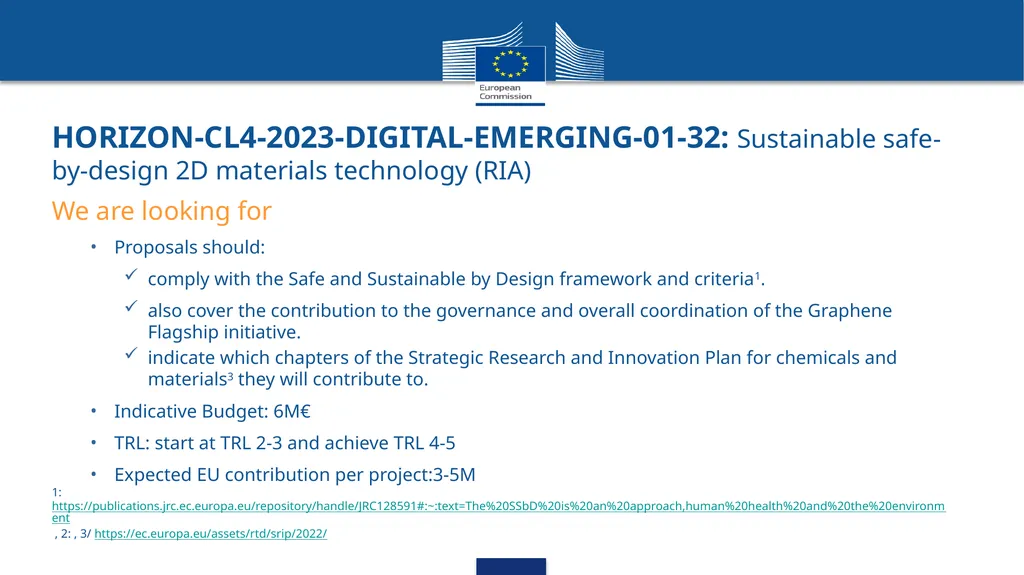
HORIZON-CL4-2023-DIGITAL-EMERGING-01-32: Sustainable safe-by-design 2D materials technology (RIA) We are looking for
Proposals should:
comply with the Safe and Sustainable by Design framework and criteria1.
also cover the contribution to the governance and overall coordination of the Graphene Flagship initiative.
indicate which chapters of the Strategic Research and Innovation Plan for chemicals and materials3 they will contribute to.
Indicative Budget: 6M€
TRL: start at TRL 2-3 and achieve TRL 4-5
Expected EU contribution per project:3-5M
1: https://publications.jrc.ec.europa.eu/repository/handle/JRC128591#:~:text=The%20SSbD%20is%20an%20approach,human%20health%20and%20the%20environment , 2: , 3/ https://ec.europa.eu/assets/rtd/srip/2022/<br>
Proposals should:
comply with the Safe and Sustainable by Design framework and criteria1.
also cover the contribution to the governance and overall coordination of the Graphene Flagship initiative.
indicate which chapters of the Strategic Research and Innovation Plan for chemicals and materials3 they will contribute to.
Indicative Budget: 6M€
TRL: start at TRL 2-3 and achieve TRL 4-5
Expected EU contribution per project:3-5M
1: https://publications.jrc.ec.europa.eu/repository/handle/JRC128591#:~:text=The%20SSbD%20is%20an%20approach,human%20health%20and%20the%20environment , 2: , 3/ https://ec.europa.eu/assets/rtd/srip/2022/<br>
72
HORIZON-CL4-2023-DIGITAL-EMERGING-01-33:
2D materials of tomorrow (RIA) We are looking for
A broad portfolio of innovative two-dimensional materials (2DM), networks and multicomponent hetero-structures exhibiting new properties or complementary functionalities that will lead to breakthroughs in digital systems and devices.
Identify and demonstrate new properties and physical phenomena, and processes enabling new functionalities, and their implementation in proof-of-principle digital devices;
Develop new characterization methods and of controlled, ultra clean and large-scale synthesis, fabrication methods and design of 2D materials and hetero-structures based on novel approaches e.g. Artificial Intelligence assisting material assembly and material simulation, preparation and growth methods combined with the help of modelling and simulation….<br>
A broad portfolio of innovative two-dimensional materials (2DM), networks and multicomponent hetero-structures exhibiting new properties or complementary functionalities that will lead to breakthroughs in digital systems and devices.
Identify and demonstrate new properties and physical phenomena, and processes enabling new functionalities, and their implementation in proof-of-principle digital devices;
Develop new characterization methods and of controlled, ultra clean and large-scale synthesis, fabrication methods and design of 2D materials and hetero-structures based on novel approaches e.g. Artificial Intelligence assisting material assembly and material simulation, preparation and growth methods combined with the help of modelling and simulation….<br>
73
HORIZON-CL4-2023-DIGITAL-EMERGING-01-33:
2D materials of tomorrow (RIA) We are looking for
Proposals should:
also cover the contribution to the governance and overall coordination of the Graphene Flagship initiative.
Indicative Budget: 12M€
TRL: start at TRL 2 and achieve TRL 4
Expected EU contribution per project:3-4M€<br>
Proposals should:
also cover the contribution to the governance and overall coordination of the Graphene Flagship initiative.
Indicative Budget: 12M€
TRL: start at TRL 2 and achieve TRL 4
Expected EU contribution per project:3-4M€<br>
74
3. Is this new or has it been called before?
It is the continuation of the Graphene Flagship
Follows the change of implementation from FPA/SGA vs RIA/IA + CSA
There are other topics/initiatives in the WP out of “Graphene Europe in the Lead” where 2DM can compete Work Programme topic – topic evolution<br>
It is the continuation of the Graphene Flagship
Follows the change of implementation from FPA/SGA vs RIA/IA + CSA
There are other topics/initiatives in the WP out of “Graphene Europe in the Lead” where 2DM can compete Work Programme topic – topic evolution<br>
75
4. Current project portfolio
Graphene Flagship
https://graphene-flagship.eu
2D experimental Pilot line
https://graphene-flagship.eu/innovation/pilot-line Work Programme topic – topic evolution<br>
Graphene Flagship
https://graphene-flagship.eu
2D experimental Pilot line
https://graphene-flagship.eu/innovation/pilot-line Work Programme topic – topic evolution<br>
76
Work Programme topic – Key actors 5. Who are the types of main stakeholders that are addressed?
Both academic and industrial partners
6. Is there a key group of actors (eg. Partnership or other) driving this?
Graphene Flagship consortium: https://graphene-flagship.eu/collaboration/our-partners/ 5. Who are the types of main stakeholders that are addressed?
6. Is there a key group of actors (eg. Partnership or other) driving this?<br>
Both academic and industrial partners
6. Is there a key group of actors (eg. Partnership or other) driving this?
Graphene Flagship consortium: https://graphene-flagship.eu/collaboration/our-partners/ 5. Who are the types of main stakeholders that are addressed?
6. Is there a key group of actors (eg. Partnership or other) driving this?<br>
77
Work Programme topic 7. Are there any additional / background documents?
Consultation report on graphene and related materials, Jan 2020:
https://digital-strategy.ec.europa.eu/en/library/consultation-report-graphene-and-related-materials-now-available<br>
Consultation report on graphene and related materials, Jan 2020:
https://digital-strategy.ec.europa.eu/en/library/consultation-report-graphene-and-related-materials-now-available<br>
78
Future Outlook 8. Do you have information about future trends, emerging initiatives, roadmaps, key players in this area?
Technology and Innovation roadmap:
https://graphene-flagship.eu/innovation/industrialisation/roadmap/
Updated version to be published very soon<br>
Technology and Innovation roadmap:
https://graphene-flagship.eu/innovation/industrialisation/roadmap/
Updated version to be published very soon<br>
79
Upcoming events / information days 9. Please list upcoming information days and other events of relevance to this area
Info Day cluster 4 (destination 4) :13th December 2022, 13:40-16:00<br>
Info Day cluster 4 (destination 4) :13th December 2022, 13:40-16:00<br>
80
# HorizonEU http://ec.europa.eu/horizon-europe Thank you for your questions<br>
81
Horizon Europe “Digital, Industry and Space”
NCP Training TUESday 6 december 2022 THANK YOU!<br>
NCP Training TUESday 6 december 2022 THANK YOU!<br>