
Detecting Covert Timing Channels with

Description: Detecting Covert Timing Channels with Time-deterministic Replay Ang Chen W. Brad Moore Hanjun Xiao Andreas Haeberlen Linh Thi Xuan Phan Micah Sherr Wenchao Zhou University of Pennsylvania Georgetown University Motivation:
Related Topics
Download Presentation
"Detecting Covert Timing Channels with" is the property of its rightful owner. Permission is granted to download and print the materials on this website for personal, non-commercial use only, and to display it on your personal computer provided you do not modify the materials and that you retain all copyright notices contained in the materials. By downloading content from our website, you accept the terms of this agreement.
Presentation Transcript
slide1. Detecting Covert Timing Channels
with Time-deterministic Replay Ang Chen* W. Brad Moore+ Hanjun Xiao*
Andreas Haeberlen* Linh Thi Xuan Phan* Micah Sherr + Wenchao Zhou +
University of Pennsylvania* Georgetown University +<br>
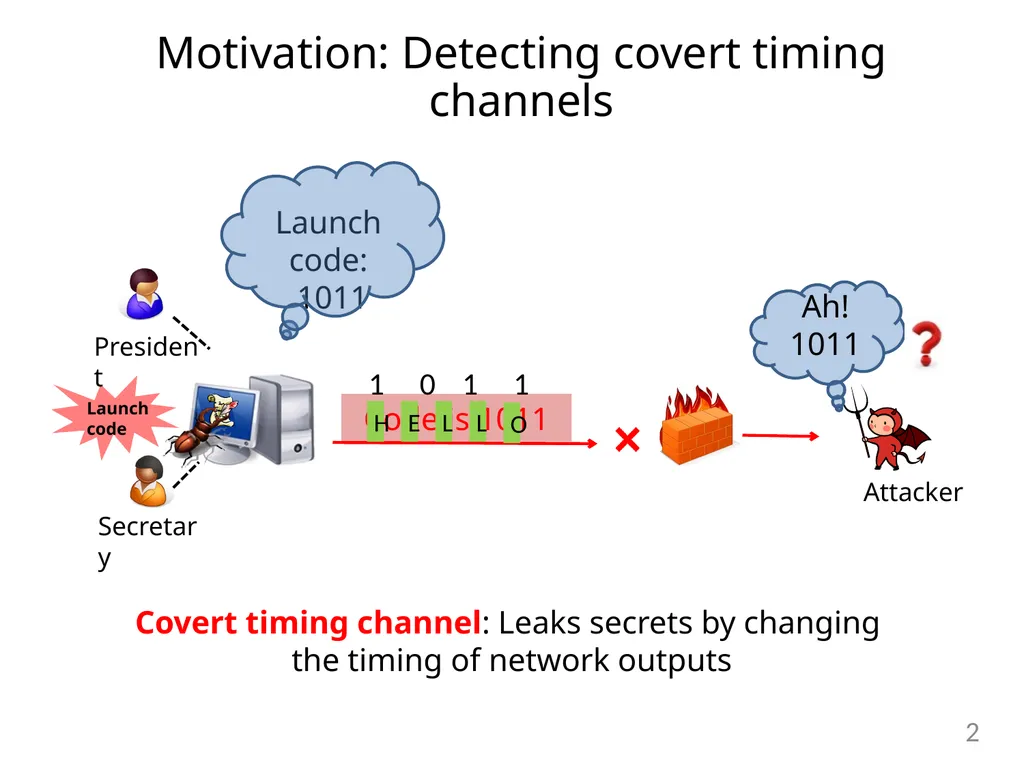
slide2. Motivation: Detecting covert timing channels 1 Secretary President Launch code:
1011 Code is 1011 Ah! 1011 H E L L O 1 0 1 1 Attacker Launch code Covert timing channel: Leaks secrets by changing the timing of network outputs<br>
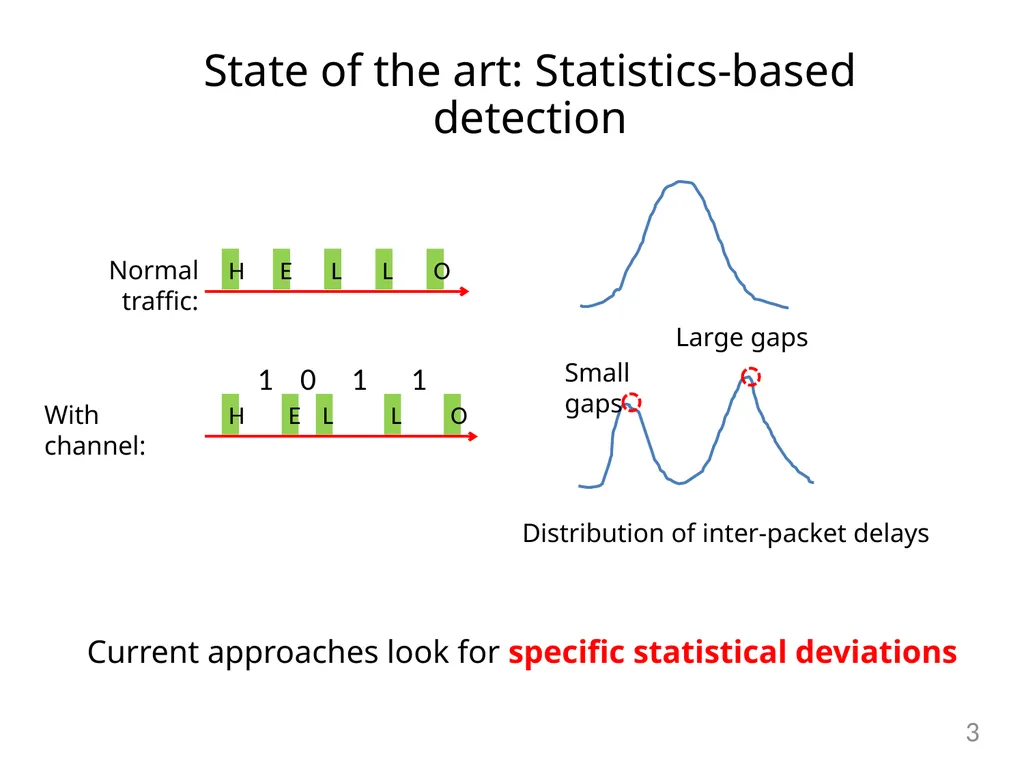
slide3. State of the art: Statistics-based detection 2 H E L L O H E L L O Normal traffic: With channel: Small gaps Large gaps Distribution of inter-packet delays 1 0 1 1 Current approaches look for specific statistical deviations<br>
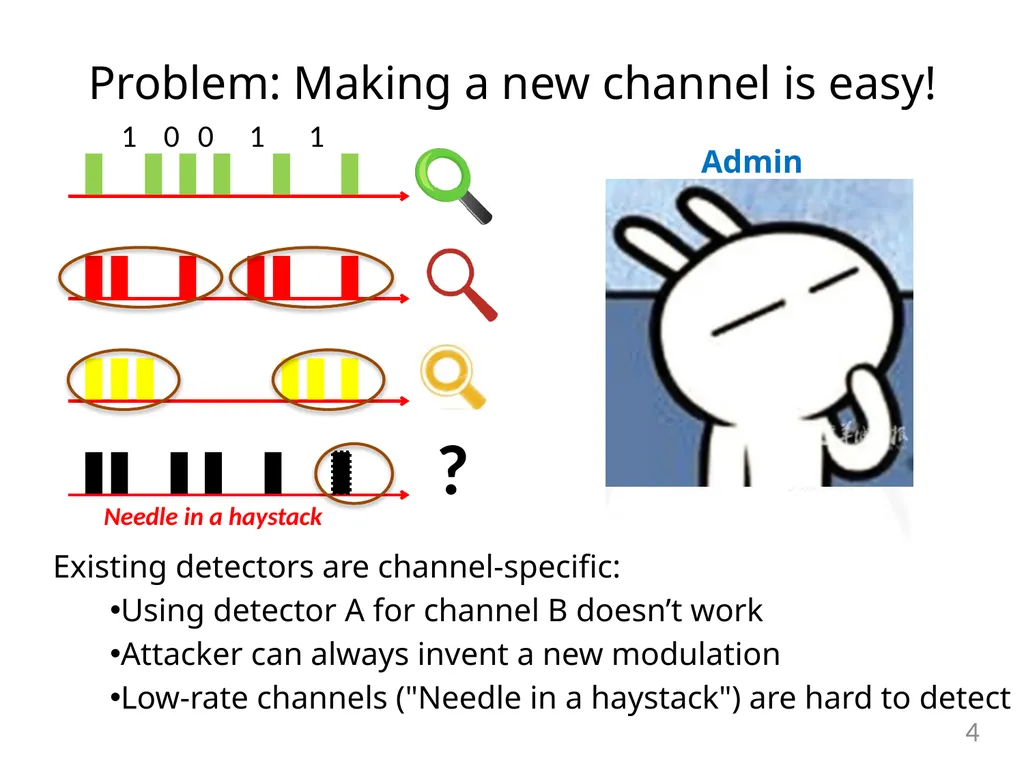
slide4. Problem: Making a new channel is easy! Admin Needle in a haystack ? Existing detectors are channel-specific:
Using detector A for channel B doesn’t work
Attacker can always invent a new modulation
Low-rate channels ("Needle in a haystack") are hard to detect 1 0 0 1 1 3<br>
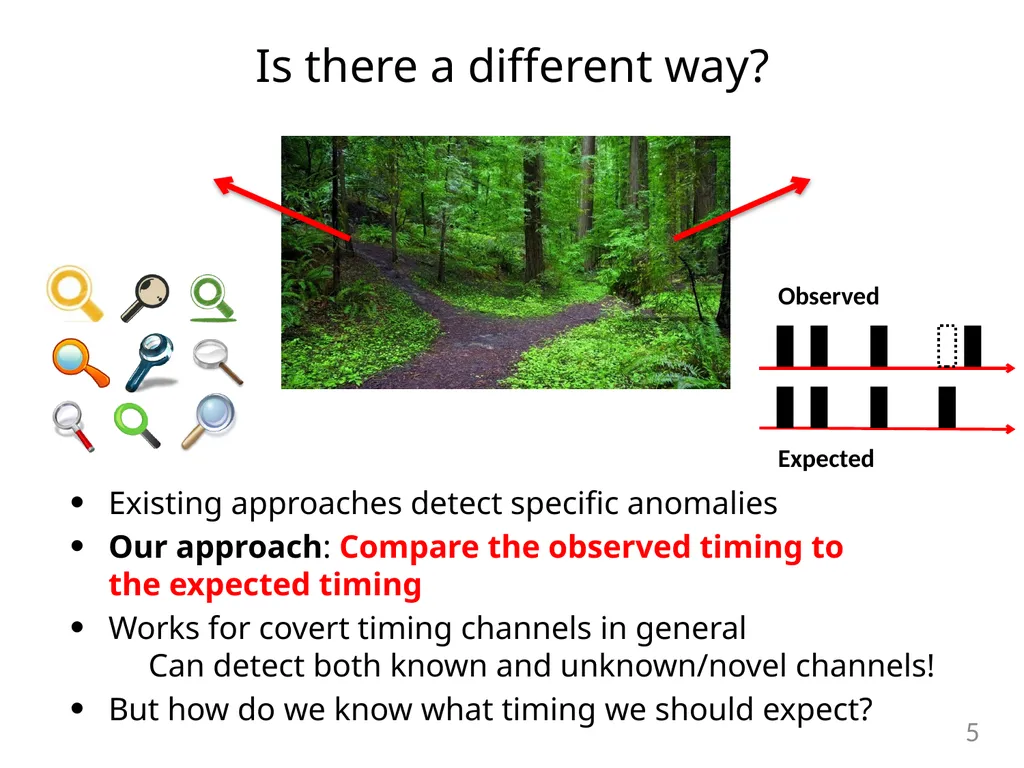
slide5. Is there a different way? 4 Observed Expected Existing approaches detect specific anomalies
Our approach: Compare the observed timing to the expected timing
Works for covert timing channels in general Can detect both known and unknown/novel channels!
But how do we know what timing we should expect?<br>
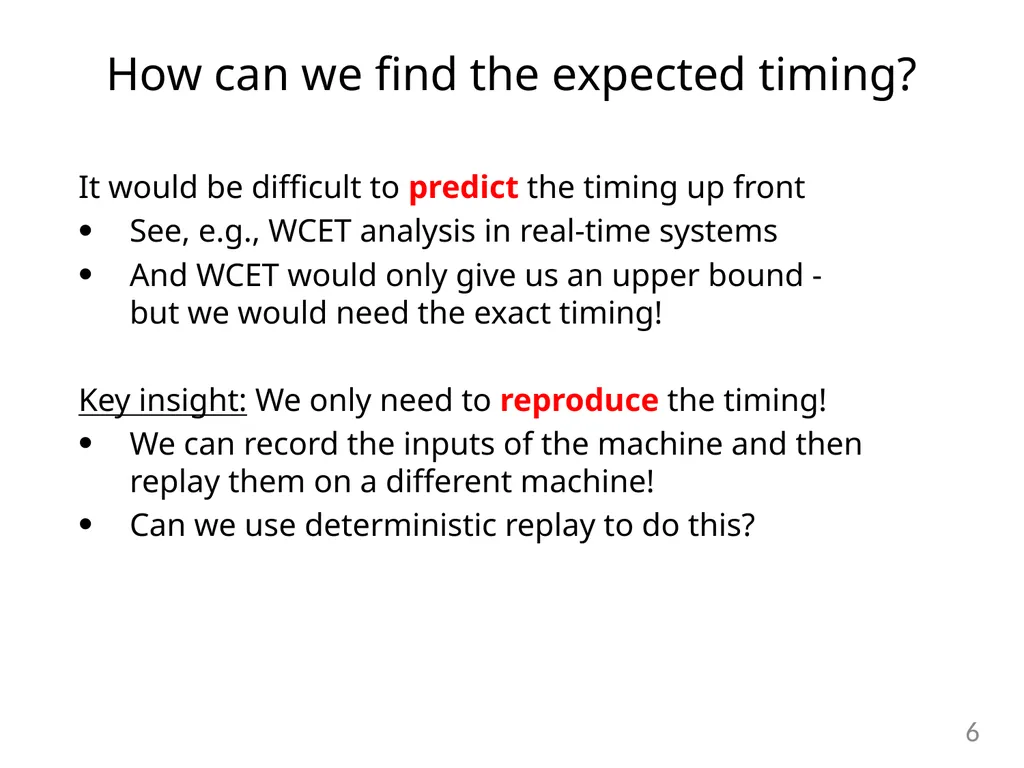
slide6. How can we find the expected timing? It would be difficult to predict the timing up front
See, e.g., WCET analysis in real-time systems
And WCET would only give us an upper bound - but we would need the exact timing!
Key insight: We only need to reproduce the timing!
We can record the inputs of the machine and then replay them on a different machine!
Can we use deterministic replay to do this? 5<br>
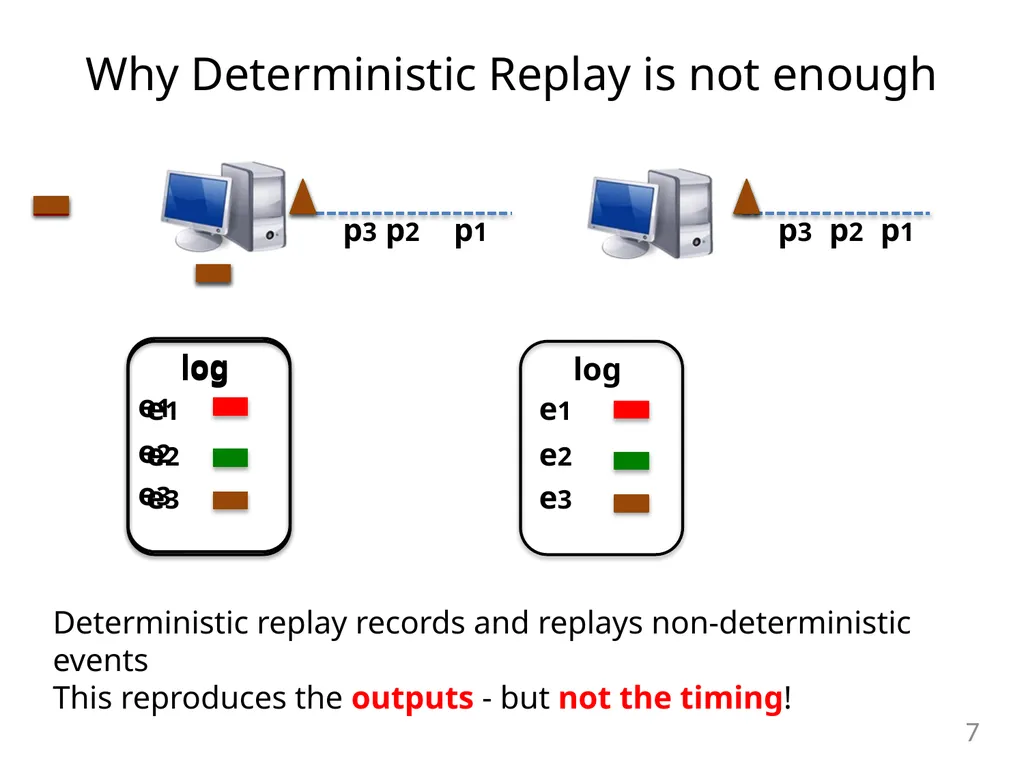
slide7. Why Deterministic Replay is not enough 6 Deterministic replay records and replays non-deterministic events
This reproduces the outputs - but not the timing! e1 log e2 e3 p1 p2 p3 e1 log e2 e3 e1 log e2 e3 p1 p2 p3<br>
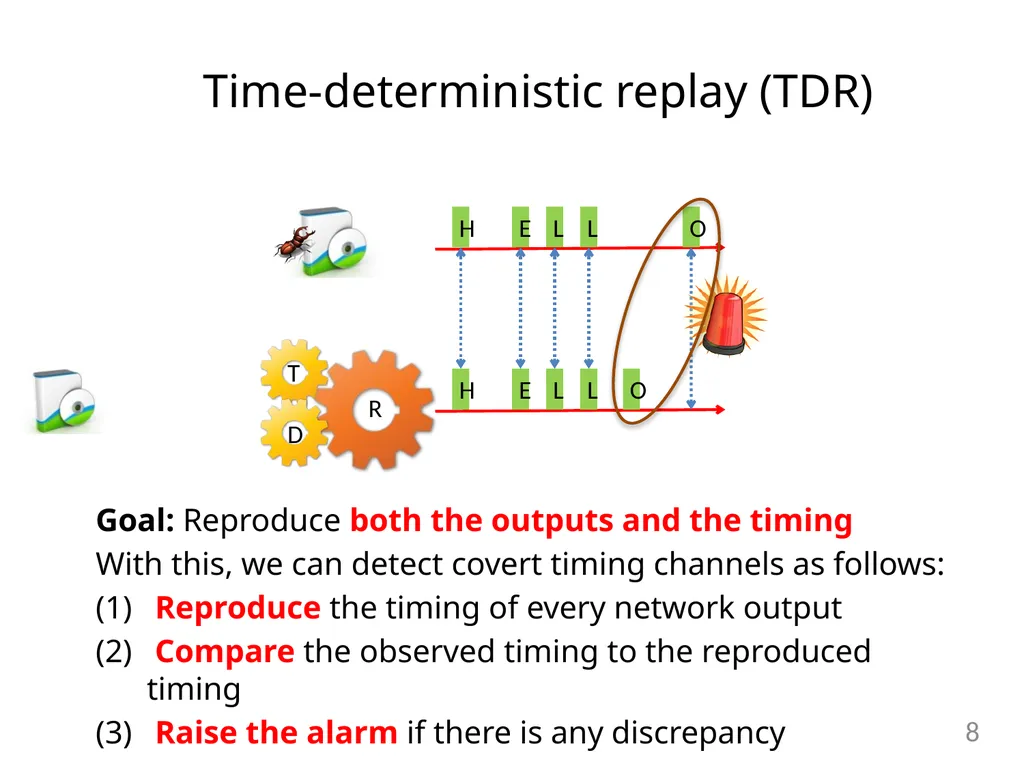
slide8. Time-deterministic replay (TDR) Goal: Reproduce both the outputs and the timing
With this, we can detect covert timing channels as follows:
Reproduce the timing of every network output
Compare the observed timing to the reproduced timing
Raise the alarm if there is any discrepancy 7 7 T D R H E L L O H E L L O<br>
slide9. Outline Motivation
Challenge
Time-deterministic replay (TDR)
Deterministic replay vs. Time-deterministic replay
Time noise, and how to reduce it
Aligning play and replay
Sanity: A TDR prototype
Design & Implementation
Evaluation
Reducing time noise
Aligning play and replay
Detecting timing channels
Conclusion 8<br>
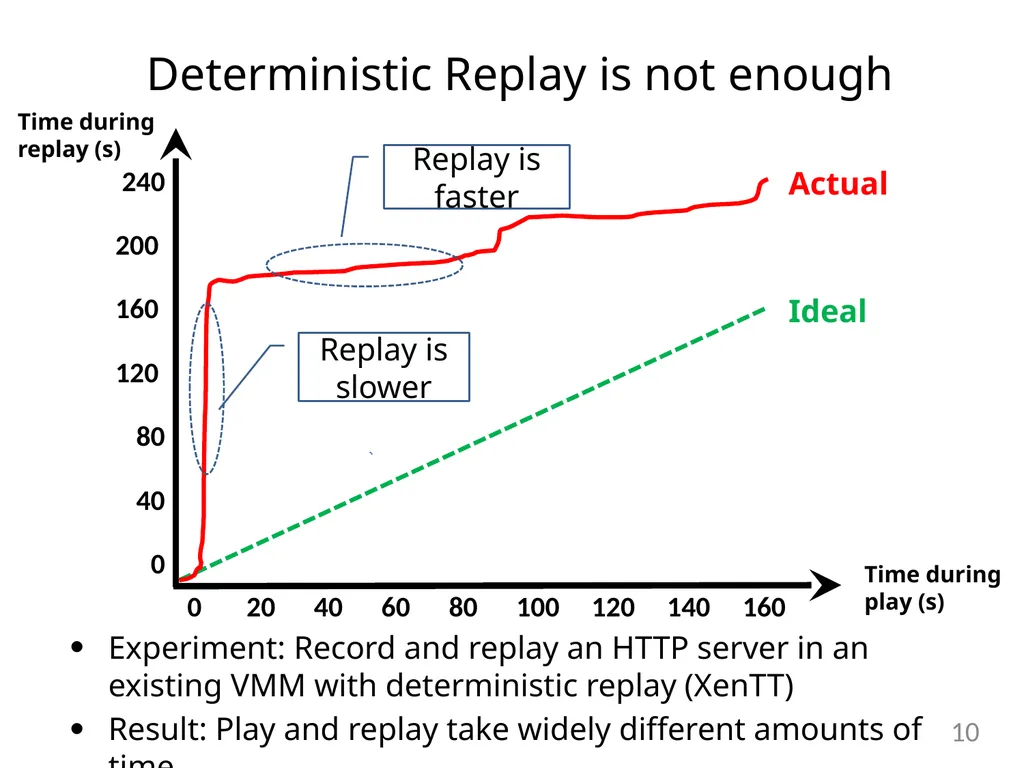
slide10. Deterministic Replay is not enough Experiment: Record and replay an HTTP server in an existing VMM with deterministic replay (XenTT)
Result: Play and replay take widely different amounts of time 240
200
160
120
80
40
0 Time during play (s) Ideal Actual 9 Replay is slower Replay is faster<br>
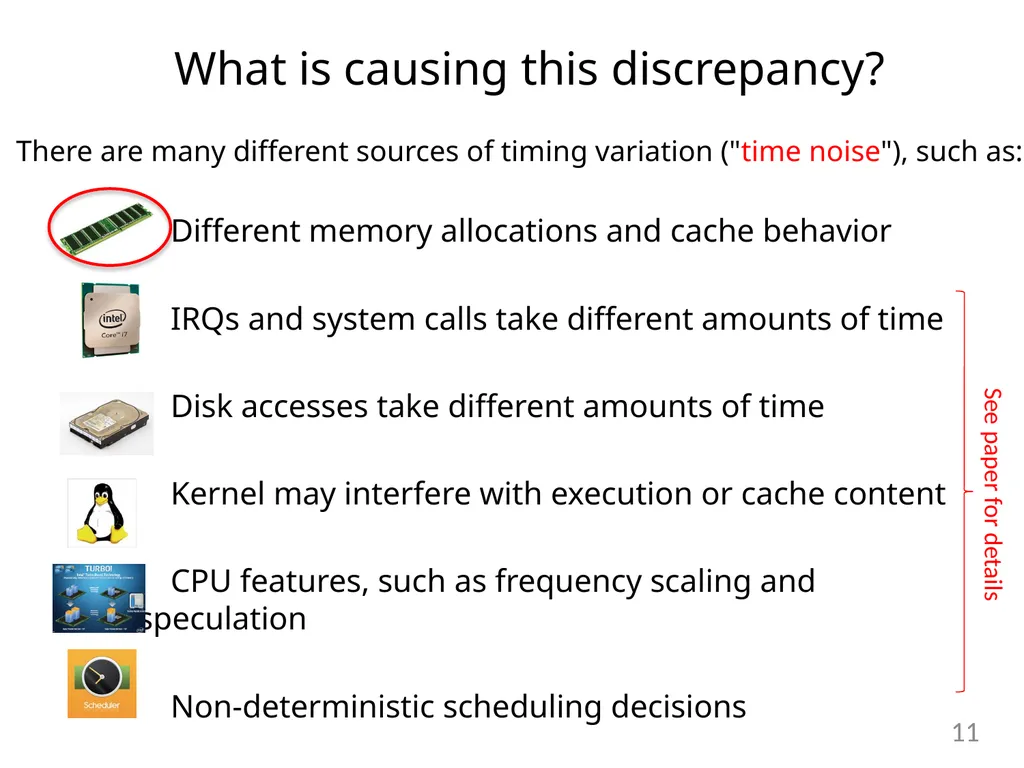
slide11. What is causing this discrepancy? Different memory allocations and cache behavior
IRQs and system calls take different amounts of time
Disk accesses take different amounts of time
Kernel may interfere with execution or cache content
CPU features, such as frequency scaling and speculation
Non-deterministic scheduling decisions 10 There are many different sources of timing variation ("time noise"), such as: See paper for details<br>
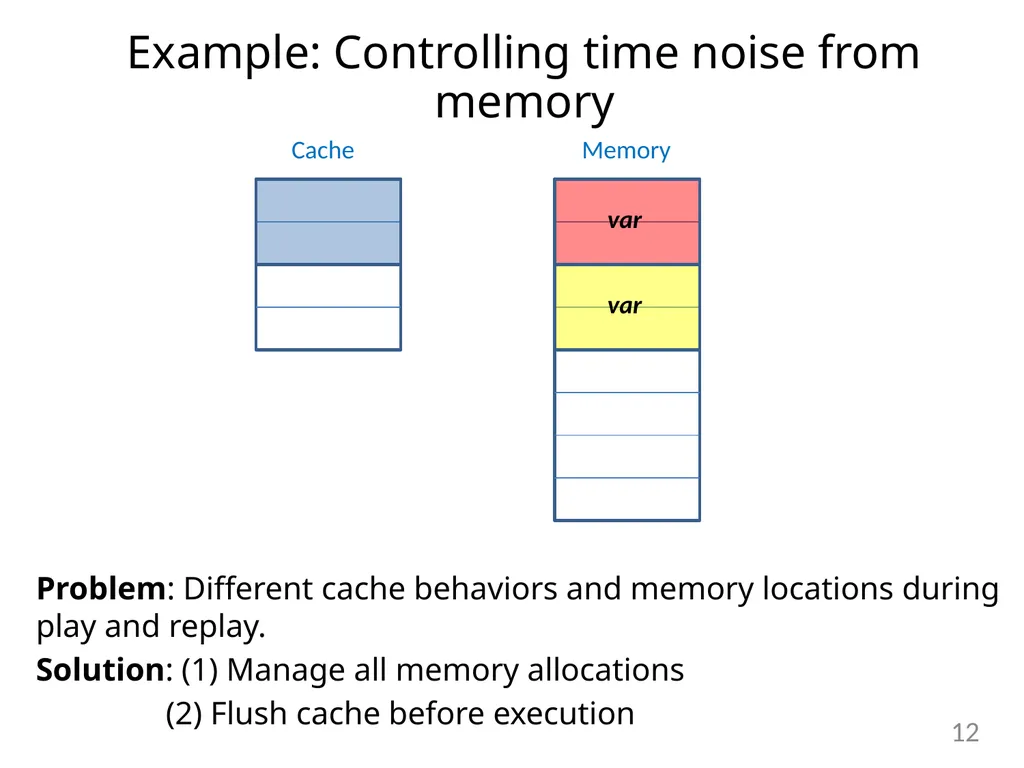
slide12. Example: Controlling time noise from memory Problem: Different cache behaviors and memory locations during play and replay.
Solution: (1) Manage all memory allocations
(2) Flush cache before execution 11 Cache Memory var var<br>
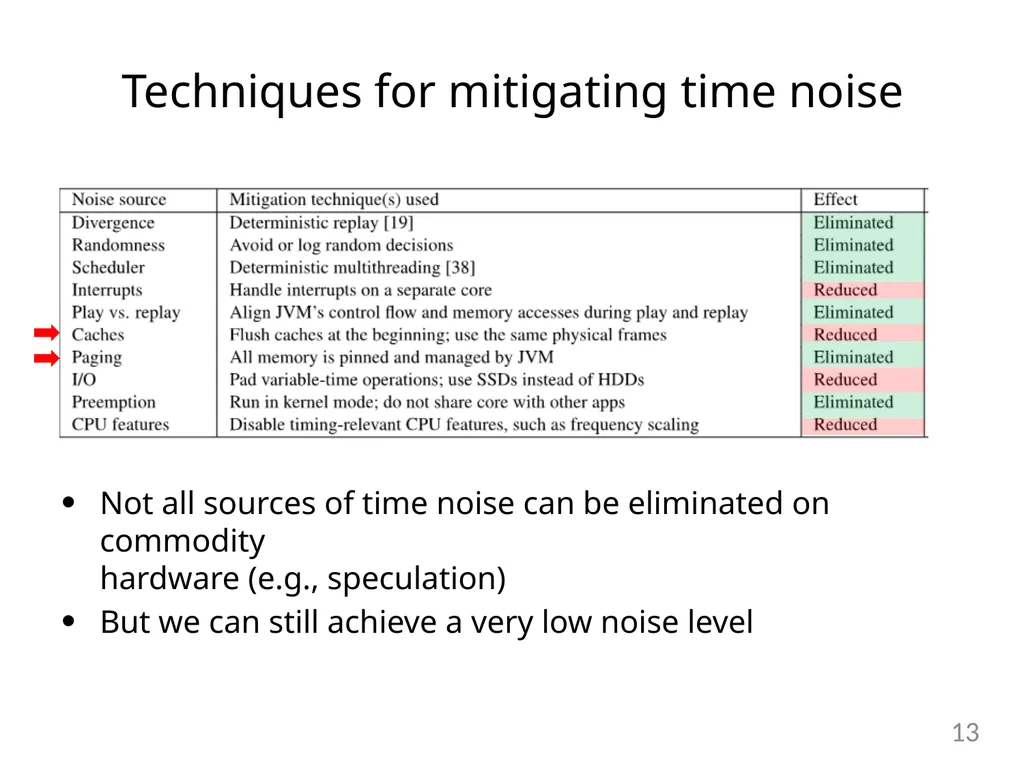
slide13. Techniques for mitigating time noise 12 Not all sources of time noise can be eliminated on commodity hardware (e.g., speculation)
But we can still achieve a very low noise level<br>
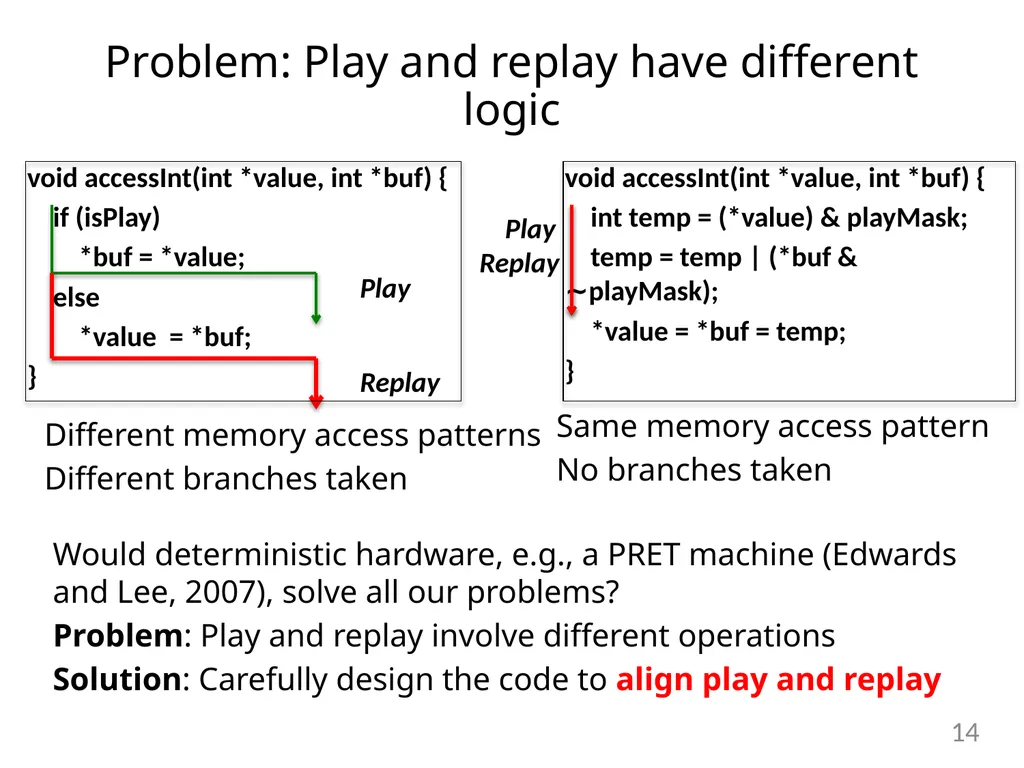
slide14. Problem: Play and replay have different logic Would deterministic hardware, e.g., a PRET machine (Edwards and Lee, 2007), solve all our problems?
Problem: Play and replay involve different operations
Solution: Carefully design the code to align play and replay 13 void accessInt(int *value, int *buf) {
int temp = (*value) & playMask;
temp = temp | (*buf & ∼playMask);
*value = *buf = temp;
} void accessInt(int *value, int *buf) {
if (isPlay)
*buf = *value;
else
*value = *buf;
} Different memory access patterns
Different branches taken Same memory access pattern
No branches taken Replay Play Replay Play<br>
slide15. Outline Motivation
Challenge
Time-deterministic replay (TDR)
Deterministic replay vs. Time-deterministic replay
Time noise, and how to reduce it
Aligning play and replay
Sanity: A TDR prototype
Design & Implementation
Evaluation
Reducing time noise
Aligning play and replay
Detecting timing channels
Conclusion 14<br>
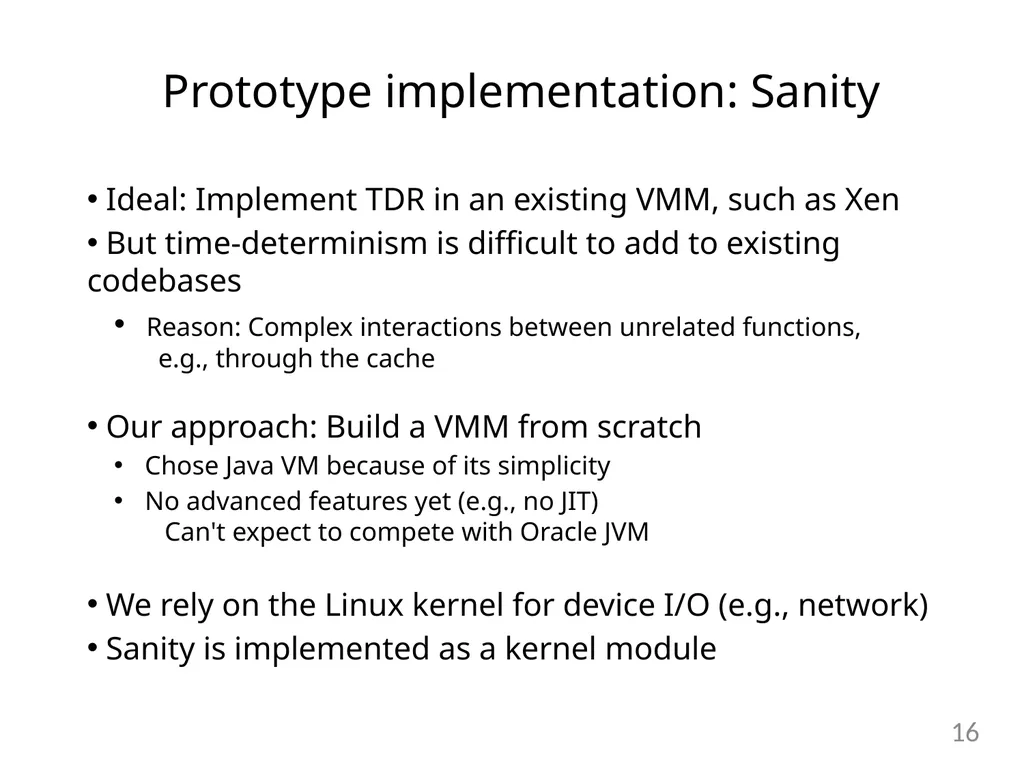
slide16. Prototype implementation: Sanity Ideal: Implement TDR in an existing VMM, such as Xen
But time-determinism is difficult to add to existing codebases
Reason: Complex interactions between unrelated functions, e.g., through the cache
Our approach: Build a VMM from scratch
Chose Java VM because of its simplicity
No advanced features yet (e.g., no JIT) Can't expect to compete with Oracle JVM
We rely on the Linux kernel for device I/O (e.g., network)
Sanity is implemented as a kernel module 15<br>
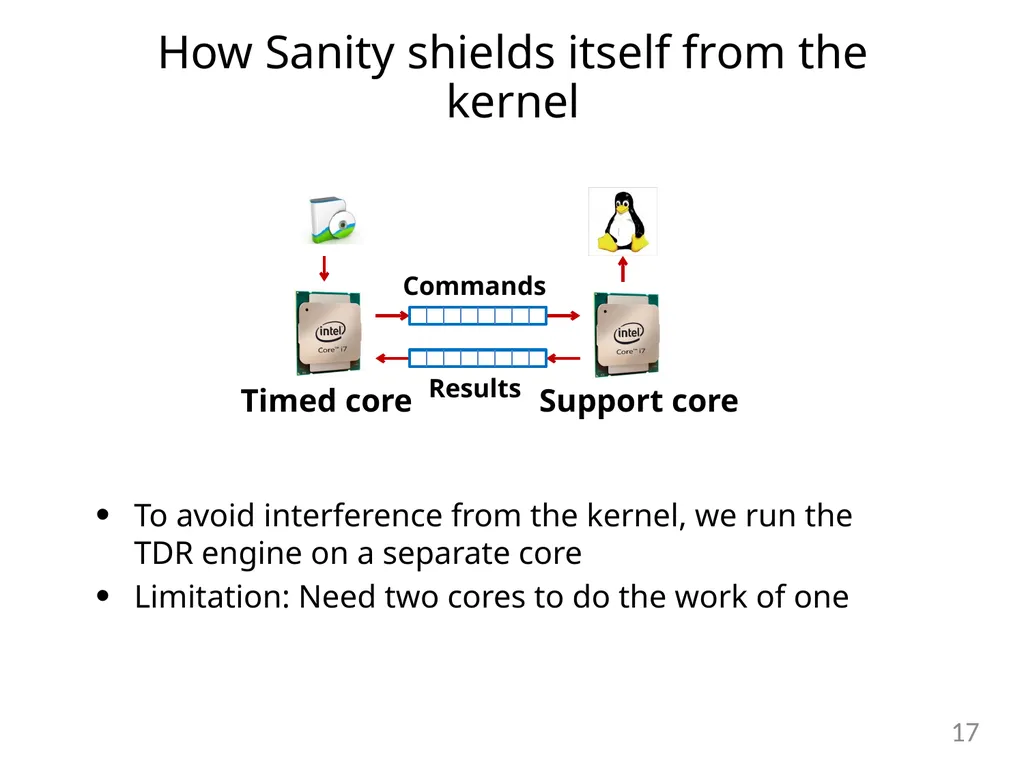
slide17. How Sanity shields itself from the kernel Timed core Support core Commands Results 16 To avoid interference from the kernel, we run the TDR engine on a separate core
Limitation: Need two cores to do the work of one<br>
slide18. Outline Motivation
Challenge
Time-deterministic replay (TDR)
Deterministic replay vs. Time-deterministic replay
Time noise, and how to reduce it
Aligning play and replay
Sanity: A TDR prototype
Design & Implementation
Evaluation
Reducing time noise
Aligning play and replay
Detecting timing channels
Conclusion 17<br>
slide19. Evaluation: Overview 18 Q1: How well can Sanity reduce time noise?
Q2: How well can Sanity align play and replay? Q3: How fast is Sanity?
Q4: How large is Sanity’s log?
Q5: How well can Sanity detect covert timing channels?<br>
slide20. Experimental setup 19 Experiments were run on a Dell Optiplex 9020 workstation (3.4GHz Intel i7-4770 CPU, 16 GB RAM, 128GB Vector ZDO SSD, Linux 3.12)
We use two applications:
SciMark2 (computation-intensive benchmark)
nfsj: Open-source NFS server
Baseline: Oracle’s SE 7u51 JVM<br>
slide21. How well can Sanity reduce time noise? 80
60
40
20
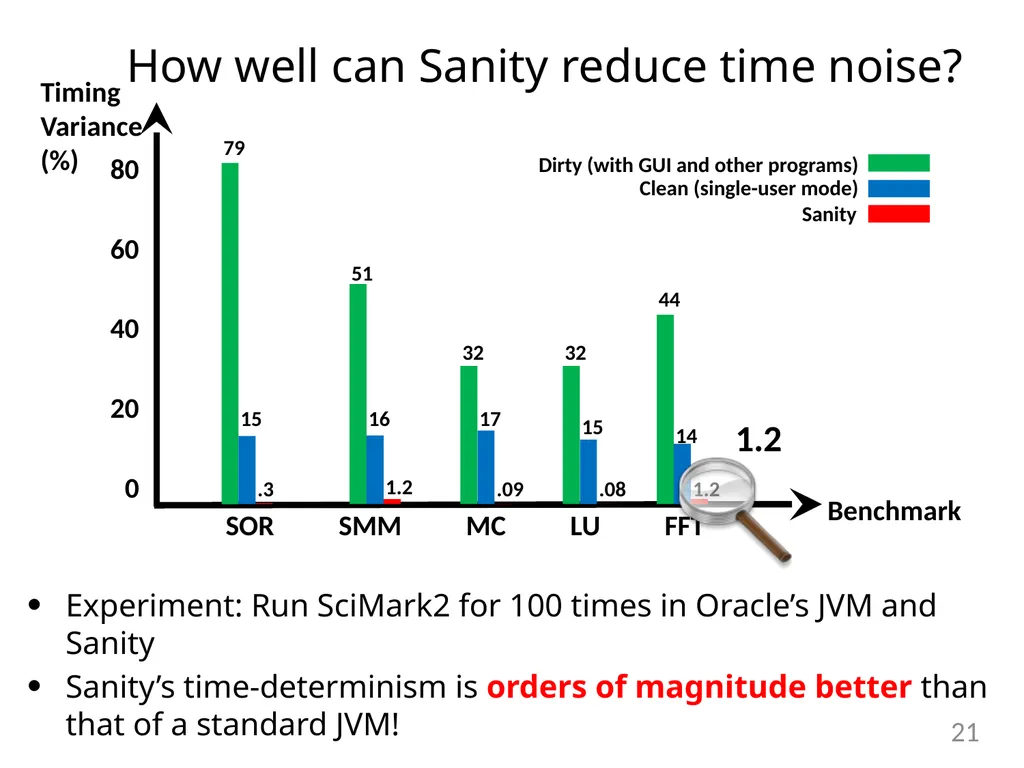
0 Benchmark 79 15 .3 51 16 32 17 1.2 .09 32 15 .08 44 14 1.2 Dirty (with GUI and other programs) Clean (single-user mode) Sanity 20 Experiment: Run SciMark2 for 100 times in Oracle’s JVM and Sanity
Sanity’s time-determinism is orders of magnitude better than that of a standard JVM! 1.2<br>
slide22. How well can Sanity reproduce timing? Experiment: Run nfsj and serve 30 files, then replay.
Sanity can almost perfectly reproduce the timing of network outputs during replay 21 Data points
Perfect accuracy
1.85% difference<br>
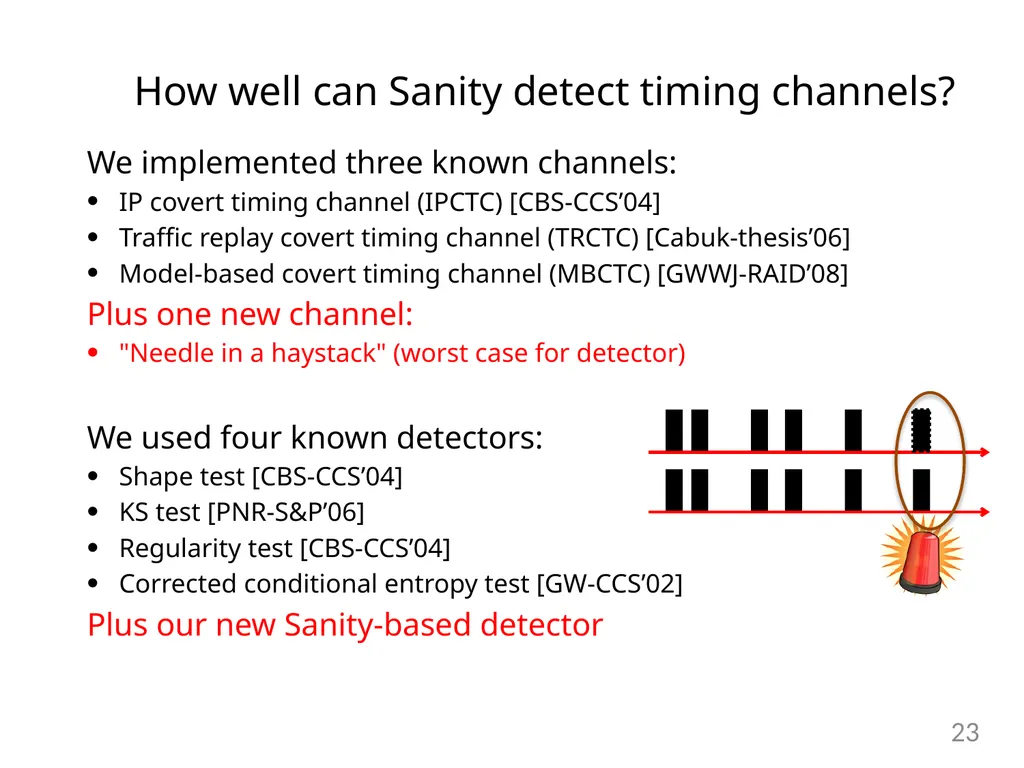
slide23. How well can Sanity detect timing channels? We implemented three known channels:
IP covert timing channel (IPCTC) [CBS-CCS’04]
Traffic replay covert timing channel (TRCTC) [Cabuk-thesis’06]
Model-based covert timing channel (MBCTC) [GWWJ-RAID’08]
Plus one new channel:
"Needle in a haystack" (worst case for detector)
We used four known detectors:
Shape test [CBS-CCS’04]
KS test [PNR-S&P’06]
Regularity test [CBS-CCS’04]
Corrected conditional entropy test [GW-CCS’02]
Plus our new Sanity-based detector 22<br>
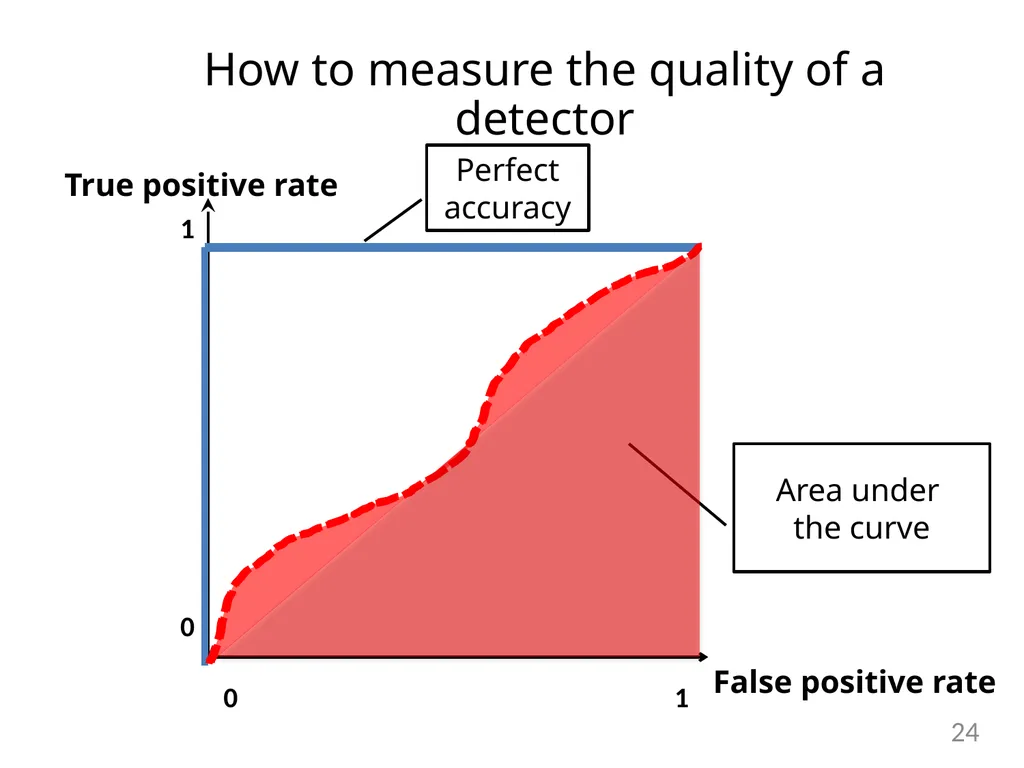
slide24. How to measure the quality of a detector 23 1
0 False positive rate 0 1 Perfect accuracy Area under the curve<br>
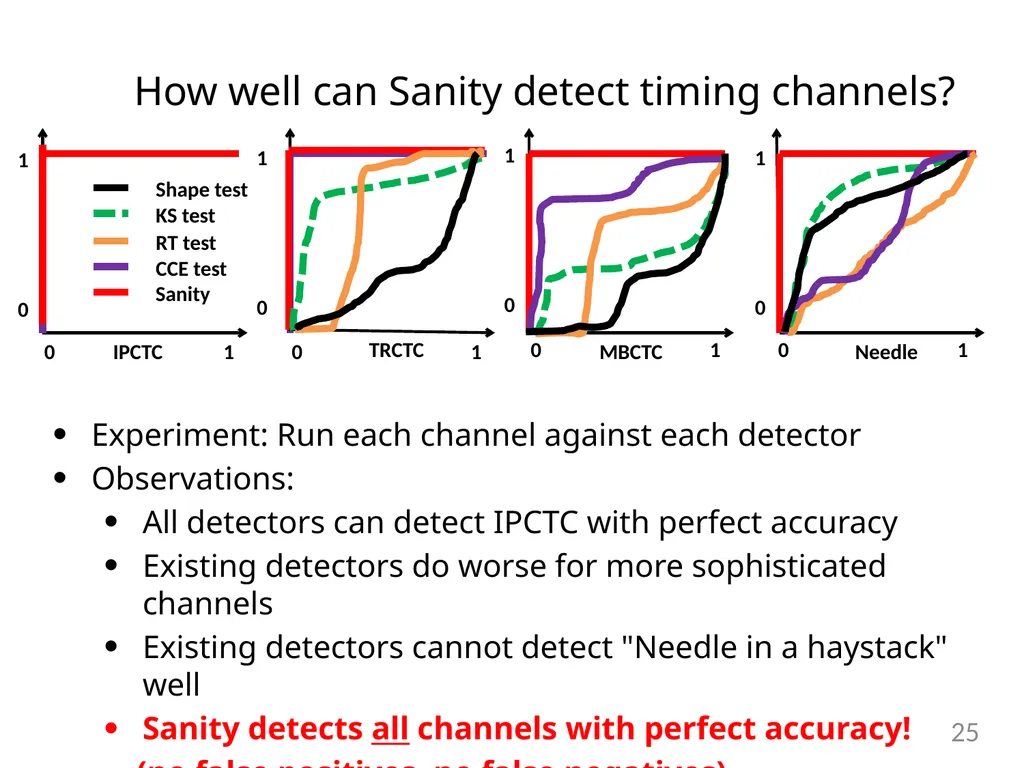
slide25. How well can Sanity detect timing channels? 24 Shape test KS test RT test CCE test Sanity IPCTC MBCTC TRCTC Needle 0 1 1
0 0 1 1
0 0 1 1
0 0 1 1
0 Experiment: Run each channel against each detector
Observations:
All detectors can detect IPCTC with perfect accuracy
Existing detectors do worse for more sophisticated channels
Existing detectors cannot detect "Needle in a haystack" well
Sanity detects all channels with perfect accuracy!
(no false positives, no false negatives)<br>
slide26. Summary Goal: Detect covert timing channels
Existing detectors look for signs of specific, known channels
Result: "Cat-and-mouse game" with the attacker
Our approach: Compare the observed timing to what it 'should be' if the machine is not compromised
Works for all timing channels, including novel ones
Key challenge: How do we know what the timing should be?
We introduce time-deterministic replay (TDR)
We have built a TDR prototype called Sanity
Reproduces timing to within 2% (on commodity hardware)
Can be used to detect a variety of existing and novel covert timing channels with perfect accuracy 25<br>
Andreas Haeberlen* Linh Thi Xuan Phan* Micah Sherr + Wenchao Zhou +
University of Pennsylvania* Georgetown University +<br>
slide2. Motivation: Detecting covert timing channels 1 Secretary President Launch code:
1011 Code is 1011 Ah! 1011 H E L L O 1 0 1 1 Attacker Launch code Covert timing channel: Leaks secrets by changing the timing of network outputs<br>
slide3. State of the art: Statistics-based detection 2 H E L L O H E L L O Normal traffic: With channel: Small gaps Large gaps Distribution of inter-packet delays 1 0 1 1 Current approaches look for specific statistical deviations<br>
slide4. Problem: Making a new channel is easy! Admin Needle in a haystack ? Existing detectors are channel-specific:
Using detector A for channel B doesn’t work
Attacker can always invent a new modulation
Low-rate channels ("Needle in a haystack") are hard to detect 1 0 0 1 1 3<br>
slide5. Is there a different way? 4 Observed Expected Existing approaches detect specific anomalies
Our approach: Compare the observed timing to the expected timing
Works for covert timing channels in general Can detect both known and unknown/novel channels!
But how do we know what timing we should expect?<br>
slide6. How can we find the expected timing? It would be difficult to predict the timing up front
See, e.g., WCET analysis in real-time systems
And WCET would only give us an upper bound - but we would need the exact timing!
Key insight: We only need to reproduce the timing!
We can record the inputs of the machine and then replay them on a different machine!
Can we use deterministic replay to do this? 5<br>
slide7. Why Deterministic Replay is not enough 6 Deterministic replay records and replays non-deterministic events
This reproduces the outputs - but not the timing! e1 log e2 e3 p1 p2 p3 e1 log e2 e3 e1 log e2 e3 p1 p2 p3<br>
slide8. Time-deterministic replay (TDR) Goal: Reproduce both the outputs and the timing
With this, we can detect covert timing channels as follows:
Reproduce the timing of every network output
Compare the observed timing to the reproduced timing
Raise the alarm if there is any discrepancy 7 7 T D R H E L L O H E L L O<br>
slide9. Outline Motivation
Challenge
Time-deterministic replay (TDR)
Deterministic replay vs. Time-deterministic replay
Time noise, and how to reduce it
Aligning play and replay
Sanity: A TDR prototype
Design & Implementation
Evaluation
Reducing time noise
Aligning play and replay
Detecting timing channels
Conclusion 8<br>
slide10. Deterministic Replay is not enough Experiment: Record and replay an HTTP server in an existing VMM with deterministic replay (XenTT)
Result: Play and replay take widely different amounts of time 240
200
160
120
80
40
0 Time during play (s) Ideal Actual 9 Replay is slower Replay is faster<br>
slide11. What is causing this discrepancy? Different memory allocations and cache behavior
IRQs and system calls take different amounts of time
Disk accesses take different amounts of time
Kernel may interfere with execution or cache content
CPU features, such as frequency scaling and speculation
Non-deterministic scheduling decisions 10 There are many different sources of timing variation ("time noise"), such as: See paper for details<br>
slide12. Example: Controlling time noise from memory Problem: Different cache behaviors and memory locations during play and replay.
Solution: (1) Manage all memory allocations
(2) Flush cache before execution 11 Cache Memory var var<br>
slide13. Techniques for mitigating time noise 12 Not all sources of time noise can be eliminated on commodity hardware (e.g., speculation)
But we can still achieve a very low noise level<br>
slide14. Problem: Play and replay have different logic Would deterministic hardware, e.g., a PRET machine (Edwards and Lee, 2007), solve all our problems?
Problem: Play and replay involve different operations
Solution: Carefully design the code to align play and replay 13 void accessInt(int *value, int *buf) {
int temp = (*value) & playMask;
temp = temp | (*buf & ∼playMask);
*value = *buf = temp;
} void accessInt(int *value, int *buf) {
if (isPlay)
*buf = *value;
else
*value = *buf;
} Different memory access patterns
Different branches taken Same memory access pattern
No branches taken Replay Play Replay Play<br>
slide15. Outline Motivation
Challenge
Time-deterministic replay (TDR)
Deterministic replay vs. Time-deterministic replay
Time noise, and how to reduce it
Aligning play and replay
Sanity: A TDR prototype
Design & Implementation
Evaluation
Reducing time noise
Aligning play and replay
Detecting timing channels
Conclusion 14<br>
slide16. Prototype implementation: Sanity Ideal: Implement TDR in an existing VMM, such as Xen
But time-determinism is difficult to add to existing codebases
Reason: Complex interactions between unrelated functions, e.g., through the cache
Our approach: Build a VMM from scratch
Chose Java VM because of its simplicity
No advanced features yet (e.g., no JIT) Can't expect to compete with Oracle JVM
We rely on the Linux kernel for device I/O (e.g., network)
Sanity is implemented as a kernel module 15<br>
slide17. How Sanity shields itself from the kernel Timed core Support core Commands Results 16 To avoid interference from the kernel, we run the TDR engine on a separate core
Limitation: Need two cores to do the work of one<br>
slide18. Outline Motivation
Challenge
Time-deterministic replay (TDR)
Deterministic replay vs. Time-deterministic replay
Time noise, and how to reduce it
Aligning play and replay
Sanity: A TDR prototype
Design & Implementation
Evaluation
Reducing time noise
Aligning play and replay
Detecting timing channels
Conclusion 17<br>
slide19. Evaluation: Overview 18 Q1: How well can Sanity reduce time noise?
Q2: How well can Sanity align play and replay? Q3: How fast is Sanity?
Q4: How large is Sanity’s log?
Q5: How well can Sanity detect covert timing channels?<br>
slide20. Experimental setup 19 Experiments were run on a Dell Optiplex 9020 workstation (3.4GHz Intel i7-4770 CPU, 16 GB RAM, 128GB Vector ZDO SSD, Linux 3.12)
We use two applications:
SciMark2 (computation-intensive benchmark)
nfsj: Open-source NFS server
Baseline: Oracle’s SE 7u51 JVM<br>
slide21. How well can Sanity reduce time noise? 80
60
40
20
0 Benchmark 79 15 .3 51 16 32 17 1.2 .09 32 15 .08 44 14 1.2 Dirty (with GUI and other programs) Clean (single-user mode) Sanity 20 Experiment: Run SciMark2 for 100 times in Oracle’s JVM and Sanity
Sanity’s time-determinism is orders of magnitude better than that of a standard JVM! 1.2<br>
slide22. How well can Sanity reproduce timing? Experiment: Run nfsj and serve 30 files, then replay.
Sanity can almost perfectly reproduce the timing of network outputs during replay 21 Data points
Perfect accuracy
1.85% difference<br>
slide23. How well can Sanity detect timing channels? We implemented three known channels:
IP covert timing channel (IPCTC) [CBS-CCS’04]
Traffic replay covert timing channel (TRCTC) [Cabuk-thesis’06]
Model-based covert timing channel (MBCTC) [GWWJ-RAID’08]
Plus one new channel:
"Needle in a haystack" (worst case for detector)
We used four known detectors:
Shape test [CBS-CCS’04]
KS test [PNR-S&P’06]
Regularity test [CBS-CCS’04]
Corrected conditional entropy test [GW-CCS’02]
Plus our new Sanity-based detector 22<br>
slide24. How to measure the quality of a detector 23 1
0 False positive rate 0 1 Perfect accuracy Area under the curve<br>
slide25. How well can Sanity detect timing channels? 24 Shape test KS test RT test CCE test Sanity IPCTC MBCTC TRCTC Needle 0 1 1
0 0 1 1
0 0 1 1
0 0 1 1
0 Experiment: Run each channel against each detector
Observations:
All detectors can detect IPCTC with perfect accuracy
Existing detectors do worse for more sophisticated channels
Existing detectors cannot detect "Needle in a haystack" well
Sanity detects all channels with perfect accuracy!
(no false positives, no false negatives)<br>
slide26. Summary Goal: Detect covert timing channels
Existing detectors look for signs of specific, known channels
Result: "Cat-and-mouse game" with the attacker
Our approach: Compare the observed timing to what it 'should be' if the machine is not compromised
Works for all timing channels, including novel ones
Key challenge: How do we know what the timing should be?
We introduce time-deterministic replay (TDR)
We have built a TDR prototype called Sanity
Reproduces timing to within 2% (on commodity hardware)
Can be used to detect a variety of existing and novel covert timing channels with perfect accuracy 25<br>