
Developing an Effective Business Plan © 2014
Description: Developing an Effective Business Plan 2014 Cengage Learning. All rights reserved. May not be copied, scanned, or duplicated, in whole or in part, except for use as permitted in a license distributed with a certain product or service or
Related Topics
Download Presentation
"Developing an Effective Business Plan © 2014" is the property of its rightful owner. Permission is granted to download and print the materials on this website for personal, non-commercial use only, and to display it on your personal computer provided you do not modify the materials and that you retain all copyright notices contained in the materials. By downloading content from our website, you accept the terms of this agreement.
Presentation Transcript
slide1. Developing an Effective Business Plan © 2014 Cengage Learning. All rights reserved. May not be copied, scanned, or duplicated, in whole or in part, except for use as permitted in a license distributed with a certain product or service or otherwise on a password-protected website for classroom use.<br>
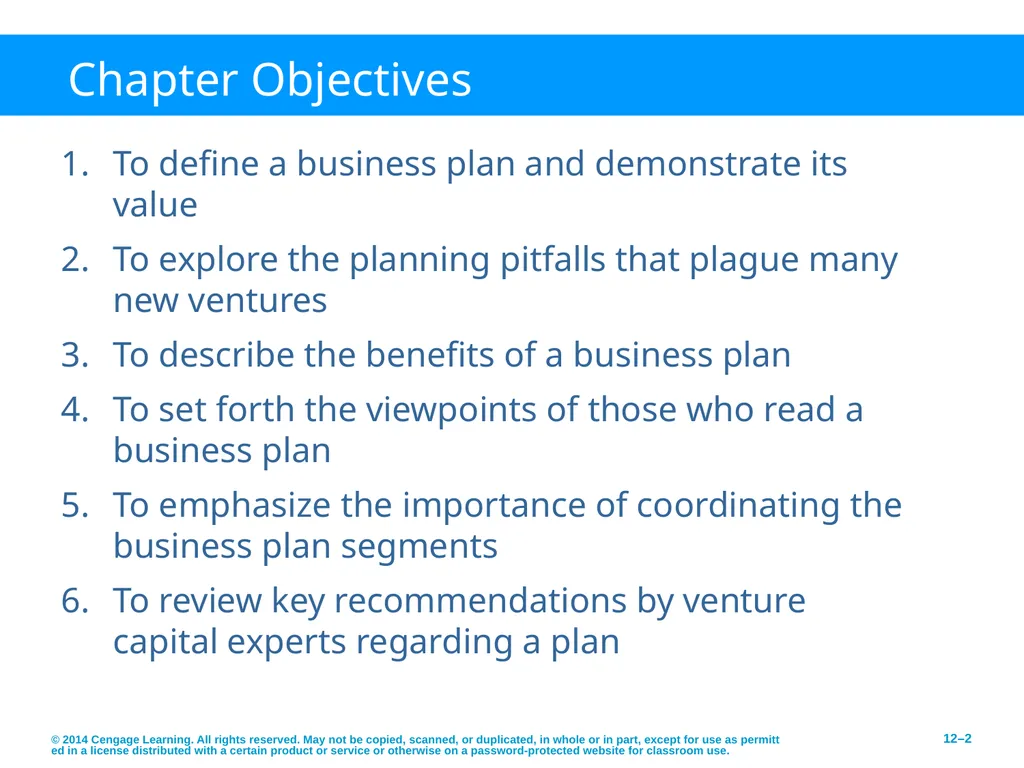
slide2. Chapter Objectives © 2014 Cengage Learning. All rights reserved. May not be copied, scanned, or duplicated, in whole or in part, except for use as permitted in a license distributed with a certain product or service or otherwise on a password-protected website for classroom use. 12–2 To define a business plan and demonstrate its value
To explore the planning pitfalls that plague many new ventures
To describe the benefits of a business plan
To set forth the viewpoints of those who read a business plan
To emphasize the importance of coordinating the business plan segments
To review key recommendations by venture capital experts regarding a plan<br>
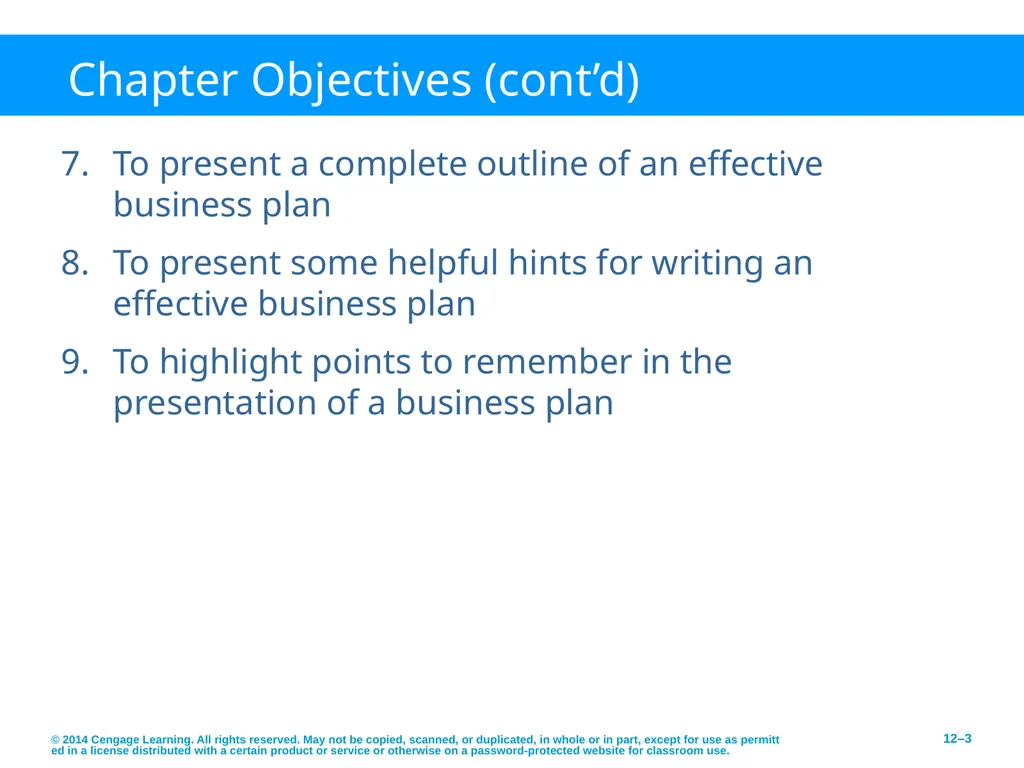
slide3. Chapter Objectives (cont’d) © 2014 Cengage Learning. All rights reserved. May not be copied, scanned, or duplicated, in whole or in part, except for use as permitted in a license distributed with a certain product or service or otherwise on a password-protected website for classroom use. 12–3 To present a complete outline of an effective business plan
To present some helpful hints for writing an effective business plan
To highlight points to remember in the presentation of a business plan<br>
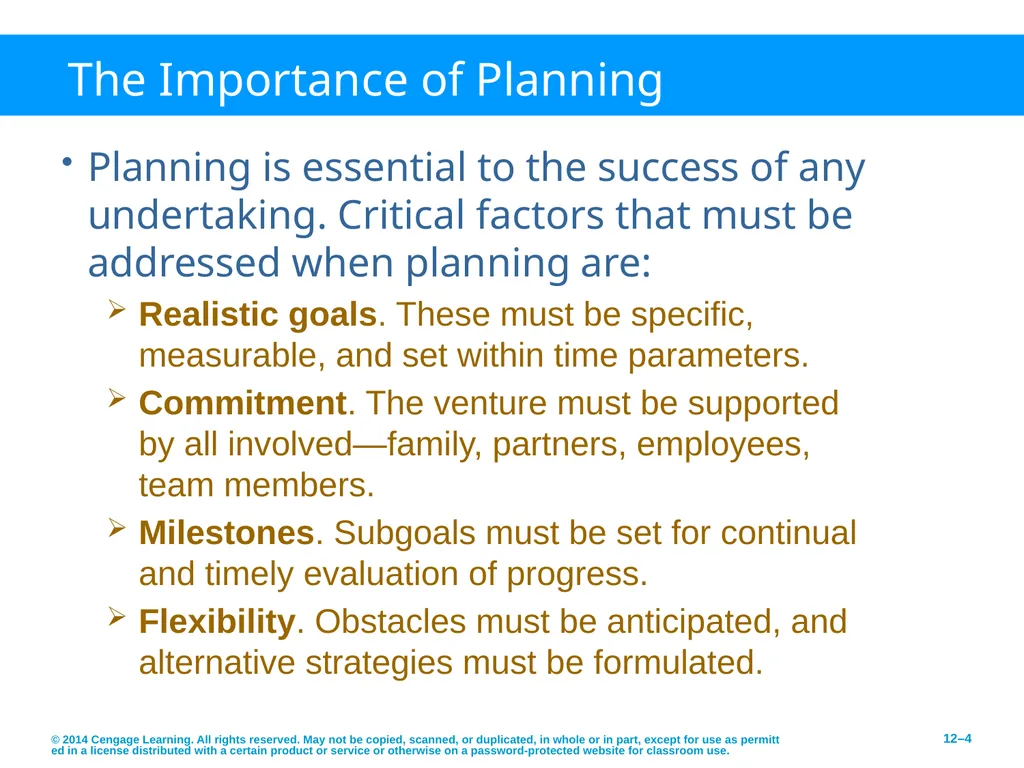
slide4. © 2014 Cengage Learning. All rights reserved. May not be copied, scanned, or duplicated, in whole or in part, except for use as permitted in a license distributed with a certain product or service or otherwise on a password-protected website for classroom use. 12–4 The Importance of Planning Planning is essential to the success of any undertaking. Critical factors that must be addressed when planning are:
Realistic goals. These must be specific, measurable, and set within time parameters.
Commitment. The venture must be supported by all involved—family, partners, employees, team members.
Milestones. Subgoals must be set for continual and timely evaluation of progress.
Flexibility. Obstacles must be anticipated, and alternative strategies must be formulated.<br>
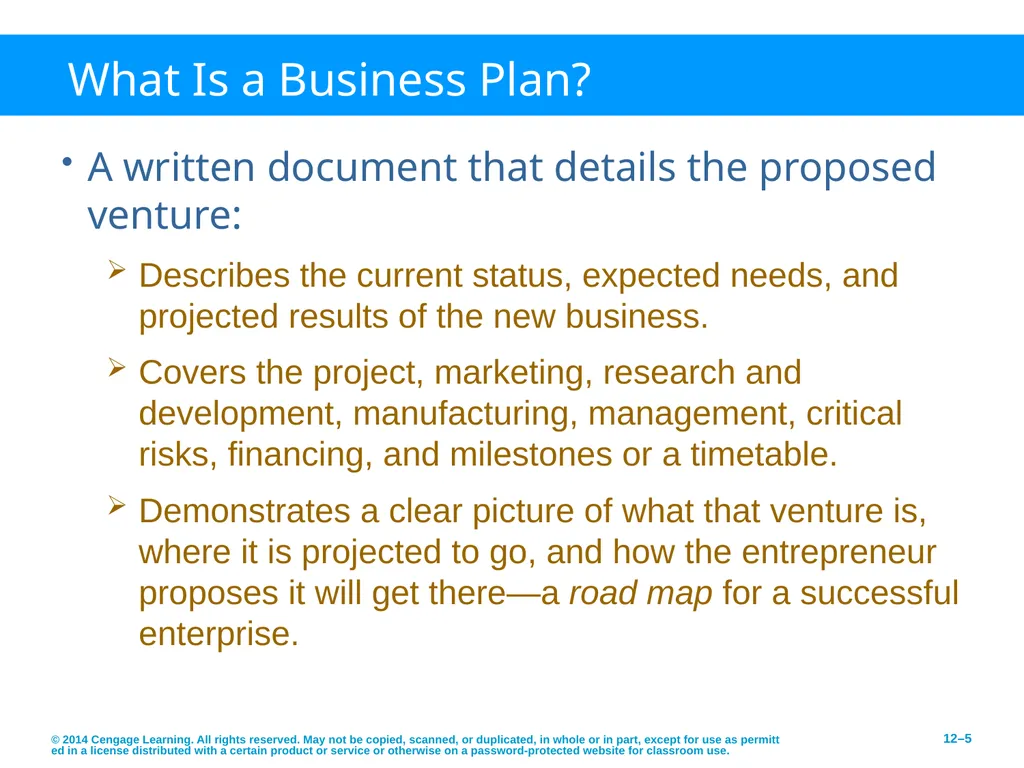
slide5. © 2014 Cengage Learning. All rights reserved. May not be copied, scanned, or duplicated, in whole or in part, except for use as permitted in a license distributed with a certain product or service or otherwise on a password-protected website for classroom use. 12–5 What Is a Business Plan? A written document that details the proposed venture:
Describes the current status, expected needs, and projected results of the new business.
Covers the project, marketing, research and development, manufacturing, management, critical risks, financing, and milestones or a timetable.
Demonstrates a clear picture of what that venture is, where it is projected to go, and how the entrepreneur proposes it will get there—a road map for a successful enterprise.<br>
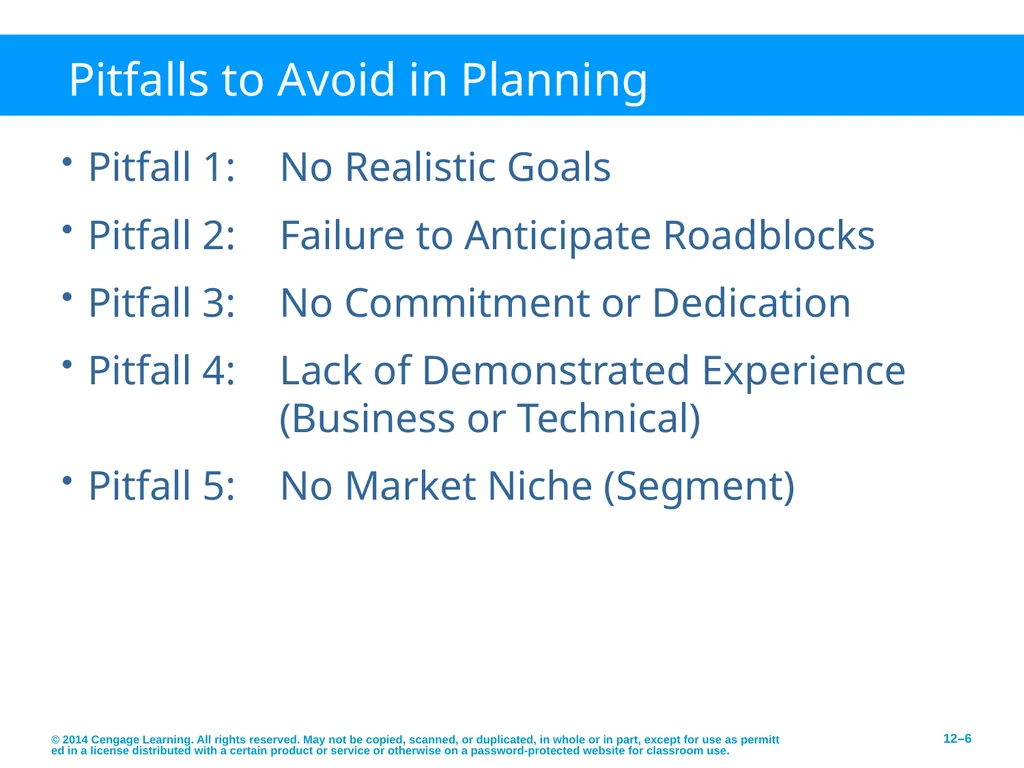
slide6. © 2014 Cengage Learning. All rights reserved. May not be copied, scanned, or duplicated, in whole or in part, except for use as permitted in a license distributed with a certain product or service or otherwise on a password-protected website for classroom use. 12–6 Pitfalls to Avoid in Planning Pitfall 1: No Realistic Goals
Pitfall 2: Failure to Anticipate Roadblocks
Pitfall 3: No Commitment or Dedication
Pitfall 4: Lack of Demonstrated Experience (Business or Technical)
Pitfall 5: No Market Niche (Segment)<br>
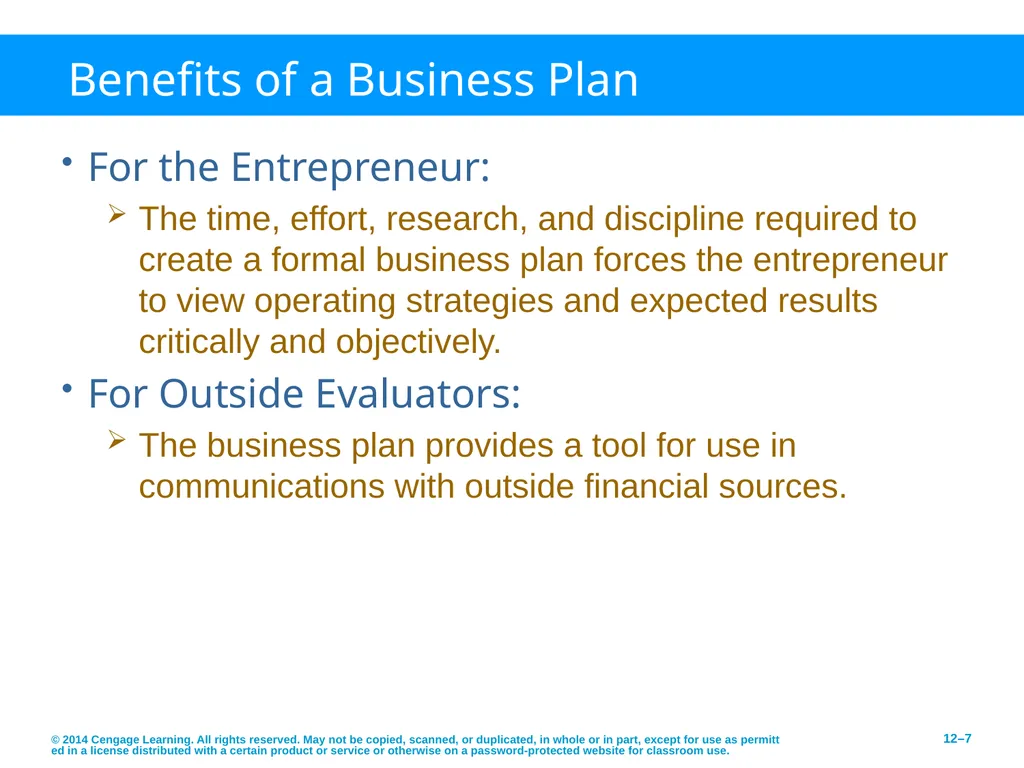
slide7. © 2014 Cengage Learning. All rights reserved. May not be copied, scanned, or duplicated, in whole or in part, except for use as permitted in a license distributed with a certain product or service or otherwise on a password-protected website for classroom use. 12–7 Benefits of a Business Plan For the Entrepreneur:
The time, effort, research, and discipline required to create a formal business plan forces the entrepreneur to view operating strategies and expected results critically and objectively.
For Outside Evaluators:
The business plan provides a tool for use in communications with outside financial sources.<br>
slide8. © 2014 Cengage Learning. All rights reserved. May not be copied, scanned, or duplicated, in whole or in part, except for use as permitted in a license distributed with a certain product or service or otherwise on a password-protected website for classroom use. 12–8 Benefits of the Business Plan (cont’d) Specifically for the Financial Sources:
Details the market potential and plans for securing a share of that market.
Shows how the venture’s intends to service debt or provide an adequate return on equity.
Identifies critical risks and crucial events with a discussion of contingency plans.
Contains the necessary information for a thorough business and financial evaluation.<br>
slide9. © 2014 Cengage Learning. All rights reserved. May not be copied, scanned, or duplicated, in whole or in part, except for use as permitted in a license distributed with a certain product or service or otherwise on a password-protected website for classroom use. 12–9 Developing a Well-Conceived Business Plan The Five-Minute Reading
Determine the characteristics of the venture and its industry.
Determine the financial structure of the plan (amount of debt or equity investment required).
Read the latest balance sheet (to determine liquidity, net worth, and debt/equity).
Determine the quality of entrepreneurs in the venture (sometimes the most important step).
Establish the unique feature in this venture (find out what is different).
Read the entire plan over lightly (this is when the entire package is paged through for a casual look at graphs, charts, exhibits, and other plan components).<br>
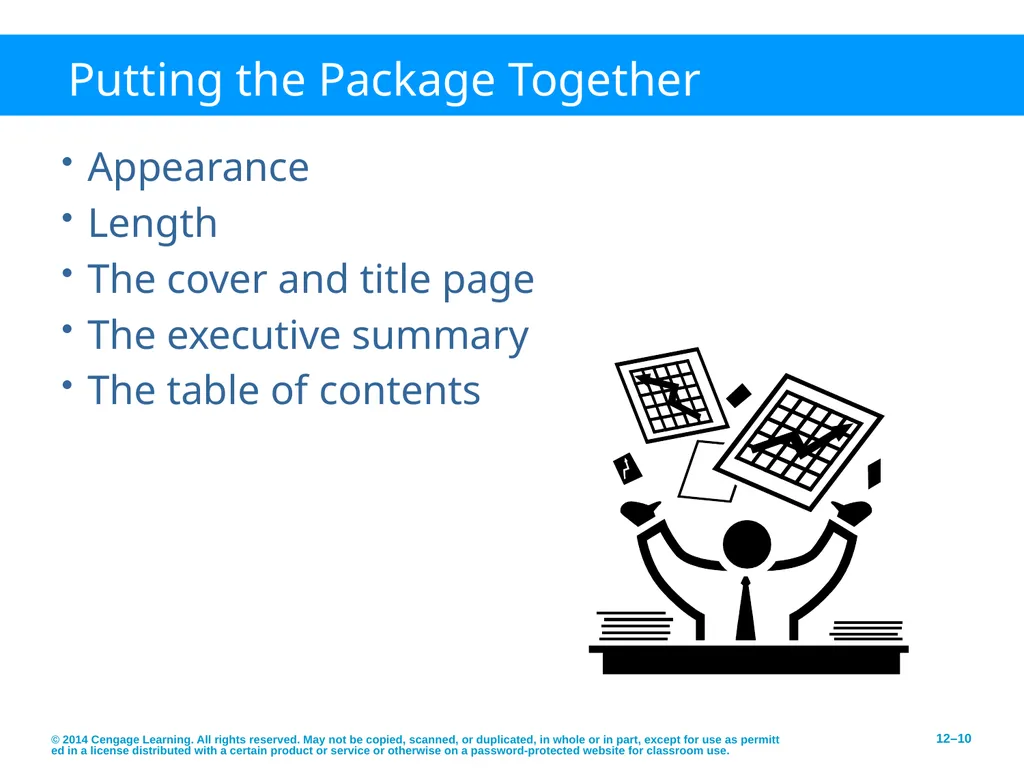
slide10. © 2014 Cengage Learning. All rights reserved. May not be copied, scanned, or duplicated, in whole or in part, except for use as permitted in a license distributed with a certain product or service or otherwise on a password-protected website for classroom use. 12–10 Putting the Package Together Appearance
Length
The cover and title page
The executive summary
The table of contents<br>
slide11. © 2014 Cengage Learning. All rights reserved. May not be copied, scanned, or duplicated, in whole or in part, except for use as permitted in a license distributed with a certain product or service or otherwise on a password-protected website for classroom use. 12–11 Guidelines to Remember Keep the plan respectably short
Organize and package the plan appropriately
Orient the plan toward the future
Avoid exaggeration
Highlight critical risks
Give evidence of an effective entrepreneurial team
Do not over-diversify
Identify the target market
Keep the plan written in the third person
Capture the reader’s interest<br>
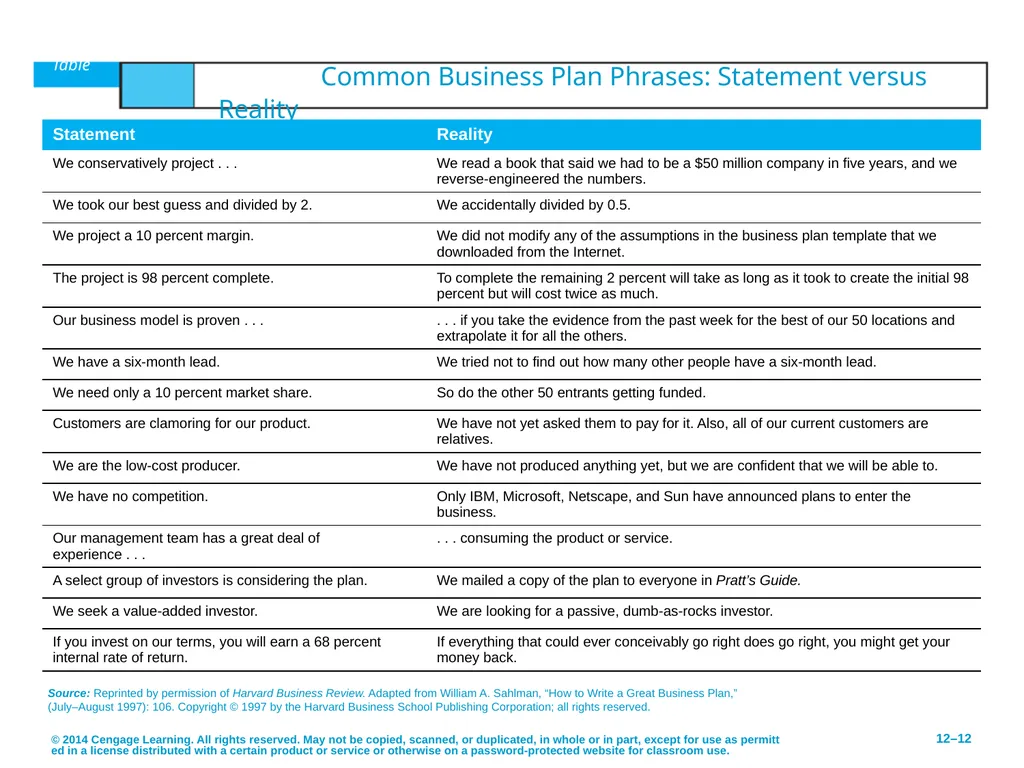
slide12. © 2014 Cengage Learning. All rights reserved. May not be copied, scanned, or duplicated, in whole or in part, except for use as permitted in a license distributed with a certain product or service or otherwise on a password-protected website for classroom use. 12–12 Table 12.1 Common Business Plan Phrases: Statement versus Reality Source: Reprinted by permission of Harvard Business Review. Adapted from William A. Sahlman, “How to Write a Great Business Plan,” (July–August 1997): 106. Copyright © 1997 by the Harvard Business School Publishing Corporation; all rights reserved.<br>
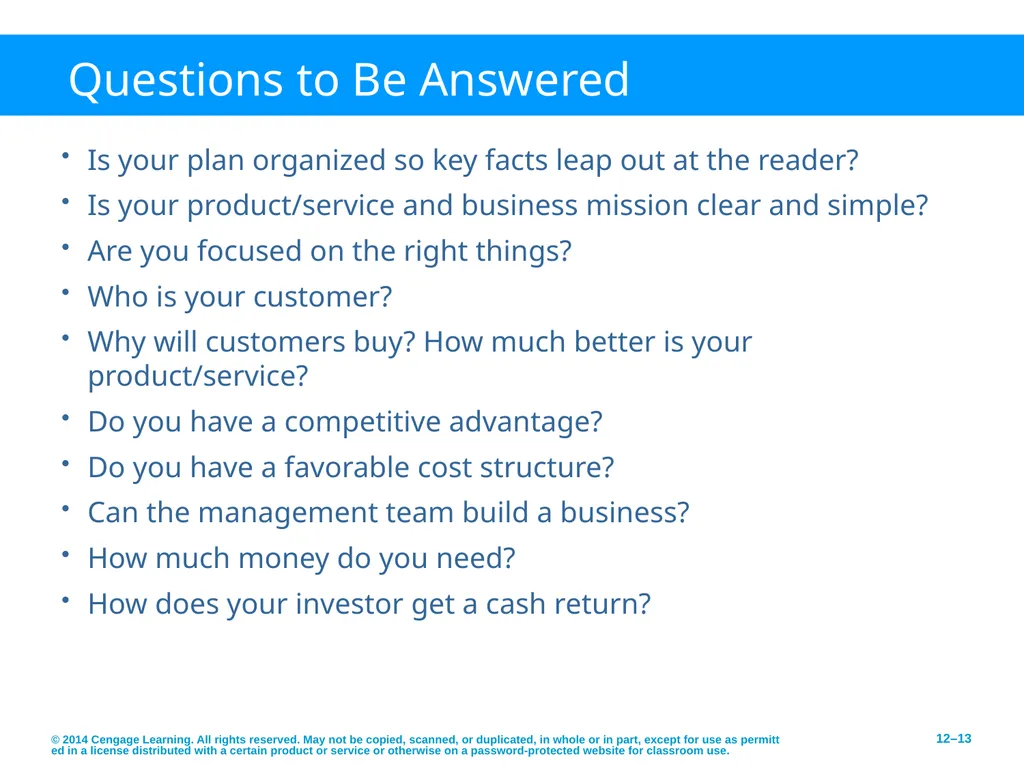
slide13. © 2014 Cengage Learning. All rights reserved. May not be copied, scanned, or duplicated, in whole or in part, except for use as permitted in a license distributed with a certain product or service or otherwise on a password-protected website for classroom use. 12–13 Questions to Be Answered Is your plan organized so key facts leap out at the reader?
Is your product/service and business mission clear and simple?
Are you focused on the right things?
Who is your customer?
Why will customers buy? How much better is your product/service?
Do you have a competitive advantage?
Do you have a favorable cost structure?
Can the management team build a business?
How much money do you need?
How does your investor get a cash return?<br>
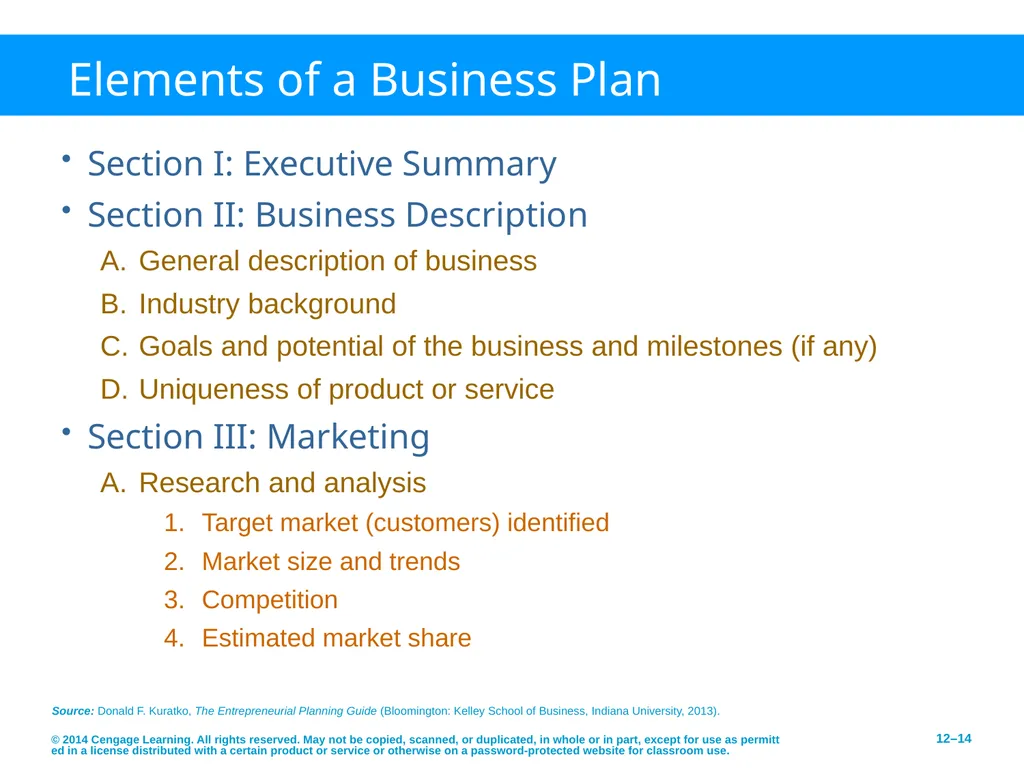
slide14. © 2014 Cengage Learning. All rights reserved. May not be copied, scanned, or duplicated, in whole or in part, except for use as permitted in a license distributed with a certain product or service or otherwise on a password-protected website for classroom use. 12–14 Elements of a Business Plan Section I: Executive Summary
Section II: Business Description
General description of business
Industry background
Goals and potential of the business and milestones (if any)
Uniqueness of product or service
Section III: Marketing
Research and analysis
Target market (customers) identified
Market size and trends
Competition
Estimated market share Source: Donald F. Kuratko, The Entrepreneurial Planning Guide (Bloomington: Kelley School of Business, Indiana University, 2013).<br>
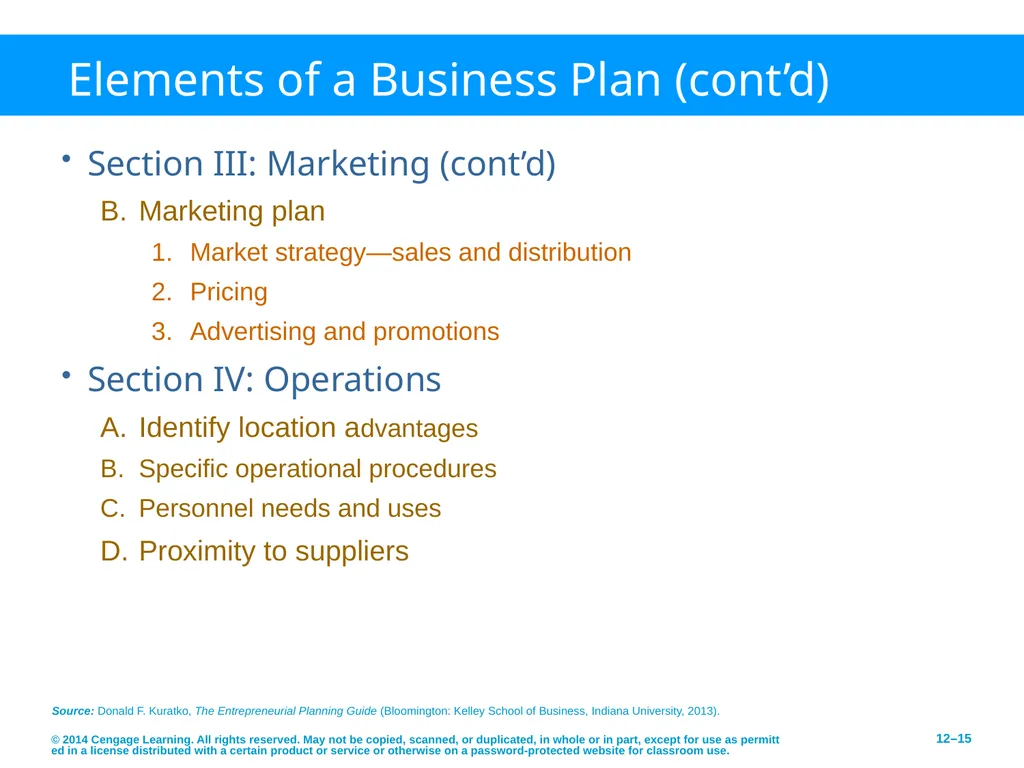
slide15. © 2014 Cengage Learning. All rights reserved. May not be copied, scanned, or duplicated, in whole or in part, except for use as permitted in a license distributed with a certain product or service or otherwise on a password-protected website for classroom use. 12–15 Elements of a Business Plan (cont’d) Section III: Marketing (cont’d)
Marketing plan
Market strategy—sales and distribution
Pricing
Advertising and promotions
Section IV: Operations
Identify location advantages
Specific operational procedures
Personnel needs and uses
Proximity to suppliers Source: Donald F. Kuratko, The Entrepreneurial Planning Guide (Bloomington: Kelley School of Business, Indiana University, 2013).<br>
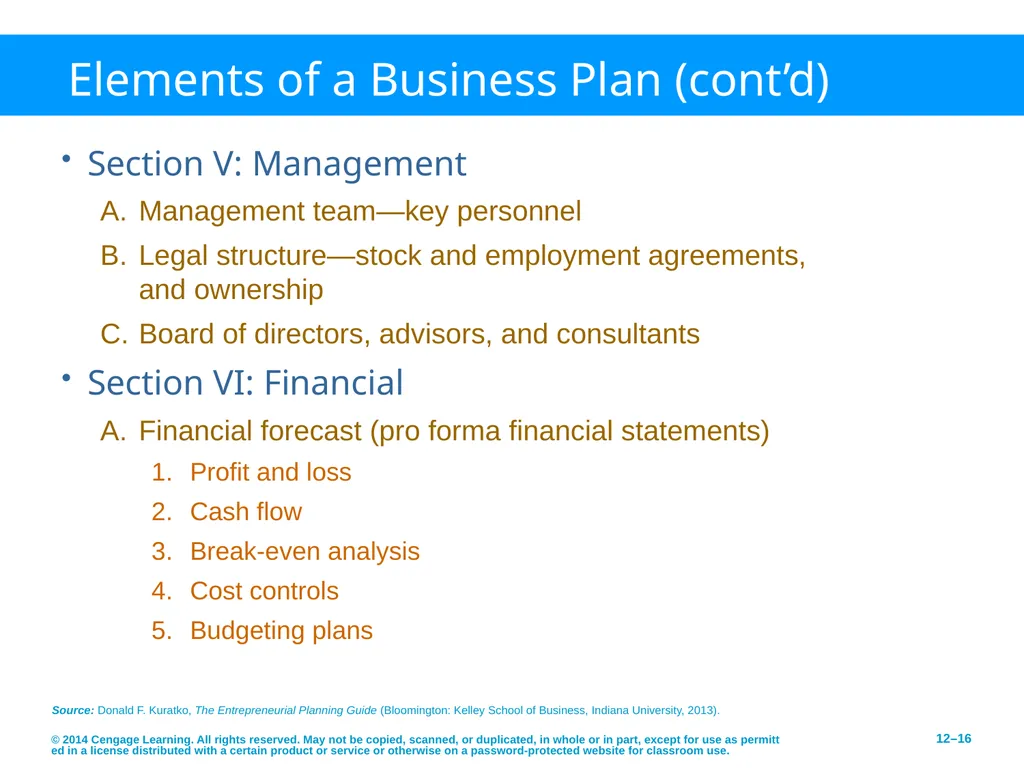
slide16. © 2014 Cengage Learning. All rights reserved. May not be copied, scanned, or duplicated, in whole or in part, except for use as permitted in a license distributed with a certain product or service or otherwise on a password-protected website for classroom use. 12–16 Elements of a Business Plan (cont’d) Section V: Management
Management team—key personnel
Legal structure—stock and employment agreements, and ownership
Board of directors, advisors, and consultants
Section VI: Financial
Financial forecast (pro forma financial statements)
Profit and loss
Cash flow
Break-even analysis
Cost controls
Budgeting plans Source: Donald F. Kuratko, The Entrepreneurial Planning Guide (Bloomington: Kelley School of Business, Indiana University, 2013).<br>
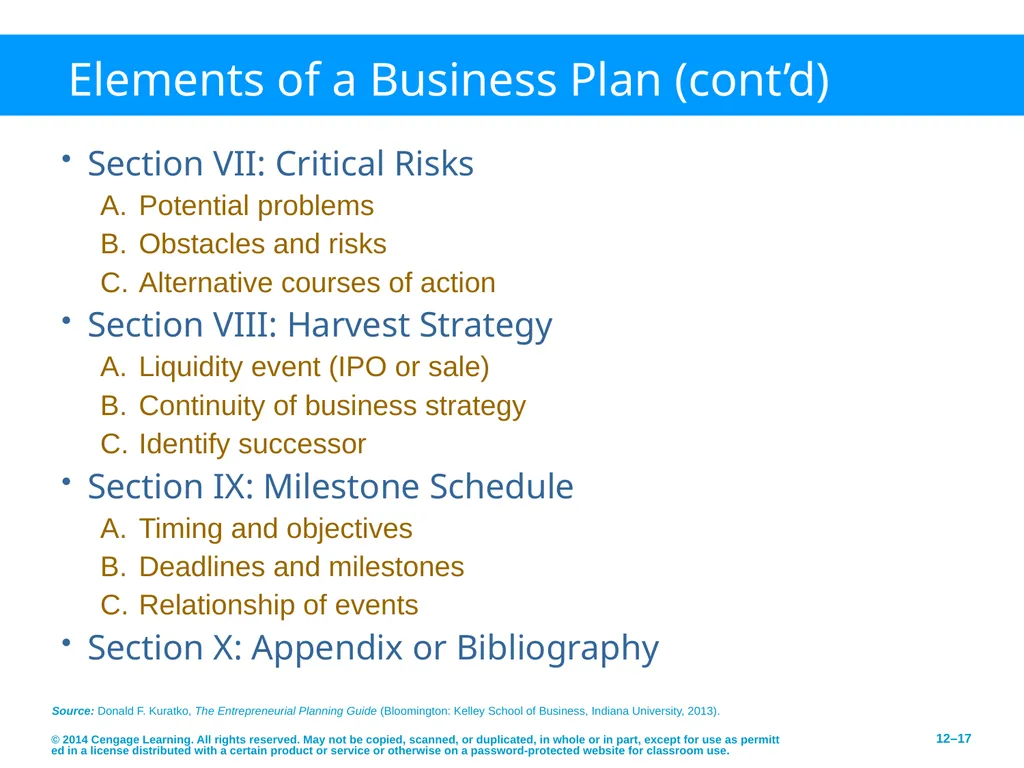
slide17. © 2014 Cengage Learning. All rights reserved. May not be copied, scanned, or duplicated, in whole or in part, except for use as permitted in a license distributed with a certain product or service or otherwise on a password-protected website for classroom use. 12–17 Elements of a Business Plan (cont’d) Section VII: Critical Risks
Potential problems
Obstacles and risks
Alternative courses of action
Section VIII: Harvest Strategy
Liquidity event (IPO or sale)
Continuity of business strategy
Identify successor
Section IX: Milestone Schedule
Timing and objectives
Deadlines and milestones
Relationship of events
Section X: Appendix or Bibliography Source: Donald F. Kuratko, The Entrepreneurial Planning Guide (Bloomington: Kelley School of Business, Indiana University, 2013).<br>
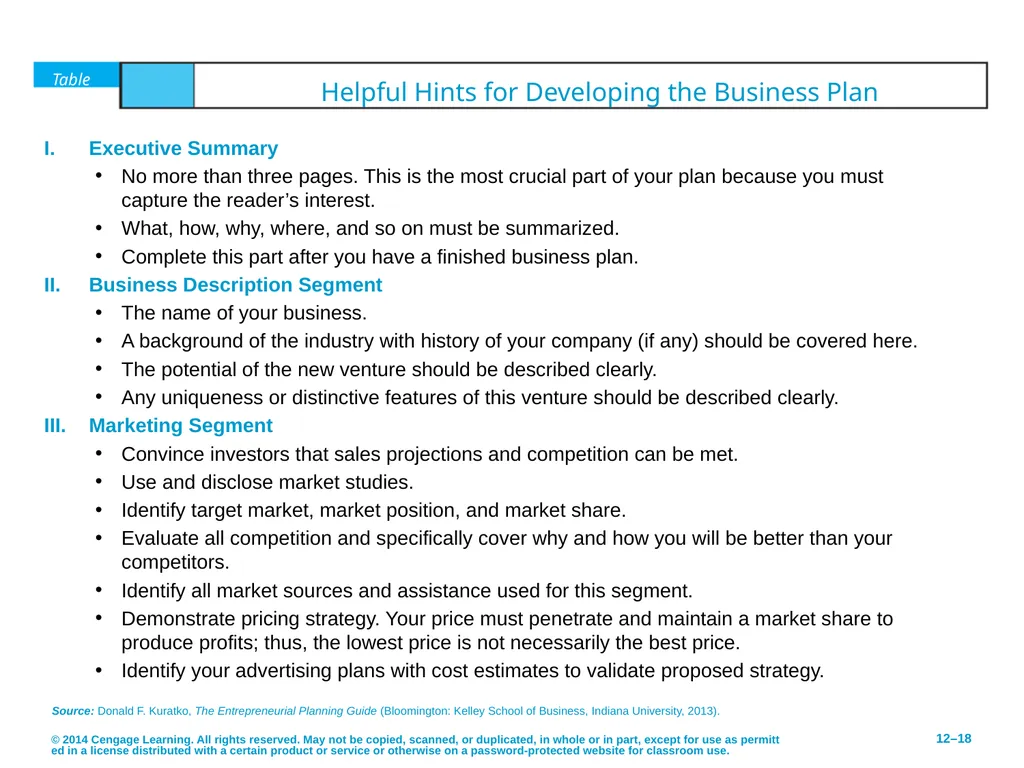
slide18. © 2014 Cengage Learning. All rights reserved. May not be copied, scanned, or duplicated, in whole or in part, except for use as permitted in a license distributed with a certain product or service or otherwise on a password-protected website for classroom use. 12–18 Table 12.3 Helpful Hints for Developing the Business Plan Executive Summary
No more than three pages. This is the most crucial part of your plan because you must capture the reader’s interest.
What, how, why, where, and so on must be summarized.
Complete this part after you have a finished business plan.
Business Description Segment
The name of your business.
A background of the industry with history of your company (if any) should be covered here.
The potential of the new venture should be described clearly.
Any uniqueness or distinctive features of this venture should be described clearly.
Marketing Segment
Convince investors that sales projections and competition can be met.
Use and disclose market studies.
Identify target market, market position, and market share.
Evaluate all competition and specifically cover why and how you will be better than your competitors.
Identify all market sources and assistance used for this segment.
Demonstrate pricing strategy. Your price must penetrate and maintain a market share to produce profits; thus, the lowest price is not necessarily the best price.
Identify your advertising plans with cost estimates to validate proposed strategy. Source: Donald F. Kuratko, The Entrepreneurial Planning Guide (Bloomington: Kelley School of Business, Indiana University, 2013).<br>
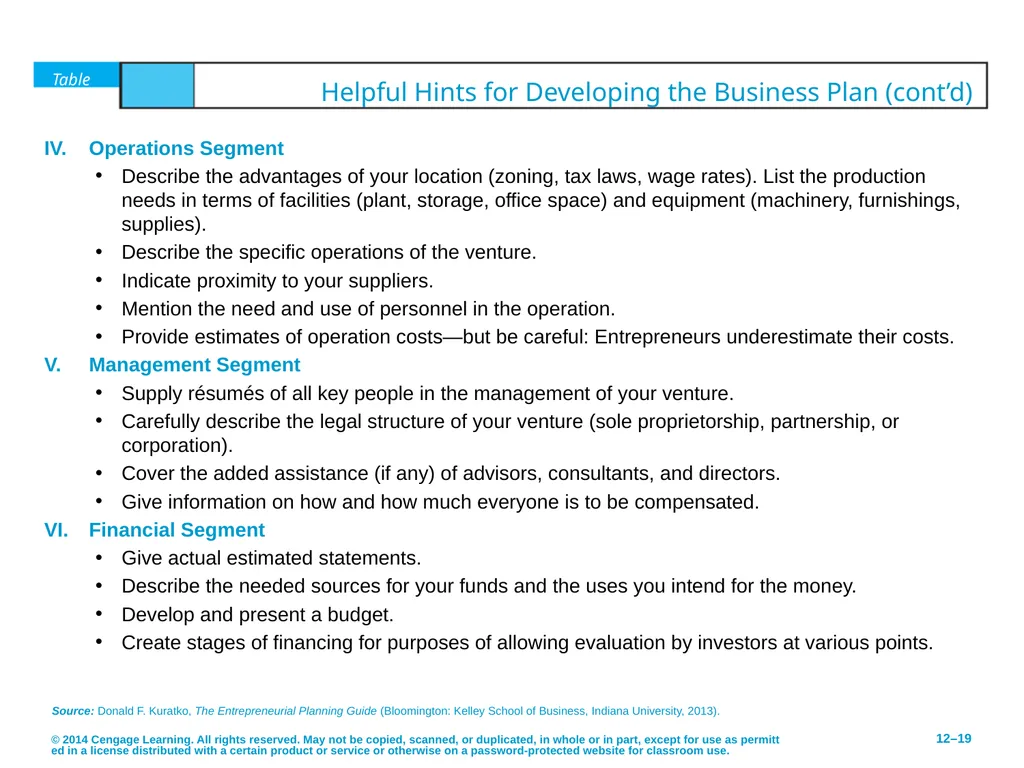
slide19. © 2014 Cengage Learning. All rights reserved. May not be copied, scanned, or duplicated, in whole or in part, except for use as permitted in a license distributed with a certain product or service or otherwise on a password-protected website for classroom use. 12–19 Table 12.3 Helpful Hints for Developing the Business Plan (cont’d) Operations Segment
Describe the advantages of your location (zoning, tax laws, wage rates). List the production needs in terms of facilities (plant, storage, office space) and equipment (machinery, furnishings, supplies).
Describe the specific operations of the venture.
Indicate proximity to your suppliers.
Mention the need and use of personnel in the operation.
Provide estimates of operation costs—but be careful: Entrepreneurs underestimate their costs.
Management Segment
Supply résumés of all key people in the management of your venture.
Carefully describe the legal structure of your venture (sole proprietorship, partnership, or corporation).
Cover the added assistance (if any) of advisors, consultants, and directors.
Give information on how and how much everyone is to be compensated.
Financial Segment
Give actual estimated statements.
Describe the needed sources for your funds and the uses you intend for the money.
Develop and present a budget.
Create stages of financing for purposes of allowing evaluation by investors at various points. Source: Donald F. Kuratko, The Entrepreneurial Planning Guide (Bloomington: Kelley School of Business, Indiana University, 2013).<br>
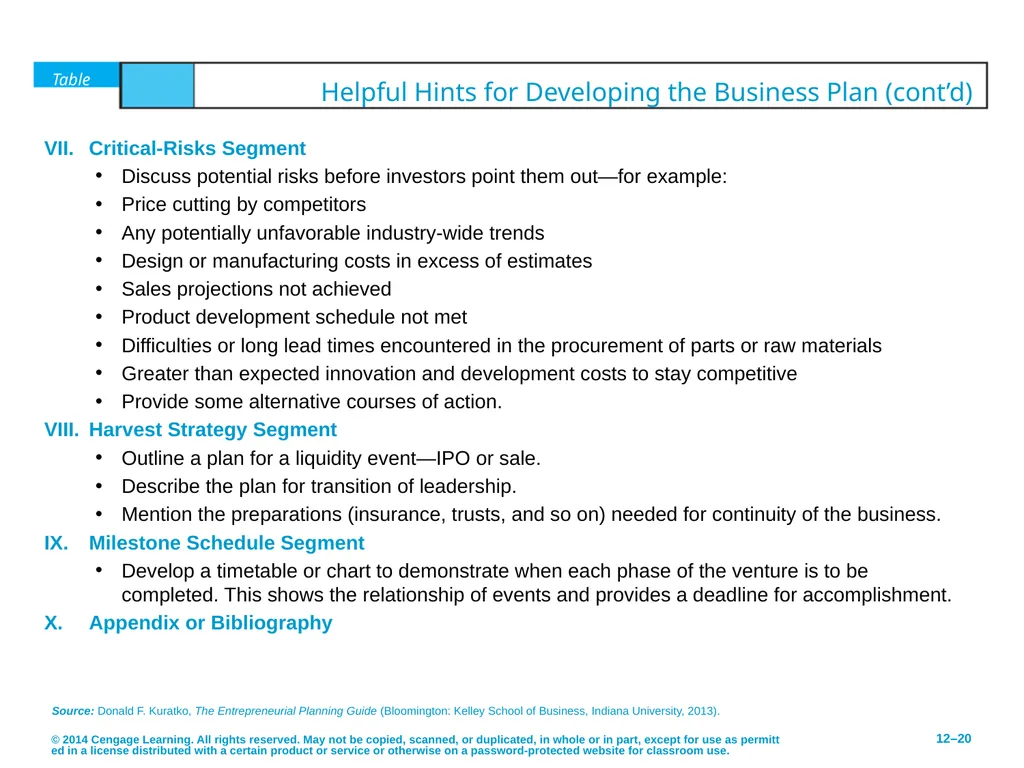
slide20. © 2014 Cengage Learning. All rights reserved. May not be copied, scanned, or duplicated, in whole or in part, except for use as permitted in a license distributed with a certain product or service or otherwise on a password-protected website for classroom use. 12–20 Table 12.3 Helpful Hints for Developing the Business Plan (cont’d) Critical-Risks Segment
Discuss potential risks before investors point them out—for example:
Price cutting by competitors
Any potentially unfavorable industry-wide trends
Design or manufacturing costs in excess of estimates
Sales projections not achieved
Product development schedule not met
Difficulties or long lead times encountered in the procurement of parts or raw materials
Greater than expected innovation and development costs to stay competitive
Provide some alternative courses of action.
Harvest Strategy Segment
Outline a plan for a liquidity event—IPO or sale.
Describe the plan for transition of leadership.
Mention the preparations (insurance, trusts, and so on) needed for continuity of the business.
Milestone Schedule Segment
Develop a timetable or chart to demonstrate when each phase of the venture is to be completed. This shows the relationship of events and provides a deadline for accomplishment.
Appendix or Bibliography Source: Donald F. Kuratko, The Entrepreneurial Planning Guide (Bloomington: Kelley School of Business, Indiana University, 2013).<br>
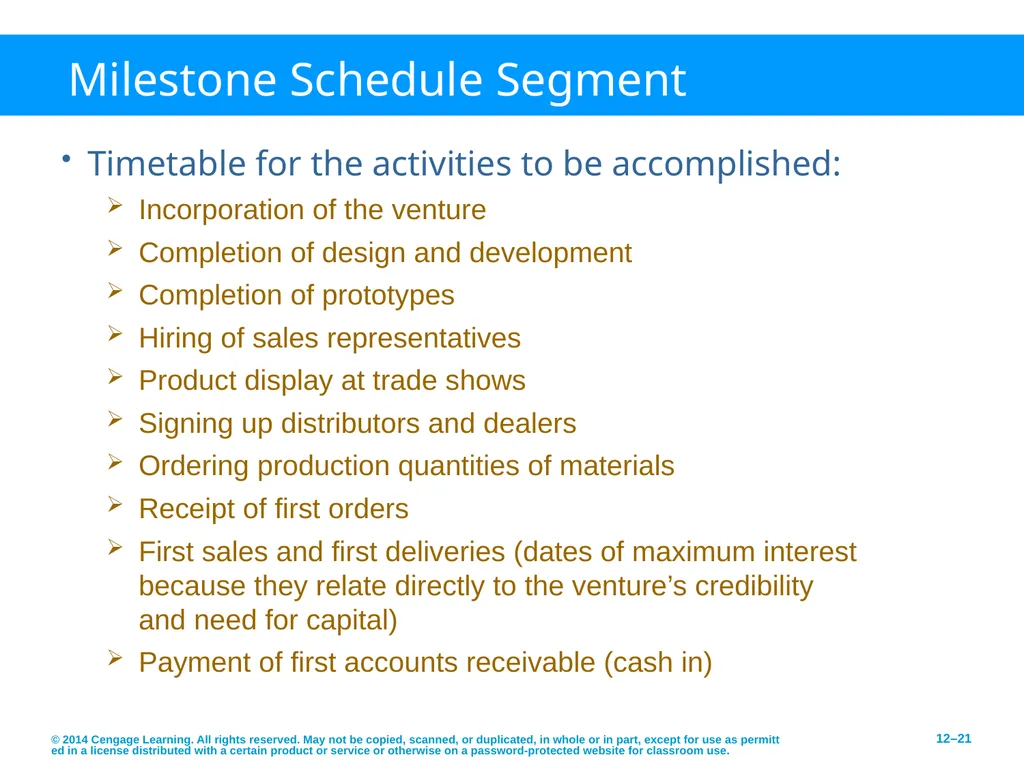
slide21. Milestone Schedule Segment Timetable for the activities to be accomplished:
Incorporation of the venture
Completion of design and development
Completion of prototypes
Hiring of sales representatives
Product display at trade shows
Signing up distributors and dealers
Ordering production quantities of materials
Receipt of first orders
First sales and first deliveries (dates of maximum interest because they relate directly to the venture’s credibility and need for capital)
Payment of first accounts receivable (cash in) © 2014 Cengage Learning. All rights reserved. May not be copied, scanned, or duplicated, in whole or in part, except for use as permitted in a license distributed with a certain product or service or otherwise on a password-protected website for classroom use. 12–21<br>
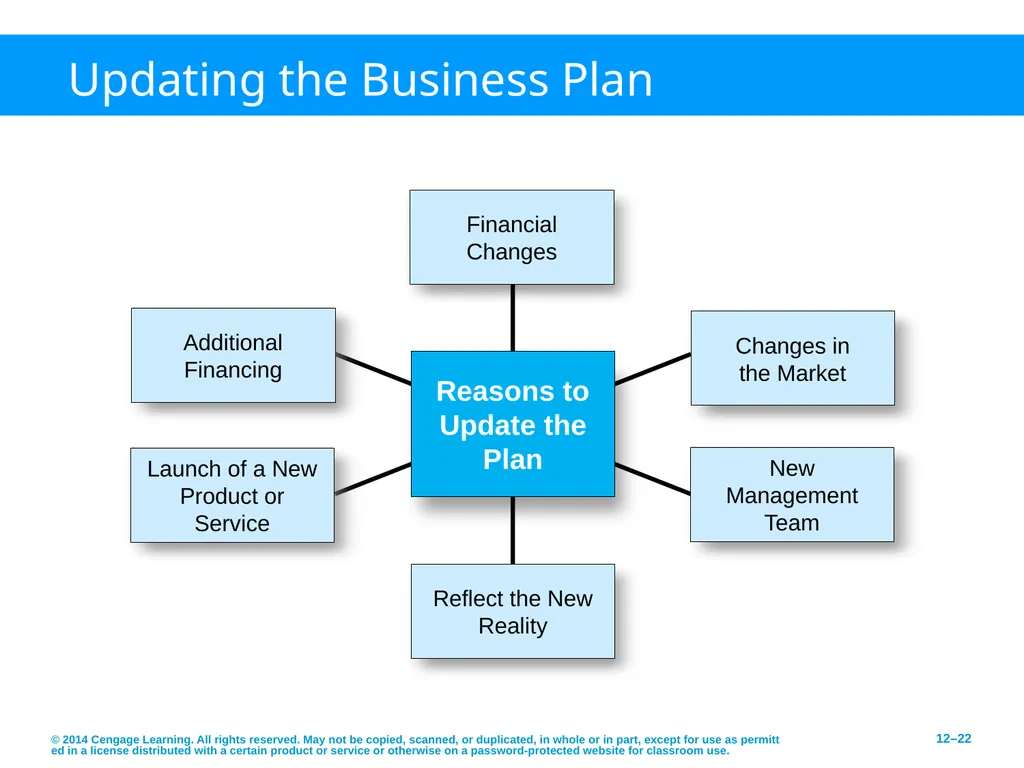
slide22. © 2014 Cengage Learning. All rights reserved. May not be copied, scanned, or duplicated, in whole or in part, except for use as permitted in a license distributed with a certain product or service or otherwise on a password-protected website for classroom use. 12–22 Updating the Business Plan<br>
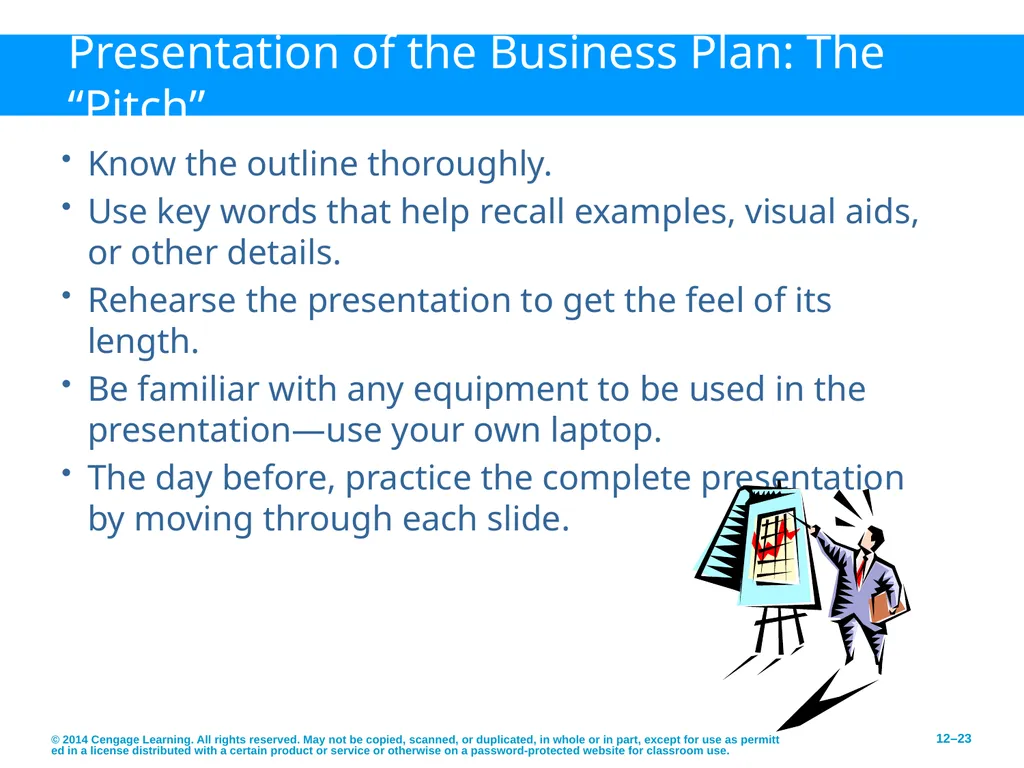
slide23. © 2014 Cengage Learning. All rights reserved. May not be copied, scanned, or duplicated, in whole or in part, except for use as permitted in a license distributed with a certain product or service or otherwise on a password-protected website for classroom use. 12–23 Presentation of the Business Plan: The “Pitch” Know the outline thoroughly.
Use key words that help recall examples, visual aids, or other details.
Rehearse the presentation to get the feel of its length.
Be familiar with any equipment to be used in the presentation—use your own laptop.
The day before, practice the complete presentation by moving through each slide.<br>
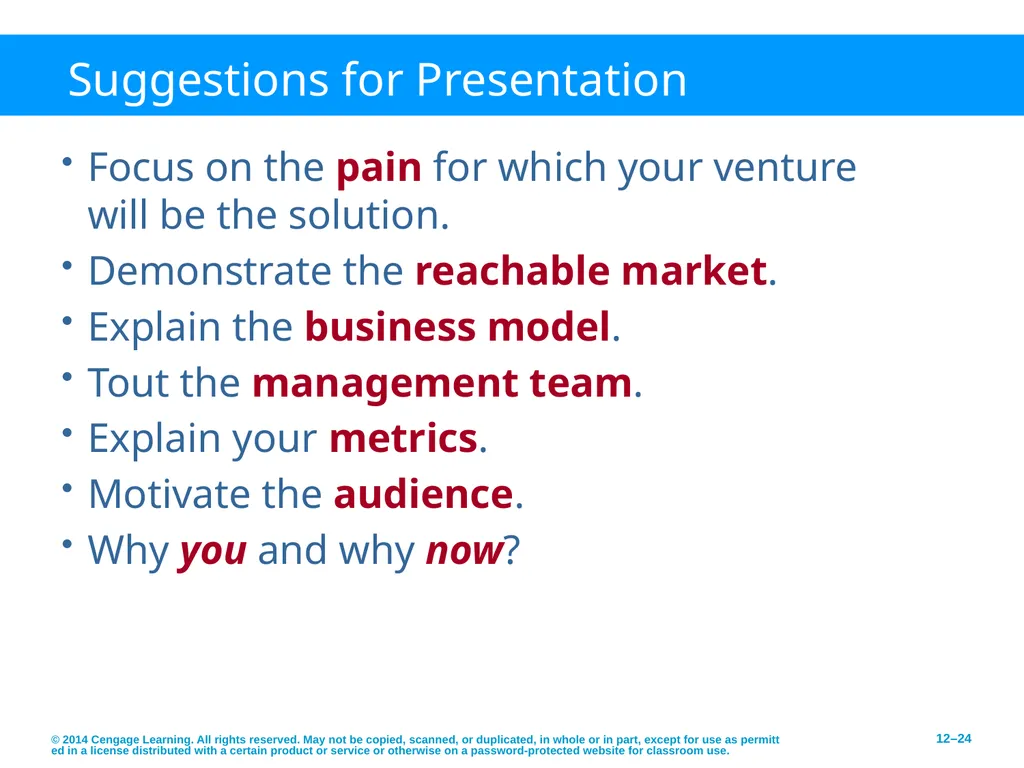
slide24. © 2014 Cengage Learning. All rights reserved. May not be copied, scanned, or duplicated, in whole or in part, except for use as permitted in a license distributed with a certain product or service or otherwise on a password-protected website for classroom use. 12–24 Suggestions for Presentation Focus on the pain for which your venture will be the solution.
Demonstrate the reachable market.
Explain the business model.
Tout the management team.
Explain your metrics.
Motivate the audience.
Why you and why now?<br>
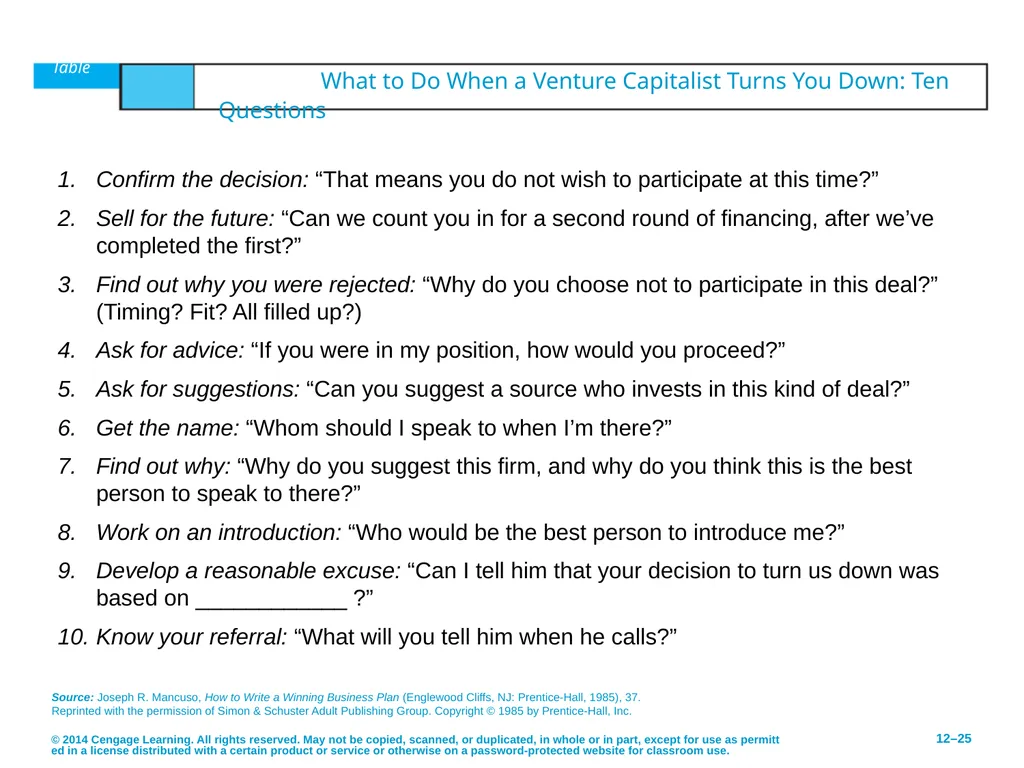
slide25. © 2014 Cengage Learning. All rights reserved. May not be copied, scanned, or duplicated, in whole or in part, except for use as permitted in a license distributed with a certain product or service or otherwise on a password-protected website for classroom use. 12–25 Table 12.5 What to Do When a Venture Capitalist Turns You Down: Ten Questions Confirm the decision: “That means you do not wish to participate at this time?”
Sell for the future: “Can we count you in for a second round of financing, after we’ve completed the first?”
Find out why you were rejected: “Why do you choose not to participate in this deal?” (Timing? Fit? All filled up?)
Ask for advice: “If you were in my position, how would you proceed?”
Ask for suggestions: “Can you suggest a source who invests in this kind of deal?”
Get the name: “Whom should I speak to when I’m there?”
Find out why: “Why do you suggest this firm, and why do you think this is the best person to speak to there?”
Work on an introduction: “Who would be the best person to introduce me?”
Develop a reasonable excuse: “Can I tell him that your decision to turn us down was based on ____________ ?”
Know your referral: “What will you tell him when he calls?” Source: Joseph R. Mancuso, How to Write a Winning Business Plan (Englewood Cliffs, NJ: Prentice-Hall, 1985), 37. Reprinted with the permission of Simon & Schuster Adult Publishing Group. Copyright © 1985 by Prentice-Hall, Inc.<br>
slide26. © 2014 Cengage Learning. All rights reserved. May not be copied, scanned, or duplicated, in whole or in part, except for use as permitted in a license distributed with a certain product or service or otherwise on a password-protected website for classroom use. 12–26 Key Terms and Concepts business model
business plan
elevator pitch
five-minute reading
management team
market niche marketing segment
marketing strategy
metrics
milestone schedule segment
pain
reachable market<br>
slide2. Chapter Objectives © 2014 Cengage Learning. All rights reserved. May not be copied, scanned, or duplicated, in whole or in part, except for use as permitted in a license distributed with a certain product or service or otherwise on a password-protected website for classroom use. 12–2 To define a business plan and demonstrate its value
To explore the planning pitfalls that plague many new ventures
To describe the benefits of a business plan
To set forth the viewpoints of those who read a business plan
To emphasize the importance of coordinating the business plan segments
To review key recommendations by venture capital experts regarding a plan<br>
slide3. Chapter Objectives (cont’d) © 2014 Cengage Learning. All rights reserved. May not be copied, scanned, or duplicated, in whole or in part, except for use as permitted in a license distributed with a certain product or service or otherwise on a password-protected website for classroom use. 12–3 To present a complete outline of an effective business plan
To present some helpful hints for writing an effective business plan
To highlight points to remember in the presentation of a business plan<br>
slide4. © 2014 Cengage Learning. All rights reserved. May not be copied, scanned, or duplicated, in whole or in part, except for use as permitted in a license distributed with a certain product or service or otherwise on a password-protected website for classroom use. 12–4 The Importance of Planning Planning is essential to the success of any undertaking. Critical factors that must be addressed when planning are:
Realistic goals. These must be specific, measurable, and set within time parameters.
Commitment. The venture must be supported by all involved—family, partners, employees, team members.
Milestones. Subgoals must be set for continual and timely evaluation of progress.
Flexibility. Obstacles must be anticipated, and alternative strategies must be formulated.<br>
slide5. © 2014 Cengage Learning. All rights reserved. May not be copied, scanned, or duplicated, in whole or in part, except for use as permitted in a license distributed with a certain product or service or otherwise on a password-protected website for classroom use. 12–5 What Is a Business Plan? A written document that details the proposed venture:
Describes the current status, expected needs, and projected results of the new business.
Covers the project, marketing, research and development, manufacturing, management, critical risks, financing, and milestones or a timetable.
Demonstrates a clear picture of what that venture is, where it is projected to go, and how the entrepreneur proposes it will get there—a road map for a successful enterprise.<br>
slide6. © 2014 Cengage Learning. All rights reserved. May not be copied, scanned, or duplicated, in whole or in part, except for use as permitted in a license distributed with a certain product or service or otherwise on a password-protected website for classroom use. 12–6 Pitfalls to Avoid in Planning Pitfall 1: No Realistic Goals
Pitfall 2: Failure to Anticipate Roadblocks
Pitfall 3: No Commitment or Dedication
Pitfall 4: Lack of Demonstrated Experience (Business or Technical)
Pitfall 5: No Market Niche (Segment)<br>
slide7. © 2014 Cengage Learning. All rights reserved. May not be copied, scanned, or duplicated, in whole or in part, except for use as permitted in a license distributed with a certain product or service or otherwise on a password-protected website for classroom use. 12–7 Benefits of a Business Plan For the Entrepreneur:
The time, effort, research, and discipline required to create a formal business plan forces the entrepreneur to view operating strategies and expected results critically and objectively.
For Outside Evaluators:
The business plan provides a tool for use in communications with outside financial sources.<br>
slide8. © 2014 Cengage Learning. All rights reserved. May not be copied, scanned, or duplicated, in whole or in part, except for use as permitted in a license distributed with a certain product or service or otherwise on a password-protected website for classroom use. 12–8 Benefits of the Business Plan (cont’d) Specifically for the Financial Sources:
Details the market potential and plans for securing a share of that market.
Shows how the venture’s intends to service debt or provide an adequate return on equity.
Identifies critical risks and crucial events with a discussion of contingency plans.
Contains the necessary information for a thorough business and financial evaluation.<br>
slide9. © 2014 Cengage Learning. All rights reserved. May not be copied, scanned, or duplicated, in whole or in part, except for use as permitted in a license distributed with a certain product or service or otherwise on a password-protected website for classroom use. 12–9 Developing a Well-Conceived Business Plan The Five-Minute Reading
Determine the characteristics of the venture and its industry.
Determine the financial structure of the plan (amount of debt or equity investment required).
Read the latest balance sheet (to determine liquidity, net worth, and debt/equity).
Determine the quality of entrepreneurs in the venture (sometimes the most important step).
Establish the unique feature in this venture (find out what is different).
Read the entire plan over lightly (this is when the entire package is paged through for a casual look at graphs, charts, exhibits, and other plan components).<br>
slide10. © 2014 Cengage Learning. All rights reserved. May not be copied, scanned, or duplicated, in whole or in part, except for use as permitted in a license distributed with a certain product or service or otherwise on a password-protected website for classroom use. 12–10 Putting the Package Together Appearance
Length
The cover and title page
The executive summary
The table of contents<br>
slide11. © 2014 Cengage Learning. All rights reserved. May not be copied, scanned, or duplicated, in whole or in part, except for use as permitted in a license distributed with a certain product or service or otherwise on a password-protected website for classroom use. 12–11 Guidelines to Remember Keep the plan respectably short
Organize and package the plan appropriately
Orient the plan toward the future
Avoid exaggeration
Highlight critical risks
Give evidence of an effective entrepreneurial team
Do not over-diversify
Identify the target market
Keep the plan written in the third person
Capture the reader’s interest<br>
slide12. © 2014 Cengage Learning. All rights reserved. May not be copied, scanned, or duplicated, in whole or in part, except for use as permitted in a license distributed with a certain product or service or otherwise on a password-protected website for classroom use. 12–12 Table 12.1 Common Business Plan Phrases: Statement versus Reality Source: Reprinted by permission of Harvard Business Review. Adapted from William A. Sahlman, “How to Write a Great Business Plan,” (July–August 1997): 106. Copyright © 1997 by the Harvard Business School Publishing Corporation; all rights reserved.<br>
slide13. © 2014 Cengage Learning. All rights reserved. May not be copied, scanned, or duplicated, in whole or in part, except for use as permitted in a license distributed with a certain product or service or otherwise on a password-protected website for classroom use. 12–13 Questions to Be Answered Is your plan organized so key facts leap out at the reader?
Is your product/service and business mission clear and simple?
Are you focused on the right things?
Who is your customer?
Why will customers buy? How much better is your product/service?
Do you have a competitive advantage?
Do you have a favorable cost structure?
Can the management team build a business?
How much money do you need?
How does your investor get a cash return?<br>
slide14. © 2014 Cengage Learning. All rights reserved. May not be copied, scanned, or duplicated, in whole or in part, except for use as permitted in a license distributed with a certain product or service or otherwise on a password-protected website for classroom use. 12–14 Elements of a Business Plan Section I: Executive Summary
Section II: Business Description
General description of business
Industry background
Goals and potential of the business and milestones (if any)
Uniqueness of product or service
Section III: Marketing
Research and analysis
Target market (customers) identified
Market size and trends
Competition
Estimated market share Source: Donald F. Kuratko, The Entrepreneurial Planning Guide (Bloomington: Kelley School of Business, Indiana University, 2013).<br>
slide15. © 2014 Cengage Learning. All rights reserved. May not be copied, scanned, or duplicated, in whole or in part, except for use as permitted in a license distributed with a certain product or service or otherwise on a password-protected website for classroom use. 12–15 Elements of a Business Plan (cont’d) Section III: Marketing (cont’d)
Marketing plan
Market strategy—sales and distribution
Pricing
Advertising and promotions
Section IV: Operations
Identify location advantages
Specific operational procedures
Personnel needs and uses
Proximity to suppliers Source: Donald F. Kuratko, The Entrepreneurial Planning Guide (Bloomington: Kelley School of Business, Indiana University, 2013).<br>
slide16. © 2014 Cengage Learning. All rights reserved. May not be copied, scanned, or duplicated, in whole or in part, except for use as permitted in a license distributed with a certain product or service or otherwise on a password-protected website for classroom use. 12–16 Elements of a Business Plan (cont’d) Section V: Management
Management team—key personnel
Legal structure—stock and employment agreements, and ownership
Board of directors, advisors, and consultants
Section VI: Financial
Financial forecast (pro forma financial statements)
Profit and loss
Cash flow
Break-even analysis
Cost controls
Budgeting plans Source: Donald F. Kuratko, The Entrepreneurial Planning Guide (Bloomington: Kelley School of Business, Indiana University, 2013).<br>
slide17. © 2014 Cengage Learning. All rights reserved. May not be copied, scanned, or duplicated, in whole or in part, except for use as permitted in a license distributed with a certain product or service or otherwise on a password-protected website for classroom use. 12–17 Elements of a Business Plan (cont’d) Section VII: Critical Risks
Potential problems
Obstacles and risks
Alternative courses of action
Section VIII: Harvest Strategy
Liquidity event (IPO or sale)
Continuity of business strategy
Identify successor
Section IX: Milestone Schedule
Timing and objectives
Deadlines and milestones
Relationship of events
Section X: Appendix or Bibliography Source: Donald F. Kuratko, The Entrepreneurial Planning Guide (Bloomington: Kelley School of Business, Indiana University, 2013).<br>
slide18. © 2014 Cengage Learning. All rights reserved. May not be copied, scanned, or duplicated, in whole or in part, except for use as permitted in a license distributed with a certain product or service or otherwise on a password-protected website for classroom use. 12–18 Table 12.3 Helpful Hints for Developing the Business Plan Executive Summary
No more than three pages. This is the most crucial part of your plan because you must capture the reader’s interest.
What, how, why, where, and so on must be summarized.
Complete this part after you have a finished business plan.
Business Description Segment
The name of your business.
A background of the industry with history of your company (if any) should be covered here.
The potential of the new venture should be described clearly.
Any uniqueness or distinctive features of this venture should be described clearly.
Marketing Segment
Convince investors that sales projections and competition can be met.
Use and disclose market studies.
Identify target market, market position, and market share.
Evaluate all competition and specifically cover why and how you will be better than your competitors.
Identify all market sources and assistance used for this segment.
Demonstrate pricing strategy. Your price must penetrate and maintain a market share to produce profits; thus, the lowest price is not necessarily the best price.
Identify your advertising plans with cost estimates to validate proposed strategy. Source: Donald F. Kuratko, The Entrepreneurial Planning Guide (Bloomington: Kelley School of Business, Indiana University, 2013).<br>
slide19. © 2014 Cengage Learning. All rights reserved. May not be copied, scanned, or duplicated, in whole or in part, except for use as permitted in a license distributed with a certain product or service or otherwise on a password-protected website for classroom use. 12–19 Table 12.3 Helpful Hints for Developing the Business Plan (cont’d) Operations Segment
Describe the advantages of your location (zoning, tax laws, wage rates). List the production needs in terms of facilities (plant, storage, office space) and equipment (machinery, furnishings, supplies).
Describe the specific operations of the venture.
Indicate proximity to your suppliers.
Mention the need and use of personnel in the operation.
Provide estimates of operation costs—but be careful: Entrepreneurs underestimate their costs.
Management Segment
Supply résumés of all key people in the management of your venture.
Carefully describe the legal structure of your venture (sole proprietorship, partnership, or corporation).
Cover the added assistance (if any) of advisors, consultants, and directors.
Give information on how and how much everyone is to be compensated.
Financial Segment
Give actual estimated statements.
Describe the needed sources for your funds and the uses you intend for the money.
Develop and present a budget.
Create stages of financing for purposes of allowing evaluation by investors at various points. Source: Donald F. Kuratko, The Entrepreneurial Planning Guide (Bloomington: Kelley School of Business, Indiana University, 2013).<br>
slide20. © 2014 Cengage Learning. All rights reserved. May not be copied, scanned, or duplicated, in whole or in part, except for use as permitted in a license distributed with a certain product or service or otherwise on a password-protected website for classroom use. 12–20 Table 12.3 Helpful Hints for Developing the Business Plan (cont’d) Critical-Risks Segment
Discuss potential risks before investors point them out—for example:
Price cutting by competitors
Any potentially unfavorable industry-wide trends
Design or manufacturing costs in excess of estimates
Sales projections not achieved
Product development schedule not met
Difficulties or long lead times encountered in the procurement of parts or raw materials
Greater than expected innovation and development costs to stay competitive
Provide some alternative courses of action.
Harvest Strategy Segment
Outline a plan for a liquidity event—IPO or sale.
Describe the plan for transition of leadership.
Mention the preparations (insurance, trusts, and so on) needed for continuity of the business.
Milestone Schedule Segment
Develop a timetable or chart to demonstrate when each phase of the venture is to be completed. This shows the relationship of events and provides a deadline for accomplishment.
Appendix or Bibliography Source: Donald F. Kuratko, The Entrepreneurial Planning Guide (Bloomington: Kelley School of Business, Indiana University, 2013).<br>
slide21. Milestone Schedule Segment Timetable for the activities to be accomplished:
Incorporation of the venture
Completion of design and development
Completion of prototypes
Hiring of sales representatives
Product display at trade shows
Signing up distributors and dealers
Ordering production quantities of materials
Receipt of first orders
First sales and first deliveries (dates of maximum interest because they relate directly to the venture’s credibility and need for capital)
Payment of first accounts receivable (cash in) © 2014 Cengage Learning. All rights reserved. May not be copied, scanned, or duplicated, in whole or in part, except for use as permitted in a license distributed with a certain product or service or otherwise on a password-protected website for classroom use. 12–21<br>
slide22. © 2014 Cengage Learning. All rights reserved. May not be copied, scanned, or duplicated, in whole or in part, except for use as permitted in a license distributed with a certain product or service or otherwise on a password-protected website for classroom use. 12–22 Updating the Business Plan<br>
slide23. © 2014 Cengage Learning. All rights reserved. May not be copied, scanned, or duplicated, in whole or in part, except for use as permitted in a license distributed with a certain product or service or otherwise on a password-protected website for classroom use. 12–23 Presentation of the Business Plan: The “Pitch” Know the outline thoroughly.
Use key words that help recall examples, visual aids, or other details.
Rehearse the presentation to get the feel of its length.
Be familiar with any equipment to be used in the presentation—use your own laptop.
The day before, practice the complete presentation by moving through each slide.<br>
slide24. © 2014 Cengage Learning. All rights reserved. May not be copied, scanned, or duplicated, in whole or in part, except for use as permitted in a license distributed with a certain product or service or otherwise on a password-protected website for classroom use. 12–24 Suggestions for Presentation Focus on the pain for which your venture will be the solution.
Demonstrate the reachable market.
Explain the business model.
Tout the management team.
Explain your metrics.
Motivate the audience.
Why you and why now?<br>
slide25. © 2014 Cengage Learning. All rights reserved. May not be copied, scanned, or duplicated, in whole or in part, except for use as permitted in a license distributed with a certain product or service or otherwise on a password-protected website for classroom use. 12–25 Table 12.5 What to Do When a Venture Capitalist Turns You Down: Ten Questions Confirm the decision: “That means you do not wish to participate at this time?”
Sell for the future: “Can we count you in for a second round of financing, after we’ve completed the first?”
Find out why you were rejected: “Why do you choose not to participate in this deal?” (Timing? Fit? All filled up?)
Ask for advice: “If you were in my position, how would you proceed?”
Ask for suggestions: “Can you suggest a source who invests in this kind of deal?”
Get the name: “Whom should I speak to when I’m there?”
Find out why: “Why do you suggest this firm, and why do you think this is the best person to speak to there?”
Work on an introduction: “Who would be the best person to introduce me?”
Develop a reasonable excuse: “Can I tell him that your decision to turn us down was based on ____________ ?”
Know your referral: “What will you tell him when he calls?” Source: Joseph R. Mancuso, How to Write a Winning Business Plan (Englewood Cliffs, NJ: Prentice-Hall, 1985), 37. Reprinted with the permission of Simon & Schuster Adult Publishing Group. Copyright © 1985 by Prentice-Hall, Inc.<br>
slide26. © 2014 Cengage Learning. All rights reserved. May not be copied, scanned, or duplicated, in whole or in part, except for use as permitted in a license distributed with a certain product or service or otherwise on a password-protected website for classroom use. 12–26 Key Terms and Concepts business model
business plan
elevator pitch
five-minute reading
management team
market niche marketing segment
marketing strategy
metrics
milestone schedule segment
pain
reachable market<br>