Developing Analytics Curriculum for the Community College: Training Todays Workforce for the Future Tanya Scott Director, Business Analytics Department Assoc. Dean, Business Public Services Dr. Manju Shah Assoc. Department Head, Business
"Developing Analytics Curriculum for the Community" is the property of its rightful owner. Permission is granted to
download and print the materials on this website for personal, non-commercial use only, and to display it
on your personal computer provided you do not modify the materials and that you retain all copyright
notices contained in the materials. By downloading content from our website, you accept the terms of this
agreement.
Presentation Transcript
01
Developing Analytics Curriculum for the Community College: Training Today’s Workforce for the Future Tanya Scott
Director, Business Analytics Department
Assoc. Dean, Business & Public Services
Dr. Manju Shah
Assoc. Department Head, Business Analytics Department<br>
02
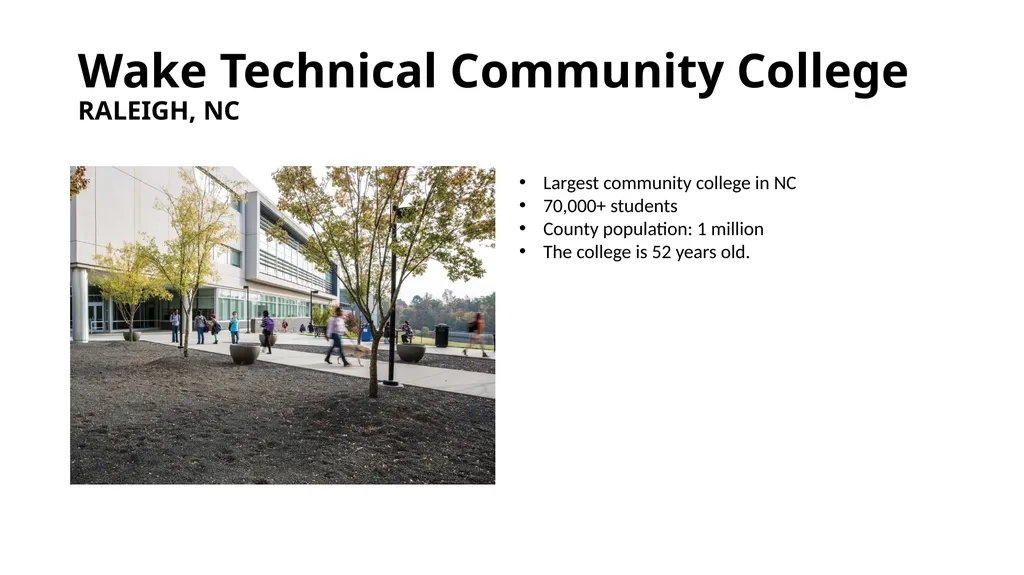
Wake Technical Community College RALEIGH, NC Largest community college in NC
70,000+ students
County population: 1 million
The college is 52 years old.<br>
03
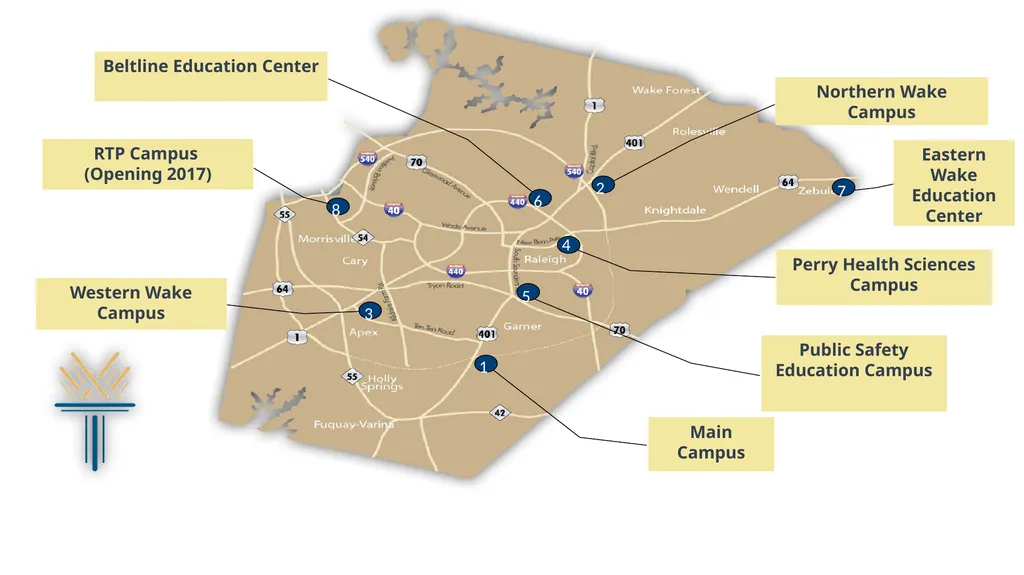
Beltline Education Center Northern Wake Campus Eastern Wake Education Center Perry Health Sciences Campus Public Safety Education Campus Western Wake Campus Main Campus RTP Campus (Opening 2017) 1 5 4 2 7 6 3 8<br>
04
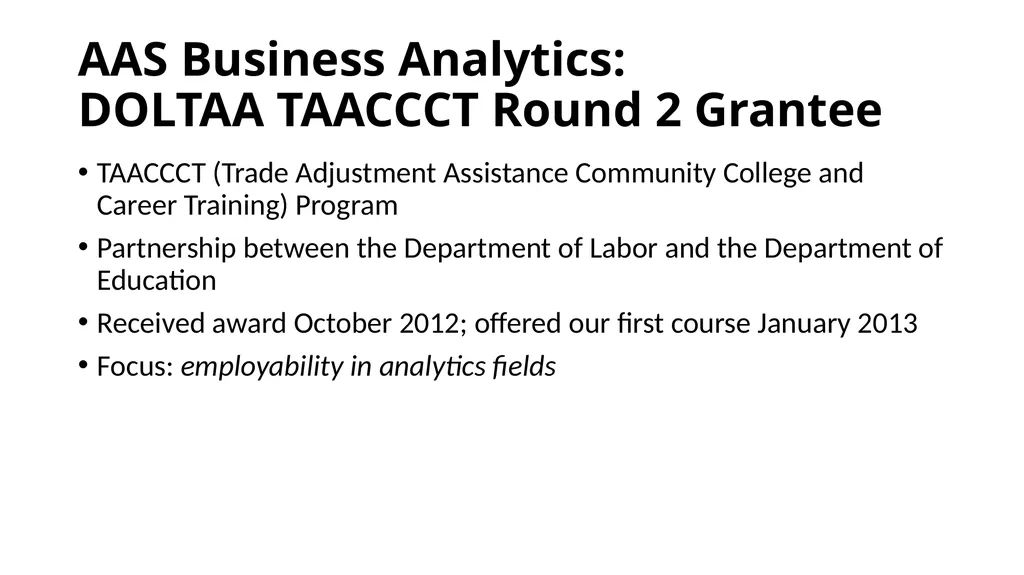
AAS Business Analytics: DOLTAA TAACCCT Round 2 Grantee TAACCCT (Trade Adjustment Assistance Community College and Career Training) Program
Partnership between the Department of Labor and the Department of Education
Received award October 2012; offered our first course January 2013
Focus: employability in analytics fields<br>
05
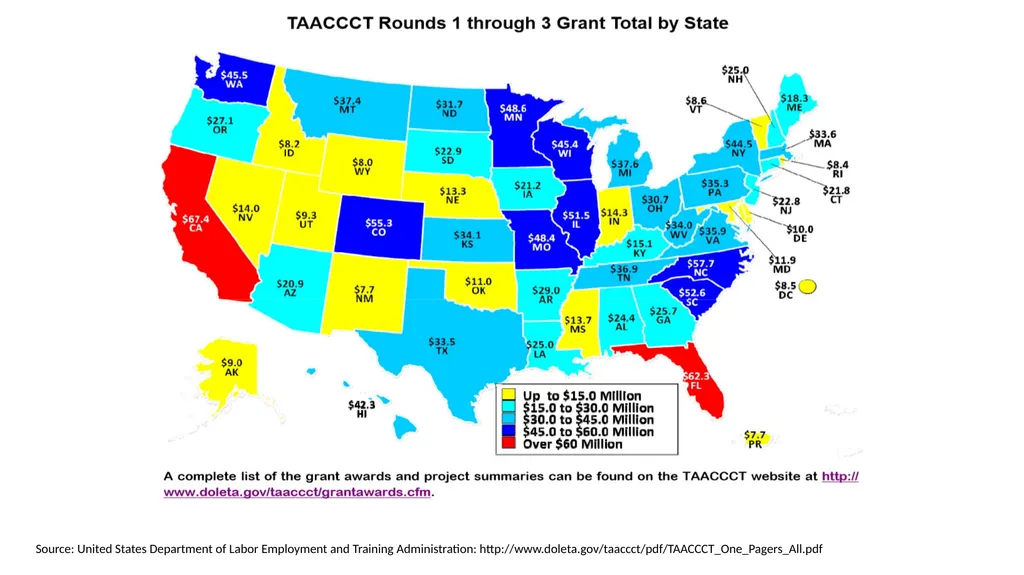
Source: United States Department of Labor Employment and Training Administration: http://www.doleta.gov/taaccct/pdf/TAACCCT_One_Pagers_All.pdf<br>
06
Poll Question Are you interested in offering an analytics program?
Yes
No<br>
07
Poll Question What educational institution do you represent?
Community College
Four-Year College, Public
Four-Year College, Private
Other training facility<br>
08
AAS Business Analytics: The Importance of the Community College Open enrollment
Accessible
Fewer perceived obstacles
Fewer ‘start-up costs’
Cost-to-benefit
Flexibility
Scheduling
Modality in learning
Likeminded student colleagues<br>
09
AAS Business Analytics: Initial Challenges No other AAS program or the like to benchmark:
Traditionally offered at the graduate level
Traditionally statistics and/or IT-Database tracked
Employability in a field that typically hires individuals with at least a Bachelor degree, usually a graduate degree
Program is open enrollment and requires little to no prerequisites (developmental math and English).
Online/hybrid most popular.
Accelerated online most popular.
Difficult to find qualified faculty (at our salary range).
Lack of industry consensus “what is analytics”<br>
10
AAS Business Analytics: Structured Pathways Clear program structure with a balance between flexible and prescriptive options
Provide timeline and sequence that keeps students on track to completion
Align courses with transfer and articulation options
Encourage degree and credential declaration early
Limit elective choices<br>
11
AAS Business Analytics: Strategies Industry partnerships
Networking and attending specialty group meetings
Student-centric program hosted events
Internships and adopting real-world projects
Focus on problem solving and application versus theory
Boot camps and other resources
Accelerated program/certificates
Structured pathways
Latticed credentials
Industry certifications<br>
12
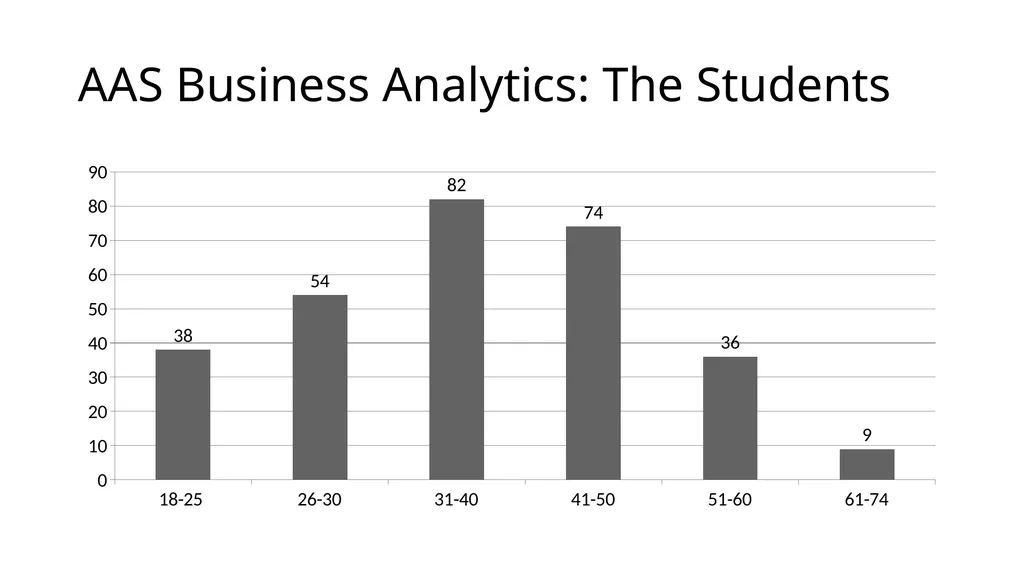
AAS Business Analytics: The Students<br>
13
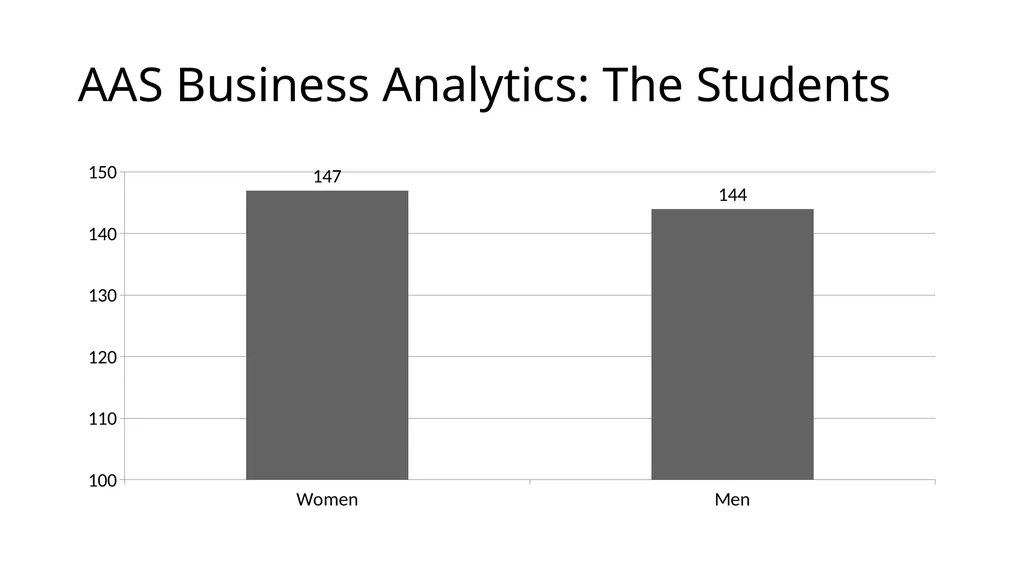
AAS Business Analytics: The Students<br>
14
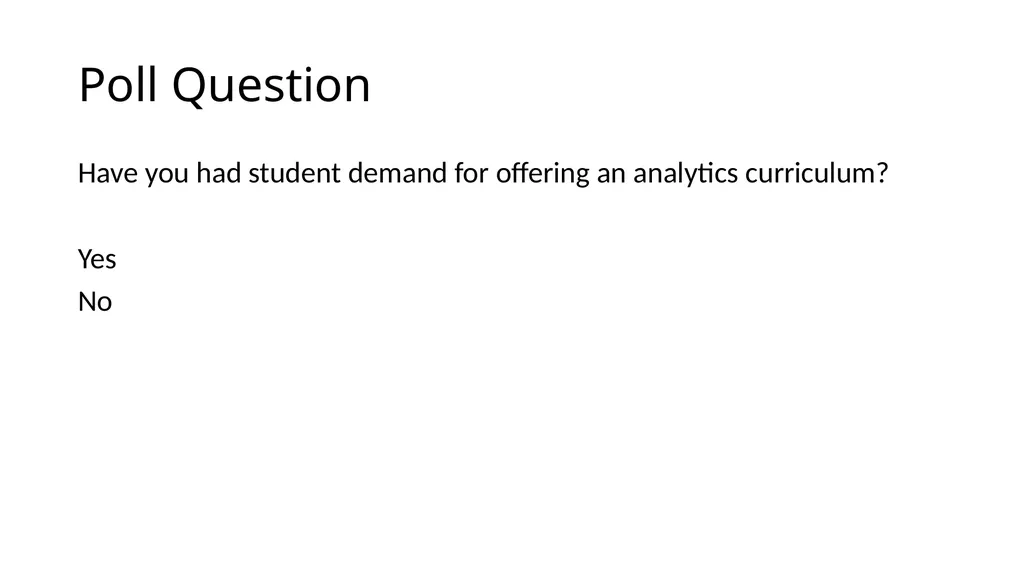
Poll Question Have you had student demand for offering an analytics curriculum?
Yes
No<br>
15
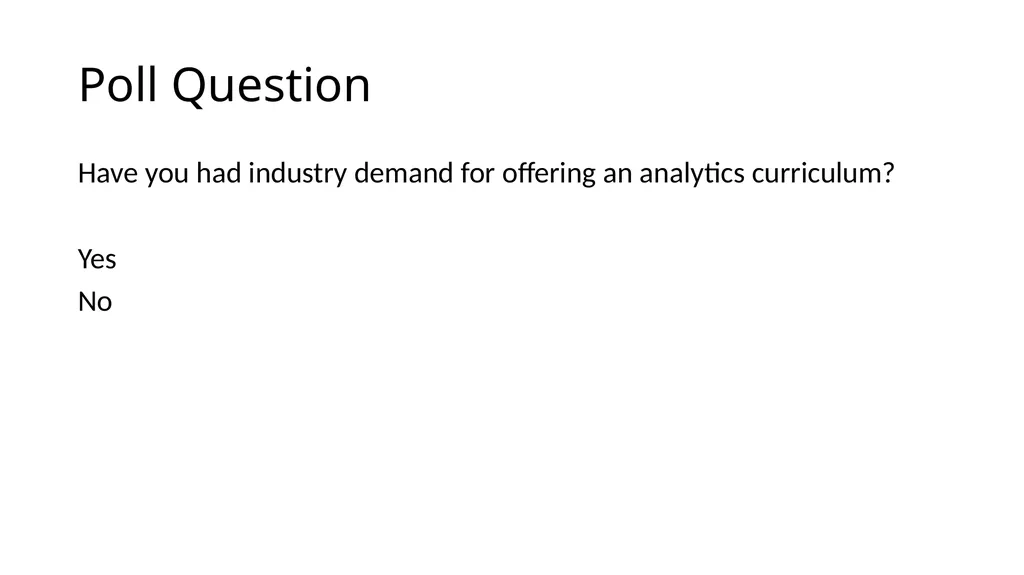
Poll Question Have you had industry demand for offering an analytics curriculum?
Yes
No<br>
16
AAS Business Analytics: Serving Underrepresented Populations in Stem-Related Careers Women
Veterans
Underserved populations<br>
17
AAS Business Analytics: Motivators Career transition
Upward mobility
Quality of life<br>
18
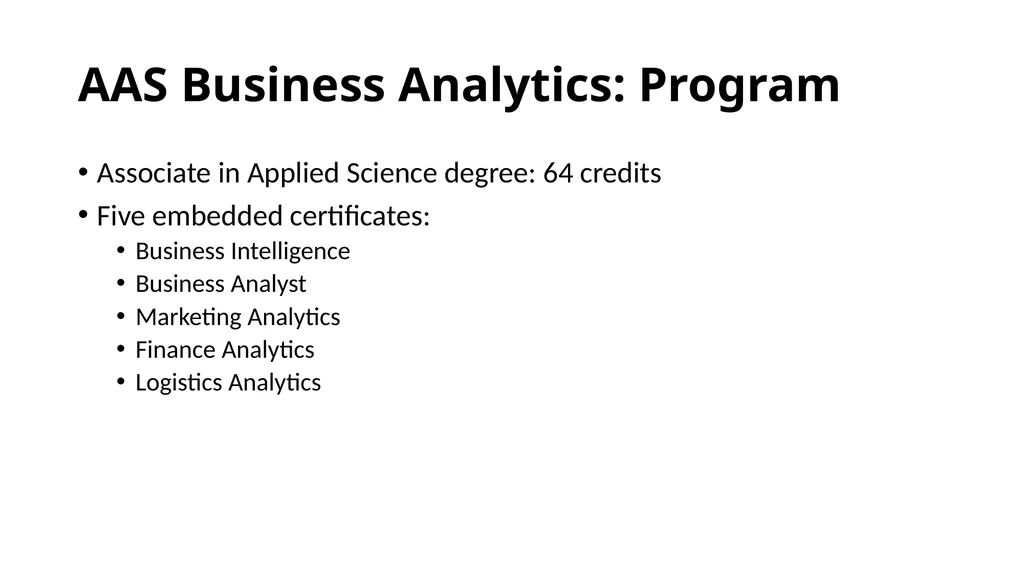
AAS Business Analytics: Program Associate in Applied Science degree: 64 credits
Five embedded certificates:
Business Intelligence
Business Analyst
Marketing Analytics
Finance Analytics
Logistics Analytics<br>
19
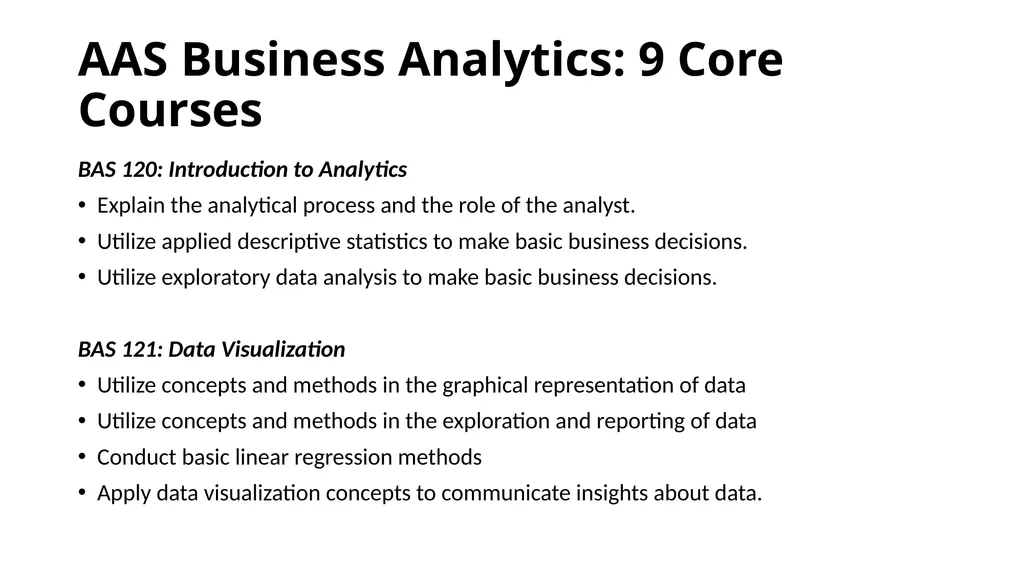
AAS Business Analytics: 9 Core Courses BAS 120: Introduction to Analytics
Explain the analytical process and the role of the analyst.
Utilize applied descriptive statistics to make basic business decisions.
Utilize exploratory data analysis to make basic business decisions.
BAS 121: Data Visualization
Utilize concepts and methods in the graphical representation of data
Utilize concepts and methods in the exploration and reporting of data
Conduct basic linear regression methods
Apply data visualization concepts to communicate insights about data.<br>
20
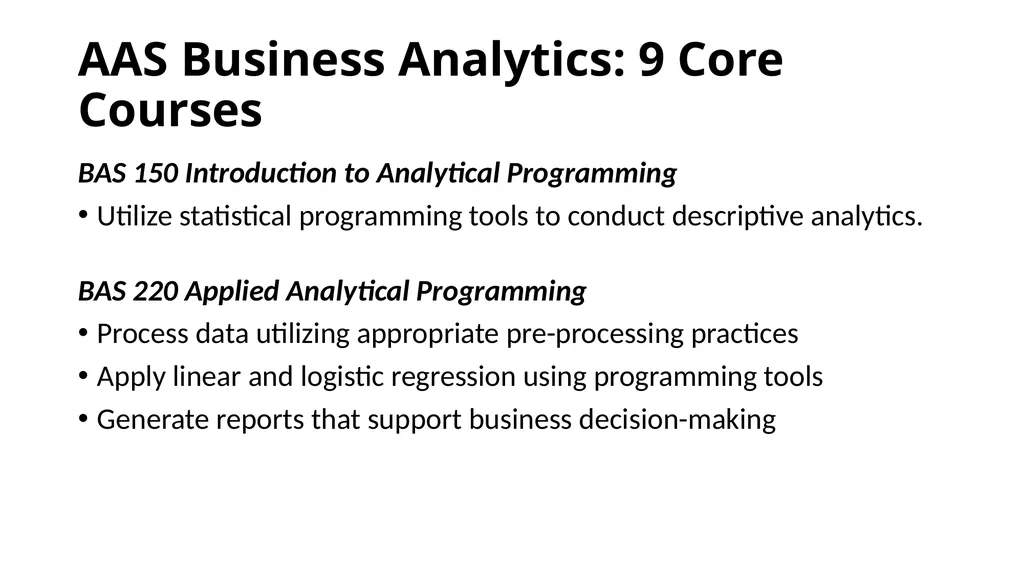
AAS Business Analytics: 9 Core Courses BAS 150 Introduction to Analytical Programming
Utilize statistical programming tools to conduct descriptive analytics.
BAS 220 Applied Analytical Programming
Process data utilizing appropriate pre-processing practices
Apply linear and logistic regression using programming tools
Generate reports that support business decision-making<br>
21
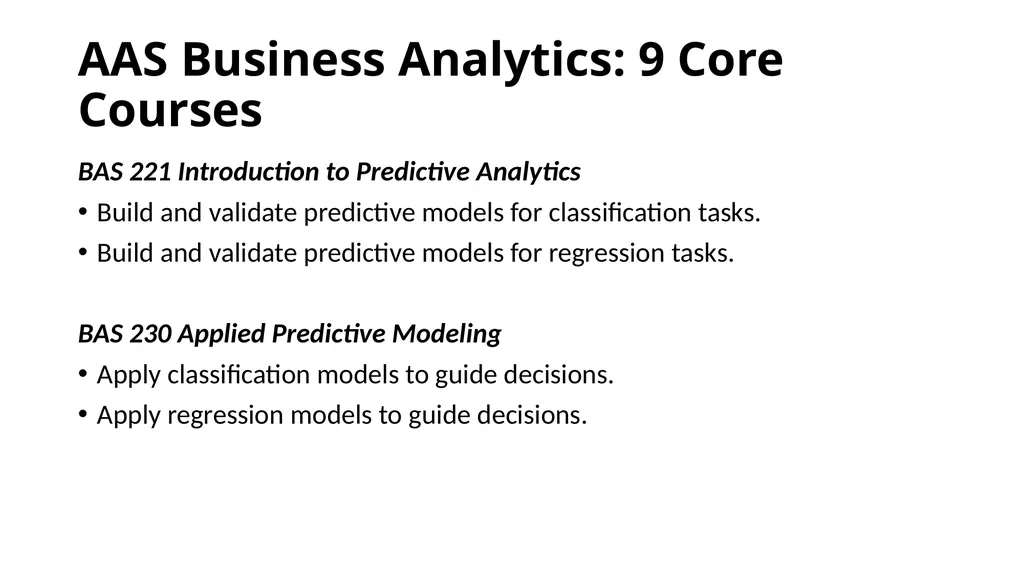
AAS Business Analytics: 9 Core Courses BAS 221 Introduction to Predictive Analytics
Build and validate predictive models for classification tasks.
Build and validate predictive models for regression tasks.
BAS 230 Applied Predictive Modeling
Apply classification models to guide decisions.
Apply regression models to guide decisions.<br>
22
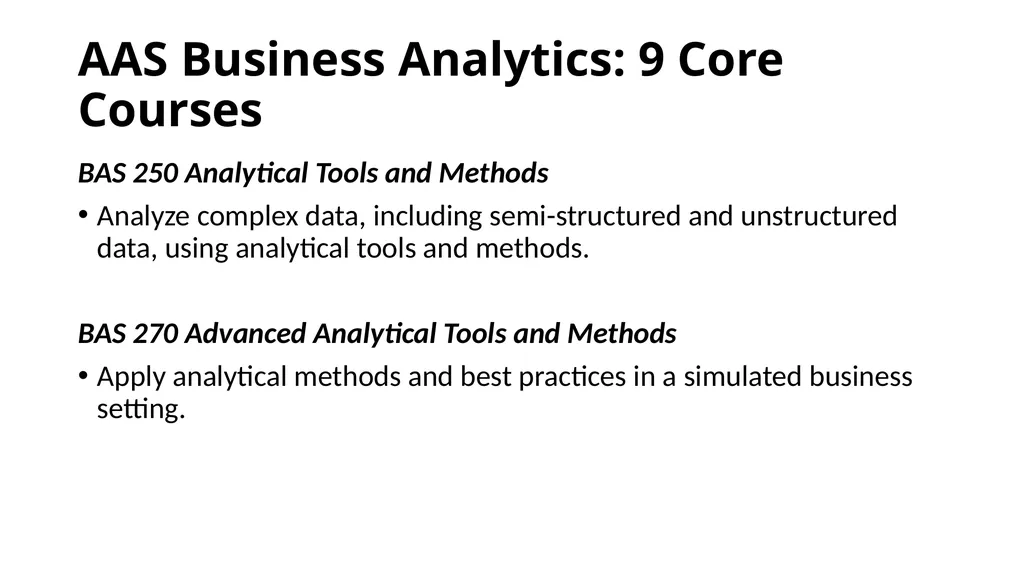
AAS Business Analytics: 9 Core Courses BAS 250 Analytical Tools and Methods
Analyze complex data, including semi-structured and unstructured data, using analytical tools and methods.
BAS 270 Advanced Analytical Tools and Methods
Apply analytical methods and best practices in a simulated business setting.<br>
23
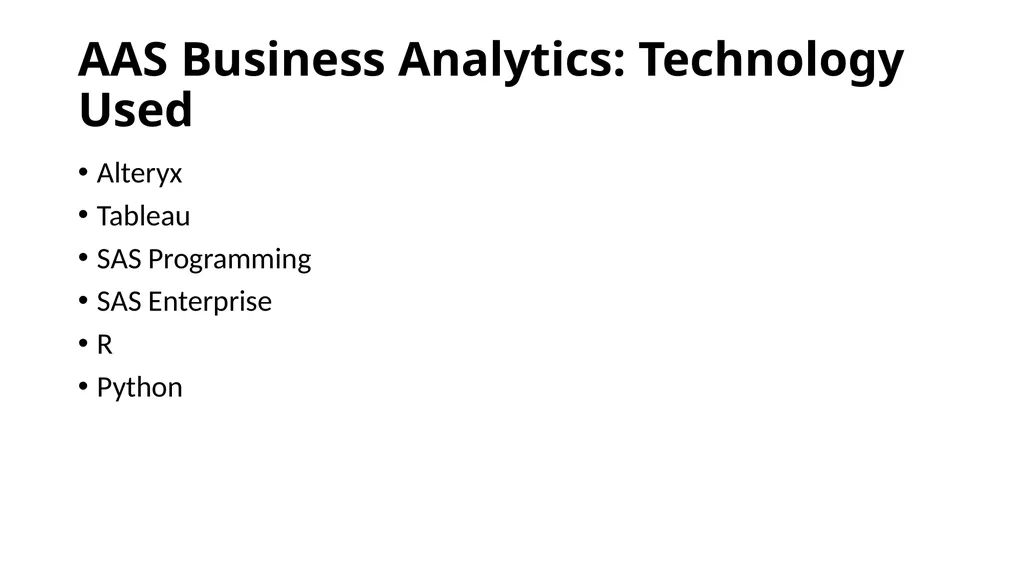
AAS Business Analytics: Technology Used Alteryx
Tableau
SAS Programming
SAS Enterprise
R
Python<br>