
Developing Effective Controls for the 21st Century



Description: Developing Effective Controls for the 21st Century Bob Scott, CPA Objectives Encourage participants to take a fresh look at their organizations control environment Discuss how specific trends in state local governments may have rendered
Related Topics
Download Presentation
"Developing Effective Controls for the 21st Century" is the property of its rightful owner. Permission is granted to download and print the materials on this website for personal, non-commercial use only, and to display it on your personal computer provided you do not modify the materials and that you retain all copyright notices contained in the materials. By downloading content from our website, you accept the terms of this agreement.
Presentation Transcript
slide1. Developing Effective Controls for the 21st Century Bob Scott, CPA<br>
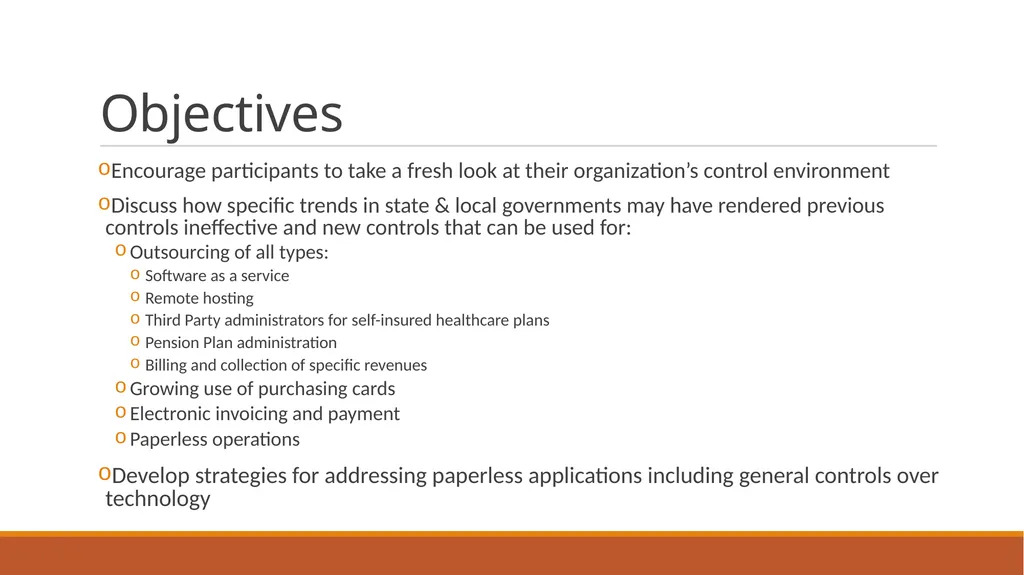
slide2. Objectives Encourage participants to take a fresh look at their organization’s control environment
Discuss how specific trends in state & local governments may have rendered previous controls ineffective and new controls that can be used for:
Outsourcing of all types:
Software as a service
Remote hosting
Third Party administrators for self-insured healthcare plans
Pension Plan administration
Billing and collection of specific revenues
Growing use of purchasing cards
Electronic invoicing and payment
Paperless operations
Develop strategies for addressing paperless applications including general controls over technology<br>
slide3. Are Your Internal Controls Relics of a By Gone Era?<br>
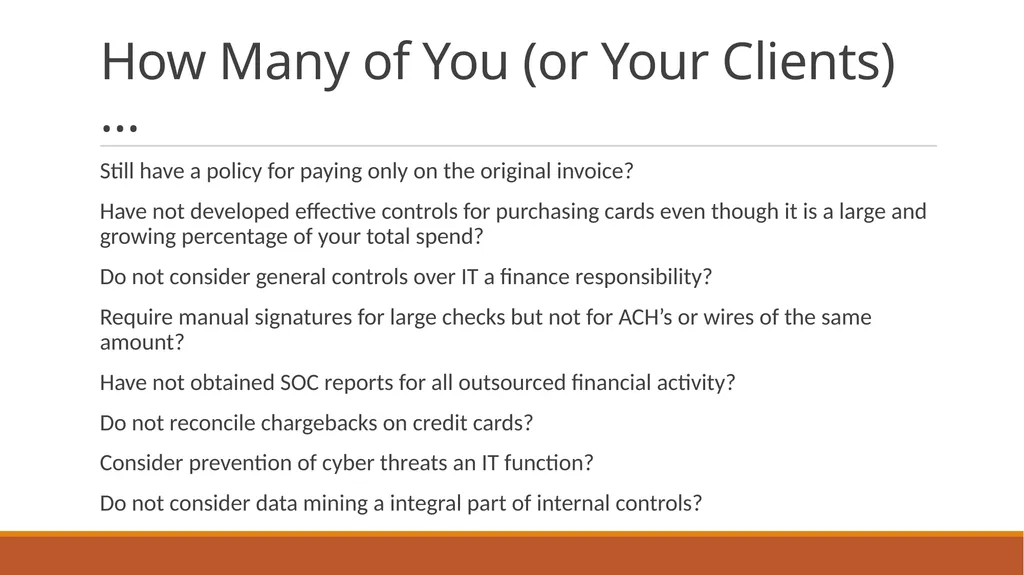
slide4. How Many of You (or Your Clients) … Still have a policy for paying only on the original invoice?
Have not developed effective controls for purchasing cards even though it is a large and growing percentage of your total spend?
Do not consider general controls over IT a finance responsibility?
Require manual signatures for large checks but not for ACH’s or wires of the same amount?
Have not obtained SOC reports for all outsourced financial activity?
Do not reconcile chargebacks on credit cards?
Consider prevention of cyber threats an IT function?
Do not consider data mining a integral part of internal controls?<br>
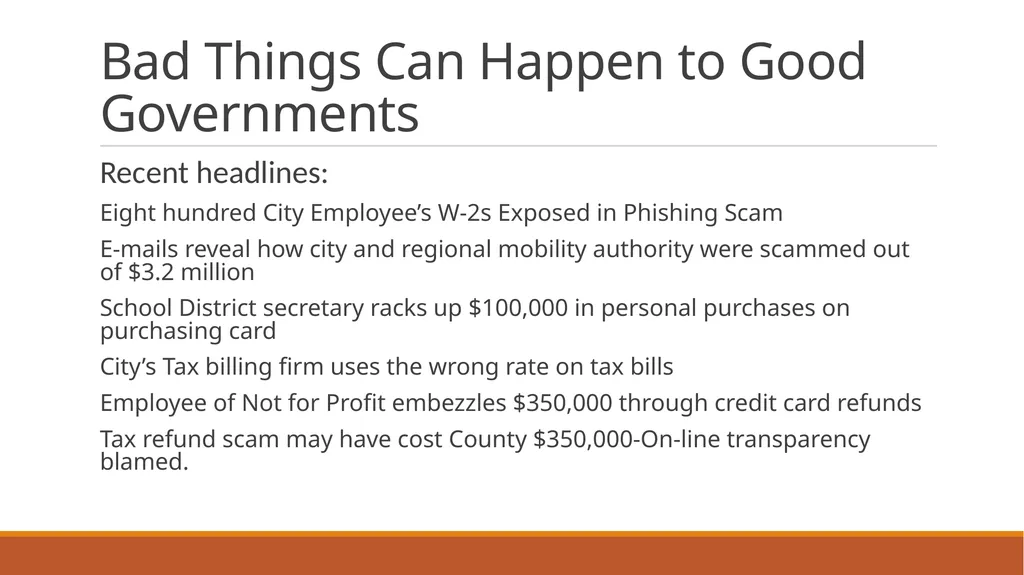
slide5. Bad Things Can Happen to Good Governments Recent headlines:
Eight hundred City Employee’s W-2s Exposed in Phishing Scam
E-mails reveal how city and regional mobility authority were scammed out of $3.2 million
School District secretary racks up $100,000 in personal purchases on purchasing card
City’s Tax billing firm uses the wrong rate on tax bills
Employee of Not for Profit embezzles $350,000 through credit card refunds
Tax refund scam may have cost County $350,000-On-line transparency blamed.<br>
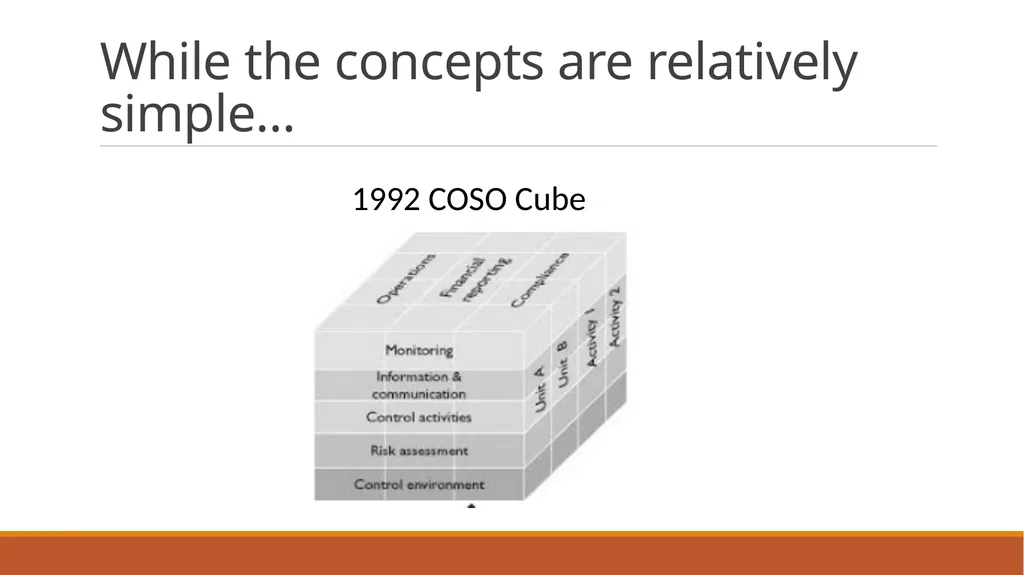
slide6. While the concepts are relatively simple… 1992 COSO Cube<br>
slide7. We Often Forget… Systems change
Technology evolves
People leave and retire
People forget
New hires need to be told
Threats are world wide
Criminals adapt
That we are never done!<br>
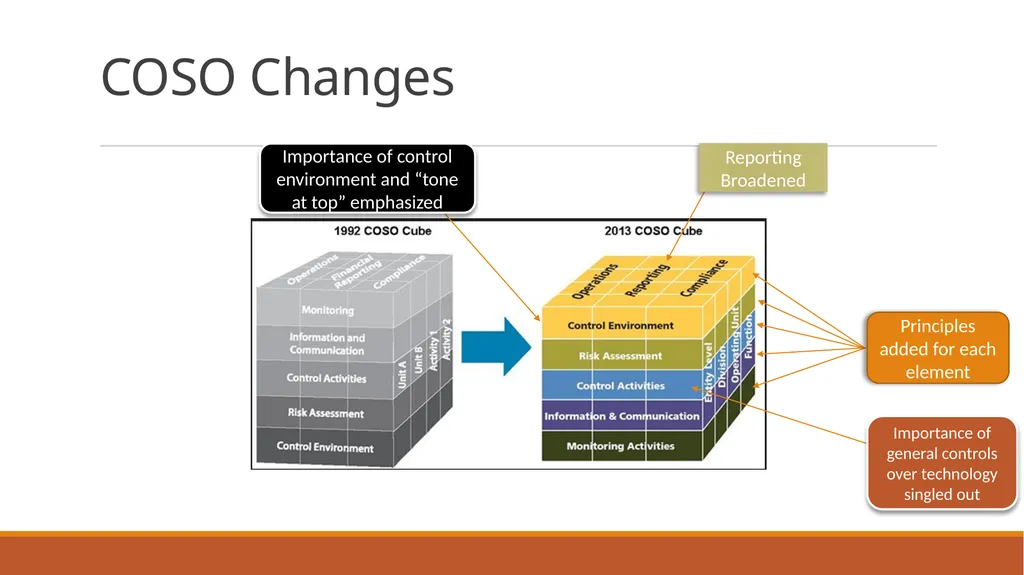
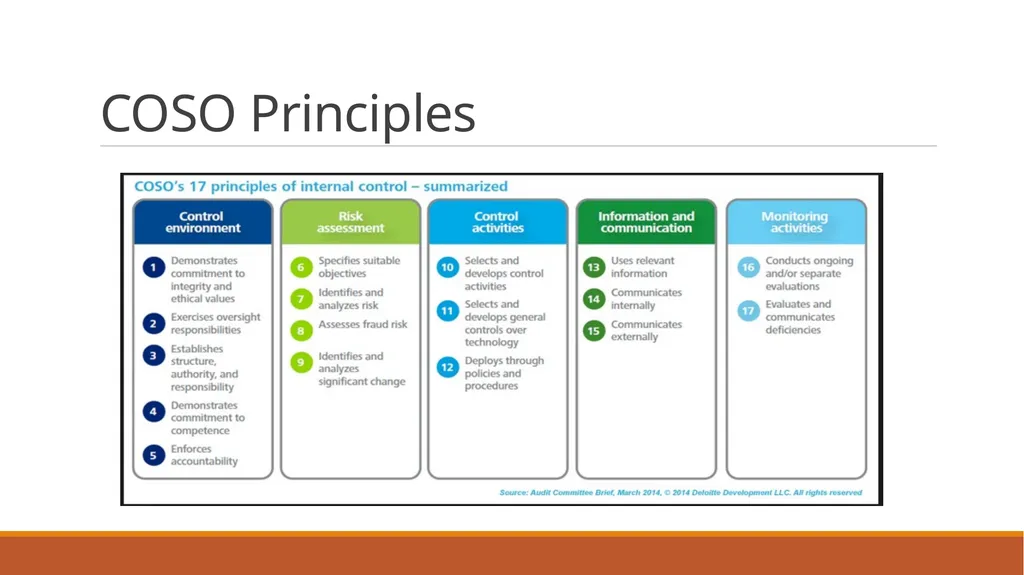
slide8. COSO Changes Reporting Broadened Principles added for each element Importance of control environment and “tone at top” emphasized Importance of general controls over technology singled out<br>
slide9. COSO Principles<br>
slide10. Outsourcing<br>
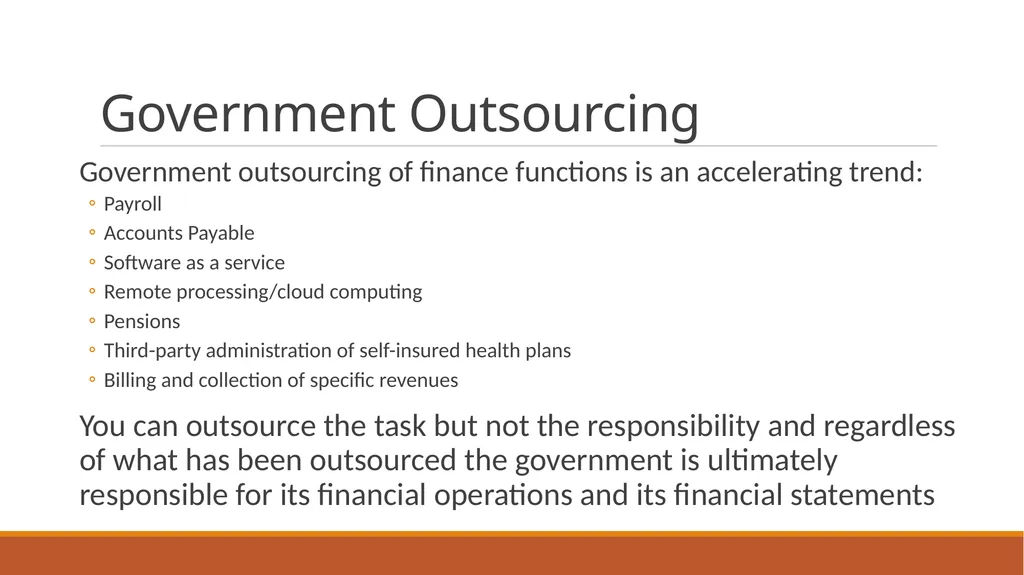
slide11. Government Outsourcing Government outsourcing of finance functions is an accelerating trend:
Payroll
Accounts Payable
Software as a service
Remote processing/cloud computing
Pensions
Third-party administration of self-insured health plans
Billing and collection of specific revenues
You can outsource the task but not the responsibility and regardless of what has been outsourced the government is ultimately responsible for its financial operations and its financial statements<br>
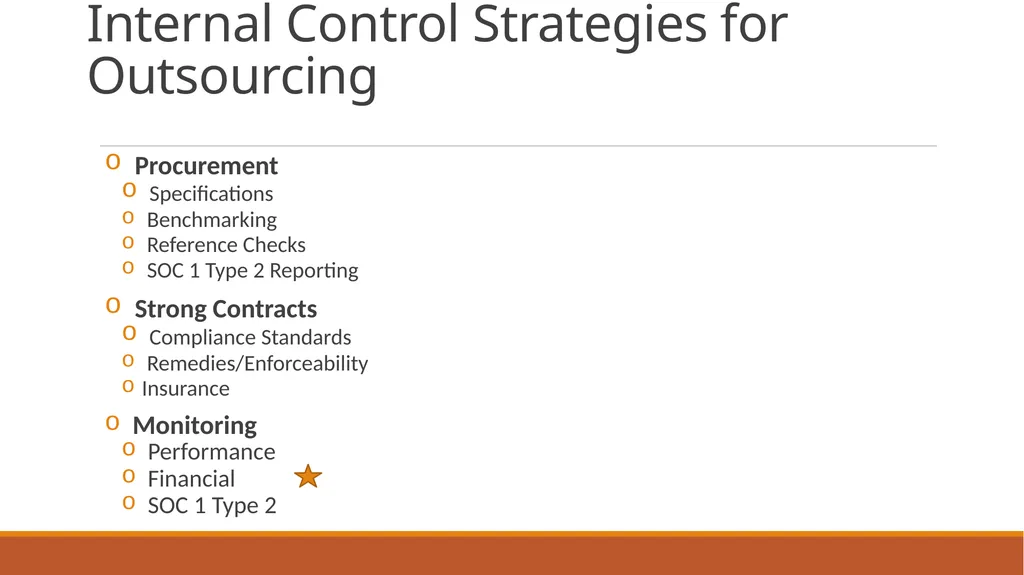
slide12. Internal Control Strategies for Outsourcing Procurement
Specifications
Benchmarking
Reference Checks
SOC 1 Type 2 Reporting
Strong Contracts
Compliance Standards
Remedies/Enforceability
Insurance
Monitoring
Performance
Financial
SOC 1 Type 2<br>
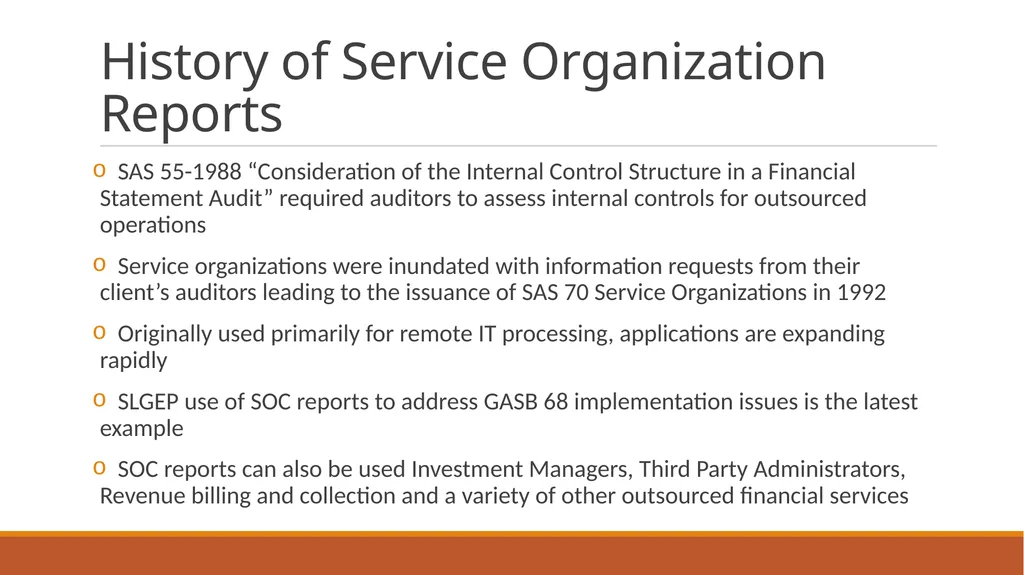
slide13. History of Service Organization Reports SAS 55-1988 “Consideration of the Internal Control Structure in a Financial Statement Audit” required auditors to assess internal controls for outsourced operations
Service organizations were inundated with information requests from their client’s auditors leading to the issuance of SAS 70 Service Organizations in 1992
Originally used primarily for remote IT processing, applications are expanding rapidly
SLGEP use of SOC reports to address GASB 68 implementation issues is the latest example
SOC reports can also be used Investment Managers, Third Party Administrators, Revenue billing and collection and a variety of other outsourced financial services<br>
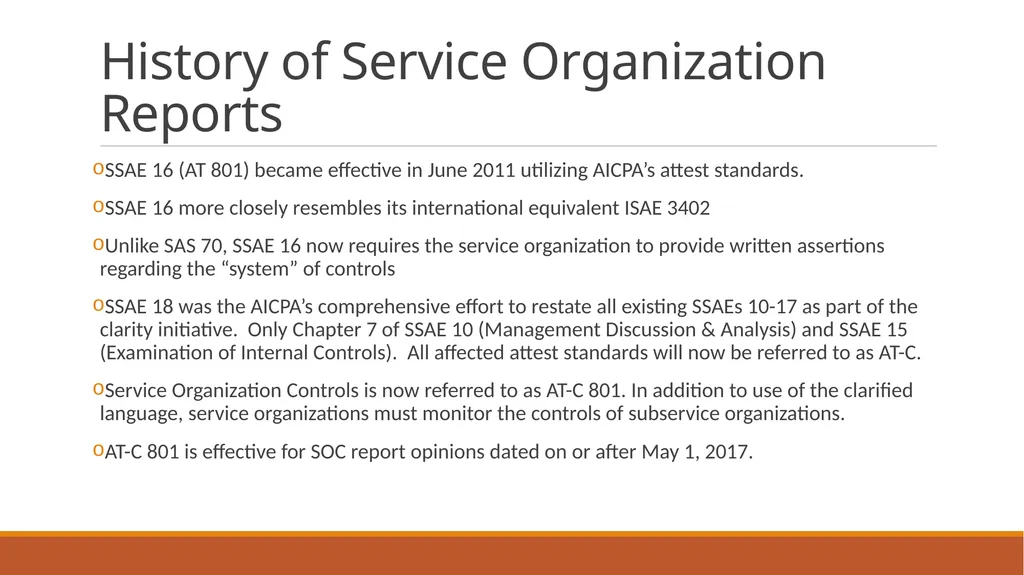
slide14. History of Service Organization Reports SSAE 16 (AT 801) became effective in June 2011 utilizing AICPA’s attest standards.
SSAE 16 more closely resembles its international equivalent ISAE 3402
Unlike SAS 70, SSAE 16 now requires the service organization to provide written assertions regarding the “system” of controls
SSAE 18 was the AICPA’s comprehensive effort to restate all existing SSAEs 10-17 as part of the clarity initiative. Only Chapter 7 of SSAE 10 (Management Discussion & Analysis) and SSAE 15 (Examination of Internal Controls). All affected attest standards will now be referred to as AT-C.
Service Organization Controls is now referred to as AT-C 801. In addition to use of the clarified language, service organizations must monitor the controls of subservice organizations.
AT-C 801 is effective for SOC report opinions dated on or after May 1, 2017.<br>
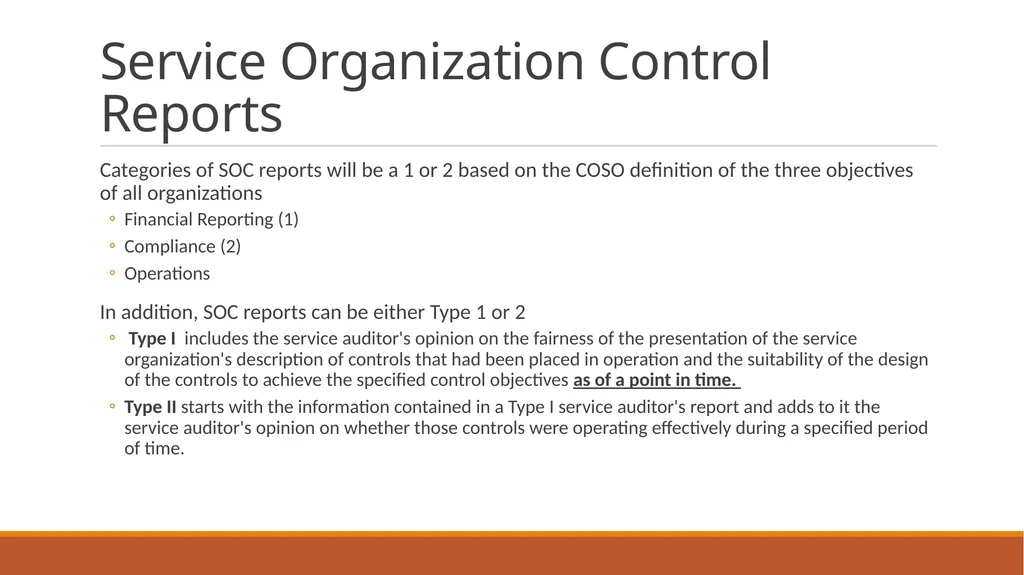
slide15. Service Organization Control Reports Categories of SOC reports will be a 1 or 2 based on the COSO definition of the three objectives of all organizations
Financial Reporting (1)
Compliance (2)
Operations
In addition, SOC reports can be either Type 1 or 2
Type I includes the service auditor's opinion on the fairness of the presentation of the service organization's description of controls that had been placed in operation and the suitability of the design of the controls to achieve the specified control objectives as of a point in time.
Type II starts with the information contained in a Type I service auditor's report and adds to it the service auditor's opinion on whether those controls were operating effectively during a specified period of time.<br>
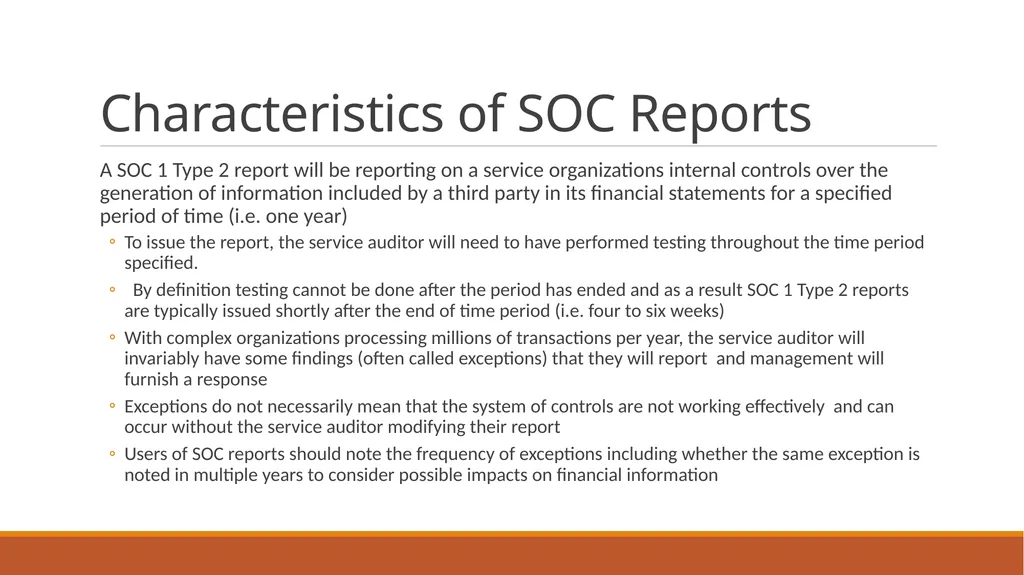
slide16. Characteristics of SOC Reports A SOC 1 Type 2 report will be reporting on a service organizations internal controls over the generation of information included by a third party in its financial statements for a specified period of time (i.e. one year)
To issue the report, the service auditor will need to have performed testing throughout the time period specified.
By definition testing cannot be done after the period has ended and as a result SOC 1 Type 2 reports are typically issued shortly after the end of time period (i.e. four to six weeks)
With complex organizations processing millions of transactions per year, the service auditor will invariably have some findings (often called exceptions) that they will report and management will furnish a response
Exceptions do not necessarily mean that the system of controls are not working effectively and can occur without the service auditor modifying their report
Users of SOC reports should note the frequency of exceptions including whether the same exception is noted in multiple years to consider possible impacts on financial information<br>
slide17. Purchasing Cards Love them Or Hate Them, You must Learn to deal with them.<br>
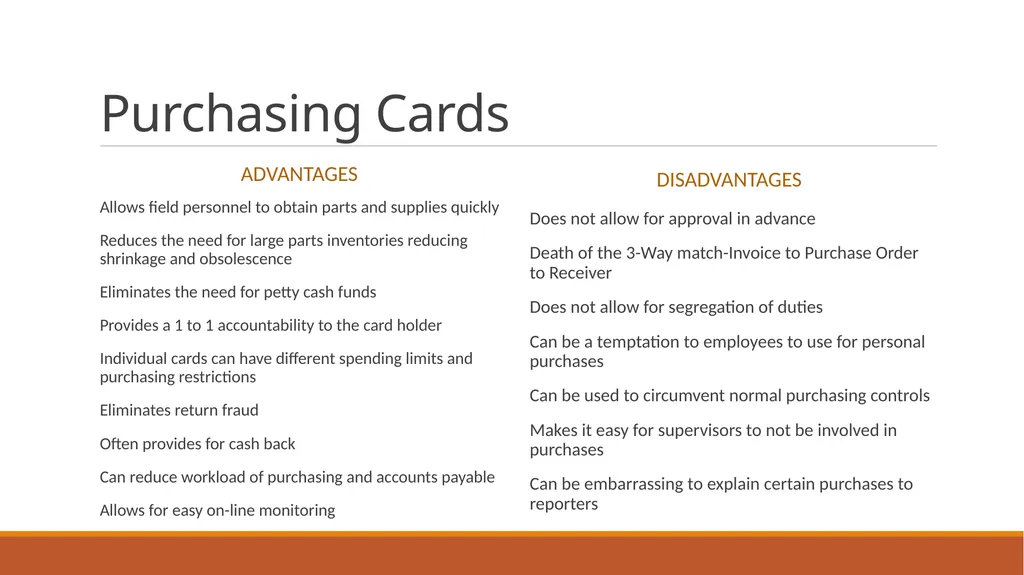
slide18. Purchasing Cards Advantages Allows field personnel to obtain parts and supplies quickly
Reduces the need for large parts inventories reducing shrinkage and obsolescence
Eliminates the need for petty cash funds
Provides a 1 to 1 accountability to the card holder
Individual cards can have different spending limits and purchasing restrictions
Eliminates return fraud
Often provides for cash back
Can reduce workload of purchasing and accounts payable
Allows for easy on-line monitoring Disadvantages Does not allow for approval in advance
Death of the 3-Way match-Invoice to Purchase Order to Receiver
Does not allow for segregation of duties
Can be a temptation to employees to use for personal purchases
Can be used to circumvent normal purchasing controls
Makes it easy for supervisors to not be involved in purchases
Can be embarrassing to explain certain purchases to reporters<br>
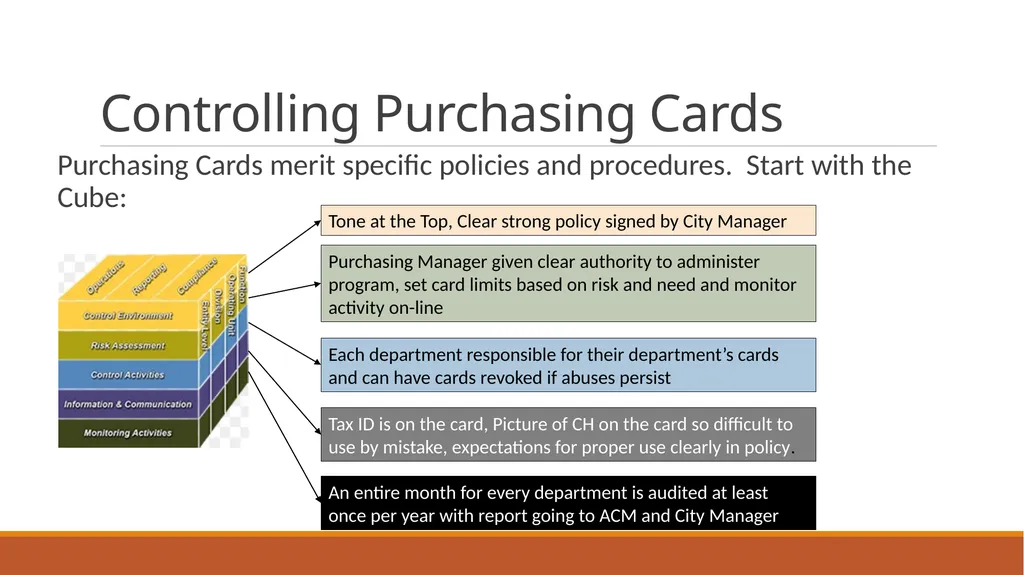
slide19. Controlling Purchasing Cards Purchasing Cards merit specific policies and procedures. Start with the Cube: Tone at the Top, Clear strong policy signed by City Manager Purchasing Manager given clear authority to administer program, set card limits based on risk and need and monitor activity on-line Each department responsible for their department’s cards and can have cards revoked if abuses persist Tax ID is on the card, Picture of CH on the card so difficult to use by mistake, expectations for proper use clearly in policy. An entire month for every department is audited at least once per year with report going to ACM and City Manager<br>
slide20. Electronic Invoicing and Payment<br>
slide21. So, is the the original, the first time I print off the PDF invoice ?<br>
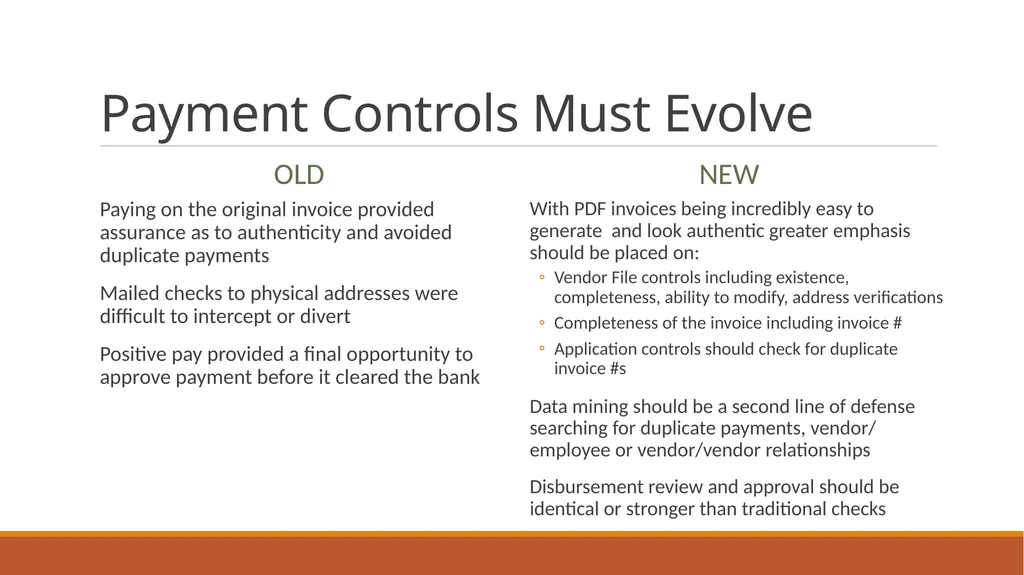
slide22. Payment Controls Must Evolve Old Paying on the original invoice provided assurance as to authenticity and avoided duplicate payments
Mailed checks to physical addresses were difficult to intercept or divert
Positive pay provided a final opportunity to approve payment before it cleared the bank new With PDF invoices being incredibly easy to generate and look authentic greater emphasis should be placed on:
Vendor File controls including existence, completeness, ability to modify, address verifications
Completeness of the invoice including invoice #
Application controls should check for duplicate invoice #s
Data mining should be a second line of defense searching for duplicate payments, vendor/ employee or vendor/vendor relationships
Disbursement review and approval should be identical or stronger than traditional checks<br>
slide23. Paperless Environments & General Controls Over Technology<br>
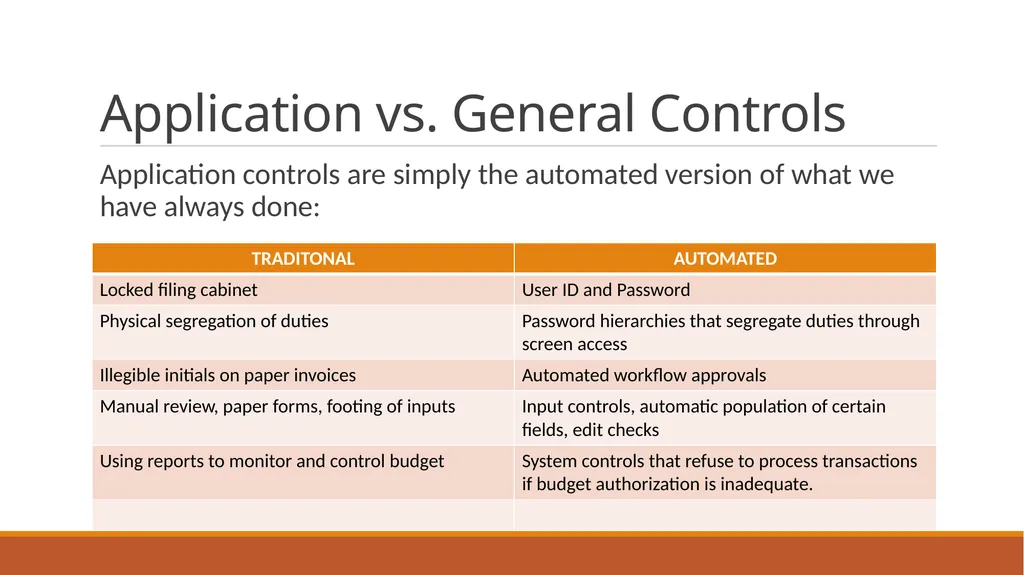
slide24. Application vs. General Controls Application controls are simply the automated version of what we have always done:<br>
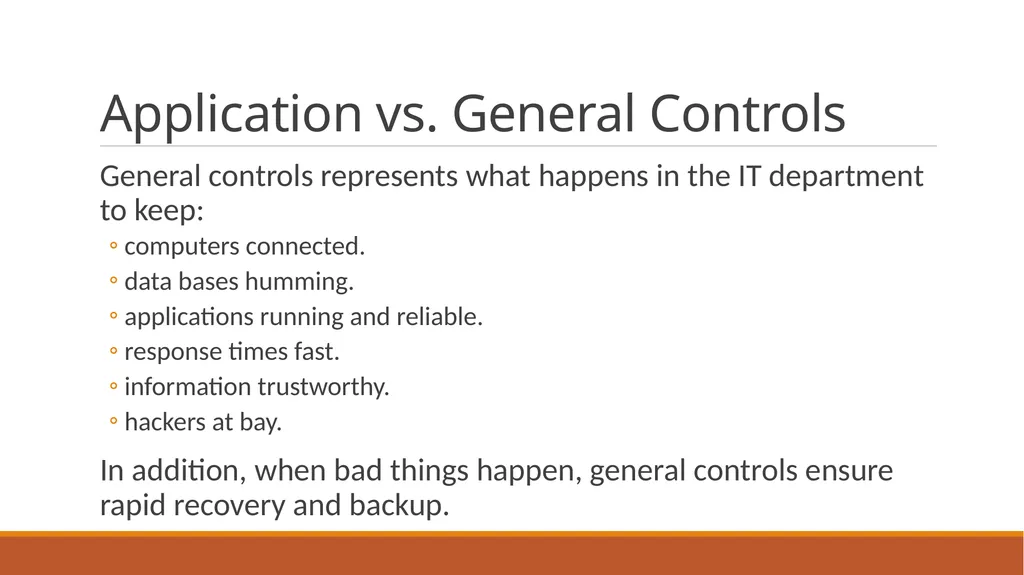
slide25. Application vs. General Controls General controls represents what happens in the IT department to keep:
computers connected.
data bases humming.
applications running and reliable.
response times fast.
information trustworthy.
hackers at bay.
In addition, when bad things happen, general controls ensure rapid recovery and backup.<br>
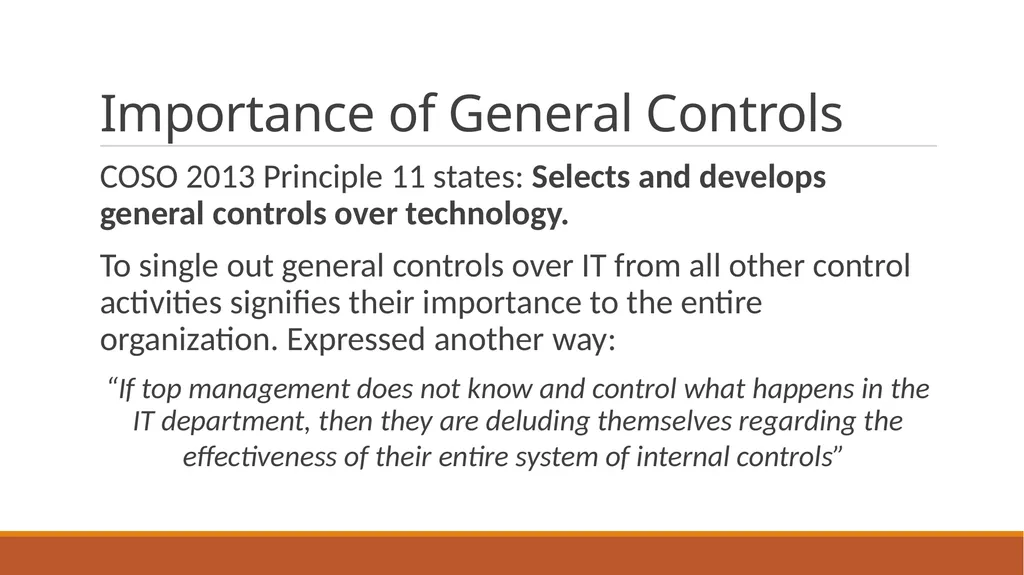
slide26. Importance of General Controls COSO 2013 Principle 11 states: Selects and develops general controls over technology.
To single out general controls over IT from all other control activities signifies their importance to the entire organization. Expressed another way:
“If top management does not know and control what happens in the IT department, then they are deluding themselves regarding the effectiveness of their entire system of internal controls”<br>
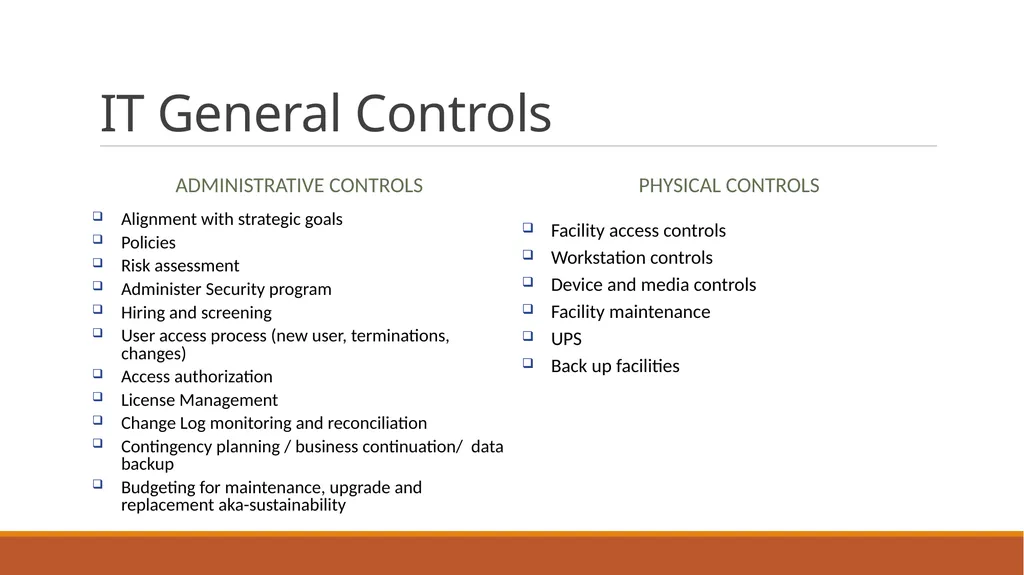
slide27. IT General Controls Administrative Controls Alignment with strategic goals
Policies
Risk assessment
Administer Security program
Hiring and screening
User access process (new user, terminations, changes)
Access authorization
License Management
Change Log monitoring and reconciliation
Contingency planning / business continuation/ data backup
Budgeting for maintenance, upgrade and replacement aka-sustainability Physical controls Facility access controls
Workstation controls
Device and media controls
Facility maintenance
UPS
Back up facilities<br>
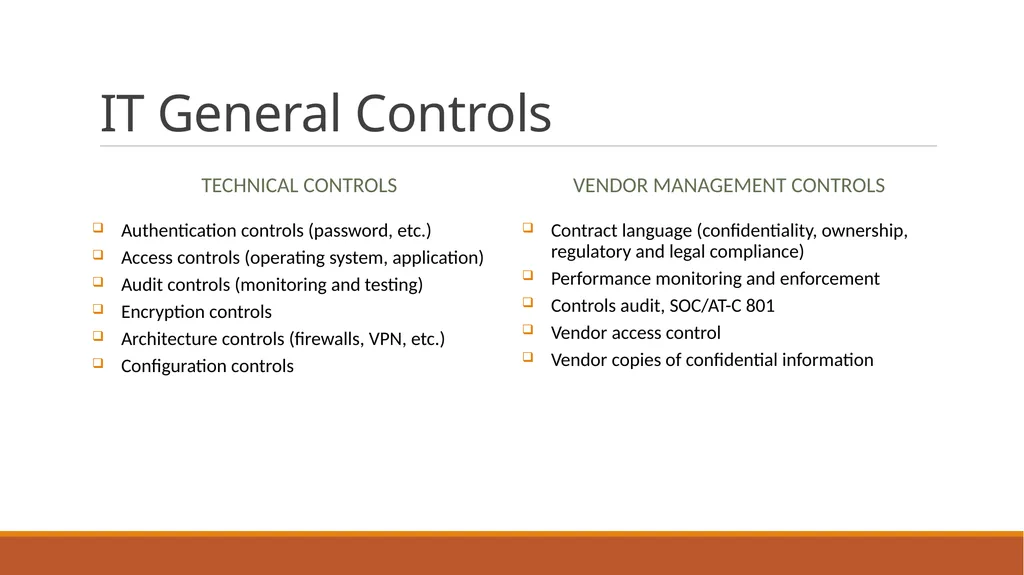
slide28. IT General Controls Technical Controls Authentication controls (password, etc.)
Access controls (operating system, application)
Audit controls (monitoring and testing)
Encryption controls
Architecture controls (firewalls, VPN, etc.)
Configuration controls Vendor Management Controls Contract language (confidentiality, ownership, regulatory and legal compliance)
Performance monitoring and enforcement
Controls audit, SOC/AT-C 801
Vendor access control
Vendor copies of confidential information<br>
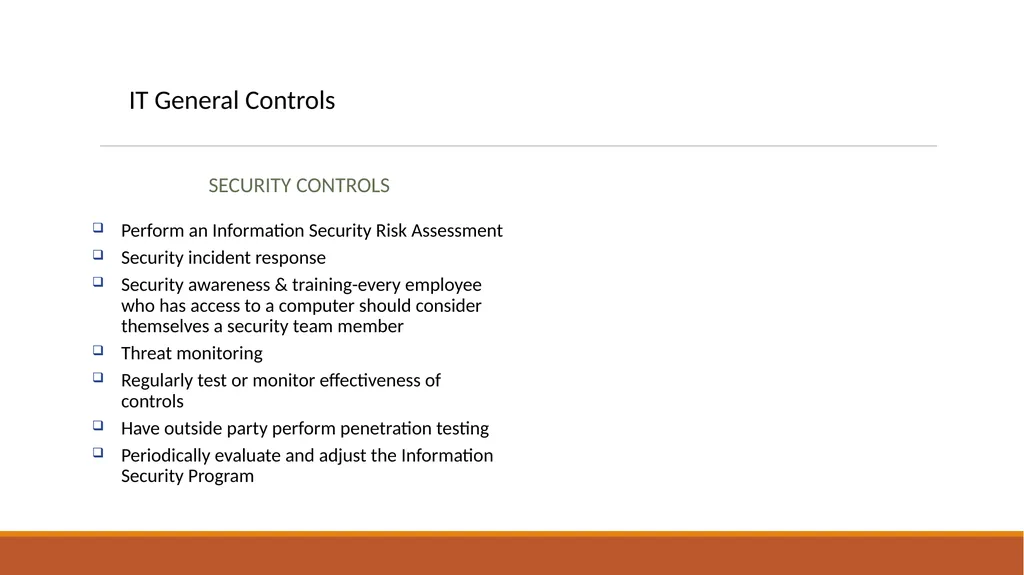
slide29. IT General Controls Security controls Perform an Information Security Risk Assessment
Security incident response
Security awareness & training-every employee who has access to a computer should consider themselves a security team member
Threat monitoring
Regularly test or monitor effectiveness of controls
Have outside party perform penetration testing
Periodically evaluate and adjust the Information Security Program<br>
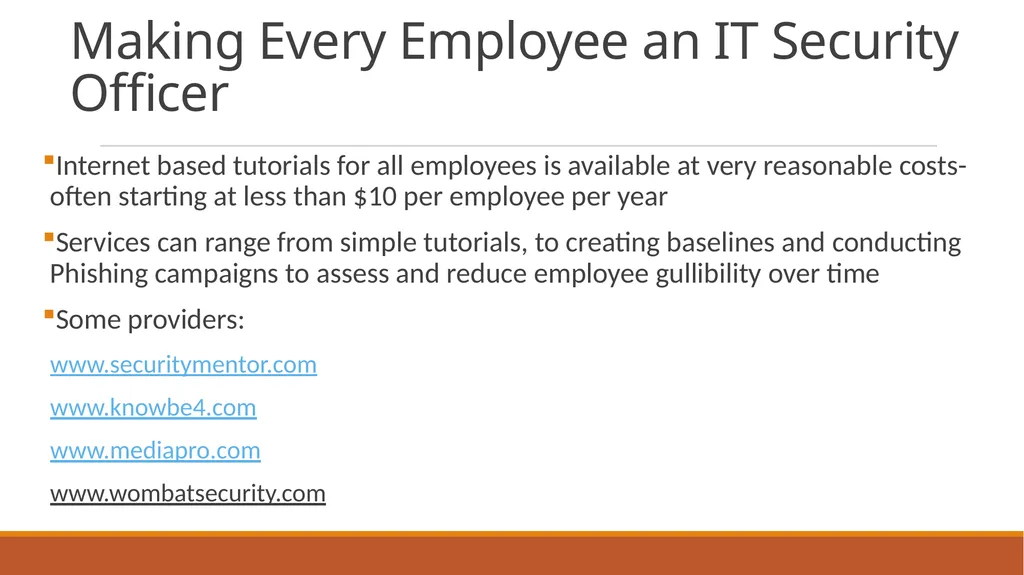
slide30. Making Every Employee an IT Security Officer Internet based tutorials for all employees is available at very reasonable costs-often starting at less than $10 per employee per year
Services can range from simple tutorials, to creating baselines and conducting Phishing campaigns to assess and reduce employee gullibility over time
Some providers:
www.securitymentor.com
www.knowbe4.com
www.mediapro.com
www.wombatsecurity.com<br>
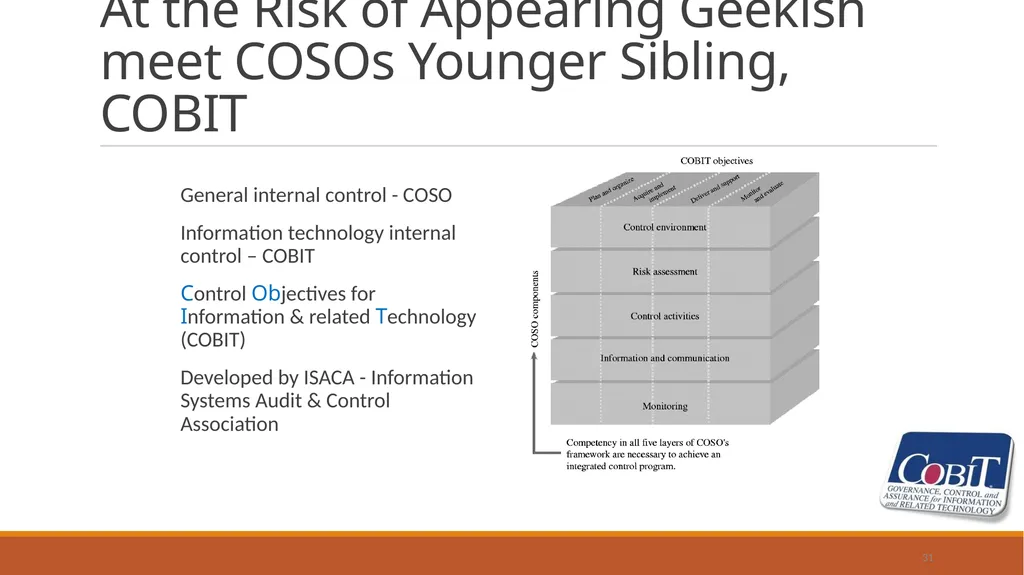
slide31. At the Risk of Appearing Geekish meet COSOs Younger Sibling, COBIT General internal control - COSO
Information technology internal control – COBIT
Control Objectives for Information & related Technology (COBIT)
Developed by ISACA - Information Systems Audit & Control Association 31<br>
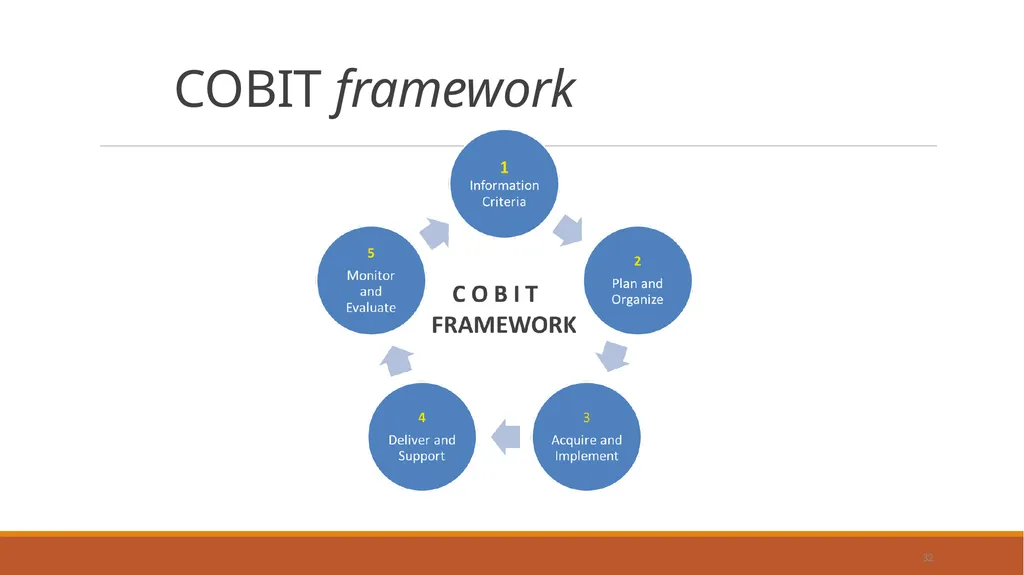
slide32. COBIT framework 32<br>
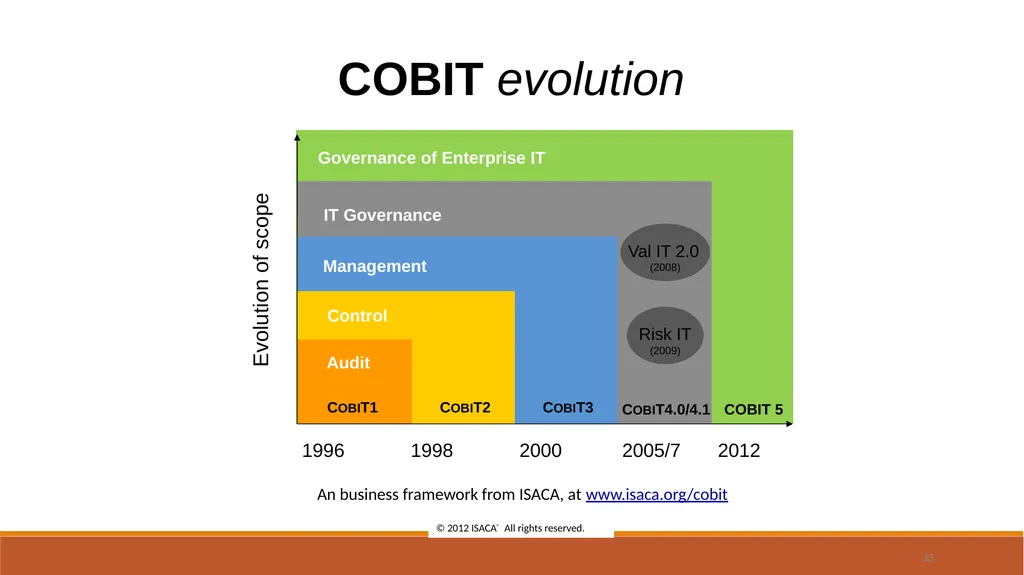
slide33. An business framework from ISACA, at www.isaca.org/cobit COBIT evolution 2012 Val IT 2.0
(2008) Risk IT
(2009) © 2012 ISACA® All rights reserved. 33<br>
slide34. This and That Credit Cards-contrary to popular belief, credit cards can facilitate money leaving the building just as easily as coming in. Reconcile charge-backs and refunds daily and always trace back to the original transactions.
Documentation –with an aging workforce and normal turnover, up to date documentation of system procedures and controls is vital. Unfortunately, most us would rather have a tooth pulled than update our procedures manual.
Consider:
1) Hiring a contract technical writer to interview staff and put the manuals together for you.
2) Have staff put together “You Tube” style how to videos for key processes. They can interject personality and (appropriate) humor and may even find that they enjoy it.<br>
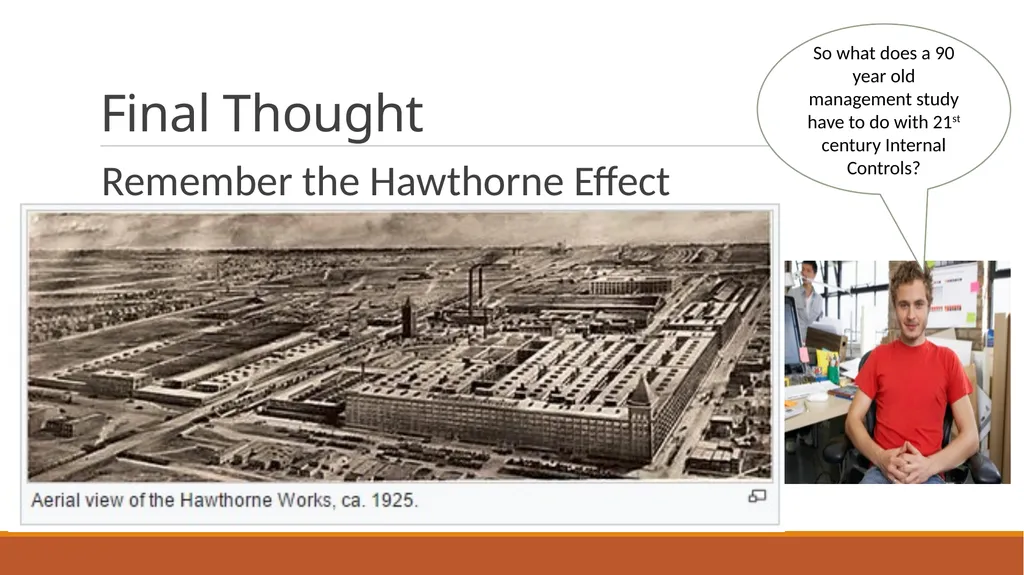
slide35. Final Thought Remember the Hawthorne Effect So what does a 90 year old management study have to do with 21st century Internal Controls?<br>
slide36. Hawthorne Effect Most things improve when management is involved and observing<br>
slide2. Objectives Encourage participants to take a fresh look at their organization’s control environment
Discuss how specific trends in state & local governments may have rendered previous controls ineffective and new controls that can be used for:
Outsourcing of all types:
Software as a service
Remote hosting
Third Party administrators for self-insured healthcare plans
Pension Plan administration
Billing and collection of specific revenues
Growing use of purchasing cards
Electronic invoicing and payment
Paperless operations
Develop strategies for addressing paperless applications including general controls over technology<br>
slide3. Are Your Internal Controls Relics of a By Gone Era?<br>
slide4. How Many of You (or Your Clients) … Still have a policy for paying only on the original invoice?
Have not developed effective controls for purchasing cards even though it is a large and growing percentage of your total spend?
Do not consider general controls over IT a finance responsibility?
Require manual signatures for large checks but not for ACH’s or wires of the same amount?
Have not obtained SOC reports for all outsourced financial activity?
Do not reconcile chargebacks on credit cards?
Consider prevention of cyber threats an IT function?
Do not consider data mining a integral part of internal controls?<br>
slide5. Bad Things Can Happen to Good Governments Recent headlines:
Eight hundred City Employee’s W-2s Exposed in Phishing Scam
E-mails reveal how city and regional mobility authority were scammed out of $3.2 million
School District secretary racks up $100,000 in personal purchases on purchasing card
City’s Tax billing firm uses the wrong rate on tax bills
Employee of Not for Profit embezzles $350,000 through credit card refunds
Tax refund scam may have cost County $350,000-On-line transparency blamed.<br>
slide6. While the concepts are relatively simple… 1992 COSO Cube<br>
slide7. We Often Forget… Systems change
Technology evolves
People leave and retire
People forget
New hires need to be told
Threats are world wide
Criminals adapt
That we are never done!<br>
slide8. COSO Changes Reporting Broadened Principles added for each element Importance of control environment and “tone at top” emphasized Importance of general controls over technology singled out<br>
slide9. COSO Principles<br>
slide10. Outsourcing<br>
slide11. Government Outsourcing Government outsourcing of finance functions is an accelerating trend:
Payroll
Accounts Payable
Software as a service
Remote processing/cloud computing
Pensions
Third-party administration of self-insured health plans
Billing and collection of specific revenues
You can outsource the task but not the responsibility and regardless of what has been outsourced the government is ultimately responsible for its financial operations and its financial statements<br>
slide12. Internal Control Strategies for Outsourcing Procurement
Specifications
Benchmarking
Reference Checks
SOC 1 Type 2 Reporting
Strong Contracts
Compliance Standards
Remedies/Enforceability
Insurance
Monitoring
Performance
Financial
SOC 1 Type 2<br>
slide13. History of Service Organization Reports SAS 55-1988 “Consideration of the Internal Control Structure in a Financial Statement Audit” required auditors to assess internal controls for outsourced operations
Service organizations were inundated with information requests from their client’s auditors leading to the issuance of SAS 70 Service Organizations in 1992
Originally used primarily for remote IT processing, applications are expanding rapidly
SLGEP use of SOC reports to address GASB 68 implementation issues is the latest example
SOC reports can also be used Investment Managers, Third Party Administrators, Revenue billing and collection and a variety of other outsourced financial services<br>
slide14. History of Service Organization Reports SSAE 16 (AT 801) became effective in June 2011 utilizing AICPA’s attest standards.
SSAE 16 more closely resembles its international equivalent ISAE 3402
Unlike SAS 70, SSAE 16 now requires the service organization to provide written assertions regarding the “system” of controls
SSAE 18 was the AICPA’s comprehensive effort to restate all existing SSAEs 10-17 as part of the clarity initiative. Only Chapter 7 of SSAE 10 (Management Discussion & Analysis) and SSAE 15 (Examination of Internal Controls). All affected attest standards will now be referred to as AT-C.
Service Organization Controls is now referred to as AT-C 801. In addition to use of the clarified language, service organizations must monitor the controls of subservice organizations.
AT-C 801 is effective for SOC report opinions dated on or after May 1, 2017.<br>
slide15. Service Organization Control Reports Categories of SOC reports will be a 1 or 2 based on the COSO definition of the three objectives of all organizations
Financial Reporting (1)
Compliance (2)
Operations
In addition, SOC reports can be either Type 1 or 2
Type I includes the service auditor's opinion on the fairness of the presentation of the service organization's description of controls that had been placed in operation and the suitability of the design of the controls to achieve the specified control objectives as of a point in time.
Type II starts with the information contained in a Type I service auditor's report and adds to it the service auditor's opinion on whether those controls were operating effectively during a specified period of time.<br>
slide16. Characteristics of SOC Reports A SOC 1 Type 2 report will be reporting on a service organizations internal controls over the generation of information included by a third party in its financial statements for a specified period of time (i.e. one year)
To issue the report, the service auditor will need to have performed testing throughout the time period specified.
By definition testing cannot be done after the period has ended and as a result SOC 1 Type 2 reports are typically issued shortly after the end of time period (i.e. four to six weeks)
With complex organizations processing millions of transactions per year, the service auditor will invariably have some findings (often called exceptions) that they will report and management will furnish a response
Exceptions do not necessarily mean that the system of controls are not working effectively and can occur without the service auditor modifying their report
Users of SOC reports should note the frequency of exceptions including whether the same exception is noted in multiple years to consider possible impacts on financial information<br>
slide17. Purchasing Cards Love them Or Hate Them, You must Learn to deal with them.<br>
slide18. Purchasing Cards Advantages Allows field personnel to obtain parts and supplies quickly
Reduces the need for large parts inventories reducing shrinkage and obsolescence
Eliminates the need for petty cash funds
Provides a 1 to 1 accountability to the card holder
Individual cards can have different spending limits and purchasing restrictions
Eliminates return fraud
Often provides for cash back
Can reduce workload of purchasing and accounts payable
Allows for easy on-line monitoring Disadvantages Does not allow for approval in advance
Death of the 3-Way match-Invoice to Purchase Order to Receiver
Does not allow for segregation of duties
Can be a temptation to employees to use for personal purchases
Can be used to circumvent normal purchasing controls
Makes it easy for supervisors to not be involved in purchases
Can be embarrassing to explain certain purchases to reporters<br>
slide19. Controlling Purchasing Cards Purchasing Cards merit specific policies and procedures. Start with the Cube: Tone at the Top, Clear strong policy signed by City Manager Purchasing Manager given clear authority to administer program, set card limits based on risk and need and monitor activity on-line Each department responsible for their department’s cards and can have cards revoked if abuses persist Tax ID is on the card, Picture of CH on the card so difficult to use by mistake, expectations for proper use clearly in policy. An entire month for every department is audited at least once per year with report going to ACM and City Manager<br>
slide20. Electronic Invoicing and Payment<br>
slide21. So, is the the original, the first time I print off the PDF invoice ?<br>
slide22. Payment Controls Must Evolve Old Paying on the original invoice provided assurance as to authenticity and avoided duplicate payments
Mailed checks to physical addresses were difficult to intercept or divert
Positive pay provided a final opportunity to approve payment before it cleared the bank new With PDF invoices being incredibly easy to generate and look authentic greater emphasis should be placed on:
Vendor File controls including existence, completeness, ability to modify, address verifications
Completeness of the invoice including invoice #
Application controls should check for duplicate invoice #s
Data mining should be a second line of defense searching for duplicate payments, vendor/ employee or vendor/vendor relationships
Disbursement review and approval should be identical or stronger than traditional checks<br>
slide23. Paperless Environments & General Controls Over Technology<br>
slide24. Application vs. General Controls Application controls are simply the automated version of what we have always done:<br>
slide25. Application vs. General Controls General controls represents what happens in the IT department to keep:
computers connected.
data bases humming.
applications running and reliable.
response times fast.
information trustworthy.
hackers at bay.
In addition, when bad things happen, general controls ensure rapid recovery and backup.<br>
slide26. Importance of General Controls COSO 2013 Principle 11 states: Selects and develops general controls over technology.
To single out general controls over IT from all other control activities signifies their importance to the entire organization. Expressed another way:
“If top management does not know and control what happens in the IT department, then they are deluding themselves regarding the effectiveness of their entire system of internal controls”<br>
slide27. IT General Controls Administrative Controls Alignment with strategic goals
Policies
Risk assessment
Administer Security program
Hiring and screening
User access process (new user, terminations, changes)
Access authorization
License Management
Change Log monitoring and reconciliation
Contingency planning / business continuation/ data backup
Budgeting for maintenance, upgrade and replacement aka-sustainability Physical controls Facility access controls
Workstation controls
Device and media controls
Facility maintenance
UPS
Back up facilities<br>
slide28. IT General Controls Technical Controls Authentication controls (password, etc.)
Access controls (operating system, application)
Audit controls (monitoring and testing)
Encryption controls
Architecture controls (firewalls, VPN, etc.)
Configuration controls Vendor Management Controls Contract language (confidentiality, ownership, regulatory and legal compliance)
Performance monitoring and enforcement
Controls audit, SOC/AT-C 801
Vendor access control
Vendor copies of confidential information<br>
slide29. IT General Controls Security controls Perform an Information Security Risk Assessment
Security incident response
Security awareness & training-every employee who has access to a computer should consider themselves a security team member
Threat monitoring
Regularly test or monitor effectiveness of controls
Have outside party perform penetration testing
Periodically evaluate and adjust the Information Security Program<br>
slide30. Making Every Employee an IT Security Officer Internet based tutorials for all employees is available at very reasonable costs-often starting at less than $10 per employee per year
Services can range from simple tutorials, to creating baselines and conducting Phishing campaigns to assess and reduce employee gullibility over time
Some providers:
www.securitymentor.com
www.knowbe4.com
www.mediapro.com
www.wombatsecurity.com<br>
slide31. At the Risk of Appearing Geekish meet COSOs Younger Sibling, COBIT General internal control - COSO
Information technology internal control – COBIT
Control Objectives for Information & related Technology (COBIT)
Developed by ISACA - Information Systems Audit & Control Association 31<br>
slide32. COBIT framework 32<br>
slide33. An business framework from ISACA, at www.isaca.org/cobit COBIT evolution 2012 Val IT 2.0
(2008) Risk IT
(2009) © 2012 ISACA® All rights reserved. 33<br>
slide34. This and That Credit Cards-contrary to popular belief, credit cards can facilitate money leaving the building just as easily as coming in. Reconcile charge-backs and refunds daily and always trace back to the original transactions.
Documentation –with an aging workforce and normal turnover, up to date documentation of system procedures and controls is vital. Unfortunately, most us would rather have a tooth pulled than update our procedures manual.
Consider:
1) Hiring a contract technical writer to interview staff and put the manuals together for you.
2) Have staff put together “You Tube” style how to videos for key processes. They can interject personality and (appropriate) humor and may even find that they enjoy it.<br>
slide35. Final Thought Remember the Hawthorne Effect So what does a 90 year old management study have to do with 21st century Internal Controls?<br>
slide36. Hawthorne Effect Most things improve when management is involved and observing<br>