
Developing Techno-Pedagogic Skills Introduction We
MT
Published · 28 slides · 0 views
1 / 1

Description
Developing Techno-Pedagogic Skills Introduction We are living in the digital age that is full of children called digital natives. Todays students are the quick observers and they are referring Internet for all their doubts. All the
Related Topics
Share
Embed code
Download this presentation From Below
"Developing Techno-Pedagogic Skills Introduction We" is the property of its rightful owner. Permission is granted to download and print the materials on this website for personal, non-commercial use only, and to display it on your personal computer provided you do not modify the materials and that you retain all copyright notices contained in the materials. By downloading content from our website, you accept the terms of this agreement.
Presentation Transcript
01
Developing Techno-Pedagogic Skills<br>
02
Introduction
We are living in the digital age that is full of children called ‘digital natives’. Today’s students are the quick observers and they are referring Internet for all their doubts. All the teachers of school and higher education are in an urgent need of using technology in their teaching. Teachers have to equip themselves with Information and Communication Technology (ICT) skills.<br>
We are living in the digital age that is full of children called ‘digital natives’. Today’s students are the quick observers and they are referring Internet for all their doubts. All the teachers of school and higher education are in an urgent need of using technology in their teaching. Teachers have to equip themselves with Information and Communication Technology (ICT) skills.<br>
03
Techno-Pedagogy ‘Pedagogy’ refers to the art-science of teaching and ‘techno’ refers to the art-skill in handwriting derived from the Latin 'texere' (to weave or fabricate). Here, 'techno' is a qualifier; it intersects or crosses the meaning of 'pedagogy' with its own.
Techno-pedagogy refers to weaving the techniques of the craft of teaching into the learning environment itself. It requires conscious recognition of the mediated learning environment in order to maximize the ease and clarity in the transmission of information. Techno pedagogical teaching and learning will improve the quality of education.<br>
Techno-pedagogy refers to weaving the techniques of the craft of teaching into the learning environment itself. It requires conscious recognition of the mediated learning environment in order to maximize the ease and clarity in the transmission of information. Techno pedagogical teaching and learning will improve the quality of education.<br>
04
Techno-pedagogy is defined as, “Electronically mediated courses that integrate sound pedagogic principles of teaching/learning with the use of technology”.
- H. Connors<br>
- H. Connors<br>
05
Techno-Pedagogy: 3 Areas of knowledge Content(C): It is the subject matter that is to be taught.
Technology(T): It encompasses modern technologies such as computer, Internet, digital video and common technologies including overhead projectors, television, radio etc.
Pedagogy(P): It describes the collected practices, processes, strategies, procedures, and methods of teaching and learning.<br>
Technology(T): It encompasses modern technologies such as computer, Internet, digital video and common technologies including overhead projectors, television, radio etc.
Pedagogy(P): It describes the collected practices, processes, strategies, procedures, and methods of teaching and learning.<br>
06
Technology knowledge : Technology knowledge in education means the knowledge about all the standard teaching technologies from books to blackboard and the recent advanced technologies such as internet and digital videos. The skills to operate these technologies are inevitable for today’s higher education teachers including teacher educators. The technology knowledge includes the knowledge about the hardware of computer and to use the software like word processor, power point, e-mail, excel spread sheets etc.<br>
07
Pedagogic knowledge: Pedagogic knowledge is the profound knowledge about the procedures and practices of methods of teaching and learning. It also includes the knowledge of overall purposes, aims and values of education.
“Pedagogic knowledge means the “how” of teaching, generally acquired through education coursework and personal experiences.
Content knowledge, on the other hand, is the “what” of teaching.<br>
“Pedagogic knowledge means the “how” of teaching, generally acquired through education coursework and personal experiences.
Content knowledge, on the other hand, is the “what” of teaching.<br>
08
The techno-pedagogical competency/skills is the ability of the teachers to make use of technology effectively in teaching. The teachers develop techno-pedagogical competencies then they make use of this often in teaching and it will in turn make the learning process simple and effective.<br>
09
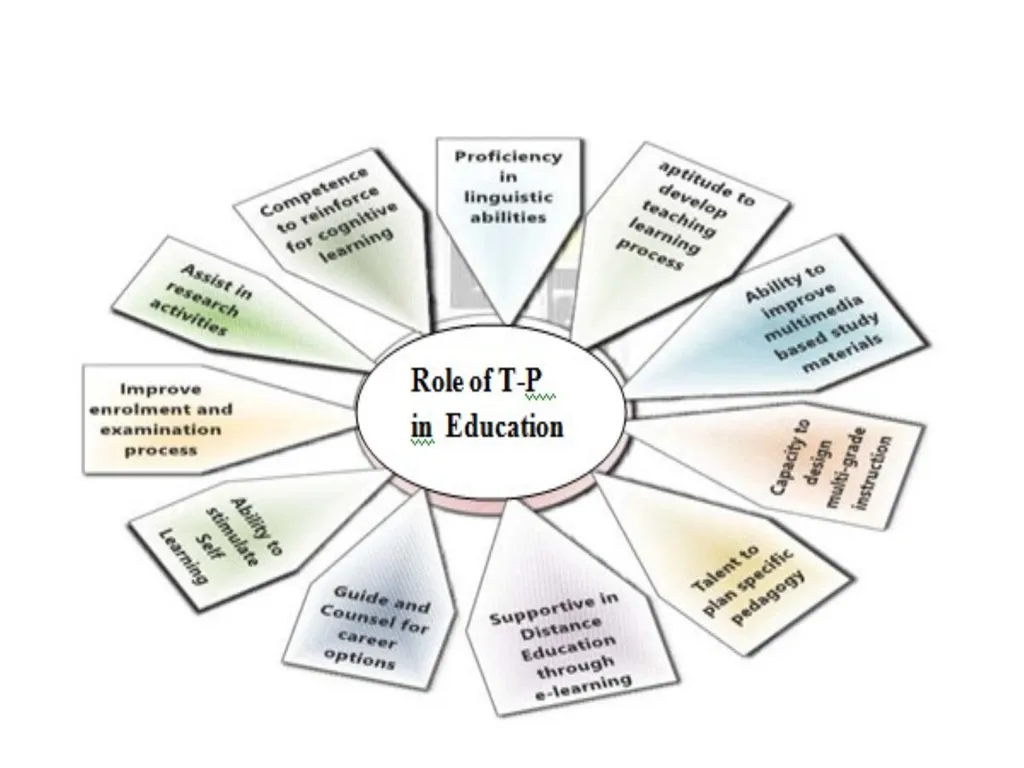
Role/Scope of Techno-pedagogy(T-P) In Education Techno-pedagogy helps to
Enhance Linguistic abilities: Linguistic ability means proficiency of speaking and writing skills in a learner. Techno pedagogy provides opportunity the use of technology in lesson planning through teaching aids like computer, internet, PowerPoint presentation etc. Technology based teaching subject makes a positive impact on the memory of the learner and he or she understands every concept in better form. It makes a learner proficient in writing and speaking skills.
Development of Teaching Learning Process : It makes the teaching learning process possible without a classroom environment. It saves time of learner and also makes learning process interesting as content is presented through a projector/computer to the learners.<br>
Enhance Linguistic abilities: Linguistic ability means proficiency of speaking and writing skills in a learner. Techno pedagogy provides opportunity the use of technology in lesson planning through teaching aids like computer, internet, PowerPoint presentation etc. Technology based teaching subject makes a positive impact on the memory of the learner and he or she understands every concept in better form. It makes a learner proficient in writing and speaking skills.
Development of Teaching Learning Process : It makes the teaching learning process possible without a classroom environment. It saves time of learner and also makes learning process interesting as content is presented through a projector/computer to the learners.<br>
10
Ease in preparation of study materials : Study material is prepared and saved digitally to make teaching learning process easy and accessible. It can be edited without any paperwork.
Support in Distance Education through e-learning: Techno pedagogy also provides e-learning support in distance education mode. This process saves time and wealth. E-content notes are available as mobile application through mobile app of IGNOU and e-pathshala APP of NCERT.
Choice of career through Guidance and Counseling: It provides a website based career guidance and counseling assistance to learners through audio-video and animation.<br>
Support in Distance Education through e-learning: Techno pedagogy also provides e-learning support in distance education mode. This process saves time and wealth. E-content notes are available as mobile application through mobile app of IGNOU and e-pathshala APP of NCERT.
Choice of career through Guidance and Counseling: It provides a website based career guidance and counseling assistance to learners through audio-video and animation.<br>
11
Stimulation of Self Learning ability : Techno-pedagogy provides self-learning opportunity to a learner through a website or video link for a particular subject. A learner is able to learn without guidance of a teacher.
Enhance enrolment and examination process: T-P assist a learner in enrollment and examination. The learner can prepare his examinations in such a way that he could get good grades and marks in his examinations.
Assist in research activities: T-P based research engines, online libraries, blogs and other sources are available for learners for research work.
Development of Life Skills: T-P helps to develop life skills among the learner to learn computer, internet and other technical sources to make them confident, sincere and able to learn better. The learner can solve their problems themselves.<br>
Enhance enrolment and examination process: T-P assist a learner in enrollment and examination. The learner can prepare his examinations in such a way that he could get good grades and marks in his examinations.
Assist in research activities: T-P based research engines, online libraries, blogs and other sources are available for learners for research work.
Development of Life Skills: T-P helps to develop life skills among the learner to learn computer, internet and other technical sources to make them confident, sincere and able to learn better. The learner can solve their problems themselves.<br>
12
Formation of educational programme and policies : The educational field is very fast and it requires new techniques and methods from time to time. It provides a platform to the educational organizations and board in formation of educational programmes and policies and also to cultivate values of education.
Techno-pedagogy can helps in promoting universal access to education, supporting the delivery of quality and variety in learning and teaching, teachers’ professional development and more efficient education management, governance and administration.<br>
Techno-pedagogy can helps in promoting universal access to education, supporting the delivery of quality and variety in learning and teaching, teachers’ professional development and more efficient education management, governance and administration.<br>
13
Development of techno-pedagogical Competency and skills “The techno-pedagogical competency is the ability and the expertise of the teachers to make use of necessary technology appropriately and effectively in teaching”.
T-P skills are those skills needed to use technology for pedagogical reasons and the competence to integrate technology into teaching. It makes quality education accessible and affordable to all students.<br>
T-P skills are those skills needed to use technology for pedagogical reasons and the competence to integrate technology into teaching. It makes quality education accessible and affordable to all students.<br>
14
Following T-P skills are required by teachers: Typing: Technology is prepared through a computer so many subject and content need in multi-language typing.
Computer knowledge: The teacher should know how to operate computer and use different application software's (Ms. Word , Ms PPT) to create study material, assignments for them.
Control panel: Control panel has large number of technical setting such as printer, font, setting, software, internet. So many errors can be edited and rectified without the support of any expert through techno-pedagogy.<br>
Computer knowledge: The teacher should know how to operate computer and use different application software's (Ms. Word , Ms PPT) to create study material, assignments for them.
Control panel: Control panel has large number of technical setting such as printer, font, setting, software, internet. So many errors can be edited and rectified without the support of any expert through techno-pedagogy.<br>
15
4. Basic Hardware skills: Hands on experience in operating 1. the PC and laptops- switching on, shutting down and networking 2. storage devices – using CD/DVD, pen drive 3. output devices –using printers and speakers 4. input devices – using keyboard, mouse, scanners etc. 5. Display devices like projectors, smart boards, interactive white boards.
5. Using Multimedia : Exposure to multimedia CD ROMs in different subjects, installing programs, evaluating CD ROMs, approaches to using CD ROMs, creating multimedia presentations.
6.Understanding System Software : Features of desktop, starting an application, resizing windows, organizing files (creating, editing, saving ,renaming), switching between programs, copying etc.
7. Using Application Software: Word processing, spreadsheet, database, creation of PDF(Portable document format) files, image processing etc.<br>
5. Using Multimedia : Exposure to multimedia CD ROMs in different subjects, installing programs, evaluating CD ROMs, approaches to using CD ROMs, creating multimedia presentations.
6.Understanding System Software : Features of desktop, starting an application, resizing windows, organizing files (creating, editing, saving ,renaming), switching between programs, copying etc.
7. Using Application Software: Word processing, spreadsheet, database, creation of PDF(Portable document format) files, image processing etc.<br>
16
8.Use of Internet : Teachers should know how to search information using different web browsers, how to download a particular file or PPT, create web blogs, send e-mails etc.
9. File conversion : File conversion means converting word file to PDF or vice versa , conversion from GIF to JPEG. Teacher should have knowledge of this.
10. Formation of CD/DVD: Teachers should know how to store data in CD/DVD or pen drive as these are the economical method to take back up of large files.
11. Social media connectivity: Facebook, twitter, whatsApp and other modes of communication are the easy mode of teaching and learning. The right use of these modes provide large amount of information to the learners.<br>
9. File conversion : File conversion means converting word file to PDF or vice versa , conversion from GIF to JPEG. Teacher should have knowledge of this.
10. Formation of CD/DVD: Teachers should know how to store data in CD/DVD or pen drive as these are the economical method to take back up of large files.
11. Social media connectivity: Facebook, twitter, whatsApp and other modes of communication are the easy mode of teaching and learning. The right use of these modes provide large amount of information to the learners.<br>
17
12. ICT for professional and personal productivity: ICT for administration, record keeping, reporting and transfer of information, attendance, research, professional development opportunities.
13. Social, legal, ethical and health issues: Advantages and disadvantages of computer use, privacy violations. Copyright, plagiarism, computer security(hacking, virus, misuse, abuse), healthy use (seating, light, sound, radiation)<br>
13. Social, legal, ethical and health issues: Advantages and disadvantages of computer use, privacy violations. Copyright, plagiarism, computer security(hacking, virus, misuse, abuse), healthy use (seating, light, sound, radiation)<br>
18
CHALLENGES OF USING TECHNO-PEDAGOGY 1. Destitute infrastructure of ICT for using Techno-pedagogical skills :Several colleges do not have proper rooms or buildings so as to accommodate the technology. Pitiable ICT lab having hardly ever used web based instruction, electronic machine such as telephone, cellular phones, fax, radio, television, video, computer, poor cable network with internet, e-mail, hardware and software, poor satellite systems, injure videoconferencing etc. create the challenges to use techno-pedagogical skills in higher education.<br>
19
2. Scarce competence on English language and online content :English is the dominant language of internet. In our country English language proficiency is not high, especially outside of town areas. This represents a serious barrier in maximizing the educational benefits of the World Wide Web.
3. Calamity of Teachers with Techno-pedagogical skills :A Techno-pedagogical skill in Teacher Education is a challenging task because mediated communication demands more of perfection on the part of teacher educators with ICT skills.<br>
3. Calamity of Teachers with Techno-pedagogical skills :A Techno-pedagogical skill in Teacher Education is a challenging task because mediated communication demands more of perfection on the part of teacher educators with ICT skills.<br>
20
4. Insufficient finance: ICT in education require large capital investment. Govt. gave priority in making buildings and for teacher welfare programmes. ICT in education has not yet been considered as a priority.
5. Lack of vision on part of management: The principal is often occupied with administration and managerial issues or lacks interest or vision in the area of information and communication technology integration into teaching and learning.<br>
5. Lack of vision on part of management: The principal is often occupied with administration and managerial issues or lacks interest or vision in the area of information and communication technology integration into teaching and learning.<br>
21
6. Limited Time:Many teachers have competence and confidence in using computers in the classroom, but they still make little use of technologies because of lack of time.
7. Frequent power fluctuations :The power outages and fluctuations dampen the potential impact for the use of techno-pedagogical skill. It became the reason for damage of working computer and other equipments which support the Techno-pedagogical frame.<br>
7. Frequent power fluctuations :The power outages and fluctuations dampen the potential impact for the use of techno-pedagogical skill. It became the reason for damage of working computer and other equipments which support the Techno-pedagogical frame.<br>
22
Developing Techno-Pedagogical Competence among Teachers Preparing teachers to use effective technology has become an important means in today’s world since teacher are the means through which students acquire knowledge. Teachers need to master themselves in every field. Following are the points for developing techno-pedagogical skills in teachers: -
1) Creating an innovative online learning environment: - In order to create an innovative learning environment the teacher should be taught how to make use of various technologies through practical as well as theoretical approach. They should be introduced to various kinds of technologies and develop their attitude and ability in implementing those skills in the modern classrooms.<br>
1) Creating an innovative online learning environment: - In order to create an innovative learning environment the teacher should be taught how to make use of various technologies through practical as well as theoretical approach. They should be introduced to various kinds of technologies and develop their attitude and ability in implementing those skills in the modern classrooms.<br>
23
2. Technology exposure: - Technology exposure includes collecting materials from the various internet sources, virtual field trips, integration method etc. The teachers should be trained about how to get access to different websites and make them known about the advantages of using those webs in teaching. Technology exposure will help the teacher in gathering information about the best use of technology in pedagogy, which will help in widening the information base of students.
3.Arrangement of annual workshop for teachers techno pedagogical skills development.
4.. Increase in salaries of ICT trained skill teacher so that the other teachers follow them.<br>
3.Arrangement of annual workshop for teachers techno pedagogical skills development.
4.. Increase in salaries of ICT trained skill teacher so that the other teachers follow them.<br>
24
5. Provision of ICT tools and devices by government in government and private institutions.
6. Head of institutions should take initiatives and motivate teachers to integrate ICT in their teachings.
7.The teachers should not be given non- academic work and should be given training to use ICT.<br>
6. Head of institutions should take initiatives and motivate teachers to integrate ICT in their teachings.
7.The teachers should not be given non- academic work and should be given training to use ICT.<br>
25
Techno-pedagogical competency of teachers is an important weapon to transform the classroom environment from traditional ‘teacher-centred’ to ‘learner-centred’. With this competency, teachers will be able to integrate technology into the pedagogy that helps to promote the active learning, collaborative learning, creative learning, integrative learning, and evaluative learning and also helps to prepare and manage a learner centred environment. In the 21st century, students are mostly dependent upon technology in every sphere of their life and it’s become a natural part of their environment. That is why their expectation is that technology will be used in the classroom teaching-learning process to help them learn, develop essential IT skills, and master the technology fluency necessary in their specific subject domain.<br>
26
Computer engages the students in different interactive collaboration and improves student level of understanding and knowledge. It brings to the student a world of joyful learning. So teachers of this era should focus on learning and instructional design, theories as well as integrating computer into the curriculum.<br>