01
Diagnostic Confirmation and Communication Protocol�
Kassie N. Conner (1); Samantha E. Fieweger (2); Gary D. Fish (3); Jennifer S. Flynn (4); Carrie L. Harmon (5); Sara E. Wallace (6)
Auburn University, Auburn, Alabama; (2) Wisconsin Department of Agriculture, Trade, and Consumer Protection, Madison, Wisconsin (3) Maine Department of Agriculture, Conservation and Forestry, Augusta, Maine; (4) University of Minnesota, St. Paul, Minnesota; (5) University of Florida, Gainesville, FL (6) Oklahoma State University, Stillwater, Oklahoma If you suspect a new, regulated, or otherwise significant pest
Contact the sample state’s: State Plant Regulatory Official (SPRO) and State Plant Health Director (SPHD). The SPHD will enter the information into the ARM system and provide a diagnostic receipt form to the lab submitting the sample. Samples cannot be shipped and will not be accepted by PPCDL without the diagnostic receipt from ARM.
Courtesy contact the local National Plant Diagnostic Network (NPDN) diagnostician or State Department of Agriculture (SDA) diagnostician, in the sample’s state and those who may receive similar samples.
Contact the USDA APHIS PPQ Domestic Diagnostic Coordinator for instructions on how and where to mail a sample for confirmation.
Use USDA-PPQ FORM 391 with sample submissions
Ship samples via overnight express courier (e.g. DHL, FedEx, UPS). Ship samples early in the week and never before a holiday. Do not require a signature and include the ARM diagnostic receipt and USDA PPQ 391 from in the package. Results
Official USDA results will only be reported back to the SPHD and SPRO. They are responsible for forwarding official USDA results to sample submitters, diagnosticians and other relevant entities. Following up is recommended to determine outcome. If you suspect a Select Agent
In addition to the items to the left you will also need to:
Closely follow the language in your 526 permit.
Your Plant Disease Diagnostic lab’s 526 permit contains this or similar language: “If any organism listed as a Select Agent is identified from materials associated with this research, the 526 permit holder is required to notify APHIS, Agriculture Select Agent Services (AgSAS) immediately by phone at 301-851-3300 option 3, and within seven (7) days of identification submit APHIS/CDC Form 4A (Report of Identification of a Select Agent or Toxin in a Clinical or Diagnostic Laboratory) to APHIS, AgSAS; 4700 River Rd, Unit 2, Riverdale, MD 20737.”
Failure to comply with this requirement is a violation of the Agricultural Bioterrorism Protection Act of 2002.
Contact your organization's Safety Officer to determine their role and requirements in the specific detection.
Current USDA-PPQ Select Agents
Coniothyrium glycines (formerly Phoma glycinicola and Pyrenochaeta glycines)
Peronosclerospora philippinensis (P. sacchari)
Ralstonia solanacearum
Rathayibacter toxicus
Sclerophthora rayssiae
Synchytrium endobioticum
Xanthomonas oryzae The Diagnostic Confirmation and Communication Protocol was created by the NPDN Regulatory Relations committee to help NPDN members, diagnosticians, and plant disease laboratories navigate the complex landscape of plant disease regulation and official confirmation. This protocol is maintained by the NPDN regulatory relations committee whose membership is made up of individuals from Land Grant Universities, National Plant Board, Local Regulatory Authorities, USFS, and USDA.
Use the QR code on this poster to find links to the webpages, emails, and forms mentioned below and a list of the acronyms used. NPDN Regional Center Labs – Here to Help!
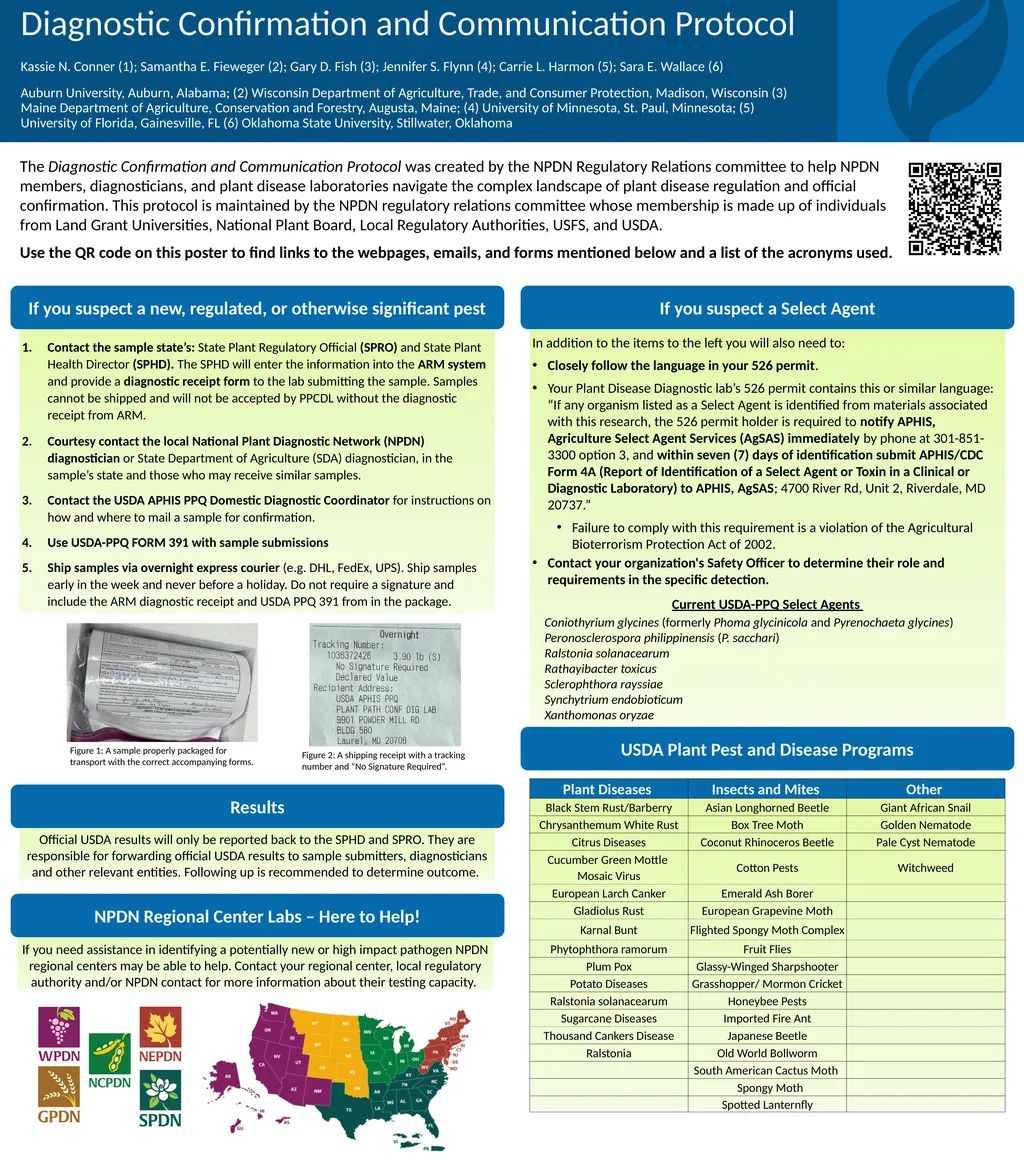
If you need assistance in identifying a potentially new or high impact pathogen NPDN regional centers may be able to help. Contact your regional center, local regulatory authority and/or NPDN contact for more information about their testing capacity. Figure 1: A sample properly packaged for transport with the correct accompanying forms. Figure 2: A shipping receipt with a tracking number and “No Signature Required”. If you suspect a new, regulated, or otherwise significant pest USDA Plant Pest and Disease Programs NPDN Regional Center Labs – Here to Help! Results If you suspect a Select Agent<br>