Diagnostic test accuracy. Study design and the 2x2 table April, 4 - 8, 2017 - Palazzo Feltrinelli - Gargnano, Lago di Garda, Italy Giovanni Casazza Outline DIAGNOSIS: the pathway of a diagnostic test from bench to bedside. Basic residential
"Diagnostic test accuracy. Study design and the 2x2" is the property of its rightful owner. Permission is granted to
download and print the materials on this website for personal, non-commercial use only, and to display it
on your personal computer provided you do not modify the materials and that you retain all copyright
notices contained in the materials. By downloading content from our website, you accept the terms of this
agreement.
Presentation Transcript
01
Diagnostic test accuracy. Study design and the 2x2 table April, 4 - 8, 2017 - Palazzo Feltrinelli - Gargnano, Lago di Garda, Italy Giovanni Casazza Outline DIAGNOSIS: the pathway of a diagnostic test from bench to bedside. Basic residential course.<br>
02
Design of a diagnostic test accuracy study
Summary of the results: the 2x2 table
Interpretation of the results: true and false results Outline<br>
03
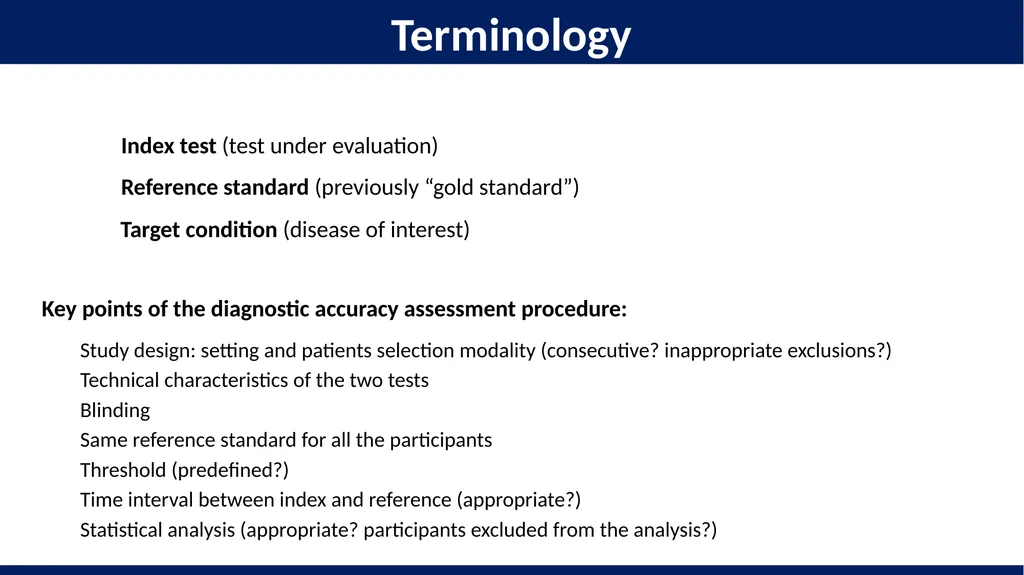
Index test (test under evaluation) Reference standard (previously “gold standard”) Key points of the diagnostic accuracy assessment procedure:
Study design: setting and patients selection modality (consecutive? inappropriate exclusions?)
Technical characteristics of the two tests
Blinding
Same reference standard for all the participants
Threshold (predefined?)
Time interval between index and reference (appropriate?)
Statistical analysis (appropriate? participants excluded from the analysis?) Target condition (disease of interest) Terminology<br>
04
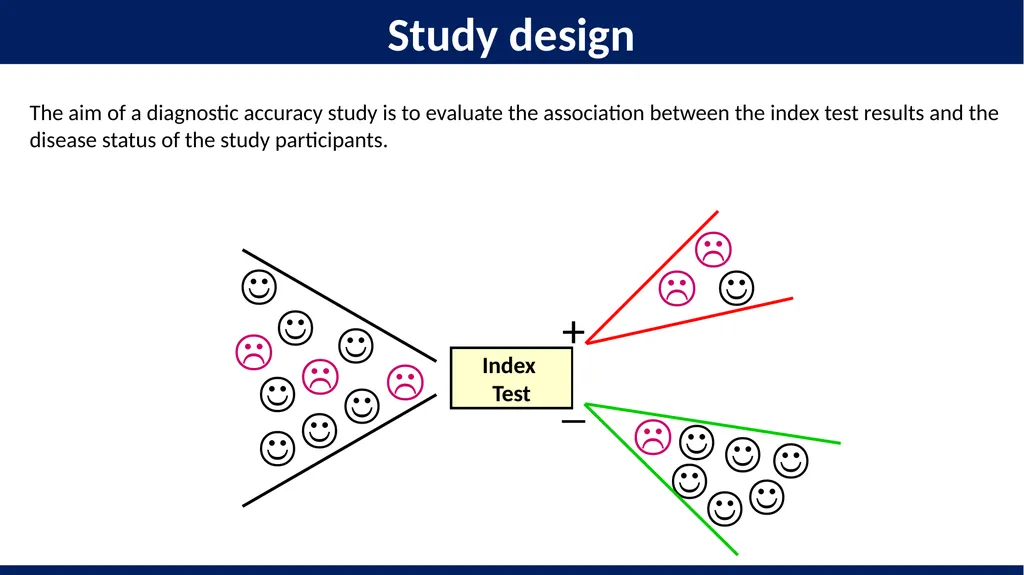
The aim of a diagnostic accuracy study is to evaluate the association between the index test results and the disease status of the study participants. Index
Test + _ Study design<br>
05
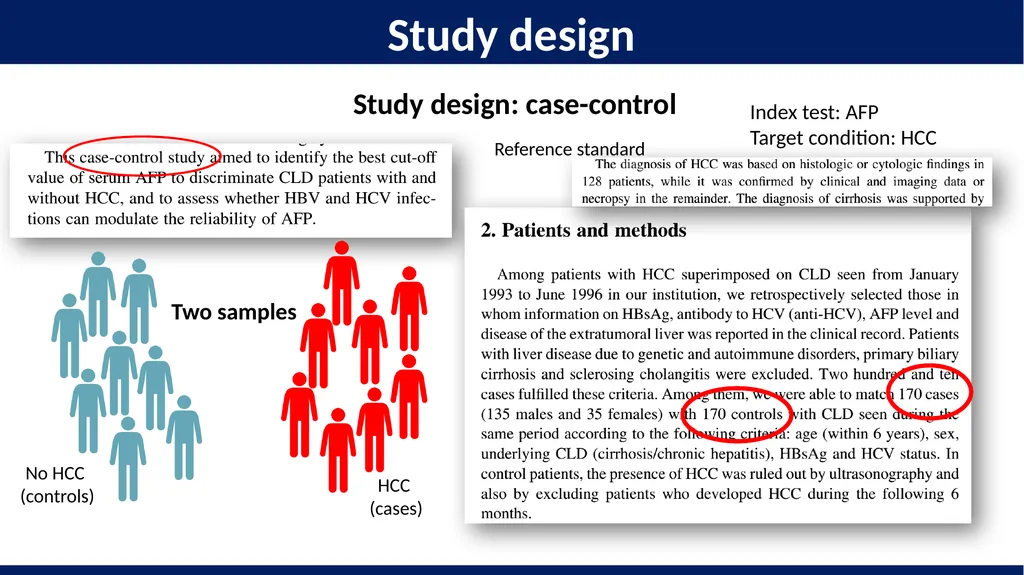
Study design: case-control Study design Index test: AFP
Target condition: HCC HCC
(cases) No HCC
(controls) Two samples Reference standard<br>
06
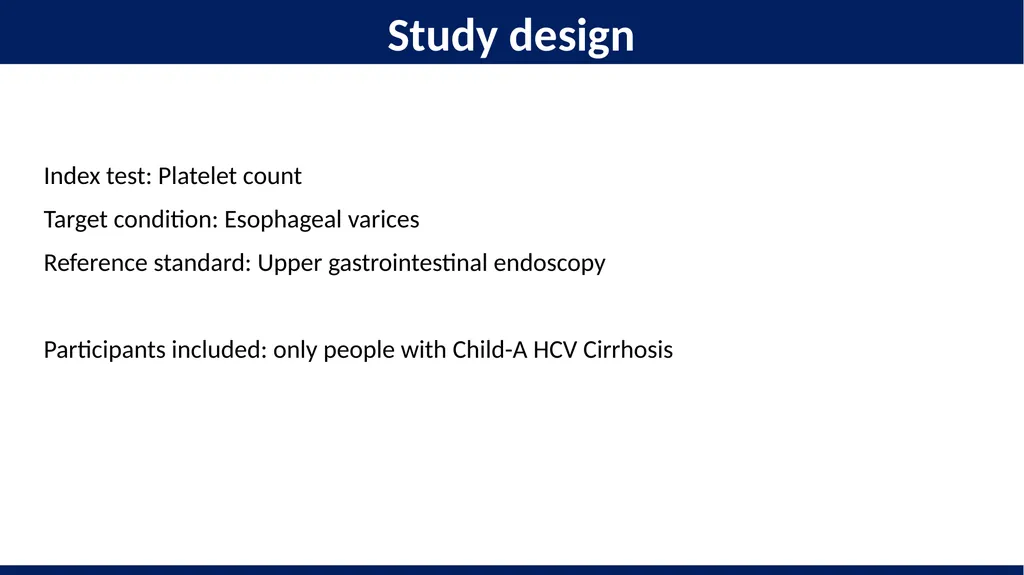
Study design Index test: Platelet count
Target condition: Esophageal varices
Reference standard: Upper gastrointestinal endoscopy
Participants included: only people with Child-A HCV Cirrhosis<br>
07
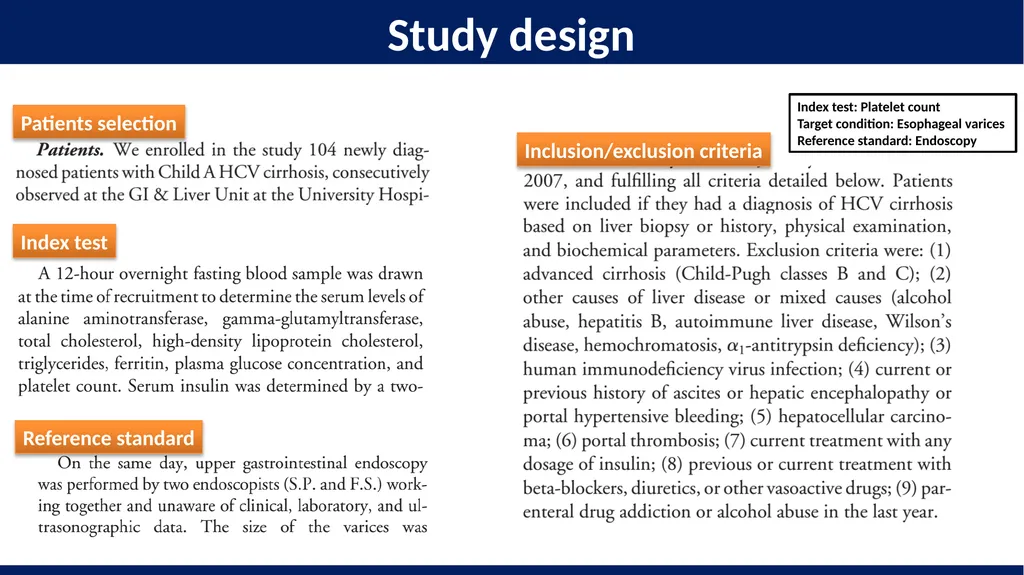
Study design Inclusion/exclusion criteria Patients selection Index test Reference standard Index test: Platelet count
Target condition: Esophageal varices
Reference standard: Endoscopy<br>
08
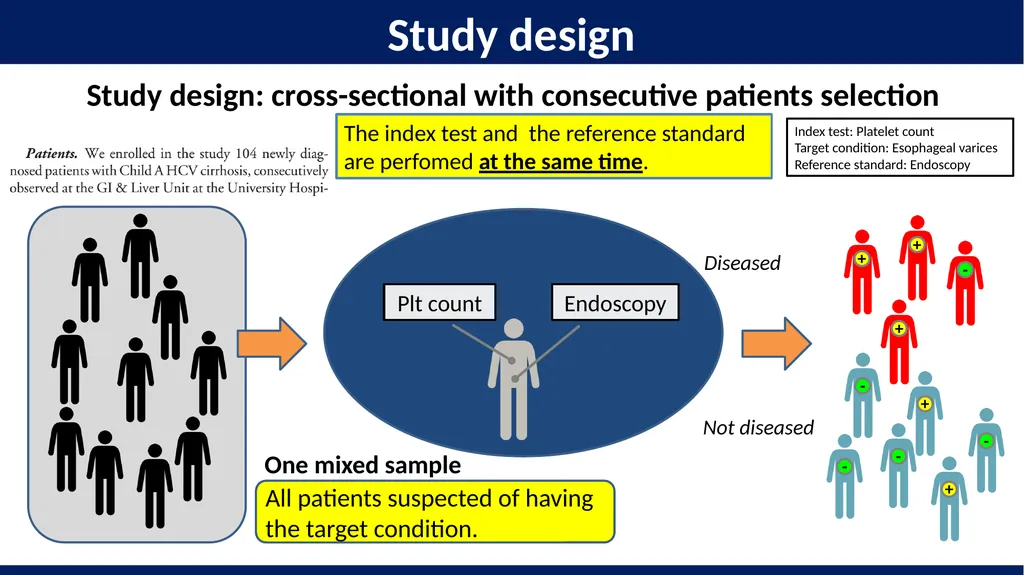
Study design: cross-sectional with consecutive patients selection Study design Index test: Platelet count
Target condition: Esophageal varices
Reference standard: Endoscopy One mixed sample Plt count Endoscopy + - - + - - + + - + All patients suspected of having the target condition. Diseased Not diseased The index test and the reference standard are perfomed at the same time.<br>
09
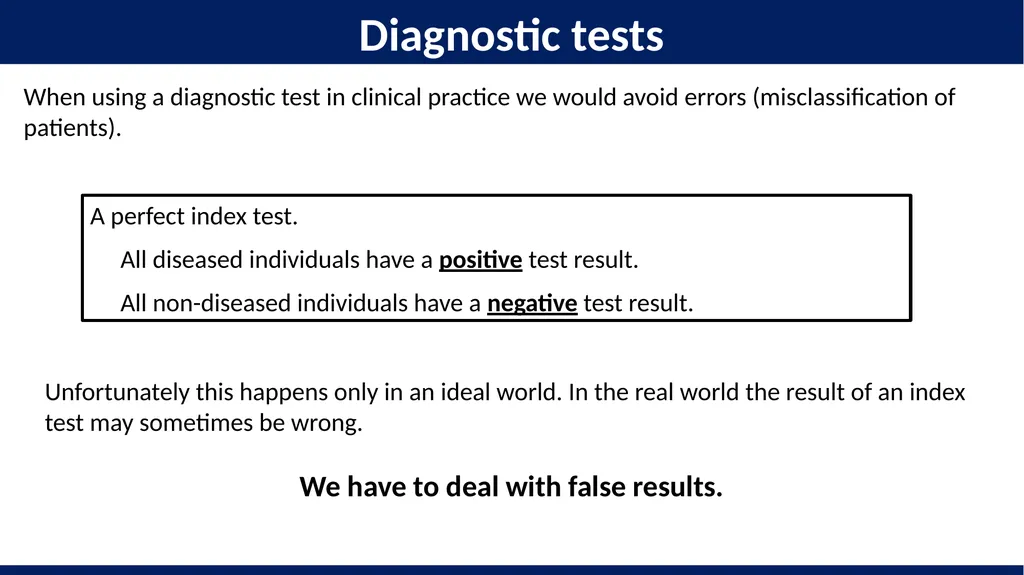
When using a diagnostic test in clinical practice we would avoid errors (misclassification of patients). A perfect index test.
All diseased individuals have a positive test result.
All non-diseased individuals have a negative test result. Unfortunately this happens only in an ideal world. In the real world the result of an index test may sometimes be wrong.
We have to deal with false results. Diagnostic tests<br>
10
Summary of the results of a diagnostic test accuracy study The 2x2 table Results of the study<br>
11
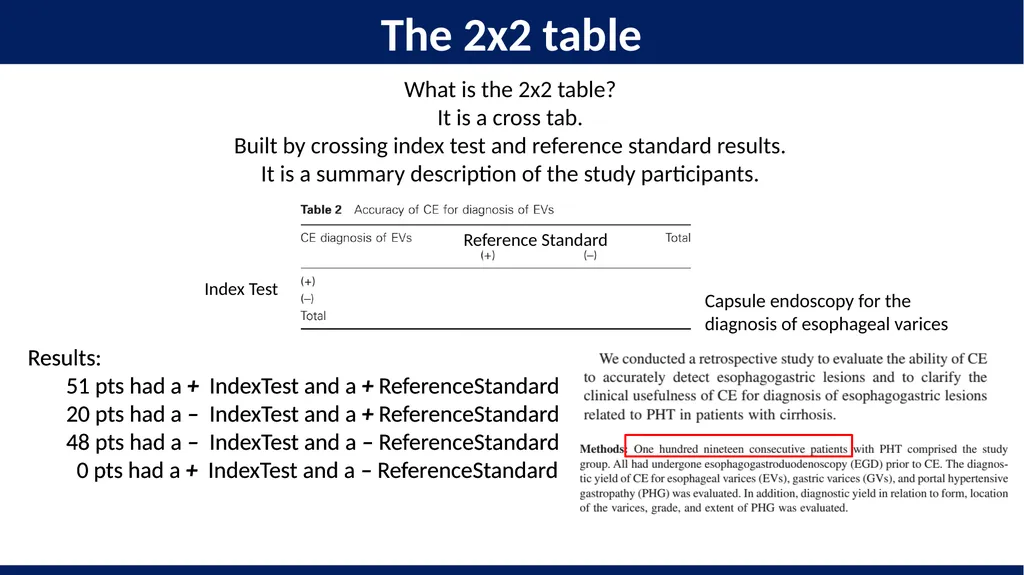
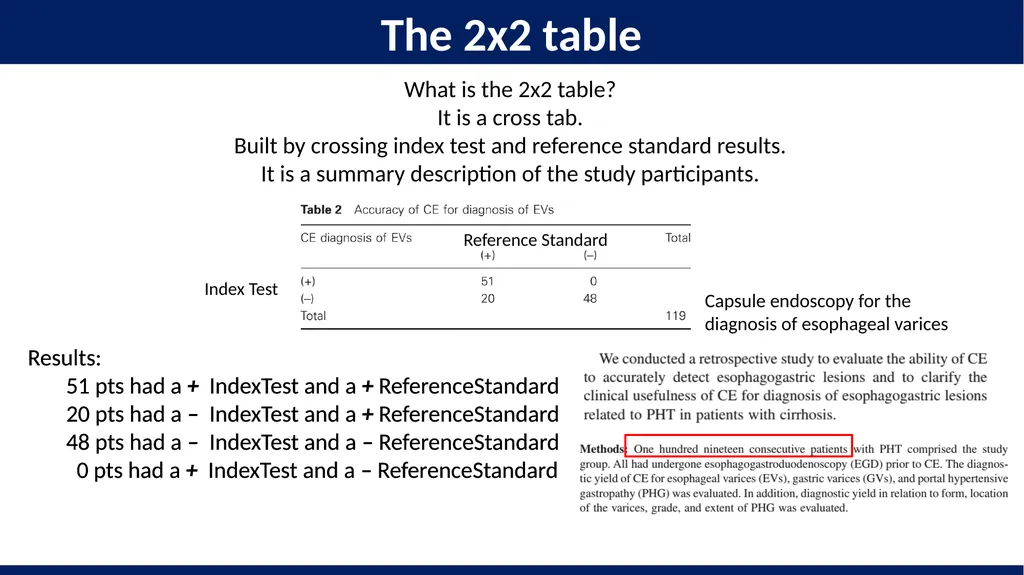
What is the 2x2 table?
It is a cross tab.
Built by crossing index test and reference standard results.
It is a summary description of the study participants. The 2x2 table Results:
51 pts had a + IndexTest and a + ReferenceStandard
20 pts had a – IndexTest and a + ReferenceStandard
48 pts had a – IndexTest and a – ReferenceStandard
0 pts had a + IndexTest and a – ReferenceStandard Index Test Reference Standard Capsule endoscopy for the diagnosis of esophageal varices Results:
51 pts had a + IndexTest and a + ReferenceStandard
20 pts had a – IndexTest and a + ReferenceStandard
48 pts had a – IndexTest and a – ReferenceStandard
0 pts had a + IndexTest and a – ReferenceStandard<br>
12
What is the 2x2 table?
It is a cross tab.
Built by crossing index test and reference standard results.
It is a summary description of the study participants. The 2x2 table Results:
51 pts had a + IndexTest and a + ReferenceStandard
20 pts had a – IndexTest and a + ReferenceStandard
48 pts had a – IndexTest and a – ReferenceStandard
0 pts had a + IndexTest and a – ReferenceStandard Index Test Reference Standard Capsule endoscopy for the diagnosis of esophageal varices Results:
51 pts had a + IndexTest and a + ReferenceStandard
20 pts had a – IndexTest and a + ReferenceStandard
48 pts had a – IndexTest and a – ReferenceStandard
0 pts had a + IndexTest and a – ReferenceStandard<br>
13
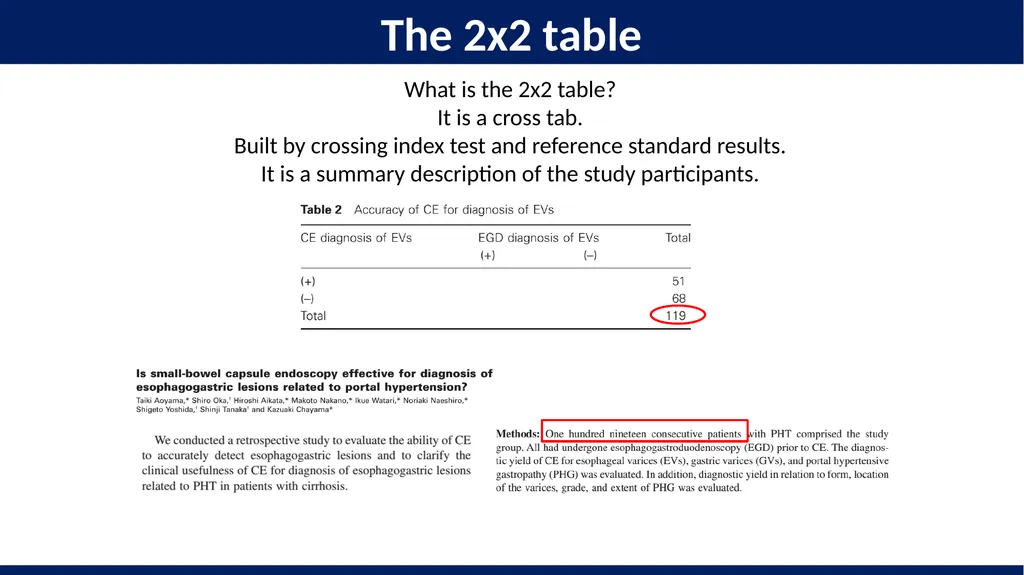
What is the 2x2 table?
It is a cross tab.
Built by crossing index test and reference standard results.
It is a summary description of the study participants. The 2x2 table<br>
14
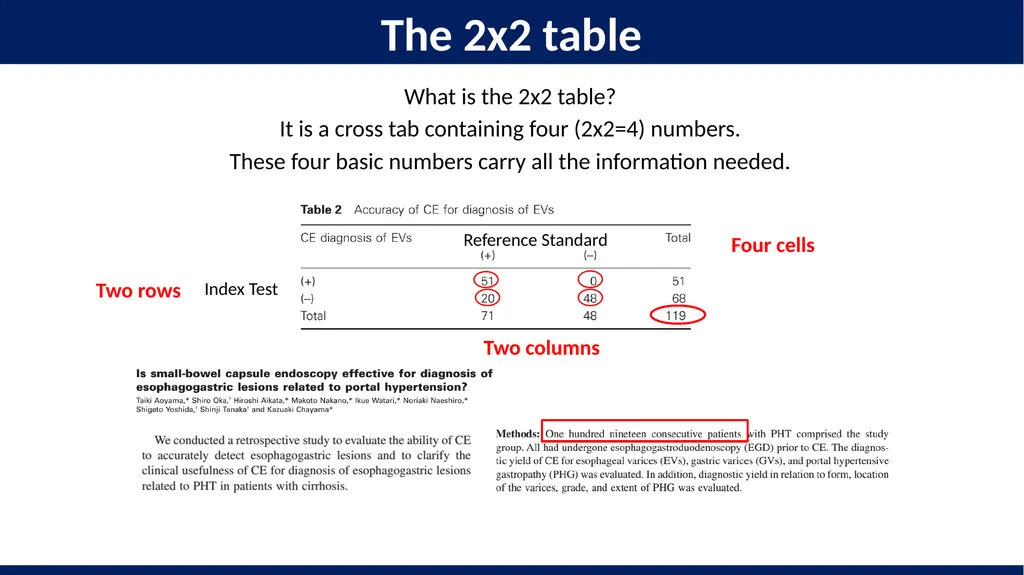
What is the 2x2 table?
It is a cross tab containing four (2x2=4) numbers.
These four basic numbers carry all the information needed. Two rows Two columns Four cells The 2x2 table Index Test Reference Standard<br>
15
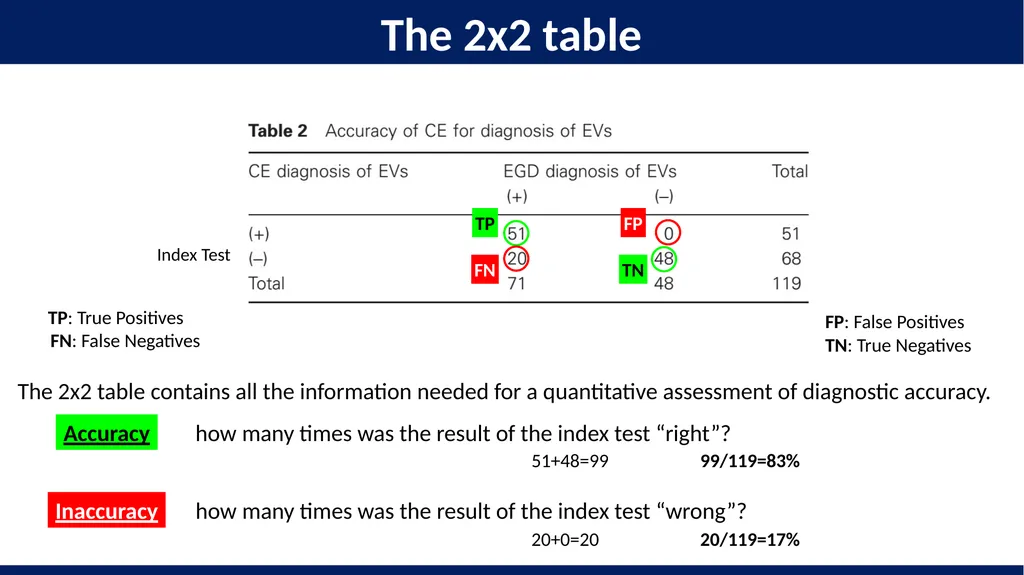
The 2x2 table contains all the information needed for a quantitative assessment of diagnostic accuracy. Accuracy 51+48=99 99/119=83% Inaccuracy 20+0=20 20/119=17% TP FN FP TN TP: True Positives FN: False Negatives FP: False Positives TN: True Negatives The 2x2 table how many times was the result of the index test “right”? how many times was the result of the index test “wrong”? Index Test<br>
16
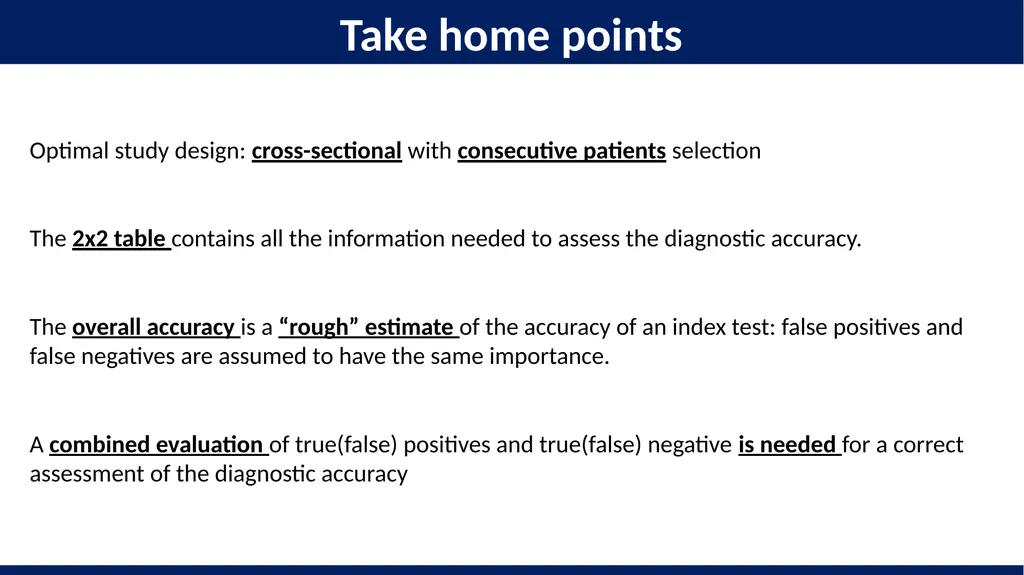
Optimal study design: cross-sectional with consecutive patients selection
The 2x2 table contains all the information needed to assess the diagnostic accuracy.
The overall accuracy is a “rough” estimate of the accuracy of an index test: false positives and false negatives are assumed to have the same importance.
A combined evaluation of true(false) positives and true(false) negative is needed for a correct assessment of the diagnostic accuracy Take home points<br>