Diagonalization Revisted Isabel K. Darcy
Description: Diagonalization Revisted Isabel K. Darcy Mathematics Department Applied Math and Computational Sciences University of Iowa Fig from knotplot.com A is diagonalizable if there exists an invertible matrix P such that P1AP D where D is a
Related Topics
Download Presentation
"Diagonalization Revisted Isabel K. Darcy" is the property of its rightful owner. Permission is granted to download and print the materials on this website for personal, non-commercial use only, and to display it on your personal computer provided you do not modify the materials and that you retain all copyright notices contained in the materials. By downloading content from our website, you accept the terms of this agreement.
Presentation Transcript
slide1. Diagonalization Revisted Isabel K. Darcy
Mathematics Department
Applied Math and Computational Sciences
University of Iowa Fig from
knotplot.com<br>
slide3. A is diagonalizable if there exists an invertible matrix P such that P−1AP = D where D is a diagonal matrix.
Diagonalization has many important applications
It allows one to convert a more complicated problem into
a simpler problem.
Example: Calculating Ak when A is diagonalizable.<br>
slide5. 3 3<br>
slide6. 3 3<br>
slide7. More diagonalization background:<br>
slide16. Check answer:<br>
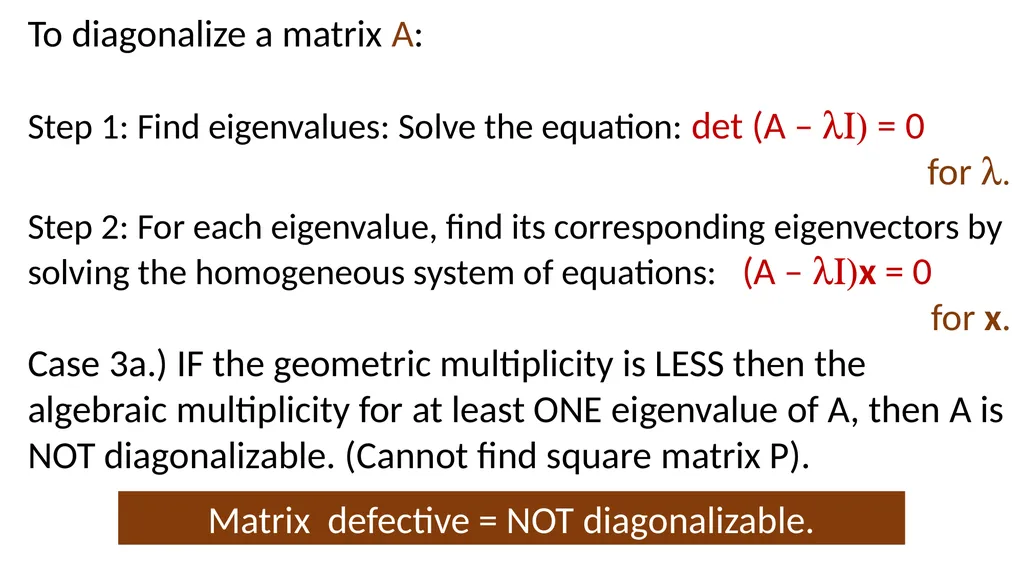
slide17. To diagonalize a matrix A:
Step 1: Find eigenvalues: Solve the equation: det (A – lI) = 0
for l.
Step 2: For each eigenvalue, find its corresponding eigenvectors by solving the homogeneous system of equations: (A – lI)x = 0
for x.
Case 3a.) IF the geometric multiplicity is LESS then the algebraic multiplicity for at least ONE eigenvalue of A, then A is NOT diagonalizable. (Cannot find square matrix P). Matrix defective = NOT diagonalizable.<br>
slide18. Case 3b.) A is diagonalizable if and only if
geometric multiplicity = algebraic multiplicity
for ALL the eigenvalues of A.
Use the eigenvalues of A to construct the diagonal matrix D
Use the basis of the corresponding eigenspaces for the
corresponding columns of P. (NOTE: P is a SQUARE matrix).
NOTE: ORDER MATTERS.<br>
slide19. Step 1: Find eigenvalues: Solve the equation: det (A – lI) = 0
for l. For more complicated example, see video 4: Eigenvalue/Eigenvector Example
& video 5: Diagonalization<br>
slide20. characteristic equation:
l = -3 : algebraic multiplicity =
geometric multiplicity =
dimension of eigenspace =
l = 5 : algebraic multiplicity
geometric multiplicity
dimension of eigenspace

1 ≤ geometric multiplicity ≤ algebraic multiplicity<br>
slide21. characteristic equation:
l = -3 : algebraic multiplicity = 1
geometric multiplicity = 1
dimension of eigenspace = 1
l = 5 : algebraic multiplicity = 1
geometric multiplicity = 1
dimension of eigenspace = 1
1 ≤ geometric multiplicity ≤ algebraic multiplicity Matrix is not defective.<br>
slide22. characteristic equation:
l = -3 : algebraic multiplicity = 1
geometric multiplicity = 1
dimension of eigenspace = 1
l = 5 : algebraic multiplicity = 1
geometric multiplicity = 1
dimension of eigenspace = 1
1 ≤ geometric multiplicity ≤ algebraic multiplicity Matrix is not defective. Thus A is diagonalizable<br>
slide23. characteristic equation:
l = -3 : algebraic multiplicity = 1
geometric multiplicity = 1
dimension of eigenspace = 1
l = 5 : algebraic multiplicity = 1
geometric multiplicity = 1
dimension of eigenspace = 1
1 ≤ geometric multiplicity ≤ algebraic multiplicity Matrix is not defective. Thus A is diagonalizable<br>
slide24. Find eigenvectors to create P<br>
slide26. Basis for eigenspace corresponding to l = -3:<br>
slide27. Basis for eigenspace corresponding to l = -3:<br>
slide28. Find eigenvectors to create P Basis for eigenspace corresponding to l = 5:<br>
slide29. Basis for eigenspace corresponding to l = -3: Basis for eigenspace corresponding to l = 5:<br>
slide30. Basis for eigenspace corresponding to l = -3: Basis for eigenspace corresponding to l = 5:<br>
slide31. Note we want to be invertible.
Note P is invertible if and only if
the columns of P are linearly independent.
We get this for FREE!!!!!<br>
slide32. Note: You can easily check your answer.<br>
slide33. Diagonalize Note there are many correct answers.<br>
slide34. Diagonalize Note there are many correct answers. ORDER MATTERS!!!<br>
Mathematics Department
Applied Math and Computational Sciences
University of Iowa Fig from
knotplot.com<br>
slide3. A is diagonalizable if there exists an invertible matrix P such that P−1AP = D where D is a diagonal matrix.
Diagonalization has many important applications
It allows one to convert a more complicated problem into
a simpler problem.
Example: Calculating Ak when A is diagonalizable.<br>
slide5. 3 3<br>
slide6. 3 3<br>
slide7. More diagonalization background:<br>
slide16. Check answer:<br>
slide17. To diagonalize a matrix A:
Step 1: Find eigenvalues: Solve the equation: det (A – lI) = 0
for l.
Step 2: For each eigenvalue, find its corresponding eigenvectors by solving the homogeneous system of equations: (A – lI)x = 0
for x.
Case 3a.) IF the geometric multiplicity is LESS then the algebraic multiplicity for at least ONE eigenvalue of A, then A is NOT diagonalizable. (Cannot find square matrix P). Matrix defective = NOT diagonalizable.<br>
slide18. Case 3b.) A is diagonalizable if and only if
geometric multiplicity = algebraic multiplicity
for ALL the eigenvalues of A.
Use the eigenvalues of A to construct the diagonal matrix D
Use the basis of the corresponding eigenspaces for the
corresponding columns of P. (NOTE: P is a SQUARE matrix).
NOTE: ORDER MATTERS.<br>
slide19. Step 1: Find eigenvalues: Solve the equation: det (A – lI) = 0
for l. For more complicated example, see video 4: Eigenvalue/Eigenvector Example
& video 5: Diagonalization<br>
slide20. characteristic equation:
l = -3 : algebraic multiplicity =
geometric multiplicity =
dimension of eigenspace =
l = 5 : algebraic multiplicity
geometric multiplicity
dimension of eigenspace
1 ≤ geometric multiplicity ≤ algebraic multiplicity<br>
slide21. characteristic equation:
l = -3 : algebraic multiplicity = 1
geometric multiplicity = 1
dimension of eigenspace = 1
l = 5 : algebraic multiplicity = 1
geometric multiplicity = 1
dimension of eigenspace = 1
1 ≤ geometric multiplicity ≤ algebraic multiplicity Matrix is not defective.<br>
slide22. characteristic equation:
l = -3 : algebraic multiplicity = 1
geometric multiplicity = 1
dimension of eigenspace = 1
l = 5 : algebraic multiplicity = 1
geometric multiplicity = 1
dimension of eigenspace = 1
1 ≤ geometric multiplicity ≤ algebraic multiplicity Matrix is not defective. Thus A is diagonalizable<br>
slide23. characteristic equation:
l = -3 : algebraic multiplicity = 1
geometric multiplicity = 1
dimension of eigenspace = 1
l = 5 : algebraic multiplicity = 1
geometric multiplicity = 1
dimension of eigenspace = 1
1 ≤ geometric multiplicity ≤ algebraic multiplicity Matrix is not defective. Thus A is diagonalizable<br>
slide24. Find eigenvectors to create P<br>
slide26. Basis for eigenspace corresponding to l = -3:<br>
slide27. Basis for eigenspace corresponding to l = -3:<br>
slide28. Find eigenvectors to create P Basis for eigenspace corresponding to l = 5:<br>
slide29. Basis for eigenspace corresponding to l = -3: Basis for eigenspace corresponding to l = 5:<br>
slide30. Basis for eigenspace corresponding to l = -3: Basis for eigenspace corresponding to l = 5:<br>
slide31. Note we want to be invertible.
Note P is invertible if and only if
the columns of P are linearly independent.
We get this for FREE!!!!!<br>
slide32. Note: You can easily check your answer.<br>
slide33. Diagonalize Note there are many correct answers.<br>
slide34. Diagonalize Note there are many correct answers. ORDER MATTERS!!!<br>