
Digital Activism Definitions, Types, and
Description: Digital Activism Definitions, Types, and Challenges Devendra Potnis, PhD Associate Professor School of Information Sciences dpotnisutk.edu 1. Defining Digital Activism Social activism mediated through information and communication
Related Topics
Download Presentation
"Digital Activism Definitions, Types, and" is the property of its rightful owner. Permission is granted to download and print the materials on this website for personal, non-commercial use only, and to display it on your personal computer provided you do not modify the materials and that you retain all copyright notices contained in the materials. By downloading content from our website, you accept the terms of this agreement.
Presentation Transcript
slide1. Digital Activism
Definitions, Types, and Challenges Devendra Potnis, PhD
Associate Professor
School of Information Sciences
dpotnis@utk.edu<br>
slide2. 1. Defining “Digital Activism” Social activism mediated through information and communication technologies to promote social movements (Selander & Jarvenpaa, 2016)
Collective action for a cause
Organized or individual-level efforts by citizens to influence social, political, cultural, and policy issues, using digital technologies (George & Leidner, 2019; Joyce, 2010) 2<br>
slide3. 2. Types of Digital Activism (1/3) Clicking (Kavada, 2015; Majchrzak et al., 2013)
Liking, upvoting, or following
Large volumes of clicks Legitimacy, validation, and authority
Metavoicing (Kane et al., 2014)
Sharing, retweeting, reposting, & commenting
Reinforcing ideas, values, information – “Echo chamber”
Size of one’s social networks
3. Asserting (Selander & Jarvenpaa, 2016)
Content creation on social media
Framing messages and opinion (George & Leidner, 2019) 3<br>
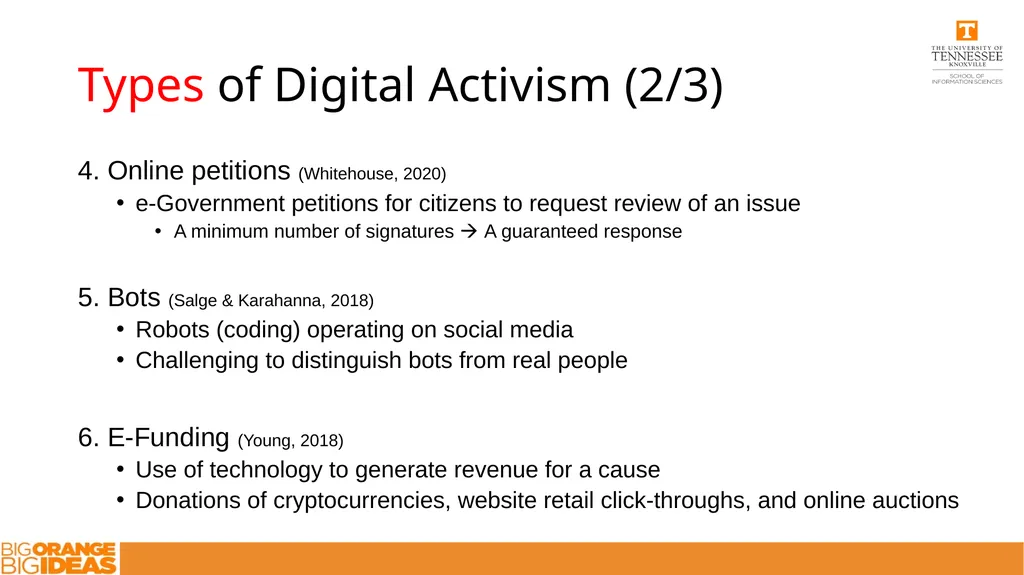
slide4. Types of Digital Activism (2/3) 4. Online petitions (Whitehouse, 2020)
e-Government petitions for citizens to request review of an issue
A minimum number of signatures A guaranteed response
5. Bots (Salge & Karahanna, 2018)
Robots (coding) operating on social media
Challenging to distinguish bots from real people
6. E-Funding (Young, 2018)
Use of technology to generate revenue for a cause
Donations of cryptocurrencies, website retail click-throughs, and online auctions 4<br>
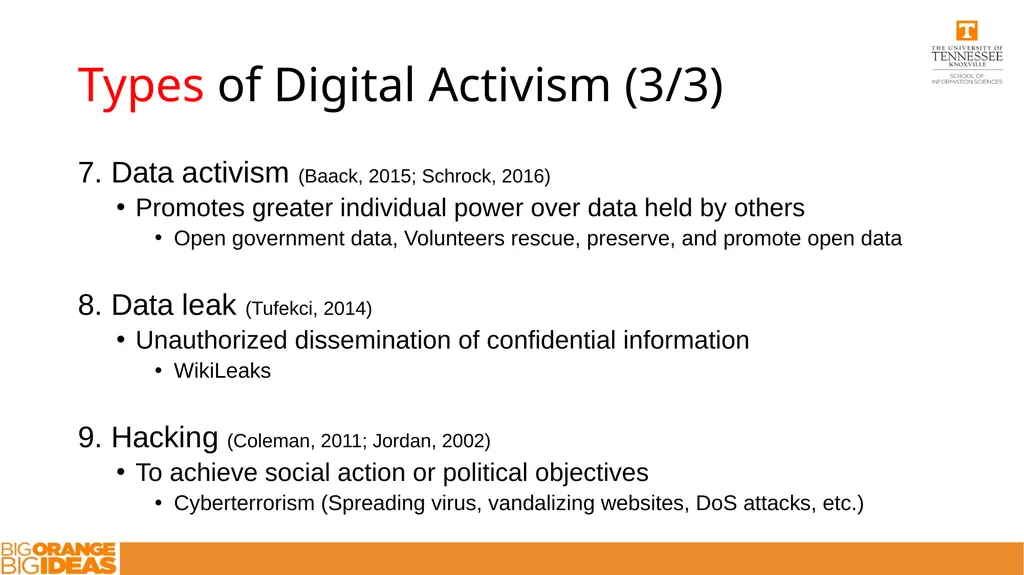
slide5. Types of Digital Activism (3/3) 7. Data activism (Baack, 2015; Schrock, 2016)
Promotes greater individual power over data held by others
Open government data, Volunteers rescue, preserve, and promote open data
8. Data leak (Tufekci, 2014)
Unauthorized dissemination of confidential information
WikiLeaks
9. Hacking (Coleman, 2011; Jordan, 2002)
To achieve social action or political objectives
Cyberterrorism (Spreading virus, vandalizing websites, DoS attacks, etc.) 5<br>
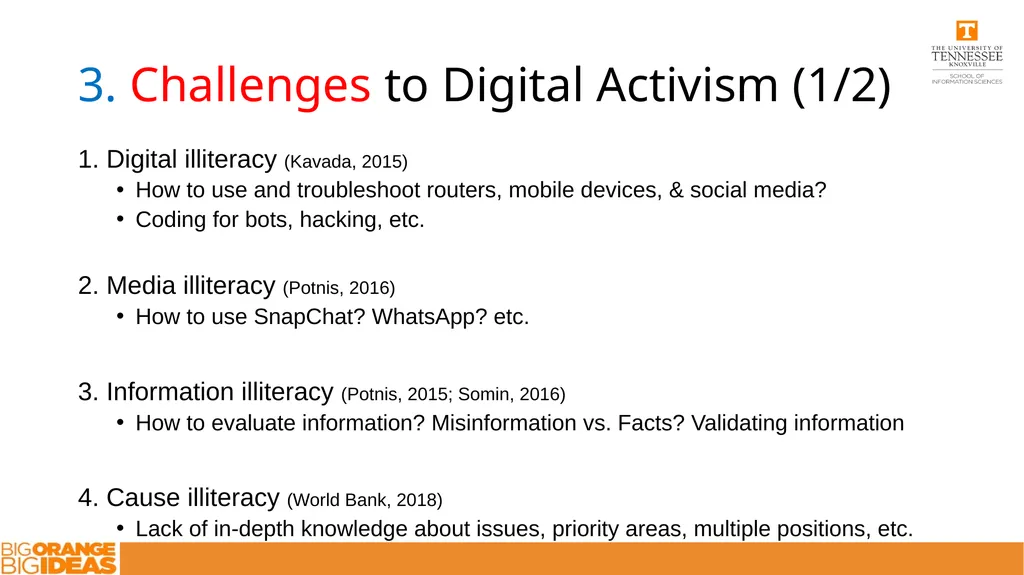
slide6. 3. Challenges to Digital Activism (1/2) 1. Digital illiteracy (Kavada, 2015)
How to use and troubleshoot routers, mobile devices, & social media?
Coding for bots, hacking, etc.
2. Media illiteracy (Potnis, 2016)
How to use SnapChat? WhatsApp? etc.
3. Information illiteracy (Potnis, 2015; Somin, 2016)
How to evaluate information? Misinformation vs. Facts? Validating information
4. Cause illiteracy (World Bank, 2018)
Lack of in-depth knowledge about issues, priority areas, multiple positions, etc. 6<br>
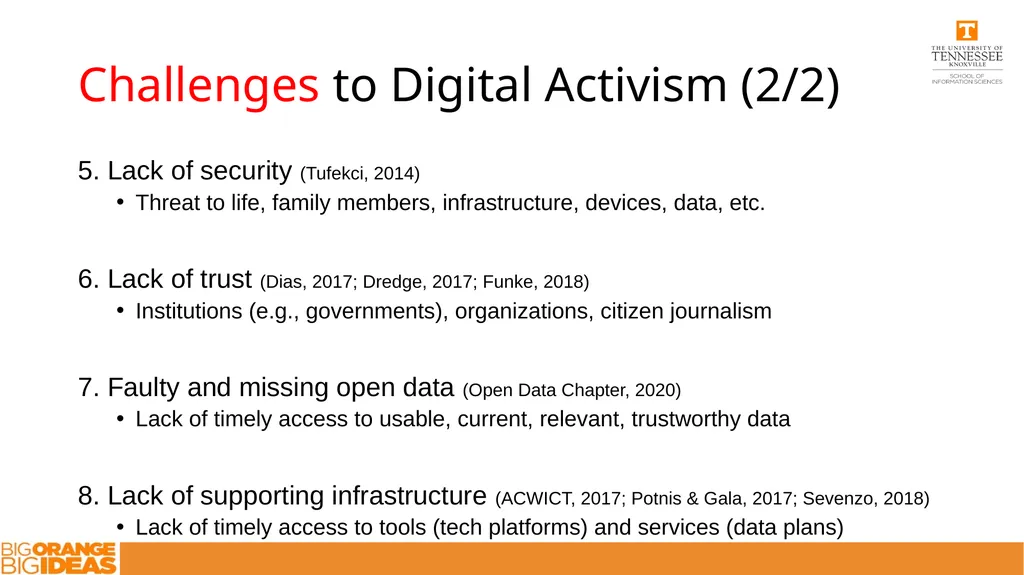
slide7. Challenges to Digital Activism (2/2) 5. Lack of security (Tufekci, 2014)
Threat to life, family members, infrastructure, devices, data, etc.
6. Lack of trust (Dias, 2017; Dredge, 2017; Funke, 2018)
Institutions (e.g., governments), organizations, citizen journalism
7. Faulty and missing open data (Open Data Chapter, 2020)
Lack of timely access to usable, current, relevant, trustworthy data
8. Lack of supporting infrastructure (ACWICT, 2017; Potnis & Gala, 2017; Sevenzo, 2018)
Lack of timely access to tools (tech platforms) and services (data plans) 7<br>
slide8. References (1/2) ACWICT (2017). State set to train 1m youth in digital literacy project. http://acwict.org/index.php/2017/04/25/state-set-train-1m-youth-digital-literacy-project/ last accessed 2018/12/04.
Baack, S. (2015). Datafication and empowerment: How the open data movement re-articulates notions of democracy, participation, and journalism. Big Data & Society, 2(2), 2053951715594634. https://doi.org/10.1177/2053951715594634.
Coleman, G. (2011). Hacker politics and publics. Public Culture, 23(3), 511–516. https://doi.org/10.1215/08992363-1336390.
Dias, N.: The era of WhatsApp propaganda is upon us, http://foreignpolicy.com/2017/08/17/the-era-of-whatsapp-propaganda-is-upon-us/ last accessed 2018/12/04.
Dredge, S.: Why political rebels love WhatsApp, https://www.theguardian.com/technology/2017/mar/05/political-rebels-whatsapp-encryption-technology-mps-security last accessed 2018/12/4.
Funke, D.: Here’s why fighting fake news is harder on WhatsApp than on Facebook, https://www.poynter.org/news/heres-why-fighting-fake-news-harder-whatsapp-facebook last accessed 2018/12/04.
George,J., & Leidner, D. (2019). From clicktivism to hacktivism: Understanding digital activism, Information & Organization, 29(3). https://doi.org/10.1016/j.infoandorg.2019.04.001
Jordan, T. (2002). Activism!: Direct action, hacktivism and the future of society. Reaktion Books.
Joyce, M. (2010). Digital activism decoded: The new mechanics of change. International Debate Education Association: New York.
Kane, G., Johnson, J., & Majchrzak, A. (2014). Emergent life cycle: The tension between knowledge change and knowledge retention in open online coproduction communities. Management Science, 60(12), 3026–3048. https://doi.org/10.1287/mnsc.2013.1855.
Kavada, A. (2015). Creating the collective: Social media, the Occupy Movement and its constitution as a collective actor. Information, Communication & Society, 18(8), 872–886. https://doi.org/10.1080/1369118X.2015.1043318.
Majchrzak, A., Faraj, S., Kane, G. C., & Azad, B. (2013). The contradictory influence of social media affordances on online communal knowledge sharing. Journal of Computer-Mediated Communication, 19(1), 38–55. https://doi.org/10.1111/jcc4.12030.
Open Data Charter (2020). Principles, https://opendatacharter.net/principles/.
Potnis, D. (2011). Cell-phone-enabled empowerment of women earning less than $1 per day. IEEE Technology & Society, 30(2), 39-45 (2011).
Potnis, D. (2015). Beyond access to information: Understanding the use of information by poor female mobile users in rural India. The Information Society, 31(1), 83-93.
Potnis, D. (2016). Culture’s consequences: Economic barriers to owning mobile phones experienced by women in India. Telematics and Informatics, 33(2), 356-369. 8<br>
slide9. References (2/2) Potnis, D. & Gala, B. (2017). Factors influencing electronic word-of-mouth among Indian youth: Implications for mobile governance, In: the Special Collection on eGovernment Innovations in India, 10th International Conference on Theory and Practice of Electronic Governance Proceedings, New Delhi, India, 107-114
Schrock, A. R. (2016). Civic hacking as data activism and advocacy: A history from publicity to open government data. New Media & Society, 18(4), 581–599. https://doi.org/10.1177/1461444816629469.
Selander, L., & Jarvenpaa, S. L. (2016). Digital action repertoires and transforming a social movement organization. MIS Quarterly, 40(2), 331–352.
Sevenzo, F.: Kenya election, BBC reports target voters, http://www.cnn.com/2017/07/31/africa/kenya-election-fake-news/index.html.
Somin, I.: Why real-world governments don’t have the consent of the governed--and why it matters. Washington Post. http://www.washingtonpost.com/news/volokh-conspiracy/wp/2016/01/27/why-real-world-governments-dont-have-the-consent-of-the-governed-and-why-it-matters/?utm_term-.b97acc2482ce last accessed 2018/12/04.
Tufekci, Z. (2014). The medium and the movement: Digital tools, social movement politics, and the end of the free rider problem. Policy & Internet, 6(2), 202–208. https://doi.org/10.1002/1944-2866.POI362.
Whitehouse (2020). https://petitions.whitehouse.gov/
World Bank (2018). Here are 10 ways to fight corruption, http://blogs.worldbank.org/governance/here-are-10-ways-fight-corruption 9<br>
Associate Professor
School of Information Sciences
dpotnis@utk.edu<br>
slide2. 1. Defining “Digital Activism” Social activism mediated through information and communication technologies to promote social movements (Selander & Jarvenpaa, 2016)
Collective action for a cause
Organized or individual-level efforts by citizens to influence social, political, cultural, and policy issues, using digital technologies (George & Leidner, 2019; Joyce, 2010) 2<br>
slide3. 2. Types of Digital Activism (1/3) Clicking (Kavada, 2015; Majchrzak et al., 2013)
Liking, upvoting, or following
Large volumes of clicks Legitimacy, validation, and authority
Metavoicing (Kane et al., 2014)
Sharing, retweeting, reposting, & commenting
Reinforcing ideas, values, information – “Echo chamber”
Size of one’s social networks
3. Asserting (Selander & Jarvenpaa, 2016)
Content creation on social media
Framing messages and opinion (George & Leidner, 2019) 3<br>
slide4. Types of Digital Activism (2/3) 4. Online petitions (Whitehouse, 2020)
e-Government petitions for citizens to request review of an issue
A minimum number of signatures A guaranteed response
5. Bots (Salge & Karahanna, 2018)
Robots (coding) operating on social media
Challenging to distinguish bots from real people
6. E-Funding (Young, 2018)
Use of technology to generate revenue for a cause
Donations of cryptocurrencies, website retail click-throughs, and online auctions 4<br>
slide5. Types of Digital Activism (3/3) 7. Data activism (Baack, 2015; Schrock, 2016)
Promotes greater individual power over data held by others
Open government data, Volunteers rescue, preserve, and promote open data
8. Data leak (Tufekci, 2014)
Unauthorized dissemination of confidential information
WikiLeaks
9. Hacking (Coleman, 2011; Jordan, 2002)
To achieve social action or political objectives
Cyberterrorism (Spreading virus, vandalizing websites, DoS attacks, etc.) 5<br>
slide6. 3. Challenges to Digital Activism (1/2) 1. Digital illiteracy (Kavada, 2015)
How to use and troubleshoot routers, mobile devices, & social media?
Coding for bots, hacking, etc.
2. Media illiteracy (Potnis, 2016)
How to use SnapChat? WhatsApp? etc.
3. Information illiteracy (Potnis, 2015; Somin, 2016)
How to evaluate information? Misinformation vs. Facts? Validating information
4. Cause illiteracy (World Bank, 2018)
Lack of in-depth knowledge about issues, priority areas, multiple positions, etc. 6<br>
slide7. Challenges to Digital Activism (2/2) 5. Lack of security (Tufekci, 2014)
Threat to life, family members, infrastructure, devices, data, etc.
6. Lack of trust (Dias, 2017; Dredge, 2017; Funke, 2018)
Institutions (e.g., governments), organizations, citizen journalism
7. Faulty and missing open data (Open Data Chapter, 2020)
Lack of timely access to usable, current, relevant, trustworthy data
8. Lack of supporting infrastructure (ACWICT, 2017; Potnis & Gala, 2017; Sevenzo, 2018)
Lack of timely access to tools (tech platforms) and services (data plans) 7<br>
slide8. References (1/2) ACWICT (2017). State set to train 1m youth in digital literacy project. http://acwict.org/index.php/2017/04/25/state-set-train-1m-youth-digital-literacy-project/ last accessed 2018/12/04.
Baack, S. (2015). Datafication and empowerment: How the open data movement re-articulates notions of democracy, participation, and journalism. Big Data & Society, 2(2), 2053951715594634. https://doi.org/10.1177/2053951715594634.
Coleman, G. (2011). Hacker politics and publics. Public Culture, 23(3), 511–516. https://doi.org/10.1215/08992363-1336390.
Dias, N.: The era of WhatsApp propaganda is upon us, http://foreignpolicy.com/2017/08/17/the-era-of-whatsapp-propaganda-is-upon-us/ last accessed 2018/12/04.
Dredge, S.: Why political rebels love WhatsApp, https://www.theguardian.com/technology/2017/mar/05/political-rebels-whatsapp-encryption-technology-mps-security last accessed 2018/12/4.
Funke, D.: Here’s why fighting fake news is harder on WhatsApp than on Facebook, https://www.poynter.org/news/heres-why-fighting-fake-news-harder-whatsapp-facebook last accessed 2018/12/04.
George,J., & Leidner, D. (2019). From clicktivism to hacktivism: Understanding digital activism, Information & Organization, 29(3). https://doi.org/10.1016/j.infoandorg.2019.04.001
Jordan, T. (2002). Activism!: Direct action, hacktivism and the future of society. Reaktion Books.
Joyce, M. (2010). Digital activism decoded: The new mechanics of change. International Debate Education Association: New York.
Kane, G., Johnson, J., & Majchrzak, A. (2014). Emergent life cycle: The tension between knowledge change and knowledge retention in open online coproduction communities. Management Science, 60(12), 3026–3048. https://doi.org/10.1287/mnsc.2013.1855.
Kavada, A. (2015). Creating the collective: Social media, the Occupy Movement and its constitution as a collective actor. Information, Communication & Society, 18(8), 872–886. https://doi.org/10.1080/1369118X.2015.1043318.
Majchrzak, A., Faraj, S., Kane, G. C., & Azad, B. (2013). The contradictory influence of social media affordances on online communal knowledge sharing. Journal of Computer-Mediated Communication, 19(1), 38–55. https://doi.org/10.1111/jcc4.12030.
Open Data Charter (2020). Principles, https://opendatacharter.net/principles/.
Potnis, D. (2011). Cell-phone-enabled empowerment of women earning less than $1 per day. IEEE Technology & Society, 30(2), 39-45 (2011).
Potnis, D. (2015). Beyond access to information: Understanding the use of information by poor female mobile users in rural India. The Information Society, 31(1), 83-93.
Potnis, D. (2016). Culture’s consequences: Economic barriers to owning mobile phones experienced by women in India. Telematics and Informatics, 33(2), 356-369. 8<br>
slide9. References (2/2) Potnis, D. & Gala, B. (2017). Factors influencing electronic word-of-mouth among Indian youth: Implications for mobile governance, In: the Special Collection on eGovernment Innovations in India, 10th International Conference on Theory and Practice of Electronic Governance Proceedings, New Delhi, India, 107-114
Schrock, A. R. (2016). Civic hacking as data activism and advocacy: A history from publicity to open government data. New Media & Society, 18(4), 581–599. https://doi.org/10.1177/1461444816629469.
Selander, L., & Jarvenpaa, S. L. (2016). Digital action repertoires and transforming a social movement organization. MIS Quarterly, 40(2), 331–352.
Sevenzo, F.: Kenya election, BBC reports target voters, http://www.cnn.com/2017/07/31/africa/kenya-election-fake-news/index.html.
Somin, I.: Why real-world governments don’t have the consent of the governed--and why it matters. Washington Post. http://www.washingtonpost.com/news/volokh-conspiracy/wp/2016/01/27/why-real-world-governments-dont-have-the-consent-of-the-governed-and-why-it-matters/?utm_term-.b97acc2482ce last accessed 2018/12/04.
Tufekci, Z. (2014). The medium and the movement: Digital tools, social movement politics, and the end of the free rider problem. Policy & Internet, 6(2), 202–208. https://doi.org/10.1002/1944-2866.POI362.
Whitehouse (2020). https://petitions.whitehouse.gov/
World Bank (2018). Here are 10 ways to fight corruption, http://blogs.worldbank.org/governance/here-are-10-ways-fight-corruption 9<br>