
Digital Crimes 1. Digital crime begins when there
CS
Published · 45 slides · 0 views

1 / 1





Description
Digital Crimes 1. Digital crime begins when there is illegal activity. These activities are done to data or information on computers or networks. 2. Crimes involving the use of digital, electronic or computing systems The origin of
Related Topics
Share
Embed code
Download this presentation From Below
"Digital Crimes 1. Digital crime begins when there" is the property of its rightful owner. Permission is granted to download and print the materials on this website for personal, non-commercial use only, and to display it on your personal computer provided you do not modify the materials and that you retain all copyright notices contained in the materials. By downloading content from our website, you accept the terms of this agreement.
Presentation Transcript
01
Digital Crimes 1.
Digital crime begins when there is illegal activity. These activities are done to data or information on computers or networks.
2.
Crimes involving the use of digital, electronic or computing systems<br>
Digital crime begins when there is illegal activity. These activities are done to data or information on computers or networks.
2.
Crimes involving the use of digital, electronic or computing systems<br>
02
The origin of cybercrime Cybercrime is one of the largest and globally most active forms of crime. After all, the internet is available and visible to everyone, and that of course involves risks.
Committing a crime via a computer or other device that is connected to the Internet is dangerous because the identity of the perpetrator is difficult to find out.<br>
Committing a crime via a computer or other device that is connected to the Internet is dangerous because the identity of the perpetrator is difficult to find out.<br>
03
The history of cybercrime The exact origin of cyber crime, the very first instance in which someone committed a crime across a computer network, is impossible to know.
What is possible to know is the first major attack on a digital network and then use that as a reference point of event in the evolution of cyber based crimes.<br>
What is possible to know is the first major attack on a digital network and then use that as a reference point of event in the evolution of cyber based crimes.<br>
04
1971 – John Draper, a phone phreak, discovers that a whistle given out as a prize in boxes of Cap’n Crunch Cereal produced the same tones as telephone switching computers of the time. Phone phreak is a term used to describe computer programmers obsessed with phone networks, the basis of modern day computer networking.
He built a “blue box” with the whistle that would allow him to make free long distance phone calls, and then published instruction on how to make it. The instances of wire fraud rose significantly.<br>
He built a “blue box” with the whistle that would allow him to make free long distance phone calls, and then published instruction on how to make it. The instances of wire fraud rose significantly.<br>
05
1973 – A teller at a local New York bank used a computer to embezzle over $2 million dollars.
1978 – The first electronic bulletin board system came online and quickly became a preferred method of communication for the cyber world.
It allowed fast, free exchange of knowledge including tips and tricks for hacking into computer networks.
1981 – Ian Murphy, known as Captain Zap to his fans, was the first person convicted of a cyber crime.
He hacked into the AT&T network and changed the internal clock to charge off-hours rates at peak times.
He received 1,000 hours of community service and 2.5 years of probation, a mere slap on the wrist compared to today’s penalties, and was the inspiration for the movie Sneakers.
1982 – Elk Cloner, a virus, is written as a joke by a 15 year old kid. It is one of the first known viruses to leave its original operating system and spread in the “wild”. It attacked Apple II operating systems and spread by floppy disk.<br>
1978 – The first electronic bulletin board system came online and quickly became a preferred method of communication for the cyber world.
It allowed fast, free exchange of knowledge including tips and tricks for hacking into computer networks.
1981 – Ian Murphy, known as Captain Zap to his fans, was the first person convicted of a cyber crime.
He hacked into the AT&T network and changed the internal clock to charge off-hours rates at peak times.
He received 1,000 hours of community service and 2.5 years of probation, a mere slap on the wrist compared to today’s penalties, and was the inspiration for the movie Sneakers.
1982 – Elk Cloner, a virus, is written as a joke by a 15 year old kid. It is one of the first known viruses to leave its original operating system and spread in the “wild”. It attacked Apple II operating systems and spread by floppy disk.<br>
06
1983 – The movie War Games is released and brings hacking to the mainstream. The movie depicts a teenage boy who hacks into a government computer system through a back door and nearly brings the world to World War III.
1986 – Congress passes the Computer Fraud and Abuse Act, making hacking and theft illegal.
1988 – Robert T. Morris jr., a graduate student at Cornell, released a self-replicating worm onto the Defense Department’s APRANET.
ARPANET is the precursor to the Internet as we know it today. The worm gets out of hand, infects more than 600,000 networked computers and lands Mr. Morris with a $10,000 fine and 3 years probation, another slap on the wrist.
1989 – The first large-scale case of ransomware is reported. The virus posed as a quiz on the AIDS virus and, once downloaded, held computer data hostage for $500.
At the same time another group is arrested stealing US government and private sector data and selling it to the KGB.<br>
1986 – Congress passes the Computer Fraud and Abuse Act, making hacking and theft illegal.
1988 – Robert T. Morris jr., a graduate student at Cornell, released a self-replicating worm onto the Defense Department’s APRANET.
ARPANET is the precursor to the Internet as we know it today. The worm gets out of hand, infects more than 600,000 networked computers and lands Mr. Morris with a $10,000 fine and 3 years probation, another slap on the wrist.
1989 – The first large-scale case of ransomware is reported. The virus posed as a quiz on the AIDS virus and, once downloaded, held computer data hostage for $500.
At the same time another group is arrested stealing US government and private sector data and selling it to the KGB.<br>
07
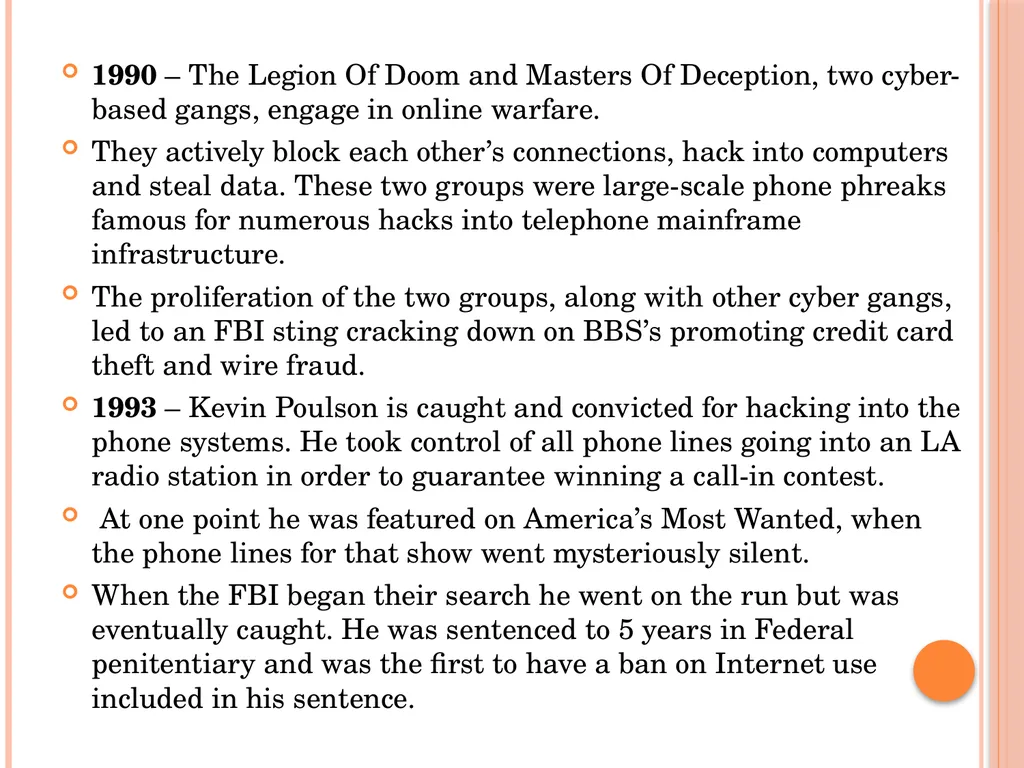
1990 – The Legion Of Doom and Masters Of Deception, two cyber-based gangs, engage in online warfare.
They actively block each other’s connections, hack into computers and steal data. These two groups were large-scale phone phreaks famous for numerous hacks into telephone mainframe infrastructure.
The proliferation of the two groups, along with other cyber gangs, led to an FBI sting cracking down on BBS’s promoting credit card theft and wire fraud.
1993 – Kevin Poulson is caught and convicted for hacking into the phone systems. He took control of all phone lines going into an LA radio station in order to guarantee winning a call-in contest.
At one point he was featured on America’s Most Wanted, when the phone lines for that show went mysteriously silent.
When the FBI began their search he went on the run but was eventually caught. He was sentenced to 5 years in Federal penitentiary and was the first to have a ban on Internet use included in his sentence.<br>
They actively block each other’s connections, hack into computers and steal data. These two groups were large-scale phone phreaks famous for numerous hacks into telephone mainframe infrastructure.
The proliferation of the two groups, along with other cyber gangs, led to an FBI sting cracking down on BBS’s promoting credit card theft and wire fraud.
1993 – Kevin Poulson is caught and convicted for hacking into the phone systems. He took control of all phone lines going into an LA radio station in order to guarantee winning a call-in contest.
At one point he was featured on America’s Most Wanted, when the phone lines for that show went mysteriously silent.
When the FBI began their search he went on the run but was eventually caught. He was sentenced to 5 years in Federal penitentiary and was the first to have a ban on Internet use included in his sentence.<br>
08
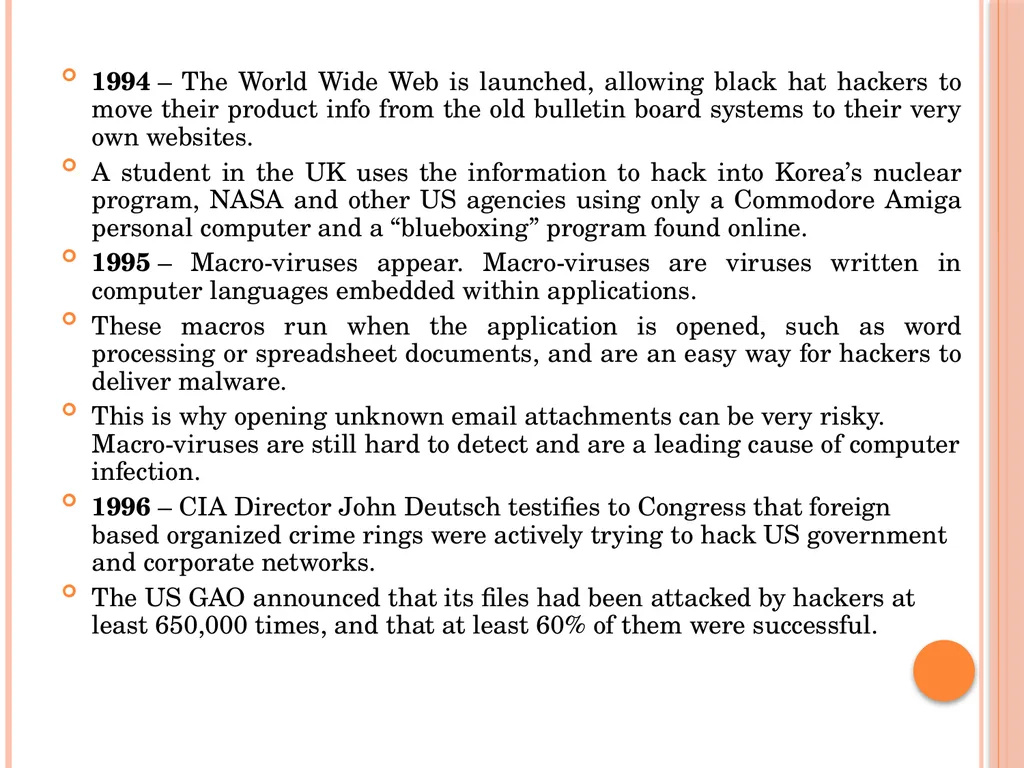
1994 – The World Wide Web is launched, allowing black hat hackers to move their product info from the old bulletin board systems to their very own websites.
A student in the UK uses the information to hack into Korea’s nuclear program, NASA and other US agencies using only a Commodore Amiga personal computer and a “blueboxing” program found online.
1995 – Macro-viruses appear. Macro-viruses are viruses written in computer languages embedded within applications.
These macros run when the application is opened, such as word processing or spreadsheet documents, and are an easy way for hackers to deliver malware.
This is why opening unknown email attachments can be very risky. Macro-viruses are still hard to detect and are a leading cause of computer infection.
1996 – CIA Director John Deutsch testifies to Congress that foreign based organized crime rings were actively trying to hack US government and corporate networks.
The US GAO announced that its files had been attacked by hackers at least 650,000 times, and that at least 60% of them were successful.<br>
A student in the UK uses the information to hack into Korea’s nuclear program, NASA and other US agencies using only a Commodore Amiga personal computer and a “blueboxing” program found online.
1995 – Macro-viruses appear. Macro-viruses are viruses written in computer languages embedded within applications.
These macros run when the application is opened, such as word processing or spreadsheet documents, and are an easy way for hackers to deliver malware.
This is why opening unknown email attachments can be very risky. Macro-viruses are still hard to detect and are a leading cause of computer infection.
1996 – CIA Director John Deutsch testifies to Congress that foreign based organized crime rings were actively trying to hack US government and corporate networks.
The US GAO announced that its files had been attacked by hackers at least 650,000 times, and that at least 60% of them were successful.<br>
09
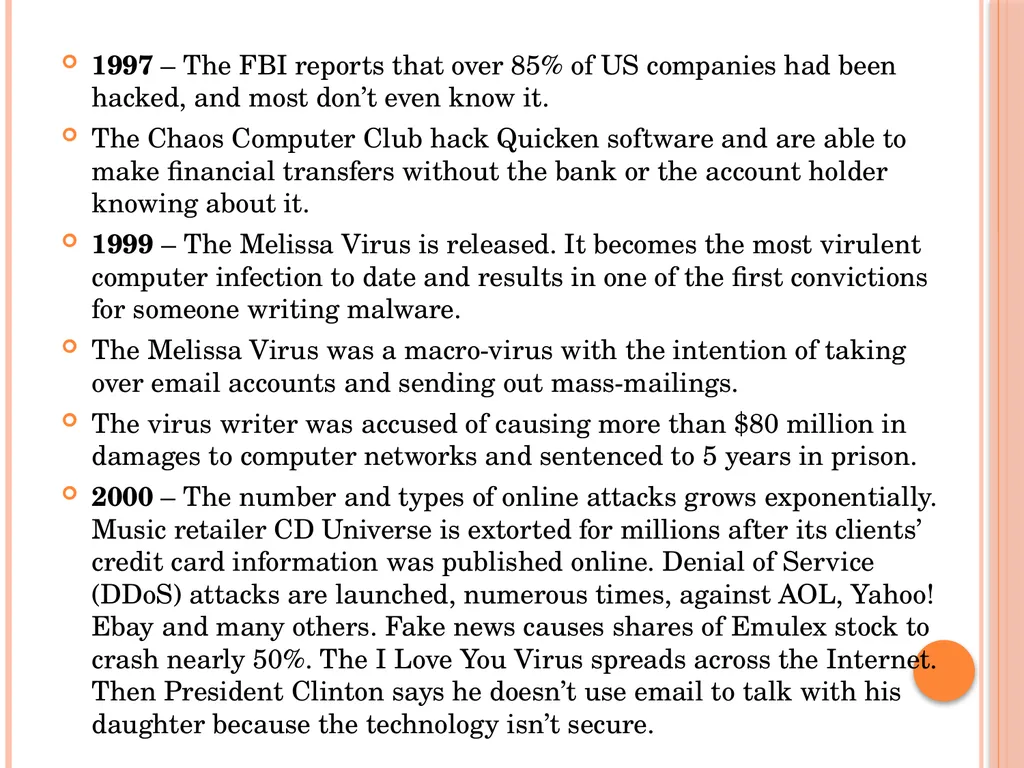
1997 – The FBI reports that over 85% of US companies had been hacked, and most don’t even know it.
The Chaos Computer Club hack Quicken software and are able to make financial transfers without the bank or the account holder knowing about it.
1999 – The Melissa Virus is released. It becomes the most virulent computer infection to date and results in one of the first convictions for someone writing malware.
The Melissa Virus was a macro-virus with the intention of taking over email accounts and sending out mass-mailings.
The virus writer was accused of causing more than $80 million in damages to computer networks and sentenced to 5 years in prison.
2000 – The number and types of online attacks grows exponentially. Music retailer CD Universe is extorted for millions after its clients’ credit card information was published online. Denial of Service (DDoS) attacks are launched, numerous times, against AOL, Yahoo! Ebay and many others. Fake news causes shares of Emulex stock to crash nearly 50%. The I Love You Virus spreads across the Internet. Then President Clinton says he doesn’t use email to talk with his daughter because the technology isn’t secure.<br>
The Chaos Computer Club hack Quicken software and are able to make financial transfers without the bank or the account holder knowing about it.
1999 – The Melissa Virus is released. It becomes the most virulent computer infection to date and results in one of the first convictions for someone writing malware.
The Melissa Virus was a macro-virus with the intention of taking over email accounts and sending out mass-mailings.
The virus writer was accused of causing more than $80 million in damages to computer networks and sentenced to 5 years in prison.
2000 – The number and types of online attacks grows exponentially. Music retailer CD Universe is extorted for millions after its clients’ credit card information was published online. Denial of Service (DDoS) attacks are launched, numerous times, against AOL, Yahoo! Ebay and many others. Fake news causes shares of Emulex stock to crash nearly 50%. The I Love You Virus spreads across the Internet. Then President Clinton says he doesn’t use email to talk with his daughter because the technology isn’t secure.<br>
10
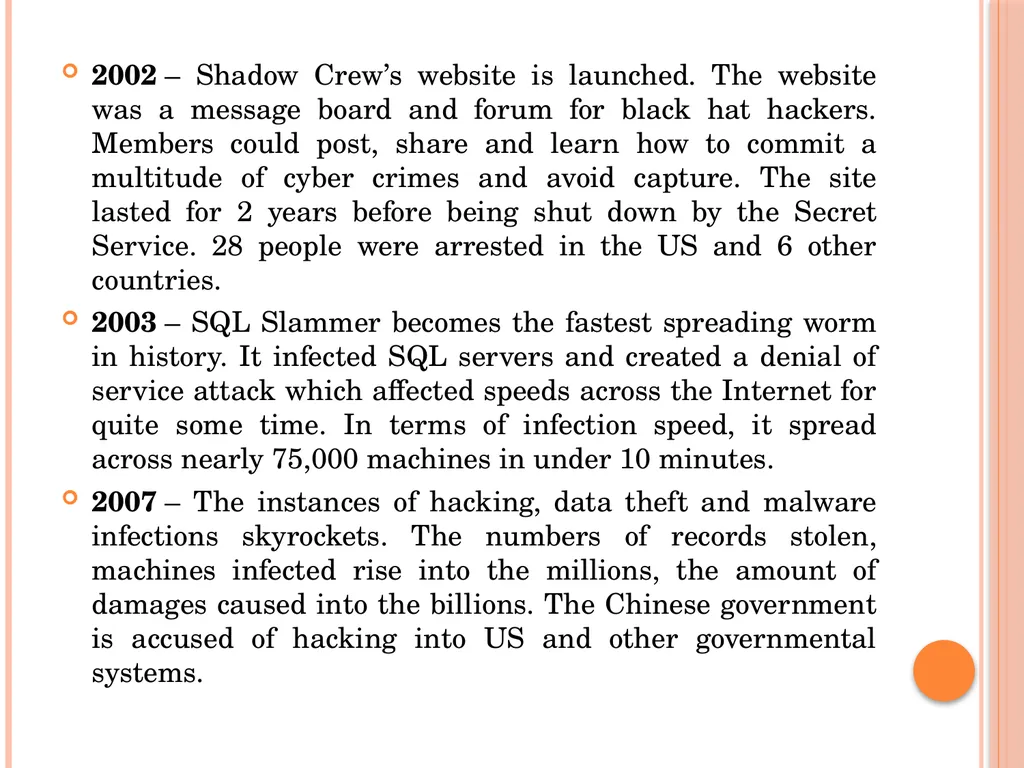
2002 – Shadow Crew’s website is launched. The website was a message board and forum for black hat hackers. Members could post, share and learn how to commit a multitude of cyber crimes and avoid capture. The site lasted for 2 years before being shut down by the Secret Service. 28 people were arrested in the US and 6 other countries.
2003 – SQL Slammer becomes the fastest spreading worm in history. It infected SQL servers and created a denial of service attack which affected speeds across the Internet for quite some time. In terms of infection speed, it spread across nearly 75,000 machines in under 10 minutes.
2007 – The instances of hacking, data theft and malware infections skyrockets. The numbers of records stolen, machines infected rise into the millions, the amount of damages caused into the billions. The Chinese government is accused of hacking into US and other governmental systems.<br>
2003 – SQL Slammer becomes the fastest spreading worm in history. It infected SQL servers and created a denial of service attack which affected speeds across the Internet for quite some time. In terms of infection speed, it spread across nearly 75,000 machines in under 10 minutes.
2007 – The instances of hacking, data theft and malware infections skyrockets. The numbers of records stolen, machines infected rise into the millions, the amount of damages caused into the billions. The Chinese government is accused of hacking into US and other governmental systems.<br>
11
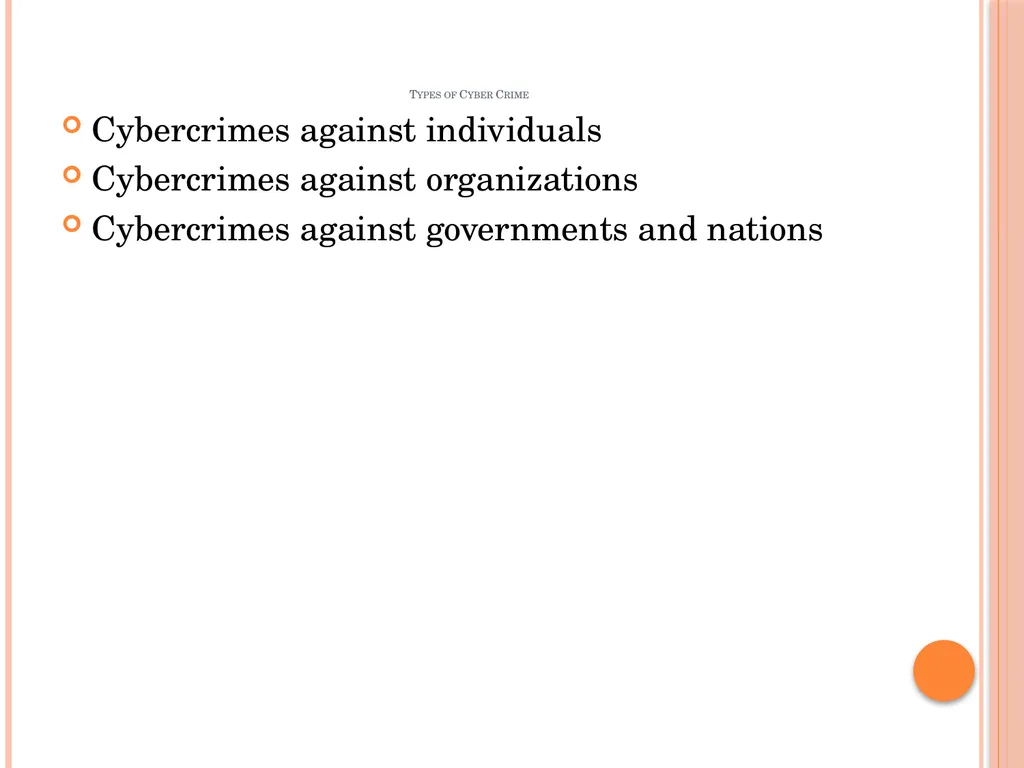
Types of Cyber Crime Cybercrimes against individuals
Cybercrimes against organizations
Cybercrimes against governments and nations<br>
Cybercrimes against organizations
Cybercrimes against governments and nations<br>
12
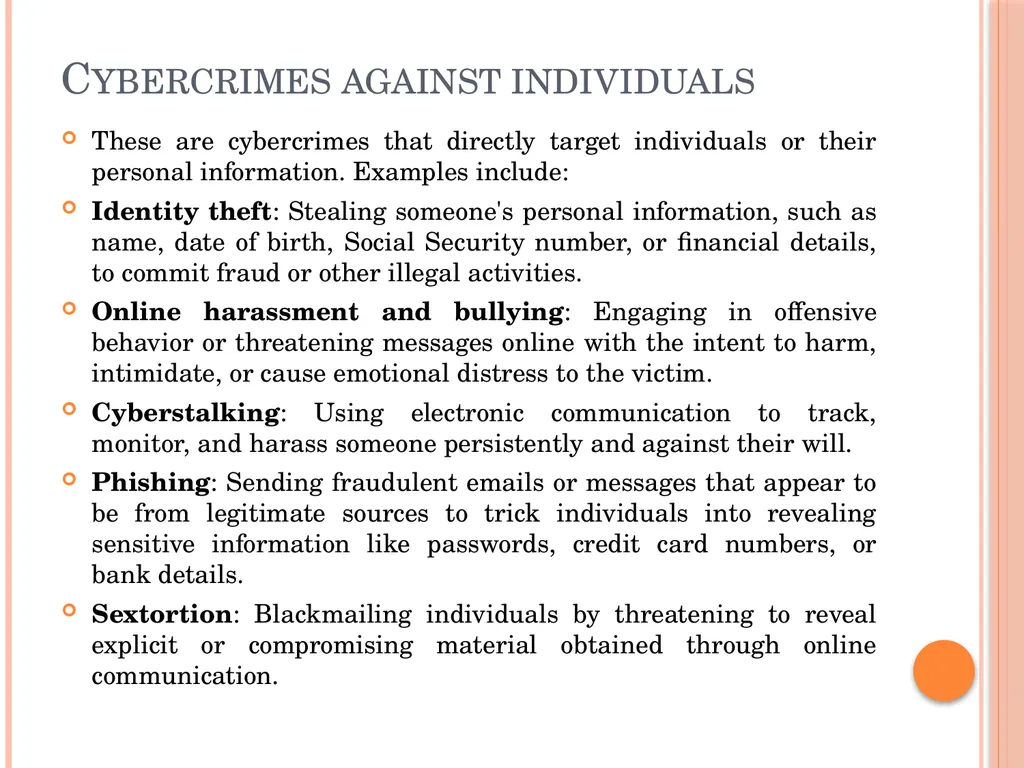
Cybercrimes against individuals These are cybercrimes that directly target individuals or their personal information. Examples include:
Identity theft: Stealing someone's personal information, such as name, date of birth, Social Security number, or financial details, to commit fraud or other illegal activities.
Online harassment and bullying: Engaging in offensive behavior or threatening messages online with the intent to harm, intimidate, or cause emotional distress to the victim.
Cyberstalking: Using electronic communication to track, monitor, and harass someone persistently and against their will.
Phishing: Sending fraudulent emails or messages that appear to be from legitimate sources to trick individuals into revealing sensitive information like passwords, credit card numbers, or bank details.
Sextortion: Blackmailing individuals by threatening to reveal explicit or compromising material obtained through online communication.<br>
Identity theft: Stealing someone's personal information, such as name, date of birth, Social Security number, or financial details, to commit fraud or other illegal activities.
Online harassment and bullying: Engaging in offensive behavior or threatening messages online with the intent to harm, intimidate, or cause emotional distress to the victim.
Cyberstalking: Using electronic communication to track, monitor, and harass someone persistently and against their will.
Phishing: Sending fraudulent emails or messages that appear to be from legitimate sources to trick individuals into revealing sensitive information like passwords, credit card numbers, or bank details.
Sextortion: Blackmailing individuals by threatening to reveal explicit or compromising material obtained through online communication.<br>
13
Cybercrimes against organizations These are cybercrimes that target businesses, government agencies, or other entities. Examples include:
Data breaches: Unauthorized access to an organization's network or database to steal sensitive information, such as customer data or intellectual property.
Ransomware attacks: Malicious software that encrypts an organization's data, rendering it inaccessible until a ransom is paid to the attackers.
Distributed Denial of Service (DDoS) attacks: Overloading a target's servers or network infrastructure with a massive volume of traffic, causing it to become unavailable to users.
Business email compromise (BEC): Impersonating a high-level executive or authority within an organization to deceive employees into transferring funds or sensitive data.<br>
Data breaches: Unauthorized access to an organization's network or database to steal sensitive information, such as customer data or intellectual property.
Ransomware attacks: Malicious software that encrypts an organization's data, rendering it inaccessible until a ransom is paid to the attackers.
Distributed Denial of Service (DDoS) attacks: Overloading a target's servers or network infrastructure with a massive volume of traffic, causing it to become unavailable to users.
Business email compromise (BEC): Impersonating a high-level executive or authority within an organization to deceive employees into transferring funds or sensitive data.<br>
14
Cybercrimes against governments and nations These are cybercrimes that target government institutions or have significant implications on national security. Examples include:
Cyber espionage: State-sponsored or politically motivated hacking activities aimed at stealing classified information or intelligence from foreign governments.
Cyber warfare: Coordinated attacks on critical infrastructure, defense systems, or communication networks of other nations to cause disruption or damage.
Cyberterrorism: Using cyberspace to conduct terrorist activities, such as spreading propaganda, coordinating attacks, or inciting violence.
State-sponsored hacking and attacks: Governments engaging in cyber operations against other countries to gain a strategic advantage, steal information, or disrupt their activities.<br>
Cyber espionage: State-sponsored or politically motivated hacking activities aimed at stealing classified information or intelligence from foreign governments.
Cyber warfare: Coordinated attacks on critical infrastructure, defense systems, or communication networks of other nations to cause disruption or damage.
Cyberterrorism: Using cyberspace to conduct terrorist activities, such as spreading propaganda, coordinating attacks, or inciting violence.
State-sponsored hacking and attacks: Governments engaging in cyber operations against other countries to gain a strategic advantage, steal information, or disrupt their activities.<br>
15
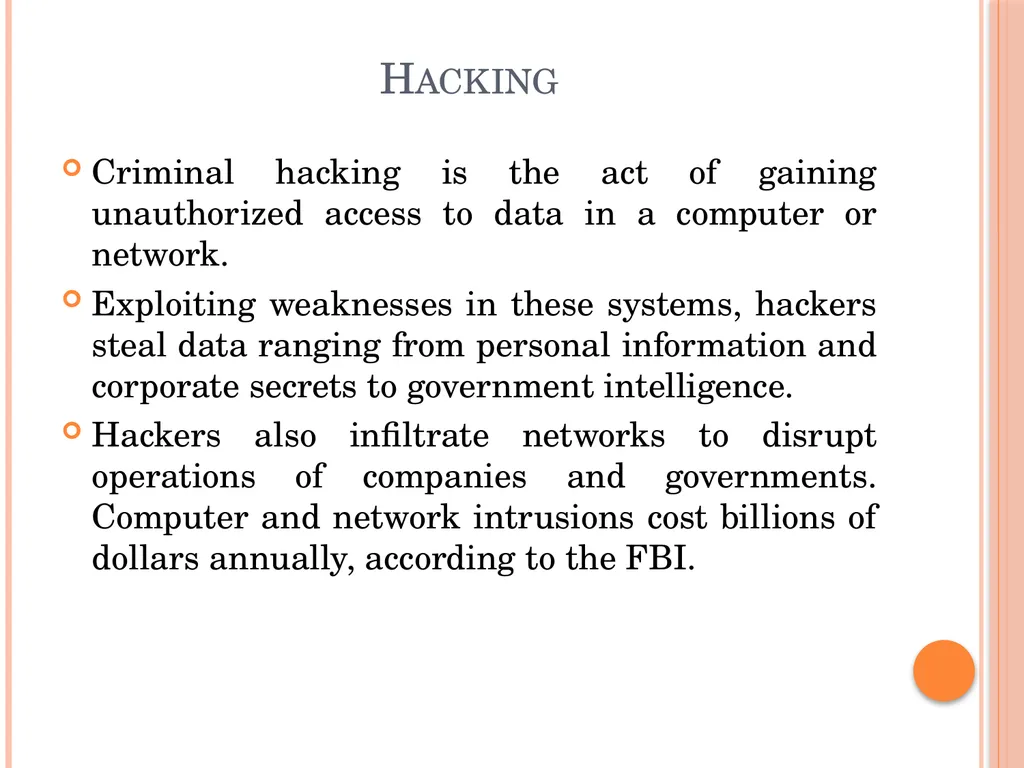
Hacking Criminal hacking is the act of gaining unauthorized access to data in a computer or network.
Exploiting weaknesses in these systems, hackers steal data ranging from personal information and corporate secrets to government intelligence.
Hackers also infiltrate networks to disrupt operations of companies and governments. Computer and network intrusions cost billions of dollars annually, according to the FBI.<br>
Exploiting weaknesses in these systems, hackers steal data ranging from personal information and corporate secrets to government intelligence.
Hackers also infiltrate networks to disrupt operations of companies and governments. Computer and network intrusions cost billions of dollars annually, according to the FBI.<br>
16
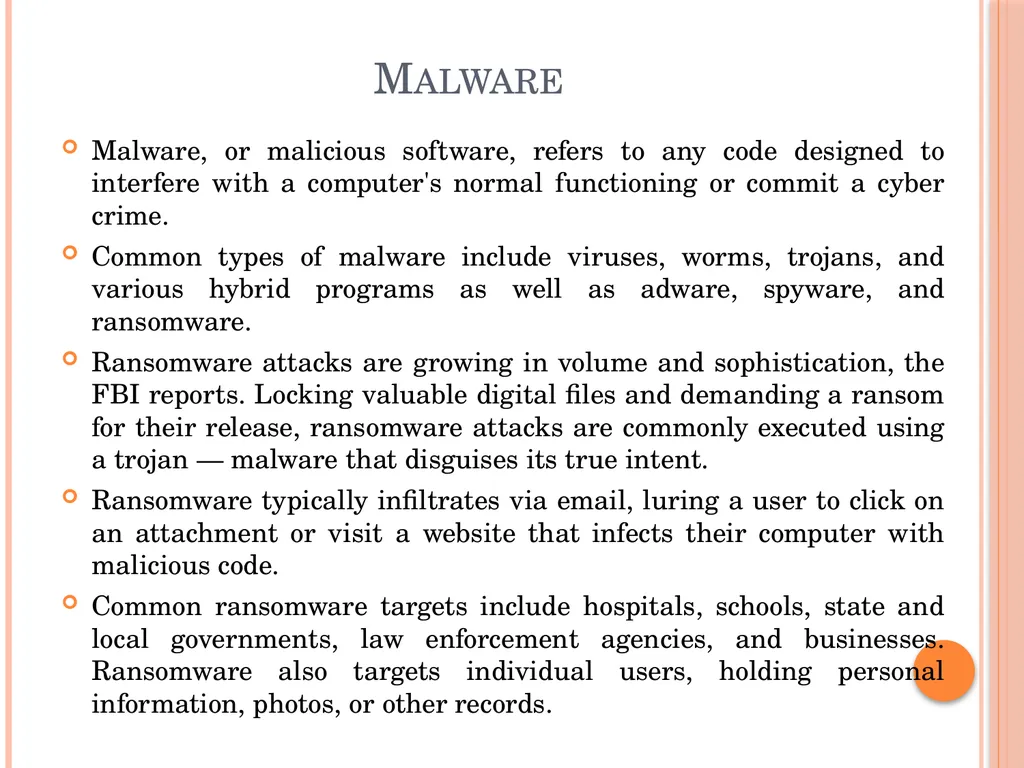
Malware Malware, or malicious software, refers to any code designed to interfere with a computer's normal functioning or commit a cyber crime.
Common types of malware include viruses, worms, trojans, and various hybrid programs as well as adware, spyware, and ransomware.
Ransomware attacks are growing in volume and sophistication, the FBI reports. Locking valuable digital files and demanding a ransom for their release, ransomware attacks are commonly executed using a trojan — malware that disguises its true intent.
Ransomware typically infiltrates via email, luring a user to click on an attachment or visit a website that infects their computer with malicious code.
Common ransomware targets include hospitals, schools, state and local governments, law enforcement agencies, and businesses. Ransomware also targets individual users, holding personal information, photos, or other records.<br>
Common types of malware include viruses, worms, trojans, and various hybrid programs as well as adware, spyware, and ransomware.
Ransomware attacks are growing in volume and sophistication, the FBI reports. Locking valuable digital files and demanding a ransom for their release, ransomware attacks are commonly executed using a trojan — malware that disguises its true intent.
Ransomware typically infiltrates via email, luring a user to click on an attachment or visit a website that infects their computer with malicious code.
Common ransomware targets include hospitals, schools, state and local governments, law enforcement agencies, and businesses. Ransomware also targets individual users, holding personal information, photos, or other records.<br>
17
Identity Theft According to the FBI, identity theft occurs when someone “unlawfully obtains another individual's personal information and uses it to commit theft or fraud”.
Not all identity thefts are a result of cyber attacks, but malware such as trojans and spyware are often used to steal personal information.<br>
Not all identity thefts are a result of cyber attacks, but malware such as trojans and spyware are often used to steal personal information.<br>
18
Social Engineering Social engineering is the psychological manipulation of people into performing actions or divulging confidential information.
Cyber criminals use social engineering to commit fraud online. Platforms such as online dating sites provide opportunities to initiate conversations with potential victims.
Once the criminal establishes a relationship with the target and gains their trust, the criminal asks for money or information.
In 2011, a series of high-profile celebrities, including actors, musicians, and sports personalities, fell victim to a social engineering attack known as the "Hackerazzi" incident. The attack involved unauthorized access to private online accounts and personal devices, leading to the leak of private and sensitive photos and videos of these celebrities.<br>
Cyber criminals use social engineering to commit fraud online. Platforms such as online dating sites provide opportunities to initiate conversations with potential victims.
Once the criminal establishes a relationship with the target and gains their trust, the criminal asks for money or information.
In 2011, a series of high-profile celebrities, including actors, musicians, and sports personalities, fell victim to a social engineering attack known as the "Hackerazzi" incident. The attack involved unauthorized access to private online accounts and personal devices, leading to the leak of private and sensitive photos and videos of these celebrities.<br>
19
Software Piracy Software piracy is unauthorized reproduction, distribution, and use of software.
Pirated software takes the form of counterfeited commercial products and illegal downloads and reproductions, as well as violations of licensing agreements that limit the number of users who can access a program.
As much as 37% of software installed on personal computers globally is unlicensed, according to BSA | The Software Alliance.
Pirate Bay (2008)
In 2008, Adobe, along with several other software companies, took legal action against The Pirate Bay, a prominent torrent indexing website known for hosting links to illegal copies of copyrighted content, including software, music, movies, and games.<br>
Pirated software takes the form of counterfeited commercial products and illegal downloads and reproductions, as well as violations of licensing agreements that limit the number of users who can access a program.
As much as 37% of software installed on personal computers globally is unlicensed, according to BSA | The Software Alliance.
Pirate Bay (2008)
In 2008, Adobe, along with several other software companies, took legal action against The Pirate Bay, a prominent torrent indexing website known for hosting links to illegal copies of copyrighted content, including software, music, movies, and games.<br>
20
Denial-of-Service (DoS) A Denial-of-Service (DoS) attack is an attack on a computer network that limits, restricts, or stops authorized users from accessing system resources.
DoS attacks work by flooding the target with traffic or sending it data that causes it to crash. It deprives genuine users of the service or resources they expect to receive.
DoS assaults frequently target high-profile corporations such as banks, commerce, media companies, and government and trade organizations' web servers.
Even through DoS assaults seldom result in the theft or loss of critical information or other assets, they can take a lot of time and money to cope with.
GitHub DDoS Attack (2018)
In February 2018, GitHub experienced one of the largest DDoS attacks in its history. The attack targeted GitHub's infrastructure with a significant volume of traffic, causing a disruption of service for its users.<br>
DoS attacks work by flooding the target with traffic or sending it data that causes it to crash. It deprives genuine users of the service or resources they expect to receive.
DoS assaults frequently target high-profile corporations such as banks, commerce, media companies, and government and trade organizations' web servers.
Even through DoS assaults seldom result in the theft or loss of critical information or other assets, they can take a lot of time and money to cope with.
GitHub DDoS Attack (2018)
In February 2018, GitHub experienced one of the largest DDoS attacks in its history. The attack targeted GitHub's infrastructure with a significant volume of traffic, causing a disruption of service for its users.<br>
21
Types of DoS Attacks DoS attacks can be carried out in two ways − flooding or crashing systems.
Flood assaults happen when a system receives too much traffic for the server to buffer, leading it to slow down and eventually stop responding. Some of the attacks are −
Attacks to the Volumetric System
This is an attack in which a network's whole bandwidth is utilized, preventing authorized clients from accessing resources.
This is accomplished by flooding network equipment such as hubs or switches with multiple ICMP echo request/reply packets, consuming all available bandwidth and preventing other clients from connecting to the target network.<br>
Flood assaults happen when a system receives too much traffic for the server to buffer, leading it to slow down and eventually stop responding. Some of the attacks are −
Attacks to the Volumetric System
This is an attack in which a network's whole bandwidth is utilized, preventing authorized clients from accessing resources.
This is accomplished by flooding network equipment such as hubs or switches with multiple ICMP echo request/reply packets, consuming all available bandwidth and preventing other clients from connecting to the target network.<br>
22
Flooding at the Application Layer
In this form of attack, an attacker floods the service with requests from a fake IP address to slow or crash it, as seen in.
This could be in the form of millions of requests per second or a few thousand requests to a resource-intensive service that chews up resources until the service can no longer process them.
Unintended Denial of Service Attacks
Not all denial-of-service assaults are malicious. The "unintended" Denial of Service attack is the third type of attack.
"The Slashdot Effect (opens new window)" is the archetypal example of an accidental DDoS.
Slashdot is a news website where anyone may upload stories and links to other websites.<br>
In this form of attack, an attacker floods the service with requests from a fake IP address to slow or crash it, as seen in.
This could be in the form of millions of requests per second or a few thousand requests to a resource-intensive service that chews up resources until the service can no longer process them.
Unintended Denial of Service Attacks
Not all denial-of-service assaults are malicious. The "unintended" Denial of Service attack is the third type of attack.
"The Slashdot Effect (opens new window)" is the archetypal example of an accidental DDoS.
Slashdot is a news website where anyone may upload stories and links to other websites.<br>
23
ICMP Flood
It takes advantage of misconfigured network devices by delivering faked packets that ping every computer on the targeted network rather than just one.
The network is then activated to increase the traffic volume. The "smurf attack" or "ping of death" is another name for this attack.
SYN Flood
It submits a connection request to a server but does not complete the handshake.
It continues until all open ports are flooded with requests, and no legitimate users can connect to them.<br>
It takes advantage of misconfigured network devices by delivering faked packets that ping every computer on the targeted network rather than just one.
The network is then activated to increase the traffic volume. The "smurf attack" or "ping of death" is another name for this attack.
SYN Flood
It submits a connection request to a server but does not complete the handshake.
It continues until all open ports are flooded with requests, and no legitimate users can connect to them.<br>
24
Plashing
This is accomplished by permanently damaging the system hardware by sending fake updates to the hardware, rendering it inoperable. Reinstalling the hardware is the only option.<br>
This is accomplished by permanently damaging the system hardware by sending fake updates to the hardware, rendering it inoperable. Reinstalling the hardware is the only option.<br>
25
How to Protect Yourself from DoS Attacks? Prevent spoofing by ensuring that traffic has a source address that matches the list of addresses for the declared site of origin and filters to prevent spoofing of dial-up connections.
Limit broadcasting − Many assaults transmit requests to all network devices, magnifying the attack.
Attacks can be disrupted by limiting or shutting off broadcast forwarding where possible.
When possible, users can also turn off the echo and CHARGEN (Character Generator Protocol) services.<br>
Limit broadcasting − Many assaults transmit requests to all network devices, magnifying the attack.
Attacks can be disrupted by limiting or shutting off broadcast forwarding where possible.
When possible, users can also turn off the echo and CHARGEN (Character Generator Protocol) services.<br>
26
Endpoint protection − Make sure all endpoints are patched to eliminate known vulnerabilities.
EDR agents should be installed on all endpoints that are capable of running them.
Set up firewalls − Check to see if your firewalls limit inbound and outbound traffic across the perimeter.
Monitor the network − The more you know about typical inbound traffic, the faster you'll be able to recognize the beginning of a DoS attack.
Real-time visibility with network detection and response (NDR) is a quick and easy approach to keep a profile of how your network should look (using machine learning), so you can see abnormal peaks right away.<br>
EDR agents should be installed on all endpoints that are capable of running them.
Set up firewalls − Check to see if your firewalls limit inbound and outbound traffic across the perimeter.
Monitor the network − The more you know about typical inbound traffic, the faster you'll be able to recognize the beginning of a DoS attack.
Real-time visibility with network detection and response (NDR) is a quick and easy approach to keep a profile of how your network should look (using machine learning), so you can see abnormal peaks right away.<br>
27
Cyber security tool:
Penetration testing tools Kali Linux
It is an operating system containing at least 300 different tools for security auditing.
Kali Linux provides various tools that organizations use to scan their networks and IT systems for vulnerabilities.
The main benefit of Kali Linux is that it can be used by users with different levels of cybersecurity knowledge.
Metasploit
Metasploit can test the security of different systems, including online-based or web-based applications, networks, and servers, among others.
Metasploit identifies all new security vulnerabilities as they emerge, thus ensuring round-the-clock security.<br>
It is an operating system containing at least 300 different tools for security auditing.
Kali Linux provides various tools that organizations use to scan their networks and IT systems for vulnerabilities.
The main benefit of Kali Linux is that it can be used by users with different levels of cybersecurity knowledge.
Metasploit
Metasploit can test the security of different systems, including online-based or web-based applications, networks, and servers, among others.
Metasploit identifies all new security vulnerabilities as they emerge, thus ensuring round-the-clock security.<br>
28
Password auditing and packet sniffers cybersecurity tools Cain and Abel
Cain and Abel is one of the earliest cybersecurity tools used to uncover vulnerabilities in Windows Operating systems.
Cain and Abel enable security professionals to discover weaknesses in the password security of systems running on the Windows operating system.
Cain and Abel can analyze routing protocols to determine whether routed data packets can be compromised.
Wireshark
Wireshark, formerly known as Ethereal, is a console-based cybersecurity tool. Wireshark is an excellent tool for analyzing network protocols and hence used for analyzing network security in real-time.
Security professionals use Wireshark to capture data packets and investigate the characteristics which individual data packets exhibit. The obtained information permits easy identification of weaknesses in the network’s security.<br>
Cain and Abel is one of the earliest cybersecurity tools used to uncover vulnerabilities in Windows Operating systems.
Cain and Abel enable security professionals to discover weaknesses in the password security of systems running on the Windows operating system.
Cain and Abel can analyze routing protocols to determine whether routed data packets can be compromised.
Wireshark
Wireshark, formerly known as Ethereal, is a console-based cybersecurity tool. Wireshark is an excellent tool for analyzing network protocols and hence used for analyzing network security in real-time.
Security professionals use Wireshark to capture data packets and investigate the characteristics which individual data packets exhibit. The obtained information permits easy identification of weaknesses in the network’s security.<br>
29
John the Ripper
John the Ripper is a vital cybersecurity tool used for testing password strength.
The tool is designed to quickly identify weak passwords which might pose security threats to a protected system.
John the Ripper was initially intended for use in Unix environments.
Tcpdump
Tcpdump is a handy tool for sniffing data packets in a network. Cybersecurity professionals use it to monitor as well as log TCP and IP traffic communicated through a network.
Tcpdump is a command-based software utility that analyzes network traffic between the computer it is executed in and the network the traffic passes through.<br>
John the Ripper is a vital cybersecurity tool used for testing password strength.
The tool is designed to quickly identify weak passwords which might pose security threats to a protected system.
John the Ripper was initially intended for use in Unix environments.
Tcpdump
Tcpdump is a handy tool for sniffing data packets in a network. Cybersecurity professionals use it to monitor as well as log TCP and IP traffic communicated through a network.
Tcpdump is a command-based software utility that analyzes network traffic between the computer it is executed in and the network the traffic passes through.<br>
30
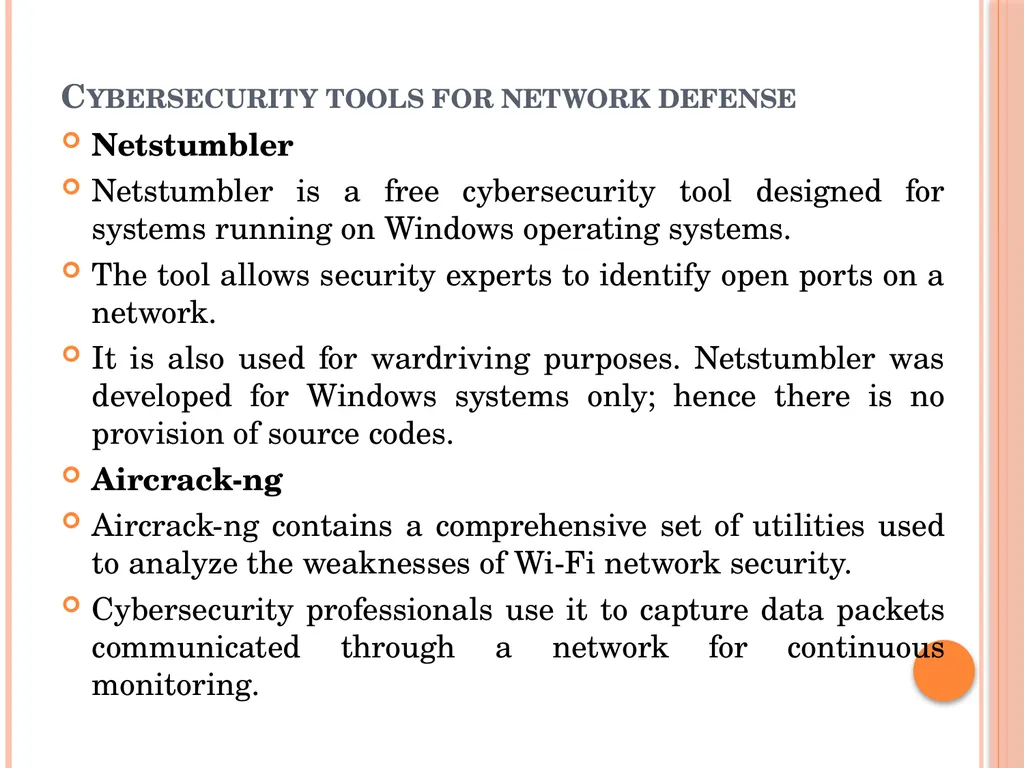
Cybersecurity tools for network defense Netstumbler
Netstumbler is a free cybersecurity tool designed for systems running on Windows operating systems.
The tool allows security experts to identify open ports on a network.
It is also used for wardriving purposes. Netstumbler was developed for Windows systems only; hence there is no provision of source codes.
Aircrack-ng
Aircrack-ng contains a comprehensive set of utilities used to analyze the weaknesses of Wi-Fi network security.
Cybersecurity professionals use it to capture data packets communicated through a network for continuous monitoring.<br>
Netstumbler is a free cybersecurity tool designed for systems running on Windows operating systems.
The tool allows security experts to identify open ports on a network.
It is also used for wardriving purposes. Netstumbler was developed for Windows systems only; hence there is no provision of source codes.
Aircrack-ng
Aircrack-ng contains a comprehensive set of utilities used to analyze the weaknesses of Wi-Fi network security.
Cybersecurity professionals use it to capture data packets communicated through a network for continuous monitoring.<br>
31
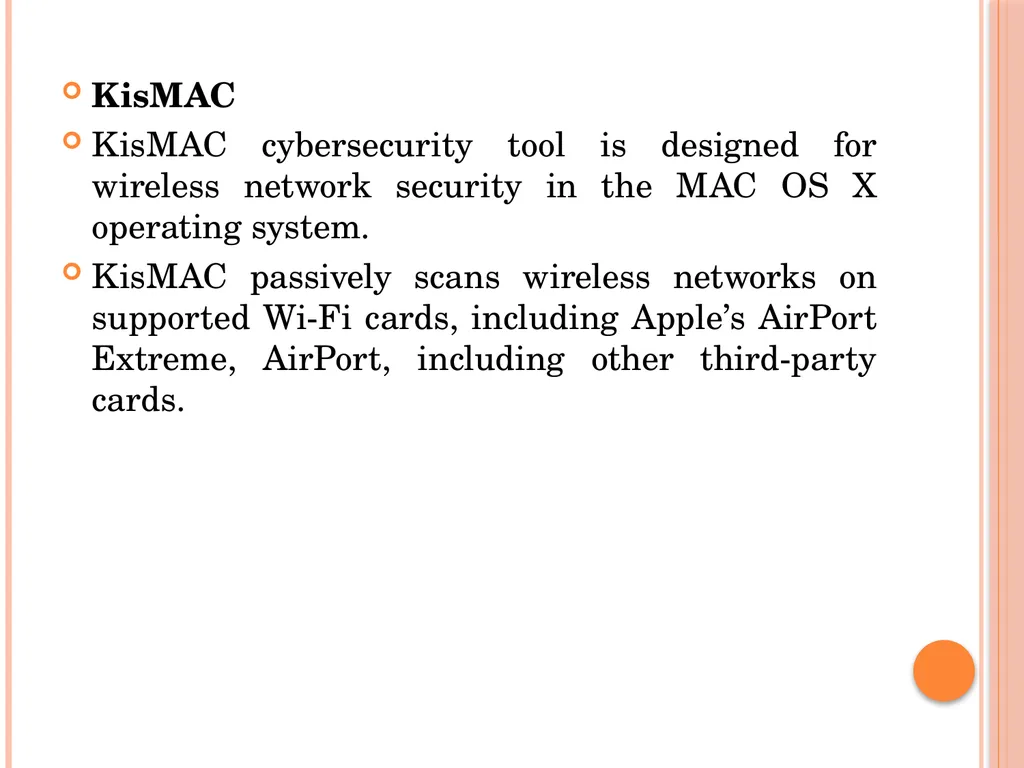
KisMAC
KisMAC cybersecurity tool is designed for wireless network security in the MAC OS X operating system.
KisMAC passively scans wireless networks on supported Wi-Fi cards, including Apple’s AirPort Extreme, AirPort, including other third-party cards.<br>
KisMAC cybersecurity tool is designed for wireless network security in the MAC OS X operating system.
KisMAC passively scans wireless networks on supported Wi-Fi cards, including Apple’s AirPort Extreme, AirPort, including other third-party cards.<br>
32
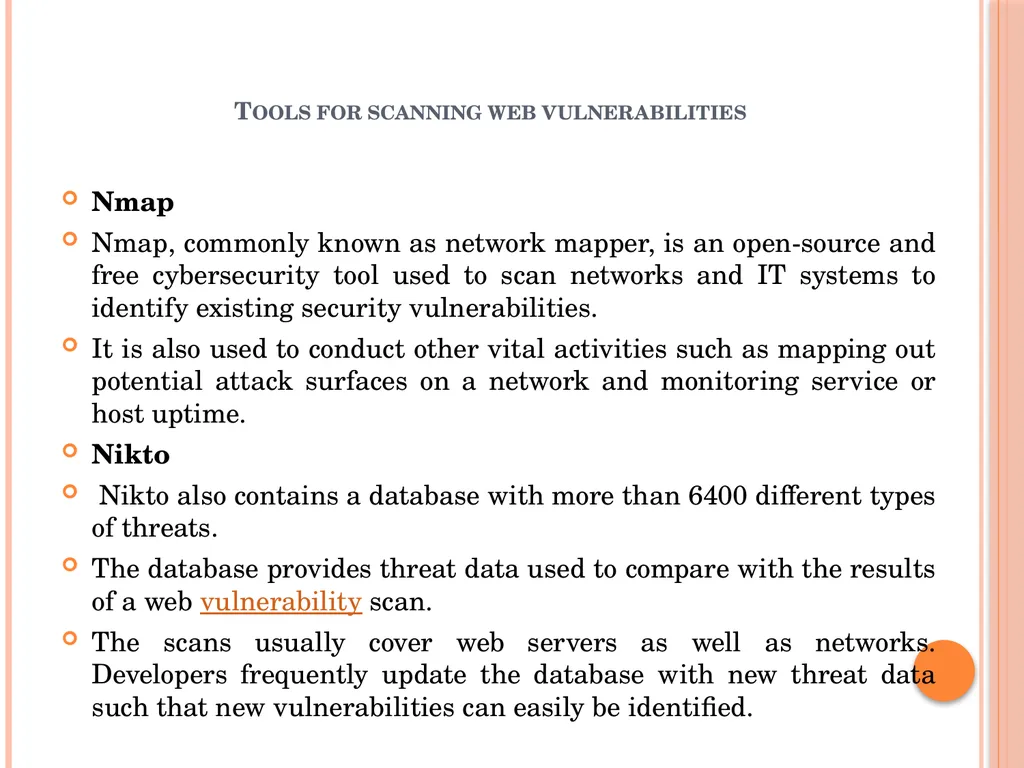
Tools for scanning web vulnerabilities Nmap
Nmap, commonly known as network mapper, is an open-source and free cybersecurity tool used to scan networks and IT systems to identify existing security vulnerabilities.
It is also used to conduct other vital activities such as mapping out potential attack surfaces on a network and monitoring service or host uptime.
Nikto
Nikto also contains a database with more than 6400 different types of threats.
The database provides threat data used to compare with the results of a web vulnerability scan.
The scans usually cover web servers as well as networks. Developers frequently update the database with new threat data such that new vulnerabilities can easily be identified.<br>
Nmap, commonly known as network mapper, is an open-source and free cybersecurity tool used to scan networks and IT systems to identify existing security vulnerabilities.
It is also used to conduct other vital activities such as mapping out potential attack surfaces on a network and monitoring service or host uptime.
Nikto
Nikto also contains a database with more than 6400 different types of threats.
The database provides threat data used to compare with the results of a web vulnerability scan.
The scans usually cover web servers as well as networks. Developers frequently update the database with new threat data such that new vulnerabilities can easily be identified.<br>
33
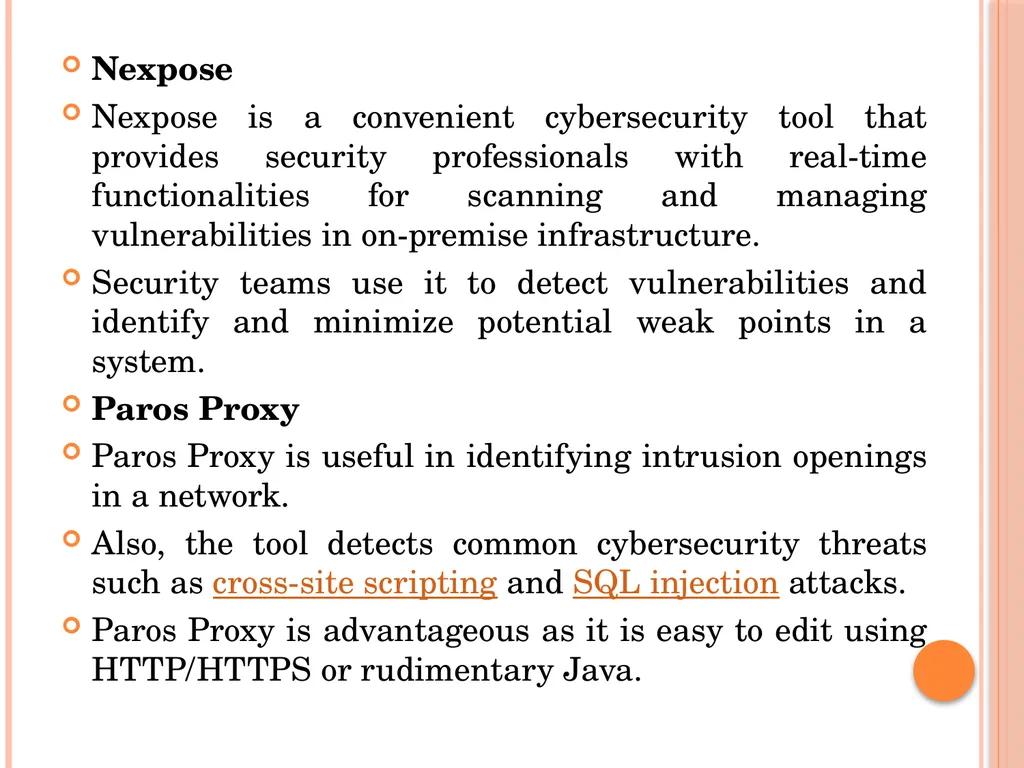
Nexpose
Nexpose is a convenient cybersecurity tool that provides security professionals with real-time functionalities for scanning and managing vulnerabilities in on-premise infrastructure.
Security teams use it to detect vulnerabilities and identify and minimize potential weak points in a system.
Paros Proxy
Paros Proxy is useful in identifying intrusion openings in a network.
Also, the tool detects common cybersecurity threats such as cross-site scripting and SQL injection attacks.
Paros Proxy is advantageous as it is easy to edit using HTTP/HTTPS or rudimentary Java.<br>
Nexpose is a convenient cybersecurity tool that provides security professionals with real-time functionalities for scanning and managing vulnerabilities in on-premise infrastructure.
Security teams use it to detect vulnerabilities and identify and minimize potential weak points in a system.
Paros Proxy
Paros Proxy is useful in identifying intrusion openings in a network.
Also, the tool detects common cybersecurity threats such as cross-site scripting and SQL injection attacks.
Paros Proxy is advantageous as it is easy to edit using HTTP/HTTPS or rudimentary Java.<br>
34
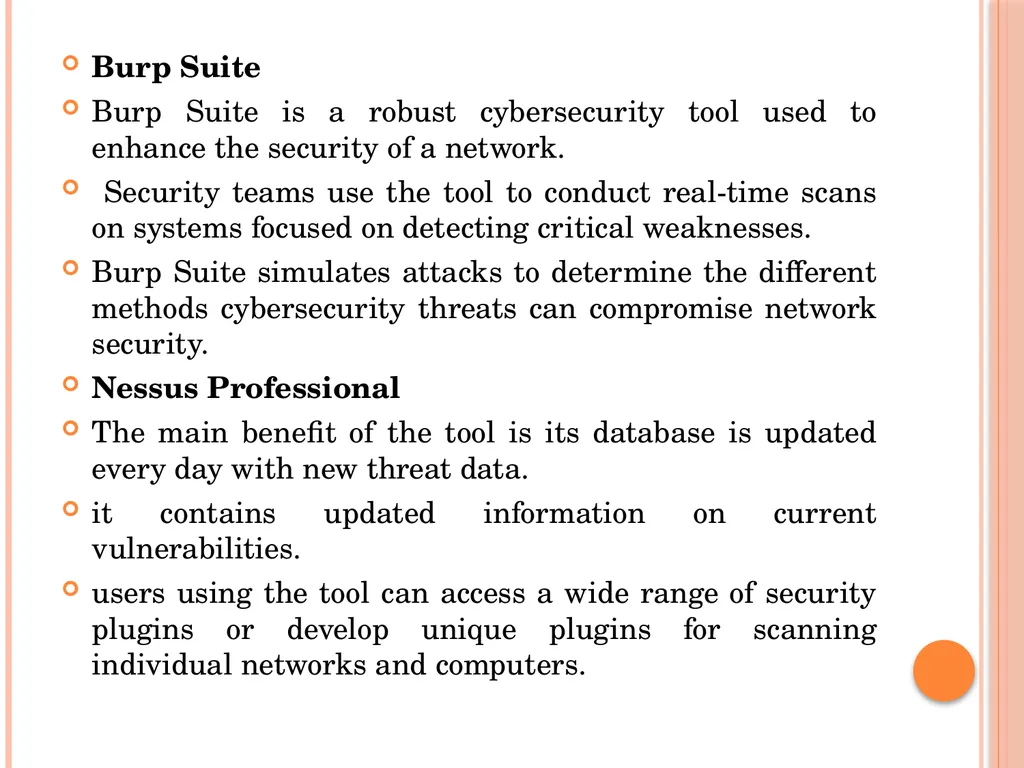
Burp Suite
Burp Suite is a robust cybersecurity tool used to enhance the security of a network.
Security teams use the tool to conduct real-time scans on systems focused on detecting critical weaknesses.
Burp Suite simulates attacks to determine the different methods cybersecurity threats can compromise network security.
Nessus Professional
The main benefit of the tool is its database is updated every day with new threat data.
it contains updated information on current vulnerabilities.
users using the tool can access a wide range of security plugins or develop unique plugins for scanning individual networks and computers.<br>
Burp Suite is a robust cybersecurity tool used to enhance the security of a network.
Security teams use the tool to conduct real-time scans on systems focused on detecting critical weaknesses.
Burp Suite simulates attacks to determine the different methods cybersecurity threats can compromise network security.
Nessus Professional
The main benefit of the tool is its database is updated every day with new threat data.
it contains updated information on current vulnerabilities.
users using the tool can access a wide range of security plugins or develop unique plugins for scanning individual networks and computers.<br>
35
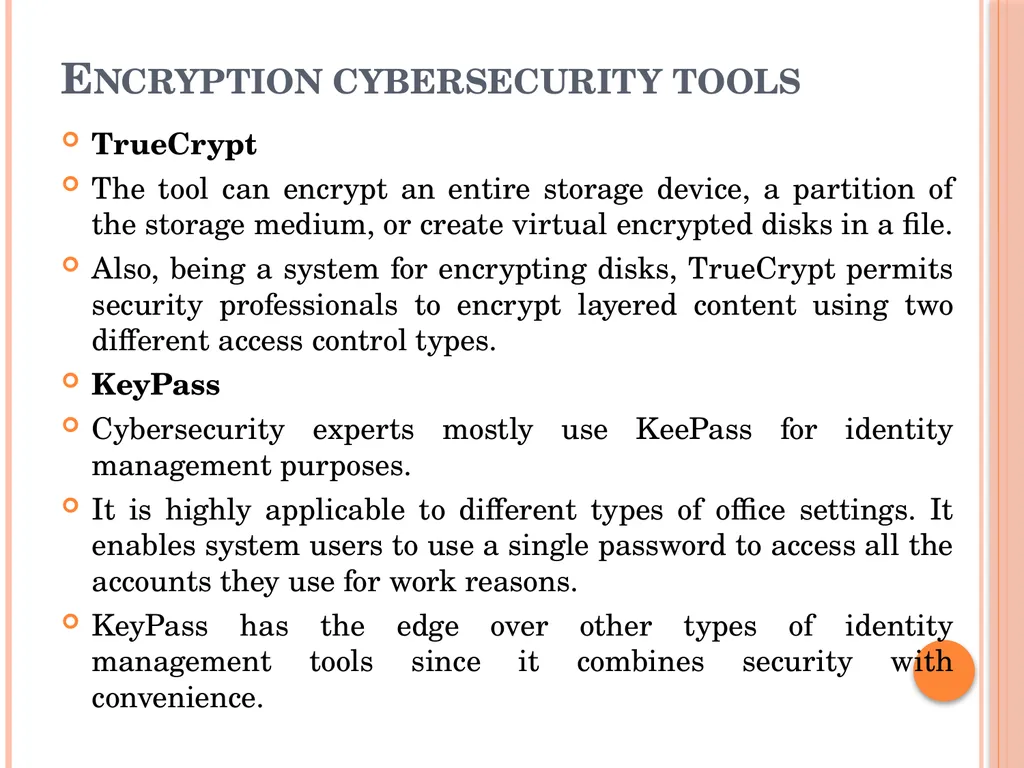
Encryption cybersecurity tools TrueCrypt
The tool can encrypt an entire storage device, a partition of the storage medium, or create virtual encrypted disks in a file.
Also, being a system for encrypting disks, TrueCrypt permits security professionals to encrypt layered content using two different access control types.
KeyPass
Cybersecurity experts mostly use KeePass for identity management purposes.
It is highly applicable to different types of office settings. It enables system users to use a single password to access all the accounts they use for work reasons.
KeyPass has the edge over other types of identity management tools since it combines security with convenience.<br>
The tool can encrypt an entire storage device, a partition of the storage medium, or create virtual encrypted disks in a file.
Also, being a system for encrypting disks, TrueCrypt permits security professionals to encrypt layered content using two different access control types.
KeyPass
Cybersecurity experts mostly use KeePass for identity management purposes.
It is highly applicable to different types of office settings. It enables system users to use a single password to access all the accounts they use for work reasons.
KeyPass has the edge over other types of identity management tools since it combines security with convenience.<br>
36
Tor
Tor is a highly efficient tool used for providing users with privacy when connected to the internet.
This is by routing the requests users make to different proxy servers such that it is hard to trace their presence on the internet.<br>
Tor is a highly efficient tool used for providing users with privacy when connected to the internet.
This is by routing the requests users make to different proxy servers such that it is hard to trace their presence on the internet.<br>
37
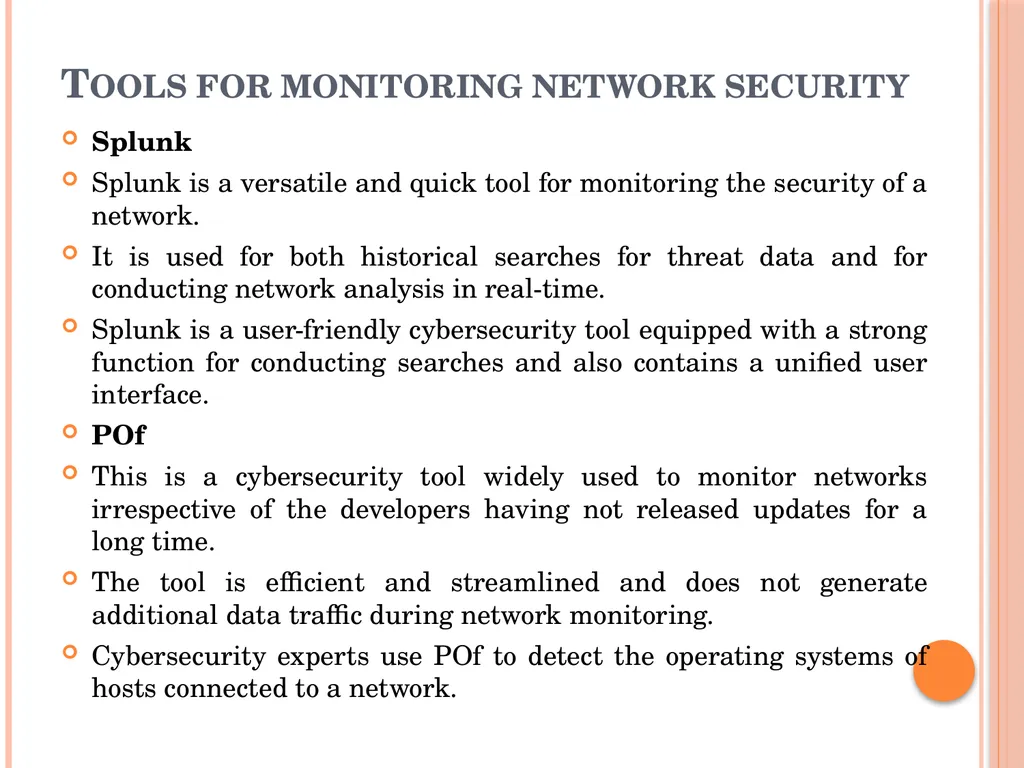
Tools for monitoring network security Splunk
Splunk is a versatile and quick tool for monitoring the security of a network.
It is used for both historical searches for threat data and for conducting network analysis in real-time.
Splunk is a user-friendly cybersecurity tool equipped with a strong function for conducting searches and also contains a unified user interface.
POf
This is a cybersecurity tool widely used to monitor networks irrespective of the developers having not released updates for a long time.
The tool is efficient and streamlined and does not generate additional data traffic during network monitoring.
Cybersecurity experts use POf to detect the operating systems of hosts connected to a network.<br>
Splunk is a versatile and quick tool for monitoring the security of a network.
It is used for both historical searches for threat data and for conducting network analysis in real-time.
Splunk is a user-friendly cybersecurity tool equipped with a strong function for conducting searches and also contains a unified user interface.
POf
This is a cybersecurity tool widely used to monitor networks irrespective of the developers having not released updates for a long time.
The tool is efficient and streamlined and does not generate additional data traffic during network monitoring.
Cybersecurity experts use POf to detect the operating systems of hosts connected to a network.<br>
38
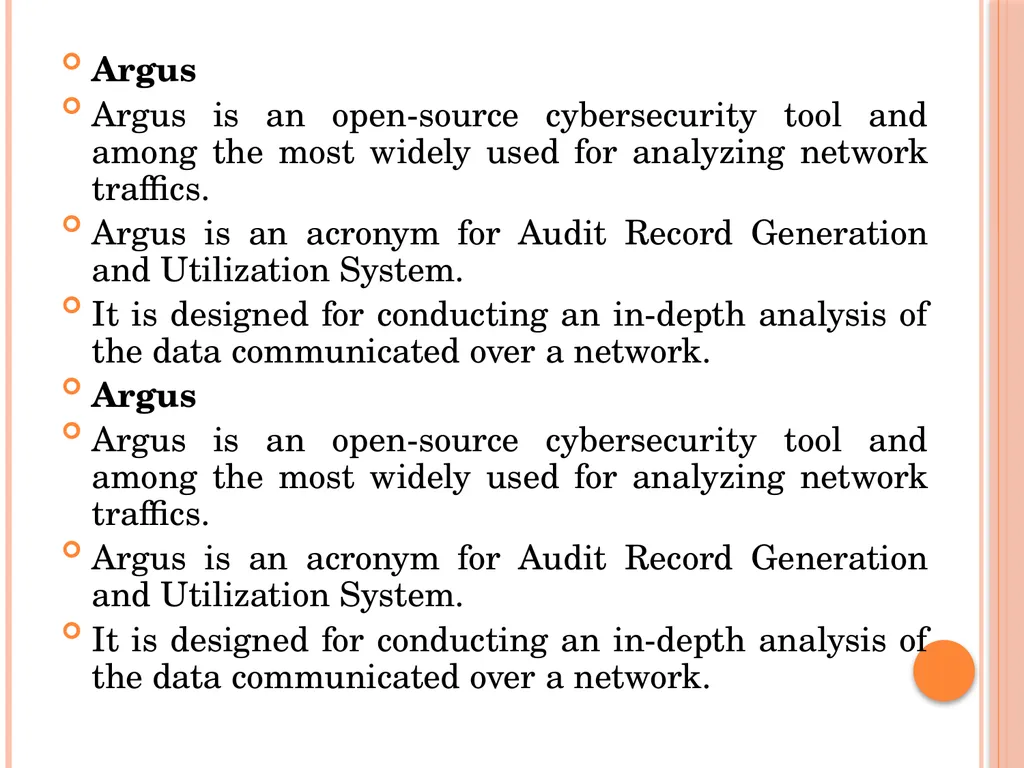
Argus
Argus is an open-source cybersecurity tool and among the most widely used for analyzing network traffics.
Argus is an acronym for Audit Record Generation and Utilization System.
It is designed for conducting an in-depth analysis of the data communicated over a network.
Argus
Argus is an open-source cybersecurity tool and among the most widely used for analyzing network traffics.
Argus is an acronym for Audit Record Generation and Utilization System.
It is designed for conducting an in-depth analysis of the data communicated over a network.<br>
Argus is an open-source cybersecurity tool and among the most widely used for analyzing network traffics.
Argus is an acronym for Audit Record Generation and Utilization System.
It is designed for conducting an in-depth analysis of the data communicated over a network.
Argus
Argus is an open-source cybersecurity tool and among the most widely used for analyzing network traffics.
Argus is an acronym for Audit Record Generation and Utilization System.
It is designed for conducting an in-depth analysis of the data communicated over a network.<br>
39
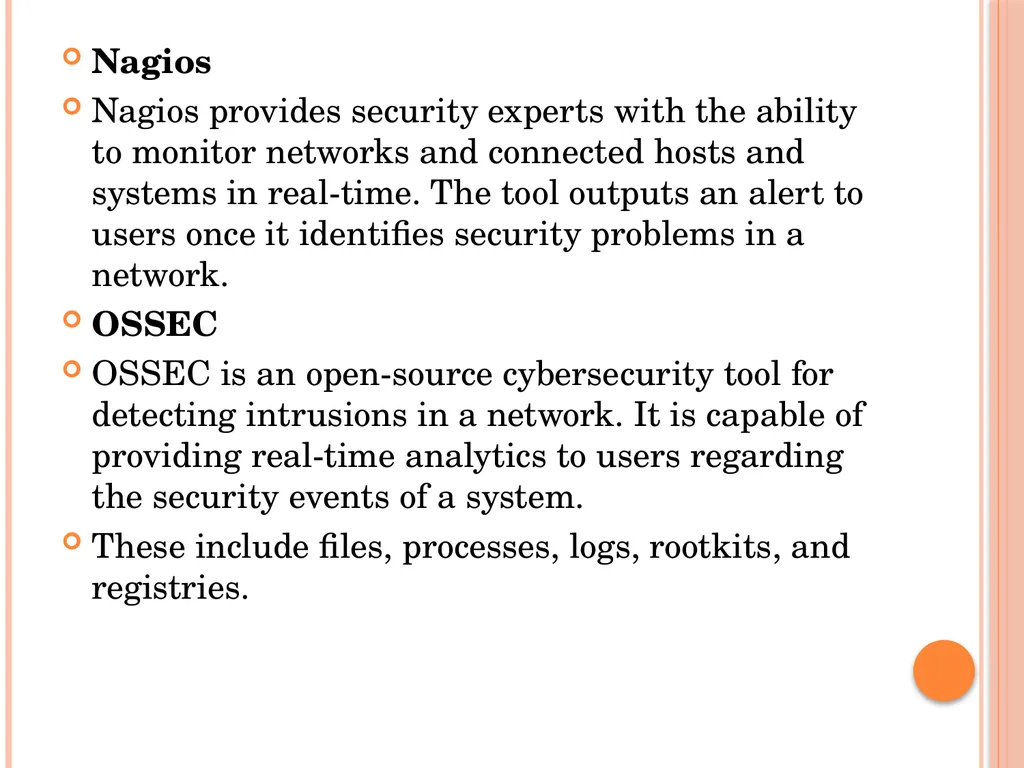
Nagios
Nagios provides security experts with the ability to monitor networks and connected hosts and systems in real-time. The tool outputs an alert to users once it identifies security problems in a network.
OSSEC
OSSEC is an open-source cybersecurity tool for detecting intrusions in a network. It is capable of providing real-time analytics to users regarding the security events of a system.
These include files, processes, logs, rootkits, and registries.<br>
Nagios provides security experts with the ability to monitor networks and connected hosts and systems in real-time. The tool outputs an alert to users once it identifies security problems in a network.
OSSEC
OSSEC is an open-source cybersecurity tool for detecting intrusions in a network. It is capable of providing real-time analytics to users regarding the security events of a system.
These include files, processes, logs, rootkits, and registries.<br>
40
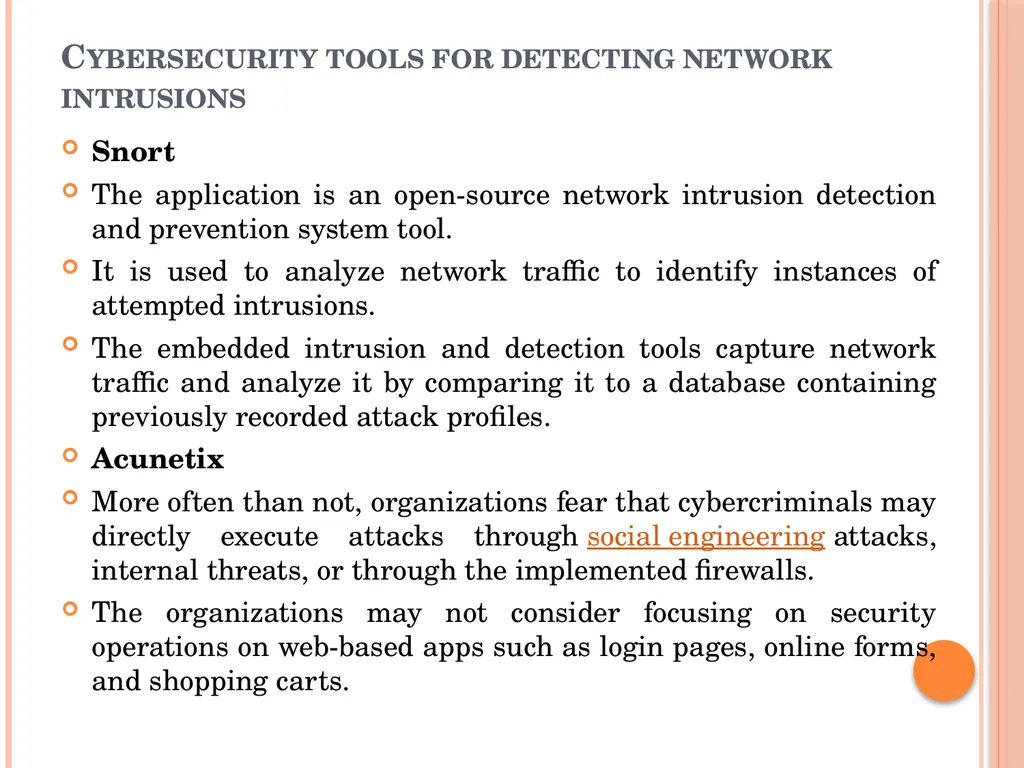
Cybersecurity tools for detecting network intrusions Snort
The application is an open-source network intrusion detection and prevention system tool.
It is used to analyze network traffic to identify instances of attempted intrusions.
The embedded intrusion and detection tools capture network traffic and analyze it by comparing it to a database containing previously recorded attack profiles.
Acunetix
More often than not, organizations fear that cybercriminals may directly execute attacks through social engineering attacks, internal threats, or through the implemented firewalls.
The organizations may not consider focusing on security operations on web-based apps such as login pages, online forms, and shopping carts.<br>
The application is an open-source network intrusion detection and prevention system tool.
It is used to analyze network traffic to identify instances of attempted intrusions.
The embedded intrusion and detection tools capture network traffic and analyze it by comparing it to a database containing previously recorded attack profiles.
Acunetix
More often than not, organizations fear that cybercriminals may directly execute attacks through social engineering attacks, internal threats, or through the implemented firewalls.
The organizations may not consider focusing on security operations on web-based apps such as login pages, online forms, and shopping carts.<br>
41
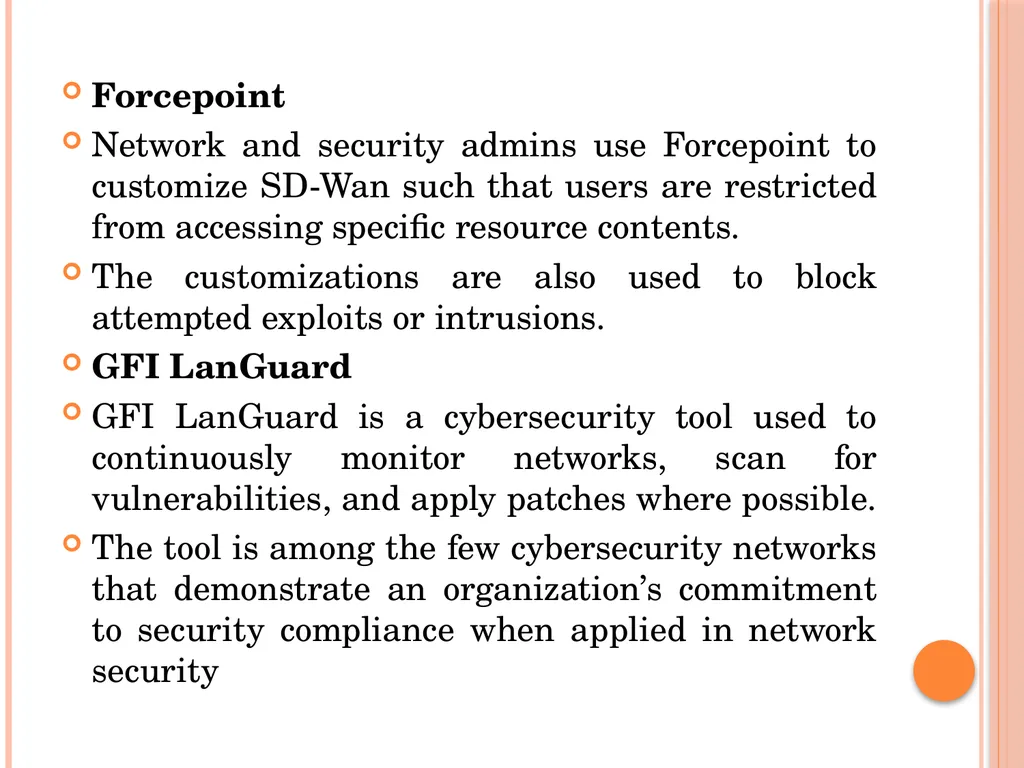
Forcepoint
Network and security admins use Forcepoint to customize SD-Wan such that users are restricted from accessing specific resource contents.
The customizations are also used to block attempted exploits or intrusions.
GFI LanGuard
GFI LanGuard is a cybersecurity tool used to continuously monitor networks, scan for vulnerabilities, and apply patches where possible.
The tool is among the few cybersecurity networks that demonstrate an organization’s commitment to security compliance when applied in network security<br>
Network and security admins use Forcepoint to customize SD-Wan such that users are restricted from accessing specific resource contents.
The customizations are also used to block attempted exploits or intrusions.
GFI LanGuard
GFI LanGuard is a cybersecurity tool used to continuously monitor networks, scan for vulnerabilities, and apply patches where possible.
The tool is among the few cybersecurity networks that demonstrate an organization’s commitment to security compliance when applied in network security<br>
42
computer crime scene A computer crime scene, also known as a digital crime scene or cybercrime scene, refers to the location where a cybercrime has taken place.
Digital Evidence: The evidence could include log files, emails, chat conversations, documents, images, videos, or malware.
Data Preservation: Investigators need to ensure that no changes or alterations occur to the data during the investigation process.
Forensic Analysis: Computer forensic experts analyze the digital evidence to reconstruct events, identify the nature of the cybercrime, and determine the proper actions.<br>
Digital Evidence: The evidence could include log files, emails, chat conversations, documents, images, videos, or malware.
Data Preservation: Investigators need to ensure that no changes or alterations occur to the data during the investigation process.
Forensic Analysis: Computer forensic experts analyze the digital evidence to reconstruct events, identify the nature of the cybercrime, and determine the proper actions.<br>
43
Chain of Custody: The documenting every person who handles the evidence, from its discovery to its presentation in court, to ensure its admissibility and authenticity.
Collaboration: Investigating computer crime scenes often requires collaboration between law enforcement agencies, computer forensic specialists, and sometimes private cyber security firms.
Legal Considerations: Investigators must follow legal procedures and obtain proper warrants or permissions to access and analyze digital evidence.
Reporting: The findings and analysis from the computer crime scene investigation are documented in a comprehensive report that may be used in court proceedings.<br>
Collaboration: Investigating computer crime scenes often requires collaboration between law enforcement agencies, computer forensic specialists, and sometimes private cyber security firms.
Legal Considerations: Investigators must follow legal procedures and obtain proper warrants or permissions to access and analyze digital evidence.
Reporting: The findings and analysis from the computer crime scene investigation are documented in a comprehensive report that may be used in court proceedings.<br>
44
Cyber-crime scene investigation (CSI) "CSI" stands for "Crime Scene Investigation," and in the context of cyber security, it is often used colloquially to describe digital forensics and cyber incident response activities.
Digital Forensics: The collection, preservation, analysis, and presentation of digital evidence from computers, servers, networks, mobile devices, and other electronic media to identify, investigate, and prove cybercrime incidents.
Incident Response: This involves investigating the incident's cause, understanding its impact, and taking steps to prevent future occurrences.<br>
Digital Forensics: The collection, preservation, analysis, and presentation of digital evidence from computers, servers, networks, mobile devices, and other electronic media to identify, investigate, and prove cybercrime incidents.
Incident Response: This involves investigating the incident's cause, understanding its impact, and taking steps to prevent future occurrences.<br>
45
Cybercrime Investigation: Investigating various types of cybercrimes, such as hacking, data breaches, malware attacks, phishing, identity theft, and cyber fraud.
Malware Analysis: Analyzing and dissecting malicious software to understand its behavior, capabilities, and potential impact on systems.
Network Forensics: Examining network traffic and logs to identify suspicious activities and trace the source and scope of cyber attacks.
Cyber Threat Intelligence: Gathering and analyzing data to understand the latest cyber threats, tactics, techniques, and procedures used by malicious actors.<br>
Malware Analysis: Analyzing and dissecting malicious software to understand its behavior, capabilities, and potential impact on systems.
Network Forensics: Examining network traffic and logs to identify suspicious activities and trace the source and scope of cyber attacks.
Cyber Threat Intelligence: Gathering and analyzing data to understand the latest cyber threats, tactics, techniques, and procedures used by malicious actors.<br>