
Digital Image processing Contents : 1). Elements

Description: Digital Image processing Contents : 1). Elements of visual perception 2). Structure of an eye 3). Image Formation of the Eye 4).Brightness of Adaptation and Discrimination Element of visual Perception The field of Digital image processing
Related Topics
Download Presentation
"Digital Image processing Contents : 1). Elements" is the property of its rightful owner. Permission is granted to download and print the materials on this website for personal, non-commercial use only, and to display it on your personal computer provided you do not modify the materials and that you retain all copyright notices contained in the materials. By downloading content from our website, you accept the terms of this agreement.
Presentation Transcript
slide1. Digital Image processing Contents :
1). Elements of visual perception
2). Structure of an eye
3). Image Formation of the Eye
4).Brightness of Adaptation and Discrimination<br>
slide2. Element of visual Perception The field of Digital image processing is built on the foundation of mathematical and probablistic formulation.
In human visual perception, the eyes act as the
sensor or camera, neurons acts as the connecting
Cable and the brain acts as the processor.
The basic elements of visual preceptions are:
Structure of Eye
Image Formation in the Eye
Brightness Adaptation and Discrimination<br>
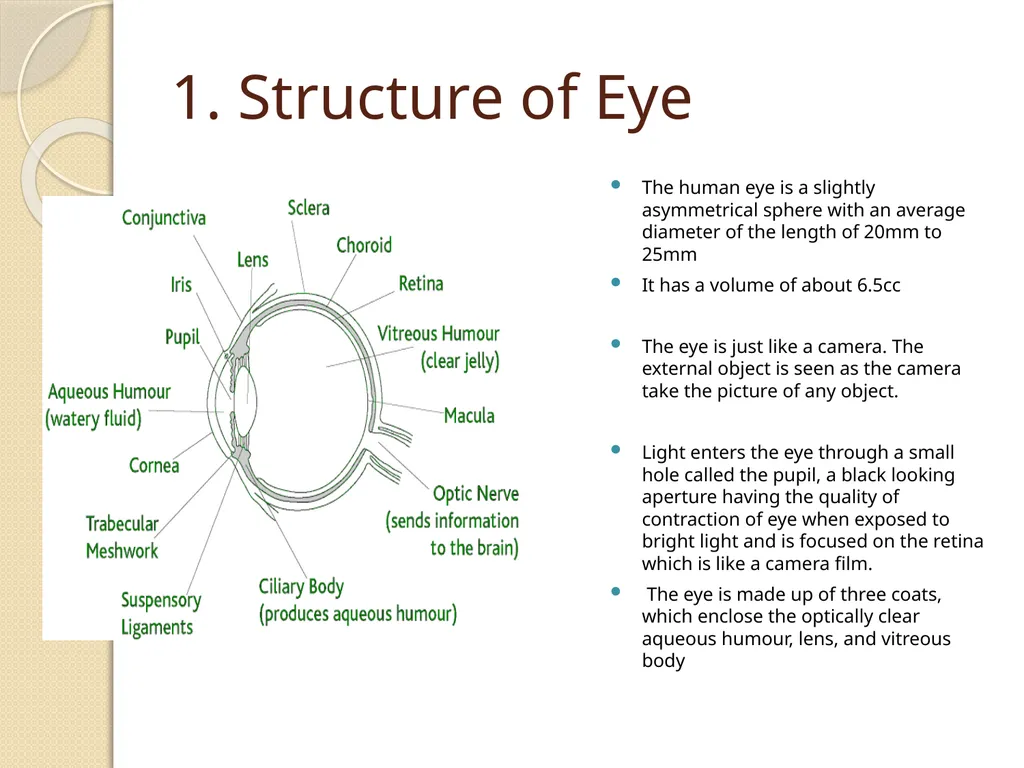
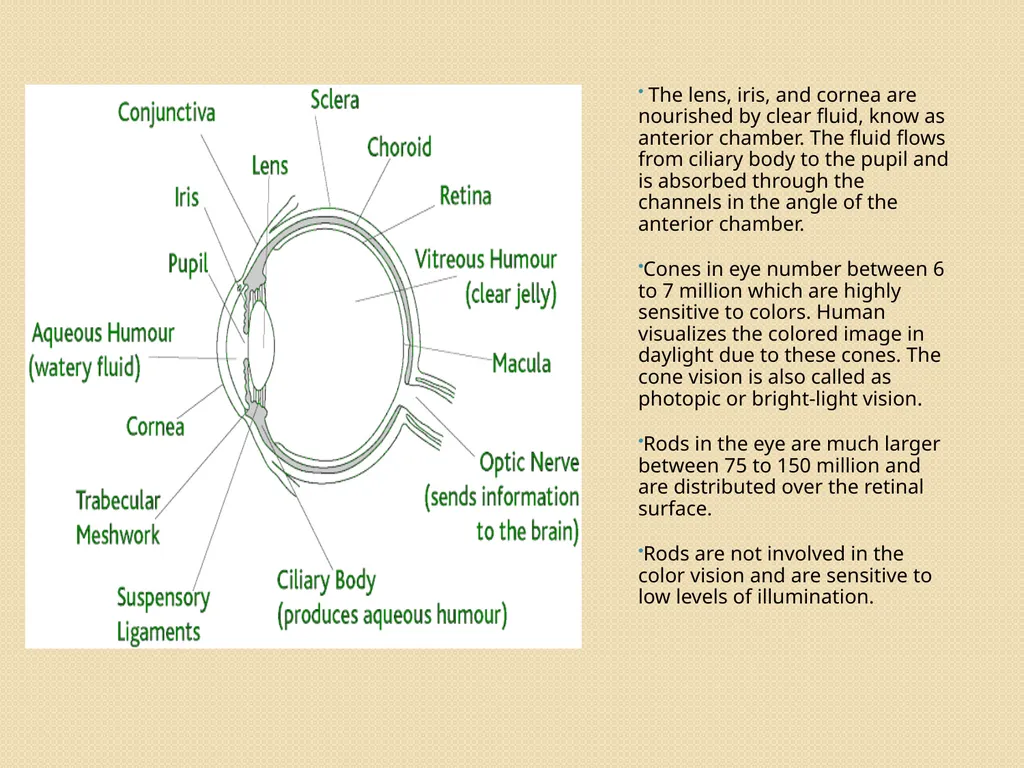
slide3. 1. Structure of Eye The human eye is a slightly asymmetrical sphere with an average diameter of the length of 20mm to 25mm
It has a volume of about 6.5cc
The eye is just like a camera. The external object is seen as the camera take the picture of any object.
Light enters the eye through a small hole called the pupil, a black looking aperture having the quality of contraction of eye when exposed to bright light and is focused on the retina which is like a camera film.
The eye is made up of three coats, which enclose the optically clear aqueous humour, lens, and vitreous body<br>
slide4. The lens, iris, and cornea are nourished by clear fluid, know as anterior chamber. The fluid flows from ciliary body to the pupil and is absorbed through the channels in the angle of the anterior chamber.
Cones in eye number between 6 to 7 million which are highly sensitive to colors. Human visualizes the colored image in daylight due to these cones. The cone vision is also called as photopic or bright-light vision.
Rods in the eye are much larger between 75 to 150 million and are distributed over the retinal surface.
Rods are not involved in the color vision and are sensitive to low levels of illumination.<br>
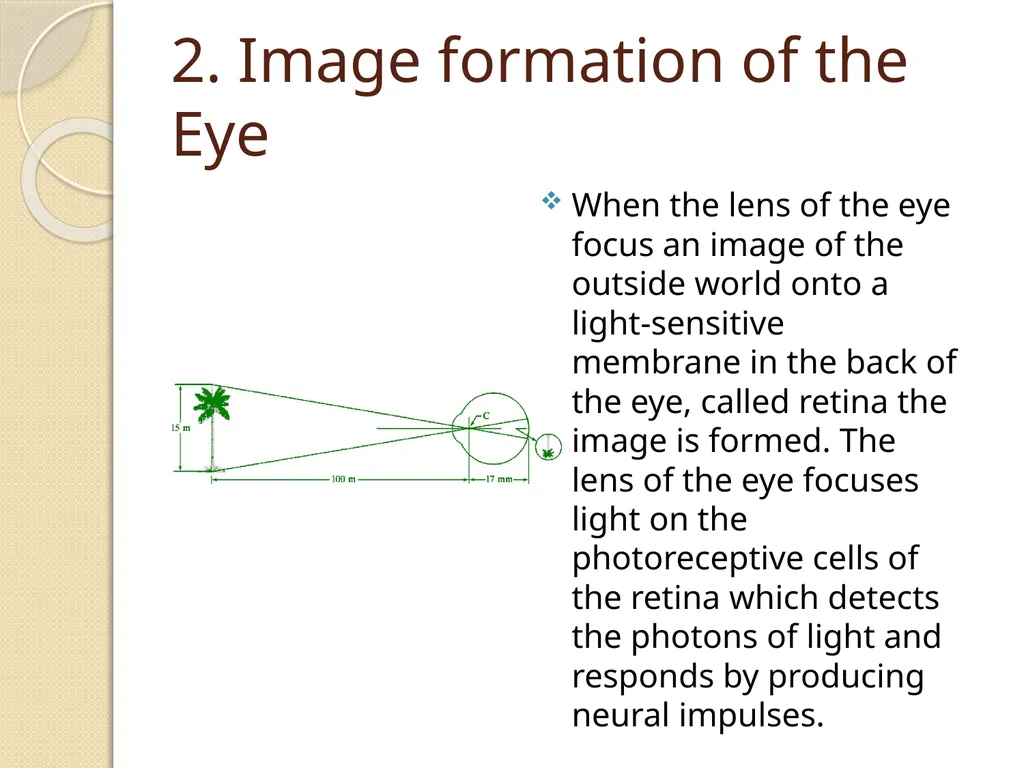
slide5. 2. Image formation of the Eye When the lens of the eye focus an image of the outside world onto a light-sensitive membrane in the back of the eye, called retina the image is formed. The lens of the eye focuses light on the photoreceptive cells of the retina which detects the photons of light and responds by producing neural impulses.<br>
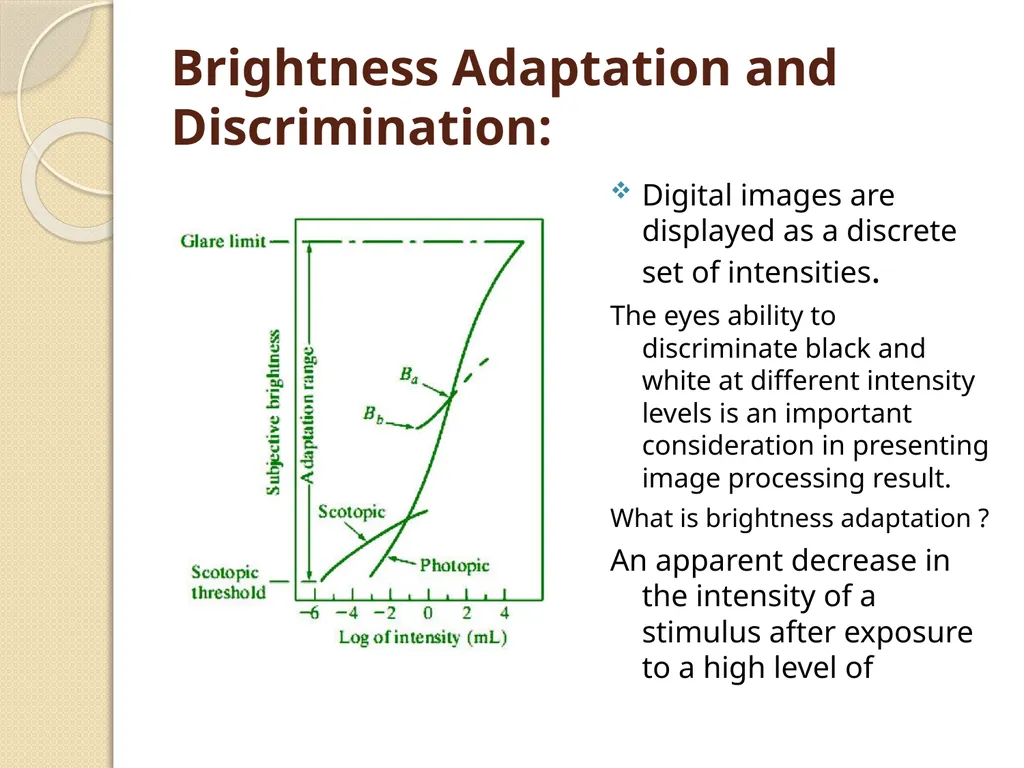
slide6. Brightness Adaptation and Discrimination: Digital images are displayed as a discrete set of intensities.
The eyes ability to discriminate black and white at different intensity levels is an important consideration in presenting image processing result.
What is brightness adaptation ?
An apparent decrease in the intensity of a stimulus after exposure to a high level of<br>
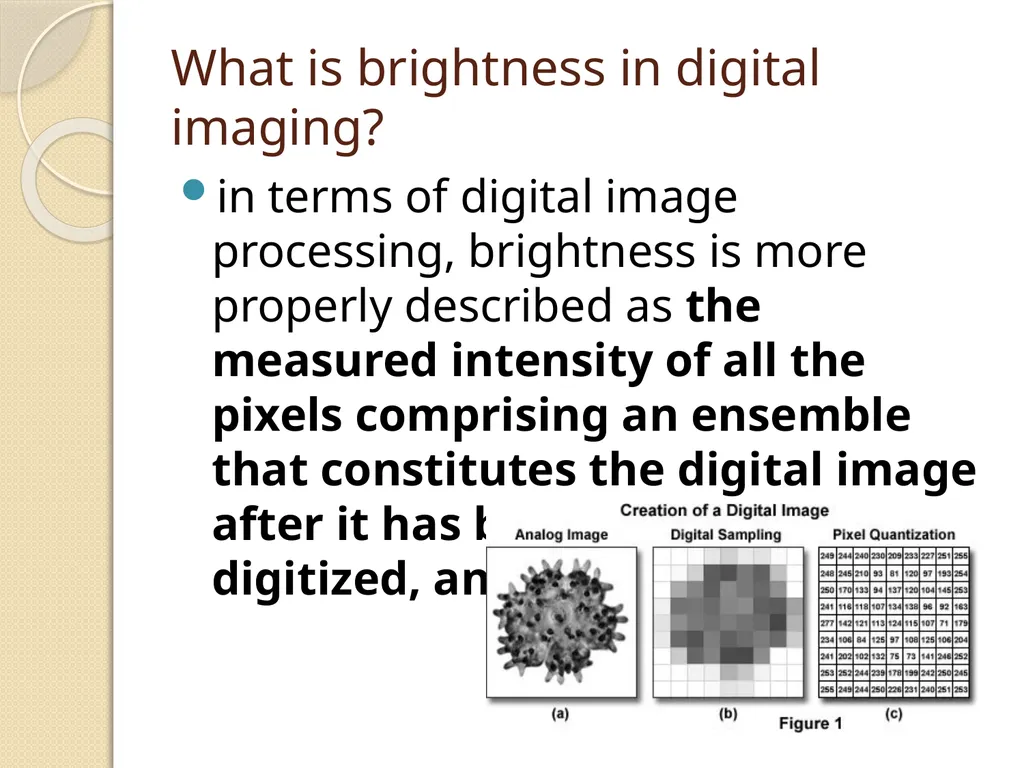
slide7. What is brightness in digital imaging? in terms of digital image processing, brightness is more properly described as the measured intensity of all the pixels comprising an ensemble that constitutes the digital image after it has been captured, digitized, and displayed.<br>
1). Elements of visual perception
2). Structure of an eye
3). Image Formation of the Eye
4).Brightness of Adaptation and Discrimination<br>
slide2. Element of visual Perception The field of Digital image processing is built on the foundation of mathematical and probablistic formulation.
In human visual perception, the eyes act as the
sensor or camera, neurons acts as the connecting
Cable and the brain acts as the processor.
The basic elements of visual preceptions are:
Structure of Eye
Image Formation in the Eye
Brightness Adaptation and Discrimination<br>
slide3. 1. Structure of Eye The human eye is a slightly asymmetrical sphere with an average diameter of the length of 20mm to 25mm
It has a volume of about 6.5cc
The eye is just like a camera. The external object is seen as the camera take the picture of any object.
Light enters the eye through a small hole called the pupil, a black looking aperture having the quality of contraction of eye when exposed to bright light and is focused on the retina which is like a camera film.
The eye is made up of three coats, which enclose the optically clear aqueous humour, lens, and vitreous body<br>
slide4. The lens, iris, and cornea are nourished by clear fluid, know as anterior chamber. The fluid flows from ciliary body to the pupil and is absorbed through the channels in the angle of the anterior chamber.
Cones in eye number between 6 to 7 million which are highly sensitive to colors. Human visualizes the colored image in daylight due to these cones. The cone vision is also called as photopic or bright-light vision.
Rods in the eye are much larger between 75 to 150 million and are distributed over the retinal surface.
Rods are not involved in the color vision and are sensitive to low levels of illumination.<br>
slide5. 2. Image formation of the Eye When the lens of the eye focus an image of the outside world onto a light-sensitive membrane in the back of the eye, called retina the image is formed. The lens of the eye focuses light on the photoreceptive cells of the retina which detects the photons of light and responds by producing neural impulses.<br>
slide6. Brightness Adaptation and Discrimination: Digital images are displayed as a discrete set of intensities.
The eyes ability to discriminate black and white at different intensity levels is an important consideration in presenting image processing result.
What is brightness adaptation ?
An apparent decrease in the intensity of a stimulus after exposure to a high level of<br>
slide7. What is brightness in digital imaging? in terms of digital image processing, brightness is more properly described as the measured intensity of all the pixels comprising an ensemble that constitutes the digital image after it has been captured, digitized, and displayed.<br>