04
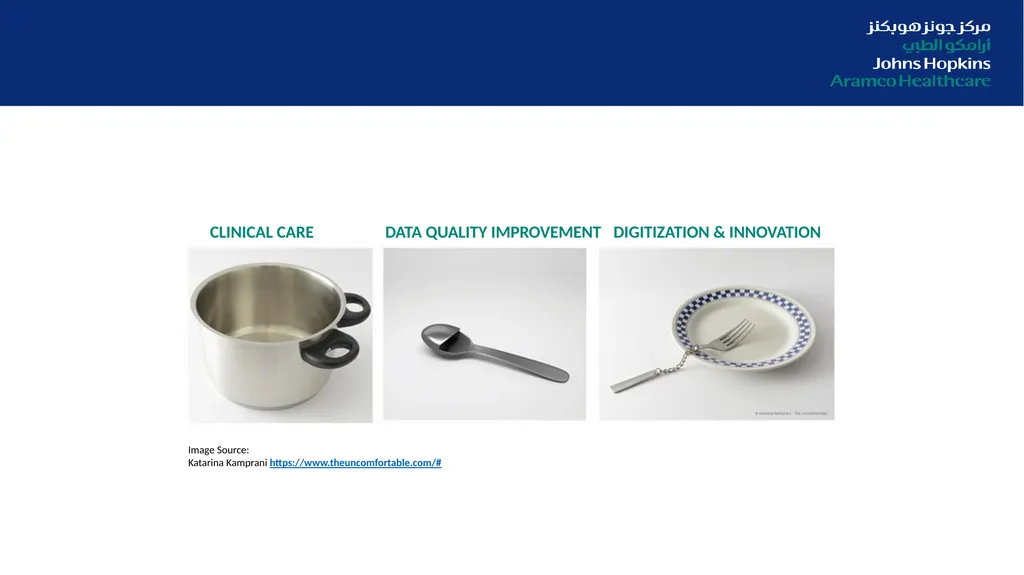
Image Source:
Katarina Kamprani https://www.theuncomfortable.com/# CLINICAL CARE DATA QUALITY IMPROVEMENT DIGITIZATION & INNOVATION<br>
05
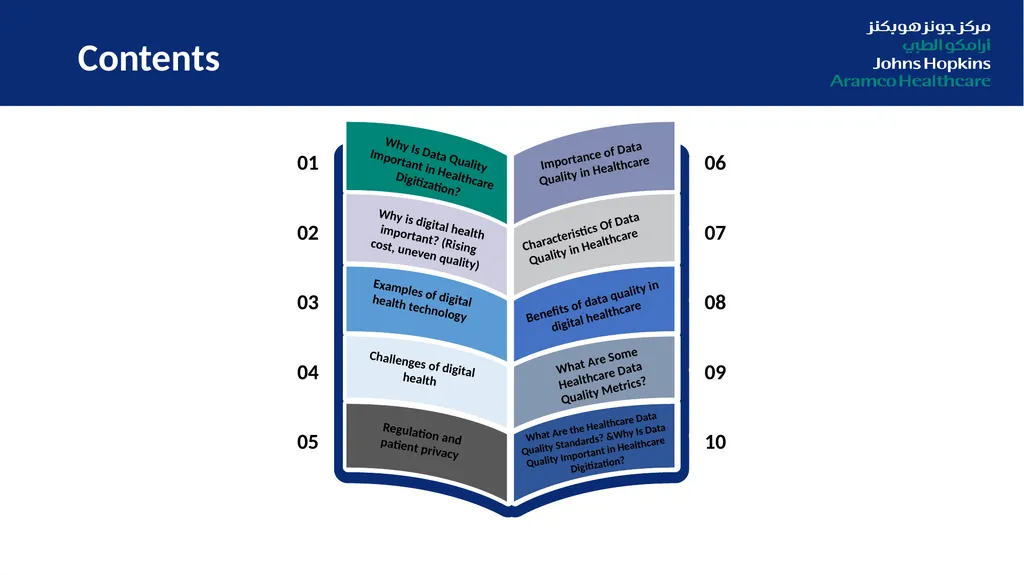
Contents 06 01 07 02 08 03 09 04 Importance of Data Quality in Healthcare Characteristics Of Data Quality in Healthcare Benefits of data quality in digital healthcare What Are Some Healthcare Data Quality Metrics? What Are the Healthcare Data Quality Standards? &Why Is Data Quality Important in Healthcare Digitization? Why Is Data Quality Important in Healthcare Digitization? Why is digital health important? (Rising cost, uneven quality) Examples of digital health technology Challenges of digital health Regulation and patient privacy 10 05<br>
06
What is digital health as we know it today? Digital health, or digital healthcare, is a broad, multidisciplinary concept that includes concepts from an intersection between technology and healthcare. Digital health applies digital transformation to the healthcare field, incorporating software, hardware and services.
Under its umbrella, digital health includes mobile health (mHealth) apps, electronic health records (EHRs), electronic medical records (EMRs), wearable devices, telehealth and telemedicine, as well as personalized medicine. There is no denying that healthcare technology has undergone considerable changes in the last 50 years. The modern hospital is home to all manner of innovative and groundbreaking devices that have improved healthcare provision significantly and resulted in superior patient care. Without these technologies, medical professionals could not provide the level of treatment we have come to expect from first-rate health systems. Digital technology offers healthcare systems significant benefits, including better-coordinated care, real-time monitoring of chronic diseases, more accurate diagnoses, more effective treatments, and convenience for both patient and physician. Digital healthcare also delivers substantial economic benefits—cost savings that can be reinvested into other priority health areas.<br>
07
Research says ,, “As organizations accelerate their digital business efforts, poor data quality is a major contributor to a crisis in information trust and business value, negatively impacting financial performance.”
Ted Friedman, VP Analyst, Gartner<br>
08
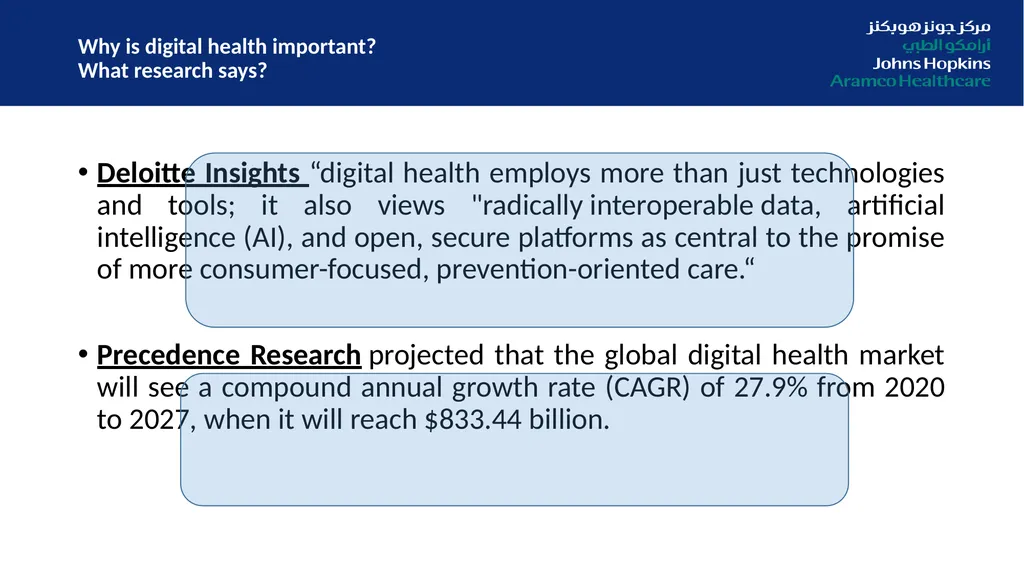
Why is digital health important?�What research says? Deloitte Insights “digital health employs more than just technologies and tools; it also views "radically interoperable data, artificial intelligence (AI), and open, secure platforms as central to the promise of more consumer-focused, prevention-oriented care.“
Precedence Research projected that the global digital health market will see a compound annual growth rate (CAGR) of 27.9% from 2020 to 2027, when it will reach $833.44 billion.<br>
09
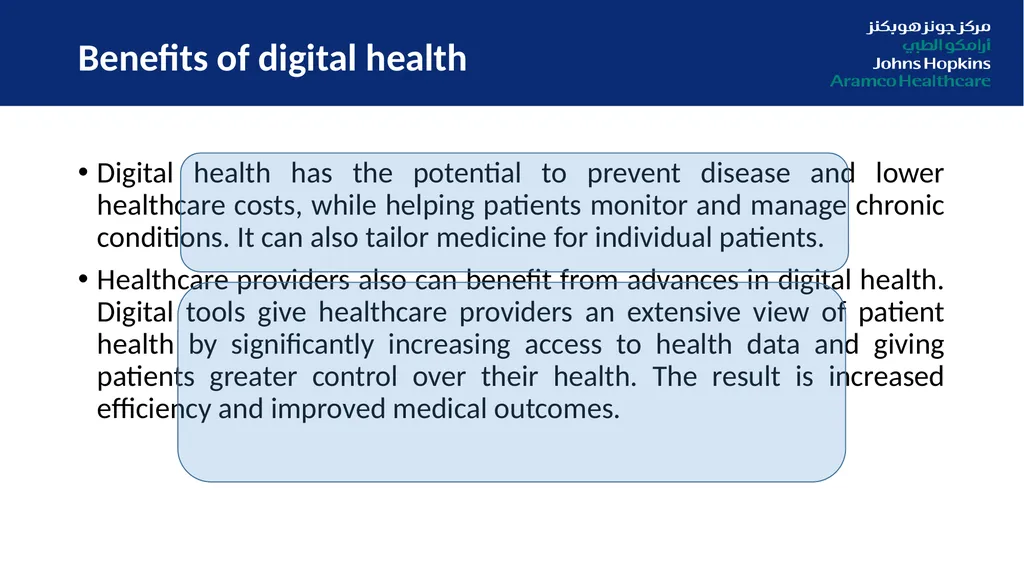
Benefits of digital health Digital health has the potential to prevent disease and lower healthcare costs, while helping patients monitor and manage chronic conditions. It can also tailor medicine for individual patients.
Healthcare providers also can benefit from advances in digital health. Digital tools give healthcare providers an extensive view of patient health by significantly increasing access to health data and giving patients greater control over their health. The result is increased efficiency and improved medical outcomes.<br>
10
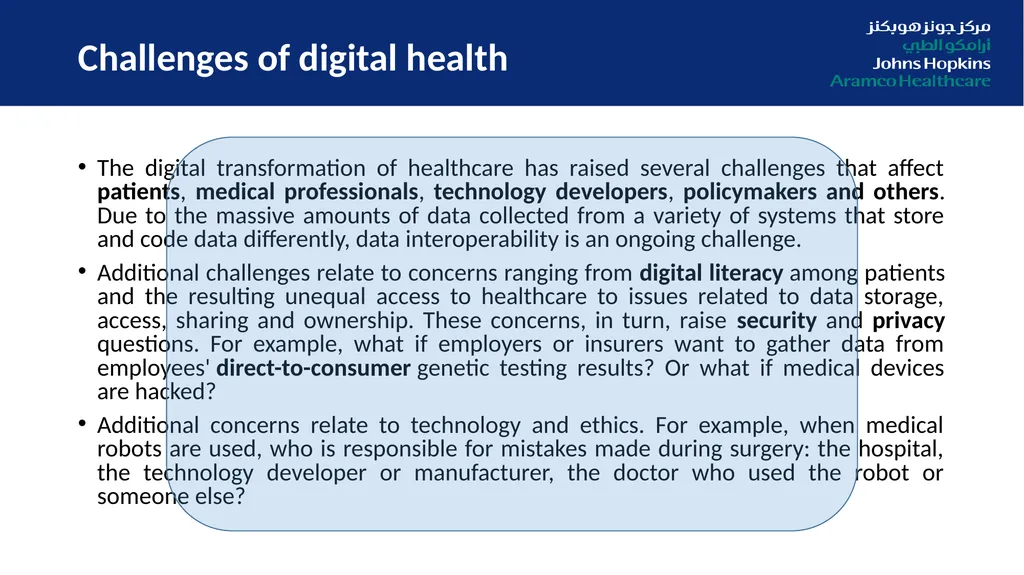
Challenges of digital health The digital transformation of healthcare has raised several challenges that affect patients, medical professionals, technology developers, policymakers and others. Due to the massive amounts of data collected from a variety of systems that store and code data differently, data interoperability is an ongoing challenge.
Additional challenges relate to concerns ranging from digital literacy among patients and the resulting unequal access to healthcare to issues related to data storage, access, sharing and ownership. These concerns, in turn, raise security and privacy questions. For example, what if employers or insurers want to gather data from employees' direct-to-consumer genetic testing results? Or what if medical devices are hacked?
Additional concerns relate to technology and ethics. For example, when medical robots are used, who is responsible for mistakes made during surgery: the hospital, the technology developer or manufacturer, the doctor who used the robot or someone else?<br>
11
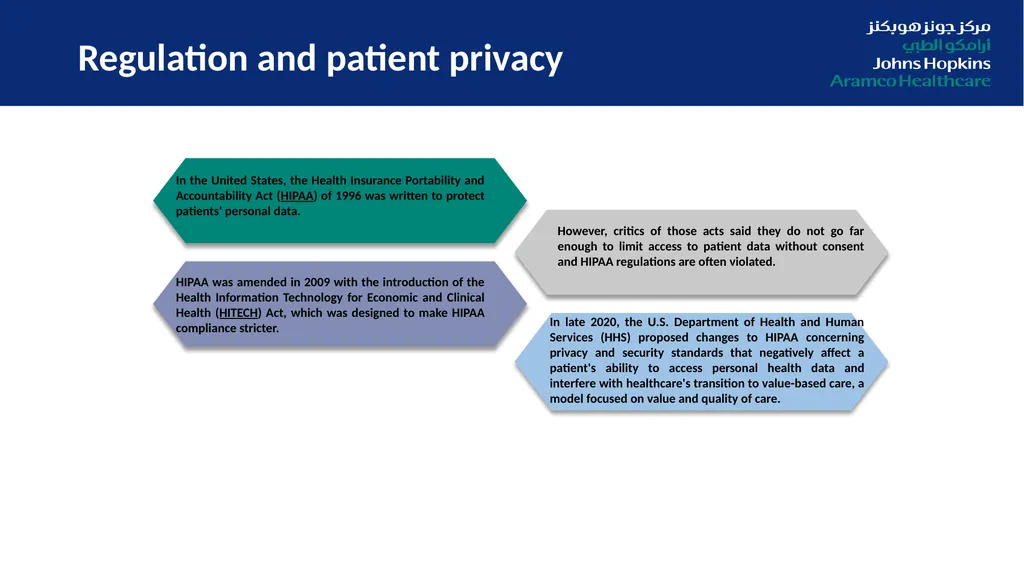
Regulation and patient privacy<br>
12
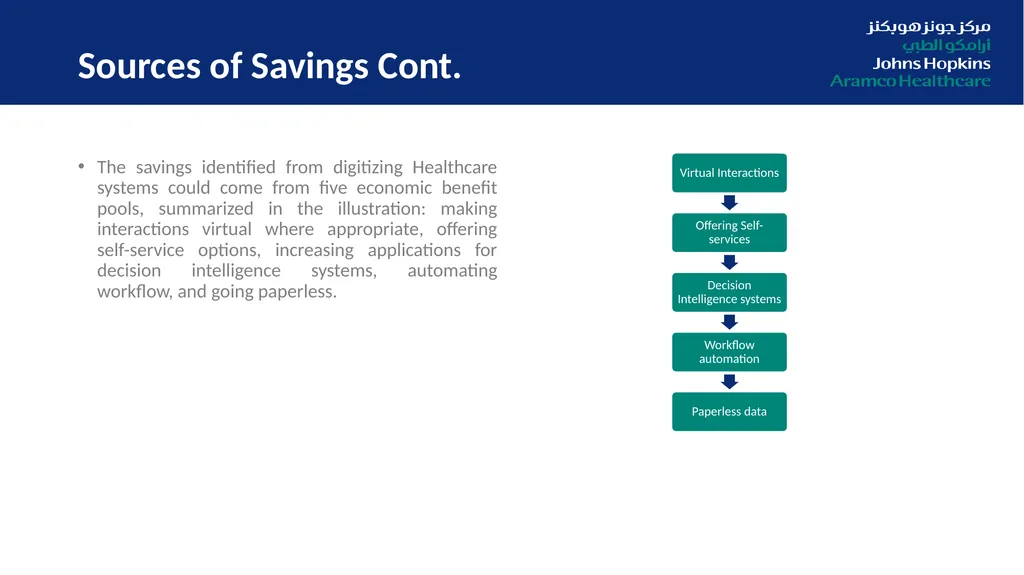
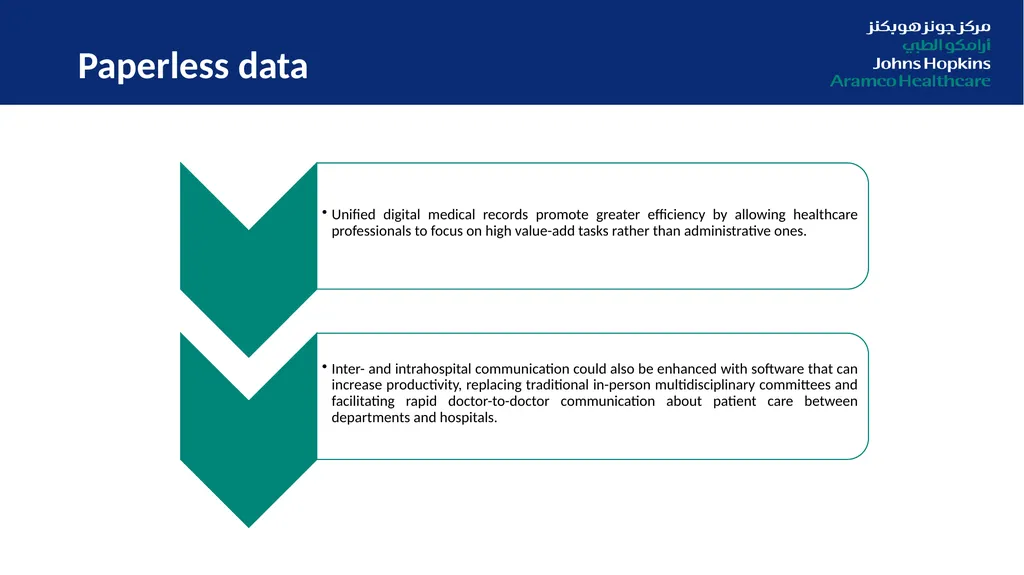
Sources of Savings Cont. The savings identified from digitizing Healthcare systems could come from five economic benefit pools, summarized in the illustration: making interactions virtual where appropriate, offering self-service options, increasing applications for decision intelligence systems, automating workflow, and going paperless.<br>
13
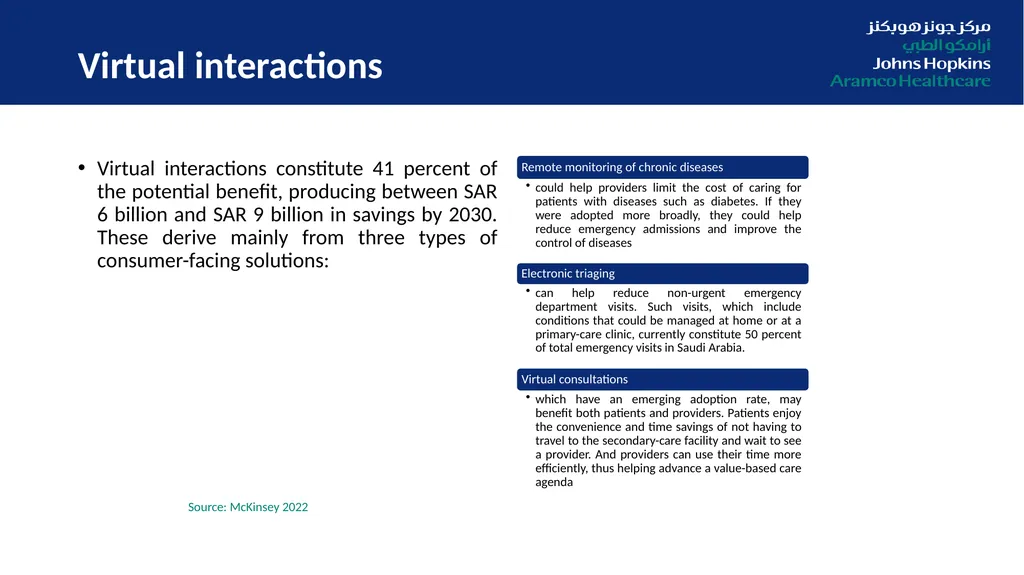
Virtual interactions Virtual interactions constitute 41 percent of the potential benefit, producing between SAR 6 billion and SAR 9 billion in savings by 2030. These derive mainly from three types of consumer-facing solutions: Source: McKinsey 2022<br>
14
Self-care and self-service Source: McKinsey 2022<br>
15
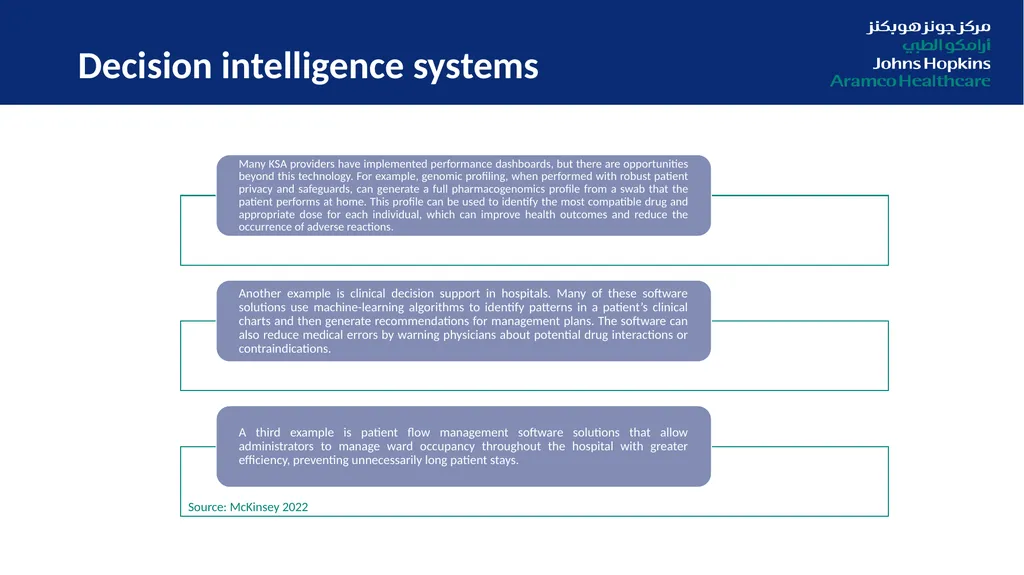
Decision intelligence systems Source: McKinsey 2022<br>
16
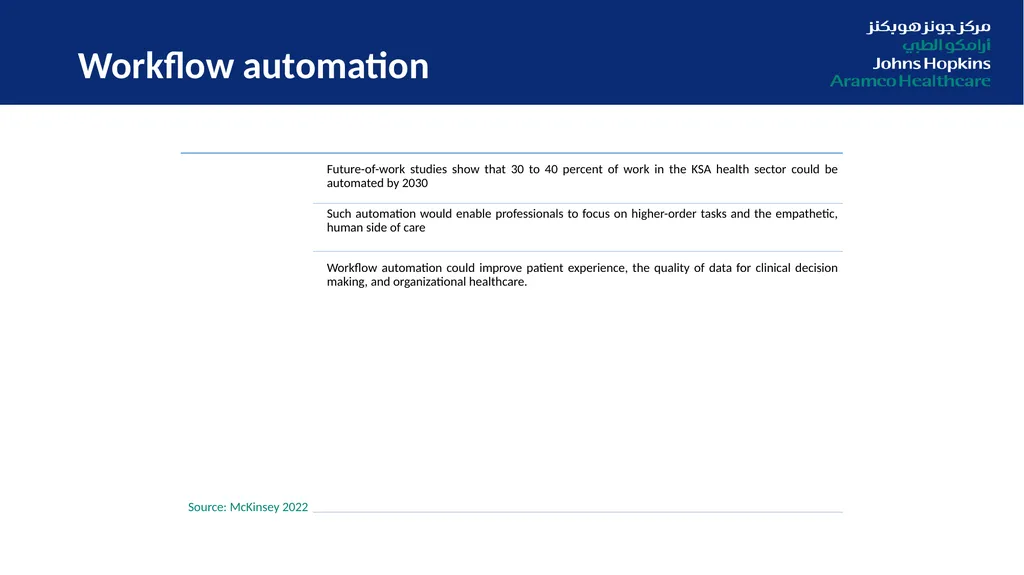
Workflow automation Source: McKinsey 2022<br>
18
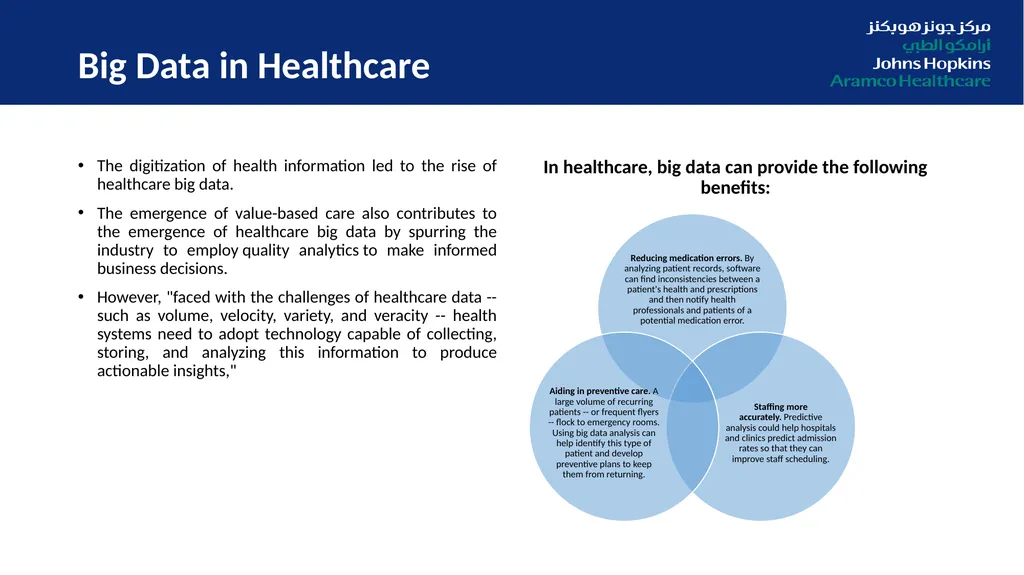
Big Data in Healthcare The digitization of health information led to the rise of healthcare big data.
The emergence of value-based care also contributes to the emergence of healthcare big data by spurring the industry to employ quality analytics to make informed business decisions.
However, "faced with the challenges of healthcare data -- such as volume, velocity, variety, and veracity -- health systems need to adopt technology capable of collecting, storing, and analyzing this information to produce actionable insights," In healthcare, big data can provide the following benefits:<br>
19
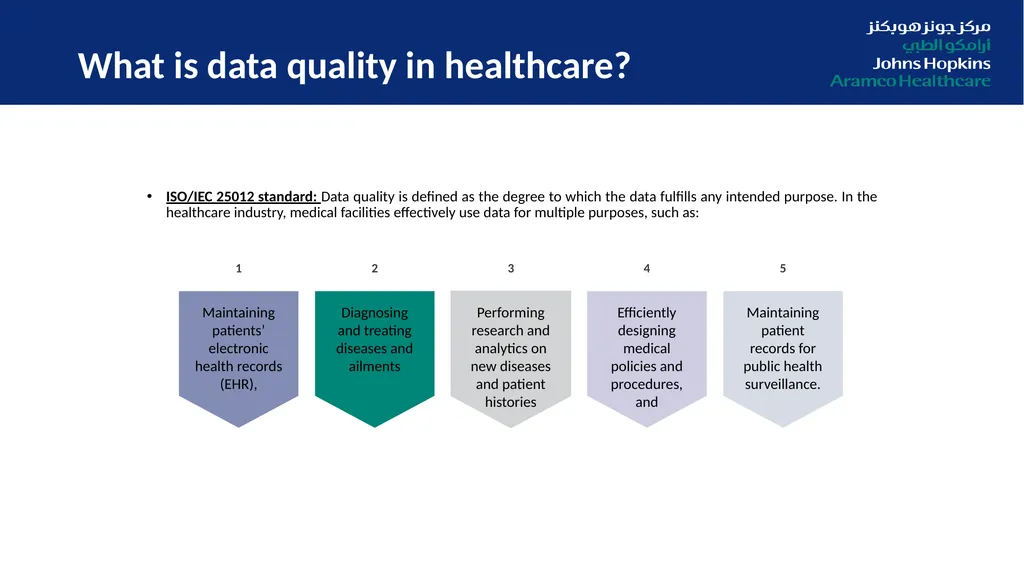
What is data quality in healthcare? ISO/IEC 25012 standard: Data quality is defined as the degree to which the data fulfills any intended purpose. In the healthcare industry, medical facilities effectively use data for multiple purposes, such as:<br>
20
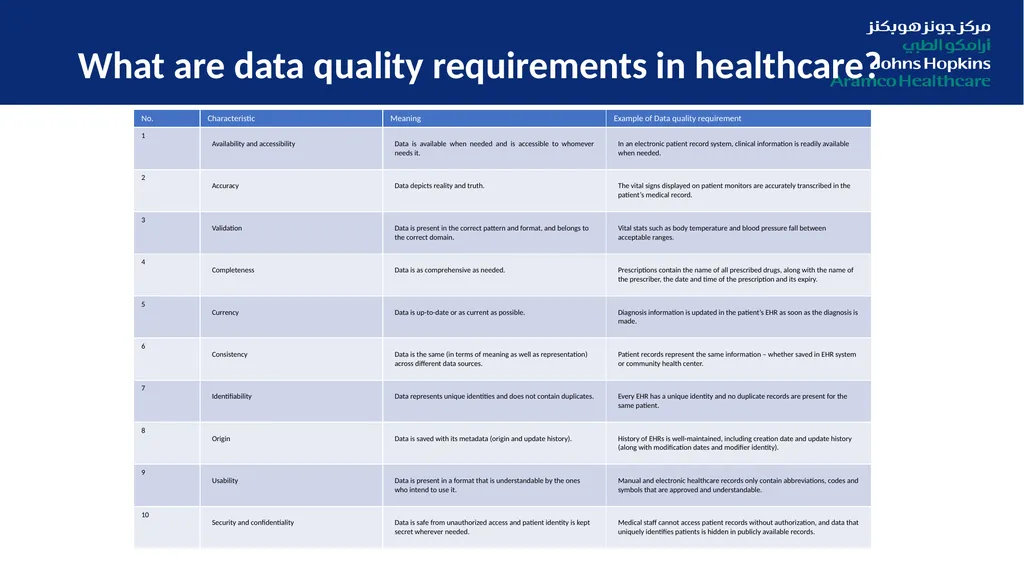
What are data quality requirements in healthcare?<br>
21
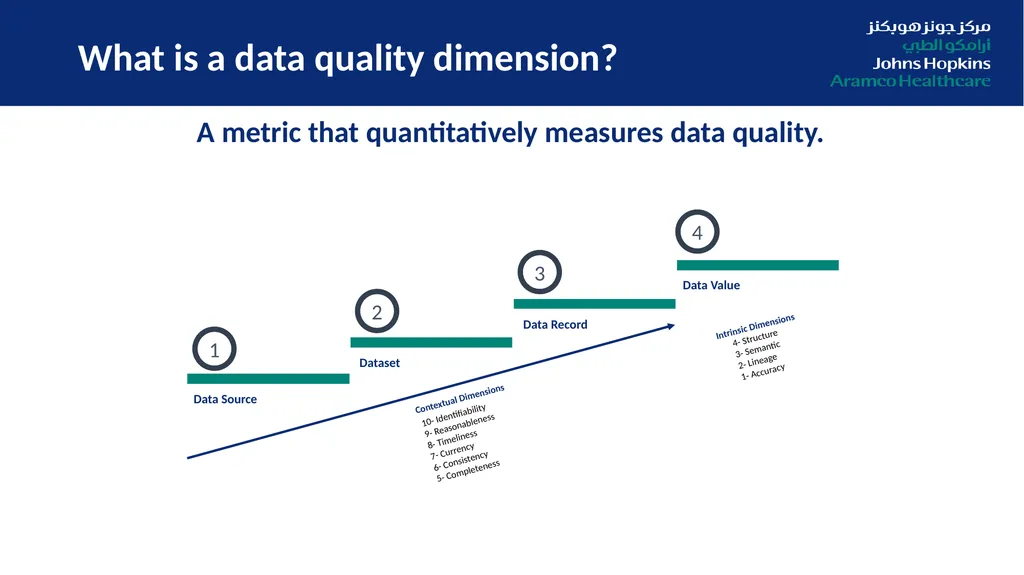
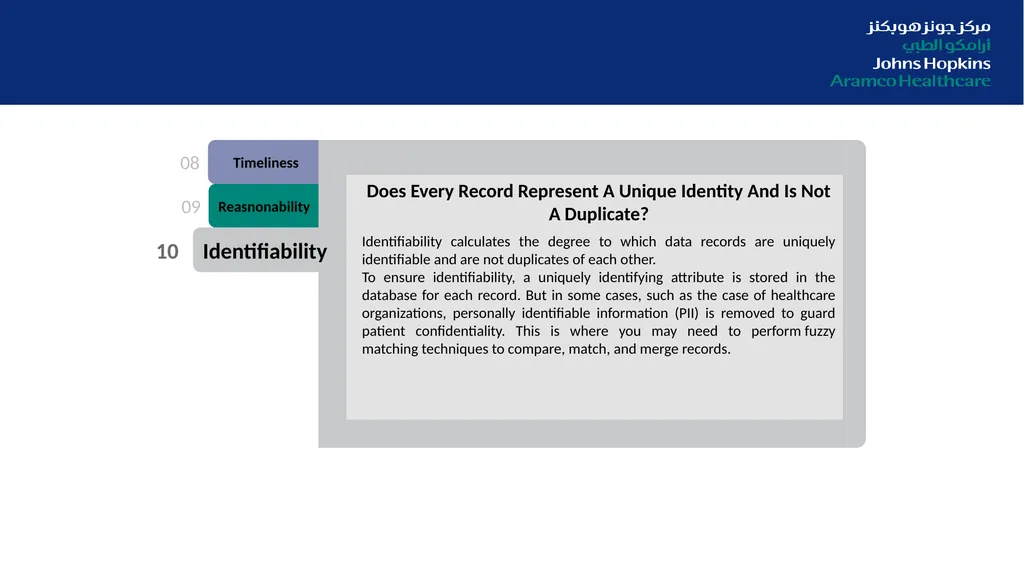
What is a data quality dimension? Data Source 1 Dataset 2 Data Record 3 Data Value 4 10- Identifiability
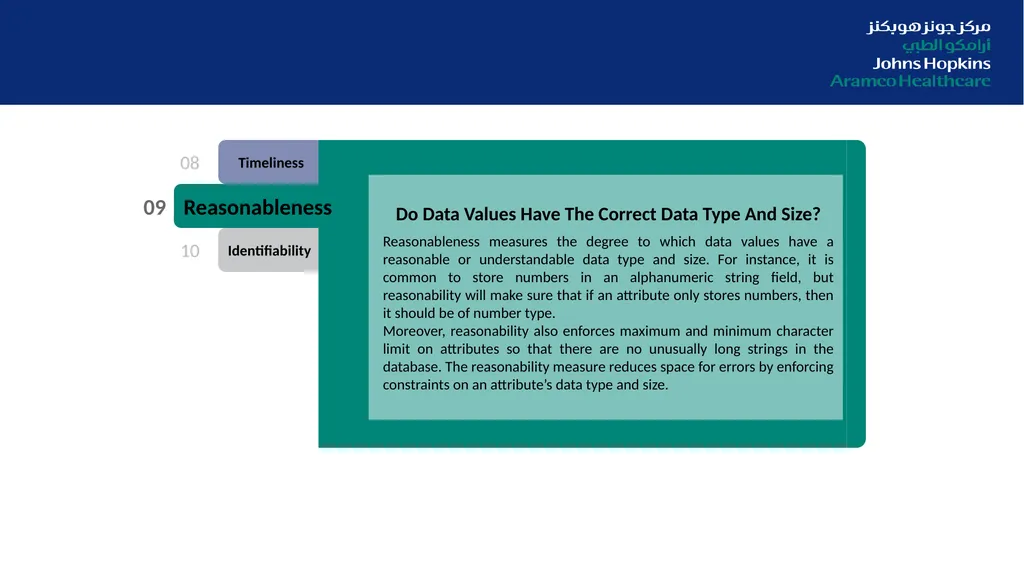
9- Reasonableness
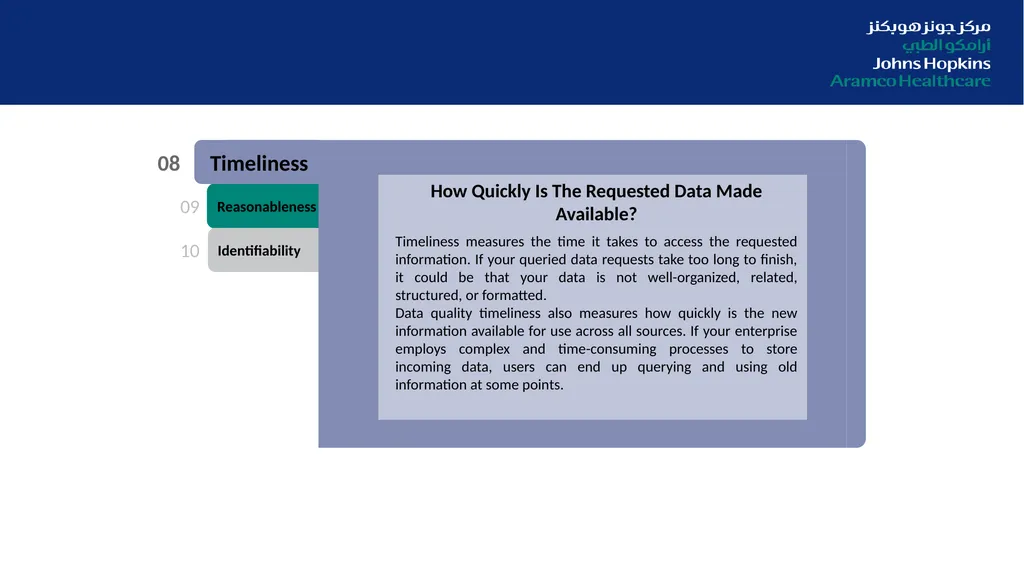
8- Timeliness
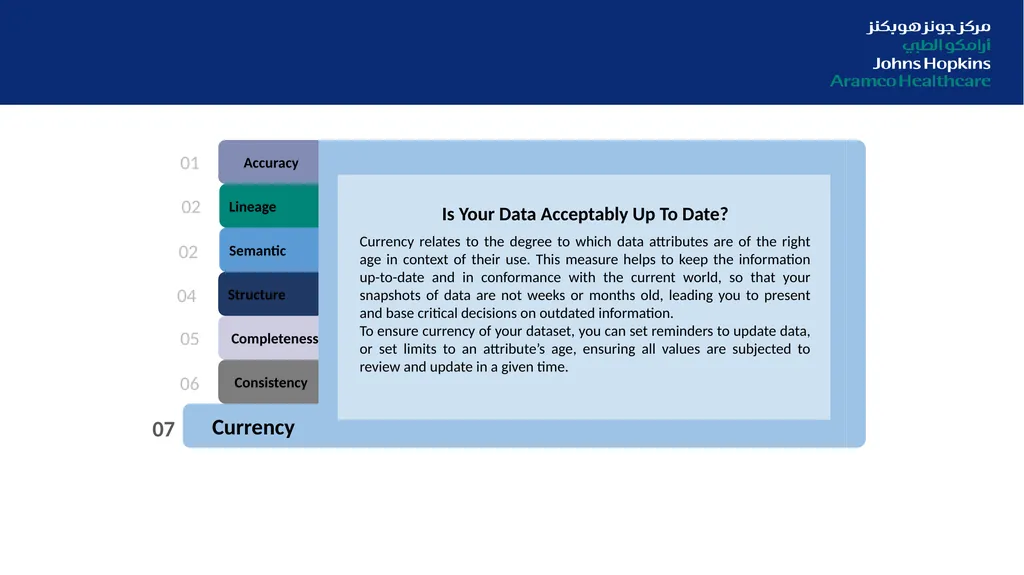
7- Currency
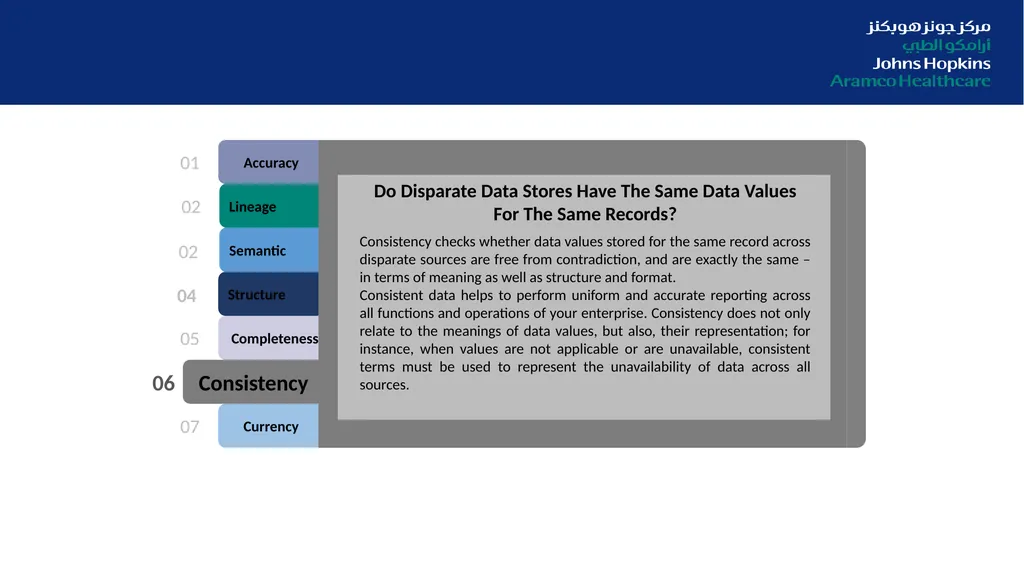
6- Consistency
5- Completeness Contextual Dimensions A metric that quantitatively measures data quality.<br>
22
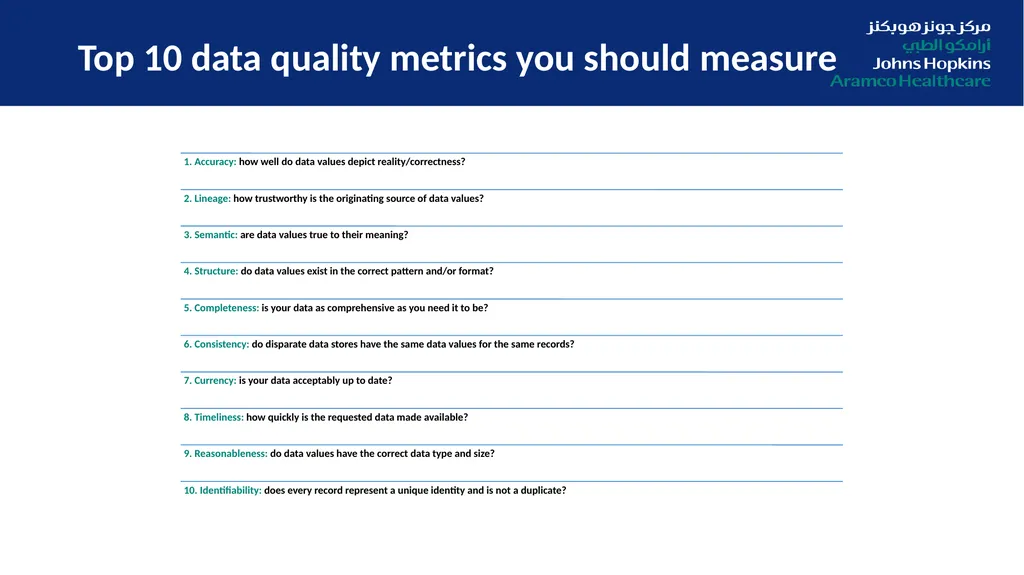
Top 10 data quality metrics you should measure<br>
23
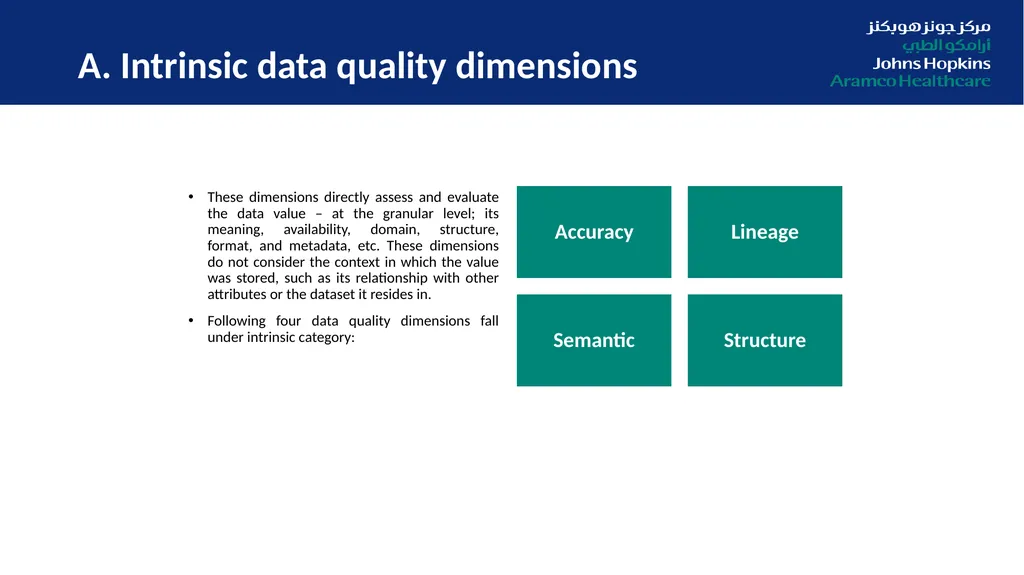
A. Intrinsic data quality dimensions These dimensions directly assess and evaluate the data value – at the granular level; its meaning, availability, domain, structure, format, and metadata, etc. These dimensions do not consider the context in which the value was stored, such as its relationship with other attributes or the dataset it resides in.
Following four data quality dimensions fall under intrinsic category:<br>
24
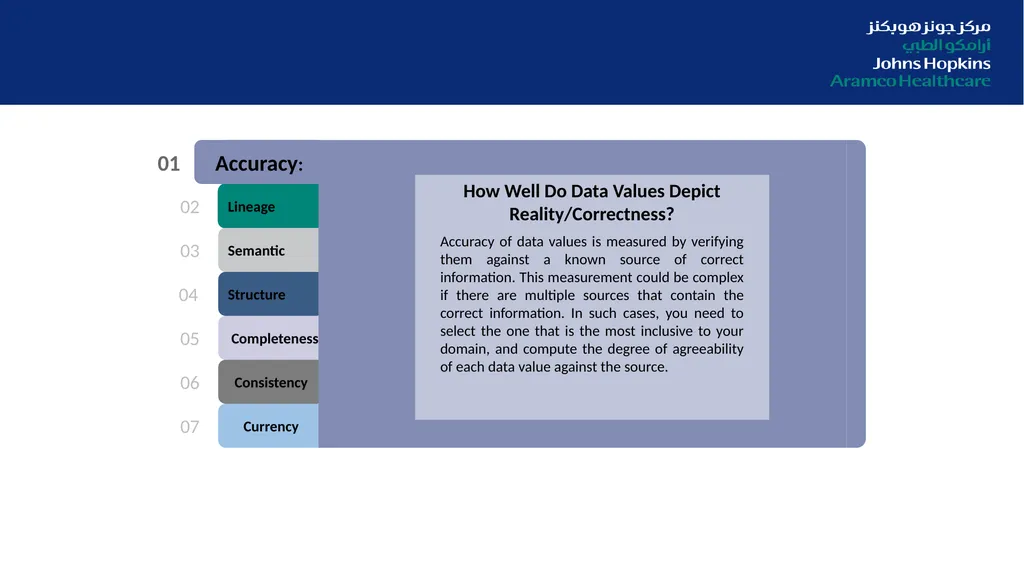
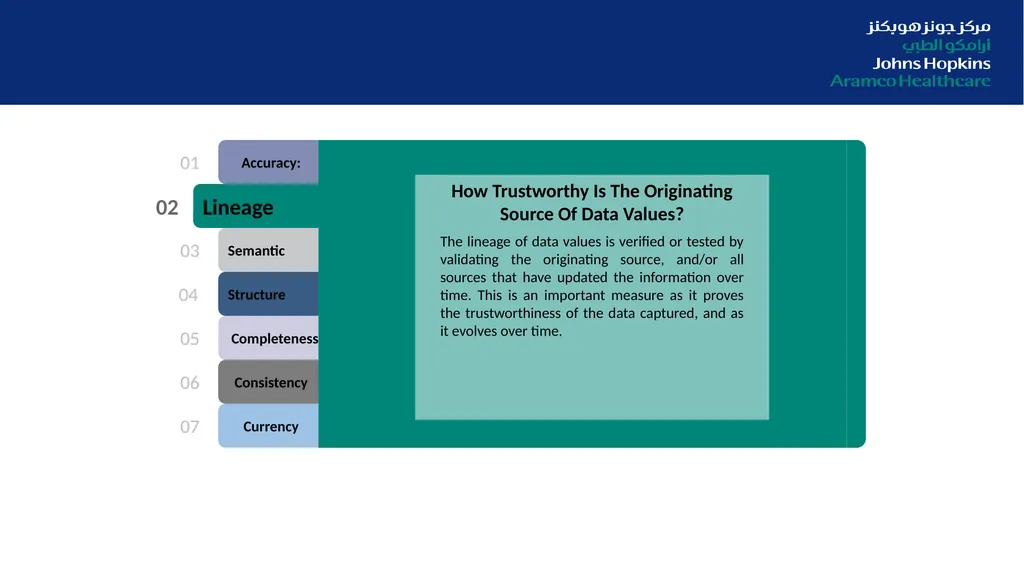
Lineage Structure Completeness Consistency Currency Semantic Lorem Ipsum 02 03 04 05 06 07 Accuracy: 01<br>
25
Accuracy: Structure Completeness Consistency Currency Semantic 02 03 04 05 06 07 01 Lineage<br>
26
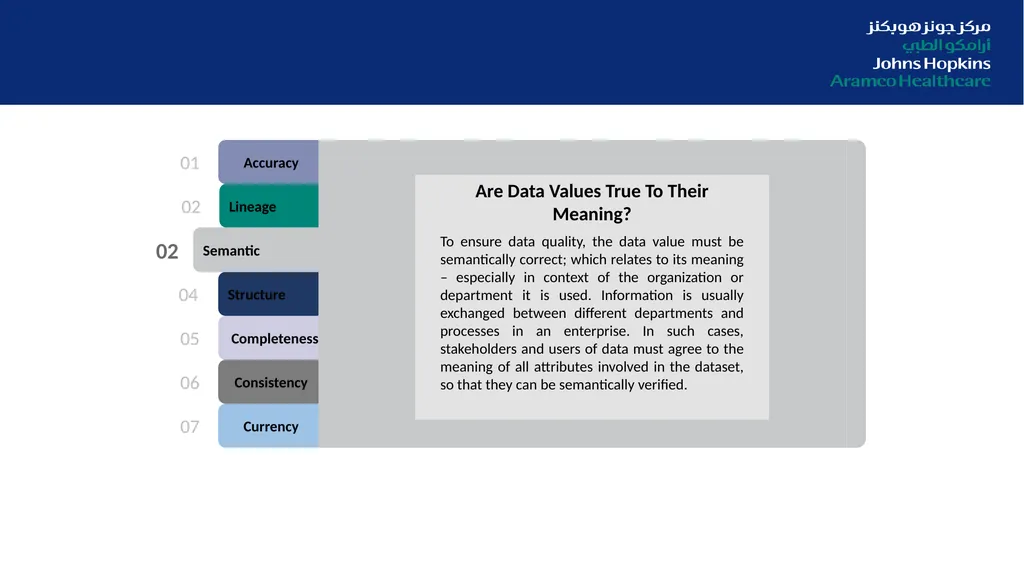
Lineage 02 Accuracy Structure Completeness Consistency Currency 04 05 06 07 01 02 Semantic<br>
27
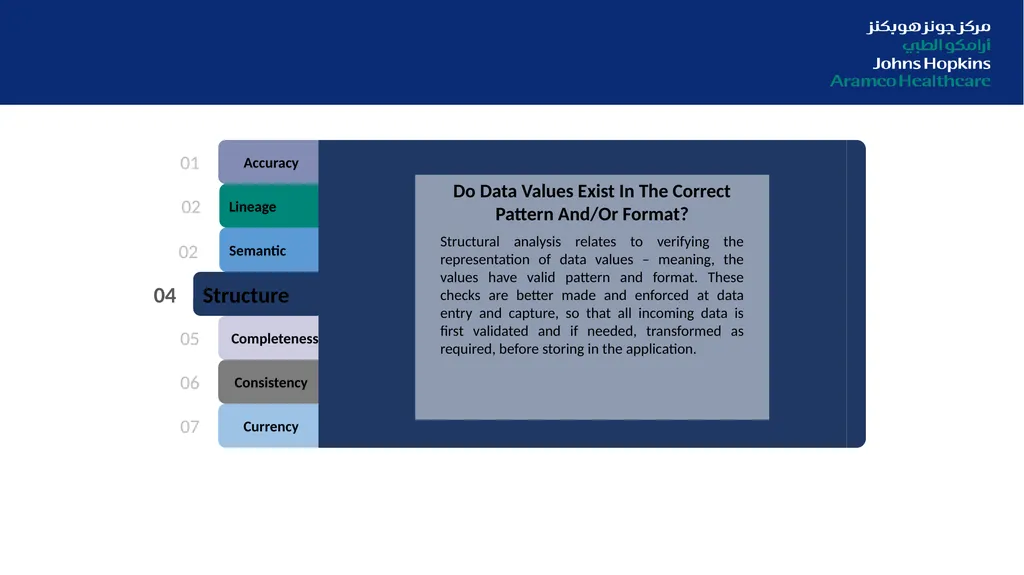
Semantic Lineage 02 Accuracy Completeness Consistency Currency 04 05 06 07 01 02 Structure<br>
28
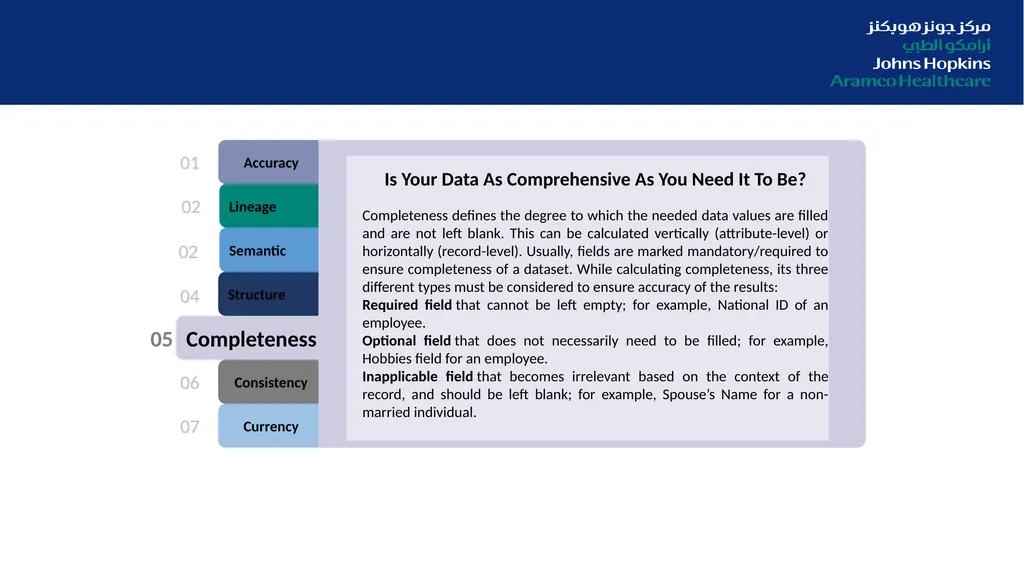
Structure Semantic Lineage 02 Accuracy Consistency Currency 04 05 06 07 01 02 Completeness<br>
29
Structure Semantic Lineage 02 Accuracy Completeness Currency 04 05 06 07 01 02 Consistency<br>
30
Consistency Structure Semantic Lineage 02 Accuracy Completeness 04 05 06 07 01 02 Currency<br>
31
Reasonableness Identifiability Lorem Ipsum 09 10 Timeliness 08<br>
32
Timeliness Identifiability 09 10 08 Reasonableness<br>
33
Reasnonability 09 Timeliness 08 10 Identifiability<br>
35
1971 Ground rounds/ Dr. Larry Weed How can the health record help guide and teach us?<br>
36
How can the health record help guide and teach us?<br>