
Dipartimento di Ingegneria Industriale e
SB
Published · 82 slides · 0 views

1 / 1





Description
Dipartimento di Ingegneria Industriale e dellInformazione via Roma 29, 81031 Aversa, Italy Speaker: Oronzio Manca Master Degree in InnovativeTechnologies in Energy Efficient Buildings for Russian Armenian Universities and Stakeholders
Related Topics
Share
Embed code
Download this presentation From Below
"Dipartimento di Ingegneria Industriale e" is the property of its rightful owner. Permission is granted to download and print the materials on this website for personal, non-commercial use only, and to display it on your personal computer provided you do not modify the materials and that you retain all copyright notices contained in the materials. By downloading content from our website, you accept the terms of this agreement.
Presentation Transcript
01
Dipartimento di Ingegneria Industriale e dell’Informazione
via Roma 29, 81031 Aversa, Italy Speaker: Oronzio Manca Master Degree in InnovativeTechnologies in Energy Efficient Buildings for Russian & Armenian Universities and Stakeholders MARUEEB project 561890-EPP-1-2015-1-IT-EPPKA2-CBHE-JP Thermal Bridges<br>
via Roma 29, 81031 Aversa, Italy Speaker: Oronzio Manca Master Degree in InnovativeTechnologies in Energy Efficient Buildings for Russian & Armenian Universities and Stakeholders MARUEEB project 561890-EPP-1-2015-1-IT-EPPKA2-CBHE-JP Thermal Bridges<br>
02
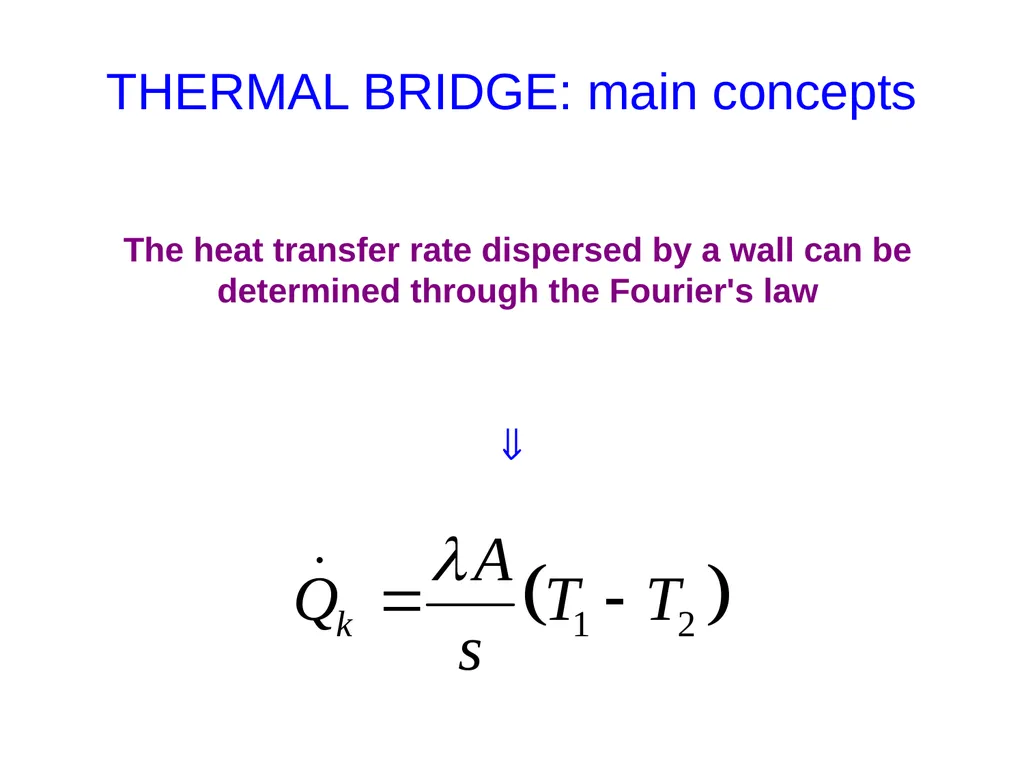
THERMAL BRIDGE: main concepts The heat transfer rate dispersed by a wall can be determined through the Fourier's law <br>
03
The evaluation can be carried out in a simple way under the following hypotheses: Steady state regime
the material is isotropic and homogeneuos
the height and width of the wall are much larger than its thickness
the temperatures of the wall surfaces are uniform THERMAL BRIDGE: main concepts<br>
the material is isotropic and homogeneuos
the height and width of the wall are much larger than its thickness
the temperatures of the wall surfaces are uniform THERMAL BRIDGE: main concepts<br>
04
These assumptions allow: Neglect the edge effects and, consequently
Consider the thermal field and the heat flux vector as a one-dimensional THERMAL BRIDGE: main concepts<br>
Consider the thermal field and the heat flux vector as a one-dimensional THERMAL BRIDGE: main concepts<br>
05
The perimetral walls of the buildings are not perfectly homogeneous Glazed windows or structural elements beams, pillars and slabs <br>
06
These elements determine differences in the thermal behavior in wall areas where they are present Typically these elements values of have much higher than the ones of infill walls or masonry<br>
07
Along the edges of the walls there are areas in which the hypothesis of one-dimensional flow is no longer satisfied This is due to the couplings with the other walls or slabs Both for the different thermal conductivity of the structures and for the particular geometry of the wall area<br>
08
Geometric and structural configurations that produce deviations from the one-dimensional flow conditions THERMAL BRIDGE ZONES<br>
09
CLASSIFICATION OF THERMAL BRIDGES Geometrical thermal bridge
Thermal bridge of structure
Mixed thermal bridge<br>
Thermal bridge of structure
Mixed thermal bridge<br>
10
Geometrical thermal bridge Portions of the considered domain where the deviation from the one-dimensional heat flux condition is due to the geometry of the structure CLASSIFICATION OF THERMAL BRIDGES<br>
11
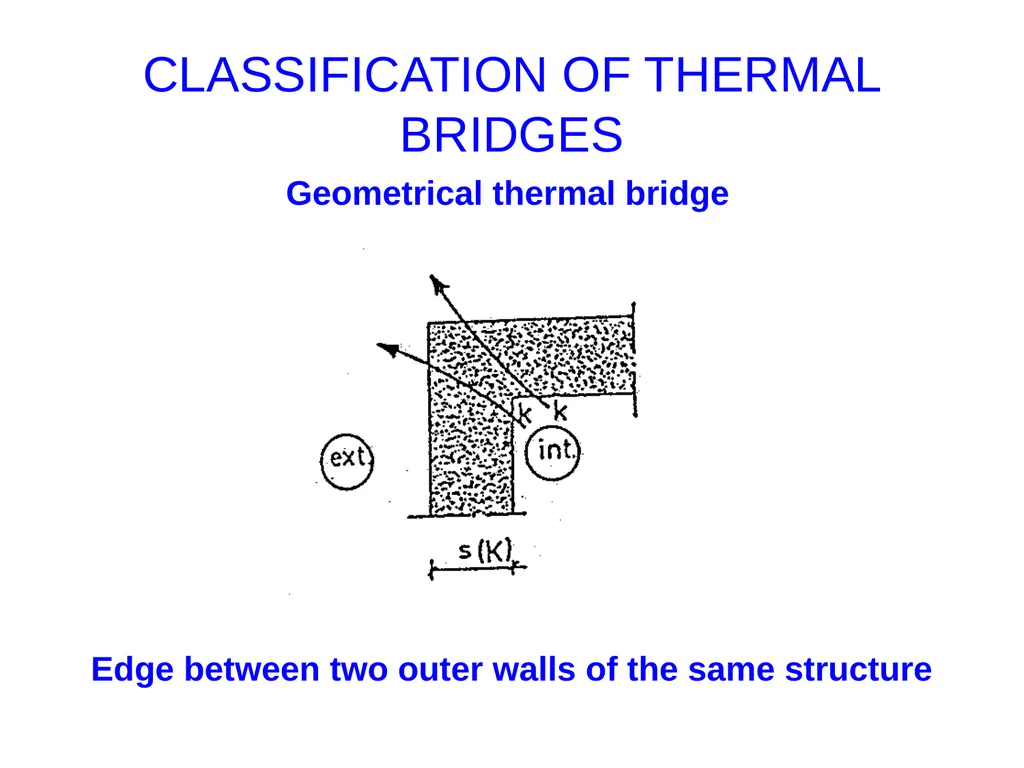
Geometrical thermal bridge Edge between two outer walls of the same structure CLASSIFICATION OF THERMAL BRIDGES<br>
12
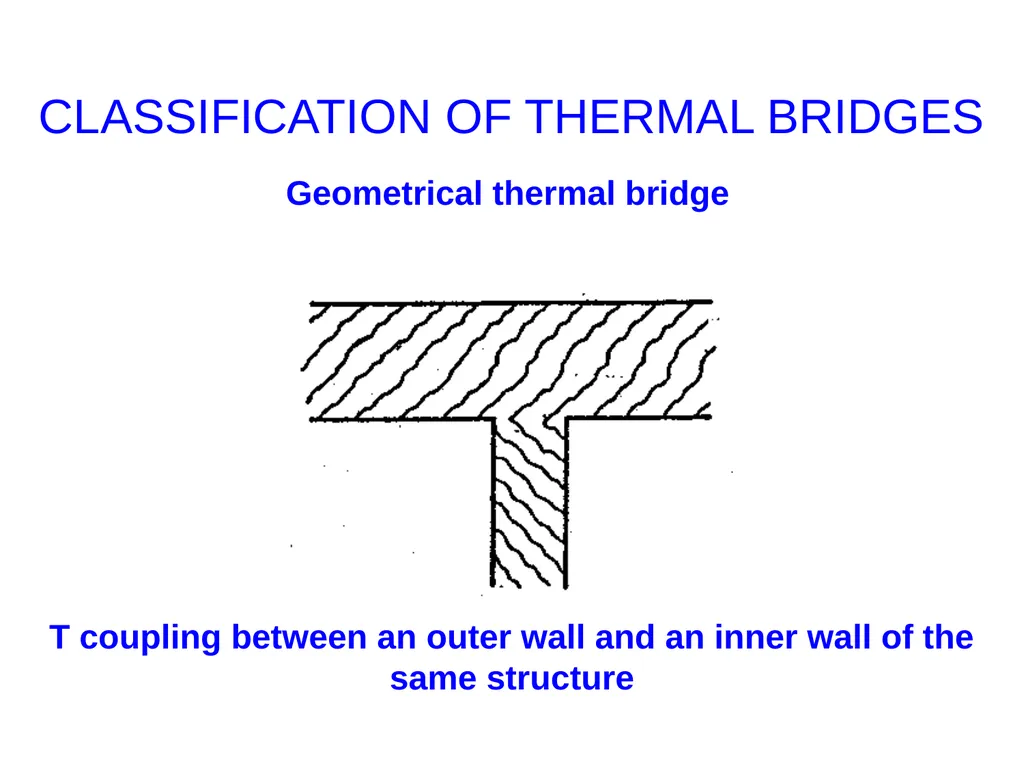
CLASSIFICATION OF THERMAL BRIDGES Geometrical thermal bridge T coupling between an outer wall and an inner wall of the same structure<br>
13
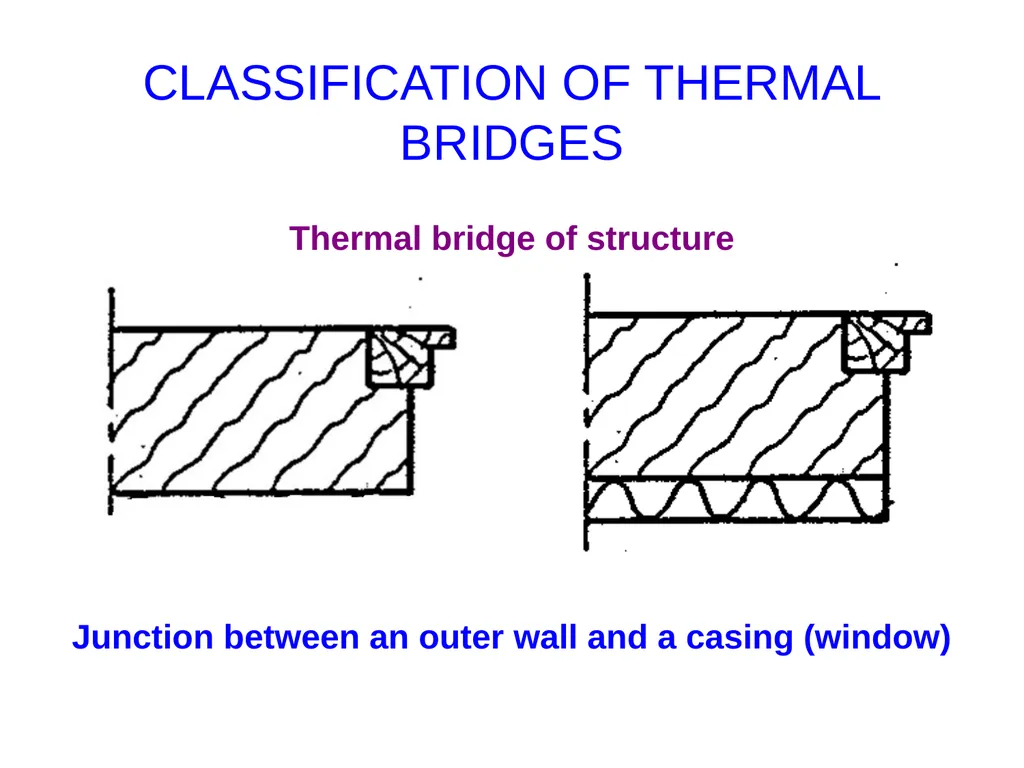
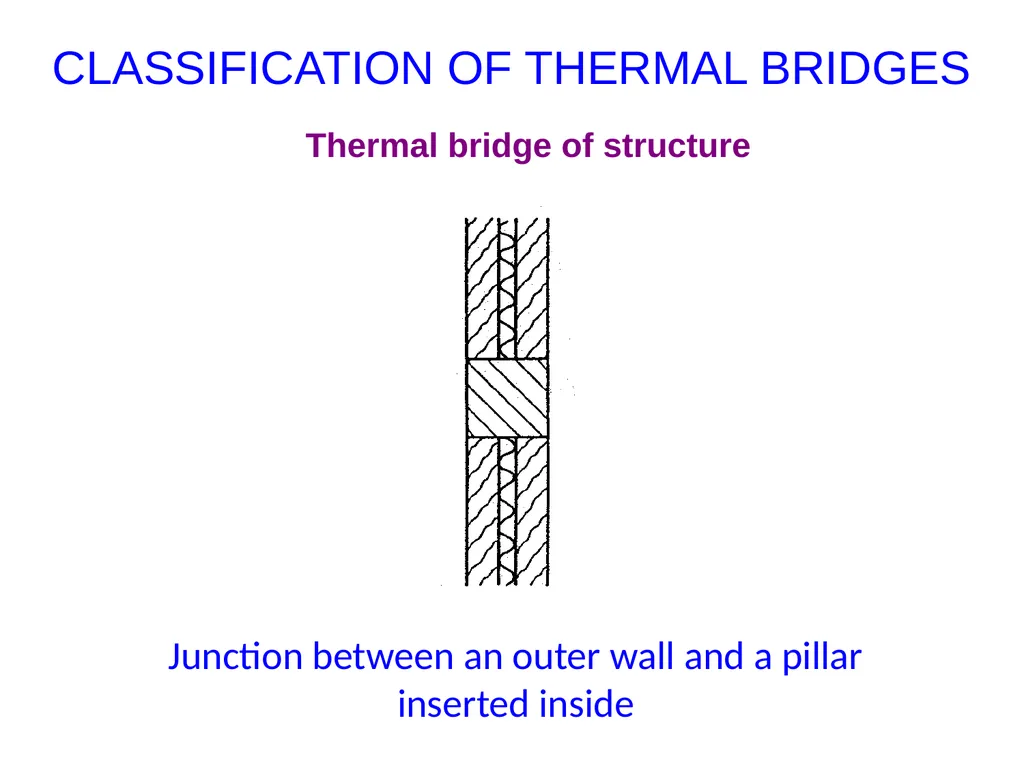
CLASSIFICATION OF THERMAL BRIDGES Thermal bridge of structure Areas where the deviation from the one-dimensional heat flow condition is due solely to the presence in the wall of a building element having a different thermal conductivity <br>
14
Junction between an outer wall and a casing (window) CLASSIFICATION OF THERMAL BRIDGES Thermal bridge of structure<br>
15
Junction between an outer wall and a pillar inserted inside CLASSIFICATION OF THERMAL BRIDGES Thermal bridge of structure<br>
16
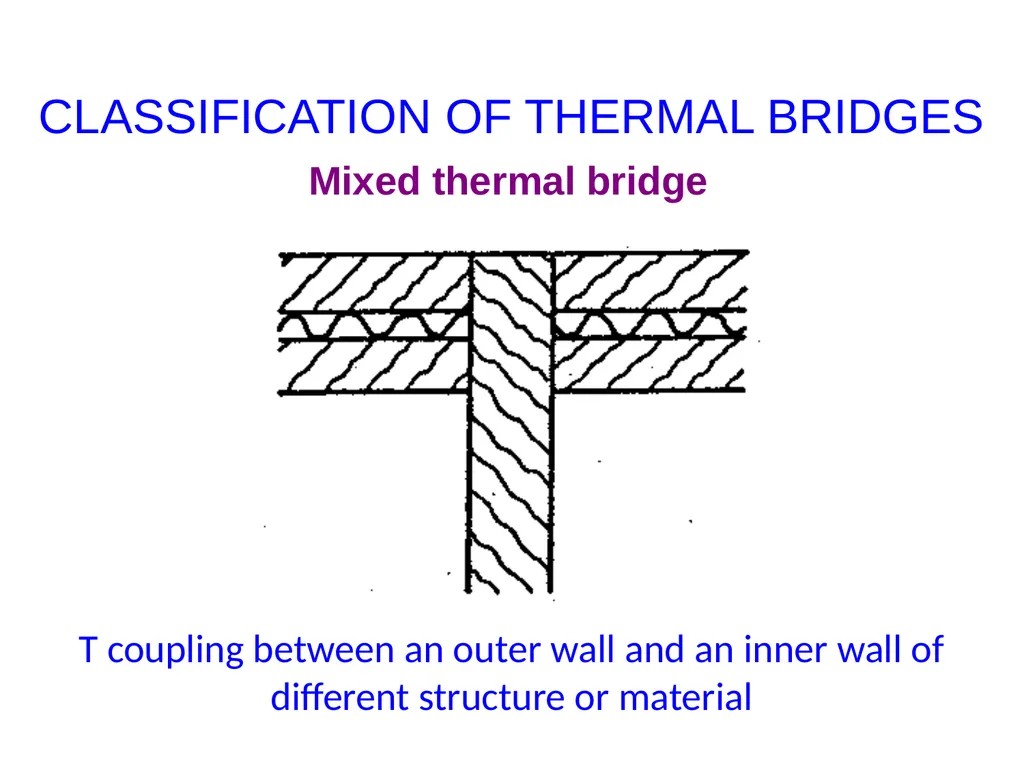
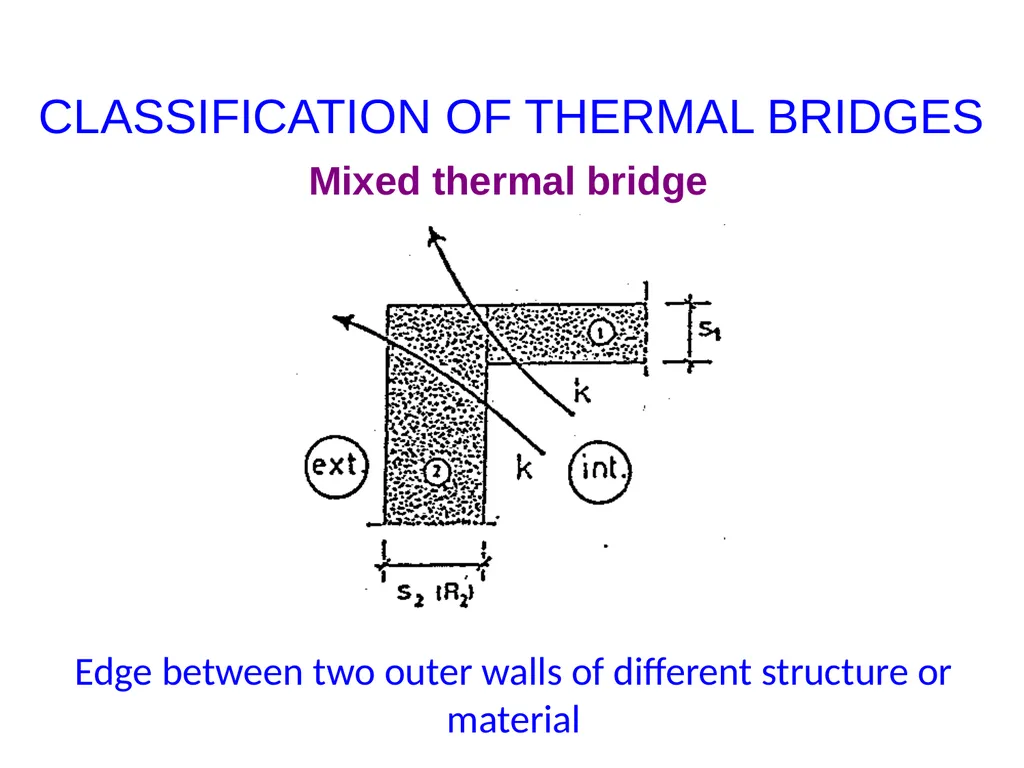
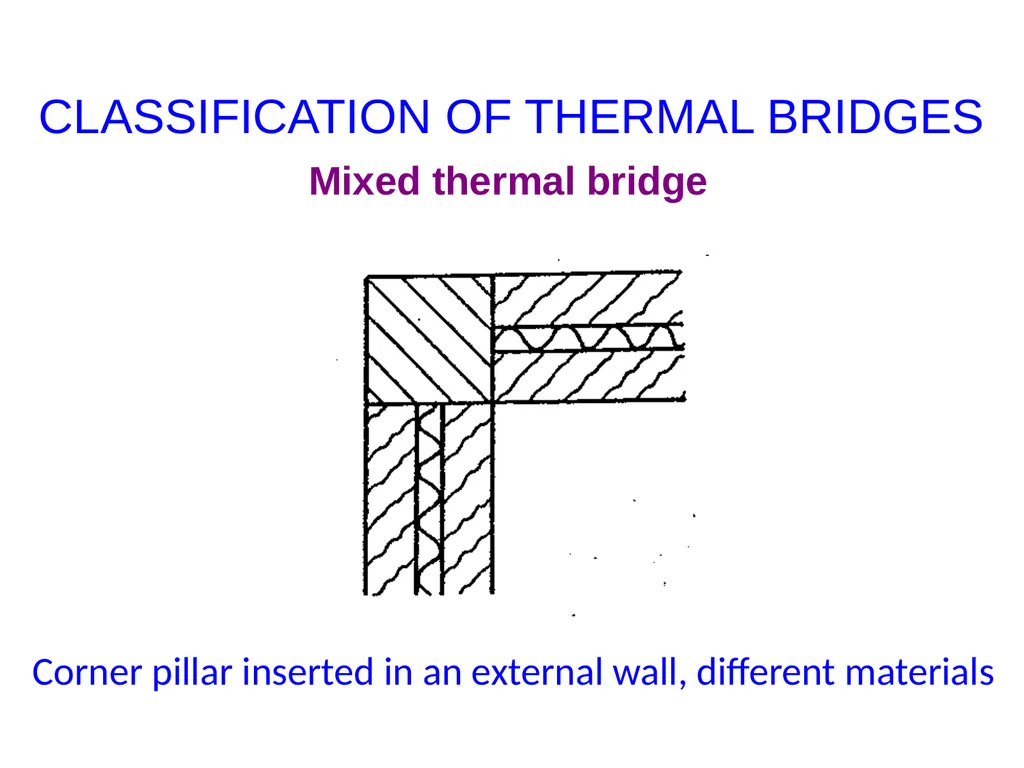
CLASSIFICATION OF THERMAL BRIDGES Mixed thermal bridge Areas where there is an overlap of a geometrical and structure thermal bridges <br>
17
CLASSIFICATION OF THERMAL BRIDGES Mixed thermal bridge T coupling between an outer wall and an inner wall of different structure or material<br>
18
CLASSIFICATION OF THERMAL BRIDGES Mixed thermal bridge Edge between two outer walls of different structure or material<br>
19
CLASSIFICATION OF THERMAL BRIDGES Corner pillar inserted in an external wall, different materials Mixed thermal bridge<br>
20
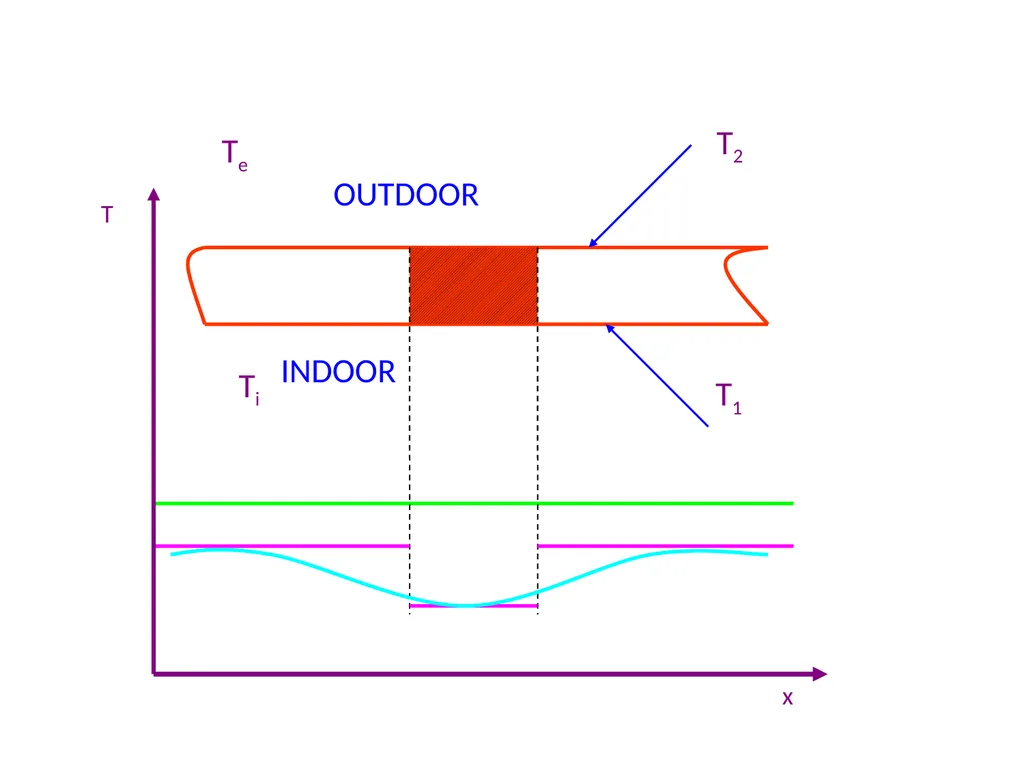
THERMAL BRIDGE EFFECTS In the thermal bridge areas the heat flux transmitted through the structure is different from the value calculated in the one-dimensional heat flux assumption
The existence of a two-dimensional or three-dimensional thermal field makes non-uniform the surface temperature of the walls<br>
The existence of a two-dimensional or three-dimensional thermal field makes non-uniform the surface temperature of the walls<br>
21
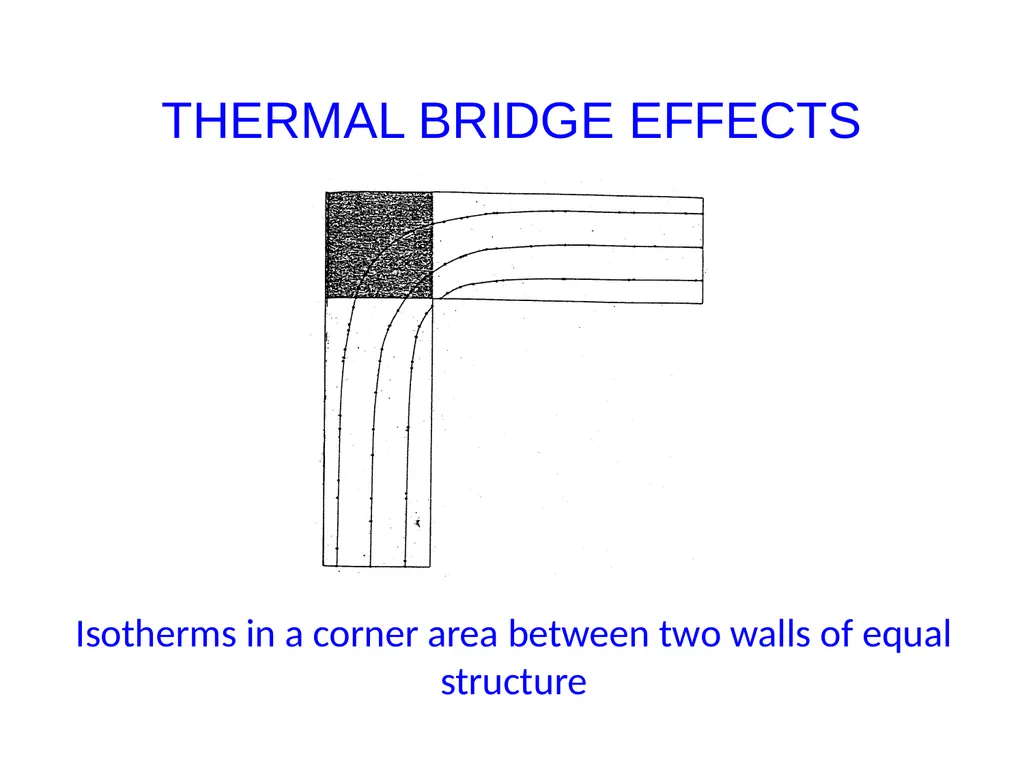
THERMAL BRIDGE EFFECTS Isotherms in a corner area between two walls of equal structure<br>
22
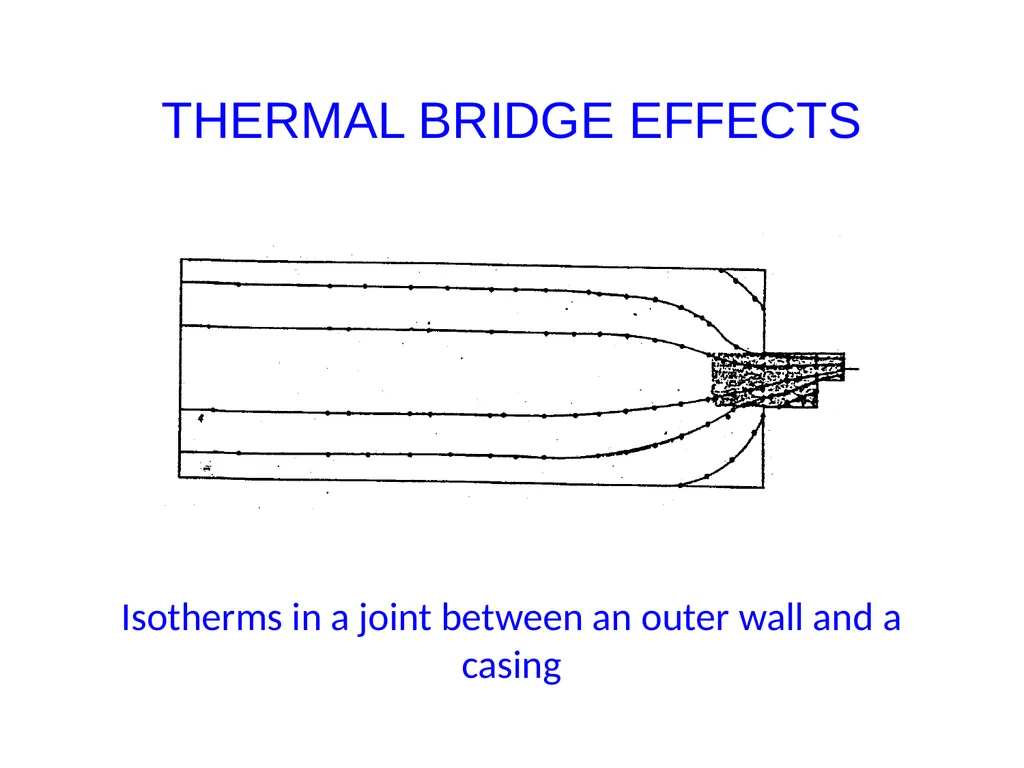
THERMAL BRIDGE EFFECTS Isotherms in a joint between an outer wall and a casing<br>
23
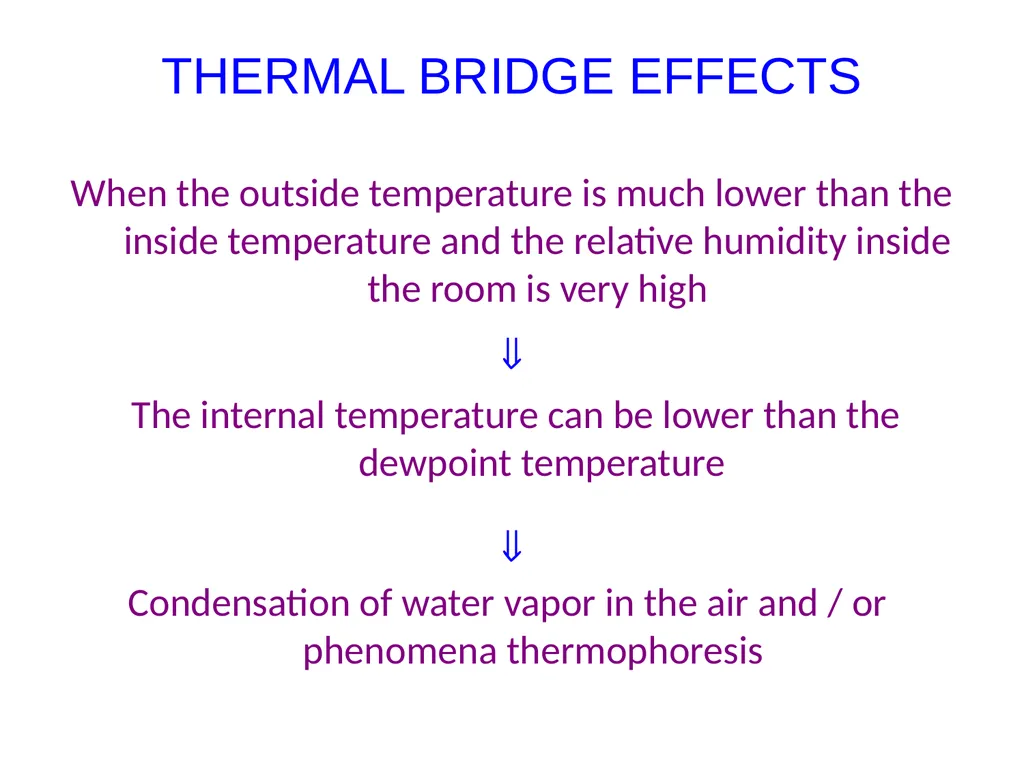
THERMAL BRIDGE EFFECTS When the outside temperature is much lower than the inside temperature and the relative humidity inside the room is very high The internal temperature can be lower than the dewpoint temperature Condensation of water vapor in the air and / or phenomena thermophoresis<br>
24
THERMAL BRIDGES EFFECTS Migration of the particles in the air to the surfaces caused by the temperature difference or temperature gradient.
physical mechanism that contributes to aging of the products.
The surfaces colder than the surrounding air continuously capture the dust creating damaging deposits to the preservation of the objects.
In particular, condensation of the intrados of the floor in correspondence with the concrete rib. Thermophoresis<br>
physical mechanism that contributes to aging of the products.
The surfaces colder than the surrounding air continuously capture the dust creating damaging deposits to the preservation of the objects.
In particular, condensation of the intrados of the floor in correspondence with the concrete rib. Thermophoresis<br>
25
THERMAL BRIDGES EFFECTS The heat flux Increases Thermal bridges determine a greater dispersion of energy from the inside to the outside<br>
26
THERMAL BRIDGES EFFECTS Condensation determines problems caused by damp patches and it determines a decrease of the mechanical and physical characteristics of the wall materials<br>
27
THERMAL BRIDGES EFFECTS The methodology to avoid the main problems due to a thermal bridge is :
determine the temperature field in the thermal bridge area
verify that the values of the internal surface temperatures are greater than the dewpoint (temperature), Tr
in case this is not verified it should proceed to the thermal bridge correction with suitable constructive operations
calculate the heat transfer rate dispersed by the thermal bridge whether it was correct or not<br>
determine the temperature field in the thermal bridge area
verify that the values of the internal surface temperatures are greater than the dewpoint (temperature), Tr
in case this is not verified it should proceed to the thermal bridge correction with suitable constructive operations
calculate the heat transfer rate dispersed by the thermal bridge whether it was correct or not<br>
28
METHODS TO REDUCE THERMAL BRIDGES A thermal bridge can be eliminated or reduced by a suitable insulation It is reduced the dispersed heat flux It should be limited the effect of the temperature decrease of the on the inner surface of wall<br>
29
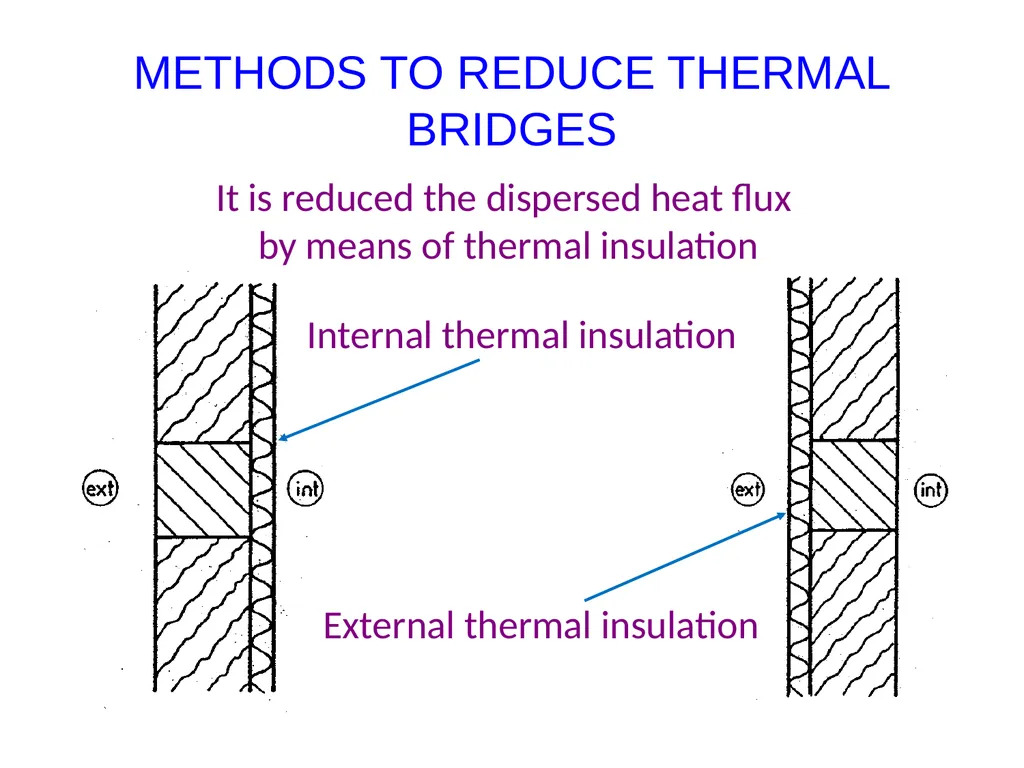
METHODS TO REDUCE THERMAL BRIDGES It is reduced the dispersed heat flux
by means of thermal insulation Internal thermal insulation External thermal insulation<br>
by means of thermal insulation Internal thermal insulation External thermal insulation<br>
30
METHODS TO REDUCE THERMAL BRIDGES If the thermal insulation is not perfectly continuous in correspondence with the thermal bridge The deviation from the one-dimensional flow condition is further accentuated<br>
31
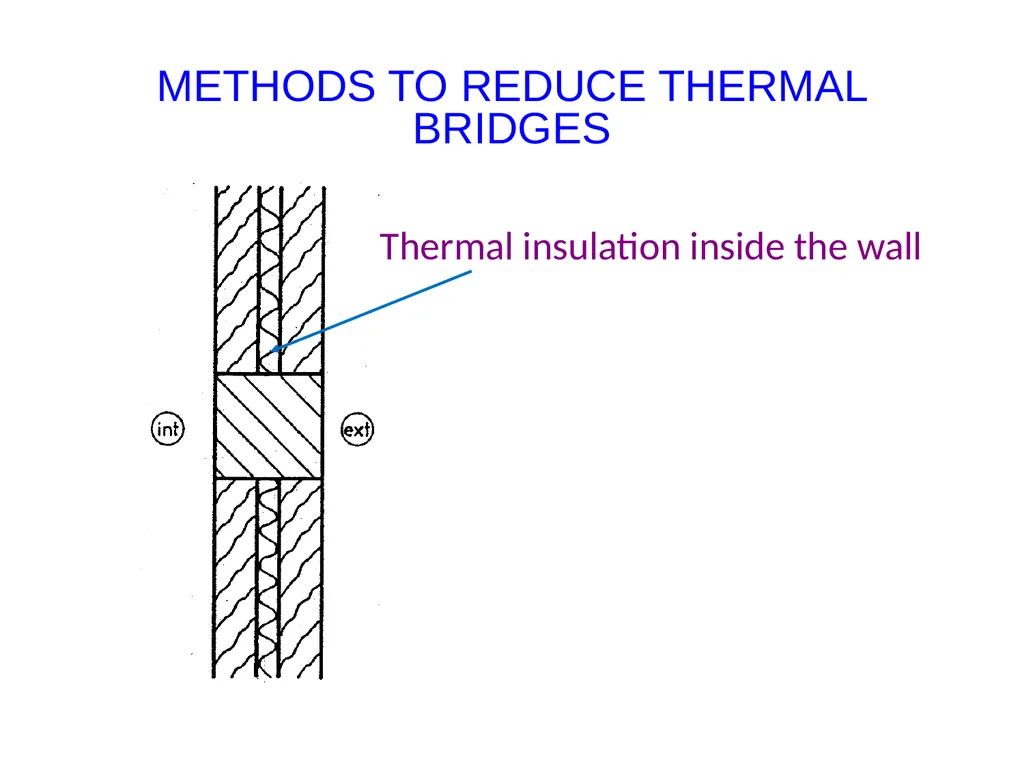
METHODS TO REDUCE THERMAL BRIDGES Thermal insulation inside the wall<br>
32
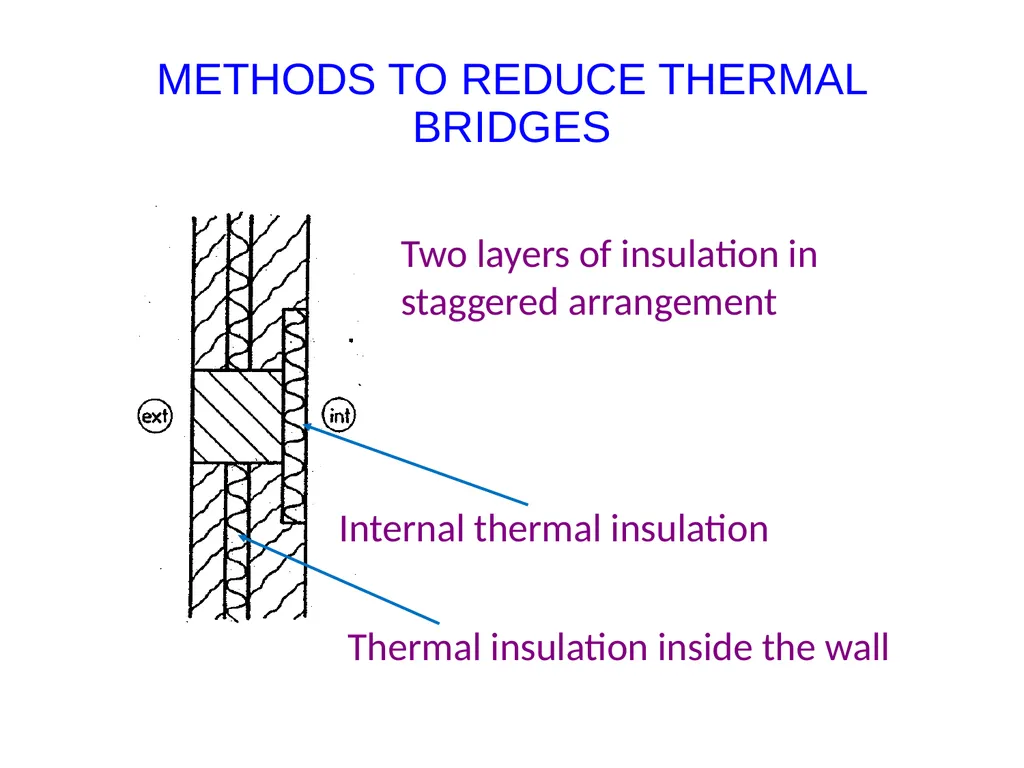
METHODS TO REDUCE THERMAL BRIDGES It is not always possible to realize a continuous insulation due to architectural or constructional constraints There should be a suitable superposition of two layers of insulation in staggered arrangement<br>
33
METHODS TO REDUCE THERMAL BRIDGES Thermal insulation inside the wall Internal thermal insulation Two layers of insulation in staggered arrangement<br>
34
THERMAL BRIDGE HEAT TRANSFER RATE EVALUATION The study of heat transfer in the areas of thermal bridge is a heat conduction multidimensional problem in steady state regime<br>
35
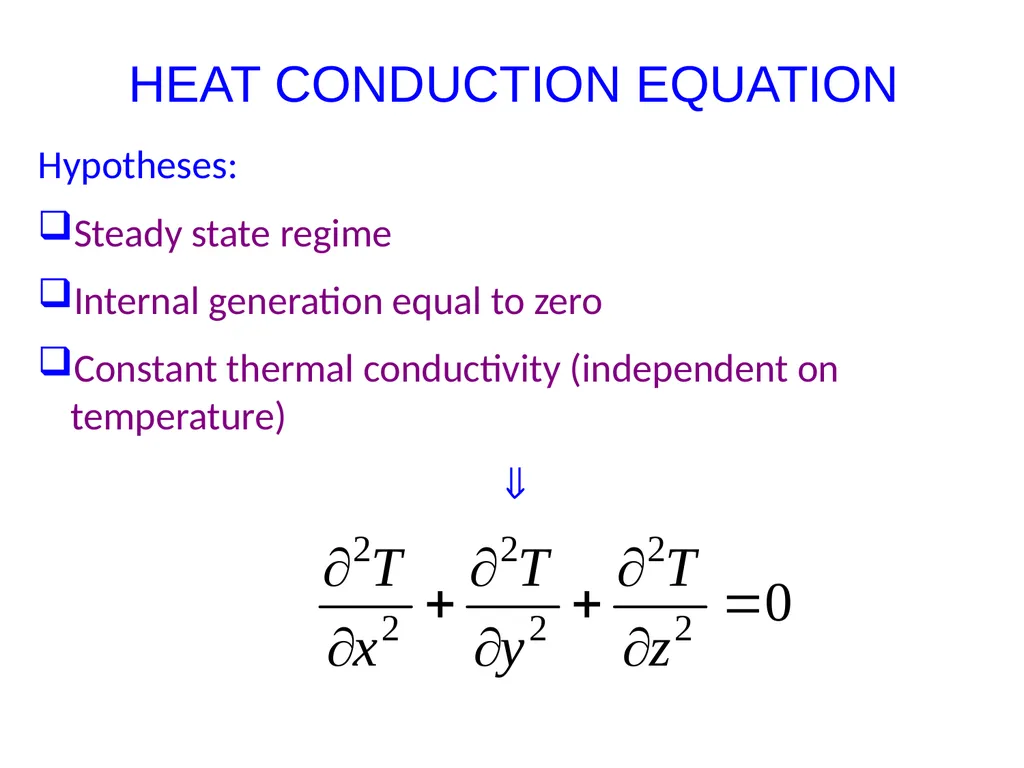
Hypotheses:
Steady state regime
Internal generation equal to zero
Constant thermal conductivity (independent on temperature) HEAT CONDUCTION EQUATION<br>
Steady state regime
Internal generation equal to zero
Constant thermal conductivity (independent on temperature) HEAT CONDUCTION EQUATION<br>
36
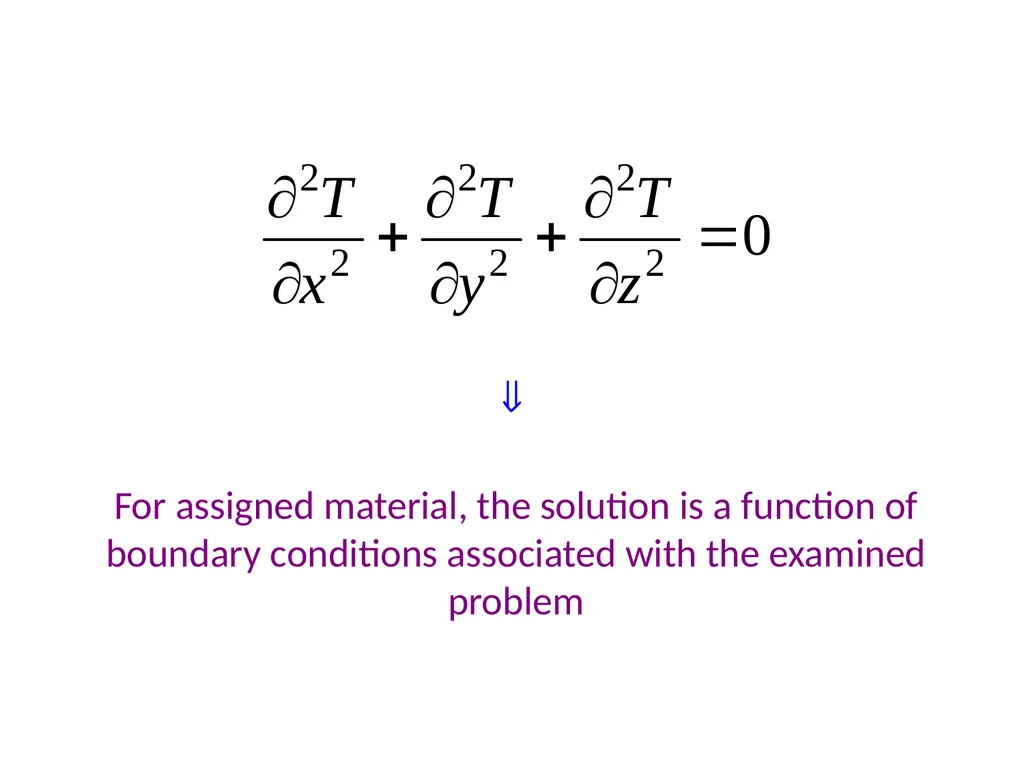
For assigned material, the solution is a function of boundary conditions associated with the examined problem<br>
37
For applications concerning the thermal bridge areas in the buildings, the boundary conditions are typically the following: heat flux continuity on interface surfaces between the examined domain and the external and internal environments
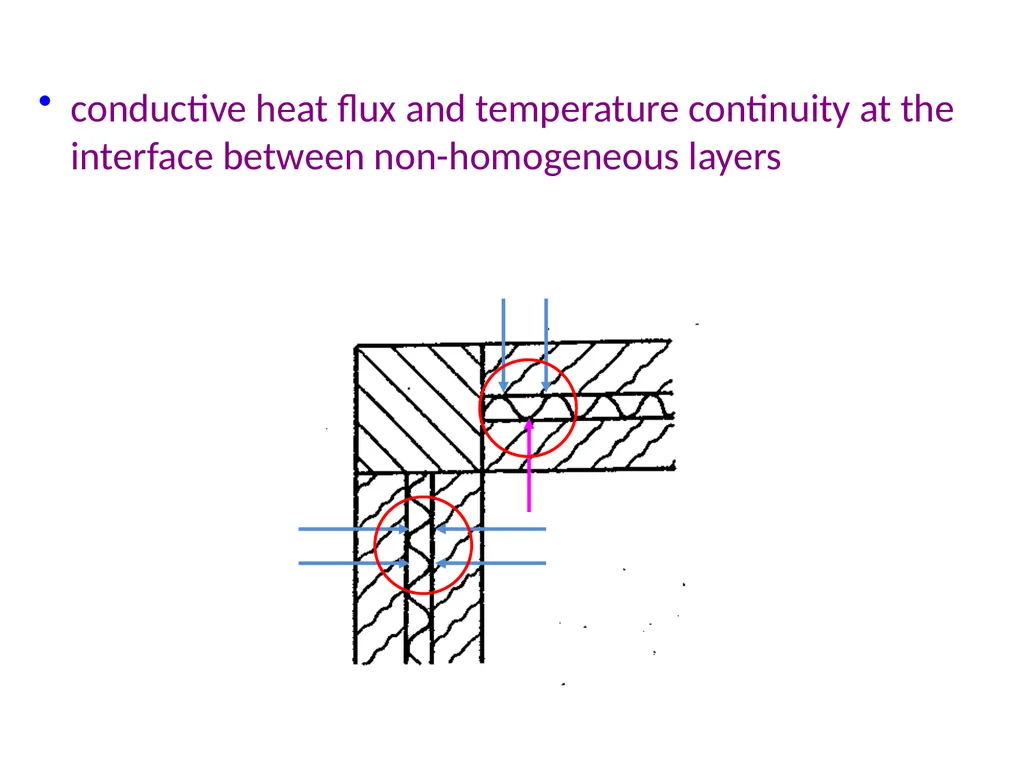
conductive heat flux and temperature continuity at the interface between non-homogeneous layers
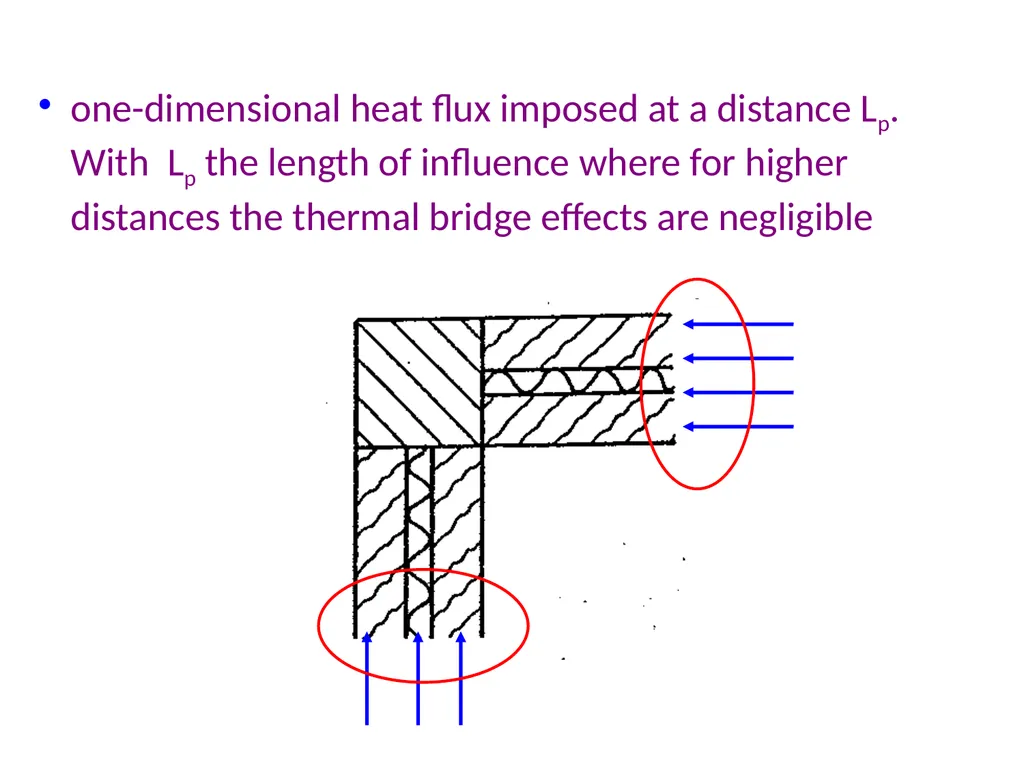
one-dimensional heat flux imposed at a distance Lp. With Lp the length of influence where for higher distances the thermal bridge effects are negligible<br>
conductive heat flux and temperature continuity at the interface between non-homogeneous layers
one-dimensional heat flux imposed at a distance Lp. With Lp the length of influence where for higher distances the thermal bridge effects are negligible<br>
38
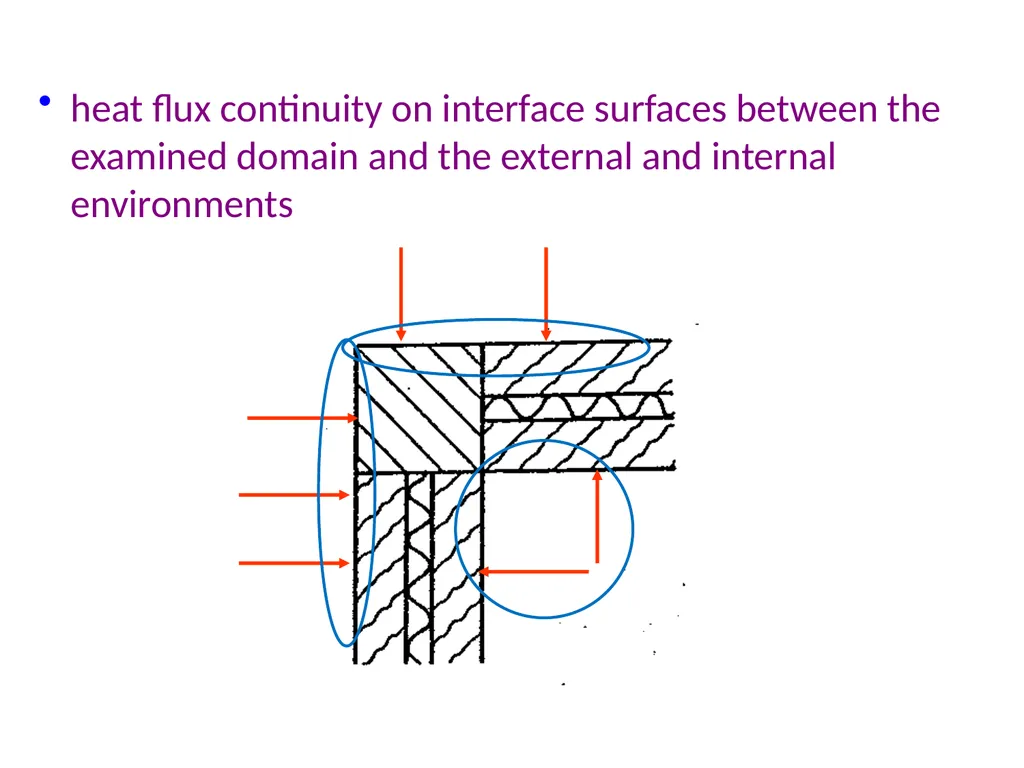
heat flux continuity on interface surfaces between the examined domain and the external and internal environments<br>
39
conductive heat flux and temperature continuity at the interface between non-homogeneous layers<br>
40
one-dimensional heat flux imposed at a distance Lp. With Lp the length of influence where for higher distances the thermal bridge effects are negligible<br>
41
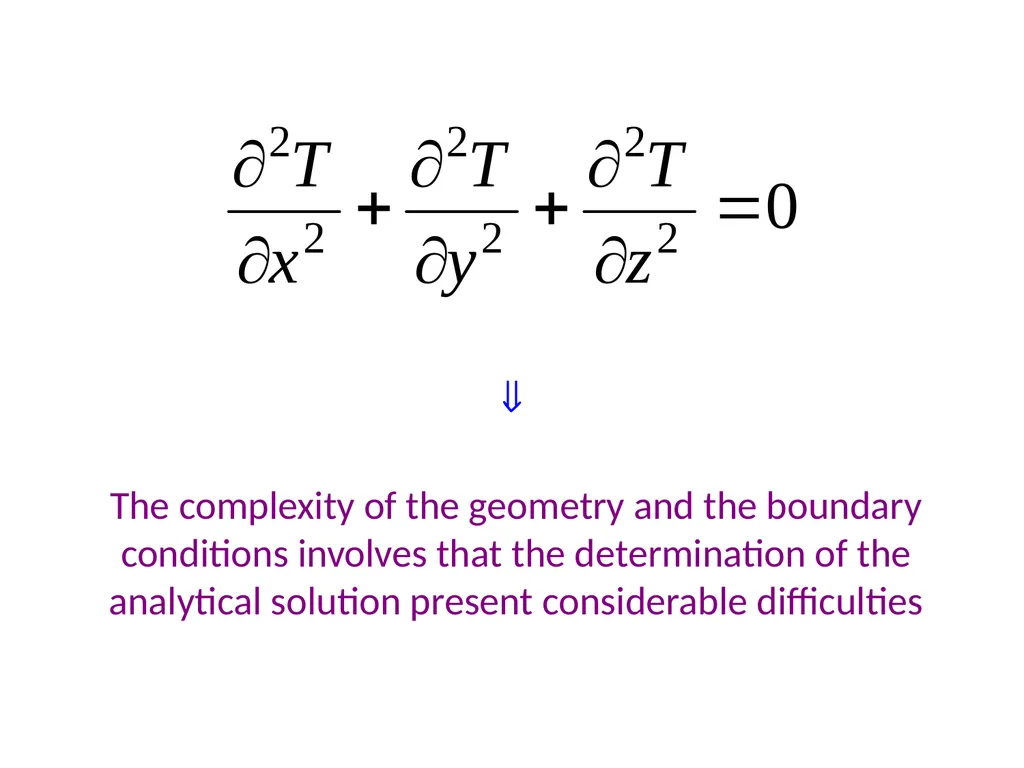
The complexity of the geometry and the boundary conditions involves that the determination of the analytical solution present considerable difficulties<br>
42
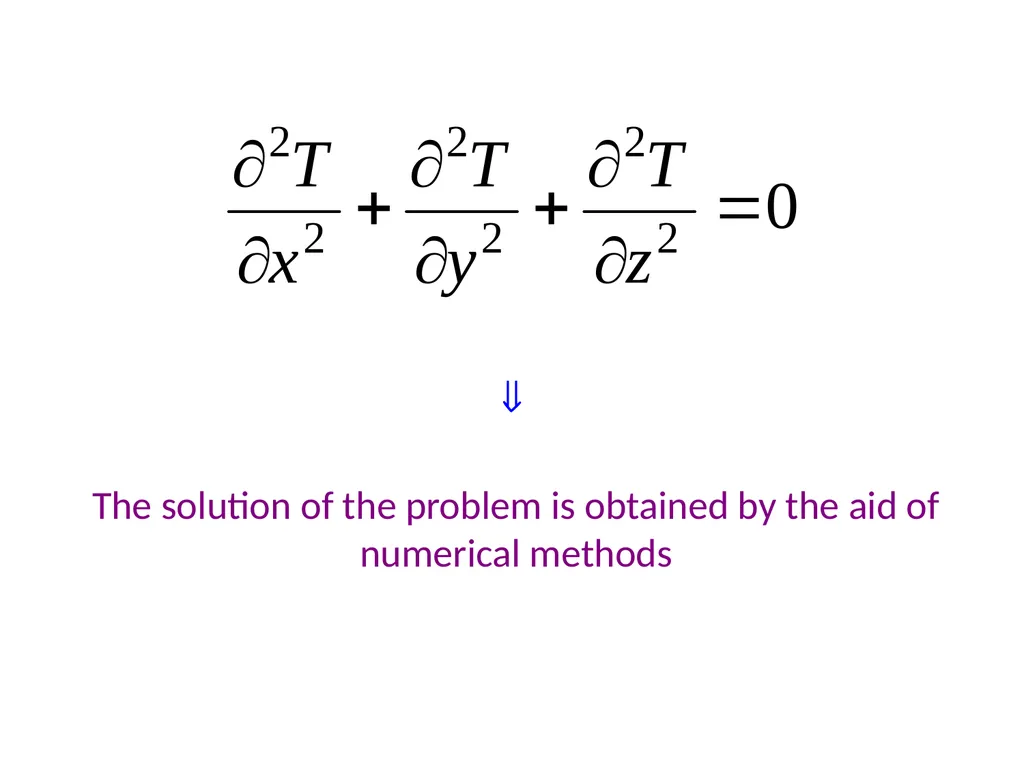
The solution of the problem is obtained by the aid of numerical methods<br>
43
The commonly used numerical methods are those differences, volumes and finite elements The partial differential equation of conduction is approximated with a system of linear algebraic equations in the unknowns temperatures in a finite number of nodes, in which the domain was discretized<br>
44
The resolution of this system allows to evaluate the temperature range of the thermal bridge in the zone, and then to verify whether or not condensation phenomena occur at the interface with the internal environment<br>
45
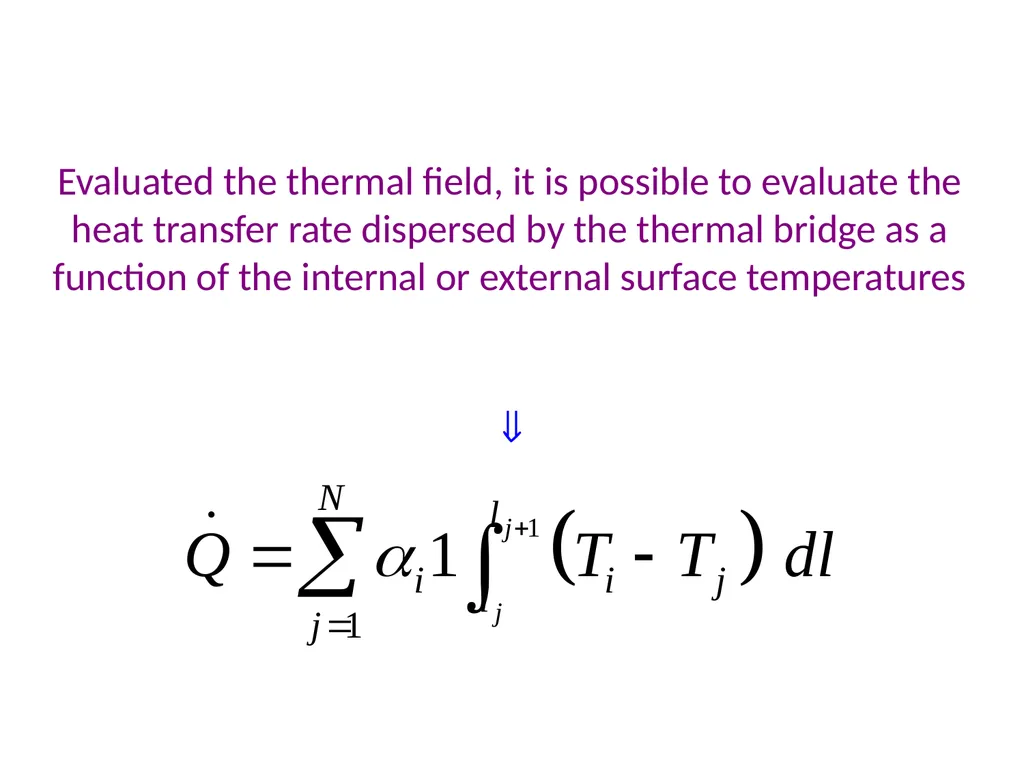
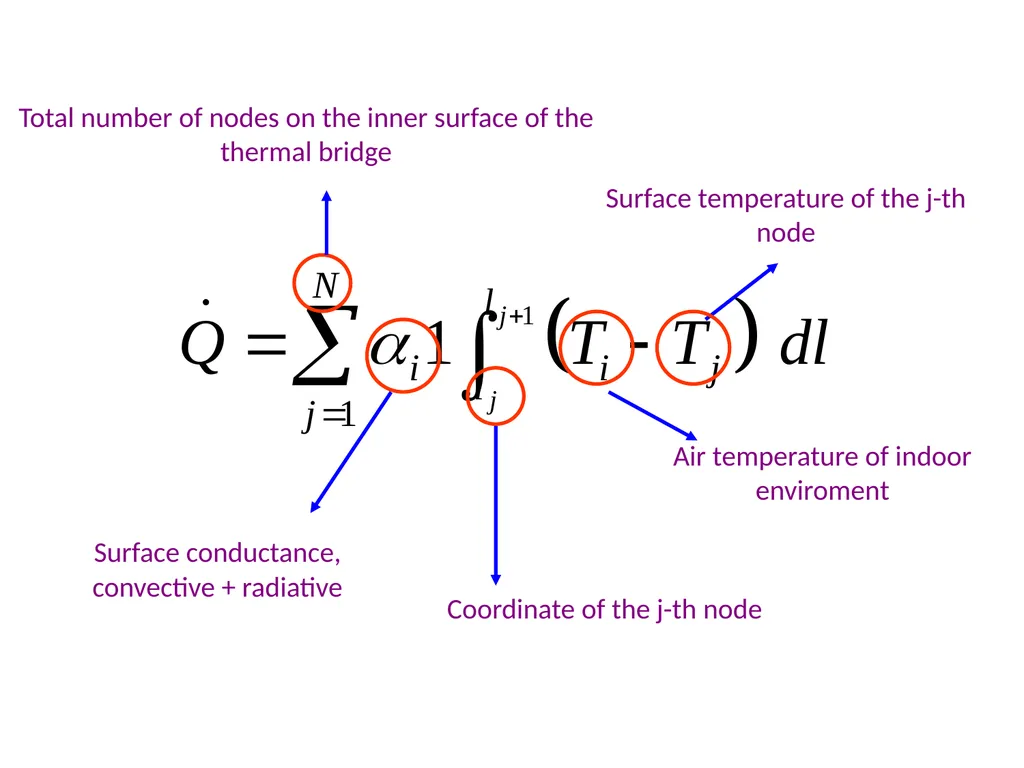
Evaluated the thermal field, it is possible to evaluate the heat transfer rate dispersed by the thermal bridge as a function of the internal or external surface temperatures<br>
46
Surface conductance, convective + radiative Total number of nodes on the inner surface of the thermal bridge Coordinate of the j-th node Surface temperature of the j-th node Air temperature of indoor enviroment<br>
47
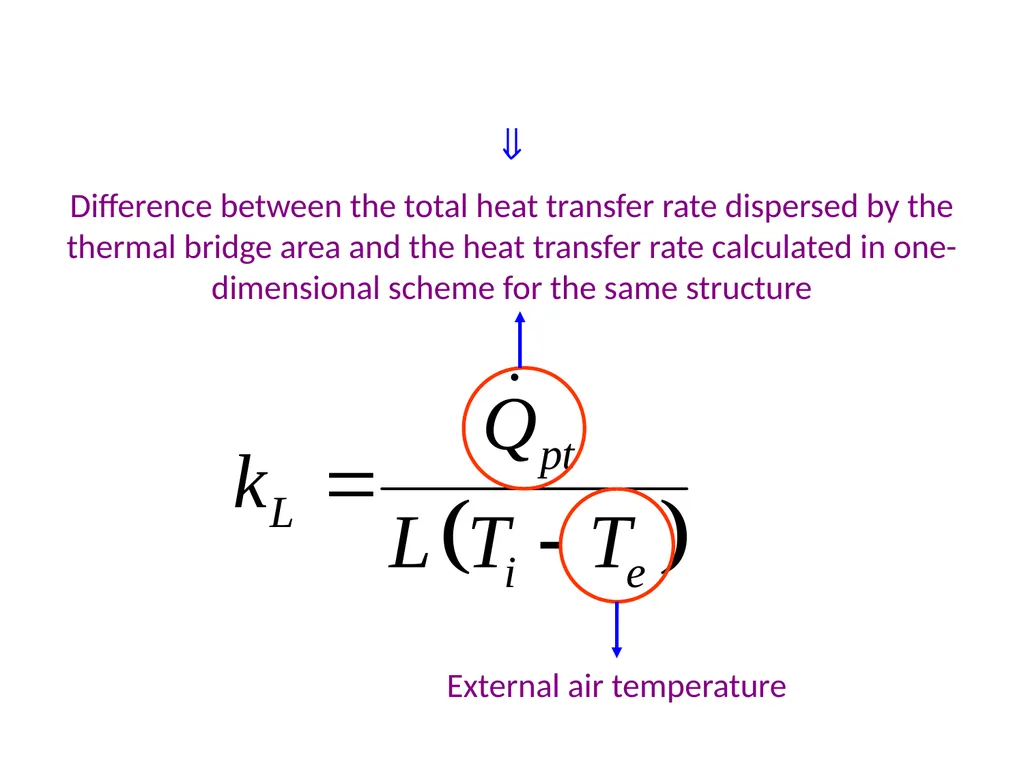
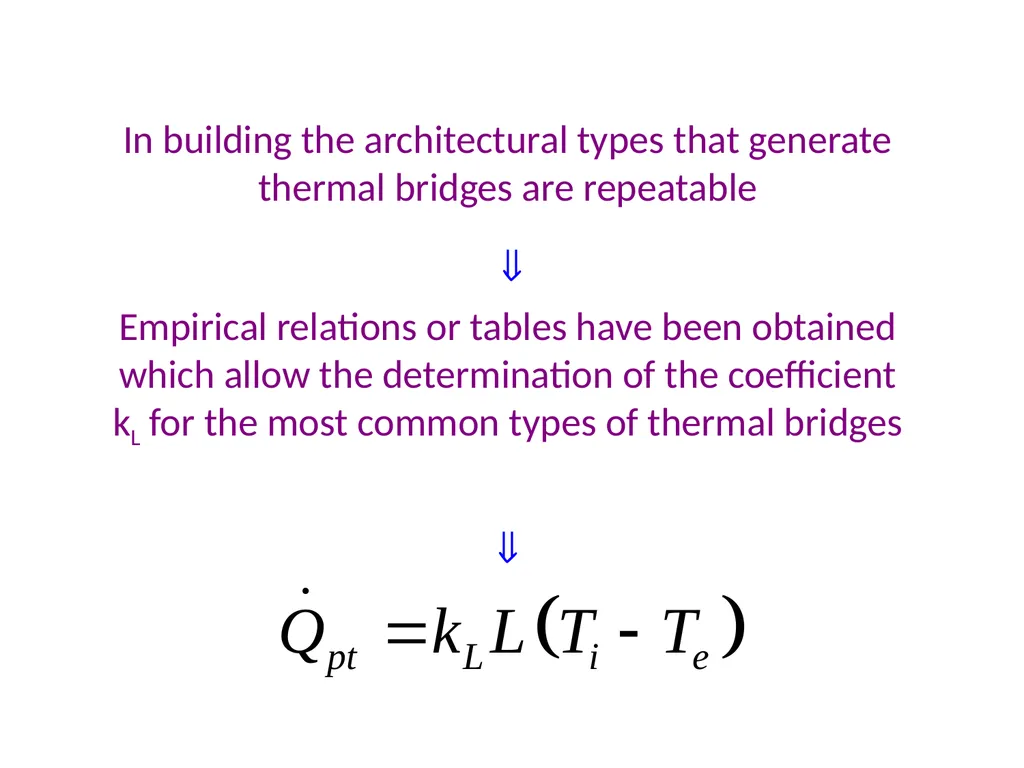
The evaluation heat transfer rate dispersed allows to calculate the linear transmission coefficient or the linear conductance coefficient The linear transmission coefficient or linear conductance coefficient, kL, is defined as the rate of thermal energy per unit of characteristic length of the thermal bridge, and per unit of temperature difference between the inside and the outside of the structure<br>
48
Difference between the total heat transfer rate dispersed by the thermal bridge area and the heat transfer rate calculated in one-dimensional scheme for the same structure External air temperature<br>
49
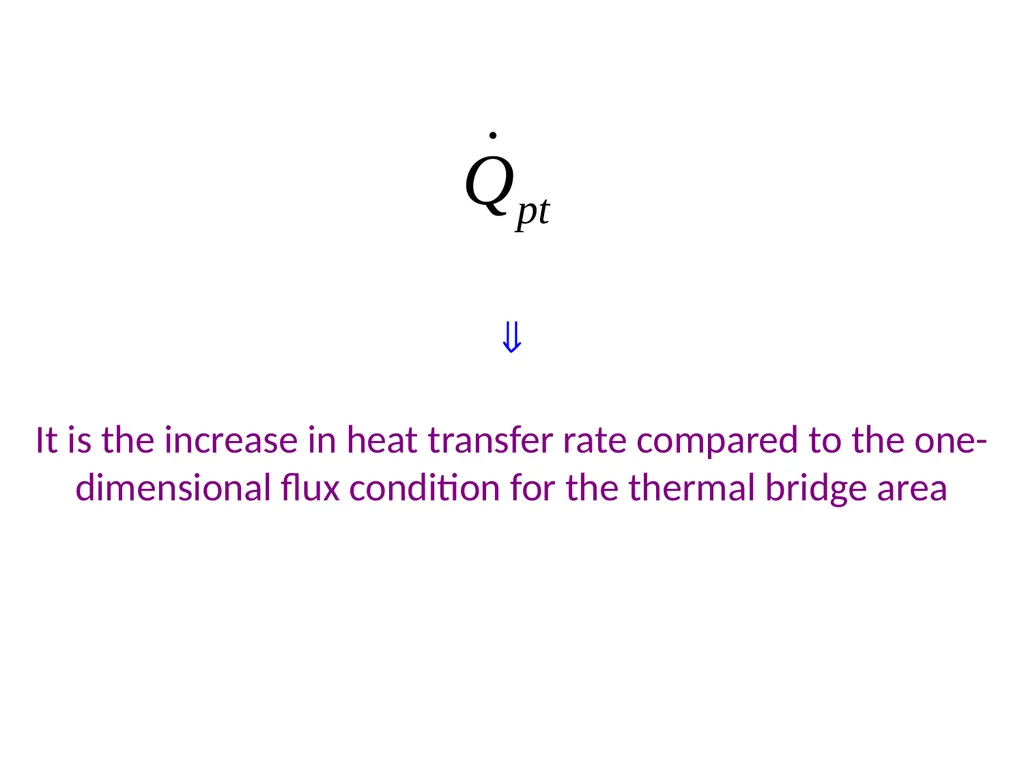
It is the increase in heat transfer rate compared to the one-dimensional flux condition for the thermal bridge area <br>
50
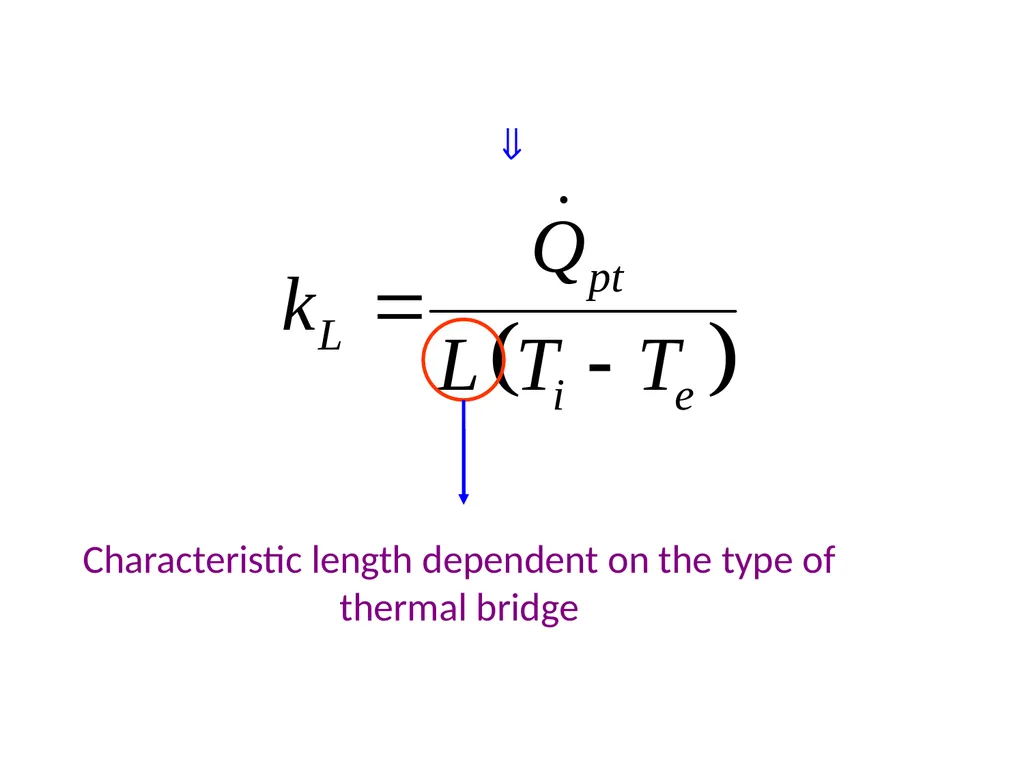
Characteristic length dependent on the type of thermal bridge<br>
51
In building the architectural types that generate thermal bridges are repeatable Empirical relations or tables have been obtained which allow the determination of the coefficient kL for the most common types of thermal bridges <br>
52
THERMAL BRIDGE
STANDARD OR REFERENCES In general, using empirical methods, it is evaluated the heat transfer rate dispersed or the conductive trasmittance or conductance of some thermal bridges<br>
53
CLASSIFICATION OF WALLS Walls with internal thermal insulation
Walls with external thermal insulation
Walls with distributed thermal insulation
Sandwich walls with concrete and insulating material
External wall with lightweight facade<br>
Walls with external thermal insulation
Walls with distributed thermal insulation
Sandwich walls with concrete and insulating material
External wall with lightweight facade<br>
54
CLASSIFICATION OF WALLS Walls with internal thermal insulation Walls satisfying the following conditions:
the thermal insulation is assured almost exclusively from a material of thermal conductivity lower than 0.12 W/mK
the insulation thickness is such that its thermal resistance is higher than 0.5 m2 K/W
the thermal insulation is placed on the inner surface of the wall <br>
the thermal insulation is assured almost exclusively from a material of thermal conductivity lower than 0.12 W/mK
the insulation thickness is such that its thermal resistance is higher than 0.5 m2 K/W
the thermal insulation is placed on the inner surface of the wall <br>
55
CLASSIFICATION OF WALLS Walls with external thermal insulation Walls satisfying the following conditions:
the thermal insulation is assured almost exclusively from a material of thermal conductivity lower than 0.12 W/mK
the insulation thickness is such that its thermal resistance is higher than 0.5 m2 K/W
the thermal insulation is placed on the outer surface of the wall <br>
the thermal insulation is assured almost exclusively from a material of thermal conductivity lower than 0.12 W/mK
the insulation thickness is such that its thermal resistance is higher than 0.5 m2 K/W
the thermal insulation is placed on the outer surface of the wall <br>
56
CLASSIFICATION OF WALLS Walls with distributed thermal insulation This category includes:
walls which do not have thermal insulation
walls in which the thermal insulation is not disposed on either the outer surface or on the inner surface <br>
walls which do not have thermal insulation
walls in which the thermal insulation is not disposed on either the outer surface or on the inner surface <br>
57
CLASSIFICATION OF WALLS Sandwich walls with concrete and insulating material These walls consist of two concrete layers separated by a core of insulating material <br>
58
CLASSIFICATION OF WALLS External wall with lightweight facade It is meant an outer wall of much lower thickness than conventional walls <br>
59
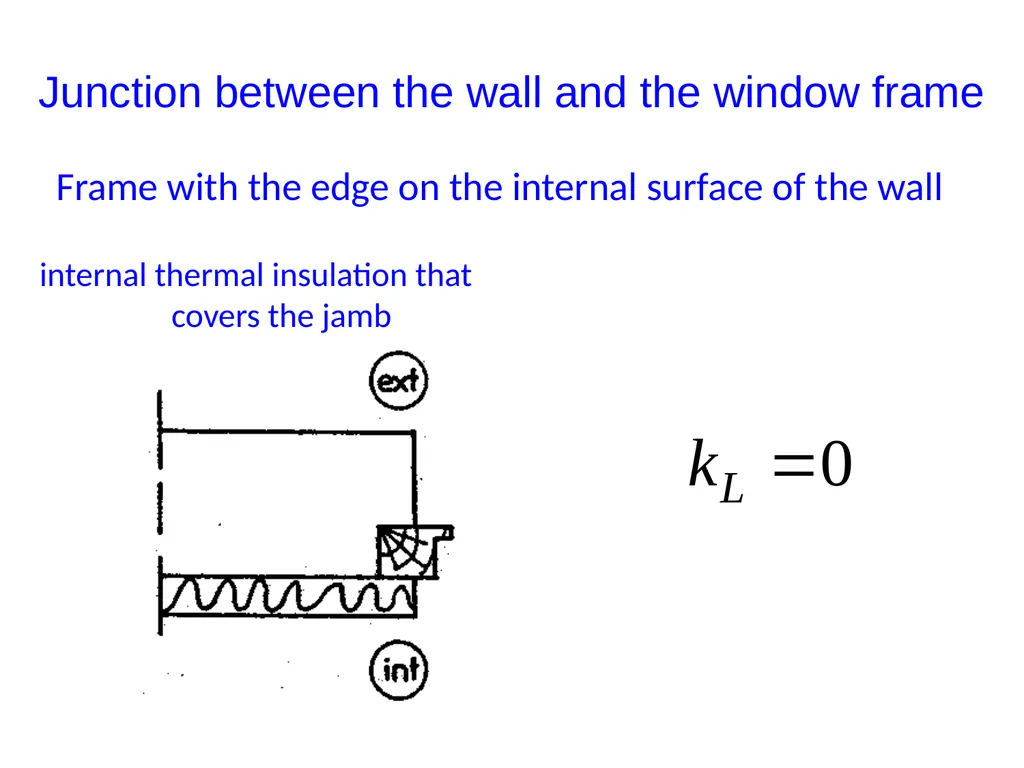
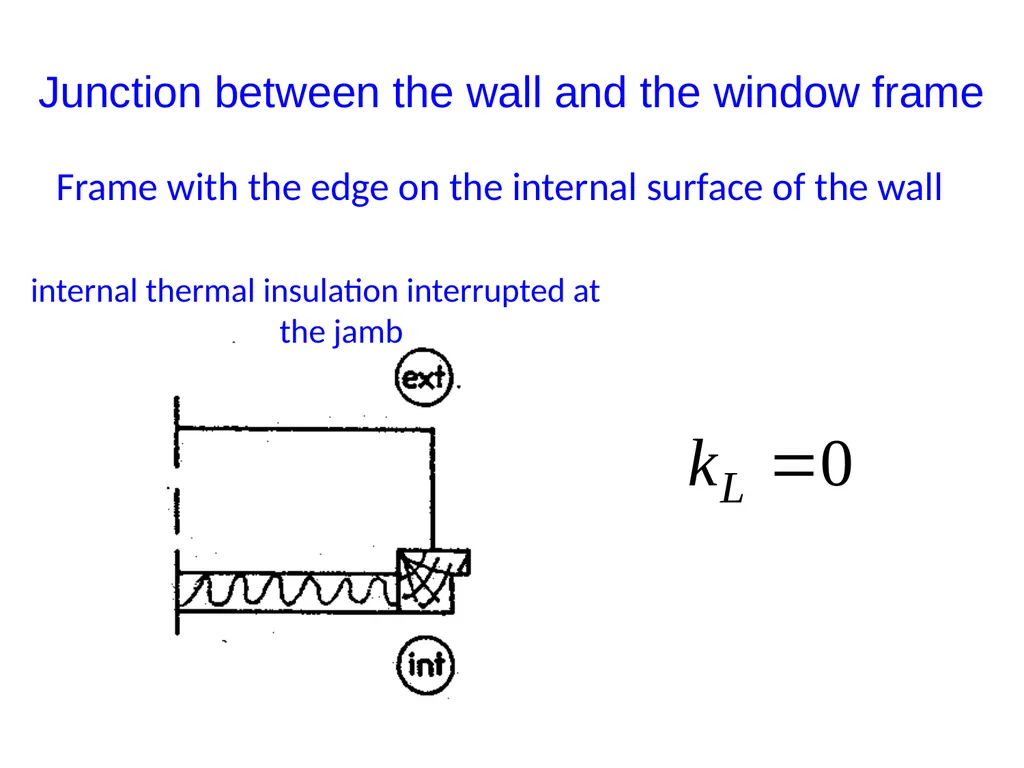
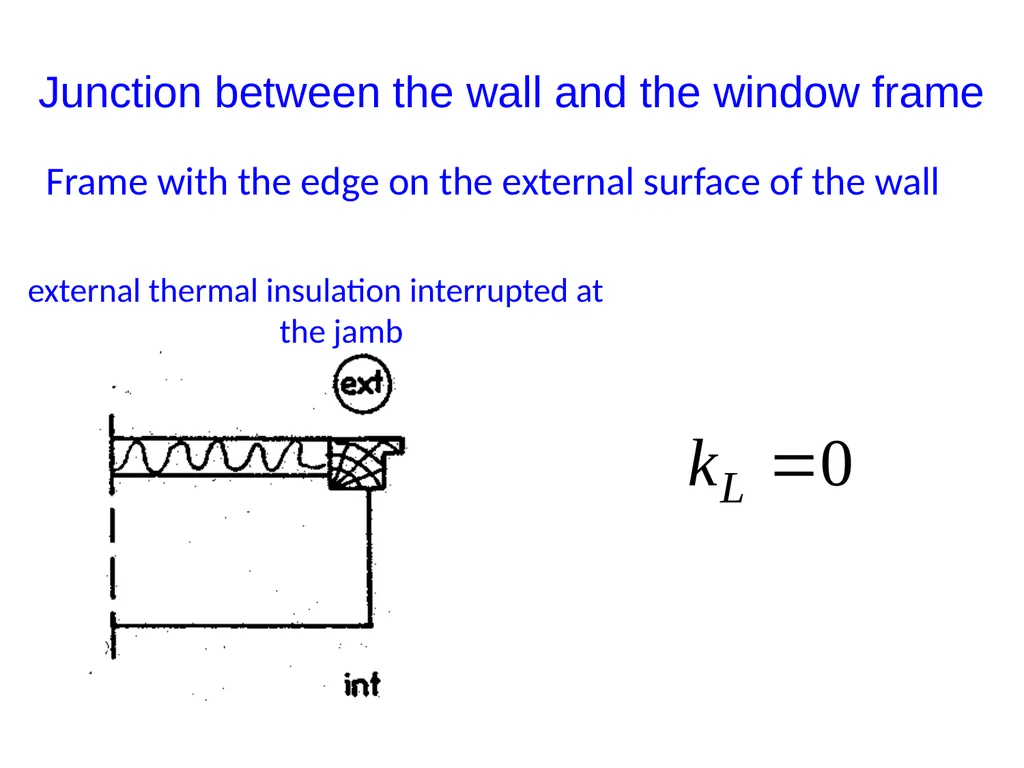
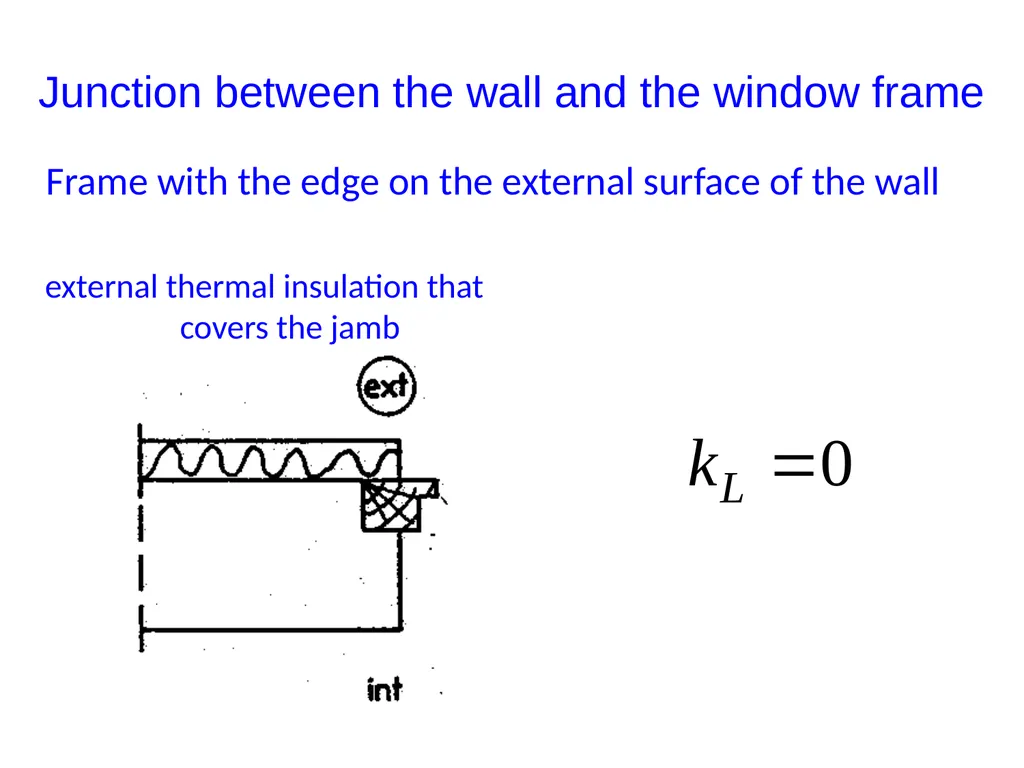
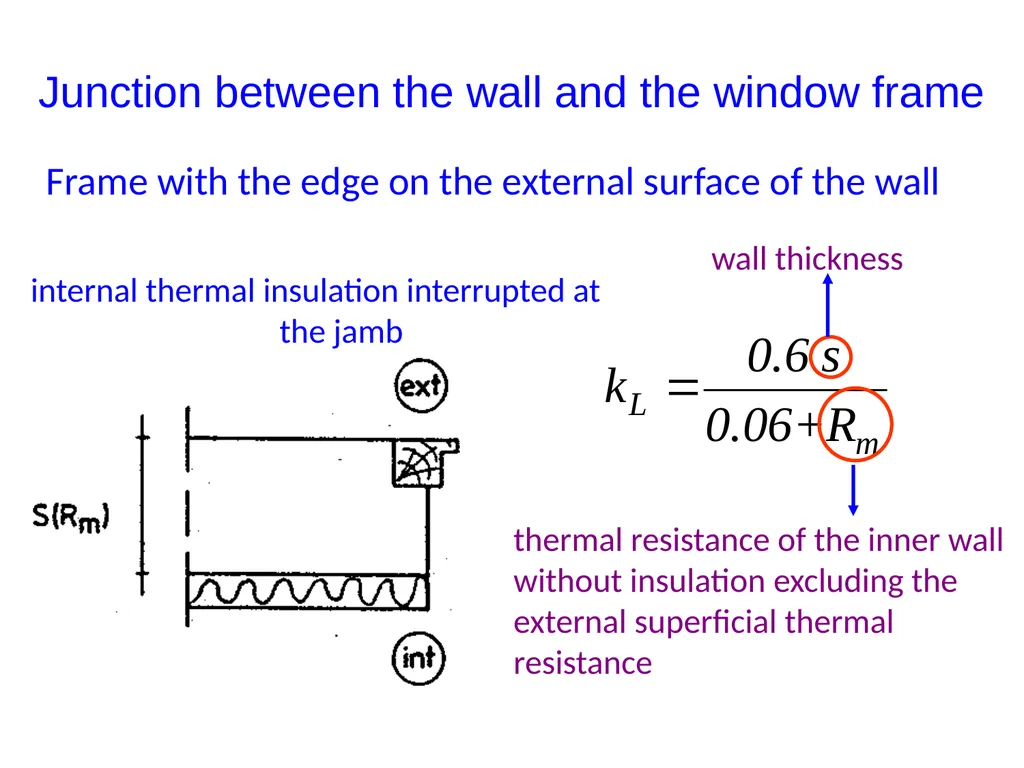
Junction between the wall and the window frame The evaluation of linear transmission coefficient kL is a function of the wall according to the classification carried out and of the frame position with respect to the masonry.
The following cases are considered :
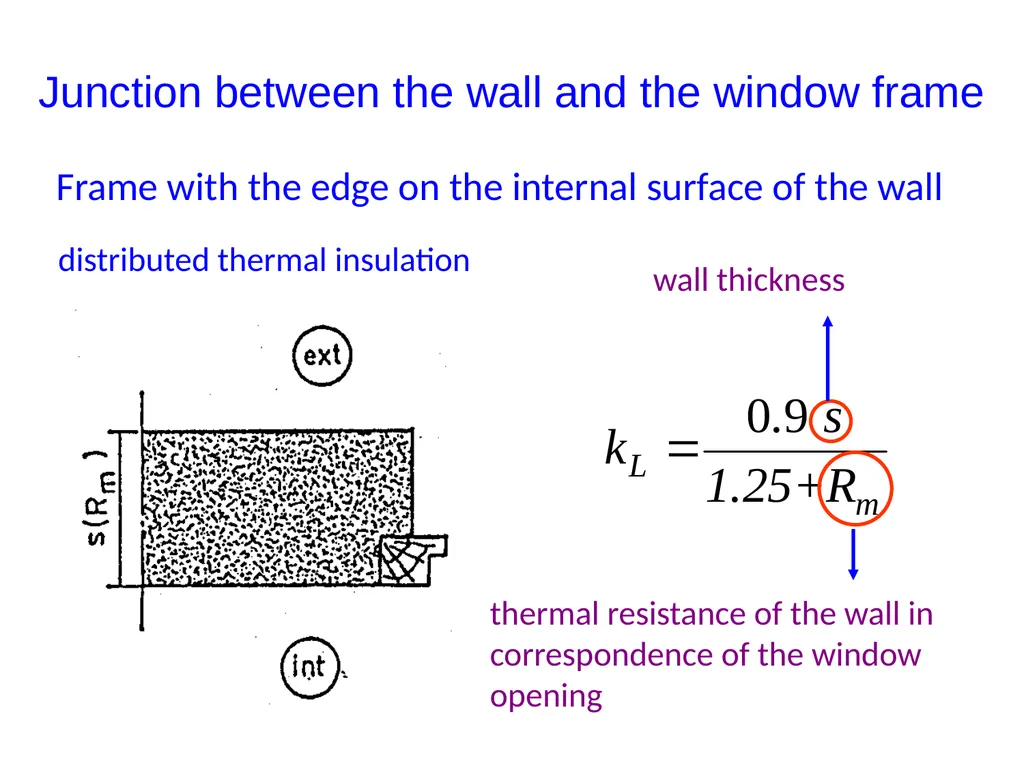
frame with the edge on the internal surface of the wall
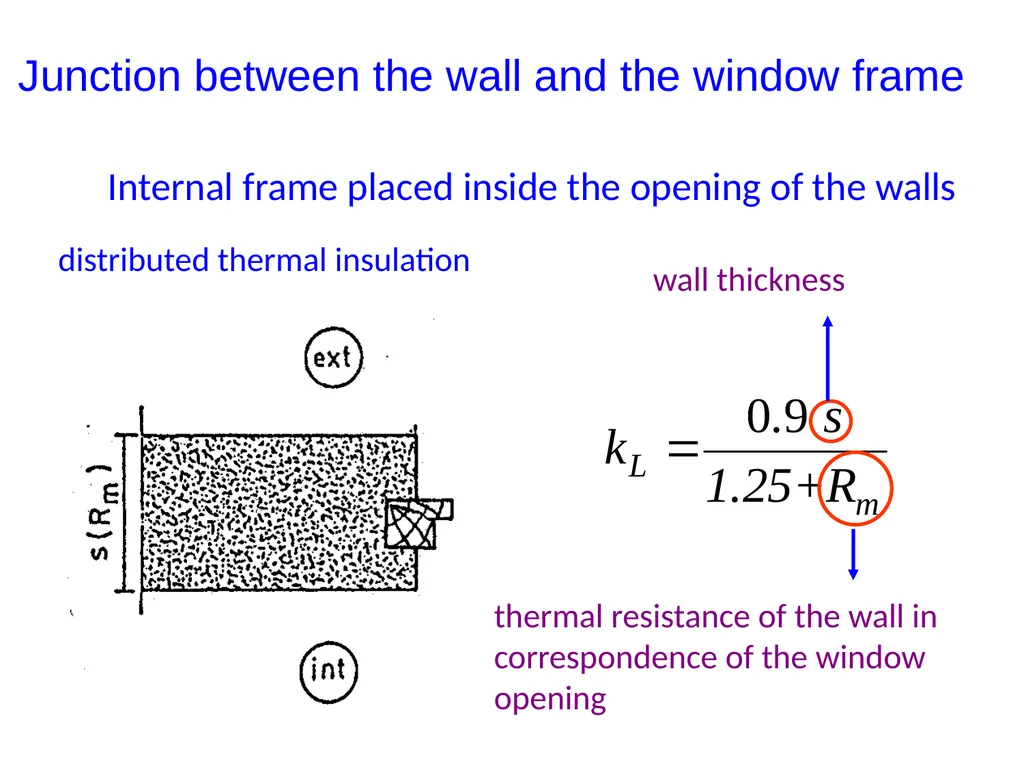
Internal frame placed inside the opening of the walls
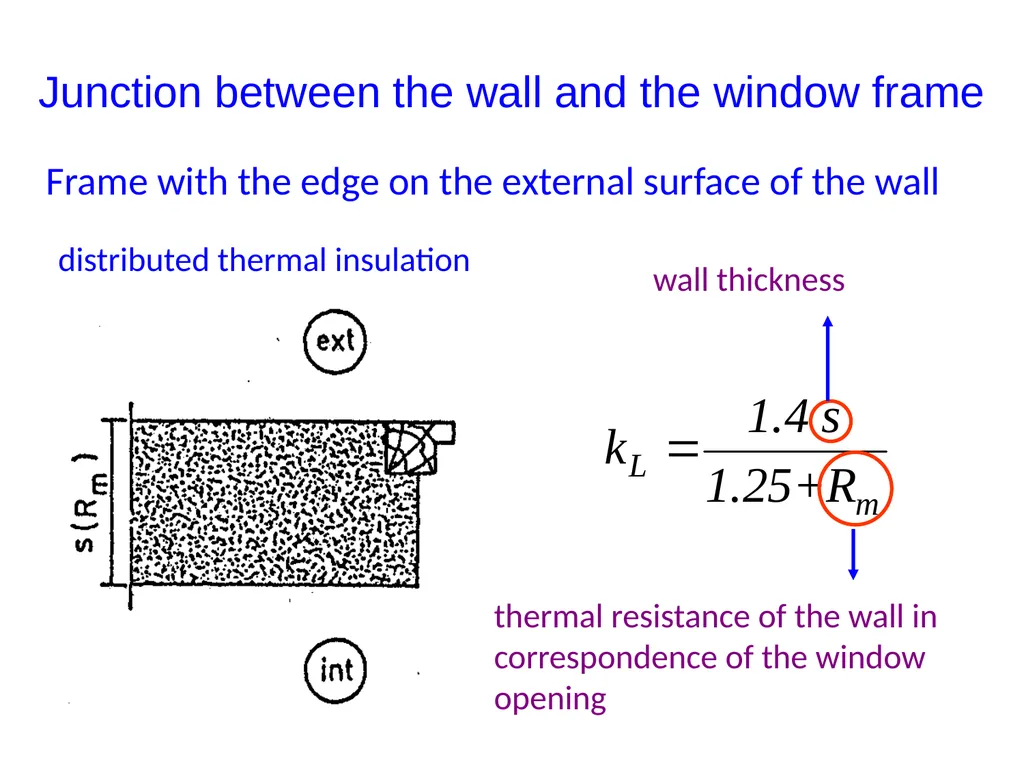
frame with the edge on the external surface of the wall<br>
The following cases are considered :
frame with the edge on the internal surface of the wall
Internal frame placed inside the opening of the walls
frame with the edge on the external surface of the wall<br>
60
Junction between the wall and the window frame Frame with the edge on the internal surface of the wall wall thickness thermal resistance of the wall in correspondence of the window opening distributed thermal insulation<br>
61
Junction between the wall and the window frame Internal frame placed inside the opening of the walls wall thickness thermal resistance of the wall in correspondence of the window opening distributed thermal insulation<br>
62
Junction between the wall and the window frame Frame with the edge on the external surface of the wall distributed thermal insulation wall thickness thermal resistance of the wall in correspondence of the window opening<br>
63
thermal resistance of the inner wall without insulation excluding the internal superficial thermal resistance external thermal insulation interrupted at the jamb Junction between the wall and the window frame Frame with the edge on the internal surface of the wall wall thickness<br>
64
unitary transmittance of the wall external thermal insulation that covers the jamb Junction between the wall and the window frame Frame with the edge on the internal surface of the wall<br>
65
Junction between the wall and the window frame Frame with the edge on the internal surface of the wall internal thermal insulation that covers the jamb<br>
66
Junction between the wall and the window frame Frame with the edge on the internal surface of the wall internal thermal insulation interrupted at the jamb<br>
67
Junction between the wall and the window frame Frame with the edge on the external surface of the wall external thermal insulation interrupted at the jamb<br>
68
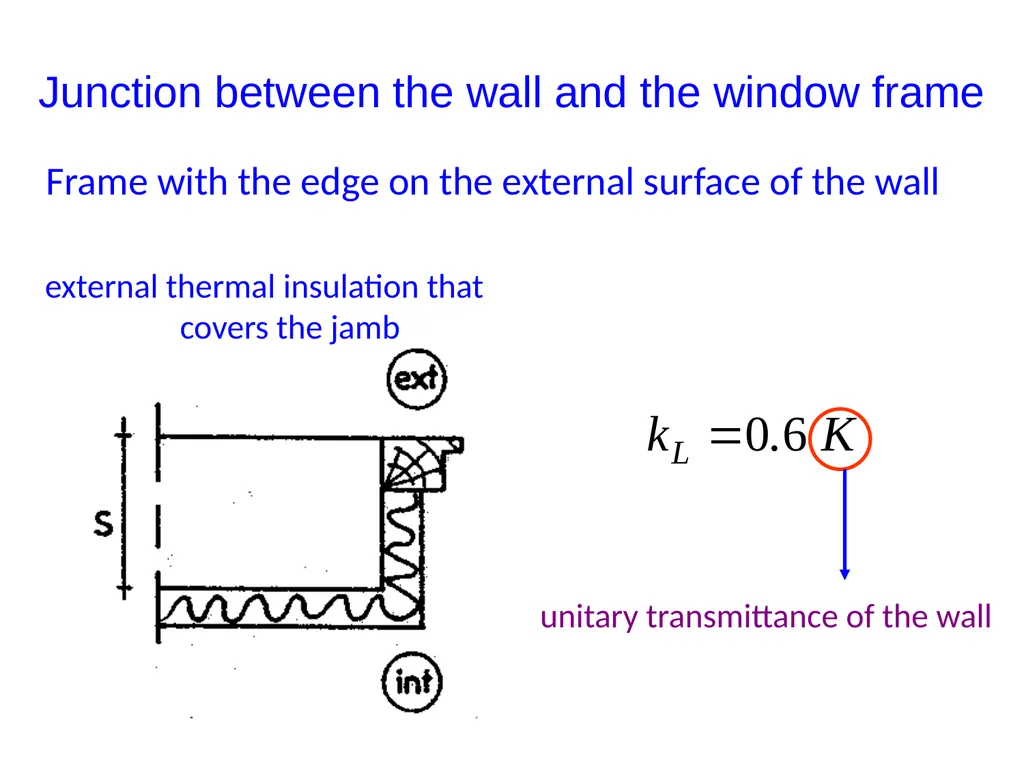
external thermal insulation that covers the jamb Junction between the wall and the window frame Frame with the edge on the external surface of the wall<br>
69
internal thermal insulation interrupted at the jamb Junction between the wall and the window frame Frame with the edge on the external surface of the wall thermal resistance of the inner wall without insulation excluding the external superficial thermal resistance wall thickness<br>
70
Junction between the wall and the window frame Frame with the edge on the external surface of the wall external thermal insulation that covers the jamb unitary transmittance of the wall<br>
71
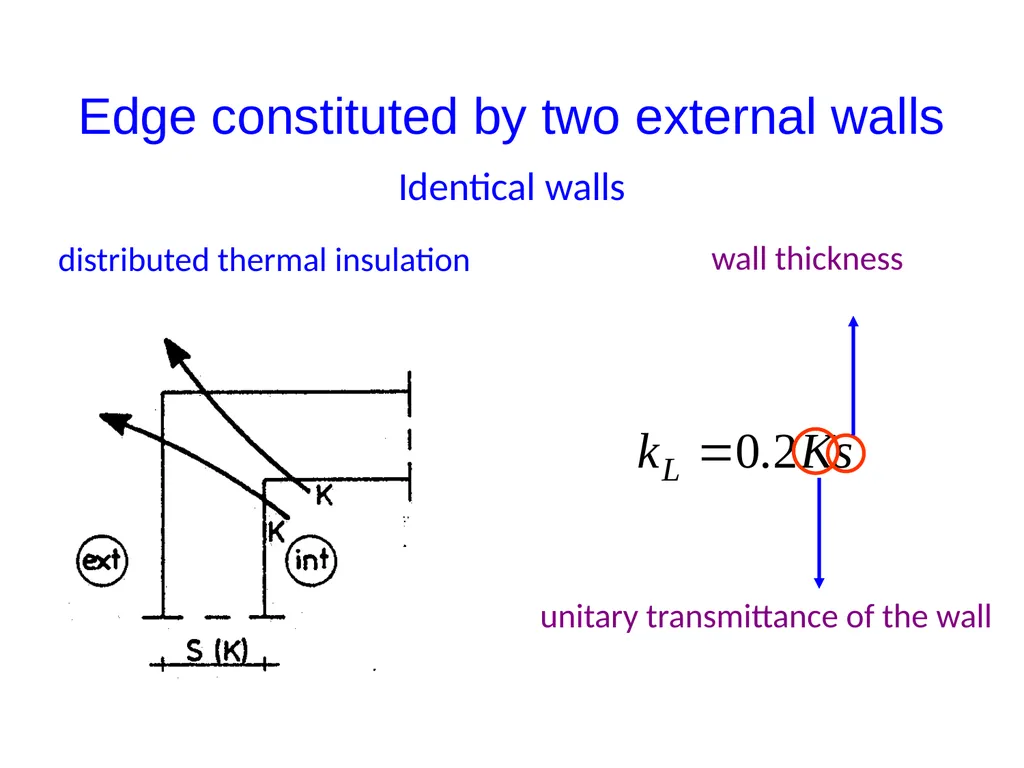
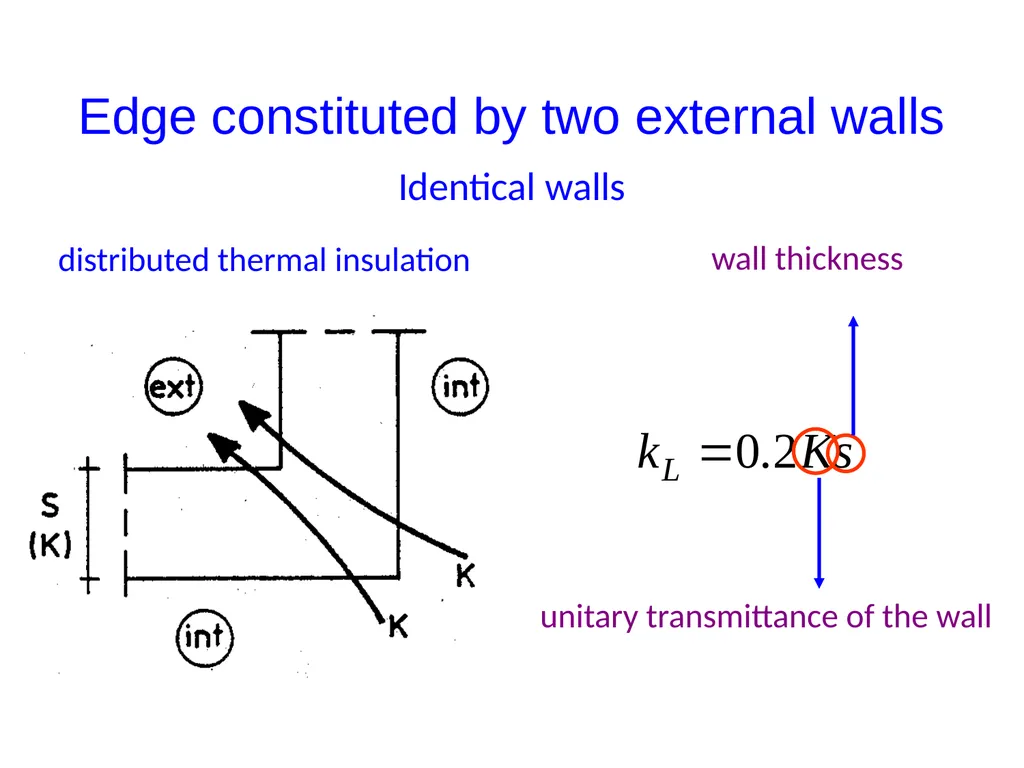
Edge constituted by two external walls Identical walls distributed thermal insulation wall thickness unitary transmittance of the wall<br>
72
Edge constituted by two external walls Identical walls distributed thermal insulation wall thickness unitary transmittance of the wall<br>
73
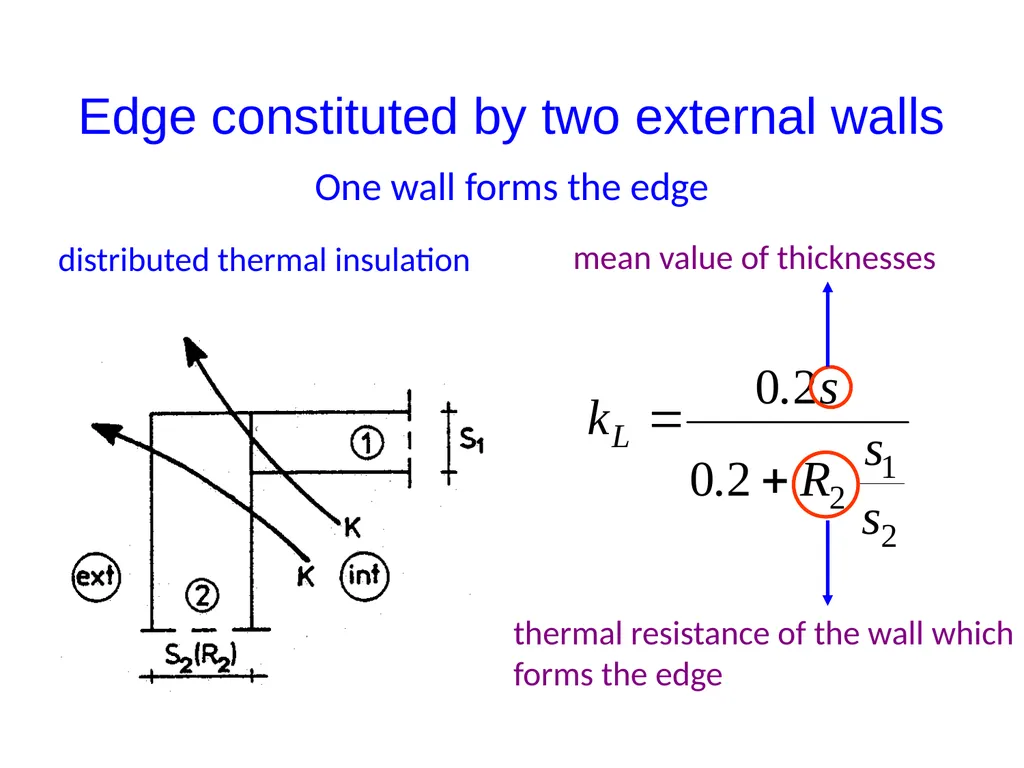
Edge constituted by two external walls One wall forms the edge mean value of thicknesses thermal resistance of the wall which forms the edge distributed thermal insulation<br>
74
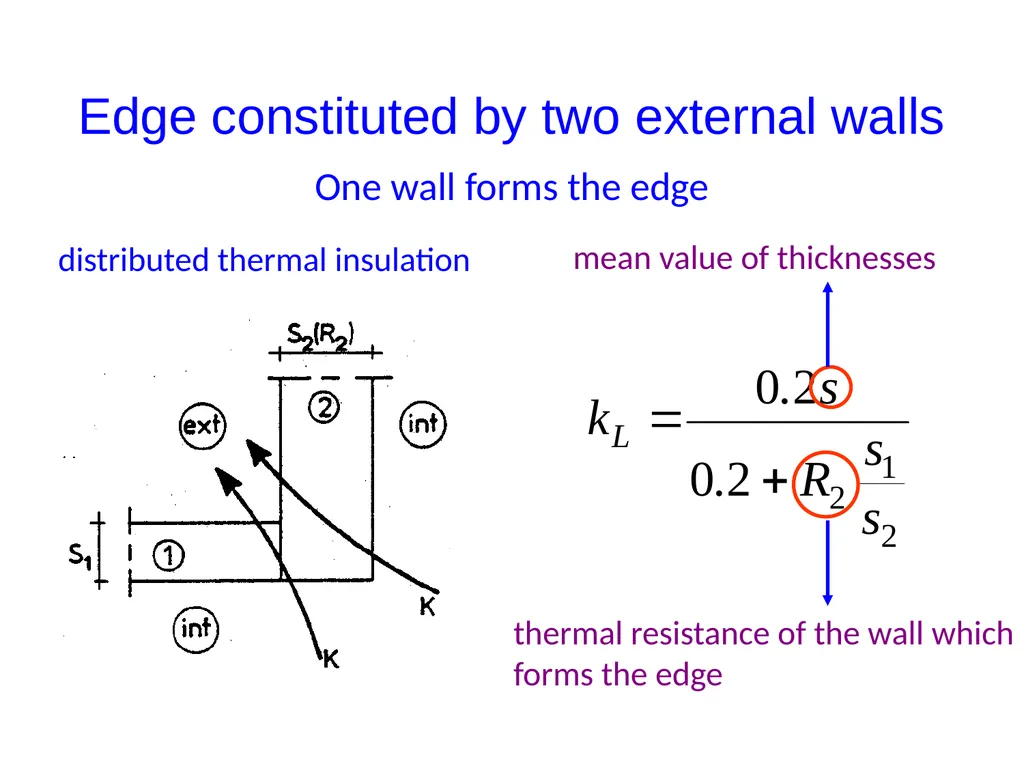
Edge constituted by two external walls One wall forms the edge mean value of thicknesses distributed thermal insulation thermal resistance of the wall which forms the edge<br>
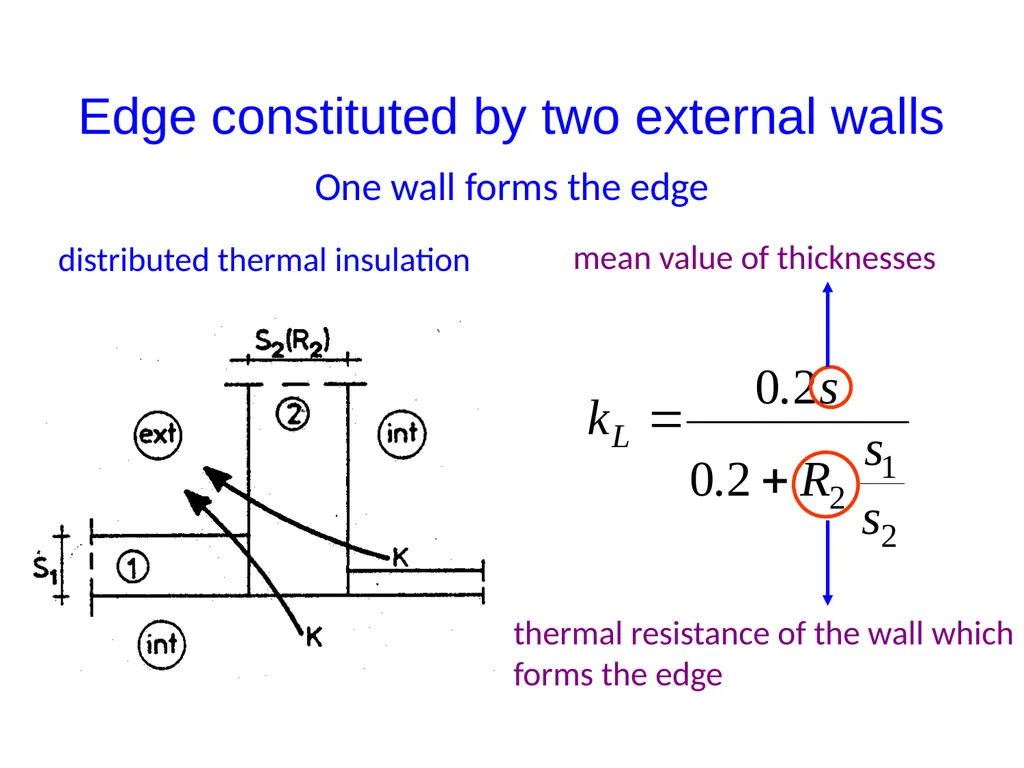
75
Edge constituted by two external walls One wall forms the edge mean value of thicknesses distributed thermal insulation thermal resistance of the wall which forms the edge<br>
76
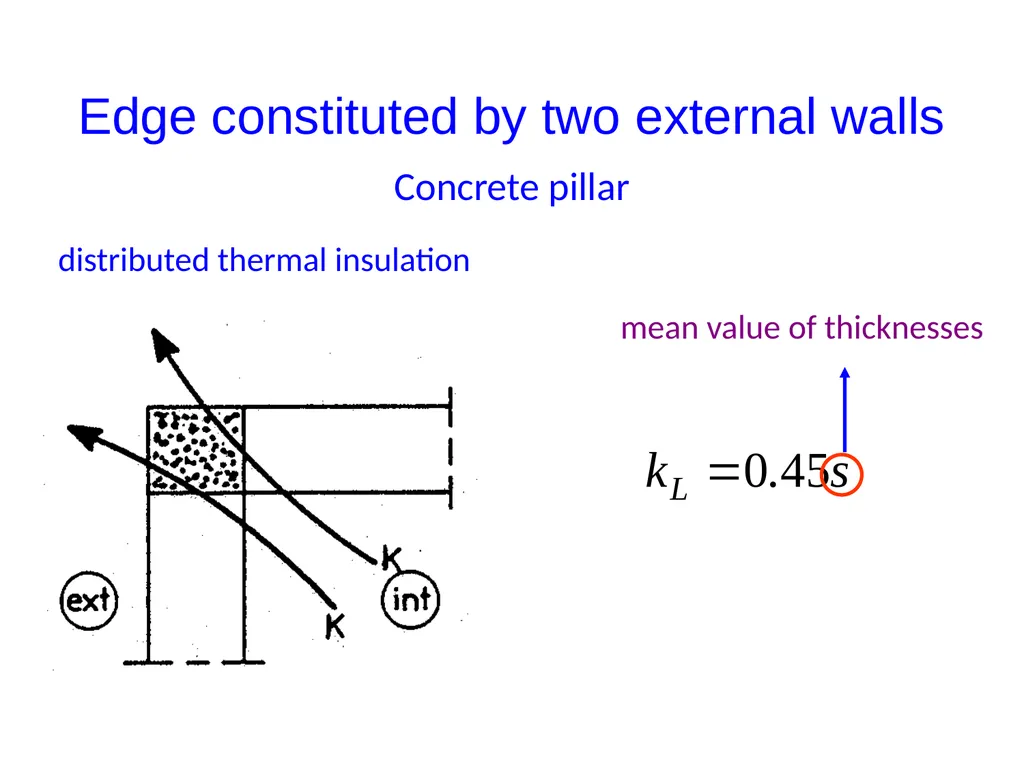
Edge constituted by two external walls Concrete pillar distributed thermal insulation mean value of thicknesses<br>
77
THERMAL BRIDGES
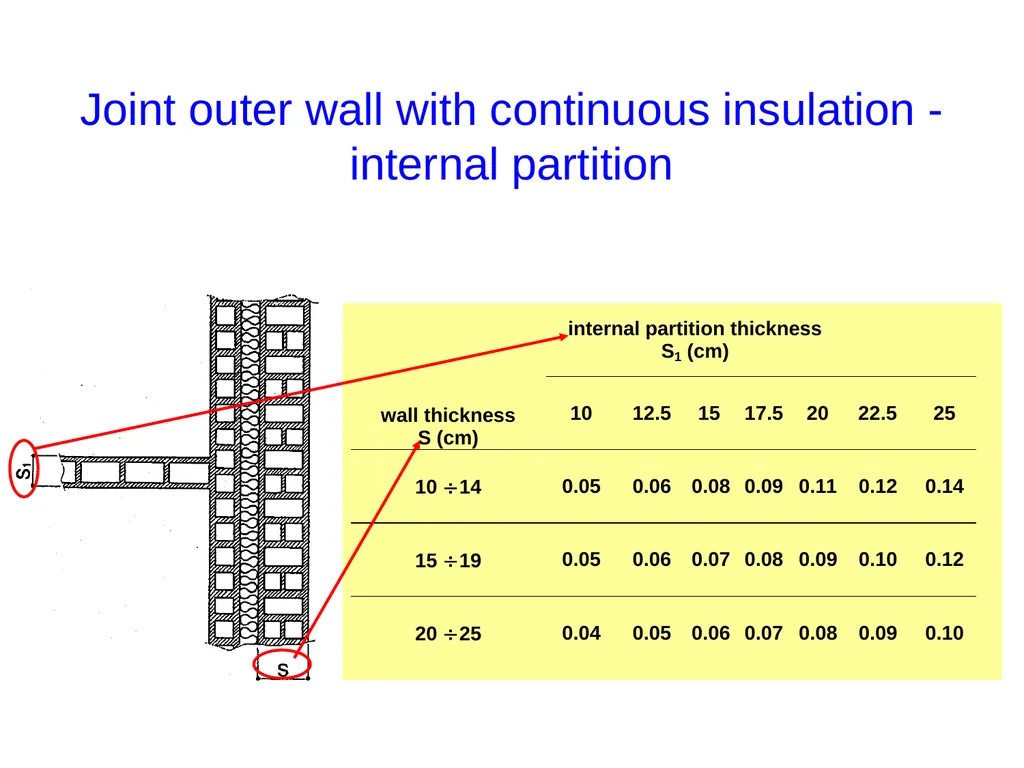
FRENCH STANDARD C.S.T.B. Th-k77 To facilitate the designer work, the French legislation provides tables for the determination of linear transmittance, kL, for a very large sample of thermal bridges and some examples are given in the next slides<br>
78
THERMAL BRIDGES
FRENCH STANDARD In these tables is assumed:
for insulation material with thermal conductivity no greater than 0.065 W/mK and of a thickness such that its thermal resistance is not lower than 0.50 m2 K/W<br>
for insulation material with thermal conductivity no greater than 0.065 W/mK and of a thickness such that its thermal resistance is not lower than 0.50 m2 K/W<br>
79
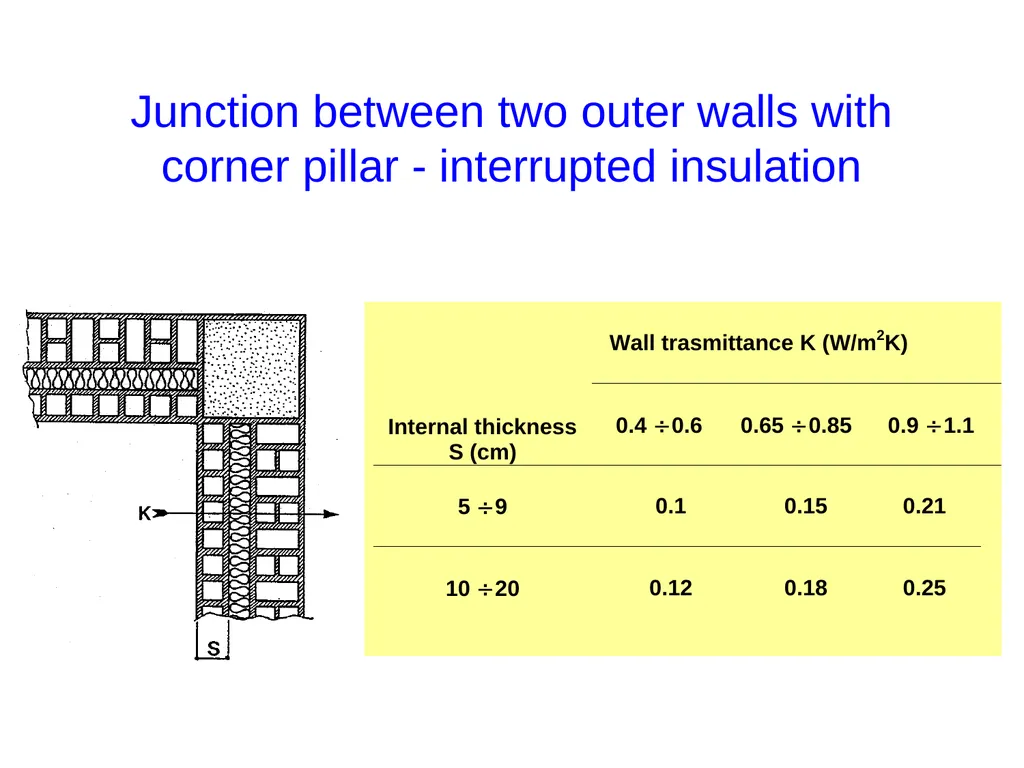
Junction between two outer walls with corner pillar - interrupted insulation<br>
80
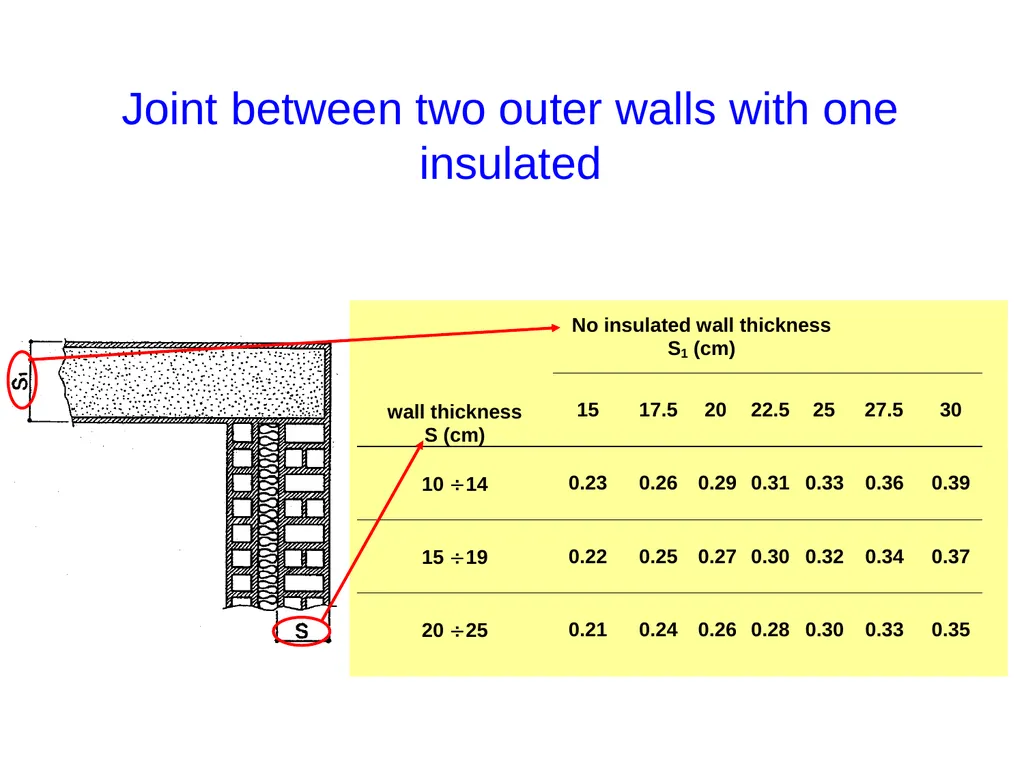
Joint between two outer walls with one insulated<br>
81
Joint outer wall with continuous insulation - internal partition<br>