DIPLOMATIC AGENTS - Dr. Anita M. J Role of
Description: DIPLOMATIC AGENTS - Dr. Anita M. J Role of Diplomatic Agent Introduction Who is a Diplomatic Agent History of Diplomatic Agent Importance Diplomatic Agent CLASSIFICATION Ambassadors and Legates They are the diplomatic agent of first
Related Topics
Download Presentation
"DIPLOMATIC AGENTS - Dr. Anita M. J Role of" is the property of its rightful owner. Permission is granted to download and print the materials on this website for personal, non-commercial use only, and to display it on your personal computer provided you do not modify the materials and that you retain all copyright notices contained in the materials. By downloading content from our website, you accept the terms of this agreement.
Presentation Transcript
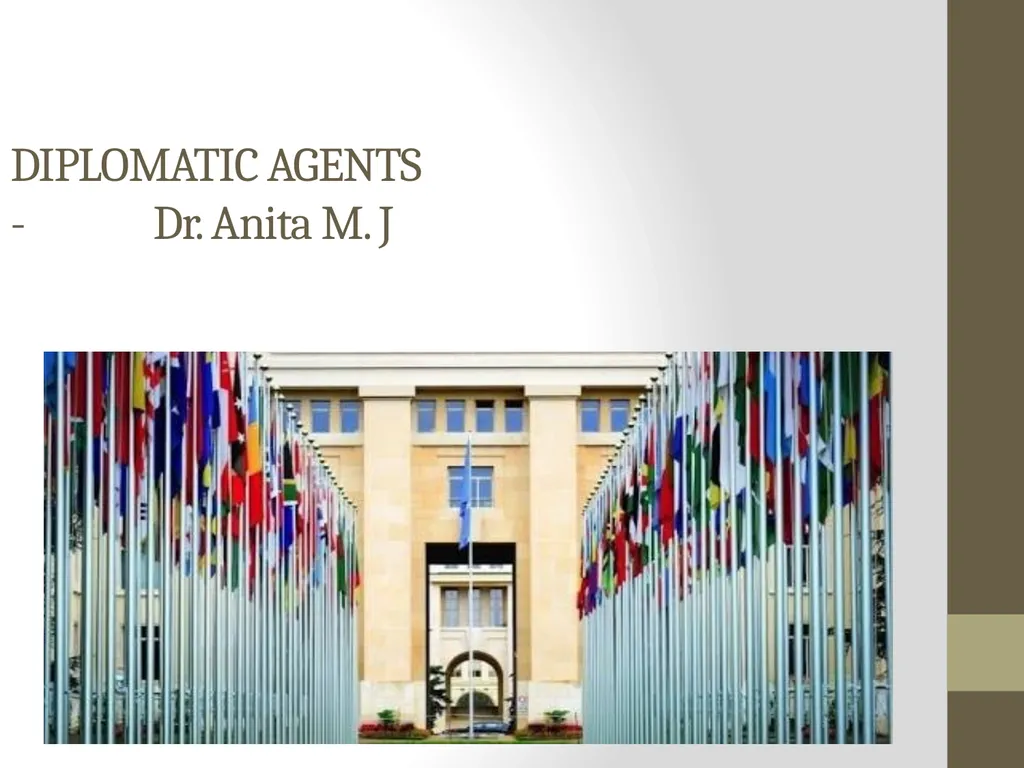
slide1. DIPLOMATIC AGENTS- Dr. Anita M. J<br>
slide2. Role of Diplomatic Agent Introduction
Who is a Diplomatic Agent
History of Diplomatic Agent
Importance Diplomatic Agent<br>
slide3. CLASSIFICATION Ambassadors and Legates
They are the diplomatic agent of first category and are the representative of sovereign state..The representatives appointed by pope are called legates.
Ministers Pleni-potentiary and Envoys Extra-ordinary
They are the second category of diplomatic agents , theses enjoy lesser privileges and immunities as compared with those of first category
Ministers-Resident
They are added in 1818 by the congress of Aix-la-chappele , They are below the second category and enjoy lesser privilege than the upper categories
Charge d’affairs
They are the diplomatic agents of the last category .they are not appointed by the head of the state.They are appointed by the Ministers of foreign Affaiars.<br>
slide5. Earlier issues relating to diplomatic agents like immunities ,powers and duties of diplomatic agents were delt under customary principles of internationl law. Now disputes relating to such issues are delt under the Vienna Convention on Diplomatic Relations, 1961.<br>
slide7. Vienna Convention on Diplomatic Relations, 1961 190 countries
It was adopted on 18 April 1961
It came into force on 24 April 1964
It’s articles are considered a cornerstone of modern international relations.
Theories :
Extra-territoriality
Functional theory
Representative Theory<br>
slide9. Immunities and Privileges of Diplomatic Agents Basis for diplomatic immunities- Theories
Theory of extra-territoriality
Representative theory
Functional theory
Inviolability of the person of Envoys
Torture of Indian Diplomat in Pakistan 1992
Rajesh Mittal (Indian Diplomat) was tortured, interrogated and given electric shocks by Pakistan Intelligence Agencies which became quite a serious medical issue.
2) Immunity from criminal jurisdiction of courts
The diplomatic agents are immune from the criminal jurisdiction
Of the court,
3) Immunity from civil jurisdiction
the diplomatic agents are immune to the civil suits too. suits relating to debts, breach of contract etc. can not be filed against the diplomatic agents
but there are exception to the civil jurisdiction
private immovable property
Succession
Any professional or commercial activity
4) Immunity regarding residence
The residence of diplomatic agents are generally regarded inviolable<br>
slide10. 5) Immunity from being present as witness
Diplomatic agents cannot be witness in the court. But a diplomatic agent may himself waive this immunity and personally present himself in the court
6)Immunity from taxes
They are also immune from the payment of the taxes etc.
7)Immunity from police rules
The diplomatic agents are also immune from the police rules of the state in which they are appointed.
8)Right to worship
The diplomatic agents can worship any religion or perform any rituals and ceremony
9) Right to exercise control and jurisdiction over their officials and families
The diplomatic agents have full control over there staff and people under him
10) Right to travel freely in the territory of the receiving State
The diplomatic agent is free to travel any where in the receiving state.<br>
slide11. 11) Freedom of communication for official purposes.
They are not bound of any obligation as concern to communicate to its official.
12) Immunity from the local and military obligations
The diplomatic agents are also immune from the local or military obligation. This is delt under the article 35 of Vienna convention.
13) Immunity from Inspection of Personal Baggage
The baggages of diplomatic agents are not liable to inspection. Immunity given the to personal baggage they carry.
14) Immunity from social security provisions
under article 33 of the Vienna convention provides that diplomatic agents immune from social security provisions of the receiving sate.<br>
slide12. DUTIES Duties to respect laws and regulations of the receiving state
Duty not to interfere in the internal affairs of the state
Official business to be conducted with or through the ministers of foreign affairs of receiving state or such other ministry as may be agreed.
Premises of Mission not to be used in any matter incompatible with the function of the Mission.
Diplomatic agents not to practice for personal profit any professional or commercial activity<br>
slide13. CONSULS Consuls are the representative of their states but they are not diplomatic agent. There main function is to look after the commerce and trade interests of their countries
Classification Of Consuls
Consuls- General
Consuls
Vice-Consuls
Consul-Agents<br>
slide14. Functions of the Consul They protect the commercial interest of their states.
They supervise and inspect ships and aircrafts etc. of their countries.
They look after the interests of their citizens and assist them in getting passport etc.
They testify signatures, registration of marriage, birth, death etc.
Any other functions assigned
to them<br>
slide15. Termination Of Diplomatic Mission Recall of Envoy
At any time ,the appointing state may recall its envoy.
Notification in regard to Envoys function
The appointing state may end the term and function of the envoy through notification.
On the request of the receiving State
The diplomatic agents on the request of the receiving state may sent back the diplomatic agents ,this can happen at the time when the relation between the sates are strained
By delivery of passport
It’s the another way of termination of the diplomats, by giving back there passports the diplomatic agents work can be terminated
Persona-non-gratia
Article 9 and 43 of the convention talks about the persona-non-gratia.it means the undesirable person.
End of the object of the mission
The diplomatic agents is sent back ,if the mission for which he was appointed is over.
Expiration of the letter of Credence
The diplomatic mission of an envoy also comes to an end after the expiration of the period for which he was appointed<br>
slide16. Refusal to Acceptance of Diplomatic Agents If the appointment of a particular person as diplomatic agent is considered harmful for the receiving state.
If the diplomatic agent has by his declaration or conduct, done some inimical thing
If he is a citizen of a receiving state<br>
slide2. Role of Diplomatic Agent Introduction
Who is a Diplomatic Agent
History of Diplomatic Agent
Importance Diplomatic Agent<br>
slide3. CLASSIFICATION Ambassadors and Legates
They are the diplomatic agent of first category and are the representative of sovereign state..The representatives appointed by pope are called legates.
Ministers Pleni-potentiary and Envoys Extra-ordinary
They are the second category of diplomatic agents , theses enjoy lesser privileges and immunities as compared with those of first category
Ministers-Resident
They are added in 1818 by the congress of Aix-la-chappele , They are below the second category and enjoy lesser privilege than the upper categories
Charge d’affairs
They are the diplomatic agents of the last category .they are not appointed by the head of the state.They are appointed by the Ministers of foreign Affaiars.<br>
slide5. Earlier issues relating to diplomatic agents like immunities ,powers and duties of diplomatic agents were delt under customary principles of internationl law. Now disputes relating to such issues are delt under the Vienna Convention on Diplomatic Relations, 1961.<br>
slide7. Vienna Convention on Diplomatic Relations, 1961 190 countries
It was adopted on 18 April 1961
It came into force on 24 April 1964
It’s articles are considered a cornerstone of modern international relations.
Theories :
Extra-territoriality
Functional theory
Representative Theory<br>
slide9. Immunities and Privileges of Diplomatic Agents Basis for diplomatic immunities- Theories
Theory of extra-territoriality
Representative theory
Functional theory
Inviolability of the person of Envoys
Torture of Indian Diplomat in Pakistan 1992
Rajesh Mittal (Indian Diplomat) was tortured, interrogated and given electric shocks by Pakistan Intelligence Agencies which became quite a serious medical issue.
2) Immunity from criminal jurisdiction of courts
The diplomatic agents are immune from the criminal jurisdiction
Of the court,
3) Immunity from civil jurisdiction
the diplomatic agents are immune to the civil suits too. suits relating to debts, breach of contract etc. can not be filed against the diplomatic agents
but there are exception to the civil jurisdiction
private immovable property
Succession
Any professional or commercial activity
4) Immunity regarding residence
The residence of diplomatic agents are generally regarded inviolable<br>
slide10. 5) Immunity from being present as witness
Diplomatic agents cannot be witness in the court. But a diplomatic agent may himself waive this immunity and personally present himself in the court
6)Immunity from taxes
They are also immune from the payment of the taxes etc.
7)Immunity from police rules
The diplomatic agents are also immune from the police rules of the state in which they are appointed.
8)Right to worship
The diplomatic agents can worship any religion or perform any rituals and ceremony
9) Right to exercise control and jurisdiction over their officials and families
The diplomatic agents have full control over there staff and people under him
10) Right to travel freely in the territory of the receiving State
The diplomatic agent is free to travel any where in the receiving state.<br>
slide11. 11) Freedom of communication for official purposes.
They are not bound of any obligation as concern to communicate to its official.
12) Immunity from the local and military obligations
The diplomatic agents are also immune from the local or military obligation. This is delt under the article 35 of Vienna convention.
13) Immunity from Inspection of Personal Baggage
The baggages of diplomatic agents are not liable to inspection. Immunity given the to personal baggage they carry.
14) Immunity from social security provisions
under article 33 of the Vienna convention provides that diplomatic agents immune from social security provisions of the receiving sate.<br>
slide12. DUTIES Duties to respect laws and regulations of the receiving state
Duty not to interfere in the internal affairs of the state
Official business to be conducted with or through the ministers of foreign affairs of receiving state or such other ministry as may be agreed.
Premises of Mission not to be used in any matter incompatible with the function of the Mission.
Diplomatic agents not to practice for personal profit any professional or commercial activity<br>
slide13. CONSULS Consuls are the representative of their states but they are not diplomatic agent. There main function is to look after the commerce and trade interests of their countries
Classification Of Consuls
Consuls- General
Consuls
Vice-Consuls
Consul-Agents<br>
slide14. Functions of the Consul They protect the commercial interest of their states.
They supervise and inspect ships and aircrafts etc. of their countries.
They look after the interests of their citizens and assist them in getting passport etc.
They testify signatures, registration of marriage, birth, death etc.
Any other functions assigned
to them<br>
slide15. Termination Of Diplomatic Mission Recall of Envoy
At any time ,the appointing state may recall its envoy.
Notification in regard to Envoys function
The appointing state may end the term and function of the envoy through notification.
On the request of the receiving State
The diplomatic agents on the request of the receiving state may sent back the diplomatic agents ,this can happen at the time when the relation between the sates are strained
By delivery of passport
It’s the another way of termination of the diplomats, by giving back there passports the diplomatic agents work can be terminated
Persona-non-gratia
Article 9 and 43 of the convention talks about the persona-non-gratia.it means the undesirable person.
End of the object of the mission
The diplomatic agents is sent back ,if the mission for which he was appointed is over.
Expiration of the letter of Credence
The diplomatic mission of an envoy also comes to an end after the expiration of the period for which he was appointed<br>
slide16. Refusal to Acceptance of Diplomatic Agents If the appointment of a particular person as diplomatic agent is considered harmful for the receiving state.
If the diplomatic agent has by his declaration or conduct, done some inimical thing
If he is a citizen of a receiving state<br>