
Direct Support Professional Pipeline Pilot – BOCES
Description: Direct Support Professional Pipeline Pilot BOCES Regional Centers for Workforce Transformation, Capital Region BOCES, NYS Office for People with Developmental Disabilities, and Provider Partners A Groundbreaking Program Course
Related Topics
Download Presentation
"Direct Support Professional Pipeline Pilot – BOCES" is the property of its rightful owner. Permission is granted to download and print the materials on this website for personal, non-commercial use only, and to display it on your personal computer provided you do not modify the materials and that you retain all copyright notices contained in the materials. By downloading content from our website, you accept the terms of this agreement.
Presentation Transcript
slide1. Direct Support Professional
Pipeline Pilot – BOCES Regional Centers for Workforce Transformation, Capital Region BOCES, NYS Office for People with Developmental Disabilities, and Provider Partners<br>
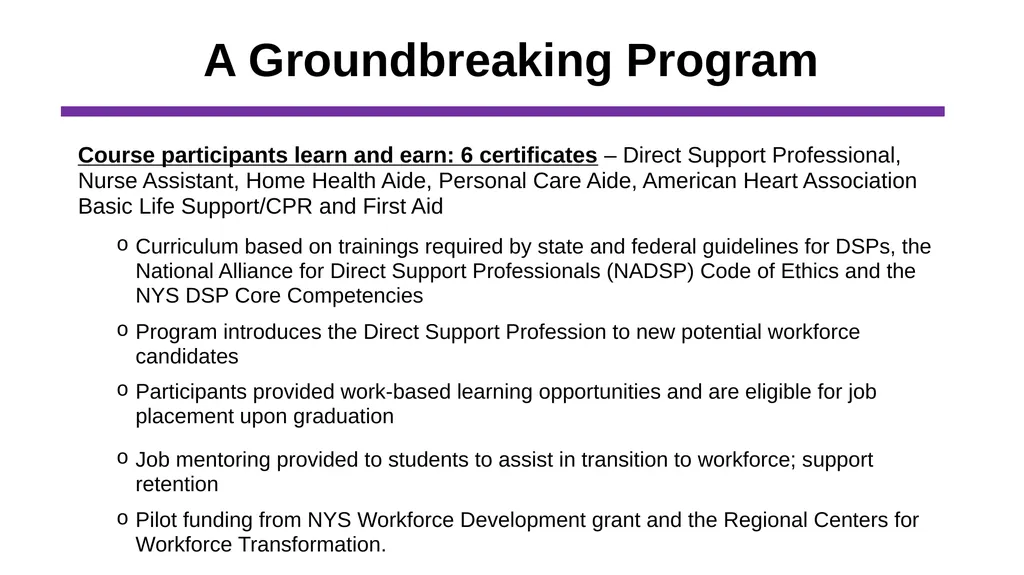
slide2. A Groundbreaking Program Course participants learn and earn: 6 certificates – Direct Support Professional, Nurse Assistant, Home Health Aide, Personal Care Aide, American Heart Association Basic Life Support/CPR and First Aid
Curriculum based on trainings required by state and federal guidelines for DSPs, the National Alliance for Direct Support Professionals (NADSP) Code of Ethics and the NYS DSP Core Competencies
Program introduces the Direct Support Profession to new potential workforce candidates
Participants provided work-based learning opportunities and are eligible for job placement upon graduation
Job mentoring provided to students to assist in transition to workforce; support retention
Pilot funding from NYS Workforce Development grant and the Regional Centers for Workforce Transformation.<br>
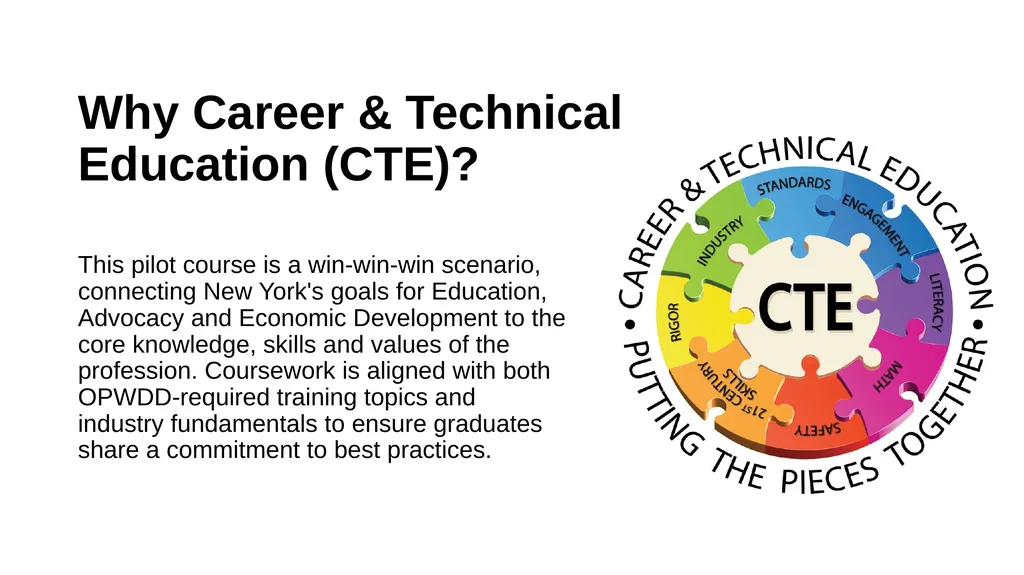
slide3. Why Career & Technical Education (CTE)? This pilot course is a win-win-win scenario, connecting New York's goals for Education, Advocacy and Economic Development to the core knowledge, skills and values of the profession. Coursework is aligned with both OPWDD-required training topics and industry fundamentals to ensure graduates share a commitment to best practices.<br>
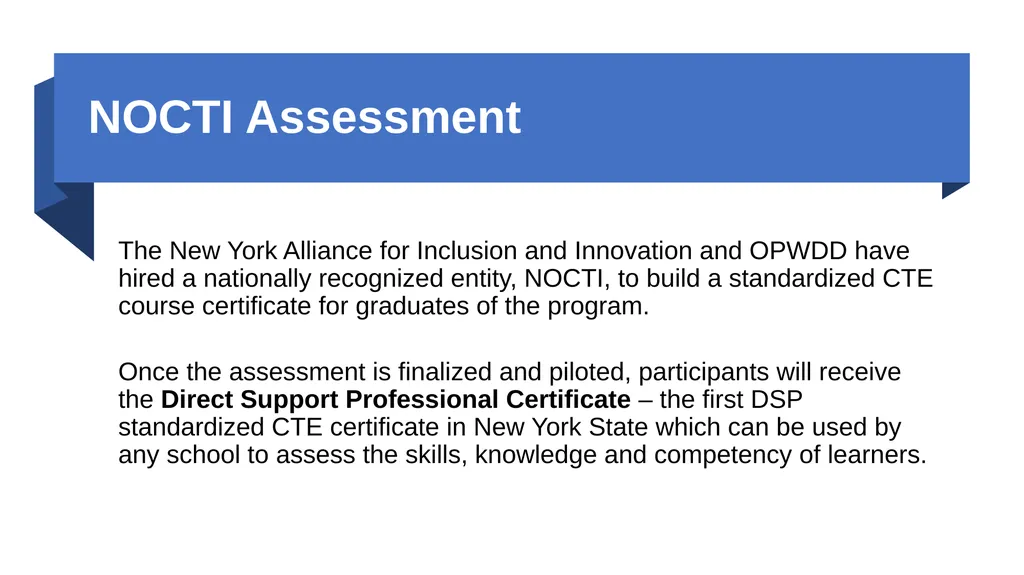
slide4. NOCTI Assessment The New York Alliance for Inclusion and Innovation and OPWDD have hired a nationally recognized entity, NOCTI, to build a standardized CTE course certificate for graduates of the program.
Once the assessment is finalized and piloted, participants will receive the Direct Support Professional Certificate – the first DSP standardized CTE certificate in New York State which can be used by any school to assess the skills, knowledge and competency of learners.<br>
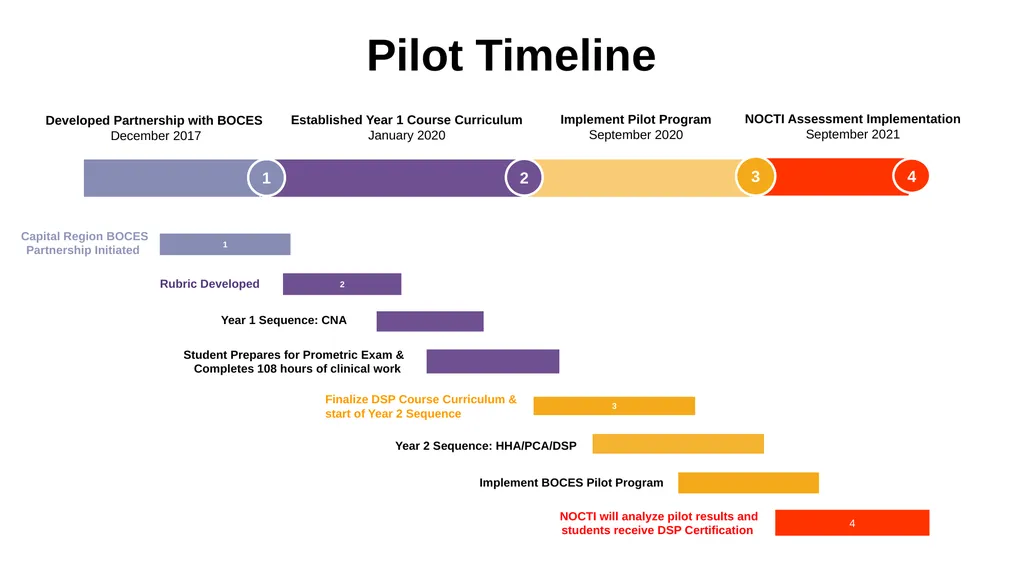
slide5. 1 Developed Partnership with BOCES
December 2017 2 Established Year 1 Course Curriculum
January 2020 3 Implement Pilot Program
September 2020 1 Capital Region BOCES Partnership Initiated Rubric Developed 2 3 Implement BOCES Pilot Program Student Prepares for Prometric Exam & Completes 108 hours of clinical work 4 Finalize DSP Course Curriculum & start of Year 2 Sequence 4 NOCTI will analyze pilot results and students receive DSP Certification Year 1 Sequence: CNA Year 2 Sequence: HHA/PCA/DSP Pilot Timeline NOCTI Assessment Implementation
September 2021<br>
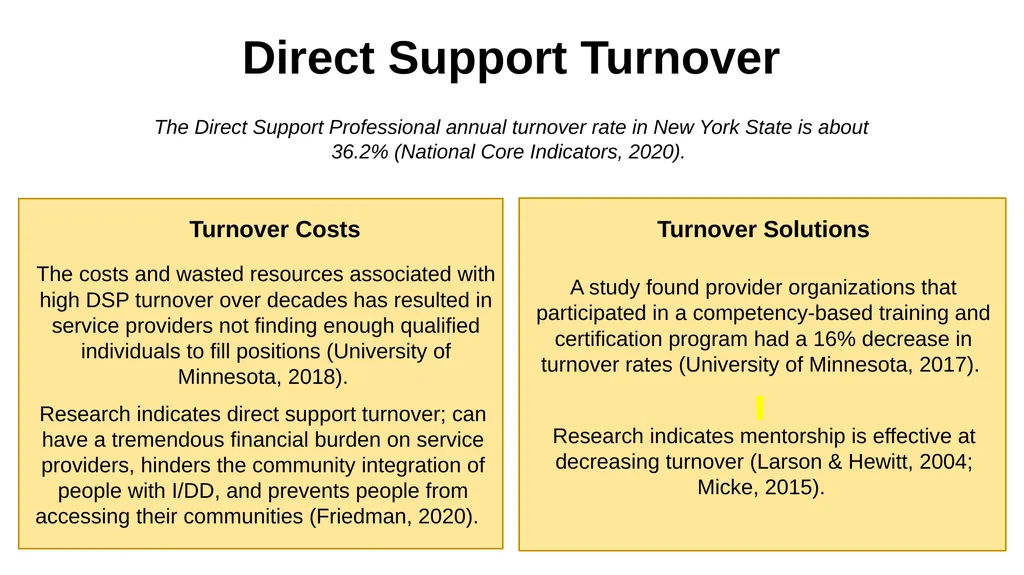
slide6. The Direct Support Professional annual turnover rate in New York State is about 36.2% (National Core Indicators, 2020). Direct Support Turnover The costs and wasted resources associated with high DSP turnover over decades has resulted in service providers not finding enough qualified individuals to fill positions (University of Minnesota, 2018). Research indicates direct support turnover; can have a tremendous financial burden on service providers, hinders the community integration of people with I/DD, and prevents people from accessing their communities (Friedman, 2020). Turnover Costs Turnover Solutions A study found provider organizations that participated in a competency-based training and certification program had a 16% decrease in turnover rates (University of Minnesota, 2017). Research indicates mentorship is effective at decreasing turnover (Larson & Hewitt, 2004; Micke, 2015).<br>
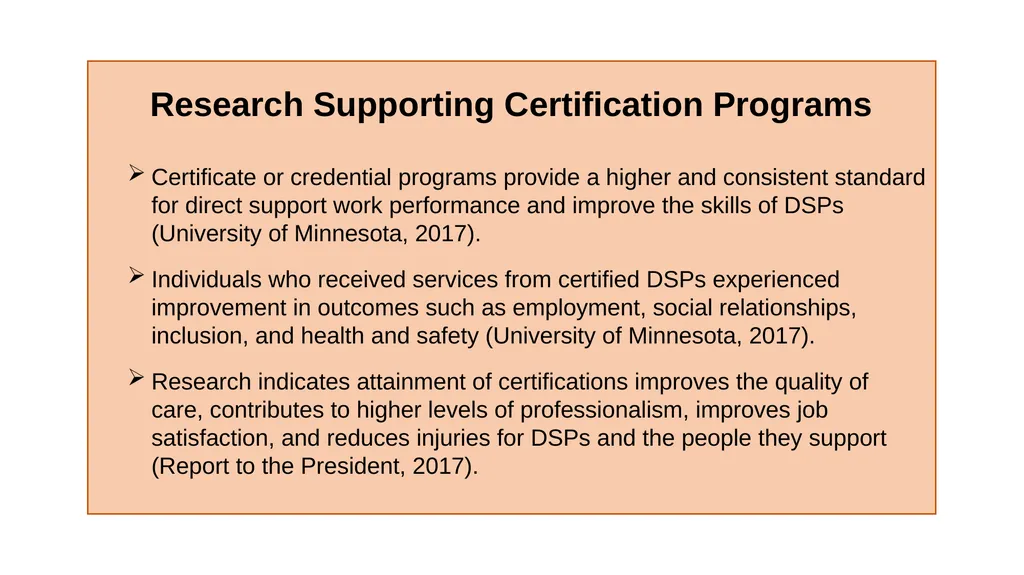
slide7. Certificate or credential programs provide a higher and consistent standard for direct support work performance and improve the skills of DSPs (University of Minnesota, 2017).
Individuals who received services from certified DSPs experienced improvement in outcomes such as employment, social relationships, inclusion, and health and safety (University of Minnesota, 2017).
Research indicates attainment of certifications improves the quality of care, contributes to higher levels of professionalism, improves job satisfaction, and reduces injuries for DSPs and the people they support (Report to the President, 2017). Research Supporting Certification Programs<br>
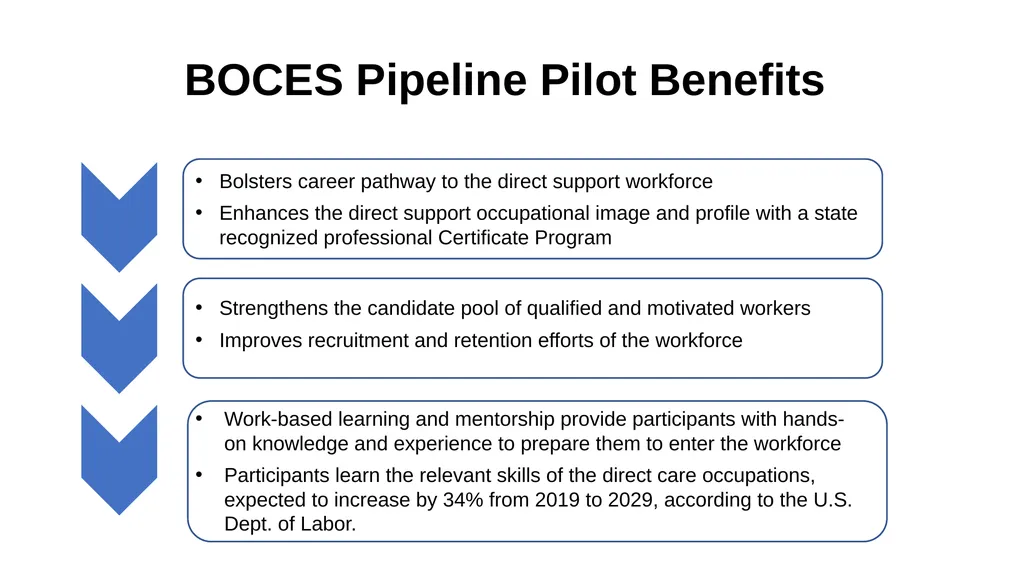
slide8. BOCES Pipeline Pilot Benefits Strengthens the candidate pool of qualified and motivated workers
Improves recruitment and retention efforts of the workforce Bolsters career pathway to the direct support workforce
Enhances the direct support occupational image and profile with a state recognized professional Certificate Program Work-based learning and mentorship provide participants with hands-on knowledge and experience to prepare them to enter the workforce
Participants learn the relevant skills of the direct care occupations, expected to increase by 34% from 2019 to 2029, according to the U.S. Dept. of Labor.<br>
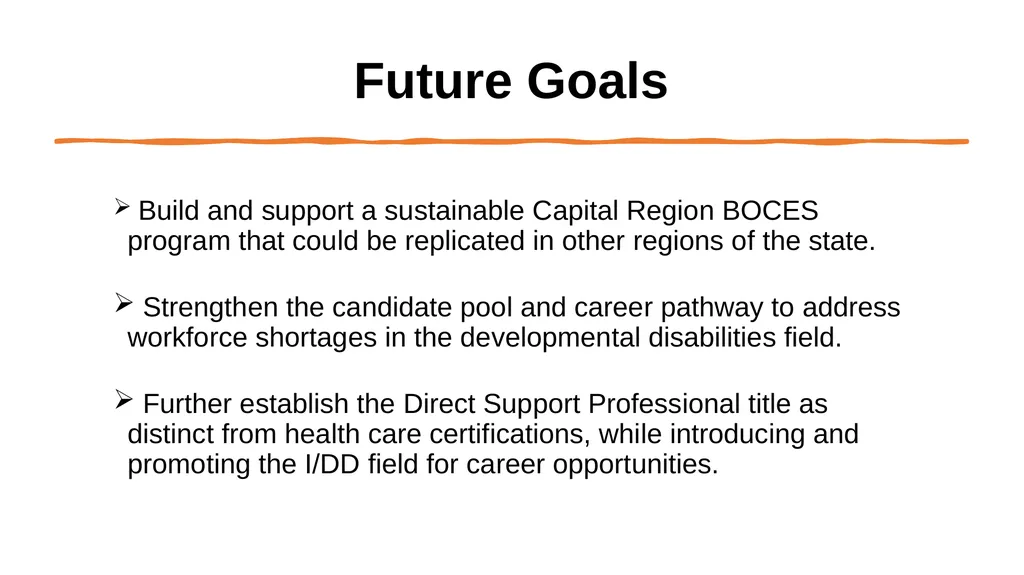
slide9. Future Goals Build and support a sustainable Capital Region BOCES program that could be replicated in other regions of the state.
Strengthen the candidate pool and career pathway to address workforce shortages in the developmental disabilities field.
Further establish the Direct Support Professional title as distinct from health care certifications, while introducing and promoting the I/DD field for career opportunities.<br>
slide2. A Groundbreaking Program Course participants learn and earn: 6 certificates – Direct Support Professional, Nurse Assistant, Home Health Aide, Personal Care Aide, American Heart Association Basic Life Support/CPR and First Aid
Curriculum based on trainings required by state and federal guidelines for DSPs, the National Alliance for Direct Support Professionals (NADSP) Code of Ethics and the NYS DSP Core Competencies
Program introduces the Direct Support Profession to new potential workforce candidates
Participants provided work-based learning opportunities and are eligible for job placement upon graduation
Job mentoring provided to students to assist in transition to workforce; support retention
Pilot funding from NYS Workforce Development grant and the Regional Centers for Workforce Transformation.<br>
slide3. Why Career & Technical Education (CTE)? This pilot course is a win-win-win scenario, connecting New York's goals for Education, Advocacy and Economic Development to the core knowledge, skills and values of the profession. Coursework is aligned with both OPWDD-required training topics and industry fundamentals to ensure graduates share a commitment to best practices.<br>
slide4. NOCTI Assessment The New York Alliance for Inclusion and Innovation and OPWDD have hired a nationally recognized entity, NOCTI, to build a standardized CTE course certificate for graduates of the program.
Once the assessment is finalized and piloted, participants will receive the Direct Support Professional Certificate – the first DSP standardized CTE certificate in New York State which can be used by any school to assess the skills, knowledge and competency of learners.<br>
slide5. 1 Developed Partnership with BOCES
December 2017 2 Established Year 1 Course Curriculum
January 2020 3 Implement Pilot Program
September 2020 1 Capital Region BOCES Partnership Initiated Rubric Developed 2 3 Implement BOCES Pilot Program Student Prepares for Prometric Exam & Completes 108 hours of clinical work 4 Finalize DSP Course Curriculum & start of Year 2 Sequence 4 NOCTI will analyze pilot results and students receive DSP Certification Year 1 Sequence: CNA Year 2 Sequence: HHA/PCA/DSP Pilot Timeline NOCTI Assessment Implementation
September 2021<br>
slide6. The Direct Support Professional annual turnover rate in New York State is about 36.2% (National Core Indicators, 2020). Direct Support Turnover The costs and wasted resources associated with high DSP turnover over decades has resulted in service providers not finding enough qualified individuals to fill positions (University of Minnesota, 2018). Research indicates direct support turnover; can have a tremendous financial burden on service providers, hinders the community integration of people with I/DD, and prevents people from accessing their communities (Friedman, 2020). Turnover Costs Turnover Solutions A study found provider organizations that participated in a competency-based training and certification program had a 16% decrease in turnover rates (University of Minnesota, 2017). Research indicates mentorship is effective at decreasing turnover (Larson & Hewitt, 2004; Micke, 2015).<br>
slide7. Certificate or credential programs provide a higher and consistent standard for direct support work performance and improve the skills of DSPs (University of Minnesota, 2017).
Individuals who received services from certified DSPs experienced improvement in outcomes such as employment, social relationships, inclusion, and health and safety (University of Minnesota, 2017).
Research indicates attainment of certifications improves the quality of care, contributes to higher levels of professionalism, improves job satisfaction, and reduces injuries for DSPs and the people they support (Report to the President, 2017). Research Supporting Certification Programs<br>
slide8. BOCES Pipeline Pilot Benefits Strengthens the candidate pool of qualified and motivated workers
Improves recruitment and retention efforts of the workforce Bolsters career pathway to the direct support workforce
Enhances the direct support occupational image and profile with a state recognized professional Certificate Program Work-based learning and mentorship provide participants with hands-on knowledge and experience to prepare them to enter the workforce
Participants learn the relevant skills of the direct care occupations, expected to increase by 34% from 2019 to 2029, according to the U.S. Dept. of Labor.<br>
slide9. Future Goals Build and support a sustainable Capital Region BOCES program that could be replicated in other regions of the state.
Strengthen the candidate pool and career pathway to address workforce shortages in the developmental disabilities field.
Further establish the Direct Support Professional title as distinct from health care certifications, while introducing and promoting the I/DD field for career opportunities.<br>