Direct Tooth colored restorative materials Before
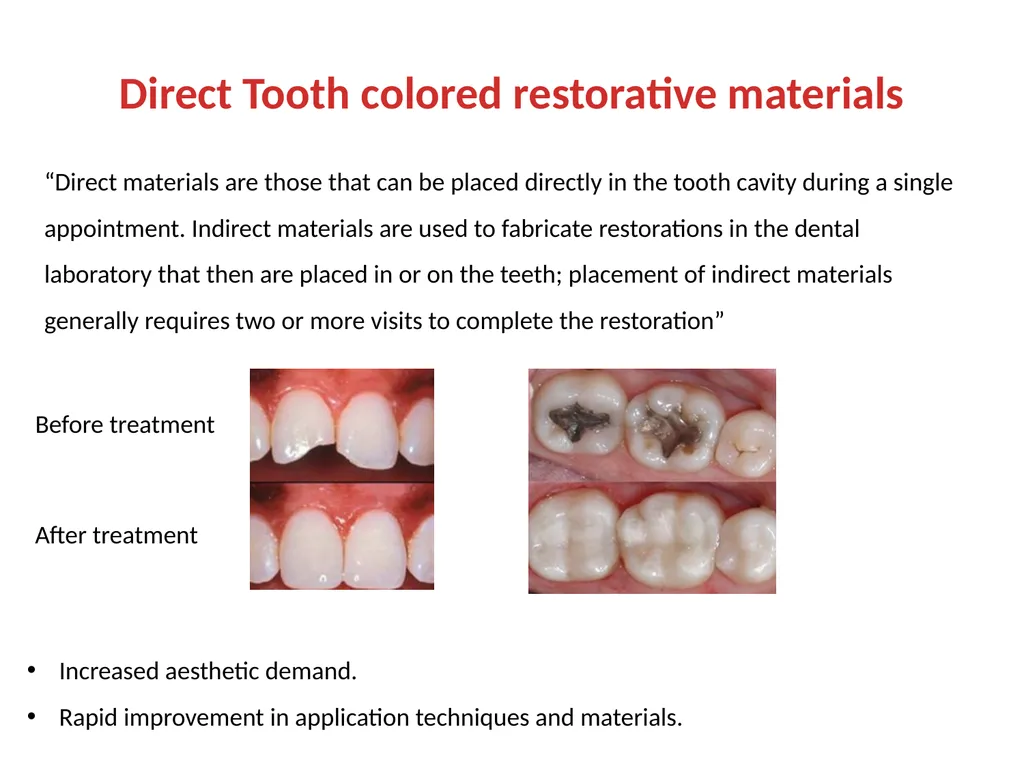
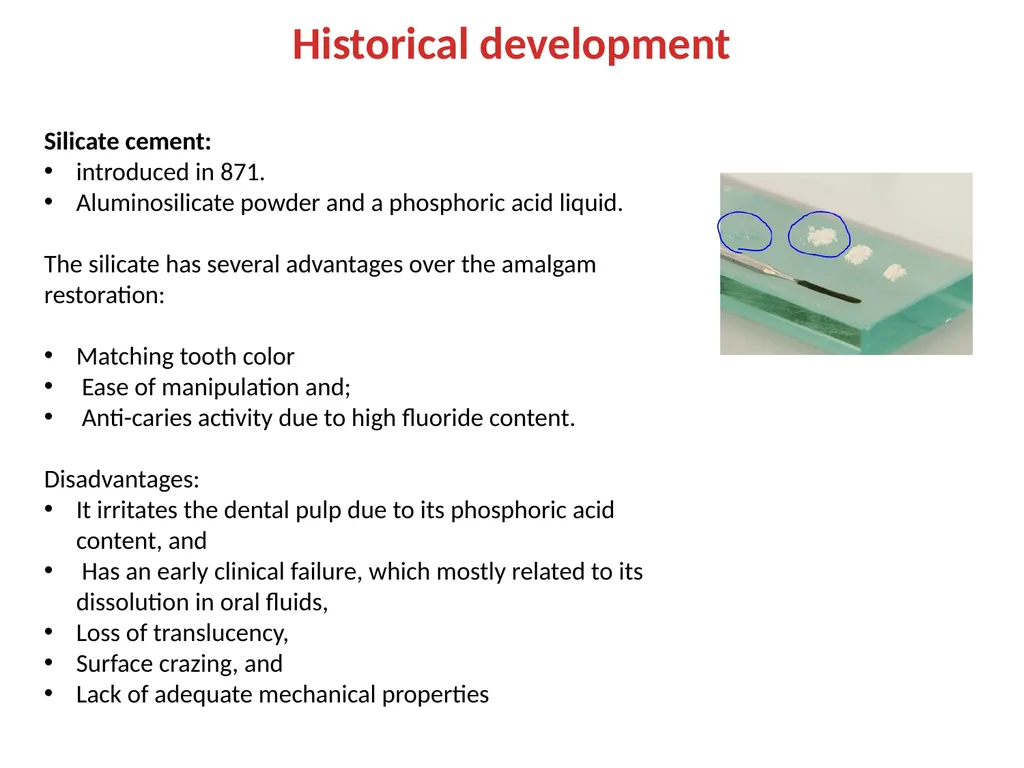
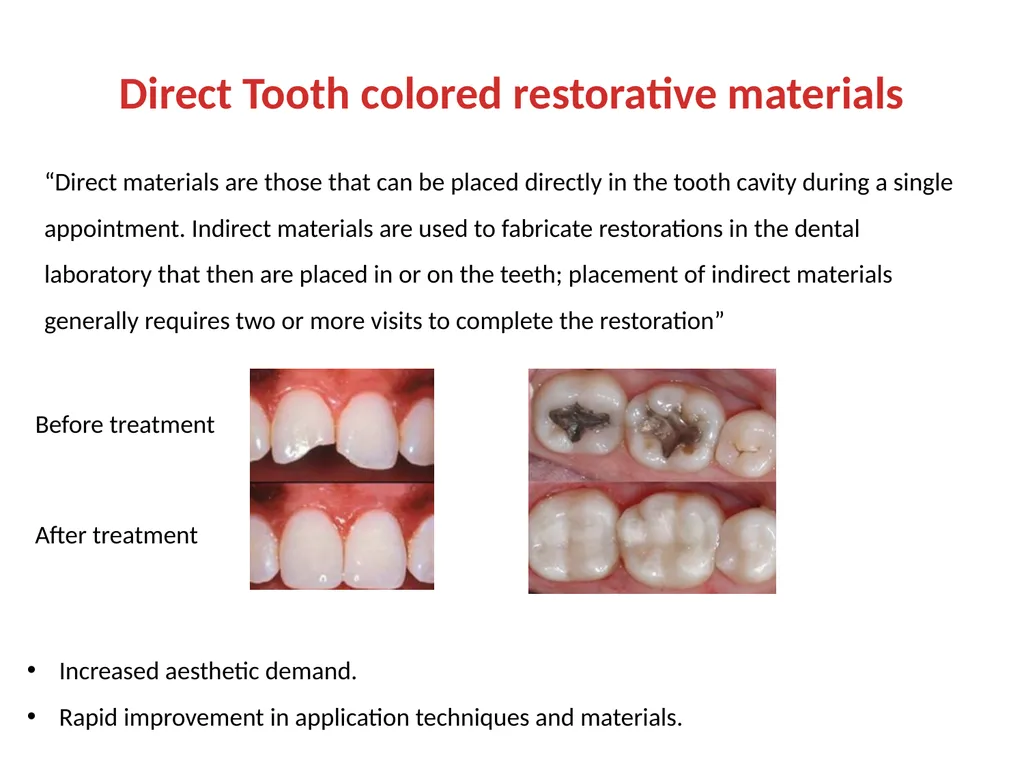
Description: Direct Tooth colored restorative materials Before treatment After treatment Increased aesthetic demand. Rapid improvement in application techniques and materials. Direct materials are those that can be placed directly in the tooth cavity
Related Topics
Download Presentation
"Direct Tooth colored restorative materials Before" is the property of its rightful owner. Permission is granted to download and print the materials on this website for personal, non-commercial use only, and to display it on your personal computer provided you do not modify the materials and that you retain all copyright notices contained in the materials. By downloading content from our website, you accept the terms of this agreement.
Presentation Transcript
slide1. Direct Tooth colored restorative materials Before treatment After treatment Increased aesthetic demand.
Rapid improvement in application techniques and materials. “Direct materials are those that can be placed directly in the tooth cavity during a single appointment. Indirect materials are used to fabricate restorations in the dental laboratory that then are placed in or on the teeth; placement of indirect materials generally requires two or more visits to complete the restoration”<br>
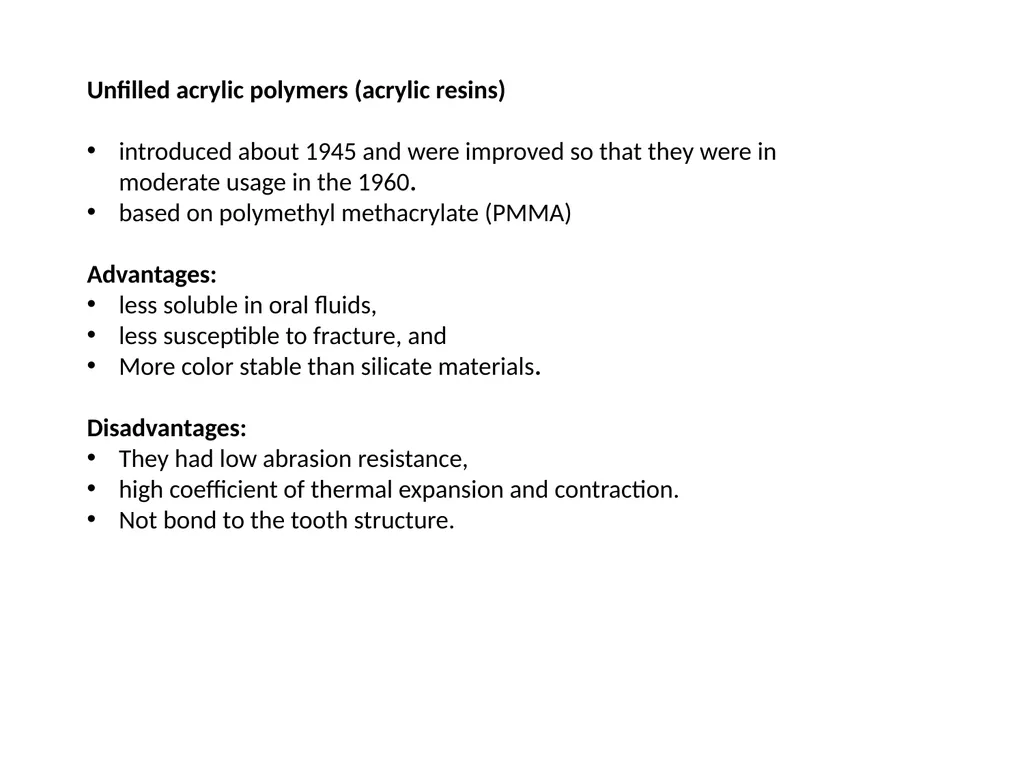
slide2. Historical development Silicate cement:
introduced in 871.
Aluminosilicate powder and a phosphoric acid liquid.
The silicate has several advantages over the amalgam restoration:
Matching tooth color
Ease of manipulation and;
Anti-caries activity due to high fluoride content.
Disadvantages:
It irritates the dental pulp due to its phosphoric acid content, and
Has an early clinical failure, which mostly related to its dissolution in oral fluids,
Loss of translucency,
Surface crazing, and
Lack of adequate mechanical properties<br>
slide3. Unfilled acrylic polymers (acrylic resins)
introduced about 1945 and were improved so that they were in moderate usage in the 1960.
based on polymethyl methacrylate (PMMA)
Advantages:
less soluble in oral fluids,
less susceptible to fracture, and
More color stable than silicate materials.
Disadvantages:
They had low abrasion resistance,
high coefficient of thermal expansion and contraction.
Not bond to the tooth structure.<br>
slide4. Composite
Started in late 1950s and early 1960s, when Bowen began
Epoxy resins reinforced with filler particles.
Advantages:
better mechanical properties and
higher abrasion and wear resistance,
lower polymerization shrinkage and
lower coefficient of thermal expansion than that of unfilled resins.<br>
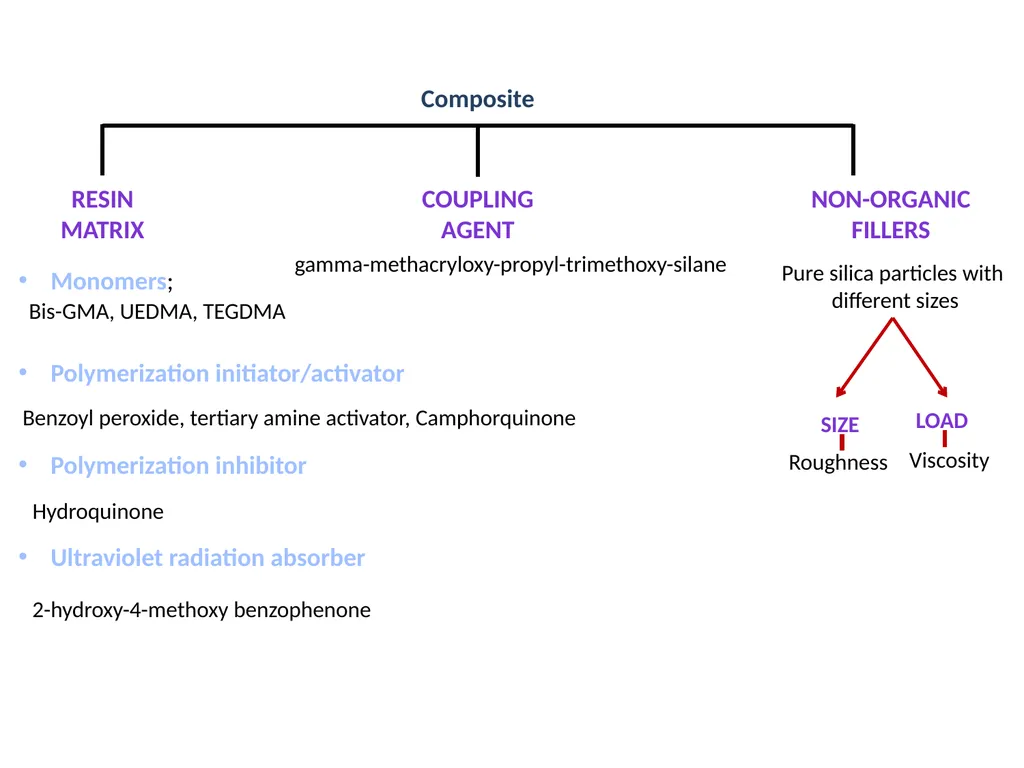
slide5. Composite Bis-GMA, UEDMA, TEGDMA Benzoyl peroxide, tertiary amine activator, Camphorquinone Hydroquinone 2-hydroxy-4-methoxy benzophenone Pure silica particles with
different sizes gamma-methacryloxy-propyl-trimethoxy-silane Size load Roughness Viscosity<br>
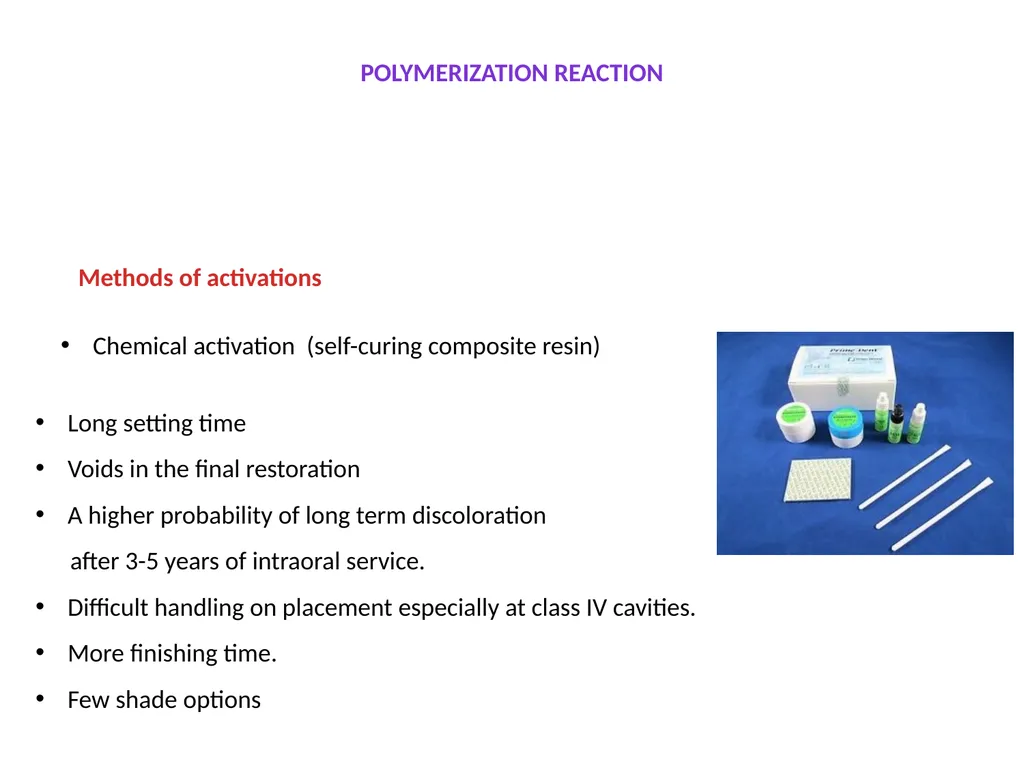
slide6. Polymerization reaction Methods of activations Chemical activation (self-curing composite resin) Long setting time
Voids in the final restoration
A higher probability of long term discoloration
after 3-5 years of intraoral service.
Difficult handling on placement especially at class IV cavities.
More finishing time.
Few shade options<br>
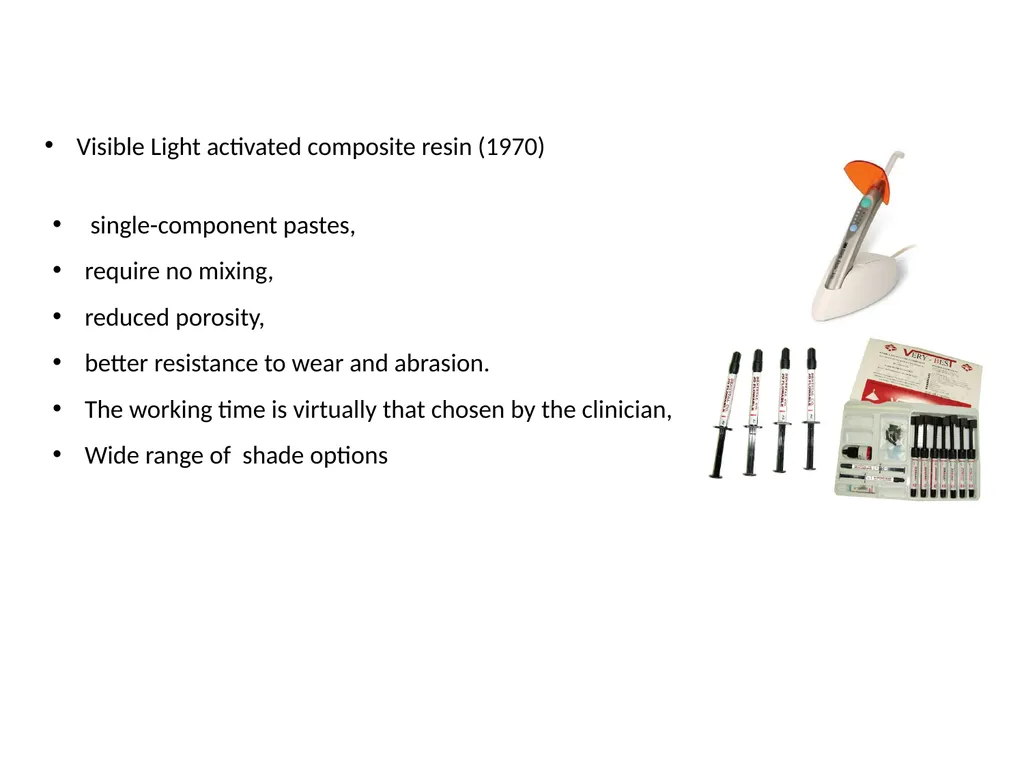
slide7. Visible Light activated composite resin (1970) single-component pastes,
require no mixing,
reduced porosity,
better resistance to wear and abrasion.
The working time is virtually that chosen by the clinician,
Wide range of shade options<br>
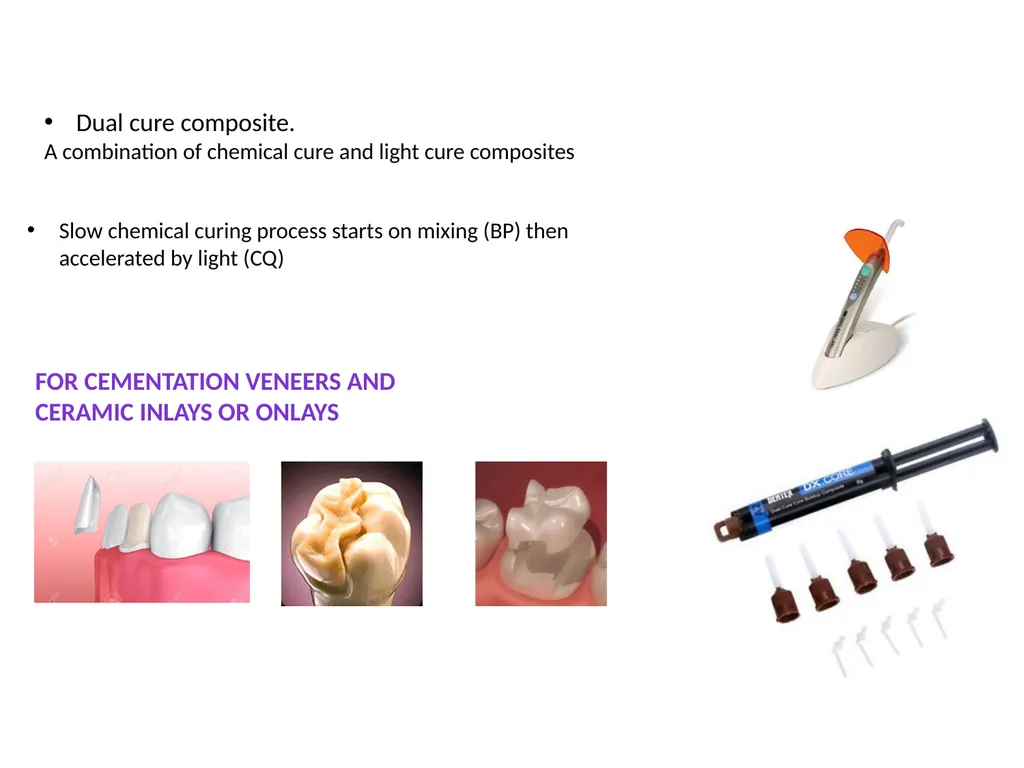
slide8. Dual cure composite.
A combination of chemical cure and light cure composites Slow chemical curing process starts on mixing (BP) then accelerated by light (CQ) For CEMENTATION veneers and
ceramic inlays or onlays<br>

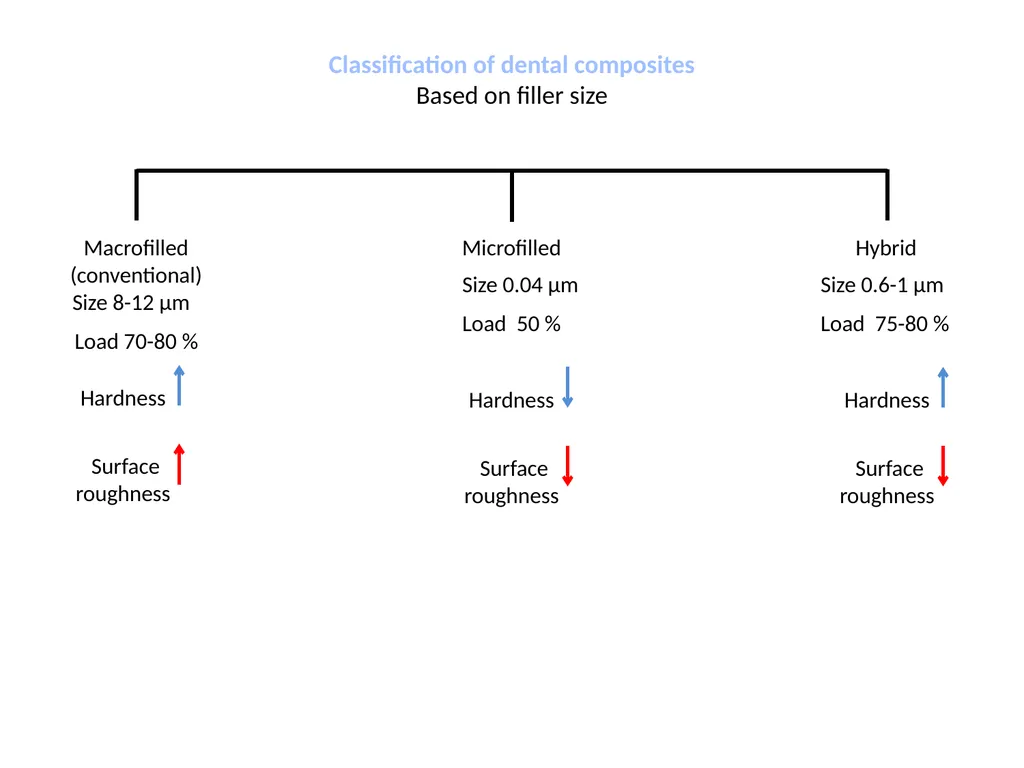
slide9. Classification of dental composites
Based on filler size Macrofilled (conventional)
Size 8-12 µm Microfilled Hybrid Hardness Surface roughness Load 70-80 % Size 0.04 µm Load 50 % Hardness Surface roughness Size 0.6-1 µm Load 75-80 % Hardness Surface roughness<br>
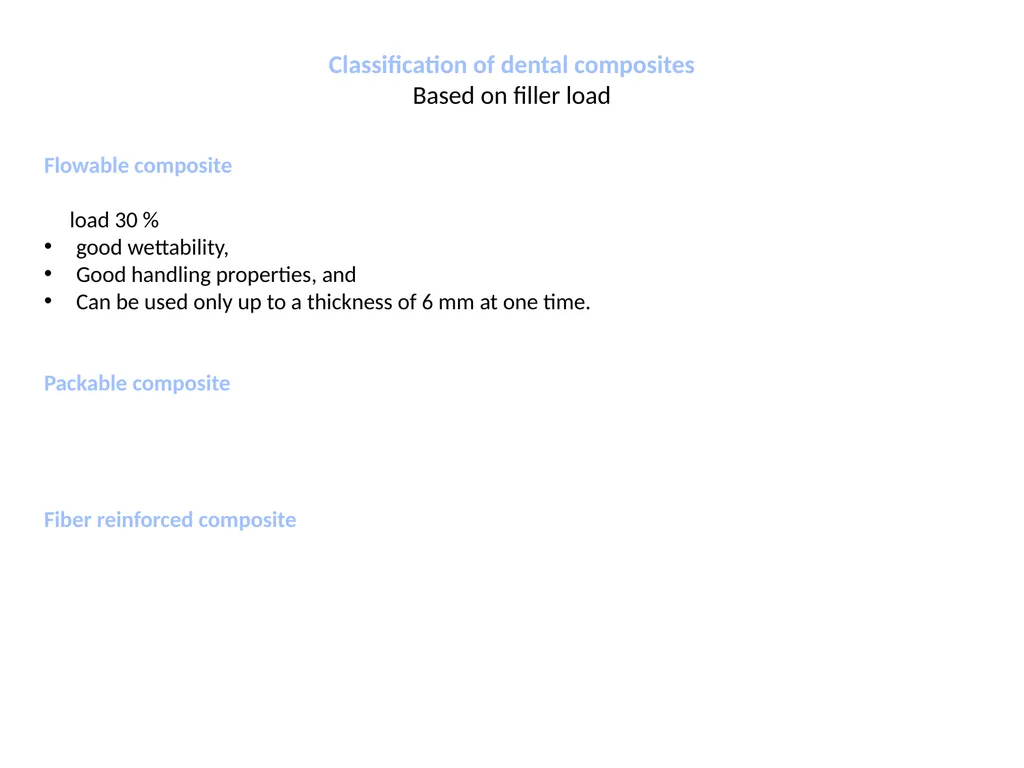
slide10. Classification of dental composites
Based on filler load Flowable composite
load 30 %
good wettability,
Good handling properties, and
Can be used only up to a thickness of 6 mm at one time.
Packable composite
Fiber reinforced composite<br>
slide11. Thank you<br>
Rapid improvement in application techniques and materials. “Direct materials are those that can be placed directly in the tooth cavity during a single appointment. Indirect materials are used to fabricate restorations in the dental laboratory that then are placed in or on the teeth; placement of indirect materials generally requires two or more visits to complete the restoration”<br>
slide2. Historical development Silicate cement:
introduced in 871.
Aluminosilicate powder and a phosphoric acid liquid.
The silicate has several advantages over the amalgam restoration:
Matching tooth color
Ease of manipulation and;
Anti-caries activity due to high fluoride content.
Disadvantages:
It irritates the dental pulp due to its phosphoric acid content, and
Has an early clinical failure, which mostly related to its dissolution in oral fluids,
Loss of translucency,
Surface crazing, and
Lack of adequate mechanical properties<br>
slide3. Unfilled acrylic polymers (acrylic resins)
introduced about 1945 and were improved so that they were in moderate usage in the 1960.
based on polymethyl methacrylate (PMMA)
Advantages:
less soluble in oral fluids,
less susceptible to fracture, and
More color stable than silicate materials.
Disadvantages:
They had low abrasion resistance,
high coefficient of thermal expansion and contraction.
Not bond to the tooth structure.<br>
slide4. Composite
Started in late 1950s and early 1960s, when Bowen began
Epoxy resins reinforced with filler particles.
Advantages:
better mechanical properties and
higher abrasion and wear resistance,
lower polymerization shrinkage and
lower coefficient of thermal expansion than that of unfilled resins.<br>
slide5. Composite Bis-GMA, UEDMA, TEGDMA Benzoyl peroxide, tertiary amine activator, Camphorquinone Hydroquinone 2-hydroxy-4-methoxy benzophenone Pure silica particles with
different sizes gamma-methacryloxy-propyl-trimethoxy-silane Size load Roughness Viscosity<br>
slide6. Polymerization reaction Methods of activations Chemical activation (self-curing composite resin) Long setting time
Voids in the final restoration
A higher probability of long term discoloration
after 3-5 years of intraoral service.
Difficult handling on placement especially at class IV cavities.
More finishing time.
Few shade options<br>
slide7. Visible Light activated composite resin (1970) single-component pastes,
require no mixing,
reduced porosity,
better resistance to wear and abrasion.
The working time is virtually that chosen by the clinician,
Wide range of shade options<br>
slide8. Dual cure composite.
A combination of chemical cure and light cure composites Slow chemical curing process starts on mixing (BP) then accelerated by light (CQ) For CEMENTATION veneers and
ceramic inlays or onlays<br>
slide9. Classification of dental composites
Based on filler size Macrofilled (conventional)
Size 8-12 µm Microfilled Hybrid Hardness Surface roughness Load 70-80 % Size 0.04 µm Load 50 % Hardness Surface roughness Size 0.6-1 µm Load 75-80 % Hardness Surface roughness<br>
slide10. Classification of dental composites
Based on filler load Flowable composite
load 30 %
good wettability,
Good handling properties, and
Can be used only up to a thickness of 6 mm at one time.
Packable composite
Fiber reinforced composite<br>
slide11. Thank you<br>