04
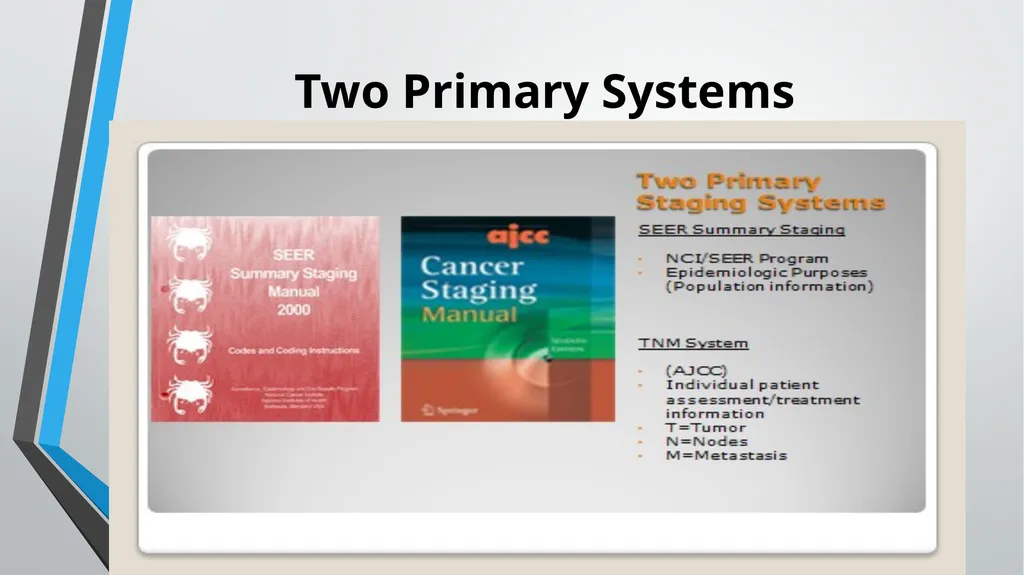
Two Primary Systems<br>
05
What is Summary Staging? “SEER Summary Stage 2000 is the most basic way of categorizing how far a cancer has spread from its point of origin.”
Young JL Jr, Roffers SD, Ries LAG, Fritz AG, Hurlbut AA (eds). SEER Summary Staging Manual - 2000: Codes and Coding Instructions, National Cancer Institute, NIH Pub. No. 01-4969, Bethesda, MD, 2001.<br>
06
What is Summary Staging? “Summary staging uses all information available in the medical record: in other words, it is a combination of the most precise clinical and pathologic documentation of the extent of disease.”
Young JL Jr, Roffers SD, Ries LAG, Fritz AG, Hurlbut AA (eds). SEER Summary Staging Manual - 2000: Codes and Coding Instructions, National Cancer Institute, NIH Pub. No. 01-4969, Bethesda, MD, 2001.<br>
07
Summary Stage Background SS77
- Diagnosed prior to 2001
SS2000
- Diagnosed from 1/1/2001
Collaborative Staging
- Diagnosed from 1/1/2004
SS 2000 Directly Coded
- Diagnosed 1/1/2015 * Currently Summary Stage is being derived by Collaborative Staging *<br>
08
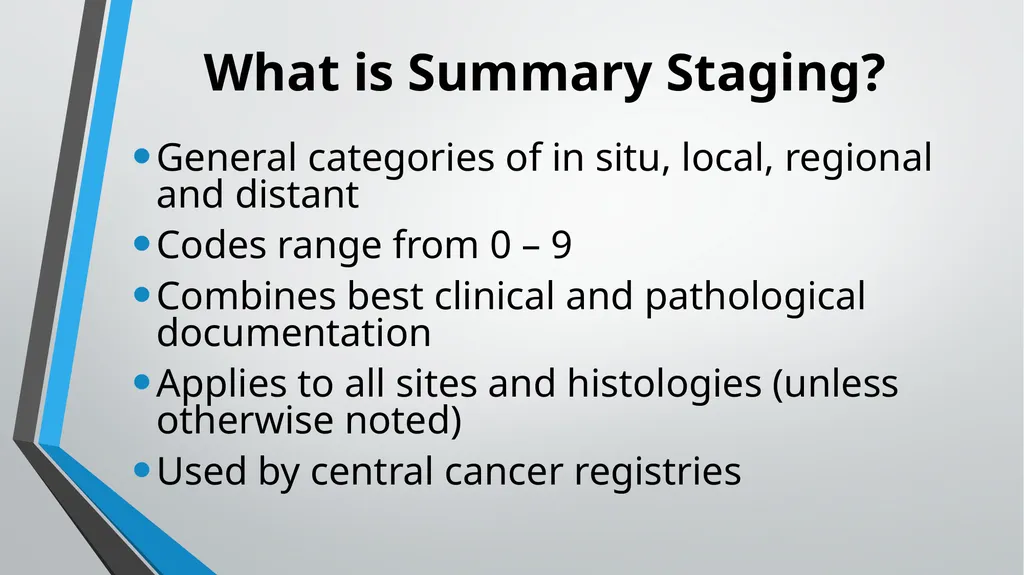
What is Summary Staging? General categories of in situ, local, regional and distant
Codes range from 0 – 9
Combines best clinical and pathological documentation
Applies to all sites and histologies (unless otherwise noted)
Used by central cancer registries<br>
09
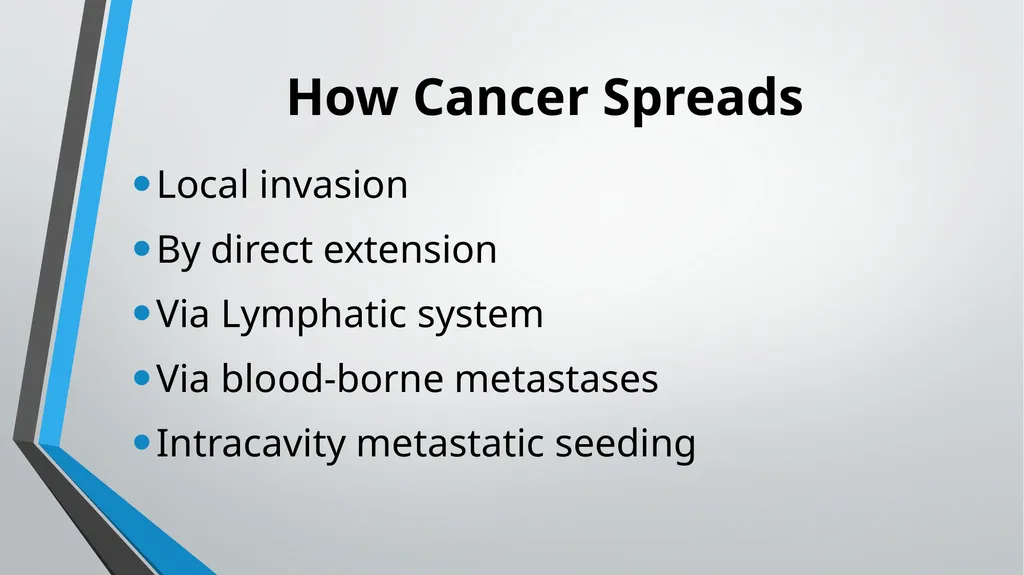
How Cancer Spreads Local invasion
By direct extension
Via Lymphatic system
Via blood-borne metastases
Intracavity metastatic seeding<br>
10
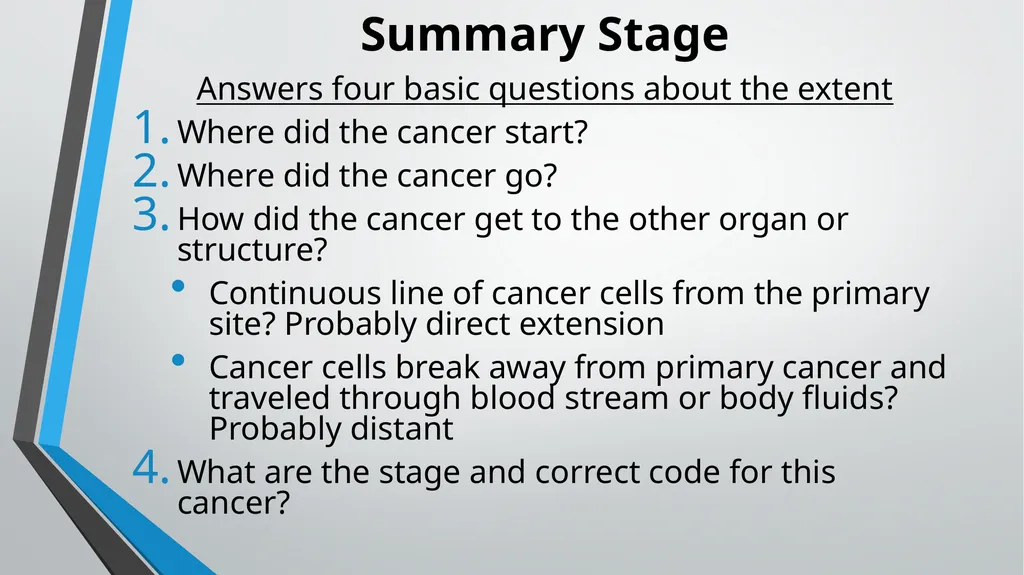
Summary Stage Answers four basic questions about the extent
Where did the cancer start?
Where did the cancer go?
How did the cancer get to the other organ or structure?
Continuous line of cancer cells from the primary site? Probably direct extension
Cancer cells break away from primary cancer and traveled through blood stream or body fluids? Probably distant
What are the stage and correct code for this cancer?<br>
11
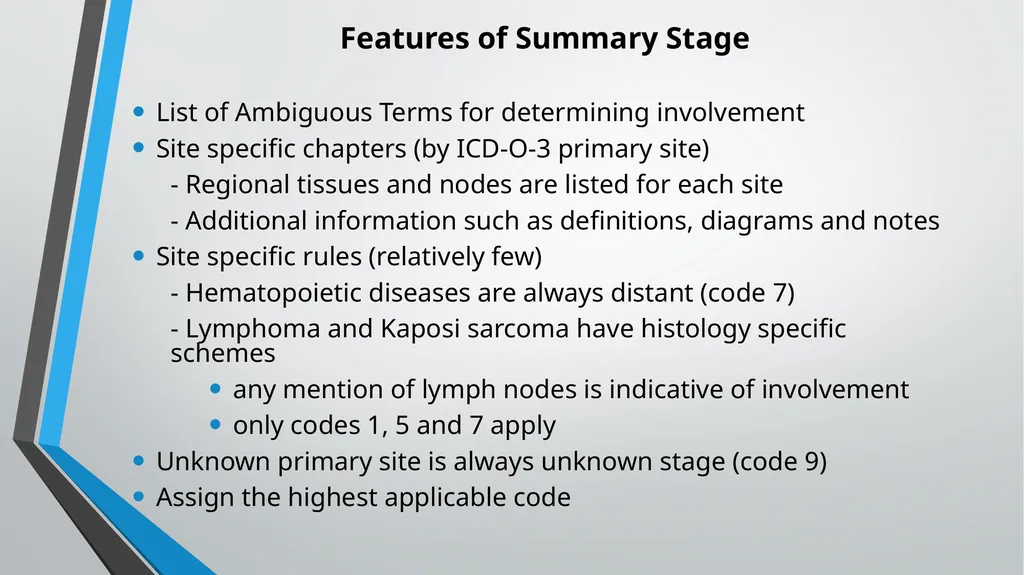
Features of Summary Stage List of Ambiguous Terms for determining involvement
Site specific chapters (by ICD-O-3 primary site)
- Regional tissues and nodes are listed for each site
- Additional information such as definitions, diagrams and notes
Site specific rules (relatively few)
- Hematopoietic diseases are always distant (code 7)
- Lymphoma and Kaposi sarcoma have histology specific schemes
any mention of lymph nodes is indicative of involvement
only codes 1, 5 and 7 apply
Unknown primary site is always unknown stage (code 9)
Assign the highest applicable code<br>
12
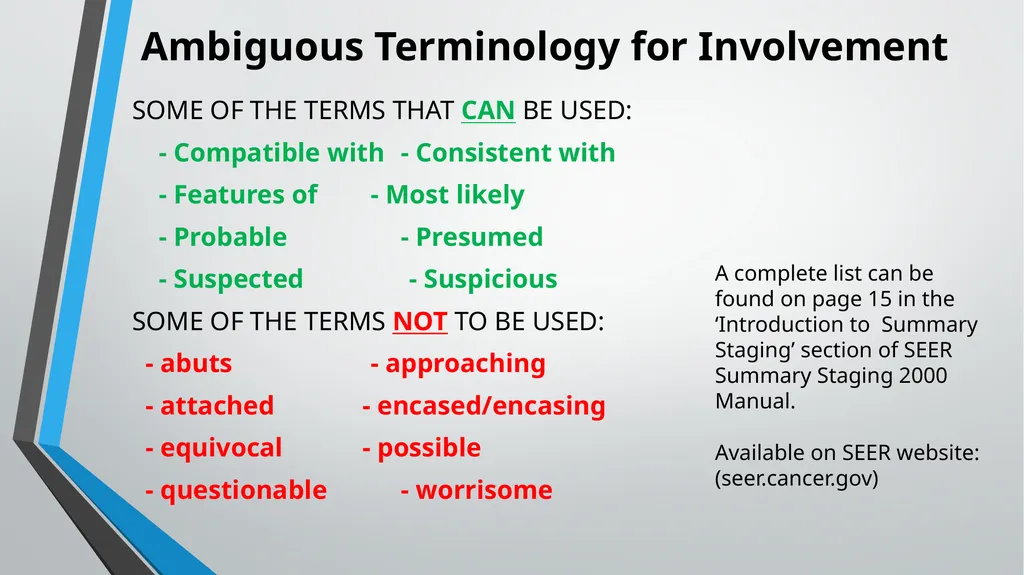
Ambiguous Terminology for Involvement SOME OF THE TERMS THAT CAN BE USED:
- Compatible with - Consistent with
- Features of - Most likely
- Probable - Presumed
- Suspected - Suspicious
SOME OF THE TERMS NOT TO BE USED:
- abuts - approaching
- attached - encased/encasing
- equivocal - possible
- questionable - worrisome A complete list can be found on page 15 in the ‘Introduction to Summary Staging’ section of SEER Summary Staging 2000 Manual.
Available on SEER website: (seer.cancer.gov)<br>
13
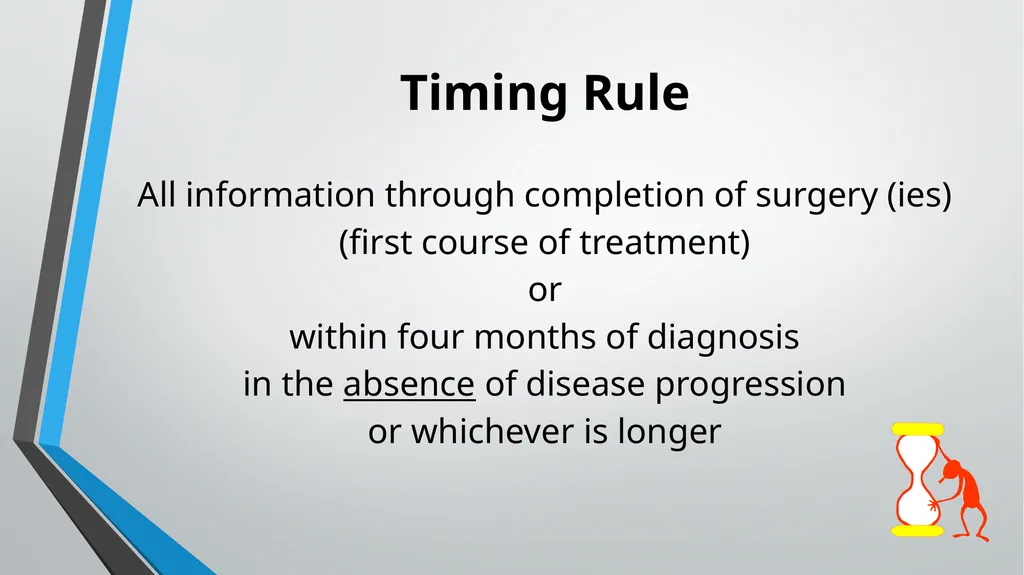
Timing Rule All information through completion of surgery (ies)
(first course of treatment)
or
within four months of diagnosis
in the absence of disease progression
or whichever is longer<br>
14
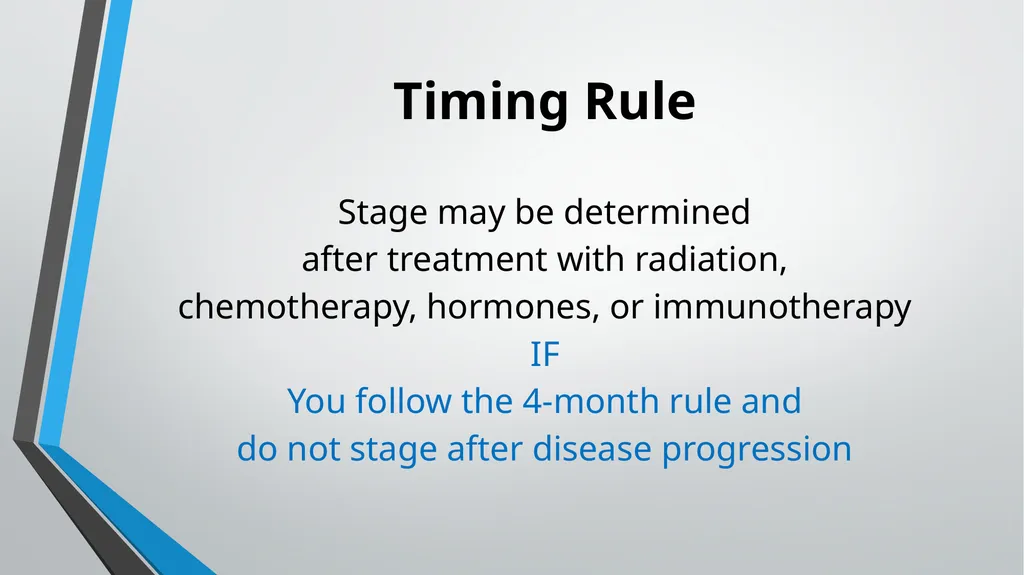
Timing Rule Stage may be determined
after treatment with radiation,
chemotherapy, hormones, or immunotherapy
IF
You follow the 4-month rule and
do not stage after disease progression<br>
15
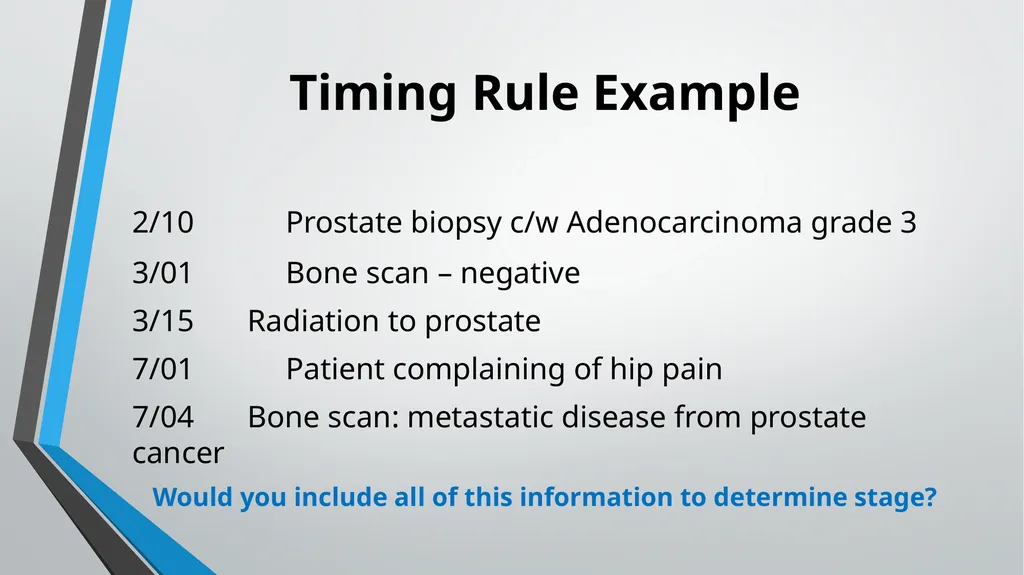
Timing Rule Example 2/10 Prostate biopsy c/w Adenocarcinoma grade 3
3/01 Bone scan – negative
3/15 Radiation to prostate
7/01 Patient complaining of hip pain
7/04 Bone scan: metastatic disease from prostate cancer
Would you include all of this information to determine stage?<br>
16
Where do I start? Where did the cancer start?
The correct primary site or
The correct histology
What is the stage?
How far has the cancer spread?<br>
17
Where do I look? Pathology Reports
Cytology Reports
Bone Marrow Biopsies
Autopsy Reports History and Physical
Admitting Notes
Discharge Summary
Consultative Reports<br>
18
KEEP LOOKING! X-rays and imaging studies
Scopes and manipulative procedures
Laboratory reports
Operative reports
Treatment
Physician’s office records/letters
Cancer Conferences
Physician Advisor<br>
19
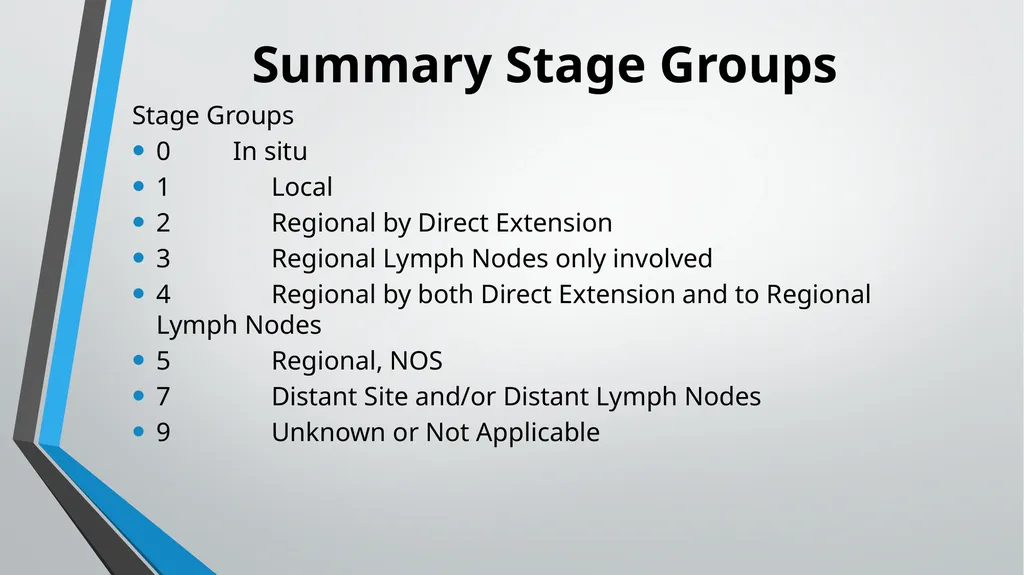
Summary Stage Groups Stage Groups
0 In situ
1 Local
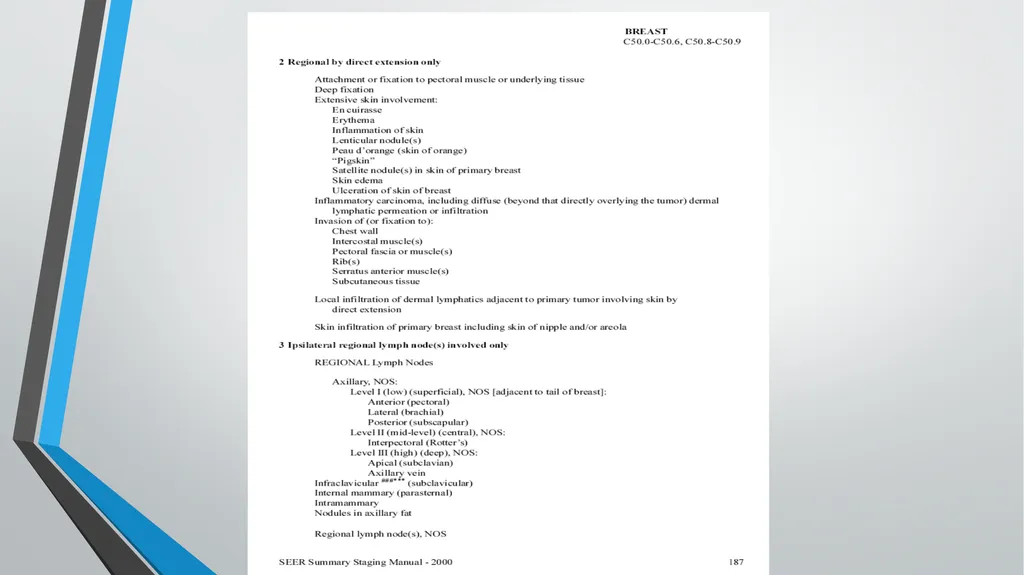
2 Regional by Direct Extension
3 Regional Lymph Nodes only involved
4 Regional by both Direct Extension and to Regional Lymph Nodes
5 Regional, NOS
7 Distant Site and/or Distant Lymph Nodes
9 Unknown or Not Applicable<br>
20
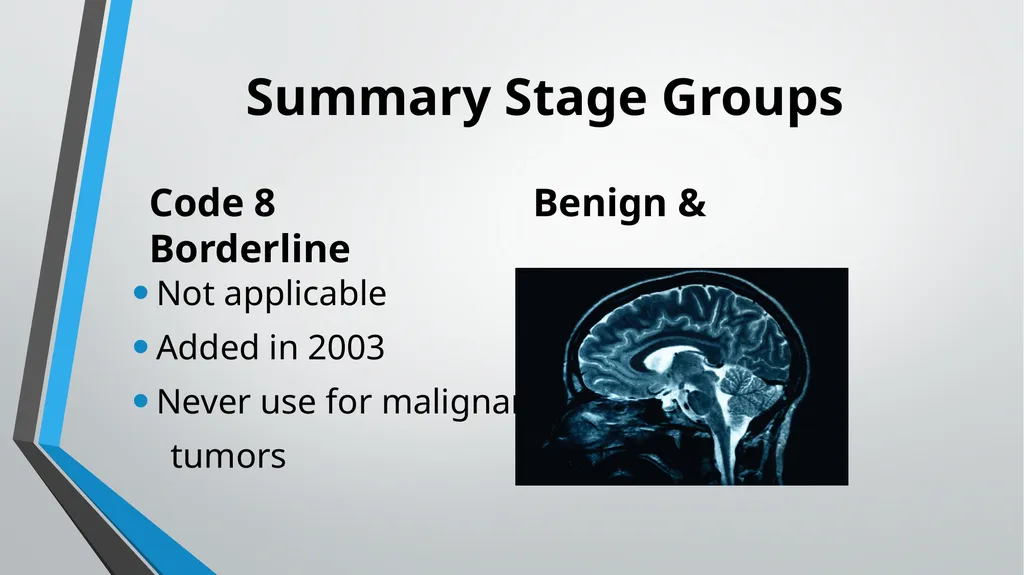
Summary Stage Groups Not applicable
Added in 2003
Never use for malignant
tumors Code 8 Benign & Borderline
CNS<br>
21
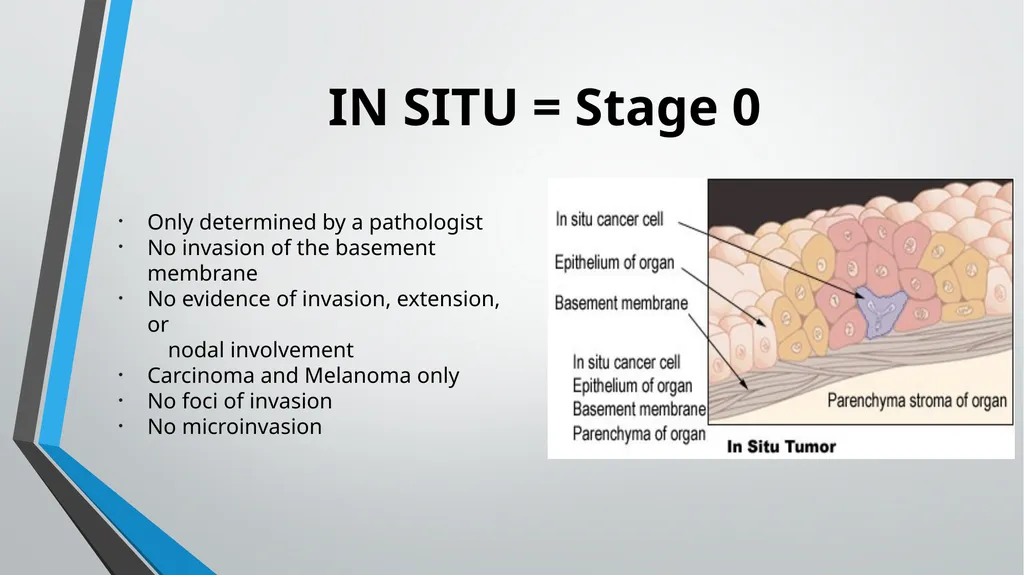
IN SITU = Stage 0 Only determined by a pathologist
No invasion of the basement membrane
No evidence of invasion, extension, or
nodal involvement
Carcinoma and Melanoma only
No foci of invasion
No microinvasion<br>
22
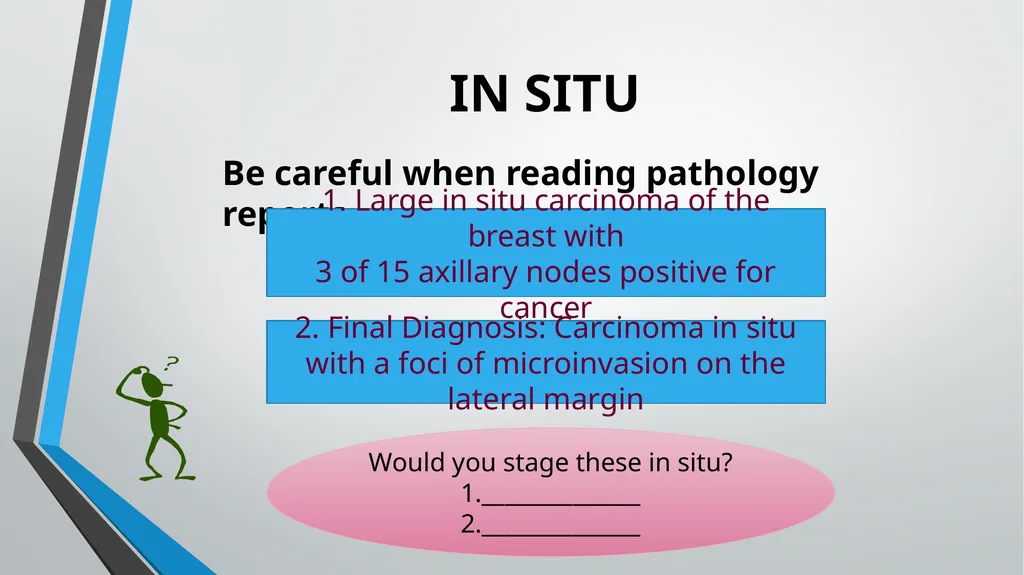
IN SITU Be careful when reading pathology reports 1. Large in situ carcinoma of the breast with
3 of 15 axillary nodes positive for cancer 2. Final Diagnosis: Carcinoma in situ with a foci of microinvasion on the lateral margin Would you stage these in situ?
1.______________
2.______________<br>
23
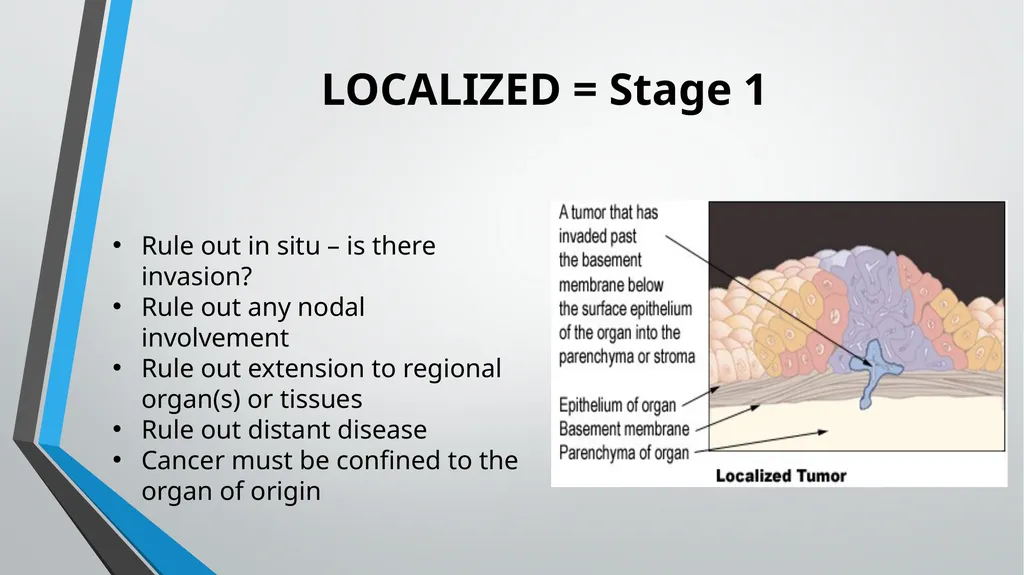
LOCALIZED = Stage 1 Rule out in situ – is there invasion?
Rule out any nodal involvement
Rule out extension to regional organ(s) or tissues
Rule out distant disease
Cancer must be confined to the organ of origin<br>
24
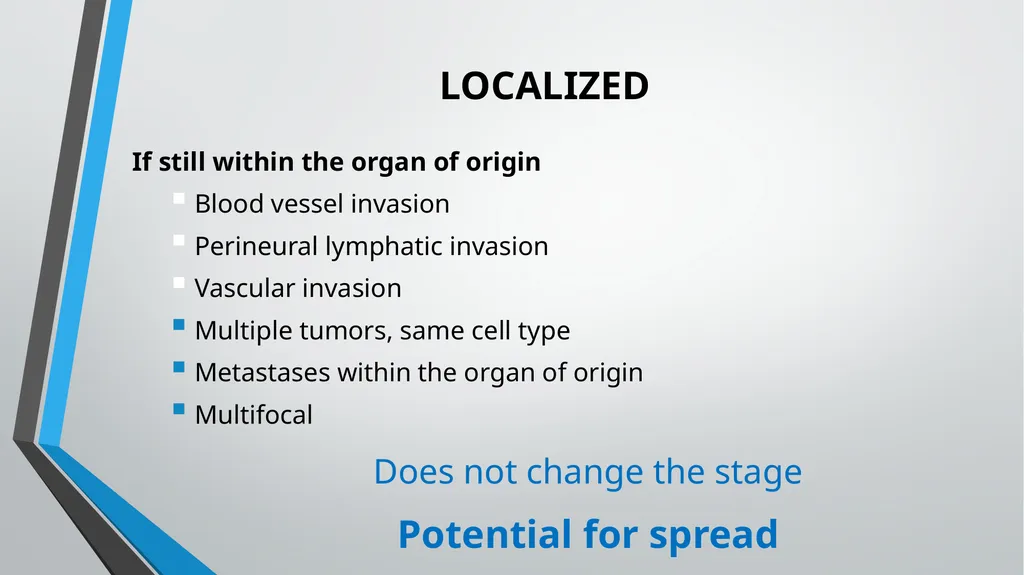
LOCALIZED If still within the organ of origin
Blood vessel invasion
Perineural lymphatic invasion
Vascular invasion
Multiple tumors, same cell type
Metastases within the organ of origin
Multifocal Does not change the stage
Potential for spread<br>
25
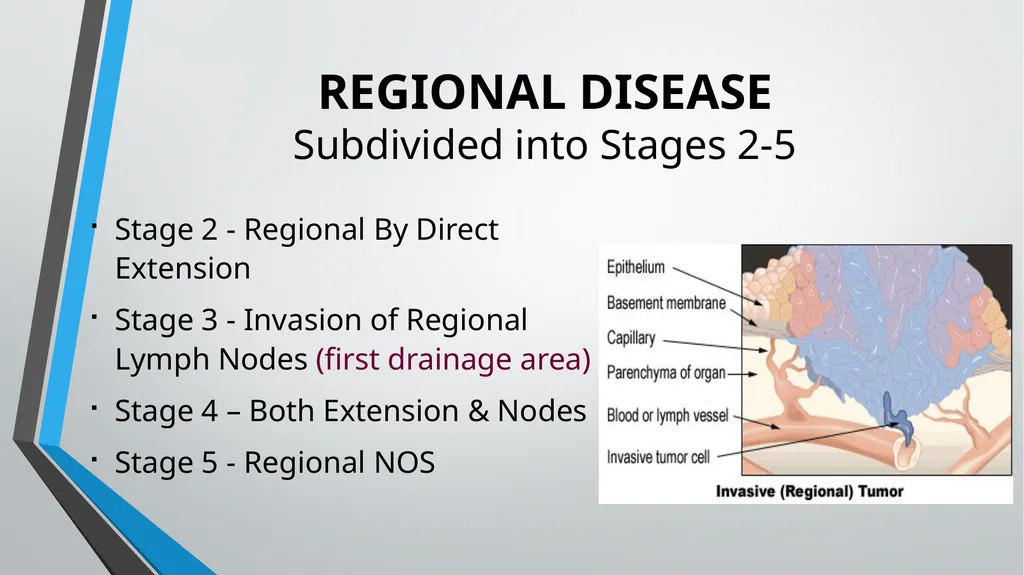
REGIONAL DISEASE�Subdivided into Stages 2-5 Stage 2 - Regional By Direct Extension
Stage 3 - Invasion of Regional Lymph Nodes (first drainage area)
Stage 4 – Both Extension & Nodes
Stage 5 - Regional NOS<br>
26
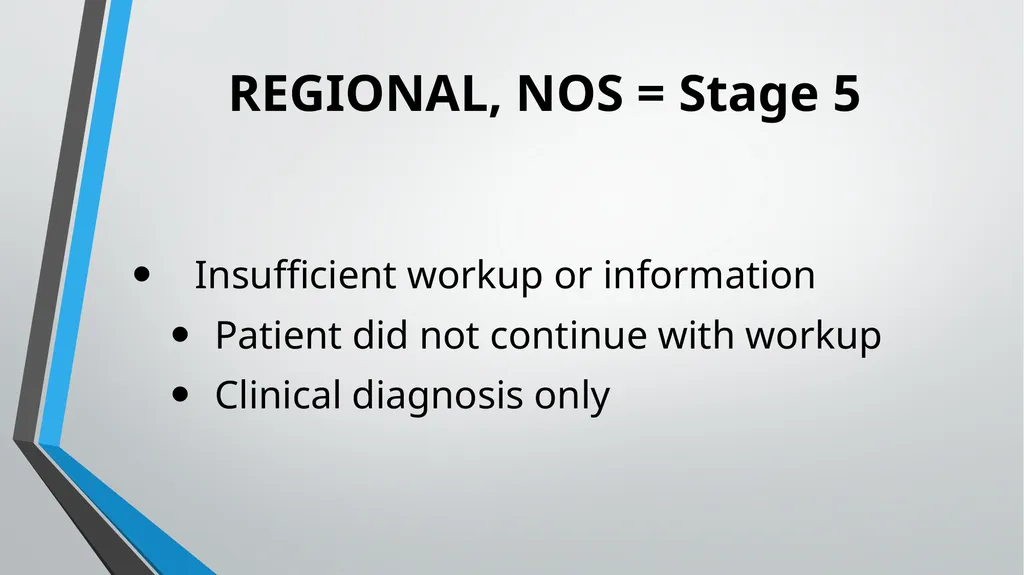
REGIONAL, NOS = Stage 5 Insufficient workup or information
Patient did not continue with workup
Clinical diagnosis only<br>
27
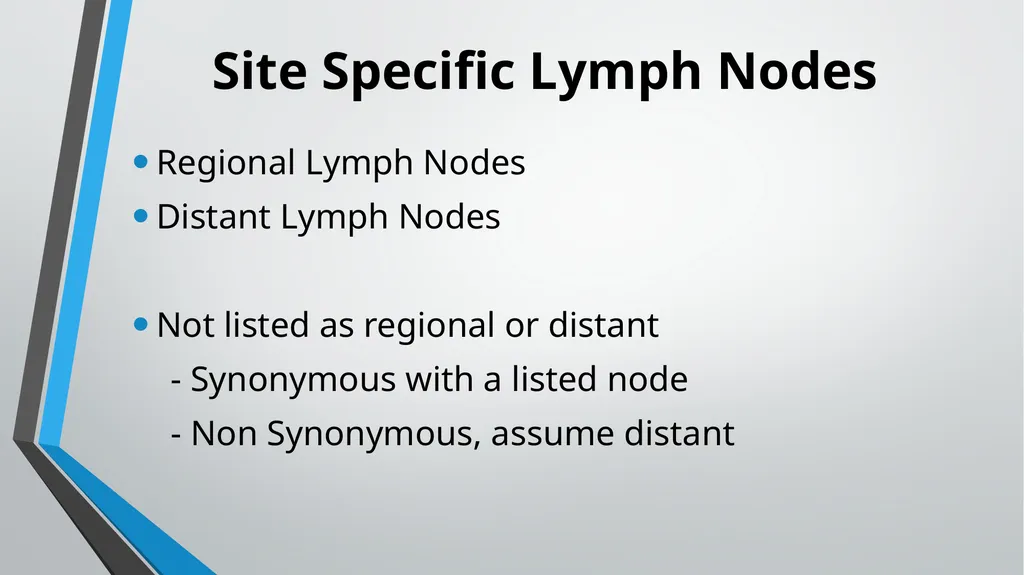
Site Specific Lymph Nodes Regional Lymph Nodes
Distant Lymph Nodes
Not listed as regional or distant
- Synonymous with a listed node
- Non Synonymous, assume distant<br>
28
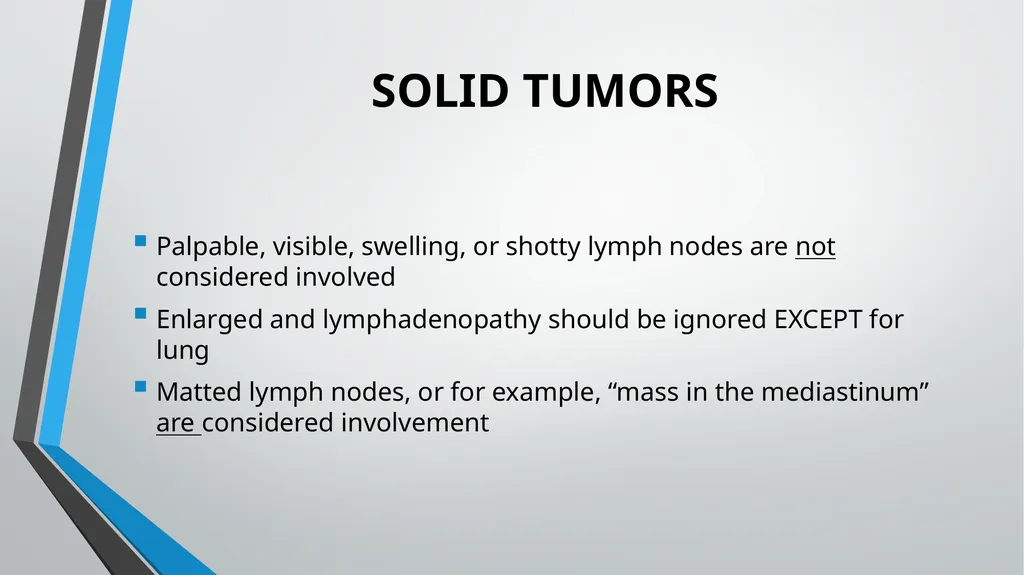
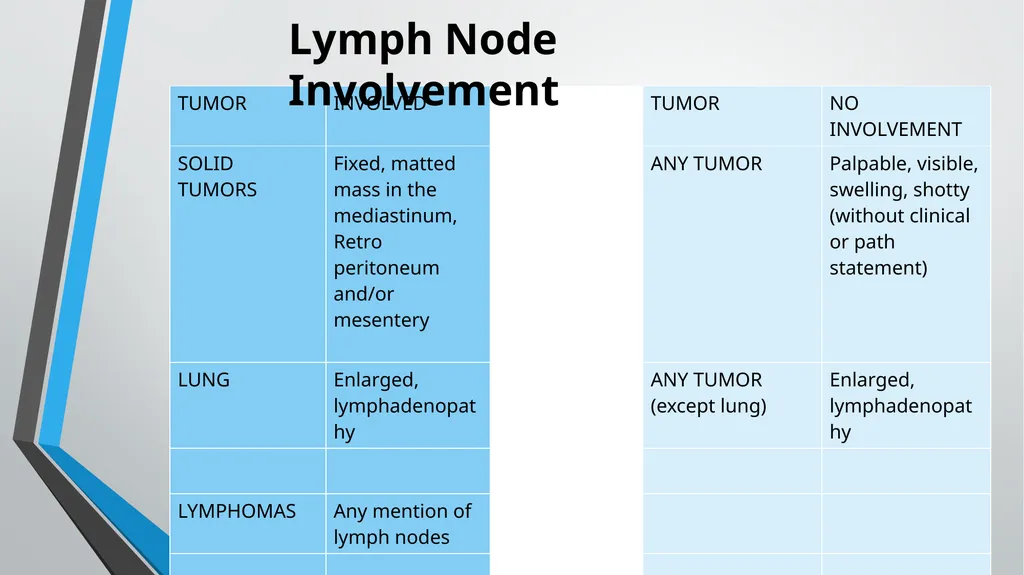
SOLID TUMORS Palpable, visible, swelling, or shotty lymph nodes are not considered involved
Enlarged and lymphadenopathy should be ignored EXCEPT for lung
Matted lymph nodes, or for example, “mass in the mediastinum” are considered involvement<br>
29
Lymph Node Involvement<br>
30
Lymph Nodes Inaccessible Bladder
Kidney
Prostate
Esophagus
Stomach
Lung
Liver
Ovary
Corpus Uteri<br>
31
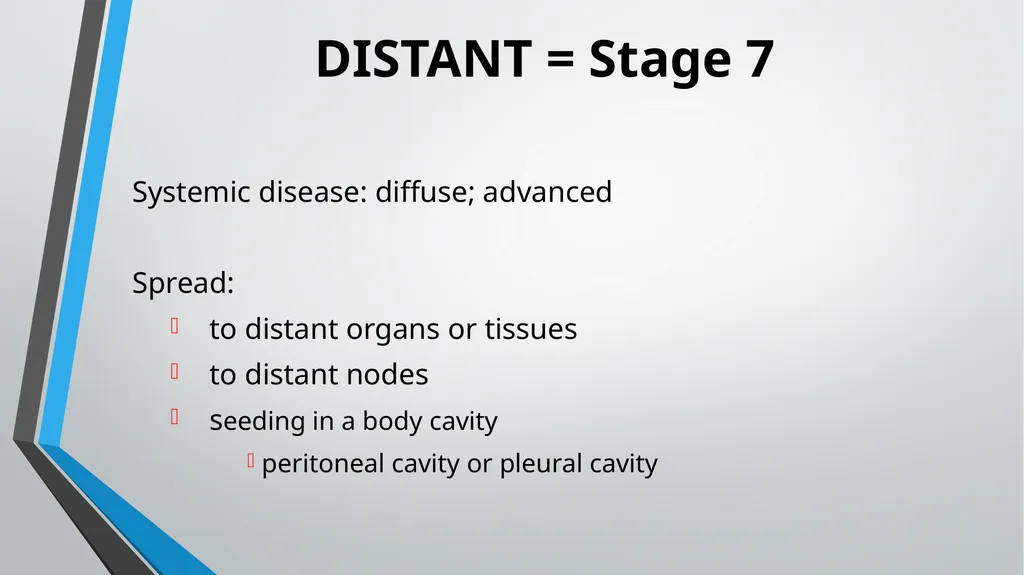
DISTANT = Stage 7 Systemic disease: diffuse; advanced
Spread:
to distant organs or tissues
to distant nodes
seeding in a body cavity
peritoneal cavity or pleural cavity<br>
32
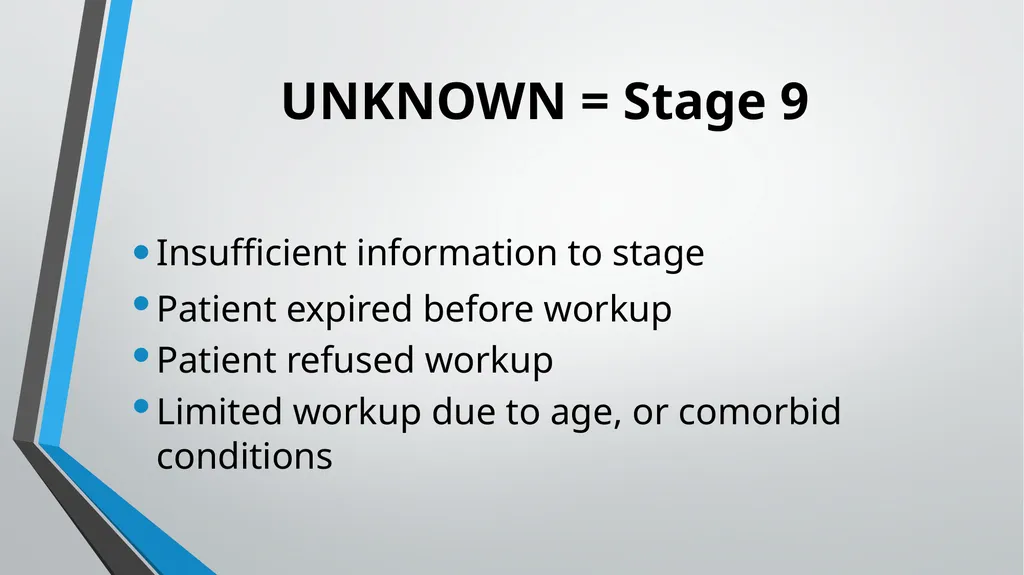
UNKNOWN = Stage 9 Insufficient information to stage
Patient expired before workup
Patient refused workup
Limited workup due to age, or comorbid conditions<br>
33
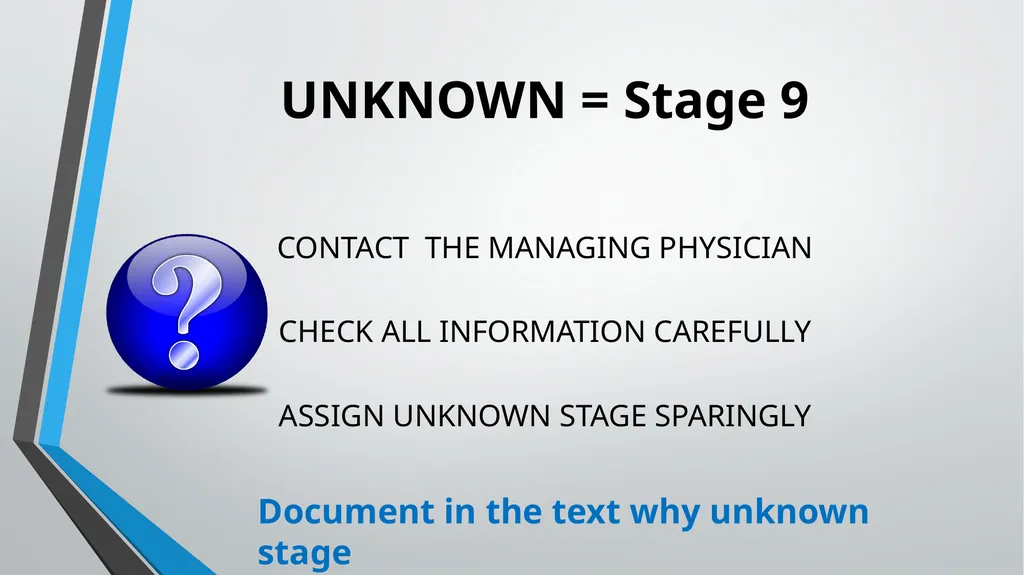
UNKNOWN = Stage 9 CONTACT THE MANAGING PHYSICIAN
CHECK ALL INFORMATION CAREFULLY
ASSIGN UNKNOWN STAGE SPARINGLY Document in the text why unknown stage<br>
34
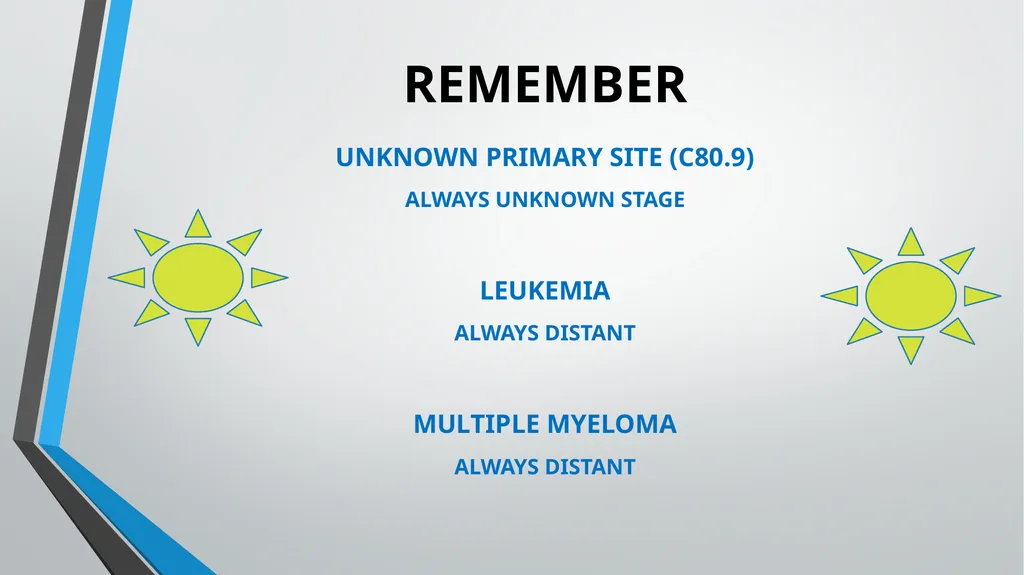
REMEMBER UNKNOWN PRIMARY SITE (C80.9)
ALWAYS UNKNOWN STAGE
LEUKEMIA
ALWAYS DISTANT
MULTIPLE MYELOMA
ALWAYS DISTANT<br>
35
IMPORTANT POINTS Read first section carefully
Schemas organized by primary site codes
- Except for those based on histology
- Example: Kaposi Sarcoma (pg 274)
ALL sites (or histologies) have a staging schema
Helpful anatomy illustrations<br>
36
IMPORTANT POINTS All malignant tissue is not removed
- Include information from gross observation
Disagreement concerning excised tissue
- Pathology report has precedence over operative report
Operative/pathology disproves clinical information
- Operative/pathology has precedence over clinical information<br>
37
ACKNOWLEDGMENTS Centers for Disease Control and Prevention
SEER Training Website<br>
38
Contact Info Nicole Catlett, CTR
Senior Regional Coordinator – Central KY
Kentucky Cancer Registry
nicole@kcr.uky.edu<br>