
Discourse Processing Ranjani Parthasarathi
MJ
Published · 99 slides · 0 views
1 / 1
Description
Discourse Processing Ranjani Parthasarathi Professor, Dept. Of Info. Science Technology Anna University, CEG campus 1 Workshop on NLP - IIITH July 2014 Contents Discourse An intro Coherence Discourse theory RST Discourse annotation
Related Topics
Share
Embed code
Download this presentation From Below
"Discourse Processing Ranjani Parthasarathi" is the property of its rightful owner. Permission is granted to download and print the materials on this website for personal, non-commercial use only, and to display it on your personal computer provided you do not modify the materials and that you retain all copyright notices contained in the materials. By downloading content from our website, you accept the terms of this agreement.
Presentation Transcript
01
Discourse Processing Ranjani Parthasarathi
Professor, Dept. Of Info. Science & Technology
Anna University, CEG campus 1 Workshop on NLP - IIITH July 2014<br>
Professor, Dept. Of Info. Science & Technology
Anna University, CEG campus 1 Workshop on NLP - IIITH July 2014<br>
02
Contents Discourse – An intro
Coherence
Discourse theory
RST
Discourse annotation & corpus
Sangati 2 Workshop on NLP - IIITH July 2014<br>
Coherence
Discourse theory
RST
Discourse annotation & corpus
Sangati 2 Workshop on NLP - IIITH July 2014<br>
03
Discourse Consists of collocated, structured, coherent groups of sentences
What makes something a discourse as opposed to a set of unrelated sentences?
How can text be structured (related)?
Coherence – central theme - models the logical flow of the discourse 3 Workshop on NLP - IIITH July 2014<br>
What makes something a discourse as opposed to a set of unrelated sentences?
How can text be structured (related)?
Coherence – central theme - models the logical flow of the discourse 3 Workshop on NLP - IIITH July 2014<br>
04
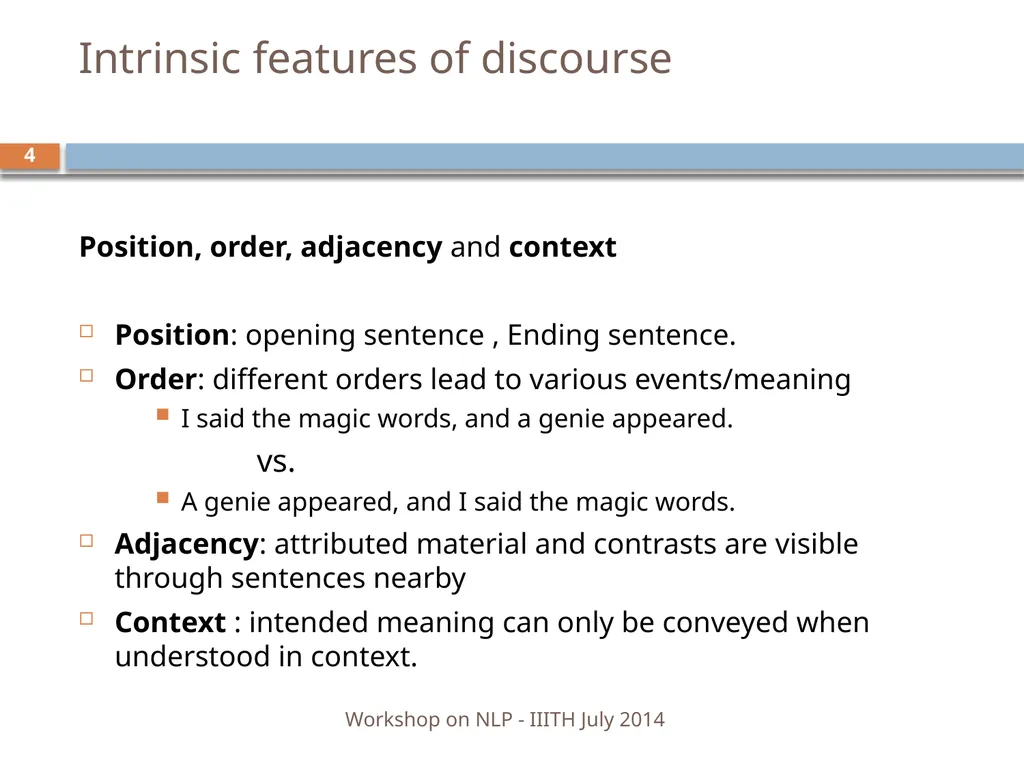
Intrinsic features of discourse Position, order, adjacency and context
Position: opening sentence , Ending sentence.
Order: different orders lead to various events/meaning
I said the magic words, and a genie appeared.
vs.
A genie appeared, and I said the magic words.
Adjacency: attributed material and contrasts are visible through sentences nearby
Context : intended meaning can only be conveyed when understood in context. 4 Workshop on NLP - IIITH July 2014<br>
Position: opening sentence , Ending sentence.
Order: different orders lead to various events/meaning
I said the magic words, and a genie appeared.
vs.
A genie appeared, and I said the magic words.
Adjacency: attributed material and contrasts are visible through sentences nearby
Context : intended meaning can only be conveyed when understood in context. 4 Workshop on NLP - IIITH July 2014<br>
05
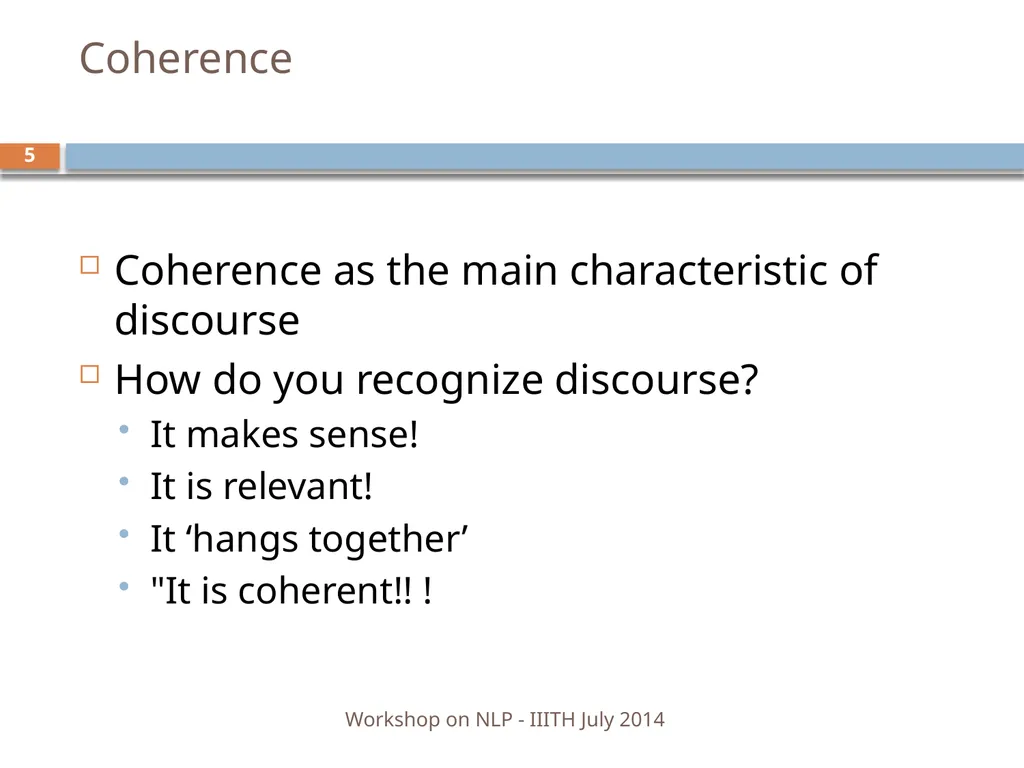
Coherence Coherence as the main characteristic of discourse
How do you recognize discourse?
It makes sense!
It is relevant!
It ‘hangs together’
"It is coherent!! ! 5 Workshop on NLP - IIITH July 2014<br>
How do you recognize discourse?
It makes sense!
It is relevant!
It ‘hangs together’
"It is coherent!! ! 5 Workshop on NLP - IIITH July 2014<br>
06
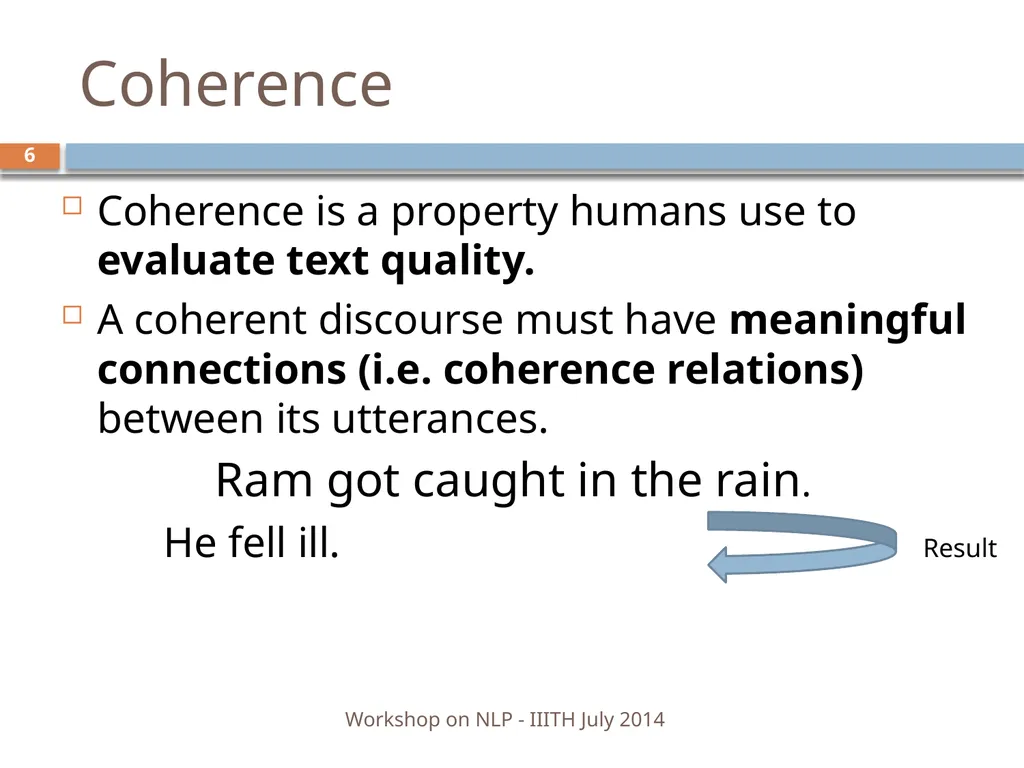
Coherence Coherence is a property humans use to evaluate text quality.
A coherent discourse must have meaningful connections (i.e. coherence relations) between its utterances.
Ram got caught in the rain.
He fell ill. Result 6 Workshop on NLP - IIITH July 2014<br>
A coherent discourse must have meaningful connections (i.e. coherence relations) between its utterances.
Ram got caught in the rain.
He fell ill. Result 6 Workshop on NLP - IIITH July 2014<br>
07
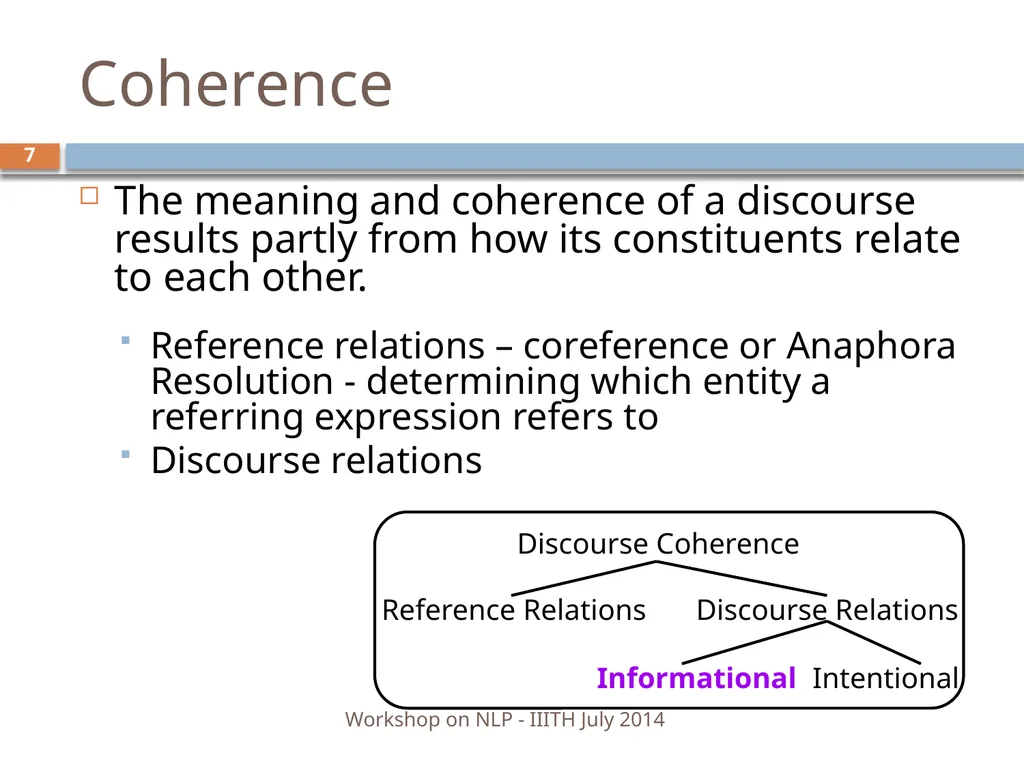
Coherence The meaning and coherence of a discourse results partly from how its constituents relate to each other.
Reference relations – coreference or Anaphora Resolution - determining which entity a referring expression refers to
Discourse relations 7 Workshop on NLP - IIITH July 2014<br>
Reference relations – coreference or Anaphora Resolution - determining which entity a referring expression refers to
Discourse relations 7 Workshop on NLP - IIITH July 2014<br>
08
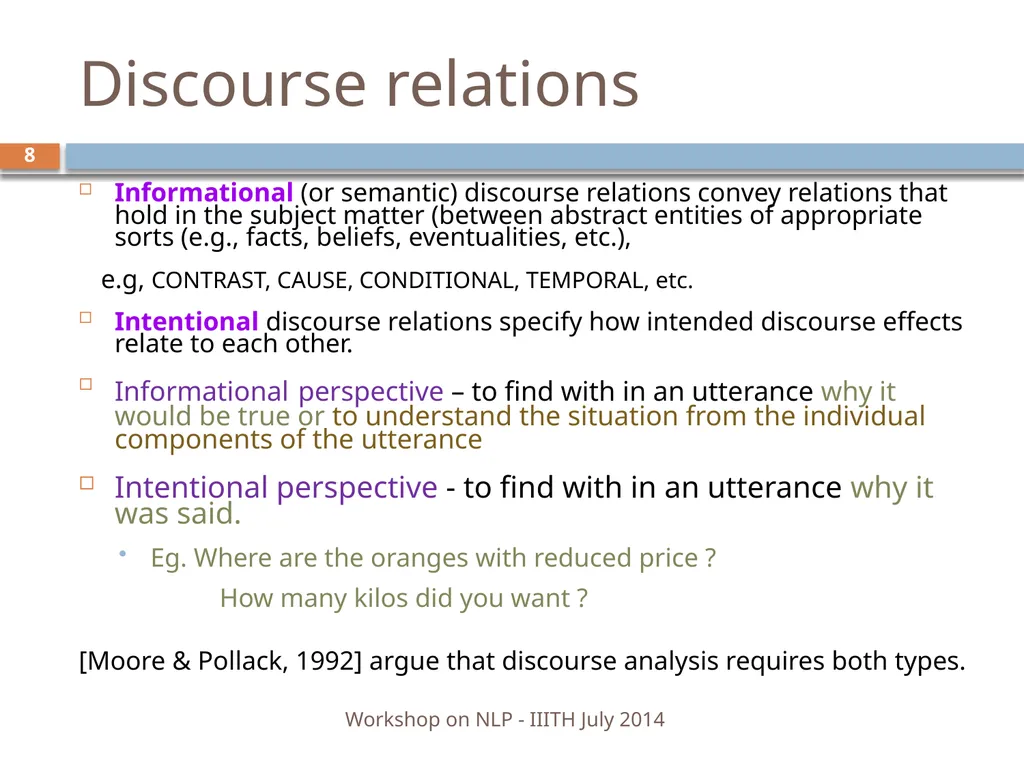
Discourse relations Informational (or semantic) discourse relations convey relations that hold in the subject matter (between abstract entities of appropriate sorts (e.g., facts, beliefs, eventualities, etc.),
e.g, CONTRAST, CAUSE, CONDITIONAL, TEMPORAL, etc.
Intentional discourse relations specify how intended discourse effects relate to each other.
Informational perspective – to find with in an utterance why it would be true or to understand the situation from the individual components of the utterance
Intentional perspective - to find with in an utterance why it was said.
Eg. Where are the oranges with reduced price ?
How many kilos did you want ?
[Moore & Pollack, 1992] argue that discourse analysis requires both types. 8 Workshop on NLP - IIITH July 2014<br>
e.g, CONTRAST, CAUSE, CONDITIONAL, TEMPORAL, etc.
Intentional discourse relations specify how intended discourse effects relate to each other.
Informational perspective – to find with in an utterance why it would be true or to understand the situation from the individual components of the utterance
Intentional perspective - to find with in an utterance why it was said.
Eg. Where are the oranges with reduced price ?
How many kilos did you want ?
[Moore & Pollack, 1992] argue that discourse analysis requires both types. 8 Workshop on NLP - IIITH July 2014<br>
09
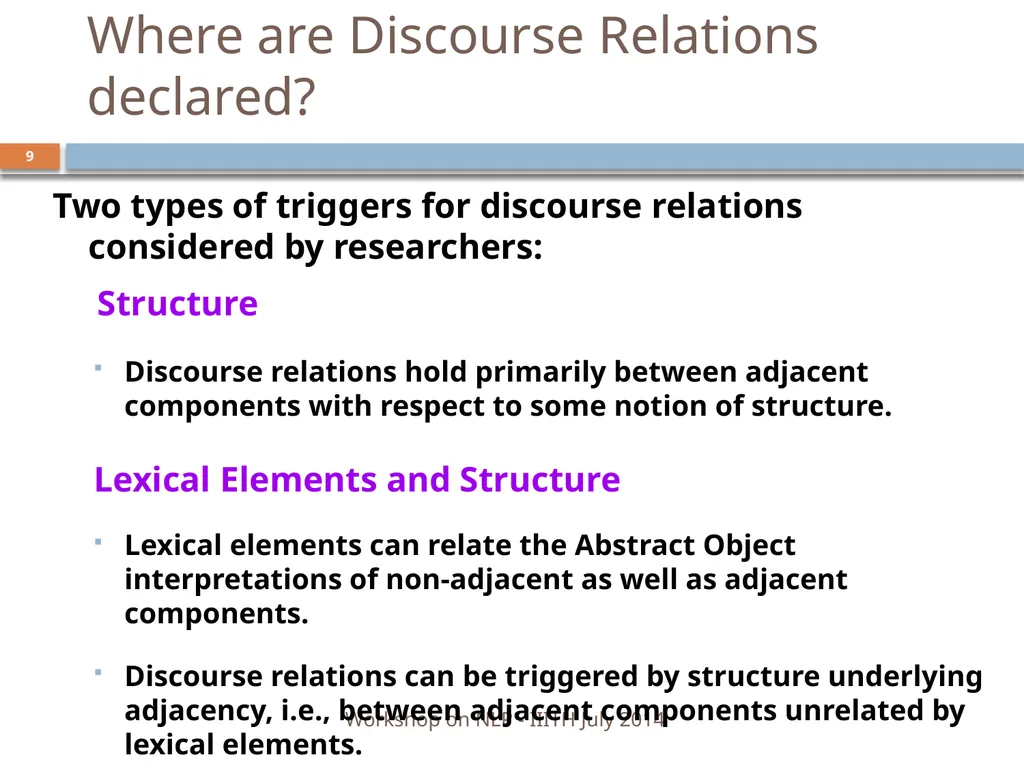
9 Where are Discourse Relations declared? Two types of triggers for discourse relations considered by researchers:
Structure
Discourse relations hold primarily between adjacent components with respect to some notion of structure.
Lexical Elements and Structure
Lexical elements can relate the Abstract Object interpretations of non-adjacent as well as adjacent components.
Discourse relations can be triggered by structure underlying adjacency, i.e., between adjacent components unrelated by lexical elements. Workshop on NLP - IIITH July 2014<br>
Structure
Discourse relations hold primarily between adjacent components with respect to some notion of structure.
Lexical Elements and Structure
Lexical elements can relate the Abstract Object interpretations of non-adjacent as well as adjacent components.
Discourse relations can be triggered by structure underlying adjacency, i.e., between adjacent components unrelated by lexical elements. Workshop on NLP - IIITH July 2014<br>
10
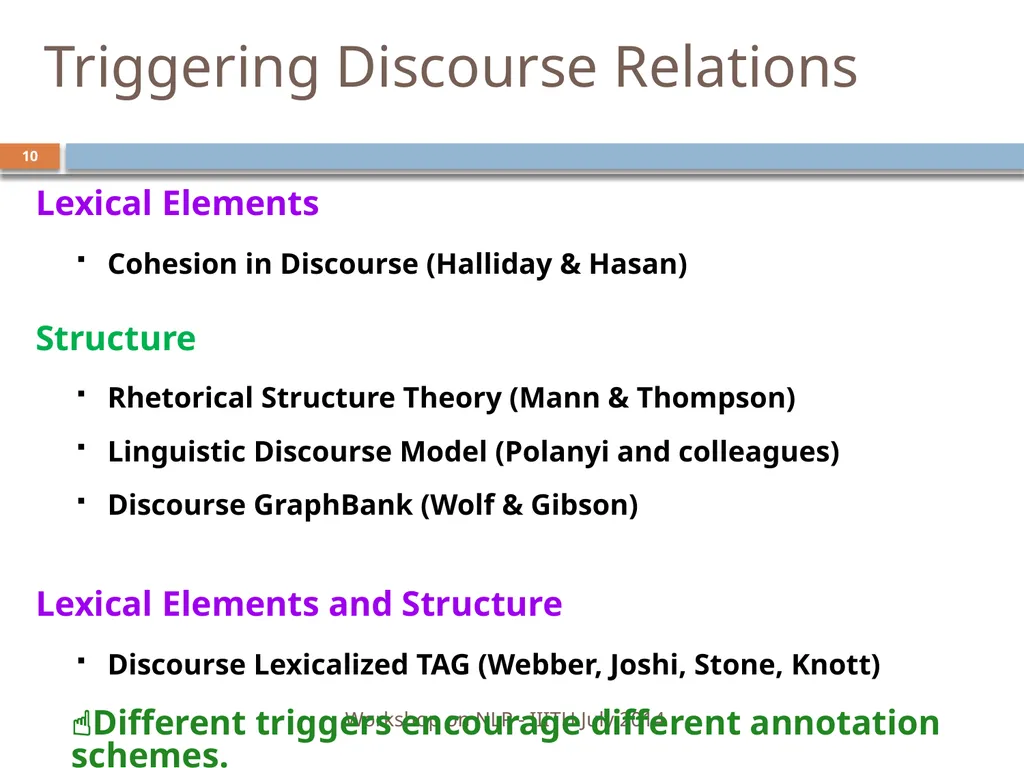
10 Triggering Discourse Relations Lexical Elements
Cohesion in Discourse (Halliday & Hasan)
Structure
Rhetorical Structure Theory (Mann & Thompson)
Linguistic Discourse Model (Polanyi and colleagues)
Discourse GraphBank (Wolf & Gibson)
Lexical Elements and Structure
Discourse Lexicalized TAG (Webber, Joshi, Stone, Knott)
Different triggers encourage different annotation schemes. Workshop on NLP - IIITH July 2014<br>
Cohesion in Discourse (Halliday & Hasan)
Structure
Rhetorical Structure Theory (Mann & Thompson)
Linguistic Discourse Model (Polanyi and colleagues)
Discourse GraphBank (Wolf & Gibson)
Lexical Elements and Structure
Discourse Lexicalized TAG (Webber, Joshi, Stone, Knott)
Different triggers encourage different annotation schemes. Workshop on NLP - IIITH July 2014<br>
11
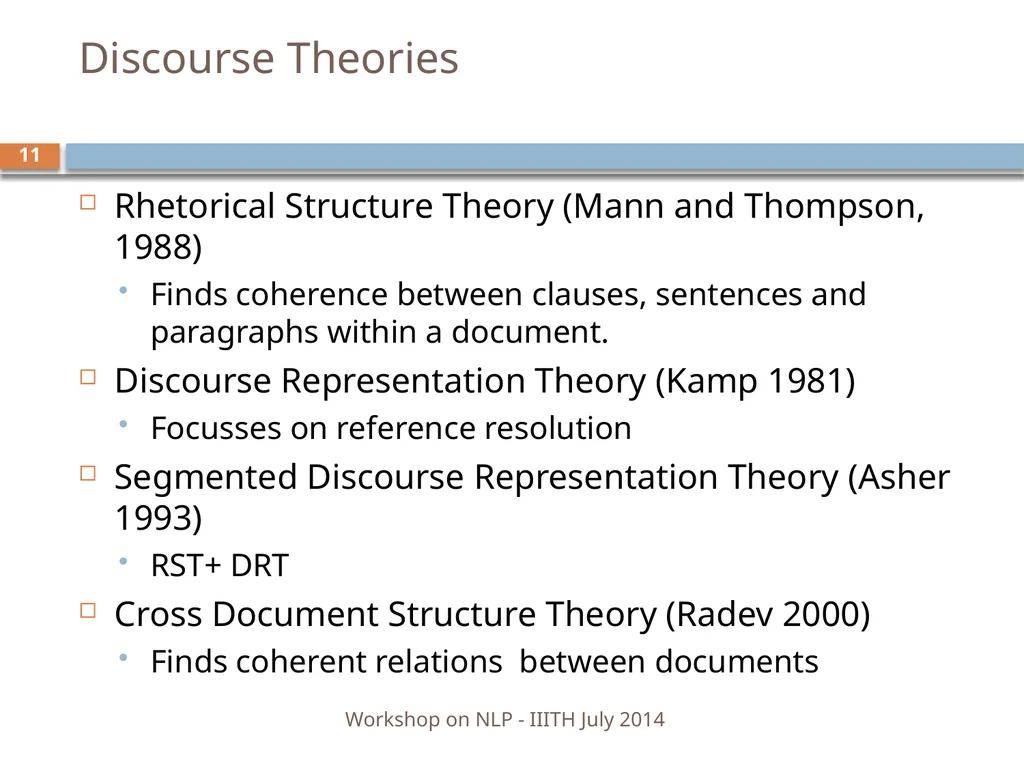
Discourse Theories Rhetorical Structure Theory (Mann and Thompson, 1988)
Finds coherence between clauses, sentences and paragraphs within a document.
Discourse Representation Theory (Kamp 1981)
Focusses on reference resolution
Segmented Discourse Representation Theory (Asher 1993)
RST+ DRT
Cross Document Structure Theory (Radev 2000)
Finds coherent relations between documents 11 Workshop on NLP - IIITH July 2014<br>
Finds coherence between clauses, sentences and paragraphs within a document.
Discourse Representation Theory (Kamp 1981)
Focusses on reference resolution
Segmented Discourse Representation Theory (Asher 1993)
RST+ DRT
Cross Document Structure Theory (Radev 2000)
Finds coherent relations between documents 11 Workshop on NLP - IIITH July 2014<br>
12
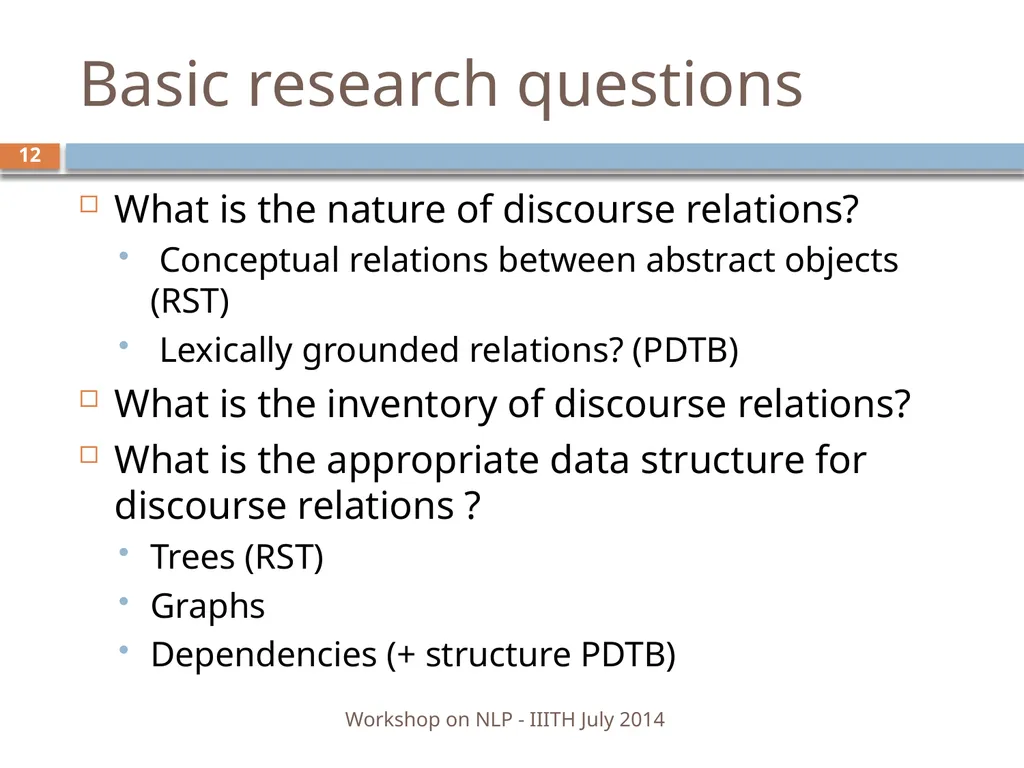
Basic research questions What is the nature of discourse relations?
Conceptual relations between abstract objects (RST)
Lexically grounded relations? (PDTB)
What is the inventory of discourse relations?
What is the appropriate data structure for discourse relations ?
Trees (RST)
Graphs
Dependencies (+ structure PDTB) 12 Workshop on NLP - IIITH July 2014<br>
Conceptual relations between abstract objects (RST)
Lexically grounded relations? (PDTB)
What is the inventory of discourse relations?
What is the appropriate data structure for discourse relations ?
Trees (RST)
Graphs
Dependencies (+ structure PDTB) 12 Workshop on NLP - IIITH July 2014<br>
13
Rhetorical Structure Theory A theory of coherence relations, in which coherence is referred to as rhetorical relation.
Originally proposed for the study of text generation (Mann and Thompson, 1988), recent overview available by Taboada and Mann (2006) 13 Workshop on NLP - IIITH July 2014<br>
Originally proposed for the study of text generation (Mann and Thompson, 1988), recent overview available by Taboada and Mann (2006) 13 Workshop on NLP - IIITH July 2014<br>
14
14 Principles Coherent texts consist of minimal units, which are linked to each other, recursively, through rhetorical relations
Coherent texts do not show gaps or non-sequiturs
Therefore, there must be some relation holding among the different parts of the text Workshop on NLP - IIITH July 2014<br>
Coherent texts do not show gaps or non-sequiturs
Therefore, there must be some relation holding among the different parts of the text Workshop on NLP - IIITH July 2014<br>
15
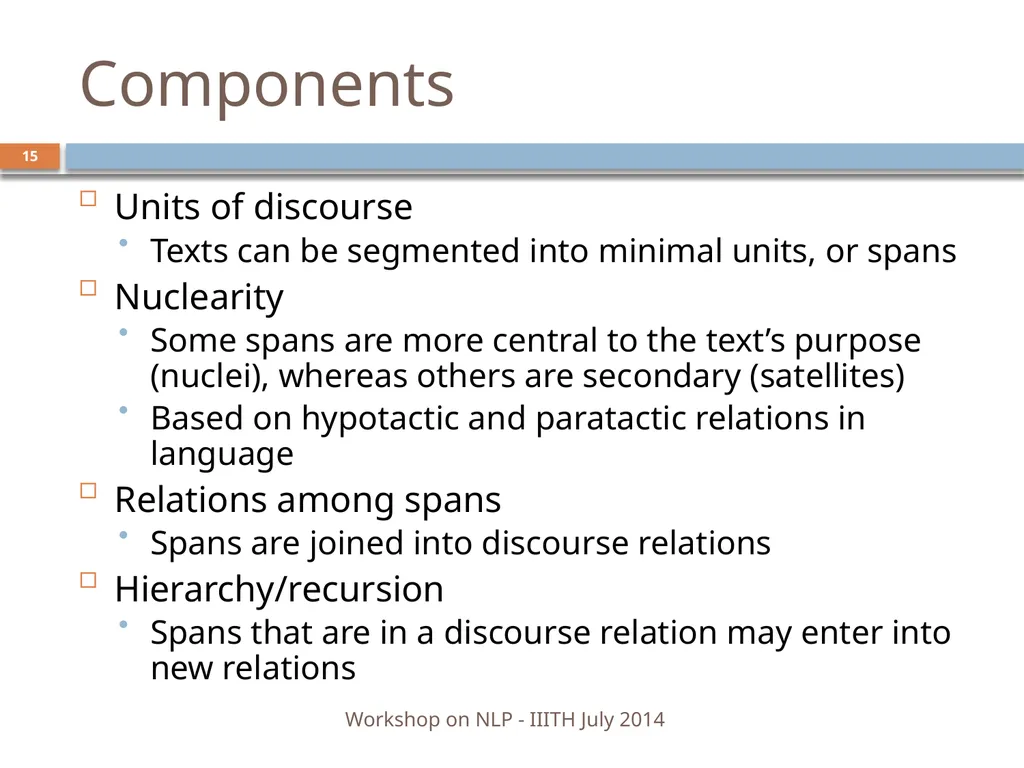
15 Components Units of discourse
Texts can be segmented into minimal units, or spans
Nuclearity
Some spans are more central to the text’s purpose (nuclei), whereas others are secondary (satellites)
Based on hypotactic and paratactic relations in language
Relations among spans
Spans are joined into discourse relations
Hierarchy/recursion
Spans that are in a discourse relation may enter into new relations Workshop on NLP - IIITH July 2014<br>
Texts can be segmented into minimal units, or spans
Nuclearity
Some spans are more central to the text’s purpose (nuclei), whereas others are secondary (satellites)
Based on hypotactic and paratactic relations in language
Relations among spans
Spans are joined into discourse relations
Hierarchy/recursion
Spans that are in a discourse relation may enter into new relations Workshop on NLP - IIITH July 2014<br>
16
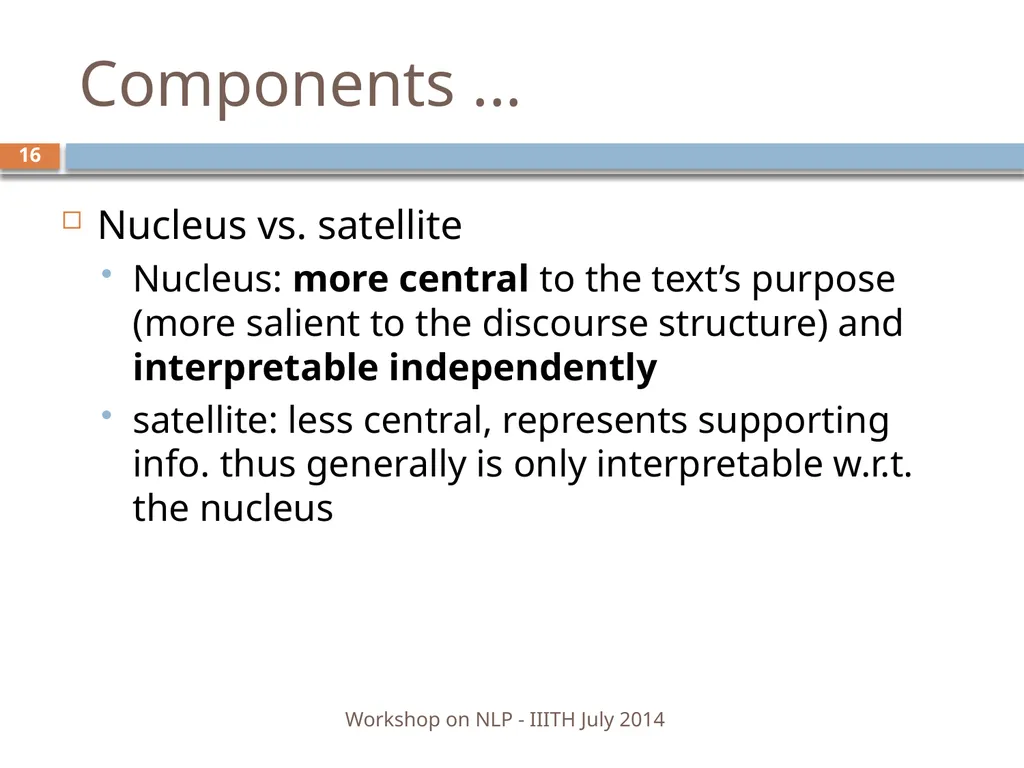
Components ... Nucleus vs. satellite
Nucleus: more central to the text’s purpose (more salient to the discourse structure) and interpretable independently
satellite: less central, represents supporting info. thus generally is only interpretable w.r.t. the nucleus 16 Workshop on NLP - IIITH July 2014<br>
Nucleus: more central to the text’s purpose (more salient to the discourse structure) and interpretable independently
satellite: less central, represents supporting info. thus generally is only interpretable w.r.t. the nucleus 16 Workshop on NLP - IIITH July 2014<br>
17
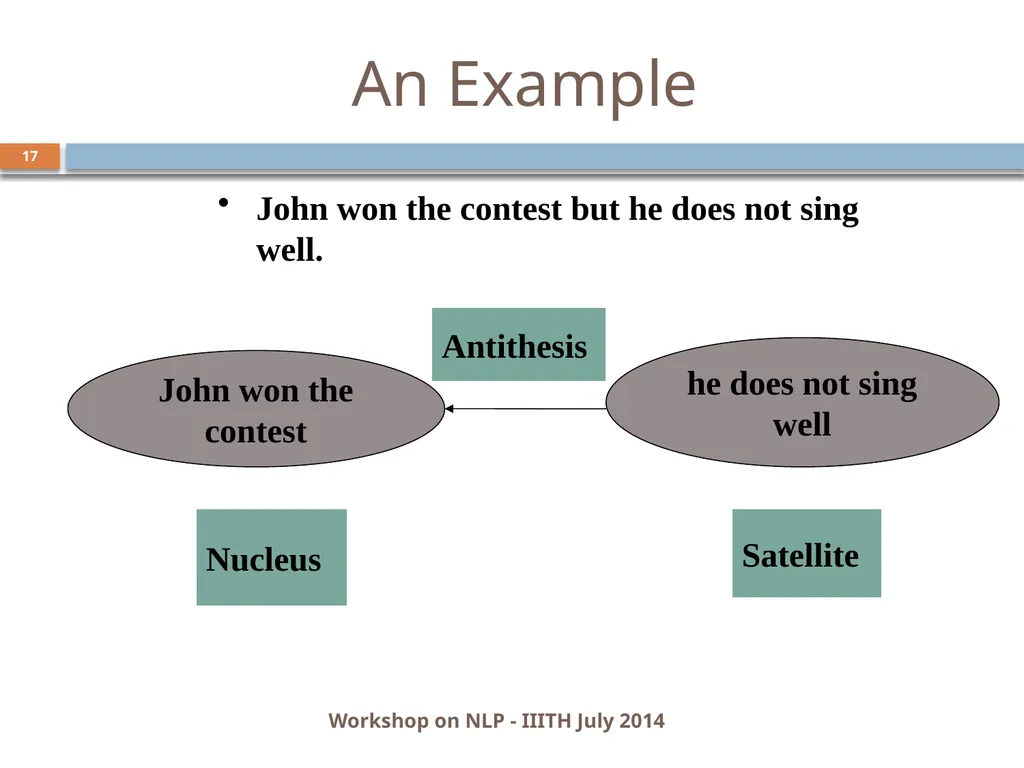
An Example Workshop on NLP - IIITH July 2014 17 John won the contest but he does not sing well.<br>
18
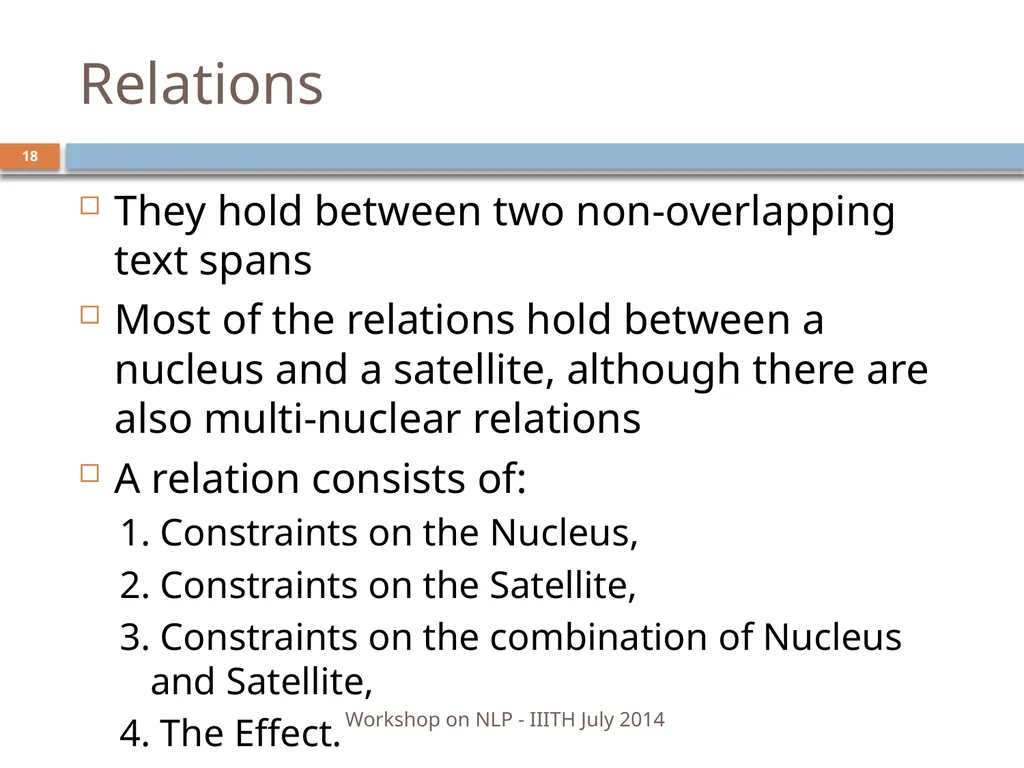
18 Relations They hold between two non-overlapping text spans
Most of the relations hold between a nucleus and a satellite, although there are also multi-nuclear relations
A relation consists of:
1. Constraints on the Nucleus,
2. Constraints on the Satellite,
3. Constraints on the combination of Nucleus and Satellite,
4. The Effect. Workshop on NLP - IIITH July 2014<br>
Most of the relations hold between a nucleus and a satellite, although there are also multi-nuclear relations
A relation consists of:
1. Constraints on the Nucleus,
2. Constraints on the Satellite,
3. Constraints on the combination of Nucleus and Satellite,
4. The Effect. Workshop on NLP - IIITH July 2014<br>
19
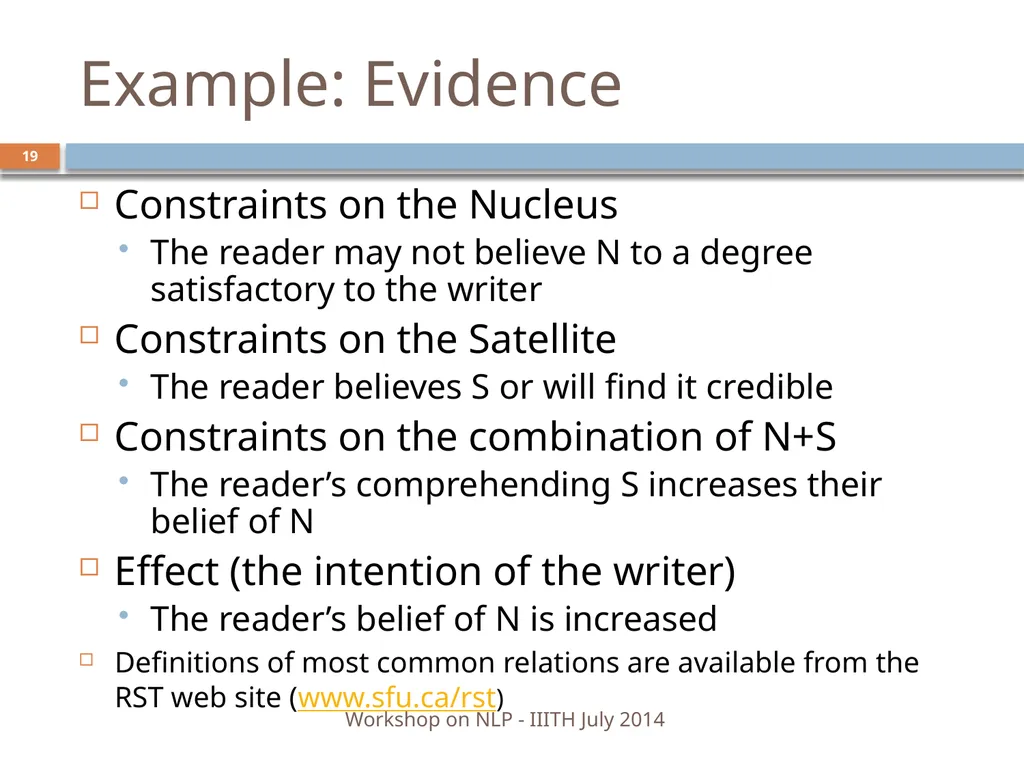
19 Example: Evidence Constraints on the Nucleus
The reader may not believe N to a degree satisfactory to the writer
Constraints on the Satellite
The reader believes S or will find it credible
Constraints on the combination of N+S
The reader’s comprehending S increases their belief of N
Effect (the intention of the writer)
The reader’s belief of N is increased
Definitions of most common relations are available from the RST web site (www.sfu.ca/rst) Workshop on NLP - IIITH July 2014<br>
The reader may not believe N to a degree satisfactory to the writer
Constraints on the Satellite
The reader believes S or will find it credible
Constraints on the combination of N+S
The reader’s comprehending S increases their belief of N
Effect (the intention of the writer)
The reader’s belief of N is increased
Definitions of most common relations are available from the RST web site (www.sfu.ca/rst) Workshop on NLP - IIITH July 2014<br>
20
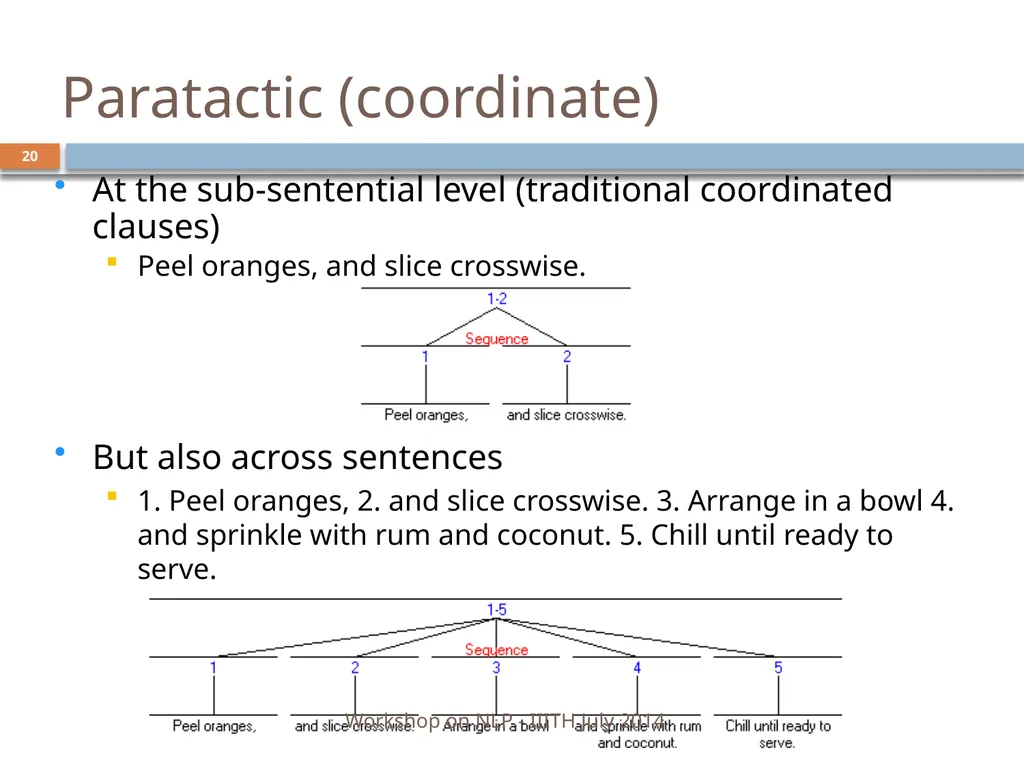
20 Paratactic (coordinate) At the sub-sentential level (traditional coordinated clauses)
Peel oranges, and slice crosswise. But also across sentences
1. Peel oranges, 2. and slice crosswise. 3. Arrange in a bowl 4. and sprinkle with rum and coconut. 5. Chill until ready to serve. Workshop on NLP - IIITH July 2014<br>
Peel oranges, and slice crosswise. But also across sentences
1. Peel oranges, 2. and slice crosswise. 3. Arrange in a bowl 4. and sprinkle with rum and coconut. 5. Chill until ready to serve. Workshop on NLP - IIITH July 2014<br>
21
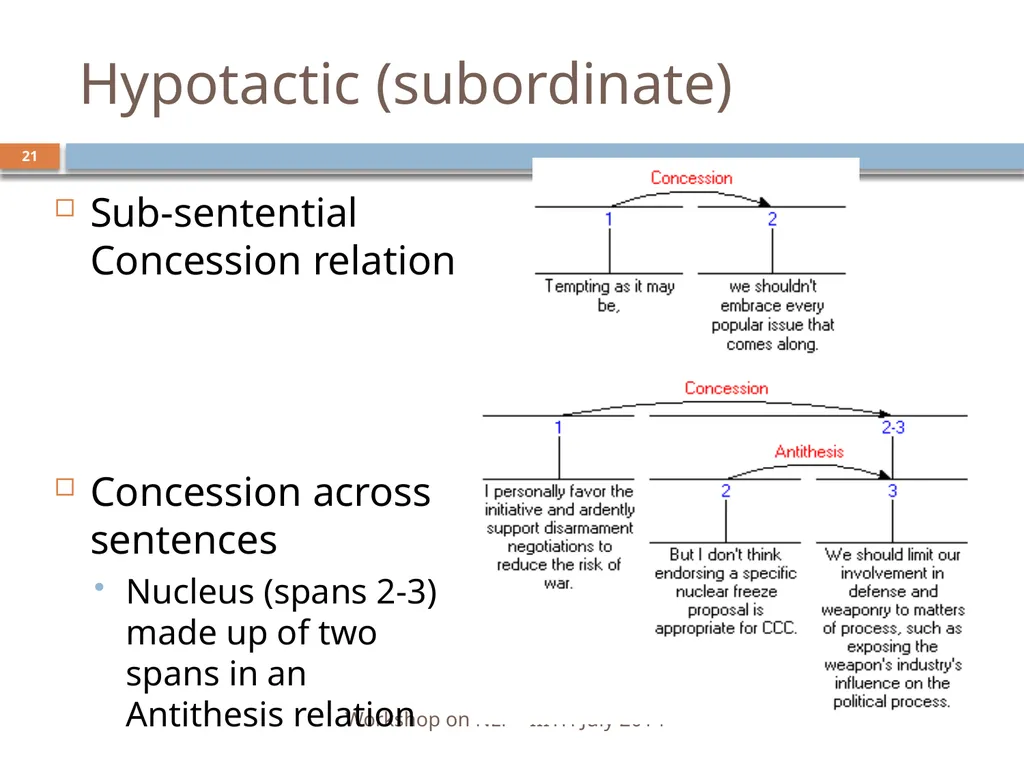
21 Hypotactic (subordinate) Sub-sentential Concession relation
Concession across sentences
Nucleus (spans 2-3) made up of two spans in an Antithesis relation Workshop on NLP - IIITH July 2014<br>
Concession across sentences
Nucleus (spans 2-3) made up of two spans in an Antithesis relation Workshop on NLP - IIITH July 2014<br>
22
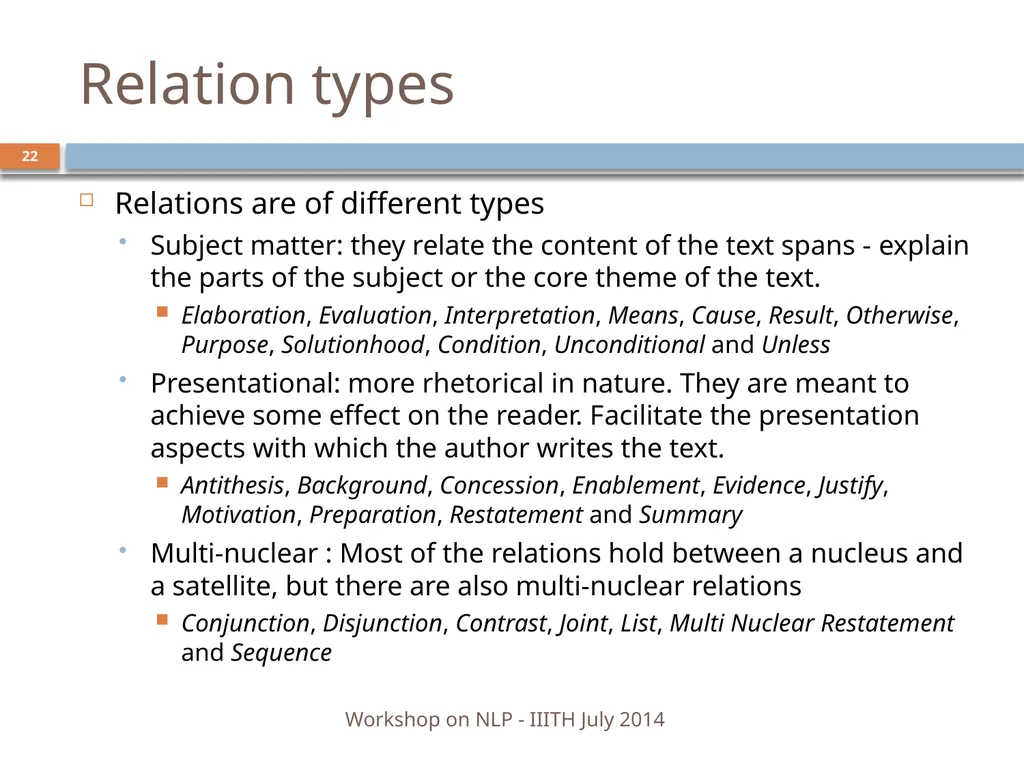
22 Relation types Relations are of different types
Subject matter: they relate the content of the text spans - explain the parts of the subject or the core theme of the text.
Elaboration, Evaluation, Interpretation, Means, Cause, Result, Otherwise, Purpose, Solutionhood, Condition, Unconditional and Unless
Presentational: more rhetorical in nature. They are meant to achieve some effect on the reader. Facilitate the presentation aspects with which the author writes the text.
Antithesis, Background, Concession, Enablement, Evidence, Justify, Motivation, Preparation, Restatement and Summary
Multi-nuclear : Most of the relations hold between a nucleus and a satellite, but there are also multi-nuclear relations
Conjunction, Disjunction, Contrast, Joint, List, Multi Nuclear Restatement and Sequence Workshop on NLP - IIITH July 2014<br>
Subject matter: they relate the content of the text spans - explain the parts of the subject or the core theme of the text.
Elaboration, Evaluation, Interpretation, Means, Cause, Result, Otherwise, Purpose, Solutionhood, Condition, Unconditional and Unless
Presentational: more rhetorical in nature. They are meant to achieve some effect on the reader. Facilitate the presentation aspects with which the author writes the text.
Antithesis, Background, Concession, Enablement, Evidence, Justify, Motivation, Preparation, Restatement and Summary
Multi-nuclear : Most of the relations hold between a nucleus and a satellite, but there are also multi-nuclear relations
Conjunction, Disjunction, Contrast, Joint, List, Multi Nuclear Restatement and Sequence Workshop on NLP - IIITH July 2014<br>
23
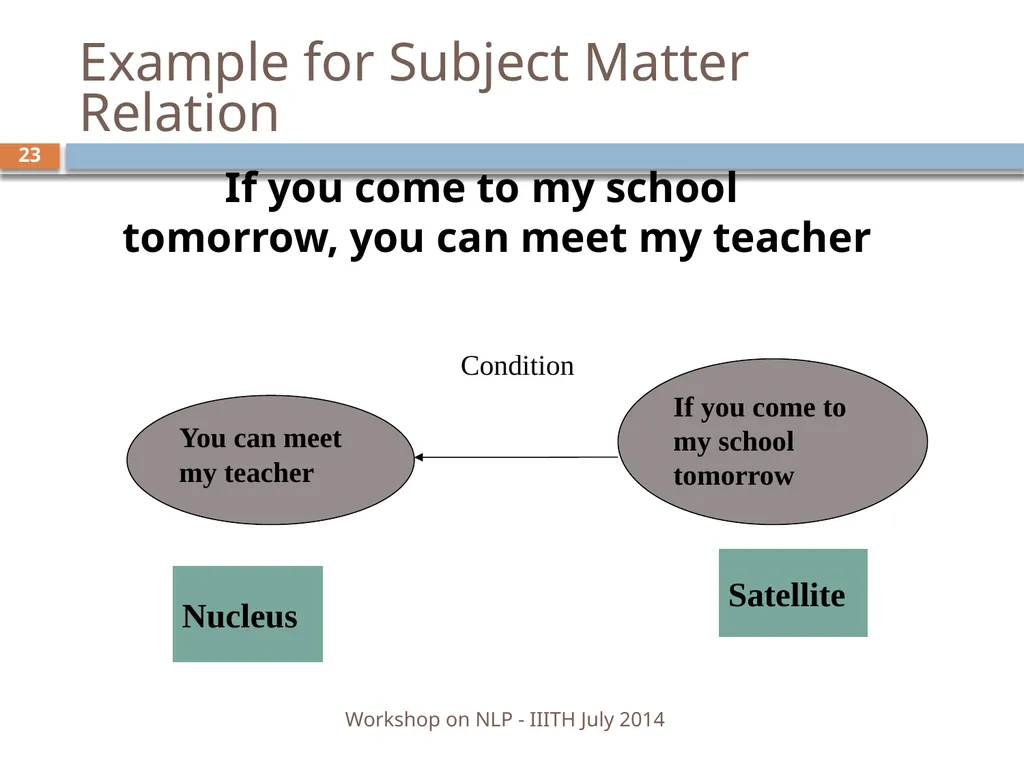
Example for Subject Matter Relation If you come to my school tomorrow, you can meet my teacher 23 Workshop on NLP - IIITH July 2014<br>
24
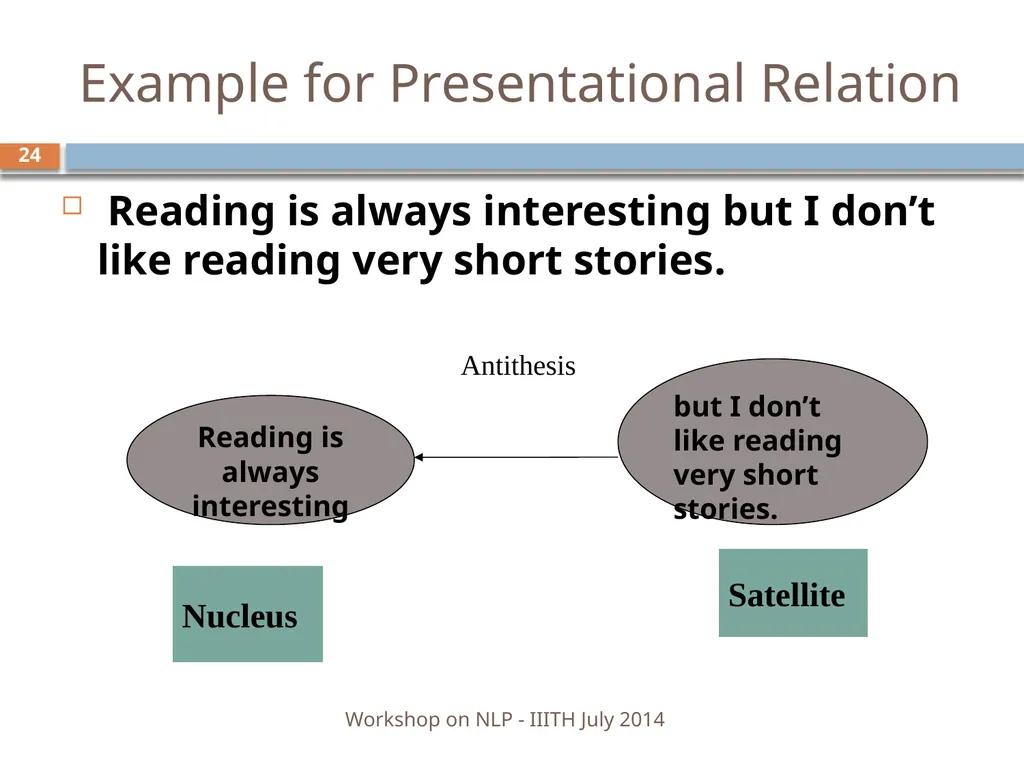
Example for Presentational Relation Reading is always interesting but I don’t like reading very short stories. 24 Workshop on NLP - IIITH July 2014<br>
25
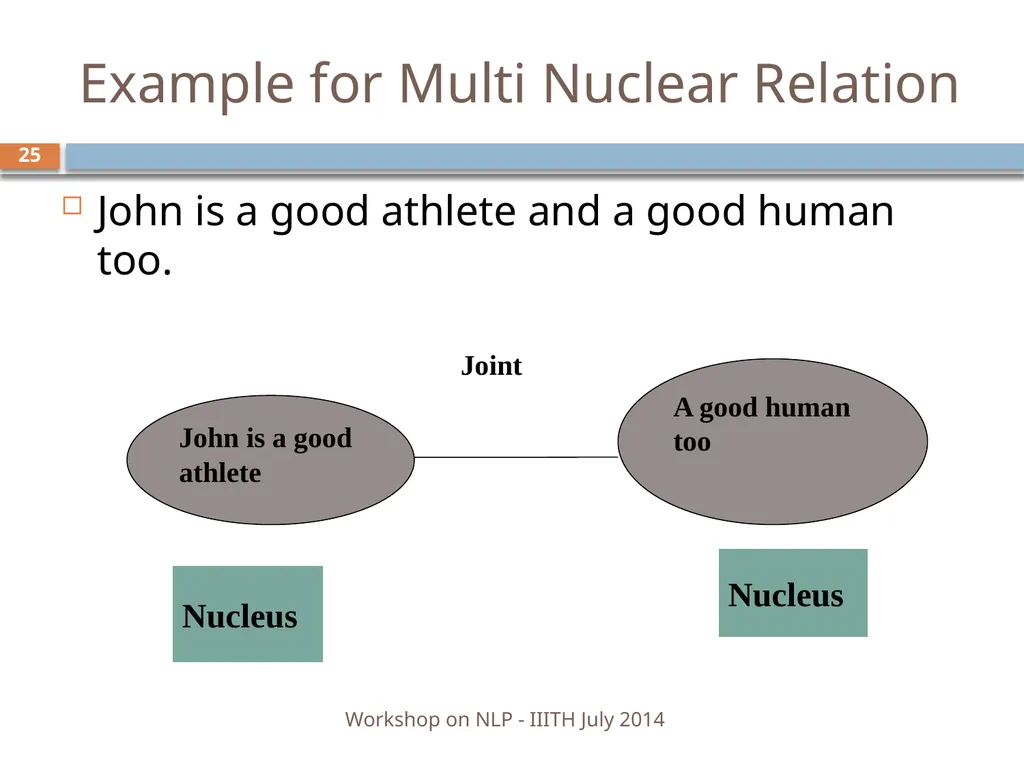
Example for Multi Nuclear Relation John is a good athlete and a good human too. 25 Workshop on NLP - IIITH July 2014<br>
26
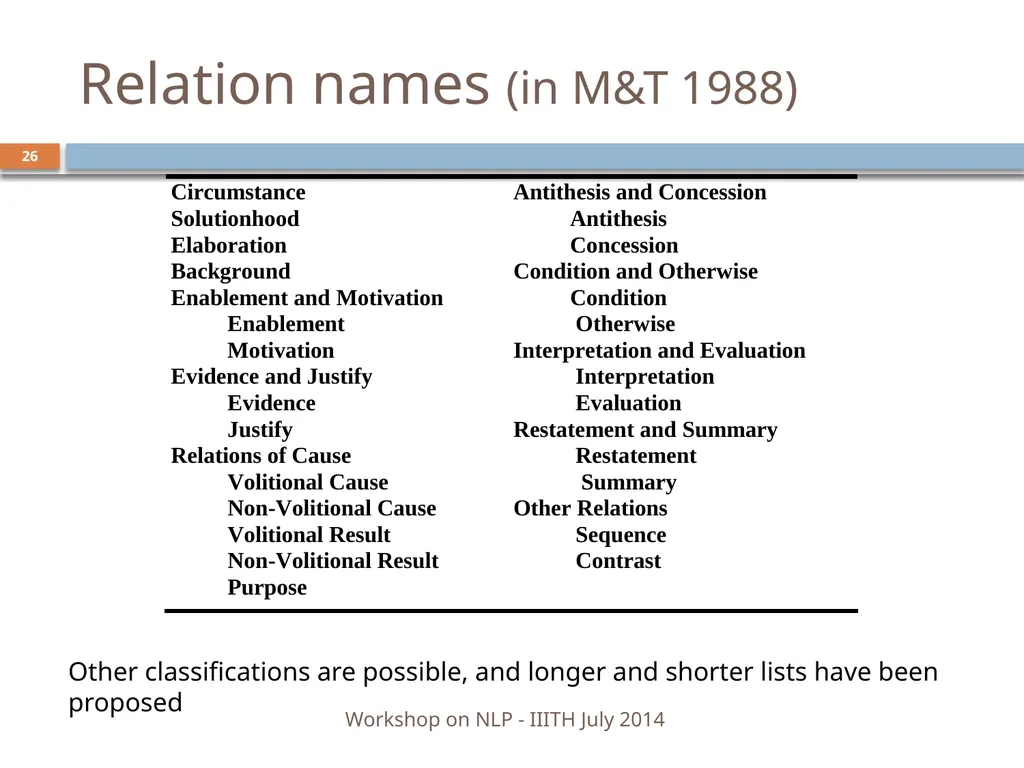
26 Relation names (in M&T 1988) Other classifications are possible, and longer and shorter lists have been proposed Workshop on NLP - IIITH July 2014<br>
27
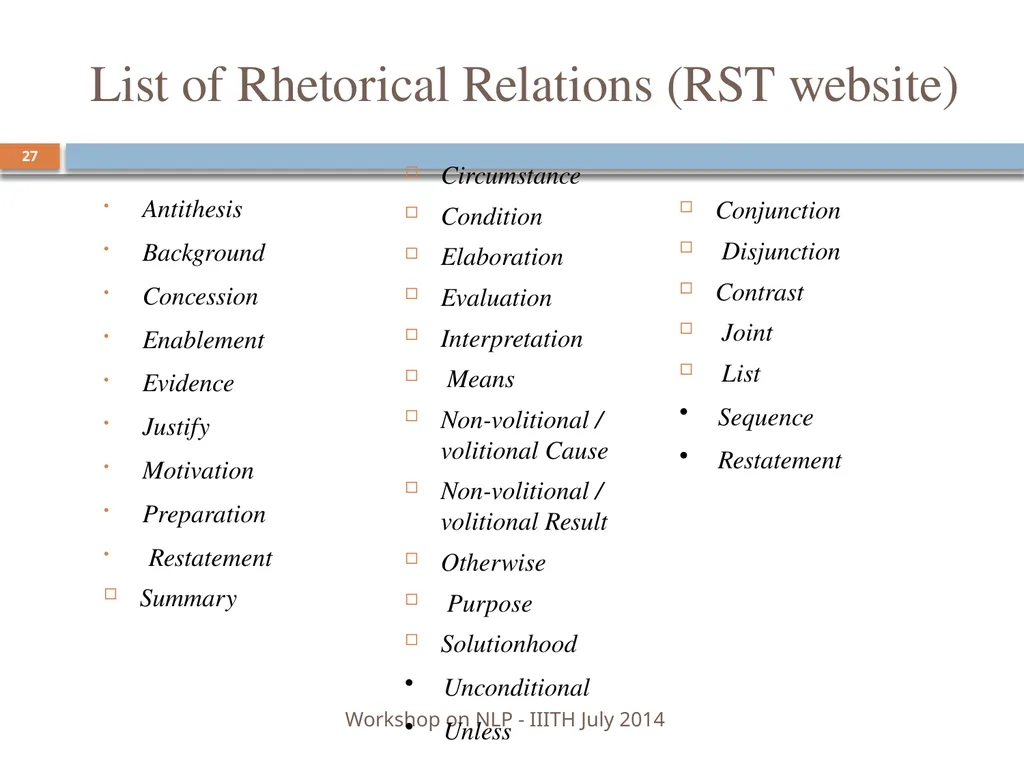
List of Rhetorical Relations (RST website) 27 Antithesis
Background
Concession
Enablement
Evidence
Justify
Motivation
Preparation
Restatement
Summary Conjunction
Disjunction
Contrast
Joint
List
Sequence
Restatement Circumstance
Condition
Elaboration
Evaluation
Interpretation
Means
Non-volitional / volitional Cause
Non-volitional / volitional Result
Otherwise
Purpose
Solutionhood
Unconditional
Unless Workshop on NLP - IIITH July 2014<br>
Background
Concession
Enablement
Evidence
Justify
Motivation
Preparation
Restatement
Summary Conjunction
Disjunction
Contrast
Joint
List
Sequence
Restatement Circumstance
Condition
Elaboration
Evaluation
Interpretation
Means
Non-volitional / volitional Cause
Non-volitional / volitional Result
Otherwise
Purpose
Solutionhood
Unconditional
Unless Workshop on NLP - IIITH July 2014<br>
28
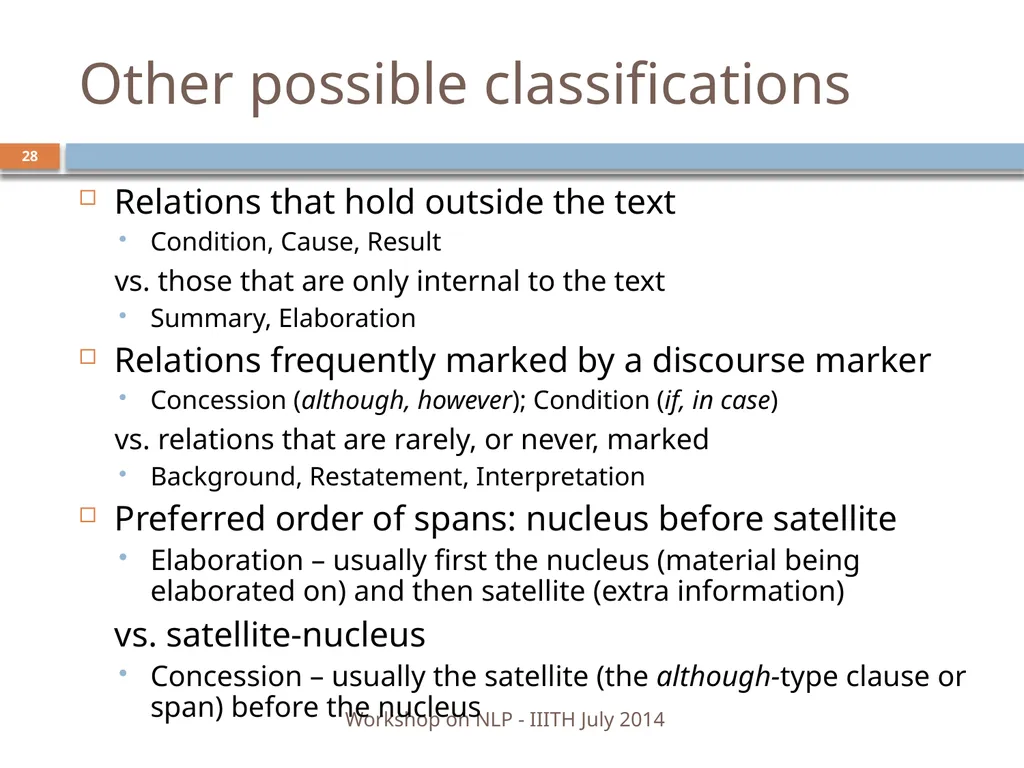
28 Other possible classifications Relations that hold outside the text
Condition, Cause, Result
vs. those that are only internal to the text
Summary, Elaboration
Relations frequently marked by a discourse marker
Concession (although, however); Condition (if, in case)
vs. relations that are rarely, or never, marked
Background, Restatement, Interpretation
Preferred order of spans: nucleus before satellite
Elaboration – usually first the nucleus (material being elaborated on) and then satellite (extra information)
vs. satellite-nucleus
Concession – usually the satellite (the although-type clause or span) before the nucleus Workshop on NLP - IIITH July 2014<br>
Condition, Cause, Result
vs. those that are only internal to the text
Summary, Elaboration
Relations frequently marked by a discourse marker
Concession (although, however); Condition (if, in case)
vs. relations that are rarely, or never, marked
Background, Restatement, Interpretation
Preferred order of spans: nucleus before satellite
Elaboration – usually first the nucleus (material being elaborated on) and then satellite (extra information)
vs. satellite-nucleus
Concession – usually the satellite (the although-type clause or span) before the nucleus Workshop on NLP - IIITH July 2014<br>
29
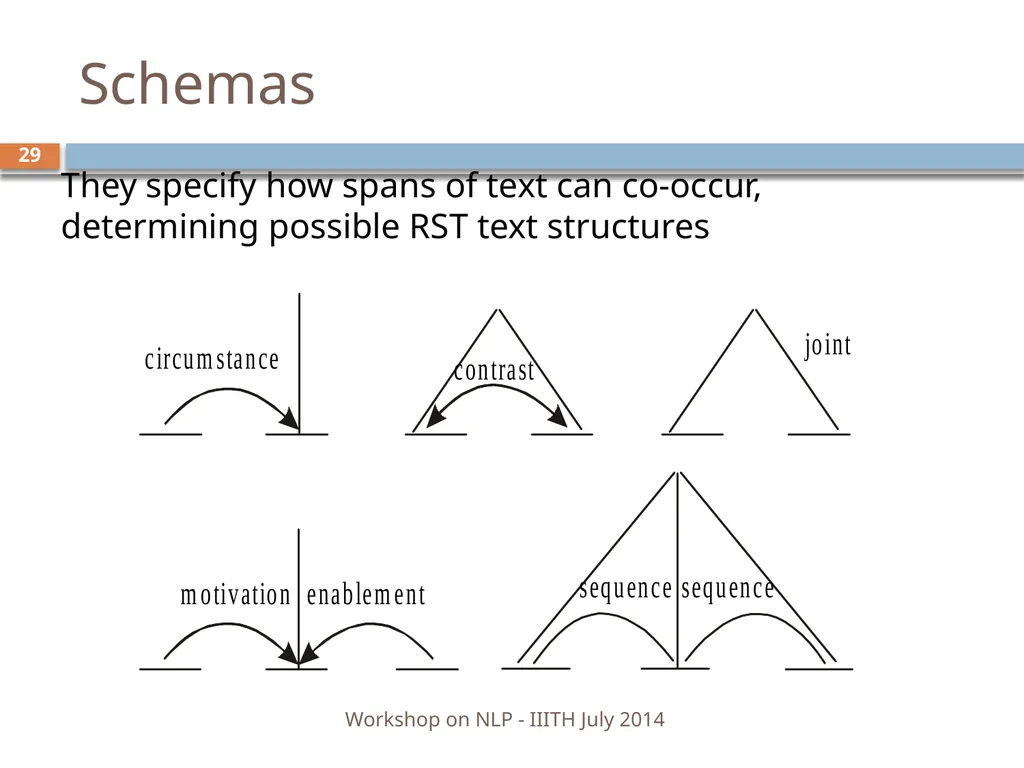
Schemas 29 They specify how spans of text can co-occur, determining possible RST text structures Workshop on NLP - IIITH July 2014<br>
30
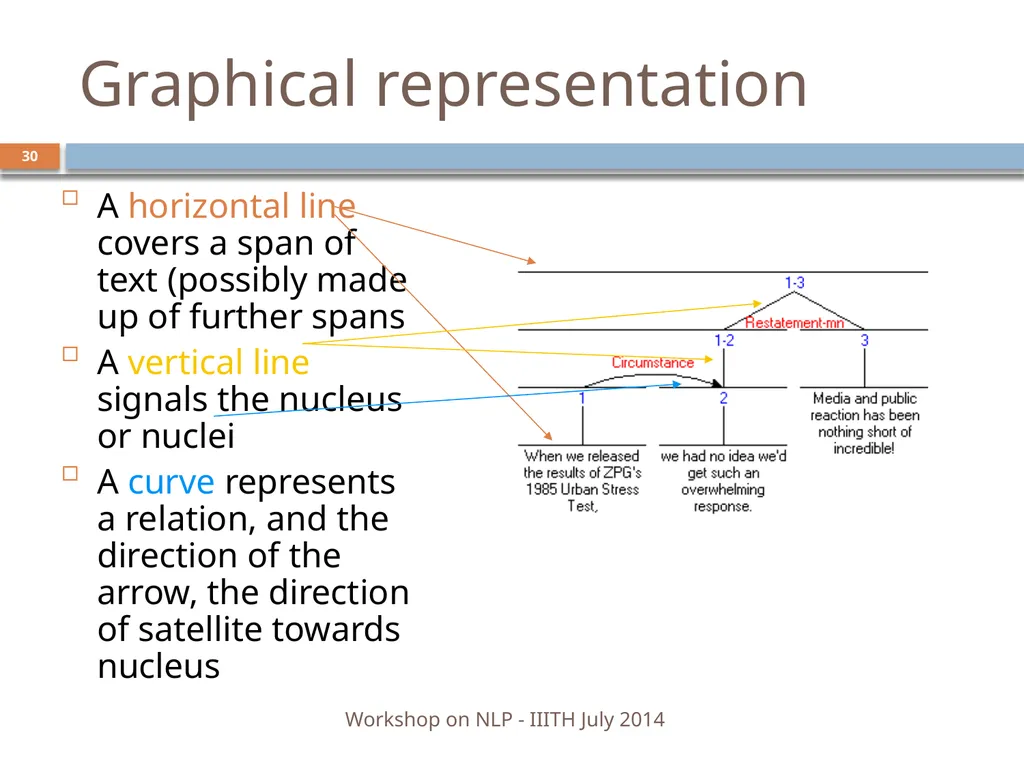
30 Graphical representation A horizontal line covers a span of text (possibly made up of further spans
A vertical line signals the nucleus or nuclei
A curve represents a relation, and the direction of the arrow, the direction of satellite towards nucleus Workshop on NLP - IIITH July 2014<br>
A vertical line signals the nucleus or nuclei
A curve represents a relation, and the direction of the arrow, the direction of satellite towards nucleus Workshop on NLP - IIITH July 2014<br>
31
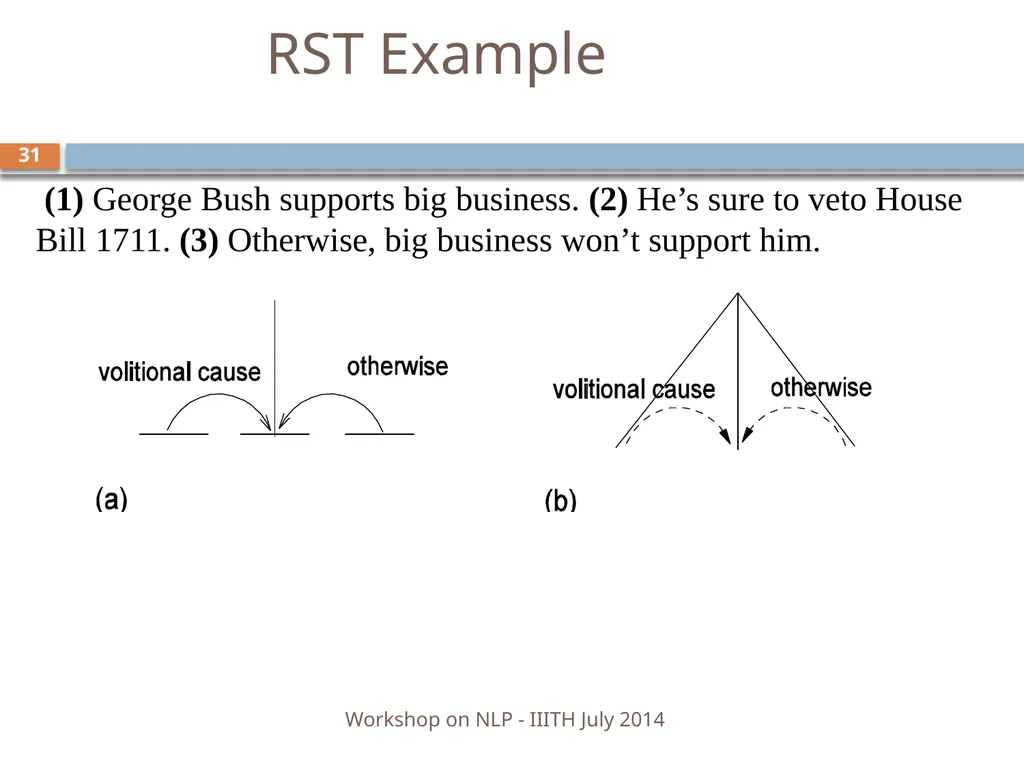
RST Example 31 (1) George Bush supports big business. (2) He’s sure to veto House Bill 1711. (3) Otherwise, big business won’t support him. Workshop on NLP - IIITH July 2014<br>
32
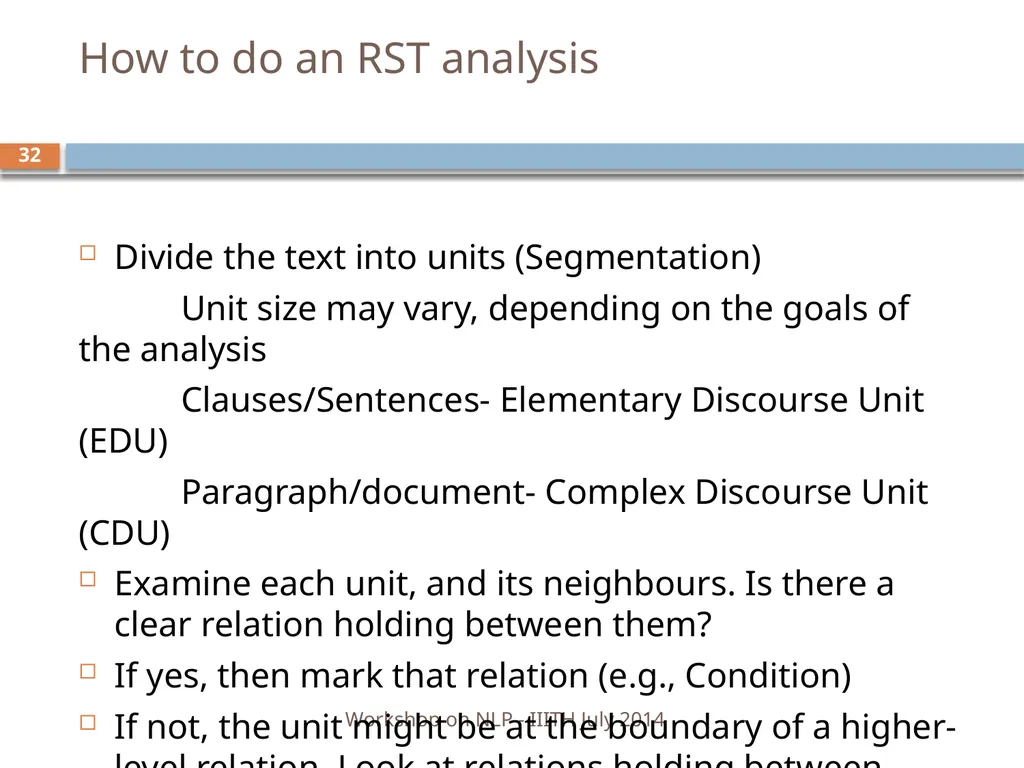
How to do an RST analysis Divide the text into units (Segmentation)
Unit size may vary, depending on the goals of the analysis
Clauses/Sentences- Elementary Discourse Unit (EDU)
Paragraph/document- Complex Discourse Unit (CDU)
Examine each unit, and its neighbours. Is there a clear relation holding between them?
If yes, then mark that relation (e.g., Condition)
If not, the unit might be at the boundary of a higher-level relation. Look at relations holding between larger units (spans) 32 Workshop on NLP - IIITH July 2014<br>
Unit size may vary, depending on the goals of the analysis
Clauses/Sentences- Elementary Discourse Unit (EDU)
Paragraph/document- Complex Discourse Unit (CDU)
Examine each unit, and its neighbours. Is there a clear relation holding between them?
If yes, then mark that relation (e.g., Condition)
If not, the unit might be at the boundary of a higher-level relation. Look at relations holding between larger units (spans) 32 Workshop on NLP - IIITH July 2014<br>
33
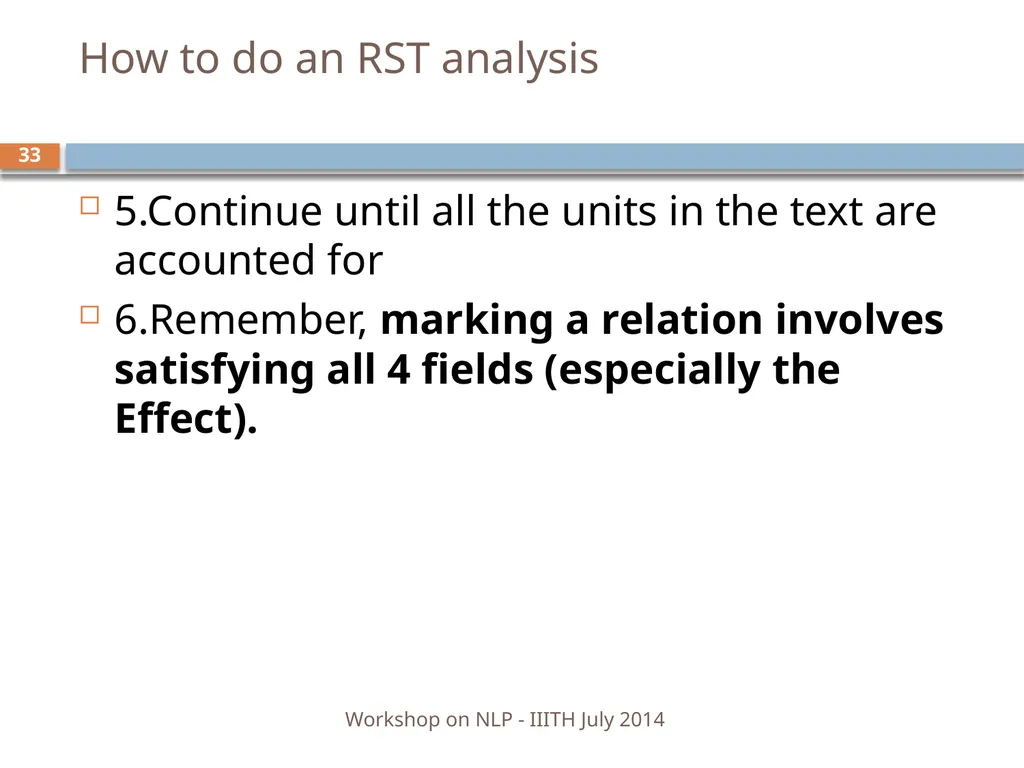
How to do an RST analysis 5.Continue until all the units in the text are accounted for
6.Remember, marking a relation involves satisfying all 4 fields (especially the Effect). 33 Workshop on NLP - IIITH July 2014<br>
6.Remember, marking a relation involves satisfying all 4 fields (especially the Effect). 33 Workshop on NLP - IIITH July 2014<br>
34
Examples 34 Workshop on NLP - IIITH July 2014<br>
35
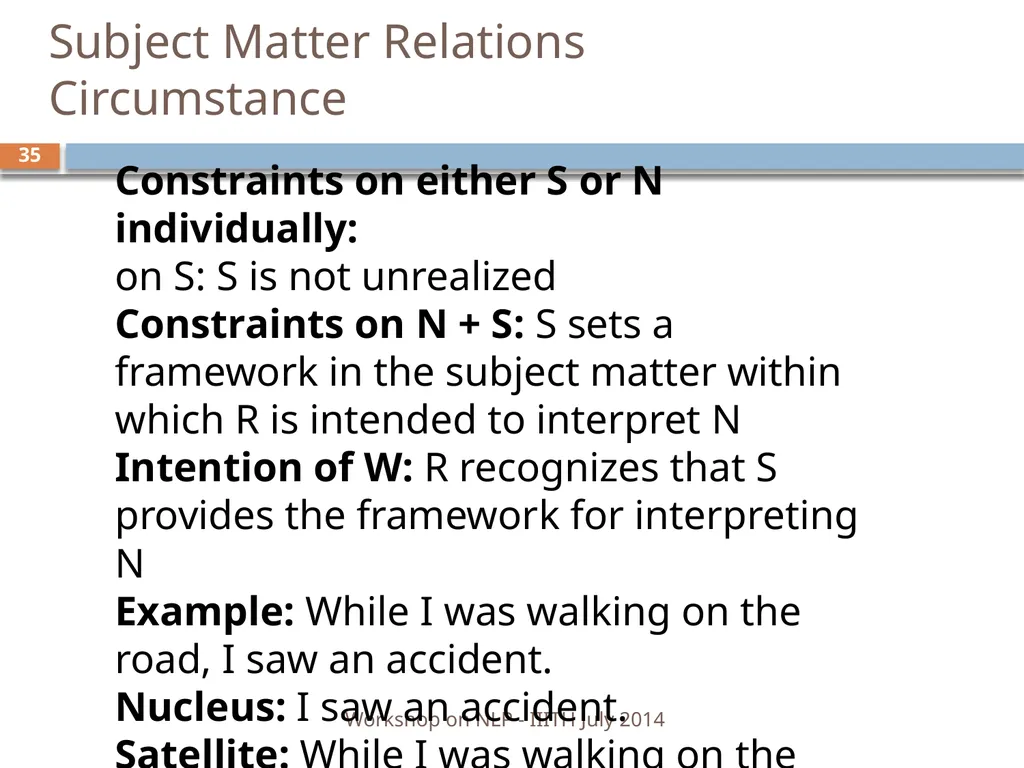
Subject Matter Relations
Circumstance Constraints on either S or N individually:
on S: S is not unrealized
Constraints on N + S: S sets a framework in the subject matter within which R is intended to interpret N
Intention of W: R recognizes that S provides the framework for interpreting N
Example: While I was walking on the road, I saw an accident.
Nucleus: I saw an accident.
Satellite: While I was walking on the road 35 Workshop on NLP - IIITH July 2014<br>
on S: S is not unrealized
Constraints on N + S: S sets a framework in the subject matter within which R is intended to interpret N
Intention of W: R recognizes that S provides the framework for interpreting N
Example: While I was walking on the road, I saw an accident.
Nucleus: I saw an accident.
Satellite: While I was walking on the road 35 Workshop on NLP - IIITH July 2014<br>
36
Subject Matter Relations
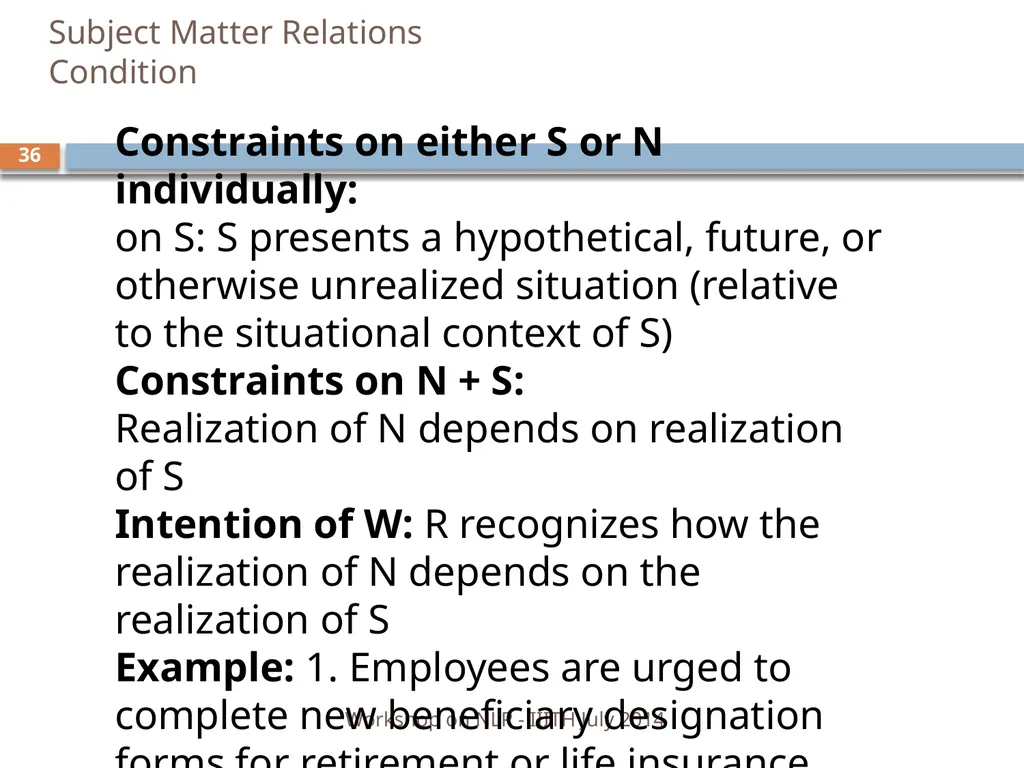
Condition Constraints on either S or N individually:
on S: S presents a hypothetical, future, or otherwise unrealized situation (relative to the situational context of S)
Constraints on N + S:
Realization of N depends on realization of S
Intention of W: R recognizes how the realization of N depends on the realization of S
Example: 1. Employees are urged to complete new beneficiary designation forms for retirement or life insurance benefits 2. whenever there is a change in marital or family status. 36 Workshop on NLP - IIITH July 2014<br>
on S: S presents a hypothetical, future, or otherwise unrealized situation (relative to the situational context of S)
Constraints on N + S:
Realization of N depends on realization of S
Intention of W: R recognizes how the realization of N depends on the realization of S
Example: 1. Employees are urged to complete new beneficiary designation forms for retirement or life insurance benefits 2. whenever there is a change in marital or family status. 36 Workshop on NLP - IIITH July 2014<br>
37
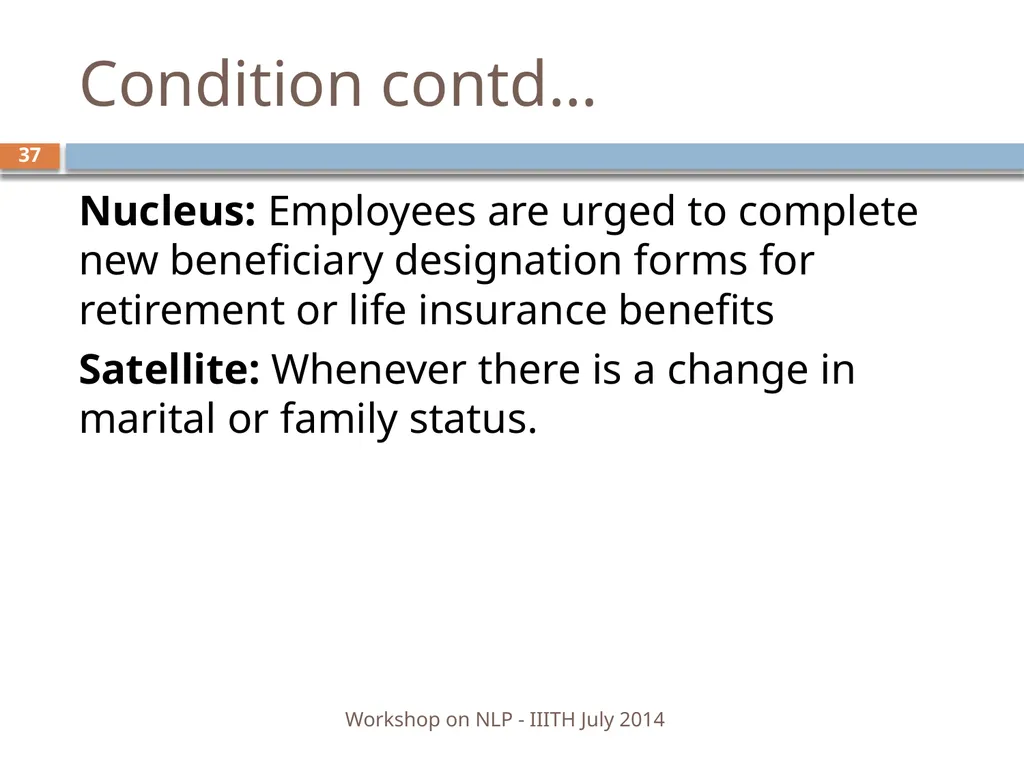
Condition contd… Nucleus: Employees are urged to complete new beneficiary designation forms for retirement or life insurance benefits
Satellite: Whenever there is a change in marital or family status. 37 Workshop on NLP - IIITH July 2014<br>
Satellite: Whenever there is a change in marital or family status. 37 Workshop on NLP - IIITH July 2014<br>
38
Subject Matter Relations
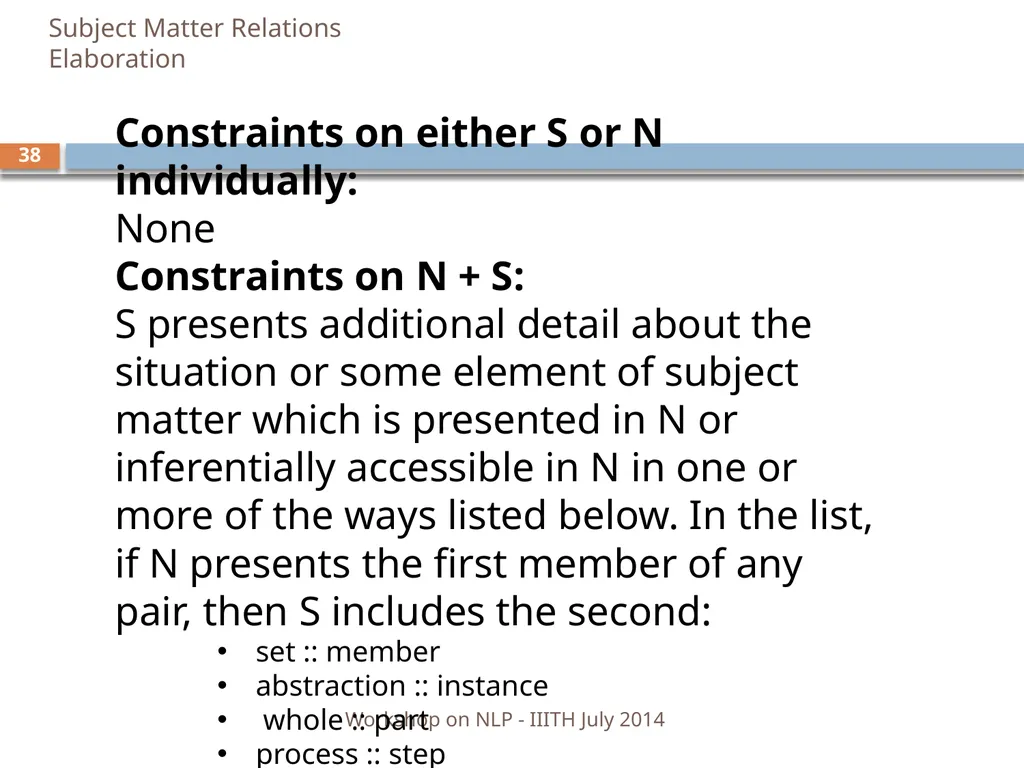
Elaboration Constraints on either S or N individually:
None
Constraints on N + S:
S presents additional detail about the situation or some element of subject matter which is presented in N or inferentially accessible in N in one or more of the ways listed below. In the list, if N presents the first member of any pair, then S includes the second:
set :: member
abstraction :: instance
whole :: part
process :: step
object :: attribute
generalization :: specific 38 Workshop on NLP - IIITH July 2014<br>
None
Constraints on N + S:
S presents additional detail about the situation or some element of subject matter which is presented in N or inferentially accessible in N in one or more of the ways listed below. In the list, if N presents the first member of any pair, then S includes the second:
set :: member
abstraction :: instance
whole :: part
process :: step
object :: attribute
generalization :: specific 38 Workshop on NLP - IIITH July 2014<br>
39
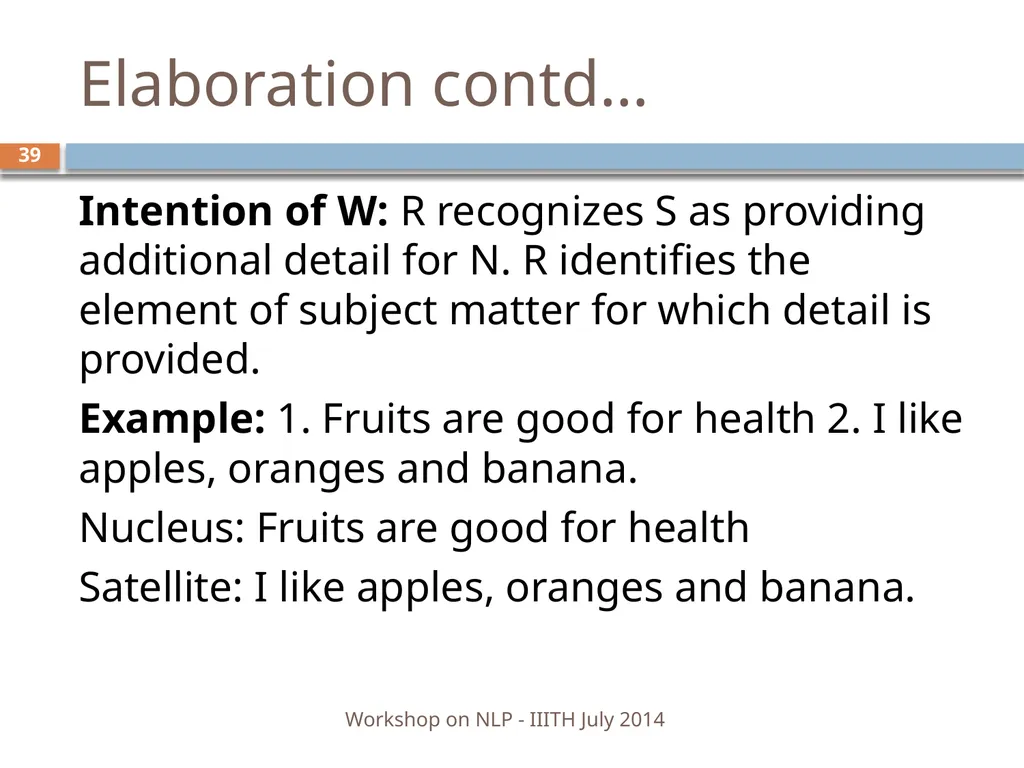
Elaboration contd… Intention of W: R recognizes S as providing additional detail for N. R identifies the element of subject matter for which detail is provided.
Example: 1. Fruits are good for health 2. I like apples, oranges and banana.
Nucleus: Fruits are good for health
Satellite: I like apples, oranges and banana. 39 Workshop on NLP - IIITH July 2014<br>
Example: 1. Fruits are good for health 2. I like apples, oranges and banana.
Nucleus: Fruits are good for health
Satellite: I like apples, oranges and banana. 39 Workshop on NLP - IIITH July 2014<br>
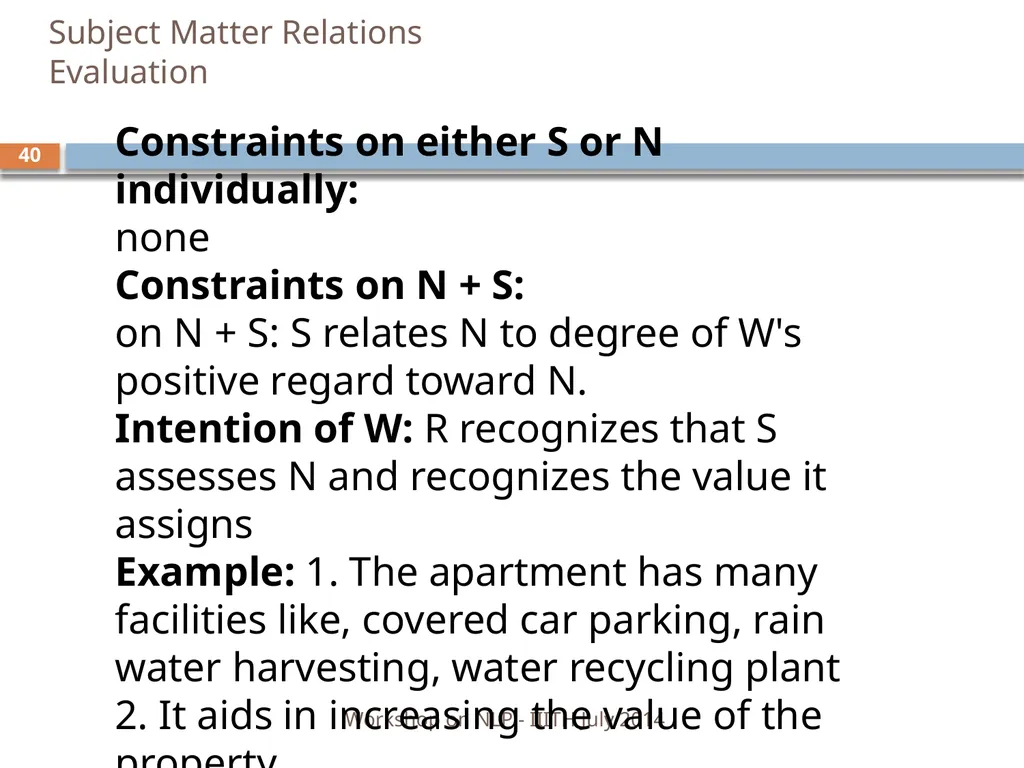
40
Subject Matter Relations
Evaluation Constraints on either S or N individually:
none
Constraints on N + S:
on N + S: S relates N to degree of W's positive regard toward N.
Intention of W: R recognizes that S assesses N and recognizes the value it assigns
Example: 1. The apartment has many facilities like, covered car parking, rain water harvesting, water recycling plant 2. It aids in increasing the value of the property.
Nucleus: The apartment has many facilities like, covered car parking, rain water harvesting, water recycling plant
Satellite :2. It aids in increasing the value of the property. 40 Workshop on NLP - IIITH July 2014<br>
none
Constraints on N + S:
on N + S: S relates N to degree of W's positive regard toward N.
Intention of W: R recognizes that S assesses N and recognizes the value it assigns
Example: 1. The apartment has many facilities like, covered car parking, rain water harvesting, water recycling plant 2. It aids in increasing the value of the property.
Nucleus: The apartment has many facilities like, covered car parking, rain water harvesting, water recycling plant
Satellite :2. It aids in increasing the value of the property. 40 Workshop on NLP - IIITH July 2014<br>
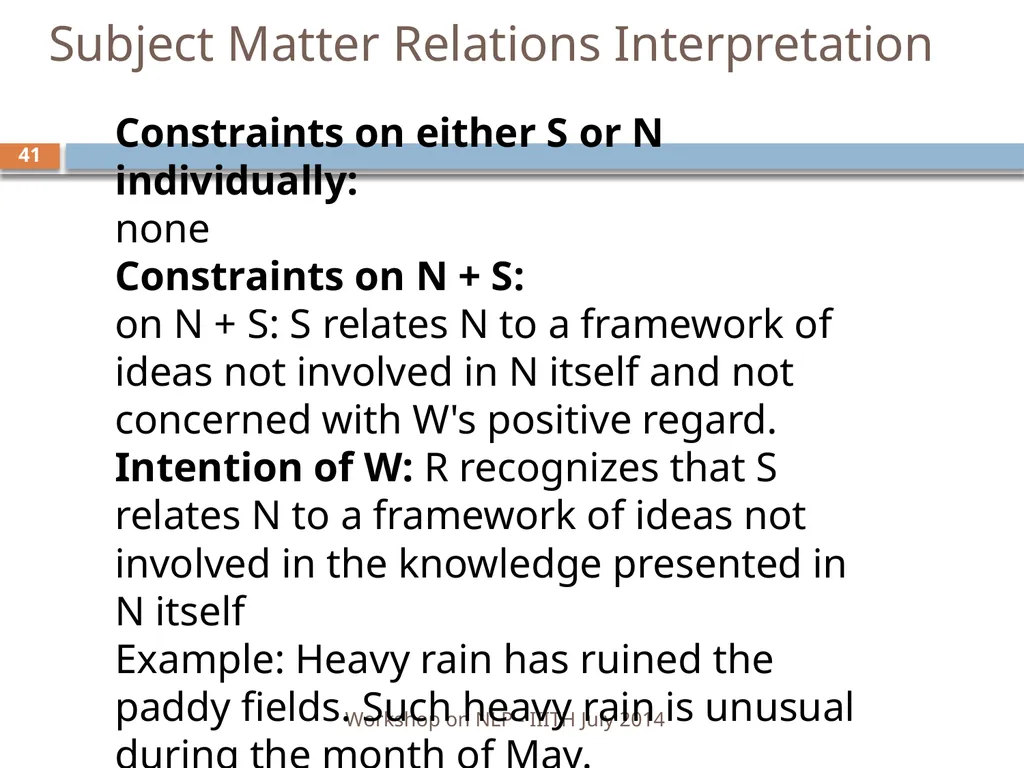
41
Subject Matter Relations Interpretation Constraints on either S or N individually:
none
Constraints on N + S:
on N + S: S relates N to a framework of ideas not involved in N itself and not concerned with W's positive regard.
Intention of W: R recognizes that S relates N to a framework of ideas not involved in the knowledge presented in N itself
Example: Heavy rain has ruined the paddy fields. Such heavy rain is unusual during the month of May. 41 Workshop on NLP - IIITH July 2014<br>
none
Constraints on N + S:
on N + S: S relates N to a framework of ideas not involved in N itself and not concerned with W's positive regard.
Intention of W: R recognizes that S relates N to a framework of ideas not involved in the knowledge presented in N itself
Example: Heavy rain has ruined the paddy fields. Such heavy rain is unusual during the month of May. 41 Workshop on NLP - IIITH July 2014<br>
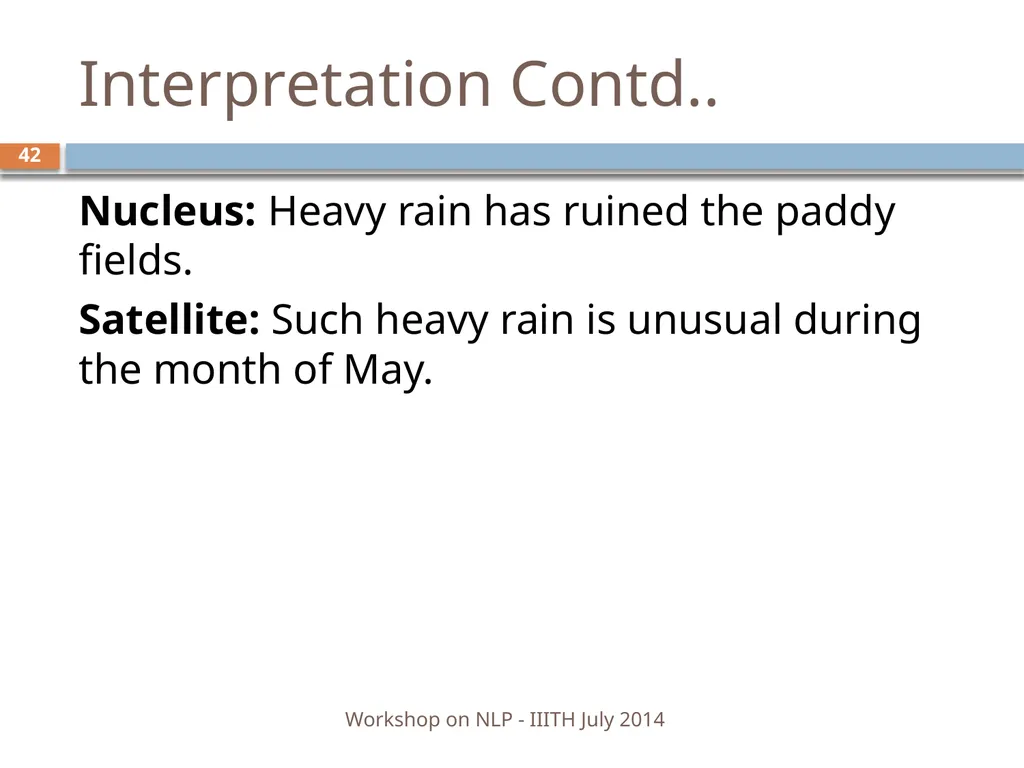
42
Interpretation Contd.. Nucleus: Heavy rain has ruined the paddy fields.
Satellite: Such heavy rain is unusual during the month of May. 42 Workshop on NLP - IIITH July 2014<br>
Satellite: Such heavy rain is unusual during the month of May. 42 Workshop on NLP - IIITH July 2014<br>
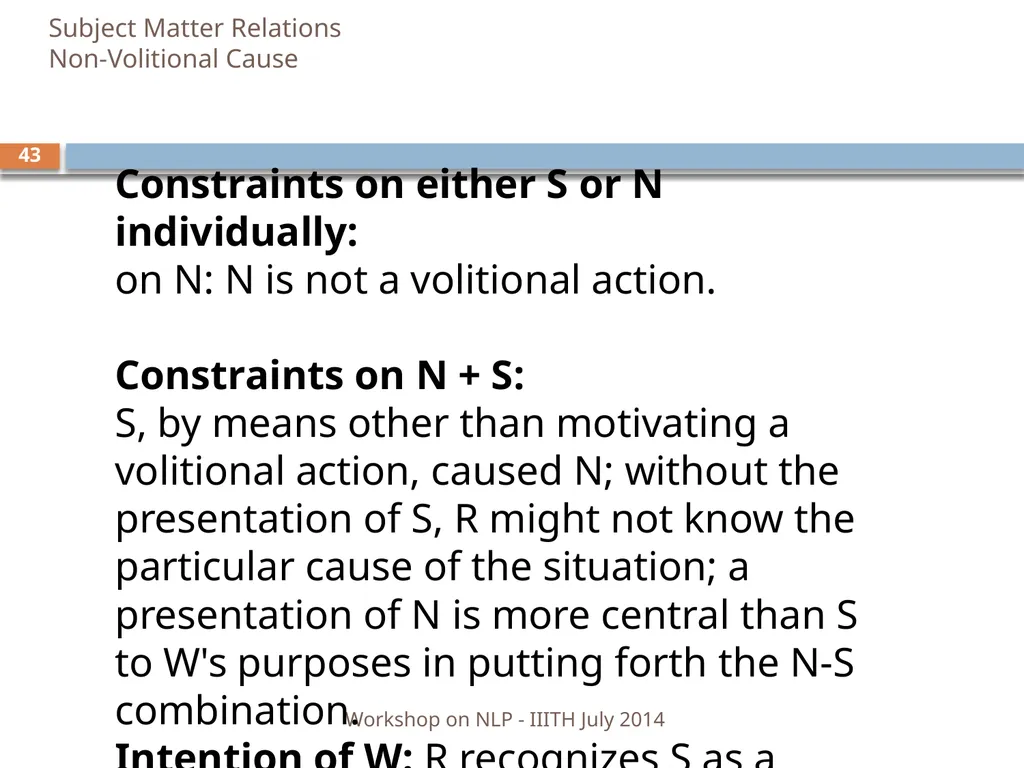
43
Subject Matter Relations
Non-Volitional Cause Constraints on either S or N individually:
on N: N is not a volitional action.
Constraints on N + S:
S, by means other than motivating a volitional action, caused N; without the presentation of S, R might not know the particular cause of the situation; a presentation of N is more central than S to W's purposes in putting forth the N-S combination.
Intention of W: R recognizes S as a cause of N 43 Workshop on NLP - IIITH July 2014<br>
on N: N is not a volitional action.
Constraints on N + S:
S, by means other than motivating a volitional action, caused N; without the presentation of S, R might not know the particular cause of the situation; a presentation of N is more central than S to W's purposes in putting forth the N-S combination.
Intention of W: R recognizes S as a cause of N 43 Workshop on NLP - IIITH July 2014<br>
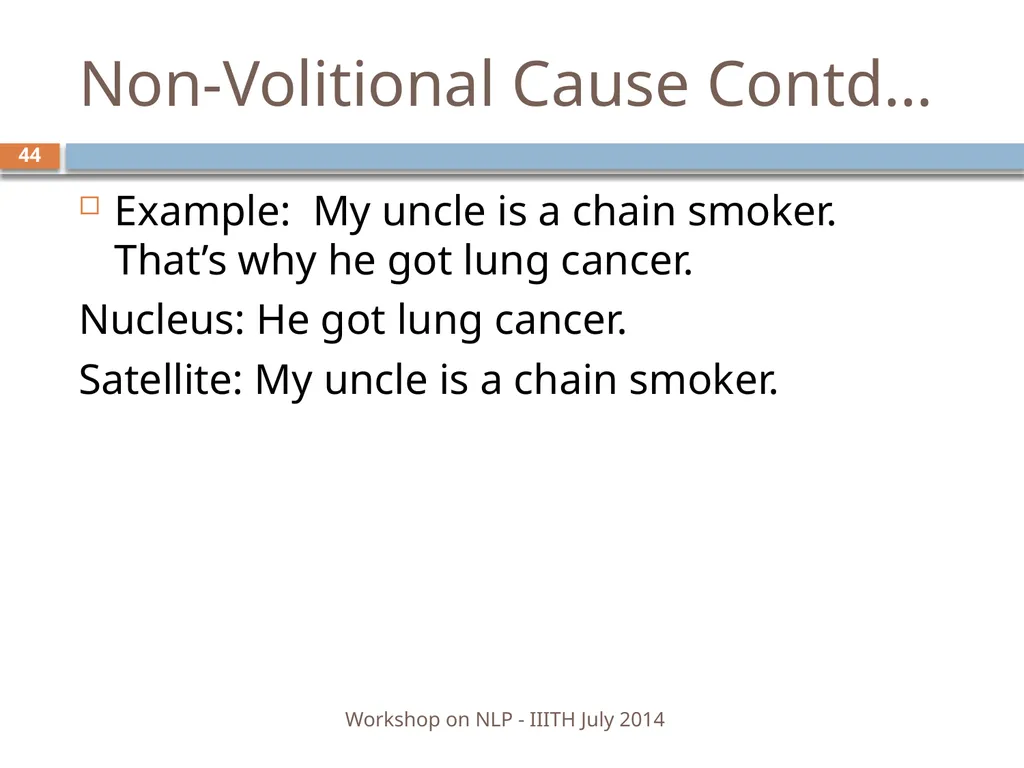
44
Non-Volitional Cause Contd… Example: My uncle is a chain smoker. That’s why he got lung cancer.
Nucleus: He got lung cancer.
Satellite: My uncle is a chain smoker. 44 Workshop on NLP - IIITH July 2014<br>
Nucleus: He got lung cancer.
Satellite: My uncle is a chain smoker. 44 Workshop on NLP - IIITH July 2014<br>
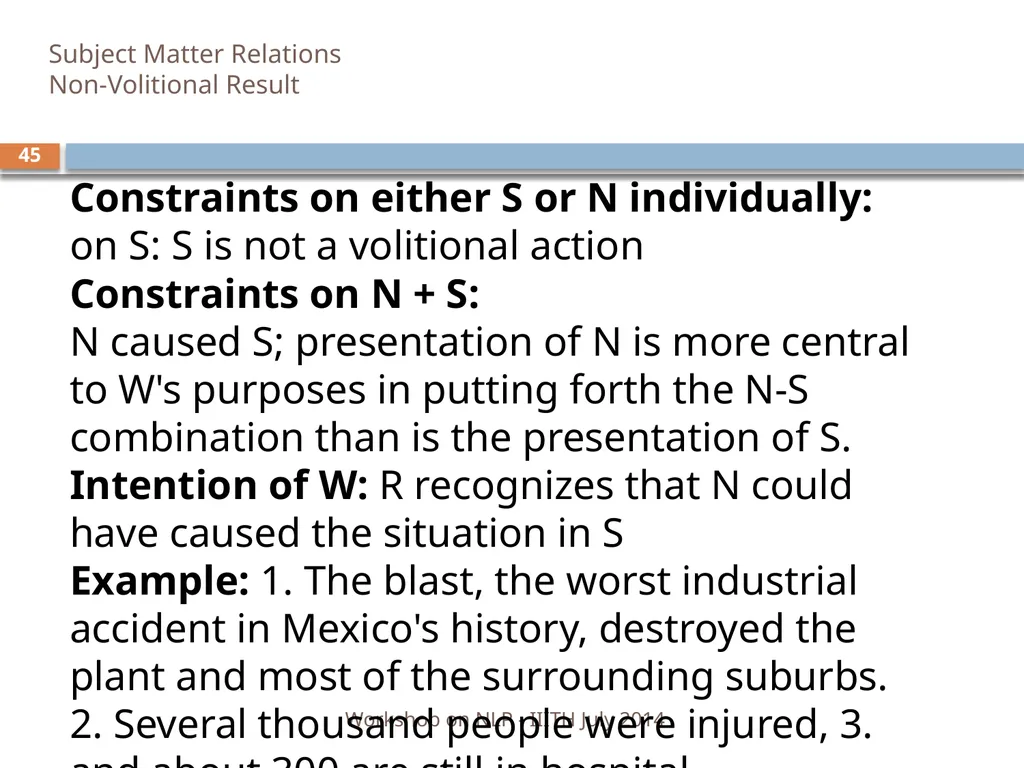
45
Subject Matter Relations
Non-Volitional Result Constraints on either S or N individually:
on S: S is not a volitional action
Constraints on N + S:
N caused S; presentation of N is more central to W's purposes in putting forth the N-S combination than is the presentation of S.
Intention of W: R recognizes that N could have caused the situation in S
Example: 1. The blast, the worst industrial accident in Mexico's history, destroyed the plant and most of the surrounding suburbs. 2. Several thousand people were injured, 3. and about 300 are still in hospital. 45 Workshop on NLP - IIITH July 2014<br>
on S: S is not a volitional action
Constraints on N + S:
N caused S; presentation of N is more central to W's purposes in putting forth the N-S combination than is the presentation of S.
Intention of W: R recognizes that N could have caused the situation in S
Example: 1. The blast, the worst industrial accident in Mexico's history, destroyed the plant and most of the surrounding suburbs. 2. Several thousand people were injured, 3. and about 300 are still in hospital. 45 Workshop on NLP - IIITH July 2014<br>
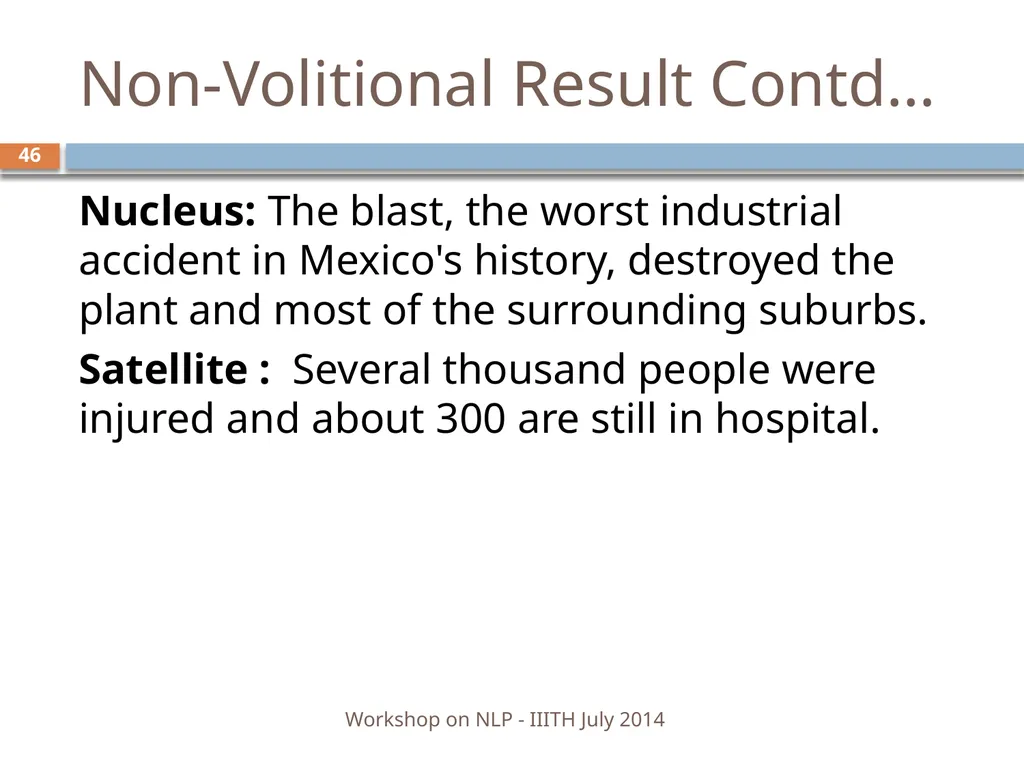
46
Non-Volitional Result Contd… Nucleus: The blast, the worst industrial accident in Mexico's history, destroyed the plant and most of the surrounding suburbs.
Satellite : Several thousand people were injured and about 300 are still in hospital. 46 Workshop on NLP - IIITH July 2014<br>
Satellite : Several thousand people were injured and about 300 are still in hospital. 46 Workshop on NLP - IIITH July 2014<br>
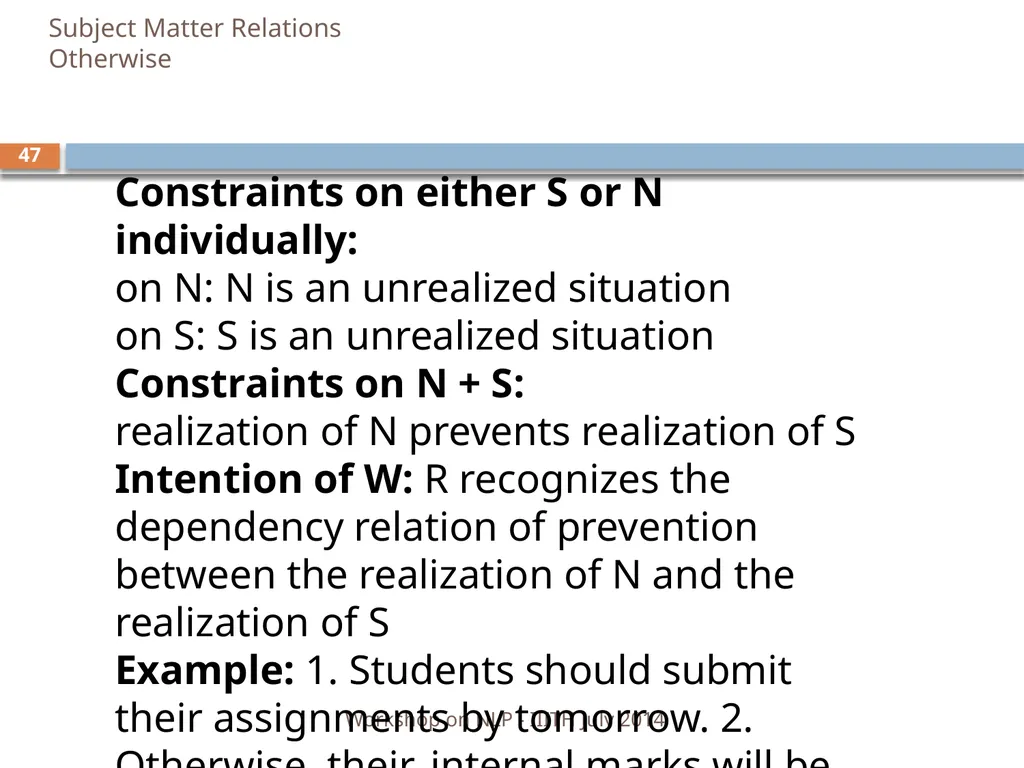
47
Subject Matter Relations
Otherwise Constraints on either S or N individually:
on N: N is an unrealized situation on S: S is an unrealized situation
Constraints on N + S:
realization of N prevents realization of S
Intention of W: R recognizes the dependency relation of prevention between the realization of N and the realization of S
Example: 1. Students should submit their assignments by tomorrow. 2. Otherwise, their, internal marks will be reduced. 47 Workshop on NLP - IIITH July 2014<br>
on N: N is an unrealized situation on S: S is an unrealized situation
Constraints on N + S:
realization of N prevents realization of S
Intention of W: R recognizes the dependency relation of prevention between the realization of N and the realization of S
Example: 1. Students should submit their assignments by tomorrow. 2. Otherwise, their, internal marks will be reduced. 47 Workshop on NLP - IIITH July 2014<br>
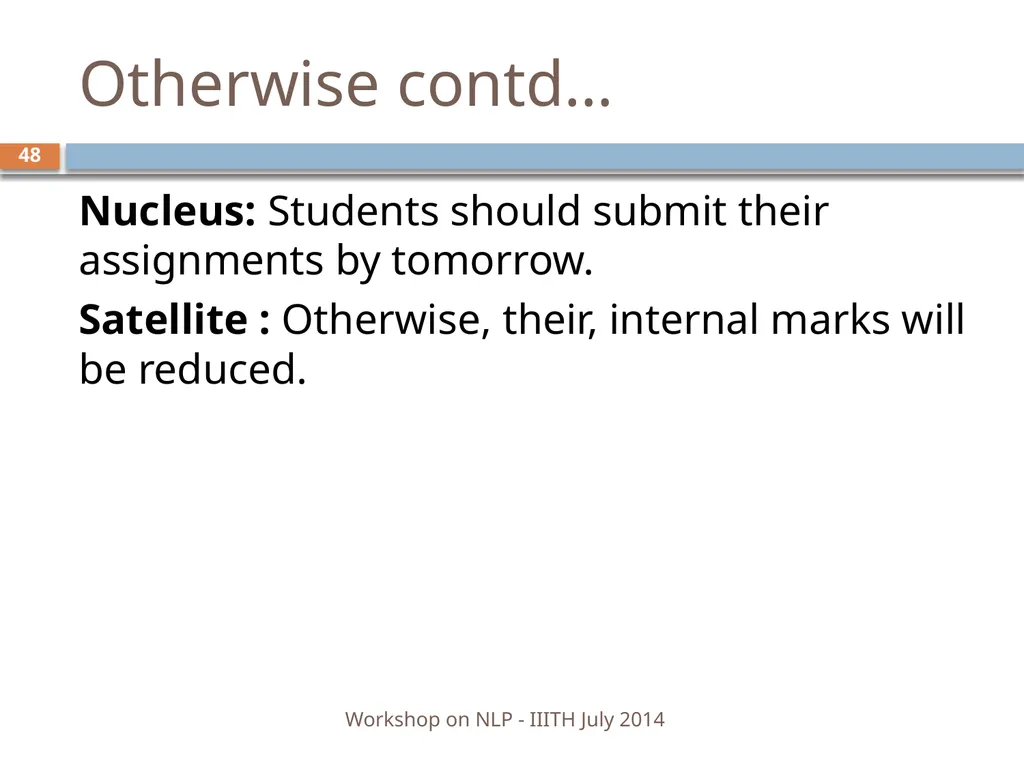
48
Otherwise contd… Nucleus: Students should submit their assignments by tomorrow.
Satellite : Otherwise, their, internal marks will be reduced. 48 Workshop on NLP - IIITH July 2014<br>
Satellite : Otherwise, their, internal marks will be reduced. 48 Workshop on NLP - IIITH July 2014<br>
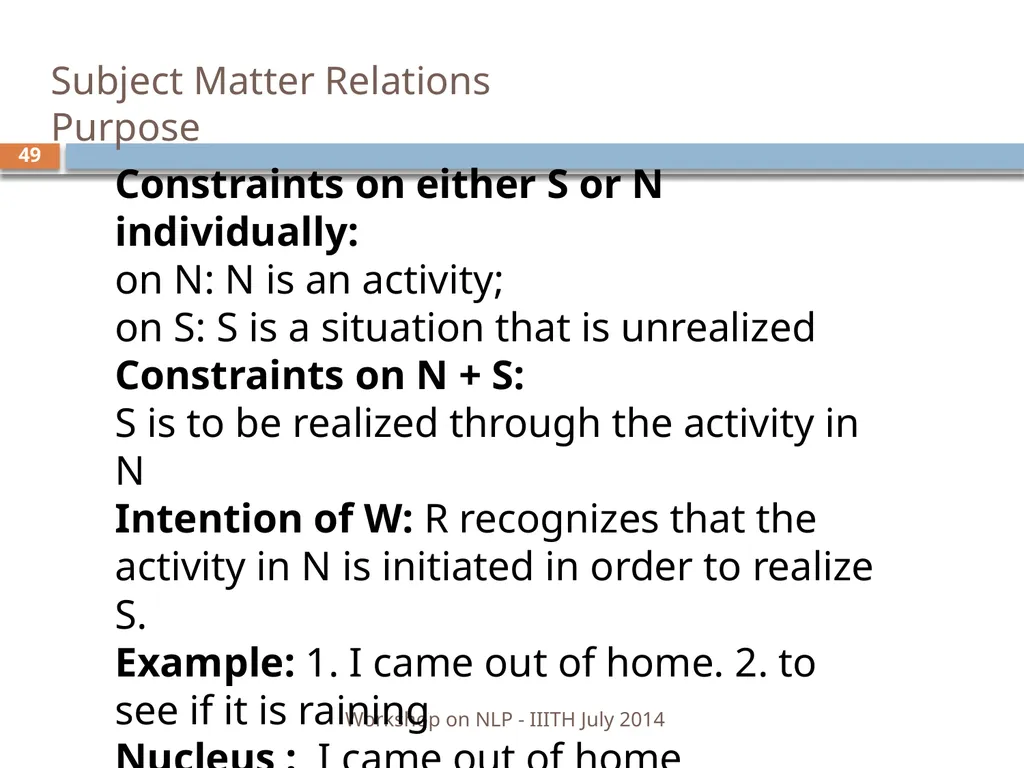
49
Subject Matter Relations
Purpose Constraints on either S or N individually:
on N: N is an activity; on S: S is a situation that is unrealized
Constraints on N + S:
S is to be realized through the activity in N
Intention of W: R recognizes that the activity in N is initiated in order to realize S.
Example: 1. I came out of home. 2. to see if it is raining
Nucleus : I came out of home
Satellite: to see if it is raining 49 Workshop on NLP - IIITH July 2014<br>
on N: N is an activity; on S: S is a situation that is unrealized
Constraints on N + S:
S is to be realized through the activity in N
Intention of W: R recognizes that the activity in N is initiated in order to realize S.
Example: 1. I came out of home. 2. to see if it is raining
Nucleus : I came out of home
Satellite: to see if it is raining 49 Workshop on NLP - IIITH July 2014<br>
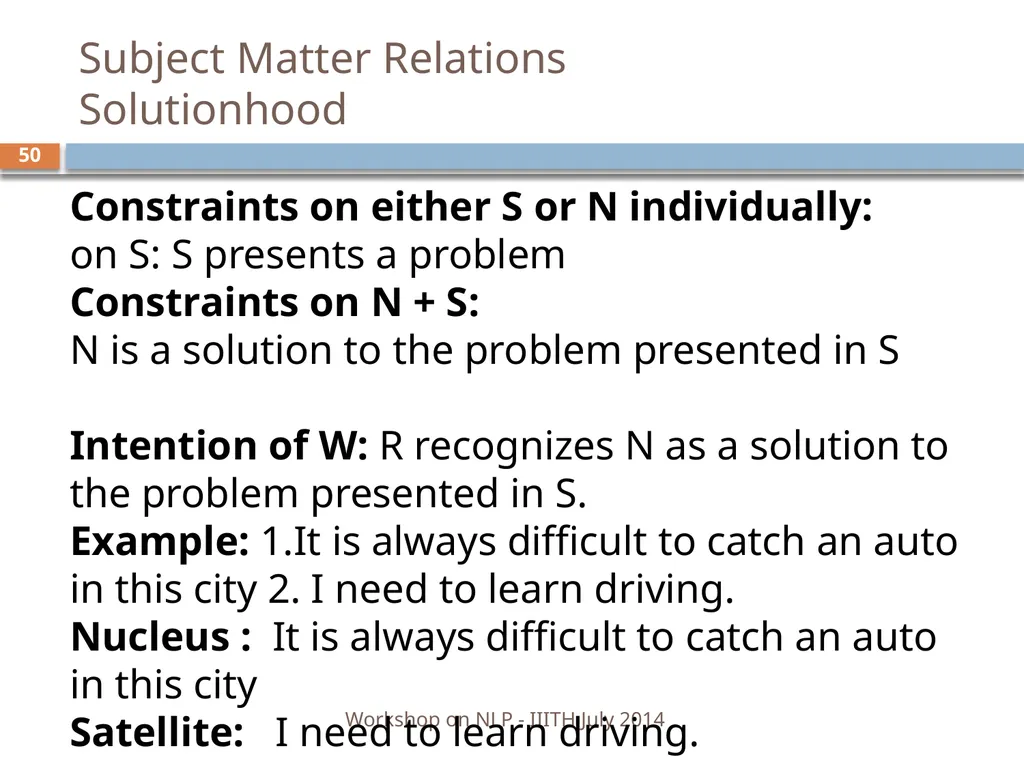
50
Constraints on either S or N individually:
on S: S presents a problem
Constraints on N + S:
N is a solution to the problem presented in S
Intention of W: R recognizes N as a solution to the problem presented in S.
Example: 1.It is always difficult to catch an auto in this city 2. I need to learn driving.
Nucleus : It is always difficult to catch an auto in this city
Satellite: I need to learn driving. Subject Matter Relations Solutionhood Workshop on NLP - IIITH July 2014 50<br>
on S: S presents a problem
Constraints on N + S:
N is a solution to the problem presented in S
Intention of W: R recognizes N as a solution to the problem presented in S.
Example: 1.It is always difficult to catch an auto in this city 2. I need to learn driving.
Nucleus : It is always difficult to catch an auto in this city
Satellite: I need to learn driving. Subject Matter Relations Solutionhood Workshop on NLP - IIITH July 2014 50<br>
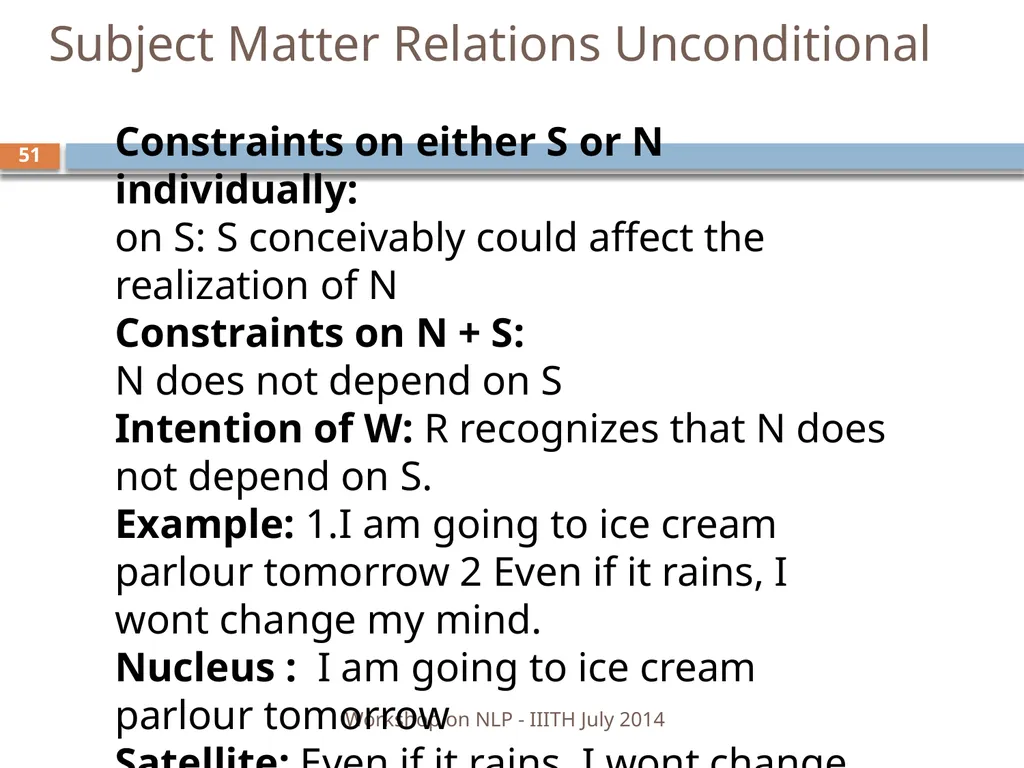
51
Subject Matter Relations Unconditional Constraints on either S or N individually:
on S: S conceivably could affect the realization of N
Constraints on N + S:
N does not depend on S
Intention of W: R recognizes that N does not depend on S.
Example: 1.I am going to ice cream parlour tomorrow 2 Even if it rains, I wont change my mind.
Nucleus : I am going to ice cream parlour tomorrow
Satellite: Even if it rains, I wont change my mind. 51 Workshop on NLP - IIITH July 2014<br>
on S: S conceivably could affect the realization of N
Constraints on N + S:
N does not depend on S
Intention of W: R recognizes that N does not depend on S.
Example: 1.I am going to ice cream parlour tomorrow 2 Even if it rains, I wont change my mind.
Nucleus : I am going to ice cream parlour tomorrow
Satellite: Even if it rains, I wont change my mind. 51 Workshop on NLP - IIITH July 2014<br>
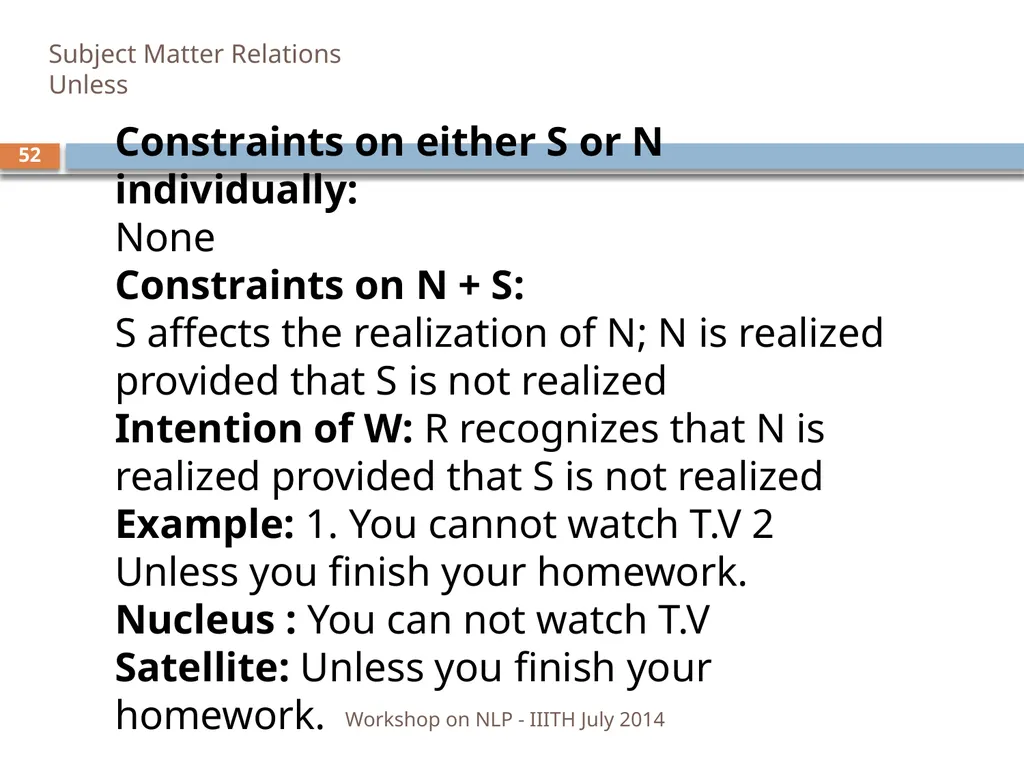
52
Subject Matter Relations
Unless Constraints on either S or N individually:
None
Constraints on N + S:
S affects the realization of N; N is realized provided that S is not realized
Intention of W: R recognizes that N is realized provided that S is not realized
Example: 1. You cannot watch T.V 2 Unless you finish your homework.
Nucleus : You can not watch T.V
Satellite: Unless you finish your homework. 52 Workshop on NLP - IIITH July 2014<br>
None
Constraints on N + S:
S affects the realization of N; N is realized provided that S is not realized
Intention of W: R recognizes that N is realized provided that S is not realized
Example: 1. You cannot watch T.V 2 Unless you finish your homework.
Nucleus : You can not watch T.V
Satellite: Unless you finish your homework. 52 Workshop on NLP - IIITH July 2014<br>
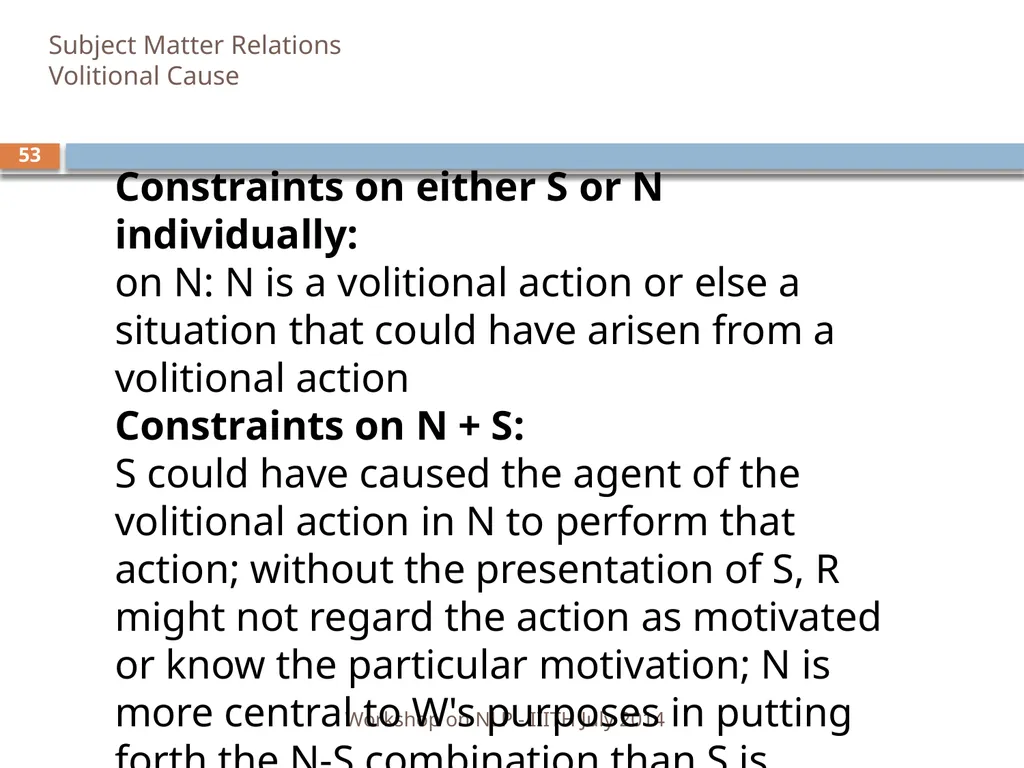
53
Subject Matter Relations
Volitional Cause Constraints on either S or N individually:
on N: N is a volitional action or else a situation that could have arisen from a volitional action
Constraints on N + S:
S could have caused the agent of the volitional action in N to perform that action; without the presentation of S, R might not regard the action as motivated or know the particular motivation; N is more central to W's purposes in putting forth the N-S combination than S is.
Intention of W: R recognizes S as a cause for the volitional action in N 53 Workshop on NLP - IIITH July 2014<br>
on N: N is a volitional action or else a situation that could have arisen from a volitional action
Constraints on N + S:
S could have caused the agent of the volitional action in N to perform that action; without the presentation of S, R might not regard the action as motivated or know the particular motivation; N is more central to W's purposes in putting forth the N-S combination than S is.
Intention of W: R recognizes S as a cause for the volitional action in N 53 Workshop on NLP - IIITH July 2014<br>
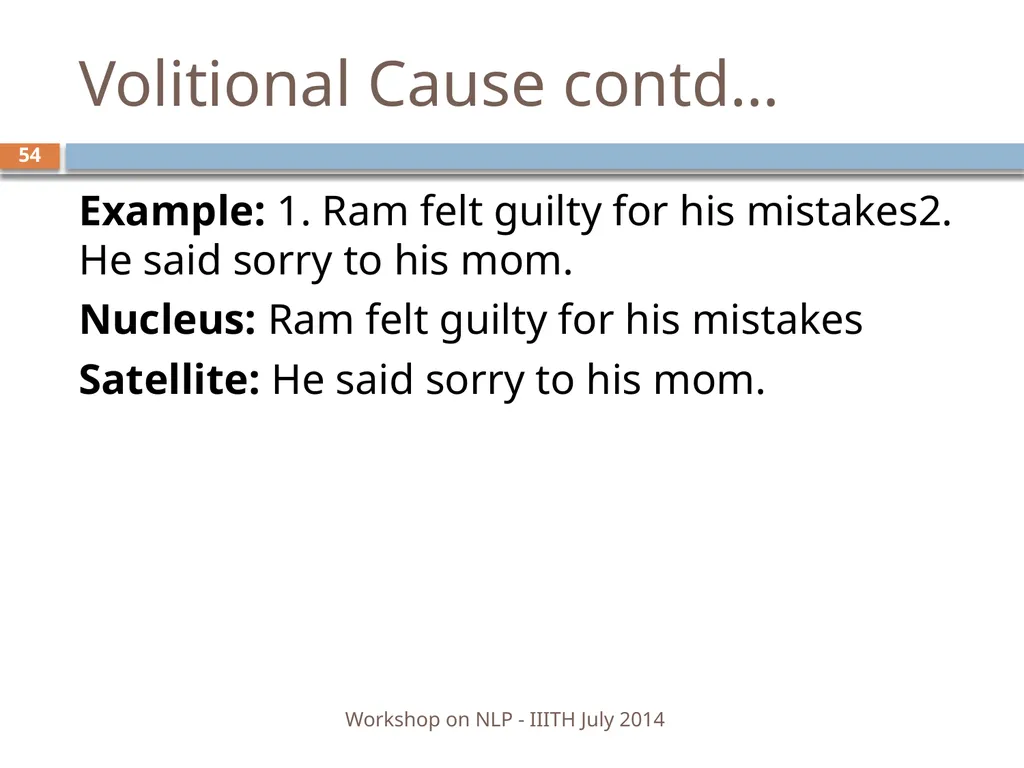
54
Volitional Cause contd… Example: 1. Ram felt guilty for his mistakes2. He said sorry to his mom.
Nucleus: Ram felt guilty for his mistakes
Satellite: He said sorry to his mom. 54 Workshop on NLP - IIITH July 2014<br>
Nucleus: Ram felt guilty for his mistakes
Satellite: He said sorry to his mom. 54 Workshop on NLP - IIITH July 2014<br>
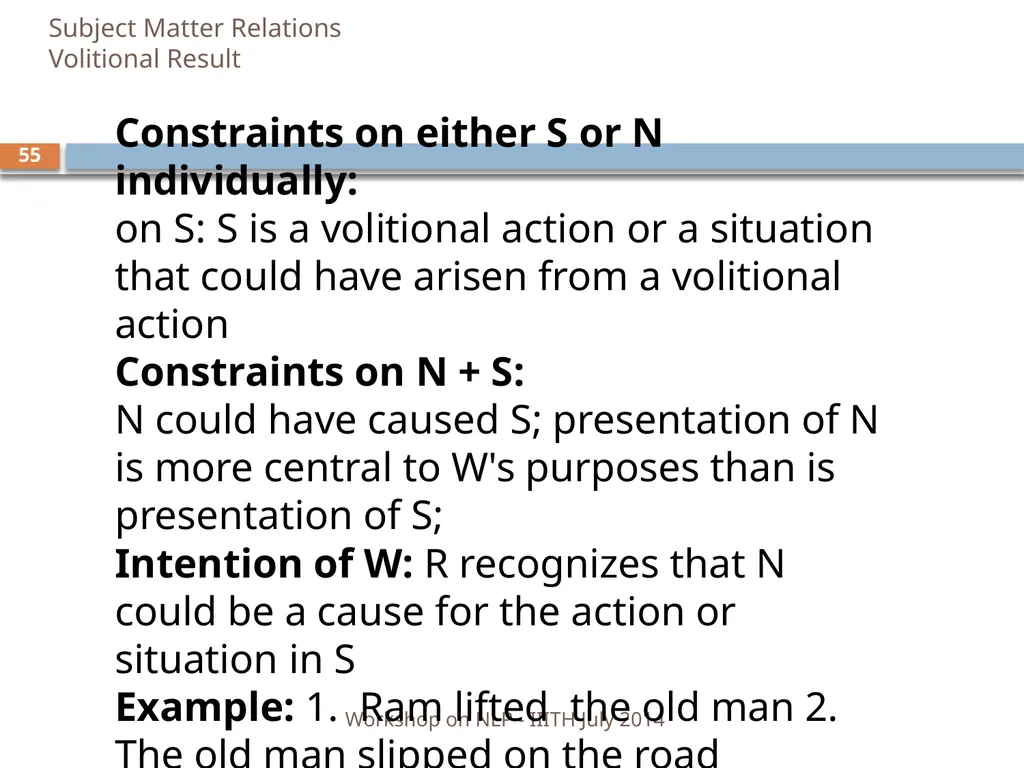
55
Subject Matter Relations
Volitional Result Constraints on either S or N individually:
on S: S is a volitional action or a situation that could have arisen from a volitional action
Constraints on N + S:
N could have caused S; presentation of N is more central to W's purposes than is presentation of S;
Intention of W: R recognizes that N could be a cause for the action or situation in S
Example: 1. Ram lifted the old man 2. The old man slipped on the road
Nucleus: Ram lifted the old man
Satellite: The old man slipped on the road 55 Workshop on NLP - IIITH July 2014<br>
on S: S is a volitional action or a situation that could have arisen from a volitional action
Constraints on N + S:
N could have caused S; presentation of N is more central to W's purposes than is presentation of S;
Intention of W: R recognizes that N could be a cause for the action or situation in S
Example: 1. Ram lifted the old man 2. The old man slipped on the road
Nucleus: Ram lifted the old man
Satellite: The old man slipped on the road 55 Workshop on NLP - IIITH July 2014<br>
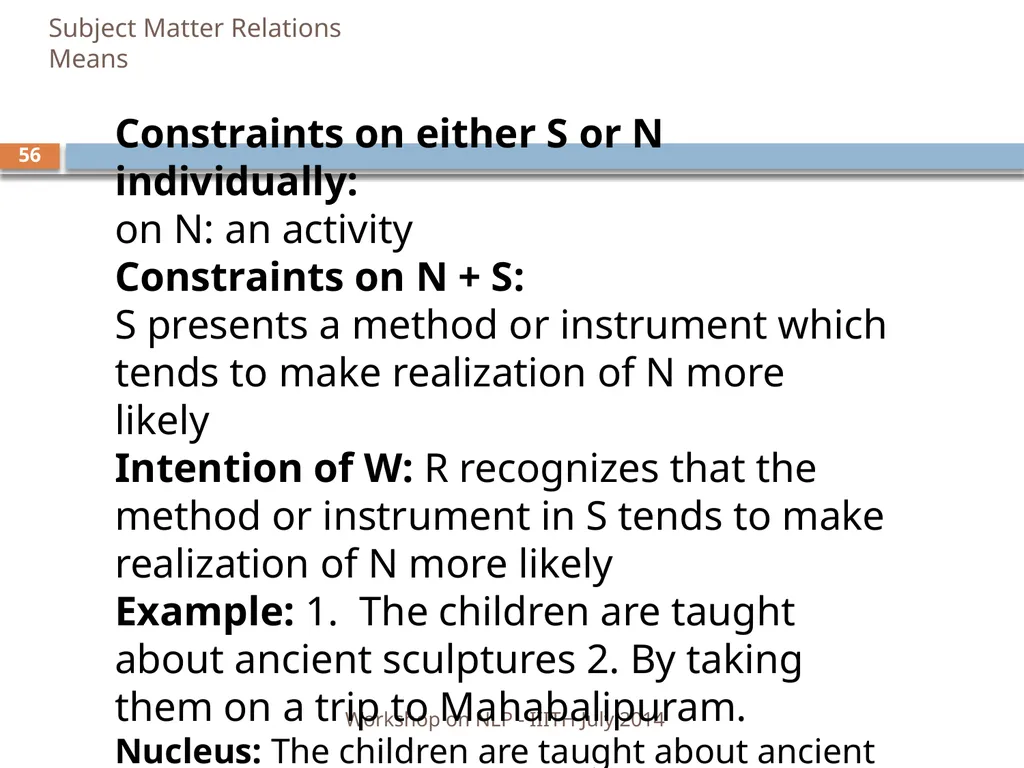
56
Subject Matter Relations
Means Constraints on either S or N individually:
on N: an activity
Constraints on N + S:
S presents a method or instrument which tends to make realization of N more likely
Intention of W: R recognizes that the method or instrument in S tends to make realization of N more likely
Example: 1. The children are taught about ancient sculptures 2. By taking them on a trip to Mahabalipuram.
Nucleus: The children are taught about ancient sculptures
Satellite: By taking them on a trip to Mahabalipuram. 56 Workshop on NLP - IIITH July 2014<br>
on N: an activity
Constraints on N + S:
S presents a method or instrument which tends to make realization of N more likely
Intention of W: R recognizes that the method or instrument in S tends to make realization of N more likely
Example: 1. The children are taught about ancient sculptures 2. By taking them on a trip to Mahabalipuram.
Nucleus: The children are taught about ancient sculptures
Satellite: By taking them on a trip to Mahabalipuram. 56 Workshop on NLP - IIITH July 2014<br>
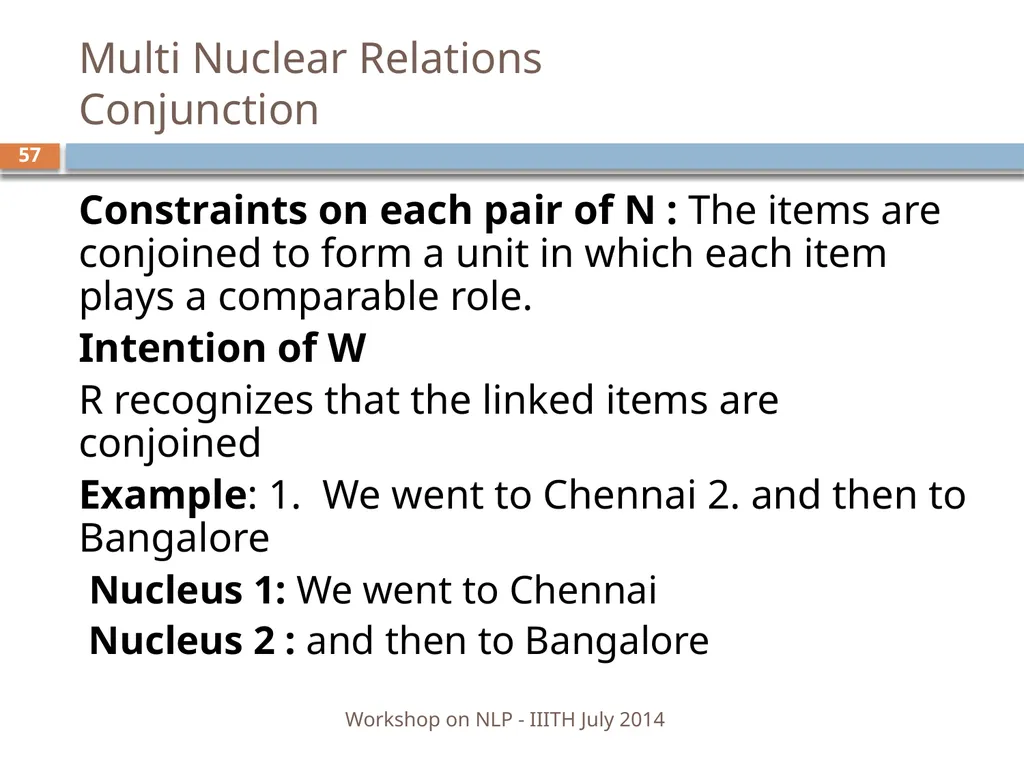
57
Multi Nuclear Relations
Conjunction Constraints on each pair of N : The items are conjoined to form a unit in which each item plays a comparable role.
Intention of W
R recognizes that the linked items are conjoined
Example: 1. We went to Chennai 2. and then to Bangalore
Nucleus 1: We went to Chennai
Nucleus 2 : and then to Bangalore 57 Workshop on NLP - IIITH July 2014<br>
Intention of W
R recognizes that the linked items are conjoined
Example: 1. We went to Chennai 2. and then to Bangalore
Nucleus 1: We went to Chennai
Nucleus 2 : and then to Bangalore 57 Workshop on NLP - IIITH July 2014<br>
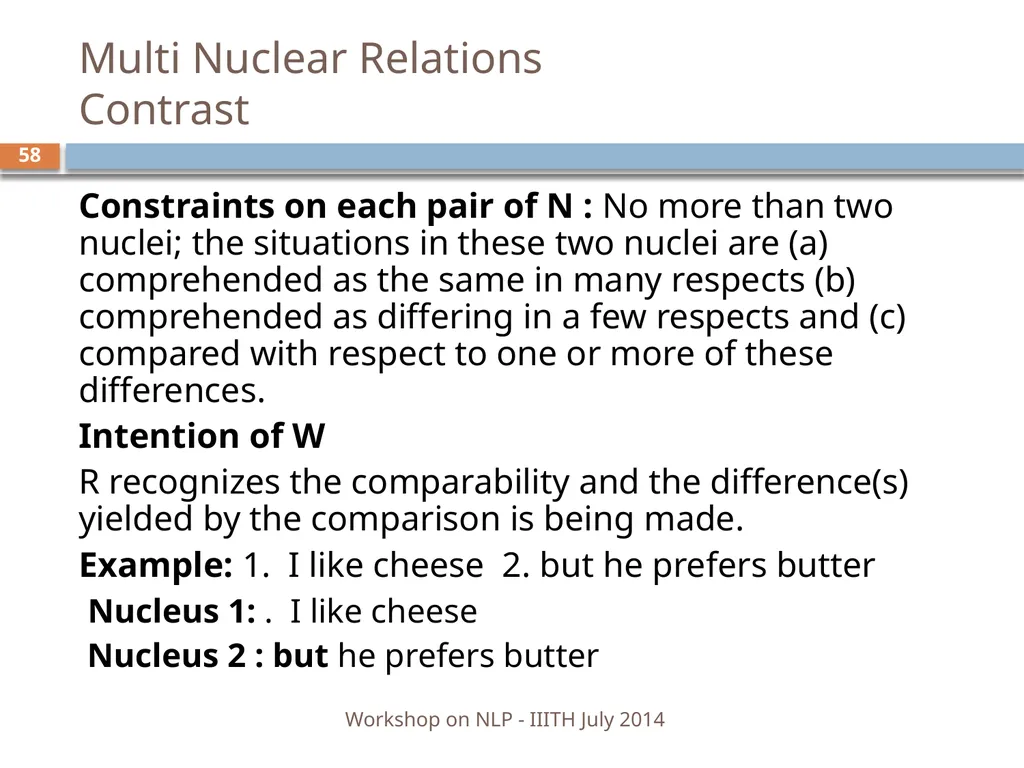
58
Multi Nuclear Relations
Contrast Constraints on each pair of N : No more than two nuclei; the situations in these two nuclei are (a) comprehended as the same in many respects (b) comprehended as differing in a few respects and (c) compared with respect to one or more of these differences.
Intention of W
R recognizes the comparability and the difference(s) yielded by the comparison is being made.
Example: 1. I like cheese 2. but he prefers butter
Nucleus 1: . I like cheese
Nucleus 2 : but he prefers butter 58 Workshop on NLP - IIITH July 2014<br>
Intention of W
R recognizes the comparability and the difference(s) yielded by the comparison is being made.
Example: 1. I like cheese 2. but he prefers butter
Nucleus 1: . I like cheese
Nucleus 2 : but he prefers butter 58 Workshop on NLP - IIITH July 2014<br>
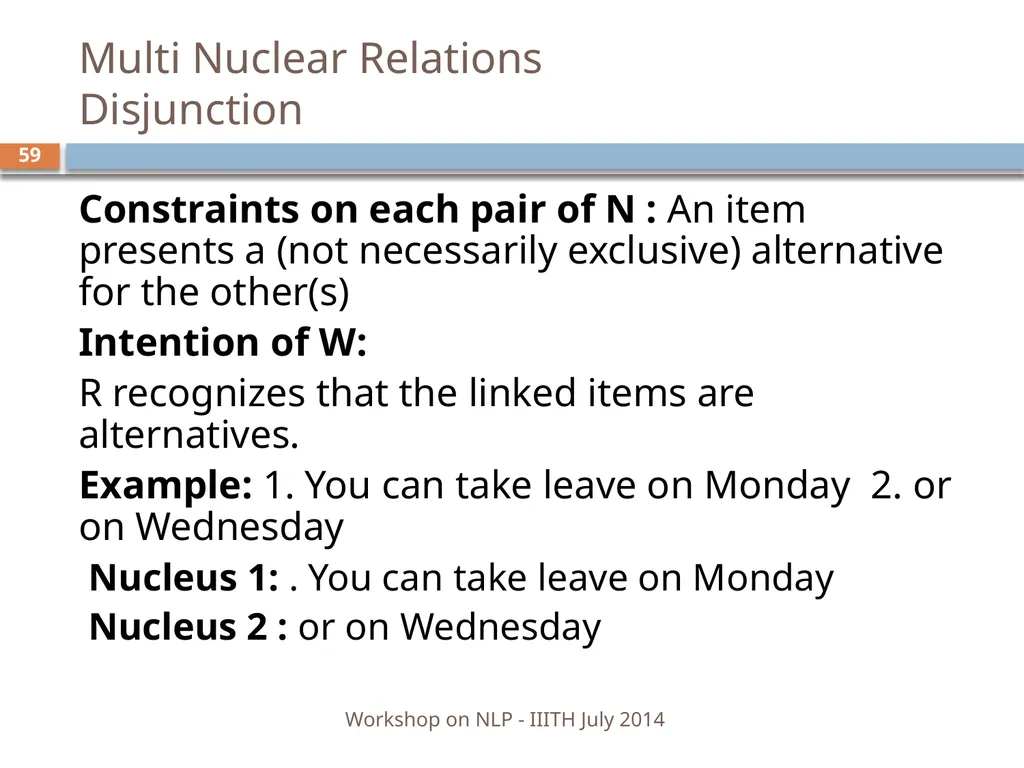
59
Multi Nuclear Relations
Disjunction Constraints on each pair of N : An item presents a (not necessarily exclusive) alternative for the other(s)
Intention of W:
R recognizes that the linked items are alternatives.
Example: 1. You can take leave on Monday 2. or on Wednesday
Nucleus 1: . You can take leave on Monday
Nucleus 2 : or on Wednesday 59 Workshop on NLP - IIITH July 2014<br>
Intention of W:
R recognizes that the linked items are alternatives.
Example: 1. You can take leave on Monday 2. or on Wednesday
Nucleus 1: . You can take leave on Monday
Nucleus 2 : or on Wednesday 59 Workshop on NLP - IIITH July 2014<br>
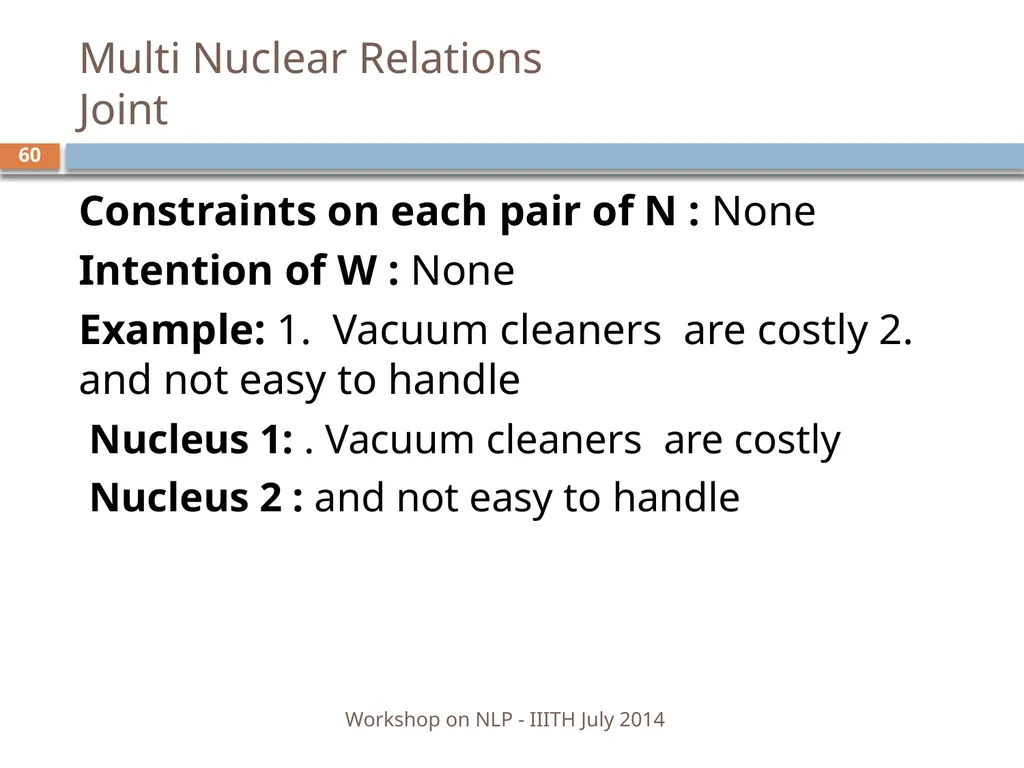
60
Multi Nuclear Relations
Joint Constraints on each pair of N : None
Intention of W : None
Example: 1. Vacuum cleaners are costly 2. and not easy to handle
Nucleus 1: . Vacuum cleaners are costly
Nucleus 2 : and not easy to handle 60 Workshop on NLP - IIITH July 2014<br>
Intention of W : None
Example: 1. Vacuum cleaners are costly 2. and not easy to handle
Nucleus 1: . Vacuum cleaners are costly
Nucleus 2 : and not easy to handle 60 Workshop on NLP - IIITH July 2014<br>
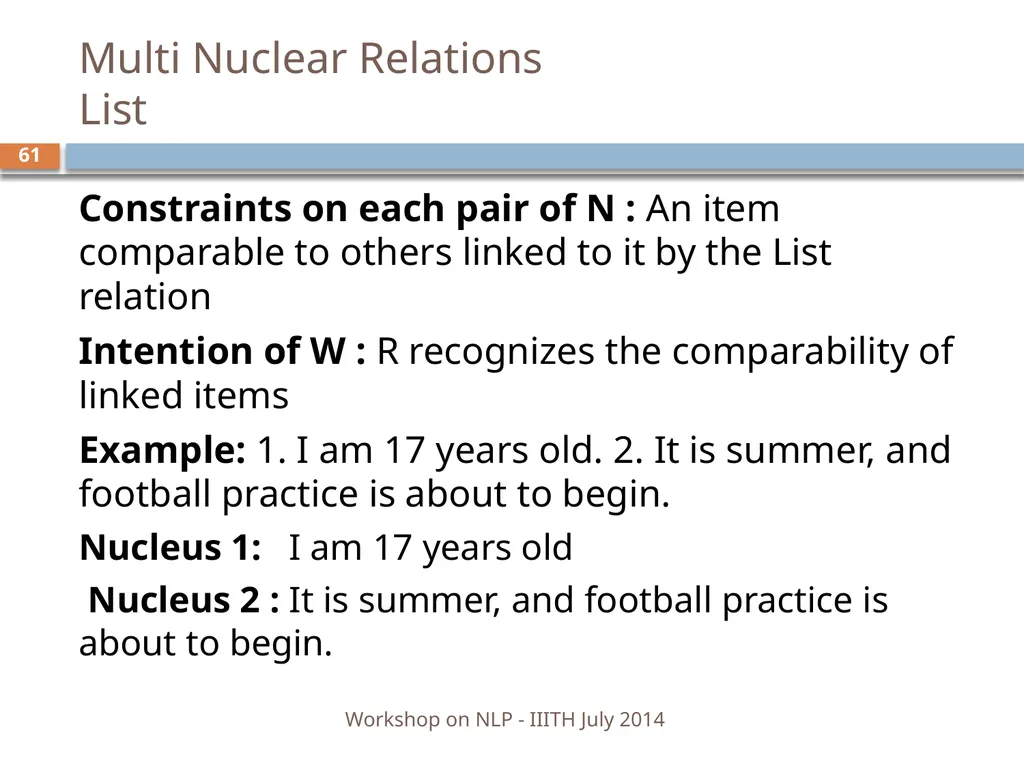
61
Multi Nuclear Relations
List Constraints on each pair of N : An item comparable to others linked to it by the List relation
Intention of W : R recognizes the comparability of linked items
Example: 1. I am 17 years old. 2. It is summer, and football practice is about to begin.
Nucleus 1: I am 17 years old
Nucleus 2 : It is summer, and football practice is about to begin. 61 Workshop on NLP - IIITH July 2014<br>
Intention of W : R recognizes the comparability of linked items
Example: 1. I am 17 years old. 2. It is summer, and football practice is about to begin.
Nucleus 1: I am 17 years old
Nucleus 2 : It is summer, and football practice is about to begin. 61 Workshop on NLP - IIITH July 2014<br>
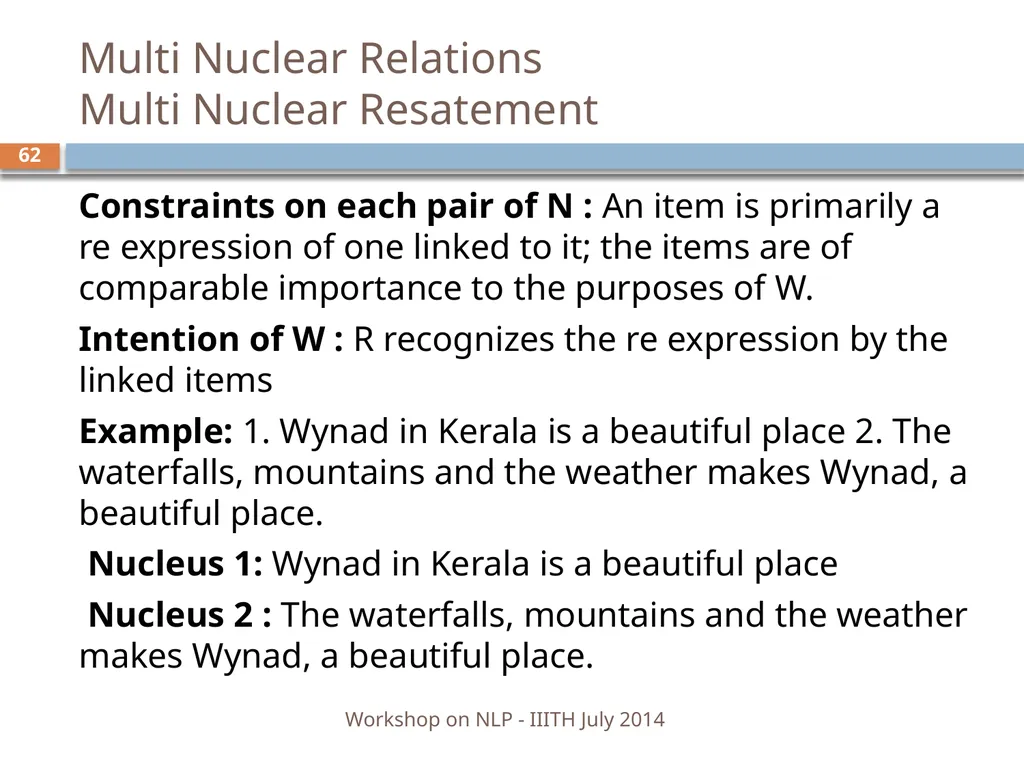
62
Multi Nuclear Relations
Multi Nuclear Resatement Constraints on each pair of N : An item is primarily a re expression of one linked to it; the items are of comparable importance to the purposes of W.
Intention of W : R recognizes the re expression by the linked items
Example: 1. Wynad in Kerala is a beautiful place 2. The waterfalls, mountains and the weather makes Wynad, a beautiful place.
Nucleus 1: Wynad in Kerala is a beautiful place
Nucleus 2 : The waterfalls, mountains and the weather makes Wynad, a beautiful place. 62 Workshop on NLP - IIITH July 2014<br>
Intention of W : R recognizes the re expression by the linked items
Example: 1. Wynad in Kerala is a beautiful place 2. The waterfalls, mountains and the weather makes Wynad, a beautiful place.
Nucleus 1: Wynad in Kerala is a beautiful place
Nucleus 2 : The waterfalls, mountains and the weather makes Wynad, a beautiful place. 62 Workshop on NLP - IIITH July 2014<br>
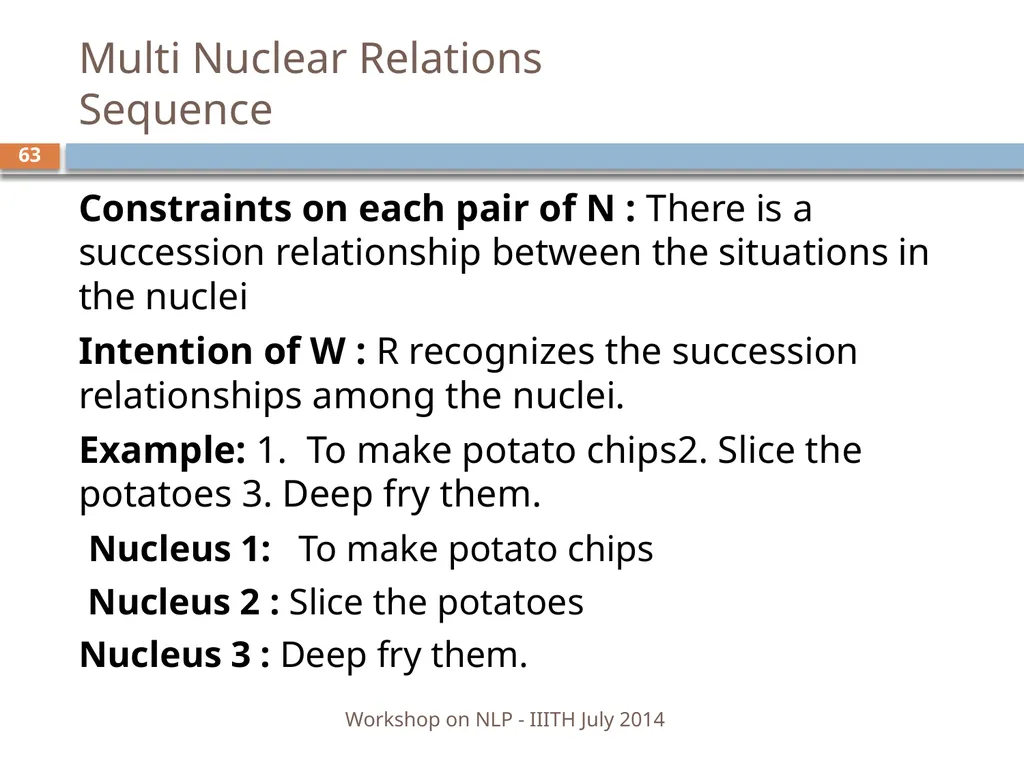
63
Multi Nuclear Relations
Sequence Constraints on each pair of N : There is a succession relationship between the situations in the nuclei
Intention of W : R recognizes the succession relationships among the nuclei.
Example: 1. To make potato chips2. Slice the potatoes 3. Deep fry them.
Nucleus 1: To make potato chips
Nucleus 2 : Slice the potatoes
Nucleus 3 : Deep fry them. 63 Workshop on NLP - IIITH July 2014<br>
Intention of W : R recognizes the succession relationships among the nuclei.
Example: 1. To make potato chips2. Slice the potatoes 3. Deep fry them.
Nucleus 1: To make potato chips
Nucleus 2 : Slice the potatoes
Nucleus 3 : Deep fry them. 63 Workshop on NLP - IIITH July 2014<br>
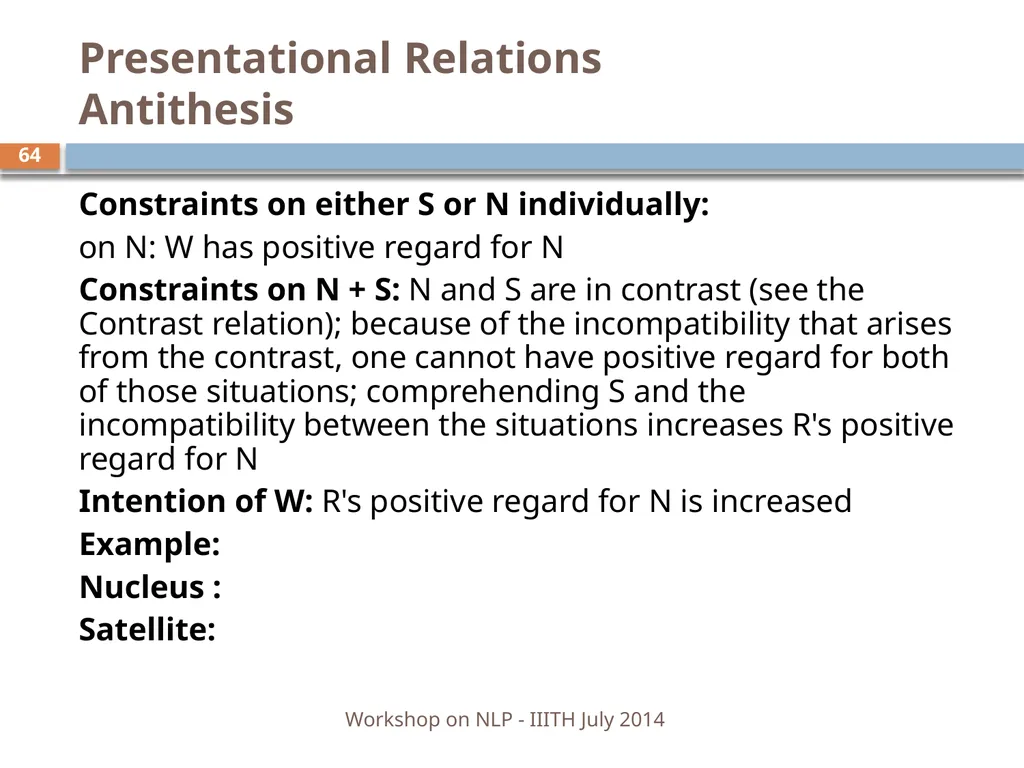
64
Presentational Relations
Antithesis Constraints on either S or N individually:
on N: W has positive regard for N
Constraints on N + S: N and S are in contrast (see the Contrast relation); because of the incompatibility that arises from the contrast, one cannot have positive regard for both of those situations; comprehending S and the incompatibility between the situations increases R's positive regard for N
Intention of W: R's positive regard for N is increased
Example:
Nucleus :
Satellite: 64 Workshop on NLP - IIITH July 2014<br>
on N: W has positive regard for N
Constraints on N + S: N and S are in contrast (see the Contrast relation); because of the incompatibility that arises from the contrast, one cannot have positive regard for both of those situations; comprehending S and the incompatibility between the situations increases R's positive regard for N
Intention of W: R's positive regard for N is increased
Example:
Nucleus :
Satellite: 64 Workshop on NLP - IIITH July 2014<br>
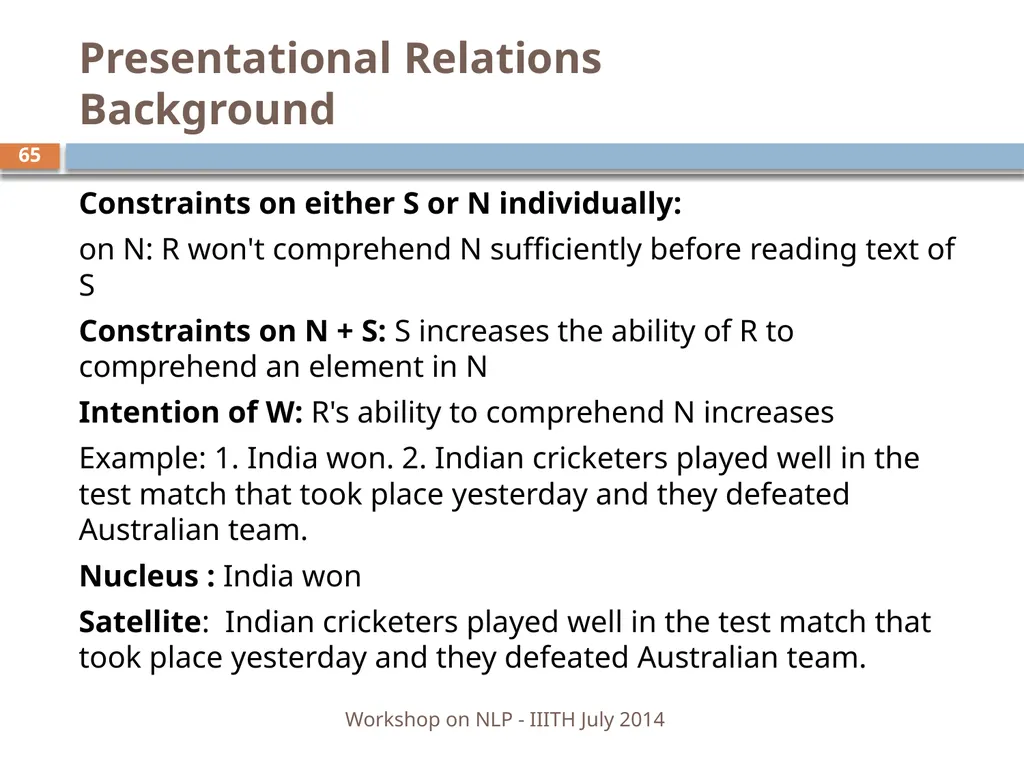
65
Presentational Relations
Background Constraints on either S or N individually:
on N: R won't comprehend N sufficiently before reading text of S
Constraints on N + S: S increases the ability of R to comprehend an element in N
Intention of W: R's ability to comprehend N increases
Example: 1. India won. 2. Indian cricketers played well in the test match that took place yesterday and they defeated Australian team.
Nucleus : India won
Satellite: Indian cricketers played well in the test match that took place yesterday and they defeated Australian team. 65 Workshop on NLP - IIITH July 2014<br>
on N: R won't comprehend N sufficiently before reading text of S
Constraints on N + S: S increases the ability of R to comprehend an element in N
Intention of W: R's ability to comprehend N increases
Example: 1. India won. 2. Indian cricketers played well in the test match that took place yesterday and they defeated Australian team.
Nucleus : India won
Satellite: Indian cricketers played well in the test match that took place yesterday and they defeated Australian team. 65 Workshop on NLP - IIITH July 2014<br>
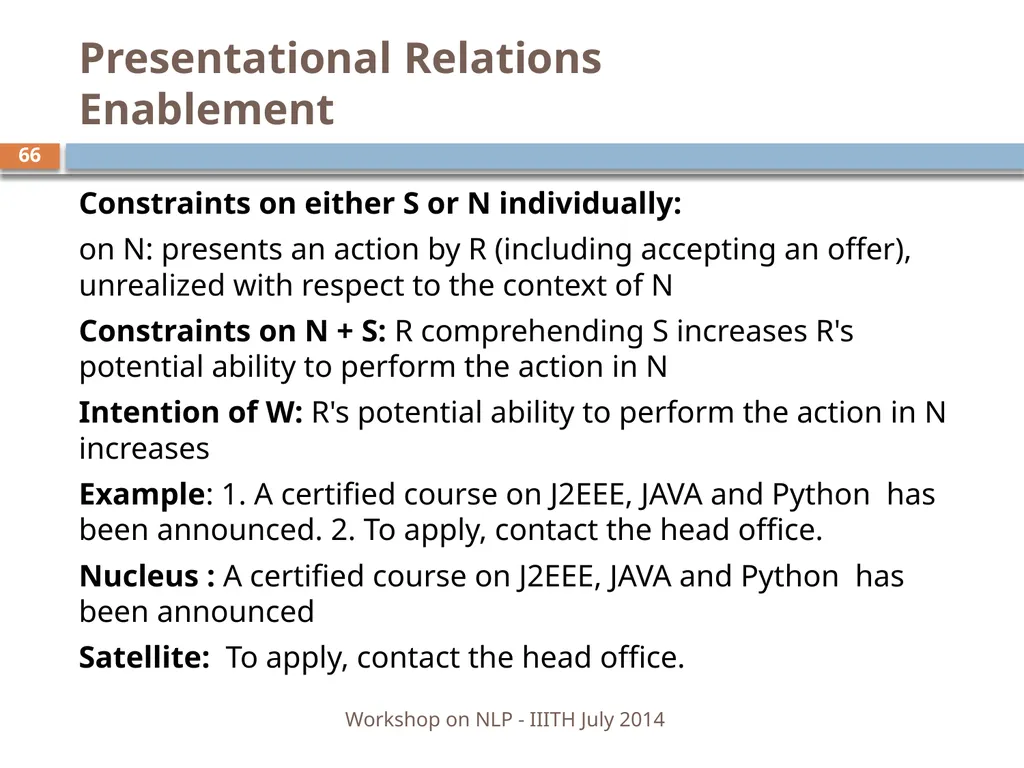
66
Presentational Relations
Enablement Constraints on either S or N individually:
on N: presents an action by R (including accepting an offer), unrealized with respect to the context of N
Constraints on N + S: R comprehending S increases R's potential ability to perform the action in N
Intention of W: R's potential ability to perform the action in N increases
Example: 1. A certified course on J2EEE, JAVA and Python has been announced. 2. To apply, contact the head office.
Nucleus : A certified course on J2EEE, JAVA and Python has been announced
Satellite: To apply, contact the head office. 66 Workshop on NLP - IIITH July 2014<br>
on N: presents an action by R (including accepting an offer), unrealized with respect to the context of N
Constraints on N + S: R comprehending S increases R's potential ability to perform the action in N
Intention of W: R's potential ability to perform the action in N increases
Example: 1. A certified course on J2EEE, JAVA and Python has been announced. 2. To apply, contact the head office.
Nucleus : A certified course on J2EEE, JAVA and Python has been announced
Satellite: To apply, contact the head office. 66 Workshop on NLP - IIITH July 2014<br>
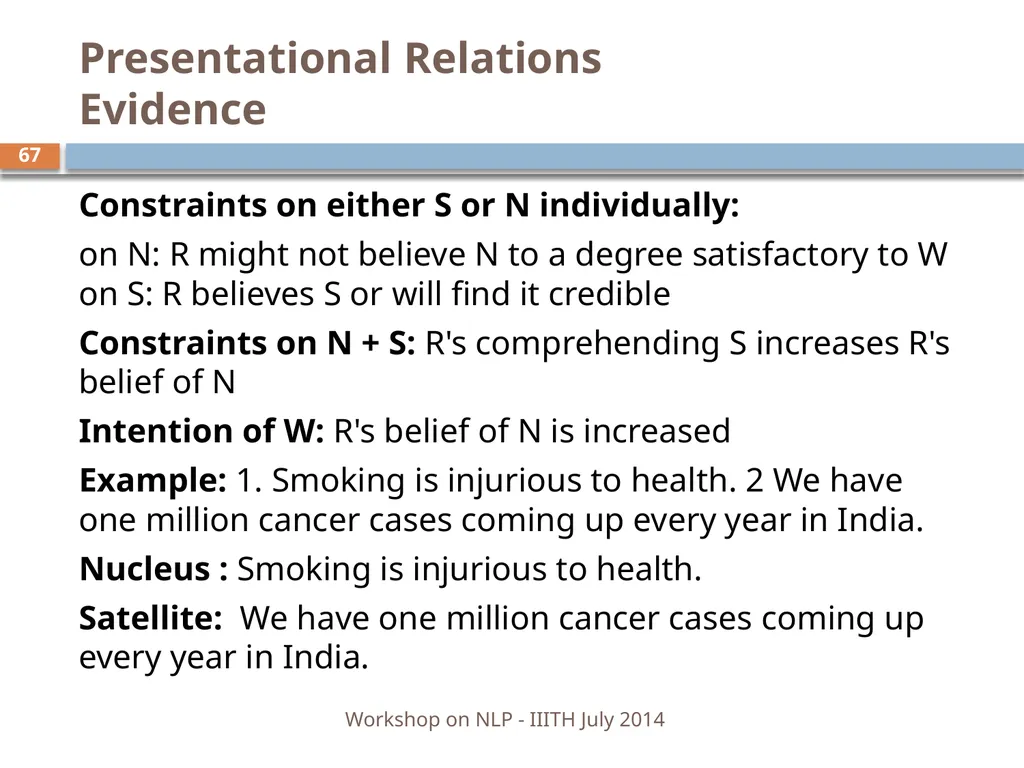
67
Presentational Relations
Evidence Constraints on either S or N individually:
on N: R might not believe N to a degree satisfactory to W on S: R believes S or will find it credible
Constraints on N + S: R's comprehending S increases R's belief of N
Intention of W: R's belief of N is increased
Example: 1. Smoking is injurious to health. 2 We have one million cancer cases coming up every year in India.
Nucleus : Smoking is injurious to health.
Satellite: We have one million cancer cases coming up every year in India. 67 Workshop on NLP - IIITH July 2014<br>
on N: R might not believe N to a degree satisfactory to W on S: R believes S or will find it credible
Constraints on N + S: R's comprehending S increases R's belief of N
Intention of W: R's belief of N is increased
Example: 1. Smoking is injurious to health. 2 We have one million cancer cases coming up every year in India.
Nucleus : Smoking is injurious to health.
Satellite: We have one million cancer cases coming up every year in India. 67 Workshop on NLP - IIITH July 2014<br>
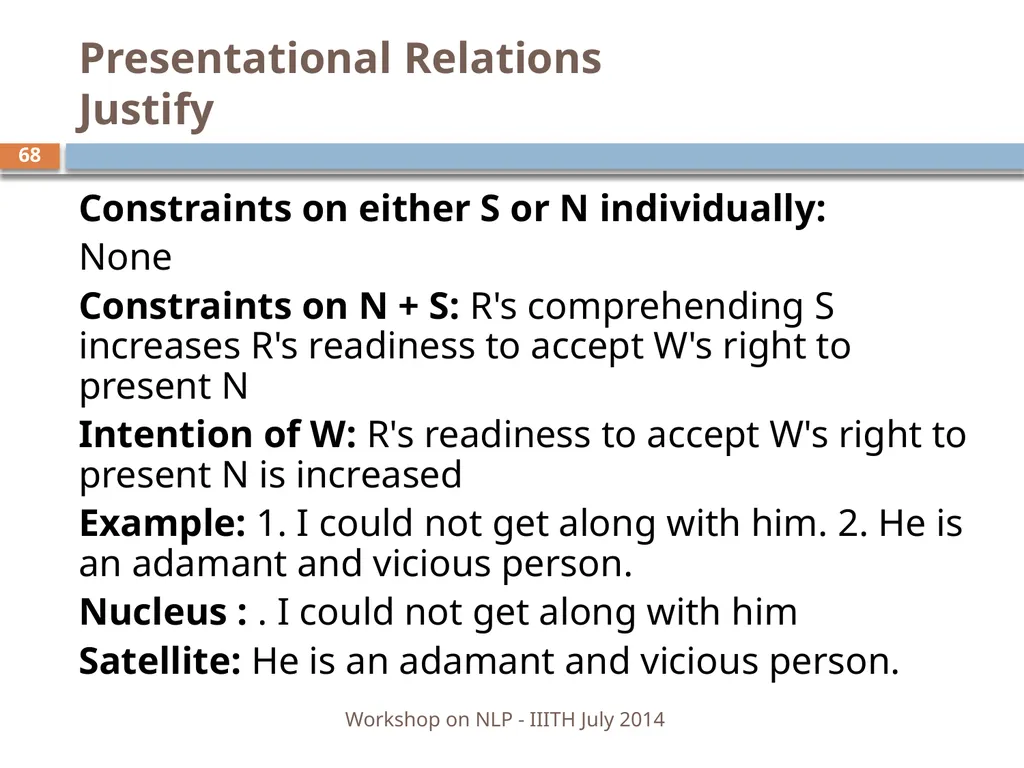
68
Presentational Relations
Justify Constraints on either S or N individually:
None
Constraints on N + S: R's comprehending S increases R's readiness to accept W's right to present N
Intention of W: R's readiness to accept W's right to present N is increased
Example: 1. I could not get along with him. 2. He is an adamant and vicious person.
Nucleus : . I could not get along with him
Satellite: He is an adamant and vicious person. 68 Workshop on NLP - IIITH July 2014<br>
None
Constraints on N + S: R's comprehending S increases R's readiness to accept W's right to present N
Intention of W: R's readiness to accept W's right to present N is increased
Example: 1. I could not get along with him. 2. He is an adamant and vicious person.
Nucleus : . I could not get along with him
Satellite: He is an adamant and vicious person. 68 Workshop on NLP - IIITH July 2014<br>
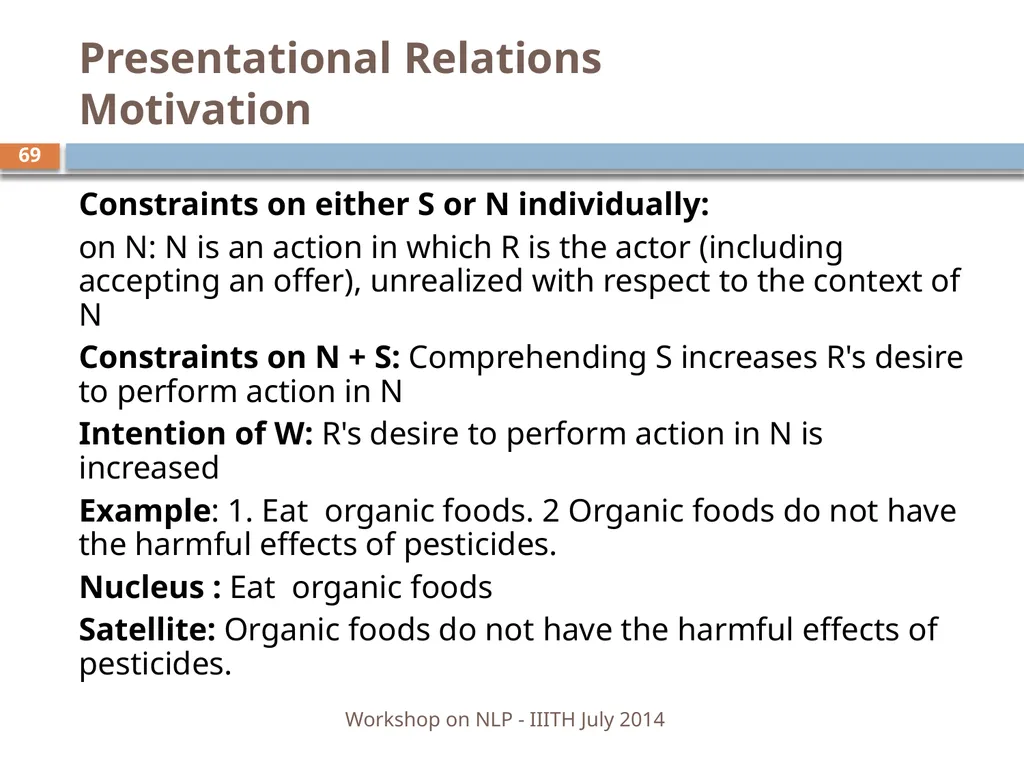
69
Presentational Relations
Motivation Constraints on either S or N individually:
on N: N is an action in which R is the actor (including accepting an offer), unrealized with respect to the context of N
Constraints on N + S: Comprehending S increases R's desire to perform action in N
Intention of W: R's desire to perform action in N is increased
Example: 1. Eat organic foods. 2 Organic foods do not have the harmful effects of pesticides.
Nucleus : Eat organic foods
Satellite: Organic foods do not have the harmful effects of pesticides. 69 Workshop on NLP - IIITH July 2014<br>
on N: N is an action in which R is the actor (including accepting an offer), unrealized with respect to the context of N
Constraints on N + S: Comprehending S increases R's desire to perform action in N
Intention of W: R's desire to perform action in N is increased
Example: 1. Eat organic foods. 2 Organic foods do not have the harmful effects of pesticides.
Nucleus : Eat organic foods
Satellite: Organic foods do not have the harmful effects of pesticides. 69 Workshop on NLP - IIITH July 2014<br>
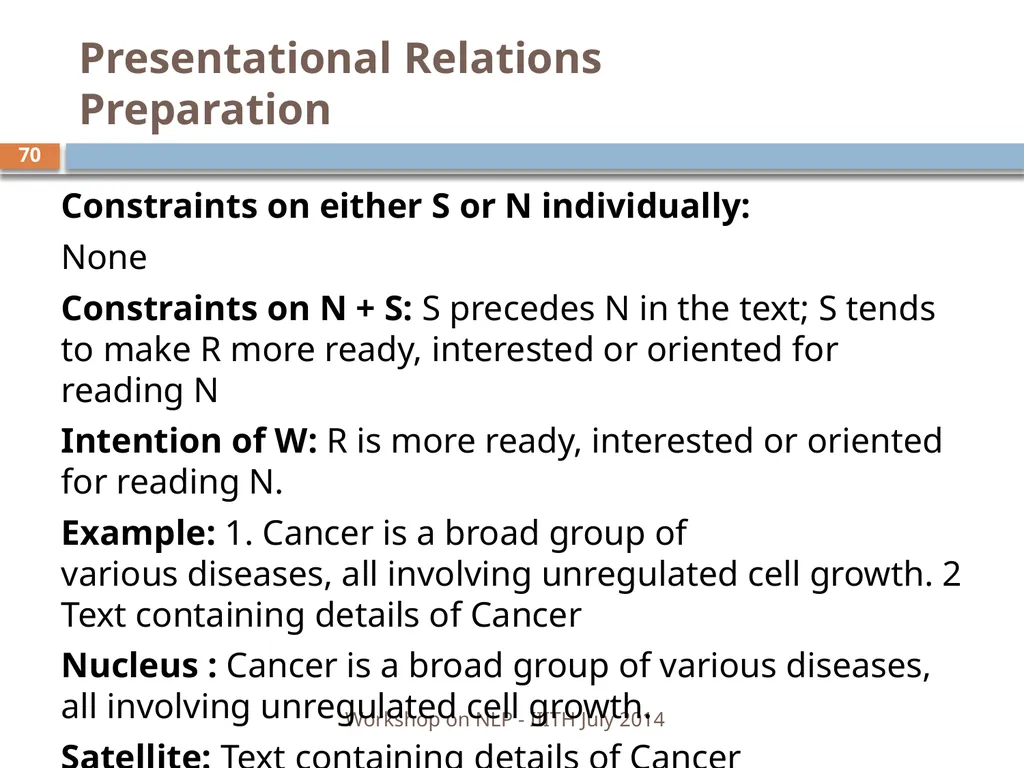
70
Presentational Relations
Preparation Constraints on either S or N individually:
None
Constraints on N + S: S precedes N in the text; S tends to make R more ready, interested or oriented for reading N
Intention of W: R is more ready, interested or oriented for reading N.
Example: 1. Cancer is a broad group of various diseases, all involving unregulated cell growth. 2 Text containing details of Cancer
Nucleus : Cancer is a broad group of various diseases, all involving unregulated cell growth.
Satellite: Text containing details of Cancer 70 Workshop on NLP - IIITH July 2014<br>
None
Constraints on N + S: S precedes N in the text; S tends to make R more ready, interested or oriented for reading N
Intention of W: R is more ready, interested or oriented for reading N.
Example: 1. Cancer is a broad group of various diseases, all involving unregulated cell growth. 2 Text containing details of Cancer
Nucleus : Cancer is a broad group of various diseases, all involving unregulated cell growth.
Satellite: Text containing details of Cancer 70 Workshop on NLP - IIITH July 2014<br>
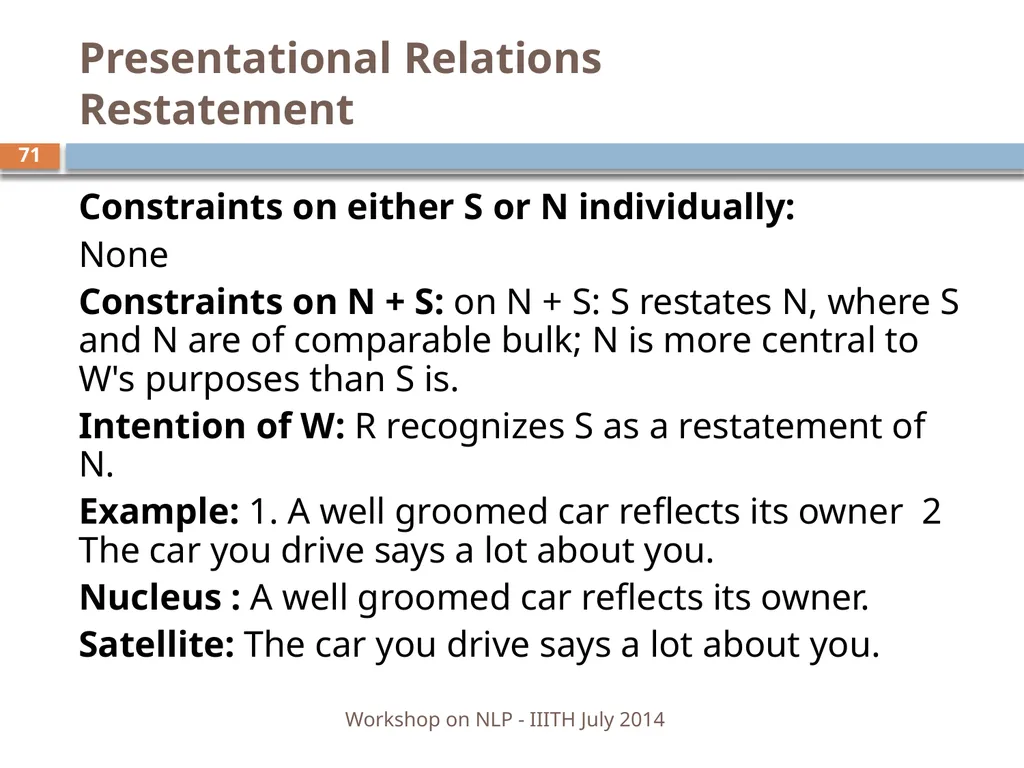
71
Presentational Relations
Restatement Constraints on either S or N individually:
None
Constraints on N + S: on N + S: S restates N, where S and N are of comparable bulk; N is more central to W's purposes than S is.
Intention of W: R recognizes S as a restatement of N.
Example: 1. A well groomed car reflects its owner 2 The car you drive says a lot about you.
Nucleus : A well groomed car reflects its owner.
Satellite: The car you drive says a lot about you. 71 Workshop on NLP - IIITH July 2014<br>
None
Constraints on N + S: on N + S: S restates N, where S and N are of comparable bulk; N is more central to W's purposes than S is.
Intention of W: R recognizes S as a restatement of N.
Example: 1. A well groomed car reflects its owner 2 The car you drive says a lot about you.
Nucleus : A well groomed car reflects its owner.
Satellite: The car you drive says a lot about you. 71 Workshop on NLP - IIITH July 2014<br>
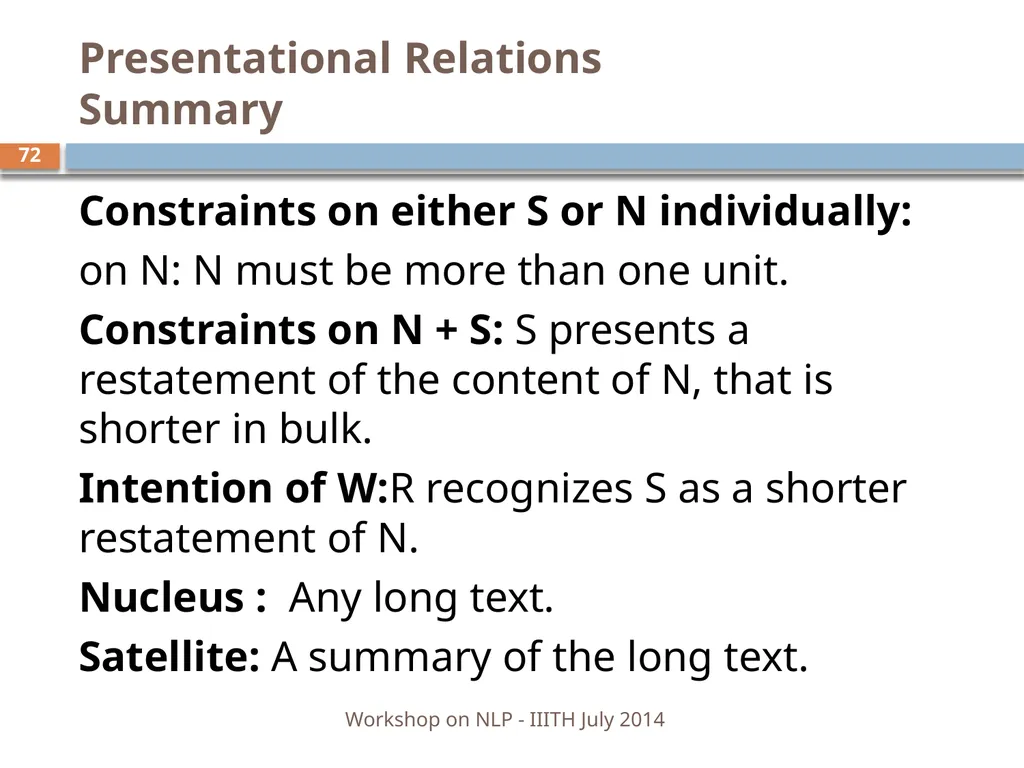
72
Presentational Relations
Summary Constraints on either S or N individually:
on N: N must be more than one unit.
Constraints on N + S: S presents a restatement of the content of N, that is shorter in bulk.
Intention of W:R recognizes S as a shorter restatement of N.
Nucleus : Any long text.
Satellite: A summary of the long text. 72 Workshop on NLP - IIITH July 2014<br>
on N: N must be more than one unit.
Constraints on N + S: S presents a restatement of the content of N, that is shorter in bulk.
Intention of W:R recognizes S as a shorter restatement of N.
Nucleus : Any long text.
Satellite: A summary of the long text. 72 Workshop on NLP - IIITH July 2014<br>
73
Annotated Corpus Workshop on NLP - IIITH July 2014 73 RST – DT from LDC
Penn Discourse Tree Bank<br>
Penn Discourse Tree Bank<br>
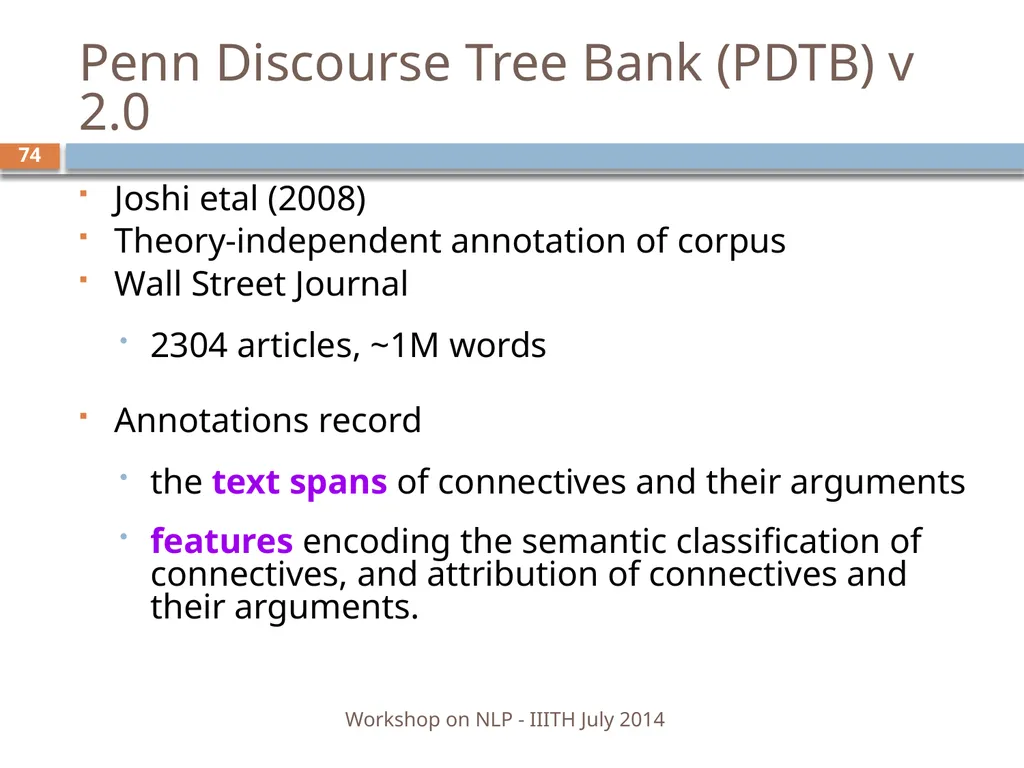
74
Penn Discourse Tree Bank (PDTB) v 2.0 Joshi etal (2008)
Theory-independent annotation of corpus
Wall Street Journal
2304 articles, ~1M words
Annotations record
the text spans of connectives and their arguments
features encoding the semantic classification of connectives, and attribution of connectives and their arguments. 74 Workshop on NLP - IIITH July 2014<br>
Theory-independent annotation of corpus
Wall Street Journal
2304 articles, ~1M words
Annotations record
the text spans of connectives and their arguments
features encoding the semantic classification of connectives, and attribution of connectives and their arguments. 74 Workshop on NLP - IIITH July 2014<br>
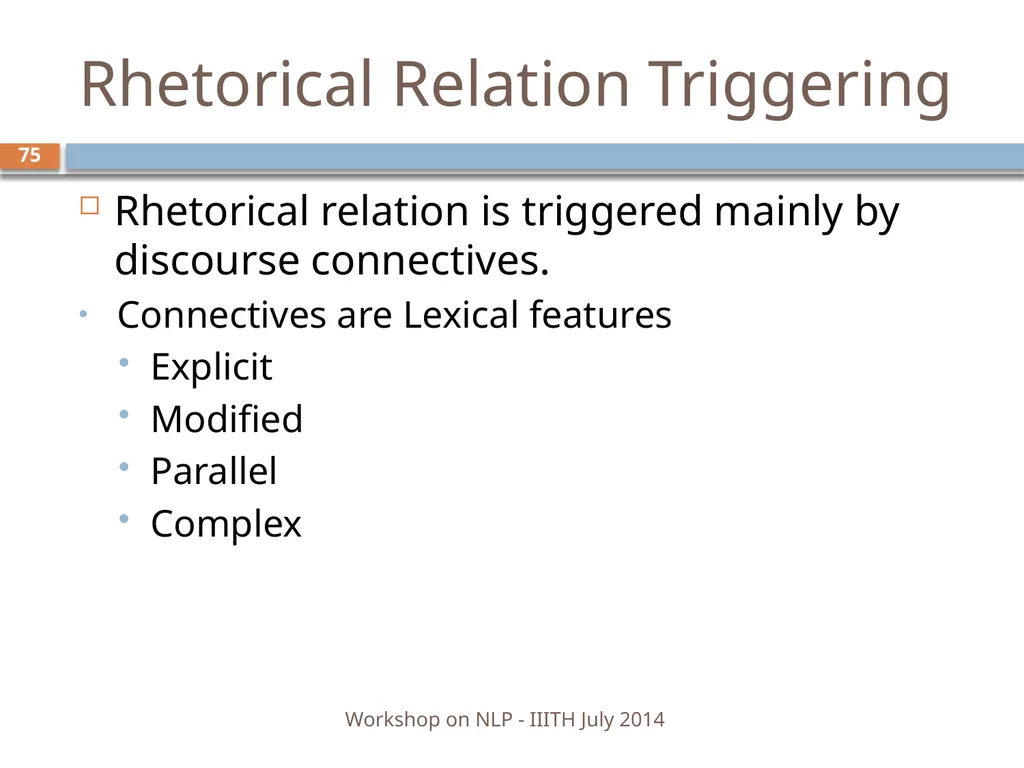
75
Rhetorical Relation Triggering Rhetorical relation is triggered mainly by discourse connectives.
Connectives are Lexical features
Explicit
Modified
Parallel
Complex 75 Workshop on NLP - IIITH July 2014<br>
Connectives are Lexical features
Explicit
Modified
Parallel
Complex 75 Workshop on NLP - IIITH July 2014<br>
76
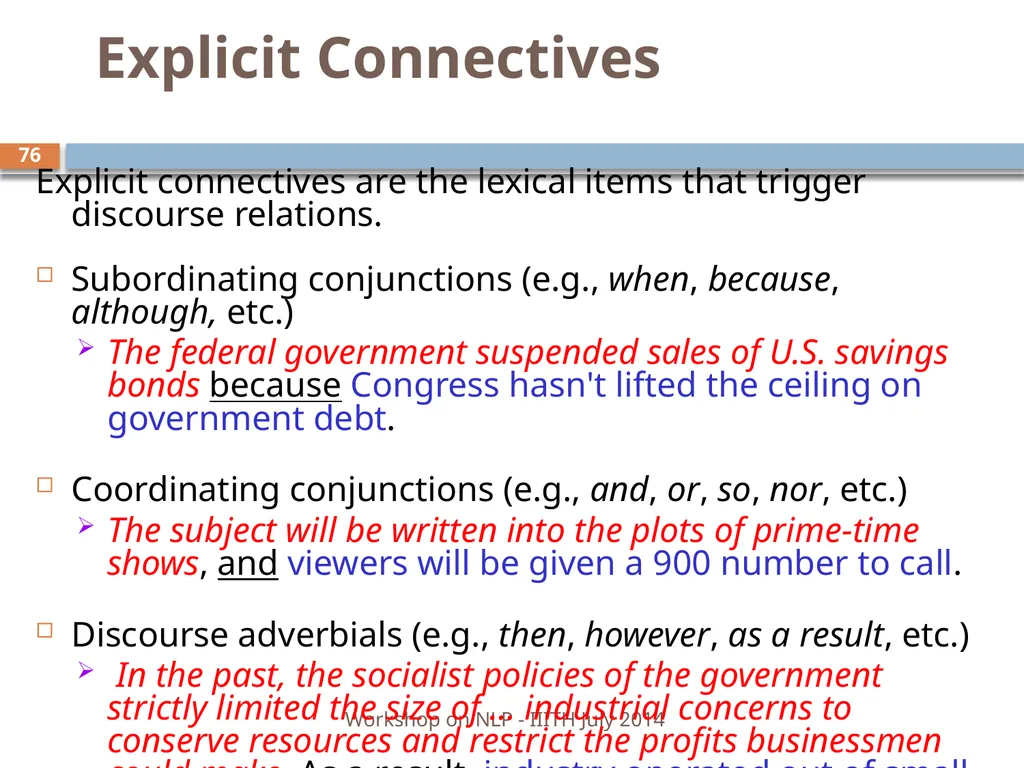
Explicit Connectives 76 Explicit connectives are the lexical items that trigger discourse relations.
Subordinating conjunctions (e.g., when, because, although, etc.)
The federal government suspended sales of U.S. savings bonds because Congress hasn't lifted the ceiling on government debt.
Coordinating conjunctions (e.g., and, or, so, nor, etc.)
The subject will be written into the plots of prime-time shows, and viewers will be given a 900 number to call.
Discourse adverbials (e.g., then, however, as a result, etc.)
In the past, the socialist policies of the government strictly limited the size of … industrial concerns to conserve resources and restrict the profits businessmen could make. As a result, industry operated out of small, expensive, highly inefficient industrial units. Workshop on NLP - IIITH July 2014<br>
Subordinating conjunctions (e.g., when, because, although, etc.)
The federal government suspended sales of U.S. savings bonds because Congress hasn't lifted the ceiling on government debt.
Coordinating conjunctions (e.g., and, or, so, nor, etc.)
The subject will be written into the plots of prime-time shows, and viewers will be given a 900 number to call.
Discourse adverbials (e.g., then, however, as a result, etc.)
In the past, the socialist policies of the government strictly limited the size of … industrial concerns to conserve resources and restrict the profits businessmen could make. As a result, industry operated out of small, expensive, highly inefficient industrial units. Workshop on NLP - IIITH July 2014<br>
77
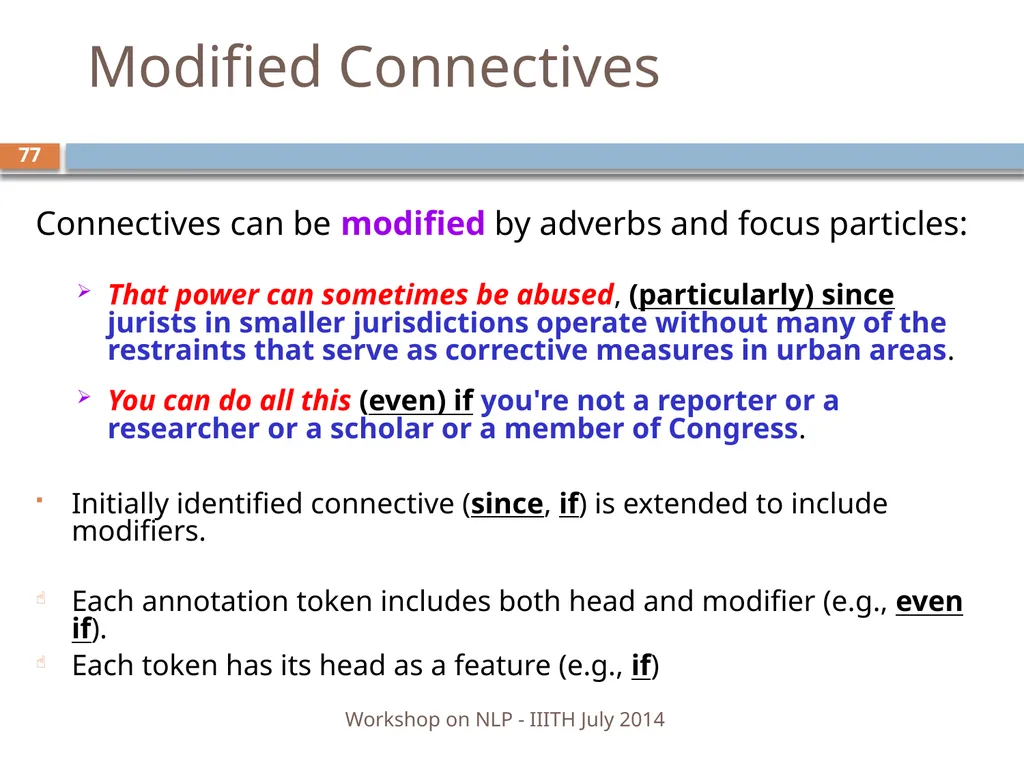
Modified Connectives 77 Connectives can be modified by adverbs and focus particles:
That power can sometimes be abused, (particularly) since jurists in smaller jurisdictions operate without many of the restraints that serve as corrective measures in urban areas.
You can do all this (even) if you're not a reporter or a researcher or a scholar or a member of Congress.
Initially identified connective (since, if) is extended to include modifiers.
Each annotation token includes both head and modifier (e.g., even if).
Each token has its head as a feature (e.g., if) Workshop on NLP - IIITH July 2014<br>
That power can sometimes be abused, (particularly) since jurists in smaller jurisdictions operate without many of the restraints that serve as corrective measures in urban areas.
You can do all this (even) if you're not a reporter or a researcher or a scholar or a member of Congress.
Initially identified connective (since, if) is extended to include modifiers.
Each annotation token includes both head and modifier (e.g., even if).
Each token has its head as a feature (e.g., if) Workshop on NLP - IIITH July 2014<br>
78
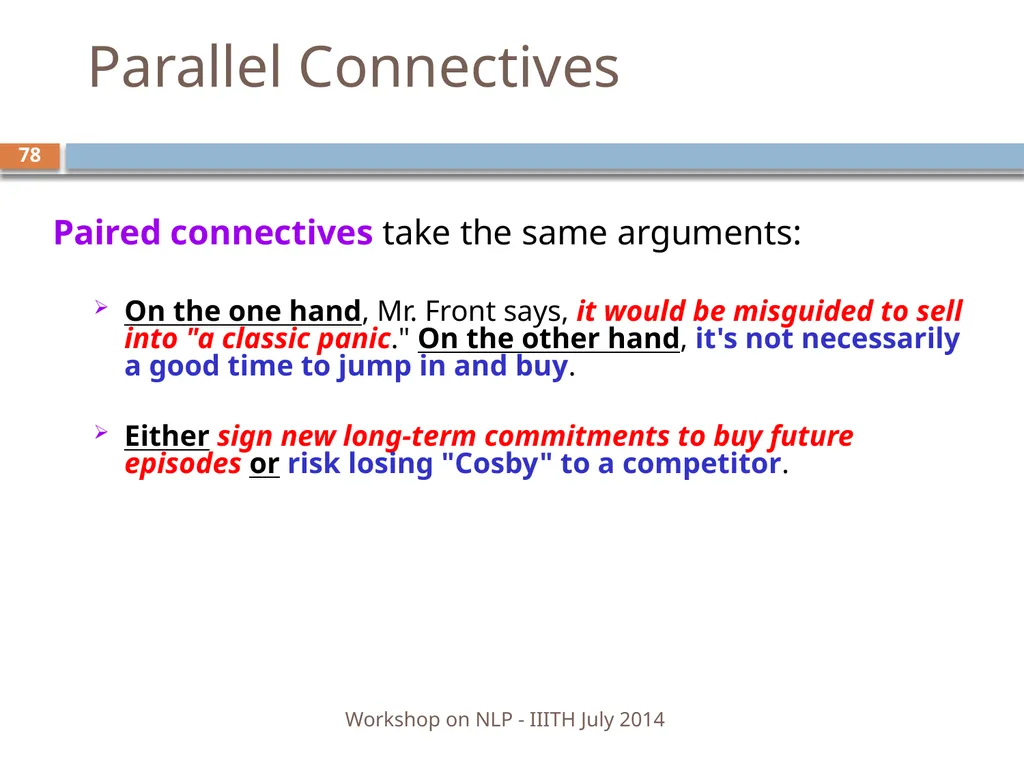
Parallel Connectives 78 Paired connectives take the same arguments:
On the one hand, Mr. Front says, it would be misguided to sell into "a classic panic." On the other hand, it's not necessarily a good time to jump in and buy.
Either sign new long-term commitments to buy future episodes or risk losing "Cosby" to a competitor. Workshop on NLP - IIITH July 2014<br>
On the one hand, Mr. Front says, it would be misguided to sell into "a classic panic." On the other hand, it's not necessarily a good time to jump in and buy.
Either sign new long-term commitments to buy future episodes or risk losing "Cosby" to a competitor. Workshop on NLP - IIITH July 2014<br>
79
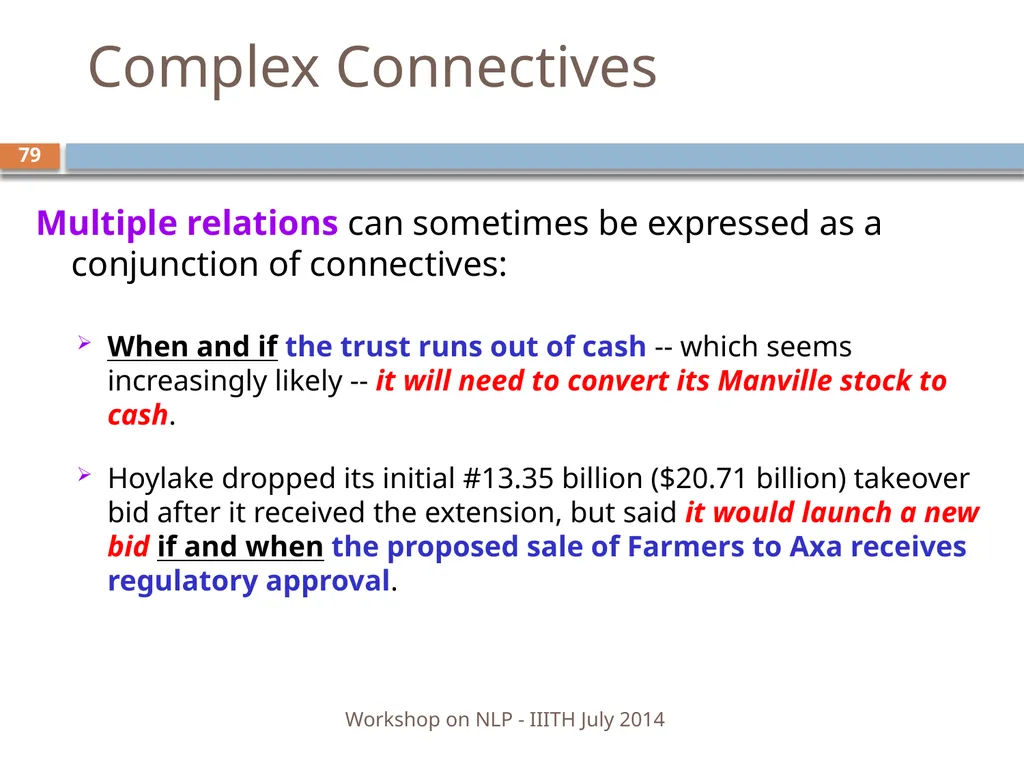
Complex Connectives 79 Multiple relations can sometimes be expressed as a conjunction of connectives:
When and if the trust runs out of cash -- which seems increasingly likely -- it will need to convert its Manville stock to cash.
Hoylake dropped its initial #13.35 billion ($20.71 billion) takeover bid after it received the extension, but said it would launch a new bid if and when the proposed sale of Farmers to Axa receives regulatory approval. Workshop on NLP - IIITH July 2014<br>
When and if the trust runs out of cash -- which seems increasingly likely -- it will need to convert its Manville stock to cash.
Hoylake dropped its initial #13.35 billion ($20.71 billion) takeover bid after it received the extension, but said it would launch a new bid if and when the proposed sale of Farmers to Axa receives regulatory approval. Workshop on NLP - IIITH July 2014<br>
80
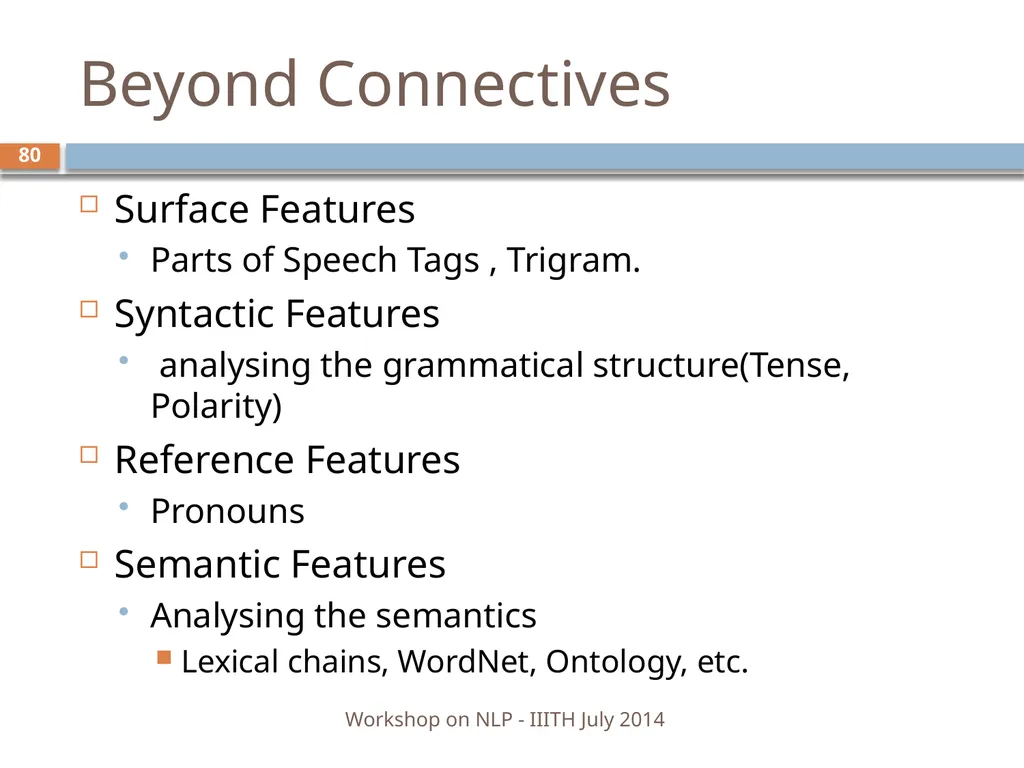
Beyond Connectives Surface Features
Parts of Speech Tags , Trigram.
Syntactic Features
analysing the grammatical structure(Tense, Polarity)
Reference Features
Pronouns
Semantic Features
Analysing the semantics
Lexical chains, WordNet, Ontology, etc. 80 Workshop on NLP - IIITH July 2014<br>
Parts of Speech Tags , Trigram.
Syntactic Features
analysing the grammatical structure(Tense, Polarity)
Reference Features
Pronouns
Semantic Features
Analysing the semantics
Lexical chains, WordNet, Ontology, etc. 80 Workshop on NLP - IIITH July 2014<br>
81
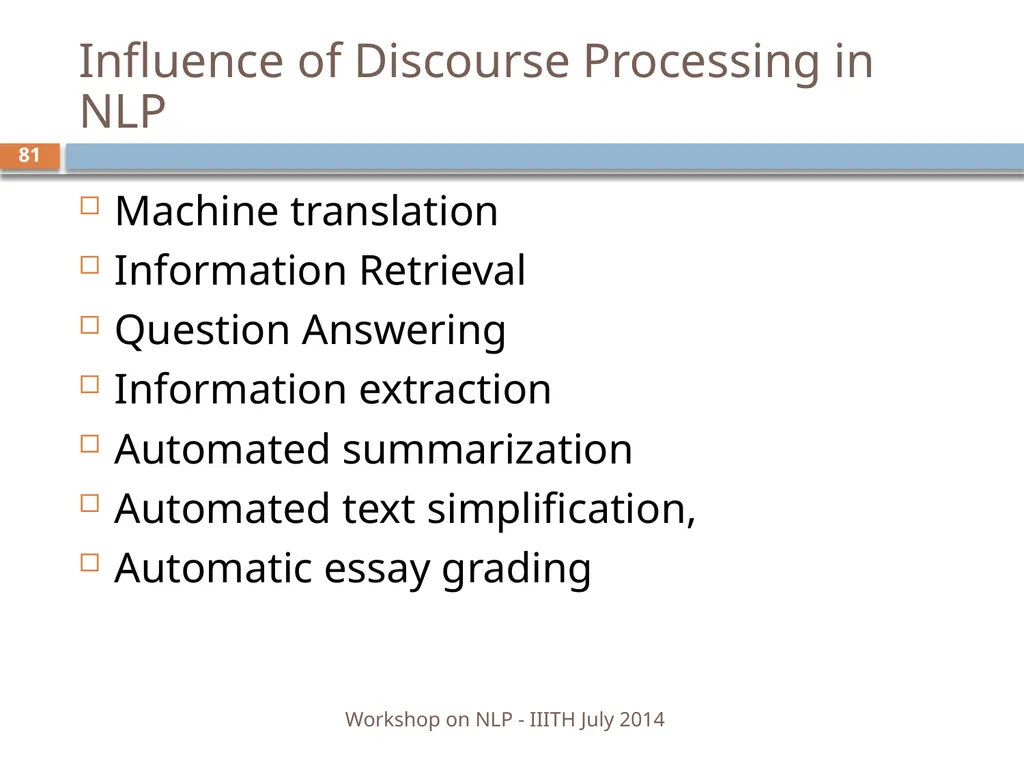
Influence of Discourse Processing in NLP Machine translation
Information Retrieval
Question Answering
Information extraction
Automated summarization
Automated text simplification,
Automatic essay grading 81 Workshop on NLP - IIITH July 2014<br>
Information Retrieval
Question Answering
Information extraction
Automated summarization
Automated text simplification,
Automatic essay grading 81 Workshop on NLP - IIITH July 2014<br>
82
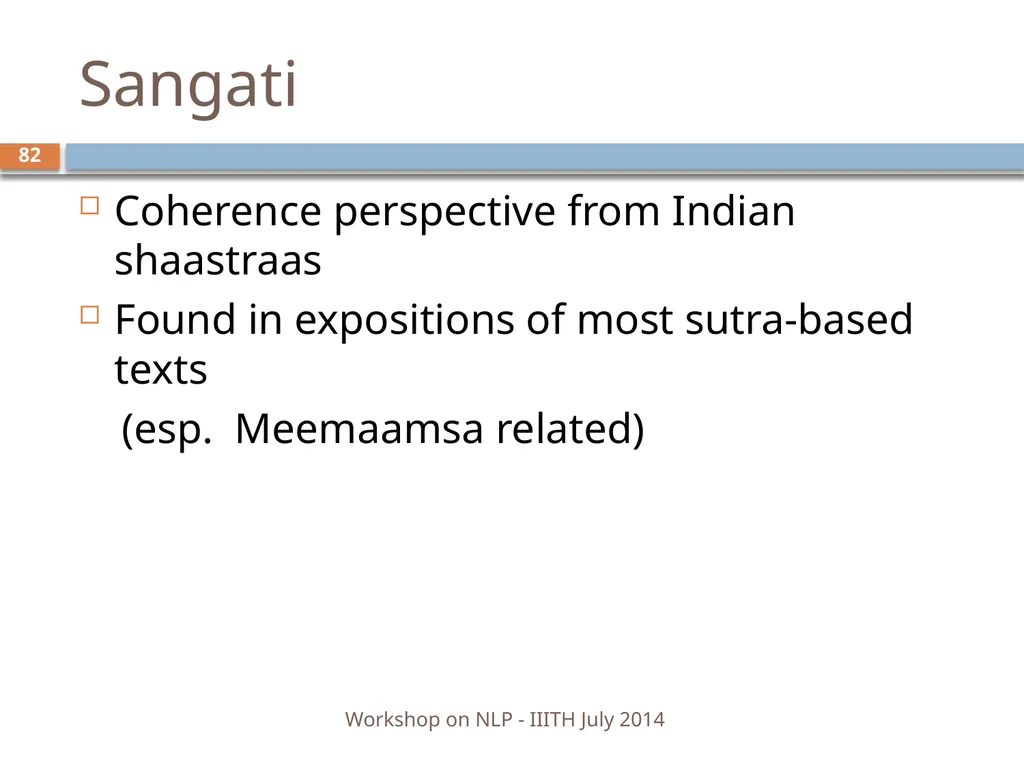
Sangati Coherence perspective from Indian shaastraas
Found in expositions of most sutra-based texts
(esp. Meemaamsa related) 82 Workshop on NLP - IIITH July 2014<br>
Found in expositions of most sutra-based texts
(esp. Meemaamsa related) 82 Workshop on NLP - IIITH July 2014<br>
83
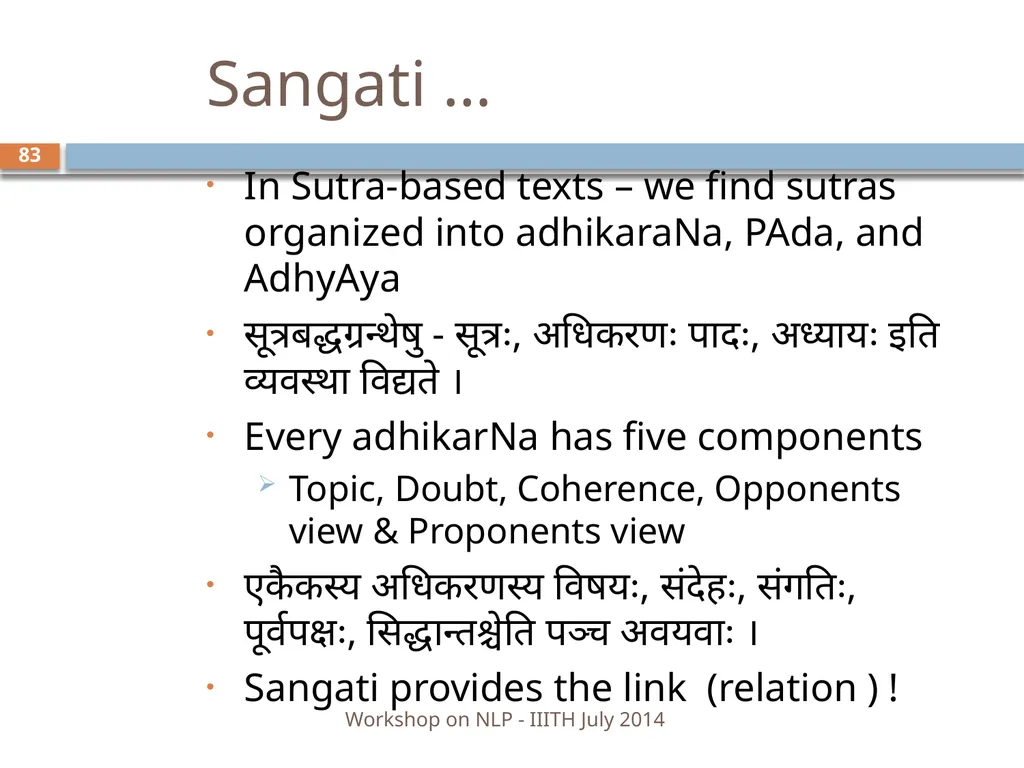
Sangati … In Sutra-based texts – we find sutras organized into adhikaraNa, PAda, and AdhyAya
सूत्रबद्धग्रन्थेषु - सूत्रः, अधिकरणः पादः, अध्यायः इति व्यवस्था विद्यते ।
Every adhikarNa has five components
Topic, Doubt, Coherence, Opponents view & Proponents view
एकैकस्य अधिकरणस्य विषयः, संदेहः, संगतिः, पूर्वपक्षः, सिद्धान्तश्चेति पञ्च अवयवाः ।
Sangati provides the link (relation ) ! 83 Workshop on NLP - IIITH July 2014<br>
सूत्रबद्धग्रन्थेषु - सूत्रः, अधिकरणः पादः, अध्यायः इति व्यवस्था विद्यते ।
Every adhikarNa has five components
Topic, Doubt, Coherence, Opponents view & Proponents view
एकैकस्य अधिकरणस्य विषयः, संदेहः, संगतिः, पूर्वपक्षः, सिद्धान्तश्चेति पञ्च अवयवाः ।
Sangati provides the link (relation ) ! 83 Workshop on NLP - IIITH July 2014<br>
84
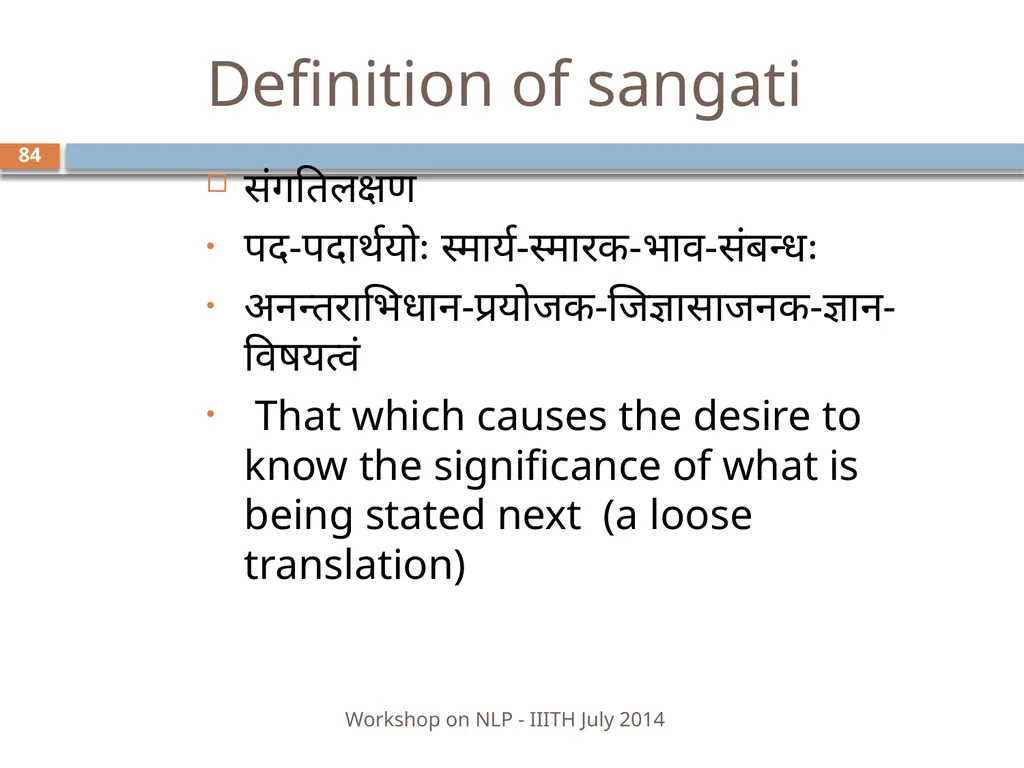
Definition of sangati संगतिलक्षण
पद-पदार्थयोः स्मार्य-स्मारक-भाव-संबन्धः
अनन्तराभिधान-प्रयोजक-जिज्ञासाजनक-ज्ञान-विषयत्वं
That which causes the desire to know the significance of what is being stated next (a loose translation) 84 Workshop on NLP - IIITH July 2014<br>
पद-पदार्थयोः स्मार्य-स्मारक-भाव-संबन्धः
अनन्तराभिधान-प्रयोजक-जिज्ञासाजनक-ज्ञान-विषयत्वं
That which causes the desire to know the significance of what is being stated next (a loose translation) 84 Workshop on NLP - IIITH July 2014<br>
85
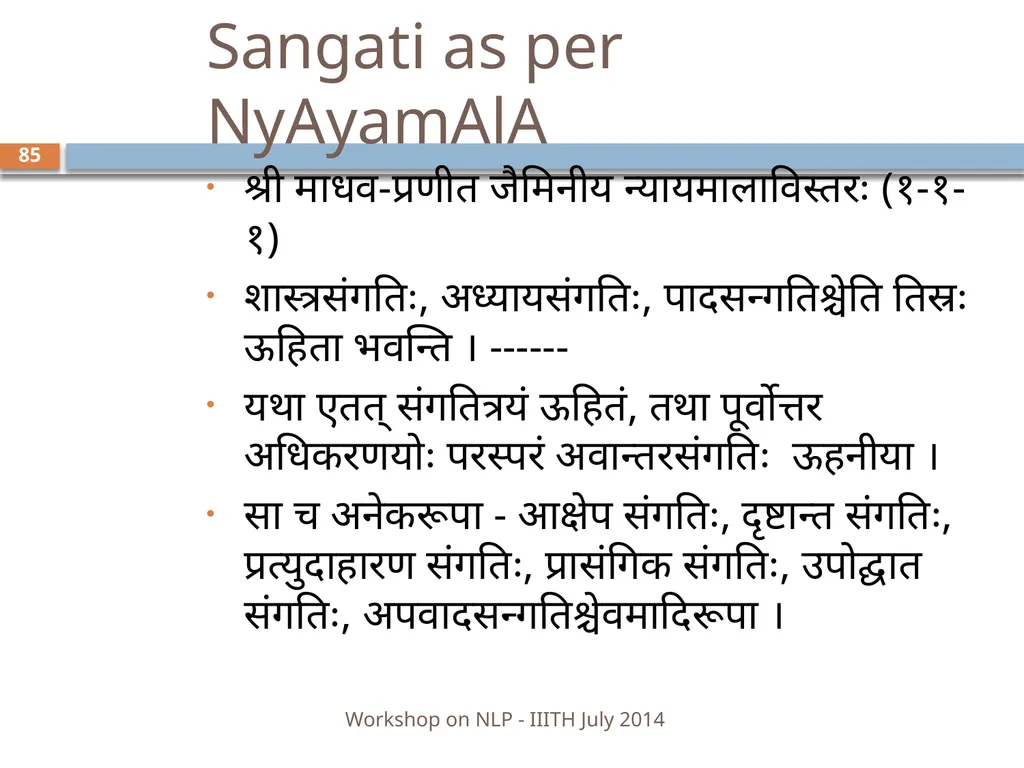
Sangati as per NyAyamAlA श्री माधव-प्रणीत जैमिनीय न्यायमालाविस्तरः (१-१-१)
शास्त्रसंगतिः, अध्यायसंगतिः, पादसन्गतिश्चेति तिस्रः ऊहिता भवन्ति । ------
यथा एतत् संगतित्रयं ऊहितं, तथा पूर्वोत्तर अधिकरणयोः परस्परं अवान्तरसंगतिः ऊहनीया ।
सा च अनेकरूपा - आक्षेप संगतिः, दृष्टान्त संगतिः, प्रत्युदाहारण संगतिः, प्रासंगिक संगतिः, उपोद्घात संगतिः, अपवादसन्गतिश्चेवमादिरूपा । 85 Workshop on NLP - IIITH July 2014<br>
शास्त्रसंगतिः, अध्यायसंगतिः, पादसन्गतिश्चेति तिस्रः ऊहिता भवन्ति । ------
यथा एतत् संगतित्रयं ऊहितं, तथा पूर्वोत्तर अधिकरणयोः परस्परं अवान्तरसंगतिः ऊहनीया ।
सा च अनेकरूपा - आक्षेप संगतिः, दृष्टान्त संगतिः, प्रत्युदाहारण संगतिः, प्रासंगिक संगतिः, उपोद्घात संगतिः, अपवादसन्गतिश्चेवमादिरूपा । 85 Workshop on NLP - IIITH July 2014<br>
86
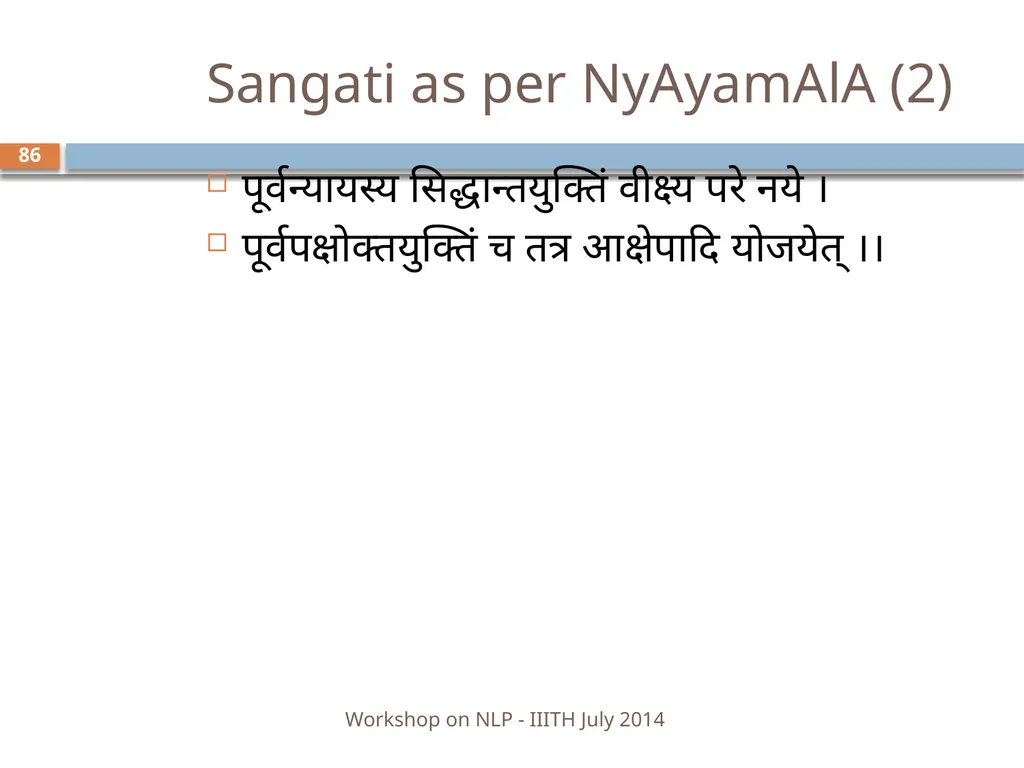
Workshop on NLP - IIITH July 2014 Sangati as per NyAyamAlA (2) पूर्वन्यायस्य सिद्धान्तयुक्तिं वीक्ष्य परे नये ।
पूर्वपक्षोक्तयुक्तिं च तत्र आक्षेपादि योजयेत् ।। 86<br>
पूर्वपक्षोक्तयुक्तिं च तत्र आक्षेपादि योजयेत् ।। 86<br>
87
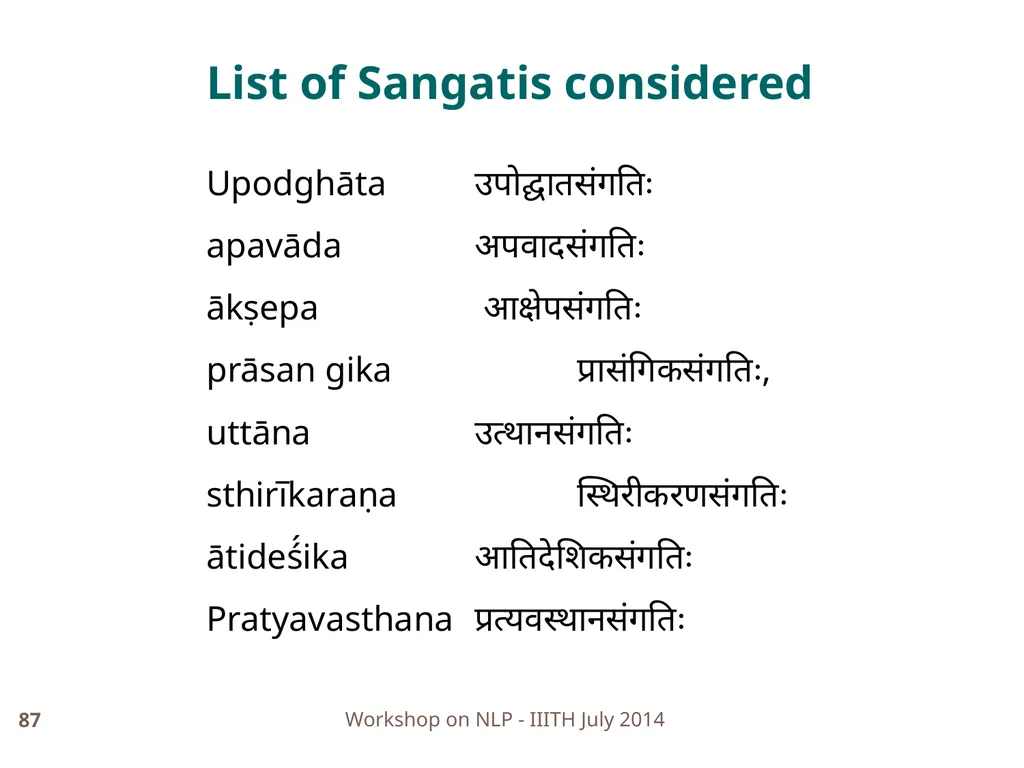
Workshop on NLP - IIITH July 2014 List of Sangatis considered Upodghāta उपोद्घातसंगतिः
apavāda अपवादसंगतिः
ākṣepa आक्षेपसंगतिः
prāsan gika प्रासंगिकसंगतिः,
uttāna उत्थानसंगतिः
sthiri̅karaṇa स्थिरीकरणसंगतिः
ātideś́ika आतिदेशिकसंगतिः
Pratyavasthana प्रत्यवस्थानसंगतिः 87<br>
apavāda अपवादसंगतिः
ākṣepa आक्षेपसंगतिः
prāsan gika प्रासंगिकसंगतिः,
uttāna उत्थानसंगतिः
sthiri̅karaṇa स्थिरीकरणसंगतिः
ātideś́ika आतिदेशिकसंगतिः
Pratyavasthana प्रत्यवस्थानसंगतिः 87<br>
88
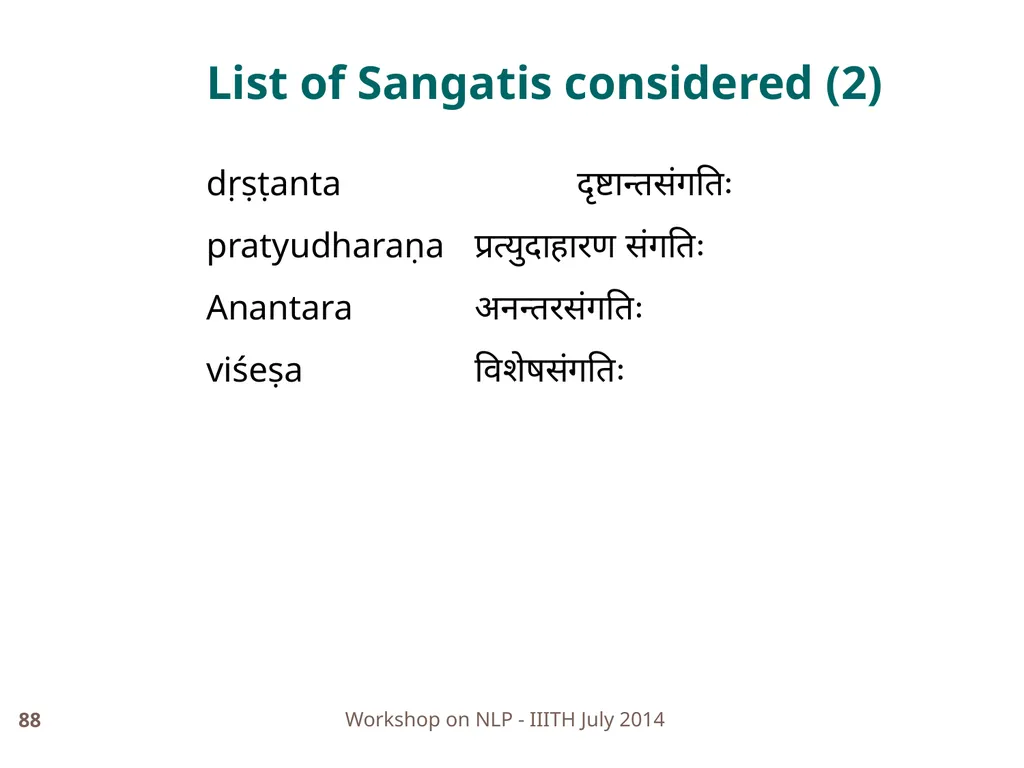
Workshop on NLP - IIITH July 2014 List of Sangatis considered (2) dṛṣṭanta दृष्टान्तसंगतिः
pratyudharaṇa प्रत्युदाहारण संगतिः
Anantara अनन्तरसंगतिः
viśeṣa विशेषसंगतिः 88<br>
pratyudharaṇa प्रत्युदाहारण संगतिः
Anantara अनन्तरसंगतिः
viśeṣa विशेषसंगतिः 88<br>
89
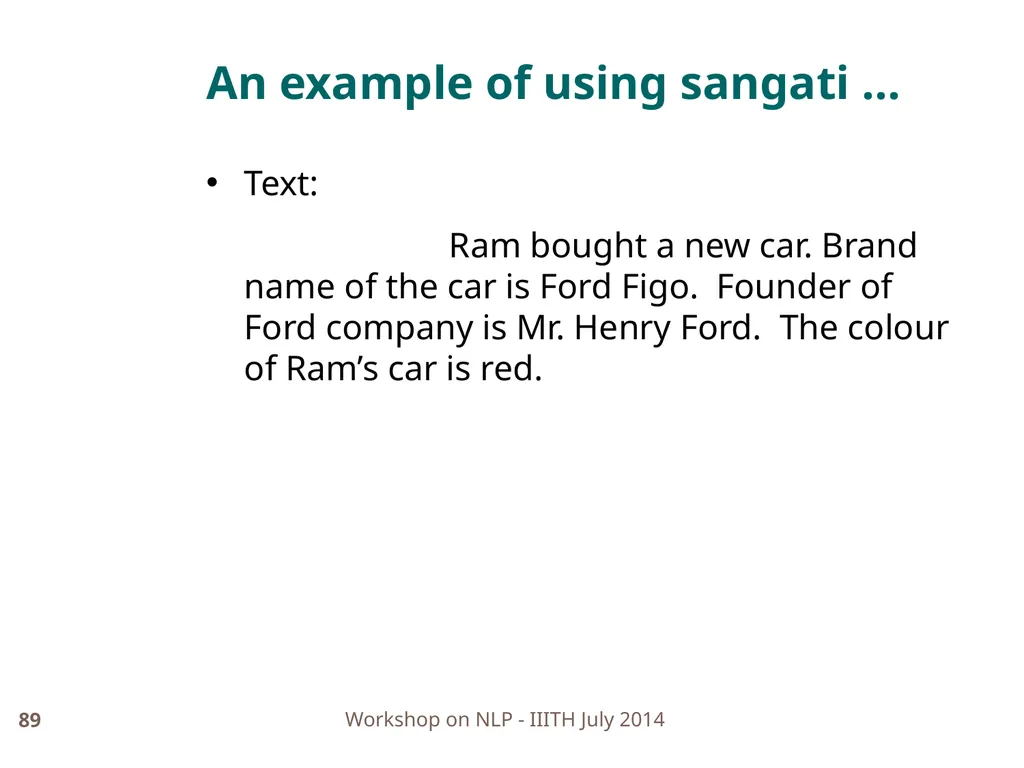
Workshop on NLP - IIITH July 2014 An example of using sangati … Text:
Ram bought a new car. Brand name of the car is Ford Figo. Founder of Ford company is Mr. Henry Ford. The colour of Ram’s car is red. 89<br>
Ram bought a new car. Brand name of the car is Ford Figo. Founder of Ford company is Mr. Henry Ford. The colour of Ram’s car is red. 89<br>
90
90 Workshop on NLP - IIITH July 2014<br>
91
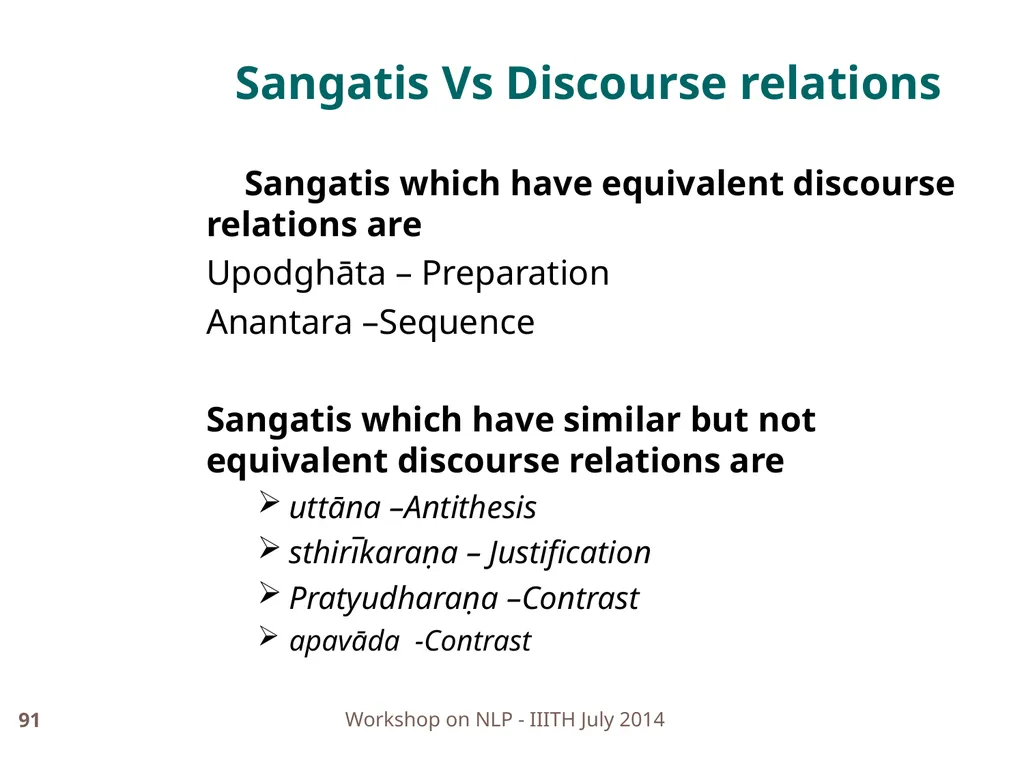
Workshop on NLP - IIITH July 2014 Sangatis Vs Discourse relations Sangatis which have equivalent discourse relations are
Upodghāta – Preparation
Anantara –Sequence
Sangatis which have similar but not equivalent discourse relations are
uttāna –Antithesis
sthiri̅karaṇa – Justification
Pratyudharaṇa –Contrast
apavāda -Contrast 91<br>
Upodghāta – Preparation
Anantara –Sequence
Sangatis which have similar but not equivalent discourse relations are
uttāna –Antithesis
sthiri̅karaṇa – Justification
Pratyudharaṇa –Contrast
apavāda -Contrast 91<br>
92
Sangatis & Discourse relations A discourse parser combining Sangatis and RST could lead to a richer representation 92 Workshop on NLP - IIITH July 2014<br>
93
Summary Discourse Processing – overview
RST – in some detail
PDTB – a peep into it
Sangatis – an insight 93 Workshop on NLP - IIITH July 2014<br>
RST – in some detail
PDTB – a peep into it
Sangatis – an insight 93 Workshop on NLP - IIITH July 2014<br>
94
rp@annauniv.edu Thank you 94 Workshop on NLP - IIITH July 2014<br>
95
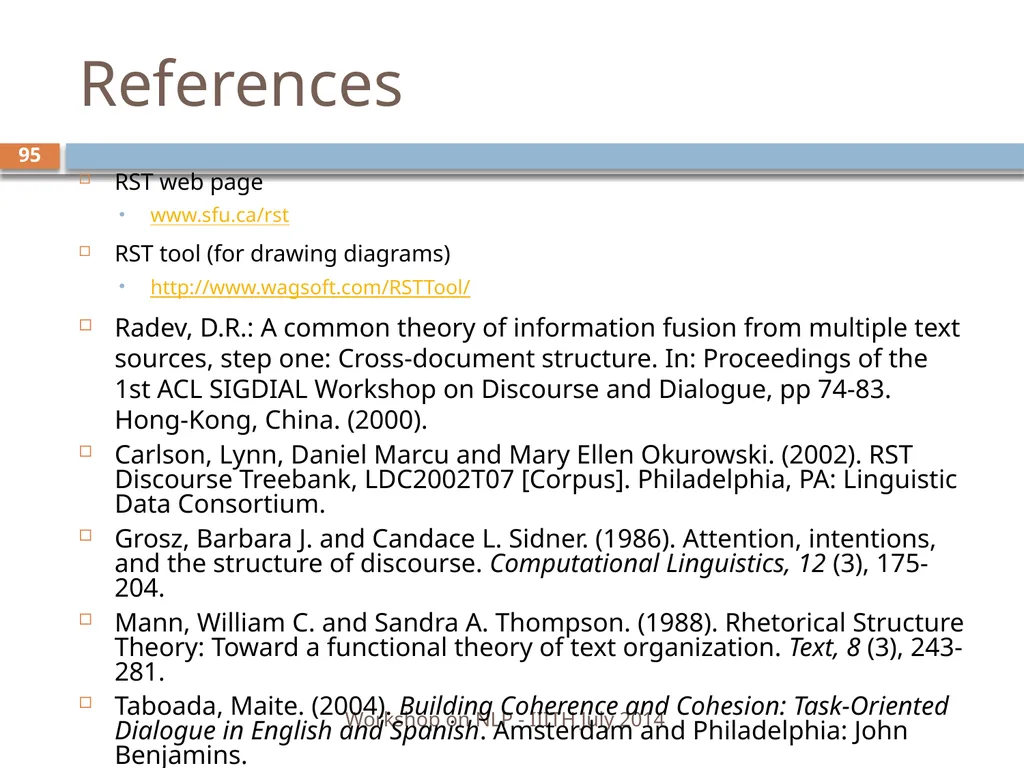
References RST web page
www.sfu.ca/rst
RST tool (for drawing diagrams)
http://www.wagsoft.com/RSTTool/
Radev, D.R.: A common theory of information fusion from multiple text sources, step one: Cross-document structure. In: Proceedings of the 1st ACL SIGDIAL Workshop on Discourse and Dialogue, pp 74-83. Hong-Kong, China. (2000).
Carlson, Lynn, Daniel Marcu and Mary Ellen Okurowski. (2002). RST Discourse Treebank, LDC2002T07 [Corpus]. Philadelphia, PA: Linguistic Data Consortium.
Grosz, Barbara J. and Candace L. Sidner. (1986). Attention, intentions, and the structure of discourse. Computational Linguistics, 12 (3), 175-204.
Mann, William C. and Sandra A. Thompson. (1988). Rhetorical Structure Theory: Toward a functional theory of text organization. Text, 8 (3), 243-281.
Taboada, Maite. (2004). Building Coherence and Cohesion: Task-Oriented Dialogue in English and Spanish. Amsterdam and Philadelphia: John Benjamins.
Taboada, Maite and William C. Mann. (2006a). Applications of Rhetorical Structure Theory. Discourse Studies, 8 (4), 567-588.
Taboada, Maite and William C. Mann. (2006b). Rhetorical Structure Theory: Looking back and moving ahead. Discourse Studies, 8 (3), 423-459. 95 Workshop on NLP - IIITH July 2014<br>
www.sfu.ca/rst
RST tool (for drawing diagrams)
http://www.wagsoft.com/RSTTool/
Radev, D.R.: A common theory of information fusion from multiple text sources, step one: Cross-document structure. In: Proceedings of the 1st ACL SIGDIAL Workshop on Discourse and Dialogue, pp 74-83. Hong-Kong, China. (2000).
Carlson, Lynn, Daniel Marcu and Mary Ellen Okurowski. (2002). RST Discourse Treebank, LDC2002T07 [Corpus]. Philadelphia, PA: Linguistic Data Consortium.
Grosz, Barbara J. and Candace L. Sidner. (1986). Attention, intentions, and the structure of discourse. Computational Linguistics, 12 (3), 175-204.
Mann, William C. and Sandra A. Thompson. (1988). Rhetorical Structure Theory: Toward a functional theory of text organization. Text, 8 (3), 243-281.
Taboada, Maite. (2004). Building Coherence and Cohesion: Task-Oriented Dialogue in English and Spanish. Amsterdam and Philadelphia: John Benjamins.
Taboada, Maite and William C. Mann. (2006a). Applications of Rhetorical Structure Theory. Discourse Studies, 8 (4), 567-588.
Taboada, Maite and William C. Mann. (2006b). Rhetorical Structure Theory: Looking back and moving ahead. Discourse Studies, 8 (3), 423-459. 95 Workshop on NLP - IIITH July 2014<br>
96
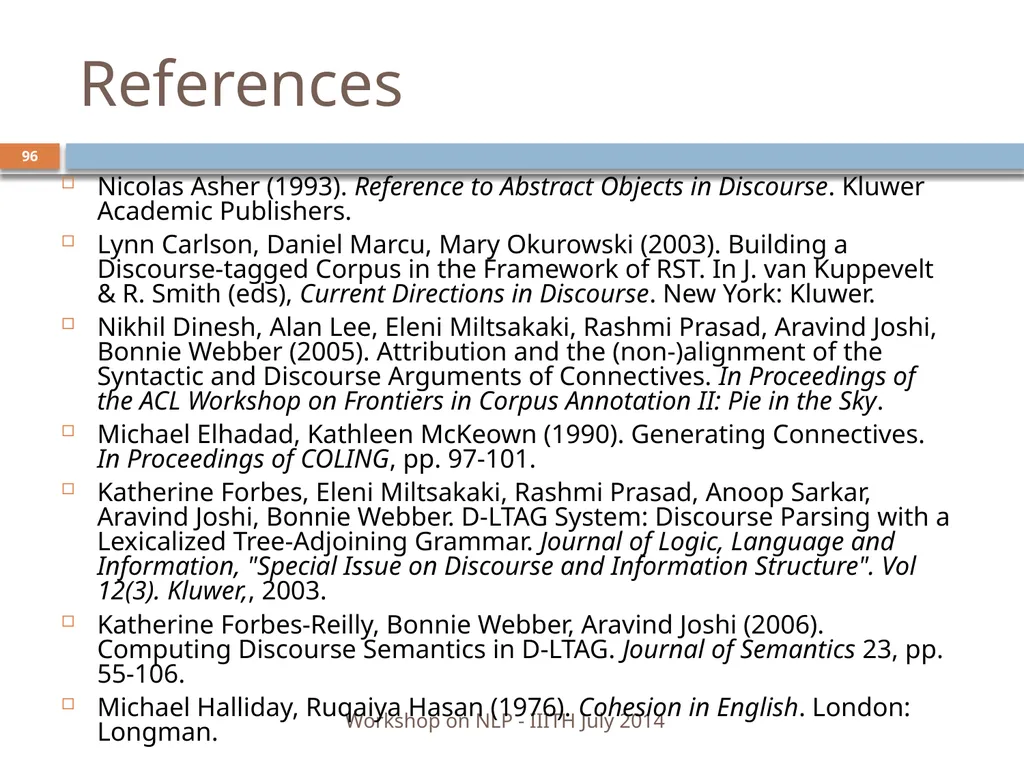
Workshop on NLP - IIITH July 2014 96 Nicolas Asher (1993). Reference to Abstract Objects in Discourse. Kluwer Academic Publishers.
Lynn Carlson, Daniel Marcu, Mary Okurowski (2003). Building a Discourse-tagged Corpus in the Framework of RST. In J. van Kuppevelt & R. Smith (eds), Current Directions in Discourse. New York: Kluwer.
Nikhil Dinesh, Alan Lee, Eleni Miltsakaki, Rashmi Prasad, Aravind Joshi, Bonnie Webber (2005). Attribution and the (non-)alignment of the Syntactic and Discourse Arguments of Connectives. In Proceedings of the ACL Workshop on Frontiers in Corpus Annotation II: Pie in the Sky.
Michael Elhadad, Kathleen McKeown (1990). Generating Connectives. In Proceedings of COLING, pp. 97-101.
Katherine Forbes, Eleni Miltsakaki, Rashmi Prasad, Anoop Sarkar, Aravind Joshi, Bonnie Webber. D-LTAG System: Discourse Parsing with a Lexicalized Tree-Adjoining Grammar. Journal of Logic, Language and Information, "Special Issue on Discourse and Information Structure". Vol 12(3). Kluwer,, 2003.
Katherine Forbes-Reilly, Bonnie Webber, Aravind Joshi (2006). Computing Discourse Semantics in D-LTAG. Journal of Semantics 23, pp. 55-106.
Michael Halliday, Ruqaiya Hasan (1976). Cohesion in English. London: Longman. References<br>
Lynn Carlson, Daniel Marcu, Mary Okurowski (2003). Building a Discourse-tagged Corpus in the Framework of RST. In J. van Kuppevelt & R. Smith (eds), Current Directions in Discourse. New York: Kluwer.
Nikhil Dinesh, Alan Lee, Eleni Miltsakaki, Rashmi Prasad, Aravind Joshi, Bonnie Webber (2005). Attribution and the (non-)alignment of the Syntactic and Discourse Arguments of Connectives. In Proceedings of the ACL Workshop on Frontiers in Corpus Annotation II: Pie in the Sky.
Michael Elhadad, Kathleen McKeown (1990). Generating Connectives. In Proceedings of COLING, pp. 97-101.
Katherine Forbes, Eleni Miltsakaki, Rashmi Prasad, Anoop Sarkar, Aravind Joshi, Bonnie Webber. D-LTAG System: Discourse Parsing with a Lexicalized Tree-Adjoining Grammar. Journal of Logic, Language and Information, "Special Issue on Discourse and Information Structure". Vol 12(3). Kluwer,, 2003.
Katherine Forbes-Reilly, Bonnie Webber, Aravind Joshi (2006). Computing Discourse Semantics in D-LTAG. Journal of Semantics 23, pp. 55-106.
Michael Halliday, Ruqaiya Hasan (1976). Cohesion in English. London: Longman. References<br>
97
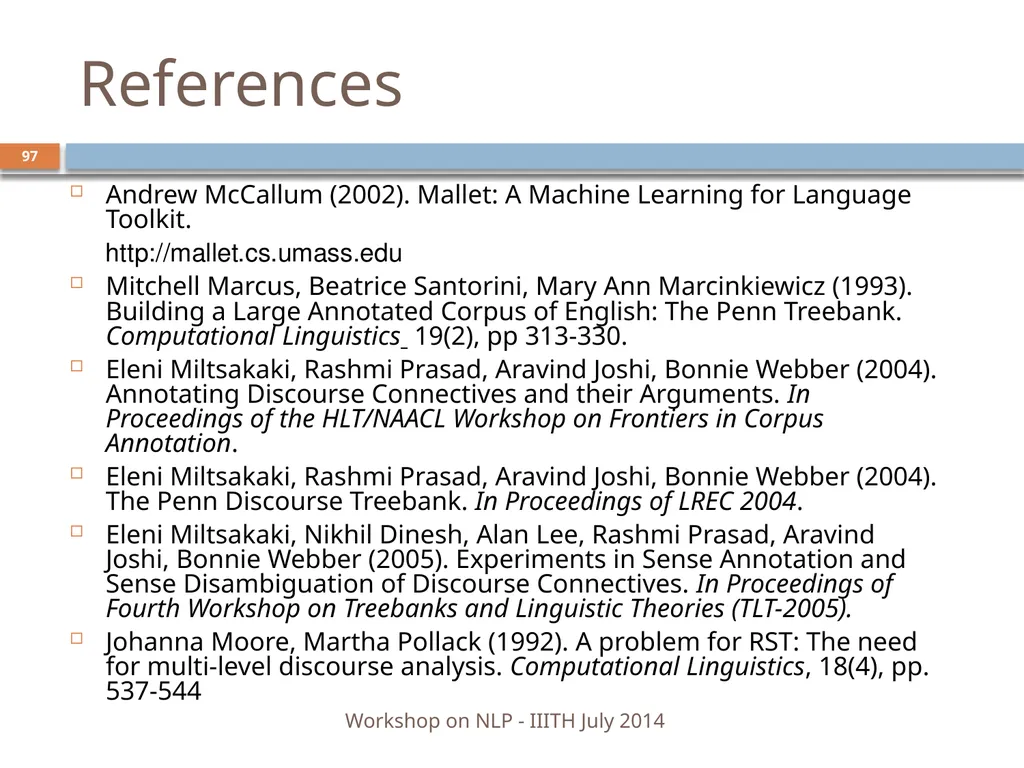
Workshop on NLP - IIITH July 2014 97 Andrew McCallum (2002). Mallet: A Machine Learning for Language Toolkit.
http://mallet.cs.umass.edu
Mitchell Marcus, Beatrice Santorini, Mary Ann Marcinkiewicz (1993). Building a Large Annotated Corpus of English: The Penn Treebank. Computational Linguistics 19(2), pp 313-330.
Eleni Miltsakaki, Rashmi Prasad, Aravind Joshi, Bonnie Webber (2004). Annotating Discourse Connectives and their Arguments. In Proceedings of the HLT/NAACL Workshop on Frontiers in Corpus Annotation.
Eleni Miltsakaki, Rashmi Prasad, Aravind Joshi, Bonnie Webber (2004). The Penn Discourse Treebank. In Proceedings of LREC 2004.
Eleni Miltsakaki, Nikhil Dinesh, Alan Lee, Rashmi Prasad, Aravind Joshi, Bonnie Webber (2005). Experiments in Sense Annotation and Sense Disambiguation of Discourse Connectives. In Proceedings of Fourth Workshop on Treebanks and Linguistic Theories (TLT-2005).
Johanna Moore, Martha Pollack (1992). A problem for RST: The need for multi-level discourse analysis. Computational Linguistics, 18(4), pp. 537-544 References<br>
http://mallet.cs.umass.edu
Mitchell Marcus, Beatrice Santorini, Mary Ann Marcinkiewicz (1993). Building a Large Annotated Corpus of English: The Penn Treebank. Computational Linguistics 19(2), pp 313-330.
Eleni Miltsakaki, Rashmi Prasad, Aravind Joshi, Bonnie Webber (2004). Annotating Discourse Connectives and their Arguments. In Proceedings of the HLT/NAACL Workshop on Frontiers in Corpus Annotation.
Eleni Miltsakaki, Rashmi Prasad, Aravind Joshi, Bonnie Webber (2004). The Penn Discourse Treebank. In Proceedings of LREC 2004.
Eleni Miltsakaki, Nikhil Dinesh, Alan Lee, Rashmi Prasad, Aravind Joshi, Bonnie Webber (2005). Experiments in Sense Annotation and Sense Disambiguation of Discourse Connectives. In Proceedings of Fourth Workshop on Treebanks and Linguistic Theories (TLT-2005).
Johanna Moore, Martha Pollack (1992). A problem for RST: The need for multi-level discourse analysis. Computational Linguistics, 18(4), pp. 537-544 References<br>
98
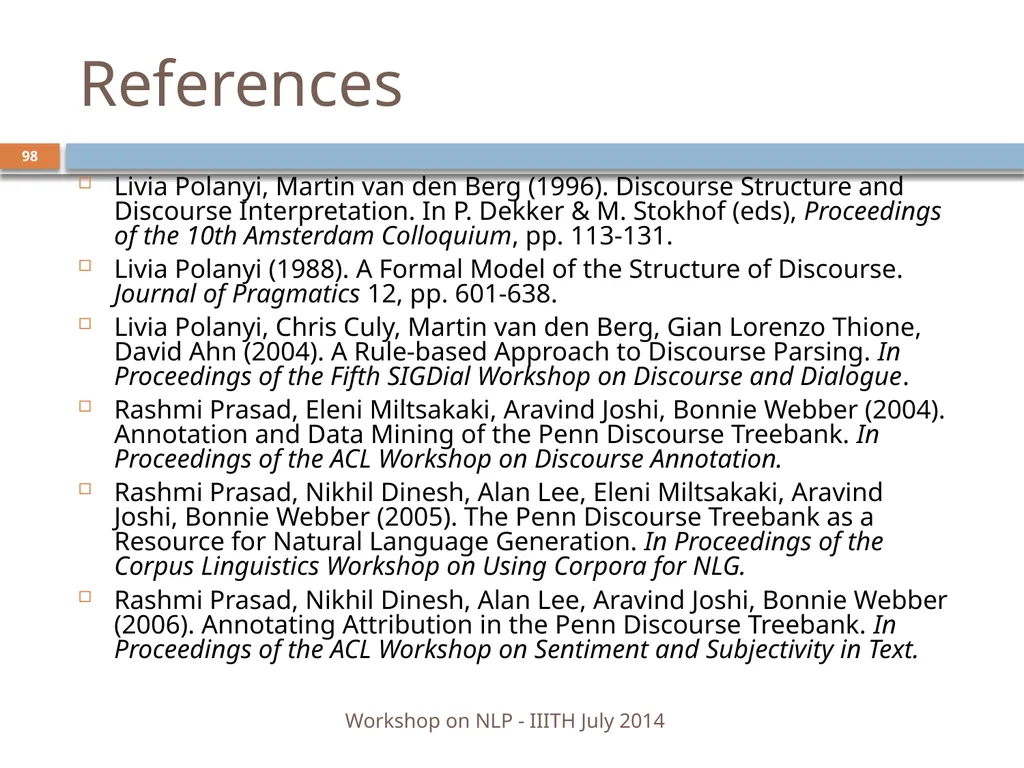
Workshop on NLP - IIITH July 2014 98 Livia Polanyi, Martin van den Berg (1996). Discourse Structure and Discourse Interpretation. In P. Dekker & M. Stokhof (eds), Proceedings of the 10th Amsterdam Colloquium, pp. 113-131.
Livia Polanyi (1988). A Formal Model of the Structure of Discourse. Journal of Pragmatics 12, pp. 601-638.
Livia Polanyi, Chris Culy, Martin van den Berg, Gian Lorenzo Thione, David Ahn (2004). A Rule-based Approach to Discourse Parsing. In Proceedings of the Fifth SIGDial Workshop on Discourse and Dialogue.
Rashmi Prasad, Eleni Miltsakaki, Aravind Joshi, Bonnie Webber (2004). Annotation and Data Mining of the Penn Discourse Treebank. In Proceedings of the ACL Workshop on Discourse Annotation.
Rashmi Prasad, Nikhil Dinesh, Alan Lee, Eleni Miltsakaki, Aravind Joshi, Bonnie Webber (2005). The Penn Discourse Treebank as a Resource for Natural Language Generation. In Proceedings of the Corpus Linguistics Workshop on Using Corpora for NLG.
Rashmi Prasad, Nikhil Dinesh, Alan Lee, Aravind Joshi, Bonnie Webber (2006). Annotating Attribution in the Penn Discourse Treebank. In Proceedings of the ACL Workshop on Sentiment and Subjectivity in Text. References<br>
Livia Polanyi (1988). A Formal Model of the Structure of Discourse. Journal of Pragmatics 12, pp. 601-638.
Livia Polanyi, Chris Culy, Martin van den Berg, Gian Lorenzo Thione, David Ahn (2004). A Rule-based Approach to Discourse Parsing. In Proceedings of the Fifth SIGDial Workshop on Discourse and Dialogue.
Rashmi Prasad, Eleni Miltsakaki, Aravind Joshi, Bonnie Webber (2004). Annotation and Data Mining of the Penn Discourse Treebank. In Proceedings of the ACL Workshop on Discourse Annotation.
Rashmi Prasad, Nikhil Dinesh, Alan Lee, Eleni Miltsakaki, Aravind Joshi, Bonnie Webber (2005). The Penn Discourse Treebank as a Resource for Natural Language Generation. In Proceedings of the Corpus Linguistics Workshop on Using Corpora for NLG.
Rashmi Prasad, Nikhil Dinesh, Alan Lee, Aravind Joshi, Bonnie Webber (2006). Annotating Attribution in the Penn Discourse Treebank. In Proceedings of the ACL Workshop on Sentiment and Subjectivity in Text. References<br>
99
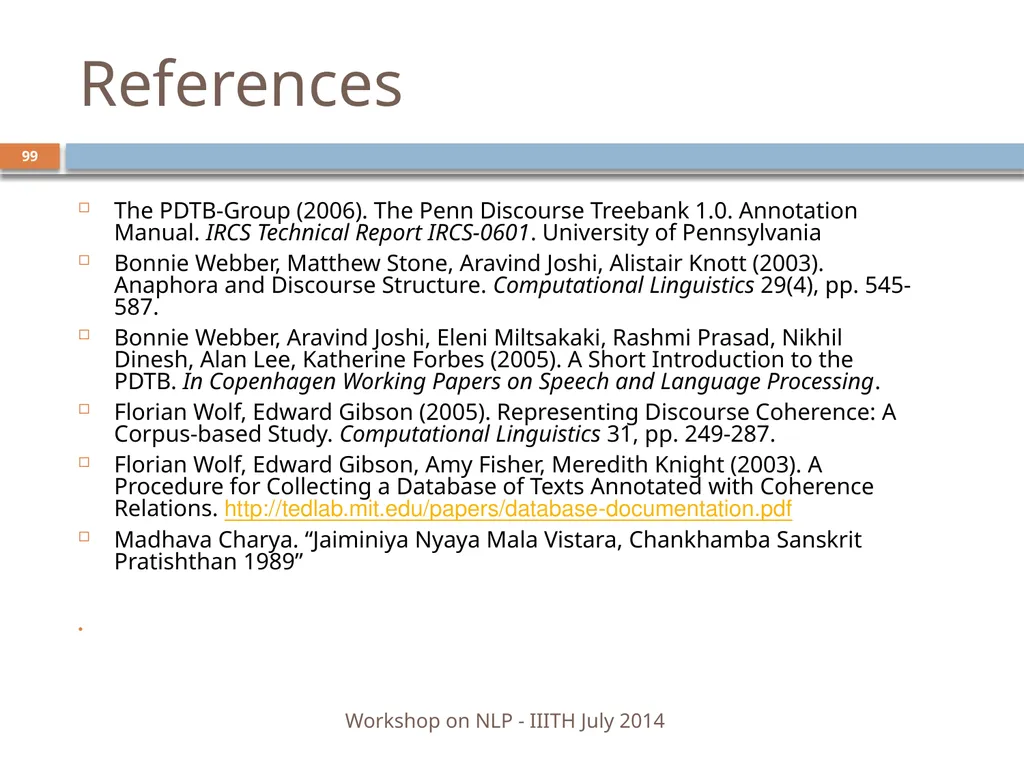
Workshop on NLP - IIITH July 2014 99 The PDTB-Group (2006). The Penn Discourse Treebank 1.0. Annotation Manual. IRCS Technical Report IRCS-0601. University of Pennsylvania
Bonnie Webber, Matthew Stone, Aravind Joshi, Alistair Knott (2003). Anaphora and Discourse Structure. Computational Linguistics 29(4), pp. 545-587.
Bonnie Webber, Aravind Joshi, Eleni Miltsakaki, Rashmi Prasad, Nikhil Dinesh, Alan Lee, Katherine Forbes (2005). A Short Introduction to the PDTB. In Copenhagen Working Papers on Speech and Language Processing.
Florian Wolf, Edward Gibson (2005). Representing Discourse Coherence: A Corpus-based Study. Computational Linguistics 31, pp. 249-287.
Florian Wolf, Edward Gibson, Amy Fisher, Meredith Knight (2003). A Procedure for Collecting a Database of Texts Annotated with Coherence Relations. http://tedlab.mit.edu/papers/database-documentation.pdf
Madhava Charya. “Jaiminiya Nyaya Mala Vistara, Chankhamba Sanskrit Pratishthan 1989” References<br>
Bonnie Webber, Matthew Stone, Aravind Joshi, Alistair Knott (2003). Anaphora and Discourse Structure. Computational Linguistics 29(4), pp. 545-587.
Bonnie Webber, Aravind Joshi, Eleni Miltsakaki, Rashmi Prasad, Nikhil Dinesh, Alan Lee, Katherine Forbes (2005). A Short Introduction to the PDTB. In Copenhagen Working Papers on Speech and Language Processing.
Florian Wolf, Edward Gibson (2005). Representing Discourse Coherence: A Corpus-based Study. Computational Linguistics 31, pp. 249-287.
Florian Wolf, Edward Gibson, Amy Fisher, Meredith Knight (2003). A Procedure for Collecting a Database of Texts Annotated with Coherence Relations. http://tedlab.mit.edu/papers/database-documentation.pdf
Madhava Charya. “Jaiminiya Nyaya Mala Vistara, Chankhamba Sanskrit Pratishthan 1989” References<br>